

Introduction
Brazilian ecosystems are crucial for maintaining global climate stability and ecological balance. They account for 10% of the biodiversity in the world, including numerous endemic species (Steffen et al., Reference Steffen, Rockström, Richardson, Lenton, Folke, Liverman, Summerhayes, Barnosky, Cornell, Crucifix, Donges, Fetzer, Lade, Scheffer, Winkelmann and Schellnhuber2018). To protect these ecosystems, the Brazilian Forest Code, as modified by Law 12651/2012, holds a central position in safeguarding the environment while allowing for the sustainable exploitation of natural resources. This regulation is regarded as one of the most comprehensive environmental regulations, as it defines several conservation areas on private rural properties, including Permanent Preservation Areas (those along riverbanks and around springs, dunes, and coastal vegetation areas – “restingas”), Legal Reserve Areas (areas within a rural property designated for the preservation of native vegetation), and Restricted Use Areas (Wetlands and Pantanal plains, and areas with slopes between 25° and 45° which require the adoption of special agricultural and forestry practices) – which can neither be deforested nor used for any productive or extraction purposes, or that require special care. Furthermore, the 2012 Forest Code establishes restoration requirements and introduces mechanisms that enable landowners to rectify prior environmental liabilities and fulfil conservation requirements through the use of tradable legal titles.
Nonetheless, over ten years have already passed since its creation and Brazil still faces challenges to implement it, leading to very heterogeneous implementation and compliance across different states in the country (Soares-Filho et al., Reference Soares-Filho, Rajão, Macedo, Carneiro, Costa, Coe, Rodrigues and Alencar2014; Lopes et al., Reference Lopes, Machado and Chiavari2023). To illustrate, only half of the Brazilian States have managed to fully implement it as of 2024, with the vast majority of them completing this process only in the past two years (Lopes et al., Reference Lopes, Didonet, Corleto and Chiavari2024). These differences raise the question: why has the Forest Code been implemented in some locations in Brazil, but not in others?
The purpose of this article is to investigate the institutional conditions that can explain why the implementation of the Brazilian Forest Code is heterogeneous. Relying on the recent literature on meso-institutions (Ménard, Reference Ménard2014, Reference Ménard2017 and Ménard et al., Reference Ménard, Jimenez and Tropp2018; Künneke et al., Reference Künneke, Ménard and Groenewegen2021; Ménard et al., Reference Ménard, Martino, Oliveira, Royer, Saes and Schnaider2022, Reference Ménard, Martino, Oliveira, Royer, Schnaider and Saes2024), we provide insights about the role of these institutions that bridge the gap between the macro-institutional level (where constitutive rules and norms are established through rule-makers) and the micro-institutional level (where operational rule-takers organise transactions); and how they can help explaining the heterogeneous implementation of the Brazilian Forest Code across the country. We define meso-institutions as the set of mechanisms and devices that implement the general rules of the game, delineating the domain of permissible transactions and the modalities of their translation, monitoring, and enforcement (Ménard et al., Reference Ménard, Martino, Oliveira, Royer, Saes and Schnaider2022, Reference Ménard, Martino, Oliveira, Royer, Schnaider and Saes2024). Building on Ménard et al. (Reference Ménard, Martino, Oliveira, Royer, Saes and Schnaider2022), the analysis herein proposed delineates the tasks involved in each of these functions – how they are conducted, what gaps can be found and how they influence the implementation of the Forest Code.
Our analysis shows that the implementation of the Forest Code involves several meso-institutions fulfilling the roles of translation, monitoring, and enforcement. We observe relevant implementation shortcomings in two key state-level regulatory components, the rural environmental registry (CAR) and the Environmental Regularisation Program (PRA). Our findings suggest that the main challenges lie in fully verifying the self-declared information provided through CAR and in clarifying the rules for managing environmental liabilities under the PRA (e.g., how, when, what should be compensated).
The article is structured as follows. Section 2 presents the theoretical framework regarding meso-institutions and their functions. Section 3 introduces the methodology. Section 4 delineates the Forest Code and summarises the tasks of the main meso-institutions supporting its implementation. Section 5 discusses insights that can be gleaned from the diverse modalities of meso-institutional functions, elucidating the consequences for policy-making due to function gaps.
Analytical framework
In line with Ménard and Martino (Reference Ménard and Martino2025), this article advocates that in order to better understand the implementation of the Brazilian Forest Code, it is needed to go beyond a unidimensional view and assess three nested institutional layers – macro, meso, and micro. Two of these layers are already widely acknowledged in the literature: the macro- and the micro-layers (Williamson, Reference Williamson2000). However, recent contributions have highlighted the limitations of this dualistic view, calling attention to the need for a meso-level perspective (Künneke et al., Reference Künneke, Ménard and Groenewegen2021; Ménard et al., Reference Ménard, Martino, Oliveira, Royer, Saes and Schnaider2022; Ménard et al., Reference Ménard, Martino, Oliveira, Royer, Schnaider and Saes2024).
Meso-institutions are “the set of devices (entities) and mechanisms (procedures) through which the general rules [of the game, in the macro-layer] are translated, adapted and made operational, providing guidelines to operators and users [in the micro-layer] and feedbacks to decision-makers [in the macro-layer].” (Ménard et al., Reference Ménard, Jimenez and Tropp2018, p. 3). Specifically, this intermediate institutional layer provides the “[…] devices and mechanisms through which public policies and the strategies of actors interact” (Ménard, Reference Ménard2018, p. 2). Examples of meso-institutions are regulatory agencies, public bureaus, and local administrators (Ménard, Reference Ménard2017).
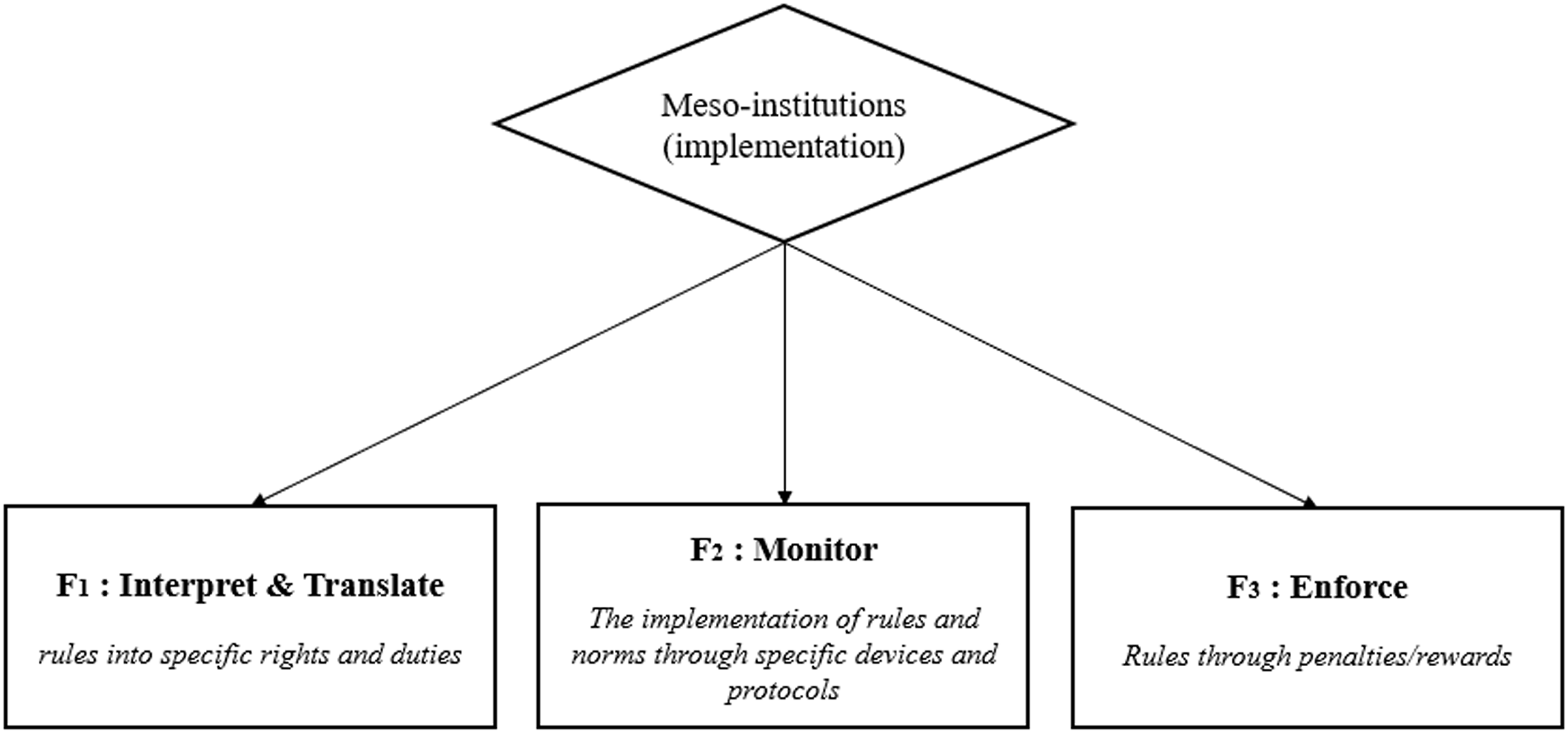
To play their role in implementing the general rules of the game, meso-institutions must fulfil three important functions. First, they must translate the general rules of the game into more specific rights or directives that can be more easily understood and complied with by economic agents (Ménard et al., Reference Ménard, Jimenez and Tropp2018). One way of doing so is by providing information to economic actors about the ongoing regulations, their (often technical) requirements, rewards, or penalties (Ménard et al., Reference Ménard, Martino, Oliveira, Royer, Saes and Schnaider2022; Oliveira et al., Reference Oliveira, Miranda, Saes and Martino2023a, Reference Oliveira, Schnaider, Saes and Martino2023b). Second, meso-institutions must also monitor rules implementation. This typically involves the collection of information, the building of databases, and/or the delivery of specialised reports on operations carried out by those subject to the rules. Of course, monitoring procedures, including the necessary technology, may vary depending on the specific rules in place and the stakeholders involved. Finally, meso-institutions help enforcing the general rules of the game. This not only involves establishing penalties but also reward systems and bonuses (Ménard et al., Reference Ménard, Martino, Oliveira, Royer, Saes and Schnaider2022). Figure 1 summarises these functions of meso-institutions.
Functions of meso-institutions.
Source: Ménard & Martino (Reference Ménard and Martino2025).
It is important to note that it is the functions meso-institutions fulfil and the types of rules they help implementing that set them apart from the other institutional layers. Meso-institutions do not participate in the value creation process (like the micro-institutions do – see Ménard et al., Reference Ménard, Martino, Oliveira, Royer, Saes and Schnaider2022 for a discussion on this); but rather, they translate, monitor and enforce the general rules defined at the macro-layer. While meso-institutions do not create these rules at a regional or locational level (like macro-institutions operating at these locations would), macro-, meso-, and micro-layers both interact and can partly overlap (see de Mello et al., Reference de Mello, Schnaider, Saes, Souza-Piao, Nunes and Silva2024 for an illustrative example of micro-institutions acting as meso-institutions).
Methodology
This article adopts an ‘analytical narrative’ in order to explore the case of the Forest Code in Brazil (Bates et al., Reference Bates, Greif, Levi, Rosenthal and Weingast1998). We perform a structured diagnostic of this case, aiming to shed some initial light on the issue at stake, rather than to establish causal relationships. This specific case has been selected for several reasons. First, the Brazilian Forest Code is considered one of the most comprehensive environmental protection regulations in the world. Second, despite it being a federal regulation, the conditions of implementation and compliance rates vary significantly across Brazil (see Soares-Filho et al., Reference Soares-Filho, Rajão, Macedo, Carneiro, Costa, Coe, Rodrigues and Alencar2014; Lopes et al., Reference Lopes, Machado and Chiavari2023). This helps illustrating that the mere presence of the Forest Code (as defined at the macro-institutional level by the Brazilian government) is not enough to guarantee compliance, as per the now ‘standard’ approach in new institutional economic. It is imperative to take on board the intermediate layer – the meso-institutions in charge of translating, monitoring, and enforcing these regulations in order for them to ‘work as expected’. A third and related motivation for this choice is that the Forest Code regulation has undergone several revisions since its initial publication in 1965, partly because of problems arising from its implementation.
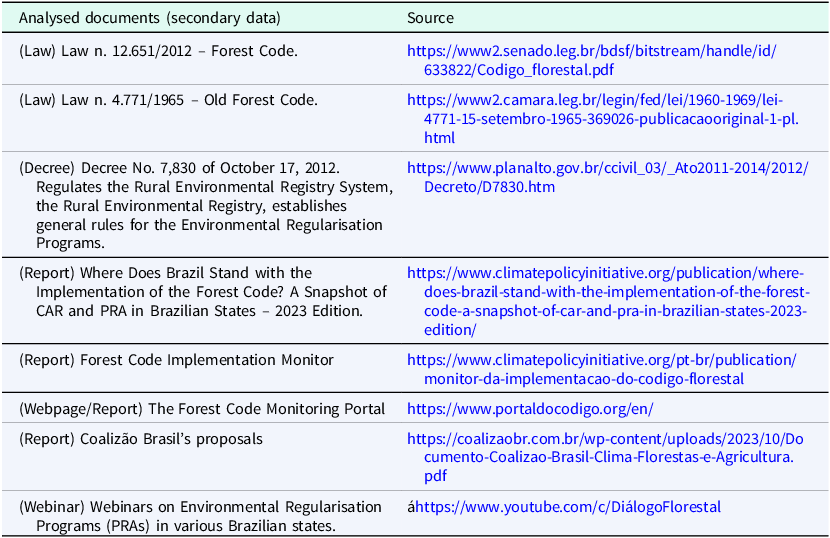
The analysis, essentially qualitative, has focused on the Forest Code and the institutional conditions of its implementation. Special emphasis has been placed on the pivotal role played by meso-institutions and all the data collection and analyses were performed in 2023. The research protocol involved several sequential steps. First, exploratory research has been conducted about what the Forest Code is and where we stand on its implementation based on publicly available data. Official documents, previous research, related literature, technical reports, and even the news in reputable publications are examples of our secondary data sources. Table 1 presents the list of documents that were consulted.
Data sources
A conceptual phase followed, in that criteria have been defined in order to identify and codify the main institutions, and in particular meso-institutions, involved in our case and their respective roles (based on Ménard et al., Reference Ménard, Martino, Oliveira, Royer, Saes and Schnaider2022). The main objective of this step is to clarify how fulfilling the meso-institutional functions depends on the accomplishment of specific operational tasks associated to each function. These classification criteria are summarised in Figure 2.
Criteria to classify the functions of meso-institutions.
Source: Adapted from Ménard et al. (Reference Ménard, Martino, Oliveira, Royer, Saes and Schnaider2022).
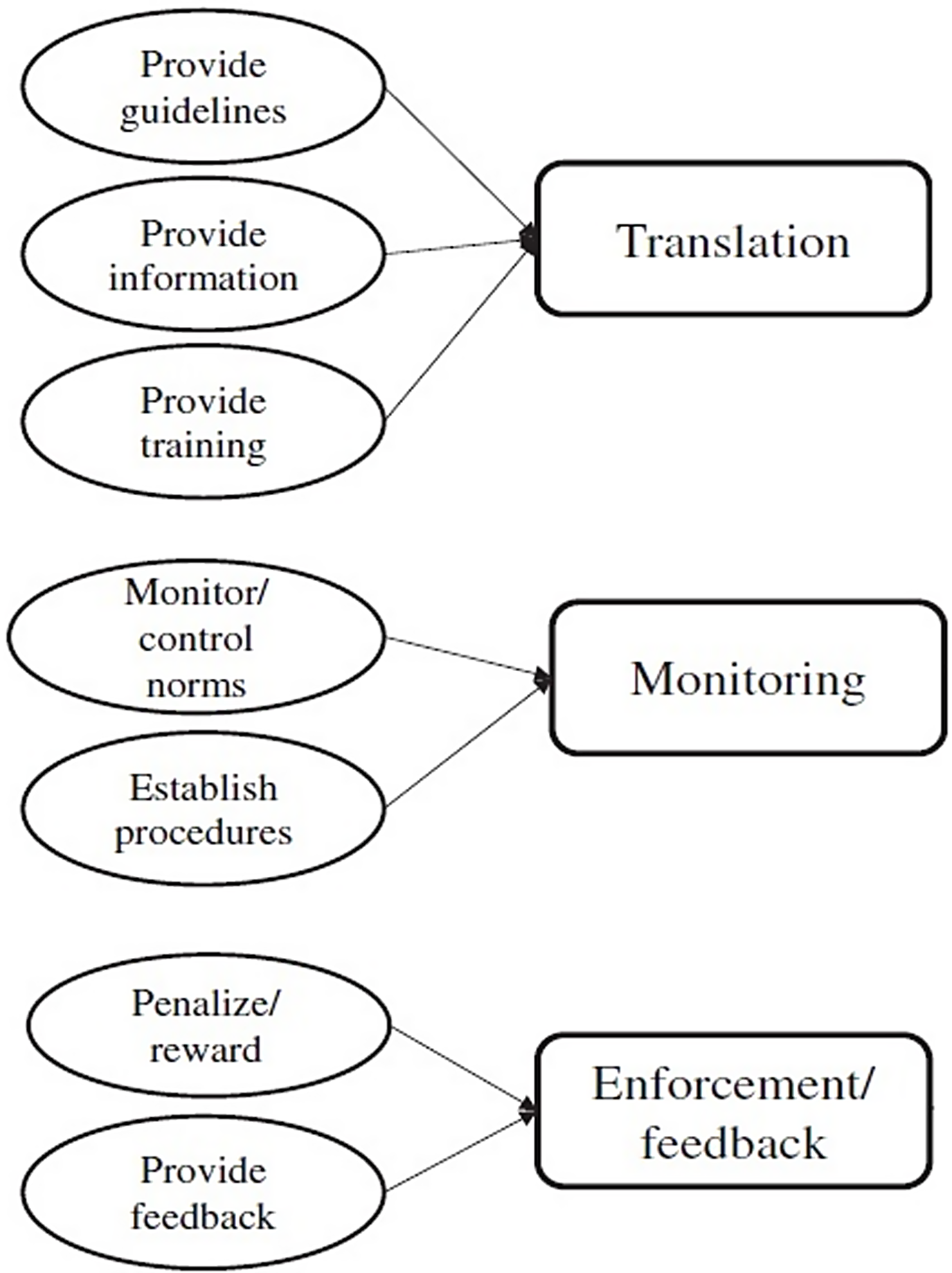
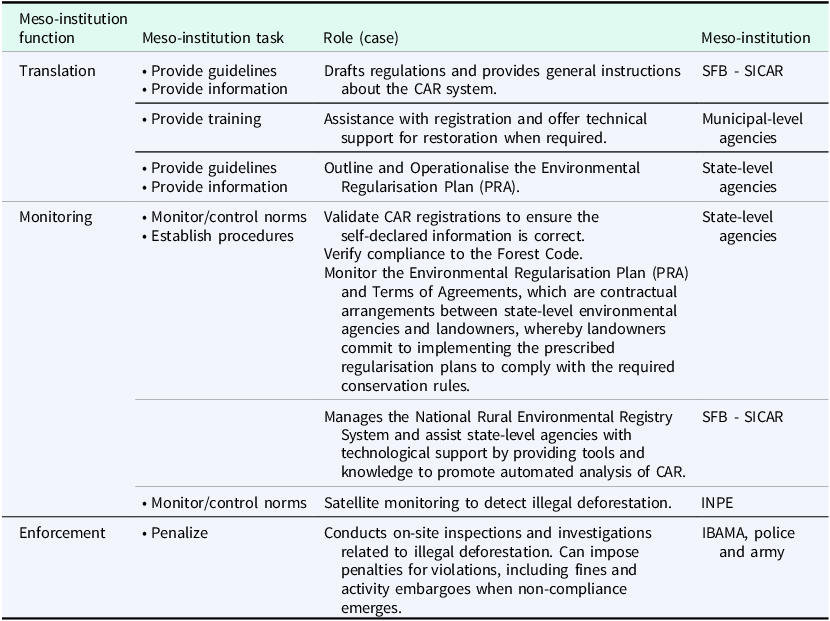
Next, a second round of data collection has been conducted based on secondary data sources in order to identify and classify the institutions involved in this case and their respective roles and functions, according to the criteria shown in Figure 2. The analysis has taken into consideration the potential overlaps that may exist between these functions, acknowledging the possibility that a single meso-institution may fulfil multiple roles. Nonetheless, for the sake of analytical simplicity, this study only focuses on the main tasks associated to each key function, potentially performed by different meso-institutions. Table 2 has been built and allows for an understanding of which meso-institutions are relevant and what are their respective functions and specific roles. Throughout each of these steps, the focus remained on the implementation of the Forest Code as the central unit of analysis, with the identification and description of the relevant meso-institutions and their three functions serving as a key part of this process.
Meso-institutions supporting the implementation of the Forest Code
Acronyms
SFB - Brazilian Forest Service.
SICAR - National Rural Environmental Registry System.
IBGE - Brazilian Institute of Geography and Statistics.
INCRA - National Institute of Colonization and Agrarian Reform.
CAR - Rural Environmental Registry.
INPE - National Institute for Space Research.
IBAMA - Brazilian Institute of Environment and Renewable Natural Resources.
PRA - Environmental Regularisation Plan.
The implementation of the Brazilian Forest Code
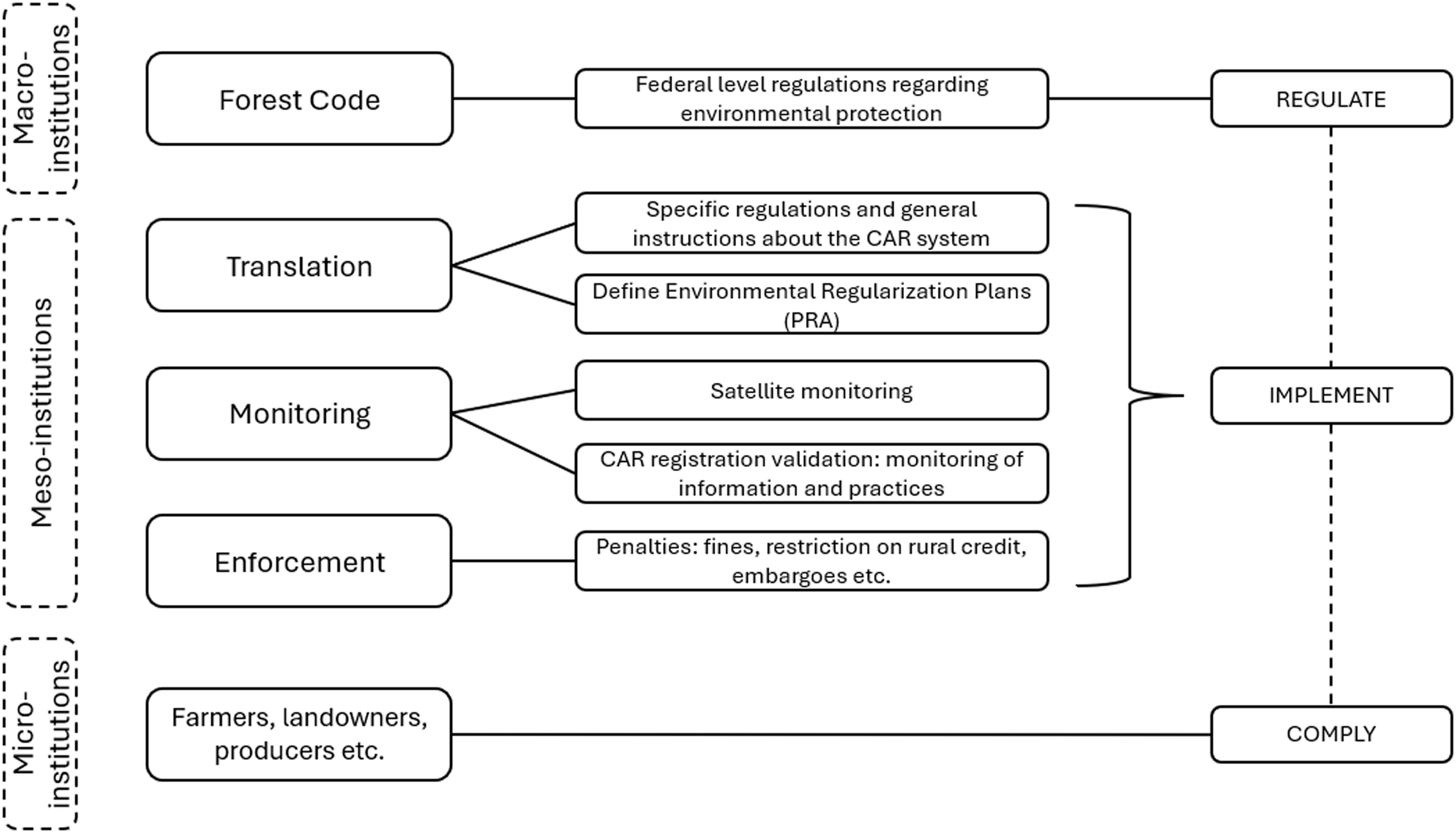
Implementing the Forest Code involves institutions populating the three layers of the institutional framework: macro-, meso-, and micro-institutions. It is important to clarify that the classification of macro-, meso-, or micro-institutions is determined by their function within the institutional environment. In other words, institutions operating at the regional level can function as macro-institutions, just as institutions at the federal level can act as meso-institutions. The complexity of creating and sustaining a system of legal rules is often exacerbated by the failure to make these rules understandable, and multiple institutions across various levels are essential to achieving the objectives of regulatory frameworks (Fuller, Reference Fuller1964).
Figure 3 provides a summary, as well as the roles played by each layer to regulate, implement and comply with the Forest Code.
Overview of the implementation of the Forest Code.
Macro-institutions: what is the Forest code?
Brazil is a federal republic composed of 26 states and a Federal District, with a presidential political system. The elaboration of new federal laws falls under the responsibility of the Brazilian National Congress, which comprises the Senate and the Chamber of Deputies. The regulation under analysis in this study is the Brazilian Forest Code, a federal law governing land use on privately-owned rural properties in Brazil under the management of the Ministry of the Environment and Climate Change at the macro-institutional level. The primary objective of this law is to promote forest conservation while balancing it with agricultural production. The implementation of the Brazilian Forest Code is essential for the country to achieve its climate goals, conserve biodiversity, and promote sustainable forest management.
Enacted initially in 1965, the law has undergone several revisions to regulate deforestation on private land. Its latest formulation, as of 2012, sought to maintain native vegetation, foster sustainable land use, and encourage the restoration of degraded areas. To this end, two types of rules have been introduced: some were universally applicable, while others applied only to certain biomes.
The most important amendment to the 2012 version of the Forest Code, being universally applicable, established the CAR, designed to map and register all rural properties in order to help improve monitoring. CAR requires registration on a compulsory digital system (the National Rural Environmental Registry System), where each landowner must outline the specific characteristics of his/her properties and self-declare his/her actions towards forest conservation. CAR is property-specific identification document that includes information about the landowner, rural occupant, or direct overseer, along with documentation verifying ownership or possession, and georeferenced data for the boundaries of the property.
Besides the compulsory registration to CAR, the general rules impose restrictions on clearing native vegetation without prior authorisation and define permanent preservation areas, such as riparian zones that must be conserved with native vegetation. In order to obtain authorisation to clear native vegetation, landowners are required to submit a detailed application to the state environmental agency, outlining the intended amount and location for clearance.
Biome-specific rules, in turn, stipulate that each farm retains a legal reserve area, contingent on the size of the farm, that cannot be used for agricultural production. These areas are set at 80%, 35%, and 20% of the total farm size for the Amazon Rainforest, the Cerrado Savannah, and other biomes, respectively. They also determine distinct restoration requirements for established areas within permanent preservation areas, calculated according to farm size (measured in Fiscal Modules) and applied diversely across biomes and Brazilian states.
While the law itself provides some very detailed guidelines, these are contingent upon the type of biome, farm size and location; not to mention the CAR system. Hence, its implementation is plagued with ambiguities, making it imperative to rely on the role of meso-institutions.
Meso-institutions: how is the Forest Code implemented?
The implementation of the Forest Code is carried out by meso-institutions in charge of translating, monitoring and enforcing the general regulations (see Tables 2 and 3). We explain each function in detail below, placing emphasis on which entities are involved, the tasks developed by them and their impact in the implementation of the Code.
Meso-institutions involved in the implementation of the Forest Code
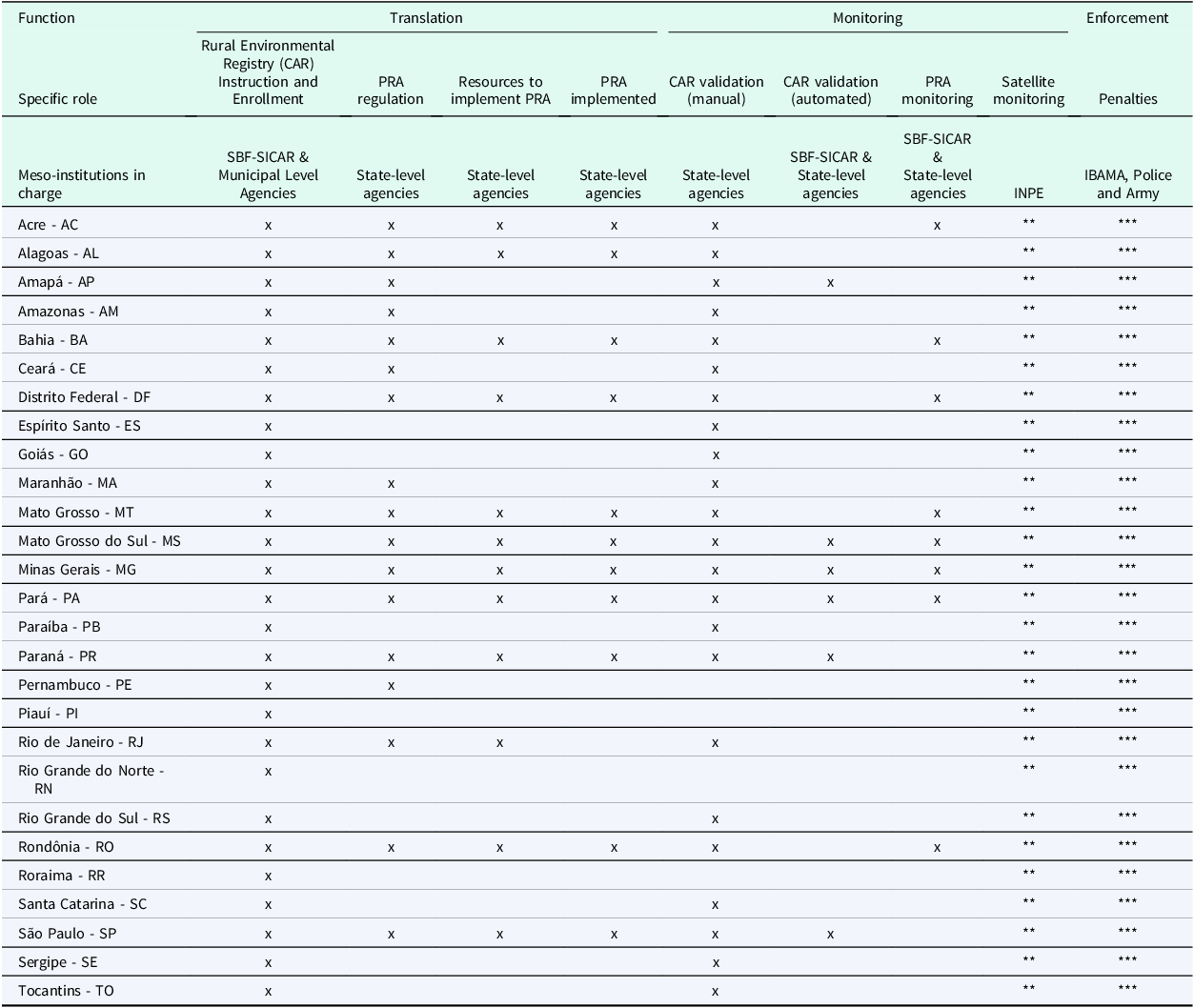
Notes: * These meso-institutions operate at the national level. Unlike other agencies, we assume there are no differences across states.
** While satellite monitoring is well developed throughout the entire country, greater attention is focused on certain biomes.
*** Although enforcement meso-institutions are present across all Brazilian states, their effectiveness varies significantly due to substantial differences in monitoring meso-institutions.
Translation
In order to comply with the Forest Code, landowners must first understand how the code applies to their properties and what are the conditions that must be satisfied. A proper understanding of the rules of the game is then a necessary first step. In the case of the Forest Code, this understanding relies upon two factors: a. the CAR system, and b. the Environmental Regularisation Program.Footnote 1
The CAR system involves a compulsory registration system for rural properties, whereby landowners must self-declare the specific characteristics of their properties and their actions towards forest conservation. This involves public agencies that regulate and manage the CAR system and landowners who need to clearly understand how to input information to said system. At the Federal level, the Brazilian Forest Service drafts specific regulations and manages the national rural environmental registry system. At the municipal level, local authorities assist landowners with their registration and offer technical support for restoration, when required. Together, these meso-institutions help to translate the Forest Code’s broad regulatory framework by translating it into actionable guidelines, offering information, and delivering targeted training and support.
The Environmental Regularisation Program was introduced with the New Forest Code in 2012 to address the widespread non-compliance with the regulation and previous liabilities. There are four ways in this program by which landowners could meet these requirements or compensate for non-compliance. They could meet requirements through (1) acquisition of environmental reserve quotas from other landowners who have exceeded the environmental standards set by the regulation (i.e., landowners who have surplus on the environmental requirements); (2) leasing of environmental servitude or excess legal reserve; (3) donation of an area located within a publicly owned conservation unit pending land regularisation; and (4) registration of an equivalent area in another rural property belonging to the same owner. This compensation scheme for not complying to legal reserve should: (1) be registered in the CAR; (2) comply to the size of the legal reserve area to be compensated; (3) be located in the same biome as the legal reserve area to be compensated; and (4) if outside the state, be located in priority areas identified by the Union or the states.
While this program has been conceptualised already on the Forest Code, which establishes the general norms, its materialisation and adaptation are done at the state level in order to better allow for requirements that meet the local territorial, climatic, historical, cultural, economic, and social specificities. To put it more sharply, state-level agencies translate the general PRA into more specific guidelines and directives with clear information on how to address the environmental regularisation of liabilities in permanent preservation areas and legal reserves. This is done by means of local regulations, so that each state in Brazil will have its own PRA program and requirements. This is a necessary condition in order to validate the CAR registration and hence allow for all the benefits this will grant, such as dedicated rural credit. As shown in Table 3, while most states have established state-level agencies to regulate the PRA, many lack the resources to do so effectively; as a result, full implementation has occurred in only a small number of states.
Monitoring
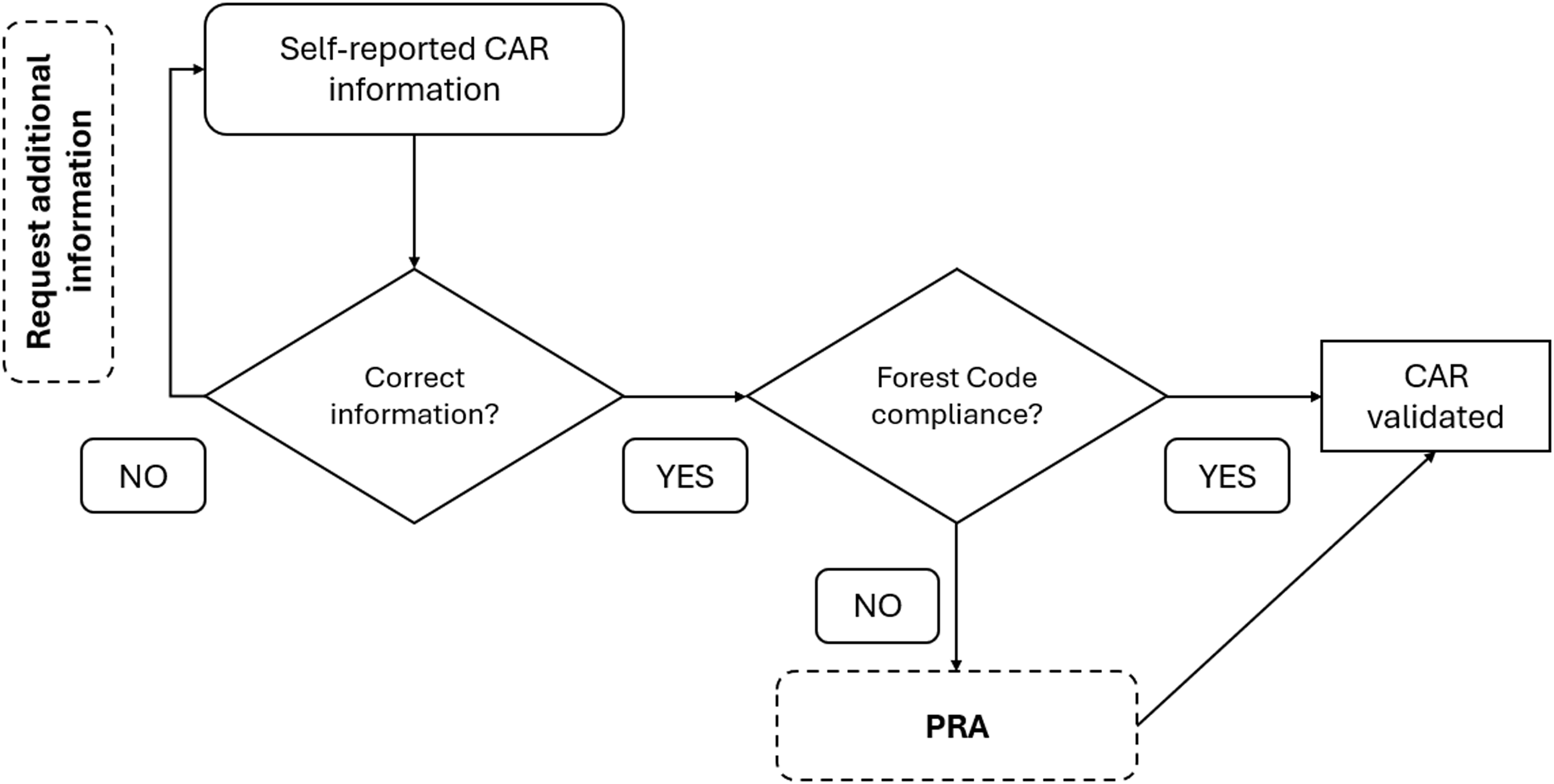
Monitoring essentially involves collecting and analysing information to validate the self-reported information in the CAR system. The most important part, in practical terms, is that landowners have a valid CAR registration, which depends on monitoring. A landowner’s registration will be considered valid if the self-declared information is correct, and he/she satisfies either of the following two conditions: (1) he/she complies with the forest code or (2) he/she does not comply with the forest code, but has a valid plan to compensate for environmental liabilities (majority of cases). In the coming lines, we shall explore how said monitoring is done. For the sake of clarity, we shall segment the argumentation into two blocks: (1) verifying that the information provided is correct and (2) assessing the PRA adherence and the restoration of liabilities in permanent preservation areas and legal reserves. Specifically, the latter is mainly monitored by state-level agencies that verify this plan and sign an agreement named ‘Terms of Agreement’, together with the landowner, whereby he/she commits to implementing all required adjustments. Compliance to this plan is also monitored by these state-level agencies.
Verification of the information provided to the CAR system
First, landowners or occupants self-declare their property boundaries and ecological data, such as forests, permanent preservation areas, and legal reserves. This information is stored in the National Rural Environmental Registry System. Second, state-level environmental agencies authenticate CAR registrations and ensure compliance with the self-declared property boundaries and environmental data. To this end, they employ methods such as remote sensing, site visits, and document checks to scrutinise the information self-reported in each CAR record. In the event of inconsistencies, they have the authority to require clarifications and/or corrections from landowners. A valid CAR registration is necessary to access rural credit and procure environmental licenses. At the federal level, the Brazilian Forest Service is in charge of supervising the national CAR system, which includes the aggregation of state data and the formulation of pertinent procedures. However, the actual monitoring of the CAR is primarily a decentralised function handled by state-level agencies.
The Brazilian Forest Service manages the National Rural Environmental Registry System and also provides technological support to the state-level agencies, making modules available for the registration of rural properties in the system, and for the analysis and management of the declared information, as well as tools to enable access to the PRAs.
Assessment of compliance and validation of the PRAs
Once the self-reported information in the CAR system is validated and deemed correct, state-level agencies verify compliance with the revised Forest Code. This is done by comparing the information received from landowners with the legal requirements. If they are compliant, their CAR registration is considered valid and receives a validation certificate.
While desirable, this does not represent the vast majority of landowners, who must then present a plan, in accordance with the PRA defined for their state, to recover and compensate for their environmental liabilities. Once all conditions are satisfied, the CAR registration is considered valid. In other words, the monitoring and control task occurs at two critical stages: first, during the initial verification of the accuracy of submitted information, and second, after the completion and assessment of the required procedures outlined in the PRA. Figure 4 summarises this process.
Summary of the validation process of CAR.
Enforcement
Enforcement is done in two ways. First, law enforcement agencies such as the Brazilian Institute of Environment and Renewable Natural Resources, state-level military police, and federal army units carry out inspections and investigations pertaining to illegal deforestation. They impose penalties for violations, including fines and activity embargoes. One way by which the Brazilian Institute of Environment and Renewable Natural Resources selects which properties to visit is by receiving alerts from the DETER system, run by the National Institute for Space Research. As the main meso-institution of enforcement, the Brazilian Institute of Environment and Renewable Natural Resources orchestrates targeted field operations, resulting in the embargo of unlawfully cleared land, seizure of equipment, and issuance of fines (for an overview see Nunes et al., Reference Nunes, Soares-Filho, Oliveira, Veloso, Schmitt, Van der Hoff and Costa2024).
Second, non-compliant landowners face restrictions in accessing credit and must resort to self-financing their properties. This is because the ongoing financial regulations require a valid CAR in order to grant credit. Banks must comply to these rules and are subject to accountability measures commensurate with their actions. In a landmark case in December 2023, the Brazilian Institute of Environment and Renewable Natural Resources imposed a fine of approximately $9 million USD (47.4 million Brazilian reais) on a private banking institution (EBC, 2023). This punitive action was taken after the bank extended agricultural credit to operations situated in an area under an embargo enacted by the Brazilian Institute of Environment and Renewable Natural Resources due to detected illegal deforestation activities.
Enforcement under the Forest Code is primarily punitive, relying on penalties to ensure compliance. Landowners who adhere to the law, either meeting the minimum requirements or exceeding them, do not receive direct rewards. However, those with surplus compliance -exceeding environmental requirements – can indirectly benefit by trading quotas to landowners with environmental liabilities. This market mechanism provides an incentive, albeit indirect, for higher compliance levels.
Discussion – why is the implementation of the Forest Code heterogeneous across Brazil?
As shown by this simplified description of this regulation and its running to protect the natural vegetation in Brazil, the implementation of the Forest Code involves several meso-institutions fulfilling the roles of translation, monitoring and enforcement. Nonetheless, the implementation of said regulations is very heterogeneous across Brazil (see Soares-Filho et al., Reference Soares-Filho, Rajão, Macedo, Carneiro, Costa, Coe, Rodrigues and Alencar2014, Lopes et al., Reference Lopes, Machado and Chiavari2023 for further details). In order to provide indications about why the implementation of the Forest Code is so heterogeneous across Brazil, the argumentation is developed in two parts. First, gaps are identified (or pointed out) in the translation, monitoring, and enforcement roles played by meso-institutions. Second, potential explanations are provided about the reasons for the existence and resilience of so many gaps. It is important to note that this discussion is descriptive in nature and does not seek to establish a direct cause-and-effect relationship between implementation failures in the Forest Code and gaps in meso-institutional functions.
Gaps in translation and the impact for the implementation of the Forest Code
Translating the general PRA into specific state-level programs is the first major challenge related to the implementation of the Forest Code. Despite it being decentralised to the state-level back to 2012, this translation is still underway in most locations in Brazil. While some state-level agencies took actions right away, others opted to wait until the new Forest Code was no longer a legal discussion (for details about said discussion, see Nusdeo et al., Reference Nusdeo, Trentini, dos Santos, Silva and Silva2023), which had been going on until 2018, to begin the process; and some have not even started this process. To date, the PRA has been transformed into state regulations in slightly more than half of the states in Brazil: Acre, Alagoas, Amapá, Amazonas, Bahia, Ceará, Distrito Federal, Maranhão, Mato Grosso, Mato Grosso do Sul, Minas Gerais, Pará, Paraná, Pernambuco, Rio de Janeiro, Rondônia, and São Paulo (Chiavari et al., Reference Chiavari, Lopes and de Alcantara Machado2023; Chiavari and Lopes, Reference Chiavari and Lopes2023; Lopes et al., Reference Lopes, Machado and Chiavari2023). However, in some cases, these state-level regulations have introduced additional contradictions to the Forest Code, thereby not necessarily supporting its effective implementation (Observatório do Código Florestal, 2016). Significant gaps remain, including landowners’ lack of clarity regarding the PRA insufficient knowledge of the restoration process and associated costs (Observatório do Código Florestal, 2024).
Another aspect that deserves attention when it comes to the translation role is exposed in Nusdeo et al. (Reference Nusdeo, Trentini, dos Santos, Silva and Silva2023). After having conducted a series of in-depth interviews with agents involved in assessing the CAR registration system in the states of Bahia and Mato Grosso, they found that an important difficulty arises from the lack of clear guidelines about what to control for, what the standards are, and how they should be interpreted. It is worth mentioning that these states are the ones with the most advanced implementation of the Forest Code, and among the 7 to have fully completed the implementation process. To put it more sharply, it has been shown that translation gaps still exist and hamper the implementation of the Forest Code, even in those states that are the most advanced in the process (Lopes et al., Reference Lopes, Machado and Chiavari2023).
The lack of an effective translation and adaptation of the general PRA regulations into specific state-level programs is a major issue for the implementation of the Forest Code. Indeed, without these clear guidelines, landowners cannot present legally compliant plans to compensate for environmental liabilities. Consequently, it becomes hard, if not impossible, to monitor their compliance and hence, validate their CAR registrations. A similar difficulty arises from the lack of clear guidelines to interpret the information provided in the CAR system. This also has direct impacts on the enforcement of the Forest Code because without a valid CAR registration, landowners can face obstacles to obtain rural credit, which can then generate a strong incentive to register their CAR. Of course, this is not the only enforcement mechanism, but our goal here is to merely stress that these gaps in the translation role have impacts also in the monitoring and enforcement process, hampering the whole implementation process.
Gaps in monitoring and the impact for the implementation of the Forest Code
Finding gaps in monitoring is surprising. Monitoring technologies have evolved over time and are now widespread in Brazil. Satellite monitoring, for example, has been extensively used to monitor deforestation. Nonetheless, the problem faced here is to connect the data obtained from said monitoring to those reported in the CAR system. That is to say, there are limitations in the process of checking whether the information reported in the system is indeed correct – the first part of the monitoring flow. For example, the National Rural Environmental Registry System exhibits numerous issues, such as overlapping boundaries and areas, as well as duplicated land registrations, leading to uncertainty about who is responsible for certain liabilities. Sparovek et al. (Reference Sparovek, Reydon, Pinto, Faria, Mazzaro de Freitas, Azevedo-Ramos, Gardner, Hamamura, Rajão, Cerignoni, Siqueira, Carvalho, Alencar and Ribeiro2019) found that nearly 17% of land in Brazil is unregistered and 6% is undesignated, compared to 44% that is privately held.
Of course, technologies are available to this end, but to date, this process relies almost exclusively on human resources. And this creates a set of difficulties. First, most states do not have enough human resources to complete this task. Second, they fear accountability for mistakes or for their individual analyses, which, as already stated, lack clear benchmarks and guidelines. This can produce interpretative divergences (Nusdeo et al., Reference Nusdeo, Trentini, dos Santos, Silva and Silva2023). Finally, there is always the possibility of conflicts of interest and agency problems or corruption, which can hamper the implementation of the Forest Code.
Besides checking whether the information reported is correct, similar monitoring gaps exist to monitor the PRA and compliance to the ‘Terms of Agreement’. Technologies that monitor forest clearance are available, but there is a dramatic lack of human resources to match the expected PRA with the data obtained from said monitoring. As an example, roughly 68% of those states that have already regulated the PRA at the state-level have managed to obtain enough human resources to this end and only 37% of these have managed to effectively monitor the compliance to the ‘Terms of Agreement’ (Lopes et al., Reference Lopes, Machado and Chiavari2023). Interestingly, these are mostly in the Amazon or neighbouring Cerrado biomes in the North, Northeast, and Central East of Brazil: Amazonas, Rondônia, Pará, Mato Grosso, Mato Grosso do Sul, and Bahia.
While state-of-the-art technologies are available to help monitor the implementation of the Forest Code today, there is a lack of human, technical, or operational resources to do the matching between collected data and the situation in the field. Indeed, only 6 states have managed to implement and monitor the PRA: Acre, Rondônia, Pará, Mato Grosso, Mato Grosso do Sul, and Bahia (Lopes et al., Reference Lopes, Machado and Chiavari2023). Moreover, the lack of a well-defined environmental regularisation program exacerbates monitoring difficulties, as there are no explicit criteria outlining what and how things must be changed. Hence, the dual issues of inadequate resources and lack of regulatory guidelines for liabilities impede effective implementation, particularly in the realm of monitoring. Without effective monitoring of non-compliance, there is little incentive for complying with the regulation.
Gaps in enforcement and the impact for the implementation of the Forest Code
Enforcement is also not free from gaps. First, the inspections by the police, army, or the Brazilian Institute of Environment and Renewable Natural Resources impose penalties to non-compliant properties. However, these inspections tend to occur more often in some locations – such as those in the Amazon biome – than in others. Despite this focus, Camara et al. (Reference Camara, Simoes, Ruivo, Andrade, Soterroni, Ramos, Ramos, Scarabello, Almeida, Sanches, Maurano, Coutinho, Esquerdo, Antunes, Venturieri and Adami2023) found significant non-compliance with the legal reserve provisions in the Amazon, where private lands have a legal reserve deficit of 18.17 million hectares. This underscores that, although there are more incentives for compliance in these regions, there remain critical voids in control and enforcement.
A second way of enforcement is by means of restricting access to rural credit to those properties without a certified CAR registration. While this should be a powerful tool in principle, doubts can be raised about its effectiveness because of the difficulties already mentioned about the validation and certification through the CAR system.
Enforcement tends to be stronger in the Amazon biome than elsewhere. Not surprisingly, the implementation of CAR system is also more advanced in regions adjacent to the Amazon biomes, such as selected areas within the Cerrado and Caatinga, as well as some Amazonian states. Potentially, because there is more translation and information available and that data collected have already been processed, enforcement can be performed, leading to more effective implementation of the Forest Code. However, environmental issues continue to afflict these regions.
Despite these gaps, why have some states successfully managed to implement the Forest Code?
An important lesson from this case study is that despite being considered one of the most comprehensive environmental policies in the world, there is crucial need for effective meso-institutions in order to make the Forest Code a working set of rules and norms. This is well substantiated by the fact that, although the meso-institutional responsibilities are in theory the same throughout Brazil, their actual fulfilment of the functions they have to implement tends to differ across the country. But why is that so? This study shows that the implementation of the Forest Code has been heterogeneous across Brazil because the performance of meso-institutions has been heterogeneous. Specifically, our analysis indicates that shortcomings in two key state-level regulatory components, the CAR and the PRA, accounts for much of this variation. The main challenges lie in fully verifying the self-declared information provided through CAR and in clarifying the rules for managing environmental liabilities under the PRA (e.g., how, when, what should be compensated).
The implementation of Brazil’s Forest Code is also shaped by a complex interaction of national and local dynamics, as well as the active involvement of various stakeholders. Several other environmental policies can influence its implementation, including the Action Plan for the Prevention and Control of Deforestation in the Legal Amazon (West and Fearnside, Reference West and Fearnside2021), the Priority List policy (Oliveira and Miranda, Reference Oliveira and Miranda2024), the Soy Moratorium (Gibbs et al., Reference Gibbs, Rausch, Munger, Schelly, Morton, Noojipady, Soares-Filho, Barreto, Micol and Walker2015; Heilmayr et al., Reference Heilmayr, Rausch, Munger and Gibbs2020), the ‘MPF-TAC’ cattle agreement (Miranda and Oliveira, Reference Miranda and Oliveira2023), and the Green Municipalities Program (Moz-Christofoletti et al., Reference Moz-Christofoletti, Pereda and Campanharo2022). Moreover, political rhetoric has been shown to influence these opportunity costs and undermine institutional credibility, with recent empirical evidence demonstrating how anti-environmental statements can drive also forest clearing (Oliveira et al., Reference Oliveira, Sellare, Cisneros and Börner2024). Although these initiatives do not necessarily address the Forest Code directly, they can alter the broader political environment and incentives at play that motivate the emergence and effectiveness of meso-institutions.
To sum up, the existence of environmental policies that create local competences in the meso-institutions in charge of implementing these policies, shared knowledge among parties involved, and more extended awareness regarding environmental issues are factors that also likely contribute to the relative effectiveness of the Forest Code. This illustrates how different sets of rules, even those with distinct objectives and targets, can co-determine their outcomes. This underscores the complexity of institutional interactions across macro-, meso-, and micro-layers within a given institutional environment.
Our model of institutional layers facilitates a systematic exploration of the key functions and tasks to be fulfilled by meso-institutions if a public policy is to be successful. Empirical investigation guided by this model enabled the identification of implementation gaps associated with each specific function, elucidating the underlying reasons of flaws or failures and their potential consequences. Moreover, the analysis underscored its significance for policymakers by offering insights into how rules can be implemented through diverse institutional arrangements.
Acknowledgements
We thank the editor, Esther-Mirjam Sent, the editor of this special issue, Claude Ménard, and several anonymous reviewers for their insightful comments and suggestions. This article also benefited from discussions at a special session of the WINIR Conference held in Catania (September 2023). Special thanks to Sylvia Saes for thought-provoking exchanges. Gustavo Magalhães de Oliveira gratefully acknowledges funding from the European Union’s Horizon Europe research and innovation programme under grant agreement No. 101060765. Open access enabled and organised by the University of Bonn.


 Open access

