Introduction
This paper is a study of older men's and women's reflections on what life would have been like if they had been born the other sex. As far as we are aware, this issue has not previously been studied among the ‘oldest old’. We believe that people's answers to this question yield important knowledge about gender perspectives in advanced old age, which in turn may fill important gaps in our understanding of gendered living conditions. The medical perspective associates advanced old age with impairments and the loss of abilities (Bould, Smith and Longino Reference Bould, Smith and Longino1997), physical decline (Dening et al. Reference Dening, Chi, Brayne, Huppert, Paykel and O'Connor1998) and cognitive losses (Stouffer Calderon Reference Stouffer Calderon2001). In contrast, the salutogenic perspective on ageing focuses on various developmental processes in late life, such as attaining wisdom (Erikson Reference Erikson1982), transcendence (Tornstam Reference Tornstam1996), and peace of mind (Nyström and Andersson-Segesten Reference Nyström and Andersson-Segesten1990). To deepen our understanding of older people's needs and to plan and deliver appropriate health care, the oldest old have been studied from the perspectives of gender (Aléx et al. Reference Aléx, Hammarström, Gustafson, Norberg and Lundman2006, Reference Aléx, Hammarström, Norberg and Lundman2008; Bennett Reference Bennett2007; Calasanti Reference Calasanti2004; Calasanti and Slevin Reference Calasanti and Slevin2001; Ribeiro, Pául and Nogueira Reference Ribeiro, Pául and Nogueira2007) and ethnicity (Aléx et al. Reference Aléx, Hammarström, Norberg and Lundman2008; Barusch and TenBarge Reference Barusch and TenBarge2003; Sudha and Mutran Reference Sudha and Mutran1999; Hays and George Reference Hays and George2002), although studies from a gender perspective are still rare and there is a need for further gender-based investigations of becoming and being old.
The paper's conceptual framework has been influenced by the several theories which hold that each society has a gender order, constructed from multiple ideas of what is seen as feminine and masculine (Bourdieu Reference Bourdieu2001; Rosaldo and Lamphere Reference Rosaldo and Lamphere1974; Shostak Reference Shostak1990). A deep-seated assumption of western philosophy is that men are rational and women are emotional (de Beauvoir Reference de Beauvoir1949; Bourdieu Reference Bourdieu2001; Connell Reference Connell1995; Miller Reference Miller1986). Early feminist researchers depicted women as ‘relational’; that is, as being oriented toward caring for others, while men were seen as striving for strength and independence (de Beauvoir Reference de Beauvoir1949; Gilligan Reference Gilligan1982; Miller Reference Miller1986). De Beauvoir argued that women are generally socialised to become objects, reproductive and immanent, and that men are socialised to become subjects, creative, active and transcendent. As individuals, we try to imitate society's ideals of how to be men or women, but as we live in different classes, ages, cultures and subcultures, the ideals are actualised to a greater or lesser extent (Butler Reference Butler1990; West and Zimmerman Reference West and Zimmerman1987). According to this perspective, ‘doing gender’ is a continuous activity that is embedded in everyday social interactions and revealed in our ways of acting and recounting our lives. De Beauvoir (Reference de Beauvoir1949: 162) said that, ‘we are not born women, we become women’, an opinion consistent with today's gender perspective that stresses the historical, social and cultural constructions of femininities and masculinities in society (Hammarström, Härenstam and Östlin Reference Hammarström, Härenstam, Östlin, Östlin, Danielsson, Diderichsen, Harenstam and Lindberg2000; Harding Reference Harding1986).
Through narrating our memories, we give meaning to our and others' lives (Bruner Reference Bruner1987; Davies and Harré Reference Davies and Harré1990; Polkinghorne Reference Polkinghorne, Hatch and Wisniewski1995). Individuals can have many different perspectives on a common event, and how an experience is narrated and reflected upon depends on the context. Reflexivity raises our awareness of ourselves and of the importance of gender. We are often unaware of the gendered frames that limit our behavioural repertoire, because they are so much a part of us that we cannot see them. The ability to perceive ourselves from various perspectives, for example ‘to gaze’ upon ourselves from an opposite-gender perspective, is related to our ability to reflect on our own gendered behaviour (Hardin Reference Hardin2001). Reflecting on one's past life is a part of adjusting to old age. It is therefore of interest to study how older people reflect upon what their lives would have been if they had been born as the other sex. An opportunity to narrate can call up many memories, and these probably depend on the positions assumed during the narration situation, and on the interaction of gender, age, class and historical context (Aléx and Hammarström Reference Aléx and Hammarström2008). From a very old person's point of view, as well as from a caring perspective, an analysis of the gendered lives of old people will widen our knowledge of the state of being old. The aim of this paper is accordingly to report an investigation of how older men and women in rural northern Sweden reflected on how life might have been if they had been born the other sex.
At the beginning of the 20th century, when our respondents were born, Sweden's social conditions were characterised by both widespread poverty and faith in economic and social development. The rural area where the participants lived was sparsely populated, and forestry and farming accounted for most of the available work. Because of the climate, agriculture was limited to growing barley and potatoes. Today, the area has few employment opportunities and there is considerable out-migration.
The study sample and methods
The participants were people in advanced old age living in the rural area of Norrland, northern Sweden, covered by the Umeå 85+ project (Bergdahl et al. Reference Bergdahl, Allard, Aléx, Lundman and Gustafson2007; Nilsson and Fisher Reference Nilsson and Fisher2006). The inclusion criteria were that the participants lived in the study area, were born before 1908 (i.e. aged 95 or more years) or in 1913 (i.e. 90 years old) or 1917 (i.e. 85 years old), and were able to participate in a narrative thematic interview. The first author of this study interviewed 18 people, from which 16 were selected for analysis (in the cases of one woman and one man, the interviewer judged that it would have been difficult or inappropriate to administer the key question about being born the other sex). The 16 included nine men (four aged 90 years and five aged 85 years) and seven women (four aged 90 years and three aged 85 years).
After information about the study was provided to the respondents and informed consent obtained, appointments were made for the face-to-face interviews in the respondents' homes.Footnote 1 Inspired by de Beauvoir's question (Reference de Beauvoir1949), ‘what does it mean to me to being born a woman?’, we asked the respondents ‘have you ever thought of how life might have been if you had been born as the other sex?’ The question came at the end of a long interview, by which time the interviewee and the interviewer generally felt comfortable with each other. The responses varied from a few words to extended reflections. All the interview exchanges were tape-recorded and transcribed verbatim. The interviewer listened to the tape-recording on the day of the interview; in many cases, immediately after.
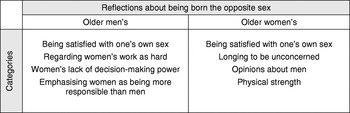
The text of the interviews was analysed using a qualitative content analysis inspired by Graneheim and Lundman (Reference Graneheim and Lundman2004) and Krippendorff (Reference Krippendorff2004), focusing on the reflections connected with the featured question. The text was divided into meaning units, i.e. words or sentences with the same content, which were labelled and coded. The codes were classified, and several preliminary categories developed. These were discussed among the authors until agreement was reached. Finally, the codes and the categories were consolidated into two content areas and eight categories. The process appears linear but the analyses went back and forth between the interviews, the codes and the categories in order to ensure trustworthiness. The participants' expressions on the hypothetical possibility of having been born as the other sex were grouped into two domains, older men's and older women's responses, and the identified categories are as arrayed in Figure 1. The next sections of the paper examine each category in turn.
The two domains and the eight categories.

Findings
Older men's reflections
Some of the men found it difficult to reflect on what life would have been like as female, and firmly stressed that being born male was important to them and that they were satisfied with their own sex. One man said, ‘it means everything to be born a man’, and another said, ‘I have never wanted to change’. The men seemed happy to have been born men; they made statements such as ‘I wanted to be a boy’ and ‘I am happy I am a man’. Being satisfied with being male was expressed as being able to have fun; for example, getting up to mischief when working with other men, such as trying to cook on the simmering wood stack while making charcoal. One man described the sense of being satisfied and unconcerned: ‘Life is playing [laugh] and perhaps something more’.
When reflecting on how life would have been if they had been born the other sex, the men's statements indicated that they regarded women's work as hard. One said, ‘the women had heavy work … they had to serve the men’. The men remembered their mothers and described them as hard-working organisers. One said, ‘my mother was in charge of everything, she kept order’. The men explained how in organising and managing daily life, a mother might sometimes discipline the children using some kind of corporal punishment, such as a slap on the backside, but they nonetheless expressed feelings of admiration for the hard-working mother. As one said, ‘she was first up in the morning and the last one to go to sleep’.
When the men reflected on being born female, they compared men's and women's work. One man regarded raking wet hay as harder work than haymaking (namely baling and stacking the hay), and said, ‘the boys had to work on the haymaking, but the girls had to work with the rakes, raking wet hay, in the swamps and in the forest’. The women's particular work, bounded by the home, children and cattle, was compared to men's collective and distant work, in the forest and at the charcoal kilns. One man said that the men's work was often hard, and involved lengthy periods living away from home in the forest, but he also stressed the positive experiences of living and working together with other men. He related that there could be 15 or 20 men in one work team, which made for good times and fun. Although forestry work and making charcoal were extremely hard, the men thought that women's lives at home were harder, because most women's work was done in isolation. Being a child stock-herder was said to have been common for both boys and girls, and there were many recollections of having to work from an early age.
The men mentioned that if they had been born female then they would probably have had fewer opportunities to make decisions. Lack of decision-making powers was described as women's destiny and determined by birth. As one man put it, ‘if I had been born a girl, I would not have been able to decide so much [laugh]’. Marriage was also described as restricting women's opportunities to make decisions. One man said, ‘if I had been a girl and married a man [laugh] I would not have been able to decide so much’. The men's narratives also emphasised that women were more responsible than men, and indicated that they believed that being born a girl and being a woman meant being socialised to become more responsible than men. They said that girls had to take responsibility for their own lives at a younger age, as exemplified by having to leave the parental home to earn a living by working as domestic or farm servants in others' homes, where everything was new. One man who had apparently lived his childhood and youth in poverty said, when thinking of his sisters, that ‘[they] probably had it even more difficult than I did … my sisters had to leave home and go and work in other homes … other places’. Furthermore, women's lives were described as involving the responsibility for taking care of children, making food, and taking care of frail parents. One man said: ‘well I think it was worse for the women. The women started early, taking care of the children and the food’. One man said, however, that it had been out of the question for him, who had no sisters, to leave his parents when they were alive.
Old women's reflections
Some of the women could not even imagine what their lives might have been like if they had been born male, and stressed being satisfied with their given sex. One made it clear that ‘I have [always] wanted to be a girl’. Much contentedness with being women was expressed, as with, ‘I am grateful that I was born a girl’. The women's narratives showed that they felt and experienced dissociation from boys and men. One woman as a child had found boys frightening: ‘the boys in school were terrifying and naughty, throwing snow’. When reflecting on being born a boy, the women distanced themselves from men's lives. One stated that she never had found it important to have the same status as a man, because to her it was sufficient to be a woman, and as she elaborated, ‘I have kept my rights and I have expressed my opinion’. This dissociation from men's lives was to some extent explained by one woman who had been raised by her grandmother, whom she described as strong and wise and an honest person with principles. She had been told repeatedly by her grandmother that she belonged to a strong family and that she could survive anything. This statement had reinforced her belief that it was possible for women to overcome life's difficulties. Another woman emphasised the benefit of being able to work at home: ‘I was provided for so I could stay at home, so to speak’. She saw womanhood as a matter of destiny and remarked, ‘you cannot give up the way you were created’.
When reflecting upon the fact that the boys in their youth had more opportunities to behave freely, the women informants appeared keen to show indifference or to be unconcerned. Being a young woman was described as having few chances to have fun, because the general expectation was that young women should behave decently and properly, and that a girl was supposed ‘to know how to behave’. One woman expressed a different opinion, however, in a recollection that ‘we [i.e. girls] thought, why should we be so very decent … and not the boys?’ One woman said of boys, ‘I think they had more fun’. She had often been told when going out to a dance that she had to behave herself and that she should not forget that she was a girl. The women spoke of being warned against boys as false and troublesome, which seemed to have forced young girls to take the responsibility for not mixing with ‘bad boys’. A view of married men as lacking responsibility was expressed. One woman said, ‘when you marry you have to think for two people’. More generally, however, when reflecting on being male, the women remembered that life in the past had been hard and poor for both women and men. The women said that when they were children, both boys and girls had worked as livestock herders, so both shared those experiences and memories. Physical strength was seen as necessary; as one woman said, ‘you had to give all your strength’. The strength of women was exemplified by one woman who, when she was young, had lifted milk cans weighing 30–40 kilograms. The emphasis on physical strength reinforced the statements that women's work had been hard.
Discussion and conclusions
This study has examined older people's perspectives on the imagined state of being born the other sex. The men's and women's narratives indicated that they were satisfied with their actual sex. The men's expressions frequently included awareness that having been born a woman would probably have meant harder work and a more restricted life in the remote rural area, and displayed consciousness of women's relative powerlessness and of women's great ability to manage and organise work at home. The women's narratives indicated a femininity characterised by longing for a state of being unconcerned when young, and consciousness of women's physical strength and the fact that men's lives had also been hard.
Swedish society has long emphasised that women's work is mainly concerned with biological and social reproduction (Hirdman Reference Hirdman1994), and this customarily has been seen as easier than many paid occupations and suited to women more than men. Our respondents, however, articulated a rather different view, of women's work as being harder than men's, as earlier studies in a similar context have found (e.g. Forssén and Carlstedt Reference Forssén and Carlstedt2001). The men's emphasis that women's work was harder than men's contrasted with the findings of an earlier study (Aléx et al. Reference Aléx, Hammarström, Norberg and Lundman2008), however, in which constructions of masculinities as ‘being in the male centre’ and ‘striving to maintain the male facade’ did not recognise women's work as at all important – rather the men emphasised their own capacities and strength (cf. Connell Reference Connell1995; Courtenay Reference Courtenay2000). Many of the men and women in this study shared similar living conditions during childhood, and as adults were aware that work had been hard for both genders, but when reflecting on being born another sex, both men and women believed that women's lives were harder than those of men and that they had fewer opportunities to make decisions. To our knowledge, such views have not previously been reported. In the equality politics recently prevalent in Sweden, it is more usual to assert that men born at the beginning of the last century had a more degrading view of women than men today.
Among these very old rural people, being born a girl rather than a boy conferred fewer possibilities to make decisions regarding important life events. In a phenomenological study of what it means to be a woman, de Beauvoir (Reference de Beauvoir1949) wrote that women are socialised to become objects, and have very limited resources. For the women we studied, this meant being restricted in their ability to control their lives, but the restricted ability to make decisions had to be balanced against the demands early in life to take responsibility. The men's and women's narratives that described the hard work of women, taking care of and organising the household and livestock, arguably instilled the women with status and power over both the home and the cattle. Again following de Beauvoir's perspective, hard work and being able to handle things by oneself – being a subject, an actor – seems to have contributed to the women's self-respect and to the men's respect. As a woman, being able to handle hard work can, according to Bourdieu (Reference Bourdieu2001), be seen as having access to strength, which was an important component of cultural capital in the rural area. Sundin-Huard (Reference Sundin-Huard2001) argued that subject positioning offers an explanation of the individual's ability to occupy and move between various subject positions as in the case of the women in this study, being organisers, looking after the cattle, and being mothers.
Being poor influenced the lives of both the women and the men, and having to work when young – for example as livestock herders – was taken for granted. The work that the respondents described as children might seem inhumane today (in Sweden, children less than nine years old have been forbidden to work since 1833). The older men's and women's experiences of childhood work were described both as wonderful and free, and as frightening. Our study prompted narrations of women's past longing to be unconcerned and unburdened. The men, in contrast, related that as well as working hard together with other men, they had taken part in rascals' behaviour, and they joked about failed attempts to cook on the charcoal stack. The men stressed the possibilities of having fun with other men, in accordance with other findings emphasising men's attraction and connections, described as homosociality (Bird Reference Bird1996; Hirdman and Andreasen Reference Hirdman, Andreasen, Andreasen, Borchors, Dahlerup, Lous and Nielsen1991; Lindgren Reference Lindgren1999) or hegemonic masculinity (Connell Reference Connell1995; Connell and Messerschmidt Reference Connell and Messerschmidt2005; White Reference White1997); that is, feelings of male solidarity premised on the exclusion of women. The older men's and women's reflections about being born another sex differed from de Beauvoir's (Reference de Beauvoir1949) theory, which stressed men as subjects and women as objects. In our study, both women and men were described as actors in their lives, though this agency was limited for both men and women by their difficult, poverty-stricken circumstances when growing up in a rural area in the north of Sweden at the beginning of the 20th century.
On the method
In any study, the trustworthiness of the results must be considered. The interviewer's intention should be to remain open to the data by using sensitivity, creativity and insight (cf. Morse et al. Reference Morse, Barrett, Mayan, Olson and Spiers2002). The data in the present study were systematically checked and the analyses and interpretations were constantly monitored and reconfirmed (cf. Morse et al. Reference Morse, Barrett, Mayan, Olson and Spiers2002; Tobin and Begley Reference Tobin and Begley2004). Methodological reflexivity, which is important in ensuring trustworthiness, was employed in the study by the systematic interaction of the interviewer and researcher throughout the research process (cf. Wilkinson Reference Wilkinson1988). For example, asking a question about what life might have been like if one had been born as the other sex indicates that the interviewer herself has reflected on that question (Aléx and Hammarström Reference Aléx and Hammarström2008). Also, as stated in the results section, some of the men found it difficult to reflect on this question which may be because the advantage of being a man (as compared to a woman) was taken for granted in society during their life time.
Qualitative researchers emphasise that the investigators and participants collaborate in constructing knowledge (Campbell and Bunting Reference Campbell and Bunting1991; Fahy Reference Fahy2002; Gordon Reference Gordon1998; Wilkinson Reference Wilkinson1988). It is important to emphasise sensitivity and flexibility in interview situations, and to reflect on the fact that the narratives related to a researcher are influenced by the interview situation (Sandelowski Reference Sandelowski1991). How a narrative is recounted depends on the context, the interviewer and both the narrator's and the interviewer's intentions – the interviewer is a co-actor in the created narratives. When reflecting on our study of inland communities in comparison with previous urban studies of constructing femininities and masculinities (Aléx et al. Reference Aléx, Hammarström, Gustafson, Norberg and Lundman2006, Reference Aléx, Hammarström, Norberg and Lundman2008), some differences have to be taken into account. The study of constructing masculinities pointed out that the narratives given were largely sexualised and sexist, an aspect which was completely absent in the present study. This raises another question: how do we as interviewers influence the narratives? The interviews in the study on constructing masculinities were not performed by the authors of the present study, but rather were mainly performed by one man and one woman as part of the Umeå 85+ project. When men for instance tell narratives about important life experiences to other men, do the narratives tend to be more sexualised and sexist? Or, if an interviewer has a gendered perspective, does this influence the interviewees, inhibiting them from telling sexist narratives and talking about hegemonic sexuality? The men's narratives in this study were neither sexualised nor focused on traditional hegemonic masculinity that stresses one's own strength, being at the centre, and being independent (Aléx et al. Reference Aléx, Hammarström, Norberg and Lundman2008; Connell Reference Connell1995; Courtenay Reference Courtenay2000). The masculinity found among the informants in the studied rural area was one characterised by a consciousness of women's relative powerlessness and of women's great ability to manage and organise work at home. Our interpretation is that this masculinity does not correspond to a hegemonic masculinity as emphasised in society at large. It is possible that in the context of the ‘equality project’ that pervades Swedish society, the question, ‘have you ever thought of how life might have been if you had been born as the other sex?’ encouraged both the men and the women to respond with ‘politically correct’ answers (Kabeer, Stark and Magnus Reference Kabeer, Stark and Magnus2008), but our results suggest that this was not the case.
Implications
The evidence presented here shows that the men were conscious of women's hard work and organisational ability and of the fact that if they had been born a girl they would probably have had a harder life. These perspectives on women are not in line with a hegemonic masculinity that focuses on men's strength and hard work. The women we interviewed also emphasised their hard work; and in describing themselves as hard working, they elucidated a femininity among the oldest old that is not often stressed in today's society. Hard work in this specific area and in this historical context seems to have contributed to men's awareness that, in spite of their own hard and impoverished experiences when growing up and living in the time and place, the lives of the women were even harder. The possibility that gender consciousness on the part of the listener/interviewer could contribute to non-stereotypical gender narratives should be kept in mind. Listening to old people's narratives and memories is one of the most important ways to increase our knowledge of older men and women, and this knowledge is crucial when it comes to planning for their future health care.