

The scientific interest in couple relationship has been increasing through the decades (Graham, Diebels, & Barnow, Reference Graham, Diebels and Barnow2011; Raffagnino & Matera, Reference Raffagnino and Matera2015). This is not surprising, bearing in mind the vast body of data revealing impressive correlations of couple relationship quality and satisfaction with different domains of psychosocial functioning of individuals. As decades pass, the attitudes towards the intimate relationship and family structure inevitably change (Graham et al., Reference Graham, Diebels and Barnow2011). Nevertheless, the consistent pattern of couple relationship satisfaction's importance remains unchanged, since it has substantial outcomes for individual mental and physical wellbeing (Raffagnino & Matera, Reference Raffagnino and Matera2015), as well as for dyadic and family emotional health (Erol & Orth, Reference Erol and Orth2014; Wiebe et al., Reference Wiebe, Johnson, Lafontaine, Moser, Dalgleish and Tasca2017). Recent studies usually confirm the tendencies found decades ago and reveal that high couple relationship satisfaction acts as a protective factor against significant stressors such as low self-esteem, first-time motherhood and unemployment (Erol & Orth, Reference Erol and Orth2014; Røsand, Slinning, Eberhard-Gran, Røysamb, & Tambs, Reference Røsand, Slinning, Eberhard-Gran, Røysamb and Tambs2012), and is related to lighter symptoms of depression (Finkbeiner, Epstein, & Falconier, Reference Finkbeiner, Epstein and Falconier2013), better sexual intimacy and satisfaction (Vowels & Mark, Reference Vowels and Mark2018), less psychological aggression between partners (Graña, Cuenca, & Redondo, Reference Graña, Cuenca and Redondo2017), and a more positive view of a partner as more emotionally accessible, responsive, and engaged (Novak, Sandberg, & Davis, Reference Novak, Sandberg and Davis2017).
Evaluation of Relationship Satisfaction
The importance of a satisfactory couple relationship is undeniable; hence, there is a need for an adequate and accurate study of this phenomenon. Graham and colleagues (Reference Graham, Diebels and Barnow2011) have summarised the strengths and weaknesses of the most often employed classical measures and concluded that Quality of Marriage Index (Norton, Reference Norton1983) is a highly reliable measure and could be a suitable choice for those who study couple relationship quality, while the Marital Adjustment Test (Locke & Wallace, Reference Locke and Wallace1959) should be the least used choice. Among other somewhat reliable measures (Graham et al., Reference Graham, Diebels and Barnow2011; Urbano-Contreras, Iglesias-García, & Martínez-González, Reference Urbano-Contreras, Iglesias-García and Martínez-González2017) are the Dyadic Adjustment Scale (DAT; Spanier, Reference Spanier1976), Kansas Marital Satisfaction Scale (Schumm, Nichols, Schectman, & Grigsby, Reference Schumm, Nichols, Schectman and Grinsby1983), Relationship Assessment Scale (RAS; Hendrick, Reference Hendrick1988), Semantic Differential Scale (Karney & Bradbury, Reference Karney and Bradbury1997) and Couples Satisfaction Index (Funk & Rogge, Reference Funk and Rogge2007). The last five years were marked by plenty of new instruments intended to measure couple relationship satisfaction, including the Marital Satisfaction Scale (MSS; Canel, Reference Canel2013), Positive and Negative Semantic Differential (Mattson, Rogge, Johnson, Davidson, & Fincham, Reference Mattson, Rogge, Johnson, Davidson and Fincham2013), Relationship Satisfaction Scale (RSS; Røysamb, Vittersø, & Tambs, Reference Røysamb, Vittersø and Tambs2014), Dyadic-Familial Relationship Satisfaction Scale (Raffagnino & Matera, Reference Raffagnino and Matera2015), and Satisfaction in Couple Relationship Scale (SCR; Urbano-Contreras et al., Reference Urbano-Contreras, Iglesias-García and Martínez-González2017). The developers of the measures claim that they are reliable instruments to measure couple relationship satisfaction.
Confusion Between the Concepts of Relationship Satisfaction and Relationship Quality
It can be hypothesised that there are some reasons why researchers decide to develop new measures while many reliable ones exist, but probably the main reason is the conceptual confusion in the field of couple relationship studies. There are two central concepts used interchangeably as synonyms in the field — relationship satisfaction and relationship quality (Erol & Orth, Reference Erol and Orth2014; Fincham & Rogge, Reference Fincham and Rogge2010; Graham et al., Reference Graham, Diebels and Barnow2011; Li & Fung, Reference Li and Fung2011; Mattson et al., Reference Mattson, Rogge, Johnson, Davidson and Fincham2013; Raffagnino & Matera, Reference Raffagnino and Matera2015; Røysamb et al., Reference Røysamb, Vittersø and Tambs2014), assuming that both concepts have the same semantic meaning. This assumption results in measures that combine the items reflecting both satisfaction and the quality of couple relationships. It can be argued that the assumption brings the confusion to the study field and sometimes can lead to erroneous conclusions, as authors discuss relationship satisfaction when they study relationship quality and vice versa. Even more confusion can be found in cases where the measure is claimed to be single factorial but contains both satisfaction- and quality-related items, leading to the question, what has been measured?
In summary, such confusion between these two concepts is indeed confusing and should be reconsidered. Unfortunately, the field lacks explicit theory (Fincham & Rogge, Reference Fincham and Rogge2010; Graham et al., Reference Graham, Diebels and Barnow2011) that could solve the issue and in turn lead to the reasonable separation or combination of the two concepts. The solution to this issue could possibly be found in the operationalisation of concepts based on their semantic meaning.
Definition of Relationship Satisfaction Based on the Concept's Semantic Meaning
The Merriam-Webster dictionary defines satisfaction as ‘the feeling experienced when one's wishes are met’ while quality is defined as a ‘degree of excellence’. The English Oxford dictionary defines the concepts similarly: satisfaction is ‘Fulfilment of one's wishes, expectations, or needs, or the pleasure derived from this’ and quality is ‘The standard of something as measured against other things of a similar kind; the degree of excellence of something’. It should be noted that there are no synonyms shared by the concepts of satisfaction (content, contentedness, contentment, delectation, delight, enjoyment, gladness, gratification, happiness, pleasure, relish) and quality (caliber [or calibre], class, grade, rate). This means that the psychological constructs marked with satisfaction and quality cannot be assumed to be the same. Based on the semantic definition, quality can be understood as something observed and evaluated objectively, relying on the behavioural features, while satisfaction can be interpreted as something objectively unobserved but evaluated subjectively, relying on a personal judgment about one's subjective feeling. Therefore, considering these concepts in the field of couple relationship studies, relationship quality can be conceptualised as different interactional patterns that can be observed by others, while relationship satisfaction is a subjective evaluation of those interactional patterns that reflect the degree of contentment. As a result, relationship quality and relationship satisfaction should not be assumed as the same phenomenon, but significantly related constructs where relationship quality should be measured without the involvement of relationship satisfaction; yet the latter cannot be measured separately as it is the degree of contentment of couple interactions. In light of this idea, it becomes important to define the most significant attributes of couple relationship quality to help individuals evaluate their satisfaction with the couple relationship.
The Significant Attributes of the Couple Relationship
Empirical studies in the field of couple relationships are a substantial source to look for the determinant interactional patterns in couple communication. Analysis of relevant literature found the most significant attributes of the couple relationship that can lead to relationship dissolution or strengthening are: behaviour during conflict situations, emotional intimacy, sexual intimacy, attachment between partners, behaviour enhancing mutual trust, meeting each other's needs, shared leisure activities, shared interests/attitudes, discussion of mutual goals, parenting activities, household management, and maintaining relationships with families-of-origin and friends.
Behaviour during conflict situations
From observing and studying married couples for more than 40 years, Gottman (Reference Gottman1993, Reference Gottman1998) created the balance theory of marriage — that is, marital dissolution and stability — and defined critical interactional patterns that lead to marital dissolution. These patterns are related to the resolution of conflict situations in the couple's everyday life: the ratio of positive to negative interactions during conflict situations for unstable couples is 0.8:1, while it is 5.0:1 for stable couples. Criticism, defensiveness, contempt and stonewalling during conflicts are high among unstable couples. The idea that conflicts play an essential role in couples’ lives is supported by other researchers (Canel, Reference Canel2013; Chow, Buhrmester, & Tan, Reference Chow, Buhrmester and Tan2014; Miller Yorgason, Sandberg, & White, Reference Miller, Yorgason, Sandberg and White2003; Raffagnino & Matera, Reference Raffagnino and Matera2015) as well as by the fact that many relationship quality and satisfaction instruments include items on how conflicts between partners or spouses are managed.
Emotional and sexual intimacy
Another interactional pattern frequently referred to in the literature is emotional and sexual intimacy between the partners. Fletcher, Simpson, and Thomas (Reference Fletcher, Simpson and Thomas2000), relying on a literature review, defined six components of relationship quality related to emotional intimacy: commitment, love, intimacy, satisfaction, passion, and trust. Kito's (Reference Kito2016) study of opinions of respondents about what components represent relationship quality partly supported the model of Fletcher and colleagues (Reference Fletcher, Simpson and Thomas2000) except for one component — respondents did not judge satisfaction as a component of relationship quality. Chow and colleagues (Reference Chow, Buhrmester and Tan2014), in defining relationship quality, highlighted the importance of emotional exchange between partners as the basis for closeness and intimacy. Finkbeiner, Epstein, and Falconier (Reference Finkbeiner, Epstein and Falconier2013), as well as Weigel, Lalasz, and Weiser (Reference Weigel, Lalasz and Weiser2016), expressed similar ideas. Sexual intimacy has the potential to either improve or aggravate a couple's relationship and thus can be named as another core component of relationship quality (Canel, Reference Canel2013; Miller et al., Reference Miller, Yorgason, Sandberg and White2003; Raffagnino & Matera, Reference Raffagnino and Matera2015; Vowels & Mark, Reference Vowels and Mark2018).
Attachment, mutual trust, and meeting each other's needs
These are other aspects closely related to the emotional intimacy that contribute to satisfaction in the couple relationship. According to Karakurt (Reference Karakurt2012), attachment theory explains couple relationship quality through the satisfaction of attachment needs for comfort, care and sexual gratification, and trust that a partner can meet those needs. Scientific data provide evidence for this, revealing that: attachment has a significant direct path to relationship soundness (Karakurt, Reference Karakurt2012); secure attachment behaviours, such as positivity, assurances and sharing tasks, predict higher levels of marital quality (Sandberg, Bradford, & Brown, Reference Sandberg, Bradford and Brown2017); and one's attachment avoidance and a partner's attachment avoidance and anxiety relate to perpetration of physical aggression and assault (Sommer, Babcock, & Sharp, Reference Sommer, Babcock and Sharp2017). Individuals who have higher trust in their partner tend to experience higher closeness and intimacy (Khalifian & Barry, Reference Khalifian and Barry2016), and therapeutic improvement in mutual trust predicts stability in relationship satisfaction (Wiebe, Johnson, Moser, Dalgleish, & Tasca, Reference Wiebe, Johnson, Moser, Dalgleish and Tasca2016). All this suggests that higher trust has the potential to intensify positive attitudes towards a partner and positive memories related to partner's responsiveness that in turn stimulates trust-oriented behaviours (Rempel, Ross, & Holmes, Reference Rempel, Ross and Holmes2001). When it comes to meeting each other's needs for intimacy and attachment, research shows that this helps partners make their union stronger (Gabb, Klett-Davies, Fink, & Thomae, Reference Gabb, Klett-Davies, Fink and Thomae2013).
Shared leisure activities and shared interests/attitudes
Data reveal that spare time spent enjoyably together can improve the communication between partners (Gere, Schimmack, Pinkus, & Lockwood, Reference Gere, Schimmack, Pinkus and Lockwood2011). For this reason, some couple therapy modalities seek to enhance couples’ shared enjoyable activities (Snyder & Halford, Reference Snyder and Halford2012), which led to the conclusion that shared activities while spending leisure time together can be considered as another critical component of couple relationship quality. Literature suggests that partners’ similarity in attitudes and interests, such as religion, politics and hobbies, has a positive effect on relationship functioning as well as contributing to its stability (Decuyper, De Bolle, & De Fruyt, Reference Decuyper, De Bolle and De Fruyt2012). Moreover, Gabb and colleagues (Reference Gabb, Klett-Davies, Fink and Thomae2013) found that sharing interests, values and faith with a partner is particularly appreciated and is ‘seen as a key “connector” in the couple relationship’ (p. 6).
Mutual goals, parenting, household management and relationships with families-of-origin
Scientific literature and specific systemic theories, such as the theory of family life cycle (Goldenberg & Goldenberg, Reference Goldenberg and Goldenberg2013), suggest that the picture of couple relationship quality would not be complete without adding elements such as couples’ mutual goals development, parenting, maintaining involvement with families-of-origin, and household management. The ability for partners to share their personal goals and manage their mutual future-related goals as a couple can have a significant impact on their closeness and wellbeing, as well as relationship stability (Fitzsimons & Fishbach, Reference Fitzsimons and Fishbach2010; Gere et al., Reference Gere, Schimmack, Pinkus and Lockwood2011). An even more critical aspect of couple life becomes management of childen in the context of parenting. A couple with children must manage two, sometimes hardly compatible, roles of being intimate partners and parents at the same time. This task becomes even more difficult when there is no agreement between partners about parenting (Khajehei, Reference Khajehei2016; Miller et al., Reference Miller, Yorgason, Sandberg and White2003). Hence, to effectively function as parents and intimate partners has a high impact on couple relationship stability (Zemp, Nussbeck, Cummings, & Bodenmann, Reference Zemp, Nussbeck, Cummings and Bodenmann2017). Another everyday life aspect related to a couple's communication is household management. Both partners usually have different tasks and housework responsibilities that define their roles at home and affect their behaviour in the partnership (Li & Fung, Reference Li and Fung2011). Klein, Izquierdo, and Bradbury (Reference Klein, Izquierdo and Bradbury2007) found that ambiguity of housework responsibilities negatively affects a couple's relationship, sustaining tension within the dyad and, as was noted by Ogletree and Worthen (Reference Ogletree and Worthen2008), can lead to a sense of unfairness and resentment. Some studies also reveal that relationship stability strongly relates to a partner's ability to maintain constructive relationships with their parents and in-laws (Bryant, Conger, & Meehan, Reference Bryant, Conger and Meehan2001; Prentice, Reference Prentice2005). Conflictual relationship with parents correlates with concurrent conflictual and intimate interactions with one's partner (Johnson, Galovan, Horne, Min, & Walper, Reference Johnson, Galovan, Horne, Min and Walper2017), while higher family-of-origin triangulation can lead to less cohesion between partners (Hu, Sze, Chen, & Fang, Reference Hu, Sze, Chen and Fang2015).
The Present Research
Summarising the literature review, the discussed attributes of couple relationship quality were grouped into two main clusters: interactions oriented toward expression and shared emotions (emotional intimacy, sexual intimacy, attachment, trust) and interactions oriented toward relationship development and maintenance (meeting the needs of the partner; similarity of interests, shared leisure time, mutual goals development, parenting, household management, maintaining involvement with families-of-origin). These significant attributes of couple relationship were employed in developing a couple relationship satisfaction scale that could be used to measure the satisfaction of couples at any stage of their development (dating, cohabitation, marriage). It was hypothesised that a satisfaction scale based on the defined couple relationship attributes will have two factors and will discriminate between couples in distress and flourishing couples. Thus, this article aims to present: (1) the development of the instrument measuring relationship satisfaction, based on the described theory that separates relationship quality from satisfaction concerning the semantic meaning of the concepts; and (2) the evaluation of psychometric properties of the new measure. The latter aim was implemented by conducting two separate studies. Study 1 aimed to investigate the preliminary psychometric properties of the new scale, while Study 2 focused on evaluating the structural, convergent and discriminant validity of the scale. The Relationship Assessment Scale (Hendrick, Reference Hendrick1988) was chosen for analysis of convergent validity as a well-established measure used to study couple relationship satisfaction/quality. The analysis of the discriminant validity involved one instrument, the Clinical Outcomes in Routine Evaluation-Outcome Measure (Evans et al., Reference Evans, Mellor-Clark, Margison, Barkham, Audin, Connell and McGrath2000), to measure the level of psychological distress, and the Differentiation of Self Inventory (Skowron & Friedlander, Reference Skowron and Friedlander1998) to measure the differentiation of self.
STUDY 1
Method
Participants and Procedure
There were two primary conditions for participating in the study: being 18 years or older and being in a romantic relationship at the time of participation in the study. The sample consisted of 372 respondents aged between 18 and 54 years, of whom 118 were males (32%), and 254 were females (68%). The mean age of the respondents was 29.25 (SD = 9.19). One hundred and eight (29%) participants were dating, 138 (37%) cohabitated and 126 (34%) were married. The average duration of the relationship was 4.34 years (SD = 5.08).
The study was conducted online. A Lithuanian online survey software program (http:// www.apklausk.lt) was used to design and host the survey, which was conducted in Lithuanian. A description of the study was presented on the first page of the internet survey and covered information about the goal of the study, voluntary participation, confidentiality, data protection and contact details of the researcher. Respondents were recruited via social websites (e.g., Facebook groups) by posting an invitation to participate in the study with the web link for the survey.
Measures
Couple Relationship Satisfaction Scale (CRSS)
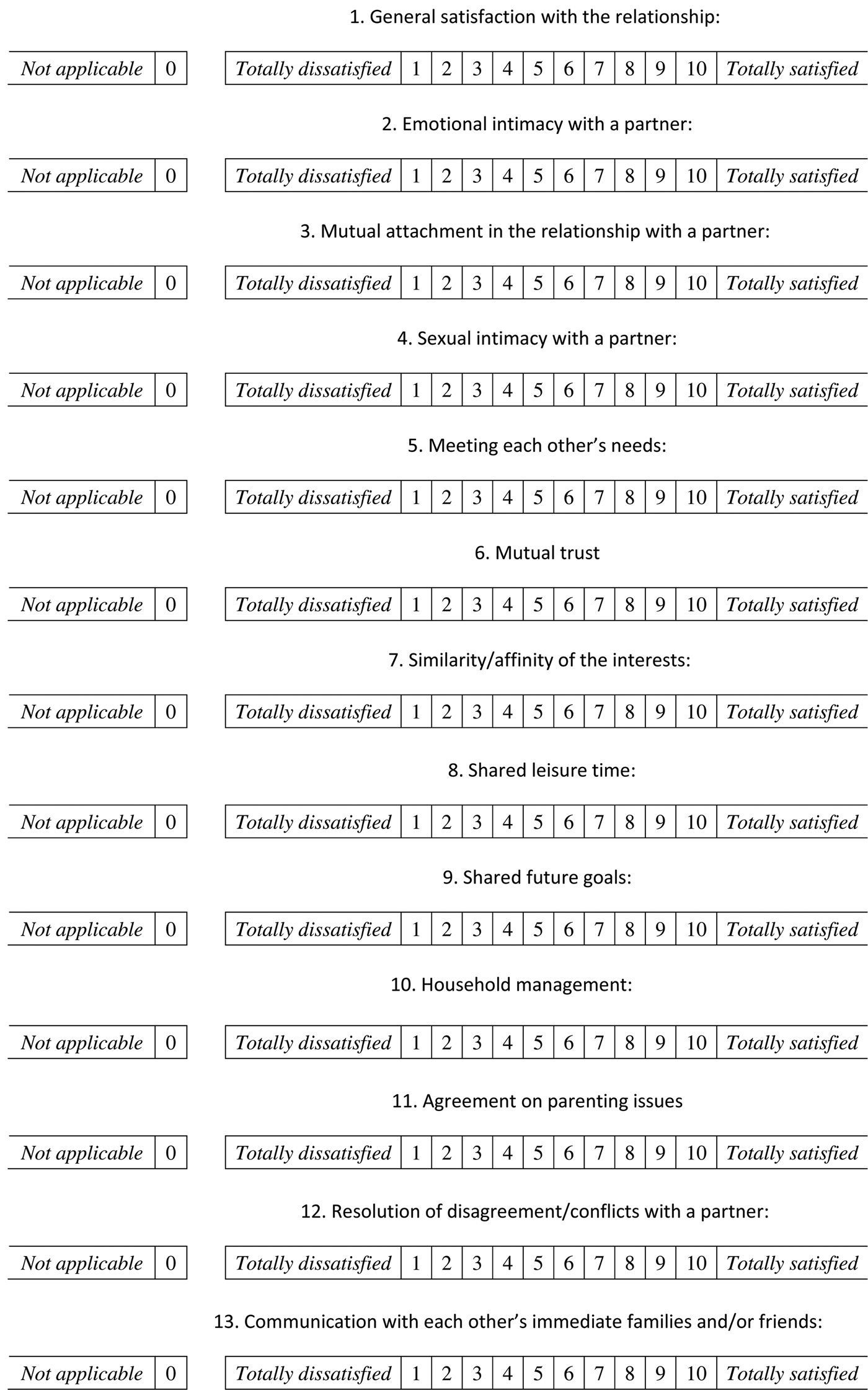
The aim was to develop an instrument that would apply to any group of couples. This decision was made having in mind that most relationship satisfaction measures are intended for couples who are married, live together and have children, and there is a lack of reliable instruments aiming to measure the relationship satisfaction of couples who are at any stage of their development (Graham et al., Reference Graham, Diebels and Barnow2011; Urbano-Contreras et al., Reference Urbano-Contreras, Iglesias-García and Martínez-González2017). Following the analysis of the literature on couple relationship described in the introduction section, it was decided to include all 12 attributes of couple relationship quality in the instrument under development. However, two attributes — parenting and household management — are quite specific and can be informative only for couples living together and who have children, while the rest of the attributes are not group-sensitive or affected by gender, duration of the relationship or couple status since they describe general relationship interactional patterns. A solution to this issue was found; although a 10-point scale for scoring was established, the additional answer point ‘Not applicable’ was set down for those specific situations when couples live separately or do not have children or do not have sexual intimacy and the like. Thus, respondents were asked to evaluate their satisfaction with different aspects of their relationship with a partner within a 10-point scale, where 1 stands for Totally dissatisfied, 10 for Totally satisfied and 0 for Not applicable. A 10-point scale was set with regard to Preston and Colman (Reference Preston and Colman2000), who argued that a higher number of response categories (between 7 and 10) produces higher reliability, validity and discriminating power, and is more preferred by respondents than a lower number of response categories (between 2 and 5). All items have the same direction; thus, a higher score reflects higher satisfaction with the relationship.
The initial instrument was provided for a professional psychologist working with couples who was asked to review it and give feedback on its potential utility to assess couples’ satisfaction with a relationship. The expert suggested to reserve all 12 items and supplement with one additional item reflecting general satisfaction with a relationship. Therefore, the final scale included 13 items reflecting different aspects of couple relationship (see Appendix).
Sociodemographic information
Respondents were asked to indicate their gender, age, couple status, and duration of the relationship.
Data Analysis
Exploratory factor analysis (EFA) was used to evaluate the structure of the CRSS using principal axis factoring and Varimax rotation. Factor eigenvalues above 1.0 determined the number of factors. Kaiser-Meyer-Olkin (KMO) and Bartlett's test of sphericity was used to decide whether the data were suited for factor analysis. An EFA was done for the overall sample and was repeated in the subsamples of men and women in order to explore whether the scale has a factor structure that is replicable and generalisable across the gender groups. Cronbach's alpha was used to determine the internal consistency reliability of the scale. Collected data were loaded and analysed using SPSS Version 23.
Results
The KMO measure of sampling adequacy was .94 for the overall sample, .92 for women and .90 for men and therefore can be considered as excellent values (Kaiser & Rice, Reference Kaiser and Rice1974). Bartlett's sphericity test was significant for all three groups (overall sample: χ2 = 2603.82, p < .001; women: χ2 = 1848.71, p < .001; men: χ2 = 865.16, p < .001). Therefore, selected sample groups were suitable for factor analysis.
The same two factors were extracted in all three groups (the overall sample and in the subsamples of men and women) with the total variance explained above 69% (see Table 1), confirming the initial hypothesis of the scale's two-factor structure.
Factors Loadings of the Couple Relationship Satisfaction Scale

The results of the factor analysis revealed that strongest loadings of factor 1 were obtained for item 5 (Satisfaction with meeting each other's needs) in overall as well as in women's samples, and for item 1 (General satisfaction with the relationship) in men's sample. The content of factor 1 reflects satisfaction with emotions-based communication between partners; thus, it was named ‘Satisfaction with an emotion-focused relationship’. The strongest loadings of factor 2 were different across three samples: for item 10 (Satisfaction with household management) in the overall sample, for item 9 (Satisfaction with shared future goals) in the men's sample, and item 11 (Satisfaction with agreement on parenting issues) in the women's sample. Factor 2 was named ‘Satisfaction with a behavior-focused relationship’, as the content of the items is related to satisfaction with how partners manage different roles and responsibilities to each other.
The internal consistency reliability of the scale and two subscales was high (total scale: Cronbach's α = .95; Satisfaction with emotions-based relationship: Cronbach's α = .93; Satisfaction with instrumental relationship: Cronbach's α = .89). It also examined whether the values would not increase if any of the scale items were removed.
Consequently, it was decided to leave the CRSS unaltered and continue its psychometric analysis in Study 2.
STUDY 2
Method
Participants and Procedure
The study was conducted online. A Lithuanian online survey software program (http:// www.apklausk.lt) was used to design and host the survey. Respondents were recruited using two methods: (1) posting an invitation to participate in the study with the web link for the survey in the social web sites (Facebook groups), and (2) requesting elementary, secondary and high schools disseminate the web link for the survey on schools’ electronic platforms designed for teachers and parents. The first web page of the survey covered a short description and information about the purpose of the study, voluntary participation, opportunity to withdraw from the study at any time, confidentiality, and data protection, as well as the contact details of the researcher.
There were two main conditions for participating in the study: being 18–60 years old and being in a romantic relationship at the moment of the participation in the study for at least half of the year. A total of 3,592 respondents reached the first web page of the survey, and 1,456 completed the questionnaires of the survey. A certain number of participants did not satisfy the criteria of inclusion, and their data were eliminated from the statistical analysis: 203 respondents indicated that they are single, 41 did not consent to their data being used in the study, and 27 were older than 60 years. Hence, the final sample consisted of 1,185 participants of whom 92% (n = 1,086) were women and 8% (n = 99) men, and the mean age was 39.21 (SD = 10.26) years. Participants were from different parts of the country: 561 (47%) lived in cities, 418 (35%) in small towns, and 195 (17%) in rural districts (1% was missing data). Regarding the level of education, 757 (64%) participants had completed university studies, 175 (15%) were studying at a college, 83 (7%) had completed professional training, 153 (13%) had finished secondary education, and 17 (1%) had not finished secondary education. Most of the participants (n = 872, 74%) were working, 132 (11%) were students, 109 (9%) were working students, and 72 (6%) were unemployed. Most of the participants (n = 848, 72%) were married, 180 (15%) cohabitated, and 157 (13%) were dating a romantic partner. The average duration of the relationship was 14.28 years (SD = 9.18). Only 22% (n = 266) of the participants did not have children.
Measures
Relationship Assessment Scale (RAS; Hendrick, Reference Hendrick1988)
The RAS is a seven-item scale designed to measure general relationship satisfaction. Respondents reply to items such as ‘How much do you love your partner?’ on a 5-point scale. The RAS is a single-factor instrument where higher scores reflect greater relationship satisfaction. For the present sample, Cronbach's alpha was .92.
Clinical Outcomes in Routine Evaluation-Outcome Measure (CORE-OM; Evans et al., Reference Evans, Mellor-Clark, Margison, Barkham, Audin, Connell and McGrath2000)
The CORE-OM is a 34-item self-report instrument designed to assess the level of psychological distress. The 34 items comprise four subscales: (1) Wellbeing (4 items; e.g., feelings about oneself and optimism about the future), (2) Symptoms (12 items; e.g., depression, anxiety, physical problems, trauma), (3) Functioning (12 items; e.g., general day-to-day functioning, close relationships, social functioning), and (4) Risk (6 items; e.g., risk of self-harm and risk of harm-to-others). All items are scored on a 5-point scale from 0 (not at all) to 4 (most or all the time). The total score is calculated by adding the response values of all 34 items with a range from 0 to 136. The higher scores of the subscales reflect the more severe distress. For the present sample, Cronbach's alphas were: (1) .79, (2) .90, (3) .82, (4) .75, and for the total score, .94.
Differentiation of Self Inventory (DSI) (Skowron & Friedlander, Reference Skowron and Friedlander1998)
The DSI is a 43-item self-report questionnaire measuring adults’ relations with the family of origin and other significant relationships. The DSI contains four subscales: (1) Emotional Reactivity (ER; 11 items reflecting the extent to which one responds to anxiety-provoking situations with intensified emotions); (2) I-Position (IP; 11 items reflecting the ability to adhere to one's beliefs despite an external pressure); (3) Emotional Cutoff (EC; 12 items reflecting feelings of excessive vulnerability in relations with others); (4) Fusion with Others (FO; 9 items reflecting emotional over-involvement as well as over-identification with parents). All items are scored on a 6-point scale from 1 (not at all true of me) to 6 (very true of me). The total score is calculated by adding the response values of all 43 items with a range from 43 to 258. The higher scores of the subscales reflect a lower level of differentiation of self. Cronbach's alphas for DSI, ER, IP, EC, and FO in the current study were .87, .82, .76, .80 and .61 respectively.
Sociodemographic information
Respondents were asked to indicate their gender, age, living place, education level, working status, couple status, duration of the relationship, and whether they had children.
Additionally, participants were asked to evaluate their relationship with a partner as poor, moderate or good. The results were used to measure the known-groups validity of the CRSS.
Data Analysis
An EFAwas used to evaluate the structure of the CRSS using principal axis factoring and Varimax rotation with two fixed factors. KMO and Bartlett's test of sphericity were inspected to decide whether the data were suited for factor analysis. Structural validity was assessed applying a CFA to investigate whether the CRSS had a two-factor structure, with two underlying latent factors accounting for item covariances, substantial factor loadings (i.e., >.40) and a low degree of mutually redundant items. A CFA was conducted using the maximum likelihood estimation. The goodness-of-fit of the proposed model was evaluated using the following indices (Hooper, Coughlan, & Mullen, Reference Hooper, Coughlan and Mullen2008): model chi-square, the root mean square error of approximation (RMSEA), the standardised root-mean-square residual (SRMR), Tucker-Lewis index (TLI) and comparative fit index (CFI). TLI and CFI values greater than .90 are considered acceptable, while values higher than .95 are considered excellent. RMSEA and SRMR values lower than 0.08 are considered acceptable, while values close to 0.05 are considered as good (Vandenberg & Lance, Reference Vandenberg and Lance2000).
Convergent validity was analysed by correlations with RAS, and discriminant validity by correlations with CORE-OM and DSI. A high correlation between the CRSS and the RAS as support for convergent validity and moderate to low correlations with subscales of the CORE-OM and the DSI as a support for the discriminant validity of the CRSS were expected. Known-groups validity of the CRSS was measured by comparing the scale scores between the groups of respondents reporting that their relationship with a partner was poor, moderate and good (ANOVA). Participants who report a poor and moderate relationship were expected to indicate lower satisfaction than participants reporting a good relationship with a partner. The data were analysed using SPSS Version 23 and AMOS Version 23.
Results
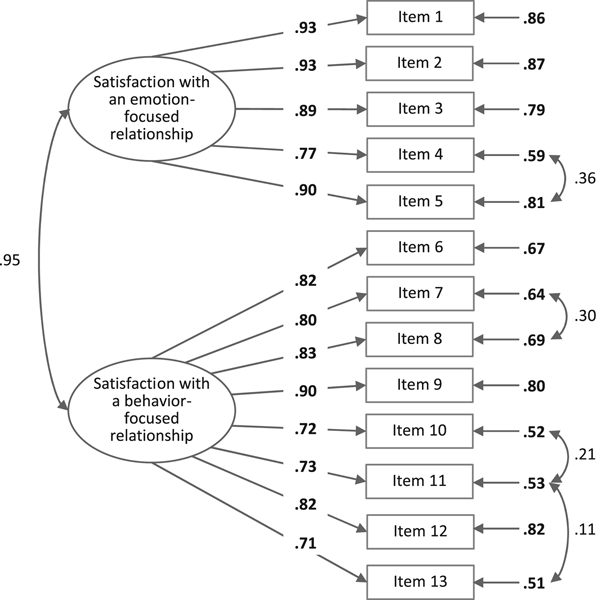
An EFA of the CRSS suggested a two-factor structure. A principal axis factoring analysis indicated that two factors explained 75% of the variance in Study 2. However, the items involved in two factors slightly changed — the loadings of items 6 and 7 showed that they were a better fit for factor 2 than for factor 1. Based on these results and the hypothesis that two underlying latent factors could account for the observed covariance structure of the observed data, the scale CFA was conducted. The analysis resulted in a significant chi-square value, χ2(64) = 564.52, p < .001, and the following indices of goodness-of-fit of the proposed model: RMSEA = .08, [.08, .09]; SRMR = .03; TLI = .95; CFI = .97. Thus, the results were rather inconsistent — some values (chi-square, RMSE) showed that the model does not fit the data, while others (SRMR, TLI, CFI) indicated that the model fits the data quite well. Therefore, the analysis of the modification indices was done. The results revealed that there were four large modification indices and covariances could be considered between items 4 and 45, 7 and 8, 10 and 11, 11 and 13. All these covariances can be explained theoretically, thus they were introduced in to the model (see Figure 1) and the goodness-of-fit indices were as follows: χ2(60) = 306.85, p < .001; RMSEA = .05, [.05, .07]; SRMR = .02; TLI = .97; CFI = .98. The chi-square value was still significant, but this statistic is substantially influenced by the sample size and hence can be ignored if the sample size is large and other indicators of fit show that the model fits the data well (Hooper et al., Reference Hooper, Coughlan and Mullen2008). Consequently, the conclusion can be drawn that the CRSS was confirmed as having a two-factor structure. The internal consistency reliability of the scale and two subscales was high (total scale, 13 items: Cronbach's α = .96; Satisfaction with emotions-based relationship, 5 items: Cronbach α = .95; Satisfaction with instrumental relationship, 8 items: Cronbach α = .93). It was also examined whether the values would not increase if any of the scale items were removed.
A confirmatory factor model of the CRSS (standardised regression weights and squared multiple correlations).

Correlations with other instruments investigated convergent and discriminant validity. The results in Table 2 demonstrate that the CRSS correlations with the RAS were very high, confirming the convergent validity of the CRSS, whereas correlations with the CORE-OM subscales as well as DSI subscales were low to moderate, confirming the discriminant validity of the CRSS.
Correlations between the Couple Relationship Satisfaction Scale and convergent as well as discriminant validity measures (N = 1,185)

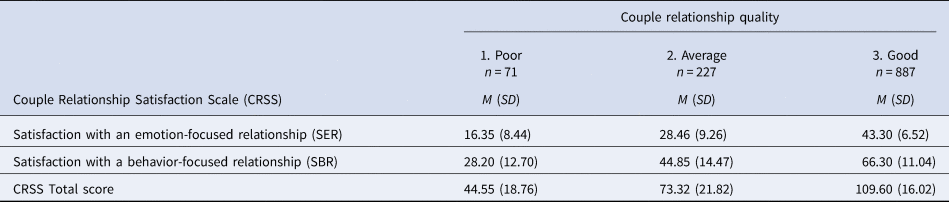
The known-groups validity of the CRSS was measured by comparing the CRSS scores between the groups of respondents reporting that their relationship with a partner is poor, moderate or good. The between-group comparisons (see Table 3) revealed that the CRSS scores significantly differentiate respondents who report different levels of the relationship: those who indicated a good relationship were satisfied more than those who indicated a lousy relationship.
The Comparison of the CRSS Group Means Between Three Groups of Couple Relationship Quality

Note: One-way ANOVA was applied, SER F(2) = 744.22, p < .001, SBR F(2) = 564.15, p < .001, CRSS F(2) = 755.83, p < .001; Levene Statistic revealed not equal variances for all subscales (p < .001), therefore Games-Howell Post Hoc Test was used; all between-group comparisons were statistically significant with p < .001
Discussion
The primary goal of this study was to develop the scale measuring couple relationship satisfaction relying on the theoretical rationale of the concept's semantic meaning and to carry out its psychometric validation.
The construct validity implemented through the exploratory and confirmatory factor analysis confirmed the hypothesis about the scale's two-factor structure. Some researchers claim that couple relationship satisfaction is a unidimensional construct and can be measured with one item or question (Graham et al., Reference Graham, Diebels and Barnow2011). Other authors support the idea that satisfaction with the couple relationship can cover more than one factor, depending on relationship aspects that are measured (Canel, Reference Canel2013; Mattson et al., Reference Mattson, Rogge, Johnson, Davidson and Fincham2013; Raffagnino & Matera, Reference Raffagnino and Matera2015). The results of the present study are in line with recent findings and strengthen the notion that couple satisfaction researchers should consider choosing instruments that cover more than one factor to allow study of the phenomenon in depth. On the other hand, the new scale, based on the idea of the concept's semantic meaning, has additional value as it measures only the phenomenon of satisfaction and undoubtedly resolves the confusion between the concepts of quality and satisfaction. The high internal consistency reliability of the subscales confirms that all items measure the same construct, as it is in this case, the couple relationship satisfaction.
The study results revealed that the CRSS has adequate convergent and discriminant validity. Convergent validity was assessed by correlating the CRSS with the RAS (Hendrick, Reference Hendrick1988) as a well-established scale measuring general relationship satisfaction, which is usually the first choice in convergent validity studies (Graham et al., Reference Graham, Diebels and Barnow2011). A high positive correlation between the scales allows a robust conclusion about the CRSS convergent validity. The discriminant validity was evaluated using two instruments, the CORE-OM, measuring an adult's level of psychosocial functioning, and the DSI, measuring an adult's differentiation of self. As expected, the correlations between the CSRR and the CORE-OM, as well as the DSI subscales, were from low to moderate. There are many studies revealing the moderate correlations between different couple relationship aspects and adults’ psychosocial functioning (Finkbeiner et al., Reference Finkbeiner, Epstein and Falconier2013; Graña et al., Reference Graña, Cuenca and Redondo2017; Røsand et al., Reference Røsand, Slinning, Eberhard-Gran, Røysamb and Tambs2012) as well as adults’ differentiation of self (Ferreira et al., Reference Ferreira, Narciso, Novo and Pereira2014). Thus, the results of this study showing that the higher relationship satisfaction is moderately related to the lower emotional, behavioural and interpersonal problems as well as to higher differentiation of self are in line with other studies. This allows the assumption that the CRSS evaluates a different construct than that of the broader psychosocial functioning or differentiation of self.
One more important aspect of the scale validity evaluated in the study was known-groups validity. The best way to measure this aspect is to compare clinical and non-clinical samples. Since this was not possible, the decision was made to group the sample according to the respondents' indication of what category of the relationship they have: poor, moderate or good. Couples seeking therapy because of relationship issues (in the studies referred to as a clinical sample) usually evaluate their relationship with a partner as poor (Snyder & Halford, Reference Snyder and Halford2012). Thus, this was the rationale to choose such an evaluation as a possible indicator of a clinical sample. Only 6% of the sample indicated having a poor relationship with a partner, leading to the assumption that this part of the sample could indeed reflect the clinical population. The results confirmed the initial expectation that individuals who evaluate their relationship with a partner as poor would be less satisfied than those who evaluate their relationship as good. Psychotherapy studies usually reveal that when a couple's relationship progresses, partners tend to evaluate satisfaction with the relationship better (Wiebe et al., Reference Wiebe, Johnson, Lafontaine, Moser, Dalgleish and Tasca2017; Wiebe et al., Reference Wiebe, Johnson, Moser, Dalgleish and Tasca2016). This clearly shows that the evaluation of one's relationship as good or poor, and satisfaction with it, are closely related. Consequently, the CRSS has the potential to discriminate couples in distress from those that are flourishing.
The initial psychometric analysis of the CRSS found that the scale is a reliable and valid measure that can be used in studies on couple relationship satisfaction. Since the scale is rather general and brief, and only measures satisfaction, it can be applied to research in adults in partnership as well as those who are married. The CRSS could have practical implications as well; practitioners working with the couples may use it to encourage discussion between partners about their satisfaction with those significant interactions and how they can contribute to improving them. The 10-point scales create more potential to observe even the slightest progress toward higher satisfaction and discuss it with a couple as well. There is already established the empirically based practice for employing 10-point scales in psychotherapy (Miller, Duncan, Brown, Sorrel, & Chalk, Reference Miller, Duncan, Brown, Sorrel and Chalk2006). Thus, the scale may serve practitioners in two ways — as a means for intervention and for progress and outcome evaluation.
Despite good initial psychometric results, some limitations of the study should be considered. The sample in Study 2 mostly consisted of women. Though the EFA and internal consistency reliability analysis conducted on male and female subsamples demonstrated very similar results in Study 1, more studies are needed to ascertain whether the CRSS is equally useful for both genders. Moreover, the study was conducted with only one partner of the couple, which limits the generalisability of the results to the couples. The CRSS research with both partners of the couple would bring more insights into the potential of the scale. The studies in the clinical sample are needed as well.
Finally, in addition to the proposed new measure, the introduced theory based on the semantic meaning of the concepts satisfaction and quality can be used in two ways. First, it can serve as a basis for improvement of measures of relationship quality and satisfaction. Second, it could be further studied by developing a measure of relationship quality to determine whether it is a separate construct. Such studies would resolve the confusion between the two concepts and whether they should be separated in couple relationship studies.
Author ORCIDs
Viktorija Cepukiene, 0000-0001-7968-5935.
Appendix
On the scale from 1 to 10 please evaluate your satisfaction with the different aspects of the relationship with your partner/spouse. If your relationship does not allow you evaluate some aspects (for example, you do not have children), please mark ‘Not applicable’: