Implications
In European pig husbandry, one out of five piglets dies before weaning, which is a major economic and welfare problem. For piglet survival, and for piglet performance before and after weaning, high piglet birth weights and litter uniformity are crucial. A way to improve piglet birth weights and litter uniformity could be the use of insulin-stimulating sow diets before mating, probably through beneficial effects on follicle development. Our results implicate that in weaned high-prolific sows, dextrose plus starch are effective insulin-stimulating feed components, but may not improve piglet birth weight and litter uniformity.
Introduction
Important factors for pre-weaning piglet survival are piglet birth weight and litter uniformity (Milligan et al., Reference Milligan, Fraser and Kramer2002; Quiniou et al., Reference Quiniou, Dagorn and Gaudré2002). Higher piglet birth weights and litter uniformity have been found using insulin-stimulating sow diets before mating (Van den Brand et al., Reference Van den Brand, Soede and Kemp2006 and Reference Van den Brand, Van Enckevort, Van der Hoeven and Kemp2009), probably through beneficial effects of insulin and/or IGF-1 on follicle development (as reviewed by Quesnel, Reference Quesnel2009). In a previous study, we found positive relationships between pre-mating insulin concentrations and luteinizing hormone (LH), follicle development and subsequent progesterone concentrations (luteal development) and embryo size (but not uniformity) at day 10 of pregnancy (Wientjes et al., Reference Wientjes, Soede, Van den Brand and Kemp2012b and Reference Wientjes, Soede, Van den Brand and Kemp2012c). Whether and how these effects lead to a more uniform development of fetuses at later stages of pregnancy, however, needs further study.
In these previous experiments with pre-mating diets (Van den Brand et al., 2006 and Reference Van den Brand, Van Enckevort, Van der Hoeven and Kemp2009; Wientjes et al., Reference Wientjes, Soede, Van den Brand and Kemp2012b and Reference Wientjes, Soede, Van den Brand and Kemp2012c), dextrose and/or lactose were used as the insulin-stimulating feed components, always at a level of 150 g/day. Effects on litter uniformity, however, may depend on the level of insulin-stimulating feed components and accompanying plasma insulin concentrations. Two sustained insulin peaks per day (i.e. twice a day feeding) seem to be more beneficial for follicle development and subsequent luteal and embryo development than a similar amount of insulin secreted in frequent short insulin peaks per day (i.e. frequent feeding; Wientjes et al., Reference Wientjes, Soede, Van den Brand and Kemp2012b and Reference Wientjes, Soede, Van den Brand and Kemp2012c). Focus of this study is, therefore, on relations with insulin profiles using twice a day feeding. Further, high and sustained insulin peaks may be more effectively obtained using dietary supplementation with dextrose plus starch than supplementation with only starch (Van den Brand et al., Reference Van den Brand, Soede, Schrama and Kemp1998) or dextrose plus lactose (Wientjes et al., Reference Wientjes, Soede, Aarsse, Laurenssen, Koopmanschap, Van den Brand and Kemp2012a).
The main objective of this study was to evaluate the effects of different levels of insulin-stimulating feed components (dextrose plus starch; fed twice daily) during the weaning-to-estrus interval (WEI) on plasma insulin and IGF-1 concentrations, and on follicle development and subsequent luteal, fetal and placental development and uniformity at days 42 to 43 of pregnancy in multiparous sows. In addition, we aim to study whether and how these reproduction characteristics are related to plasma insulin and IGF-1 concentrations.
Material and methods
General design
During WEI, multiparous sows were isocalorically fed a diet supplemented with different levels of dextrose plus corn starch and/or animal fat. After estrus, all sows received a standard gestation diet until slaughter at days 42 to 43 of pregnancy, after which luteal, fetal and placental development was assessed. All experimental procedures were approved by the Institutional Animal Use and Care Committee of Wageningen University (Wageningen, The Netherlands).
Animals and management
General management
Throughout the experiment, sows were fed twice daily (at 0730 and 1530 h), feed refusals were removed within 1 h after feeding (at 36 min after feeding on blood sampling days), and water was available ad libitum. During WEI and on blood sampling days, feed refusals were weighed, and refusal samples were stored at 4°C until analysis of dry matter content. During pregnancy and lactation, feed refusals were recorded as none (<10%), moderate (10% to 50%) or high (>50%). Sows were exposed to 12 h of light (0700 to 1900 h) during pregnancy and lactation, and 16 h of light (0700 to 2300 h) during WEI. Room temperature was kept at 18°C during pregnancy and WEI, 24°C around farrowing and 19°C during lactation.
Previous pregnancy and lactation
At day 35 of pregnancy, 60 multiparous (parity 4.7 ± 1.1 at farrowing) Topigs 20 (Topigs, Vught, The Netherlands) sows, from one farm, arrived at the experimental farm of Wageningen University in three consecutive batches of 20 sows. During pregnancy, sows were housed in groups of five sows in pens with individual feeding stalls, and fed a standard gestation feed (8.5 MJ net energy (NE)/kg, 134 g/kg CP, 5.6 g/kg ileal digestible lysine) at a level of 2.8 kg/day (days 35 to 84) or 3.1 kg/day (days 85 to 108). From day 108 of pregnancy, sows were crated in farrowing pens, and were gradually switched to a standard lactation feed (9.0 MJ NE/kg, 155 g/kg CP, 7.7 g/kg ileal digestible lysine) at a level of 2.8 kg/day. On the day of farrowing, sows received 1.5 kg feed. Thereafter, feed allowance was gradually increased to a maximum of 7 kg/day at day 17 of lactation. Piglets were fed a creep feed from 3 days of age onwards. Sows farrowed 17.3 ± 0.4 piglets (14.7 ± 0.5 liveborn and 2.5 ± 0.4 stillborn). Litter sizes were standardized within 3 days after birth. At 1.5 days before weaning (11.3 ± 0.3 piglets weaned), 57 sows received a jugular vein catheter through the ear vein as described by Wientjes et al. (Reference Wientjes, Soede, Van den Brand and Kemp2012b). The remaining three sows were excluded from the experiment because of farrowing problems (n = 1), severe lameness (n = 1) or diarrhea and low feed intake during a large part of lactation (n = 1).
WEI
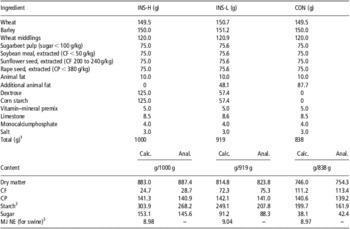
After weaning at 26.0 ± 0.2 days of lactation (at 1530h; day 0), sows were crated in feeding stalls, and fed 1 kg of the lactation feed. Thereafter, 57 sows were assigned to the experimental diets (fed until end of estrus), on the basis of parity class (⩽4 or ⩾5 at previous farrowing) and BW loss during lactation (%). Sows received either a diet supplemented with 375 g/day dextrose plus 375 g/day corn starch (INS-H) or 172 g/day dextrose plus 172 g/day corn starch (INS-L), or received a control diet (CON). Therefore, dextrose plus corn starch (both 375 g/day; INS-H) or animal fat (263 g/day; CON) were added to a basal diet containing sufficient protein, vitamins and minerals (Table 1; manufactured by Research Diet Services BV, Wijk bij Duurstede, The Netherlands). The INS-L diet was a mixture of the INS-H and CON diet (1 : 1). With daily feed allowances of 3.0 kg for INS-H, 2.75 kg for INS-L and 2.5 kg for CON, all diets were fed to be isocaloric and isonitrogenous. To account for differences in pregnancy rate among treatments in the first batches, more sows received the CON (n = 23) diet compared with the INS-L (n = 18) and INS-H (n = 16) diets. From 1.5 days after weaning, estrus detection was performed at 8-h intervals by a back-pressure test in the presence of a mature boar. Sows were inseminated every day of estrus with a commercial available dose of semen (2 × 10⁹ sperm cells) of a Topigs boar line. Ear vein catheters were removed at 3 days after weaning.
Composition of the experimental diets (as fed)

CF = crude fat; Calc. = calculated; Anal. = analyzed.
11000 g of the INS-H diet, 919 g of the INS-L diet and 838 g of the CON diet are isocaloric and isonitrogenous.
2Calculated: Ewers method; analyzed: enzymatic method.
3According to the Centraal Veevoederbureau (CVB, 2003).
Pregnancy
After end of estrus until slaughter at days 42 to 43 of pregnancy, sows were group housed and fed 2.8 kg/day of the standard gestation diet (as in previous pregnancy). At 18 to 25 days after insemination, sows were checked for estrus once daily using a mature boar, and at 25 days after insemination, pregnancy was determined by transcutaneous ultrasonography.
Measurements
Sow body condition
Sows were weighed and P2 backfat thickness was measured within 24 h after farrowing and at weaning. Sow BW loss (and backfat loss) during lactation was calculated as BW (or backfat thickness) at farrowing minus BW (or backfat thickness) at weaning.
Follicle development and estrus
On days 0.5 and 4.5 after weaning, follicle diameter was determined with transrectal ultrasonography (Scanner 200; Pie Medical/Esaote, Maastricht, The Netherlands), by averaging the diameter of the five largest follicles at one ovary. Time of onset of estrus was defined as 4 h before the first time a sow showed a standing response; end of estrus was defined as 4 h after the last time the sow showed a standing response. Ovulation was estimated to occur at 70% of the way through estrus (Soede and Kemp Reference Soede and Kemp1997).
Luteal, fetal and placental development
Non-pregnant sows (including one CON sow that aborted on day 27 of pregnancy) were slaughtered to determine the number of corpora albicantia. Pregnant sows were slaughtered at 42 or 43 days after estimated time of ovulation. Immediately after stunning and exsanguination, reproductive tracts were removed and placed on ice. Individual corpora lutea were counted, dissected and weighed. After removal of the mesometrium and separation of uterine horns, the horns were cut open at the antimesometrial side, number of total and vital fetuses was counted (vitality was based on size and color). After separating fetuses and placentas, length, weight and sex of the vital fetuses and length of their implantation sites were determined. Implantation sites of non-viable/degenerated embryos were only counted. Placental length (between necrotic tips) was measured and placental weight was determined after drying (24 h at 70°C, followed by 4 h at 103°C). Embryonic survival was calculated as the total number of implantation sites divided by the number of corpora lutea, whereas fetal survival was calculated as the number of vital fetuses divided by the number of corpora lutea.
Blood sampling
Before weaning (at day −0.5; 0730 h feeding), and at day 2 (1530 h feeding; batch 2 and 3) and day 2.5 (0730 h feeding) after weaning, blood samples were taken from the ear vein catheter at −24, −12, 0, 12, 24, 36, 48, 60, 84, 120, 156, 228, 300, 372 and 444 min relative to feeding to assess glucose and insulin profiles. In addition, at day −1 (pre-weaning), 0, 1, 2 and 3 relative to weaning, blood samples were taken at 1500 h (before feeding) to determine IGF-1 concentrations. At 12 to 13 days (by jugular venipuncture) and at 42 to 43 days (at slaughter) after estimated time of ovulation, additional blood samples were taken (prior to feeding) for progesterone determination. Blood samples were collected in polypropylene tubes with 100 μl EDTA (Titriplex III, Merck Nederland B.V., Amsterdam, The Netherlands) solution (0.39 M EDTA in saline), immediately placed on ice, centrifuged at 1710 × g for 10 min at 4°C, and plasma was stored at −20°C until analyses.
Plasma analyses
Glucose and insulin
For glucose analyses, 500 μl 0.3 M trichloroacetic acid was added to 50 μL of plasma for precipitation of protein. After centrifugation at 16 000 × g for 1 min, glucose concentrations in the supernatant were analyzed in triplicate with an enzymatic colorimetric assay using the glucose-oxidase–peroxidase (GOD–PAP) method using a commercial kit® (Roche Diagnostics Nederland BV, Almere, The Netherlands). Plasma insulin concentrations were analyzed in duplicate with a commercial RIA-kit (PI-12K Porcine Insulin RIA-kit®; Millipore, St. Charles, MO, USA). Sensitivity was 2 μU/ml, intra-assay CV was 6.4% (n = 42) and inter-assay CV was 6.0% (n = 9). For each sampling day, basal glucose and basal insulin concentrations were calculated as the mean value of the three samples taken before feeding (−24, −12 and 0 min); maximal insulin concentrations were defined as the maximum value during the first 156 min after feeding; and the area under the curve (AUC) was calculated as the area above basal glucose and insulin concentrations from feeding until 444 min after feeding.
IGF-1
Plasma IGF-1 concentrations were quantified in duplicate, using a commercial kit (IRMA IGF-1 A15729®; Immunotech, Marseille, France), after extraction of the samples with ethanol/HCl (as validated by Louveau and Bonneau, Reference Louveau and Bonneau1996). Sensitivity was 2 ng/ml, intra-assay CV was 2.2% (n = 26) and inter-assay CV was 3.5% (n = 12).
Progesterone
Progesterone concentrations were determined in duplicate, using a commercial Coat-A-Count Progesterone RIA-kit (PITKPG-7®; Siemens Medical Solutions Diagnostics, Los Angeles, CA, USA). Sensitivity was 0.1 ng/ml, intra-assay CV was 4.7% (n = 78) and inter-assay CV was 3.2% (n = 21).
Feed analyses
Diets were analyzed for dry matter (International Organization for Standardization (ISO 6496, 1999), crude fat (ISO 6492, 1999), Kjeldahl nitrogen (ISO 5983, 2005), starch (ISO 15914, 2004) and reducing sugars (as described by Van Vuuren et al., Reference Van Vuuren, Van Der Koelen, Valk and De Visser1993). CP was calculated as N × 6.25.
Statistical analyses
Three sows (two CON; one INS-H) had a low dry matter intake (DMI < 30%) during WEI and were therefore excluded from all analyses. The remaining 54 sows had a DMI ⩾83% during WEI (until onset of estrus) and a 100% DMI at blood sampling days for glucose and insulin profiles. Due to the lack of catheter patency, for one CON sow no glucose and insulin profiles were available before weaning.
Results are presented as LS means ± s.e.m., unless otherwise stated. ANOVA was applied to continuous data using the GLM procedure of SAS 9.1 (SAS Inst. Inc., Cary, NC, USA). The factors and interactions included in the statistical model were tested for significance and stepwise omitted from the model, if P > 0.05 (except for the factor treatment). Bonferroni corrections were used for multiple comparisons.
To test whether glucose and insulin parameters and plasma IGF-1 concentrations differed between sampling days, the statistical model included treatment (CON, INS-L, INS-H), parity class (⩽5 (n = 26), ⩾6 (n = 28) at slaughter), batch (1, 2, 3), sow nested within treatment, parity class and batch, sampling day (2, 2.5 for glucose and insulin; 1, 2, 3 for IGF-1), and the interaction between treatment and sampling day. Additional analyses were done for each sampling day separately. To analyze whether insulin parameters at day 2 and day 2.5 were related with pre-weaning insulin parameters, pre-weaning insulin parameters and their interactions with treatment were added to the model.
Insulin concentrations were natural logarithm-transformed, because assumptions of normality were not fulfilled. For glucose and insulin profiles, significant interactions existed between treatment and sampling time and the variance of error terms was not uniform over time (variance decreases with time after feeding). Therefore, differences between treatments were analyzed for each sampling time separately (at days 2 and 2.5), with a statistical model that included treatment (CON, INS-L, INS-H), parity class (⩽5 (n = 26), ⩾6 (n = 28) at slaughter) and batch (1, 2, 3).
To evaluate treatment effects on reproduction characteristics, the statistical model included treatment (CON, INS-L, INS-H), parity class (⩽5, ⩾6 at slaughter), batch (1, 2, 3) and the interactions between treatment and batch and between treatment and parity class. For luteal development and progesterone concentrations and for fetal and placental development, sampling time (12 or 13 days for progesterone) or slaughter time (42 or 43 days) was added as additional factor. For number of vital fetuses and implantation sites, additional analyses were performed adding ovulation rate as covariate. For fetal and placental development, additional analyses were performed adding number of implantation sites as a covariate. To check whether lactation characteristics (insulin parameters before weaning, IGF-1 concentrations before weaning, BW loss (in %) and backfat loss (in mm) during lactation) interacted with the effect of treatment, these characteristics and their interaction with treatment were added to the models.
The percentage of sows showing estrus ⩽7 days and pregnancy rate at days 42 to 43 were analyzed using the LOGISTIC procedure. The model included treatment (CON, INS-L, INS-H), parity class (⩽5, ⩾6 at slaughter), batch (1, 2, 3) and the interactions between treatment and batch and between treatment and parity class.
Pearson correlations were assessed among insulin parameters, IGF-1 concentrations and sow body condition characteristics. To study relations between insulin parameters (before weaning and at day 2.5), IGF-1 concentrations (before weaning and at day 3) or sow body condition characteristics (sow BW and backfat thickness at weaning, sow BW and backfat loss during lactation) and reproduction characteristics, the statistical model contained an insulin, IGF-1 or sow body condition characteristic as factor (divided into three classes: 25% lowest, 50% average and 25% highest observations). When reproduction characteristics were significantly affected by treatment (except for insulin parameters at day 2.5), batch, sampling/slaughter time, ovulation rate or number of implantation sites, these factors or covariates were added to the model. When effects of insulin, IGF-1 or sow body condition characteristics seemed linear, additional analyses were performed with the insulin, IGF-1 or sow body condition characteristics analyzed as covariate instead of class variable, using the same model.
Results
Effect of treatment
Average DMI during WEI (until onset of estrus) was 98.9% ± 0.4%.
Glucose
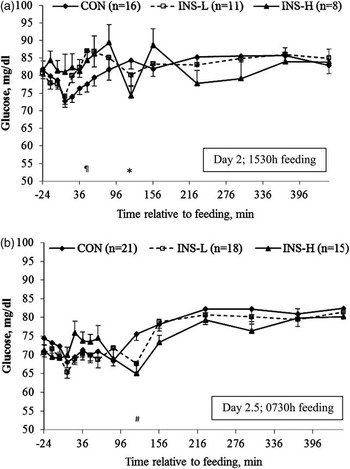
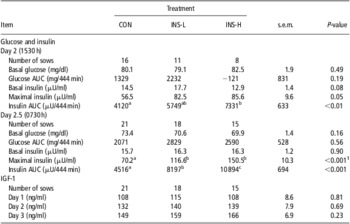
Glucose profiles are shown in Figure 1. Glucose parameters differed between days 2 (1530 h) and 2.5 (0730 h) for all treatments; basal glucose concentration was higher at day 2 than at day 2.5 (80.2 mg/dl at day 2 and 71.7 mg/dl at day 2.5; s.e.m. = 1.2, P < 0.001), whereas glucose AUC was lower at day 2 than at day 2.5 (1351 mg/444 min at day 2 and 2751 mg/444 min at day 2.5; s.e.m. = 449, P = 0.03). Glucose parameters were not affected by treatment (Table 2).
Glucose profiles at day 2 (a; 1530 h feeding) and day 2.5 (b; 0730 h feeding) after weaning for sows fed a diet supplemented with either 375 g/day dextrose plus 375 g/day starch (INS-H) or with 172 g/day dextrose plus 172 g/day starch (INS-L), or a control diet (CON) during WEI (means ± s.e.). *CON v. INS-H, P ⩽ 0.05; #CON v. INS-L and INS-H, P ⩽ 0.05; ¶CON v. INS-L, P ⩽ 0.05.

Glucose and insulin parameters and IGF-1 concentrations during WEI (weaning is day 0) for sows fed a diet supplemented with either 375 g/day dextrose plus 375 g/day starch (INS-H) or with 172 g/day dextrose plus 172 g/day starch (INS-L), or a control diet (CON; LS means ± s.e.m.)

WEI = weaning-to-estrus interval; AUC = area under the curve.
1Significantly affected by parity (P = 0.02); LS means were 126.3 μU/ml for parity ⩽5 and 98.5 μU/ml for parity ⩾6.
abcWithin treatment, values lacking a common superscript differ (P ⩽ 0.05).
Insulin
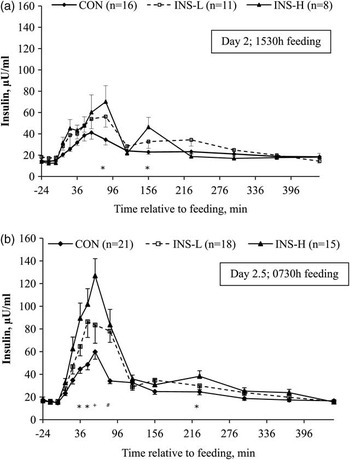
Insulin AUC was lower at day 2 (1530 h) than at day 2.5 (0730 h) (5892 μU/444 min at day 2 and 7478 μU/444 min at day 2.5; s.e.m. = 379, P < 0.01) for all treatments, but the interaction between treatment and sampling day for maximal insulin (P < 0.01) indicated that maximal insulin was significantly lower at day 2 than at day 2.5 for INS-H only (85.6 μU/ml at day 2 and 137.3 μU/ml at day 2.5; s.e.m. = 5.5). Therefore, treatment effects on insulin profiles (Figure 2) and insulin parameters (Table 2) are analyzed for each sampling day separately.
Insulin profiles at day 2 (a; 1530 h feeding) and day 2.5 (b; 0730 h feeding) after weaning for sows fed a diet supplemented with either 375 g/day dextrose plus 375 g/day starch (INS-H) or with 172 g/day dextrose plus 172 g/day starch (INS-L), or a control diet (CON) during WEI (means ± s.e.). *CON v. INS-H, P ⩽ 0.05;+INS-H v. CON and INS-L, P ⩽ 0.05; #CON v. INS-L and INS-H, P ⩽ 0.05.

At day 2 (1530 h feeding), insulin AUC was higher for INS-H than for CON (Δ = 3211 μU/444 min; P < 0.01; Table 2). At day 2.5 (0730 h feeding), maximal insulin concentrations were higher for INS-L and INS-H compared with CON (Δ = 46 and 80 μU/ml, respectively; P < 0.001), and insulin AUC differed between all three treatments (P < 0.001; Table 2).
IGF-1
Plasma IGF-1 concentrations increased during WEI (111 ng/ml at day 1, 137 ng/ml at day 2 and 158 ng/ml at day 3; s.e.m. = 2.0, P < 0.001), but IGF-1 concentrations up to 3 days after weaning were not affected by treatment (Table 2).
Reproduction characteristics
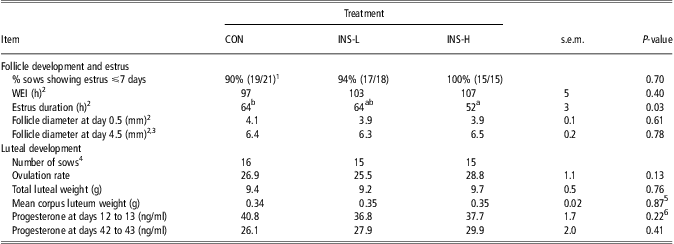
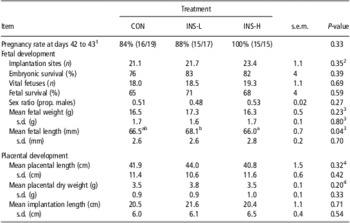
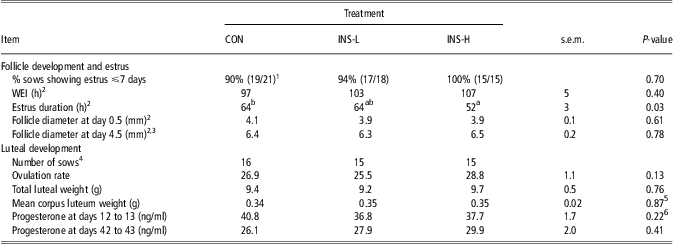
WEI and follicle development were not affected by treatment, but estrus duration was shorter in INS-H compared with CON (Δ = 12h, P = 0.03; Table 3). Pregnancy rate at days 42 to 43 (Table 4), luteal development (Table 3), and embryonic and fetal survival (Table 4) were not affected by treatment. Mean fetal length was higher for INS-L than for INS-H (Δ = 2.1 mm, P = 0.04). Litter uniformity (s.d. and CV) of fetuses and placentas was not affected by treatment (Table 4).
Follicle development, estrus and luteal development characteristics of sows fed a diet supplemented with either 375 g/day dextrose plus 375 g/day starch (INS-H) or with 172 g/day dextrose plus 172 g/day starch (INS-L), or a control diet (CON) during WEI (LS means ± s.e.m.)
WEI = weaning-to-estrus interval.
1Of which one sow ovulated (this sow is included in analyses on follicle diameter).
2Of sows with WEI ⩽7 days.
3Excluding three CON sows that had already ovulated at day 4.5.
4Excluding sows that were not pregnant (including one CON sow that aborted on day 27 of pregnancy), except that for ovulation rate and progesterone at day 12 non-pregnant sows were included.
5After correction for ovulation rate (P < 0.001), P-value for treatment was 0.74.
6Corrected for sampling moment (P = 0.01).
abWithin treatment, values lacking a common superscript differ (P ⩽ 0.05).
Fetal and placental development characteristics of sows fed a diet supplemented with either 375 g/day dextrose plus 375 g/day starch (INS-H) or with 172 g/day dextrose plus 172 g/day starch (INS-L), or a control diet (CON) during WEI (LS means ± s.e.m.)

WEI = weaning-to-estrus interval.
1Of sows with WEI ⩽7 days.
2After correction for ovulation rate (P = 0.02), P-value for treatment was 0.39.
3Corrected for slaughter time (P < 0.05).
4After correction for number of implantation sites (P < 0.05), P-values were 0.34 for mean placental length and 0.16 for mean placental dry weight.
abWithin treatment, values lacking a common superscript differ (P ⩽ 0.05).
Effects of previous lactation characteristics
During previous lactation, sows lost on average 22.9 ± 1.6 kg (8.8% ± 0.6%) of BW and 4.6 ± 0.3 mm of backfat. Before weaning (at day −0.5; 0730 h), basal glucose concentration was 65.1 ± 1.1 mg/dl, glucose AUC was 8494 ± 542 mg/444 min, basal insulin concentration was 8.0 ± 0.8 μU/ml, maximal insulin concentration was 135.6 ± 9.1 μU/ml and insulin AUC was 11 228 ± 786 μU/444 min. Plasma IGF-1 concentrations were 134 ± 7 ng/ml before weaning (at day −1) and 119 ± 6 ng/ml at weaning (day 0). No differences existed in these lactation characteristics among treatments. The interactions of these previous lactation characteristics with treatment were never significant, indicating that treatment effects on reproduction characteristics were never affected by these previous lactation characteristics (data not shown).
Relationships between insulin, IGF-1 and reproduction characteristics
Relationships among insulin and IGF-1
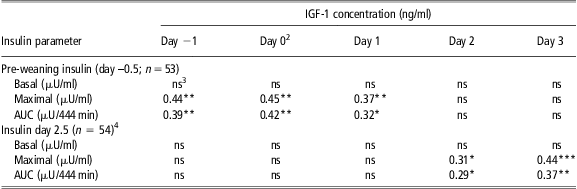
Pre-weaning insulin parameters were not related to insulin parameters at day 2 or 2.5 (after corrections for treatment), but IGF-1 concentrations at all sampling days were highly correlated (r ⩾ 0.63, P < 0.01). Pre-weaning insulin response parameters (maximal and AUC) were positively correlated with IGF-1 concentrations before weaning and at days 0 and 1, whereas insulin response parameters at day 2.5 were positively correlated with IGF-1 concentrations at days 2 and 3 (Table 5).
Pearson correlations between insulin parameters and IGF-1 concentrationsFootnote 1
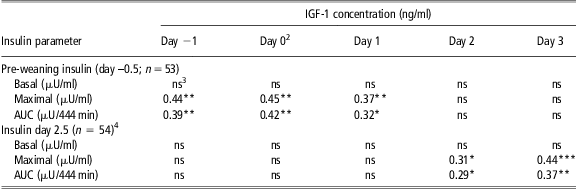
AUC = area under the curve.
1 Insulin parameters at day 2 (n = 35) were not correlated with IGF-1 concentrations.
2 Day 0 = day of weaning.
3 ns = not significant (P > 0.05).
4 For insulin parameters at day 2.5, relationships corrected for treatment gave similar results (the interaction between treatment and insulin parameter was never significant).
*P ⩽ 0.05; **P ⩽ 0.01; ***P ⩽ 0.001.
Relationships between insulin or IGF-1 and reproduction characteristics
Pre-weaning plasma IGF-1 concentration was negatively related to WEI (WEI (h) = 122.92 – 0.16 × pre-weaning IGF-1 concentration (ng/ml); r = −0.37; P < 0.01). Maximal insulin concentration at day 2.5 was positively related to progesterone at days 42 to 43 (progesterone concentration at days 42 to 43 (ng/ml) = 22.50 +0.05 × maximal insulin concentration at day 2.5 (μU/ml); r = 0.35; P = 0.02).
Relationships between sow body condition and reproduction characteristics
Relationships among insulin, IGF-1 and sow body condition
Sow BW at weaning was positively correlated with IGF-1 concentrations before weaning (r = 0.33, P = 0.02) and at weaning (r = 0.39, P < 0.01), and sow backfat thickness at weaning was positively correlated with IGF-1 concentrations before weaning (r = 0.42, P < 0.01) and at weaning (r = 0.49, P < 0.01) and with maximal insulin before weaning (r = 0.30, P = 0.03). BW loss during lactation was negatively correlated with IGF-1 concentrations before weaning (r = −0.42, P < 0.01 for both kg and %) and at weaning (r = −0.43, P < 0.01 for both kg and %), and with maximal insulin (r = −0.38, P < 0.01 for both kg and %) and insulin AUC (r = −0.32, P = 0.02 for both kg and %) before weaning.
Relationships between sow body condition and reproduction characteristics
Sow backfat loss during lactation was positively related to mean implantation length (mean implantation length (cm) = 17.25 + 0.77 × backfat loss during lactation (mm); r = 0.38; P < 0.01). No other clear relationships were found.
Discussion
The dextrose plus starch diets effectively enhanced the postprandial insulin response in a dose-dependent manner, but did not affect plasma IGF-1 concentrations in the first 3 days after weaning. Follicle development and subsequent luteal, fetal and placental development and uniformity were not affected by the dietary treatments, nor related to plasma insulin and IGF-1 concentrations during the first 3 days of WEI.
The postprandial insulin response, both insulin peak concentrations (within an hour after feeding) and long-term insulin concentrations (around 4 h after feeding), increased with the dextrose and starch content of the diet, likely reflecting the separate effects of dextrose (rapid available glucose) and starch (slower available glucose), respectively. The contrast in postprandial insulin response between the INS-L diet (172 g/day dextrose plus 172 g/day corn starch) and the control diet in this study was considerably higher than the contrast found in a previous study comparing a dextrose plus lactose diet (both 150 g/day) with a control diet (+67% v. +50% in peak concentration, +82% v. +34% in AUC; Wientjes et al., Reference Wientjes, Soede, Aarsse, Laurenssen, Koopmanschap, Van den Brand and Kemp2012a) in sows. In gilts, Van den Brand et al. (1998) found a higher insulin response (+14% in peak concentration, +44% in AUC) for a diet supplemented with dextrose plus corn starch (60 g/kg dextrose; 178 g/kg corn starch) compared with a diet supplemented with only corn starch (238 g/kg corn starch). Dietary supplementation with dextrose plus starch, thus, seems to be more effective in stimulating insulin secretion than supplementation with only starch or dextrose plus lactose. The comparable plasma glucose responses for the three diets in the present study indicate that these sows were highly able to cope with differences in glucose availability among the diets by secretion of sufficient insulin.
The postprandial insulin response was higher after morning feeding than after afternoon feeding, as observed earlier in sows (Valros et al., Reference Valros, Rundgren, Spinka, Saloniemi, Rydhmer, Hultén, Uvnäs-Moberg, Tománek, Krejcí and Algers2003) and growing pigs (Malmlöf et al., Reference Malmlöf, Örberg, Hellberg, Cortova and Björkgren1990; Koopmans et al., Reference Koopmans, Van der Meulen, Dekker, Corbijn and Mroz2005) with identical meals at either equal or unequal time intervals. A circadian rhythm in insulin responses, independent of time intervals between feedings, probably exists (La Fleur Reference La Fleur2003; Koopmans et al., Reference Koopmans, Van der Meulen, Dekker, Corbijn and Mroz2005). In addition, the longer fasting period before the morning feeding (16 h) compared with the afternoon feeding (8 h) in our study probably resulted in short-term increases in plasma free fatty acid levels before morning feeding (Barb et al., Reference Barb, Kraeling, Rampacek and Dove1997; Inoue et al., Reference Inoue, Watanuki, Myint, Ito, Kuwayama and Hidari2005), which in turn can stimulate glucose-stimulated insulin secretion (Haber et al., Reference Haber, Ximenes, Procópio, Carvalho, Curi and Carpinelli2003; Itoh et al., Reference Itoh, Kawamata, Harada, Kobayashi, Fujii, Fukusumi, Ogi, Hosoya, Tanaka, Uejima, Tanaka, Maruyama, Satoh, Okubo, Kizawa, Komatsu, Matsumura, Noguchi, Shinohara, Hinuma, Fujisawa and Fujino2003). As insulin responses differ between morning and afternoon feedings, studies investigating effects of insulin on, for example, follicle development should consider both insulin responses.
It is well known that during a period of insulin deficiency, for example, because of a catabolic state during lactation, hepatic growth hormone (GH) binding, and thereby GH-stimulated IGF-1 production is inhibited (Thissen et al., Reference Thissen, Ketelslegers and Underwood1994). Indeed in our sows, insulin and IGF-1 concentrations before weaning were negatively related to sow BW loss during lactation, and positively related to sow backfat thickness at weaning, as also observed by Hoving et al. (Reference Hoving, Soede, Feitsma and Kemp2012) and Rojkittikhun et al. (Reference Rojkittikhun, Einarsson, Uvnäs-Moberg and Edqvist1993). After weaning, sows change towards an anabolic state, associated with restoration of plasma insulin and IGF-1 concentrations (Van den Brand et al., Reference Van den Brand, Dieleman, Soede and Kemp2001a; Wientjes et al., Reference Wientjes, Soede, Van den Brand and Kemp2012b). In our sows, after weaning a quick restoration of insulin secretion took place and no relations existed between pre- and post-weaning insulin levels. Restoration of IGF-1 secretion, however, took longer and plasma IGF-1 concentrations during the first 3 days of WEI were not affected by the insulin-stimulating diets. This may indicate that modulation of plasma IGF-1 concentrations by insulin-stimulating diets after weaning is limited, as has also been found previously in anabolic sows (Wientjes et al., Reference Wientjes, Soede, Aarsse, Laurenssen, Koopmanschap, Van den Brand and Kemp2012a). However, positive relations between IGF-1 concentrations and insulin parameters were stronger at day 3 after weaning than at day 2, and plasma IGF-1 concentrations started to diverge between the diets on day 3 after weaning. This may indicate that insulin-stimulating diets during WEI result in higher plasma IGF-1 levels from 4 to 5 days after weaning onwards. Due to this possible latency in IGF-1 response to insulin-stimulating diets after weaning, however, the WEI may be too short for an effective stimulation of IGF-1 secretion by insulin-stimulating diets. Further, plasma IGF-1 concentrations during the first days of WEI were strongly related to pre-weaning IGF-1 concentrations. To stimulate IGF-1 concentrations during (the first days of) WEI, and thereby possibly influence follicle development, focus should be on increased IGF-1 concentrations during (late) lactation. In primiparous sows, both an increased feeding level and insulin-stimulating diets were effective stimulators of plasma IGF-1 concentrations during lactation (Van den Brand et al., Reference Van den Brand, Dieleman, Soede and Kemp2001a).
In contrast to previous studies (Van den Brand et al., 2006 and Reference Van den Brand, Van Enckevort, Van der Hoeven and Kemp2009; Wientjes et al. Reference Wientjes, Soede, Van den Brand and Kemp2012b and Reference Wientjes, Soede, Van den Brand and Kemp2012c), insulin-stimulating diets before mating did not affect follicle development, and thereby subsequent litter development and uniformity. These inconsistent effects may be related to differences in sow parity, sow body condition loss during lactation and/or the period of feeding insulin-stimulating diets (lactation and/or WEI) among studies, and thereby differences in plasma IGF-1 levels and follicle development at weaning. Because the insulin-stimulating diets during WEI did not effectively enhance plasma IGF-1 levels after weaning in this study, plasma IGF-1 levels may have been insufficient for the insulin-stimulating diets to improve litter uniformity. The use of younger sows (parity after treatment 3.0 ± 0.2) in the study of Van den Brand et al. (2006), which generally have higher plasma IGF-1 levels (Clowes et al., Reference Clowes, Aherne and Foxcroft1994; Van den Brand et al., Reference Van den Brand, Dieleman, Soede and Kemp2001a), may explain why insulin-stimulating diets during only WEI had positive effects on litter uniformity in their study. Effects of insulin-stimulating diets during WEI on litter uniformity may depend on the degree to which follicle development was compromised at weaning, which in turn is related to sow body condition loss, and thereby suppressed insulin and IGF-1 levels during lactation (e.g. Quesnel, Reference Quesnel2009). Insufficient restoration of follicle development at weaning may increase developmental variation within the pre-ovulatory follicle pool, as may be deduced from the recently found negative and linear relation between sow body condition loss during lactation and subsequent litter uniformity (Wientjes et al., 2013). In a previous study, in which sows lost 12.0% ± 0.5% of their BW during lactation, plasma insulin concentrations during WEI were positively related to LH, follicle development and subsequent luteal and embryo development at day 10 of pregnancy (Wientjes et al., Reference Wientjes, Soede, Van den Brand and Kemp2012b and Reference Wientjes, Soede, Van den Brand and Kemp2012c). In the current study, sows lost only 8.8% ± 0.6% of their BW during lactation, and pre-mating insulin profiles were not related to follicle development or subsequent development and uniformity of fetuses and placentas. Moreover, current sows had follicles of 4.0 ± 0.1 mm at weaning and 27.0 ± 0.6 subsequent ovulations, which may indicate that follicle development was not sufficiently suppressed in these high-prolific sows for the insulin-stimulating diets to be effective. In (organic) sows with minimal body condition loss (1.7% ± 0.7% of BW) during prolonged lactations (41 ± 4 days), and thereby probably a better follicle development at weaning compared with conventionally weaned sows, as indicated by their large litters (17.4 ± 0.3 total born piglets), insulin-stimulating diets during WEI neither affected litter uniformity at birth (Wientjes et al., Reference Wientjes, Soede, Van der Peet-Schwering, Van den Brand and Kemp2012d). It is recommended to further study whether an insulin-stimulating diet during (late) lactation could improve subsequent litter uniformity, and whether its effects are additive to or interact with effects of an insulin-stimulating diet after weaning.
In our multiparous sows, estrus duration was 12 h shorter in sows fed the INS-H diet compared with the other two diets and interval to estrus was not affected by the diets, which is in contrast to previous studies. An insulin-stimulating diet (dextrose plus starch) during WEI did not affect estrus duration (Δ = 0h) in weaned primiparous sows (Van den Brand et al., Reference Van den Brand, Prunier, Soede and Kemp2001b). Insulin-stimulating diets (starch, either or not in combination with dextrose) fed during lactation plus WEI resulted in longer estrus duration (Δ = 7h; P = 0.02) in primiparous sows (Van den Brand et al., 2000) and numerically longer estrus duration (Δ = 8h; P > 0.05) in multiparous sows (Kemp et al., Reference Kemp, Soede, Helmond and Bosch1995). Although insulin-stimulating diets did not significantly affect intervals to estrus, in all these previous studies intervals to estrus were numerically shorter in sows fed the insulin-stimulating diets (Kemp et al., Reference Kemp, Soede, Helmond and Bosch1995; Van den Brand et al., 2000 and Reference Van den Brand, Prunier, Soede and Kemp2001b). Effects of insulin-stimulating diets on estrus, thus, are not clear.
To conclude, this study shows that dietary dextrose plus starch effectively stimulate insulin secretion (both postprandial peak and long-term concentration), but not IGF-1 secretion during the first 3 days after weaning in multiparous sows. Extreme insulin-stimulating diets during WEI, however, did not improve development of follicles, and subsequent development and uniformity of fetuses and placentas in our high-prolific multiparous sows. The role of plasma IGF-1 levels and follicle development at weaning, which are both related to sow parity and sow body condition loss during lactation, and effects of insulin-stimulating diets during (late) lactation on subsequent litter uniformity need further study.
Acknowledgments
The financial support of the Product Board Animal Feed is gratefully acknowledged. The authors thank all involved students and staff of the experimental farm of Wageningen University for their help during the experiment.