On February 11, 2004, nearly fifty years after the Supreme Court handed down its landmark decision, Brown v. Board of Education, a political activist echoed the Court's rejection of “separate but equal” treatment of American citizens. The Supreme Judicial Court of Massachusetts had ruled in December that a state law providing for the option of “civil unions” between gay people violated the guarantees of equal treatment established by the Massachusetts constitution. Citing its own opinion months before, the Court held that the state constitution “affirms the dignity and equality of all individuals” and “forbids the creation of second-class citizens.”1
Goodridge v. Public Health, Id. at 312.
Seeking to prevent gay marriages in Massachusetts, state legislative leaders hastily convened a constitutional convention with the express intent of avoiding this day of reckoning; they sought to amend the state constitution to eliminate any protections against discrimination that might open the door for same-sex marriage. The Supreme Judicial Court's decision, however, prevented any easy compromise that afforded gays the benefits of marriage without marriage, and advocates on both sides of the issue aggressively mobilized their supporters.
Opponents of gay marriage in the Massachusetts debate pointed to natural law. As example, State Representative Marie Parente opined, “Nature left her blueprint behind and she left it in DNA, a man and a woman…. I didn't create that combination, Mother Nature did.”2
AP February 12.
AP February 12.
Although marriage, much less gay and lesbian rights, didn't figure into the politics of the Brown decision, the language of Brown was everywhere, and advocates claimed to capture its spirit. Arline Isaacson, co-chair of the Massachusetts Gay and Lesbian Political Caucus warned, “It's increasingly clear that the Legislature is positioning itself to take back the marriage rights we currently have, to take back over 1,000 protections we currently have, to enshrine discrimination into our constitution, and to create a system of separate but unequal.”4
AP February 12, emphasis added.
The anniversary of Brown produced a great deal of writing assessing its effects, often considering Brown's place in a larger framework of a centuries-long struggle for civil rights, its impact and limitations, and various visions of the work left to be done.5
See, for example, Anderson, Byrne, and Smiley 2004; Bell 2004; Cashin 2004; Foreman 2004; Klarman 2004; Ogletree 2004.
We begin by considering the claims activists and analysts have made for the significance of Brown. Although generally credited with helping to animate and focus the civil rights movement, scholars have also noted the Court's dependence upon other actors and institutions in order to effect broad social change. We then turn to the literature on social movements, reviewing theories relevant to our consideration of the extended effects of a judicial decision and a social movement, pointing particularly to the concepts of “signals” as a component of political opportunity, and the “spillover” of one social movement to another. We examine two related legacies of Brown for subsequent social movements: the use of litigation as a social movement strategy, and the focus on “rights” as an organizing principle or “master frame.”6
Snow and Benford 1992.
The Brown Watershed
The unanimous decision in Brown v. Board of Education looms large in virtually every narrative of the civil rights movement. Although African-Americans had been organizing for civil rights for decades beforehand, the decision marked a national political breakthrough.7
See, for example, Morris 1984.
Explicitly reversing Plessy v. Ferguson and declaring de jure segregation of public schools unconstitutional, the decision marked a success for a long-term litigation strategy employed by the National Association for the Advancement of Colored People (NAACP)'s Legal Defense Fund, which was based on building on smaller decisions about segregation in professional schools and in other public institutions.9
Kluger 1975.
Carillo 2004.
Lopez 1996.
The strategy animating Brown represented a departure in that it ended the run of cases about who was entitled to the privileges of whiteness, in effect, undermining de jure racial privilege for any group. Read aloud from the bench with all nine justices present, the decision immediately sparked action in both support of and opposition to both the desegregation of schools and a broader civil rights agenda. Brown aligned the Court with the goal of civil rights, often against the positions of not only Southern state governments, but also the president and Congress, and suggested both a tactic (litigation) and an orientation (equal rights) that animated the civil rights movement and subsequent movements for decades to come. It promised that the Supreme Court could—and would—do what other institutions of government would not.
Brown became the textbook example of the Supreme Court's political influence, even as scholars disputed how influential the decision itself was. Gerald Rosenberg, in a careful study of the effect of judicial decisions on public policy, argues that analysts assign too much importance to the Court.12
Rosenberg 1991.
Garrow 1978.
Rosenberg 2004.
But symbols matter—even if the justices could not force other branches of government to implement their decision. In a long response to Rosenberg, Michael McCann contends that a full evaluation of the importance of Brown, or any Supreme Court decision, must consider how other actors, including supporters and opponents, responded to the decision, which can alter the opportunities and discursive frameworks within which politics takes place.15
McCann 1992.
The decision circulated around activist circles. Rosa Parks read it, in conjunction with Henry Thoreau's essay on civil disobedience, at the Highlander Institute in Nashville in the summer of 1955. Brown operated as a “signal” of changed political opportunities for African-Americans,16
particularly a newly receptive federal government, and spurred what McAdam describes as “cognitive liberation” among activists and potential activists, that is, a new sense of personal efficacy for pursuing social change.17McAdam 1982.
Both supporters and critics constructed Brown as a landmark in American political history, creating a mythic tale of judicial influence. According to Aryeh Neier, “There is little need to speculate about one part of the legacy of Brown. It stimulated blacks and other deprived minorities to seed redress of their grievances through litigation…. Brown is the cause of the transformation and remains its symbol.”18
Neier 1982, 57.
Ibid., 13, emphasis original.
Others have suggested that Brown, in conjunction with a series of the Warren Court's criminal law decisions, led Americans to place undue emphasis on the courts in the political process. Reformers turned to the courts, writes Mary Ann Glendon, crafting arguments based on rights and entitlements rather than building majorities through broader political campaigns.20
Glendon 1991.
Epp 1998.
In summary, Brown appeared as a “critical event” for the civil rights movement.22
Staggenborg 1993.
Signals and Spillover
Social movements respond to, but also influence, mainstream politics, public policy, and culture. Activists choose strategies they believe to be accessible and potentially effective, and the outcomes of their efforts, at least as understood by others, shape the opportunities they and others face in the future.23
Meyer and Staggenborg 1996.
Movements can affect other movements both indirectly, through government actions they influence and cultural changes they contribute to, and directly, through shared personnel and coalition politics.25
Meyer and Whittier 1994.
Following McAdam, Tarrow, and Tilly 2002.
These three mechanisms of influence do not comprise an exhaustive list of possibilities, either for this case or in general. Meyer and Whittier 1994 offer a distinct, but overlapping set of four mechanisms, while McAdam, Tarrow, and Tilly 2002, looking at a wider range of movement processes, identify more than three dozen possible mechanisms. These three are adequate, however, for the purposes of this analysis.
Personnel. While social movements are often explicitly identified with only one issue or set of issues, activists rarely are. Working in a variety of related social changes over several decades is the rule rather than the exception for individual activists.28
The civil rights movement was animated by people who had a range of other political concerns, most notably, commitments to economic justice, peace, and the labor movement. Activists can shift goals and groups in response to the changing political environment, responding to proximate threats and opportunities, while maintaining an essentially consistent political world view.29Meyer 1993.
McAdam 1988.
Political Opportunity Structure. The world outside a social movement, that is, its political context, influences its emergence, development, and ultimate influence. Scholars working from this premise refer to the structure of political opportunities a movement faces, economically defined by Tarrow as “consistent—but not necessarily formal or permanent—dimensions of the political struggle that encourage people to engage in contentious politics.”31
Tarrow 1998, 19–20.
Meyer 2004.
Emulation. McAdam, Tarrow, and Tilly define “emulation” as “collective action modeled on the actions of others.”33
McAdam, Tarrow, and Tilly 2002, 335.
Freeman 1983.
Brown as a Signal for Social Movements
Based on the premises outlined above, we can summarize the ways in which the civil rights movement, through the Brown decision, “spilled over” to affect subsequent social movements.
Shared Personnel. The adoption of the litigation model of the civil rights movement was aided by the movement of personnel from the civil rights movement to successor movements. The experience of activism spurred young people who had campaigned in the South, for example, to return to their communities and take on issues of economic justice and rights of other disadvantaged groups. Breines, for example, documents how civil rights work energized student activists, and led them to take on urban issues in the North, transforming a concern with civil rights to a more inclusive one of economic justice. One wing of the women's movement of the 1960s and 1970s grew out of the civil rights movement, responding partly to women's frustration at their treatment within the movement. The anti-war movement, also, was built on the organizations of students who had supported civil rights, and was filled with young lawyers who saw the Federal judiciary as a potential ally.35
Breines 1989; Evans 1980; Miller 1987; Neier 1982. Some activists also spilled over into conservative causes, including the anti-abortion movement, see, for example, Marsh 1999; Maxwell 2002.
Brown's apparent success encouraged this view. First, whatever its limitations, Brown put not only school desegregation, but civil rights for African Americans more generally, on a broad national political agenda. Because activists—and others—mobilized in response to Brown, the decision became even more important. The decision sent several significant messages: first, segregation violated fundamental individual Constitutional rights, and the Federal government would intervene to end it.
Second, the Supreme Court was a powerful and independent political institution, and therefore an attractive venue for activism on behalf of those who might not win elsewhere. The Court could act against other popular and democratically accountable institutions, in the service of the Constitution, and could stand against majority will to defend the Constitution and the rights of minorities. African Americans in the South in the 1940s and 1950s did not face many attractive political alternatives for redress. Congress was dominated by a Democratic Party that depended upon a solid Southern (segregationist) contingent to maintain its majority. Presidents were also loath to act on civil rights for fear of alienating the South. The Court, more distant from political pressure, was the best available bet.
For social movements, which arise mostly among those who cannot win through more conventional political activities,36
But see Meyer and Tarrow 1998.
Epp 1998, 64.
Third, the choice to use the Supreme Court encouraged activists to frame their claims Constitutionally, and in terms of fundamental rights understood as opportunities for individuals; it directed claimants to look to the Federal government—and particularly the judiciary—as a protector. The apparent responsiveness of other branches of government, particularly the Executive, to the Court, and the receptivity of the judiciary to certain kinds of claims, encouraged all sorts of groups who saw themselves as disadvantaged to adopt a litigation strategy based on rights. Indeed, the 14 years following Brown were characterized by an activist court protecting individual rights of weak or unpopular constituencies, and hearing challenges against the government by a wide range of interests.
While the Court has always been a last resort for individuals threatened by powerful interests, including government, after the 1950s, the Court became “the most accessible, and often the most effective instrument for bringing about the changes in public policy sought by social protest movements.”38
Next, we can consider emulation. Civil rights activists' success in using the courts led a range of other interests to adopt litigation strategies, and indeed, even the organizational structure of the NAACP and its Legal Defense Fund. O'Connor, for example, describes pressure from board members of the National Organization for Women (NOW) to create a subsidiary directed to litigate on behalf of women's rights.39
O'Connor 1980, 104.
Baker, Bowman, and Torrey 1994, 17–18.
Baker, Bowman, and Torrey, 22.
Costain 1992.
The successful example of litigation, and the simple story about social change implicit in a judicial pronouncement, encouraged the strategy, and groups sought to frame themselves as like African Americans in some way, usually as a distinct group that suffers discrimination. Activists organized to provide for equal protection under the law, the same standard articulated in Brown, regardless of the nature of their constituency.43
Neier 1982, 13.
Handler reports that the war on poverty's legal services program, started in 1967, was explicitly modeled on the NAACP and the Legal Defense Fund,44
as was the Environmental Defense Fund, also founded in 1967.45Handler 1978, 44.
Rosenberg 1991, 272.
The most obvious parallel to the Brown case for social movements was the successful effort to use the Supreme Court to bypass state legislatures on abortion rights. Responding to Brown, Planned Parenthood organizers had begun litigation to get the judiciary to ensure access to birth control, advancing the notion of a “privacy right.” Activists' attention to the Courts represented something of a shift, as abortion advocates had primarily been advocating for liberalized laws through state legislatures. Blocked in the Connecticut legislature by the organized opposition of the Catholic Church, Planned Parenthood saw the federal judiciary as a friendly venue and powerful ally. In 1965, the Supreme Court recognized a privacy right in Griswold v. Connecticut, citing “penumbra” or shadows cast in the Bill of Rights, and the fourteenth amendment protection of due process.
Building on this precedent, two young lawyers in Texas, Linda Coffee and Sarah Weddington, resolved to challenge abortion law in Texas, hoping for a sweeping decision comparable to Brown. Recent graduates of the University of Texas Law School, both were well-informed on the desegregation decision. Both women were also involved with new activist women's organizations. Coffee was a member of NOW and the Women's Equity Action League, and Weddington had joined a feminist consciousness-raising group.47
They approached their goal politically, searching for a plaintiff to establish standing in order to challenge the law.The victory in Roe (1973) came before extensive national action on abortion rights, and spurred political action, first from opponents of abortion rights, and then, in response, from advocates of abortion. The evolving debate has hinged on competing visions of rights, where abortion rights advocates emphasize the autonomy of women to make decisions about their bodies and lives, and anti-abortion advocates seek to assert Constitutionally protected rights for the fetus—or unborn child.48
Staggenborg 1991.
Meyer and Staggenborg 1996. Of course, Brown didn't end the legal battle over segregation, even if important subsequent decisions about desegregating schools got far less popular attention.
The abortion story is one that remains particularly salient, but as an example of activists employing a litigation strategy and discourse of rights it is hardly unique. Table 1 offers a preliminary inventory of social movement litigation groups, most formed in the long, deep wake of Brown—with the notable exception of the American Civil Liberties Union (ACLU). To compile this list, we used several internet search engines and a variety of key words to identify social movement groups that employed the litigation strategy well-established by the NAACP's Legal Defense Fund or that employed the rhetoric of rights that Brown institutionalized in American politics.
Selected national rights organizations

A few qualifications are in order: first, this is not all-inclusive, and the descriptions provided are from the organizations themselves, and so must be considered incomplete, at least partly as marketing appeals, rather than objective assessments of activities. Most of these groups were formed during or after a period of tremendous growth in the number of interest groups in American politics, which was a response to broad changes in the organization of American politics, including, but not limited to, a period of judicial activism on rights.50
Berry 1999.
Nonetheless, the visible extent of organizational and strategic emulation is striking. The language of rights and the strategy of litigation extend well beyond the concerns of ethnic minorities, much less African Americans, to include women, disabled people, the environment, gays and lesbians, student journalists, and animals—in laboratories, farms, and the wild. Group claims explicitly reference due process under the law, basic rights, and challenge the notion of separate standards. Opponents of the social movements of the 1960s have also organized litigation-oriented social movement groups to advance their political concerns. The Center for Individual Rights, for example, recently advocated against affirmative action at the University of Michigan, citing Constitutional protections for the rights of non-minority applicants (Grutter v. Bollinger; Gratz v. Bollinger). The Pacific Legal Foundation represents property owners and the general right of private property against environmental regulation. Any observer can find at least a few groups on this list whose attributions of similarity to black children in the South in the 1950s seems strained, if not completely tortured. The point is that in the wake of Brown, more groups representing more constituencies have formed to advance a broader variety of claims through litigation.
Consequences of Spillover
Public understanding of the Brown decision encouraged numerous groups to adopt a litigation strategy for pursuing their political claims. The widespread diffusion of a litigation strategy has also had other consequences worth considering. A social movement strategy organized around litigation may lead activists to pursue efforts unlikely to pay off for them, neglecting alternative political strategies (including mass politics) that might ultimately prove more effective. A proliferation of lawsuits based on causes can crowd court dockets, distorting activist claims while undermining respect for the legal system and the law more generally. Even when successful in winning favorable decisions, litigation can provoke a political backlash against the cause and against the courts.
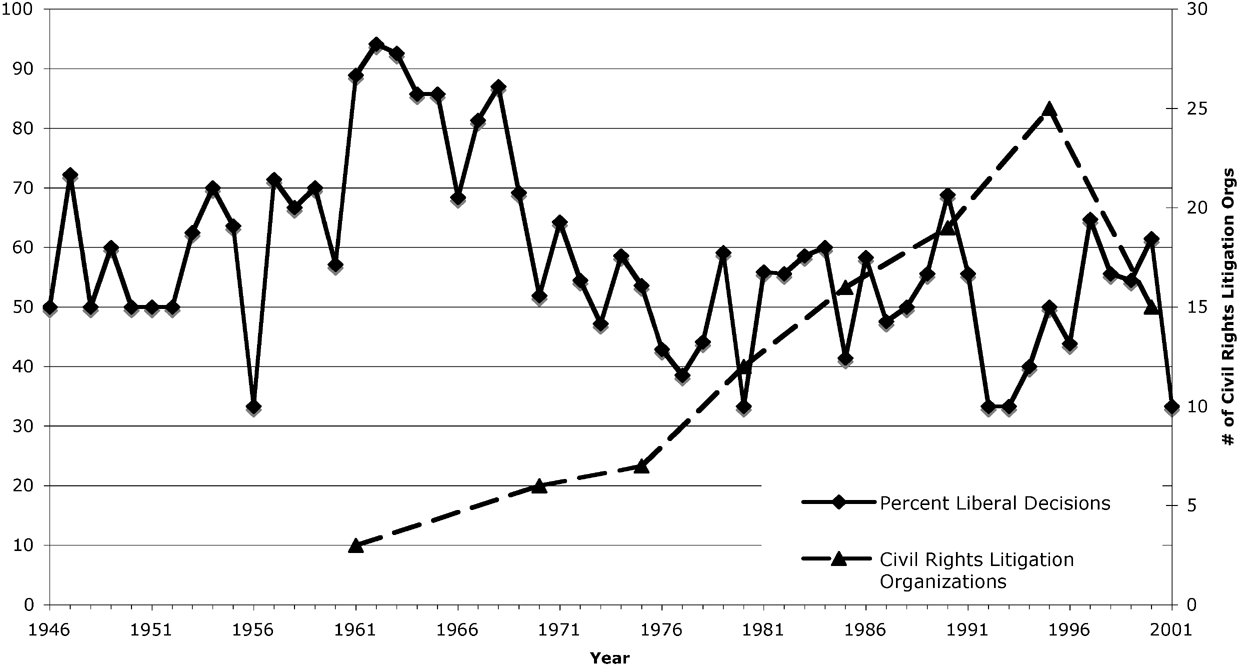
Activists read Brown as a signal of a responsive Supreme Court, but they continued to respond to that signal even when the Court that issued it was long gone. Although the Court has sometimes intervened against majorities to protect fundamental rights, activist groups cannot reliably count on it. Figure 1 shows that while the number of groups employing litigation-based strategies has increased dramatically, and rather consistently since Brown, the share of favorable Court decisions has decreased precipitously.51
The number of groups using litigation is from various editions of the Encyclopedia of Associations under the heading “civil rights.” The percentage of liberal decisions is taken from Epstein et al.'s 2003 Supreme Court Compendium.

Civil rights and the Supreme Court, 1946–2001
The declining number of liberal decisions doesn't mean that conservative activists are now winning sweeping victories in the courts. To be sure, conservative advocacy groups have also actively sought to advance their claims through the courts, but they have also been frequently disappointed, as seen in recent cases about ending affirmative action (Grutter; Gratz) and preventing the seizure of private property (Kelo v. City of New London). Antiabortion crusaders have been unsuccessful in reversing Roe v. Wade, despite decades of litigation and some significant, but not sweeping, victories in interpretation. The figure does suggest, however, that groups pursuing social change through a litigation-based strategy are unlikely to get the results they seek. Activist groups are responding to an old green light that now marks the entry to a gridlocked intersection.
The focus on the Court, perhaps once appropriate for some organizations, continues even after the composition and political role of the Court has changed. Advocacy groups, however, routinize activities, rhetoric, and tactics in order maintain their support and survival, and they develop organizational structures and professional staff that generally make tactical shifts or innovation more difficult.52
Further, the adoption of litigation ties any social movement claimant to the law and Constitutional interpretation. It is tempting to assume that we can produce massive social change by convincing a small number of justices, by strength of legal argument and logic, to mandate the policies we want, avoiding the messier and potentially less logical business of mass politics. By focusing on interpretation, however, social movement organizations may neglect simple, but unattractive, possibilities, most notably, that the law may not be on their side and that a clever interpretation of the vague language of the Constitution will fail to win many adherents. The sometimes twisted Constitutional logic that groups must employ in order to make Constitutional claims on, say, the rights of animals, undermines respect for the law more broadly and for Court decisions on other issues.
Moreover, in seeking to frame claims that appeal to Supreme Court justices, groups adopt a language of rights, inherently absolute and not amenable to compromise. Such language provokes opposition. This virtually ensures continued litigation as well as conflict outside the courts. When the Court does provide a favorable ruling, it is likely to inspire opponents not only to continue litigation, but also to undertake the necessary political organizing to forestall change. As a notable example, Roe v. Wade mobilized not only opposition to abortion rights, but also a broader conservative movement, which continues as a powerful force in American politics. The conservative backlash to Roe has recently led both liberal and conservative writers to lament the decision.53
The apparent simplicity of the judicial process, which results in a Supreme Court decision that can be interpreted as a win or loss, makes for a simpler story than the more complicated political processes that promote broad social change. Glendon suggests that the story of Brown has led to unfair, and distorted expectations of the Court on other issues, arguing, “Our justifiable pride and excitement at the great boost given to racial justice by the moral authority of the unanimous Supreme Court decision in Brown seems, in retrospect, to have led us to expect too much from the court where a wide variety of other social ills were concerned. Correspondingly, it seems to have induced us to undervalue the kind of progress represented by an equally momentous social achievement: the Civil Rights Act of 1964.”54
Glendon 1991, 6.
Simplified stories of the civil rights movement focus on Brown and edit out not only earlier lawsuits, but also the messy, difficult, and critically important political organizing and social protest that led to legislative action and social change. The important legal triumph led activists to expect the Court to step in more frequently against majorities to rescue the righteous. To the extent that groups focus on institutions unlikely to be responsive, they may be missing real openings elsewhere in the American polity—and neglecting efforts to create such openings. We might add that the focus on the Court has to some degree corrupted electoral politics, as candidates running for office, particularly the presidency, can campaign by promising to uphold or overturn Court decisions, on say, abortion, gay marriage, or the death penalty, mobilizing voters and raising money and expectations—making promises on which even successful candidates cannot deliver.
The Lure of the Law
Given the difficulties of winning broad social change in the courts, why do activists continue to pursue litigation-oriented strategies? Persistence in the face of an unfavorable environment is a function of ideological enticements, organizational interests, specialized expertise, and policy threats. First, activists are lured to the courts by what Stuart Scheingold called the “myth of rights.”55
Scheingold 1974.
Unlike playing the lottery, however, engaging in litigation entails greaters risks than the costs of entry. Even as activists lawyer on in search of the big victory, they risk defeats that can destroy morale and deal the cause a setback.56
McCann 1994.
Merry 1990, 3.
Second, some social movement organizations have extensive resources invested in the pursuit of social change through litigation. Activists are committed to social change, but they are also bound to support the survival of their organizations, and to make best use of the tools and expertise they have. Social movements comprise multi-organizational fields, including groups that specialize in litigation. In order to sustain the flow of resources into these groups, they must maintain an identity distinct from their allies, and continue to offer the promise of victory.58
Wilson 1995.
Third, like organizations, individuals have investments in particular identities and tactics. Lawyers committed to social change employ familiar tactics and make use of the skills they have. The choice of the legal system as a venue for political action reflects not only beliefs, but educational and professional investments that support those beliefs. It's easy to imagine the cause lawyer doubting the effectiveness of shifting his or her skills and efforts to an alternative political venue.
Finally, advocates of social change continue to litigate at least partly because their opponents do. When an opposing group seeks to pursue its interests through the courts, it virtually forces its opponent to do the same—or risk leaving a potentially important front in the political battle undefended.59
Meyer and Staggenborg 1996.
Conclusion
We can return to the example at the outset of this paper to see some of Brown's legacy at work in the past year or two. The gay and lesbian movements' focus on marriage emerged from material, as well as symbolic, concerns. Because health insurance, for example, is dispensed through the family unit, the costs of being barred from marriage are quite substantial. The “civil union” alternative, trumpeted by Howard Dean, John Kerry, Dick Cheney, and others in the 2004 presidential campaign, was crafted to provide material equality while ducking divisive symbolic, religious, and moral issues—and the politics of absolutes. Once the Supreme Judicial Court in Massachusetts acted, however, using the language of fundamental rights and “separate but equal,” the inevitable battle escalated.
Using the language of rights, a few local officials began to act. Mayor Gavin Newsom ordered the City of San Francisco to issue marriage licenses to same-sex couples. The Constitution of the United States, he argued, provides for this fundamental right—even in opposition to a recently passed state referendum prohibiting gay marriage, and a federal law “defending” marriage. Based on his analysis, he claimed he was not breaking the law, but instead, followed the Constitution's higher law. The mayor of New Paltz, New York, adopted a similar analysis, and began performing marriages himself. In response, an embattled President, George W. Bush, sought to use the issue to mobilize his own support, calling for a Constitutional amendment to define marriage as a mixed-sex institution, a proposal quietly dropped after his 2004 victory. That election also saw referenda prohibiting same-sex marriage in eleven states; all passed by very large margins in a preemptive backlash against judicial intervention. Meanwhile, both federal and state courts have begun to pass judgment on the issue, but we feel safe in predicting both sides pushing the issue further and further up the judicial system, hoping for an ultimate resolution that, even if articulated, is unlikely to sit.
Brown v. Board of Education serves as an icon of American progress and judicial activism. Here, we have ignored its most obvious effects—on segregation, education, and law, focusing instead on its impact on successor social movements. Brown's legacy inspired, invited, and provoked all sorts of other social movements to turn to the legal system to pursue their claims. This has also affected the way they have framed their claims and mobilized support.
Activists read the Brown decision, aided by popular interpretations of its influence, as a signal of the openness of the Courts to rights claims from those unlikely to win through other political means. Groups interpreting the NAACP's success in winning this decision, explicitly emulated its strategies and organizational structure. Importantly, organizational structures and routines adopted in one time have essentially remained, even as the signal of judicial responsiveness may no longer be appropriate. In effect, the powerful litigation interpretation may serve as a “bait and switch,” in which groups have committed to a strategy that is no longer most promising or appropriate. Symbols can matter, often in unexpected and unintended ways, and can have long-lasting effects.
In turning to the legal system, activist groups have recognized that the Supreme Court has the capacity to affect large scale political changes—albeit constrained somewhat by the language of the Constitution. Expecting the Court to come to the rescue, and placing activist hopes in the hands of a small number of people acting on their behalf, undermines the notion of a broader democratic politics; indeed, it is compatible with a kind of vicarious political participation in which professionals act on behalf of a broader imagined constituency.60
In placing politics in the hands of the Court, however, activists may have neglected a broader, more democratic, and potentially more effective politics.