I. INTRODUCTION
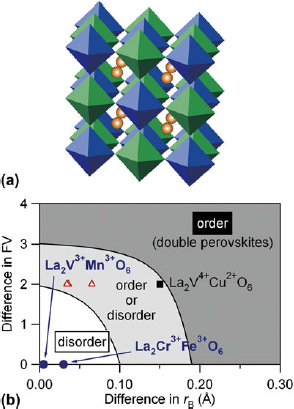
Double perovskite oxides are an intriguing class of materials, exhibiting a number of exotic properties such as the high Curie temperature (T C) ferrimagnetism and the half-metallicity.Reference Pickett and Moodera 1 Such materials and properties can be potential candidates for a new generation of spin-based devices, thereby have been attracting renewed attention. They are expressed as A2B′B″O6, where A is an alkaline or rare earth element and B′ and B″ are different transition metal elements. Figure 1(a) shows a schematic structure of the double perovskite, where the transition metals occupy the B-site alternately along the [111] direction to form a rock-salt-type sublattice. When 3d and 4d (or 5d) transition metals are combined, a large difference in the formal valences (FV) and ionic radii (r B) permits spontaneous ordering of transition metal ions, thus facile to synthesize in a bulk form. Representative examples are Sr2Fe3+Mo5+O6,Reference Kobayashi, Kimura, Sawada, Terakura and Tokura 3 Sr2Fe3+Re5+O,Reference Kobayashi, Kimura, Tomioka, Sawada, Terakura and Tokura 4 , Reference Kim, Uehara, Cheong and Lee 5 and Sr2Cr3+Re5+O6.Reference Kato, Okuda, Okimoto, Tomioka, Takenoya, Ohkubo, Kawasaki and Tokura 6 On the other hand, a few 3d–3d combinations are known to form the ordered phase, such as La2Mn4+B″O6 (B″ = Fe2+, Ni2+, Co2+).Reference Blasse 7 , Reference Ueda, Muraoka, Tabata and Kawai 8 In any cases, the differences in FV and r B have to be large to realize the ordered phase. A boundary condition between disordered and ordered phases is suggested by Anderson et al.Reference Anderson, Greenwood, Taylor and Poeppelmeier 2 They surveyed more than 300 compounds and summarized the crystalline phase in a FV–r B diagram, which is shown in Fig. 1(b). This phase diagram has been a useful guidance to date for studying bulk crystals or powder materials of the mixed perovskites. In fact, aforementioned Sr2B′B″O6 (B′B″ = Fe3+Mo5+, Fe3+Re5+, Cr3+Re5+) are located out of the disorder region (triangles), and La2Mn4+B″O6 (B″ = Fe2+, Ni2+, Co2+) will be plotted in the order region (just at right-hand side of a filled square). To the best of our knowledge, there has been no report of double perovskite oxides in ordered forms that would be placed in the disorder region (bottom left). Here, we have attempted epitaxial synthesis of La2Cr3+Fe3+O6 (LCFO) and La2V3+Mn3+O6 (LVMO) double perovskites that are marked by filled circles in Fig. 1(b). Despite vanishingly small differences in FV and r B, we have succeeded in synthesizing well-ordered phase of these compounds for the first time.
(a) Schematic unit lattice of double perovskite A2B′B″O6. The transition metals B′ and B″ surrounded with six coordinated oxygen ions (represented by blue and green octahedral, respectively) form a rock-salt-type sublattice. (b) Bulk phase diagram as a function of differences in FV and ionic radii (r B) (adopted from Ref. Reference Anderson, Greenwood, Taylor and Poeppelmeier2). The double perovskite oxides investigated in this study are marked by filled circles and square. Open triangles represent high T C half-metallic ferrimagnets, Sr2B′B″O6(B′B″ = CrRe, FeMo, FeRe, from left to right in the figure).

Our study presented here is in part motivated by seminal works by Pickett. Based on the local spin density calculation, he showed that in LCFO, the ferrimagnetic ground state with a net spin moment of 2 μB per formula unit (f.u.) is more stable than the ferromagnetic ground state with ∼7 μB/f.u.Reference Pickett 9 This prediction is inconsistent with the Kanamori–Goodenough (KG) rule, in which the d 3–d 5 superexchange (Cr3+/Fe3+; 3d 3/3d 5) is ferromagnetic.Reference Kanamori 10 , Reference Goodenough 11 On the other hand, Ueda et al.Reference Ueda, Tabata and Kawai 12 , Reference Pickett, Meijer, Ueda, Tabata and Kawai 13 postulated that their (111)-oriented films, grown by pulsed laser deposition (PLD) technique in a fashion of the LaCrO3/LaFeO3 superlattice, exhibited ferromagnetism, though the measured saturation magnetization is much less than the expected value. Until now, there is no critical evidence to support either scenario.Reference Miura and Terakura 14 , Reference Gray, Lee, Liu, Chakhalian and Freeland 15
Pickett has also investigated LVMO to find it as a possible half-metallic antiferromagnet (HMAFM), assuming a low spin (LS) state of Mn3+ ions.Reference Pickett 9 The HMAFM is a unique class of materials having a large degree of spin polarization of conduction electrons but vanishing macroscopic magnetic moment.Reference van Leuken and de Groot 16 In the case of LVMO, local spin moment will be exactly canceled if spins at V3+ and Mn3+(LS) are antiparallel (3d 3 ↓3d 5 ↑; S = −1 + 1 = 0). Some experimental studies have already been performed on the bulk disordered phase of this material, but a clear conclusion is still missing because of B-site disorder in the material.Reference Androulakis, Katsarakis and Giapintzakis 17
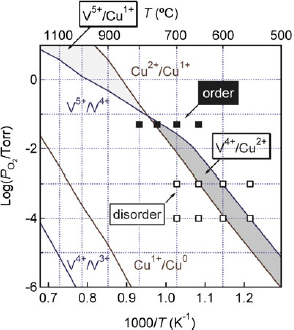
The epitaxial synthesis of the desired materials is a trial-and-error protocol, in which one has to explore a wide region of the kinetic and/or thermodynamic landscape even if a suitable material to substrate is provided. The PLD synthesis of the double perovskite oxides may be particularly puzzling because totally different oxidation dynamics of the transition metals must be tuned simultaneously. Such situation can be found in a growth phase diagram on La2VCuO6 (see Fig. 2).Reference Chakraverty, Ohtomo and Kawasaki 18 The charge neutrality will be preserved by accessing two mixed valence states with either V5+Cu1+ or V4+Cu2+, while ordered phase is realized near a crossover between two oxidation states. Similar phase diagram is established for Sr2FeMoO6.Reference Manako, Izumi, Konishi, Kobayashi, Kawasaki and Tokura 19 In this respect, tuning of oxidation dynamics is crucially important for both LCFO and LVMO systems as well.
Epitaxial growth phase diagram as a function of P O2 and growth temperature for La2VCuO6 on (111) STO. The ordered and disordered phases are marked by filled and open squares, respectively. Solid lines and shaded regions indicate phase equilibrium of V–O and Cu–O binary systems and a stable condition for coexistence of V4+/Cu2+ (dark) or V5+/Cu1+(light), respectively.

This paper summarizes our earlier results on the epitaxial synthesis of LCFO and LVMO double perovskite films, without using the artificial superlattice technique, and their structural and magnetic properties.Reference Chakraverty, Ohtomo, Okuyama, Saito, Okude, Kumai, Arima, Tokura, Tsukimoto, Ikuhara and Kawasaki 20 , Reference Chakraverty, Yoshimatsu, Kozuka, Kumigashira, Oshima, Makino, Ohtomo and Kawasaki 21 LCFO exhibits the degree of order as high as ∼90% and a saturation magnetization of ∼2 μB/f.u., being consistent with the Pickett’s model, but violating the KG rule. LVMO is a ferrimagnet with Mn3+ ions at a high spin (HS) state, in contrast to the theoretically calculated one. In addition, optical properties of these double perovskites are also investigated and compared with those of a sesquioxide analog to LCFO [i.e., α-(Cr x Fe1−x )2O3] to draw new aspects of their electronic structures.
II. EXPERIMENT
A. Pulsed laser deposition
A large number of LCFO and LVMO films were grown on an atomically flat surface of both side polished (111) SrTiO3 (STO) substrates by using an ultrahigh vacuum PLD system.Reference Chakraverty, Ohtomo, Okude, Ueno and Kawasaki 22 KrF excimer laser pulses (5 Hz, ∼1 J/cm2) were focused on targets (disordered ceramic tablet, 99.99% purity) with laser spot area of 0.35 × 0.10 cm2. The entire growth was in situ monitored by reflection high-energy electron diffraction (RHEED). The film thickness was regulated by estimating the growth rate from periods of RHEED intensity oscillations that were observable at the initial stage when a layer-by-layer growth mode was realized. During the growth, temperature (T g) and oxygen partial pressure (P O2) were kept in a range of 700–1000 °C and 10 mTorr−1 × 10⁻⁸ Torr, respectively. After the growth, samples were cooled to room temperature, keeping P O2 constant. As for LCFO, some of the samples were furnace annealed in air at 400 or 800 °C for 3 h to refill residual oxygen vacancies. The film composition was analyzed by an electron probe microanalyzer (EPMA) for those grown on (001) MgO substrates under the same conditions. The composition of cations was confirmed to be identical to those of the targets regardless of growth condition. Crystalline structure was characterized by using a four-circle x-ray diffractometer (X’pert MRD, PANalytical, Almelo, Netherlands) with Cu Kα radiation. To evaluate the degree of order accurately, x-ray diffraction (XRD) measurements were also performed at the synchrotron beamline BL-3A on the Photon Factory, KEK, Japan.
To compare with LCFO, the α-(Cr x Fe1−x )2O3 (0 ≤ x ≤ 1) solid solution films were prepared.Reference Mashiko, Oshima and Ohtomo 23 The growth was performed at 740 °C and P O2 = 1 mTorr on atomically flat c-plane sapphire substrates in the same PLD system with a KrF excimer laser operated at 10 Hz and 0.9 J/cm2. The film composition was varied with using homemade ceramics targets (x = 0, 0.25, 0.50, 0.74, 1). The films having intermediate compositions were prepared by repeating alternate ablation of two neighboring targets. The composition and crystalline structure were characterized by EPMA and XRD (SmartLab, Rigaku, Tokyo, Japan), respectively.
B. Characterizations
Film thickness was regulated to be 40–80 nm for investigating the magnetic and optical properties. Magnetization measurements were performed for LCFO and LVMO films using a superconducting quantum interference device magnetometer (MPMS-XL, Quantum Design, San Diego, CA). The hysteresis measurements were done in a field range of ±1 T at 5 K. The field-cooled (FC) and zero-field-cooled (ZFC) magnetizations were measured over a temperature range from 5 to 300 K. For clarity, diamagnetic signal of the STO substrates was subtracted. Optical absorption spectra of LCFO and α-(Cr x Fe1−x )2O3 films were evaluated from transmittance and reflectance measured with UV–Vis–IR spectroscopy at room temperature. Note that for LCFO film, data at photon energy higher than 3.0 eV does not reflect actual property because of the opaque STO substrate. This is a reason why we characterize α-(Cr x Fe1−x )2O3 films grown on transparent sapphire substrates. As will be discussed in Sec. III. C, the absorption spectra of the a-(Cr x Fe1−x )2O3 films were comparable with those of the LCFO film and reference bulks (LaCrO3 and LaFeO3).
III. RESULTS AND DISCUSSION
A. Epitaxial growth and structural characterizations
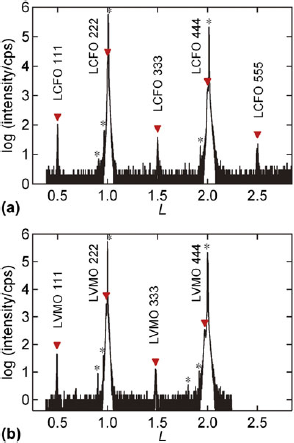
The ordered films were reproducibly obtained for both LCFO and LVMO grown in a wide T g–P O2 range. We have mapped the B-site order as a function of T g and P O2 to find the best condition at T g = 1000 °C (880 °C) and P O2 = 1 × 10⁻⁴ Torr (1 × 10⁻⁵ Torr) for LCFO (LVMO), where the Cr/Fe (V/Mn) order reached ∼90% (∼80%).Reference Chakraverty, Ohtomo, Okuyama, Saito, Okude, Kumai, Arima, Tokura, Tsukimoto, Ikuhara and Kawasaki 20 , Reference Chakraverty, Yoshimatsu, Kozuka, Kumigashira, Oshima, Makino, Ohtomo and Kawasaki 21 Figures. 3(a) and 3(b) show θ–2θ XRD patterns along the out-of-plane reflections for LCFO and LVMO films, respectively. Superlattice reflections can be seen at near half-integers L (a reciprocal lattice unit referred to STO). These results present striking demonstration of spontaneous ordering, which is unexpected in a bulk form taking similar ionic characters of constituent transition metal ions into account.
XRD patterns of the highest ordered (a) LCFO and (b) LVMO films grown on (111) STO. Film and substrate peaks are marked with triangles and asterisks, respectively. The superlattice reflections correspond to odd index peaks located at near half-integers L.

We found that these films were pseudomorphically grown on (111) STO, reflecting small lattice mismatches to cubic STO (3.905 Å); pseudocubic lattice constants were evaluated to be 3.915 and 3.919 Å for LCFO and LVMO, respectively. Atomically abrupt and coherent interface was clearly observed for the LCFO/STO by using high-angle annular dark-field scanning transmission electron microscopy.Reference Chakraverty, Ohtomo, Okuyama, Saito, Okude, Kumai, Arima, Tokura, Tsukimoto, Ikuhara and Kawasaki 20 The valence state of Cr and Fe ions was confirmed to be both 3+ by electron energy loss spectroscopy analysis. Also, the valence states of V3+ and Mn3+ were identified by synchrotron radiation photoemission spectroscopy. In addition, a HS state of Mn3+ ions was deduced from the photoemission and an optical absorption spectrum.Reference Chakraverty, Yoshimatsu, Kozuka, Kumigashira, Oshima, Makino, Ohtomo and Kawasaki 21
The mechanism of spontaneous ordering is unclear at the moment, yet we find a general tendency that lattice disorder corrupts B-site ordering, namely, a degree of ordering systematically decreased as rocking curve width for a fundamental perovskite reflection increased.Reference Chakraverty, Ohtomo, Okuyama, Saito, Okude, Kumai, Arima, Tokura, Tsukimoto, Ikuhara and Kawasaki 20 This epitaxy-induced effect with a nonequilibrium nature of PLD growth could lead to spontaneous atomic ordering in the present and other systems that are inaccessible in bulk materials. In this respect, our study presents a new benchmark beyond a framework of conventional notion of epitaxial stabilization.Reference Gorbenko, Samoilenkov, Graboy and Kaul 24
B. Magnetic properties
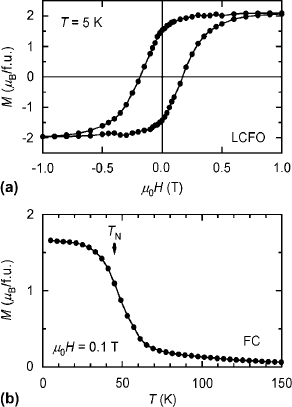
The as-grown LCFO films exhibited vanishingly small magnetization that will be discussed later. As for the oxygen-annealed films (400 °C), however, the in-plane magnetization loop taken at 5 K traced well-defined hysteresis [Fig. 4(a)]. The magnitude of saturation magnetization (M s) was ∼2 μB/f.u. being consistent with antiferromagnetic ordering of local spin moment, namely ferrimagnetic [Cr(3d 4 ↓)Fe(3d 6 ↑); S = −3/2 + 5/2 = 1]. The temperature dependence of FC magnetization showed a clear magnetic transition at 45 K [Fig. 4(b)], which was deduced from the intercept of a liner fit to 1/M(T).Reference Chakraverty, Ohtomo, Okuyama, Saito, Okude, Kumai, Arima, Tokura, Tsukimoto, Ikuhara and Kawasaki 20 Note that the sample annealed at higher temperature (800 °C) showed structural and magnetic properties almost identical to the sample annealed at 400 °C, suggesting that the ordered double perovskite form is stable against thermally assisted cation redistribution.
(a) Magnetization hysteresis curve taken at 5 K for oxygen-annealed LCFO film (88% ordered). (b) The temperature dependence of FC magnetization taken during warming under 0.1 T for the same sample.

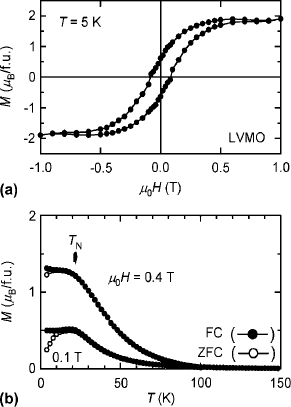
The in-plane magnetization loop measured for the as-grown LVMO films was similar to that of annealed LCFO films, but the coercive field was smaller [Fig. 5(a)]. Note that oxygen annealing was not conducted to maintain the trivalent state of V ions. The magnitude of M s was ∼1.9 μB/f.u. being consistent with antiferromagnetic ordering of local spin moment with V3+ and Mn3+ ions at a HS state (3d 2 ↓3d 4 ↑; S = −1 + 2 = 1). Figure 5(b) shows temperature-dependent FC and ZFC magnetization curves taken under 0.1 and 0.4 T. At a glance, a bifurcation in FC and ZFC curves is reminiscent of a spin glass magnet. But this observation arises from coercivity. Indeed, the coercive field vanished at a Néel temperature of T N= 21 K, where bifurcation originated.Reference Chakraverty, Yoshimatsu, Kozuka, Kumigashira, Oshima, Makino, Ohtomo and Kawasaki 21
(a) Magnetization hysteresis curve taken at 5 K for LVMO film (80% ordered). (b) The temperature dependence of FC and ZFC magnetization taken during warming under 0.1 and 0.4 T for the same sample.

We notice that the observed magnetic transition temperatures for LCFO and LVMO are considerably lower than T N of the parent compounds (280 K for LaCrO3, 750 K for LaFeO3, 140 K for both LaVO3 and LaMnO3),Reference Imada, Fujimori and Tokura 25 suggesting relatively weak antiferromagnetic superexchange. According to the KG rule, the pdσ hybridization between the e g orbitals of the transition metal ions and the oxygen pσ orbital is ferromagnetic, while the pdπ hybridization with the t 2g orbitals is antiferromagnetic. The amount of orbital overlap is larger for pdσ hybridization, while the number of paths is larger for pdπ hybridization. This competition would lead to instability in any of the dominant one for the d 3–d 5 superexchange.Reference Miura and Terakura 14 We anticipate that this mechanism is also responsible for the d 2–d 4 superexchange in LVMO.
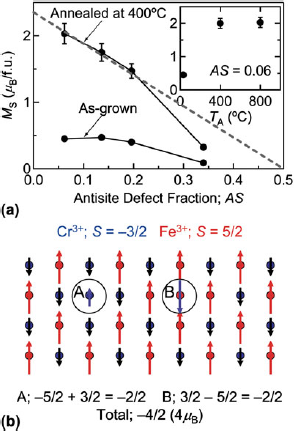
Next, let us discuss the dependence of M s on degree of order in LCFO. Here, we wish to use the notion of antisite defect (AS) instead of the Cr/Fe order, which is defined as the percentage of misplaced Cr at Fe site and vice versa, thus a single perovskite phase with complete B-site disorder would be denoted by AS = 0.5.Reference Serrate, De Teresa and Ibarra 26 Figure 6(a) shows AS dependence of M s for as-grown and annealed samples. Note that oxygen annealing led to a drastic enhancement of low-temperature magnetization. We suggest that residual oxygen vacancies existed in the as-grown samples, leading to suppression of antiferromagnetic ordering of local spin moment. The magnitude of M s systematically decreased with increasing AS and vanished at AS ∼0.37 for both cases. This systematic dependence can be explained as follows. Considering that type of antiferromagnetic ordering in LaCrO3 and LaFeO3 is G-type, the spin moment at the antisite will be antiparallel with respect to the magnetization of the host, as depicted in Fig. 6(b). In this case, each misplaced Cr ion reduces M s by 2 μB (3d 5 ↑→3d 3 ↑; S = −5/2 + 2/3 = −1), while each misplaced Fe ion also reduces M s by 2 μB (3d 3 ↓→3d 5 ↓; S = 3/2 − 5/2 = −1), giving a loss of the spin magnetization per antisite of 4 μB. Then, one expects that M s varies as (2 − 4AS)μB/f.u. and thus vanishes at AS = 0.5. In reality, the other factors such as magnetic frustration or long-range interaction may disturb the nearest- and the next-nearest-neighbor superexchange,Reference Serrate, De Teresa and Ibarra 26 which is consistent with rather rapid damping of M s, as seen here experimentally.
(a) Saturation magnetization (M s) as a function of antisite defect fraction (AS) for as-grown and oxygen-annealed LCFO films. Inset depicts M s as a function of annealing temperature (T A) for AS = 0.06 sample. The error bars reflect inaccuracy of the sample volume. Broken line indicates dependence expected from a model in (b). (b) Model of arrangement of local spin moment at an antisite defect [a pair of CrFe (circle A) and FeCr (circle B)], showing net spin compensation of 4 μB per site. Note that the spin direction at each antisite defect is opposite to either that at the right positions or that at the nearest-neighbor sites and overall antiferromagnetic ordering of the local spin moment is preserved.

C. Electronic structures
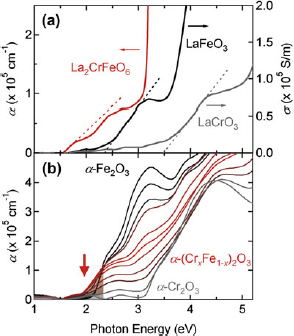
Figure 7(a) shows absorption spectrum of a LCFO film in a comparison with optical conductivity spectra of the parent compounds.Reference Arima, Tokura and Torrance 27 It is remarkable that absorption edge of LCFO exhibited redshift with respect to LaCrO3 and LaFeO3. The optical band gap is evaluated to be approximately 1.6 eV through the linear interpolation. To reveal the origin of the redshift, we have measured the absorption spectra for α-(Cr x Fe1−x )2O3 films grown on (0001) α-Al2O3,Reference Mashiko, Oshima and Ohtomo 23 which are shown in Fig. 7(b). We have found that the spectral weight around 2.0 eV dramatically increased as the composition approached to x = 0.5. This lower-energy absorption band can be attributed to excitation of valence electrons at Cr t 2g and/or O 2p orbitals to the empty Fe t 2g orbital.Reference Nabi and Pentcheva 28 Given a common coordination in the octahedral crystal field, the same mechanism is likely responsible for the observed redshift in LCFO film.
(a) Optical absorption spectrum of LCFO film taken at room temperature and optical conductivity spectra of parent compounds, LaCrO3 and LaFeO3 bulks.Reference Arima, Tokura and Torrance 27 (b) Optical absorption spectra of α-(Cr x Fe1−x )2O3 films (x = 0, 0.05, 0.15, 0.25, 0.4, 0.5, 0.6, 0.74, 0.85, 0.95, and 1).Reference Mashiko, Oshima and Ohtomo 23 Arrow and shaded region indicate absorption band assignable to a transition from O 2p/Cr 3d(t 2g) to Fe 3d(t 2g).

We have also measured absorption spectrum of a LVMO film to find that its absorption edge (0.9 eV) was close to that of LaMnO3 (1.0 eV).Reference Chakraverty, Yoshimatsu, Kozuka, Kumigashira, Oshima, Makino, Ohtomo and Kawasaki 21 In addition, synchrotron radiation photoemission spectroscopy measurements for LVMO revealed that the valence band maximum is consisted of a narrow state arising from partially occupied V t 2g and Mn e g orbitals and a broad O 2p state. Based on these results, we concluded that the lowest transition occurs as valence electrons at Mn e g and/or O 2p orbitals are excited to the empty Mn e g orbital (note that an interatomic transition from Mn e g to the empty V orbitals is spin forbidden).
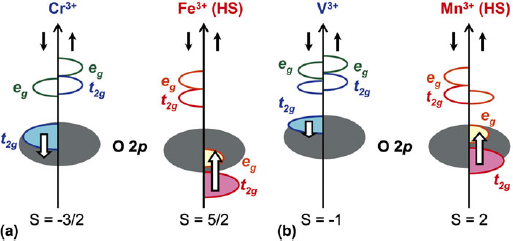
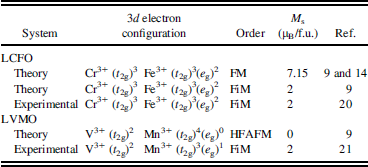
Finally, we wish to present electronic structures of LCFO and LVMO, being consistent with all of our experimental results [Figs. 8(a) and 8(b), respectively]. It is worth mentioning that the electronic structures of LCFO and LVMO are slightly modified from, but preserving characteristics of parent compounds, LaCrO3 (mixed type of insulator), LaFeO3, LaMnO3 (charge transfer insulators), and LaVO3 (Mott–Hubbard insulator).Reference Nabi and Pentcheva 28 To summarize the magnetic and electronic properties, our experimental results are compared to the results of local spin density calculation in Table I.
Schematic band structures of (a) a Cr3+–Fe3+–O compound and (b) a V3+–Mn3+(HS)–O compound having antiferromagnetic spin ordering. Energy levels of empty bands are tentatively assigned.

A comparison between experimental and theoretical calculation results on the magnetic properties of LCFO and LVMO (FM, ferromagnetic; FiM, ferrimagnetic; HFAFM, half-metallic antiferromagnetic).

IV. CONCLUSIONS
Two novel double perovskite oxides have been synthesized by epitaxial stabilization through PLD on (111) STO. As for LCFO, saturation magnetization reached ∼2 μB/f.u. at 5 K as the Cr/Fe order increases up to 90%, from which the ground state magnetic order has been verified to be ferrimagnetic (3d 33d 5; S = −3/2 + 5/2 = 1) below 45 K. LVMO (V/Mn order ∼80%, T N = 21 K) is also ferrimagnetic with Mn3+ at a HS state (3d 23d 4; S = −1 + 2 = 1). Both compounds are insulators exhibiting charge transfer gaps in visible light region. α-(Cr x Fe1−x )2O3 as a sesquioxide analog to LCFO also shows similar optical properties including smaller band gaps than its end members. Based on these results, we propose plausible band structures of LCFO and LVMO. Although it remains an open question why epitaxial films yield double perovskite phases, while bulk does not, our study sheds light on physical properties of the double perovskites, consisting of earth-abundant transition metals and yet experimentally unexplored.
ACKNOWLEDGMENTS
The authors thank Dr. D. Okuyama, Prof. R. Kumai, Prof. T. Arima, and Prof. Y. Tokura for synchrotron radiation XRD measurements and structural analysis, Dr. M. Saito, Prof. S. Tsukimoto, and Prof. Y. Ikuhara for STEM and EELS analyses, Prof. H. Kumigashira, Dr. K. Yoshimatsu, Dr. E. Sakai, Prof. M. Oshima, Dr. T. Makino, and Dr. Y. Kozuka for synchrotron radiation XPS and optical spectroscopy analyses, and all of them for fruitful discussions. A.O., H.M., and T.O. thank Prof. Y. Wada and Dr. D. Mochizuki for assistance regarding EPMA analysis. This work was partly supported by a Grant-in-Aid for Scientific Research (Grant No. 24245035) from the Japan Society for the Promotion of Science. H.M. is supported by the Program for Leading Graduate Schools “Academy for Co-creative Education of Environment and Energy Science,” of the Ministry of Education, Culture, Sports, Science and Technology.