Introduction
In most European countries, male piglets are castrated during their first days of life, in order to avoid meat with boar taint. In 2010, castration of young male piglets without pain relief will be prohibited in Switzerland (TSchV, 2008). Fattening entire male pigs and active immunization against gonadotropin-releasing hormone (GnRH) (so called immunocastration) offer possible alternatives to common surgical castration practice.
Due to the anabolic effects of testicular hormones, entire males are more feed efficient and consequently their carcasses are leaner (Xue et al, Reference Xue, Dial and Pettigrew1997). However, the presence of boar taint, which depends mainly on the concentration of androstenone, skatole and indole stored in tissue lipids (Claus et al, Reference Claus, Weiler and Herzog1994), can reduce consumer’s acceptance of pork. In a recent study comparing the growth performance of group-penned entire males and barrows, we reported that, entire males grew slower (774 v 830 g/day), consumed less feed (1.88 v 2.23 kg/day) but were more feed efficient (2.43 v 2.69 kg feed/kg gain) than barrows (Pauly et al, Reference Pauly, Spring, O’Doherty, Ampuero Kragten and Bee2008) The lower average daily feed intake (ADFI) and lower average daily gain (ADG) of entire males compared to barrows, is in agreement with Lawlor et al (Reference Lawlor, Mullane, Lynch, Kerry and Allen2003) and Dunshea et al (Reference Dunshea, Colantoni, Howard, McCauley, Jackson, Long, Lopaticki, Nugent, Simons, Walker and Hennessy2001) but in contrast to earlier results reported by Campbell et al (Reference Campbell, Steele, Caperna, McMurtry, Solomon and Mitchell1989) and Dunshea et al (Reference Dunshea, King, Campbell, Sainz and Kim1993). Based on earlier observations (Pauly et al, Reference Pauly, Spring, O’Doherty, Ampuero Kragten and Bee2008), it is unclear whether appetite is limiting or feed intake is low because of increased aggressive behaviour of group-penned entire males. We hypothesized that when social interactions and aggressive behaviour are limited by raising the boars in individual pens, their full growth potential could be exploited.
Active immunization against GnRH by using Improvac® (Pfizer Ltd, Zurich, Switzerland) inhibits the sexual development of boars by disrupting the hypothalamic-pituitary-gonadal axis. As a result, the development of testes and hormone synthesis is hindered. From a meat quality point of view, the most important effect of active immunization is that the synthesis of androstenone is suppressed. Furthermore, reduced levels of testicular steroids in immunocastrates accelerate the metabolic clearance of indolic compounds, thus, lowering skatole and even indole concentrations at tissue level (Zamaratskaia et al, Reference Zamaratskaia, Andersson, Chen, Andersson, Madej and Lundström2008). Until the second vaccination, immunocastrates grow at a similar rate as entire male pigs (Dunshea et al, Reference Dunshea, Colantoni, Howard, McCauley, Jackson, Long, Lopaticki, Nugent, Simons, Walker and Hennessy2001). In several studies comparing barrows, immunocastrates and entire male pigs, it was found that immunocastrates had higher ADG and better feed conversion ratio (FCR) than barrows (Dunshea et al, Reference Dunshea, Colantoni, Howard, McCauley, Jackson, Long, Lopaticki, Nugent, Simons, Walker and Hennessy2001; Turkstra et al, Reference Turkstra, Zeng, van Diepen, Jongbloed, Oonk, van de Wiel and Meloen2002). When entire males are compared to immunocastrates, results are inconsistent (Dunshea et al, Reference Dunshea, Colantoni, Howard, McCauley, Jackson, Long, Lopaticki, Nugent, Simons, Walker and Hennessy2001; Turkstra et al, Reference Turkstra, Zeng, van Diepen, Jongbloed, Oonk, van de Wiel and Meloen2002; D’Souza and Mullan, Reference D’Souza and Mullan2003). The available data suggest that the growth performance and carcass characteristics of immunocastrated boars are strongly influenced by two key factors. These are the growth potential of entire males prior to the second vaccination, and the time interval between the second vaccination and slaughter (Dunshea et al, Reference Dunshea, Colantoni, Howard, McCauley, Jackson, Long, Lopaticki, Nugent, Simons, Walker and Hennessy2001; Metz et al, Reference Metz, Hohl, Waidelich, Drochner and Claus2002).
Castration influences carcass leanness. The adipose tissue of entire male pigs has a lower lipid content and the degree of unsaturation is higher than in barrows (EFSA, 2004). Through variation in the backfat thickness, one can hypothesize that fatty acid composition of immunocastrated boars should be intermediate between entire males and barrows.
The primary objective of this study was to compare growth performance, carcass characteristics, meat quality traits and fatty acid composition of the subcutaneous adipose tissue from group-penned barrows, immunocastrates and entire male pigs reared under Swiss husbandry conditions and fed standard growing–finishing diet used in Switzerland (experiment 1). A second objective of this study was to elucidate the reasons for the low ADFI and ADG of entire males by rearing entire male pigs either in a group pen or in individual pens (experiment 2).
Material and methods
The Swiss Federal Committee for Animal Care and Use approved all procedures involving animals.
Experiment 1: animals and treatments
In experiment 1, a total of 39 Swiss Large White male pigs originating from 12 litters (11 litters with three siblings/litter; 1 litter with six siblings/litter) were included. From weaning until the start of the experimental period (BW = 27.6 ± 0.5 kg; age = 74.5 ± 1.3 days (mean ± s.e.)), pigs were group penned (13 pigs/pen) and had ad libitum access to a standard starter diet formulated according to Swiss feeding recommendations (ALP, 2005). The pens for the weaned pigs were equipped with single-space computerized feeders (Mastleistungsprüfung MLP-RAP; Schauer Agrotronic AG, Sursee, Switzerland) which allowed for the recording of individual feed intake. At an average BW of 15.3 ± 0.6 kg (age = 55.2 days), the three littermates were allocated to three experimental groups (barrows (C; n = 13), immunocastrated male pigs (IC; n = 13) and entire male pigs (EMG; n = 13)) to assure equal average BW between the experimental groups. After the piglets were allocated, the C pigs were castrated after injecting a local anaesthesia (Lidocain–Epinephrin 2%; Streuli Pharma AG, Switzerland). Under Swiss commercial practice, castration is performed within the first 14 days of age. The reason for the delayed castration in this experiment was to assure group homogeneity with respect to BW at the start of the trial. At an average BW of 27.6 ± 0.5 kg, the C, IC and EMG pigs were moved to the growing–finishing barn.
Vaccination
The IC pigs were vaccinated with Improvac®, which contains a modified form of gonadotropin-releasing factor (200 μg GnRF–protein conjugate/ml) in an aqueous adjuvant system. Each IC pig was vaccinated twice subcutaneously behind and below the base of the ear with 2 ml of Improvac®. Furthermore, as a control, the C and EMG pigs were injected with a saline solution (0.8% (w/v)). All pigs were injected at one time. The first and second injections were carried out when the heaviest IC reached 25 kg of BW (mean ± s.e. of all IC pigs: BW = 22.6 ± 0.8 kg; age = 67 ± 1 days) and 80 kg of BW (mean ± s.e. of all IC pigs: BW = 73.0 ± 1.5 kg; age = 131 ± 1 days), respectively. The rectal body temperature of the C, IC and EMG pigs was assessed 48 h before and at 0, 4, 24 and 48 h after the injection. In addition, at the same time points, based on visual observations and palpation, the injection site was scored on a scale from 1 to 4 (score 1 = normal, not more than a visible injection site with less than 0.5 cm diameter zone of cutaneous erythema surrounding it; score 4 = severe, visible and palpable subcutaneous or intramuscular swelling as well as evidence of irritation at the injection site with >5 cm diameter zone of cutaneous erythema surrounding it).
Experiment 2: animals and treatments
Experiment 2 was conducted in parallel with experiment 1. Thus, in addition to the 39 pigs originating from 12 litters used in experiment 1, 13 additional male piglets from those litters (two from one litter and one per litter from 11 litters) were selected at 55.2 days of age. Compared to the EMG pigs, these entire male pigs (EMP; n = 13) were reared from weaning until slaughter in semi-slatted individual pens (2.6 m2/pig) with the laying area slightly covered with sawdust and straw, in environmentally controlled buildings (22°C and 60% to 70% relative humidity). They had free access to water. EMP pigs were also injected with a saline solution (0.8% (w/v)).
Growth experiment, slaughter procedure and carcass measurements
The growth trial (experiments 1 and 2) lasted from May to September 2007 and was divided into a growing (27 to 63 kg BW) and a finishing (63 to 107 kg BW) period. In experiment 1, to evaluate the effect of vaccination on growth performance, the finishing period was divided into an early finishing period (63 kg BW to second vaccination) and a late finishing period (second vaccination to slaughter). The C, IC and EMG pigs were reared for the entire experimental period in semi-slatted group-pens (13 animals/pen; 1.5 m2/animal) with the laying area slightly covered with sawdust and straw, in environmentally controlled buildings (22°C and 60% to 70% relative humidity). Pens were equipped with two drinkers and two single-space computerized feeders (Mastleistungsprüfung MLP-RAP) as described earlier (Bee et al, Reference Bee, Jacot, Guex and Biolley2008).
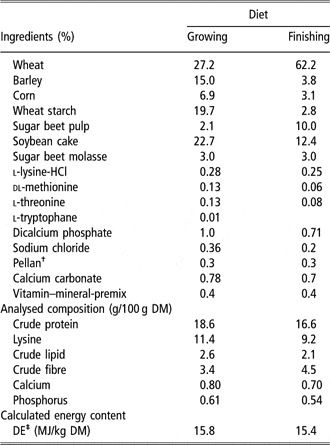
All pigs had ad libitum access to the same growing and finishing diets (Table 1). Individual feed intake was recorded weekly for the EMP pigs and at each visit to the feeder for the C, IC and EMG pigs, respectively. The BW of all animals was determined once a week. From 80 kg BW until slaughter, pens were cleaned daily and barn ventilation was set at maximum-power to reduce skatole absorption through the skin and the lungs (Hansen et al, Reference Hansen, Larsen, Jensen, Hansen-Møller and Barton-Gade1994). Two pigs (one C and one EMG) died during the trial. The cause of death was not related to the treatments.
Composition of the growing and finishing diet, as-fed basis

DM = dry matter.
†Pellan = a binder that aids in pellet formation (Mikro-Technik GmbH & Co. KG, Germany).
‡DE = digestible energy content (MJ/kg) calculated from nutrient content (expressed in g/g DM) according to ALP (2005).
Animals were slaughtered 2 days after reaching 103 kg BW. Feed was withdrawn from the pigs 12 h before transportation to a nearby commercial abattoir (approximate transport time = 15 min). During transport and lairage, slaughter pigs from different pens were separated from each other. At the abattoir, animals were electrically stunned, exsanguinated, scalded, mechanically de-haired and eviscerated. Internal organs were removed and hot carcass weight was obtained. The weight of the testes, bulbourethral and salivary glands as well as the heart, liver and kidneys were assessed. At 30 min after exsanguination, the carcasses entered the air-chilling system (3°C) for 24 h. One day after slaughter, the left side of each carcass was weighed and dissected according to the meat cutting standards applied by the Swiss Performance testing Station (MLP, Sempach, Switzerland), as described earlier (Bee, Reference Bee2001).
Meat quality measurements
The pH of the longissimus muscle (LM) at 30 min and 24 h post mortem, was measured using a pH meter (pH196-S, WTW, Weilheim, Germany) equipped with an electrode (Eb4; WTW) and a temperature probe. Sets of measurements were obtained at the 10th-rib of the right carcass side at 30 min, by insertion of the pH and temperature probe between the ribs from the inside of the carcass. At 24 h post mortem, the LM from the 10 to 13th-rib level was excised and pH was determined at the 10th-rib level. Subsequently, four 1.5-cm-thick LM chops were cut and labelled A, B, C and D. From chops A and C, drip loss was determined as the amount of purge formed during storage of chops at 4°C for 48 h (Honikel, Reference Honikel1998). From the chops B and D, light reflectance coordinates (L*: lightness, a*: redness and b*: yellowness) of the muscle surface were determined following a 10-min bloom, using a Chroma Meter CR-300 with a D65 light source (Minolta, Dietikon, Switzerland). Subsequently, these samples were vacuum-packaged and stored at −20°C until thaw and cooking loss, as well as Warner-Bratzler shear force were assessed. The frozen samples were thawed for 24 h at 2°C, subsequently, kept at room temperature for 1 h and the thaw loss was determined. Both samples were then cooked on a grill plate (Beer Grill AG, Zurich, Switzerland) at 190 to 195°C, to an internal temperature of 69°C, and cooking losses were measured. Using a Warner-Bratzler shear device (Model 3000, G-R Electric Mfg Co., Manhattan, KS, USA), shear force was measured as described earlier (Bee et al, Reference Bee, Calderini, Biolley, Guex, Herzog and Lindemann2007). From each carcass, adipose tissue samples (both layers) were collected at the 10 to 14th-rib level, vacuum-packaged and stored at −20°C until further analysis.
Adipose tissue analysis
The androstenone, skatole and indole concentrations in the adipose tissue were measured by HPLC as described earlier (Pauly et al, Reference Pauly, Spring, O’Doherty, Ampuero Kragten and Bee2008), and the levels were expressed as μg/g tissue. In addition, the fatty acid profile in the adipose tissue was determined as described earlier (Bee et al, Reference Bee, Calderini, Biolley, Guex, Herzog and Lindemann2007).
Statistical analysis
The data on growth performance, carcass characteristics and meat quality traits, as well as the fatty acid composition and androstenone, skatole and indole concentrations of the adipose tissue, were separately analysed for each experiment using the MIXED procedure of SAS (version 9.1; SAS Institute, Cary, NC, USA), and the statistical analysis was based on the following model:

where Xijk is the observed parameter, μ is the overall mean, αi is the experimental treatment (fixed effect), βj is the litter (random effect) and εijk is the error.
The individual pig served as the experimental unit. Least square means were separated using the PDIFF option (P < 0.05). Tendencies were established at P < 0.10. Due to lack of normality of the residuals, the concentrations of skatole were transformed with 1/√x Normality of the residuals of the androstenone and indole levels could not be achieved by data transformation, therefore the data were analysed with the non-parametric Friedman test, with the experimental groups as fixed and litter as random effects. To determine differences between treatments, the Bonferroni procedure was used with the two-tailed Wilcoxon’s signed-rank test (P < 0.05). Spearman’s rank correlations were calculated between androstenone, skatole and indole tissue concentrations, and organ weights and length.
Results
Growth performance, carcass characteristics and organ weights (experiment 1)
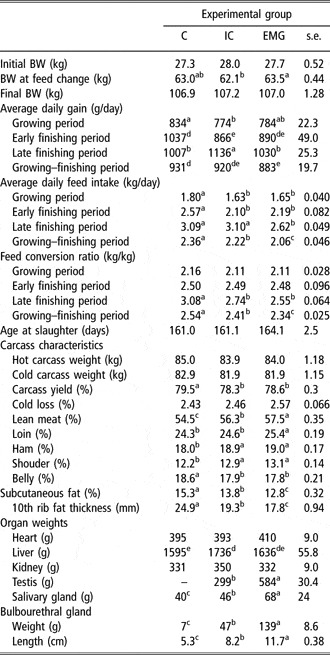
Growth performance from weaning to the start of the experimental period did not (P > 0.05; data not shown) differ among the experimental groups, despite that C pigs were castrated only at 53 days of age. Over the entire experimental period, C pigs tended to grow faster (P < 0.10) than EMG pigs, ingested more (P < 0.05) feed and were less (P < 0.05) feed efficient than IC and EMG pigs (Table 2). There was no difference in overall ADG between IC and EMG (P > 0.05). Due to the higher feed intake of IC compared to EMG, FCR was better for EMG (P < 0.05). During the late finishing period, which varied from 23 to 44 days, IC pigs grew faster (P < 0.05) than EMG and C pigs and, together with C pigs, ingested more (P < 0.05) feed than EMG pigs. However, during this period, IC and EMG pigs had a better feed efficiency (P < 0.05) than C pigs. In accordance to the lacking differences in the overall ADG, age at slaughter did not (P > 0.05) differ among the experimental groups.
Growth performance, carcass characteristics and organ weights of barrows (C), immunocastrated (IC) and entire male pigs (EMG) raised in group pens (experiment 1)Footnote †

a–c Within a row, least square means for experimental treatments without a common superscript differ (P < 0.05).
d,e Within a row, least square means for experimental treatments without a common superscript differ (P < 0.10).
† Abbreviations are: BW at feed change = BW when the grower diet was switched to the finisher diet; early finishing period = 63 kg BW until the time point of second vaccination at 73 kg BW; late finishing period = from second vaccination to slaughter at 107 kg BW; carcass yield = hot carcass weight expressed as the percentage of the BW at slaughter; cold loss = cold carcass weight expressed as the percentage of the hot carcass weight; lean meat percentage = sum of denuded shoulder, back and ham weights as percentage of cold carcass weight; subcutaneous fat percentage = sum of external fat from the shoulder, back and ham expressed as percentage of cold carcass weight.
Carcass yield in the IC and EMG groups was lower (P < 0.05; Table 2) than in the C experimental group. The carcasses of C pigs were fatter than those of IC, which themselves were fatter (P < 0.05) than those of EMG pigs. The percentages ham and shoulder were lower, and the percentage belly was greater (P < 0.05) in C than IC and EMG pigs. The loin percentage did not (P > 0.05) differ between C and IC pigs, but was lower (P < 0.05) than in EMG pigs.
The liver tended (P < 0.10) to be heavier in IC pigs compared with C pigs, EMG pigs being intermediate. As expected, method of castration affected (P < 0.05) the weight of the testes, salivary and bulbourethral glands, being heavier in EMG than IC pigs. In accordance to the heavier weights, the bulbourethral glands of EMG pigs were longer (P < 0.05) than those of IC pigs. It is worth mentioning that the testes of one IC pig were heavier than those of four EMG pigs (553 v 431, 471, 512 and 541 g). The time span from second vaccination to slaughter did not correlate with testes weight of IC (r = −0.18; P > 0.05). The bulbourethral glands were, without exception, lighter (P < 0.05) in IC than in EMG pigs. The lightest (P < 0.05) and shortest (P < 0.05) bulbourethral glands, and the lightest salivary glands (P < 0.05) were found in C pigs.
Effect of Improvac® or saline solution injection on body temperature and injection site (experiment 1)
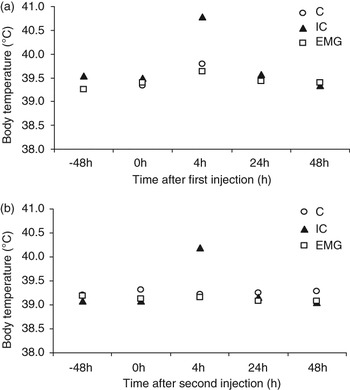
After the first and second vaccination, the body temperature at 4 h post-injection was on an average 1.1 and 0.9°C higher (P < 0.05) in IC than in C and EMG pigs (Figure 1a and b). The visual observation and palpation of the injection site revealed overall low scores. No animal showed a score above 2. Higher scores (P < 0.05) were observed for IC than C and EMG pigs after the first (24 and 48 h) and the second vaccination (4 and 24 h; data not shown).
Body temperature determined −48 h before and 0, 4, 24 and 48 h after the first (a) and second (b) injection of barrows (C) and entire male pigs (EMG) with a saline solution and immunocastrated pigs (IC) with Improvac®.

Meat quality and fatty acid composition of the adipose tissue (experiment 1)
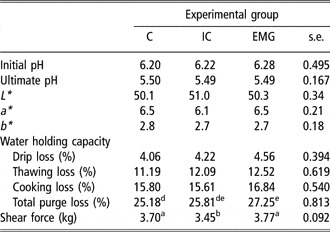
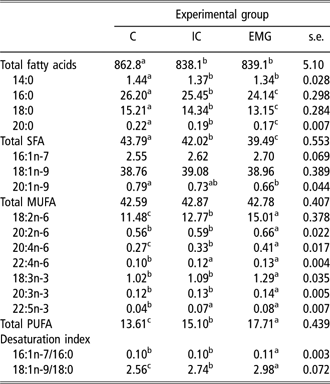
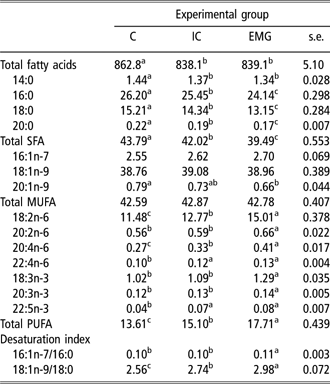
Initial and ultimate pH, L*, a*, b* values, as well as the percentages drip, thaw and cooking loss did not (P > 0.05) differ among the experimental groups (Table 3). However, total purge loss (sum of thaw and cooking loss) tended to be greater (P < 0.10) in the LM of EMG than C pigs, with intermediate values in the LM of IC pigs. Shear force values were higher (P < 0.05), indicating tougher meat, in the LM of C and EMG than IC pigs. The degree of saturation of the adipose tissue decreased (P < 0.05) from C to IC and from IC to EMG pigs (Table 4). These differences were mainly due to a decrease in the concentrations of palmitic (16:0), stearic (18:0) and eicosanoic acids (20:0), and concomitantly to an increase in levels of linoleic (18:2n-6) and arachidonic acids (20:4n-6). The tissue level of monounsaturated fatty acids (MUFA), especially oleic acid (18:1n-9), did not (P > 0.05) differ among the experimental groups. In accordance, the 18:1n-9/18:0 desaturation index increased (P < 0.05) from C to IC, and from IC to EMG. By contrast, the 16:1n-7/16:0 desaturation index was similar for C and IC but was higher (P < 0.05) for EMG pigs.
Meat quality traits determined in the longissimus muscle from barrows (C), immunocastrated (IC) and entire male pigs (EMG) raised in group pens (experiment 1)Footnote †

a,b Within a row, least square means for experimental treatments without a common superscript differ (P < 0.05).
d,e Within a row, least square means for experimental treatments without a common superscript differ (P < 0.10).
† Abbreviations are: total purge loss = total weight loss of a loin chop collected the day after slaughter, vacuum-packaged and stored at −20°C for several months, subsequently thawed overnight at 4°C and then cooked to an internal temperature of 69°C expressed as percentage of the initial weight of the fresh loin chop.
Fatty acid composition of the adipose tissue from barrows (C), immunocastrated (IC) and entire male pigs (EMG) raised in group pens (experiment 1)Footnote †
a–c Within a row, least square means for experimental treatments without a common superscript differ (P < 0.05).
† Abbreviations are: SFA = saturated fatty acids; MUFA = monounsaturated fatty acids; PUFA = polyunsaturated fatty acids; fatty acids are expressed as g/100 g total fatty acids. Fatty acids were designated by the number of carbon atoms followed by the number of double bonds. The position of the first double bond relative to the methyl(n) end of the molecule was also included.
Androstenone and skatole concentrations in the adipose tissue of group-penned animals (experiment 1)
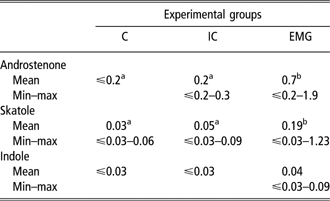
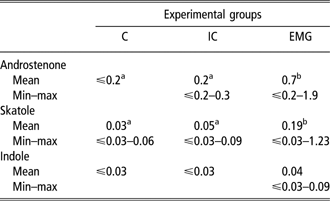
The androstenone concentration in the adipose tissue of EMG pigs was higher (P < 0.05) than in IC and C pigs (Table 5). A large variability in the androstenone concentration was observed in the adipose tissue of EMG pigs, ranging from below detection limit (⩽0.20 μg/g) to 1.9 μg/g. Except for one IC pig (0.3 μg/g), the androstenone concentrations in the adipose tissue of all C and IC pigs were below the detection limit of the HPLC method used. As observed for androstenone, the skatole concentrations in the adipose tissue of the EMG pigs were greater (P < 0.01) than in the adipose tissue of both the C and IC pigs. The skatole concentrations in the adipose tissue of four EMG pigs were high (0.21, 0.21 and 0.24 μg/g) or very high (1.23 μg/g). The indole level in the adipose tissue was not (P > 0.05) influenced by the method of castration and was very low. When data from C, IC and EMG pigs were combined, androstenone tissue concentration was correlated with skatole levels (r = 0.46; P < 0.05). Both, androstenone and skatole tissue concentrations were positively (P < 0.05) correlated with the weight of the salivary (r = 0.83 and 0.43) and bulbourethral glands (r = 0.81 and 0.66), as well as with the length of the bulbourethral glands (r = 0.76 and 0.61). Analyses of the combined data from IC and EMG revealed increasing androstenone (r = 0.81; P < 0.05) and skatole (r = 0.37; P = 0.07) tissue levels with increased testes weights.
Androstenone, skatole and indole concentrations (expressed in μg/g tissue) in the adipose tissue of barrows (C), immunocastrates (IC) and entire male pigs (EMG) raised in group pens (experiment 1)Footnote †
a,b Within a row, least square means for experimental treatments without a common superscript differ (P < 0.05).
† The detection limits of the used HPLC procedure are (expressed as μg/g adipose tissue): androstenone = 0.2 μg, skatole and indole = 0.03 μg.
Growth performance, carcass characteristics and organ weights (experiment 2)
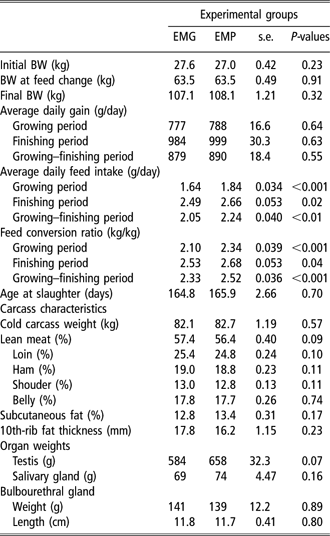
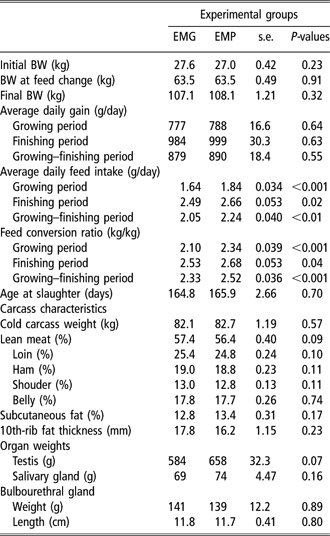
In the growing and finishing periods, EMP pigs consumed more (P < 0.05) feed than EMG ones and had a poorer feed efficiency (P < 0.05) (Table 6). However, ADG did not differ (P > 0.05) among the experimental groups. Compared with EMG pigs, the carcasses of EMP pigs tended (P = 0.09) to have less lean meat mainly due to lighter (P = 0.10) loins. The testes, but not the salivary and bulbourethral glands, tended (P = 0.07) to be heavier in EMP than in EMG pigs.
Growth performance, carcass characteristics and organ weights of entire male pigs reared in group pens (EMG) or in individual pens (EMP) (experiment 2)Footnote †
† Abbreviations are: P-values = probability values for the experimental treatment; lean meat percentage = sum of denuded shoulder, back and ham weights as percentage of cold carcass weight; subcutaneous fat percentage = sum of external fat from the shoulder, back and ham expressed as percentage of cold carcass weight.
Meat quality, fatty acid composition, androstenone, skatole and indole concentrations of the adipose tissue (experiment 2)
Initial and ultimate pH, as well as percentages drip, thaw and cooking loss of the LM did not differ (P ⩾ 0.16; data not shown) among the experimental groups. Compared with EMP, the LM of EMG pigs was redder (a*: 6.4 v 6.0; s.e.: 0.17; P < 0.05) and shear force values were lower (3.8 v 4.1 kg; s.e.: 0.11; P < 0.01). The numerically higher saturated fatty acids (SFA) (EMP = 40.4% v EMG = 39.7%; s.e.: 0.61; P > 0.05) and MUFA (EMP = 43.4% v EMG = 42.7%; s.e.: 0.50; P > 0.05) concentrations in the adipose tissue of EMP pigs were compensated by lower polyunsaturated fatty acid (PUFA) concentrations (EMP = 16.3% v EMG = 17.7%; s.e.: 0.48; P < 0.01). Responsible for these differences were the lower (P < 0.01) linoleic (13.9% v 15.0%; s.e.: 0.41), arachidonic (0.3% v 0.4%; s.e.: 0.02), docosatetraenoic (0.10% v 0.13%; s.e.: 0.004), linolenic (1.2% v 1.3%; s.e.: 0.04) and docosahexaenoic acid (0.05% v 0.08%; s.e.: 0.007) tissue concentrations in EMP compared with EMG pigs.
No differences (P > 0.05) in the androstenone, skatole and indole concentrations were detected in the adipose tissue between EMP and EMG pigs. Androstenone tissue concentrations were positively (P < 0.05) correlated with skatole levels (r = 0.81), salivary glands weight (r = 0.48), bulbourethral glands weight (r = 0.45) and length (r = 0.44), but not (P > 0.05) with the weights of testes. The level of skatole was not (P > 0.05) correlated with the anatomical parameters (P < 0.05).
Discussion
Castration leads to a drastic reduction of the gonadal steroids synthesis, such as androgens and estrogens (Claus et al, Reference Claus, Weiler and Herzog1994). By doing so, the anabolic potential of the pig is modified, thereby affecting growth performance, carcass composition and pork quality. Compared to barrows, IC pigs keep this anabolic potential for a much longer period of time (Metz and Claus, Reference Metz and Claus2003), which is of high practical relevance. In experiment 1, the ADG of IC pigs confirms those obtained in a recent Swiss field study (Jaros et al, Reference Jaros, Bürgi, Stärk, Claus, Hennessy and Thun2005). Despite the lower ADG of IC pigs during the growing period, the overall growth rate did not differ from C pigs, due to the higher ADG after the second vaccination (late finishing period). During the same period, IC pigs had higher ADFI and ADG than EMG pigs. These findings are in agreement with recent results of other studies (Zeng et al, Reference Zeng, Turkstra, Jongbloed, van Diepen, Meloen, Oonk, Guo and van de Wiel2002; Oliver et al, Reference Oliver, McCauley, Harrell, Suster, Kerton and Dunshea2003). In contrast, Metz et al (Reference Metz, Hohl, Waidelich, Drochner and Claus2002) obtained comparable ADG, FCR and backfat thickness in immunocastrates and barrows. In comparison to the present study (second vaccination: 23 to 44 days before slaughter), Metz et al (Reference Metz, Hohl, Waidelich, Drochner and Claus2002) applied the second immunization earlier (10th and 16th-week of age), thus shortening the phase during which the animal can profit from the anabolic potential of the entire male. The timing of the second vaccination is likely to be a key reason for the observed differences. The observed differences in appetite, before and after the second vaccination, could be related to drastic changes in testosterone concentration. According to Claus and Weiler (Reference Claus and Weiler1987), the application of a testosterone implant reduced feed intake of barrows by about 25%. While the testosterone levels have been shown to drop quickly after the second vaccination (Claus et al, 2007), Metz and Claus (Reference Metz and Claus2003) determined that the growth hormone concentration in the plasma of immunocastrates remained close to those of entire males for several weeks. This might explain the observed compensatory growth after immunocastration (Bonneau et al, Reference Bonneau, Dufour, Chouvet, Roulet, Meadus and Squires1994).
As the vaccination lowers testosterone production, it is likely to decrease the aggressive behaviour, which is related to the testosterone concentration (Giersing et al, Reference Giersing, Lundström and Andersson2000). At 2 weeks after the second Improvac® injection, Velarde et al (Reference Velarde, Gispert, Font i Furnols, Dalmau, Soler, Tibau and Fàbrega2008) observed less activity and a lower number of mounts in immunocastrates than entire males. Consequently, immunocastrates had less time for general activity and social behaviour than entire males. This lower behavioural activity may account for better feed conversion, because the energetic cost of being standing is very high in pigs (Noblet et al, Reference Noblet, Shi and Dubois1993).
An additional consequence of the higher ADFI of IC compared to EMG pigs after the second vaccination, was the fatter carcasses. However, the benefits of the sexual hormones before the second vaccination were not completely lost, as IC pigs had an overall higher feed efficiency and their carcasses were leaner compared to barrows. Differences in percentage lean meat between the IC and C groups are due to higher percentage of ham and shoulder, but not of loin. Muscle associated with mobility (muscles of the fore and hind limb) have been shown to develop earlier in life (Richmond and Berg, Reference Richmond and Berg1982). By contrast, allometric growth coefficients of muscles involved with posture, such as the LM, are higher. Thus, they may be regarded as developmentally retarded muscles (Bee et al, Reference Bee, Calderini, Biolley, Guex, Herzog and Lindemann2007). As the second vaccination reduces the anabolic potential in the late finishing period, LM development might be more affected than ham and shoulder.
Not only carcass fatness, but also the lipid content of the subcutaneous fat differed among the experimental groups, being lower in EMG and IC, than in C pigs, which is in line with results reported by Barton-Gade (Reference Barton-Gade1987). Besides the impact on lipid content, the fatty acid composition also differed between experimental groups. The palmitic, stearic and total SFA concentrations increased and the linoleic, arachidonic and total PUFA decreased in the adipose tissue from EMG to IC, and from IC to C pigs. No changes among the experimental groups were observed for the oleic and total MUFA concentrations. In accordance to these findings, differences in the fatty acid composition between entire males and barrows have been reported in earlier studies as well (Wood et al, Reference Wood, Buxton, Whittington and Enser1986; Barton-Gade, Reference Barton-Gade1987). These differences in the fatty acid composition, especially the level of PUFA, were mainly related to changes in the rate of subcutaneous fat deposition (Wood and Enser, Reference Wood and Enser1982). The proportion of oleic acid, the main MUFA in swine adipose tissue, is determined by the dietary supply, as well as by the elongation and desaturation of the saturated homologues. The desaturation step is influenced by dietary PUFA of the n-6 family, which are known to impair the activity of the stearoyl-CoA desaturase (Kouba and Mourot, Reference Kouba and Mourot1998). In the present study, the desaturation indexes (ratios: palmitoleic to palmitic acid and oleic to stearic acid) were calculated, which are known to relate well with the activity of the stearoyl-CoA desaturase (Klingenberg et al, Reference Klingenberg, Knabe and Smith1995; Kouba et al, Reference Kouba, Mourot and Peiniau1997). Compared to the IC and EMG groups, conversion of palmitic and stearic acids into their desaturated homologues was decreased in the adipose tissues of C pigs. This suggests a regulatory effect of dietary PUFA intake on stearoyl-CoA desaturase activity. Due to the higher ADFI, dietary PUFA intake was greater in C pigs compared to pigs in the other experimental groups. To our knowledge, no information on the fatty acid composition of the adipose tissue from immunocastrates is available. In accordance to the aforementioned relationship between fat deposition rate and PUFA concentration, the degree of unsaturation in IC pigs was intermediate between C and EMG pigs, as was the case with the backfat thickness.
In contrast to the profound differences in fat quality, only pork tenderness, as assessed by the shear force measurements in the LM, differed among the experimental groups, being higher in C than in IC and EMG pigs. A plausible cause for this difference could be the compensatory growth of IC, compared to C and EMG pigs, at the end of the finishing period. Recently, Kristensen et al (Reference Kristensen, Therkildsen, Riis, Sorensen, Oksbjerg, Purslow and Ertbjerg2002) and Bee et al (Reference Bee, Biolley, Guex, Herzog, Lonergan and Huff-Lonergan2006) reported that compensatory growth before slaughter is followed by an increased proteolytic potential (μ-calpain : calpastatin ratio) and higher tenderization rate.
After the second vaccination, anti-GnRH response markedly inhibits testes growth. In accordance to results reported by Dunshea et al (Reference Dunshea, Colantoni, Howard, McCauley, Jackson, Long, Lopaticki, Nugent, Simons, Walker and Hennessy2001), testes of IC pigs were 51% lighter than testes of EMG pigs. Based on this finding, testes weights could be used to judge good vaccination practice at the slaughter line. However, a complete discrimination is not possible because as shown in the present study, the testes of one IC pig were heavier than those of four EMG pigs. Based on results of earlier studies, testes weight is highly correlated with BW in entire males (Prunier et al, Reference Prunier, Bonneau and Etienne1987). Similarly, we report that testes of IC pigs are also heavier when slaughter weight increases. Thus, both traits, testes and slaughter weight together, could be used to judge the effectiveness of vaccination.
Through changes in liver metabolism, a reduction of the androstenone concentration implicates also a reduction of the skatole concentration in the adipose tissue. Several studies (Dunshea et al, Reference Dunshea, Colantoni, Howard, McCauley, Jackson, Long, Lopaticki, Nugent, Simons, Walker and Hennessy2001; Jaros et al, Reference Jaros, Bürgi, Stärk, Claus, Hennessy and Thun2005; Zamaratskaia et al, Reference Zamaratskaia, Rydhmer, Andersson, Chen, Lowagie, Andersson and Lundström2008) have demonstrated a very consistent effect of Improvac® on both, androstenone and skatole levels, with proper vaccine application. Our findings confirm this effect, as the androstenone, skatole and indole concentrations in the adipose tissue of all IC pigs were clearly below the sensory thresholds set by Walstra et al (Reference Walstra, Claudi-Magnussen, Chevillon, von Seth, Diestre, Matthews, Homer and Bonneau1999), while some of the EMG littermates had concentrations above these limits.
Similar to results of an earlier experiment (Pauly et al, Reference Pauly, Spring, O’Doherty, Ampuero Kragten and Bee2008), EMG pigs tended to grow slower than C. This low growth rate was associated with a low feed intake. Although ADFI in the present study tended to be higher than in the aforementioned study (2.06 v 1.90 kg/day), overall the ADFI of entire males was still low. Cronin et al (Reference Cronin, Dunshea, Butler, McCauley, Barnett and Hemsworth2003) and Zeng et al (Reference Zeng, Turkstra, Jongbloed, van Diepen, Meloen, Oonk, Guo and van de Wiel2002) also observed lower dietary energy intake of entire males than barrows. The low feed intake could be related to the negative influence of sexual hormones. Claus and Weiler (Reference Claus and Weiler1987) reported that increased oestrogen and androgen concentrations inhibit feed intake. Thus, the low feed intake could limit the intake of essential nutrients. The lysine concentration of the diets was slightly lower compared to recent published recommendations (9.2 v 9.6 g/kg dry matter; O’Connell et al, Reference O’Connell, Lynch, Lawlor and O’Doherty2006). Therefore, one could hypothesize that the lysine intake was below the required level for maximal protein accretion of entire males, thereby further limiting their growth rate.
In experiment 2, EMP consumed more feed than EMG, however, ADG was similar for both groups. The higher feed intake is in agreement with results from other studies (de Haer, Reference de Haer1992; Nielsen et al, Reference Nielsen, Lawrence and Whittemore1996), showing that the feeding behaviour of individually penned pigs (castrates and females) differ significantly from that of group-penned animals, with individual penning resulting in shorter, more frequent visits of the feeder and overall higher ADFI. However, the higher ADFI of EMP compared with EMG was not sufficient to affect growth rate. It is unlikely that differences in social thermoregulation caused differences in ADFI because the air temperature and relative humidity in the building was 22°C and 60% to 70%, respectively. As mentioned earlier, dietary lysine concentration could have been a limiting factor in entire males in this study. Total lysine intake was higher in EMP than EMG pigs. Nevertheless, there was no extra response on weight gain. It is worth mentioning the larger variability (standard deviation within experimental group) in ADG of EMP than EMG (125 v 72 g/day) during the finishing period, while the variability in ADFI (202 v 161 g/day) did not differ. This could suggest that the response to individual housing differed among EMP pigs.
In the present study, very low to quite high androstenone and skatole concentrations were measured in the adipose tissue of entire male pigs. By combining data of EMG and EMP, four (15%) entire male pigs were above the sensory threshold for androstenone (⩾1.0 μg/g adipose tissue) and eight (31%) above the threshold for skatole (⩾0.16 μg/g adipose tissue). This high incidence of boar taint confirms results of an earlier study carried out under similar conditions with pigs of the same genetic background (Pauly et al, Reference Pauly, Spring, O’Doherty, Ampuero Kragten and Bee2008). The rearing conditions did not affect the androstenone and skatole concentrations in the adipose tissue. The number of entire male pigs having concentrations of androstenone and skatole above the aforementioned threshold limits was equal in both experimental groups.
In conclusion, EMP ingested markedly more feed under ad libitum conditions than EMG, but ADG did not differ. Immunocastrated entire male pigs had an improved feed efficiency and leaner carcasses compared with barrows. By contrast, when compared to entire males, immuncastration reduced carcass leanness and increased feed efficiency. The present results confirm that androstenone and skatole concentrations can be efficiently controlled by vaccination with Improvac®. Contrarily, the risk for boar tainted pork remained elevated when raising entire Swiss Large White males. Thus, immunocastration offers a good and reliable alternative to avoid castration and produce pork free of boar taint.
Acknowledgements
The authors would like to thank Y. Aeby, C. Biolley, B. Dougoud, S. Dubois, G. Guex, A. Gutzwiller, G. Maïkoff and P. Stoll from Agroscope Liebefeld-Posieux, Research Station ALP, for their support and technical assistance.
This trial was a part of the ‘ProSchwein’ project. Project ProSchwein is acknowledged for supporting the present study. The authors thank the Federal veterinary office, Migros, Suisseporcs, Coop, Suisag, Federal office for agriculture, Proviande and Swiss animal protection, for financial support. Furthermore, the authors also thank Pfizer GmbH for the financial and technical support.