1. INTRODUCTION
The 2015 Paris AgreementFootnote 1 represents a promising change of course in international climate diplomacy, but one critical question still unanswered is how the world will meet the daunting technological challenges that lie ahead. It has become increasingly clear that new or dramatically more effective technologies are needed to both reduce emissions and to reverse them by sequestering greenhouse gases (GHGs). This article proposes a global strategy to build up a stock of human capital that is predicated on an alternative, non-fossil economy, and on a deeper understanding of climate systems. Geoengineering, most prominently through the design of mechanisms to capture and sequester GHGs already emitted, has a particularly important role to play. Simply committing funding to climate technology is insufficient; policies and funding priorities must take into account the nature of human capital, which is not necessarily synonymous with technological advancement. Human capital can grow very quickly and usher in new technologies, but only under the right conditions: creativity and collaboration must be fostered, and care must be taken to avoid constraining the pathways for innovation.
Human capital should be a central aspect of an international climate agreement for three reasons. Firstly, the wrong kind of human capital (attached to fossil fuel-related methods of energy generation and consumption) has helped to create a political economy that is unfavourable for climate policy. Secondly, the right kind of human capital (broader, and building on fundamental understandings of energy systems and natural climate systems) can create a more favourable political economy for climate policy. Thirdly, the technological changes needed for both mitigation and geoengineering are so profound and far-reaching that a human capital stock must be developed with a conscious focus on radical technological change that can be delivered quickly. While individual countries may pursue an enlightened human capital policy on their own, cooperation at the international level would maximize the scale economies of inventive effort, and would also generate a net benefit for signatories, potentially making climate treaty-making more palatable generally. An international agreement that includes a human capital component, from which signatories benefit, could facilitate further international negotiations. A focus on human capital could help to tackle a shortcoming of the common but differentiated responsibilities (CBDR) concept – namely, that it divisively allocates responsibility in a zero-sum world, rather than identifying positive-sum mechanisms that might induce greater participation.Footnote 2
Fossil fuel-related industries have vigorously contested climate policy, but the exact nature of their interest has not been fully examined. While fossil fuel-related industries have many assets that are threatened by climate policy, an important and overlooked asset is their stock of human capital: the many kinds of formal and informal learning that is part of their industry. Their human capital is an integral part of a highly evolved and finely tuned system of extraction, transportation, processing and combustion. Because this knowledge is specific to fossil fuels, climate policy poses nothing less than an existential threat to this capital, and to the millions of individuals tethered by their human capital to fossil fuels. This human capital is the wrong kind of human capital, and has served as the political glue for coalitions resisting climate policy.
The right kind of human capital – broader and with a more fundamental understanding of energy systems and climate systems – is needed as a political counterweight to the incumbent stock of fossil fuel-oriented human capital. Human capital invested in alternative methods of energy production and consumption can serve as a political focal point for coalitions that favour strong climate policy, and help to create a political economy conducive to change. Importantly, if this new stock of human capital succeeds in lowering the costs of alternative energy systems, it would induce change through market pressures, which are generally more effective than political or legal pressures.Footnote 3
Harnessing the right kind of human capital is all the more important as it is apparent that no foreseeable combination of mitigation policies can succeed in halting warming at the 2 degrees Celsius (2°C) target.Footnote 4 This is a cause for concern, as the risks of catastrophic climate change seem to grow with every updated report on predicted climate change impacts.Footnote 5 It now seems likely that revolutionary technological breakthroughs are needed not only to reduce emissions, but also to reverse emissions through carbon sequestering and possibly other geoengineering technologies. Moreover, increasingly dire climate predictions suggest that these technologies must mature very quickly. Promising technologies exist, but safe deployment at the required scales remains out of reach. There is no way of improving these bleak prospects without changing the intellectual foundations of climate technologies. This will require the rapid build-up of a human capital stock that is radically different from the existing one.
An international agreement for the joint pursuit of a human capital formation policy must therefore build up a human capital stock to address two distinct technological objectives: (i) the development of alternative energy systems; and (ii) lower costs and risks of geoengineering technologies. Both objectives derive not only from technological necessity but also from the need to address the unfavourable political economy of climate policy. Sections 2, 3 and 4 discuss these political economic considerations, while Sections 5 and 6 set forth measures to achieve these objectives. Section 7 discusses the nature of the proposed international agreement.
2. HUMAN CAPITAL
Broadly defined, capital is an asset that generates a future stream of benefits.Footnote 6 Put another way, capital can be considered as foregone current consumption for the purpose of producing more future income.Footnote 7 A wide variety of equipment, structures, machines and other assets represent capital that serves as an engine for economic trade, growth and prosperity.Footnote 8
Human learning is a powerful form of capital.Footnote 9 Human capital consists of the formal and informal education and the on-the-job training that enable people to perform skilled productive tasks.Footnote 10 Estimates suggest that the value of human capital is huge: in the United States (US) economy, its value is estimated to amount to US$700 trillion.Footnote 11 A subset of human capital is intellectual capital, which is specialized knowledge about specific technologies that can generate supra-normal returns in the form of intellectual property.Footnote 12 In the US, intellectual property-intensive industries accounted for over US$5 trillion in added value for the year 2010.Footnote 13 Human capital has reached these astoundingly high levels despite the fact that it is commonly undersupplied relative to physical capital. Although the value of human capital is between 11 to 16 times that of the stock of physical capital, investment in human capital is only about four times that of physical capital.Footnote 14
There are two reasons for this undersupply. Firstly, from an individual viewpoint, human capital is a riskier investment than investment in physical capital. Human capital is learning by an individual, and cannot be bought or sold as is the case with physical capital, so an individual is ‘stuck’ with his or her human capital with no salvage value.Footnote 15 Secondly, the nature of human capital is such that it builds on itself: knowledge begets knowledge.Footnote 16 As such, human capital generates large positive externalities, so that creators of knowledge seldom capture the full value of their knowledge.Footnote 17
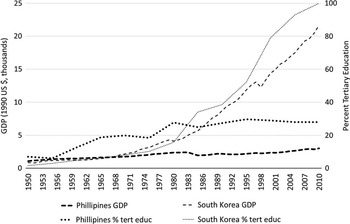
It is a testament to the power of human capital that it can be undersupplied and still reach such staggering levels, and play a central role in economic development. Economists have long appreciated the importance of human capital for economic growth. Nobel Laureate Robert Lucas argued in a comparative study of South Korea and the Philippines that South Korea’s ‘miraculous’ growth was attributable largely to its accumulation of human capital.Footnote 18 Lucas’s study drew on data from 1960 to 1987; Figure 1 shows gross domestic product (GDP) levels and percentage of population with tertiary education (as a measure of human capital) in the two countries from 1950 to 2010.
GDP and Percent Tertiary Education

While Lucas elides some important historical factors, his underlying argument – that human capital has been the primary driver for economic growth in South Korea – seems to have stood the test of time and remains an example of the potential of human capital to effect transformative changes. It is a different matter to hope that human capital can also wean economies from fossil fuel-based energy systems, and to foster the kind of intellectual capital needed to develop and deploy specific climate technologies. Nonetheless, because of the potential of human capital to grow quickly and transform economies, a human capital approach is likely to represent the best hope for a timely transition away from fossil fuel-based economies.
Because human capital feeds so powerfully on itself, it can exhibit a high degree of path dependence.Footnote 19 Many choices about human capital investment are thus constrained by past choices. The enormous potential for human capital growth is therefore also reason for caution. Current reliance on fossil fuels is in part the product of past choices to encourage the development of fossil fuel technologies. If the goal is to construct a new stock of human capital to meet an objective, that objective should be chosen carefully. Not only might a poorly chosen objective result in the misallocation of resources, but changing course may prove to be politically or administratively difficult. This challenge is discussed in the following section.
3. FOSSIL FUEL-RELATED HUMAN CAPITAL AND RENT-PRESERVING ACTIVITIES
Capital is the engine of economic growth, but it has a little-appreciated downside: large capital stocks cause their owners to resist policy reforms that reduce capital value.Footnote 20 Having invested substantial sums of money, owners of expensive capital naturally have a strong interest in preserving the value of that capital and the stream of benefits it was acquired to secure, along with the hard-won gains in efficiency. It is in this charged context that climate policy has struggled to gain footing: capital-intensive energy industries find their large expensive capital stock threatened by climate policies that impose additional, potentially crippling costs. Under these circumstances we observe rent-preserving activities, the ex post analogue of rent seeking, and the political and legal exercise of protecting existing legal privileges.Footnote 21
Energy industries have previously demonstrated their inclination and ability to engage in rent-preserving activities. A push in the 1990s and early 2000s to deregulate retail electricity markets in the US stalled,Footnote 22 as utilities worried that their capital would be rendered uncompetitive by a new, deregulated, and more competitive electricity marketplace.Footnote 23 Legal and political manoeuvring limited the gains made by deregulation.Footnote 24
Another stranded asset of great concern was the vast stock of human capital embedded in existing electricity systems. If the stock of human capital is generally far more valuable than the stock of physical capital, then it is reasonable to assume that the greater worry for electricity generators is the loss of value to their human capital. If so, those fears are not unfounded: plants in states that deregulated electricity generation employed about 6% fewer employees after deregulation and, incidentally, enjoyed a 13% decrease in non-fuel operating expenses.Footnote 25
For the millions of workers worldwide in the coal, oil, natural gas, and electricity generation industries, their human capital is their livelihood. Whereas physical capital can be part of a diversified portfolio of assets belonging to a large investor-owned firm, individuals have only a few chances in a lifetime to acquire human capital.Footnote 26 Individuals rarely possess political power as individuals, but the concentration of job losses within a firm or industry make the affected firm or industry a convenient vehicle for exercising political power. Towards this end, American trade groups such as the American Petroleum Institute and the Edison Electric Institute have exercised enormous power over the US legislative and administrative processes,Footnote 27 as has the Canadian Association of Petroleum Producers over the Canadian government.Footnote 28
The incentive to preserve rents might be less powerful if capital (physical or human) were flexible enough to be redeployed for some alternative use. One’s stake in capital might not be so momentous if the capital could survive regulatory change and still hold value. This is often the case with buildings and vehicles. Unfortunately, energy industries tend to hold capital that cannot be redeployed for alternative modes of energy production, delivery or consumption.Footnote 29 Offshore oil rigs cost billions of dollars and cannot be used for anything other than drilling for oil in oceanic waters. A century’s worth of evolution in fossil fuel-related industries, gradually but relentlessly achieving small operational efficiencies, has produced highly integrated energy extraction, production, transportation and combustion systems. Energy production has become technically efficient and capable of delivering energy at exceptionally low prices. However, such finely tuned systems are exposed to risk because they embody capital, both physical and human, that has evolved into highly specific and interdependent parts. The disadvantage of such finely tuned systems is that they are vulnerable to disturbance.
Human capital in fossil fuel-related industries could be more flexible, less vulnerable, and less of a trigger for rent-preserving activities if the nature of the learning were sufficiently general. Engineering principles learned by petroleum or power engineers could be transferable but, like the physical capital in fossil fuel-related industries, most of the human capital in these industries is specialized and inflexible.Footnote 30 In part, because of the public-good nature of human capital, fossil fuel-related industries have financed only that capital which serves their specific production needs and have left the broader, more general educational tasks to formal schooling.Footnote 31 Workers on offshore oil rigs acquire formal and on-the-job training that is very valuable when they actually work: ‘drillers’, ‘rig mechanics’, ‘subsea engineers’, and ‘derrickmen’ earn US$50,000 to US$100,000 for six months’ work.Footnote 32 However, these jobs, which put unskilled workers through certified training courses,Footnote 33 do not prepare workers for anything other than the idiosyncratic life on an offshore oil rig. In a similar vein, regulated electricity generation utilities have also developed a highly specialized labour force with skills that are not easily transferable to other industries.Footnote 34 The resulting human capital is inflexible, and is of a kind that creates political economy problems for would-be reformers. Most of the tens of thousands of laid-off workers in the struggling Canadian oil sands industry, for example, have not found re-employment.Footnote 35
4. CAPITAL ‘STUFFING’
It is perhaps inevitable that capital, for all its positive effects on economic growth, also creates inefficiencies by incentivizing rent-preserving activities and opposition to regulation. However, the avoidable shame is that government laws and policies that embody an implicit bias towards capital enlarge the scale and size of capital, which in turn incentivizes engagement in rent-preserving activities and opposition to regulation. Legal rules and institutions have chronically conferred a privileged legal status on capital, thereby inducing firms to ‘stuff’ capital, or inefficiently substitute capital for labour.Footnote 36
Capital stuffing has been particularly prevalent in the capital-intensive fossil fuel-related industries. Worldwide, subsidies for oil, gas, and coal total about US$500 billion per year.Footnote 37 To appreciate the full impact of these subsidies, it must be borne in mind that a subsidy need not be large to alter a firm’s decision environment. A few hundred thousand dollars could push a multi-million-dollar capital project from unprofitability to profitability. The excess capital stock fostered through a subsidy, therefore, is likely to be many times larger than the amount of subsidy granted.
A pro-capital bias is not limited to the case of an outright subsidy. In theory, rules governing electricity generation under a regulated monopoly contemplate that regulated utilities charge capital expenses to customers only if they are appropriately prudent investments.Footnote 38 In practice, however, regulated utilities tend to over-invest in capital, which may be privately profitable but is socially inefficient.Footnote 39 Regulators, in turn, err on the side of protecting capital investments.Footnote 40 This results in capital stocks that are larger, and rent-preserving activities that are more vigorous, than would otherwise be the case, creating unnecessarily high barriers to entry.
The unique focus of this article, however, is that human capital may be an even greater source of political resistance to reform. A firm that receives a subsidy for physical capital does not simply pocket the savings. Some is inevitably channelled back into the production process for the purchase of more capital, both physical and human. It is true that a subsidy for physical capital distorts a firm’s decision environment and tilts the mix of inputs towards physical capital. However, physical and human capital are still, to varying extents, complementary: a firm cannot acquire too much physical capital without also acquiring some human capital to operate it.
The effect of a pro-capital bias (including but not limited to subsidies), then, is to create policy inertia. Capital creates its own political economy against reform. The effect of a pro-capital legal bias is to enlarge capital, and enlarge the incentives to oppose any reform which might challenge the value of that capital. In the name of promoting economic growth through investment in capital, legal rules and institutions unintentionally obstruct policy reform. This trend is particularly prominent in the fossil fuel-related industries.
5. OVERCOMING FOSSIL FUEL-RELATED CAPITAL
Climate policy thus encounters political resistance in part because it directly attacks the value of capital in fossil fuel-related industries. A less confrontational way of addressing this political economy problem is to build up a rival stock of capital oriented towards alternative modes of energy generation, delivery and consumption. A rival capital stock that enables humankind to harness, deliver or allocate energy with little or no fossil fuel input and at low cost would create the kind of countervailing political influence that would change the political economy of climate policy, not to mention the economics of alternative energy systems. Since the climate technologies of the future do not yet exist, such a capital-oriented strategy must necessarily begin with assembling human capital.
Some degree of policy confrontation is inevitable, as the existing stock of fossil fuel-related capital benefits from legal preferences that deter the development of rivals. Building up a rival stock of human capital will necessitate their removal, because as long as these preferences are in place, alternative technologies and methods will be at a great disadvantage. This part of the article proposes the development of an international agreement to implement a global policy to counter the human capital advantage of fossil fuel-related industries. The policy would be built around three key measures:
-
∙ the repeal of subsidies favouring fossil fuel-related capital;
-
∙ the removal of legal barriers to development of alternative capital, most notably those legal mechanisms that protect existing capital from competition or legal interference; and
-
∙ a carbon tax to address the emissions externality and replace existing renewable energy subsidies.
These proposals are all quite familiar and have been widely discussed in the literature. However, it is important to emphasize why the measures are necessary, and why all three are necessary: they are needed to remove separate and independent legal preferences for fossil fuel-based energy supply, which continue to play an important role in fostering the wrong kind of human capital. Given the precariousness of new human capital, and the political robustness of incumbent human capital, it is important to completely eliminate these preferences.
5.1. The Repeal of Subsidies Favouring Fossil Fuel-Related Capital
Fossil fuel subsidies are politically popular in developed and developing countries alike. Reform is difficult; attempts to repeal have been defeated by populist protests in Venezuela (1989), Yemen (2005), Cameroon (2008), Bolivia (2010), and Nigeria (2012).Footnote 41 In developing countries, fossil fuel subsidies can be a way of ensuring that a natural resource endowment inures for the benefit of a broad populace.Footnote 42 If subsidy reform efforts lead to higher fuel prices, this raises the popular suspicion that corrupt governments have simply transferred resources from the broad and mostly poor populace to a kleptocratic elite.Footnote 43
Despite the political headwinds, it bears repeating that the subsidies serve no legitimate public policy, and no welfarist case can be made for these subsidies.Footnote 44 For our purposes, it is vital to appreciate that fossil fuel subsidies have inflated the capital stock of fossil fuel-related industries which, through their market dominance, have inhibited the development of alternatives.
Precedent exists for an international agreement to phase out fossil fuel subsidies. The 2009 G20 Summit of the governments and central banks of the 20 most important economiesFootnote 45 produced an agreement to ‘[r]ationalize and phase out over the medium term inefficient fossil fuel subsidies that encourage wasteful consumption’, and ‘impede investment in clean energy sources’.Footnote 46 Though the agreement was not binding, it contained a provision ‘request[ing] relevant institutions, such as the IEA [International Energy Agency], OPEC [Organization of Petroleum Exporting Countries], OECD [Organisation for Economic Co-operation and Development], and the World Bank’ to essentially play the role of referee and provide the G20 parties with analysis on subsidies that would presumably embarrass their governments into reform. Needless to say, the agreement has not held up, and fossil fuel subsidy reform has not come to pass.Footnote 47 A stand-alone international agreement to undertake politically difficult reform is a bridge too far. Nonetheless, the agreement provides an important template for a future agreement. With credible international bodies such as the IEA and the World Bank in a monitoring and reporting role, there would at least be data to determine whether a signatory was fulfilling a stated commitment.
Without subsidy reform, any policy to address climate change starts with a built-in effectiveness handicap. If a carbon tax were to be imposed without subsidy reform, some part of the tax would merely cancel out subsidies instead of actually internalizing the cost of emissions.
5.2. The Removal of Legal Barriers to Development of Alternative Capital
In the substantial part of the industrialized world that still generates electricity in a regulated utility legal regimeFootnote 48 there is institutional resistance to change, and a reluctance to utilize renewable energy sources.Footnote 49 Regulated electricity generation utilities have much autonomy in determining their fuel sources.Footnote 50 Absent external pressures, they generally eschew innovation in favour of stability.Footnote 51 This institutional aversion to change poses a formidable barrier for renewable energy sources.Footnote 52 Scale economies are important for energy industries. Without sufficient uptake from electricity generators, renewable energy sources can never develop. Without a critical mass of demand for renewable energy sources, investment will be lacking and a human capital stock will never form.
Some progress has been made in lowering barriers to renewable energy sources for electricity generation.Footnote 53 In the US, federal law now requires utilities to buy power from cogeneration and renewable energy sources,Footnote 54 and requires access to transmission lines to be granted to independent generators without discrimination.Footnote 55 Competition in electricity markets has been stimulated by requiring utilities to unbundle retail electricity services,Footnote 56 which creates some openings for renewable energy sources. In the European Union (EU), electricity integration and liberalization are particularly complex, given the variety of electricity suppliers and consumers in the Member States. However, the main elements of EU electricity liberalization – vertical unbundling, privatization, wholesale and retail competition, and transmission access requirementsFootnote 57 – are strikingly similar to those in the US. With the regulatory infrastructure in place, the EU electricity market has, in fact, noticeably progressed towards its goal of an integrated electricity market, removing barriers that might otherwise have thwarted integration.Footnote 58
However, barriers remain, and larger, change-averse utilities continue to rely on their fossil fuel-related human capital. For example, non-utility firms now disrupt some fossil fuel-based markets by installing solar panels on the roofs of private residences, allowing the homeowners to defray the cost of utility-provided electricity.Footnote 59 These potentially transformative methods of electricity production are thwarted by barriers such as the costs of permitting, financing and installation.Footnote 60 In the US state of Florida, which enjoys strong solar energy resources,Footnote 61 state law allows only regulated utilities to sell electricity in the retail market.Footnote 62 This constitutes a barrier to solar rooftop installations because financing such installations may be considered ‘selling’ electricity, which could expose non-utility firms to utility regulations.Footnote 63
5.3. A Carbon Tax to Replace Renewable Energy Tax Credits
Existing subsidies to aid in the development of specific renewable energy sources should be abolished and replaced with a carbon tax. Given the world’s tortured experience with fossil fuel subsidies, it is ironic that renewable energy sources have been boosted in some jurisdictions by government subsidies. In theory, subsidizing a ‘good’ is economically comparable (but not equivalent) to taxing a ‘bad’, which would be the economist’s preferred method of accounting for external costs.Footnote 64 In practice, subsidizing what lawmakers deem to be ‘good’ is an exercise fraught with uncertainty and rent seeking. American tax policy provides that certain qualified renewable energy sources enjoy a tax credit for each kilowatt-hour of electricity produced.Footnote 65 The list of qualified technologies, however, changes frequently over time, reflecting the constantly evolving technology and economics of alternative electricity sources. The tax credit was first applied in 1992 to wind energy and closed-loop biomass,Footnote 66 followed in later years by open-loop biomass, geothermal and solar energy, then municipal solid waste and, astonishingly, refined coal.Footnote 67 In 2007, marine hydrokinetic energy, a technology scarcely in existence just a decade earlier, was added to the list of qualified sources.Footnote 68
Defining ‘refined coal’ as a renewable technology was certainly imaginative.Footnote 69 However, it underscores the less hilarious point that it is simply too difficult to determine which alternative technologies are worthy of a subsidy, as the meandering list of qualified technologies exemplifies. Choices to favour specific technologies – wind, solar photovoltaic, and biomass energy – have the effect of shunting human capital towards those specific energy sources at the expense of other, possibly even better, renewable energy technologies. Marine hydrokinetic energy, hardly in existence until a few years before its elevation to a ‘qualified’ source, could prove to be one of them. It is far more sensible to identify and tax ‘bads’ than it is to identify and subsidize all possible ‘goods’.
Moreover, subsidization inflates physical and human capital stock. There is good reason to be wary that today’s privileged renewable energy sources might not ultimately be the best renewable energy sources. If they are not, then the subsidization will make it that much more difficult to wean energy systems off the inferior sources, as our experience with fossil fuel-related industries should have taught us.
6. DEVELOPING A NEW HUMAN CAPITAL STOCK
Ideally, the three common-sense measures proposed above – the removal of fossil fuel subsidies and legal barriers, and the implementation of a carbon tax – would assume most of the workload in correcting distortions and spurring research into and development of alternative energy systems. But the nature of capital is such that the larger the stock, the greater the incentives to protect it from reform. Fossil fuels, by virtue of their early development and early subsidies, have almost a one hundred-year head start on most renewable energy technologies in terms of human capital development. Merely levelling the playing field is therefore insufficient. If capital investment is hereafter made in proportion to energy market share on a level playing field, fossil fuels would continue to dominate renewable sources for a long time simply because of their current size advantage.Footnote 70 To build up a new human capital stock, a considerable amount of ‘catching-up’ is needed, and time is of the essence. An aggressive policy is needed to counter an incumbent stock of fossil fuel-oriented human capital, as well as to facilitate the development of breakthrough technologies.
Despite the problems with subsidies – including their potential for inefficiency, rent seeking, capital stuffing and policy rigidity – some level of subsidization is still needed to counteract past subsidies. Economists’ policy prescription for ramping up development of renewable energy technologies is to levy a carbon tax to internalize the GHG emissions externality, accompanied by a modest amount of funding for research and development in renewable energy technologies.Footnote 71 However, the problem with the use of subsidies to help with catching up is that it runs the risk of falling into the same capital-stuffing trap that has entrenched fossil fuels and made reform so difficult.
A better answer is to subsidize the formation of human capital in a technology-neutral manner to the greatest extent possible. Instead of trying to identify the most promising renewable energy technologies and subsidizing their development, a human capital policy should be oriented towards broader, unambiguously positive climate outcomes. For example, human capital should be formed to generate a better understanding of the general properties of energy storage systems, rather than subsidizing a specific battery development project. Alternatively, it would be preferable to develop an energy system that can satisfy the energy needs of an entire city without fossil fuel inputs, rather than to concentrate intensively on one potential aspect of the system (and possibly ultimately extraneous), such as boosting the productivity of photovoltaic solar panels.
This is obviously easier said than done. The locus of innovation in climate technologies must be an environment dedicated to innovation and upheaval, which insulates research scientists from other academic duties and maximizes time and space for collaboration and creativity. Research universities, for all their public benefits, have generally not been drivers of truly disruptive technologies that have transformed industries.Footnote 72 This part of the article therefore proposes two measures to build up a new stock of human capital: firstly, the establishment of prizes for successful development and deployment of non-fossil fuel energy or geoengineering technologies; secondly, the establishment of an international network of independent research and development laboratories, each with a specified but sufficiently broad research mandate to discover and successfully deploy non-fossil fuel energy systems or geoengineering technologies. Each is discussed in turn.
6.1. Prizes
Prizes for innovation specify a set of conditions for an outcome, and commit an award – typically money – for the first to achieve that outcome under the specified conditions. Prizes actually preceded the patent system as an inducement for innovation: the dominant method of rewarding inventive effort in 18th century Europe was to award a prize.Footnote 73 Over time, prizes gave way to mechanisms better suited to smaller breakthroughs, such as patents, targeted research and development funding.Footnote 74 The climate technology challenge, however, does not call for small discoveries; revolutionary technological breakthroughs are desperately needed soon to prevent catastrophic climate change.
Jonathan Adler has argued for the use of prizes to induce the development of technologies to address climate change.Footnote 75 In fact, climate prizes are already being offered. The US Department of Energy has for several years issued challenges for a variety of energy-related outcomes, such as to ‘[d]evelop affordable systems for small-scale hydrogen fuelling’ and to ‘develop a BTU [British thermal unit] sensor with accuracy <10% full scale and costing <20% of conventional BTU measurement instruments’.Footnote 76 The US Department of Transportation’s ‘Smart City Challenge’ awards up to US$40 million to US cities that submit the best plans to integrate electric vehicles and public transportation into their transportation systems.Footnote 77 Private contests also exist: Sir Richard Branson’s Virgin Earth Challenge is a US$25 million prize for a ‘commercially viable’ technology that is capable of removing one billion carbon dioxide (CO2)-equivalent tonnes of GHGs every year for ten years.Footnote 78 The American utility NRG Energy Inc. supports a US$20 million prize for a technology that can convert emitted CO2 into a useful product, such as a building material.Footnote 79
Prizes offer important advantages over more common methods of inducing innovation, such as patents, and research and development funding. Firstly, a prize defined as a climate outcome is, by design, technology-neutral or method-neutral. The point of a prize is for the awarding body to announce the desired outcome in advance and leave the methods to would-be contestants. Building a human capital stock is a delicate matter and possibly creates path dependencies of its own. A prize at least keeps the objective front and centre, providing a measure of transparency as to the desired outcome.
Secondly, prizes are superior to patents in that discovered knowledge remains available for others to build on. A human capital strategy requires that knowledge begets knowledge. For that to happen, use of knowledge must remain in the public domain. Issuing a patent for an invention creates a monopoly over that knowledge so that the fruits of that invention are the property of the patentee. Building on the discoveries of a patent thus depends on the willingness of the patentee to license his or her technology.Footnote 80 Patents are less expensive for governments because the compensatory mechanism is not money, but the conferring of a benefit – the monopoly on the patented knowledge. The social cost of a patent, however, is the potential sequestration of important information. In light of the urgency of climate change, this could be disastrous. If payment is in the form of prize money, the discovered knowledge can remain in the public domain.
Thirdly, a prize-based policy of inducing innovation opens up the creative process to the widest possible variety of innovators. Energy generation, delivery and the consumption of energy constitute a very long production chain, which takes place in heterogeneous conditions worldwide. Hence, the opportunities to improve on existing processes are extremely rich. In stark contrast to the plodding improvements taking place inside regulated electricity utilities,Footnote 81 the most startling innovations to restructure energy systems have taken place outside the electricity mainstream. With the goal of constructing badly needed but difficult-to-site transmission lines, Atlantic Grid Holdings (a holding company in which Google is a key investor) has proposed siting a transmission line in the ocean floor off the coast of New Jersey, Delaware and Maryland, with a view to attaching offshore wind turbines to the transmission line.Footnote 82 Technology maverick and Tesla Motors founder Elon Musk has begun production of the ‘Powerwall’ – a home, wall-mounted batteryFootnote 83 that can store excess energy from a rooftop solar system and potentially allow residential customers to unhook from the grid completely, bypassing any regulatory hurdles that solar providers might face in entering retail electricity markets. Whether these technologies actually succeed is, of course, still to be determined, but their startling novelty is a reminder to avoid the temptation to ‘pick winners’.
Many desirable climate outcomes could be pursued via a prize contest. Projects under consideration in the Virgin Earth Challenge include not only industrial-scale construction initiatives, but proposals that seek to scale up natural carbon-cycling processes.Footnote 84 We might conceive of others. For example, a prize might be offered for the first research team to design a community-based energy system that can satisfy the reasonable energy needs of a sizeable group of people for an extended period (of, say, ten years). Another possible prized climate outcome might be to achieve a particular amount of carbon sequestration in soils used for farming. The possibilities are numerous.
Signatories to the Paris AgreementFootnote 85 have already committed funding for the development of climate technologies, through the Technology Mechanism established under the original United Nations Framework Convention on Climate Change (UNFCCC).Footnote 86 A subsequent agreement may set aside some of the committed monies for agreed prizes. While there is still scope for disagreement, it is generally easier to agree on overall goals than on implementing technologies.
6.2. Basic Research Laboratories
Governments certainly fund research and development through many projects, recruiting academics, industry and others for the task of innovation. The common temptation is to target ‘practical’ or ‘useful’ technologies, but those kinds of judgment are inherently political, and often turn out poorly.Footnote 87 The better government role for research and development funding is to fund basic research. Fundamental discoveries may be ex ante high-risk and high-reward propositions that private actors are unwilling to undertake. Fundamental discoveries emerging from basic research tend to have a broad variety of applications. Since private innovators may be unable to appropriate all of the benefits, they are likely to undersupply basic research.Footnote 88
At the same time, climate technologies need to mature very quickly. A human capital stock formed to advance non-fossil energy alternatives must be able to not only make fundamental discoveries but also shepherd them to marketability or large-scale deployment in a matter of years rather than decades. Research into and development of climate technologies – both to establish non-fossil fuel systems and geoengineering technologies – thus face a conundrum: research and development must be very basic and general so as to provide a platform for a broad variety of possibilities, but once a theoretical breakthrough is achieved, development must be applied, specific and fast.
One way to promote both the needed basic research and the applied research is to adopt the research laboratory model pioneered by Bell Laboratories in the last century. Bell Labs scientists and engineers not only discovered some of the most transformative ideas in technology but also found ways to reduce them to practice and make them commercially useful.Footnote 89 Bell Labs scientists developed the world’s first semiconductor solar cell (a precursor to the photovoltaic cell),Footnote 90 communications satellites,Footnote 91 fibre optic cables,Footnote 92 the cell phone system,Footnote 93 the first modern operating system UNIX,Footnote 94 the remarkably enduring computer language C,Footnote 95 and, perhaps most importantly, the transistor.Footnote 96 Bell Labs scientists have won the Nobel Prize in Physics 13 times.Footnote 97
What made Bell Labs such a prolific institution for innovation? Why might it be a model for innovation in climate technologies? Bell Labs was unique and fortunate in many ways, but ex post reflections highlight some important factors that might serve as guidance for establishing climate technology research laboratories. While Bell Labs was not consciously developing ‘human capital’, its practices were ahead of their time and serve as a model for incubating human capital.
Well before social scientists began to study the effect of spatial relationships on creative relationships, Bell Labs director Mervin Kelly designed workspaces in such a way as to maximize the collaborative potential of the talented researchers at Bell Labs. Kelly understood the importance of physical contact; phone calls were insufficient.Footnote 98 Researchers were intentionally made to walk long distances to restrooms and cafeterias, past other workspaces, so as to create chance encounters. Scientists on their way to lunch down a long corridor were said to be ‘a magnet rolling past iron filings’.Footnote 99 Moreover, Kelly uniquely recognized the importance of interdisciplinarity.Footnote 100 Researchers were not divided into silos by specialty or function, as research universities are. Recognizing that invention and deployment needed to go hand in hand, Kelly assigned spaces so that basic scientists were forced to bump into applied scientists, theoreticians into experimentalists, physicists into chemists, and engineers into metallurgists. In instituting these practices, Bell Labs drew on the most powerful and unique aspect of human capital: the positive network effects of knowledge. The conditions at Bell Labs were such that knowledge begat knowledge. Bell Labs developed a huge and advanced stock of human capital so quickly because it was effective in growing it.
Bell Labs was also remarkably egalitarian in its training, encouraging continued learning for every employee, no matter how senior or junior. The Communications Development Training Program, or ‘Kelly College’, consisted of a series of unaccredited but challenging graduate-level courses for any employees seeking to sharpen their understanding of cutting-edge communications technology research.Footnote 101 What was not appreciated at the time – and, to a large extent, remains so today – is that raising the skill level of the lowest workers raises the level of interaction among everyone. Again, economists would recognize this as enlightened human capital policy;Footnote 102 rather than seeing expertise as a zero-sum competition, Bell Labs recognized that the positive network effects of knowledge are increased by breadth.
Finally, Bell Labs tolerated failure to an unprecedented extent. This was a luxury afforded by AT&T’s telephone monopoly, but it was still radical to encourage grand but failed ideas. Bell supervisors understood that risk and reward are often correlated, and that failure is a necessary if not a sufficient condition for innovation.Footnote 103
Kelly’s management practices at Bell Labs serve as a model for developing human capital and marshalling it to achieve objectively positive outcomes. His ideas on physical contact, space, and chance encounters are now studied as part of a body of research on productivity and collaboration.Footnote 104 Interdisciplinarity has become a clarion call at research universities.Footnote 105 Well before economists began to talk about the positive network effects of knowledge,Footnote 106 and well before they began to study the importance of compulsory public secondary education on economic growth,Footnote 107 Bell Labs was making its best researchers better by lifting up its lowest workers.Footnote 108
The history of Bell Labs has obvious lessons for the development of climate technologies. Many of the breakthroughs at Bell were really advances in metallurgy and materials science.Footnote 109 It seems likely that many of the future breakthroughs in climate technologies will similarly be in materials science. New materials are needed for transmission lines,Footnote 110 transportation,Footnote 111 energy storage,Footnote 112 and for the direct capture of CO2 from ambient air,Footnote 113 to name just a few. Even more importantly, Bell Labs holds out important lessons in governance. Specifically, while some basic direction needs to be set by a policy body, any individual research lab must be governed by a technically sophisticated research lab director granted a wide degree of independence and sufficient funding. Mervin Kelly’s job description and his leadership of Bell are vitally important models.
Former US Energy Secretary Steven Chu, one of the 13 Nobel Prize-winning Bell Labs scientists,Footnote 114 has attempted to replicate the Bell Labs culture and creative environment in American energy policy. Chu managed to secure US$366 million for his re-creations of Bell Labs, ‘Energy Innovation Hubs’, which were charged with undertaking high-risk, high-reward technologies that could transform energy production, transmission, and consumption.Footnote 115 Dr Chu’s Energy Innovation Hubs are only a slight reorientation of Bell Labs. Creating a network of climate technology research laboratories need only be a slight reorientation of the Energy Innovation Hubs.
7. AN INTERNATIONAL AGREEMENT FOR A NEW HUMAN CAPITAL STOCK
None of the prescriptions offered in this article are new. However, it is the totality of the prescriptions that is important, and the joint purpose that it is important to recognize: the need to develop a new stock of human capital surrounding energy and climate systems that is dramatically different from the existing one. A focus on human capital changes the nature of these prescriptions in subtle but important ways. A human capital focus militates against existing patent laws as incentives for innovation, because in order for human capital to reach its exponential growth potential, there must be unfettered access to ongoing discoveries. A system of prizes, which provides an outright grant of money in lieu of a monopoly on knowledge, would be more appropriate if the goal is to maximize the amount of knowledge – or human capital – in the public domain. Viewed in this light, intellectual property regimes such as patent protection act as a barrier to the discovery and adoption of new systems, and hence a brake on the development of human capital. A human capital focus also highlights the need to place researchers in physical proximity to each other, to maximize the human interactions that provide instant and calibrated feedback, allowing human capital to build on itself. This stands in contrast to the more typical polyglot, university-centred research model. Finally, and perhaps most importantly, the positive feedback effects of human capital raise the prospect that international cooperation can actually be a positive-sum game. A major problem with international negotiations on climate policy has been the focus on dividing up obligations, drawing problematically on the concept of CBDR.Footnote 116 The necessary but politically difficult reforms listed in Section 5 above can be paired with the mutually beneficial measures in Section 6 to create an international agreement with participation that is broader and less fraught with political peril.
The 2015 Paris Agreement provides that the ‘Parties noting the importance of technology for the implementation of mitigation and adaptation actions … shall strengthen cooperative action on technology development and transfer’.Footnote 117 The Agreement contemplates accomplishing this supposedly greater ‘cooperative action’ through the existing Technology Mechanism established under the 16th Conference of the Parties of the UNFCCC (COP-16) in Cancun (Mexico) in November 2010.Footnote 118 However, it remains unclear how the Technology Mechanism will actually develop, operationalize and diffuse climate technologies.Footnote 119
What the Technology Mechanism fails to account for is the nature and potential of human capital. At first glance, the Climate Technology Centre and Network (CTCN), the ‘implementation arm’ of the Technology Mechanism, would seem to embody the spirit of international cooperation and the efficient sharing of knowledge. Over 100 ‘network members’ – non-governmental organizations, research labs, and other places of knowledge – in 50 countries are linked by a package of member benefits that encourage information sharing and market opportunities for climate technologies. Upon closer examination, however, there is less to the CTCN than meets the eye. CTCN membership confers no funding benefits. To date, funding for the CTCN itself has been much lower than that envisioned by the Cancun COP.Footnote 120 No plan currently exists for building up the CTCN to serve as the knowledge hub it was meant to be.Footnote 121 Meanwhile, the Technology Executive Committee, the ‘policy arm’ of the Technology Mechanism, has been largely ineffectual in helping to develop that CTCN vision, and has been staffed by political figures rather than those with technical expertise.Footnote 122 What is needed is a network that is substantive in nature, and governed not by political figures but by technical experts capable of competently setting research priorities. This requires an international agreement to establish a network of re-created versions of the Bell Labs re-creations model.
Fortunately, a precedent exists for an internationally governed research body with a network of independent research laboratories: the Consultative Group for International Agricultural Research (CGIAR). CGIAR is an international research organization charged with conducting research into, and the development of, agriculture to ‘tackle poverty, hunger and major nutrition imbalances, and environmental degradation’.Footnote 123 CGIAR has an annual budget of about US$1 billion, is funded by about 60 major donors – the largest of which are the US, the Bill and Melinda Gates Foundation, and the World BankFootnote 124 – and operates 15 research centres around the world. Each centre is dedicated to some aspect of agriculture and development. Funding is channelled through the CGIAR Fund, the organization’s monetary arm, operated by the World Bank but governed by a Fund Council that is populated mostly, but certainly not exclusively, by major donors.Footnote 125 Each research centre operates independently with its own charter, board of trustees and staff, and develops its own focus.Footnote 126 Research centres include Africa Rice, Biodiversity International, the Center for International Forestry Research, the International Center for Tropical Agriculture, and the International Food Policy Research Institute. A similar network of research centres for climate technologies might focus on a variety of important areas, including energy storage or transmission systems or materials, information systems on energy consumption, alternative fuels, solar radiation management, ocean chemistry, weatherization systems or other natural processes that capture and sequester atmospheric CO2, and agricultural practices that both reduce emissions and increase the sequestration of CO2.
Perhaps most relevant for the purposes of climate technology research is that CGIAR represents a joint international effort to improve agricultural and food outcomes through intensive research. It has certainly been helpful that researchers come from around the world, and benefits accrue to every country in the world. Similarly, a worldwide recruitment effort for climate change research would take advantage of the scale economies of inventive effort, as research laboratories could more easily assemble the critical mass of talent needed. Research laboratories can be both the locus and the source of the human capital needed to combat climate change. Recruiting researchers from around the world, moreover, would provide some political stability.
A conscious effort to build up a new human capital stock requires capacity building, and a structure for doing so. The UNFCCC Technology Mechanism can still serve as the appropriate vehicle, given its relative youth.Footnote 127 However, the Technology Executive Committee (TEC) must recruit laboratory directors with substantive expertise to achieve objective outcomes, not political processes. Moreover, the existing CTCNs must be scrapped and reconstituted as individual research laboratories established to serve specified but open-ended climate technology goals. They must be given a broad grant of independence, latitude and, most critically, funding. Such a reconfiguration of research institutions, even if breaking from extant practice, seems consistent with the Cancun Agreement, which vaguely provides that the CTCN ‘shall facilitate a network of national, regional, sectoral and international technology networks, organizations and initiatives’.Footnote 128 A future COP might tighten some language surrounding the Technology Mechanism and perhaps provide that the CTCN is to be constituted as a system of independent research laboratories, staffed and directed by scientific researchers recognized by their peers as experts in their respective fields.
8. CONCLUSION
The history of human progress is nearly synonymous with the history of human capital. Every major discovery in human history, whether technological or social, has drawn upon human capital as an input. Climate change, likely to be the most pressing ecological crisis in human history, must be resolved by a new stock of human capital, which must be assembled very quickly.
Much resistance to climate policy worldwide stems from vested interests in the form of human capital, in addition to tangible physical capital. The sum of all human capital is more important than the sum of all physical capital because it is likely to be more valuable, and also because it is far more personal and fragile to the individual who owns it. A strategy to develop the new technologies needed to address climate change must account for this source of resistance and overcome it by developing a rival stock of human capital. Only then can the new human capital stock turn to addressing the twin challenges of reducing emissions and sequestering GHGs already emitted.
In quickly building up a new stock, care must be taken to avoid repeating a past mistake – namely, that of subsidizing seemingly ‘good’ ideas and entrenching them by allowing them to stuff capital. Instead, society should foster actions that are technology-neutral, such as removing legal barriers to entry by alternative energy sources, and switching from a subsidy regime to a taxing regime to account for environmental externalities. Furthermore, building up a newer, more flexible stock of human capital requires incentives and research funding to be as technology-neutral as possible. Towards this end, this article proposes that prizes replace subsidies as a way of bringing new energy technologies into the market, and also that research laboratories be established as a way of heralding new knowledge into the energy and climate realms. Talk of ‘investment’ in climate technologies is all well and good, but it should not be forgotten that the forerunner of all physical investments is human capital. Domestic and international policy making should bring to the fore this much overlooked policy dimension.
As Mervin Kelly said, ‘invention is to be neither scheduled nor coerced’.Footnote 129 However, the incentives and the environment can be optimized for creative effort, and global policies to introduce climate technology prizes and to establish a network of research laboratories in the tradition of Bell Labs and CGIAR represent the best hope. Developing a radically new human capital stock must occur rapidly, and be put to work in deploying the technologies needed to reduce emissions and lower ambient GHG concentrations.