Influenza is a common human viral disease that has killed an estimated 30,000 to 49,000 people in the United States each year since 1976. 1 Influenza occurs in epidemics in the United States each winter, punctuated 2 to 6 times every century by pandemics, when a novel strain type of influenza A emerges and spreads rapidly around the globe. After each of the 3 pandemic seasons during the twentieth century (1918–1919, 1957–1958, and 1968–1969), the newly emergent strain type became the predominant circulating strain. During normal epidemic influenza seasons, most deaths occur in young children and in adults older than 65 years. The influenza pandemic of 1918 was the most severe infectious disease outbreak in history, causing 50 million to 100 million deaths worldwide.Reference Taubenberger and Morens 2 Unlike normal epidemic seasons, a great number of these deaths occurred in young adults.Reference Jordan 3
During 2009, the most recent pandemic year, a novel H1N1 influenza A virus (influenza A [H1N1] pdm09) was first recognized in Mexico in March and then rapidly spread to all 50 states in the United States by the end of the summer. 4 – Reference Dawood, Jain and Finelli 5 During the 2009 pandemic season, severe influenza infections and deaths were more common among children and healthy young adults than during typical epidemic seasons,Reference Jain, Kamimoto and Bramley 6 but the case fatality rate overall was not unusually high.Reference Nguyen and Noymer 7 In contrast to the previous 3 pandemic years, the novel influenza A (H1N1) pdm09 virus did not become the exclusive circulating strain after 2009; instead, both it and influenza A (H3N2) virus circulated during the 2010–2011, 8 2011–2012, 9 and 2012–2013 10 seasons. However, during the 2013–2014 season, the surveillance program of the US Centers for Disease Control and Prevention found almost exclusive circulation of the influenza A (H1N1) pdm09 virus.Reference Arriola, Brammer and Epperson 11 It is not known whether the patient population at risk for severe illness and death during 2013–2014 was similar to that of the 2009–2010 season.
We conducted a retrospective review of patients with laboratory-confirmed influenza infection hospitalized in intensive care units (ICUs) at 33 medical centers to determine the demographic characteristics, outcomes of infection, and risk factors for death of this cohort during the 2013–2014 influenza season.
METHODS
At each of the 33 study sites in the Severe H1N1 Influenza Consortium 2014, collaborating specialists in infectious diseases or critical care prepared a list of eligible subjects. All patients who had a positive test result from the clinical microbiology laboratory for influenza A and/or influenza B and were admitted to an ICU were included. Influenza testing may have used a polymerase chain reaction–based test, a rapid test, or viral culture. Complete laboratory data were accessed from infection control records, from an enterprise data warehouse, or directly from the clinical microbiology laboratory. Subjects included all patients who both tested positive for influenza (at either the study site or an outside hospital) and were admitted to an ICU from September 1, 2013, through April 1, 2014. For inclusion, the patient must have been diagnosed with laboratory-confirmed influenza during an ICU stay or within 30 days prior to ICU admission. Institutional review boards of each participating hospital approved the study.
Data Collected
At each center in this retrospective cohort study, a physician abstracted data from the electronic health record and entered them into a Research Electronic Data Capture database.Reference Harris, Taylor, Thielke, Payne, Gonzalez and Conde 12 Data included race and ethnicity; comorbidities; body mass index (calculated as weight in kilograms divided by height in meters squared; obesity defined as ≥30); presenting symptoms; diagnoses, therapies, and complications (reflecting the opinion of the treating physician); vital signs; Glasgow Coma Score at admission; laboratory, pathology, cytology, microbiology, and polymerase chain reaction diagnostic data; radiologic reports; prescription and nonprescription medications received; information on prior vaccination for influenza and Streptococcus pneumoniae; other pathogens isolated from clinical specimens; disposition and 30-day outcome; and autopsy reports. Data on underlying medical conditions specified by the Advisory Committee on Immunization Practices as risk factors for severe influenza were collected. 13 The Sequential Organ Failure Assessment (SOFA) score was calculated on the basis of data in the first 24 hours of admission to the ICU.Reference Ferreira, Bota, Bross, Mélot and Vincent 14 Patients were not followed up after hospital discharge.
Site-specific data were collected, including the type of hospital (academic, community, or Veterans Affairs), number of pediatric and adult beds, number of pediatric and adult ICU admissions during the 2013–2014 influenza season and the 2013 calendar year, and the type and brand name of the influenza test used during that season. Participating centers were located in 12 US states (CA, CO, FL, IA, IL, IN, MI, NC, NE, NY, OH, and TX) and included 20 academic, 10 community, and 3 Veterans Affairs hospitals. Study sites had a median (interquartile range) of 31 (18–90) ICU beds, 373 (199–560) total beds, 1,421 (800–3,110) annual ICU admissions, and 16,087 (10,014–24,384) annual hospital admissions.
Statistical Analysis
Data were analyzed with Stata, version 12 (StataCorp). Outliers were reexamined in the electronic medical record to ensure that data were accurate. No subjects with outlying values were dropped from any analysis. Descriptive statistics were tabulated for demographic data, symptoms, comorbidities, length of stay, laboratory test results, radiologic studies, complications, treatment, SOFA score, and support measures. An epidemic curve was generated. The case fatality rate was calculated.
Bivariable analyses compared potential risk factors for death less than 30 days after ICU admission. A multivariable logistic regression model was developed to identify variables significantly associated in bivariable analyses at a P<.05 with death. In 4 sensitivity analyses, we ran the model without the SOFA score, with only influenza A (H1N1) pdm09 cases, excluding centers that used diagnostic assays not based on polymerase chain reaction and excluding patients who were given a diagnosis of influenza more than 7 days prior to ICU admission.
RESULTS
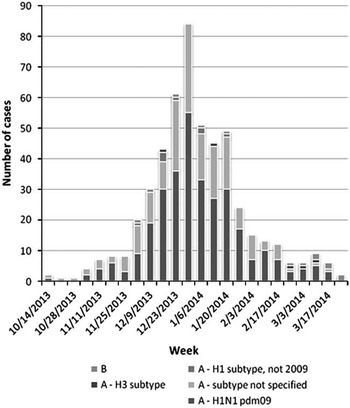
From September 1, 2013, through April 1, 2014, a total of 507 patients with influenza infection were admitted to an ICU at any of the 33 study hospitals (median [interquartile range], 22 [11–37] patients per hospital). Influenza A (H1N1) pdm09 was the predominant strain type, causing 311 infections (61.3%) in this cohort. Additionally, 170 infections (33.5%) were identified as influenza A but were not subtyped (Figure 1). The remaining influenza strains identified included influenza A with an H1 subtype other than pdm09 (1.6%), influenza A with an H3 subtype (1.0%), and influenza B (2.6%).
A total of 507 patients with influenza admitted to intensive care units at 33 US hospitals, by week, from September 1, 2013, through April 1, 2014, indicating influenza type and subtype.

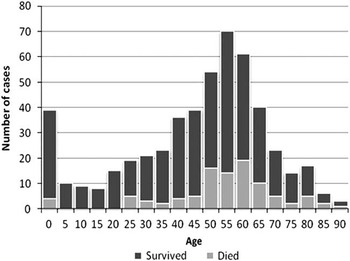
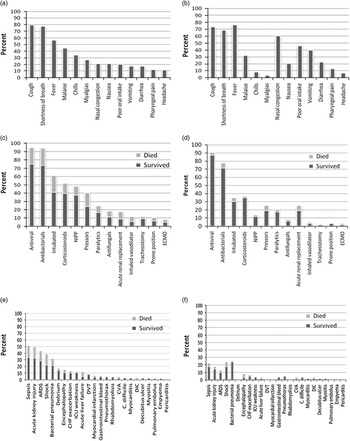
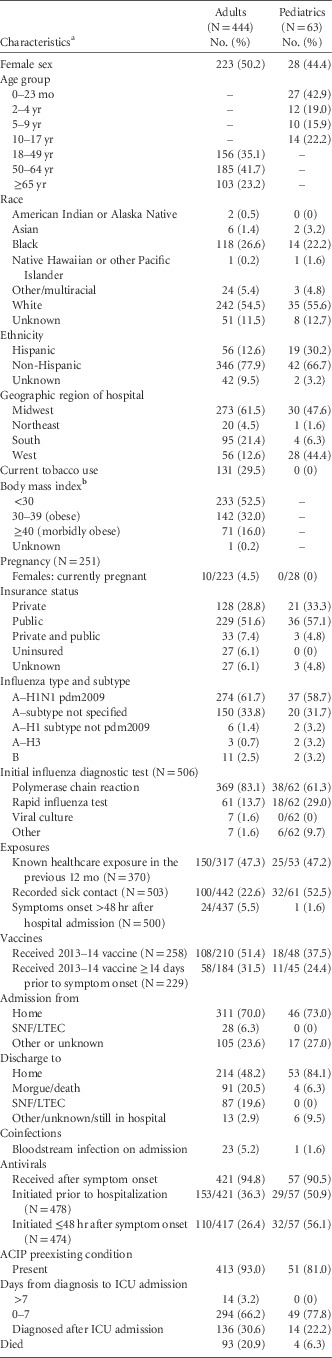
The study population comprised 444 adults and 63 children. The 63 children were admitted at 10 of the 33 study hospitals. Baseline characteristics are displayed in Table 1. Notably, 213 (48.0%) of the 444 adults were obese, 10 (4.5%) of the 223 females were pregnant, and 25 (5.0%) of 502 patients tested positive for influenza more than 48 hours after hospital admission. Fifty-eight (31.5%) of 184 adults and 11 (24.4%) of 45 children were known to have received the 2013–2014 vaccine 14 or more days before symptom onset, and 110 (26.4%) of 417 adults and 32 (56.1%) of 57 children were known to have received antiviral therapy within 48 hours after symptom onset. Ninety-seven patients (19.1%) died within 30 days of ICU admission, of whom 93 were adults and 4 were children (Figure 2). Presenting symptoms among adults included cough (79.5%), shortness of breath (77.4%), fever (56.4%), and malaise (44.5%), compared with fever (76.2%), cough (73.0%), shortness of breath (68.3%), and nasal congestion (60.3%) among children (Figure 3a and 3b).
Age distribution (5-year increments) of 507 patients with severe influenza infection in the United States from September 1, 2013, through April 1, 2014, by outcome.

(a-f). Symptoms present on initial hospital admission for 444 adult (3a) and 63 pediatric (3b) patients who were diagnosed with influenza infection and admitted to an intensive care unit (ICU) from September 1, 2013, through April 1, 2014. Therapies and supportive care utilized during ICU admission among these adult (3c) and pediatric (3d) patients, by outcome within 30 days of ICU admission. Complications during ICU admission among adult (3e) and pediatric (3f) patients, by outcome within 30 days of ICU admission. ARDS, acute respiratory distress syndrome; C. difficile, Clostridium difficile; CHF, congestive heart failure; CVA, cerebrovascular accident; DIC, disseminated intravascular coagulation; DVT, deep vein thrombosis; ECMO, extracorporeal membrane oxygenation; NIPP, noninvasive positive pressure.

Characteristics of 507 Patients With Severe Influenza Infection in the United States Diagnosed From September 1, 2013, Through April 1, 2014, Comparing Adult and Pediatric Patients

NOTE. ACIP, Advisory Committee on Immunization Practices; ICU, intensive care unit; LTEC, long-term extended care facility; SNF, skilled nursing facility.
a When there are missing data for a specific variable, the n for subjects with data on this variable is indicated in the far left column and the denominator is present in the two columns on the right.
b Calculated as weight in kilograms divided by height in meters squared.
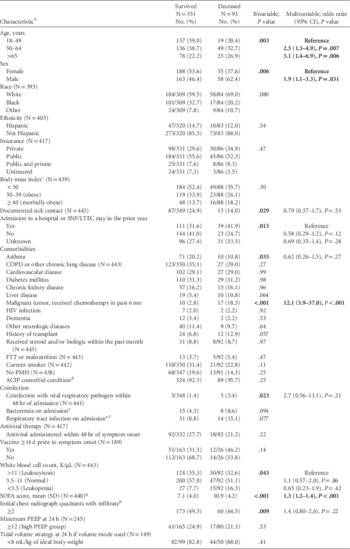
Patient characteristics associated with mortality among adults (>17 years of age) in bivariable analyses are shown in Table 2. The number of children in our cohort who died was too small to assess risk factors for mortality. By logistic regression, characteristics associated with mortality among adults included older age (>65 years, odds ratio, 3.1 [95% CI, 1.4–6.9], P=.006 and 50–64 years, 2.5 [1.3–4.9], P=.007; reference group 18–49 years), male sex (1.9 [1.1–3.3], P=.031), history of malignancy with chemotherapy administered within the prior 6 months (12.1 [3.9–37.0], P<.001), and a higher SOFA score (for each increase by 1 in SOFA score, 1.3 [1.2–1.4], P<.001). Separate regression models (1) excluding patients infected with influenza B, influenza A of an H3 subtype, or influenza A of an H1 subtype other than pdm09; (2) excluding centers that used only rapid influenza tests; and (3) excluding patients diagnosed more than 7 days prior to ICU admission all showed no change in the variables associated significantly with death (data not shown).
Patient Characteristics Associated With Mortality Among 444 Adult Patients With Severe Influenza Infection in the United States From September 1, 2013, Through April 1, 2014: Results of Bivariable Analyses and a Multivariable Logistic Regression ModelFootnote a

NOTE. ACIP, Advisory Committee on Immunization Practices; COPD, chronic obstructive pulmonary disease; FTT, failure to thrive; HIV, human immunodeficiency virus; LTEC, long-term extended care facility; PEEP, positive end-expiratory pressure; PMH, past medical history; SNF, skilled nursing facility; SOFA, Sequential Organ Failure Assessment.
a The multivariable analysis included all variables with P<.05 in the bivariable analysis.
b When there are missing data for a specific variable, the n for subjects with data on this variable is indicated in the far left column and the denominator is present in the columns in the middle.
c Calculated as weight in kilograms divided by height in meters squared.
d ACIP conditions include children aged 6 through 59 months; all adults ≥50 years; adults and children with chronic pulmonary or cardiovascular, renal, hepatic, neurologic, hematologic, or metabolic disorders; persons with immunosuppression; women who are or will be pregnant during the influenza season; children aged 6 months to 18 years who are receiving long-term aspirin therapy and who might be at risk for experiencing Reye syndrome; residents of nursing homes and other long-term care facilities; American Indians/Alaska Natives; persons who are morbidly obese (BMI≥40).
e Were considered true infections by primary team based on documentation in the electronic medical record and appropriate antibiotic administered.
f Included sputum, tracheal aspirate, and bronchoalveolar lavage cultures.
g SOFA score is determined by the following laboratory or clinical criteria: PaO2/FiO2; Glasgow coma scale; mean arterial pressure or requiring administration of vasopressor; bilirubin; platelet count; creatinine or urine output.
h Determined by data abstracter by visual review of chest radiograph.
In a planned secondary sensitivity analysis, when the SOFA score covariate on day 1 of ICU admission was removed from the multivariable model, 2 additional covariates became significantly associated with death within 30 days of ICU admission: (1) having infiltrates on initial chest radiograph in 2 or more lung quadrants and (2) having been admitted to a hospital, a skilled nursing facility, or a long-term extended care facility during the prior year (data not shown). We chose to include the SOFA score in the final multivariable model because it is a proven predictor of mortality among adult ICU patients.Reference Ferreira, Bota, Bross, Mélot and Vincent 14
Medical and supportive therapies provided for patients in the study cohort are shown in Figure 3c and 3d; 94.8% of adults and 87.3% of children received antiviral medications. Of adults, 419 received oseltamivir, 10 received intravenous zanamivir, 2 received amantadine, and 1 received inhaled zanamivir. Of pediatric patients, 57 received oseltamivir and 1 received intravenous zanamivir. Two hundred seventy-two adults (61.3%) and 22 children (34.9%) were intubated and mechanically ventilated. Of these patients, 114 adults (41.9%) and 2 children (9.1%) had noninvasive positive pressure ventilation attempted first. Also, 77 (44.8%) of 172 adults and 6 (14.6%) of 41 children who were not intubated underwent noninvasive positive pressure ventilation.
Reported complications of influenza infection are shown in Figure 3e and 3f. In a secondary bivariable analysis, complications occurring after ICU admission associated with death among all adults in the cohort and those adults with influenza A (H1N1) pdm09 included sepsis, acute kidney injury, acute respiratory distress syndrome, shock, bacterial pneumonia, myocardial infarction, cerebrovascular accident, and disseminated intravascular coagulation (data not shown). Encephalopathy was associated with death in the entire cohort and acute liver injury was associated with death among patients with influenza A (H1N1). By bivariable analyses, sepsis, shock, encephalopathy, and acute liver failure were associated with death among all children and those with influenza A (H1N1) pdm09. Acute respiratory distress syndrome and disseminated intravascular coagulation were also associated with death among all children (data not shown).
One influenza A (H1N1) pdm09 isolate and one influenza A isolate that was not subtyped were susceptible to oseltamivir when tested at the Centers for Disease Control and Prevention.
Autopsies were performed for 12 of 97 patients who died. Lung histology revealed classic diffuse alveolar damage in 8 patients (with necrotizing bronchiolitis in 3 and with extensive hemorrhage in 3) and bacterial superinfection in 4 patients.
DISCUSSION
In our cohort of severely ill patients, older age, male sex, having received chemotherapy in the previous 6 months, and higher SOFA score on ICU day 1 were significantly associated with mortality. In 2009, in contrast, age younger than 65 years,Reference Jain, Kamimoto and Bramley 6 , Reference Louie, Acosta and Samuel 15 pregnancy,Reference Louie, Acosta, Jamieson and Honein 16 – Reference Siston, Rasmussen and Honein 17 and morbid obesityReference Santa-Olalla Peralta, Cortes García and Limia Sánchez 18 were associated with severe disease and mortality. Several multinational and non-US studies have documented an age shift of severe disease and death toward older adults in the second influenza A (H1N1) pdm09 season.Reference Borja-Aburto, Chowell and Viboud 19 – Reference Lynfield, Davey and Dwyer 23 In our study of patients who were admitted to ICUs, persons 50–64 years old (36.5%) and those 18–49 years old (30.8%) accounted for nearly 70% of the cohort. However, the oldest patients, those at least 65 years of age, were at the highest risk for death. The percentage of school-age children, adolescents, or young adults who were critically ill with influenza was greater in a 2009 studyReference Kumar, Zarychanski and Pinto 24 than in the present study. Therefore, the age distribution of patients with severe influenza in our study demonstrated a shift to older adults compared with the 2009 pandemic year. Given that the genome of the influenza A (H1N1) pdm09 virus circulating in 2013–2014 was similar to the virus circulating during 2009,Reference Epperson, Blanton and Kniss 25 this age shift may reflect increased population-level immunity among younger people resulting from H1N1 infections or from vaccination during the preceding 4 years.
The winter of 2013–2014 was the first season since 2009 during which influenza A (H1N1) pdm09 was the predominant circulating influenza strain in the United States, and the number of severely ill influenza patients was the highest since the 2009 influenza pandemic.Reference Ayscue, Murray and Uyeki 26 During the pandemic year 2009, mortality among patient cohorts with severe influenza ranged from 14.3% to 26%.Reference Kumar, Zarychanski and Pinto 24 , Reference Louie, Yang and Acosta 27 , Reference Miller, Markewitz and Rolfs 28 In our cohort during 2013–2014, mortality was 19.1%.
The influenza A (H1N1) pdm09 virus has caused increased morbidity and mortality among pregnant women.Reference Jain, Kamimoto and Bramley 6 , Reference Louie, Acosta, Jamieson and Honein 16 , Reference Kumar, Zarychanski and Pinto 24 Although 10 pregnant women required ICU care in our study, none died. We observed a higher risk of death among males, which has been reported previously for seasonal influenzaReference Quandelacy, Viboud, Charu, Lipsitch and Goldstein 29 and has been attributed to numerous behavioral, immunologic, and comorbid factors.Reference Klein, Passaretti, Anker, Olukoya and Pekosz 30
In our cohort, 93% of adults and 81% of children had underlying medical conditions included on the Advisory Committee on Immunization Practices’ list of factors increasing the risk of severe influenza. In California, 79% of severely ill influenza patients during 2009 and 93% during 2013–2014 had one of these conditions.Reference Ayscue, Murray and Uyeki 26 – Reference Louie, Yang and Acosta 27 This suggests that a population with more comorbid conditions was severely ill with influenza infection in 2013–2014 compared with the 2009 pandemic year. This may mark 2013–2014 as the season when the influenza A (H1N1) pdm09 strain became, for the first time, the cause of a more typical, annual epidemic of influenza in the United States.
Although morbid obesity was a newly recognized risk factor for hospitalization and death from influenza during the 2009 pandemic,Reference Louie, Acosta and Samuel 15 , Reference Santa-Olalla Peralta, Cortes García and Limia Sánchez 18 it was not associated with death in our study. Of note, an estimated 34.9% of all US adults were obese during 2012Reference Ogden, Carroll, Kit and Flegal 31 and roughly 50% of Californians at least 20 years of age hospitalized with 2009 H1N1 infection were obese.Reference Louie, Acosta and Samuel 15 In our cohort 48.0% of adult patients were obese; thus, obesity may still be a risk factor for severe influenza infection.
Nearly all patients in our cohort received an antiviral medication after symptom onset but only 26.4% of adults and 56.1% of children received an antiviral within 48 hours of symptom onset. A recent study has shown that there is a statistically significant survival benefit of starting antiviral therapy within 5 days of symptom onset for critically ill influenza patients.Reference Louie, Yang and Acosta 27 It is noteworthy that receiving antiviral therapy within 5 days of symptom onset was not associated with survival in a bivariable analysis (P=.07); however, it trended toward significance in our cohort. Although our study may have been underpowered to determine an association between antiviral medication use and mortality, it may be that host factors were more important than the use of antiviral therapy for preventing death in our cohort.
Vaccination programs in the United States have not achieved adequate coverage, including among persons at high risk for complications.Reference Lu, Santibanez and Williams 32 For example, only 52.2% of pregnant women reported receiving the influenza vaccine before or during pregnancy during the 2013–2014 season.Reference Ding, Black and Ball 33 In our cohort, 31.5% of adults and 24.4% of children were known to have received influenza vaccination in the 2013–2014 season 14 or more days before symptom onset. However, a history of vaccination was not associated with decreased mortality. The circulating influenza A (H1N1) pdm09 virus was antigenically similar to the vaccine component in the 2013–2014 Northern Hemisphere influenza vaccine.Reference Epperson, Blanton and Kniss 25 This may suggest that the immunologic response to the vaccine may not have been adequate to prevent death in our severely ill cohort.
Data suggest that during the 1918 pandemic most patients who died with influenza, died of secondary bacterial infection.Reference Chien, Klugman and Morens 34 , Reference Morens, Taubenberger and Fauci 35 During the 2009 pandemic, bacterial pneumonia complicated roughly one-quarter of severe cases.Reference Blyth, Webb and Kok 36 During the 2013–2014 season, 157 (31.0%) patients in our cohort were diagnosed with secondary bacterial pneumonia. This high prevalence of bacterial coinfection may justify the frequent administration of antibacterials in our population.
Acute respiratory distress syndrome was diagnosed in 201 patients (39.6%), which is similar to the 38% observed among severely ill patients in the 2009 pandemic year.Reference Bramley, Dasgupta and Skarbinski 37 Consequently, aggressive rescue maneuvers and therapies were performed on both adult and pediatric patients (Figure 3c-d).
Our study had several limitations. First, while ICUs in 33 hospitals were included, most subjects were treated at tertiary referral centers. Thus, our findings may not be generalizable to all critically ill US patients. Additionally, patients with severe comorbidities or elevated age may have elected to not be admitted to the ICU, which may affect risk factors for death. By collecting data only through April 1, 2014, we did not include the final part of the influenza season, likely excluding disproportionately patients with severe influenza B infection. Moreover, management of patients was not standardized and was determined in accordance with local protocols. Rapid diagnostic testing was the only method used in 3 of 33 hospitals, which may have resulted in some missing cases, although risk factors for death did not change when these institutions were excluded. We also did not record which patients received high-dose vaccines, and vaccination data were obtained only from the electronic health record. Although we used a standardized data-collection form, some variables were not available for some patients. Also, our cohort was likely not adequately powered to assess the associations of antiviral therapy or pregnancy with mortality. Finally, because this was a retrospective study, selection bias and immortal time bias may have affected our choice of subjects and our analysis, respectively.
In conclusion, we identified risk factors known on ICU admission that increased the likelihood of death among adult patients with severe influenza during 2013–2014. We did not find associations with previously described risk factors for death among those infected with influenza A H1N1 pdm09 virus in 2009. Our findings suggest that risk factors associated with death from severe illness caused by influenza A H1N1 pdm09 virus may have shifted in this first predominant influenza A H1N1 pdm09 postpandemic season, after the virus had circulated at a relatively low prevalence over the previous 3 epidemic seasons and as the population acquired immunity to this virus through widespread infection or vaccination.
ACKNOWLEDGMENTS
Financial support. National Institute of Allergy and Infectious Diseases (grant K23 AI095361 to M.Z.D.).
Potential conflicts of interest. All authors report no conflicts of interest relevant to this article.