INTRODUCTION
Neobythites Goode & Bean 1885 (Ophidiiformes: Ophidiidae) is a genus of deep-sea benthopelagic fish (Uiblein & Nielsen, Reference Uiblein and Nielsen2005) distributed mostly on the lower shelf and upper slope of subtropical and tropical waters except the East Atlantic (Nielsen, Reference Nielsen and Wolff2002). They are characterized by a short body with a tapering caudal region, small cycloid scales and the presence or absence of ocelli. The genus Neobythties occurs in tropical and subtropical waters. It is mainly caught along with other benthic organisms during fishing operations. This combined with the presence of a swim bladder indicates that Neobythites lives close to the bottom (Neilsen, Reference Nielsen and Wolff2002).
Twelve species of Neobythites have been reported from the western Indian Ocean (Nielsen, Reference Nielsen1995). In Indian waters, four species are known to occur: N. steatiticus from the Bay of Bengal (Alcock, Reference Alcock1893), N. alcocki off the Andaman coast (Nielsen, Reference Nielsen and Wolff2002), N. stefanovi from the Bay of Bengal (Kannan et al., Reference Kannan, John, Joshi and Zacharia2013), and N. multistriatus from the Arabian Sea (Kurup et al., Reference Kurup, Cubelio, Joseph and Venu2010). The following is the first record of N. multistriatus from the Bay of Bengal.
MATERIALS AND METHODS
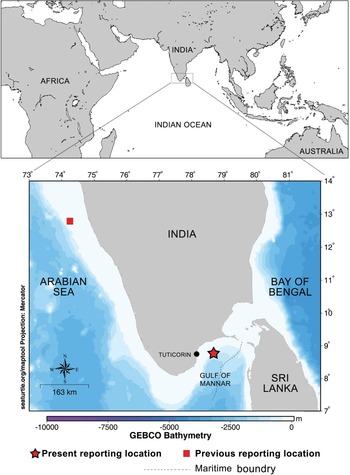
Two specimens of Neobythites multistriatus (Figure 1) with standard length 160 and 180 mm were collected from a commercial deep-sea trawler by-catch at Tuticorin fishing harbour, south-east coast of India in March 2010. The specimens were caught approximately 50 km east off Tuticorin (8°46′39.94″N and 78°36′17.19″E) in the Gulf of Mannar (the Gulf of Mannar is a transitional region between the Arabian Sea and Indian Ocean and is part of the Bay of Bengal) at a depth ranging from 200 to 250 m (Figure 2). After photographic documentation, the specimens were fixated with 5% formalin and brought to the laboratory for detailed examination. The specimens were identified as N. multistriatus based on morphometric and meristic characters as described by Nielsen (Reference Nielsen1995). The morphometric measurements were taken to the nearest mm using a digital Vernier caliper following Nielsen et al. (Reference Nielsen, Cohen, Markle and Robinson1999). The specimens were deposited in the National Biodiversity Museum at the Central Marine Fisheries Research Institute, Kochi (GB.28.4.17.10).
Lateral view of Neobythites multistriatus collected from the Gulf of Mannar, Bay of Bengal.

Capture location of Neobythites multistriatus from the Gulf of Mannar star (red) and from the Arabian Sea box (red).

RESULTS
SYSTEMATICS
Order OPHIDIIFORMES Berg, 1937
Suborder: OPHIDIOIDEI Berg, 1937
Family OPHIDIIDAE Rafinesque, 1810
Subfamily NEOBYTHITINAE Radcliffe, 1913
Genus Neobythites Goode & Bean, 1885
Species Neobythites multistriatus Nielsen & Quéro, Reference Nielsen and Quéro1991
DESCRIPTION
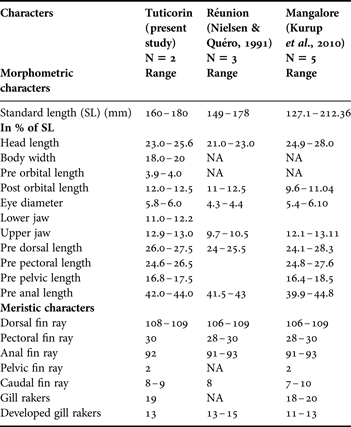
Morphometrics and meristics of N. multistriatus are given in Table 1. Elongate body with vague lateral line; snout blunt, slightly longer than eye, maxilla ends well behind eye; granular teeth; vomer tooth in patches, anterior basibranchial tooth patch broad in front; hind margin of preopercle with two spines; anterior nostril with flap or low tube and larger posterior nostril a mere hole; ventral fin reaches half way from its base to anal fin. The anterior gill arch with three short and three long rakers on upper branch, one long raker in angle and lower branch with 8–10 long and 4–6 short rakers, 3–5 pseudobranchial filaments. Dorsal-fin rays 108–109; numbers of anal fin rays 92, body yellowish, nine block blotches on dorsal fin. Lens bluish. Diffuse brown line from front of snout through to eye.
Comparison of morphometric and meristic characters of Neobythites multistriatus from the Gulf of Mannar with those recorded in other areas.

NA, no data available.
Neobythites multistriatus shows resemblance to N. fasciatus because of the presence of two pre-opercular spines and several vertical bars on the body ending as ocelli (dark blotches). Neobythites multistriatus differs from N. fasciatus in the number of developed gill rakers (N. multistriatus = 13 and N. fasciatus = 8–10), number of anal fin rays (N. multistriatus = 92 and N. fasciatus = 84–88), number of dorsal finrays (N. multistriatus = 108–109 and N. fasciatus = 99–106) and number of anal fin dark blotches (N. multistriatus = 9 and N. fasciatus = 6).
Neobythites multistriatus is characterized by the presence of dark blotches on the dorsal fin (7 or 8), anal fin (3 or 4), 4–10 vertical bars on the body and 12–15 developed gill rakers. In N. crosnieri the dorsal fin shows two distinct ocelli and no vertical bars, whereas in N. natalensis the dorsal fin has six indistinct ocelli. In N. somaliaensis the dorsal fin shows no ocelli or dark blotches and the distal part of the dorsal and anal fins are black, whereas in N. analis distal part of anal fin is black. In N. steatiticus the edge of the anal fin is transparent and the body shows indistinct brown vertical bars, whereas in N. stefanovi the edge of the anal fin is black and the body shows no vertical bars.
DISCUSSION
Neobythites multistriatus is recorded from water depth of 300–490 m (Scherbachev et al., Reference Scherbachev, Pakhnorukov and Piotrovsky1986; Nielsen & Quéro, Reference Nielsen and Quéro1991; Schwarzhans, Reference Schwarzhans1994; Nielsen, Reference Nielsen1995). From the Indian waters, a previous record of N. multistriatus originated from the Arabian Sea from a depth of 415 m (Kurup et al., Reference Kurup, Cubelio, Joseph and Venu2010). The current record of N. multistriatus from the Bay of Bengal at the east coast of India is from a depth range of 200–250 m, and thus represents the shallowest record of the species. This indicates the capability of the species adaptation to much shallower environments in the oceans.
The present report adds to the species diversity of Neobythites in the Bay of Bengal. Several fish species have recently been recorded for the first time along the east coast of India (Zacharia et al., Reference Zacharia, Joshi and Kandan2011; Joshi et al., Reference Joshi, Zacharia and Kanthan2012; Kannan et al., Reference Kannan, Arumugam, Sathakkathullah and Prabhu2012; Zacharia & Kannan, Reference Zacharia and Kannan2012) and most of them stem from by-catches of deep-sea exploitation by commercial trawlers. More in-depth studies on the by-catch composition are required for the better understanding of the benthic/bentho-pelagic biota.
ACKNOWLEDGEMENTS
The authors thank the Director, Central Marine Fisheries Research Institute (CMFRI), and Scientist in Charge (SIC), of Tuticorin Research Centre (TRC) of CMFRI for providing facilities and encouragement. The online GIS program MAPTOOL, provided by SEATURTLE.ORG is also acknowledged.