Introduction
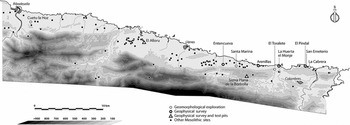
Northern Spain is one of the classic areas for the study of the European Mesolithic. Since the ‘Asturian culture’ was first defined in the early twentieth century (Obermaier Reference Obermaier1916; Vega del Sella Reference Vega del Sella1923), the archaeological evidence from this region has been one of the most relevant sources for the study of late hunter-gatherer societies of south-west Europe. Despite this long research tradition, there are still gaps in our knowledge of the north Iberian Mesolithic; perhaps the most significant of these is the lack of information about settlement sites. This may seem surprising because the central coast of northern Spain—eastern Asturias and western Cantabria—boasts one of the highest densities of Mesolithic sites in Europe. Around 130 so-called ‘Asturian culture’ sites (c. 8000–5000 cal BC) are known in a relatively small area (some 50 × 5km) (Figure 1) (Fano et al. Reference Fano, Gutiérrez Zugasti, Álvarez-Fernández, Fernandez García, Bailey, Hardy and Camara2013: 160). Most of these sites are shell middens (in many cases poorly preserved) in the mouths of caves and rock shelters, which have provided scant archaeological information. Moreover, archaeological explorations of these sites (Vega del Sella Reference Vega del Sella1923; González Morales Reference González Morales1982; Clark Reference Clark1983) have shown that they mainly consist of accumulations of marine invertebrate shells, together with other archaeological remains such as mammal and fish bones and charcoal, but contain a very low density of lithics and little (if any) evidence for hearths or other features usually associated with hunter-gatherer camps. This suggests that these shell middens may be simply refuse areas.
Mesolithic sites located in the coastal area of eastern Asturias, highlighting those explored during each phase of the research.

The question of where the Asturian dwellings are located remains unresolved. This issue was raised at the very beginning of research on the north Spanish Mesolithic, when Vega del Sella (Reference Vega del Sella1923: 9) suggested the possibility of the existence of unknown open-air sites located in the vicinity of the caves, which in some cases could not have been used as dwelling places because they were filled with sediment up to the very ceiling. No systematic programme aiming to test that hypothesis has ever been developed, although partial attempts have been made, among them Geoffrey Clark's excavations at La Riera (Clark Reference Clark1974). He reports an Asturian open-air occupation site located outside the cave, but reanalyses of the context have since challenged that interpretation, suggesting that Mesolithic materials may have come from early twentieth century excavation spoil heaps (González Morales Reference González Morales1982: 89–90; Arias Reference Arias1991: 40–41, 53 & 83). More convincing evidence comes from the ground surface in the outer rock-shelter of the cave of Mazaculos, interpreted as a habitation floor (González Morales et al. Reference González Morales, Márquez Uría, Díaz, Ortea and Volman1980); this opened the possibility that some caves were used as dwelling areas, a possibility that has been discussed in later contributions (Fano Reference Fano1998).
After a century of research on the Cantabrian Mesolithic, our understanding of Asturian dwellings is still very poor. There is plenty of evidence for the nature of subsistence, but the available material is clearly not sufficient to study aspects such as technology, let alone the organisation of living space. A substantial part of the Asturian archaeological record is still missing, and open-air locations are the obvious environments in which to search for it.
Methodological approach
An explicit approach to this issue is one of the main concerns of the COASTTRAN project, a research programme aiming to analyse the Neolithic transition in coastal areas of south-west Europe. To achieve that aim, the research design included a magnetic gradiometry survey of open-air locations near Asturian shell middens.
Around 130 Mesolithic sites have been catalogued on the east coast of Asturias (Figure 1). It was not possible to survey all and so a sample of sites was chosen, selected using the following criteria:
-
• Volume of archaeological deposit: in most shell middens an estimate of the original extent and depth of the Mesolithic layers is possible. Our hypothesis is that there may be a direct relationship between the size of the associated shell midden and the importance of adjacent settlement structures. Therefore, areas close to known large shell middens were preferred.
-
• Topographic features: only sites that were located close to relatively level areas of landscape were selected. Those on steep slopes or cliffs were discounted, as it was thought unlikely that relevant and durable settlements were situated in that kind of location. Additionally, a relatively level surface was judged to offer the best potential results for a magnetometry survey.
-
• Local geomorphology: only sites with a low probability of being affected by erosion processes were selected. Sediment traps such as dolines were preferred.
-
• Previous information: sites with shell middens that had already been excavated or sampled were also judged preferable, as complementary archaeological information could contribute to a better understanding of any structures that may be found.
The geophysical survey focused on magnetometry, a well-established method based on the measurement of local variations in the hypothetically consistent magnetic field of the earth. This can be used to identify and systematically map archaeological sites (Scollar et al. Reference Scollar, Tabbagh, Hesse and Herzog1990; Zickgraf Reference Zickgraf1999; Neubauer Reference Neubauer2001; Witten Reference Witten2006). In most soils the concentration of magnetic minerals varies depending on the depth of the deposit; concentrations are usually higher in the upper levels. Anthropogenic alterations to soil structure, caused by features such as pits, ditches, postholes, foundations, trenches or burials, may result in the mixing of material with different magnetic characteristics and therefore produce measurable differences to the ‘normal’ magnetic values of the area. A similar effect may also be produced by changes in soil composition—such as the accumulation of shells. Both of these anomalies can be detected using magnetometry.
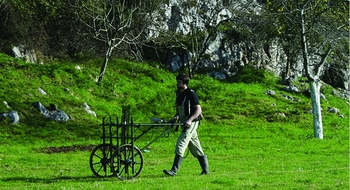
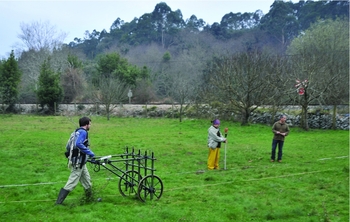
Fieldwork was performed by two of the authors (Salzmann and Teichner), with the collaboration of the Frankfurt branch of the German Archaeological Institute (Römisch-Germanische Kommission). We considered using the innovative vehicle-based (ATV) 16-channel carrier system with automatic GPS positioning (Digital Landscape Model—DLM-GPS), a device that is highly efficient for surveying large areas or transects and recently used in Spain at the Roman sites of Regina and La Olmeda. Yet we decided against it because of the spatial particularities of the sites to be analysed, which are too small for efficient use of that instrument. Instead, a 5-channel carrier for manual use, fit for small- or medium-sized areas, was employed (Figures 2 & 3). The particular geophysical device, the MAGNETO®-ARCH-5-channel-system produced by the firm SENSYS Sensorik & Systemtechnologie GmbH (Bad Saarow, Germany), is a two-wheeled trolley that is pushed over the area. The multi-channel magnetometer system had five probes of the FGM-650/3 type. The measuring range was ±3000 nanotesla and its accuracy was 0.1 nanotesla. The distance between the probes was 0.25m, allowing the simultaneous measurement of 1m transects. Each probe took one measurement every 0.1m. The distance travelled was documented by an odometer, which was fixed to one of the wheels. Rectangular grids were laid out at each site, designed to cover as many of the expected archaeological features as possible while avoiding objects that could disturb the magnetic signature (such as trees, modern structures, geological features).
Magnetometry survey near the shell midden of Entencueva.

Magnetometry survey near the cave site of El Alloru.

The grids were different sizes, varying from relatively small (6 × 20m) to larger areas (36 × 50m), according to local conditions. The corners of the grids were geo-referenced to the official Spanish coordinate system—ETRS89 UTM projection—using a dual frequency RTK GPS (Leica 900GNSS) connected to the GNSS net of the Government of Asturias. Detailed mapping of each site was undertaken with the same device. A Digital Terrain Model was prepared with the aid of n4ce professional software (Applications in CADD). After staking out the fields and assembling and calibrating the magnetometer, lines were set at 1.25m intervals, and the survey was undertaken in zig-zag mode, walking each line in the opposite direction to the last.
For each measurement the magnetometer recorded the x and y coordinates and the magnetisation; these were exported as a text file by the software MAGNETO®. From these data a raster image was generated using ‘gvSIG-OA’, open-source GIS software. The raster image was calculated with the aid of the GRASS tool ‘r.in.xyz’ and interpolated with the help of the GRASS tool ‘r.fill.gap’. Once the processing was complete we were able to begin the interpretation of the geophysical survey. For the representation of the magnetisation, different ranges of nanotesla values were essayed in order to improve the understanding of potential anomalies.
The geomorphological exploration
Selection of the sites was undertaken through a two-stage process. Preliminary analysis was made on the basis of information recorded in an extensive and systematic database prepared some time ago by one of the present authors (Fano Reference Fano1998), which allowed us to pre-select 11 sites (Figure 1). A detailed in situ assessment of these locations followed in October 2012, resulting in a shortlist of six sites: the caves or rockshelters of El Pindal, La Huerta el Monje, Arenillas, Entencueva and El Alloru, and the open air site of Sierra Plana de la Borbolla.
The sites
El Pindal
El Pindal is a large cave, close to the modern coastline. Archaeological evidence attributable to the Mesolithic has been found in the mouth of the cave and possibly on the platform next to it (Jordá & Berenguer Reference Jordá and Berenguer1954; Fano Reference Fano1998: 67; Álvarez-Fernández et al. Reference Álvarez-Fernández, Álvarez, Cubas and Cueto2015). Indeed, the platform appeared to be a promising context for the potential preservation of Holocene layers, as shown by a stratigraphic section preserved in the entrance of the cave facing it. Here, a thick succession of apparently undisturbed layers could be observed above the layer in which Francisco Jordá found materials judged to be Magdalenian (Jordá & Berenguer Reference Jordá and Berenguer1954). Further, the area in front of the cave forms a flat, very regular surface, with clear natural limits (two limestone outcrops). Some arrangement for visits was evident (the cave preserves Palaeolithic rock art and is open for the public), but it did not seem to have involved any significant alterations that would have disturbed the underlying archaeology; early twentieth-century photographs demonstrated that the area had not been significantly altered.
La Huerta el Monje
La Huerta el Monje is a typical sediment trap. The cave has acted as a sinkhole for a relatively steep slope descending from an Ordovician quartzite hill located close to the cave to the east. Some areas with visible stratigraphy revealed a thick layer of quartzite cobbles, covered by flowstone, and, above the latter, an Asturian shell midden. No archaeological evidence was observed in the lower phase, which likely dates to the Pleistocene. During the early and middle Holocene the cave appears to have been nearly filled with sediment; the distance between the flowstone below the Asturian shell midden and the ceiling was cramped, and in some areas all of the available space was covered by the shells. The platform in front of the cave was an ample, nearly flat surface, with just a gentle slope towards the rock shelter.
Arenillas
Arenillas is a large but shallow rock shelter located close to the sea. The morphology of the area suffered important changes during the Holocene; the neighbouring beach appears to be the result of the erosion and drowning of a doline during the post-glacial transgression. The space in front of the shelter is a level meadow, with no evidence of erosion processes or severe human-induced alteration. Moreover, the remains of a 2m-thick Asturian shell midden suggest long or intense Mesolithic activity in the area. A sample of Phorcus lineatus from the lower part of the deposit (taken 0.35m above the base) dated this midden to the second quarter of the fifth millennium cal BC (UBAR-775: 6455 ± 60 BP; 4895–4574 cal BC) (Fano Reference Fano and Fano2004: 351; Arias et al. Reference Arias, Fano, Armendariz, Álvarez-Fernández, Cueto, García, Garralda, Mensua and Teira2007).
Entencueva
Entencueva is another cave that had been completely filled with archaeological sediments during the Mesolithic. In front of the cave there is a flat area, covered by an apple orchard, which shows no particular evidence of erosion, either natural or anthropogenic.
El Alloru
El Alloru is a shallow cave where remains of an Asturian shell midden are preserved, again nearly filling the entire space. A previous test pit excavated by our team (Fano Reference Fano and Fano2004: 351; Arias et al. Reference Arias, Fano, Armendariz, Álvarez-Fernández, Cueto, García, Garralda, Mensua and Teira2007) demonstrated that the base of the Mesolithic layer was dated to the early seventh millennium cal BC (UBAR-781: 8360±70 BP on Phorcus lineatus shell; 6931–6477 cal BC). The cave opens onto a large level area, corresponding to a sinkhole plain, that is currently used as a garden by a neighbouring youth hostel. During the 2012 survey a new shell midden was found in another small cave on the edge of the same doline, 64m east of Alloru (Figure 4), suggesting protracted Mesolithic activity in the area. Although the site appears to have acted as a sediment trap, the building of the hostel nearby introduces some risk of disturbance or alteration.
Results of the magnetometry survey and location of excavations at El Alloru.

Sierra Plana de la Borbolla
Sierra Plana de la Borbolla is a very large open-air site located in an early Pleistocene marine abrasion plain, currently situated 220m above sea level, and cut into Ordovician quartzite. It includes the biggest megalithic necropolis in northern Spain (57 monuments have been catalogued) and evidence of previous late Mesolithic activity dating to the first half of the sixth millennium cal BC (Arias & Pérez Reference Arias and Pérez1990). Several of the megaliths have been dated to an early stage of the local Neolithic, in the fifth millennium cal BC, and evidence has been found of possible cultural continuity with the Mesolithic, such as the presence of Asturian picks (typical local Mesolithic artefacts) among the grave goods found in the megalithic tombs (Arias & Fano Reference Arias and Fano2003). Because the area is a nearly perfect plain, the effects of erosion processes are not intense; it has traditionally been used for activities that do not disturb the ground, such as extensive sheep grazing and, since the late 1970s, hay meadows. We selected a particularly favourable area in the central part of the plain, where risks of erosion were particularly low and a well-preserved group of four megaliths was located, 750m east of one of the locations where Mesolithic evidence had been encountered in our 1985 excavations.
Geophysical survey
Analysis of the results of the survey led to the identification of probable anthropogenic features at three sites: Alloru, Huerta del Monje and Sierra Plana de la Borbolla. Additional possible features were discovered at Arenillas.
At Alloru (Figure 4) the display of the geophysical data (covering 1670m2) shows intense modern activity at the site, largely related to the fill of building rubble on the western limits of the area surveyed (Figure 4, area md). In the centre of the field a strong dipole structure (Figure 4, area md) seems to exist and comparable interferences are indicated along the southern limit of the area prospected, in the vicinity of a railway track (Figure 4, md3). The straight lines running north-west to south-east, south of the large dipole and parallel to the limestone outcrop in the north-east corner of the surveyed area, are likely to be related to pipe lines. Possible archaeological features can be most clearly identified near the limestone outcrop in the north-east, and especially in front of the cave, where some signals were judged to be possible indications of pits or fireplaces (Figure 4, a1). On the other hand, thin rounded features running east to west and then to the north can be interpreted as the continuation of the visible limestone outcrop. Other archaeological structures may be indicated by the grey and black dots in the east, between the strong dipole structures (Figure 4, a2).
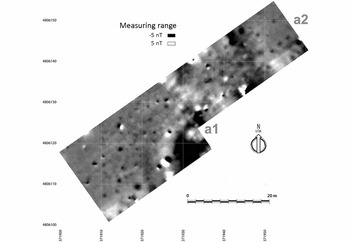
At Huerta el Monje (Figure 5), scrap metal in the cave prevented geomagnetic surveying inside it and near the rock outcrop. Within the area that was surveyed (1089m2) a large oval structure and an adjacent feature, running north, were visible in the centre (Figure 5, a1). It is very likely that the high magnetic values obtained there were produced simply by the mixing of soil horizons. These two main features are surrounded by several small dots, perhaps pits or small postholes, forming lines in some sectors, which could indicate some kind of hut (see especially the north-east end: Figure 5, a2).
Results of the magnetometry survey at Huerta el Monje.

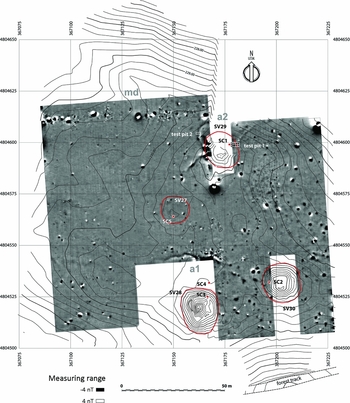
A much larger area was surveyed at Sierra Plana (12 500m2) (Figure 6). The relatively homogeneous survey image indicates that the area is reasonably free of modern waste; only some limited dipole structures (black and white contrast in the image) may indicate small metal objects, probably nails or other small scraps from agricultural tools or vehicles. At the northern end of the area prospected, a regular line of dipole dots probably marks the position of a modern fence, now dismantled (Figure 6, md). The most interesting archaeological features appear near the megalithic monuments SV28 and SV29 (Figure 6, a1 & a2). Surprisingly, however, the ditches indicated by lower nanotesla values do not correspond exactly to the visible barrows. Quite the opposite, in SV29 they seem to indicate earlier structures located below the visible Neolithic mound: a circular element and a ditch (Figure 6, a2). A larger structure, ostensibly another circular feature, is located to the north of megalith SV28 (Figure 6, a1).
Results of the magnetometry survey and location of excavations at Sierra Plana de la Borbolla; red lines indicate the current perimeter of the megalithic monuments.

At Arenillas, three areas covering a total of 646.75m2 were surveyed near the rock shelter. In addition to several dipole signals that are probably traces of recent camping activities (one tent peg was found), linear anomalies of different magnetisation appear to reflect the natural geological features of the subsoil. On the other hand, some signals in the western part of the area surveyed might be related to anthropogenic activities, perhaps prehistoric settlement structures such as pits or postholes.
Finally, as we have already stated, the work at El Pindal and Entecueva (Figure 2) was unsuccessful in tracing buried features of interest. In both cases the proximity to areas with modern metal concentrations prevented the effective use of the method (at El Pindal, the railing protecting the access to the Palaeolithic paintings; at Entencueva, accumulations of waste inside the cave and metallic fences nearby).
Testing the results of the geomagnetic prospection: the 2013 excavations
As a final stage of our programme of research, test pits were opened in the most promising sites to check whether the anomalies detected were really prehistoric features, and, if so, to define them more precisely. The selected sites were Sierra Plana de la Borbolla, El Alloru and Huerta del Monje. Unfortunately, the fieldwork at Huerta del Monje had to be postponed as a consequence of the timing of agricultural activities.
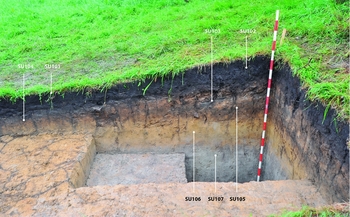
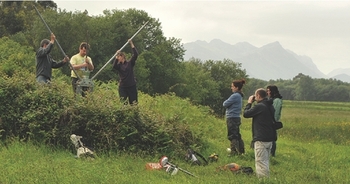
At Sierra Plana two test pits were opened in an attempt to locate archaeological features related to the linear anomaly that appeared to exist beneath the megalithic monument SV29 and the possible circular structure north-west of it (Figure 6). The north-east edge of the mound was included in the excavated area to study the stratigraphic relationship between the Neolithic monument and the newly discovered features. With this aim a 4 × 2m trench (oriented west to east, following the grid of the UTM-ETRS89 projection) was opened (test pit 1). There was a very clear difference between the artificial deposits of the tumulus (stratigraphic unit SU103) and the fossil soil beneath (SU105) (Figure 7). Further, the outer edge of SU103 was delimited by a series of quartzite blocks, some 0.3m long, that likely correspond to the remains of a circular kerb. Below the palaeosol, dated to the second third of the fourth millennium cal BC (OxA-29171: 4730±32 BP; 3635–3377 cal BC on organic matter from the A horizon), a clay layer was found. Another test pit was opened outside the tumulus, over a circular anomaly detected by the geophysics. This 2 × 1m trench, also oriented west to east (test pit 2), had identical stratigraphy to the sequence found outside the barrow in test pit 1. In the lower clayey horizon of the palaeosol, some lithics on flint, quartzite and quartz (including a splintered piece) were found. They may be related to the Mesolithic layer dating to the sixth millennium cal BC, which was excavated in 1985, below megalith SV24, 750m west of this group (Arias & Pérez Reference Arias and Pérez1990). In the framework of the COASTTRAN project, sediment cores were taken by our colleagues Eneko Iriarte and Carlos Duarte Simões at every megalithic monument in the Maipelay group (SV27, SV28, SV29 & SV30), sampling the barrows and the soils beneath them (Figures 6 (SC1–SC5) & 8). They were obtained using a percussion window sampler (0.05m diameter and up to 4m long).
Sierra Plana, test pit 1, southern stratigraphic section; note the upper horizon of the palaeosol (SU105) beneath the artificial mound of the megalithic monument SV29 (SU102 & SU103) and at its eastern edge, one of the quartzite blocks of the kerb surrounding the mound.

Coring for geological analysis at Sierra Plana (SC3).

Despite the extreme care taken in the excavation procedures, no evidence was found in any of the excavation areas that might be related to the anomalies detected by the geomagnetic survey. This may be considered an example of the phenomenon commonly described in the literature as ‘ghost features’ or ‘magnetic ghosts’; these are features that are recognised by geophysical survey, but are barely identifiable (or even visible) during archaeological excavation (Schleifer Reference Schleifer2004; Fröhlich et al. Reference Fröhlich, Posselt and Schleifer2005; Posselt & Schleifer Reference Posselt, Schleifer, Lüning and Kaenel2006). The phenomenon is generally attributed to post-depositional processes leading to the disappearance of organic matter (and thus of colour contrast), whereas minerals with different magnetisation remain in the soils (Faßbinder Reference Faßbinder1994). To facilitate study of this issue, further research is planned at this site, including new test excavations, the application of other geophysical techniques (electrical resistivity survey, ground-penetrating radar) and soil analysis.
More conventional results were obtained at El Alloru (Figure 4). In this case two 2 × 1m test pits, once again aligned with the UTM-ETRS89 projection, were opened in a level, open area facing the cave where some apparently relevant anomalies were observed in the geophysics: on the one hand, an arc-like line enclosing the rectangular strip, limited to the north-east by the cave and to the south by a limestone outcrop; on the other, a series of smaller oval features in front of the cave entrance. Another test pit was opened in the mouth of the cave (test pit 3) and a section from previous excavations in the shell midden, inside the cave, was recut and cleaned (test pit 4). In both cases the aim was to determine the relationship between the cave stratigraphy and the open-air deposits. As at Sierra Plana, a sediment core was extracted.
Test pit 1, oriented west to east, targeted the small oval features. Below thin sediments containing modern material, an intact layer (SU105) containing prehistoric pottery was found. It lay above a silty layer, which showed several stratigraphic facies (SU104, SU107 & SU112) (Figure 9), and included a high density of Holocene marine molluscs and Mesolithic tools (Asturian picks). Its attribution to this period was confirmed by two radiocarbon dates for a chamois bone from SU104 (OxA-29115: 7979±38 BP; OxA-29116: 7979±38 BP; 7049–6708 cal BC). It is interesting that, unlike typical Asturian assemblages, this layer included evidence for knapping. At the base of this Mesolithic layer, two small pits (Figure 10), possibly the sockets for narrow posts (SU109 & SU111, filled respectively with SU108 and SU110) were dug in a clayey layer that contained abundant limestone blocks (SU106). The latter layer was almost sterile, but included some archaeological items that could be attributed to an early stage of the Mesolithic. SU 106 overlay a large limestone block that was probably the consequence of the collapse of the rock shelter.
El Alloru, test pit 1; eastern stratigraphic section.

Open-air Mesolithic structure found near the cave of El Alloru (test pit 1), indicating the anthropogenic holes (top left) interpreted as possible post holes (SU109 & SU111).

Test pit 2, oriented north to south, revealed a large geological feature, corresponding to the former edge of the limestone hill. It was overlain by a sequence of deposits that included prehistoric layers with pottery (probably of late Bronze Age or early Iron Age date), covering a soil provisionally dated to the Pleistocene.
Both test pits proved that there was fairly good correspondence between geophysical anomalies and archaeological features. There is little doubt that the arc-like line identified in the south-western area in front of the cave is related to the edge of the limestone hill. On the other hand, it is quite likely that the oval anomalies mentioned above (Figure 4, a1) correspond to the features observed within the Mesolithic (Asturian) layer (contexts SU104, SU107 & SU112).
Concluding remarks
For the first time in northern Spain, geophysical survey techniques have been used to explore Mesolithic and early Neolithic sites. These methods, and particularly magnetic gradiometry, have been frequently employed for later periods, especially in the search for architectural structures, in Spain and elsewhere, but no attempt had hitherto been made to use these techniques to locate the usually evanescent evidence of hunter-gatherer settlement structures. The results have been encouraging, yet technical and practical problems have emerged. Most significant of these has been the excess magnetic ‘noise’ resulting from the location of the surveyed areas near to villages. Modern structures such as fences, railways or pipelines, waste from building activity and, more generally, the presence of hundreds of pieces of scrap metal produced a great variety of magnetic anomalies. In many cases they were easily recognisable (for instance, through the characteristic dipole shape of the strong magnetic signal derived from metal items), but they masked older structures. In some cases, notably at El Pindal and Entencueva, these obscured large parts of the areas under analysis and greatly reduced the usefulness of this technique.
Interpretation of geophysical survey results is never an easy task, and, in cases such as this, where no previous information on Mesolithic and Neolithic structures exists, it becomes even more complicated. That is why test pits were required to reach a correct interpretation of the survey results. The results have been twofold. On the one hand, highly visible anomalies that appeared to be related to prehistoric structures were not recognised as such in the field (for example, at Sierra Plana de la Borbolla), suggesting that some latent structures may be too subtle for standard excavation methods. On the other hand, at Alloru both geological and archaeological features were found in the excavations, confirming in both cases the provisional initial interpretations of the survey results and revealing what appears to be the first Asturian dwelling structure to have been identified. More promising still is the very conspicuous anomaly detected at Huerta del Monje, although it has not yet been possible to test whether that corresponds to a Mesolithic structure or not.
Geomagnetic survey, then, has proved to be a rapid, relatively cheap and efficient method for locating very elusive Mesolithic settlements. We venture to suggest that this experience could be useful for other areas of Atlantic Europe where identifying evidence for late hunter-gatherer settlements is problematic. The main aim of the research programme, finding evidence of late Mesolithic open-air settlement, has been a success. The hypothesis that shell middens were related to areas nearby where the bulk of everyday activities were performed has been proven. It was confirmed by the combined use of geomorphological prediction, geophysical survey and archaeological excavation.
Acknowledgements
This paper is a contribution to the research project ‘Coastal transitions: a comparative approach to the processes of neolithization in Atlantic Europe’ (COASTTRAN) (HAR2011–29907-C03–00; subproject HAR2011–29907-C03–01), granted by the VI Plan Nacional de Investigación Científica, Desarrollo e Innovación Tecnológica 2008–2011 of the Spanish Ministry of Economy and Competitiveness. Administrative authorisations were granted by the Consejería de Educación, Cultura y Deporte of the Government of the Principality of Asturias. We are particularly grateful to the colleagues who participated in the field season, despite terrible weather: Ángel Armendariz, Inés López-Dóriga, Alfredo Maximiano, Carlos Duarte Simões, Jesús Tapia, Cecilia Adanes, Rafael Bolado, Aida Cecilia Marqués, Irene Reyero (Universidad de Cantabria), Eneko Iriarte (Universidad de Burgos) and Sara Núñez de la Fuente (Universidad de Valencia). We are also indebted to the owners and tenants of the fields: María Concepción González Sordo, Julián Herrero, José Ramón Sordo, Víctor and Mercedes San Miguel and Juan Álvarez Corao, who were very patient with the occupation of their lands by a disturbing flock of archaeologists. Special thanks to the Römisch-Germanische Kommission des Deutschen Archäologischen Instituts for allowing us to use their instruments. We particularly appreciate the most efficient collaboration of our colleagues Dr Friedrich Lüth (Berlin) and Dr Knut Rassmann (Frankfurt am Main). The GRASS tool ‘r.fill.gap’ program used during the processing of our results has been developed by Benjamin Ducke. The calibrations of the radiocarbon dates were made with the curves IntCal13 and Marine13 (Reimer et al. Reference Reimer, Bard, Bayliss, Beck, Blackwell, Bronk Ramsey, Grootes, Guilderson, Haflidason, Hajdas, Hatté, Heaton, Hoffmann, Hogg, Hughen, Kaiser, Kromer, Manning, Niu, Reimer, Richards, Scott, Southon, Staff, Turney and van der Plicht2013) and the calculations with the program OxCal v. 4.2.3 (Bronk Ramsey Reference Bronk Ramsey2009). For the estimation of the reservoir effect, we have used the ΔR provisional value for the northern coast of Spain, as calculated by Mestres and Arias (Reference Mestres, Arias and Clemente2006).