Introduction
Cucumbers are grown under protected plastic house conditions in Jordan. Various stress factors and pest attacks have remained a threat to efficient cucumber production by lowering yields, reducing quality and making harvest unreliable. Water constraint is the main obstacle to the development of the agricultural sector in Jordan, especially for crops such as cucumber with high water demand. Irrigation with saline water is a common feature, especially in arid and semi-arid regions, which can drastically impact crop growth and marketable yield (Sato et al., Reference Sato, Sakaguchi, Furukawa and Ikeda2006; Baghbani et al., Reference Baghbani, Forghani and Kadkhodaie2013). It has been estimated that more than 30% of the agricultural land in the Jordan valley is affected by salinity (Mashali, Reference Mashali1989). Generally, Jordanian farmers use brackish water for irrigation. Salinity and sodicity problems could intensify by the continual use of poor-quality irrigation water (Gharaibeh et al., Reference Gharaibeh, Eltaif and Shunnar2009). It has been reported that water salinity starts with less than 600 mg/l and exceeds 3000 mg/l in certain areas (Fardous et al., Reference Fardous, Mudabber, Jitan and Badwan2004). Desalinization is extremely costly, and the introduction of cultivars resistant to salinity can be beneficial both economically and ecologically (Valydany et al., Reference Valydany, Hassanzadeh and Tajbakhsh2005).
Soil-borne pathogens including Rhizoctonia solani Kuhn, Fusarium spp., Pythium debaryanum Hesse and root-knot nematodes are also serious stress factors that impact the growth and yield of cucumber. Even though proper disease management is advised, an effective control of disease-causing pathogens depends mainly on chemical use. However, plants that are disease resistant or tolerant are protected from pathogens. The interest in the development of genetic disease tolerance has long been the focal goal of plant breeding efforts, and the search for disease resistance in wild types is continuing (Huang et al., Reference Huang, Li, Zhang, Li, Gu, Fan, Lucas, Wang, Xie, Ni, Ren, Zhu, Li, Lin, Jin, Fei, Li, Staub, Kilian, van der Vossen, Wu, Guo, He, Jia, Ren, Tian, Lu, Ruan, Qian, Wang, Huang, Li, Xuan, Cao, Asan, Wu, Zhang, Cai, Bai, Zhao, Han, Li, Li, Wang, Shi, Liu, Cho, Kim, Xu, Heller-Uszynska, Miao, Cheng, Zhang, Wu, Yang, Kang, Li, Liang, Ren, Shi, Wen, Jian, Yang, Zhang, Yang, Chen, Liu, Li, Ma, Liu, Zhou, Zhao, Fang, Li, Fang, Li, Liu, Zheng, Zhang, Qin, Li, Yang, Yang, Bolund, Kristiansen, Zheng, Li, Zhang, Yang, Wang, Sun, Zhang, Jiang, Wang, Du and Li2009). Resistant cultivars can be extremely valuable to growers (Walters et al., Reference Walters, Wehner and Barker1993).
Induction of plant resistance against the fungus Rhizoctonia is still ongoing (Seo et al., Reference Seo, Nguyen, Song and Jung2012). No single-gene resistance to the disease-causing fungus has been found (Sloane and Wehner, Reference Sloane and Wehner1984). Moreover, most cucumber cultivars are not resistant to Meloidogyne incognita (Kofoid and White) Chitwood and M. javanica (Treub) Chitwood.
The wild melon Cucumis prophetarum L. is a perennial desert plant and a weed in many crops in the semi-arid regions. Diseases common to cucumber have not been reported to occur in C. prophetarum, including powdery mildew, wilt diseases and nematodes. Wild melon could be a potential genetic source for resistance to many diseases and may be a useful rootstock for grafting.
The objective of this study was to compare the tolerances of the cultivated cucumber and wild melon to salinity, the damping-off disease caused by the fungus R. solani and the root-knot nematode M. incognita.
Materials and methods
Greenhouse pot experiments were carried out during the growing season 2012/2013 to study the tolerances of the cultivated cucumber and wild melon.
Tolerance to salinity induced by either NaCl or CaSO4.2H2O
Tolerance of the cultivated cucumber and wild melon to NaCl concentrations
One greenhouse pot experiment was conducted to determine the effect of NaCl concentrations on cucumber survival. The experiment included five treatments prepared with tap water: 0 (tap water only), 2500, 5000, 7500 and 10,000 ppm NaCl concentrations. Each treatment included four replicates, each consisting of five pots of either the cultivated cucumber or the wild melon. The lowest concentration (2500 ppm) of NaCl was used as the initial concentration to mimic NaCl concentrations in certain sodic soils in which tomato and cucumber plants are grown. The pots were irrigated with a proper solution three times per week until the flowering stage, at which the experiment was terminated. Monitoring yellowing and the number of dead plants were recorded weekly until the end of the experiment.
Tolerance of the cultivated cucumber and wild melon to CaSO4.2H2O concentrations
Two greenhouse pot experiments were conducted to determine the effect of calcium sulphate concentrations on cucumber growth.
The first experiment included three concentrations of CaSO4.2H2O prepared with tap water: 1000, 2000 and 4000 ppm in addition to 0 ppm CaSO4.2H2O (tap water only) as a check. Each treatment was replicated five times, each consisting of five pots, i.e. 25 pots per treatment, of either the cultivated cucumber or the wild melon. The pots were irrigated with a proper solution three times per week until the flowering stage. The number of dead plants was recorded each week after planting.
The second experiment included ten concentrations of CaSO4.2H2O prepared with tap water: 1000, 2000, 3000, 4000, 5000, 6000, 7000, 8000, 9000 and 10,000 ppm in addition to 0 ppm CaSO4.2H2O (tap water only) as a check.
Each treatment was replicated five times (two pots per replicate), each consisting of either the cultivated cucumber or the wild melon. The pots were irrigated with a proper solution three times per week until the flowering stage. Shoots were harvested and placed in a dry oven at 75°C for 3–4 d. When the plants dried completely, the dry weight per shoot was measured on a digital weighing balance. Dry weights and the number of dead plants were recorded.
Tolerance to Rhizoctonia solani
Preparation of the fungal inoculum
The inoculum was prepared by growing the infested cutting of cucumber on agar for 2 weeks. The growing mycelium was scraped off the media, and then suspended in distilled water to dip each seedling.
Infestation with the fungus
Cucumber seedlings of either the cultivated cucumber or the wild melon were infested with the inocula of the fungus R. solani in the following way: the roots of each seedling were washed and dipped in the inoculum suspension. The seedlings were then planted in oven-sterilized soils and kept in the greenhouse until the flowering stage when the experiment was terminated. The treatments included 15 pots of seedlings inoculated with the fungus and 15 pots of seedlings without the inocula, as a check, from each Cucumis species. Each plant was examined for infection prior to the termination of the experiment, and the percentage of infestation was recorded. At the termination of the experiment, the crown area with the attached roots was extracted from the soil, grown on agar media for 10–15 d and then tested for the presence of the fungus. Data are recorded as the number of infested plants per treatment.
Tolerance to the root-knot nematode Meloidogyne incognita
Seedlings of either the cultivated cucumber or the wild melon were planted in oven-sterilized soils, infested with the inoculum of the nematode M. incognita at a rate of five egg masses per seedling and then kept in the greenhouse until the flowering stage when the experiment was terminated. The treatments included five pots of seedlings inoculated with the nematode and five pots of seedlings without the inocula, as a check, from each Cucumis species. After 1 month of infesting the plants with the nematodes, two plants from each treatment were harvested to examine nematode infestation and to ensure that the inoculum was viable as well as inoculation, penetration and invasion were successful. The other three plants were tested for galling at the termination of the experiment (about 2.5 months after planting).
All the treatments were conducted according to the completely randomized design. The analysis of variance was conducted, where appropriate, with the SAS program, version 7 for Completely Randomized Design, CRD arrangement, and the means were separated by Least Significate Difference, LSD0.05 according to the generalized linear model, GLM procedure, Statistical Analysis System (Anonymous, 1998). LSD0.05 values are presented in tables, where appropriate.
Results
Tolerance to salinity induced by either NaCl or CaSO4.2H2O concentrations
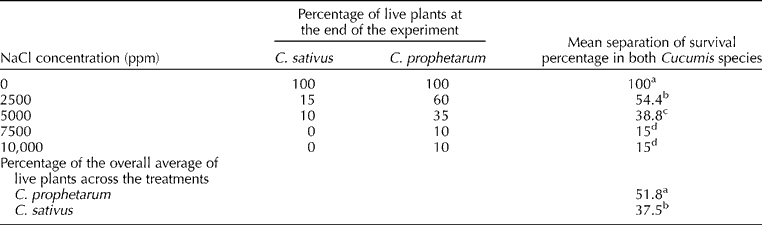
Plants of the cultivated cucumber (Cucumis sativus) and the wild melon (C. prophetarum) started to die at the 5th week after planting when the plants were irrigated with NaCl at the concentration of 2500 ppm. The percentage of survival was higher in the wild melon than in the cultivated cucumber (Table 1) when NaCl was the source of salinity. Death continued to occur in the plants of cultivated cucumber. At the end of the experiment, the percentage of the plants that survived at the 2500 ppm NaCl concentration was 15%, and at 5000 ppm, only 10% of the plants survived. The tolerance of wild melon to NaCl concentrations was higher, as 60% of the plants survived the 2500 ppm NaCl concentration and 35% survived the 5000 ppm NaCl concentration. The plants of cultivated cucumber could not tolerate NaCl concentration at 7500 ppm or higher, whereas some of the wild melon plants survived. The survival of the plants of both species was significantly reduced with increasing NaCl concentration. The percentage of the overall average survival of wild melon plants was significantly higher than that of cultivated cucumber plants across all salinity levels, indicating the higher tolerance of the wild melon to salinity.
Survival of the two Cucumis species in response to NaCl concentrations

a,b,c,dMean values within a column with different letters are significantly different at P≤ 0.05, according to the least-square means by the GLM procedure (SAS Institute, 1998).
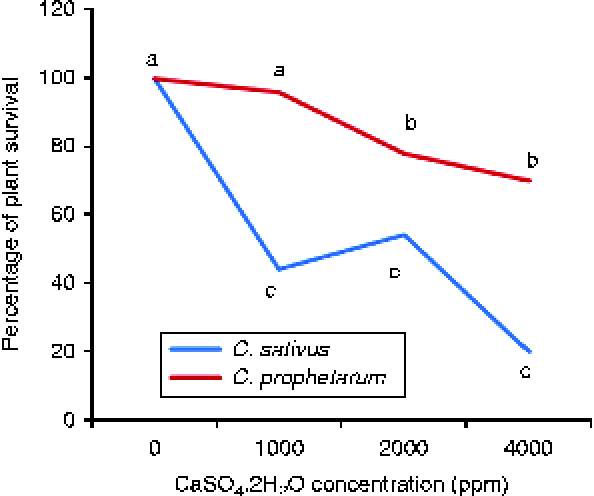
The survival of the plants of both species was much better when CaSO4.2H2O (Fig. 1) than when NaCl was the source of salinity. The percentage of the live plants of the cultivated cucumber and wild melon was 20 and 70%, respectively, at the end of the experiment when irrigated with CaSO4.2H2O at the 4000 ppm concentration (Fig. 1).
Percentage of plant survival in the two Cucumis species at different CaSO4.2H2O concentrations during the termination of the experiment. a,b,cDifferent letters indicate significant differences between the means of survival percentage.

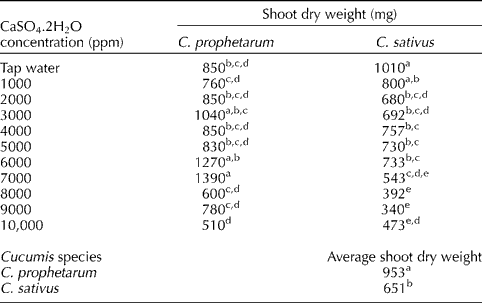
During the period of this experiment, the cultivated cucumber plants started to die after 1 month of planting when irrigated at the 1000 ppm concentration, whereas no ill effects appeared on the wild melon. The percentages of the plants that survived at the termination of the experiment were 20 and 70% for the cultivated and wild species, respectively (Fig. 1). The average dry weights of the plants of both species were significantly reduced with increasing CaSO4.2H2O concentration (Table 2), but the overall average dry weights and survival percentages of the wild melon were significantly higher than those of the cultivated cucumber (Table 2). The dry weights clearly showed that the cultivated cucumber was more sensitive to CaSO4.2H2O concentration than the wild melon. A significant reduction in the shoot dry weights of the cultivated cucumber was encountered at 2000 ppm compared with tap water. On the other hand, the shoot dry weights of the wild melon were not affected, and intriguingly, but not significantly, were increased with higher CaSO4.2H2O concentrations of 7000 ppm and then started to decline at higher concentrations (Table 2).
Average dry weights of the two Cucumis species irrigated at different CaSO4.2H2O concentrations

a,b,c,d,eMean values within a column with different letters are significantly different at P≤ 0.05, according to the least-square means by the GLM procedure (SAS Institute, 1998).
Tolerance to Rhizoctonia solani
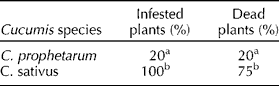
The plants of the cultivated cucumber were more sensitive to infection caused by R. solani than those of the wild melon (Table 3). The wild melon plants showed higher tolerance to attack by the fungus. The shoot crown area and the neighbouring roots of all the cultivated cucumber plants were infested with the fungus, and most of them showed signs of death by the end of the experiment. The check plants were devoid of the fungus.
Percentage of infested and dying plants of the two Cucumis species due to Rhizoctonia infestation

a,bMean values within a column with different letters are significantly different at P≤ 0.05, according to the least-square means by the GLM procedure (SAS Institute, 1998).
Tolerance to the root-knot nematode Meloidogyne incognita
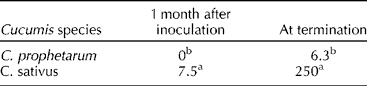
The plants of the cultivated cucumber were more sensitive to infection by the nematode than the wild melon plants (Table 4). The inoculum was active and nematode galls were apparent on the roots of the cultivated cucumber plants 1 month after inoculation.
Average number of nematode galls per plant on the roots of the two Cucumis species

a,bMean values within a column with different letters are significantly different at P≤ 0.05, according to the least-square means by the GLM procedure (SAS Institute, 1998).
The wild melon plants showed higher tolerance to attack by Meloidogyne. The percentage of infestation in the wild melon was less than that in the cultivated cucumber. The roots of all the cultivated cucumber plants were highly infested with the nematode. The average number of galls on the roots of the cultivated cucumber at the termination of the experiment was 250 galls per plant compared with 6.3 galls per plant for the wild melon.
Discussion
The tolerance of the two Cucumis species to calcium sulphate concentration was higher than that to NaCl. The plants of both species showed yellowing when NaCl was the source of salinity. This effect is due to the decrease in net photosynthesis, as Na is known to affect chloroplast structure. The high concentrations of NaCl (25–50 mM) in the rooting medium restricted cucumber growth due mainly to the impairment of the photosynthetic apparatus at the chloroplast level, which indicates an ion-specific effect (Drew et al., Reference Drew, Hall and Picchioni1990). The vegetative growth and yield of cucumber were more sensitive to NaCl concentration than to CaCl2 salinity (Trajkova et al., Reference Trajkova, Papadantonakis and Savvas2006). A Na concentration of 1.3 mM NaCl brought about 50% of chlorophyll loss in Amber rice, high Na concentrations disorganized cellular structure and decreased photosynthesis (Flowers et al., Reference Flowers, Duque, Hajibagheri, McGonigle and Yeo1985). In addition to the dry weight data, our observations indicated that yellowing started to appear on the cultivated cucumber plants 2 weeks after planting at the 2500 ppm NaCl concentration or higher, while yellowing on the plants of the wild melon did not appear until the 5th week after planting. Yellowing could be explained by the harmful effect of Na to the photosynthetic apparatus (Drew et al., Reference Drew, Hall and Picchioni1990). In addition, cucumber plants have a lower capability of excluding Na ions from the leaves, leading to the accumulation of Na that aggravates Na toxicity (Savvas et al., Reference Savvas, Pappa and Kotsiras2005). Thus, it seems that the wild melon is naturally better adapted to higher levels of Na, as such species grows well enough in sodic soils. The wild melon C. prophetarum L. is a perennial desert plant distributed in the East Saharo-Arabian phytogeographical region. The plant grows wild in arid and semi-arid regions and near brackish water sources.
When CaSO4.2H2O was the source of salinity, yellowing on the plants of the cultivated cucumber was not observed even when the plants were irrigated with the 4000 ppm CaSO4.2H2O concentration. The higher tolerance of cucumber to salinity induced by CaSO4.2H2O concentration was due to the less harmful effect of Ca ions, presumably because of Ca involvement in calmodulin, a major class of Ca sensor proteins that collectively plays a crucial role in cellular signalling cascades through the regulation of numerous target proteins (Ranty et al., Reference Ranty, Aldon and Galaud2006), in combination with more efficient compartmentation of Ca in the vacuole and other cellular compartments such as the mitochondria (Marme’, Reference Marme’, Lauchli and Bieleski1984; Garciadeblas et al., Reference Garciadeblas, Benito and Rodriguez-Navarro2001). In addition, roots tend to grow better with higher Ca levels in the root media, enhancing the efficiency of water and other nutrient uptake (Trajkova et al., Reference Trajkova, Papadantonakis and Savvas2006). Ca is a multifunctional nutrient, and in the soluble form, it influences availability and uptake and increases nitrogen-use efficiency. External Ca2+ enhances plant salt tolerance (Läuchli, Reference Läuchli, Leonard and Hepler1990). High levels of extracellular Ca2+ exert numerous effects on plant cells, many of which may be correlated with alleviating Na toxicity. These effects include improved K and Ca2+ nutrition and reduced cellular Na content. Many of the effects of extracellular Ca2+ on relieving salt toxicity are probably achieved by activating signalling pathways for K+ and Na+ transport, which include the regulation of influx and efflux and the compartmentation of these ions.
The results of this study ascertained that the wild melon C. prophetarum is more tolerant to salinity than the cultivated species, C. sativus, especially when NaCl was the source of salinity.
The management of the fungal disease caused by Rhizoctonia can be achieved via an integrated approach involving deep plowing to reduce the inocula from the surface layer of the soil, the application of biofungicides such as Corticium sp. and Trichoderma sp. and the application of fungicides such as captafol (Lewis and Papavizas, Reference Lewis and Papavizas1979). However, the induction of plant resistance against the fungus Rhizoctonia is still ongoing. Few studies have shown a possible success in inducing resistance by treating cucumbers with Bacillus thuringiensis GS1 (Seo et al., Reference Seo, Nguyen, Song and Jung2012). No single-gene resistance to the disease-causing fungus has been found (Sloane and Wehner, Reference Sloane and Wehner1984; Uchneat and Wehner, Reference Uchneat and Wehner1998). Screening methods have shown that certain cucumber lines have quantitatively inherited resistance to the disease, and can be potential sources for resistant genes (Sloane et al., Reference Sloane, Wehner and Jenkins1983). The wild melon C. prophetarum might have a certain mechanism that allows the plants to be more tolerant to the fungus than the cultivated cultivars.
Significant research efforts have been underway to develop nematode-resistant cultivars for many of these crops including cucumber (Wehner et al., Reference Wehner, Walters and Barker1991). Several cultigens of the cultivated cucumber showed resistance to Meloidogyne hapla Chitwood, but were highly susceptible to certain races of M. incognita. Some cultigens of the horned cucumber Cucumis metuliferus were highly resistant to all root-knot nematodes, including certain races of Meloidogyne arenaria (Neal) Chitwood, M. incognita (Kofoid and White) Chitwood, M. javanica (Treub) Chitwood and M. hapla (Walters et al., Reference Walters, Wehner and Barker1993).
Root-knot nematode management by pesticides does not always provide adequate control. Other management tools such as soil solarization, biological agents and other cultural means either are not applicable or do not provide sufficient protection for the production of quality fruits. Nematode-resistant cultivars can be used as part of an integrated approach to develop an effective alternative against a wide variety of nematodes for a wide variety of crops, particularly high-value vegetable and fruit commodities.
In conclusion, research in genetic resistance has been the focal venue of many scientists who are trying to develop commercially acceptable cultivars. Resistant cultivars can be more economic than non-resistant cultivars. They are particularly effective because they can be used in conjunction with other pest control practices (i.e. sanitation, soil solarization, soil amendments (compost and manure), biological control, crop rotation and early planting scheduling to reduce or eliminate pest attacks; Cook and Evans, Reference Cook, Evans, Brown and Kerry1987; Lehman and Cochran, Reference Lehman and Cochran1991; Dunn, Reference Dunn1993).
Genetic sources for resistance against certain diseases or stress factors have been discovered in many cultigens of cultivated cucumbers. In this study, we found that the wild melon is comparably more tolerant than the cultivated cucumber to salinity, the damping-off disease caused by the fungus R. solani and the root-knot nematode M. incognita. The wild melon could be a potential source of resistant/tolerant genes that can be transferable to cultivated cucumbers. Further research should be carried out to exploit the possibility.
Acknowledgements
This research was funded by the Deanship of the Academic Research, University of Jordan.