Young children display a reliable tendency to reserve a single word for a single object (Markman & Wachtel, Reference Markman and Wachtel1988; Merriman & Bowman, Reference Merriman and Bowman1989). This assumption that word meanings contrast, or are mutually exclusive, is commonly demonstrated in tasks in which children are presented with a pair of objects, one familiar (e.g. a cup) and one unfamiliar (e.g. a gyroscope), and asked to select the object that best corresponds to a novel word (e.g. ‘Can you bring me the gyroscope?’). On this standard disambiguation task children reliably select the unfamiliar object. Merriman & Bowman (Reference Merriman and Bowman1989) dubbed this phenomenon (i.e. the tendency to assign the novel word to the unfamiliar object) the disambiguation effect for its role in reducing the ambiguity of novel word meanings (also known as the avoidance of lexical overlap, Markman & Wachtel, Reference Markman and Wachtel1988; Diesendruck & Markson, Reference Diesendruck and Markson2001). There are two competing accounts of the disambiguation effect: a pragmatic account and a word learning principles account.
According to a pragmatic account of the disambiguation effect children assume that two contrasting referential acts indicate two contrasting referential intentions (Diesendruck & Markson, Reference Diesendruck and Markson2001; see also Gathercole, Reference Gathercole1989; Clark, Reference Clark and MacWhinney1987, Reference Clark1990). For example, children assume that when a speaker presents two different words (e.g. cup and gyroscope) the speaker intends to refer to two different things, namely, a cup and a gyroscope. In this example the two different words represent contrasting referential acts and these acts are assumed to be intended for two contrasting referents, such as two different objects. Since the familiar object (i.e. the cup) in the standard disambiguation task already has a known word (i.e. cup), a pragmatic account predicts that the unfamiliar object (i.e. the gyroscope) will be assigned the novel word (i.e. gyroscope). This particular pragmatic assumption of contrast aligns with a larger theoretical framework in which children's facility to interpret human actions, including referential actions, as intentional and informative, is an important part of the machinery used to acquire knowledge (Baldwin, Reference Baldwin2000). Other pragmatic cues to the referential intentions of a speaker include gaze, attention and emotions (Baldwin & Moses, Reference Baldwin and Moses2001). Pragmatic cues to referential intent, such as contrast, assist word learning by directing children toward the most likely referent which, in the standard disambiguation task, is the unfamiliar object.
Alternatively, according to a word learning principles account of the disambiguation effect children assume that words are mutually exclusive and that a single referent (e.g. a cup) should only be assigned a single word (e.g. cup) (Markman & Wachtel, Reference Markman and Wachtel1988; Golinkoff, Mervis & Hirsh-Pasek, Reference Golinkoff, Mervis and Hirsh-Pasek1994; Hollich, Hirsh-Pasek & Golinkoff, Reference Hollich, Hirsh-Pasek and Golinkoff2000). For example, when a speaker presents a novel word, children assume that the word refers to a novel thing. Since the familiar object (i.e. the cup) in the standard disambiguation task already has a familiar word (i.e. cup), a word learning principles account predicts that the novel word (i.e. gyroscope) will be assigned to the unfamiliar object (i.e. the gyroscope). This particular word learning principle of mutual exclusivity aligns with a larger theoretical framework in which children assume words have unique properties and that those properties guide and simplify word learning (Behrend, Reference Behrend1990; Markman, Reference Markman, Gunner and Maratsos1992). Other word learning principles include taxonomy, whole-object, and novel-name nameless-category (N3C) (Woodward & Markman, Reference Woodward, Markman, Kuhn and Siegler1998). Word learning principles, such as mutual exclusivity, assist word learning by directing children toward the most likely referent which, in the standard disambiguation task, is the unfamiliar object.
During episodes of word learning, pragmatic cues and word learning principles often direct children toward the same referent (see Jaswal & Hansen, Reference Jaswal and Hansen2006, for exception). Consequently, it can be difficult to differentiate between the predictions of the two theoretical accounts. Indeed, in the standard disambiguation task both a pragmatic account and a word learning principles account provide viable explanations for the disambiguation effect in part because each predicts that the novel word will be assigned to the unfamiliar object (see Saylor, Sabbagh & Baldwin (Reference Saylor, Sabbagh and Baldwin2002) for related discussion of whole–part distinction). As a result, differences between the accounts are not apparent and it remains unclear which of the two accounts provides a better explanation for the disambiguation effect. However, it is possible to differentiate the predictions of the two accounts. While a pragmatic account predicts disambiguation across multiple domains, including word learning (i.e. it is domain-general), a word learning principles account predicts disambiguation only within the domain of word learning (i.e. it is domain-specific). By converting the disambiguation probe in the standard disambiguation task from a novel word to novel information from a different domain (e.g. a novel fact) the predictions of the two accounts can be differentiated (Diesendruck & Markson, Reference Diesendruck and Markson2001). Since a pragmatic account predicts disambiguation in the presence of any two contrasting referential acts, regardless of domain, then disambiguation of novel words and novel facts should not differ. Conversely, since a word learning principles account predicts disambiguation only in the domain of word learning, then disambiguation of novel words and novel facts could differ.
Recent studies have also contrasted novel words and novel facts (Diesendruck & Markson, Reference Diesendruck and Markson2001; Markson & Bloom, Reference Markson and Bloom1997; Waxman & Booth, Reference Waxman and Booth2000; Behrend, Scofield & Kleinknecht, Reference Behrend, Scofield and Kleinknecht2001). However, to date only one reported study has used both novel words and novel facts to examine the disambiguation effect. Diesendruck & Markson presented three- and four-year-olds with a variant of the standard disambiguation task using a word condition (i.e. which they termed a ‘label’ condition) and a fact condition. In both the word and fact conditions children were shown two unfamiliar objects. In the word condition children were presented with a novel word for one of the unfamiliar objects (e.g. ‘This is a sev.’) and were then presented a second novel word as the disambiguation probe (e.g. ‘Can you give Percy [a puppet] the jop?’). In the fact condition children were presented with a novel fact for one of the unfamiliar objects (e.g. ‘My sister gave me this.’) and were then presented a second novel fact as the disambiguation probe (e.g. ‘Can you give Percy the one my dog likes to play with?’). Two novel facts qualify as contrasting referential acts because they contain contrasting language and convey contrasting meanings. Interestingly, Diesendruck & Markson (Reference Diesendruck and Markson2001) found that three- and four-year-olds reliably disambiguated in both the word and the fact conditions and assigned the novel word and fact to the unfamiliar object. Because disambiguation was not limited to the word condition, a word learning principles account of the disambiguation effect was rejected in favor of a pragmatic account. According to Diesendruck & Markson, similar patterns of disambiguation for words and facts reflect children's belief that a speaker who makes two different statements intends to refer to two different things (see also Clark, Reference Clark and MacWhinney1987, Reference Clark1990).
While Diesendruck & Markson's (Reference Diesendruck and Markson2001) findings provide preliminary support for the pragmatic account, there are at least two additional issues that must be addressed before the scope of their account is determined. First, it is important to investigate the disambiguation of facts in children younger than three years of age. There is sufficient reason to believe that children younger than three are capable of disambiguating novel facts. Previous research has reported that children as young as 1;6 reliably interpret another's actions as intentional (Meltzoff, Reference Meltzoff1995), that children as young as 2;0 reliably disambiguate novel words (Merriman & Schuster, Reference Merriman and Schuster1991; Graham, Poulin-Dubois & Baker, Reference Graham, Poulin-Dubois and Baker1998; see Halberda, Reference Halberda2003; Markman, Wasow & Hansen, Reference Markman, Wasow and Hansen2003; Xu, Cote & Baker, Reference Xu, Cote and Baker2005 for younger ages), and that children as young as 2;6 years old both generate (e.g. Braine, Reference Braine1976) and discriminate multiword utterances (e.g. Starr, Reference Starr1974). Thus, these reports suggest that children younger than three years of age have access to the social-cognitive apparatus and the basic linguistic abilities needed to solve the disambiguation task and therefore should be capable of disambiguating both novel words and novel facts.
Second, it is important to know how children would respond in conditions in which both a novel word and a novel fact were presented. According to a pragmatic account, disambiguation should not be affected by the presentation of both a novel word and a novel fact in the same condition, since both represent contrasting referential acts. A word learning principles account, however, would not make the same prediction. Instead, a word learning principles account would only predict disambiguation in conditions in which a novel word was being learned but would make no prediction about disambiguation in conditions in which a novel fact was being learned. Conditions which combined a novel word and a novel fact would reveal these divergent predictions. Interestingly, combining a novel word and a novel fact may also reveal other, unique, patterns of disambiguation. For example, children may only disambiguate information from the same domain, such as two novel words or two novel facts. Or, children may only disambiguate when a novel word is presented as the disambiguation probe. Such patterns can only be revealed by combining a novel word and a novel fact in the same condition.
The current study was designed to address these issues. Two-, three- and four-year-olds completed four separate conditions in which novel words and novel facts were featured in the disambiguation task: the word/word condition, the word/fact condition, the fact/word condition and the fact/fact condition. The word/word condition in this study was similar to the condition in the standard disambiguation task described earlier and was conceptually identical to the label condition in Diesendruck & Markson (Reference Diesendruck and Markson2001). Similarly, the fact/fact condition in this study was conceptually identical to the fact condition in Diesendruck & Markson. Importantly, a pragmatic account predicted disambiguation across all four conditions. A word learning principles account however only predicted disambiguation in conditions in which children were learning a novel word (i.e. the word/word and fact/word conditions).
METHOD
Subjects
Forty-nine children participated in this study. Sixteen two-year-olds (M=2;6, SD=0;2), 17 three-year-olds (M=3;7, SD=0;3) and 16 four-year-olds (M=4;6, SD=0;3) were recruited with parental consent and participant assent from preschools in the south central US.
Materials
Participants were presented with four pairs of unfamiliar objects (one pair for each of four trials). Objects differed in terms of shape and color, making them easy to distinguish, and were small in size, making them easy for children to manage (see Figure 1). Objects were selected if they met these qualifications and were unfamiliar to children (Behrend et al., Reference Behrend, Scofield and Kleinknecht2001). During each trial children were also presented with a novel word and/or a novel fact (see Table 1 for list of stimuli). Novel words were designed to be unfamiliar to children and novel facts were designed to be arbitrary and referentially ambiguous (Diesendruck & Markson, Reference Diesendruck and Markson2001). There was consideration given to using incompatible facts (i.e. facts that could not be assigned to the same referent). However, because words were not inherently incompatible the decision was made to match novel words with facts that were also not inherently incompatible.
Sample pair of unfamiliar objects.

List of stimuli

Procedure
Participants completed four trials. On each trial, two unfamiliar objects were placed on the tabletop between the experimenter and the child. One object was randomly selected and presented with either a word (e.g. ‘This is a koba.’) or a fact (e.g. ‘This is a thing my uncle gave me.’). Participants were then presented with a disambiguation probe, either a novel word (e.g. ‘Can you show me the nixon?’) or a novel fact (e.g. ‘Can you show me the thing my cat stepped on?’), and a request to select the object that best corresponded to the probe. At the conclusion of each trial the pair of objects was removed and replaced with a new, randomly selected pair of unfamiliar objects for the next trial. This procedure continued until all four trials were completed. Each child completed a trial that contained an example from the word/word condition (e.g. ‘This is a koba. Can you show me the agnew?’), word/fact condition (e.g. ‘This is a jeter. Can you show me the thing my uncle gave me?’), fact/word condition (e.g. ‘My cat stepped on this. Can you show me the nixon?’) and fact/fact condition (e.g. ‘This fell in the sink. Can you show me the thing that goes in my desk?’).
All presentation orders for conditions, object pairs and words and facts were counterbalanced across trials. As a result, each condition (i.e. word/word, word/fact, fact/word and fact/fact) and object pair was presented during the first, second, third and fourth trial an equal number of times, and each word and fact were presented an equal number of times across conditions.
RESULTS
The primary dependent measure in this study was the number of trials on which children disambiguated. Disambiguation occurred on any trial in which the disambiguation probe (either the novel word or the novel fact) was assigned to the second, unfamiliar object. Because there were four trials, the minimum number of disambiguations for any child was zero and the maximum number was four. Four primary analyses were conducted: (1) a comparison of disambiguation across all ages and conditions; (2) a comparison of disambiguation between conditions; (3) a comparison of disambiguation between ages; and (4) a comparison of disambiguation across both age and condition on a word probe and a fact probe measure. Item analyses for presentation of order and object pair did not reveal any statistically significant differences.
First, children's disambiguation was analyzed across all ages (two-, three- and four-year-olds) and conditions (word/word, word/fact, fact/word and fact/fact). A one-sample t-test compared children's average number of disambiguations to the number predicted by chance (i.e. 2/4 or 50% of trials) and indicated an overall tendency for children to disambiguate (M=2·63, SD=1·10, t(48)=4·05, p<0·001, d=0·579).
Second, children's disambiguation was analyzed across conditions. A Cochran's Q statistic indicated that children's disambiguation varied significantly as a function of condition (Cochran's Q(3, n=49)=15·61, p=0·01), (see Table 2). Specifically, children disambiguated at above chance levels in the word/word (χ2(1, n=49)=22·22, p<0·001) and fact/word conditions (χ2(1, n=49)=9·00, p=0·003), but not in the word/fact and fact/fact conditions. According to these analyses, children's overall tendency to disambiguate was largely explained by conditions in which a novel word was presented as the disambiguation probe.
Proportion of all ages disambiguating by condition

** Different from chance, p<0·01.
Third, children's disambiguation was analyzed across ages. A one-way ANOVA indicated that children's disambiguation varied significantly as a function of age (F(2, 46)=4·84, p=0·012, η2=0·174). Post-hoc Tukey tests did not indicate significant differences between two-year-olds (M=2·00) and three-year-olds (M=2·82, p=0·062), but did indicate significant differences between two-year-olds and four-year-olds (M=3·06, p=0·013). Three- and four-year-olds did not differ.
Further analyses revealed that two-year-olds' disambiguation varied significantly across conditions (Q(3, n=16)=15·11, p=0·002) (see Table 3), whereas three- and four-year-olds' did not. Two-year-olds disambiguated at above chance levels on the word/word condition (χ2(1, n=16)=6·25, p=0·012), but not on the word/fact and fact/word conditions. Interestingly, in the fact/fact condition two-year-olds disambiguated at below chance levels (χ2(1, n=16)=6·25, p=0·012), indicating a tendency to assign the second novel fact to the original object. According to these analyses, two-year-olds' disambiguation was restricted to word/word conditions.
Proportion of two-year-olds disambiguating by condition

* Different from chance, p<0·05.
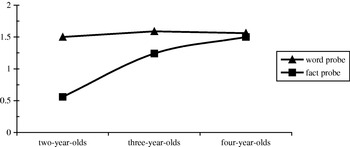
Fourth, because earlier analyses indicated that conditions in which a novel word was presented as the disambiguation probe (i.e. word/word and fact/word) and conditions in which a novel fact was presented as the disambiguation probe (i.e. word/fact and fact/fact) were disambiguated differently, children's disambiguation was analyzed across all ages (two-, three- and four-year-olds) on two aggregate measures, a word probe measure and a fact probe measure. A 2 (probe: word or fact)×3 (age: two-, three- or four-year-olds) mixed-model ANOVA compared differences in children's disambiguation of probes between ages and revealed a significant main effect for age (F(2, 46)=4·84, p=0·012, η2=0·174), a significant main effect for probe (F(1, 46)=12·92, p=0·001, η2=0·219) and a significant age by probe interaction (F(2, 46)=4·38, p=0·018, η2=0·160) (Figure 2 displays this interaction). The main effect for age, as expected given the previous analysis, indicated that two-year-olds disambiguated significantly less often than four-year-olds (p=0·013) but not less often than three-year-olds (p=0·062). Three- and four-year-olds did not differ. The main effect for probe showed that children disambiguated on the word probe trials (M=1·55) significantly more often than on the fact probe trials (M=1·08). Simple effects analyses of the age by probe interaction revealed no effect for age on the novel word probes but a significant effect for age on the novel fact probes (F(2, 46)=8·59, p=0·001, η2=0·272). Follow-up Tukey tests for age indicated that two-year-olds (M=0·50) disambiguated on significantly fewer fact probe trials than three-year-olds (M=1·24, p=0·012) and four-year-olds (M=1·50, p=0·001), but that three- and four-year-olds did not differ significantly. According to these analyses, two-year-olds' disambiguation of novel facts differed from three- and four-year-olds'.
Disambiguation of novel word probes and novel fact probes by age group.

DISCUSSION
The current study was designed to examine whether children's tendency to assign a novel word to an unfamiliar object (i.e. the disambiguation effect) was unique to novel words and whether that tendency varied as a function of age. This was accomplished by comparing two-, three- and four-year-olds' disambiguation of novel words and novel facts in four separate conditions, a word/word, word/fact, fact/word and fact/fact condition.
The overall analyses indicated that children did not disambiguate in a consistent manner across either age or condition. The critical difference across age groups occurred between two-year-olds and three- and four-year-olds. Two-year-olds disambiguated at above chance levels when a novel word was the disambiguation probe (i.e. the word/word and fact/word conditions) and at, or below, chance levels when a novel fact was the disambiguation probe (i.e. the word/fact and fact/fact conditions) (similar to findings reported by Markson (Reference Markson2005)). Three- and four-year-olds, however, disambiguated at or above chance in all conditions, a pattern that replicated Diesendruck & Markson's (Reference Diesendruck and Markson2001) results for three- and four-year-olds. Interestingly, the disambiguation patterns for facts followed a distinct developmental trend. Specifically, two-year-olds disambiguated facts at below chance levels, three-year-olds disambiguated facts at chance levels and four-year-olds disambiguated facts at above chance levels. In contrast, no age differences were found in children's disambiguation of novel words. The critical difference between conditions occurred when either a novel word or a novel fact was presented as the disambiguation probe. In the word/word and fact/word conditions all children disambiguated at, or above, chance levels. In the word/fact and fact/fact conditions, however, children did not disambiguate at levels different from chance. These findings suggest that: (1) two-year-olds are not operating under the same processes when disambiguating a novel word as when disambiguating a novel fact; and (2) that two-year-olds are not operating under the same processes as three- and four-year-olds when disambiguating novel facts.
As a result, these findings raise serious challenges for the pragmatic account of the disambiguation effect. Recall that the pragmatic account argues that the disambiguation effect results from the assumption that contrasting referential acts indicate contrasting reference or meaning (e.g. Clark, Reference Clark and MacWhinney1987, Reference Clark1990; Diesendruck & Markson, Reference Diesendruck and Markson2001). If disambiguation were the result of this pragmatic assumption, then two predictions would follow. First, novel words and novel facts should be disambiguated similarly. Simply put, the same underlying pragmatic process should yield the same pattern of disambiguation. Second, children of different ages should disambiguate similarly. That is, once the pragmatic rule is acquired it should be applied easily and with little variation (Diesendruck & Markson, Reference Diesendruck and Markson2001). Therefore, disambiguation as a pragmatic process should presumably be applied broadly to a variety of referential acts and should be applied similarly by a variety of ages. The current findings do not support either of these predictions.
Regarding the disambiguation of words and facts, it is unlikely that a reliable pattern for disambiguating novel words would emerge separately from a reliable pattern for disambiguating novel facts if the same underlying pragmatic process was guiding disambiguation. Instead, reliable disambiguation patterns for both types of information should emerge similarly. If, as a pragmatic account argues, disambiguation results from the assignment of two contrasting referential acts to two contrasting referents, then the presentation of any two contrasting referential acts should result in disambiguation. In theory, the speaker's underlying referential intent, and not the type of information, is the essential cue (see Preissler & Carey (Reference Preissler and Carey2005) for discussion). Because the intent underlying two contrasting words is assumed to be the same as the intent underlying any other two contrasting referential acts, the type of information should not matter. In the current study, however, the type of information did matter: children disambiguated novel words and novel facts differently. This pattern is not easily explained by a pragmatic account.
In addition, if the same underlying process was guiding disambiguation of both words and facts, then a reliable pattern of disambiguation should not emerge differently across ages. Instead, children should display a reliable disambiguation pattern for both types of information at the same time. That is, if the disambiguation effect truly derives from contrasting referential acts then contrast, and not age or experience, should predict disambiguation. Furthermore, there is no specific pragmatic process that predicts age- or experience-related changes in disambiguation, with the possible exception of conventionality (Diesendruck, Reference Diesendruck2005; Diesendruck & Markson, Reference Diesendruck and Markson2001; Markson, Reference Markson2005). Therefore, once children are eligible for disambiguation of one type of information they should be eligible for disambiguation of all types of information. In the current study, however, two-year-olds disambiguated novel words and novel facts differently, most notably disambiguating the word/word condition at above chance levels and the fact/fact conditions at below chance levels. While this latter pattern is not easily explained by either a word learning principles account or a pragmatic account, it is more problematic for the pragmatic account. Because the fact/fact condition does not include the presentation of words there is no reason to tender a word learning principles account. However, the fact/fact condition easily qualifies as an example of contrasting referential acts and, according to a pragmatic account, should result in disambiguation. That it does not and instead results in the exact opposite pattern is a serious challenge for the pragmatic account. In fairness though, the disambiguation pattern in the fact/fact condition is a challenge for either theoretical explanation. One potential explanation is that two-year-olds committed to an established topic when the first fact was provided (Bloom, Margulis & Tinker, Reference Bloom, Margulis and Tinker1996; Dunn & Shatz, Reference Dunn and Shatz1989). The second fact, while informative, did not cause a shift in topic. In contrast, in the fact/word condition, where a topic was established in an identical manner, the word did cause a shift in topic. It could be suggested that two-year-olds are willing to perseverate on a topic until a powerful disambiguator, in this case a novel word, causes an unambiguous shift in topic.
Ultimately, both of the main patterns of disambiguation found in the current study are more easily and completely explained by a word learning principles account. First, in support of a domain specific system, a word learning principles account predicts disambiguation in the presence of a novel word but makes no such prediction for other types of information, such as facts. In the current study, this was precisely the case. Children across all ages reliably disambiguated in the word/word and fact/word conditions but not in the word/fact and fact/fact conditions, a pattern especially prominent in two-year-olds. The pattern of disambiguation in the fact/word condition might initially seem surprising, as neither object had been assigned a novel word during the trial. However, there is reason to believe that this pattern better aligns with a word learning principles account than a pragmatic account. To begin with, the standard disambiguation task is a word learning task. In the current study this task was used to examine whether learning a word differed from learning a fact. That disambiguation occurred reliably in conditions in which children were asked to learn a novel word (i.e. word/word and fact/word) but not in conditions in which children were asked to learn a novel fact (i.e. word/fact or fact/fact) favors a word learning principles account. Moreover, it is important to remember that the fact/word condition and the word/fact condition are pragmatically identical and therefore a pragmatic account would predict identical disambiguation patterns. That the word was disambiguated more often than the fact also favors a word learning principles account. Finally, one word learning principle described earlier, N3C, maintains that children assign novel words to novel categories (Halberda, Reference Halberda2003; Mervis & Bertrand, Reference Mervis and Bertrand1994). According to N3C, in the standard disambiguation task children accept the novel object as a referent for the novel word rather than reject the known object. In the fact/word condition of the current study, the fact functions to strip the first object of its novelty leaving only the second, novel, object a viable referent of the novel word.
Second, because word learning principles, like mutual exclusivity, are available early in language development (Halberda, Reference Halberda2003; Markman, Wasow & Hansen, Reference Markman, Wasow and Hansen2003), the word learning principles account predicts the disambiguation of words in young children (e.g. two-year-olds), but makes no such prediction about the disambiguation of facts. In the current study this was also the case as two-year-olds differed from three- and four-year-olds on the disambiguation of facts. This pattern strongly suggests that the processes underlying the disambiguation of novel facts are different from the processes that underlie the disambiguation of novel words, a suggestion that would be entirely consistent with a word learning principles account but inconsistent with a pragmatic account.
A potential explanation for this shift in disambiguation patterns across ages is that children gradually learn to apply specific principles, like word learning principles, to non-specific cases, like facts. Children may initially restrict disambiguation to novel words and later apply disambiguation to other types of information more broadly. In this way, what appears to a pragmatic bias in four-year-olds may actually descend from a word learning principles bias in two-year-olds. A more conservative explanation, however, would simply suggest that two-year-olds display a reliable pattern of disambiguating novel words but do not display a reliable pattern of disambiguating novel facts. These dissimilar patterns may occur because children are acting under different sets of principles when disambiguating novel words and novel facts. For novel words, the application of a set of domain-specific word learning principles (e.g. mutual exclusivity) may result in a reliable disambiguation pattern for novel words. For facts, however, children may rely on general, non-specific strategies (e.g. pragmatic principles) and only gradually develop a reliable disambiguation pattern (see Behrend et al., Reference Behrend, Scofield and Kleinknecht2001). In this way, children may engage specific processes when presented with a novel word but general processes when presented with other novel types of information.
Of course, the current study cannot eliminate the possibility that two-year-olds recruit different pragmatic knowledge for disambiguating words than when disambiguating facts. Though the experimenter's presentation of words and facts did not vary pragmatically across condition in this study it is certainly possible that the presentation of words and facts varies pragmatically for two-year-olds in other settings. In addition, the current study cannot eliminate the possibility that two-year-olds recruit different pragmatic knowledge for disambiguating facts than either three- or four-year-olds. However, if contrasting reference leads two-year-olds to disambiguate words then it follows that contrasting reference would lead two-year-olds to disambiguate facts. One potential exception would be if two-year-olds did not perceive facts as contrasting references, but neither the pragmatic account nor the word learning principles account currently makes that claim.
In summary, the current study advances our understanding of children's word learning in two important ways. First, this study demonstrated that children disambiguate novel words and novel facts differently. Second, this study demonstrated that children display a systematic pattern for disambiguating novel words earlier than a systematic pattern for disambiguating novel facts. Importantly, neither of these findings can be easily reconciled with a pragmatic account of the disambiguation effect. Alternatively, a word learning principles account more adequately explains the changes in disambiguation across both age and condition. These changes could be the result of learning to apply domain-specific processes to other types of information or they could result from two emerging sets of principles, one specific to novel words and one available to other, more general types of information, such as facts. In either case, from the current study it is clear that an established pattern of disambiguating novel words emerges and stabilizes prior to an established pattern for disambiguating novel facts.