Introduction
The family Berberidaceae consists of the large woody genus Berberis L. and a few much smaller herbaceous genera. Members of the Berberidaceae are morphologically diverse, which has led some authors to split it into small families. For example, Hutchinson (Reference Hutchinson1959), Airy Shaw (Reference Airy Shaw1965) and Takhtajan (Reference Takhtajan1969) recognised Nandinaceae (Nandina), Podophyllaceae (Podophyllum) and Berberidaceae (Berberis, Mahonia, Epimedium). APG II (2003) and APG III (2009) placed all these small families into the Berberidaceae. The family as currently accepted (Mabberley, Reference Mabberley2008) includes 14 genera and about 715 species. In Nepal, the Berberidaceae is represented by Berberis (including Mahonia) and Podophyllum.
The name Berberis derives from ‘Berberys’, the Arabic name for the fruit (Quattrocchi, Reference Quattrocchi1947). Berberis is the largest genus in the Berberidaceae and the most recent monograph of the whole genus was by Ahrendt (Reference Ahrendt1961), who included 496 species with a further 110 in Mahonia (Ahrendt listed the species in his monograph from 1 to 497, but omitted number 365, so the total number of species is 496). There are conflicting views on generic delimitation in Berberis and Mahonia. Ahrendt (Reference Ahrendt1961) postulated that the simple-leaved Berberis are derived from the compound-leaved Mahonia and maintained Mahonia as a distinct genus. Studies of chromosome numbers (Derman, Reference Derman1931), floral anatomy (Terabayashi, Reference Terabayashi1978) and seedling morphology (Terabayashi, Reference Terabayashi1987) found no significant differences between Berberis and Mahonia. Kim & Jansen (Reference Kim and Jansen1994) reported that Berberis and Mahonia share a 11.5 kb expansion of the inverted repeat (IR) region of the chloroplast genome, which suggests a close phylogenetic relationship. Marroquin & Laferriere (Reference Marroquin and Laferriere1997) and Laferriere (Reference Laferriere1997) transferred all the species of Mahonia to Berberis. Mahonia is not included in this revision and the term Berberis sensu stricto (s.s.) is used to refer to simple-leaved Berberis.
Berberis s.s. has two important centres of diversity: Eurasia with c.300 species mainly in the Himalayas and in China, and South America with c.200 (Ahrendt, Reference Ahrendt1961). It is, however, very likely that the true number of species in Berberis is significantly lower, as Ahrendt (Reference Ahrendt1961) used very narrow species definitions and many of the species which he recognised have been reduced to synonymy by later authors. For example, Landrum (Reference Landrum1999) recognised only 20 out of the 60 species reported by Ahrendt (Reference Ahrendt1961) from Chile. Similarly, in this study only 21 species are accepted in Nepal (including two novelties), compared with Ahrendt (Reference Ahrendt1961) who reported 27 species and 16 varieties in Nepal in his worldwide monograph, Tebbs (Reference Tebbs, Hara and Williams1979) who listed 30 species and 12 varieties, Bista et al. (Reference Bista, Adhikari and Rajbhandari2001) who reported 36 species and 20 varieties, and Press et al. (Reference Press, Shrestha and Sutton2000) who recorded 30 species and 13 varieties.
Taxonomic History of Nepalese Berberis s.s.
The genus Berberis was first described by Linnaeus (Reference Linnaeus1753). Later, de Candolle (Reference Candolle1821) published a global treatment of Berberis and included 29 species. Amongst them was Berberis aristata, the first species of Berberis collected from Nepal in 1802 by the country’s earliest plant collector Francis Buchanan (later Hamilton), and another Himalayan species, B. asiatica Roxb. ex DC. De Candolle (Reference Candolle1824) listed 32 species of Berberis which included the addition of another Nepalese species, B. wallichiana DC., based on Nathaniel Wallich’s specimens.
Using the Buchanan and Wallich specimens, David Don (Reference Don1825) produced the first account of the plants of Nepal, Prodromus Florae Nepalensis, in which he mentioned only the three species of Berberis which had already been published by de Candolle in 1824. George Don (Reference Don1831) listed 43 species of Berberis from throughout the world, including seven species from Nepal. Hooker & Thomson (Reference Hooker and Thomson1855) enumerated 11 species of Berberis from the Himalayan region including six species from Nepal, of which two were newly described (Berberis angulosa and B. insignis). This list was the same in their later work, Hooker & Thomson (Reference Hooker, Thomson and Hooker1872).
A monograph of the genus was published by Schneider (Reference Schneider1904, Reference Schneider1905) in which he recognised 156 species. The number of species of Berberis increased significantly in the 1940s when Ahrendt (Reference Ahrendt1941, Reference Ahrendt1942, Reference Ahrendt1944a, Reference Ahrendt1945a) described new species of Berberis from Bhutan, Assam, southern Tibet, Upper Burma and NW Yunnan. He went on to publish his worldwide monograph of 496 species of Berberis in 1961, with 27 species from Nepal.
Chatterjee (Reference Chatterjee1953) published a revision of the genus from India in which he included 68 species, while Rao et al. (Reference Rao, Husain, Dutt and Garg1998a, Reference Rao, Husain, Dutt and Garg1998b) recognised only 55 species of Berberis in their revision of the Indian species. Grierson (Reference Grierson, Grierson and Long1984) recorded 14 species of Berberis in the Flora of Bhutan, of which nine species are also found in Nepal.
Chamberlain & Hu (Reference Chamberlain and Hu1985) provided a synopsis of Berberis sect. Wallichianae and recognised 75 species with two new taxa. Most of the species in this section were from China, with four species reported from Nepal.
The most recent account of Berberis is in the Flora of China (Junsheng, Reference Junsheng, Zhengyi, Raven and Deyuan2011) with 215 species. However, a more thorough revision of Chinese Berberis is currently being prepared by Julian Harber with the recognition of about 200 species (J. Harber, pers. comm.).
Infrageneric Classification of Berberis s.s.
The first major infrageneric classification of Berberis s.s. was by C. K. Schneider (Reference Schneider1904, Reference Schneider1905), who classified 156 species into 21 sections and 32 subsections. Schneider (Reference Schneider1908) updated his monograph and also divided the genus into two subgeneric groups, the Eurasian Septentrionales and the South American Australes. Later Schneider (Reference Schneider1942) revised Berberis sect. Wallichianae and recognised 71 species.
The most recent monograph by Ahrendt (Reference Ahrendt1961) classified the genus into 33 sections and 50 subsections and listed 496 species (including species of apparently hybrid origin), which included 114 species newly described by him.
The validity of Ahrendt’s (Reference Ahrendt1961) infrageneric classification has been called into doubt by Landrum’s (Reference Landrum1999) revision of Berberis from continental Chile, the Juan Fernandez Islands and adjacent southern Argentina in which he synonymised three species from three of Ahrendt’s sections into a single species. In addition Landrum recognised only 20 out of the 60 species reported by Ahrendt (Reference Ahrendt1961). We agree that Ahrendt’s species concept is unrealistically narrow, especially because delimitation of his species was based on dubious characters such as the colour of stems and margin of leaves. The true number of Berberis species worldwide is therefore likely to be significantly lower than the 496 he reported.
Ahrendt’s infrageneric classification is rejected, but a new classification will require a revision of the entire genus on the basis of both morphological and molecular data. We do not follow any infrageneric classification in this account for Nepal and taxa are grouped according to their overall morphological similarity.
Materials and Methods
This revision is based on a study of over 700 herbarium specimens and on field observations of wild populations of Berberis in Nepal. It is not possible to get a true picture of the morphological variation in Berberis from a limited number of herbarium specimens, so every attempt was made to observe variation within wild populations in addition to examining all available herbarium specimens. All but two of the 21 species recognised in this study were collected and studied in the wild. Specimens of all collections made during the field visits are deposited in the herbaria of the Royal Botanic Garden Edinburgh (E) and the National Herbarium in Kathmandu (KATH), Nepal.
Specimens were studied from the herbaria with major holdings of Himalayan material (BM, E, K, KATH, TUCH), including material gifted to E from Tokyo University (TI). Images of specimens were consulted from BR, CGE, G, OXF, W and WU, particularly for type specimens, but most of the important collections from Himalayan regions were found to be deposited in BM, E and K.
Data from herbarium labels of all Berberis specimens and associated information were entered into the PADME database developed at the Royal Botanic Garden Edinburgh (RBGE). Conservation assessments for all species were made using the criteria provided by IUCN (2001).
The genus Berberis is commonly thought to hybridise both in cultivation and in the wild, potentially causing problems for species level identifications. During this study a few individuals were observed in the field which appeared to be of hybrid origin and these are referred to under their putative parent species.
In this revision Berberis species are delimited by combinations of morphological characters. To determine the diagnostic characters of a particular species, the morphology of all herbarium specimens was studied along with field observations of wild populations of Berberis species.
Morphology
Habit
All Nepalese species of Berberis are woody and they range from small shrubs to large tree-like shrubs up to 6 m tall. On the basis of height, Nepalese Berberis can be divided into three categories:
1 Small shrubs rarely exceeding 1 m tall: Berberis everestiana var. ventosa, B. kumaonensis, B. mucrifolia, B. pendryi and B. tsarica.
2 Shrubs usually more than 1 m and up to 2 m tall: Berberis angulosa, B. concinna (B. concinna var. concinna is sometimes less than 1 m), B. hookeri, B. jaeschkeana var. usteriana, B. karnaliensis and B. wallichiana.
3 Large shrubs or small tree-like shrubs usually more than 2 m and up to 6 m tall: Berberis aristata, B. asiatica, B. glaucocarpa, B. hamiltoniana, B. insignis, B. koehneana, B. orthobotrys var. rubicunda, B. petiolaris, B. thomsoniana and B. virescens.
Most of the species are erect and branch profusely from the base. Berberis kumaonensis is the only exception and is a semi-erect or prostrate shrub.
Stem
Stems are terete, angled or sulcate. They can be divided into two categories: primary stem (long shoots) and short axillary stems (short shoots). Short shoots are distinct and elongated in some species like Berberis petiolaris and B. thomsoniana, while very short or indistinct in other Nepalese species. Mature long shoots are usually reddish brown, ash grey or sometimes yellowish grey, while young twigs are usually green. Twigs which receive more exposure to sun turn reddish brown. Twig colour is therefore variable on a single plant and cannot be taken as a diagnostic character for species delimitation. Young twigs are puberulous in some species, but they are soon glabrescent.
Leaves and spines
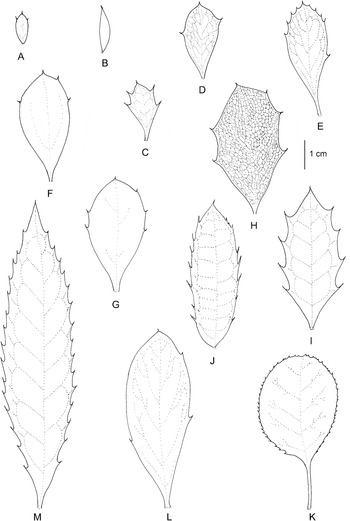
Spines have sometimes been interpreted as the reduced leaves of long shoots, and normal leaves as the leaves of short shoots (Landrum, Reference Landrum1999). Spines are usually present in all Nepalese species, and in all cases they are distinct and strong, and not foliaceous. The least spiny individuals, with solitary spines or even spineless stems, are found in Berberis insignis and B. petiolaris. Spines are 3- or rarely 5-fid (Berberis tsarica) or solitary towards the apex of the twigs. They are usually terete, angled or slightly sulcate below. Leaves are borne only on short shoots, and are simple and pinnate-veined in all species of Berberis s.s. They are arranged in whorls or in fascicles. Petioles are usually very small or indistinct in the Nepalese taxa except in Berberis petiolaris (Fig. 1K), which has petioles up to 3.5 cm long. Leaves are obovate, elliptic, lanceolate, obovate to elliptic or obovate to oblanceolate in shape and their lengths range from 0.5 cm in Berberis tsarica to 17 cm in B. insignis (Fig. 1). The apices of the leaves are obtuse to acute and mucronate, and the bases are cuneate or attenuate to the small petiole. The margins are entire or spinose-spinulose toothed and variable within the species. Four types of venation can be recognised in Nepalese taxa: few veins which are slightly prominent below and less distinct above (Berberis angulosa, B. hamiltoniana, B. jaeschkeana var. usteriana, B. karnaliensis, B. orthobotrys var. rubicunda, B. pendryi, B. tsarica and B. virescens); venation prominent on both sides with distinct primary and few secondary veins (Berberis aristata, B. concinna, B. koehneana, B. kumaonensis, B. petiolaris and B. thomsoniana); venation prominent on both sides with reticulate veins (Berberis asiatica and B. glaucocarpa) and venation prominent on both sides with distinctly looping closed primary veins (Berberis hookeri, B. insignis and B. wallichiana). The veins are not visible in Berberis mucrifolia. Leaf texture varies from papery in Berberis petiolaris to leathery coriaceous in B. asiatica. Leaves are usually glabrous above and papillose below. Leaves of some species are distinctly glaucous on their lower surfaces (Berberis asiatica and B. concinna).
Leaves of various species of Berberis. A. B. tsarica (DNEP3 BY132). B. B. mucrifolia (SSW 8111). C. B. kumaonensis (JRS B163). D. B. concinna var. extensiflora (Manaslu 08 20812277). E. B. thomsoniana (LKSR B181). F. B. angulosa var. angulosa (Adhikari BL2 38). G. B. koehneana (Adhikari, B. BL2 51). H. B. asiatica (Adhikari, B. B105). I. B. hookeri (Proud, D. 1). J. B. wallichiana (Adhikari BL 123). K. B. petiolaris var. petiolaris (JRS A122). L. B. glaucocarpa (JRS A134). M. B. insignis (EMAK875). All leaves are drawn at the same scale.

Inflorescences
The most frequent types of inflorescence are racemes, which are either pedunculate (Berberis aristata, B. petiolaris and B. thomsoniana) or shortly pedunculate or epedunculate (B. asiatica), and fascicles (Berberis hookeri, B. insignis and B. wallichiana). Some intermediate types such as sub-umbellate inflorescences are also present in some taxa. Some species (Berberis kumaonensis, B. pendryi and B. tsarica) have solitary flowers. Bracts are visible and distinct in racemes and panicles but not in fasciculate inflorescences or with solitary flowers. Bracteoles are rarely present.
Flowers
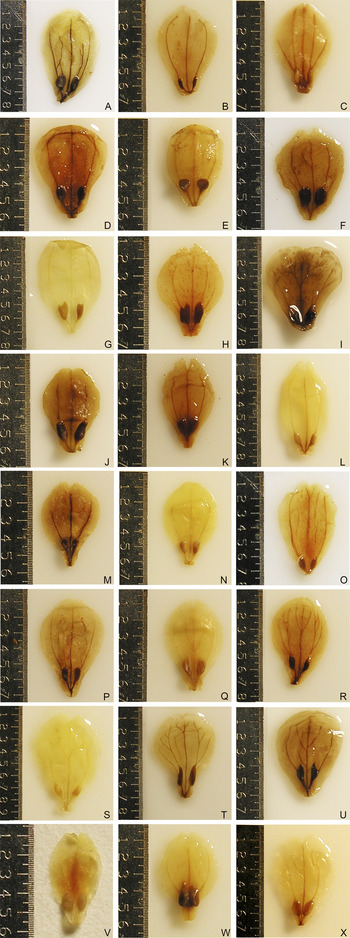
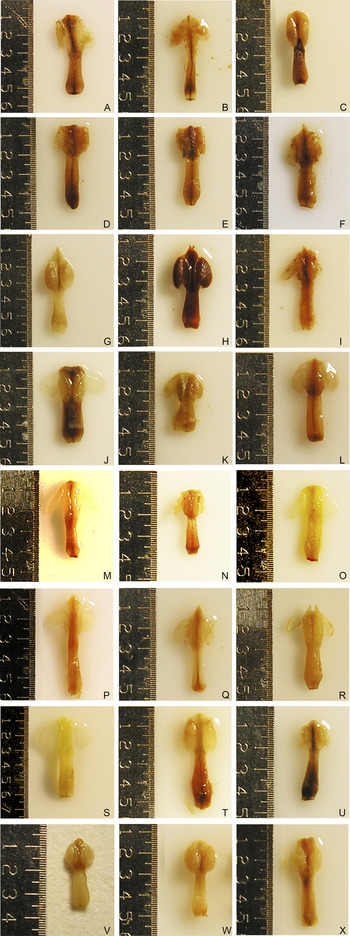
Flowers are 0.8–2.5 cm in diameter, bright yellow or sometimes greenish yellow in some species (Berberis hookeri and B. wallichiana). The flowers have 2–4 whorls of sepals with three sepals in each whorl. The sepals of the outermost whorl are small and have been called prophylls in many publications (Ahrendt, Reference Ahrendt1961; Rao et al., Reference Rao, Husain, Dutt and Garg1998a, Reference Rao, Husain, Dutt and Garg1998b). As there is no clear distinction between the sepals and the prophylls in all the Nepalese species of Berberis, the term ‘outermost sepal’ is used throughout the descriptions where four whorls of sepals are present. The shapes of the outer sepals and inner sepals are usually ovate and obovate, respectively. The petals are in two whorls of three petals each and are usually obovate. They are usually smaller than the inner sepals and are distinguished from them by the presence of two nectariferous glands on the base of the inner surface (Fig. 2). The apices of the petals range from entire or emarginate to distinctly notched. Petals have a central vein and 1–3 pairs of lateral veins, though this is not always constant within species. Stamens are attached at the base of each petal. The connective of the stamens is sometimes distinctly produced beyond the anther locules and is an important character in distinguishing several species. The apices of connectives are apiculate, bifurcate, retuse or conical in shape (Fig. 3). The pistil is simple and the ovary contains 1–13 ovules. The stigma is sessile or sub-sessile and the style is usually indistinct at the time of flowering.
Petals of various species of Berberis. A. B. angulosa var. angulosa (LKSR B71). B. B. aristata (Proud, D. 5). C. B. asiatica (Adhikari, B. 101). D. B. concinna var. concinna (SSW 5595). E. B. concinna var. extensiflora (Manaslu 08 20812277). F. B. everestiana var. ventosa (Stainton 4289). G. B. glaucocarpa (JRS A80). H. B. hamiltoniana (PSW 4579). I. B. hookeri (LKSR B22). J. B. insignis (Suzuki et al. 9263024). K. B. jaeschkeana var. usteriana (SSW 1225). L. B. karnaliensis (JRS A59). Scale in millimetres.

Stamens of various species of Berberis. A. B. angulosa var. angulosa (LKSR B71). B. B. aristata (Proud, D. 5). C. B. asiatica (Adhikari, B. 101). D. B. concinna var. concinna (SSW 5595). E. B. concinna var. extensiflora (Manaslu 08 20812277). F. B. everestiana var. ventosa (Stainton 4289). G. B. glaucocarpa (JRS A80). H. B. hamiltoniana (PSW 4579). I. B. hamiltoniana (Lowndes 941). J. B. hookeri (LKSR B22). K. B. insignis (Suzuki et al. 9263024). L. B. jaeschkeana var. usteriana (SSW1225). Scale in millimetres.

Fruits
The fruits are berries and are globose, ellipsoid, ovoid or obovoid in shape. As the fruits develop, the style becomes more distinct in some species. The colour of the berries ranges from bright red to dark purplish black. Some of the species (Berberis asiatica and B. glaucocarpa) have glaucous berries. The seeds are usually ellipsoid in shape and range from 3 to 7 mm long.
Ecology and Distribution
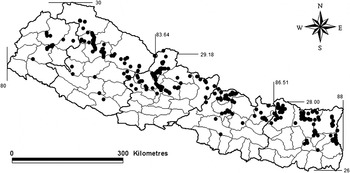
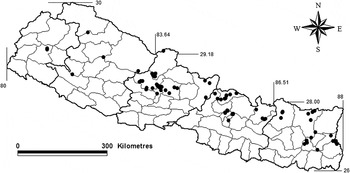
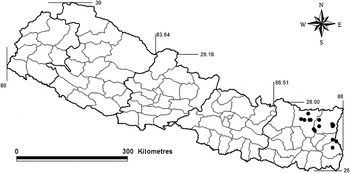
The Nepalese species of Berberis usually grow in somewhat disturbed habitats such as forest margins, open pastures at higher altitudes, semi-desert vegetation, and the margins of cultivated land. A few exceptions include Berberis insignis and B. wallichiana which usually grow on the forest floor of oak–laurel forest in eastern Nepal. Similarly, Berberis petiolaris is a component of temperate moist Abies–Betula–Acer forest in western Nepal. Nepalese Berberis species grow in a wide range of rainfall regimes from wet forests in eastern Nepal to the very much drier trans-Himalayan regions of western Nepal. They grow from as low as 1000 m altitude (Berberis asiatica) up to 4700 m (B. tsarica). The distribution of Berberis collections in Nepal is shown in Fig. 4.
Distribution of Berberis collections in Nepal.

Uses
Most of the Nepalese species of Berberis have medicinal uses due to the presence of the alkaloid berberine. Extracts from the stem and root of Berberis are used in ophthalmic medicine, and to treat jaundice, malarial fever, diarrhoea and peptic ulcers (Manandhar, Reference Manandhar2002). Fruits are eaten fresh and are sometimes used locally for making alcoholic drinks. In Nepali, all the species are commonly known as ‘chutro’.
Taxonomic Treatment
Berberis L., Sp. Pl. 330 (1753). – Type species: Berberis vulgaris L., designated by Britton & Brown (Reference Britton and Brown1913).
Shrubs or small tree-like shrubs, evergreen or deciduous, usually with yellow wood. Stems and branches terete, sulcate or angled, reddish brown or yellowish brown becoming ash grey when older. Spines 3–5-fid, terete, sulcate or angled, strong or weak. Leaves simple, petiolate or sessile, in fascicles or in whorls, margin entire or spinose-spinulose toothed, venation pinnate, prominent or obscure. Flowers solitary, fascicled, or in pedunculate or epedunculate racemes, umbels or in panicles. Bracts often present, bracteoles rarely present. Perianth greenish yellow to yellow (in Nepal), 3-merous. Perianth segments in 4–6 whorls, outer 2–4 whorls of sepals, inner 2 whorls of petals. Outermost sepals small, bract-like, median sepals usually smaller than the inner sepals, innermost sepals usually larger than the petals. Petals with nectariferous glands at the base; venation usually distinct, with 1 central vein and 1–3 pairs of lateral veins. Stamens 6; filament thick, sometimes with connective produced beyond the apex of anther-locules; anther-locules opening by valves. Pistil usually barrel-shaped. Ovary 1-locular, ovules 1–13, stigma peltate. Berries ellipsoid, sub-globose, ovoid, ovoid to oblong, obovoid to oblong, usually red or purplish black, with or without style, sometimes covered with white or bluish white bloom (glaucous).
Distribution. About 500 species reported but it is very likely that the true number of species is significantly lower. Widespread in the northern hemisphere (especially in Himalayas and E Asia) and extending into Africa (three species), and C and S America (secondary centre of diversity); 21 species in Nepal.
Key to the species
1a. Flowers solitary or in fascicles (sometimes in a 2–3-flowered umbel in B. concinna var. extensiflora) 2
1b. Flowers in racemes, panicles or in umbels (with more than 4 flowers) 11
2a. Evergreen shrubs. Berries black 3
2b. Deciduous shrubs. Berries red 5
3a. Spines usually absent. Leaves large, up to 17 cm long. Anther connectives slightly produced or not21. B. insignis
3b. Spines present. Leaves small, up to 8 cm long (rarely up to 11 cm in B. wallichiana). Anther connectives distinctly produced 4
4a. Berries with a distinct style. Inflorescence a fascicle of 10–25(–30) flowers. Ovule solitary19. B. wallichiana
4b. Berries without a style. Inflorescence a fascicle of 3–8(–11) flowers. Ovules 3–620. B. hookeri
5a. Semi-prostrate shrubs up to 20 cm tall3. B. kumaonensis
5b. Erect shrubs (B. mucrifolia rarely semi-prostrate) more than 20 cm tall 6
6a. Stem spines mostly 5-fid6. B. tsarica
6b. Stem spines mostly 3-fid 7
7a. Flowers large, 1.5–2.5 cm in diameter. Berries without a style 8
7b. Flowers small, up to 1 cm in diameter. Berries with a distinct style 9
8a. Leaves glaucous below, venation prominent both sides. Nectariferous glands cup-shaped4. B. concinna
8b. Leaves not glaucous, venation sub-conspicuous above, slightly prominent below. Nectariferous glands obovoid1. B. angulosa
9a. Leaves rigidly coriaceous. Anther connectives slightly produced5. B. mucrifolia
9b. Leaves thin or slightly coriaceous. Anther connectives distinctly produced 10
10a. Sepals in 4 whorls. Anther connectives apiculate 2. B. everestiana var.ventosa
10b. Sepals in 3 whorls. Anther connectives produced into 2 or 3 tooth-like appendages7. B. pendryi
11a. Secondary and tertiary leaf venation usually reticulate. Berries very glaucous 12
11b. Secondary leaf venation with closed or open loops, tertiary venation obscure. Berries slightly glaucous or not glaucous 13
12a. Flowers in flexible epedunculate racemes or in fascicles17. B. asiatica
12b. Flowers in stiff pedunculate racemes18. B. glaucocarpa
13a. Leaves with a distinct petiole up to 3.5 cm long. Lamina broadly obovate or broadly elliptic to rounded13. B. petiolaris
13b. Leaves without a distinct petiole. Lamina obovate or narrowly obovate to narrowly elliptic 14
14a. Inflorescence (3–)8–16 cm long, a panicle with 15–70 flowers10. B. koehneana
14b. Inflorescence 1–6 cm long, a simple raceme, or umbellate, sub-umbellate or sub-paniculate raceme with 2–15 flowers (up to 20 in B. aristata) 15
15a. Berries dark purple or black, slightly glaucous8. B. aristata
15b. Berries red, non-glaucous 16
16a. Sepals in 4 whorls9. B. thomsoniana
16b. Sepals in 3 whorls 17
17a. Shrubs usually less than 2 m tall. Berries with a distinct style 18
17b. Shrubs usually more than 2 m tall. Berries without a style (sometimes very short, ≤ 0.5 mm in B. virescens) 19
18a. Young branches glabrous. Peduncle usually less than 1 cm long 14. B. jaeschkeana var.usteriana
18b. Young branches densely puberulous. Peduncle usually more than 1 cm long15. B. karnaliensis
19a. Outer sepals up to 3.5 mm long. Apex of connectives obtuse or retuse16. B. virescens
19b. Outer sepals 3.5 mm or more long. Apex of connectives pointed or bifurcate 20
20a. Berries ovate-ellipsoid. Petals notched12. B. hamiltoniana
20b. Berries ellipsoid to oblong-obovoid. Petals obtuse, rarely emarginate or crenate 11. B. orthobotrys var.rubicunda
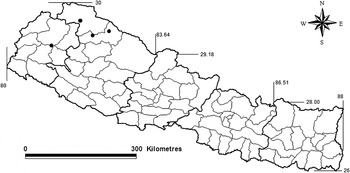
1. Berberis angulosa Wall. ex Hook.f. & Thomson, Fl. Ind. 1: 227 (1855); Hooker & Thomson in Hooker, Fl. Brit. India 1(1): 111 (1872); Hooker, Bot. Mag. 115: t. 7071 (1889); Schneider, Bull. Herb. Boissier 2.5: 398 (1905); Chatterjee, Rec. Bot. Surv. India 16(2): 24 (1953); Ahrendt, J. Linn. Soc. Bot. 57: 113 (1961); Tebbs in Hara & Williams, Enum. Fl. Pl. Nepal 2: 29 (1979); Grierson in Grierson & Long, Fl. Bhutan 1(2): 323 (1984); Rao et al., Rheedea 8(2): 110 (1998); Press et al., Annot. Checkl. Fl. Pl. Nepal 25 (2000). – Type: Nepal, Gosaithan, Wallich 1475.1 (lecto K-W!, designated here by Harber; isolecto K! [barcode K000077366], labelled as ‘a’). Figs 5,6.
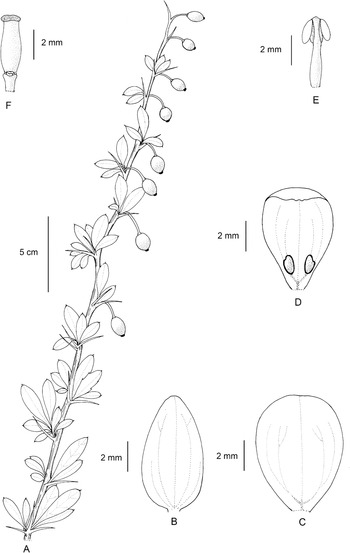
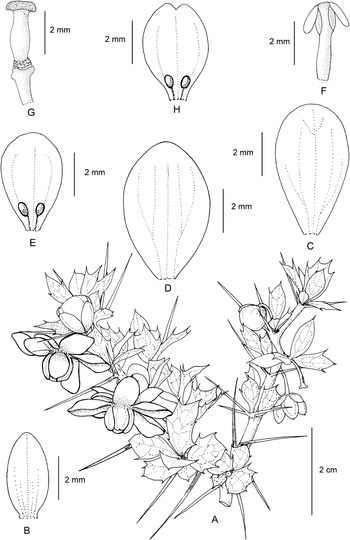
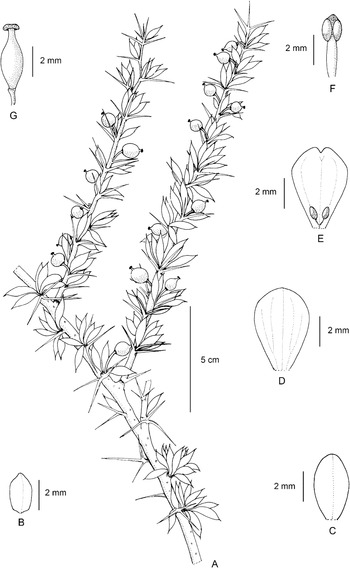
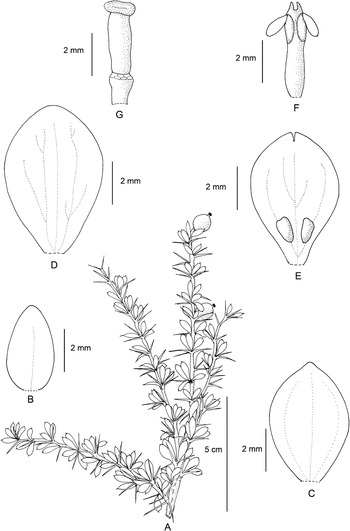
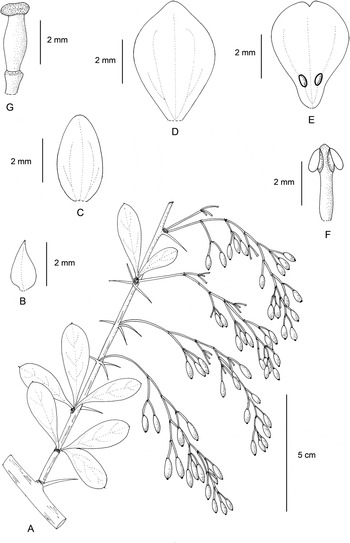
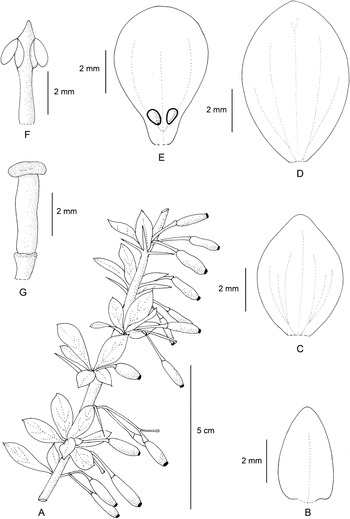
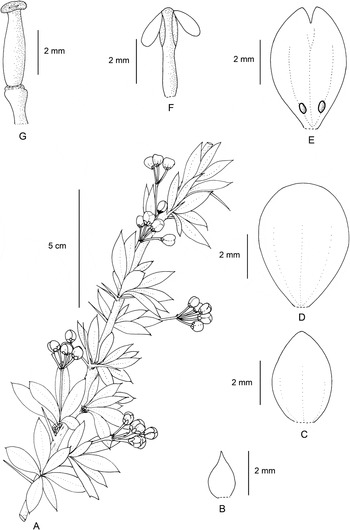
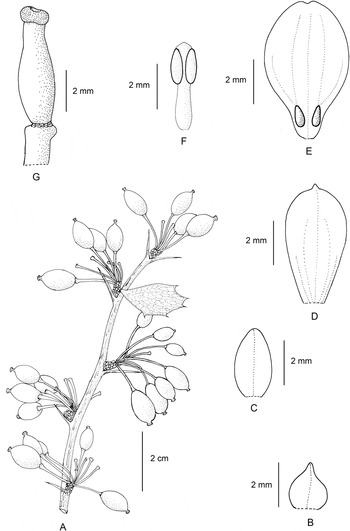
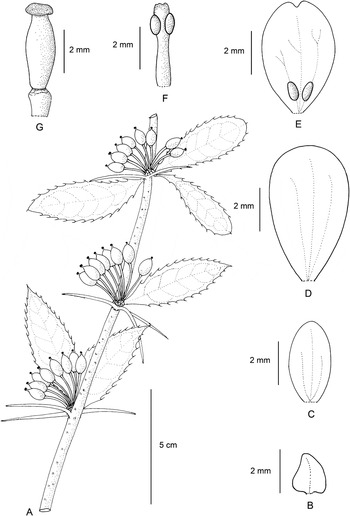
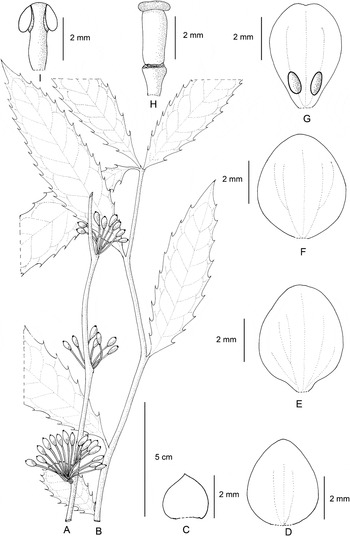
Fig. 5.Berberis angulosa var. angulosa. A, fruiting branch; B, outer sepal; C, inner sepal; D, petal; E, stamen; F, pistil (A from EMAK 585; B–F from LKSR B45).
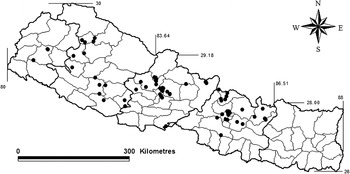
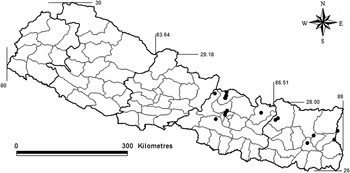
 Fig. 6.
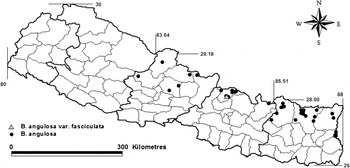
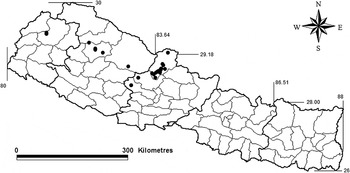
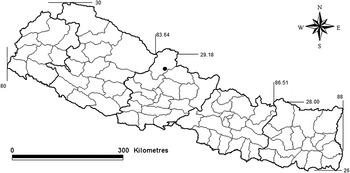
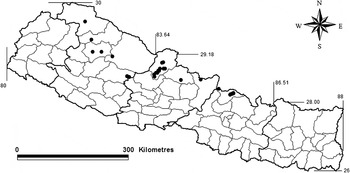
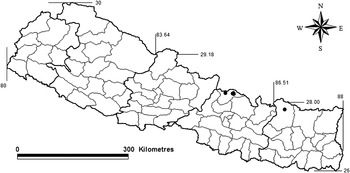
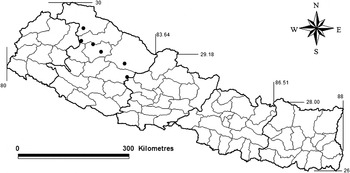
Distribution of Berberis angulosa.
Berberis parisepala Ahrendt, Gard. Chron. 109(3): 100 (1941). – Type: Cultivated from K.W.8350 (holo BM!).


Shrub to 2 m. Stems and branches terete to sulcate, glabrous, reddish brown when young becoming greyish and verruculose when older. Internodes 1–2.5 cm. Spines 3(–5)-fid, strong, usually terete, central spine 1–3 cm, lateral spines 0.5–1.5 cm. Leaves deciduous, slightly coriaceous. Petiole indistinct or short, 2–5 mm. Lamina obovate to oblanceolate, 1.5–4.5 × 0.5–1.5 cm, base cuneate to shortly attenuate, apex obtuse, mucronate, margin usually entire, sometimes with 1–3 spinulose teeth on each side, dark green above, paler beneath, venation sub-conspicuous above, slightly prominent below. Flowers solitary or in fascicles of 2–6 flowers. Bracts indistinct. Perianth yellow, 1.5–2 cm in diameter. Pedicel 0.5–2 cm, glabrous to puberulous. Sepals in 2 whorls, outer sepals ovate or spathulate, 6–10 × 3.5–4.5 mm; inner sepals obovate, 7–10 × 5–7 mm. Petals obovate, 5.5–8.5 × 3.5–5.5 mm, base cuneate, apex undulate or rounded, margin entire, venation distinct with 2–3 pairs of lateral veins; glands obovoid, c.1 mm long. Stamens 4–5 mm long, connectives slightly produced, tip conical. Pistil 3–4 mm long; ovules 4–6. Berries bright red, sub-globose, 8–10 mm long; style absent.
Distinguishing features. Berberis angulosa is distinguished by its low stature of less than 2 m and its bright red, estylose and usually solitary fruits.
Key to the varieties of Berberis angulosa
1a. Flowers solitary 1a. var.angulosa
1b. Flowers in fascicles of 2–6 flowers 1b. var.fasciculata
1a. Berberis angulosa var.angulosa
Flowers always solitary. Pedicels glabrous to puberulous.
Phenology. May–Jul (fl.); Jun–Oct (fr.).
Habitat and ecology. In dry open rocky places at 3000–4500 m altitude.
Distribution. Nepal (Central, Eastern), E Himalaya, Tibetan Plateau.
Proposed IUCN conservation status. Least Concern (LC). The extent of occurrence of this taxon is more than 20,000 km2in Nepal and it is also widespread in Bhutan and Sikkim.
Selected specimens. Central. Baglung, east of Dhorpatan, 11,500 ft, 21 x 1954, Stainton, Sykes & Williams 9109 (BM); Kaski, Annapurna Himal, Setikhola, 12,500 ft, 3 viii 1954, Stainton, Sykes & Williams 6656 (BM); Lamjung, Rambrong, Lamjung Himal, 12,000 ft, 29 vi 1954, Stainton, Sykes & Williams 6047 (BM); Manang, Bimatang, 3730 m, 13 viii 2008, Manaslu 08 20815195 (E); Myagdi, south of Gurjakhani, 12,500 ft, 8 vi 1954, Stainton, Sykes & Williams 3062 (BM, E); Rasuwa, Gosaikund-Cholangpati, 4030 m, 9 x 2001, ENEP 280 (E); Rasuwa, Langtang khola, 11,100 ft, 24 v 1962, Bowes-Lyon 147 (BM, E). Eastern. Panchthar, Prangbung 6, Pasi Bhanjyang, 3236 m, 11 vi 2007, LKSR 45 (E, TUCH); Sankhuwasabha, N bank of Barun Khola below Repu Kharka, 3560 m, 8 x 1991, EMAK 585 (E); Sankhuwasabha, Numbuk-Yangri Kharka, 3470 m, 18 vii 1988, Suzuki et al. 8840287 (E); Taplejung, Topkegola, 12,000 ft, 19 x 1971, Beer, Lancaster & Morris88 (BM).
Julian Harber has designated Wallich 1475.1 at K-W! as lectotype for Berberis angulosa but this work is as yet unpublished. By agreement we publish and credit him here for this lectotypification.
1b. Berberis angulosa var. fasciculata Ahrendt, J. Bot. 79 (Suppl.): 42 (1941); Ahrendt, J. Linn. Soc. Bot. 57: 114 (1961). – Type: India, Sikkim, 10,700 ft, Hooker & Thomson s.n. (lecto K!, designated by Ahrendt (Reference Ahrendt1961: 114)).
Flowers in fascicles of 2–6 flowers. Pedicels usually puberulous.
Phenology. May–Jul (fl.); Jun–Oct (fr.).
Habitat and ecology. In dry open rocky places around 3000 m altitude.
Distribution. Nepal (Central).
Proposed IUCN conservation status. Data Deficient (DD). In Nepal this taxon is currently confirmed only from a single location in central Nepal.
New record for the Flora of Nepal.
Specimen examined. Central. Rasuwa, Cholangpati, 3623 m, 20 x 2006, Adhikari EL 127 (E).
Hooker & Thomson (Reference Hooker and Thomson1855) mentioned within their description of Berberis angulosa a variety β with fasciculate pedicels. This was later formally described by Ahrendt (Reference Ahrendt1941) as Berberis angulosa var. fasciculata but without the citation of specimens. Later Ahrendt (Reference Ahrendt1961) cited the type as ‘Sikkim: 10,700 ft, Hooker and Thomson (Type K)’ which is an effective lectotypification.
Rao et al. (Reference Rao, Husain, Dutt and Garg1998b) did not recognise Berberis angulosa var. fasciculata, noting that a putative isotype of Berberis angulosa from BM (Wallich 1475) has fasciculate to sub-umbellate inflorescences. Wallich 1475 actually comprises two gatherings: 1475.1 which is Berberis angulosa var. angulosa from Nepal and 1475.2 which is B. umbellata from Kumaon. Wallich 1475 in BM is more likely to be 1475.2 or from different gatherings. The flowers of Wallich 1475.1 in K-W are all solitary. Both varieties were observed in the field and are considered in this paper to be distinct varieties. However, the type specimen of Berberis angulosa var. fasciculata contains only fruits and fragments of leaves, and is similar to B. lasioclema and B. cooperi from Sikkim and Bhutan (J. Harber, pers. comm.). More detailed study of material from the Sikkim and Bhutan regions is necessary to further clarify the status of Berberis angulosa var. fasciculata.
2. Berberis everestiana Ahrendt var. ventosa Ahrendt, J. Linn. Soc. Bot. 57: 117 (1961); Tebbs in Hara & Williams, Enum. Fl. Pl. Nepal 2: 30 (1979); Rao et al., Rheedea 8(2): 116 (1998); Press et al., Annot. Checkl. Fl. Pl. Nepal 26 (2000). – Type: Nepal, Dolpa, between Pudamigaon and Ringmigaon, Polunin, Sykes & Williams 3554 (holo BM!). Figs 7,8.
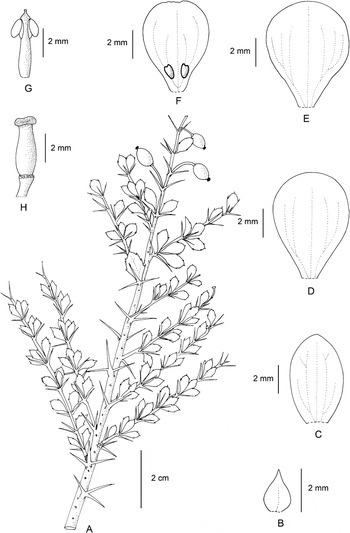
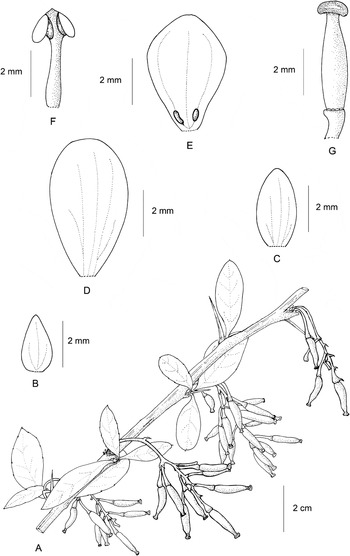
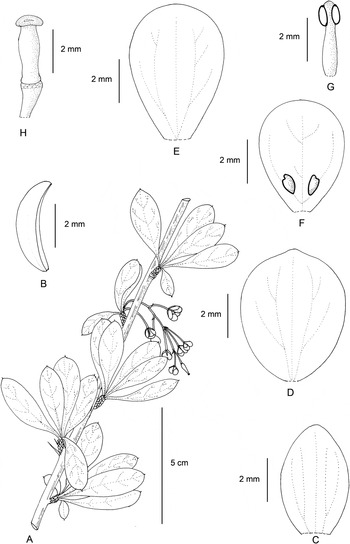
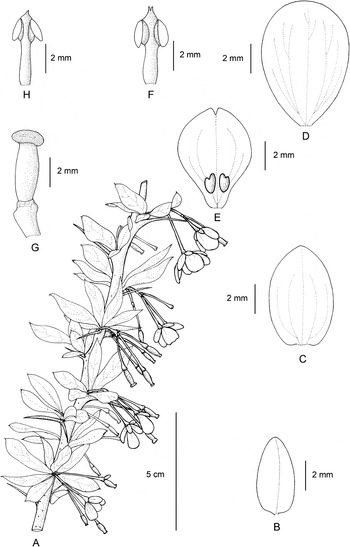
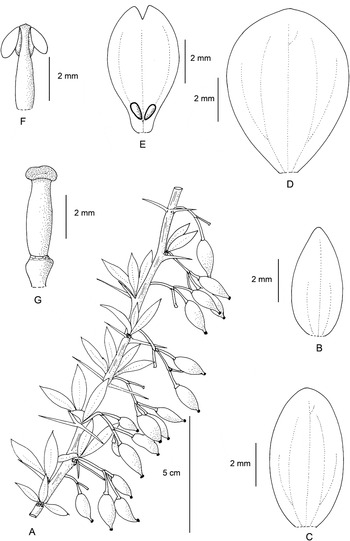
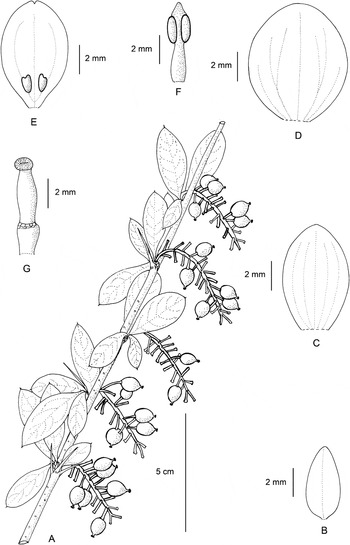
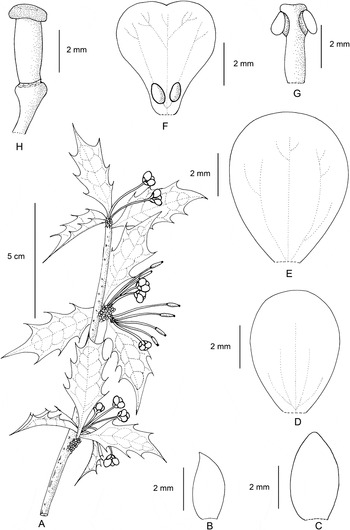
Fig. 7.Berberis everestiana var. ventosa. A, fruiting branch; B, outermost sepal; C, outer sepal; D, median sepal; E, inner sepal; F, petal; G, stamen; H, pistil (A from Polunin, Sykes & Williams 3554; B–H from Stainton4289).
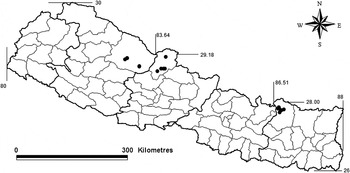
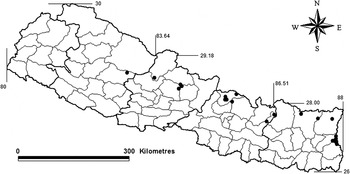
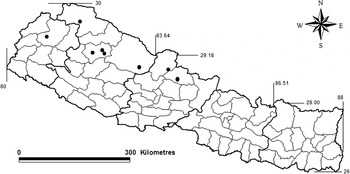
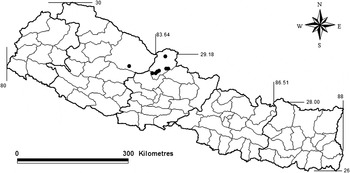
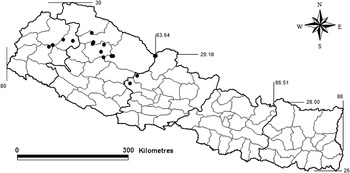
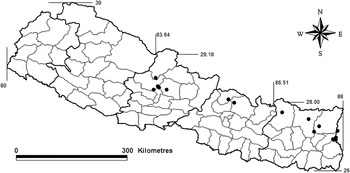
Fig. 8.Distribution of Berberis everestiana var.ventosa.


Shrub to 1 m. Stems and branches terete to slightly sulcate, glabrous, yellowish brown when young becoming greyish and verruculose when older. Internodes 0.5–2 cm. Spines 3(–5)-fid, strong, usually terete, central spine 1–1.5 cm, lateral spines 0.5–1.2 cm. Leaves deciduous, thin or slightly coriaceous. Petiole absent. Lamina usually obovate, 0.5–2.5 × 0.5–1 cm, base cuneate, apex obtuse, mucronate, margin entire or sometimes with 1–3 spinulose teeth on each side, dark green above, paler beneath, venation prominent below. Flowers solitary, rarely 2, yellow, c.1 cm in diameter. Bracts indistinct. Pedicel 0.3–1 cm. Sepals in 4 whorls, outermost sepals ovate with acute apex, 2 × 1.5 mm; outer sepals ovate or elliptic-ovate, 6–7 × 3–4 mm; median sepals ovate-elliptic, 7–7.5 × 5–5.5 mm; inner sepals broadly obovate, 6.5–7.5 × 5–6 mm. Petals obovate, 5–6.5 × 3.5–4.5 mm, base cuneate, apex obtuse, undulate or slightly notched, margin entire, venation distinct with 1 or 2 pairs of lateral veins; glands obovoid, 1–1.5 mm long. Stamens 3.5–5 mm long, connectives distinctly produced, tip apiculate. Pistil 3–4 mm long; ovules 5–7. Berries red, sub-globose or oblong-ovoid, c.1 cm long; style small, c.1 mm long.
Phenology. Jun–Sep (fl.); Aug–Oct (fr.).
Habitat and ecology. Usually grows on exposed dry slopes at 2700–4550 m altitude.
Distribution. Nepal (Western, Central, Eastern), E Himalaya (Sikkim).
Proposed IUCN conservation status. Least Concern (LC).
Distinguishing features. Small shrub less than 1.5 m; flowers usually solitary; connective distinctly produced; berries red with a short style. Berberis everestiana var. ventosa is most likely to be confused with B. angulosa but is easily distinguished by its smaller flowers and leaves, and distinctly produced anther connective.
Selected specimens. Western. Dolpa, Barbung Khola, Pemrigaon, 15,000 ft, 9 vi 1952, Polunin, Sykes & Williams 1104 (E); Dolpa, Phoksundo Tal, 12,500 ft, 11 x 1952, Polunin, Sykes & Williams 2202 (BM, E). Central. Mustang, Kaligandaki Valley, 27 ix 2006, Pendry, Milne & Adhikari EA 46 (E). Eastern. Solukhumbu, Bhotekoshi Valley, 3917 m, 23 ix 2005, DNEP3 BY156 (E).
Berberis everestiana var. ventosa differs from B. everestiana var. everestiana by its distinctly produced anther connective. The only specimen of the typical variety cited by Ahrendt (Reference Ahrendt1961) from Nepal is Bailey 46 from Cholong Pati. Bailey 46 has been identified as Berberis angulosa in this study and no specimens of B. everestiana var. everestiana have been recorded from Nepal. However, Berberis everestiana var. everestiana has been reported from Tibet close to the Nepal border and we consider it likely that it also grows in Nepal.
3. Berberis kumaonensis C.K.Schneid., Bull. Herb. Boissier 2.5: 397 (1905); Chatterjee, Rec. Bot. Surv. India 16(2): 25 (1953); Ahrendt, J. Linn. Soc. Bot. 57: 120 (1961); Tebbs in Hara & Williams, Enum. Fl. Pl. Nepal 2: 30 (1979); Rao et al., Rheedea 8(2): 112 (1998); Press et al., Annot. Checkl. Fl. Pl. Nepal 26 (2000). – Type: India, Kumaon, rocks near Garbyang, Kalivalley, 13,000 ft, Duthie 2697 (holo G!; iso K!). Figs 9,10.
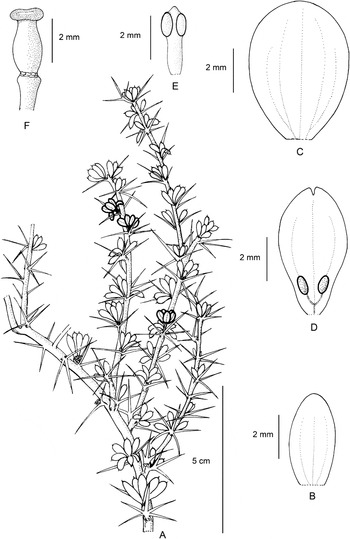
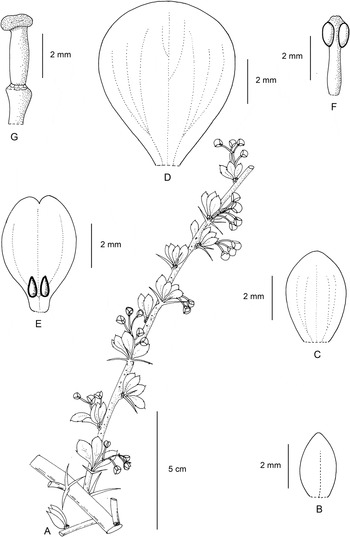
Fig. 9.Berberis kumaonensis. A, flowering branch; B, outer sepal; C, median sepal; D, inner sepal; E & H, petal; F, stamen; G, pistil (A–G from JRS B163; H from JRS B172).
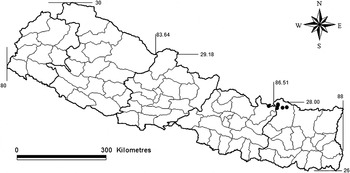
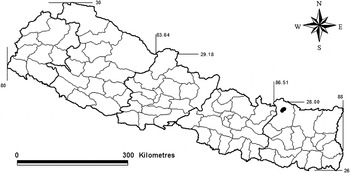
Fig. 10.Distribution of Berberis kumaonensis.


Semi-prostrate shrub to 20 cm. Stems and branches sulcate, glabrous, brownish-grey. Internodes 0.5–2 cm. Spines usually 3-fid, sulcate, central spine 1–3 cm, the lateral spines equal or slightly shorter than the central. Leaves deciduous, slightly coriaceous. Petiole absent. Lamina obovate, 1–2 × 0.3–1 cm, base cuneate, apex acute or obtuse, tapering to a spine-like mucro, margin with 1–2(–3) spinose teeth on each side, green above, papillose and slightly glaucous beneath, venation prominent on both sides. Flowers solitary, yellow, 1.5–2 cm in diameter. Pedicel 0.5–1.2 cm, reddish yellow. Sepals in 3(–4) whorls, outermost sepals linear or oblong-ovate, 4–6 × 1–2 mm (if present); outer sepals ovate-elliptic, 4–6 × 2–4 mm; median sepals broadly obovate to elliptic, 6–8 × 3.5–5 mm; inner sepals broadly obovate to elliptic, 5.5–8.5 × 3.5–5 mm. Petals obovate, 4.5–6 × 3–4 mm, base cuneate, apex obtuse or slightly notched to 0.2–0.4 mm, margin entire, venation distinct with 1 pair of lateral veins; glands ellipsoid, 0.5–1 mm long. Stamens 3.5–4 mm long, connective scarcely produced or not. Pistil 3–3.5 mm long; ovules 7–12. Berries not seen.
Phenology. May–Jul (fl.); Jun–Sep (fr.).
Habitat and ecology. In dry, rocky, open and exposed areas at 3000–4000 m altitude.
Distribution. Nepal (Western), W Himalaya (Kumaon).
Proposed IUCN conservation status. Least Concern (LC). In Nepal, this species is recorded only from far western Nepal but it is common in the Kumaon and Garhwal regions of India.
Distinguishing features. Small spiny semi-prostrate shrub; flowers large, up to 2 cm in diameter, ovules 7–12.
Selected specimens. Western. Doti, Khaptad National Park, 2967 m, 2 vii 2009, Bajhang 09 20915029 (E); Humla, Norkeni, above Simikot, 3650 m, 21 vi 2008, JRS B163 (E); Mugu, Ghurchi lekh, between Lumsa and Murma, 3330 m, 11 viii 1952, Polunin, Sykes & Williams5124 (BM).
4. Berberis concinna Hook.f., Bot. Mag. 79: t. 4744 (1853); Hooker & Thomson, Fl. Ind. 1: 228 (1855); Hooker & Thomson in Hooker, Fl. Brit. India 1(1): 111 (1872); Schneider, Bull. Herb. Boissier 2.5: 397 (1905); Chatterjee, Rec. Bot. Surv. India 16(2): 26 (1953); Ahrendt, J. Linn. Soc. Bot. 57: 118 (1961); Tebbs in Hara & Williams, Enum. Fl. Pl. Nepal 2: 30 (1979); Grierson in Grierson & Long, Fl. Bhutan 1(2): 324 (1984); Rao et al., Rheedea 8(2): 111 (1998); Press et al., Annot. Checkl. Fl. Pl. Nepal 25 (2000). – Type: India, Sikkim, Lachen Valley, 12,000–13,000 ft, Hooker s.n. (lecto K! [barcode K000077361], designated by Ahrendt (Reference Ahrendt1961: 119)). Figs 11,12.
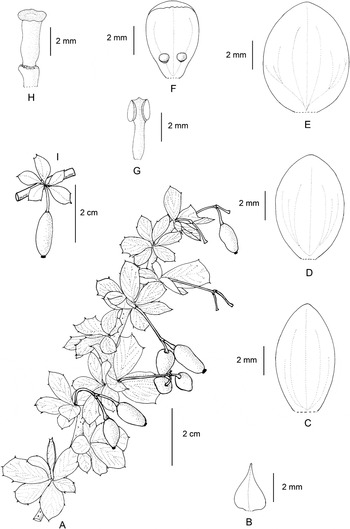
Fig. 11.A–H. Berberis concinna var. extensiflora. A, fruiting branch; B, outermost sepal; C, outer sepal; D, median sepal; E, inner sepal; F, petal; G, stamen; H, pistil (A from Pendry, Milne & Adhikari EA 105; B–H from Manaslu 08 20812277). I. Berberis concinna var. concinna. Fruiting branch (from Adhikari, B. EL 125).
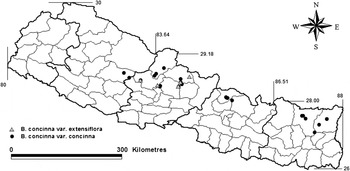
Fig. 12.Distribution of Berberis concinna.
Berberis concinna var. brevior Ahrendt, J. Asiat. Soc. Bengal (Sci.) 11: 3 (1945). – Type: Nepal, Namlang, Sharma E269 (holo BM!; iso E!).


Shrub to 2 m. Stems and branches usually sulcate, glabrous, yellowish grey, sparsely verruculose. Internodes 1–2.5 cm. Spines usually 3-fid, terete, angled or slightly sulcate below, strong, central spine 0.8–1.5 cm, lateral spines 0.5–1.2 cm. Leaves deciduous, slightly coriaceous. Petiole absent. Lamina obovate, 1–3 × 0.5–1.5 cm, base cuneate, apex obtuse, sometimes acute, usually mucronate, margin with 1–3 spinose teeth on each side, dark green above, glaucous and papillose beneath, venation reticulate, prominent both sides. Inflorescence 1–5 cm long, flowers solitary or an umbel of 2 or 3 flowers. Bracts ovate-triangular, 1.5–3 × 1–1.5 mm, bracteole ovate, 1–3 × 0.8–1.5 mm (if present). Flowers yellow, 1.5–2.5 cm in diameter. Peduncle 1.5–3 cm in umbellate flowers. Pedicel 0.5–2 cm, glabrous, red, slightly swollen at the base of fruit. Sepals in 4 whorls, outermost sepals ovate, 2–4 × 1.5–2.5 mm; outer sepals ovate, elliptic, obovate or narrowly obovate, 5–8.5 × 2.5–4 mm; median sepals elliptic, ovate, broadly obovate-elliptic, 5–8.5 × 3–5.5 mm; inner sepals broadly ovate to obovate-elliptic, 5.5–9 × (2.5–)4–6 mm. Petals obovate, 4.5–6.5 × 2.5–4.5 mm, base cuneate, apex obtuse, slightly emarginate or crenate, margin entire, venation distinct with 1 pair of lateral veins; glands cup-shaped, 0.3–0.5 mm in diameter. Stamens 3.5–4.5 mm long, connective scarcely produced. Pistil 3–4 mm long; ovules 7–13. Berries red, oblong-ovoid, 1–1.5 cm long; style absent.
Distinguishing features. Berberis concinna is usually identified by its glaucous leaves with reticulate venation, flowers solitary or 2–3 in umbels and large, estylose berries up to 1.5 cm long.
Key to the varieties of Berberis concinna
1a. Flowers solitary without bracts on the middle of pedicel. Inflorescence 0.8–1.5 cm long 4a. var.concinna
1b. Flowers 2–3, usually in umbels, if solitary subtended by bracteoles on the middle of pedicel. Inflorescence 2–5 cm long 4b. var.extensiflora
4a. Berberis concinna var.concinna
Shrub up to 1 m. Flowers solitary. Ovules usually 7–10.
Phenology. Jun–Aug (fl.); Aug–Oct (fr.).
Habitat and ecology. Open areas on sunny dry slopes at 2600–4600 m altitude.
Distribution. Nepal (Western, Central, Eastern), E Himalaya.
Proposed IUCN conservation status. Least Concern (LC).
Selected specimens. Western. Rukum, above Ranmagaon, 12,000 ft, 2 vii 1954, Stainton, Sykes & Williams 3352 (E). Central. Mustang, Kaligandaki, Lete, 11,500 ft, 4 vi 1954, Stainton, Sykes & Williams 5595 (BM, E). Eastern. Sankhuwasabha, Milkedada, 3480 m, 1971, Beer, Lancaster & Morris 41 (BM); Sankhuwasabha, Ridge near Kauma, S of Shipton La, 3530 m, 26 ix 1991, EMAK315 (E).
Ahrendt (Reference Ahrendt1945b) separated Berberis concinna var. brevior from B. concinna var. concinna on the basis of length of the pedicels and size of the fruits, but these characters are not consistent within these two varieties, so B. concinna var. brevior is considered to be a synonym of B. concinna var. concinna.
4b. Berberis concinna var. extensiflora Ahrendt, J. Linn. Soc. Bot. 57: 119 (1961). – Type: Nepal, Larjung, Kaligandaki Valley, Stainton, Sykes & Williams8175 (holo BM!; iso E!).Fig. 11A–H.
Shrub up to 2 m. Flowers usually 2–3 in umbels. Ovules usually 10–13.
Phenology. Jun–Aug (fl.); Aug–Oct (fr.).
Habitat and ecology. Open areas in sunny dry slopes at 3000–3400 m altitude.
Distribution. Nepal (Central).
Proposed IUCN conservation status. Vulnerable (VU B1ab(iii)). This taxon is currently known only from central Nepal and has not been reported from Tibet, India or Bhutan. It might qualify for Endangered (EN) status but considering the low collection density over much of Nepal, we prefer to consider this taxon Vulnerable.
Selected specimens. Central. Lamjung, Rambrong, Lamjung Himal, 11,000 ft, 27 x 1954, Stainton, Sykes & Williams 9352 (BM, E); Manang, Bimtang-Gho, 3280 m, 14 viii 2008, Manaslu 08 20812277 (E); Myagdi, Ghorepani, Poon hill, 3120 m, 4 x 2006, Pendry, Milne & Adhikari EA 105 (E).
5. Berberis mucrifolia Ahrendt, J. Roy. Hort. Soc. 81: 135 (1956); Ahrendt, J. Linn. Soc. Bot. 57: 135 (1961); Tebbs in Hara & Williams, Enum. Fl. Pl. Nepal 2: 31 (1979); Press et al., Annot. Checkl. Fl. Pl. Nepal 26 (2000). – Type: Nepal, Tegar, N of Mustang, Stainton, Sykes & Williams 8111 (holo BM!; iso E!). Figs 13,14.
Fig. 13.Berberis mucrifolia. A, fruiting branch; B, outer sepal; C, median sepal; D, inner sepal; E, petal; F, stamen; G, pistil (A from JRS A1; B–G from Stainton4847).
Fig. 14.Distribution of Berberis mucrifolia.


Dwarf shrub, rarely semi-prostrate, up to 1 m. Stems and branches terete, puberulous to glabrous, dark grey to greyish yellow, verruculose, young shoots reddish green. Internodes 0.3–1.2 cm. Spines 3-fid, strong, terete or slightly angular, central spine 1–2 cm, lateral spines 0.5–1.5 cm. Leaves deciduous, coriaceous. Petiole absent. Lamina narrowly elliptic to narrowly obovate, 0.8–2.5 × 0.2–0.5 cm, base cuneate, apex acute to acuminate, tapering to a spine-like mucro of 0.5–1.5 mm, margin usually entire, rarely one spine-like tooth on either side, lustrous green above, paler whitish green beneath, venation indistinct. Flowers solitary or in fascicles of 2–3 flowers. Bracts ovate-triangular, 0.5–1 mm. Perianth yellow, c.0.8 cm in diameter. Pedicel 0.5–1 mm. Sepals in 3 whorls, outer sepals oblong-ovate, 2.5–3 × 1.5–2 mm; median sepals ovate-elliptic, 4–4.5 × 1.5–2.8 mm; inner sepals broadly obovate, 5.5–7 × 3.5–4.5 mm. Petals broadly obovate, 5–6 × 3–5 mm, base cuneate, apex slightly notched, 0.2–0.5 mm deep, margin entire, venation distinct with 1 pair of lateral veins; glands oblong or oblong-ovate, 0.8–1.3 mm long. Stamens 3.5–5 mm long, connective slightly produced, tip conical. Pistil 4–5 mm long; ovules 3–6(–9). Berries red, globose or obovoid-globose, 5–7 mm long; style 1–1.5 mm long.
Phenology. Apr–Jun (fl.); Jun–Oct (fr.).
Habitat and ecology. In dry, rocky and open areas at 2000–4400 m altitude.
Distribution. Nepal (Western, Central). Endemic to Nepal.
Proposed IUCN conservation status. Vulnerable (VU B1ab(iii)). This species is endemic to Nepal and grows only in calcareous soils in dry, trans-Himalayan regions of western Nepal.
Distinguishing features. Berberis mucrifolia is easily distinguished by its low stature, coriaceous leaves and red, stylose berries.
Selected specimens. Western. Jumla, Munigaon, 9500 ft, 28 ix 1952, Polunin, Sykes & Williams 5444 (BM). Central. Baglung, Okhaldhungagaon, south of Dhorpatan, 11,000 ft, 1 v 1954, Stainton, Sykes & Williams 367 (BM, E); Mustang, Tetang, 3600 m, 18 v 1974, Dobremez & Manandhar 3029 (74-658) (E); Mustang, Kaligandaki, 500 m north of Jomsom, 2750 m, 26 ix 2006, Pendry, Milne & Adhikari EA 1 (E); Mustang, south of Eklobhatti, 28 ix 2006, Pendry, Milne & Adhikari EA 40 (E); Myagdi, above Gurjakhani, 9500 ft, 21 vii 1954, Stainton, Sykes & Williams3567 (BM, E).
One individual from Jumla, JRSA 12, is considered to be a potential hybrid of Berberis mucrifolia and B. jaeschkeana var. usteriana. It resembles Berberis mucrifolia in its coriaceous leaves but differs by its 2–4-flowered racemes.
6. Berberis tsarica Ahrendt, J. Bot. 79 (Suppl.): 48 (1941); Ahrendt, J. Linn. Soc. Bot. 57: 133 (1961); Tebbs in Hara & Williams, Enum. Fl. Pl. Nepal 2: 31 (1979); Grierson in Grierson & Long, Fl. Bhutan 1(2): 324 (1984); Press et al., Annot. Checkl. Fl. Pl. Nepal 26 (2000). – Type: SE Tibet, Tsari district, near Langong, Chianang, Ludlow, Sherriff & Taylor 3961 (lecto BM! sheet 1 [barcode 00055959], designated here; isolecto BM! sheet 2 [barcode 000559592]). Figs 15,16.
Fig. 15.Berberis tsarica. A, flowering branch; B, outer sepal; C, inner sepal; D, petal; E, stamen; F, pistil (from DNEP1153).
Fig. 16.Distribution of Berberis tsarica.


Shrub to 50 cm, sometimes with arching branches. Stems and branches terete to sulcate, glabrous, dark grey to black, young shoots purplish brown, slightly sulcate or angular, puberulous. Internodes 0.2–1 cm. Spines usually 5-fid, rarely 3-fid, sulcate, central spine 0.7–1.5 cm, the lateral spines equal or slightly shorter than the central. Leaves deciduous, thin or slightly coriaceous. Petiole absent. Lamina obovate-elliptic, 0.5–1.5 × 0.2–0.5 cm, base cuneate, apex acute, rarely obtuse, margin usually entire, sometimes with 1–3 spinose teeth on each side, mucronate, green above, slightly glaucous beneath, venation slightly prominent below. Flowers solitary, yellow with red tips, c.1 cm in diameter. Pedicel 2–8 mm. Sepals in 2 whorls, outer sepals ovate-elliptic, 4–5.5 × 2–2.5 mm; inner sepals broadly obovate, 4.5–6.5 × 3–4.5 mm. Petals obovate, 4–6 × 2–3 mm, base cuneate, apex notched, 0.3–0.6 mm deep, rarely obtuse, margin entire, venation obscure or with the central vein and 1 pair of lateral veins evident; glands elliptic, 0.8–1 mm long. Stamens 2.5–3.5 mm long, connective slightly produced, tip conical. Pistil 3–4 mm long; ovules 2–5. Berries red, oblong-obovoid, 0.8–1 cm long; style very short or absent.
Phenology. May–Jul (fl.); Jun–Oct (fr.).
Habitat and ecology. Dry rocky slopes, open dry Rhododendron and Juniper shrubland at 4000–4700 m altitude.
Distribution. Nepal (Central, Eastern), E Himalaya, Tibetan Plateau.
Proposed IUCN conservation status. Least Concern (LC). Berberis tsarica is recorded from only a few localities of the Sagarmatha region of Nepal but has been widely recorded in SE Xizang.
Distinguishing features. Berberis tsarica is easily identified by its 5-fid spines and distinctly notched petals.
Selected specimens. Central. Dolkha, Rolwaling, 15,000 ft, 30 vi 1964, Stainton 4718 (BM). Eastern. Solukhumbu, Bhote Koshi, 4700 m, 21 ix 2005, DNEP3 BY134 (E); Solukhumbu, Dole-Luza, 4300 m, 15 v 2004, DNEP1 153 (E); Solukhumbu, Khumbu, Tsolu Khola, 4550 m, 25 vi 1964, Bowes-Lyon 2103 (BM); Solukhumbu, Langmuche Valley, 4400 m, 24 ix 2005, DNEP3 BY188 (E).
7. Berberis pendryi Bh.Adhikari,sp. nov.
Species Berberis tsarica Ahrendt affinis; spinae 3-fidae, flores solitarii, petala apice incisura, stamina apice producta bicornis, ovulis 2–3. – Type: Nepal, Mustang, below Muktinath, Pendry, Milne & Adhikari EA 34 (holo E!; iso KATH!). Figs 17,18.
Berberis pendryi Bh.Adhikari, sp. nov. A, fruiting branch; B, outer sepal; C, median sepal, D, inner sepal; E, petal; F, stamen; G, pistil (A from Pendry, Milne & Adhikari EA 28; B–G from Pendry, Milne & Adhikari EA 34).

Distribution of Berberis pendryi.

Low-growing shrub to 70 cm. Stems and branches terete, young shoots slightly sulcate, reddish brown, puberulous, becoming greyish and sparsely verruculose when older. Internodes 0.2–1 cm. Spines usually 3-fid, rarely 5-fid in smallest outermost pair, strong, terete or angular, central spine 0.5–1.2 cm, lateral spines 0.5–1 cm, much smaller in older stem c.0.3–0.5 cm. Leaves deciduous, thin. Petiole absent. Lamina obovate, 0.5–2 × 0.4–0.8 cm, base cuneate, apex obtuse, apiculate or mucronate, margin usually entire, sometimes with 1–3(–5) spinulose teeth on each side, dark green above, paler beneath, venation slightly prominent below. Flowers solitary, yellow, c.1 cm in diameter. Pedicel 0.3–1 cm. Sepals in 3 whorls, outer sepals ovate, 3.5–6 × 2.5–4.5 mm; median sepals obovate to broadly obovate, 5–7.5 × 3–5 mm, inner sepals obovate, 6–8.5 × 4–6.5 mm. Petals obovate, 5–6.5 × 3–4.5 mm, base cuneate, margin entire, apex notched, 0.5–0.8 mm deep, venation distinct with 1 or 2 pairs of lateral veins; glands obovoid, 0.8–1.5 mm long. Stamens 4–5 mm long, connective produced into 2, or sometimes 3, tooth-like appendages, rarely truncate. Pistil 3–5 mm long; ovules 3–5. Berries red, sub-globose to ellipsoid, 0.5–1 cm long; style 1 mm long.
Phenology. Jun–Aug (fl.); July–Nov (fr.).
Habitat and ecology. In open dry rocky areas with thin soil at c.3600 m altitude.
Distribution. Nepal (Central).
Proposed IUCN conservation status. Data Deficient (DD). Since this species was discovered during this study and is known only from the type locality more data are needed to confirm its status.
Distinguishing features. Berberis pendryi is most closely related to B. tsarica Ahrendt, from which it differs by its mainly 3-fid spines and distinctly produced bifurcated horn-like connective.
Selected specimens. Central. Mustang, near Muktinath temple, 3600 m, 28 ix 2006, Pendry, Milne & Adhikari EA 32 (E, KATH); Mustang, outside of main gate of Muktinath temple, 3600 m, 28 ix 2006, Pendry, Milne & Adhikari EA 31 (E, KATH).
This species is currently known only from the type locality. It is dedicated to Dr Colin Pendry who supervised the PhD project of the first author and who also led the expedition to the Annapurna region of central Nepal during which this species was discovered.
8. Berberis aristata DC., Syst. Nat. 2: 8 (1821); Hooker & Thomson, Fl. Ind. 1: 222 (1855); Hooker & Thomson in Hooker, Fl. Brit. India 1(1): 110 (1872); Schneider, Bull. Herb. Boissier 2.5: 451 (1905); Chatterjee, Rec. Bot. Surv. India 16(2): 20 (1953); Ahrendt, J. Linn. Soc. Bot. 57: 101 (1961); Tebbs in Hara & Williams, Enum. Fl. Pl. Nepal 2: 29 (1979); Grierson in Grierson & Long, Fl. Bhutan 1(2): 326 (1984); Rao et al., Rheedea 8(1): 24 (1998); Press et al., Annot. Checkl. Fl. Pl. Nepal 25 (2000). – Berberis chitria Buch.-Ham. ex Ker Gawl., Bot. Reg. 9: t. 729 (1823), nom. superfl. – Type: Nepal, ‘Berberis chitria Hamilt. Don.’-ex herb. Lambert (lecto BR! [barcode 000000571934], designated here). Figs 19,20.
Fig. 19.Berberis aristata. A, fruiting branch; B, outer sepal; C, median sepal; D, inner sepal; E, petal; F, stamen; G, pistil (A from Adhikari SB 15; B–G from Proud5).
Fig. 20.Distribution of Berberis aristata.
Berberis ceratophylla G.Don, Gen. Hist. 1: 115 (1831). – Type: not seen.
Berberis chitria var. sikkimensis C.K.Schneid., Bull. Herb. Boissier 2.5: 453 (1905). – Berberis sikkimensis (C.K.Schneid.) Ahrendt, J. Bot. 79 (Suppl.): 85 (1942). – Type: India, Larhoery, 9000 ft, 27 viii 1849, Hooker & Thomson s.n. (lecto K! [barcode K000077367], designated by Ahrendt (Reference Ahrendt1942: 86); isolecto CGE n.v.).
Berberis sikkimensis var. baileyi Ahrendt, J. Linn. Soc. Bot. 57: 99 (1961). – Type: Nepal, Gyang, 3 vi 1935, Bailey47 (holo BM!).


Shrub to 5 m. Stems and branches sulcate or angled, glabrous or puberulous, reddish brown. Internodes 1–5 cm. Spines 3-fid, solitary towards twig apex, strong, usually terete, central spine 1–2 cm, the lateral spines equal to or slightly shorter than the central. Leaves deciduous, slightly coriaceous. Petiole indistinct. Lamina obovate or obovate to narrowly elliptic, 2–6 × 0.5–1.5 cm, base cuneate, apex acute or obtuse, mucronate, margin entire or with 2–10 spinulose teeth on each side, dark green above, paler beneath, venation distinct and slightly raised both sides. Inflorescence 4–6 cm long, a pedunculate and sub-paniculate raceme of 10–20 flowers. Bracts ovate, reddish brown, 2–2.5 mm long. Flowers yellow, c.1 cm in diameter. Peduncle 0.5–2 cm, glabrous. Pedicel 0.5–1 cm, slightly glaucous. Sepals in 3 whorls, outer sepals ovate, 2–3 × 1–2 mm; median sepals elliptic or elliptic obovate, 3–5 × 1.5–3 mm; inner sepals obovate, 6–8.5 × 3–5 mm. Petals obovate, 5–8 × 3–5 mm, base cuneate, apex obtuse, rarely notched, 0.2–0.3 mm deep, margin entire, venation distinct with 1 pair of lateral veins; glands elliptic or obovoid, 0.7–1 mm long. Stamens 4–5.5 mm long, connectives scarcely produced, tip conical. Pistil 5–6 mm long; ovules 3–4. Berries greenish purple becoming dark purple to black on ripening, oblong-ovoid, sometimes asymmetric, 8–10 mm long, slightly glaucous; style thick, 1–2.5 mm long.
Phenology. Apr–Jul (fl.); May–Oct (fr.).
Habitat and ecology. Common in forest clearings and disturbed vegetation along forest edges and roadsides at 1300–3400 m altitude.
Distribution. Nepal (Western, Central, Eastern), E Himalaya, W Himalaya.
Proposed IUCN conservation status. Least Concern (LC).
Distinguishing features. Berberis aristata is easily identified by its pedunculate and sub-paniculate raceme, and dark purple or black oblong-ovoid berries with a short, thick style.
Selected specimens. Western. Dailekh, 2100 m, 31 vii 1991, Suzuki et al. 9194038 (BM). Central. Kathmandu, Sheopuri, 8000 ft, 6 v 1957, Proud 5 (BM, E); Rasuwa, route to Langtang Khola, 9000 ft, 6 vi 1949, Polunin 161 (BM, E); Rasuwa, near Dhunche towards Deurali, 1990 m, 19 x 2006, Adhikari EL 122 (E). Eastern. Dhankuta, Hile-Shidua, 2100 m, 12 vii 1991, Ohba et al. 9154008 (E); Sagarmatha, Jorsale, 2842 m, 28 ix 2005, DNEP3 BY207 (E).
Berberis aristata is one of the commonest species of Berberis growing in the Himalayas and it shows a great range of variation in shape and size of leaf and inflorescence. Several attempts have been made (Schneider, Reference Schneider1904, Reference Schneider1905; Ahrendt, Reference Ahrendt1961) to describe new species and varieties based on minor, variable characters, greatly confusing the identity of this species. Several individuals collected during this study, EA 50, 52, 53 and EA2 38, have been identified as putative hybrids between Berberis aristata and B. jaeschkeana var. usteriana. These plants have a long pedunculate or sub-pedunculate inflorescence similar to Berberis aristata and leaves similar to those of B. jaeschkeana var. usteriana.
Berberis aristata was first collected by Francis Buchanan (later Hamilton) most probably from ‘Chitlong’ (today’s Chitlang), central Nepal, on 10 April 1802 (Press & Shrestha, Reference Press and Shrestha2000). The first name Francis Buchanan intended for it was Berberis chitria, which is probably derived from its local name ‘chutro’. He gave his original set of Nepalese collections, along with large collections of drawings and manuscripts of Indian plants, to his friend J. E. Smith, with another set being given to Aylmer Bourke Lambert. De Candolle (Reference Candolle1821) described Berberis aristata and cited the specimen in Lambert’s herbarium with Francis Buchanan’s name Berberis chitria. Ker Gawler in 1823 (Bot. Reg. 9: t. 729) rejected the first published name, Berberis aristata, and restored Francis Buchanan’s original name Berberis chitria, since when the two names have been a source of confusion, with subsequent authors accepting one or the other or both names as correct. Based on Lambert’s materials, together with those of Wallich, D. Don (Reference Don1825) produced Prodromus Florae Nepalensis in which he accepted Francis Buchanan’s name Berberis chitria. Later, Hooker and Thomson (Reference Hooker and Thomson1855, Reference Hooker, Thomson and Hooker1872) accepted Berberis aristata as the first validly published name. Schneider (Reference Schneider1904, Reference Schneider1905) treated both Berberis aristata and Berberis chitria as separate species, saying ‘Buch-Ham. seems to have distributed other forms under the same name and Lindley described some of this in Bot. Reg. t 729’. Ahrendt (Reference Ahrendt1942, Reference Ahrendt1961) also accepted both names and treated them as separate species.
Francis Buchanan collected Berberis specimens from Chitlang and from the surroundings of Kathmandu valley since he was not permitted to visit other parts of the country during his year-long stay in Nepal. Several populations of Berberis aristata from central Nepal and the hills surrounding the Kathmandu valley were examined during this study and it is concluded that there are no other Berberis species similar to B. aristata growing in this region.
After the death of Lambert, his herbarium was split up and sold at auction. Francis Buchanan’s specimens collected from Nepal along with Mysore and Malabar were purchased by Robert Brown for the British Museum and incorporated into their herbarium (Fraser-Jenkins, Reference Fraser-Jenkins2005). However, some of the specimens did not find their way into the collections (Press & Shrestha, Reference Press and Shrestha2000) and Francis Buchanan’s Berberis aristata specimens have not been found in BM. According to Miller (Reference Miller1970), some of the Francis Buchanan specimens were also distributed before the sale and can be found in BR (from Herb. Martius), OXF and P-JU. The Buchanan specimen in BR bears a handwritten label ‘Berberis chitria Hamilt. Don. Nepal: Ind. Orient. Lamb’, and therefore it appears to have come from Lambert’s herbarium, and has been chosen as the lectotype. Another Buchanan specimen of Berberis aristata which appears to be a different collection from the BR specimen was found at LINN-SM (herbarium sheet no 622.7) and it is considered likely to be a syntype.
In Don’s (Reference Don1831) description of Berberis ceratophylla he cited ‘Wall. MSS with native of Nipaul?’ in the protologue. Ahrendt (Reference Ahrendt1945b) cited the type as ‘Nepal: Wallich, s.n. (Typus Dupl. in Herb. Oxon)’ and in 1961 as ‘Nepal: Wallich, s.n. (Type, O)’. During this study a Wallich specimen annotated by Ahrendt as a type was found in OXF and this could serve as lectotype or neotype. However, there is no evidence that Don saw this specimen or that it is original material. No other material has been discovered which could be original material and therefore no type has been designated in this study.
Schneider (Reference Schneider1905) cited the type for Berberis chitria var. sikkimensis as ‘Diese Form sah ich im Herb. Berlin mit der Etiquette aristata var. parviflora? Hook. f. et Th. aus Sikkim’ in the protologue. However, this specimen was destroyed in World War II. The isotype of this collection in the Kew herbarium was cited by Ahrendt (Reference Ahrendt1942) as a type of Berberis sikkimensis (C.K.Schneid.) Ahrendt, thereby effectively lectotypifying it.
Specimens with longer peduncles and sub-paniculate inflorescences are usually identified as Berberis chitria corresponding to Ker Gawler’s figure (Bot. Reg. t. 729, 1823). Ker Gawler’s drawing was from a cultivated plant, with no information on its origin. There are some collections of Berberis with longer peduncles growing in the western Himalayas (Kumaon, India) which could be a different species or variety. No specimens of this kind were observed in the field and no such herbarium specimens from Nepal were located. This matter is therefore beyond the scope of this revision.
9. Berberis thomsoniana C.K.Schneid., Bull. Herb. Boissier 2.5: 454 (1905); Ahrendt, J. Linn. Soc. Bot. 57: 106 (1961); Grierson in Grierson & Long, Fl. Bhutan 1(2): 327 (1984); Rao et al., Rheedea 8(1): 27 (1998). – Type: India, Sikkim, Hooker s.n. (holo W!; iso K!). Figs 21,22.
Fig. 21.Berberis thomsoniana. A, flowering branch; B, outermost sepal; C, outer sepal; D, median sepal; E, inner sepal; F, petal; G, stamen; H, pistil (A from LKSR B46; B–H from LKSR B17).
Fig. 22.Distribution of Berberis thomsoniana.


Shrub to 3 m. Stems and branches sulcate, glabrous, dark grey to greyish yellow, verruculose, young shoots reddish brown. Internodes 1.5–4 cm. Spines usually 3-fid, smaller and then absent towards the apex of twig, terete or angular, central spine 1–2 cm, lateral spines 0.5–1.2 cm. Leaves deciduous, thin or slightly coriaceous. Petiole absent or 0.2–1 cm. Lamina obovate, 2–4.5 × 1–2 cm, base cuneate or attenuate to a small petiole, apex obtuse, usually mucronate, margin usually entire, sometimes with 2–6 spinulose teeth on each side, green above, paler beneath, venation prominent both sides. Inflorescence 2–4.5 cm long, a pedunculate raceme or sub-umbellate raceme of 4–10 flowers, sometimes with a few flowers arising from the base of the rachis. Bracts narrowly ovate to triangular, 1.5–2.5 mm. Flowers yellow, c.1–1.5 cm in diameter. Peduncle 0.2–1 cm, glabrous to puberulous, red. Pedicel 1–2 cm, glabrous to puberulous. Sepals in 4 whorls, outermost sepals boat-shaped, linear or oblong-ovate, 4–6 × 1–2 mm; outer sepals narrowly ovate, 4.5–7 × 2–4 mm; median sepals broadly obovate-elliptic, 6–8 × 4–6 mm; inner sepals broadly obovate-elliptic, 5–8 × 3–5 mm. Petals obovate, 4.5–6.5 × 3.5–5 mm, base cuneate, apex obtuse or emarginate, margin entire, venation distinct with 1 pair of lateral veins; glands obovoid, 0.8–1.3 mm long. Stamens 3–4 mm long, connective scarcely produced or not. Pistil 3.5–4 mm long; ovules 2–5. Berries red, oblong-obovoid, c.1 cm long; style small (less than 0.5 mm) or absent.
Phenology. May–Aug (fl.); Aug–Oct (fr.).
Habitat and ecology. Open hillsides and the edges of oak–Rhododendron forest at 3000–3650 m altitude.
Distribution. Nepal (Western, Central, Eastern), E Himalaya.
Proposed IUCN conservation status. Least Concern (LC).
Distinguishing features. Berberis thomsoniana is identified by its pedunculate or sub-umbellate raceme and 4 whorls of sepals with the outermost sepals nearly equal to the next outer sepals.
Selected specimens. Western. Rukum, near Seng Khola, 11,000 ft, 6 x 1954, Stainton, Sykes & Williams 4706 (BM). Central. Rasuwa, Langtang Khola, 3180 m, 24 v 1962, Bowes-Lyon 148 (BM, E); Rasuwa, near Chandanbari, 3166 m, 19 x 2006, Adhikari EL 124 (E). Eastern. Illam, Jaubari-Jogmai, 2621 m, 18 vi 2007, LKSRB 181 (E); Panchthar, Maimajuwa-8, Bharlang, 2904 m, 8 vi 2007, LKSRB 17 (E); Sankhuwasabha, north bank of Barun Khola, below Nehe Kharka, 3560 m, 8 x 1991, EMAK583 (E).
Schneider (Reference Schneider1905) cited the type as ‘Sikkim: c 3000 m (Hooker), typus in Herb. Hofm. Wien’. Later, in 1908, he cited Hooker specimen no 39 and Clarke specimen no 27575 a, without distinguishing a type. Ahrendt (Reference Ahrendt1961) identified the type as Hooker39 (K). Hooker’s specimen without number in Hofmuseum Wien (W) has been identified as the holotype.
10. Berberis koehneana C.K.Schneid., Bull. Herb. Boissier 2.5: 814 (1905); Chatterjee, Rec. Bot. Surv. India 16(2): 32 (1953); Ahrendt, J. Linn. Soc. Bot. 57: 210 (1961); Tebbs in Hara & Williams, Enum. Fl. Pl. Nepal 2: 30 (1979); Rao et al., Rheedea 8(2): 129 (1998); Press et al., Annot. Checkl. Fl. Pl. Nepal 26 (2000). – Type: India, Kumaon, near Budhi, Byans, Duthie 5309 (holo WU!; iso DD n.v., K!). Figs 23,24.
Fig. 23.Berberis koehneana. A, fruiting branch; B, outer sepal; C, median sepal; D, inner sepal; E, petal; F, stamen; G, pistil (A from Stainton, Sykes & Williams 8136; B–G from Polunin506).
Fig. 24.Distribution of Berberis koehneana.
Berberis koehneana var. auramea Ahrendt, J. Linn. Soc. Bot. 57: 210 (1961). – Type: Nepal, Langtang, Polunin506 (holo BM!; iso A!, E!).


Shrub to 4 m. Stems and branches terete or slightly angled, glabrous, yellow or yellowish brown, verruculose. Internodes 1–4 cm. Spines usually 3-fid, solitary towards twig apex, strong, terete or angular, central spine 0.5–1.5 cm, the lateral spines equal to or slightly shorter than the central. Leaves deciduous, thin or slightly coriaceous. Petiole absent or 2–5 mm. Lamina obovate, 2–5 × 0.7–1.5 cm, base cuneate, tapering to the small petiole, apex obtuse, rarely acute, usually mucronate, margin usually entire, sometimes with 1–4 spinulose teeth on each side, lustrous green above, paler and papillose beneath, venation prominent both sides. Inflorescence (3–)8–16 cm long, a panicle of 15–70 flowers. Bracts ovate-triangular, 1.5–3 mm. Flowers yellow, c.0.5–1 cm in diameter. Peduncle 0.5–4 cm, glabrous, reddish brown. Pedicel 0.5–1 cm. Sepals in 3 whorls, outer sepals ovate-triangular, 1.5–2.5 × 1–1.5 mm; median sepals elliptic or elliptic-ovate, 2.5–5 × 2–3.5 mm; inner sepals obovate to broadly obovate, 3.5–6.5 × 3.5–4.5 mm. Petals obovate, 3.5–6 × 2.5–4.5 mm, base cuneate or slightly clawed, margin entire, apex notched, 0.3–0.5 mm deep, venation distinct with 1 pair of lateral veins; glands elliptic or elliptic-ovate, 0.5–0.7 mm long. Stamens 2–3.5 mm long, connective scarcely produced, tip conical. Pistil 2–3.5 mm long; ovules 2–3. Berries bright red, oblong-ovoid or ellipsoid, 0.5–1 cm long; style absent.
Phenology. Apr–Aug (fl.); Aug–Oct (fr.).
Habitat and ecology. Dry, open, degraded areas along forest margins, settlements and agricultural lands at 2400–4000 m altitude.
Distribution. Nepal (Western, Central), W Himalaya (Kumaon).
Proposed IUCN conservation status. Least Concern (LC).
Distinguishing features. Berberis koehneana is easily identified by its long, paniculate inflorescence with up to 70 flowers and red estylose berries.
Selected specimens. Western. Humla, Dozam, near Simikot, 8500 ft, 4 vi 1952, Polunin, Sykes & Williams 4272 (E); Jumla, Bhurchula lekh, 9000 ft, 10 vii 1952, Polunin, Sykes & Williams 4514 (E); Rukum, above Ghustung Khola, 10,500 ft, 11 x 1954, Stainton, Sykes & Williams 4786 (BM, E). Central. Mustang, below Muktinath, 3604 m, 16 viii 2007, Adhikari EA2 14 (E); Mustang, Kaligandaki Valley, Thinigaon, 3480 m, 26 ix 1954, Stainton, Sykes & Williams 8022 (BM, E); Rasuwa, Ghodatabala, 3018 m, 4 viii 2007, Adhikari BL2 55 (E).
Ahrendt (Reference Ahrendt1961) described Berberis koehneana var. auramea from central Nepal on the basis of its yellow stem. Stem colour varies greatly within species and not consistently within any subgroup, so is not considered a reliable character with which to separate taxa. Berberis koehneana var. auramea is therefore reduced to synonymy.
11. Berberis orthobotrys Bienert ex Aitch. var. rubicunda Ahrendt, J. Linn. Soc. Bot. 57: 144 (1961); Rao et al., Rheedea 8(2): 126 (1998). – Type: Nepal, Langtang, Polunin 514 (holo BM!; iso E!). Figs 25,26.
Fig. 25.Berberis orthobotrys var. rubicunda. A, fruiting branch; B, outer sepal; C, median sepal; D, inner sepal; E, petal; F, stamen; G, pistil (A from Adhikari G2; B–G from Polunin514).
Fig. 26.Distribution of Berberis orthobotrys var. rubicunda.


Shrub to 3 m. Stems and branches terete, glabrous, yellowish grey to black, verruculose, young shoots dark brown, slightly sulcate or angular. Internodes 0.7–1.5 cm. Spines 3-fid, terete or angled, central spine 0.8–1.5 cm, the lateral spines equal to or slightly shorter than the central. Leaves deciduous, slightly coriaceous. Petiole absent. Lamina obovate or narrowly obovate to narrowly elliptic, 1–2.5 × 0.4–1.5 cm, base cuneate, apex acute or obtuse, mucronate, margin usually entire, sometimes with 1–3 spinulose teeth on each side, green above, slightly papillose beneath, venation sub-conspicuous above, distinct and slightly raised below. Inflorescence 1–3 cm long, a shortly pedunculate or sub-umbellate raceme of 2–12 flowers, sometimes with a few flowers arising from the base of the rachis. Bracts ovate or oblong-ovate, 1–2 mm. Flowers yellow, c.1 cm in diameter. Peduncle 0.2–1.2 cm. Pedicel 0.3–1.3 cm. Sepals in 3 whorls, outer sepals ovate or oblong-ovate, 4–5 × 2–3 mm; median sepals ovate or obovate, 5–7 × 3–5 mm; inner sepals elliptic, broadly obovate to rounded, 6–8 × 4–6 mm. Petals obovate, 5.5–6.5 × 3–4.5 mm, base cuneate, apex obtuse, rarely emarginate or crenate, margin entire, venation distinct with 1 pair of lateral veins; glands elliptic, rounded or obovate, 0.5–1 mm long. Stamens 4–5 mm long, connective distinctly produced, tip pointed, sometimes with 2–3 tips. Pistil 4–5 mm long; ovules (2–)3–4. Berries red, ellipsoid to oblong-obovoid, 0.8–1 cm long; style absent.
Phenology. May–Jul (fl.); Aug–Oct (fr.).
Habitat and ecology. Open, exposed areas with Rhododendron and Rosa species at 2800–4200 m altitude.
Distribution. Nepal (Central, Eastern).
Proposed IUCN conservation status. Data Deficient (DD).
Distinguishing features. Berberis orthobotrys var. rubicunda is usually identified by the following combination of characters: leaves usually entire; connectives distinctly produced to long pointed tips; berries red, ellipsoid to oblong-obovoid; style absent.
Selected specimens. Central. Rasuwa, above Langtang, 11,500–12,500 ft, 21 vi 1949, Polunin 483 (BM); Rasuwa, Langtang, 11,500 ft, 22 vi 1949, Polunin 514 (BM, E); Rasuwa, Langtang-Kyanjin, 3579 m, 3 viii 2007, Adhikari BL2 39 (E). Eastern. Solukhumbu, Tengboche-Deboche, 3750 m, 16 ix 2005, DNEP3 AY63 (E).
Berberis orthobotrys var. rubicunda replaces B. koehneana above around 3200 m altitude in central Nepal from where this plant was first described. The specimen Stainton, Sykes & Williams 6049 (BM) which was cited by Ahrendt (Reference Ahrendt1961) for Berberis orthobotrys var. orthobotrys has been identified as B. thomsoniana during this study.
Ahrendt (Reference Ahrendt1961) described Berberis orthobotrys var. canescens based on cultivated material from Sikkim without citing any type material. The Nepalese specimen Stainton, Sykes & Williams 8100 (BM), which was assigned to Berberis orthobotrys var. canescens by Ahrendt (Reference Ahrendt1961), has been identified as B. jaeschkeana var. usteriana during this study. Therefore, Berberis orthobotrys var. canescens has not been included in this account.
Berberis orthobotrys is a variable species and has been reported from Afghanistan, Pakistan, Kashmir, Nepal and Tibet. Berberis orthobotrys var. rubicunda differs from Berberis orthobotrys var. orthobotrys in its distinctly produced anther connectives, inflorescence with 2–4 flowers, and smaller leaves. Berberis orthobotrys var. rubicunda, which has been reported only from Nepal, may be a distinct species but a detailed comparison across the entire range of the species is necessary to clarify its status.
12. Berberis hamiltoniana Ahrendt, Gard. Ill. 64: 426 (1944); Chatterjee, Rec. Bot. Surv. India 16(2): 22 (1953); Ahrendt, J. Linn. Soc. Bot. 57: 137 (1961); Tebbs in Hara & Williams, Enum. Fl. Pl. Nepal 2: 30 (1979); Rao et al., Rheedea 8(2): 111 (1998); Press et al., Annot. Checkl. Fl. Pl. Nepal 25 (2000). – Type: Nepal-Jeyjey, 12,500 ft, 19 x 1934, seed producing cultivated plant (holo OXF, lost). Cultivated, L.A. 347 (from seed from Jey Jey, Kew 1056/34), fl. 3 vi 1942, 10 vi 1943, fr. 15 x 1943 (neo BM!, first step designated by Ahrendt (Reference Ahrendt1961: 138), of which plant grown from Nepal seed (Kew 1056/34 pro parte), fr. 15 x 1943, specimen no 534, neo BM! [barcode 000554686], second step designated here). Figs 27,28.
Fig. 27.Berberis hamiltoniana. A, flowering branch; B, outer sepal; C, median sepal; D, inner sepal; E, petal; F & H, stamen; G, pistil (A from JRS B162; B–G from Polunin, Sykes & Williams 4579; H from Lowndes941).
Fig. 28.Distribution of Berberis hamiltoniana.


Shrub to 4 m. Stems and branches terete, glabrous, reddish brown when young becoming grey when older, sparsely verruculose. Internodes 1–2(–4) cm. Spines usually 3, solitary towards twig apex, strong, terete or slightly angled, central spine 0.8–1.8 cm, lateral spines 0.5–1.5 cm. Leaves deciduous, thinly coriaceous. Petiole absent. Lamina obovate or narrowly obovate to narrowly elliptic, 2–3.5 × 0.7–1.5 cm, base cuneate, apex obtuse, mucronate, margin usually entire, rarely with 2 or 3 spinulose teeth on each side, dark green above, paler and papillose beneath, venation sub-conspicuous above, prominent and slightly raised below. Inflorescence 1.5–4 cm long, an umbellate or sub-umbellate raceme of 3–8 flowers with a few flowers arising from the base of the rachis. Bracts ovate-triangular, 1–2.5 mm long. Flowers yellow, 1–1.5 cm in diameter. Peduncle 0.5–2 cm. Pedicel 0.5–2 cm. Sepals in 3 whorls, outer sepals ovate or ovate-elliptic, 3.5–5.5 × 2–3 mm; median sepals elliptic or elliptic-obovate, 4.5–7 × 2.5–5 mm; inner sepals broadly obovate, 7–9 × 5–6.5 mm. Petals obovate, 5–7 × 3–5 mm, base cuneate, apex notched, 0.2–0.4 mm deep, margin entire, venation distinct with 1 or 2 pairs of lateral veins; glands obovoid-ellipsoid, 0.8–1.5 mm long. Stamens 4–5 mm long, connective distinctly produced, tip pointed, sometimes bifurcated. Pistil 3.5–4.5 mm long; ovules 3–5. Berries red, ovate-ellipsoid, 0.6–1 cm long; style absent.
Phenology. May–Jul (fl.); Jun–Oct (fr.).
Habitat and ecology. Open hillside at 2900–4250 m altitude.
Distribution. Nepal (Western, Central), W Himalaya (Himachal Pradesh).
Proposed IUCN conservation status. Least Concern (LC).
Distinguishing features. Berberis hamiltoniana is identifiable by its usually entire leaves, umbellate or sub-umbellate raceme, notched petals and distinctly produced anther connectives.
Selected specimens. Western. Dolpa, near Hurikot, 3030 m, 25 ix 1952, Polunin, Sykes & Williams 5407 (BM); Humla, below Saathapla towards Rimi, 2640 m, 13 vi 2008, JRSA 134 (E); Jumla, Chanki, NW of Jumla, 2580 m, 9 viii 1952, Polunin, Sykes & Williams 5072 (BM); Jumla, 2420 m, 10 v 1952, Polunin, Sykes & Williams 930 (BM); Mugu, below Ghuruchi Lagna, 3400 m, 7 vi 2008, JRSA 80 (E). Central. Manang, Marsyangdi River, 11,500 ft, 5 vi 1950, Lowndes941 (BM).
Ahrendt (Reference Ahrendt1944b) cited the type as ‘Nepal-Jeyjey, 12500 ft, Oct. 19, 1934, seed producing cultivated plants (Type: Herb. Oxon)’ although in 1961 he cited the type as ‘Cultivated: L.A. 347 (from seed from Jey Jey, Kew 1056/34), fl. 3 vi 1942, 10 vi 1943; fr. 15 x 1943 (Type, BM)’. No specimen with the date 19 x 1934 has been found in OXF. Two herbarium sheets apparently of the later collection were found in BM with the same annotations but different numbers, 534 and 535. This later typification by Ahrendt (Reference Ahrendt1961) is an effective first step neotypification but, as the collection comprises two herbarium sheets, a second step is also necessary. The specimen numbered 535 was chosen for second step neotypification because the fruiting specimen is in better condition.
13. Berberis petiolaris Wall. ex G.Don, Gen. Hist. 1: 116 (1831); Chatterjee, Rec. Bot. Surv. India 16(2): 16 (1953); Ahrendt, J. Linn. Soc. Bot. 57: 93 (1961); Tebbs in Hara & Williams, Enum. Fl. Pl. Nepal 2: 31 (1979); Rao et al., Rheedea 8(1): 10 (1998); Press et al., Annot. Checkl. Fl. Pl. Nepal 26 (2000). – Type: India, Kumaon, Wallich s.n. (lecto CGE! [barcode 12652], designated here). Figs 29,30.
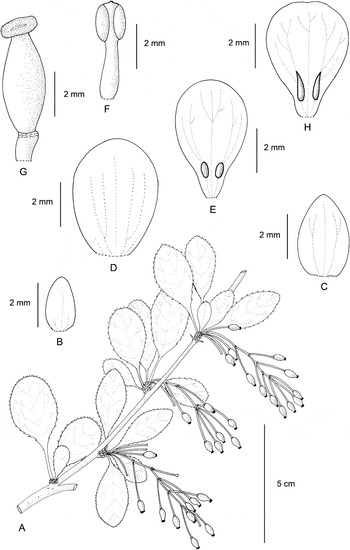
Fig. 29.A–G. Berberis petiolaris var. petiolaris. A, fruiting branch; B, outer sepal; C, median sepal; D, inner sepal; E, petal; F, stamen; G, pistil (A from JRS A122; B–G from Polunin, Sykes & Williams 2066). H. Berberis petiolaris var. garhwalana. Petal (from Dobremez1967).
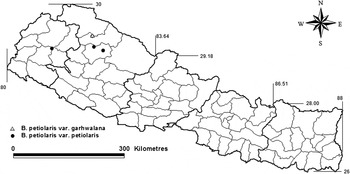
Fig. 30.Distribution of Berberis petiolaris.
Berberis petiolaris var. extensa Ahrendt ex R.R.Rao et al., Bot. Bull. Acad. Sin. 35: 231 (1994). – Type: Nepal, Sialgarhi, Polunin, Sykes & Williams2066 (holo BM!).


Shrub or small tree to 6 m. Stems and branches terete, purplish brown becoming greyish black when older. Internodes 2–6 cm. Spines absent or solitary, rarely 3-fid, terete. Leaves deciduous, papery. Petiole 1–3.5 cm. Lamina elliptic-rounded or elliptic to broadly obovate, 3–6 × 1–4.5 cm, base cuneate, apex obtuse, margin finely serrate with 10–36 spinules on each side, rarely entire, dull green above, paler beneath, venation prominent both sides. Inflorescence 3–5 cm long, a simple pedunculate or sub-umbellate raceme of 3–25 flowers, sometimes fasciculate or with a few flowers arising from the base of the rachis. Bracts ovate-triangular, 1–2 mm long. Flowers yellow, c.0.5–1 cm in diameter. Peduncle 0.5–1.7 cm. Pedicel 1–1.5 cm, swollen at the base of the flower. Sepals in 3 whorls, outer sepals ovate-triangular, 2–3 × 1–2 mm; median sepals ovate-elliptic, 2.5–4.5 × 1.5–3.5 mm; inner sepals broadly obovate, 4–7 × 2.5–6 mm. Petals broadly obovate, 4–8.5 × 4–5.5 mm, base cuneate or slightly clawed, apex obtuse, emarginate or slightly notched, margin entire, venation distinct with 1 pair of lateral veins; glands ovate-elliptic or lanceolate, 1–2 mm long. Stamens 4–6 mm long, connective scarcely produced or not. Pistil 5–7 mm long; ovules 2–4. Berries red, oblong ovoid; style very short or absent.
Distinguishing features. Small, tree-like shrubs with few spines; leaves with distinct long petiole.
Key to the varieties of Berberis petiolaris
1a. Inflorescence a 8–25-flowered raceme. Glands ovate-elliptic 13a. var.petiolaris
1b. Inflorescence a 3–9-flowered sub-umbellate raceme. Glands lanceolate 13b. var.garhwalana
13a. Berberis petiolaris var.petiolaris
Inflorescence 4–8 cm long, a raceme of 8–25 flowers. Petals with ovate-elliptic glands.
Phenology. Apr–Jun (fl.); Jun–Aug (fr.).
Habitat and ecology. In moist temperate forests at 2700–3500 m altitude.
Distribution. Nepal (Western), W Himalaya (Kumaon).
Proposed IUCN conservation status. Least Concern (LC).
Selected specimens. Western. Jumla, below Khalichaur, 2890 m, 5 vi 2008, JRSB 39 (E); Jumla, Sialgarhi, Chudhabise Khola, 3030 m, 19 v 1952, Polunin, Sykes & Williams 2066 (BM, E); Mugu, Chankheli Lagna, 3330 m, 19 v 1952, Polunin, Sykes & Williams 4123 (E); Mugu, north of Chankheli Lagna, 3250 m, 12 vi 2008, JRSA122 (E).
George Don (Reference Don1831) cited only ‘Wall. mss.’ in the protologue without any reference to a specimen and collection number. Ahrendt (Reference Ahrendt1961) cited the type as ‘Nepal 1818, fl. Wallich 1475, part (Type, BM)’. Ahrendt’s typification with Wallich 1475 is a mistake because Wallich 1475 contains two gatherings, 1475.1 (Berberis angulosa) from Gosaithan and 1475.2 (Berberis umbellata) from Kumaon (also see notes under B. angulosa).
Wallich (Reference Wallich1829) listed Berberis petiolaris under number 1474 which includes four different collections (1474.1–1474.4). The Berberis petiolaris specimen in K-W (1474.2, B), which was collected from Kumaon by Robert Blinkworth, is annotated with Wallich’s handwriting. When Don described this species he mentioned that it was ‘Native of Nipaul?’, which indicates that he probably did not see the specimen with the Kumaon annotation. As Don worked for the Royal Horticultural Society, the Wallich specimen of Berberis petiolaris from the Lindley herbarium at CGE is the specimen most likely to have been seen by him. Moreover, the specimen lacks any indication of the collecting locality, which might be the reason that Don was unsure of its provenance. Therefore, the Wallich specimen of Berberis petiolaris at CGE has been selected for lectotypification.
Rao et al. (Reference Rao, Husain and Dutt1994) described Berberis petiolaris var. extensa based on Polunin, Sykes & Williams 2066 from Nepal. On examination of the specimens of Berberis petiolaris from Kumaon along with the type of B. petiolaris var. extensa and other specimens from western Nepal, they were found to be insufficiently different for them to be maintained as different varieties. The characters given by Rao et al. (Reference Rao, Husain and Dutt1994) to separate Berberis petiolaris var. extensa from B. petiolaris var. petiolaris are entire leaves and uni- or biserrate bracts. The type of Berberis petiolaris var. petiolaris itself has serrate leaves, and the serration of bracts alone is not sufficient to separate this variety.
13b. Berberis petiolaris Wall. ex G.Don var. garhwalana Ahrendt, J. Bot. 79 (Suppl.): 82 (1942); Ahrendt, J. Linn. Soc. Bot. 57: 94 (1961); Rao et al., Rheedea 8(1): 11 (1998). – Type: India, Garhwal, Strachey & Winterbottom5 (holo BM!).Fig. 29H.
Inflorescence 3–4 cm long, a sub-umbellate raceme of 3–9 flowers. Petals with lanceolate glands.
Phenology. Apr–Jun (fl.); Jun–Aug (fr.).
Habitat and ecology. In moist temperate forests at c.2700 m altitude.
Distribution. Nepal (Western), W Himalaya.
Proposed IUCN conservation status. Data Deficient (DD). Currently this variety is known from only one locality from western Nepal but it also grows in the western Himalaya. More data from the western Himalaya are needed to confirm its status.
Specimen examined. Western. Doti, Khaptad, 2700 m, 24 iv 1973, Dobremez1967 (BM).
14. Berberis jaeschkeana C.K.Schneid. var. usteriana C.K.Schneid., Bull. Herb. Boissier 2.5: 399 (1905); Ahrendt, J. Linn. Soc. Bot. 57: 139 (1961); Tebbs in Hara & Williams, Enum. Fl. Pl. Nepal 2: 30 (1979); Rao et al., Rheedea 8(2): 121 (1998); Press et al., Annot. Checkl. Fl. Pl. Nepal 26 (2000). – Type: India, Kumaon, Byans, Duthie 5307 (lecto WU!, designated here; isolecto K!). Figs 31,32.
Fig. 31.Berberis jaeschkeana var. usteriana. A, fruiting branch; B, outer sepal; C, median sepal; D, inner sepal; E, petal; F, stamen; G, pistil (A from Adhikari EA2 33; B–G from Stainton, Sykes & Williams1225).
Fig. 32.Distribution of Berberis jaeschkeana var. usteriana.


Shrub to 2 m. Stems and branches terete or angled, glabrous, greyish brown. Internodes 1–2 cm. Spines usually 3, strong, sulcate, central spine 1–2 cm, the lateral spines equal to or slightly shorter than the central. Leaves deciduous, coriaceous. Petiole absent. Lamina obovate, 1.5–4 × 0.7–1 cm, base cuneate, apex acute or obtuse, tapering to a spine-like mucro, margin entire or with 1–3 spinulose teeth on each side, green above, papillose beneath, venation obscure above, sub-conspicuous below. Inflorescence 2–4 cm long, a simple pedunculate raceme or sub-umbellate raceme of 5–15 flowers. Bracts ovate-triangular, 1–2 mm long. Flowers yellow, c.1 cm in diameter. Peduncle 0.3–1 cm, sometimes puberulous. Pedicel 0.5–1 cm. Sepals in 3 whorls, outer sepals ovate or oblong-ovate, 3–5.5 × 1–3 mm; median sepals obovate-elliptic, 4–7.5 × 2–4 mm; inner sepals broadly obovate, 6–8.5 × 4–6 mm. Petals obovate, 5–6 × 3–3.5 mm, base cuneate, apex notched, 0.5–1 mm deep, margin entire, venation distinct with 1 pair of lateral veins; glands ellipsoid or obovate-ellipsoid, 0.8–1 mm long. Stamens 3.5–4 mm long, connective scarcely produced or not. Pistil 3–4 mm long; ovules 2–4. Berries red, 1–1.2 cm long, oblong-ovoid tapering to a small style; style 1–2 mm long.
Phenology. May–Aug (fl.); Jul–Oct (fr.).
Habitat and ecology. In open dry exposed areas at 2600–3800 m altitude.
Distribution. Nepal (Western, Central), W Himalaya.
Proposed IUCN conservation status. Least Concern (LC). This taxon is currently recorded from only a few places in western and central Nepal but is also reported from Jammu Kashmir and Himachal Pradesh.
Distinguishing features. Berberis jaeschkeana var. usteriana is identifiable by the combination of coriaceous leaves, pedunculate, sub-umbellate racemes and red, oblong-ovoid berries.
Selected specimens. Western. Dolpa, Bheri river, below Tarakot, 9500 ft, 2 vi 1952, Polunin, Sykes & Williams 1014 (E). Central. Mustang, Muktinath, 12,500 ft, 9 vi 1954, Stainton, Sykes & Williams 5694 (BM); Mustang, Thinigaon, Muktinath Himal, 13,000 ft, 20 vi 1954, Stainton, Sykes & Williams1225 (BM).
The specimen JRS A64, collected during a field trip to western Nepal, is identified as a probable hybrid of Berberis jaeschkeana var. usteriana and B. mucrifolia. It looks similar to Berberis jaeschkeana var. usteriana in its leaves but differs by its small (less than 1 cm) six-seeded berries.
Ahrendt (Reference Ahrendt1961) and Rao et al. (Reference Rao, Husain, Dutt and Garg1998b) differentiate Berberis jaeschkeana var. usteriana from the typical variety mainly by its emarginate petals. All Nepalese specimens examined during this study have emarginate petals, and the Nepalese specimens (Stainton, Sykes & Williams 4706 and 9353) which were assigned to Berberis jaeschkeana var. jaeschkeana by Ahrendt (Reference Ahrendt1961) have been re-identified as Berberis thomsoniana.
In the protologue Schneider (Reference Schneider1905) cited two specimens collected by Duthie (nos 5306 and 5307) from the same locality, Byans, Kumaon. Duthie5307, deposited in WU, has been chosen as the lectotype because the specimen is in better condition than 5306 and there is a duplicate in Kew.
15. Berberis karnaliensis Bh.Adhikari,sp. nov.
Species Berberis jaeschkeana C.K.Schneid. affinis; spinae 3-fidae, ramuli puberuli, inflorescentiae umbellatae, petala apice incisura, stamina apice leviter producta, ovulis 2–3. – Type: Nepal, Jumla, Bumra, JRS A59 (holo E!; iso KATH!). Figs 33,34.
Fig. 33.Berberis karnaliensis Bh.Adhikari, sp. nov. A, flowering branch; B, outer sepal; C, median sepal; D, inner sepal; E, petal; F, stamen; G, pistil (from JRS A59).
Fig. 34.Distribution of Berberis karnaliensis.


Shrub to 2 m. Stems and branches terete or slightly angled, densely puberulous when young becoming less puberulous when older, yellow or yellowish brown, slightly verruculose. Internodes 0.5–2.5 cm. Spines usually 3, solitary towards twig apex, strong, terete or angular, central spine 1–1.5 cm, the lateral spines equal to or slightly shorter than the central. Leaves deciduous, thinly coriaceous. Lamina narrowly obovate to narrowly elliptic, 1–3 × 0.3–1 cm, base cuneate, apex acute, rarely obtuse, mucronate, margin usually entire, sometimes with 3–5 spinulose teeth on each side, lustrous green above, paler and slightly papillose beneath, venation sub-conspicuous above, slightly raised and prominent below. Inflorescence 2–5 cm long, an umbellate or sub-umbellate raceme of 2–15 flowers. Bracts ovate with acuminate apex, 1–1.5 mm. Flowers yellow, c.1 cm in diameter. Peduncle 1–2.5 cm, glabrous, reddish brown. Pedicel 0.5–1.5 cm, glabrous. Sepals in 3 whorls, outer sepals ovate, 1.5–2 × 1–1.5 mm; median sepals elliptic or elliptic-ovate, 3–5 × 2–3 mm; inner sepals obovate to broadly obovate, 5–7 × 3–6 mm. Petals narrowly obovate to elliptic, 5–7 × 2–4 mm, base cuneate, margin entire, apex notched, 0.8–1 mm deep, venation distinct with 1 pair of lateral veins; glands ellipsoid, 0.5–0.7 mm long. Stamens 3–5 mm long, connective slightly produced, tip obtuse or conical. Pistil 3–5 mm long; ovules 2–3. Berries dark red, oblong-obovoid, 0.8–1 cm long; style 1 mm long.
Phenology. Apr–Jun (fl.); Jun–Oct (fr.).
Habitat and ecology. Common along roadsides and forest margins of Pinus–Rhododendron forest in western Nepal at 1800–3400 m altitude.
Distribution. Western Nepal.
Proposed IUCN conservation status. Data Deficient (DD). This species grows commonly in western Nepal and is very likely to be found in similar habitats in the western Himalaya. Therefore, more information from the western Himalaya is needed to confirm its status.
Distinguishing features. Berberis karnaliensis is identifiable by its pubescent branches, umbellate or sub-umbellate inflorescences, notched petals and stylose red berries.
Selected specimens. Western. Dolpa, Dunai, 2100 m, 26 iv 1974, Dobremez 2781 (E); Dolpa, Kolagaun, 11,000 ft, 3 vi 1952, Polunin, Sykes & Williams 1365 (BM); Humla, Unapani-Limne, 1820 m, 15 vi 2008, JRS A146 (E); Jumla, Gothichaur-Chutra, 2760 m, 27 ix 1991, Minaki et al. 9104265 (E); Mugu, Khater Dara, 1850 m, 21 iv 1952, Polunin, Sykes & Williams 834 (E); Rukum, 2700 m, 20 v 1969, Dobremez142 (BM).
This species is recorded from the Karnali and Rapti zones of western Nepal. It is most closely related to Berberis jaeschkeana C.K.Schneid. but differs in its densely pubescent branches, long peduncle, umbellate inflorescence and smaller fruits.
16. Berberis virescens Hook.f., Bot. Mag. 116: t. 7116 (1890); Chatterjee, Rec. Bot. Surv. India 16(2): 27 (1953); Ahrendt, J. Linn. Soc. Bot. 57: 125 (1961); Tebbs in Hara & Williams, Enum. Fl. Pl. Nepal 2: 31 (1979); Grierson in Grierson & Long, Fl. Bhutan 1(2): 326 (1984); Rao et al., Rheedea 8(2): 109 (1998); Press et al., Annot. Checkl. Fl. Pl. Nepal 27 (2000). – Type: Sikkim, 1849, Hooker s.n. (lecto K!, first step designated by Ahrendt (Reference Ahrendt1961: 125), of which Sikkim, Lachen Valley, 9000 ft, 28 v 1849, Hooker s.n., lecto K! [barcode K000340167], second step designated here). Figs 35,36.
Fig. 35.Berberis virescens. A, flowering branch; B, outer sepal; C, median sepal; D, inner sepal; E, petal; F, stamen; G, pistil (A–G from DNEP1238).
Fig. 36.Distribution of Berberis virescens.


Shrub to 3 m. Stems and branches terete or slightly angular, reddish brown when young becoming greyish brown and verruculose when older. Internodes 1–2 cm. Spines 3-fid, strong, terete or angular, central spine 0.8–1 cm, the lateral spines equal to or slightly smaller than the central. Leaves deciduous, thin to slightly coriaceous. Petiole absent. Lamina obovate or narrowly obovate to narrowly elliptic, 0.8–2 × 0.3–1 cm, base cuneate, apex obtuse, mucronate, margin entire or 3–5 spinulose toothed, dark green above, slightly glaucous beneath, venation sub-conspicuous above, prominent below. Inflorescence 1–3 cm long, a short condensed raceme or sub-umbellate raceme of 2–8 flowers, rarely fasciculate. Flowers yellow, c.0.8 cm in diameter. Peduncle 0.2–0.5 cm (if present). Pedicel 0.3–1 cm. Bracts ovate-triangular, 2–2.5 × 1–1.5 cm. Sepals in 3 whorls, outer sepals ovate, 2.5–3.5 × 1–2 mm; median sepals ovate-elliptic, 3.5–5 × 2–3 cm; inner sepals broadly obovate, 7–8 × 5–7 mm. Petals obovate-elliptic, 4.5–6 × 2.5–4 mm, base clawed, apex notched, 0.5 mm deep, margin entire, venation distinct with 1 pair of lateral veins; glands ovoid, c.1 mm long. Stamens 3–4 mm long, connectives produced, tip obtuse or slightly retuse. Pistil 3–4 mm long; ovules 3–4. Berries red, oblong-ellipsoid, 8–12 mm long; style very short or absent.
Phenology. Apr–Jun (fl.); May–Oct (fr.).
Habitat and ecology. Open degraded woodland at 3500–4000 m altitude.
Distribution. Nepal (Eastern), E Himalaya (Sikkim, Bhutan).
Proposed IUCN conservation status. Data Deficient (DD).
Distinguishing features. Berberis virescens is identified by the following combination of characters: condensed or sub-umbellate raceme, distinctly notched petals and produced anther connective with obtuse or retuse tip.
Selected specimens. Eastern. Sagarmatha, Solukhumbu, 3700 m, 12 v 2004, DNEP1 93 (E); Sagarmatha, Tengboche-Phunki Tenga, 3670 m, 23 v 2004, DNEP1238 (E).
Ahrendt (Reference Ahrendt1961) cited the type as ‘Sikkim: 1849, Hooker s.n. (Type, K)’ but this is ambiguous as two specimens collected by Hooker in Sikkim in 1849 were found in K: the first collected on 28 May and the second on 6 July. The specimen dated 28 May 1849 was also mentioned by Hooker in his protologue and has therefore been selected for second step lectotypification.
17. Berberis asiatica Roxb. ex DC., Syst. Nat. 2: 13 (1821); Don, Prodr. Fl. Nepal 204 (1825); Roxburgh, Fl. Ind. 2: 182 (1832); Hooker & Thomson, Fl. Ind. 1: 224 (1855); Hooker & Thomson in Hooker, Fl. Brit. India 1(1): 110 (1872); Schneider, Bull. Herb. Boissier 2.5: 456 (1905); Chatterjee, Rec. Bot. Surv. India 16(2): 13 (1953); Ahrendt, J. Linn. Soc. Bot. 57: 86 (1961); Tebbs in Hara & Williams, Enum. Fl. Pl. Nepal 2: 29 (1979); Grierson in Grierson & Long, Fl. Bhutan 1(2): 326 (1984); Rao et al., Rheedea 8(1): 52 (1998); Press et al., Annot. Checkl. Fl. Pl. Nepal 25 (2000). – Type: Nepal, Wallich s.n. (lecto G-DC! [barcode G00201761], designated here). Figs 37,38.
Fig. 37.Berberis asiatica. A, fruiting branch; B, outer sepal; C, median sepal; D, inner sepal; E, petal; F, stamen; G, pistil (A from Adhikari, B. G2; B–G from Adhikari, B.101).
Fig. 38.Distribution of Berberis asiatica.


Shrub to 4 m. Stems and branches terete or angled, glabrous, yellowish grey, sparsely verruculose, young shoots slightly sulcate. Internodes 1–6 cm. Spines usually 3, solitary towards twig apex, strong, terete or angular, central spine 1–2 cm, the lateral spines equal to or slightly smaller than the central. Leaves deciduous, leathery. Petiole indistinct or up to 0.8 cm. Lamina obovate, obovate-elliptic or oblanceolate, 2–6(–9) × 1–3(–5) cm, base cuneate or attenuate to the small petiole, apex obtuse, usually mucronate, margin with 1–4 spinose teeth on each side, rarely entire, light green above, glaucous and papillose beneath, venation reticulate, prominent on both sides. Inflorescence 1.5–6 cm long, a fascicle or a condensed epedunculate raceme of 8–20(–35) flowers with a few flowers arising from the base of the rachis. Bracts ovate-triangular, 1–2 mm. Flowers yellow, 1–1.5 cm in diameter. Pedicel 0.5–2 cm, glabrous. Sepals in 3 whorls, outer sepals ovate-triangular, 1.5–2.5 × 1–1.5 mm; median sepals ovate, ovate-triangular or elliptic, 2.5–3.5 × 1.5–2.5 mm; inner sepals obovate, oblong-obovate or elliptic, 4.5–6 × 2–4 mm. Petals obovate, 4.5–6.5 × 3.5–4.5 mm, base cuneate or slightly clawed, apex slightly emarginate, sometimes obtuse, margin entire, venation distinct with 2 pairs of lateral veins; glands oblong-obovate, 0.8–1.2 mm long. Stamens 3.5–5 mm long, connective slightly produced or not, tip obtuse or conical. Pistil 4.5–6 mm long; ovules 3–6. Berries dark purple, ovoid or globose, 7–10 mm long, glaucous; style 0.5–1.5 mm long.
Phenology. Feb–May (fl.); Mar–Jul (fr.).
Habitat and ecology. Disturbed vegetation beside roads and trails, and forest clearings at 1000–2700 m altitude.
Distribution. Nepal (Western, Central), W Himalaya, Tibetan Plateau.
Proposed IUCN conservation status. Least Concern (LC).
Distinguishing features. Berberis asiatica is easily identified by its leathery leaves with distinct reticulate venation and glaucous berries.
Selected specimens. Western. Mugu, above Luma, 2180 m, 11 vi 2008, JRSA 108 (E); Mugu, Karkhan, Khater Dara, 2120 m, 24 iv 1952, Polunin, Sykes & Williams 836 (BM, E). Central. Dolkha, Khimti Khola, 8000 ft, 13 iv 1964, Stainton 4471 (BM, KATH); Kaski, Ghabung Khola, 5000 ft, 19 v 1954, Stainton, Sykes & Williams 5316 (E); Kaski, Lumle, 5600 ft, 15 iii 1970, Flatt 163 (BM); Kathmandu, Thankot, 5000 ft, 28 iii 1975, Stainton 7327 (E); Myagdi, Lumsum, 1820 m, 22 iii 1974, Vickery 407 (BM); Palpa, Bhairabsthan, 1300 m, 5 v 2006, Adhikari, B.101 (E).
De Candolle (Reference Candolle1821) stated in the protologue ‘hab. in India orientali (Roxb.), in Napaulia (Wallich)’. Ahrendt (Reference Ahrendt1961) cited the type as ‘Nepal: 1819, Wallich 1477’ but no specimens have been found from Nepal with that date. According to Wallich (Reference Wallich1829), Wallich 1477 contains two gatherings, 1477.1 from Nepal (Napalia) and 1477.2 from Kumaon. The specimen Wallich 1477.1 in the Wallich herbarium (K-W) is dated 1821 while the other Wallich 1477 specimens in MO and E (ex herb. Greville) have no dates, and the specimen in Vienna (W) is dated 1820. A single sheet of Berberis asiatica in the de Candolle herbarium (G-DC) has three gatherings from Bengal, Napaul (Nepal) and a leaf specimen from Lambert. The specimen most likely to have been seen by de Candolle was the specimen in G-DC, and therefore this has been chosen as the lectotype. Some early Wallich collections which were actually collected by Edward Gardner and his team (1817–1819) were also distributed to different herbaria under Wallich’s name (Fraser-Jenkins, Reference Fraser-Jenkins2005). This specimen was most likely to have been collected by Edward Gardner and his team in 1817–1819 (Fraser-Jenkins, Reference Fraser-Jenkins2005), and the date 1821 on the sheet appears to have been added later in reference to the publication date of a species or may have been copied later from Wallich (Reference Wallich1829).
18. Berberis glaucocarpa Stapf, Bot. Mag. 151: sub t. 9102 (1926); Ahrendt, J. Bot. 79 (Suppl.): 101 (1942); Chatterjee, Rec. Bot. Surv. India 16(2): 14 (1953); Ahrendt, J. Linn. Soc. Bot. 57: 90 (1961); Tebbs in Hara & Williams, Enum. Fl. Pl. Nepal 2: 30 (1979); Rao et al., Rheedea 8(1): 57 (1998); Press et al., Annot. Checkl. Fl. Pl. Nepal 26 (2000). – Type: India, Jaunsar, hills between Tons and Gisi rivers, 8000 ft, v 1875, Brandis 746 (neo K! [barcode K000644849], designated by Ahrendt (Reference Ahrendt1961: 90)). Figs 39,40.
Fig. 39.Berberis glaucocarpa. A, fruiting branch; B, outer sepal; C, median sepal; D, inner sepal; E, petal; F, stamen; G, pistil (A from Polunin, Sykes & Williams 5072; B–G from JRS A80).
Fig. 40.Distribution of Berberis glaucocarpa.


Shrub to 4 m. Stems and branches terete, glabrous, dark grey to greyish yellow, verruculose. Internodes 2–4 cm. Spines usually 3, solitary towards the apex of twig, strong, terete or angular, central spine 0.8–2 cm, lateral spines 0.5–1.5 cm. Leaves deciduous, thinly coriaceous to coriaceous. Petiole absent. Lamina obovate-oblanceolate, 2–5.5(–7) × 1–3 cm, base cuneate, apex obtuse, usually mucronate, margin usually entire, sometimes with 2–6 spinose teeth on each side, lustrous green above, paler beneath, venation reticulate, prominent both sides. Inflorescence 3–6 cm long, a stiff pedunculate raceme of 10–30 flowers, sometimes with a few flowers arising from the base of the rachis. Bracts ovate, 1.5–2 mm long. Flowers yellow, c.1.5 cm in diameter. Peduncle 0.2–1.5 cm. Pedicel 0.5–1 cm. Sepals in 3 whorls, outer sepals ovate, 4.5–6 × 2–2.5 mm; median sepals ovate-elliptic, 5.5–8 × 3.5–4.5 mm; inner sepals elliptic-orbiculate, 7.5–8.5 × 5–7 mm. Petals obovate, 5–7.5 × 4–4.5 mm, base cuneate, margin entire, apex notched, 0.2–0.5 mm deep, venation distinct with 1 pair of lateral veins; glands obovoid, 1–1.5 mm long. Stamens 4.5–5.5 mm long, connective distinctly produced, tip obtusely pointed. Pistil 3.5–4.5 mm long; ovules 3–4. Berries dark purple, oblong-ovoid or ovoid-globose, 0.8–1.2 cm long including style, glaucous; style 0.5–1.5 mm long.
Phenology. May–Jul (fl.); Jun–Oct (fr.).
Habitat and ecology. Along forest edges at 2300–3500 m altitude.
Distribution. Nepal (Western, Central), W Himalaya (Kumaon).
Proposed IUCN conservation status. Least Concern (LC). This species commonly grows in western Nepal, Kumaon and also in Pakistan.
Distinguishing features. Berberis glaucocarpa is easily identified by its glaucous berries in stiff racemes and distinctly produced anther connectives.
Selected specimens. Western. Dolpa, near Hurikot, 3030 m, 25 ix 1952, Polunin, Sykes & Williams 5407 (BM); Humla, below Saatthapla towards Rimi, 2640 m, 13 vi 2008, JRSA 134 (E); Jumla, Chanki, NW of Jumla, 2580 m, 9 viii 1952, Polunin, Sykes & Williams 5072 (BM); Jumla, 2420 m, 10 v 1952, Polunin, Sykes & Williams 930 (BM); Mugu, below Ghuruchi Lagna, 3400 m, 7 vi 2008, JRSA 80 (E). Central. Baglung, near Sirtibang Lekh, 11,000 ft, 14 x 1984, Stainton, Sykes & Williams 9024 (E); Myagdi, above Sauwala Khola, 10,500 ft, 13 ix 1954, Stainton, Sykes & Williams4376 (E).
Stapf (Reference Stapf1926) did not cite reference specimens in the protologue and no collections have been discovered which could serve as original material. Therefore, the type specimen cited by Ahrendt (Reference Ahrendt1961) is an effective neotypification. Two more specimens with the same collection number Brandis746 were found in K but with different dates (June 76, K000644847; Nov 76, K000644848).
19. Berberis wallichiana DC., Prodr. 1: 107 (1824); Don, Prodr. Fl. Nepal 204 (1825); Wallich, Pl. Asiat. Rar. 3: 23, t. 243 (1832); Hooker & Thomson, Fl. Ind. 1: 225 (1855); Schneider, Bull. Herb. Boissier 2.5: 403 (1905); Chatterjee, Rec. Bot. Surv. India 16(2): 10 (1953); Ahrendt, J. Linn. Soc. Bot. 57: 71 (1961); Tebbs in Hara & Williams, Enum. Fl. Pl. Nepal 2: 31 (1979); Rao et al., Rheedea 8(1): 42 (1998); Press et al., Annot. Checkl. Fl. Pl. Nepal 27 (2000). – Type: Nepal, Gardner in Wallich 1819 (lecto G-DC! [barcode G00201780], designated here; isolecto K!). Figs 41,42.
Fig. 41.Berberis wallichiana. A, fruiting branch; B, outer sepal; C, median sepal; D, inner sepal; E, petal; F, stamen; G, pistil (A from Proud 2; B–G from Adhikari G18).
Fig. 42.Distribution of Berberis wallichiana.
Berberis poluninii Ahrendt, J. Linn. Soc. Bot. 57: 73 (1961). – Type: Nepal, Timure, Compaling, Polunin746 (holo BM!).


Shrub to 2 m. Stems and branches glabrous, terete, dark grey, verruculose, young stems yellowish grey, sulcate or angled. Internodes 2–5 cm. Spines usually 3-fid, sometimes absent on old stems, terete or sulcate, central spine 1–3 cm, lateral spines 1.5–2 cm. Leaves evergreen, coriaceous. Petiole absent or 2–5 mm. Lamina oblong-lanceolate, 3–8(–11) × 1–2 cm, base cuneate, sometimes attenuate to a small petiole, apex acute to acuminate, mucronate, margin 6–13(–25) spinose-toothed on each side, lustrous green above, paler beneath, venation prominent to sub-conspicuous above, prominent below with distinctly looping closed primary veins. Inflorescence a fascicle of 10–25(–30) flowers. Flowers yellow, 1–2 cm in diameter. Pedicel 0.5–1.5(–4) cm, glabrous or puberulous, dark red. Sepals in 3 whorls, outer sepals ovate or ovate-triangular, 1–2.5 × 0.8–2 mm; median sepals ovate or ovate-elliptic, 3.5–4.5 × 1.5–2.5 mm; inner sepals obovate, 6–7 × 3–5 mm. Petals obovate, 5–6.5 × 3.5–4.5 mm, base cuneate, apex undulate or notched, 0.5 mm deep, margin entire, venation distinct with 1 pair of lateral veins; glands ovate, 0.8–1.2 mm long. Stamens 3.5–4.5 mm long, connective produced, truncate or sometimes slightly bilobed. Pistil 4–4.5 mm long; ovule solitary. Berries black, ellipsoid, 0.5–1 cm long; style 0.5–1 mm long.
Phenology. Mar–Jun (fl.); May–Nov (fr.).
Habitat and ecology. Edges of Rhododendron–oak forests at 2300–3300 m altitude.
Distribution. Nepal (Central, Eastern), E Himalaya, Assam, Burma.
Proposed IUCN conservation status. Least Concern (LC).
Distinguishing features. Berberis wallichiana is easily identified by its evergreen habit, pistil with a solitary ovule and black stylose berries in fascicles.
Selected specimens. Central. Kathmandu, Nangi Dada, 2730 m, 16 iv 1957, Proud 3b (E); Rasuwa, Chandanbari, 3300 m, 21 v 2008, Adhikari G18 (E); Rasuwa, Khanjing-Sherpagaon, 2295 m, 2 viii 2007, Adhikari BL2 24 (E). Eastern. Dhankuta, above Hille, 2580 m, 13 xi 1975, Beer 25741 (BM); Solukhumbu, Junbesi, 2420 m, 24 iv 1974, Stainton 6977 (E); Terathum, near Chauki, 2620 m, 26 x 1991, EMAK1066 (E).
Specimens from two different gatherings, Wallich 1478 and Wallich s.n., 1819, have been cited as the type by different authors (Ahrendt, Reference Ahrendt1961; Chamberlain & Hu, Reference Chamberlain and Hu1985; Rao et al., Reference Rao, Husain, Dutt and Garg1998a). Wallich 1478 is the Wallich (Reference Wallich1829) catalogue number and specimens were collected by him in 1821. Early Wallich collections (1817–1819) were actually collected by Edward Gardner and his team (Fraser-Jenkins, Reference Fraser-Jenkins2005) but distributed to different herbaria under Wallich’s name. The specimen in the de Candolle herbarium is from Gardner’s 1819 collections and has been chosen as the lectotype. As suggested by Fraser-Jenkins (Reference Fraser-Jenkins2005), the specimen is cited as Gardner in Wallich1819.
Ahrendt (Reference Ahrendt1961) described Berberis poluninii based on Polunin 746 collected near Timure, central Nepal. Chamberlain & Hu (Reference Chamberlain and Hu1985) treated Berberis poluninii as a synonym of Berberis praecipua. The area around Timure was revisited during this study and all plants from the surrounding area have been identified as Berberis wallichiana. The type specimen of Berberis poluninii differs from Berberis wallichiana only by its slightly smaller leaves and Berberis poluninii has therefore been treated as synonym of Berberis wallichiana.
20. Berberis hookeri Lem., Ill. Hort. 6: 207 (1859); Schneider, Bull. Herb. Boissier 2.5: 401 (1905); Chatterjee, Rec. Bot. Surv. India 16(2): 8 (1953); Ahrendt, J. Linn. Soc. Bot. 57: 39 (1961); Tebbs in Hara & Williams, Enum. Fl. Pl. Nepal 2: 30 (1979); Grierson in Grierson & Long, Fl. Bhutan 1(2): 326 (1984); Chamberlain & Hu, Notes Roy. Bot. Gard. Edinburgh 42: 536 (1985); Rao et al., Rheedea 8(1): 40 (1998); Press et al., Annot. Checkl. Fl. Pl. Nepal 26 (2000). – Type: Illustration: Illustration Horticole, Planche 207 (1859) (lecto, designated here). Figs 43,44.
Fig. 43.Berberis hookeri. A, flowering branch; B, outermost sepal; C, outer sepal; D, median sepal; E, inner sepal; F, petal; G, stamen; H, pistil (A from Proud 1; B–H from LKSR B22).
Fig. 44.Distribution of Berberis hookeri.


Shrub to 1.5 m. Stems and branches glabrous, terete, dark grey to greyish yellow, verruculose, young shoots slightly sulcate. Internodes 2–5(–8) cm. Spines usually 3, strong, terete, central spine 1–2.2 cm, the lateral spines equal to or slightly shorter than the central. Leaves evergreen, coriaceous. Petiole absent or rarely up to 5 mm. Lamina lanceolate-elliptic, rarely obovate, 3–7 × 1–3 cm, base cuneate or attenuate to a small petiole, apex acute, usually mucronate, margin with 2–7(–14) spinose teeth on each side, lustrous green above, paler and sometimes glaucous beneath, venation prominent both sides with distinctly looping closed primary veins. Inflorescence a fascicle of 3–8(–11) flowers. Flowers yellowish green, c.1.5 cm in diameter. Pedicel (0.5–)1–2.5 cm, glabrous. Sepals in 4 whorls, outermost sepals ovate-triangular with acute or acuminate apex, 3–4 × 1–1.5 mm; outer sepals ovate or oblong-ovate, 3.5–4.5 × 1.5–2.5 mm; median sepal elliptic-obovate or broadly obovate, 4.5–8 × 3–5.5 mm; inner sepals broadly obovate, 6–9 × 3.5–7.5 mm. Petals obovate, 4.5–6.5 × 3.5–6 mm, base cuneate, apex obtuse or emarginate, margin entire, venation distinct with 1 pair of lateral veins; glands ovate, 0.8–1.5 mm long. Stamens 3–4.5 mm long, connective produced, truncate or slightly retuse. Pistil 3–4.5 mm long; ovules 3–6. Berries black, oblong-ovoid, 1–1.5 cm long, glaucous; style absent.
Phenology. May–Jul (fl.); Jul–Oct (fr.).
Habitat and ecology. Open hillsides, edges of evergreen forest at 2000–3400 m altitude.
Distribution. Nepal (Central, Eastern), E Himalaya, Tibetan Plateau, Assam, Burma.
Proposed IUCN conservation status. Least Concern (LC).
Distinguishing features. Berberis hookeri is identifiable by its evergreen habit, greenish yellow flowers in fascicles, and glaucous, black, estylose berries.
Selected specimens. Central. Myagdi, near Kuinekhani, 2730 m, 25 v 1954, Stainton, Sykes & Williams 2846 (E); Rasuwa, Gosaikund Ridge, 3180 m, 14 v 1960, Proud 1 (BM). Eastern. Panchthar, Sidin-1, Lamapokhari, 3007 m, 8 vi 2007, LKSRB 22 (E, TUCH); Taplejung, between Koping and Noondaki, 3000 m, 24 x 1991, EMAK 1021 (E); Taplejung, Mewakhola, c.3300 m, 25 x 1971, Beer, Lancaster & Morris157 (BM).
Lemaire’s (Reference Lemaire1859) protologue description is based on a cultivated plant for which he did not cite any specimen. Lemaire’s illustration has therefore been designated as the lectotype.
Ahrendt (Reference Ahrendt1961) recognised three varieties of Berberis hookeri, Berberis hookeri var. viridis, B. hookeri var. microcarpa and B. hookeri var. platyphylla, based mainly on the size of the fruit and the leaf margin. Chamberlain & Hu (Reference Chamberlain and Hu1985) merged all these varieties into Berberis hookeri subsp. hookeri, and distinguished Berberis hookeri subsp. longipes. All Nepalese material belongs to Berberis hookeri subsp. hookeri.
21. Berberis insignis Hook.f. & Thomson, Fl. Ind. 1: 226 (1855); Hooker & Thomson in Hooker, Fl. Brit. India 1(1): 111 (1872); Schneider, Bull. Herb. Boissier 2.5: 401 (1905); Chatterjee, Rec. Bot. Surv. India 16(2): 7 (1953); Ahrendt, J. Linn. Soc. Bot. 57: 36 (1961); Tebbs in Hara & Williams, Enum. Fl. Pl. Nepal 2: 30 (1979); Grierson in Grierson & Long, Fl. Bhutan 1(2): 324 (1984); Chamberlain & Hu, Notes Roy. Bot. Gard. Edinburgh 42: 536 (1985); Rao et al., Rheedea 8(1): 32 (1998); Press et al., Annot. Checkl. Fl. Pl. Nepal 25 (2000). – Type: India, Sikkim, 23 v 1849, Hooker s.n. (lecto K! [barcode K000077368], designated by Ahrendt (Reference Ahrendt1961: 37)). Figs 45,46.
Fig. 45.Berberis insignis. A, fruiting branch; B, vegetative branch; C, outermost sepal; D, outer sepal; E, median sepal; F, inner sepal; G, petal; H, stamen; I, pistil (A & B from EMAK 875; C–I from Suzuki et al.9263024).
Fig. 46.Distribution of Berberis insignis.
Berberis insignis var. tongloensis C.K.Schneid., Mitt. Deutsch. Dendrol. Ges. 55: 45 (1942). – Type: India, West Bengal, Darjeeling, Tonglo Ridge, 28 v 1902, J.H. Lace2243 (lecto E! [barcode E00373486], designated here; isolecto CAL! [barcode 0000006779]).


Shrub to 4 m. Stems and branches terete, glabrous, grey, young stems reddish brown. Internodes 2–7 cm. Spines absent or 3, rarely 5, central spine 2–2.5 cm, lateral spines 1–1.5 cm. Leaves evergreen, slightly coriaceous. Petiole absent or up to 8 mm. Lamina oblong or elliptic-lanceolate, 8–17 × 2–4 cm, base cuneate or attenuate to the small petiole, apex acuminate, sometimes acute, margin with 10–26 spinose teeth on each side, green above, paler beneath, venation prominent to sub-conspicuous above, prominent below with distinctly looping closed primary veins. Inflorescence a fascicle of 5–25 flowers. Flowers yellow, c.1.5–2 cm in diameter. Pedicel 0.5–1.5 cm, glabrous. Sepals in 4 whorls, outermost sepals broadly ovate, 1.5–3.5 × 1.5–3 mm; outer sepals broadly ovate-rounded, 3–6 × 2.5–4 mm; median sepal broadly ovate or elliptic-ovate, 4–7 × 3.5–4.5 mm; inner sepals broadly obovate or elliptic-rounded, 4–7 × 4–6 mm. Petals obovate or narrowly obovate, 4.5–6 × 2.5–4 mm, base cuneate, apex emarginate, margin entire, venation distinct with 1 pair of lateral veins; glands ellipsoid or oblong-obovoid, 1–1.5 mm long. Stamens 3–4.5 mm long, connective slightly produced or not, tip obtuse. Pistil 3–4 mm long; ovules 2–4. Berries black, oblong-obovoid or ellipsoid, c.1 cm long; style absent.
Phenology. Apr–Jun (fl.); Jun–Nov (fr.).
Habitat and ecology. Forest floor in moist evergreen forests at 2000–3400 m altitude.
Distribution. Nepal (Eastern), E Himalaya, Assam, Burma.
Proposed IUCN conservation status. Least Concern (LC). Though this species grows in only a few areas of eastern Nepal, it is common in Sikkim, Arunachal Pradesh, Nagaland and Bhutan.
Distinguishing features. Berberis insignis is easily identified by its large leaves up to 17 cm long, flowers in fascicles and black berries.
Selected specimens. Eastern. Sankhuwasabha, Arun Valley, Maghang Khola, 3330 m, 1 v 1956, Stainton 182 (E); Sankhuwasabha, Milke Bhanjyang, 2420 m, 3 vii 1969, Williams 1104 (BM); Sankhuwasabha, west side of Panch Pokhari Khola, 2460 m, 17 x 1991, EMAK 875 (E); Taplejung, Mewa Khola, 3030 m, 25 x 1971, BLM 145 (BM); Taplejung, Sewaden-Topkegola, 2520 m, 15 v 1992, Suzuki et al.9263064 (E).
Chamberlain & Hu (Reference Chamberlain and Hu1985) recognised two subspecies, namely Berberis insignis subsp. insignis and B. insignis subsp. incrassata. All the Nepalese material belongs to Berberis insignis subsp. insignis.
Hooker & Thomson (Reference Hooker and Thomson1855) mentioned three gatherings, that of Griffith from Bhutan and Hooker’s own collections from Sikkim and Nepal. Later Ahrendt (Reference Ahrendt1961) cited one of Hooker’s specimens as a type, an effective lectotypification.
Schneider (Reference Schneider1942) cited Lace 2243 as the type for Berberis insignis var. tongloensis without giving a herbarium location. Chamberlain & Hu (Reference Chamberlain and Hu1985) cited the specimen at E as an isotype, but as no lectotype had previously been selected the E specimen is here designated as the lectotype.
Excluded or Uncertain Taxa
Berberis bhutanensis Ahrendt
Banerji (Reference Banerji1964) reported Berberis bhutanensis from eastern Nepal. It was later included by Tebbs (Reference Tebbs, Hara and Williams1979). However, Banerji (Reference Banerji1964) did not cite any reference specimens and this species has not been found during this study. Grierson (Reference Grierson, Grierson and Long1984) treated this species as a synonym of Berberis griffithiana.
Berberis coriaria Royle ex Lindl.
Lindley (Reference Lindley1841) described Berberis coriaria based on a living plant raised from seeds collected by Royle in 1835. This species is closely related to Berberis glaucocarpa and could be a variety or hybrid of that species. A detailed study from India is necessary to clarify its status. Polunin, Sykes & Williams 5538, the only specimen cited by Tebbs (Reference Tebbs, Hara and Williams1979) for this species, has been identified as Berberis glaucocarpa in this study.
Berberis edgeworthiana C.K.Schneid.
The only record of Berberis edgeworthiana in Nepal comes from a single specimen, Wyss Dunant 1097 (BM), cited by Tebbs (Reference Tebbs, Hara and Williams1979) but which we have not relocated. In the absence of any other specimens to confirm its presence in Nepal, it has been excluded from this study.
Berberis erythroclada Ahrendt
Berberis erythroclada is easily identified by its 5–7-fid spines and finely serrate leaves. This species is reported from Tibet but has not been found in Nepal during this study. The specimens cited by Tebbs (Reference Tebbs, Hara and Williams1979), Stainton 1633 and Proud 4, have been identified here as Berberis concinna.
Berberis hobsonii Ahrendt
Berberis hobsonii is similar to B. virescens of Nepal. Of the two specimens cited by Tebbs (Reference Tebbs, Hara and Williams1979) from Nepal, Dobremez 142 is identified here as Berberis karnaliensis and Stainton 4267 is more likely to be a hybrid involving B. karnaliensis or B. virescens. Berberis karnaliensis is easily distinguished from the type of B. hobsonii by its long pedicellate umbellate and sub-umbellate inflorescence. This species has therefore been excluded from this account of the Nepalese species. Grierson (Reference Grierson, Grierson and Long1984) treated this species as a synonym of Berberis cooperi in the Flora of Bhutan.
Berberis khasiana Ahrendt
The record of Berberis khasiana in Nepal is based on Tebbs’ (1979) identification of Zimmermann 852 (BM). However, we have not relocated this specimen at BM and this species is therefore excluded from this study. Berberis khasiana is closely related to B. lycium and has at times been treated as a synonym of it (Husain & Rao, Reference Husain and Rao1997).
Berberis lycium Royle
Berberis lycium is a western Himalayan species frequently used for its medicinal properties. This species has not been found during field trips to western Nepal and no specimens were found to confirm its presence in Nepal. Specimens which were identified as Berberis lycium in the University of Tokyo herbarium (TI) (TI 8530125, TI 8540194 and TI 6306934) have been re-identified during this study as B. thomsoniana.
Berberis umbellata Wall ex G.Don
Don (Reference Don1831) described Berberis umbellata based on the name in Wallich (Reference Wallich1829) under the number 1475. Wallich 1475 contains two different gatherings: 1475.1 is Berberis angulosa collected from Gosaithan, Nepal, whereas 1475.2 is B. umbellata and was collected by Robert Blinkworth from Kumaon, India. No specimens of Berberis umbellata from Nepal have been found during this study. This species is close to Berberis hamiltoniana of Nepal and the species from India need to be revised to clarify its status there. The only specimen cited by Tebbs (Reference Tebbs, Hara and Williams1979), TI 6306933, was re-identified as Berberis thomsoniana in this study.
Acknowledgements
This study formed part of the first author’s PhD project. We would like to thank Dr Mark F. Watson and Dr David Middleton for their advice on typification. We are grateful to Julian Harber for sharing his expertise on Chinese Berberis and also for his help in locating some type specimens, including Berberis aristata from BR. Thanks are also due to Dr John David for his help and suggestions on cultivated Berberis, and Anshu Bhattarai for her work on Berberis collection localities. We are also indebted to the curators of the following herbaria who provided specimens on loan and/or facilities on visits: BM, K, KATH and TUCH. In addition we are grateful to the curators of BR, CGE, G, OXF, TI, W and WU for providing images of Berberis specimens. Thanks to John Hunnex and Sven Landrein for their continuous help during several visits by the first author to the Natural History Museum, London and Royal Botanic Gardens Kew. We are also grateful to the reviewers Dr David Chamberlain and Julian Harber for their valuable comments on the manuscript. The project was funded by the University of Edinburgh, the Royal Horticultural Society and the Royal Botanic Garden Edinburgh.