1. Introduction
This study investigates the conceptual domain of manner of speaking (hereafter MoS) verbs in English. In particular, drawing upon Talmy’s notion of ‘fictive motion’,Footnote 2 it investigates the presence of fictive path, types of path elaboration, and path-windowing in speaking event-frames. Unlike that of Manner of Motion (hereafter MoM) verbs, the domain of MoS verbs has received less attention in the literature and, more relevant, the verification of fictive path of MoS verbs has not been researched to date. Despite this, it is a provocative issue that needs to be pursued, especially because interesting similarities do emerge in the way English encodes fictive motion in both MoM and MoS verbs.
As for research on MoS verbs, Zwicky first identified twenty-two morphosyntactic properties with which MoS verbs could be selected and, subsequently, analyzed (see Zwicky, Reference Zwicky1971). However interesting and pioneering, his paper lacks some clarity in associating such properties (or, at least, some of them) exclusively to this class of verbs. Since Zwicky’s paper, interest in this linguistic domain has emerged in the works of Mufwene (Reference Mufwene, Farkas, Jacobsen and Todrys1978), Snell-Hornby (Reference Snell-Hornby1983), Levin (Reference Levin1993), Urban and Ruppenhofer (Reference Urban and Ruppenhofer2001), and Rojo and Valenzuela (Reference Rojo and Valenzuela2001). Among these, the most exhaustive study is Snell-Hornby’s who, focusing on both English and German, combines verb descriptivity through extensive and contrastive analysis with a dynamic semantic approach to the category of MoS verbs. As for the others mentioned, Mufwene (Reference Mufwene, Farkas, Jacobsen and Todrys1978) criticizes Zwicky’s approach and proposes a “semantic class version approach” (p. 278) in which the concept of typicality – and not necessarily exclusivity – is seen as being fundamental in natural language and not as a lack of explanatory properties. Zwicky’s list is expanded by Levin (1993, p. 204), who includes seventy-seven verbs classified into nine subclasses. However, her proposal overlooks that some verbs are a combination of two or more subclasses and that manner is not just a matter of sound expression. From the perspective of frame semantics, Urban and Ruppenhofer (Reference Urban and Ruppenhofer2001) offer a corpus-based account of MoS verbs. They argue that the syntactic and semantic behavior of these verbs changes according to their communicative or non-communicative uses, thus drawing a distinction between core and noise verbs. Finally, from a contrastive perspective, Rojo and Valenzuela (Reference Rojo and Valenzuela2001) analyze the possible gain or loss of information when translating MoS verbs from English to Spanish. They show how relevant the semantic information conveyed by MoS verbs is, and discuss how, when translating from an S-framed language (English) to a V-framed one (Spanish), it is maintained or added. These results are in contrast with Slobin’s (Reference Slobin, Gumperz and Levinson1996, Reference Slobin, Bybee, Haiman and Thompson1997) findings on MoM verbs.
Partly in keeping with and partly refuting these previous contributions to the topic, the recent study by Vergaro et al. (unpublished observations) proposes an in-depth description of how English MoS verbs are construed. Their collection combines the verbs found in previous research and all the synonyms found in Dictionary.com, Wordreference.com, and Merriam-Webster.com. The corpus thus obtained was then expanded by consulting a number of dictionaries (Oxford English Dictionary, Oxford Dictionary of English, Cobuild Dictionary, Macmillan English Dictionary, Longman Language Activator, New Oxford American English Dictionary), resulting in 186 verb entries. In Vergaro et al. each verb entry is described, going beyond just the physical auditory components considered in previous research, and includes and accounts for semantic−pragmatic components.
The descriptive categories on which Vergaro et al.’s (unpublished observations) analysis of English MoS verbs is based are established according to two superordinate components: physical auditory and semantic−pragmatic. The authors propose, consequently, a fine-grained analysis of these verbs through the use of these descriptive categories, which are motivated by the embodied act of speaking and which can be conceptualized according to the conduit metaphor. Our experiential basis of the speaking event allows us to identify and interpret the parts of the sounds/words, thereby creating a response or a reaction. Sometimes the speaker speaks with a specific intention in mind, and sometimes the act of speaking is a physiological response to another event. The effect on the hearer can be positive or negative. These aspects are then reflected in our embodied experience of speaking.
The physical auditory components of our embodied experience include pitch, volume, speed, and rhythm; the semantic−pragmatic components include directionality, persistence, formality, speaker’s attitude, speaker’s intention, and effect on the hearer. Vergaro et al. (unpublished observations) discusses how MoS verbs include properties and specifications that belong to the context or to the participants in the conversation in order to convey a message in a particular way. Such implications, at a semantic−pragmatic level, play a major role in communication and permit a more precise profiling of the conceptual domain of MoS verbs. Following Slobin’s (Reference Slobin, Bybee, Haiman and Thompson1997) distinction between first- and second-tier verbs,Footnote 3 these initial findings suggest that the combination of physical auditory and semantic−pragmatic components, or lack thereof, accounts for the diverse properties that define these MoS verbs. This thus enables identification of first-tier (e.g., call, cry, yell, shout) and second-tier (e.g., bicker, drone, shriek, yammer) verbs within this domain. Moreover, this type of analysis has proved to be useful in distinguishing nuances of meaning in groups of apparently synonymous verbs.
Since Vergaro et al. (unpublished observations) focuses only on the semantic analysis of MoS verbs, the present study concentrates on how and to what extent fictive path is realized in MoS verbs. The paper is organized as follows. Section 2 illustrates the framework used for this analysis. Section 3 provides the methodology used in our corpus analysis of the MoS verb entries and the realization of fictive path. Section 4 discusses the results in relation to the framework of analysis used. Finally, Section 5 concludes with a summary and a proposal for further research.
2. Framework of analysis
The term ‘fictive motion’ was coined by Talmy in (1996) and extensively discussed in Talmy (Reference Talmy2000). It refers to “the cognitive representation of nonveridical phenomena – instances that depict motion with no physical occurrence” (2000, p. 100), as illustrated by the following examples:
(1) a.The fence goes from the plateau to the valley.
b. The cliff wall faces toward / away from the island.
c. I looked out past the steeple.
d. The vacuum cleaner is down around behind the clothes-hamper.
e. The scenery rushed past us as we drove along.
More precisely:
The fictivity pattern, in language, is extensively exhibited in the case where one of the discrepant representations is the belief held by the speaker or hearer about the real nature of the referent of a sentence, and the other representation is the literal reference of the linguistic form that makes up the sentence. Here, the literal representation is assessed as less veridical than the representation based on belief. Accordingly, the literal representation is fictive, while the representation based on belief is factive. […] Thus, in The fence goes from the plateau to the valley, we presume by our general beliefs that the fence is factively stationary, while the literal meaning of the sentence fictively presents the fence as moving (Talmy, Reference Talmy2000, p. 101).
Talmy discusses a number of distinct categories of fictive motion, though he gives broad coverage especially to the Emanation Type, namely “the fictive motion of something intangible emerging from a source. In most subtypes, the intangible entity continues along its emanation path and terminates by impinging on some distal object” (2000, p. 106). The Emanation Path type includes the subtypes of Orientation (2a), Radiation (2b), Shadow (2c), and Sensory Paths (2d). Talmy’s (Reference Talmy2000) examples are given below for each of these types.
(2) a.The cliff wall faces toward / away from / into / past the valley.
b. The sun is shining into the cave / onto the back wall of the cave.
c. The tree threw its shadow down into/across the valley.
d. I can hear/smell him all the way from where I am standing.
According to Talmy, in (2a), the Figure (cliff wall) moves relatively to the Ground (the valley) along a path indicated by directional adpositions. In (2b), the radiating event involves three different processes: the emanation of the radiation from the radiator (the sun), the motion of the radiation along the path designated by the satellites (into, onto), and the impingement of the radiation on the irradiated object (the back wall of the cave). Moreover, in the Shadow Path example (2c), the shadow of an object (the tree) can be perceived as the fictive movement of the shadow from that object to a surface (the valley). Finally, in (2d), two entities are conceptualized, the Experiencer (I) and the Experienced (he), together with the movement of something intangible (the sound or smell) in a straight path between the two.
Further categories of fictive motion discussed by Talmy, albeit in a less detailed way, include Pattern Paths (3a), Frame-Relative Motion (3b), Advent Paths (3c), Access Paths (3d), and Coextensive Paths (3e); all the examples are from Talmy (Reference Talmy2000).
(3) a.As I painted the ceiling, (a line of) paint spots slowly progressed across the floor.
b. I rode along in the car and looked at the scenery we were passing through.
c. The palm trees clustered together around the oasis.
d. The bakery is across the street from the bank.
e. The fence goes/zigzags/descends from the plateau to the valley.
Furthermore, Talmy (Reference Talmy2000) defines the notion of the ‘windowing’ of an event in saying that “languages can place a portion of a coherent referent situation into the foreground of attention by the explicit mention of that portion, while placing the remainder of the situation into the background of attention by omitting mention of it” (p. 257). It is thus possible to have a window of prominent attention placed over the beginning, middle, or end portion of the fictive path; that is, one may have initial, medial, and/or final windowing (p. 259). In the specific case of path windowing, the path is foregrounded by inclusion in the sentence of explicit linguistic material referring to it. The explicated path may refer to a determined portion known as single windowing, or portions known as combined windowing. Example (4) foregrounds the medial and final portion of the path (the two sides of the street), whereas its initial portion is gapped (where the path begins, the location of the speaker).
(4) My bike is across the street.
In contrast, example (5) shows medial gapping (where Jane and John are) and foregrounds the initial and final portion of the path (the location of Jane and John).
(5) Jane sat across from John.
Example (6) shows final gapping (‘where they ran to’) and describes the initial (from the kitchen) and medial windowing (out of the door).
(6) They ran from the kitchen out of the door.
Fictive motion, in defining a path, is necessarily conceived through a visual representation that enacts the conceptual metaphor on which the construal of an event is processed. Image schemas and metaphoric models are employed in the organization of our knowledge (Lakoff, Reference Lakoff and Johnson1990). The speaker/listener accesses the image schema that serves as a basis for the linguistic conceptualization of space and time. As Langacker explains:
image schemas are seen as basic, ‘preconceptual’ structures that give rise to more elaborate and more abstract conceptions (or at least provide their skeletal organization) through combination and metaphorical projection. (Langacker, Reference Langacker2008, p. 32)
Duly, one of the primary types of image schemas is the scale schema that includes path (cf. Johnson, Reference Johnson1990; Lakoff, Reference Lakoff and Johnson1990; Croft & Cruse, Reference Croft and Cruse2004). And, as we illustrate in Section 3.2, the different levels of path elaboration therefore require some variation of the image schema. Lakoff (Reference Lakoff1990) describes the basic image schemas as those
simple everyday structures that constantly recur in our everyday bodily experience: containers, paths, links, forces, balance, and in various orientations and relations: up-down, front-back, whole-part, center-periphery, etc. (Lakoff, Reference Lakoff1990, p. 267)
The path image is schematic, in that it is an abstract representation of factive/fictive motion. The schema, known more specifically as the source−path−goal schema, describes a point of departure (the source), a goal or destination (the end point), the path (which is made up of the series of connected locations between the source and the destination), and the implicit direction toward the goal (Lakoff, Reference Lakoff1990, p. 275).
Another cognitive mechanism involved in the conceptualization of an event is Conceptual Metaphor, which motivates human comprehension of any experience in the projected structure of Figure, Ground, and Path and the elaboration of the source and goal. More precisely, the speaking event is manifested through the ‘conduit metaphor’, which yields communicating is sending meaning objects from a mind container to another mind container along a conduit (Kövecses, 2010, p. 84). This maps our knowledge of ideas (meaning) are objects, linguistic expressions are containers, and communication is sending (Reddy, Reference Reddy and Ortony1979; Lakoff & Johnson, 2003, p. 10). Furthermore, this basic conceptualization has been similarly elaborated as communication is transfer, and perception is reception − the perception involved in the case of MoS verbs is hearing. Accordingly, the image schema of a path is a manifest part of our metaphoric structuring of the speaking event. The speaker (Experiencer) marks the source of the sound, the goal (Experienced) is the listener, and the path follows the direction of the sound, from the Figure across the Ground.
3. Methodology
3.1. corpus
We used the 186 MoS verb entries identified and analyzed in Vergaro et al. (unpublished observations) to conduct a qualitative corpus-based analysis to verify fictive motion constructions. For this purpose we utilized the COCA corpus,Footnote 4 entering the search string for each of the MoS verbs from our list and checking its collocation with all the prepositions the corpus revealed.
The procedure we followed to retrieve the MoS verb constructions was to insert the verb in brackets so as to identify the verb category, and then select the option of six post-verb collocates for all the prepositions. For each verb entry we analyzed the prepositions that emerged and verified the most complex path that was present among those prepositions, taking note of what kind of path elaboration each collocation allowed. Up to the first 100 examples were analyzed per verb satellite construction when available.
3.2. analysis and results
Data retrieval revealed that 158 out of 186 verb entries have fictive path examples in the COCA corpus. We did not find fictive motion examples for the following twenty-eight verb entries: carp (2)Footnote 5chirrup, decry, drivel, ejaculate, objurgate, palaver, perorate, rap (1), rouse, shrill, sibilate, singsong, snuffle, spiel, squabble, squall, susurrate, thunder, thrum, twaddle, twang, twitter, ululate, vociferate, whoop, wrangle, and yak.Footnote 6
The analysis of the examples showed a variety of path elaboration for MoS verbs that, following Talmy (Reference Talmy2000), falls within the emanation (sensory) path. This path category proved to be complex, thus we further divided it into four categories according to the degree of path elaboration: location (L), direction (D), minimum path (MP), and elaborated path (EP). The following examples of L in (7), D in (8), and MP in (9) are listed according to the type of image schema specification − we present one example for each type of preposition found for each path category − whereas the examples of EP in (10) are alphabetically ordered according to the MoS verb selected. This is because the kind of image schema that each utterance represents in (10) is a unique series of satellites, which, being Elaborate, did not lend themselves to specific schematic categorization.
Verbs that only had examples with prepositions describing the location were characterized as belonging to the L category. Location designates the scope of attention as being in the final part of the path. We consider Location as ‘final’ only, because to imagine X as being ‘at Y’ or ‘on Y’ means that a path from an implicit point of departure ‘Z” has already been followed before reaching location ‘Y’, which is the sole scope of attention. As Slobin (2008, p. 206) suggests, the ‘goal’ of the speaking event is designated by prepositions such as in, outside, on, under, at. Examples of this category are reported in (7):
(7) a.Then I sighed in his ear, “You don’t know how much that means to me.” [2010 FIC]
b. Florence had grasped, as soon as boys had begun to bay outside her windows, that in addition to being a gift, beauty was a tool, like a Swiss army knife. [2004 FIC]
c. This evening, we will look at how three conservatives and three liberals, all of whom bloviate on the radio, are handling the presidential race. [2008 SPOK]
d. “Good heavens!” Hannah exclaimed under her breath. Since she didn’t remember why she’d been smiling, her smile would just have to remain a mystery. [2007 FIC]
e. Followers of the case got a gruesomely intimate portrait of the Simpsons’ relationship when police released the transcript of a 911 call Nicole Brown Simpson made as her ex-husband raged at the door of her house. [1994 MAG]
(7a) uses in and (7b) outside to indicate the final location of the speech sound that has traveled from the speaker through the air and is either interior or exterior to the factive/fictive container. (7c) conceptualizes the final location as a surface and the MoS takes place on the horizontal plane of the container. (7d) uses under to indicate the final location of the speech sound as being in a lower vertical spatial relation to a factive/fictive plane. (7e) is an example of at that indicates a location or position in the space schema. This is a case in which at may metaphorically signify contact or being ‘against’ something; at, however, can also imply direction in the sense of ‘toward’ or ‘against’, as in the force schema (see (8d)).
In the D category we included verbs that have examples with prepositions focusing on the direction of the path in the speaking event, such as: from, to, against, at, out, about, around, as exemplified in (8):
(8) a.“You will be warriors!” yowled the tabby from the high rock. Thunder, River, Wind, and Shadow bowed their heads. [2007 FIC]
b. To the point where I bemoaned to my yoga teacher, “I’ll never be able to clear it out, and even if I do, it’ll just pile up again.” [2011 MAG]
c. To demonstrate the depths of Jacobin hatred toward Christianity, Hamilton said that revolutionary leaders congratulated children who appeared in the Convention hall “to lisp blasphemy against the King of Kings.” [1997 ACAD]
d. “Don’t listen to him” he yapped at a reporter seeking insight from Eddie, 32-year-old evangelist four years older than Ben. [1990 NEWS]
e. “D.J., y’all gonna have to take all that rowdy shit somewhere else” she hollered out of the kitchen window. [2008 FIC]
f. I’m tired, I’ve got to tell you, of reporters bellyaching about this stuff. [2010 SPOK]
g. What’s more, says Wendy Hilliard, president of the Women’s Sports Federation, men have long reaped the ‘bonding’ benefits of sports, as they’ve schmoozed around the collective water cooler about their golf games. [1997 NEWS]
(8a) uses from to describe the direction of the speaking event, focusing attention on the point of departure of a path as described in the scale schema. (8b), (8c), (8d) use to, against, and at to indicate the intermediate phase of this path (medial windowing), describing the speech sound traveling towards the receiver. (8e), on the other hand, uses out to express the movement of sound from the inside to the outside of the container. (8f) and (8g) use about and around as an indication of movement that winds in a nondescript fashion through space, focusing on the intermediate phase (medial windowing) of the path.
Verbs included in the MP category are used with prepositions that window a combination of location and direction, and may presuppose the crossing of a boundary, employing the space or container schema accordingly. Examples of these prepositions are into, over, upon, across, through, and along, as shown in (9):
(9) a.“You want to skate all that way?” “Now you’re talking. I’d love to go all the way with you.” She snorted into the phone. “I’ll be at your place in half an hour.” [1995 FIC]
b. “Olivia,” the assistant squawked over the intercom, “thirty-five dollars for a woman with bracelets who’s about to float through.” [1995 FIC]
c. The accusation of treason was soon to be retorted upon him. Evidently, in Burke’s acutest displays of sensibility his opponents thought they could detect an indelicate curiosity about the fall of a king. [1991 ACAD]
d. “Don’t, don’t, don’t, / don’t,” she stutters across the line break, and we begin to see that he does now see what she can’t stand to see. [2008 ACAD]
e. Can’t you people hold your horses? “I remained silent as my mother admonished me through the barricade of a door; the only sound I made came from a breath of fresh relief. [2010 FIC]
f. “I wished I could see her face instead of just hearing her − it was impossible to sort out how much truth she was spouting along with the rest of it.” [1990 FIC]
(9a) uses into to describe the medial and final windowing of the speaking event, where the direction is given by ‘to’ and the location is indicated by ‘in’, focusing the attention on the interior of the factive container (the phone). (9b) and (9c) use over and upon to describe the fictive path of the speech sound that moves across a surface. (9d) and (9e) use across and through to focus on a path that passes from one side to another of a boundary. (9f) uses the fictive path of along to window the medial part of a path event that runs parallel to the length, or the direction, of a Ground.
The EP category is the most complex and includes verbs that allow constructions with multiple prepositions that describe initial, medial, and final windowing, as in the examples in (10):
(10) a.Suzanne Pappas, our instructor, sits astride a bike facing the class. She barks out orders from under her black beret. [1998 MAG]
b. “It’s a dog,” Chuy says, panting up to me through the ocean of the air, and sure enough, that’s what it is, a dog. [2010 FIC]
c. Molly’s voice, speaking to him. It is her real voice, speaking in real time, but it is ghostly, pealing out disembodied from among the empty rooms or from the shadows under the live oaks. [1990 FIC]
d. “She was very good in the clip from the movie of the week,” the casting guy piped in from a chair in the corner; none of them acknowledged him or turned around. [2000 FIC]
e. As I was walking in, someone screamed out from across the street, “How’s Anne?” [2002 NEWS]
f. “What does your father do?” Pinky had squeaked at the kid from across the reject’s table in the dining hall during the first week at lunchtime. [2005 FIC]
g. “Wait,” he told Brother S as Jerry went into the chapel. “Let him see for himself” Jerry stormed through the hermitage from cell to cell, throwing doors open and rushing into rooms. [2005 FIC]
(10a) describes a path that illustrates the speech sound that travels out of the person’s mouth (container), giving the direction with from indicating the starting point, which is further specified by under. This type of specification is pertinent in identifying an EP, rather than windowing just a combination of L and D, or an MP. Similarly, (10b) describes the path with up indicating the vertical direction, which is further specified by to establishing the horizontal direction, and through details the medial windowing that crosses a boundary. In the case of (10c), similarly to (10a), the speech sound travels out, indicating the direction, and from among or from … under, which describe a detailed horizontal and vertical axis of the initial windowing in the speaking event. (10d) describes, through the container schema, the location of the speech sound with in, creating the direction with the starting point of the flow with from, and its further specification with in. (10e) also describes the direction of the speaking event with out, its departure point with from, and the specification of the sound traveling perpendicularly to the ground with across. In contrast, (10f) gives us a complete EP with the direction indicated with at, the point of departure with from, the perpendicularity to the ground with across, and also the final location with in. (10g) windows the medial part of the path with through, the crossing of a boundary, the initial windowing with from, and medial windowing of the direction of the speaking with to, thereby gapping the final windowing of the event.
In keeping with the cognitive linguistic paradigm and the results that have emerged from our corpus analysis, we argue that the categories we have identified situate themselves on a dynamic continuum of path elaboration, as shown in Figure 1.
Dynamic continuum of path elaboration.

The continuum of path elaboration also results in a hierarchical scale. In other words, considering the example of the verb bark, verbs that allow constructions of EP (11a) bark out … from under, also allow constructions of MP (11b) bark into, D (11c) bark from, and L (11d) bark … at:
(11) a.Suzanne Pappas, our instructor, sits astride a bike facing the class. She barks out orders from under her black beret. [1998 MAG]
b. The old man had been barking into the void. # Let them pin you and you were dead. [2011 FIC]
c. He’d barked instructions from the backseat, where he and Kelog pored over a soggy map and planned intricate double-backs. [2001 FIC]
d.Then he barked something at the man to his left, who rose from inspecting mirror fragments in the sand. [2012 FIC]
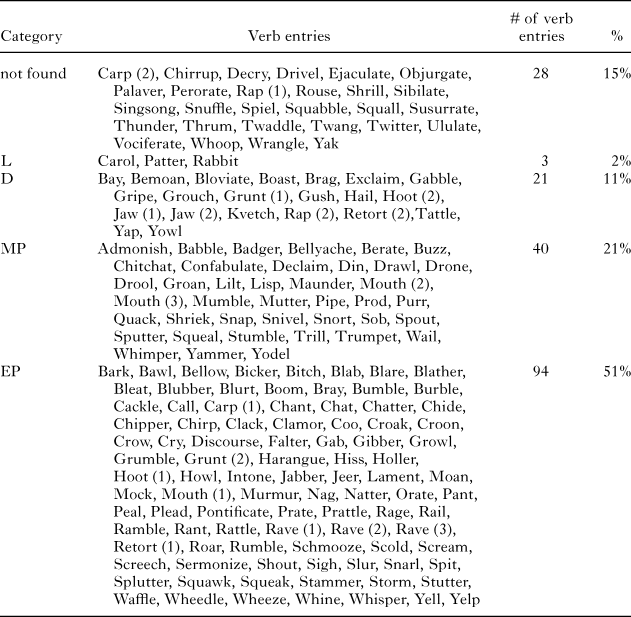
This relation, though, is not bidirectional. Verbs that we have classified in the L category are not used with D, MP, or EP constructions. Verbs in the D category are not used with MP or EP constructions, but they are used with the L constructions. MP verbs are not used with EP constructions, but they are used with L and D constructions. And finally, the EP verbs are used with all the other constructions, L, D, and MP. Table 1 shows the 186 MoS verb entries grouped according to their maximum degree of path elaboration as they emerged from the randomized corpus analysis.
186 MoS verb entries grouped according to the maximum degree of path elaboration

This means thus that, as in the case of (11) bark, verbs which allow for the maximum degree of path elaboration EP, also allow for the other constructions and are at the top of the hierarchical scale. Table 2 clarifies this relation by listing the verbs according to the range of possible use. It shows the results we found for the 158 verb entries; 85% allow L constructions (which is the sum of L, D, MP, and EP), 83% allow D (which is the sum of D, MP, and EP), 72% allow MP (which is the sum of MP and EP), and 51% allow EP.
Results for each category

The EP category is the most complex, in that verbs in this category allow one to follow the mental map of the speaking event path through the satellite clustering. Category L is the lowest on the path elaboration scale. It is the least elaborated category, and it is the one for which we found the highest number of verbs allowing it.
In Section 4 we discuss these results in relation to what previous research on motion events suggests about English. We then describe the conceptual processes lying behind the fictive path of MoS verbs.
4. Discussion
4.1. path windowing
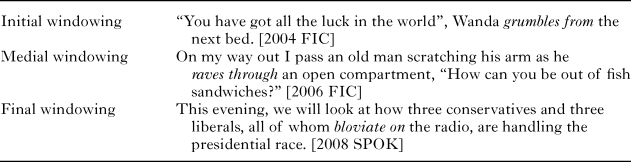
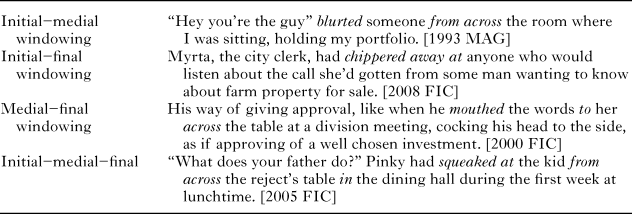
As far as the partitioning of the speaking event is concerned, MoS verbs allow both single windowing (Table 3) and combined windowing (Table 4) of the path. Table 3 illustrates each type of single windowing (initial, medial, and final).
Single windows
Combined windows
In Table 3, initial windowing is indicated by grumbles from. It windows one’s attention to the ‘point of departure’ of the fictive path in the speaking event. The medial windowing is represented by raves through, which focuses on the ‘central part’ of the fictive path. The final windowing is expressed by bloviate on, which focuses on the ‘point of arrival’ of the fictive path in the speaking event.
Going back to our distinction of degrees of path elaboration, the verbs in our four categories all permit single windowing. On the other hand, combined windowing is allowed in the categories of MP and EP. MP, however, is unique because it includes both verbs that allow only single windowing and verbs that allow combined windowing. Table 4 illustrates the various possible combinations of windowing.
The first example of initial−medial windowing expressed through blurted … from across describes the departure point from of the utterance pronounced by someone (the Figure) and moving towards the central part of the path across the room (the Ground), gapping the endpoint of arrival. Initial−final windowing is indicated by chippered away at, that focuses the attention on the point of departure away [from] ‘Myrta’ and the point of arrival at anyone, without explicitly describing the central portion of the path. The medial−final windowing is articulated by mouthed … to … across that gaps the departure point, drawing attention to the point of arrival to her and the central portion of the path across the table. The last and most complex combined window is initial−medial−final, also called maximal windowing (Talmy, Reference Talmy2000, p. 266), which describes each portion of the path from the beginning from ‘Pinky’, through the middle across the reject’s table, to the end at the kid … in the dining hall. Thus, the maximal window example from Table 4 is exemplified by squeaked at … from across … in.
In the following section the link between path elaboration and the conceptualization process is discussed.
4.2. sensory path and conceptual metaphor
Considering the speaking event in terms of a fictive path that is elaborated according to the specific communicative need, it is useful to describe the embodied perspective. All humans perceive the speaking event as a primary experience that is characterized by three entities: the speaker, the speaking event itself, and the speech receiver. The speaking event involves three processes: the generation and emanation from the speaker, the motion of the speech/sound along a fictive path, and the impingement or reception of the speech/sound by the receiver/listener. The speech event path is a subtype of the Emanation Path defined by Talmy (2000, p. 115) as a Sensory Path, as in (2d), see Section 1. An opposite directional example is:
(12) I can hear/smell him all the way from where he is standing.
The sensory path involves the conceptualization of “something intangible moving in a straight path between the two entities in one direction or another” (Talmy, Reference Talmy2000, p. 115). In the case of sound there is nothing to be seen, but the sound is felt or sensed as present and moving in clearly localized space in either direction: (13a) listener perspective and (13b) speaker perspective. The sound of speech travels through materials (13c) and in space (13d).
(13) a.As I was walking in, someone screamed out from across the street, “How’s Anne?” [2002 NEWS]
b. “Three guesses who’s here,” she trilled into the telephone. [1996 FIC]
c. I would have to scold her through the plastic curtain, mop in hand, my view blurred by drops and rivulets on the curtains. [1990 FIC]
d. It seemed that in my obsession, I’d lost all proportion. I was yodeling stuff across the street. I was not of right mind. [2006 FIC]
Moreover, the conceptualization of fictivity vs. factivity is in keeping with Conceptual Metaphor Theory (cf. Kövecses, 2010; Lakoff, 1990; Lakoff & Johnson, Reference Lakoff and Johnson2003, Reference Lakoff and Johnson1999; Lakoff & Turner, Reference Lakoff and Turner1989), as clarified by Talmy (Reference Talmy2000).
Metaphor theory […] accords readily with general fictivity. The source domain and the target domain of a metaphor supply the two discrepant representations. The representation of an entity within the target domain is understood as factive and more veridical. The representation from the source domain that is mapped onto the entity in the target domain, on the other hand, is understood as fictive and less veridical. (Talmy, Reference Talmy2000, p. 168)
Duly ‘A is B’ is fictive and ‘A is not B’ is factive. The metaphorical concept is fictive. It is pervasive in thought and not a mere rhetorical figure (Lakoff & Johnson, 2003). Today the conceptual metaphor/metonym base of language is seen as having an embodied neural foundation (Feldman, Reference Feldman2008). It is considered a cognitive mechanism that replicates the mechanics of neural connections between domains of our brains.
Hence, we argue that Conceptual Metaphor Theory is fundamental in motivating human understanding of the speaking event in the projected structure of Figure, Ground, and Path (see Section 2). The domain of speaking is conceptualized through the ‘conduit metaphor’, which is further elaborated with our conceptualization of the speech event as perception is reception, where the source domain is reception, getting, possession, and the target domain is perception, perceiving, seeing, smelling,hearing. As explained specifically in the Master Metaphor List:
Note: The perception is understood as traveling from the outside to the experiencer. Notice we do not have separate words for sensory experience as perceived apart from stimulus: ‘That is a wonderful view/sight/smell/sound’, ‘I experienced a wonderful view/sight/smell/sound’. (Lakoff, Espenson, Goldberg, & Schwartz, 1991, p. 127)
The concept of speech/sound moving along a path is intrinsic to the conceptualization of communication: speaking or sending, and hearing or receiving, is established through a primary image schema. Thus the distinction of the ever-present fictive motion path in MoS utterances as identified in this paper is possible to varying degrees of elaboration and windowing of the event. Image schemas are the simple cognitive structures that organize our bodily interaction with the world, and our non-bodily experience via metaphor (Lakoff, 1990, p. 453). The conduit image schema – both a container and an extended linear path – on which an individual bases communication conceptualization is further designated according to interaction with other image schemas. The container schema that is employed in the conduit metaphor, in terms both of our minds and of the linguistic expression itself, gives us a series of schematic mental representations of the ‘container ’ that fit with in, out, into, out of, the ‘surface’ on, off, the ‘ scale’ path and the ‘space’ up, down, from, to, at, away, front, back, through, over, and about. These are all satellites that make the realization of path explicit.
5. Conclusion
This study presents a descriptive analysis of fictive path as it is realized in the domain of MoS verbs. Although the Talmyan notion of fictive path has been applied to domains different from that of motion (cf. Cifuentes-Férez, Reference Cifuentes-Férez2006; Slobin, Reference Slobin and Gathercole2008), to the best of our knowledge this study is the first that applies this notion to the domain of speaking. This was possible due to a previous in-depth analysis carried out on English MoS verbs (Vergaro et al., unpublished observations). The study is based on authentic data. Through a comprehensive qualitative analysis we have identified the existence and the type of fictive path in contemporary American English for 186 MoS verb entries.
Although the study may be considered preliminary, the results suggest that, from the cognitive point of view, MoS verb fictive paths are motivated by conceptual organization through primary image schemas. The conduit metaphor represents a primary image schema of a linear path that moves between the speaker and the listener, being therefore the conceptual grounding of the presence of fictive path in the speaking event process. The various kinds of scale/space/path image schemas have been illustrated in relationship to the notion of path windowing of MoS fictive path. When people use satellites combined with prepositional phrases to express fictive path, the choice of windowing one part or the whole path has to be made. Windowing is an aspect of the cognitive process involved in the focusing of attention. The mental elaboration of paths is based on the representation of spatial relations according to abstract image schemas. This highlights the correlation between the use of satellites with the MoS verbs and the cognitive processing of the speaking event. Thus, the conceptual basis of communication is tranfer that is manifested via the conduit metaphor constrains the use of these verbs with fictive path constructions which may be implicit, though they are regularly made explicit.
The results of the study show that among the various types of fictive paths envisaged by Talmy (Reference Talmy2000), MoS verbs realize paths falling into the category of Emanation (sensory) Path. This category allows both single and combined windowing of the path. A preference for combined windowing may be motivated by the English characteristic of being an S-framed language, which allows the encoding of Path in a very granular way. However, further research is needed to confirm this behavior.
Due to the objective of this study, which was to see how and to what extent fictive motion is realized in the frame of speaking, quantification of the occurrence of each type of path for each verb goes beyond our present scope. Research to verify the number of the combinations of the various satellites for each verb remains for future investigation.