Upon returning to England in December 1856 after sixteen years in the interior of southern Africa, David Livingstone, the celebrated missionary and explorer, received an enthusiastic welcome. Already a household name because of his well-publicized discoveries and travels, Livingstone now found himself a hero of national stature.Footnote 1 The Royal Geographical Society and the London Missionary Society organized large receptions in his honor; he received the freedoms of several cities, including London, Edinburgh, and Glasgow; Oxford University awarded him an honorary D.C.L. (Doctor of Civil Law); and Queen Victoria invited him to a private audience (Schapera ix-x). Likewise, the encyclopedic narrative of his adventures, Missionary Travels and Researches in South Africa (1857), garnered numerous favorable reviews, sold some 70,000 copies, and ultimately made the explorer a rich man.Footnote 2 Livingstone's narrative, wrote one early reviewer, opened up “a mystic and inscrutable continent,” while the story of Livingstone's famous four-year transcontinental journey – the first such documented journey in history – inspired admiration for being “performed without the help of civilized associate, trusting only to the resources of his own gallant heart and to the protection of the missionary's God” (“Dr. Livingstone's African Researches” 107).Footnote 3 In promoting the Zambesi River as a natural highway into the interior of Africa and in advocating for the three C's – Christianity, commerce, and civilization – as a means to ending the slave-trade and opening the continent's natural riches to the outside world, Missionary Travels also struck a resounding chord with the public. Reviewers welcomed Livingstone's pronouncements, while describing the missionary as “an instrument, divinely appointed by Providence for the amelioration of the human race and the furtherance of God's glory” (“Livingstone's Missionary Travels” 74).
In the last thirty years, critics have advanced a variety of arguments to account for the surprising popularity of Livingstone and his narrative. Many of these arguments center on cultural factors or on the cumulative force of Livingstone's biography, travels, and ideas. In an influential and oft-cited work, Patrick Brantlinger singles out Livingstone's iconic status as a “saintly bestower of light” (180), one whose ideas gave shape and direction to a growing Victorian cultural debate on the duty of Britain to Africa. Andrew Ross points to the publicity – generated by Livingstone's discoveries and his arrival at Loanda in 1854 – that preceded the missionary's return to London. Ross also suggests that the disheartening results of the Crimean War (1854–56) created a public “thirst for stories about heroes and heroines,” a thirst that the successful “publicity campaign” on behalf of Livingstone by Sir Roderick Murchison, president of the Royal Geographical Society, went far to assuage (Mission 109–10). William Cecil Northcott argues that Livingstone as an individual “embodied all the ingredients of heroism that [Victorian Britain] idealized – rugged simplicity, a victory against odds, dedication to a cause, plus a patina of piety that stirred emotions” (50), while in his definitive biography Tim Jeal argues that “[t]here is no one reason that accounts for Livingstone's sudden emergence as a national hero” (Livingstone 163). Rather, Jeal posits, factors as diverse as Livingstone's ability to combine “patriotism and Christianity” (Livingstone 3), “the determination of various interested parties [such as the RGS and the LMS] to make him famous” (Livingstone 164), his transcontinental journey, and the fact that Livingstone's ideas and life story appealed to the expanding middle class as well as the leaders of industry and commerce all contributed to the missionary's fame and best-selling status (see Livingstone 163–65).
Those critics that focus on the actual narrative of Missionary Travels as key to the success of both text and missionary likewise develop a variety of theories to support their claims. Mary Angela Schwer, for instance, argues for Livingstone's careful self-fashioning, which “blended elements both of the Christian solider tradition and of middle-class ‘muscular Christianity,’ with its concern for chivalry and hard physical work” (194), while Meriel Buxton emphasizes Livingstone's panoramic gaze and his descriptive abilities: “His catholic interest in everything around him enabled him to write sufficiently detailed descriptions to satisfy the scientist while simultaneously painting a vivid enough picture to enthral the lay reader” (104). Timothy Holmes also cites the power of Livingstone's descriptions, but highlights the missionary's overall editorial dexterity as key to generating mass appeal. Missionary Travels, Holmes observes, “contains . . . something for everyone,” including Christians, missionaries, abolitionists, medical men, empire builders, mill owners, engineers, geographers, naturalists, and geologists (124). Felix Driver, while giving prominence to the role of institutions like the RGS and LMS in fostering Livingstone's fame, adds that the missionary, like other mid-Victorian explorers, “created imaginative geographies” that offered “new ways of seeing the world beyond Europe.” “For Livingstone,” Driver concludes, “Central and East Africa was above all a landscape to be cultivated” (22).
However, despite the vast ground covered by these readings, critics have failed to address one key dimension of Livingstone's project – the missionary's heroic ability to map the cultural and physical geography of southern Africa in a way that responded to the sacred and secular desires of the British public. This article, therefore, seeks to add a new dimension to the ongoing discussion by arguing that the success of Missionary Travels – and hence Livingstone as a public figure – also depended on the missionary's cartographical pronouncements. In the following I offer a detailed analysis of the text, something few recent critics have done, and suggest that Livingstone develops his “narrative of benign imperial influence” (De Kock 163) by imposing a series of imaginary overlapping boundaries on the heart of southern Africa. By doing so, Livingstone casts the region – previously the subject of myth and uninformed speculation – into a “very inviting field” (2: 170; ch. 25) for the capitalist and missionary alike.Footnote 4 South central Africa, as Livingstone shapes it, abounds with idyllic and “fertile” lands, with indigenous populations predisposed to the institution of Christianity, and with self-motivated individuals longing for the introduction of commerce. The text, consequently, does more than just offer its readers “a landscape to be cultivated,” as Driver suggests (22). Rather, through its subtle but pervasive cartographical observations, the narrative develops, suitably populates, and so overdetermines an ideal, interstitial site for British intervention. Such a gesture, in turn, transforms Missionary Travels into an administrative document – one that ultimately reveals the textual means by which Livingstone sought to position himself as a key agent in the expansion of the British Empire.
Fashioning the Empire's Hero
Livingstone's cartographical success depends, foremost, on his ability to develop a seemingly respectable and transparent narrative persona. His prose, De Kock observes, “deliberately underplays individual glory while maintaining the empirically impersonal rhetorical posture appropriate to the observing scientist” (166). Key to this project is Livingstone's lower middle-class background. In the opening pages of Missionary Travels, the missionary details his arduous childhood, which included fourteen-hour workdays and extended night-time study sessions (1: 6ff; Introduction). He notes his own skill in combining manual work and intellectual endeavor: “My reading while at work was carried on by placing the book on a portion of the spinning-jenny, so that I could catch sentence after sentence as I passed at my work” (1: 9; Introduction). Likewise, he underscores the formative value of his childhood: “were it possible, I should like to begin life over again in the same lowly style, and to pass through the same hardy training” (1: 10; Introduction). Such pronouncements showcase Livingstone's humility, while also linking him to an assortment of nineteenth-century Nonconformist missionaries, “men who had made their way from laboring, peasant, and artisan backgrounds to the lower reaches of the bourgeoisie” and so were “marked by modest upward mobility and the acquisition of respectability” (Comaroff 1: 80–81). At the same time, Livingstone's personal triumph over adversity, his arduous rites of passage, and his impressive Protestant work ethic position him as a paragon of individual comportment and set his life as a model for the ideal missionary career path, a fact well-noted by organizations such as the London Missionary Society, one of Livingstone's primary sponsors during his first stint in Africa (Johnston 36–37).
Livingstone's religious ethic also contributes to rendering his persona credible. Throughout Missionary Travels, Livingstone emphasizes his honesty, a virtue rooted in his Christian upbringing. This honesty both connects him to the piety of his Scottish ancestors (1: 5; Introduction) and becomes one of his primary strategies for working with southern Africa's indigenous populations: “the truthful way of dealing with the uncivilized is unquestionably the best” (1: 313; ch. 15). Livingstone's apparent honesty also infuses an important element of transparency into his story, a point not lost on his early reviewers who praise Livingstone for such qualities as his “candor” (Abraham 178) and “manly truthfulness” (Dickens 124). In addition, Livingstone aligns his own humble work with a larger Providential plan. In the final pages of Missionary Travels, for example, he casts his ostensibly “formless” narrative (“Livingstone's Travels in South Africa” 1422) into a radical new configuration by revealing, deus ex machina, that the “Divine hand” has determined the overall course of his travels and adventures (2: 360–61; ch. 32). Through this move Livingstone recuperates the scenes of toil, suffering, and illness that pervade Missionary Travels, and establishes what Victorian religious enthusiasts would soon call his “muscular Christianity” (see Schwer passim). Livingstone's narrative as a whole thus acquires an unexpected moral urgency, suggesting that he offers his imperial directives based on his own firsthand experience and because he has received a higher calling.
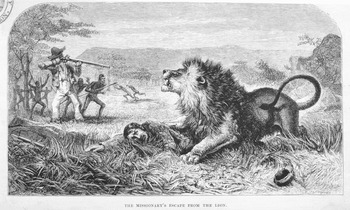
Yet, as many critics have noted, instances of substantial textual reworking reveal the project of self-aggrandizement that underwrites Livingstone's narrative persona. In an oft-quoted letter of 1841, Livingstone writes that he “would never build on another man's foundation” (Family Letters 1: 31), revealing an independent and headstrong spirit that likewise infuses many passages in Missionary Travels. For example, in describing his relations with the Makololo, Livingstone notes his skill in maintaining the devotion of the tribe via displays of his own independence and resilience (1: 400; ch. 18) and stresses his ability to discipline his attendants: “I seized a double-barreled pistol, and darted forth from the domicile, looking, I suppose, so savage as to put them to a precipitate flight. As some remained within hearing, I told them that I must maintain discipline, though at the expense of some of their limbs; so long as we traveled together they must remember that I was master, and not they” (1: 393; ch. 18, emphasis added). Several famous incidents, the most notable being his near-death encounter with the lion (see 1: 15–18; ch. 1), also foreground Livingstone's strategies of self-aggrandizement.
The lion incident in particular, an encounter in which Livingstone barely escaped being mauled and which rendered his left arm permanently disabled, has been key in fostering the Livingstone myth (Figure 26). Nearly all early reviewers celebrate the incident, while one even argues that there is “no doubt it is perfectly authentic” (Abraham 174). However, the evidence of Livingstone's letters, Mary Angela Schwer observes, tells another story. The “unwitting and unwilling participant” of the earlier manuscripts becomes “a natural gentleman” in Missionary Travels, one that demonstrates “how a true manly spirit could conquer and thrive” in Africa (207–10).Footnote 5 Comparison of the journals and letters with Missionary Travels reveals many further instances of such textual revision (see Schwer 207–33; Schapera xv-xix). “Whatever [Livingstone] says in [Missionary Travels],” writes Schapera, “must be checked with his journals and letters, and in case of discrepancy the version finally published needs to be treated with more caution than biographers and historians have normally been in the habit of showing” (xviii). Livingstone's textual persona thus emerges as a strategic creation, one that the missionary carefully cultivated in developing the final narrative of Missionary Travels.Footnote 6
“The Missionary's Escape from the Lion.” Illustration from David Livingstone, Missionary Travels and Researches in South Africa (London: J. Murray, 1857), facing 13. © Royal Geographical Society.

Further Strategies of Authentication
In addition to the transparent persona, Livingstone also falls back on his own extensive fieldwork or, as the narrative's subtitle puts it, “sixteen years’ residence in the interior of Africa” to support his claims. Livingstone's extended immersion allows him to offer comprehensive and ostensibly definitive representations of southern Africa and its inhabitants. Textual catalogues, scientific expositions, detailed maps, an appendix of latitudes and longitudes, and set pieces that encompass the microscopic (e.g., the Tsetse fly 1: 93–96; ch. 4), the macroscopic (the Kalahari desert 1: 56–62; ch. 2), and the intermediate (the lion 1: 159–62; ch. 7) all underscore the magnitude and depth of the missionary's gaze.Footnote 7 Livingstone's observations culminate in his grand theory of the central African basin, a theory that, he states, accounts for “the true form of the river systems and continent” (2: 131, but see 2: 130–37 passim; ch. 24). The theory, in its all-encompassing scope, allows Livingstone to “apprehend” the geological history of the entire southern portion of Africa and, significantly, to offer this knowledge to his readers.Footnote 8 Of course, as noted in the narrative's dedication, Livingstone is a bit late in formulating his theory:
To Sir Roderick Impey Murchison, President Royal Geographical Society . . . to express admiration of his eminent scientific attainments, nowhere more strongly evidenced than by the striking hypothesis respecting the physical conformation of the African continent, promulgated in his Presidential Address to the Royal Geographical Society in 1852, and verified three years afterward by the Author of these Travels. (n.p.)
However, despite his belatedness, Livingstone (as the text indicates) still manages to assign himself credit for having “verified” Murchison's theory and so succeeds in marshalling even the RGS president in the service of his, Livingstone's, own statements.
Livingstone's travels also place him in what Mary Louise Pratt calls the “contact zone”: the “social [space] where disparate cultures meet, clash, and grapple with each other, often in highly asymmetrical relations of domination and subordination” (4). In such a sphere, indicate the Comaroffs, there are consequences for both the colonizers and the colonized, “missionaries no less than Africans” (1: 54). For Livingstone one important consequence is his distancing from the average British reader. Repeatedly, for instance, Livingstone underscores his long separations from civilization (e.g., 1: 107; ch. 4) and, at the end of the narrative, he drives the point home in an especially memorable manner: “With the exception of a short interval in Angola, I had been three and a half years without speaking English, and this, with thirteen years of previous partial disuse of my native tongue, made me feel sadly at a loss on board the ‘Frolic’ [the British ship transporting him to Mauritius]” (2: 365; ch. 32). However, notes Livingstone, separation from European culture also has its advantages – it provides “an insight into the habits, ways of thinking, laws, and language of that section of the Bechuanas called Bakwains, which has proved of incalculable advantage in my intercourse with them ever since” (1: 14; ch. 2). Knowledge of one Bantu language also opens the door to many other Bantu-speaking tribes in southern Africa and, significantly, allows Livingstone to overhear otherwise inaccessible conversations (e.g., 1: 14; ch. 2), to participate in the practices of indigenous government (1: 212; ch. 9), and to see and appreciate correct social behavior (1: 329, 2: 283; ch. 16, 30). As a result, Missionary Travels suggests that Livingstone's fieldwork earns him the right to speak with considerable authority about the indigenous populations of southern Africa.
Yet for Livingstone, immersion remains a strategic move, a means for facilitating travel and missionary work, and so in his narrative he always stresses the cultural and ideological distance between himself and his African hosts. For example, at one point Livingstone describes the somatic means by which he establishes a common identity with Africans: “the contrast between the exposed and unexposed parts of my skin, when exhibited in evidence of our all being made of one stock originally, and the children of one Maker, seemed to strike [Sansawe, an African chief] with wonder” (2: 91; ch. 22). Livingstone later reveals the design behind these putatively “open” dealings: “Much greater influence will be gained by studying how you may induce [Africans] to act aright, with the impression that they are doing it of their own free will” (1: 216; ch. 9). Such behavior certainly conflicts with the transparent persona Livingstone attempts to foist on his readers. In one extraordinary passage, the missionary even reveals the personal “disgust” that his work ultimately inspires:
I had been, during a nine weeks’ tour, in closer contact with heathenism than I had ever been before; and though all, including the chief, were as kind and attentive to me as possible, and there was no want of food (oxen being slaughtered daily, sometimes ten at a time, more than sufficient for the wants of all), yet to endure the dancing, roaring, and singing, the jesting, anecdotes, grumbling, quarreling, and murdering of these children of nature, seemed more like a severe penance than any thing I had before met with in the course of my missionary duties. I took thence a more intense disgust at heathenism than I had before and formed a greatly elevated opinion of the latent effects of missions in the south, among tribes which are reported to have been as savage as the Makololo. (1: 260, cf. 1: 297; ch. 12, cf. ch. 14)
By thus detailing the parameters and personal costs of his missionary endeavors, Livingstone narrows the distance between him and his readers, while reinforcing his authority on the African mind and lending yet another level of authentication to his larger imperial roadmap.
Reinventing the African
Missionary Travels is a transitional text, a document that enacts in miniature the complex historical shift from the “altruism” of the abolitionist movement to the “cynicism of empire building” (Brantlinger 173). This change in public disposition, in turn, occurred partly because of a mid-century change in the players directing British colonial expansion in Africa. From the older set of missionaries, the imperial reigns passed to a new generation of missionaries as well as explorers, commercial adventurers, and administrators. The personnel change ushered in an ideological change. Whereas older missionaries to Africa and elsewhere had championed the “oneness of humanity” (Ross, “Mask” 39), and espoused “conversionism,” an “‘incorporative’ ideology” that represented the “other” as open to conversion, i.e. “as pagans rather than as savages or members of inferior races” (Thomas 125), the new imperialists assumed a less liberal view. Taking their cue from the work of racial theorists like Robert Knox and others, the new imperialists divided humanity “into a number of mutually exclusive groups arranged on an ascending scale of moral as well as intellectual ability.” Not surprisingly, they placed Europeans at the top (Ross, “Mask” 38). Within this larger ideological framework, in turn, there emerged two opposing schools of thought. The first, “scientific racism,” argued that “‘backward’ or ‘savage’ peoples” would be “swept aside by the superior races in the inexorable march of progress.” The second and relatively more humane approach stressed “an attitude of responsible and caring superiority,” a type of paternalism or noblesse oblige known as “trusteeism.” Advocates of trusteeism (or, as it later came to be called, “the white man's burden”) argued that “[i]t was the duty of the superior race to care for the inferior races, to ensure they were treated with justice and helped to develop as far as their limited abilities could go” (Ross, “Mask” 40–41).
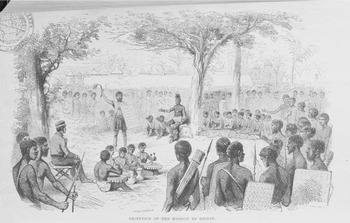
Although critics most often describe Livingstone as a conversionist and suggest that his famous meeting with Stanley in 1871 symbolizes the encounter between “two eras” of British colonialism (Ross, “Mask” 54), Missionary Travels in fact occupies a complex interstitial position between the discourses of conversionism and trusteeism. Much of the narrative's position depends on the topic at hand. For instance, in early narrative discussions of the Bechuanas and their chief Sechele, Livingstone emerges as a conversionist. Regarding “worldly affairs,” Livingstone praises the Bechuanas for showing “more intelligence than is to be met with in our own uneducated peasantry” (1: 25; ch. 1), while commending Sechele because he “has not only embraced Christianity, but expounds its doctrines to his people” (1: 18–19; ch. 1). The long set pieces on Sechele (1: 18ff; ch. 1) and the Makololo chief Sebituane (1: 97ff; ch. 4), both of which demonstrate Livingstone's willingness to think of Africans as complex individuals, his observation that the Makololo “are just such a strange mixture of good and evil as men are every where else” (2: 173; ch. 25),Footnote 9 and various textual illustrations (e.g., Figure 27)Footnote 10 likewise suggest a conversionist disposition. However, at moments of intense emotion and despair, as when Livingstone decries the “degradation” to which the Caffres and Bechuanas, “the most godless races of mortals known any where,” have sunk (1: 181–83; ch. 8), or when he describes his “disgust” at Makololo “heathenism” (see above), Livingstone takes an ideological stance more akin to trusteeism, intimating that there exists an impassible divide between himself and his African hosts. Missionary Travels, therefore, appears to waver between the discourses of conversionism and trusteeism.
“Reception of the Mission by Shinté.” Illustration from David Livingstone, Missionary Travels and Researches in South Africa (London: J. Murray, 1857), facing 291. © Royal Geographical Society.

Alternately, Livingstone's particularized depictions of individual Africans and African tribes set his pronouncements within the discourses of both conversionism and trusteeism. This dual discursive thrust, in turn, gestures toward the first set of geographical boundaries that Missionary Travels imposes on the map of Africa. This set of boundaries differentiates the interior tribes of southern Africa from their neighbors. For example, as noted in the previous paragraph, despite praising Sechele and his tribe, Livingstone also calls the Bechuana among the “most godless” people on earth (1: 183; ch. 8) and describes their entreaties that he “give up that everlasting preaching and praying” (1: 29; ch. 1). The tribes northwest of the Bechuana, however, display a more congenial religious disposition. The Barotse show “a more vivid perception of the existence of spiritual beings, and greater proneness to worship than among the Bechuanas” (1: 252; ch. 12); the Makalaka flock to hear Livingstone in droves and at least “[s]ome begin to pray to Jesus in secret as soon as they hear of the white man's God” (1: 270–71; ch. 13); while the Makololo exhibit “devout belief” in unseen beings (2:283; ch. 30) and so “form a very inviting field for a missionary” (2: 170; ch. 25). In fact, the farther northwest Livingstone proceeds, the more he finds tribes possessed of the “reverence” necessary to appreciate Christianity (see especially 1: 322, 1: 375; ch. 16, 18)Footnote 11 – though again, in Angola, the most northwestern of the tribes are “sunk” in “gross superstition” (2: 95; ch. 22). The tribes along the eastern portion of Livingstone's route, especially those in close proximity to the Makololo, also exhibit the requisite and properly proportioned religious feelings (see, e.g., 2: 225, 2: 337; ch. 27, 32). In this way, Missionary Travels constructs an African geography based on religious disposition, i.e. the potential for successful conversion to Christianity, that situates the Makololo, the tribe on which Livingstone has set his hopes, at its imaginary center.
Livingstone's depiction of the border tribes, the hostile tribes settled between the Makololo and the Portuguese, adds yet another set of imaginary boundaries, boundaries now oriented around tribal disposition. In describing the Barotse Valley, home of the Makololo and their allies and proposed site for one of Livingstone's missionary stations (see 1: 303; ch. 15), Livingstone notes the “deeds of generosity” and the selfless kindness of the tribes. Waxing poetic, he adds that “my heart glows with gratitude to them, and I hope and pray that God may spare me to make them some return” (1: 287; ch. 14). Conversely, as he passes beyond the Barotse Valley and approaches Loanda, Livingstone encounters increasingly hostile tribes. Instead of imparting food and gifts, the tribes now demand “either a man, a tusk, beads, copper rings, or a shell, as payment for leave to pass through [the] country” (1: 378; ch. 18). Livingstone's heroic refusals – “I declared that we were ready to die rather than give up one of our number to be a slave” (1: 386; ch. 18) – simply incite further hostility: “it was evident that they [the Chiboque] wanted to fight” (1: 387; ch. 18, emphasis in original). In the same manner, while traveling towards Mozambique, Livingstone encounters another set of hostile tribes. The crisis now becomes acute:
I felt some turmoil of spirit in the evening at the prospect of having all my efforts for the welfare of this great region and its teeming population knocked on the head by savages tomorrow, who might be said to “know not what they do.” It seemed such a pity that the important fact of the existence of the two healthy ridges which I had discovered should not become known in Christendom, for a confirmation would thereby have been given to the idea that Africa is not open to the Gospel. But I read that Jesus said, “All power is given unto me in heaven and on earth; go ye, therefore, and teach all nations . . . and lo, I am with you always, even unto the end of the world.” I took this as His word of honor, and then went out to take observations for latitude and longitude, which, I think, were very successful. (The [ruins of the] church [at Zumbo]: lat. 15d 37′ 22″ S., long. 30d 32′ E.). (2: 257; ch. 29)Footnote 12
In this, one of the most striking and dense passages in Missionary Travels, imperialism joins cartography and religion (for the Biblical citation see Matt 28:18–20) to configure the textual map of Africa and to mark the locale of the Bazunga and other like-minded hostile east African tribes.
In contrast to these tribes, Livingstone depicts the Makololo and their immediate neighbors as the African tribes most amenable to free trade. Sebituane, for example, the first Makololo chief with whom Livingstone collaborates, exhibits a life-long passion “to have intercourse with the white man” (1: 99; ch. 4) and, even before Livingstone's arrival in Africa, the Makololo chief had already broken down “the old system which prevented trade from penetrating into the great central valley” (1: 102; ch. 4). The Makololo under Sekeletu, Sebituane's successor, likewise display a growing (and curiously described) interest in commerce. “The desire,” writes Livingstone, “of the Makololo for direct trade with the sea-coast coincided exactly with my own conviction that no permanent elevation of a people can be effected without commerce” (1: 262; ch. 13). In addition to their commercial disposition, the Makololo also show a keen interest in western products. Missionary Travels contains an array of scenes in which the Makololo marvel at items like Livingstone's mirror (1: 221–22; ch. 9), his magic lantern (1: 340; ch. 16), and European clothing (2: 151–52; ch. 24). In their desire for commerce the Makololo envision a “Makololo village on the banks of the Leeba, as an approach to the white man's market” (2: 140; ch. 24),Footnote 13 and both under Livingstone's guidance and on their own initiative make their first attempts at trade (e.g., 1: 220, 2: 21, 2: 43, 2: 162–63, 2: 174–75; ch. 9, 19, 20, 25). As a result, through these various passages and, more importantly, through the imaginary boundaries that these passages institute (“godless” vs. religious, friendly and disposed to trade vs. hostile), the text of Missionary Travels carefully fashions an Africa tribe – the Makololo – and a region that responds to larger British imperial fantasies. Or, as one early reviewer observes, Livingstone offers his readers Africans “in a very different light from that in which they have hitherto been presented” (Lewes 7).
Interstitial Cartographer
Livingstone's representation of the various tribes in south central Africa thus points to a larger cartographical scheme woven into the text of Missionary Travels, a scheme that seeks to reinvent Africa in the British public imagination. In the nineteenth century, note the Comaroffs, imperial texts often introduced such schemes “to arouse the middle and laboring classes to a passion for epic reform” and to help to establish Africa “as a metaphysical stage on which various white crusaders struck moral postures” (1: 87). Ultimately, owing to these schemes, imperial narratives constructed a relationship between Europe and Africa which implied “a historical imperative, a process of intervention through which the wild would be cultivated, the suffering saved” (1: 88). In Missionary Travels fostering such an imperative depends specifically on marking the land – on placing several overlapping textual maps on southern Africa.
For example, beyond the boundaries already noted, in constituting Africa as a textual entity Livingstone also creates geological boundaries – as when he contrasts the “shadeless glare” of the Kalahari desert with the “fertile” and “deep gloom” of the Barotse Valley (1: 326; ch. 16) or when he notes “the watershed between the southern and northern regions” (1:372; ch. 17), a watershed which incidentally also marks the border between the Makololo and their hostile neighbors to the north. Along similar lines, Livingstone distinguishes between the “civilized life” of the mission at Kuruman and that of the “untaught heathen in the regions beyond” (1: 126, 1: 135; ch. 5, 6), and he separates the Barotse Valley from the lands immediately to the east and west where “the slave-trade has defiled the path” (1: 262; ch. 13). At one point, Livingstone even uses skin color, running in “five longitudinal bands along the southern portion of the continent,” to distinguish the Makololo and Batoka from the fierce “very dark” border tribes (1: 384–85; ch. 18). Such varied textual geographies, whatever the underlying material reality, work together to identify and overdetermine the Makololo and the regions of the Barotse Valley and the Batoka Plateau, Livingstone's “two healthy ridges” (2: 257; ch. 29), as the ideal points for British imperial and missionary intervention.Footnote 14
Livingstone also distinguishes the interior of Africa from the spheres of Portuguese influence and settlement. As Livingstone's transcontinental journey takes him into the western and eastern Portuguese territories of southern Africa, the narrative of Missionary Travels presents various scenes of rural and urban decay. For example, in depicting Angola, Livingstone notes that the Quango Valley's “agricultural and pastoral riches are lying waste” (2: 21; ch. 19) and observes that Loanda is “in a state of decay” (2: 45; ch. 20). In visiting Mozambique, he discovers that “Tete is now a ruin” (2: 307; ch. 31) and Senna is “ten times worse” (2: 338; ch. 32). Such scenes result in despair: “nowhere does the European name stand at so low an ebb” (2: 343; ch. 32). In commenting on Portuguese territories, Livingstone also offers numerous examples of political corruption (e.g., 2: 72–73; ch. 21) and agricultural mismanagement (2: 78; ch. 21); he blames such ruin on short-sighted Portuguese exploitation of African resources (2: 47; ch. 20) and, of course, on the persistence of the slave-trade – which degrades the indigenous populations (2: 102–03; ch. 22), inhibits trade and travel in Portuguese territories (1: 397, 2: 322; ch. 18, 31), undermines the growth of gold production (2: 308; ch. 31), and promotes theft and dishonesty (2: 65–66; ch. 21). Likewise, Livingstone emphasizes that such developments are due specifically to Portugal's colonial policies. The “inborn energy” of the English, he writes, would have produced much more favorable results (2: 362; ch. 32).
Livingstone's cartographical project thus seeks not only to map southern Africa and make it and its inhabitants, via a range of textual representations, known to the British public (cf. Hobsbawm 51), but also to intervene in a larger discourse on the role of British imperialism in Africa. When Missionary Travels appeared, note critics, “the British government had no interest in carving out African colonies” (Jeal, “Biographical” 49). Rather, before the European “scramble for Africa” of the 1880s, British policy favored “informal ties of trade and influence over those of imperial control,” and so British leaders endorsed and advocated “influence” over “political possession” and sought to deal with white settler populations rather than indigenous peoples (Robinson 7–8, but see 1–26). In terms of indigenous populations, many in the British public even questioned the need and efficacy of overseas missionary work. For example, the issue occasioned a fierce literary debate in the nineteenth century, one that pitted missionary supporters against writers like Charlotte Brontë and Charles Dickens, the latter of whom famously lambasted missionary projects through the character of Mrs. Jellyby in Bleak House (Comaroff 1: 49–54). In advocating indigenous commerce and the founding of missionary stations in central Africa, Missionary Travels takes a controversial stance, one which ultimately depends on the credibility and persuasiveness of Livingstone's imperial vision (hence his attempt to forge a transparent narrative persona) and on the convincing textual creation of a viable, appealing colonial locale in south central Africa.
From another perspective, the text of Missionary Travels seeks to invent and map an “inviting” (2: 170; ch. 25) interstitial space in Africa – one outside of various spheres of influence and, most importantly, beyond the white man's gaze (for the latter see passim, but especially 1: 77, 1: 105, 1: 244; ch. 3, 4, 11). In doing so, Livingstone's narrative addresses the larger crisis in mid-Victorian England initiated by the industrial revolution. The industrialization of England, critics note, evoked a paradoxical response in the Victorian imagination. On one hand, “the rise of capitalism . . . heightened the sheer antagonism between urban and rural interests,” and transformed the countryside into a symbol of purity and innocence. On the other, steady urban expansion appeared to dissolve the division between city and country (Comaroff 1: 73–74; cf. Hobsbawm 60–61). As a result, the countryside became not only a symbol of “innocence lost,” but also offered “the possibility of paradise regained,” the latter being especially significant to Nonconformist missionaries like Livingstone, who were trying to shift public interest towards Africa (Comaroff 1: 75). Missionary Travels, consequently, contains numerous allusions to the fertility and abundance of central Africa. The Barotse Valley, observes Livingstone, “is as capable of supporting millions of inhabitants as it is of thousands” (1: 303, cf. 1: 247–48; ch. 15, cf. ch. 12), while the Batoka Plateau “had more large game on it than any where else I had seen in Africa” (2: 241; ch. 28). Even in Portuguese lands the indigenous inhabitants live in “glorious ease”: “Food abounds, and very little labour is required for its cultivation” (2: 4; ch. 19). Nor does Livingstone fail to capitalize on the symbolic potential of such observations. The Barotse Valley, he writes, recalls “the valley of the Nile” (1: 247; ch. 12); his last glimpse reminds him of the Israelites looking back to “the flesh-pots of Egypt” (1: 291; ch. 14). Through such descriptions, Livingstone creates a land that plays on the fantasy of a new Eden and so further responds to imperial dreams. “Does not [Livingstone's] announcement,” asks one enthusiastic reviewer, “look like one of those providential interferences with the affairs of great nations . . .?” (“Dr. Livingstone's African Researches” 131).
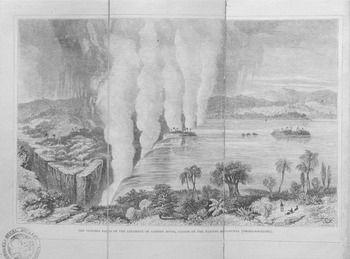
Livingstone's famous description of his “discovery” of Victoria Falls provides the cornerstone of his mapping project (Figure 28). In representing the falls, Livingstone employs many of the cartographical strategies that appear elsewhere in his text. For instance, as in the cases of Lake Ngami (1: 77; ch. 3) and the Zambezi River (1: 105; ch. 4), Livingstone brings the falls under the western gaze – “[The falls] had never been seen before by European eyes” (2: 184; ch. 26); he notes how the falls inspire his Batoka attendants to prayer, thereby underscoring the favorable religious inclinations of the tribes settled near the falls (2: 189; ch. 26); and he makes several attempts to “capture” the falls at the textual level. These attempts range from rapturous descriptions of “the most wonderful sight I had witnessed in Africa” (2: 185; ch. 26); to an epic simile that pictures the Thames “leaping boldly” into a fissure similar to that of the falls (2: 185; ch. 26); to narrating several attempts at measuring the distance of the falls as well as a failed bid to take a “lunar observation” of an island near the falls’ edge (2: 187–90; ch. 26). The text also follows Livingstone's ventures in placing his own mark on the falls – as when he describes making a “little garden” on the mid-stream island and cutting “my initials on a tree, and the date 1855,” an act that represents “the only instance in which I indulged in this piece of vanity” (2: 190; ch. 26); and when, more significantly, he reveals that he has imposed the name by which the falls have since come to be known – “the only English name I have affixed to any part of the country” – over the indigenous names of the falls, “Shongwe” and “Mosioatunya” (2: 183; ch. 26). Finally, in perhaps the most telling passage in all of Missionary Travels, Livingstone narrates his phallic-like visual penetration of the falls: “. . . creeping with awe to the verge [of the mid-stream island], I peered down into a large rent which had been made from bank to bank of the broad Zambesi, and saw that a stream of a thousand yards broad leaped down a hundred feet, and then became suddenly compressed into a space of fifteen or twenty yards” (2: 185; ch. 26).Footnote 15 Through these various passages, Livingstone's narrative “maps” the falls and offers them in a near-definitive form to British readers, thereby transforming an already authentic geological fissure into the symbol par excellence of the larger interstitial African space it, the narrative, seeks to create and present to the public.Footnote 16
“The Victoria Falls of the Leeambye or Zambesi River.” Illustration from David Livingstone, Missionary Travels and Researches in South Africa (London: J. Murray, 1857), opposite frontispiece. © Royal Geographical Society.

* * *
In Missionary Travels, the text that permanently secured his fame, David Livingstone reinvents south central Africa in a manner which invites British intervention and colonization. By imposing a set of imaginary boundaries on the continent, Livingstone creates an ideal space – an interstitial, idyllic domain that caters to deeper British imperial fantasies. That the British public lionized Livingstone and that, during the Victorian period, his fame remained untarnished however much he failed in his later endeavors testifies, ultimately, to the success of his cartographical project and the larger imperial pronouncements on Christianity, commerce, and civilization that the project made possible. However, material reality, history, and Livingstone's own subsequent travels would all soon unravel the fantasies of Missionary Travels. For example, Livingstone's decision to omit and downplay the array of travails and dangers he suffered on his travels (see, e.g., 1: 283, 1: 307; ch. 14, 15) ensured the eventual collapse of missionary stations established on his advice – disease, natural dangers, and hostility from indigenous populations caused numerous British deaths and lead to disgrace and public censure for Livingstone (Jeal, “Biographical” 41, 50). Likewise, the impassable Kebrabasa Bassa rapids, which Livingstone had missed on his first journey and which he would survey with immense dismay on his return in 1858 (Zambesi, ch. 2; cf. Missionary Travels 2: 224, 2: 279; ch. 27, 29), permanently ended his dreams of making the Zambesi a highway into the interior. Finally, the course of imperial history itself would also soon throw Livingstone's imperial masterplan into disarray. The future agents of empire and capitalist expansion would not have the luxury or the patience for “sixteen years’ residence in the interior” and would certainly not cultivate the cultural sensitivity that Livingstone prescribed for and envisioned in his successors.