Introduction
Emergency medical services (EMS) personnel in the US respond to a total of 30 million calls per year.1 The major mode of transportation for each call is in a motor vehicle, and yet, research on transportation-related occupational risks is limited. Previous research identifies that there is a serious problem and supports the need for further evaluation of transportation-related occupational risks among these workers.
In 2002, there were approximately 900,000 full-time, part-time, and volunteer EMS personnel in the US.1 The US Department of Labor (DOL) Bureau of Labor Statistics indicates that: (1) the number of EMS workers has been rising (it is likely to be approximately one million in 2010); and (2) approximately 201,000 are paid.2
Reports indicate that both the fatality rate and the injury rate for this occupation are far above the national average. Maguire et al found that the EMS transportation-related occupational fatality rate for 1992 to 1997 averaged 9.6 fatalities/100,000 workers/year;3 this rate is approximately five times higher than the national average. Using DOL data from 2003 to 2007, Maguire and Smith found that 51 of 59 (86.4%) fatalities among EMS workers were transportation-related.4 Kahn et al documented the characteristics of fatal ambulance crashes in the US and found 89 (13.2%) ambulance occupant fatalities and 592 (86.8%) non-fatal ambulance occupant injuries during one 11-year period.5 Eighteen percent of the 538 EMS fatalities listed by the National EMS Memorial Service for 1993 to 2010 were related to ambulance collisions.6 Pirrallo found that 69% of fatal crashes occurred during emergency operations.7
Maguire et al found that: (1) the rate of non-fatal transportation-related injuries/100 full-time workers/year from 1998 to 2002 was approximately 30 times higher than the national average;8 (2) 15% of all EMS occupational injuries were transportation-related; and (3) most of the cases were classified as “multiple trauma”.9 Maguire and Smith found that the rate of non-fatal transportation-related injuries with lost work days was approximately five times higher for EMTs than the national average.10 Maguire and Porco reported on injuries to EMS personnel occurring secondary to ambulance collisions in one New York City (NYC) EMS agency between 01 August 1988 and 31 August 1994, and found that approximately 50% of ambulance collisions resulted in injury to EMS personnel.11
Saunders and Heye report an overall collision injury rate of 22.2 injuries/100,000 lights and sirens responses (emergency responses as opposed to non-emergency responses for calls such as some inter-facility transfers) among EMS personnel;12 they also found that a major cause of ambulance crashes in an urban environment was “due to inattention”. Elling noted that between 1984 and 1987, 1,894 ambulance occupants were injured in 1,412 ambulance collisions in New York State.13 Weiss et al found that in one state, there were more ambulance injuries in the urban environment, but the severity of the injuries was worse in the rural environments.14 Schwartz et al found that paramedics were more frequently (than EMTs) involved in ambulance collisions.15
Maguire reported that “the crashworthiness of ambulances is largely unknown”; the same author reported that there were 565 case reports associated with 221 ambulance crashes between January 1994 and December 2001 and that crashes involving ambulances produced twice as many casualties as the national average.16 One hundred percent of the litigation against one EMS agency resulted from transportation-related injuries.17
Becker et al found that “relative to police cars and fire trucks, ambulances experienced the highest percentage of fatal crashes where occupants are killed and the highest percentage of crashes where occupants are injured.”18 Ray and Kopas found that the most common cause of crashes was operator error.19 Levick et al evaluated ambulance patient compartments under crash conditions; they demonstrated the need for special testing to be done for the compartment.20, 21,22 Maguire and Kahn note that fatigue may be associated with the risk of crashes.23
Medical residents working on ambulances also are at risk of ambulance crash-related injuries.24 The community is at risk both of crashes with ambulances (16) and crashes related to the “wake-effect” of ambulance responses.25
The goal of this epidemiological study was to use data from the US Department of Labor (DOL) Bureau of Labor Statistics to determine the transportation-related risks for EMTs and to compare these rates to the national average.
Methods
The DOL methods and criteria as well as rate calculation formulas have been previously described.4 The rates, relative risks, and proportions associated with the 1,050 injury cases with lost work days and 30 fatalities resulting from transportation incidents occurring to EMTs and paramedics (collectively referred to as EMTs) in the US between 2006 and 2008 were calculated and described. The University of Maryland Baltimore County (UMBC) Institutional Review Board certified the project as exempt (protocol number Y11BM08024).
Results
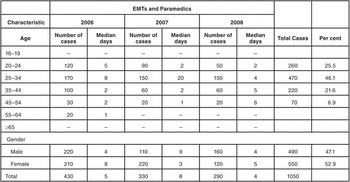
Of the 1,050 cases abstracted, 46% occurred to workers 25 to 34 years of age. Females were the victims in 53% of the cases yet females only accounted for 27% of employment in this occupation in 2007 (Table 1).26 More than 20% of cases resulted in ≥31 lost work days. The leading injury type was “sprains, strains and tears”. The number of cases and median days away from work for the 1,050 transportation-related injury cases involving days away from work for EMTs employed in private industry from 2006 to 2008 are in Table 1.
Number of cases and median days away from work for transportation-related injuries involving days away from work for emergency medical technicians (EMTs) from 2006– 2008 n = 1,050

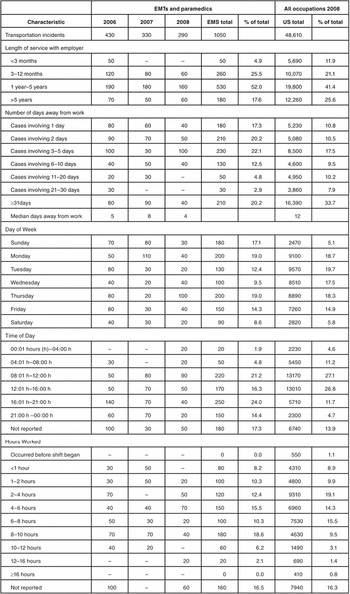
Fifty-two percent of the cases occurred to employees with 1 to 5 years of service with their current employer; 30% of cases occurred to employees in their first year of service. Twenty percent of the EMT cases resulted in ≥31 lost work days, compared to 34% for all workers in the US. The median of the days lost varied from eight in 2007 to four in 2008; the median days lost for all occupations in the US was 12 in 2008.
The number of non-fatal occupational injuries and illnesses involving days away from work by selected worker and case characteristics for EMTs in private industry from 2006 to 2008 and US worker injuries in 2008 are in Table 2.
Number of non-fatal, occupational injuries and illnesses involving days away from work by selected worker and case characteristics for emergency medical technicians (EMTs), 2006–2008 compared to all of the United States in 2008 (private industry only)

The lowest percentage of cases occurred on Saturdays and between midnight and 04:00 hours. The highest percentages occurred on Mondays and Thursdays, and between 04:00 and 20:00 hours. The highest percentage of cases by hours worked took place between eight and 10 hours after the start of the shift.
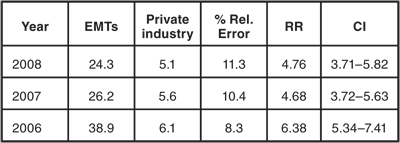
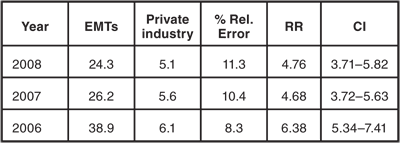
The rate of transportation-related injury for EMTs ranged from 24 to 39 cases/10,000 full-time workers/year. The risk of transportation related injury for EMTs is about five times higher than the US. national average (Table 3). The incidence rates for transportation-related injuries with days away from work per 10,000 full-time employees for EMTs and private industry for the years 2006 to 2008, with relative risk (RR) and 95% confidence interval (CI) are in Table 3.
Incidence rates for transportation related injuries with days away from work/10,000 full-time employees for emergency medical technicians (EMTs) and private industry for the years 2006–2008 by relative risk (RR) and 95% confidence interval (CI)
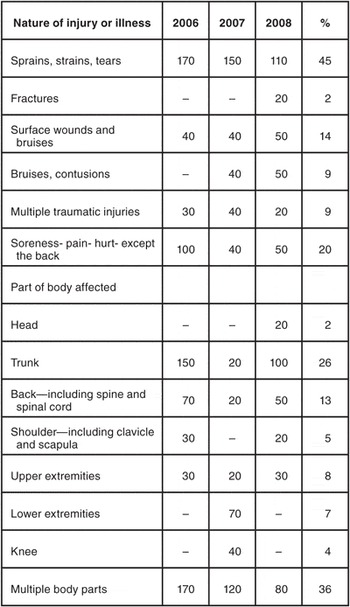
Forty-five percent of all transportation-related injuries are sprains, strains, or tears. Twenty-six percent of injuries occur to the trunk and 13% to the back; 36% affect multiple body parts. The transportation-related injury and illness cases resulting in days away from work for EMTs from 2006 to 2008 by nature of injury and body part are described in Table 4.
Transportation-related injury and illness cases resulting in days away from work for emergency medical technicians (EMTs) from 2006 to 2008 by nature and body part, n = 1,040

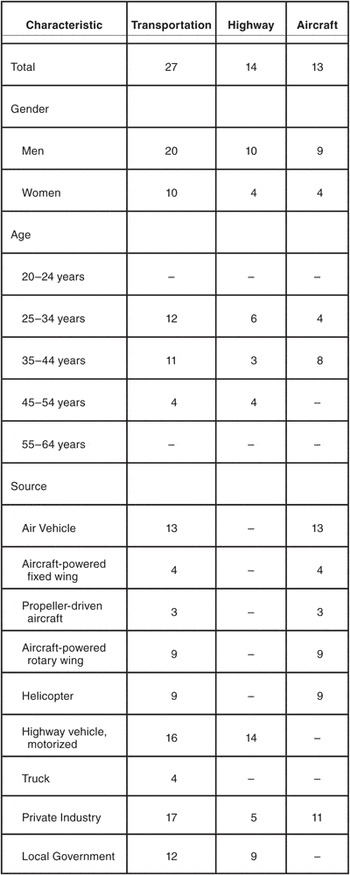
There were 30 transportation-related fatalities among EMTs between 2006 and 2008. Of these, 14 were highway incidents and 13 were aircraft incidents (3 were unknown) 13 aircraft incidents, nine (60%) were associated with helicopter operations. Twenty of the cases occurred to males and 17 occurred among private industry employers. Table 5 lists the number of fatal transportation related occupational injuries among public and private EMTs in the United States between 2006 and 2008.
Number of fatal transportation-related occupational injuries among emergency medical technicians. All US (public and private employers), 2006–2008, n = 30

Discussion
The findings corroborate earlier reports that EMS workers face risks of transportation-related injuries that are above the national average. In addition, these data support a growing body of evidence that female EMS workers may face a disproportionately high risk of occupational injuries.
Fatigue—Anecdotal reports indicate that EMS workers are scheduled for both extended shifts (even >24 hours) and rotating shifts (e.g., day shifts one week, then evenings, and then nights). Maguire and Kahn noted that 21 hours of wakefulness produces impairment of the same magnitude as a 0.08% blood alcohol concentration (the legal limit for civilian drivers and twice the legal limit for commercial drivers).23 Sofianopoulos et al found that “almost half of paramedic (respondents) answered yes to having nodded off or fallen asleep whilst driving”.27 Studnek and Fernandez found that the two variables associated with increased risk of ambulance collision were young age and fatigue.28
Gender—Fifty-three percent of the cases in this study involved females, yet females make up just 27% of the study population. Baker et al found that male and female pilots crash for different reasons.29 Perhaps male and female paramedics crash for different reasons and get injured under different circumstances. If so, this topic should be further researched and training programs should address all risk factors.
Distractions—Saunders and Heye noted that a major cause of ambulance crashes in an urban environment was “due to inattention”.11 McEvoy found that distractions contributed to 13.6% of all crashes studied.30
Restraints—Larmon found that seatbelt use in the rear of the ambulance during emergency runs was rare (median, 0%), and that 68% of respondents stated their reason for non-use of safety belts in the patient compartment was that it “inhibited patient care”.31 Johnson found that “two-thirds of respondents reported not wearing their seatbelt on the squad bench while treating patients, and half believe that wearing a seatbelt interferes with patient care”.32
The US Centers for Disease Control and Prevention (CDC) report that “(26%) of the EMS workers killed were drivers who were not wearing a restraint, and two (7.4%) were unrestrained in the front right seat”.33 Auerbach et al found that “the variable most strongly associated with the probability of an injury-accident was use of a passenger restraint device”.34 Studnek et al noted that “participants reporting no organizational seat belt policy had lower odds of seat belt usage when compared to individuals that do have a seat belt policy”.35
Driver—Custalow and Gravitz found that in 71% of the studied collisions, the responsible ambulance driver had a history of multiple collisions.36 Driver performance feedback and monitoring devices have been found to improve ambulance safety.37,38
Other—Maguire notes that Haddon’s Matrix “allows us to look at multiple causal, contributing and associated factors” for risks such as collisions.39 This perspective suggests other areas for future research such as vehicle design, and analyses of the effectiveness of current driver training programs as well as emphasizing the importance of recording more complete and consistent data.
Future Research
Based on these findings, some promising areas for future research include: fatigue, gender disparities, distractions, occupant restraint, and human factors related to the drive.
Limitations
The data abstracted lack EMS-specific information such as call volume, miles travelled, driver training, agency policies (e.g., related to seatbelt use and vehicle speed), vehicle type, type of call and call cycle (e.g., en route to scene, en route to hospital). Such data are owned by EMS agencies and tend to be inconsistently recorded. However, analyses of those data are critical before interventions can be developed, implemented, and evaluated; those data must be made available for future research.
Furthermore, the data in this study are limited to EMS-related transportation risks for EMS workers and do not address the risks for EMS patients or for the community.
Conclusions
The US national EMS system is built on the premise of having an unlimited supply of 20-year-old persons interested in, and dedicated to, the provision of EMS care, and who are willing to work long hours for a small salary. Not only is there not an unlimited supply of 20 year olds, the current workforce may be being depleted through preventable risks such as transportation incidents.
The practice of prehospital emergency medical care is more dangerous than the national average, and transportation- related events are a significant component of that risk. Resources must be devoted to further research and to the development and evaluation of interventions designed to mitigate these hazards. Prospective studies must be conducted and interventions developed, implemented, and evaluated in statistically rigorous projects.
Acknowledgments
The author thanks Sean Smith from the US Bureau of Labor Statistics for his help with data acquisition and Barbara O’Neill for her review of the paper.
Abbreviations:
EMT: Emergency Medical Technician
EMS: emergency medical services
DOL: US Department of Labor