Introduction
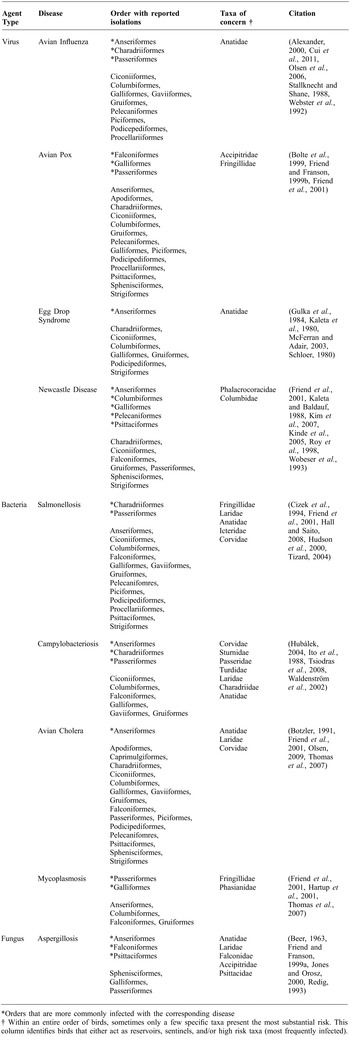
Climate change has been recognised as a factor influencing avian migratory patterns, causing a marginal shift northward in many species (Thomas and Lennon, Reference THOMAS and LENNON1999; Walther et al., Reference WALTHER, POST, CONVEY, MENZEL, PARMESAN, BEEBEE, FROMENTIN, HOEGH-GULDBERG and BAIRLEIN2002; Parmesan and Yohe, Reference PARMESAN and YOHE2003; Brommer, Reference BROMMER2004; Hitch and Leberg, Reference HITCH and LEBERG2007). Changes in migrant distributions could increase the risk of disease for both wild and domestic birds because birds have been identified as pathogen-dispersing agents (Palmgren et al., Reference PALMGREN, SELLIN, BERGSTROM and OLSEN1997; Hubálek, Reference HUBÁLEK2004; Owen et al., Reference OWEN, MOORE, PANELLA, EDWARDS, BRU, HUGHES and KOMAR2006; Jourdain et al., Reference JOURDAIN, GAUTHIER-CLERC, BICOUT and SABATIER2007) facilitating the dissemination of diseases caused by bacteria, viruses, and fungi (Table 1).
Diseases associated with poultry health and the wild birds that are most commonly infected.

*Orders that are more commonly infected with the corresponding disease
† Within an entire order of birds, sometimes only a few specific taxa present the most substantial risk. This column identifies birds that either act as reservoirs, sentinels, and/or high risk taxa (most frequently infected).
It is anticipated that climate change will influence the distribution, emergence, and re-emergence of many diseases (Charron et al., Reference CHARRON, WALTNER-TOEWS, MAAROUF and STALKER2003; Jones et al., Reference JONES, PATEL, LEVY, STOREYGARD, BALK, GITTLEMAN and DASZAK2008). For vector-borne pathogens, any range or distributional anomalies might be partly attributed to changes in the ranges of vector and reservoir species (Ostfeld et al., Reference OSTFELD, GLASS and KEESING2005; de La Rocque et al., Reference DE LA ROCQUE, RIOUX and SLINGENBERGH2008; Mills et al., Reference MILLS, GAGE and KHAN2010). With these new ranges and exposures, the risk of disease to humans, domesticated animals, wildlife, and livestock could increase.
The cause of the 2004 outbreak of highly pathogenic avian influenza (HPAI) virus, subtype H7N3, in British Columbia, Canada, was unknown; however, it has been shown that migratory birds can play an important role in the dispersal of influenza A, avian viruses (Webster et al., Reference WEBSTER, BEAN, GORMAN, CHAMBERS and KAWAOKA1992; Keawcharoen et al., Reference KEAWCHAROEN, VAN RIEL, VAN AMERONGEN, BESTEBROER, BEYER, VAN LAVIEREN, OSTERHAUS, FOUCHIER and KUIKEN2008; Cui et al., Reference CUI, HOU, XING, HE, LI, GUO, LUO, YAN, YIN and LEI2011; Prosser et al., Reference PROSSER, CUI, TAKEKAWA, TANG, HOU, COLLINS, YAN, HILL, LI, LI, LEI, GUO, XING, HE, ZHOU, DOUGLAS, PERRY and NEWMAN2011). A similar outbreak of HPAI, subtype H5N1, among village poultry farms in Romania, was associated with exposure to wild migratory waterfowl in the area (Ward et al., Reference WARD, MAFTEI, APOSTU and SURU2009). The outbreak in British Columbia lasted more than 90 days, and resulted in the destruction of 17 million commercial chickens, the depopulation of 410 commercial poultry farms, severe restrictions on international trade, and millions of dollars in losses (Bowes, Reference BOWES2007). These can occur in the form of direct costs caused by high mortality, reduced egg production, decreased weight gain, and feed and materials, as well as indirect costs, including treatment, clean-up, transportation, delays and disruptions in production schedules, and low income (Lasley, Reference LASLEY2003). Because many avian reservoirs (Thomas and Lennon, Reference THOMAS and LENNON1999; Parmesan and Yohe, Reference PARMESAN and YOHE2003; Hitch and Leberg, Reference HITCH and LEBERG2007) and vector species (Hickling et al., Reference HICKLING, ROY, HILL, FOX and THOMAS2006; Ogden et al., Reference OGDEN, MAAROUF, BARKER, BIGRAS-POULIN, LINDSAY, MORSHED, O'CALLAGHAN, RAMAY, WALTNER-TOEWS and CHARRON2006) are shifting northward, the potential for bird-borne and vector-borne pathogens reaching Canada may increase. Thus, the Canadian poultry industry is concerned that commercially-relevant diseases could occur with greater frequency, both in Canada and around the world, as a consequence of climate change.
To date, research has focused on the effects of climate change on avian biology (Crick and Sparks, Reference CRICK and SPARKS1999; Stenseth and Mysterud, Reference STENSETH and MYSTERUD2002; Walther et al., Reference WALTHER, POST, CONVEY, MENZEL, PARMESAN, BEEBEE, FROMENTIN, HOEGH-GULDBERG and BAIRLEIN2002; Winkler et al., Reference WINKLER, DUNN and MCCULLOCH2002; Parmesan and Yohe, Reference PARMESAN and YOHE2003) and disease emergence and re-emergence (Epstein, Reference EPSTEIN2001; Charron et al., Reference CHARRON, WALTNER-TOEWS, MAAROUF and STALKER2003; McMichael et al., Reference MCMICHAEL, WOODRUFF and HALES2006; Lafferty, Reference LAFFERTY2009). However, it remains unclear how climate-driven changes in avian biology might influence the proliferation of avian and zoonotic diseases. This paper is the second part of a two-part review examining the effects of climate change on avian migration in the context of the potential for wild birds to spread diseases affecting poultry. Part I reviewed the impact of climate change on the ecology of migratory birds. Part II summarises the role of migratory birds on the introduction and spread of disease, including vector-borne spread, discusses the potential impact that changes in migratory patterns might have on commercial poultry, and provides a basis for evaluating the potential risks for the poultry industry.
Migration and disease dispersal
Wild birds have long been recognised as potential carriers for several diseases (Palmgren et al., Reference PALMGREN, SELLIN, BERGSTROM and OLSEN1997; Hubálek, Reference HUBÁLEK2004; Jourdain et al., Reference JOURDAIN, GAUTHIER-CLERC, BICOUT and SABATIER2007). Long-distance migrants provide the most obvious connection for long-range disease dispersal (Reed et al., Reference REED, MEECE, HENKEL and SHUKLA2003; Gilchrist, Reference GILCHRIST2005; Owen et al., Reference OWEN, MOORE, PANELLA, EDWARDS, BRU, HUGHES and KOMAR2006; Jourdain et al., Reference JOURDAIN, GAUTHIER-CLERC, BICOUT and SABATIER2007; Prosser et al., Reference PROSSER, CUI, TAKEKAWA, TANG, HOU, COLLINS, YAN, HILL, LI, LI, LEI, GUO, XING, HE, ZHOU, DOUGLAS, PERRY and NEWMAN2011). The presence of antibodies in migratory birds, which serves as evidence of natural exposure, is well-documented for a number of pathogens (Malkinson and Weisman, Reference MALKINSON and WEISMAN1980; Maldonado et al., Reference MALDONADO, ARENAS, TARRADAS, LUQUE, ASTORGA, PEREA and MIRANDA1995; Samuel et al., Reference SAMUEL, SHADDUCK, GOLDBERG, BARANYUK, SILEO and PRICE1999; Hlinak et al., Reference HLINAK, MÜHLE, WERNER, GLOBIG, STARICK, SCHIRRMEIER, HOFFMANN, ENGELHARDT, HÜBNER, CONRATHS, WALLSCHLÄGER, KRUCKENBERG and MÜLLER2006; Figuerola et al., Reference FIGUEROLA, JIMÉNEZ-CLAVERO, ROJO, GÓMEZ-TEJEDOR and SORIGUER2007; Prosser et al., Reference PROSSER, CUI, TAKEKAWA, TANG, HOU, COLLINS, YAN, HILL, LI, LI, LEI, GUO, XING, HE, ZHOU, DOUGLAS, PERRY and NEWMAN2011) (Table 1), suggesting their potential role in perpetuating disease. However, this only identifies a previous relationship between the host and disease agent and fails to identify when and where the infection was contracted (Blaskovic and Ernek, Reference BLASKOVIC and ERNEK1972), or if the host is still infectious. Some disease-causing microorganisms can survive within an avian host for an extended period of time; for example, mallard ducks (Anas platyrhynchos) experimentally-infected with Newcastle Disease virus showed persistent infection and viral shedding for more than two months following exposure (Vickers and Hanson, Reference VICKERS and HANSON1982). Consequently, infected birds might carry micro-organisms during migration (Rappole et al., Reference RAPPOLE, DERRICKSON and HUBALEK2000; Hess and Paré, Reference HESS and PARÉ2004; Owen et al., Reference OWEN, MOORE, PANELLA, EDWARDS, BRU, HUGHES and KOMAR2006; Cui et al., Reference CUI, HOU, XING, HE, LI, GUO, LUO, YAN, YIN and LEI2011; Prosser et al., Reference PROSSER, CUI, TAKEKAWA, TANG, HOU, COLLINS, YAN, HILL, LI, LI, LEI, GUO, XING, HE, ZHOU, DOUGLAS, PERRY and NEWMAN2011). Although migratory birds have the capacity to carry several different poultry diseases (Table 1), this paper will focus on diseases spread by waterfowl, with an emphasis on influenza A, avian virus, to illustrate the potential role that birds play in disease dispersal.
Waterfowl have been identified as carriers of influenza A, avian viruses (Webster et al., Reference WEBSTER, BEAN, GORMAN, CHAMBERS and KAWAOKA1992; Horimoto and Kawaoka, Reference HORIMOTO and KAWAOKA2001; Reed et al., Reference REED, MEECE, HENKEL and SHUKLA2003; Sturm-Ramirez et al., Reference STURM-RAMIREZ, HULSE-POST, GOVORKOVA, HUMBERD, SEILER, PUTHAVATHANA, BURANATHAI, NGUYEN, CHAISINGH, LONG, NAIPOSPOS, CHEN, ELLIS, GUAN, PEIRIS and WEBSTER2005; Chen et al., Reference CHEN, SMITH, LI, WANG, FAN, RAYNER, VIJAYKRISHNA, ZHANG, ZHANG, GUO, CHEUNG, XU, DUAN, HUANG, QIN, LEUNG, WU, LU, CHEN, XIA, NAIPOSPOS, YUEN, HASSAN, BAHRI, NGUYEN, WEBSTER, PEIRIS and GUAN2006; Cui et al., Reference CUI, HOU, XING, HE, LI, GUO, LUO, YAN, YIN and LEI2011; Prosser et al., Reference PROSSER, CUI, TAKEKAWA, TANG, HOU, COLLINS, YAN, HILL, LI, LI, LEI, GUO, XING, HE, ZHOU, DOUGLAS, PERRY and NEWMAN2011), Newcastle disease (Vickers and Hanson, Reference VICKERS and HANSON1982; Hlinak et al., Reference HLINAK, MÜHLE, WERNER, GLOBIG, STARICK, SCHIRRMEIER, HOFFMANN, ENGELHARDT, HÜBNER, CONRATHS, WALLSCHLÄGER, KRUCKENBERG and MÜLLER2006; Liu et al., Reference LIU, WANG, WANG, SUN, ZHENG and WU2008; Reference LIU, WANG, WU, HU, PENG, XUE and LIU2009), Salmonella spp. (Wobeser, Reference WOBESER1997; Reed et al., Reference REED, MEECE, HENKEL and SHUKLA2003), Campylobacter jejuni (Luechtefeld et al., Reference LUECHTEFELD, BLASER, RELLER and WANG1980; Pacha et al., Reference PACHA, CLARK, WILLIAMS and CARTER1988), and Pasteurella multocida (avian cholera) (Glisson et al., Reference GLISSON, HOFACRE and CHRISTENSEN2003; Samuel et al., Reference SAMUEL, SHADDUCK, GOLDBERG and JOHNSON2005). Some wild birds, including different species of waterfowl, are more effective carriers of disease than others as a result of co-evolution between that species and corresponding disease agents (Lebarbenchon et al., Reference LEBARBENCHON, FEARE, RENAUD, THOMAS and GAUTHIER-CLERC2010). These birds do not show signs of illness because the fitness of a virus depends strongly on the ability of a host to survive and disperse; therefore, strains that decrease migratory performance and increase predation risk will be less common among wild flocks (Lebarbenchon et al., Reference LEBARBENCHON, FEARE, RENAUD, THOMAS and GAUTHIER-CLERC2010). This co-evolution has allowed different bird species to adapt to resist and tolerate infection (Dobson and Foufopoulos, Reference DOBSON and FOUFOPOULOS2001), explaining why some avian migrants can carry diseases during migration with minimal impairment (Altizer et al., Reference ALTIZER, BARTEL and HAN2011).
The relationship between waterfowl and influenza A, avian viruses provides a good example of this co-evolution. Aquatic birds, especially waterfowl, are the primordial genetic reservoir of all influenza A avian viruses (Hinshaw et al., Reference HINSHAW, WEBSTER and TURNER1980; Yee et al., Reference YEE, CARPENTER and CARDONA2009) because they have the capacity to carry the viruses without experiencing illness (Webster et al., Reference WEBSTER, BEAN, GORMAN, CHAMBERS and KAWAOKA1992). Hinshaw et al. (Reference HINSHAW, WEBSTER and TURNER1980) found that infection rates were high among both juvenile (18-60%) and adult (4-27%) ducks; these results were consistent with similar surveillance studies (Webster et al., Reference WEBSTER, BEAN, GORMAN, CHAMBERS and KAWAOKA1992; Krauss et al., Reference KRAUSS, WALKER, PRYOR, NILES, CHENGHONG, HINSHAW and WEBSTER2004; Olsen et al., Reference OLSEN, MUNSTER, WALLENSTEN, WALDENSTROM, OSTERHAUS and FOUCHIER2006). Ducks excrete the virus in high concentrations and frequently contaminate water systems that come into contact with a variety of other organisms that might be susceptible to the disease (Webster et al., Reference WEBSTER, BEAN, GORMAN, CHAMBERS and KAWAOKA1992). Because many species of waterfowl carry different strains of influenza A avian viruses asymptomatically (Webster et al., Reference WEBSTER, BEAN, GORMAN, CHAMBERS and KAWAOKA1992), infection and shedding rates are high (Webster et al., Reference WEBSTER, BEAN, GORMAN, CHAMBERS and KAWAOKA1992), thus making waterfowl effective dispersing agents of different influenza A strains in the low pathogenic form (Altizer et al., Reference ALTIZER, BARTEL and HAN2011).
Influenza A avian viruses are classified as: 1) HPAI viruses (subtypes H5 and H7), which are highly virulent and cause high mortality in poultry; and 2) low pathogenic avian influenza (LPAI) viruses, which are less virulent and cause minor symptoms, such as respiratory signs or a drop in egg production (Capua and Alexander, Reference CAPUA and ALEXANDER2009). However, H5 and H7 subtypes do not always cause HPAI (Alexander, Reference ALEXANDER2000). Highly pathogenic avian influenza arises after LPAI viruses of the H5 or H7 subtype are introduced to poultry and subsequently mutate, such that they become highly virulent (Feare, Reference FEARE2007; Capua and Alexander, Reference CAPUA and ALEXANDER2009). Although all strains of influenza A avian viruses circulate in waterfowl populations naturally (Webster et al., Reference WEBSTER, BEAN, GORMAN, CHAMBERS and KAWAOKA1992; Alexander, Reference ALEXANDER2000), including the H5 and H7 subtypes, influenza A avian viruses persist in the low pathogenic form (Alexander, Reference ALEXANDER2000); HPAI has rarely been observed in wild birds (Alexander and Capua, Reference ALEXANDER and CAPUA2008) until recently (Prosser et al., Reference PROSSER, CUI, TAKEKAWA, TANG, HOU, COLLINS, YAN, HILL, LI, LI, LEI, GUO, XING, HE, ZHOU, DOUGLAS, PERRY and NEWMAN2011).
The first large epizootic of H5N1 among wild bird species occurred in 2005 on Qinghai Lake, north-western China (Chen et al., Reference CHEN, SMITH, ZANG, QIN, WANG, LI, WEBSTER, PEIRIS and GUAN2005). There were no poultry farms nearby, suggesting that wild birds played a role in carrying the HPAI H5 subtype into the area (Prosser et al., Reference PROSSER, CUI, TAKEKAWA, TANG, HOU, COLLINS, YAN, HILL, LI, LI, LEI, GUO, XING, HE, ZHOU, DOUGLAS, PERRY and NEWMAN2011). The first cases of H5N1 in wild birds were reported in bar-headed geese (Anser indicus) shortly after they returned to their breeding grounds in Qinghai Lake. Infections were subsequently reported in other water-bird species (Prosser et al., Reference PROSSER, CUI, TAKEKAWA, TANG, HOU, COLLINS, YAN, HILL, LI, LI, LEI, GUO, XING, HE, ZHOU, DOUGLAS, PERRY and NEWMAN2011), however, the majority of cases were reported in bar-headed geese. To investigate the role of wild birds in spreading H5N1 over long distances, Prosser et al. (Reference PROSSER, CUI, TAKEKAWA, TANG, HOU, COLLINS, YAN, HILL, LI, LI, LEI, GUO, XING, HE, ZHOU, DOUGLAS, PERRY and NEWMAN2011) attached GPS satellite transmitters on wild bar-headed geese on their breeding grounds in Qinghai Lake. They found a previously unknown migratory route between Qinghai Lake and the Lhasa Valley of Tibet. The movement of the geese and the location of their wintering habitats near Lhasa provided opportunity for exposure to three potential sources of H5N1 (poultry farms, a captive bar-headed goose farm and outbreak locations of H5N1) (Prosser et al., Reference PROSSER, CUI, TAKEKAWA, TANG, HOU, COLLINS, YAN, HILL, LI, LI, LEI, GUO, XING, HE, ZHOU, DOUGLAS, PERRY and NEWMAN2011). Furthermore, most of the confirmed outbreaks of HPAI occurring from 2003-2009 in poultry or wild birds on the Qinghai-Tibet Plateau intersected with the newly identified migratory pathway used by the wild bar-headed geese, which provided an opportunity for HPAI to spillover from poultry into wild bird populations (Prosser et al., Reference PROSSER, CUI, TAKEKAWA, TANG, HOU, COLLINS, YAN, HILL, LI, LI, LEI, GUO, XING, HE, ZHOU, DOUGLAS, PERRY and NEWMAN2011). Following infection in bar-headed geese, there was evidence of an asymptomatic period during which the wild geese were able to shed the virus along the migratory route at various stopover sites before becoming physiologically impaired by their symptoms. Newly infected individuals would then continue to carry the virus and spread it along the migratory pathway. Several other studies support the role of wild birds in spreading H5N1 virus across long distances (Normile, Reference NORMILE2006; Keawcharoen et al., Reference KEAWCHAROEN, VAN RIEL, VAN AMERONGEN, BESTEBROER, BEYER, VAN LAVIEREN, OSTERHAUS, FOUCHIER and KUIKEN2008; Ward et al., Reference WARD, MAFTEI, APOSTU and SURU2009; Cui et al., Reference CUI, HOU, XING, HE, LI, GUO, LUO, YAN, YIN and LEI2011). The risk of migratory birds carrying H5N1 into North America remains a priority in research, and surveillance programs are in place to detect the introduction of H5N1 into North America (Peterson et al., Reference PETERSON, BENZ and PAPES2007; Davis et al., Reference DAVIS, DOHERTY, GILBERT, REESE, WILSON, FARNSWORTH, MILLER, FRANKLIN, MCLEAN, PIAGGIO, HOETING, MERTON and WEBB2009).
For influenza viruses, the risk of waterfowl facilitating disease dispersal might be even greater than other species because of the gregarious nature of most waterfowl (Wobeser, Reference WOBESER1992) and the frequency with which they intermingle with other species when stopping at staging sites during migration (Hess and Paré, Reference HESS and PARÉ2004; Cui et al., Reference CUI, HOU, XING, HE, LI, GUO, LUO, YAN, YIN and LEI2011; Prosser et al., Reference PROSSER, CUI, TAKEKAWA, TANG, HOU, COLLINS, YAN, HILL, LI, LI, LEI, GUO, XING, HE, ZHOU, DOUGLAS, PERRY and NEWMAN2011). These factors are important for evaluating the risk of migrant waterfowl spreading avian influenza in Canada because North America supports a large number of waterfowl breeding and staging sites, especially in the Prairie Pothole Region in mid-western Canada (Sorenson et al., Reference SORENSON, GOLDBERG, ROOT and ANDERSON1998), an area which has higher traffic levels of waterfowl and greater opportunity for mixing of birds migrating along different flyways (Davis et al., Reference DAVIS, DOHERTY, GILBERT, REESE, WILSON, FARNSWORTH, MILLER, FRANKLIN, MCLEAN, PIAGGIO, HOETING, MERTON and WEBB2009). If climate change-induced drought reduces the abundance and quality of these sites, waterfowl may begin to crowd on limited sites, which could facilitate the perpetuation of disease (Reed et al., Reference REED, MEECE, HENKEL and SHUKLA2003). Because many birds travel long distances and stop frequently to refuel, areas where migration routes of birds from different parts of the world intersect are of interest and should be investigated to monitor and control for intercontinental spread of disease (Krauss et al., Reference KRAUSS, OBERT, FRANKS, WALKER, JONES, SEILER, NILES, PRYOR, OBENAUER, NAEVE, WIDJAJA, WEBBY and WEBSTER2007; Lei et al., Reference LEI, TANG, ZHAO, ZHANG, KOU, LI, ZHANG, YIN, CHEN, LI, ZHANG, YAN and LI2007; Winker et al., Reference WINKER, MCCRACKEN, GIBSON, PRUETT, MEIER, HUETTMANN, WEGE, KULIKOVA, ZHURAVLEV, PERDUE, SPACKMAN, SUAREZ and SWAYNE2007).
However, not all species of waterfowl have an equal capacity to carry and spread influenza viruses. For some species, long distance migration might reduce disease prevalence, because the combined physiological stress of infection and migration will prevent infected individuals from successfully migrating (Altizer et al., Reference ALTIZER, BARTEL and HAN2011). A study on Bewick swans (Cygnus columbianus bewickii) found that individuals infected with LPAI viruses experienced a one-month delay in migration, and reduced migratory distance, compared to healthy individuals (van Gils et al., Reference VAN GILS, MUNSTER, RADERSMA, LIEFHEBBER, FOUCHIER and KLAASSEN2007). However, a similar study of avian influenza in mallard ducks found no difference in the distance travelled during migration between infected and healthy birds (Latorre-Margalef et al., Reference LATORRE-MARGALEF, GUNNARSSON, MUNSTER, FOUCHIER, OSTERHAUS, ELMBERG, OLSEN, WALLENSTEN, HAEMIG, FRANSSON, BRUDIN and WALDENSTRÖM2009). This demonstrates that different species of waterfowl differ in their ability to effectively spread disease during migration, highlighting the importance of identifying and targeting appropriate species for surveillance.
The impact of climate change and migratory birds on vector-borne disease dispersal
Vector-borne disease transmission involves the transfer of a pathogen from an infected to a susceptible individual through an intermediate vector (mosquitoes, ticks, flies, lice, beetles, or other blood-sucking arthropods). Vectors become infectious after feeding on an infected host and are able to maintain some diseases for extended periods of time; for instance, mosquitoes remain infected with avian pox for a month or longer following infection (Ritchie, Reference RITCHIE1995).
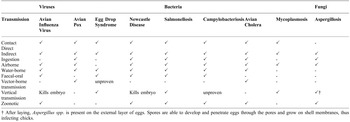
Vector transmission is likely the main process by which some diseases, such as avian pox and avian cholera (Table 2), are dispersed. Some of these vectors will be vulnerable to climate change (Parmesan and Yohe, Reference PARMESAN and YOHE2003; Ogden et al., Reference OGDEN, MAAROUF, BARKER, BIGRAS-POULIN, LINDSAY, MORSHED, O'CALLAGHAN, RAMAY, WALTNER-TOEWS and CHARRON2006). For instance, the primary mosquito vector (Culex quinquefasciatus) of avian pox is predicted to experience changes in population dynamics in response to climate change (Morin and Comrie, Reference MORIN and COMRIE2010). Using computer modelling, Morin and Comrie (Reference MORIN and COMRIE2010) found that future climate change will likely cause decreases in the population sizes of C. quinquefasciatus in different geographic areas or at different times in the season due to drier conditions.
Modes of transmission for important poultry diseases.

† After laying, Aspergillus spp. is present on the external layer of eggs. Spores are able to develop and penetrate eggs through the pores and grow on shell membranes, thus infecting chicks.
Although there is limited research investigating how climate change could affect vector-borne poultry diseases, there is an accumulating body of evidence demonstrating the effects of climate warming on non-poultry related vector-borne diseases. Therefore, for completeness, we have included in this review one example that highlights how climate change affects the movement of a vector and corresponding pathogen into a new area, and the role that migratory birds play in these distributional changes.
the effects of climate change on Ixodes scapularis and the spread of Lyme disease
The distribution of vector-borne diseases is determined by climate (Epstein, Reference EPSTEIN2004) and the geographical range of the vector and, when applicable, the vertebrate host (Hunter, Reference HUNTER2003). A review of published data conducted by Brinkerhoff et al. (Reference BRINKERHOFF, FOLSOM-O'KEEFE, TSAO and DIUK-WASSER2009) concluded that 70 North American passerine species are parasitized by the black-legged tick (Ixodes scapularis), a primary vector for the bacterium Borrelia burgdorferi (Brinkerhoff et al., Reference BRINKERHOFF, FOLSOM-O'KEEFE, TSAO and DIUK-WASSER2009; Hamer et al., Reference HAMER, TSAO, WALKER and HICKLING2010), and a potential carrier of Babesia microti and the rickettsial agent that causes human granulocytic ehrlichiosis (Varde et al., Reference VARDE, BECKLEY and SCHWARTZ1998). Ixodes scapularis has been experiencing range shifts northward (Ogden et al., Reference OGDEN, MAAROUF, BARKER, BIGRAS-POULIN, LINDSAY, MORSHED, O'CALLAGHAN, RAMAY, WALTNER-TOEWS and CHARRON2006), and will likely continue contracting its southern range margin while expanding further north into Canada (Ogden et al., Reference OGDEN, BOUCHARD, KURTENBACH, MARGOS, LINDSAY, TRUDEL, NGUON and MILORD2010). This shift northward is considered mainly a response to climate change, but migrants might also share some responsibility for the distributional change by carrying ticks into new areas. Brinkerhoff et al. (Reference BRINKERHOFF, FOLSOM-O'KEEFE, TSAO and DIUK-WASSER2009) found that 58.6% of the bird species tested were able to infect I. scapularis larvae with B. burgdorferi, suggesting that birds serve an important role in the range expansion of B. burgdorferi. However, the invasion B. burgdorferi into a new area does not necessarily require an established population of I. scapularis, as a study by Hamer et al. (Reference HAMER, TSAO, WALKER and HICKLING2010) investigating the expansion of I. scapularis and B. burgdorferi reported three outcomes: 1) I. scapularis was the first to invade a site; 2) I. scapularis and B. burgdorferi invaded concurrently; and 3) B. burgdorferi moved into a site first. In the last scenario, the author concluded that in the absence of I. scapularis, B. burgdorferi was transmitted by other vector-competent ticks. Furthermore, there were areas where the competent tick vector was present, but no recorded cases of B. burgdorferi were detected (Ostfeld and Keesing, Reference OSTFELD and KEESING2000). This illustrates the complex dynamics between vectors, hosts, and pathogens involved in disease emergence into new areas in the context of climate change.
Evaluating the impact of climate change on the dispersal of vector-borne disease
Although climate change will likely affect avian hosts, vector species, and disease agents, this does not necessarily imply a wider range for disease transmission (de La Rocque et al., Reference DE LA ROCQUE, RIOUX and SLINGENBERGH2008). In general, for disease transmission to occur there must be sufficient overlap in the distribution of the pathogen, reservoir host, and the vector (Ostfeld et al., Reference OSTFELD, GLASS and KEESING2005; Watts et al., Reference WATTS, PALMER, BOWMAN, IRVINE, SMITH and TRAVIS2009; Reisen, Reference REISEN2010). In the Lyme disease example, the incidence of disease depends much more on the number of pathogen-infected vectors than the presence and abundance of vectors (Ostfeld et al., Reference OSTFELD, GLASS and KEESING2005). Therefore, factors affecting the spatial distribution of reservoirs, vectors, and pathogens, such as habitat, landscape, and climate, will impact disease transmission (Watts et al., Reference WATTS, PALMER, BOWMAN, IRVINE, SMITH and TRAVIS2009). Climate change and variability might favour the creation of suitable ecological niches for emerging vector-borne pathogens; especially given that climate change and variability affect the ability of vectors, pathogens, and reservoirs to move into new habitats (de La Rocque et al., Reference DE LA ROCQUE, RIOUX and SLINGENBERGH2008). However, the effects of climate change on each of these factors is not synchronized (Gale et al., Reference GALE, DREW, PHIPPS, DAVID and WOOLDRIDGE2009); thus, it is difficult to predict future ranges and potential for successful transmission for vector-borne diseases (Gale et al., Reference GALE, DREW, PHIPPS, DAVID and WOOLDRIDGE2009).
It is also important to note that most pathogens have a temperature range for development; when the temperature falls below this threshold, replication does not occur, and when it rises above, development is highly modulated (de La Rocque et al., Reference DE LA ROCQUE, RIOUX and SLINGENBERGH2008). When the longevity of the vector exceeds the extrinsic incubation period of the pathogen, temperature is critical in determining the latitudinal and altitudinal limits of pathogen transmission (Jetten and Focks, Reference JETTEN and FOCKS1997). Climate change would likely influence pathogen distribution, with higher temperatures promoting pathogen replication and transmission in areas where they were previously too low to be sustainable for disease (Harvell et al., Reference HARVELL, MITCHELL, WARD, ALTIZER, DOBSON, OSTFELD and SAMUEL2002). However, for successful disease transmission to occur, temperatures must not exceed the biological thresholds for vector and pathogen survivorship and disease transmission (Lafferty, Reference LAFFERTY2009; Rosenthal, Reference ROSENTHAL2009). Therefore, even if climate change and the movement of migratory birds were introducing vectors and corresponding pathogens to new habitat, it does not necessarily mean that it will result in disease emergence; there are confounding and complex interactions between climate change and disease that must also be taken into account when evaluating the possibility of disease emergence (de La Rocque et al., Reference DE LA ROCQUE, RIOUX and SLINGENBERGH2008; Rohr et al., Reference ROHR, DOBSON, JOHNSON, KILPATRICK, PAULL, RAFFEL, RUIZ-MORENO and THOMAS2011). Although climate change is affecting vector species, avian migrants, and pathogens, to-date there is no evidence to suggest that it will significantly affect the poultry industry.
Risks of diseases affecting the Canadian poultry industry
As highlighted in Part I of this review, there is substantial evidence in the literature demonstrating the consequences of climate change, including increases in temperature (Vose et al., Reference VOSE, EASTERLING and GLEASON2005; Hansen et al., Reference HANSEN, SATO, RUEDY, LO, LEA and MEDINA-ELIZADE2006), rising sea level (Cazenave and Nerem, Reference CAZENAVE and NEREM2004; Bates et al., Reference BATES, KUNDZEWICZ, WU and PALUTIKOF2008; FitzGerald et al., Reference FITZGERALD, FENSTER, ARGOW and BUYNEVICH2008) changes in precipitation regimes (Wentz et al., Reference WENTZ, RICCIARDULLI, HILBURN and MEARS2007; Bates et al., Reference BATES, KUNDZEWICZ, WU and PALUTIKOF2008), increases in extreme weather events (Michener et al., Reference MICHENER, BLOOD, BILDSTEIN, BRINSON and GARDNER1997; Francis and Hengeveld, Reference FRANCIS and HENGEVELD1998), and redistribution of biomes (Scott et al., Reference SCOTT, MALCOLM and LEMIEUX2002; Walther et al., Reference WALTHER, POST, CONVEY, MENZEL, PARMESAN, BEEBEE, FROMENTIN, HOEGH-GULDBERG and BAIRLEIN2002; Parmesan and Yohe, Reference PARMESAN and YOHE2003). Furthermore, the effects of these changes on other biological organisms and their life strategies, such as birds and migration, are extensive and highly complex (Berthold, Reference BERTHOLD1996). Although the processes governing migration vary between different species, most birds demonstrate a considerable level of plasticity in their ability to change migratory behaviour in response to environmental changes (Berthold, Reference BERTHOLD1990; Pulido, Reference PULIDO2007). Evidence for this has already been documented as birds shift northward (Thomas and Lennon, Reference THOMAS and LENNON1999; Walther et al., Reference WALTHER, POST, CONVEY, MENZEL, PARMESAN, BEEBEE, FROMENTIN, HOEGH-GULDBERG and BAIRLEIN2002; Parmesan and Yohe, Reference PARMESAN and YOHE2003; Brommer, Reference BROMMER2004; Hitch and Leberg, Reference HITCH and LEBERG2007), alter distributions in response to climate change (Thomas and Lennon, Reference THOMAS and LENNON1999; Parmesan and Yohe, Reference PARMESAN and YOHE2003), and modify migratory activity, distances (Pulido, Reference PULIDO2007; Doswald et al., Reference DOSWALD, WILLIS, COLLINGHAM, PAIN, GREEN and HUNTLEY2009; Visser et al., Reference VISSER, PERDECK, VAN BALEN and BOTH2009), direction (Berthold, Reference BERTHOLD1990), destinations, and the timing of migration (Winkler et al., Reference WINKLER, DUNN and MCCULLOCH2002; Austin and Rehfisch, Reference AUSTIN and REHFISCH2005; Végvári et al., Reference VÉGVÁRI, BÓKONY, BARTA and KOVÁCS2010). When considering how birds are able to change migratory behaviour and distribution over time, their role in disease dispersal becomes a more apparent cause for concern. If climate change facilitates increased contact rates between wild birds and domestic poultry, it could increase the likelihood of disease-exchange between these groups (Table 2). After reviewing the available literature on the effects that climate-driven changes in avian migratory patterns will have on the introduction and spread of disease, we have summarized the potential impact these changes might have on commercial poultry below.
Evidence for increased risk
changes in avian migratory patterns and behaviour
Although many avian species demonstrate high levels of site fidelity (Berthold, Reference BERTHOLD2001), when birds are faced with reproductive failure, they will disperse into new habitats (Sorenson et al., Reference SORENSON, GOLDBERG, ROOT and ANDERSON1998; Johnson et al., Reference JOHNSON, MILLETT, GILMANOV, VOLDSETH, GUNTENSPERGEN and NAUGLE2005; Martin et al., Reference MARTIN, FRENCH and MAJOR2010). The effect of climate change will likely reduce the abundance and quality of breeding habitat and force migrants to disperse into new habitat more frequently (Chambers et al., Reference CHAMBERS, HUGHES and WESTON2005). With an increase in dispersal, birds could face a greater risk of encountering novel pathogens and parasites more frequently (Harvell et al., Reference HARVELL, ALTIZER, CATTADORI, HARRINGTON and WEIL2009), which could also lead to the dispersal of disease agents and/or vector parasites (ticks) into areas where they were previously absent or rare (Rappole et al., Reference RAPPOLE, DERRICKSON and HUBALEK2000; Malkinson et al., Reference MALKINSON, BANET, WEISMAN, POKAMUNSKI, KING, DROUET and DEUBEL2002; Ogden et al., Reference OGDEN, LINDSAY, HANINCOVA, BARKER, BIGRAS-POULIN, CHARRON, HEAGY, FRANCIS, O'CALLAGHAN, SCHWARTZ and THOMPSON2008).
changes in migratory distances and distribution
Migration, albeit physiologically stressful for the individual, can confer a variety of advantages by weeding out old, weak, and sick individuals from the population (Altizer et al., Reference ALTIZER, BARTEL and HAN2011). However, as the number of short-distance migrants forgoing migration and overwintering on the breeding grounds rises (Berthold, Reference BERTHOLD1999), the population density of avifauna communities could also increase, which could affect the transmission and amplification of disease in those areas (Hochachka and Dhondt, Reference HOCHACHKA and DHONDT2000).
Furthermore, many migrants are experiencing shifts in the proportion of individuals that display migratory behaviour, in addition to changes in migratory distances (Berthold, Reference BERTHOLD2001; Pulido, Reference PULIDO2007; Doswald et al., Reference DOSWALD, WILLIS, COLLINGHAM, PAIN, GREEN and HUNTLEY2009; Visser et al., Reference VISSER, PERDECK, VAN BALEN and BOTH2009). Many long-distance migrants are predicted to substantially increase migratory distances (Doswald et al., Reference DOSWALD, WILLIS, COLLINGHAM, PAIN, GREEN and HUNTLEY2009); these increases, coupled with a reduction in crucial staging habitat, could be exacerbating for many long-distance migrants. Birds will have to invest more energy into migration, which could result in higher susceptibility to disease. The risk of contracting an infection could also increase if birds are forced to crowd on limited staging habitat (Wobeser, Reference WOBESER1992).
changes on staging site usage in migrants
Climate change will continue to affect important migrant habitats, including wintering, breeding, and staging sites (Bairlein and Hüppop, Reference BAIRLEIN and HÜPPOP2004; Sehgal, Reference SEHGAL2010). For instance, climate change will likely reduce the abundance and quality of important shallow wetlands used by migratory waterfowl (Murkin et al., Reference MURKIN, MURKIN and BALL1997; Sorenson et al., Reference SORENSON, GOLDBERG, ROOT and ANDERSON1998). Stopover sites can serve as bottlenecks, whereby several different species rely on the same staging sites for rest and refueling (Webb et al., Reference WEBB, SMITH, VRTISKA and LAGRANGE2010; Cui et al., Reference CUI, HOU, XING, HE, LI, GUO, LUO, YAN, YIN and LEI2011; Prosser et al., Reference PROSSER, CUI, TAKEKAWA, TANG, HOU, COLLINS, YAN, HILL, LI, LI, LEI, GUO, XING, HE, ZHOU, DOUGLAS, PERRY and NEWMAN2011). In recent years, flocks reaching numbers greater than one million birds have been reportedly gathering at staging and wintering sites (Strong et al., Reference STRONG, GILMER and BRASS1991). These large crowds of waterfowl are likely a byproduct of limited habitat (Wobeser, Reference WOBESER1992). Crowding might increase the risk of disease transmission within and between wild and domestic flocks (Vandegrift et al., Reference VANDEGRIFT, SOKOLOW, DASZAK and KILPATRICK2010).
Additionally, it is likely that the species that make up migrant populations using certain stopover sites, such as the Prairie Pothole Region discussed in Part I, will change in response to climate warming. It is likely that species relying on wetlands will decrease and be replaced by those that are more human-commensal (Vandegrift et al., Reference VANDEGRIFT, SOKOLOW, DASZAK and KILPATRICK2010). This raises the question of whether these species will serve as efficient hosts; a factor that will be strongly influenced by changes in the interactions between hosts, vectors, and pathogens (Vandegrift et al., Reference VANDEGRIFT, SOKOLOW, DASZAK and KILPATRICK2010).
Evidence against increased risk
changes in avian migratory patterns and behaviour
Even though birds can modify migratory behaviour, there are reasons to explain why most migrants demonstrate high levels of site fidelity instead of dispersing into novel habitats (Berthold, Reference BERTHOLD2001). Specifically, birds might return to breeding and wintering grounds consistently each year because they are adapted to local parasites and pathogens in those areas (Møller and Szép, Reference MØLLER and SZÉP2011). Any advantages associated with dispersal are likely trumped by the significant risks of encountering new pathogens and parasites in new habitats (Harvell et al., Reference HARVELL, ALTIZER, CATTADORI, HARRINGTON and WEIL2009).
changes in migratory distances and distribution
Although many birds have shifted their distributions northward, there is no substantial evidence indicating that this could lead to an increase in the incidence and prevalence of disease outbreaks in Canada. Even under circumstances where birds could potentially introduce vectors or disease agents into new areas, this does not guarantee an extension of the transmission region (de La Rocque et al., Reference DE LA ROCQUE, RIOUX and SLINGENBERGH2008). Climate change will likely influence other factors that affect disease range and transmission, including environmental conditions, habitat, and the distribution of corresponding vector and/or reservoir species (de La Rocque et al., Reference DE LA ROCQUE, RIOUX and SLINGENBERGH2008). However, the effects of climate change will not be equal or synchronized for each of these elements (Gale et al., Reference GALE, DREW, PHIPPS, DAVID and WOOLDRIDGE2009).
Furthermore, although some long-distance migrants are expected to increase migratory distances (Doswald et al., Reference DOSWALD, WILLIS, COLLINGHAM, PAIN, GREEN and HUNTLEY2009), which could lead to the introduction of vectors and/or disease agents into new areas, there is no significant evidence to indicate that this will pose any substantial threat to the poultry industry. Many long-distance migrants are experiencing population declines that appear be linked to climate change, which could reduce any risks they present in the introduction and perpetuation of disease (Both et al., Reference BOTH, BOUWHUIS, LESSELLS and VISSER2006; Nebel et al., Reference NEBEL, MILLS, MCCRACKEN and TAYLOR2010).
changes on staging site usage in migrants
The impact of climate change will likely decrease the quality and abundance of important migrant habitats, including staging sites (Bairlein and Hüppop, Reference BAIRLEIN and HÜPPOP2004; Sehgal, Reference SEHGAL2010). Consequently, migratory birds might begin to crowd on substandard habitats, potentially increasing contact rates within and between different bird species (Vandegrift et al., Reference VANDEGRIFT, SOKOLOW, DASZAK and KILPATRICK2010). However, evidence demonstrating the effect of crowding on disease transmission is limited (Tsiodras et al., Reference TSIODRAS, KELESIDIS, KELESIDIS, BAUCHINGER and FALAGAS2008). Although there might initially be crowding on limited staging and breeding habitat that could increase contact rates between wild and domestic fowl (Vandegrift et al., Reference VANDEGRIFT, SOKOLOW, DASZAK and KILPATRICK2010), the long-term projections forecast a decrease in many bird populations, including waterfowl and long-distance migrants (Sorenson et al., Reference SORENSON, GOLDBERG, ROOT and ANDERSON1998), which could substantially reduce any risks resulting from crowding.
Conclusions
Although many of the scenarios discussed in Part II remain speculative, they illustrate the complexity and the specificity involved in assessing risk. Ample evidence supports that birds are shifting their distributions northward and changing migration strategies in response to climate change; however, their role in the perpetuation of disease is unclear. Even in the event that climate change contributes to an increase in the introduction of bird-borne pathogens into Canada, based on a review of the available literature, it is difficult to predict whether this will translate into an increased occurrence of disease for the poultry industry. Outbreaks are likely to become more unpredictable, which will complicate efforts to identify periods and areas of high risk.
A recent study in Canada that documented wild bird activity on poultry farms identified ten wild bird species that should be targeted for influenza A, avian virus surveillance based on the relative abundance of various wild bird species found on poultry farms and how these species utilized habitat around poultry farms (Burns et al., Reference BURNS, RIBBLE, STEPHEN, KELTON, TOEWS, OSTERHOLD and WHEELER2012). Furthermore, the abundance of these and other wild bird species varied between provinces and seasons (Burns et al., Reference BURNS, RIBBLE, STEPHEN, KELTON, TOEWS, OSTERHOLD and WHEELER2012), suggesting that regional and seasonal factors must be factored into surveillance activities, which will improve our ability to predict disease outbreaks.
Further research should be aimed at 1) investigating the role of wild birds in disease dispersal and 2) identifying which wild bird species are at a higher risk of coming into contact with poultry and transmitting commercially-relevant diseases. Farms in close proximity to high risk areas should be under close surveillance, especially during periods when there is a higher risk of disease outbreaks. High risk areas include regions that have higher traffic of migratory waterfowl, areas where multiple flyways intersect and increase the risk that birds from different geographic regions intermingle and spread disease agents, and stopover sites where large densities of different species intermingle during migration (Davis et al., Reference DAVIS, DOHERTY, GILBERT, REESE, WILSON, FARNSWORTH, MILLER, FRANKLIN, MCLEAN, PIAGGIO, HOETING, MERTON and WEBB2009). Furthermore, close monitoring of sentinel species will help prevent large scale outbreaks by providing a means of early detection. Ensuring that proper biosecurity measures are practiced on poultry farms, as recommended by the National Avian On-Farm Biosecurity Standard (CFIA, Reference CFIA2009), remains a key strategy in disease prevention. The pros and cons of vaccination of commercial and small flocks that are at higher risk of exposure (such as domestic fowl with access to the outdoors that could come into contact with wild birds) in high risk areas (based on surveillance) in high risk seasons, should be included in risk management discussions.