1. Introduction
The latest stages of the Caledonian and the earliest stages of Variscan orogenic cycles that affected the marginal zone of the Old Red Continent in southern Poland are still unsatisfactorily recognized. In some places they are expressed by a tectonic discordance (Kowalczewski & Lisik, Reference Kowalski1974; Buła, Reference Buła2000), coarse-grained deposits along the major fault zones (Buła, Reference Buła2000; Malec, Reference Malinowski, Żelaźniewicz, Grad, Guterch and Janik2001) and magmatic bodies (Nawrocki et al. Reference Nawrocki, Żylińska, Buła, Grabowski, Krzywiec and Poprawa2013). This area consists of two tectonostratigraphic units, the Małopolska Terrane (MT) and the neighbouring Brunovistulian Terrane (BVT) (e.g. Dudek, Reference Dudek1980; Belka et al. Reference Belka, Valverde-Vaquero, Dörr, Ahrendt, Wemmer, Franke, Schäfer, Winchester, Pharaoh and Verniers2002; Żelaźniewicz et al. Reference Żelaźniewicz, Buła, Fanning, Seghedi and Żaba2009). Several magmatic bodies were penetrated by the boreholes located in the border area of both units defined by the NW-trending, crustal-scale Kraków–Lubliniec Fault Zone (e.g. Żaba, Reference Żaba1999; Malinowski et al. Reference Mazur, Kröner and Szczepański2005). Mafic intrusions were also drilled by the deep borehole of Goczałkowice IG-1 and Sosnowiec IG-1, located c. 50 km from this zone (Fig. 1a). However, the poor age constraints on the pre-late Carboniferous magmatic activity in the area of the BVT make the relationship of these processes with the tectonic evolution of Central Europe unclear.
(a) The location of sites for U–Pb age estimation on a terrane map of Poland (see Nawrocki, Reference Nawrocki, Krzemiński and Pańczyk2015) (CDF – Caledonian Deformation Front; LTT – Teisseyre–Tornquist tectonic line; GF – Grójec Fault; DFZ – Dolsk Fault Zone; OF – Odra Fault; KLFZ – Kraków–Lubliniec Fault Zone; MTL – Moravian Tectonic Line; HCF – Holy Cross Fault; SD – Sosnowiec IG-1 borehole with diorite intrusion; BD – Bardo diabase; LC – Łapczyca conglomerate; MC – Miedziana Góra conglomerate; GC – Gruchawka conglomerate; P – Podłazie; U – Ujazd). (b) Main palaeotectonic regions of the Palaeozoic core of the Holy Cross Mountains (Czarnocki, Reference Czarnocki1938).

The aim of this paper is to provide a reliable and accurate age of prominent diorite intrusion from the BVT drilled in the Sosnowiec IG-1 borehole, using U–Pb zircon single grain dating. The next aim is to ascertain if this intrusion and another extensive mafic intrusion from the Bardo syncline in the MT were emplaced during approximately the same extensional event at the turn of Silurian and Devonian. Both intrusions have a distinct signature of anorogenic magmatics, typical of continental extensional settings (Krzemiński, Reference Kusiak, Kędzior, Paszkowski, Suzuki, Gonzalez-Alvarez, Wajsprych and Doktor2004).
Additionally, we examined ages of zircons derived from the early Emsian tuffs cropping out among Emsian clastic rocks in the southern region of the Holy Cross Mountains, in order to define the source of tuffs and zircons, and to check whether they fit with existing knowledge about the early Devonian palaeogeography of neighbouring areas. Finally, we attempt to link the studied magmatic activity with continental-scale processes operating at the margin of the Old Red Continent at the transition from the Caledonian to Variscan cycle.
2. Geological setting
The BVT, comprising the Upper Silesian Block, is a complex terrane that was consolidated in the Neoproterozoic (e.g. Dudek, Reference Dudek1980; Żelaźniewicz et al. Reference Żelaźniewicz, Buła, Fanning, Seghedi and Żaba2009). Palaeozoic rocks of the BVT in the Kraków–Lubliniec Fault Zone were disturbed by strike-slip motions during two periods: firstly at the end of the Silurian (sinistral transpression) and later during the late Carboniferous (dextral transpression and transtension) (Bogacz & Krokowski, Reference Bogacz and Krokowski1981; Żaba, Reference Żaba1999). Winchester et al. (Reference Winchester2002) have defined the MT as a Neoproterozoic accretionary prism of the BVT and pointed out that both terranes were always close to each other and the Baltica palaeocontinent. In fact, the lithostratigraphic and structural records on both sides of the KLFZ became similar from the Emsian (Buła, Reference Buła2000). The Emsian cover of the ‘old red’ type deposits may indicate that final amalgamation of the BVT took place sometime between the Silurian and Devonian (e.g. Dadlez, Reference Dadlez1995; Belka et al. Reference Belka, Valverde-Vaquero, Dörr, Ahrendt, Wemmer, Franke, Schäfer, Winchester, Pharaoh and Verniers2002; Nawrocki et al. Reference Oncken, von Winterfeld and Dittmar2004). The proximity of the BVT and MT since the Emsian can be inferred from the distribution of particular ‘old red’ facies (Pajchlowa & Miłaczewski, Reference Pajchlowa, Miłaczewski, Czermiński and Pajchlowa1974). An argument for a substantially older spatial linkage of both terranes arises from their Cambrian trilobite faunas. The trilobite Schmidiellus panowi (Samsonowicz) found in the Cambrian sediments of the Holy Cross Mountains (belonging to the MT) and Upper Silesia is endemic at the species level to both areas (Żylińska, Reference Żylińska2002; Nawrocki et al. Reference Oncken, von Winterfeld and Dittmar2004), and at the genus level points to a link with Baltica (Żylińska, Reference Żylińska2002). Many authors postulate a peri-Gondwana origin of the BVT, hence its link with the South American (Hegner & Kröner, Reference Hegner, Kröner, Franke, Haak, Oncken and Tanner2000; Friedl et al. Reference Friedl, Fritz, Von Quadt, McNaughton and Fletcher2001; Belka et al. Reference Belka, Valverde-Vaquero, Dörr, Ahrendt, Wemmer, Franke, Schäfer, Winchester, Pharaoh and Verniers2002; Mazur et al. Reference Moczydłowska2010; Walczak & Bełka, Reference Walczak and Bełka2017) or African part of the peri-Gondwana orogenic belt (Unrug et al. Reference Unrug, Harańczyk and Chocyk-Jamińska1999; Leichman & Höck, Reference Linnemann, Herbosch, Liégeois, Pin, Gärtner and Hofmann2001). Moczydłowska (Reference Nawrocki1997) has defined the BVT as part of East Avalonia. On the other hand, some authors postulate a peri-Baltic initial location of the BVT, i.e. near the Uralian margin of this palaeocontinent (Fatka & Vavrdova, Reference Fatka and Vavrdova1998) or close to its southern present-day edge that was also involved in the Neoproterozoic peri-Gondwana orogen (Winchester et al. Reference Winchester2002; Nawrocki et al. Reference Oncken, von Winterfeld and Dittmar2004). The MT is defined by most authors as always linked with the Baltica foreland (e.g. Dadlez, Reference Dadlez1995; Nawrocki & Poprawa, Reference Nawrocki, Salwa and Pańczyk2006; Żelaźniewicz et al. Reference Żelaźniewicz, Buła, Fanning, Seghedi and Żaba2009) or peri-Gondwana that collided with Baltica in the early Palaeozoic before the collision with Avalonia (Belka et al. Reference Belka, Valverde-Vaquero, Dörr, Ahrendt, Wemmer, Franke, Schäfer, Winchester, Pharaoh and Verniers2002; Walczak & Bełka, Reference Walczak and Bełka2017). Palaeomagnetic data (Nawrocki, Reference Nawrocki2000; Shatz et al. Reference Shatz, Zwing, Tait, Belka, Soffel and Bachtadse2006) suggest that large-scale wandering of the MT, if it occurred, must have ended before the Late Ordovician. During the Variscan orogeny, the BVT represented the lower plate of the southern margin of the Old Red Continent, involved in the collision with the Armorican Terrane Assemblage (e.g. Kalvoda et al. Reference Kowalczewski and Lisik2008).
Along the boundary between the BVT and MT, several late Carboniferous – early Permian magmatic bodies have been penetrated by boreholes (e.g. Buła, Reference Buła2000; Żelaźniewicz et al. Reference Żelaźniewicz, Pańczyk, Nawrocki and Fanning2008; Nawrocki et al. Reference Nawrocki and Poprawa2010; Słaby et al. Reference Słaby, Breitkreuz, Żaba, Domańska-Siuda, Gaidzik, Falenty and Falenty2010). Mafic intrusions have also been drilled in the area of the BVT c. 50 km from the KLFZ. A diabase–diorite polycyclic intrusion of c. 90 m thickness, drilled here in the Sosnowiec IG-1 borehole, cuts Middle Cambrian clastic rocks. Samples from the dioritic parts of this intrusion gave a 40Ar–39Ar plateau age of 399.4 ± 1.8 Ma, obtained on an amphibole concentrate, but the whole-rock 40Ar–39Ar dating of the diabase part of the same intrusion revealed a plateau age of 289.1 ± 1.8 Ma (Nawrocki et al. Reference Nawrocki and Poprawa2010).
The most extensive mafic intrusion recognized in the area of the MT fills the Bardo Syncline in the Kielce Region of the Holy Cross Mountains. (Fig. 1a, b). This diabase is up to 30 m thick and penetrates Silurian rocks of the syncline, close to the stratigraphic boundary between Gorstian graptolite shales and Ludfordian greywackes (Kowalczewski & Lisik, Reference Kowalski1974). A relatively precise age of the Bardo intrusion was inferred from the comparison of the 40Ar–39Ar isotope dating and the normal polarity palaeomagnetic record that was correlated with the global polarity timescale (Nawrocki et al. Reference Nawrocki, Żylińska, Buła, Grabowski, Krzywiec and Poprawa2013). According to these data, the intrusion was formed in the age interval between 425 and 417 Ma, preceding the late Lochkovian tectonic event expressed in the Holy Cross Mountains by the Gruchawka Conglomerates, and the tectonic unconformity observed in the Bardo Syncline where the Silurian strata were more intensively folded than the overlying Emsian sandstones (Kowalczewski & Lisik, Reference Kowalski1974; Malec, Reference Malinowski, Żelaźniewicz, Grad, Guterch and Janik2001).
Silurian (438 ± 16 Ma) magmatic activity has been documented through K–Ar dating of a basalt vein intruding into the Brunovistulian basement in Moravia (Přichystal, Reference Přichystal1999). S Hoenig (unpub. PhD thesis, Masaryk Univ., Brno, 2016) links the extensional anorogenic magmatism recognized in this part of the BVT with the Silurian subduction. The magmatic activity or metamorphism of Silurian age is also supported by common occurrences of Silurian micas and monazites in Carboniferous sedimentary sequences (Kusiak et al. Reference Leichman and Höck2006). The Quenast quartz–diorite from the Brabant Massif c. 430 Ma old (Linnemann et al. Reference Ludwig2012) might be regarded as a distant correlative.
3. Material and methods
One sample for U–Pb dating of zircon grains was collected from massive, granophyric diorite drilled in the Sosnowiec IG-1 borehole (Fig. 2; sample depth 3259.5 m) which comprises mostly altered plagioclases and amphiboles affected by chloritization (Krzemiński, Reference Kusiak, Kędzior, Paszkowski, Suzuki, Gonzalez-Alvarez, Wajsprych and Doktor2004; Nawrocki et al. Reference Nawrocki and Poprawa2010). These pyroxene and amphibole diorite samples on the Zr/TiO2 – Nb/Y classification diagram plot within the basaltic-andesite field and have a high Fe/Mg ratio and silica content indicating a tholeiitic affinity (Krzemiński, Reference Kusiak, Kędzior, Paszkowski, Suzuki, Gonzalez-Alvarez, Wajsprych and Doktor2004).
Lithological columns of Middle Cambrian rocks drilled in the Sosnowiec IG-1 borehole and Emsian rocks cropping out in Podłazie and Ujazd with stratigraphic succession from the Holy Cross Mountains. Locations of samples for U–Pb age estimation of zircon grains are marked.

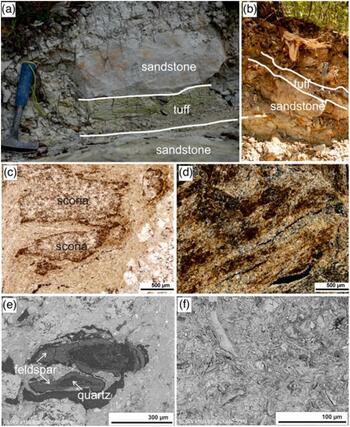
Four samples for U–Pb dating of detrital zircon grains were taken from the Emsian tuffs of the Holy Cross Mountains. These tuffs were sampled in the Podłazie and Ujazd sections (Figs 2, 3a, b). Based on miospores and tephro-correlation, the succession from Podłazie is considered to be Emsian in age (Tarnowska, Reference Tarnowska1976; Szulczewski & Porębski, Reference Szulczewski, Porębski, Pieńkowski and Uchman2008), and belongs to the lower part of the Winna Formation (see Fijałkowska-Mader & Malec, Reference Fijałkowska-Mader and Malec2011). The section is composed of sandstones, mudstones and tuffs. The light-grey, strongly altered tuffs can exceed 15 cm in thickness. The second studied section, Ujazd near Iwaniska, is located in the same Kielce Region of the Holy Cross Mountains. This section is composed of sandstones interbedded with light-grey, strongly altered tuffs (up to 20 cm thick). In this locality some poorly preserved vertebrate remains were found. They represent sarcopterygians and placoderms corresponding to the assemblage from the Podłazie locality (Szrek & Dupret, Reference Szrek and Dupret2017). This suggests the similar stratigraphic position of this section. Bearing in mind the Emsian age of the whole Winna Formation (see e.g. Wójcik, Reference Wójcik2015), we assume that the age of the studied section should correspond approximately to 405 Ma (see Gradstein et al. Reference Gradstein, Ogg, Schmitz and Ogg2012). The strongly altered tuffs (bentonites) from both sections are composed of former glassy ash, single crystals of quartz, rock fragments of volcanic origin (presumably scoriae) as well as opaque minerals and zircon grains (Fig. 3c–f). The clasts of volcanogenic rocks are strongly altered and compacted without any phenocrysts of quartz and other minerals. The altered glass shards and fragments of volcanogenic rocks consist of kaolinite, illite and other phyllosilicate minerals. Because of extensive alteration processes, the phenocrysts or phenoclasts of mafic minerals such as olivine and pyroxene are not observed. Additional particles of epiclastic origin, including small grains of quartz and fragments of claystones, are also rarely observed. Amygdales are filled by quartz and feldspar.
(a) Sandstones interbedded with the light-grey, strongly altered tuffs in the Ujazd section. (b) The tuff layer in the Podłazie section. (c–f) Microphotographs of tuffs from Podłazie: volcanic clasts (scoria) surrounded by strongly altered ash (parallel polars) (c); strongly altered ash (crossed polars) (d); amygdaloids infilled by quartz and feldspar (backscatter electron image, BSE) (e); and strongly altered ash – mixture of kaolinite, illite and other phyllosilicate minerals and quartz (BSE) (f).

A sample of subvolcanic rock from the Sosnowiec IG-1 borehole (named: S) and four samples of tuffs from Podłazie (named: Pod-10, Pod-26, Pod- 30) and Ujazd (named: U-6) were crushed and sieved for zircon separation. Heavy mineral fractions were separated using conventional heavy-liquid and magnetic techniques. All hand-picked zircons from the studied samples, and several grains of the TEMORA standard and two grains of the SL13 zircons standard were cast into an epoxy mount. These were polished and observed using an optical microscope (reflected and transmitted light), then imaged by cathodoluminescence (CL) using a Hitachi SU3500 scanning electron microscope (SEM) for evaluation of the zircons from the Sosnowiec subvolcanic rocks and a Zaiss EVO 10 SEM for zircons separated from tuffs. The CL images were used to characterize the zircon grains and select locations for isotope analyses. The sample from the Sosnowiec IG-1 borehole was analysed using a SHRIMP IIe/MC ion microprobe in the Micro-area Analysis Laboratory of the Polish Geological Institute – NRI, whereas the zircons separated from the tuffs were analysed using a SHRIMP IIe/MC ion microprobe at the IBERSIMS Lab (University of Granada, Spain). The analytical procedures for both instruments were based on those described by Williams & Claesson (Reference Williams and Claesson1987).
Analytical conditions used for investigation of the sample were as follow: 3 nA negative O2− primary ion beam focused to c. 25 µm diameter spot; mass resolution c. 5500; isotope ratio measurement by single electron multiplier and cyclic peak stepping. The selected spots were analysed over seven scans (196Zr2O – 2 s; 204Pb – 10 s; 204.1background – 10 s; 206Pb – 15 s; 207Pb – 20 s; 208Pb – 15 s; 238U – 10 s; 248ThO – 5 s; 254UO – 5 s). The TEMORA standard was measured every three spots. The data for the sample were reduced in a manner similar to that presented by Williams (Reference Williams, McKibben, Shanks III and Ridley1998, and references therein), using the SQUID Excel Macro of Ludwig (Reference Ludwig2000). Data reduction for the tuffs was done with the SHRIMPTOOLS software, specifically developed for IBERSIMS by F. Bea. Plots of SHRIMP results use ISOPLOT/EX (Ludwig, Reference Malec2003) including a Tera–Wasserburg plot (Tera & Wasserburg, Reference Tera and Wasserburg1972) 238U/206Pb vs 207Pb/206Pb using data corrected for common Pb and probability density distribution plots for each sample. Ages were calculated using the constants recommended by the International Union of Geological Sciences (IUGS) Subcommission on Geochronology (Steiger & Jäger, Reference Steiger and Jäger1977).
4. Results of U–Pb dating
Results of our isotope studies are summarized in Tables 1 and 2. The zircon population from the Sosnowiec subvolcanic rocks is homogeneous and ranges from 80 to 120 µm in length. Almost all zircons are transparent and unzoned in CL images, with elongated prismatic crystals (Fig. 4a). Only two crystals from 37 separated grains are different: they are rounded, with evidence of dissolution and fragments of complicated zoning texture. The homogeneous, unzoned zircons from the Sosnowiec rocks have moderate U and Th contents (513–959 ppm and 373–1129 ppm, respectively) and typical Th/U ratio for igneous rocks, ranging from 0.74 up to 1.17. The SHRIMP results (Fig. 4b) are concordant and the calculated concordia age is 420 ± 2 Ma (mean square weighted deviation (MSWD) = 0.057, probability = 0.81, n = 16 after excluding zircons with discordance >10 and results with high error). Two inherited grains of zircon have lower Th/U ratios, 0.38 and 0.21, and lower concentrations of Th and U. These much older zircons provided ages of 1676 ± 16 and 970 ± 13 Ma (Table 1).
Age estimation of zircon grains from the Sosnowiec diorite

Errors are 1-sigma; Pbc and Pb* indicate the common and radiogenic portions, respectively.
Error in standard calibration was 0.15 % (not included in above errors but required when comparing data from different mounts).
(1) Common Pb corrected using measured 204Pb.
Age estimation of detrital zircons from Podłazie and Ujazd

Errors are 1-sigma; Pbc and Pb* indicate the common and radiogenic portions, respectively.
Error in standard calibration was 0.14 %.
(a) Representative CL images of zircon crystals from the diorite in the Sosnowiec IG-1 borehole with location of analysed spots and obtained isotope ages. (b) Results of U–Pb isotope studies of magmatic zircons from the Sosnowiec diorite presented as a concordia plot.

The zircons separated from the tuff samples are not homogeneous. Generally, they range from 50 to 150 µm in length. Most of them are transparent, pale-coloured and rounded (Fig. 5a). We were unable to identify a homogeneous subpopulation within any tuff samples. The CL images show a spectrum of textures including oscillatory as well as sector-zoning crystals with inherited cores and metamorphic grains with evidence of dissolution. Euhedral prismatic crystals with slightly rounded shapes occur rarely. The detrital zircons from the tuffs in both outcrops show a wide spectrum of concordant ages (Fig. 5b). Most of them are enclosed between 1 and 1.8 Ga where the two intervals of highest frequency (c. 1–1.2 Ga and 1.4–1.8 Ga) can be observed (Fig. 5c). Evidently, younger and older ages were defined for single crystals only. They correspond to c. 0.4, 0.6, 2.2, 2.6 and 3 Ga.
(a) Representative CL images of zircon crystals from Emsian tuffs sampled in Podłazie and Ujazd with location of the analysed spots and obtained isotope ages. (b) Results of U–Pb isotope studies of detrital zircons from Podłazie and Ujazd shown as concordia plots. (c) Probability density diagrams of U–Pb ages of detrital zircons from Podłazie and Ujazd.

5. Discussion
The U–Pb age for zircons from the diorite, and results of earlier age estimation of the Bardo diabase (Nawrocki et al. Reference Nawrocki, Żylińska, Buła, Grabowski, Krzywiec and Poprawa2013), clearly indicate that these magmatic bodies were emplaced at approximately the same time, i.e. close to the Silurian/Devonian boundary. These intrusions point to extensional processes at the Silurian/Devonian boundary (Krzemiński, Reference Kusiak, Kędzior, Paszkowski, Suzuki, Gonzalez-Alvarez, Wajsprych and Doktor2004) common for both the BVT and the MT which must have been situated close to each other at least since the latest Silurian, forming the marginal part of the Old Red Continent. The geochemical features of both intrusions are generally similar (Krzemiński, Reference Kusiak, Kędzior, Paszkowski, Suzuki, Gonzalez-Alvarez, Wajsprych and Doktor2004). They display a negative Nb anomaly. This can indicate a contribution of a ‘subduction component’ in the source or crustal contamination (e.g. Pin & Marini, Reference Pin and Marini1993). However, assimilation of crustal material did not occur on a large scale, as manifested by low large-ion lithopile elements and SiO2 contents (Krzemiński, Reference Kusiak, Kędzior, Paszkowski, Suzuki, Gonzalez-Alvarez, Wajsprych and Doktor2004). Because of this, the negative Nb anomaly arose in these rocks most probably during subduction. This ‘subduction component’ was primarily interpreted as having originated in the lithospheric mantle due to late Proterozoic subduction of the Tornquist Sea under the Gondwana active margin (Krzemiński, Reference Kusiak, Kędzior, Paszkowski, Suzuki, Gonzalez-Alvarez, Wajsprych and Doktor2004). In some parts of the MT, the Silurian/Devonian tectonic activity is documented by coarse-grained deposits. After the early Ludlow and before the ‘old red’ type (Pragian? – Emsian) sedimentation, the Łapczyca, Miedziana Góra and Gruchawka conglomerates (Fig. 6) were deposited close to the zones of the main dislocations that separate the MT from the BVT and from the Łysogóry terrane (Kowalski, Reference Kozłowski, Domańska-Siuda and Nawrocki1983; Buła, Reference Buła2000; Malec, Reference Malinowski, Żelaźniewicz, Grad, Guterch and Janik2001). Clastic rocks of the Łapczyca Formation were tectonically deformed and tilted up to 60°, which is significantly more than for overlying rocks (Buła, Reference Buła2000). A tectonic discordance between Silurian and Emsian strata also occurs at the NE margin of the MT (Kowalczewski & Lisik, Reference Kowalski1974).
Stratigraphy around the Silurian/Devonian boundary in the marginal parts of the Małopolska and Brunovistulia terranes. Stratigraphic positions of mafic intrusions from both terranes are marked by the grey belt. Changes of tectonic regime (Żaba, Reference Żaba1999) are also shown.

Lack of Lower Devonian zircons and phenocrysts of quartz in tuffs from Ujazd and Podłazie indicates derivation most probably from a mafic type of volcanic source. The age spectrum of detrital zircons from these localities points to their Baltic (Sveconorwegian and Transscandinavian) derivation, with the two characteristic frequency peaks at c. 1 Ga and 1.6 Ga (see e.g. Zeh & Gerdes, Reference Zeh and Gerdes2010; Willner et al. Reference Willner, Barr, Gerdes, Massonne and White2013). Neoproterozoic and early Palaeozoic ages were only found in two single grains from the Podłazie section (Fig. 5c; Table 2). The tuffs could not be derived from the neighbouring part of Baltica since Emsian volcanic activity has not been documented in that area. The zircons from the Podłazie and Ujazd sections were most probably derived from the Rheno-Hercynian Zone (RHZ) where bimodal volcanism is documented. According to Zeh & Gerdes (Reference Zeh and Gerdes2010), part of the RHZ with the Avalonian basement was covered by detritus derived from Baltica in the Early Devonian. Zircons from these sediments and the Avalonian basement were reworked during volcanic eruptions producing tuffs that were deposited in the area of the Holy Cross Mountains. Given the quite large size of these zircons, the distance of their air transportation was most probably not longer than 1000 km (see e.g. Stevenson et al. Reference Stevenson, Millington, Beckett, Swindles and Thordarson2015).
The geochronological data obtained can be considered in terms of the tectonic evolution of post-Caledonian Europe. They fit well with the tectonic models by Kroner et al. (Reference Krzemiński2007) and Franke et al. (Reference Franke, Cocks and Torsvik2017) that are shown in Figure 7. Magmatic intrusions emplaced close to the Silurian/Devonian boundary in the area of the BVT and MT were associated with extensional processes that must have been linked temporally and spatially with the closure of the Rheic Ocean and simultaneous opening of the Rheno-Hercynian Basin, and finally the Rheno-Hercynian Ocean. However, the extension that affected the BVT and MT was too weak to open an oceanic basin. This extensional event was followed by short-lived sinistral transpression (Żaba, Reference Żaba1999) and most probably translation in a southeastward direction of the BVT and MT (see Kozłowski et al. Reference Kroner, Hahn, Romer, Linnemann, Linnemann, Nance, Kraft and Zulauf2014). Further extension in this area (Żaba, Reference Żaba1999) and in the Rheno-Hercynian Basin, with its peak in the Emsian (Oncken et al. Reference Oncken, von Winterfeld and Dittmar1999), was accompanied by the bimodal volcanic activity (Penfound-Marks & Shail, Reference Penfound-Marks and Shail2015) which caused tuff sedimentation in the Emsian of the Holy Cross Mountains. Since both tectonic blocks were close to an early Variscan subduction zone (Kroner et al. Reference Krzemiński2007), the negative Nb anomaly noted in the mafic rocks from the BVT and MT (Krzemiński, Reference Kusiak, Kędzior, Paszkowski, Suzuki, Gonzalez-Alvarez, Wajsprych and Doktor2004) might have been a consequence of Palaeozoic subduction of the Rheic Ocean. According to the reconstruction of Franke et al. (Reference Franke, Cocks and Torsvik2017), the Sosnowiec diorite and the Bardo diabase could be linked with the back-arc extension proposed c. 425–410 Ma ago in the marginal (Avalonian) part of the Old Red Continent (Fig. 7b). These intrusions cannot be directly connected with the opening of the Rheno-Hercynian Ocean that started in the Emsian (Franke et al. Reference Franke, Cocks and Torsvik2017), i.e. at least 12 Ma later than the emplacement of intrusions within the BVT and MT.
(a) Onset of oblique subduction and collision processes along the European segment of the Rheic suture (schematic map modified after Kroner et al. Reference Krzemiński2007) and simplified geotectonic cross-section (lower part of figure) through the German part of the Reno-Hercynian Basin in the Lower Devonian (slightly modified after Zeh & Gerdes, Reference Zeh and Gerdes2010). (b) Late Silurian and Early Devonian palaeogeography of the European part of the Rheic Ocean and the cross-sections (lower part of figure) illustrating the plate-tectonic evolution in the central European segment of the Variscides during Late Silurian to Early Devonian (after Franke et al. Reference Franke, Cocks and Torsvik2017; simplified). BVT – Brunosilesia Terrane, MT – Małopolska Terrane, BD – Bardo diabase, SD – Sosnowiec diorite.

6. Conclusions
The U–Pb age of diorite intrusion (420 ± 2 Ma) from the northern part of the BVT is comparable with the combined Ar–Ar and magnetostratigraphic age of the Bardo diabase intrusion (425–417 Ma) from the northern part of the MT. These intrusions were emplaced during the same event of regional tectonic extension at the Silurian/Devonian boundary. This event was most probably associated with the Rheic Ocean closure in this part of Europe already proposed by S Hoenig (unpub. PhD thesis, Masaryk Univ., Brno, 2016) and with the onset of extension forming the Rheno-Hercynian Basin. The tectonic extension in the BVT and MT was too weak to open an oceanic domain. The negative Nb anomaly characteristic of both intrusions could be linked with Palaeozoic subduction of the Rheic Ocean under the SE margin of the Old Red Continent. Traces of younger, i.e. Emsian, magmatic activity in the Rheno-Hercynian Basin were recorded in the northern part of the MT where several horizons of tuffaceous horizons occur within the clastic rocks of this age. Volcanic ashes were transported to the MT from the Rheno-Hercynian domain, where the eruptions most probably had a mafic composition. The magma assimilated detrital zircons from a sedimentary succession of Baltica provenance that was derived from western and central Scandinavia and laid down at the margin of the Rheno-Hercynian Ocean.
Author ORCIDs
Jerzy Nawrocki, 0000-0002-9644-0224; Piotr Szrek, 0000-0001-9855-2003
Acknowledgements
Financial support for this study was provided by the Polish Geological Institute – NRI. We are grateful to Mark Hounslow (Lancaster University) for substantial improvement of the English of the manuscript. Three anonymous reviewers, Prof. Christian Pin and Prof. Ulf Linnemann are thanked for valuable remarks. We also thank Prof. Ian Williams for discussion of our U–Pb data and Paweł Derkowski for help in BSE imaging.