Introduction
In biological control programmes against arthropod pests, it is imperative that attack by prospective agents on native species be tested, and that plans be developed to assess non-target impacts after agent release. However, these requirements can be hindered by a lack of knowledge of the host plants of putative non-target species. Developing this essential natural history knowledge is an important component of a biological control programme.
In developing a biological control program against the cabbage seedpod weevil, Ceutorhynchus obstrictus (Marsham) (Coleoptera: Curculionidae), it became apparent that major knowledge gaps existed with respect to the natural history and ecology of species of the genus Ceutorhynchus Germar in North America. The genus includes ~400 species worldwide (Colonnelli Reference Colonnelli2004). In North America, there are 68 described species (Anderson Reference Anderson2002), an estimated 32 of which occur in Canada (Bousquet et al. Reference Bousquet, Bouchard, Davies and Sikes2013). However, larval host plants were known for only six of these Canadian species. Adequate host range tests and plans for long-term monitoring of non-target impacts required a much more comprehensive knowledge of the ecology and natural history of non-target Ceutorhynchus.
The Ceutorhynchus species that are most likely to be attacked by parasitoids released against C. obstrictus are those that feed as larvae, in pods of Brassicaceae, in a manner similar to C. obstrictus. The mature larvae of C. obstrictus produce exit holes in pod walls, and drop from the pod to pupate in the soil. These exit holes are circular in outline and have relatively smooth edges, which distinguishes them from external herbivory and other forms of plant damage. Because one of the standard methods for obtaining C. obstrictus larvae for experimental purposes is to collect ripe pods and hold these until the larvae emerge, we hypothesised that larval emergence holes would also appear in specimens of Brassicaceae in herbarium collections where the specimen includes mature pods. Identifiable insect damage persists in plant fossils (Chaloner et al. Reference Chaloner, Scott and Stephenson1991) and herbarium specimens have been used to estimate long-term trends in defoliation (Morrow and Fox Reference Morrow and Fox1989) and densities of galls on oaks (Taper and Case Reference Taper and Case1987). Therefore it is quite likely that the characteristic exit holes of Ceutorhynchus would be visible in plant specimens in museum collections. Almost all of the Ceutorhynchus species are associated with Brassicaceae (Anderson Reference Anderson2002), and to the best of our knowledge are the only larvae likely to emerge from pods in North America. Our objectives in this study were to determine if damage that was characteristic of Ceutorhynchus species larval emergence holes was visible in pods of preserved plant specimens; to list the Brassicaceae species that showed this characteristic injury; and to subsequently use this information to locate plant populations in which larvae of native Ceutorhynchus weevil species might be found.
We examined the collection of Brassicaceae in the University of Washington herbarium at the Burke Museum of Natural History and Culture (Seattle, Washington, United States of America). This collection provided digitised records of a broad representation of the Brassicaceae of the Pacific Northwest with emphasis on specimens from Washington and Oregon, and this diversity includes most of the species found in British Columbia, Canada. We examined each specimen that had mature pods using a magnifying headset, checking pods (siliques) for visible signs of exit holes, and tangentially examined stems of these specimens for injury characteristic of the stem-feeding Ceutorhynchus species. We did observe other injury symptoms on pods, in particular feeding injury from dermestid beetles (Coleoptera: Dermestidae), but this damage was always with ragged edges and subcircular or quadrate in outline. In some specimens, pods were already split open, in which case we examined the inner surfaces of pods for larval remains (e.g., head capsules) and evidence of seed feeding and frass. We did not have permission to dissect specimens or to remove material from the specimens, so did not collect samples from these specimens. We recorded the accession number, locality, and date of collection of each specimen with visible injury. We photographed all injury symptoms using a Nikon D90 digital camera (Nikon Canada, Mississauga, Ontario, Canada) with a macrophotography lens and flash. All plant names, synonyms, and authors were determined from the Missouri Botanical Garden website (www.tropicos.org, accessed 10 December 2014).
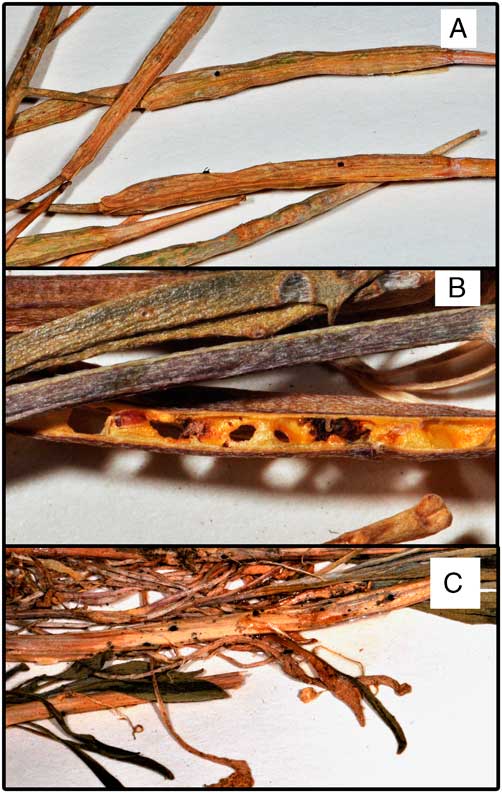
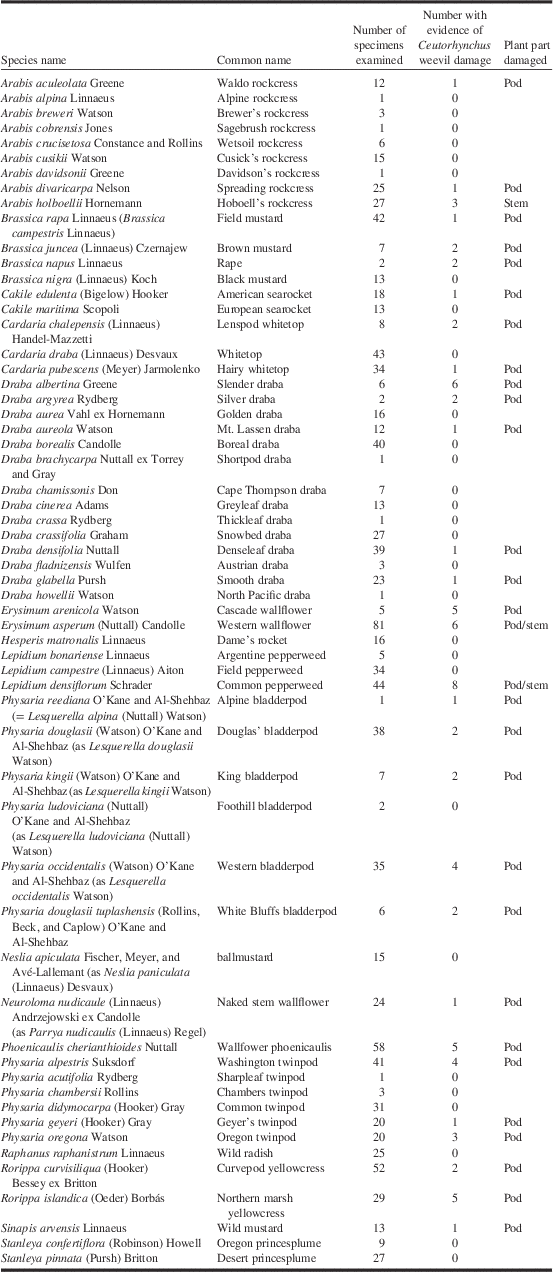
We examined 1114 plant specimens in 16 genera and 60 species of Brassicaceae and found 70 specimens among 30 species and subspecies that showed clear evidence of feeding injury and exit holes that are typical of Ceutorhynchus (Table 1). The majority of the symptoms were exit holes in pods (Fig. 1A). In some cases where the pods were already split open, frass, and larval remains (head capsules) were visible (Fig. 1B). One of 81 specimens of western wallflower, Erysimum asperum (Nuttall) Candolle, also showed symptoms on the stem (Fig. 1C) that were similar to injury caused by stem feeding weevils such as C. pubescens (LeConte), which we have reared from stems of Sysimbrium altissimum Linnaeus. Pods of a further five specimens of E. asperum had symptoms typical of Ceutorhynchus larva emergence on Brassicaceae.
Injury on pods and stems of specimens of Brassicaceae in the herbarium collection of the Burke Museum of Natural History and Culture, Washington State University, Seattle, Washington, United States of America. (A) Emergence holes on pods of Brassica juncea, specimen WSU 182144. (B) Frass and larval remains (head capsule) in an open pod of Erysimum arenicola, specimen WSU 3724. (C) Emergence holes in a stem of Erysimum asperum, specimen WSU 12149.

Numbers of specimens of Brassicaceae examined in the Burke Museum herbarium, together with numbers with injury symptoms typical of feeding damage by larvae of Ceutorhynchus species.

Note: Where a species was labelled under a synonym in the collection, we have included that synonym in brackets following the currently accepted species name.
In an ideal world, it would be possible to extract data about distribution, habitat specificity, changes in abundance, and phenology of Ceutorhynchus from herbarium specimens. However, specimens in herbarium collections are haphazardly distributed in time and space, and depend very much on the research interests of collectors and personnel. For example, five of five specimens of E. arenicola, which we examined had weevil injury in pods. It would be tempting to imply abundance and widespread distribution but in fact, the five specimens we examined were all collected in Clallam and Chelan counties, in Washington State in 1921–1937. It should also be noted that our methods were dependent on specimens with pods – and of the 58 specimens of E. arenicola in the collection, only five bore mature pods. Similarly, the seven specimens of Physaria douglasii tuplashensis (Rollins, Beck, and Caplow) O’Kane and Al-Shehbaz in the collection were collected at different sites in Franklin County, Washington State from 1995 to 1998. Six had mature pods and pods on two of those contained weevil injury. Our results do not imply abundance or distribution. Each observation of weevil injury is simply a coincidence that provides evidence of presence, but not evidence of absence.
Specimens of Sinapis arvensis Linnaeus (in herbarium as Brassica kaber (Candolle) Wheeler), Brassica napus Linnaeus, and Brassica rapa Linnaeus showed clear symptoms of pod injury. These species are known hosts of C. obstrictus, and the injury on the herbarium specimens was very likely caused by that species. This supports our hypothesis that the exit holes in herbarium specimens of other Brassicaceae species were also likely from Ceutorhynchus species. Of particular interest are exit holes in a specimen of B. rapa (in collection as B. campestris Linnaeus) from Port Townsend, Washington in 1933 (accession number WTU 1827JWT). Cabbage seedpod weevil was first reported from the Vancouver, British Columbia, Canada area in 1931 (McLeod Reference McLeod1953) and the exit holes could be evidence for the rapid spread of this species in the region following that first report.
In order to verify the evidence from pod injury we used plant distribution data for British Columbia (Klinkenberg Reference Klinkenberg2013) to locate populations of Physaria douglasii (Watson) O’Kane and Al-Shehbaz and Rorippa nasturtium var. aquaticum Linnaeus that were within a day’s drive of Agassiz, British Columbia. At these locations we found populations of weevils, subsequently identified as Ceutorhynchus nodipennis Dietz (or near), feeding on flowers as adults and developing as larvae inside the pods of P. douglasii and a population of Ceutorhynchus querceti Gyllenhal (or near), similarly on flowers as adults and in pods of R. nasturtium var. aquaticum.
The frass and insect remains inside the pods provide an opportunity to begin to make comprehensive host plant associations for the Ceutorhynchus species in North America if mitochondrial DNA from the Ceutorhynchus can be isolated from the pods or stems of herbarium specimens. This study demonstrates that herbarium collections are a valuable resource in the development of non-target risk assessment studies in biological control. We were particularly successful in this survey because of the characteristic nature of Ceutorhynchus injury to plants, and because of the close association of Ceutorhynchus weevils with the Brassicaceae. Genera and suprageneric groups with specific plant-injury symptoms might also be surveyed in a similar manner. These might include gall-makers, leaf miners, for example. It is unlikely that this approach will be useful for chewing defoliators, unless DNA traces of these herbivores can be isolated from wounds. It is clear that accessible and curated natural history collections and authoritative electronic records of those collections, especially those that include insect feeding damage, are of value to biological control and other researchers. In an era of rapidly changing distributions and evolving threats to biodiversity, collections have more importance than ever.
Acknowledgements
The authors thank David Giblen and Ben Legler of the University of Washington Herbarium, Burke Museum, for providing access and facilities for this study and Peter Mason, Agriculture and Agri-Food Canada, Ottawa for helpful comments on an earlier version of this manuscript. Peggy Clarke, Agriculture and Agri-Food Canada Agassiz Research Centre, assisted with field collection of plant material in British Columbia, and Patrice Bouchard, Agriculture and Agri-Food Canada, Ottawa, identified the weevil species. We also thank the subject editor and three anonymous reviewers whose comments and suggesting improved the manuscript. This research was funded in part by Agriculture and Agri-Food Canada and University of the Fraser Valley, Department of Biology.