INTRODUCTION
Lepas australis (Darwin, Reference Darwin1852) and Lepas pectinata (Spengler, Reference Spengler1793), commonly known as goose barnacles, are members of the family Lepadidae Darwin, Reference Darwin1852 (Crustacea: Cirripedia). Goose barnacles are pelagic and have been found attached to all types of floating structures, both biotic and abiotic, such as buoys, plastic boats, petroleum lumps, macroalgae, marine mammal remains, seals and birds (Darwin, Reference Darwin1852; Bishop, Reference Bishop1951; MacIntyre, Reference Macintyre1966; Fine, Reference Fine1970; Horn et al., Reference Horn, Teal and Backus1970; Arnaud, Reference Arnaud1973; Tsikhon-Lukanina et al., Reference Tsikhon-Lukanina, Nikolaeva and Reznichenko1986; Conway et al., Reference Conway, Ellis and Humpheryes1990; Young, Reference Young1990; Aznar et al., Reference Aznar, Balbuena and Raga1994; Arnbom & Lundberg, Reference Arnbom and Lundberg1995; Minchin, Reference Minchin1996; Barnes et al., Reference Barnes, Warren, Webb, Phalan and Reid2004; Hinojosa et al., Reference Hinojosa, Boltaña, Lancellotti, Macaya, Ugalde, Valdivia, Vásquez, Newman and Thiel2006; Setsaas & Bester, Reference Setsaas and Bester2006; Reisinger & Bester, Reference Reisenger and Bester2010) as well as pumice (Newman & Ross, Reference Newman and Ross1971; Donovan, Reference Donovan1999; Bryan et al., Reference Bryan, Cook, Evans, Colls, Wells, Lawrence, Jell, Greig and Leslie2004), and are sometimes ingested by certain birds, incorporating Lepas spp. in their diets (Simpson, Reference Simpson1965). Lepas australis has a circumpolar subantarctic distribution, with its presence diminishing to 33°S (Hinojosa et al., Reference Hinojosa, Boltaña, Lancellotti, Macaya, Ugalde, Valdivia, Vásquez, Newman and Thiel2006), whereas L. pectinata is known from both hemispheres (Conway et al., Reference Conway, Ellis and Humpheryes1990; Young, Reference Young1990; Aliani & Molcard, Reference Aliani and Molcard2003; Jones, Reference Jones, Wells, Walker and Jones2003, Reference Jones and Jones2004; Hinojosa et al., Reference Hinojosa, Boltaña, Lancellotti, Macaya, Ugalde, Valdivia, Vásquez, Newman and Thiel2006). Lepas pectinata is more abundant in central Chile than L. australis and shows a preference for Sargassum species as a substrate in the northern hemisphere (Fine, Reference Fine1970; Conway et al., Reference Conway, Ellis and Humpheryes1990; Hinojosa et al., Reference Hinojosa, Boltaña, Lancellotti, Macaya, Ugalde, Valdivia, Vásquez, Newman and Thiel2006).
The 2010 Mw 8.8 Maule earthquake of central Chile induced the Cordón-Caulle Volcanic Complex (CCVC) eruption on 4 June 2011, due to stress changes produced on the magma pathway (Bonali et al., Reference Bonali, Tibaldi, Corazzato, Tormey and Lara2013). It generated an immense amount of pumice that was transported to the adjoining watersheds of the Bueno and Puyehue Rivers, in Chilean North Patagonia, i.e. the ‘X Los Lagos Region' (Figure 1), as well as to other watersheds of Argentina (Castro & Schipper, Reference Castro and Schipper2011). Pumice is a distinctive feature of silicic eruptions (Eichelberger et al., Reference Eichelberger, Carrigan, Westrich and Price1986). These two Chilean basins carry their waters to the Pacific Ocean. The surface ocean currents, present in the Bueno River mouth, flow in a north-south to north direction, parallel to the Humboldt Current. Pumice that had been stranded on the beaches had a massive settlement of cirripedes. Previous studies affirmed the importance of ocean conditions related to the modulation of the distribution of Lepas species along the Chilean coast (Hinojosa et al., Reference Hinojosa, Boltaña, Lancellotti, Macaya, Ugalde, Valdivia, Vásquez, Newman and Thiel2006) but the direct mechanisms that affect these distribution patterns are unknown. Four months after the volcanic eruption of 2011, pumice with an immense number of Lepas individuals attached was found stranded on the Valdivian coast (XIV Los Ríos Region, Chile). The purpose of this study was to characterize this observed settlement, including the average size of the scutum of the barnacles, the number of individuals per each piece of pumice and the pumice percentage of the total settlement presented on the pumice surface stranded on the Valdivian coast beaches and those found in the VIII Bío Bío Region.
Study area: (A) North Patagonia and South Pacific Chilean coast, Chile; (B) study coastal areas located between 36°20′S and 37°70′S (i.e. VIII Bío Bío Region), 6: Lebu, 7: Punta Lavapié, 8: Bellavista, 9: Cocholgue y 10: Dichato; (C) study beaches located between 39°48′S and 39°40′S (i.e. XIV Los Ríos Region), 1: San Ignacio, 2: Loncoyén, 3: Centenilla, 4: Curiñanco, 5: Pilolcura; *, shows the Bueno River mouth.

MATERIALS AND METHODS
No specific permits were required for the described intertidal field studies. The sandy beaches we studied in Chile are unrestricted to public access and use, and are not privately owned or designated as protected areas (reserves or parks). No protected or endangered species were involved in this study.
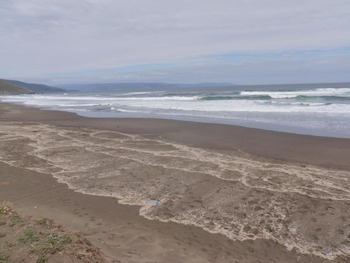
Four months after the CCVC eruption, cirripedes found attached to the pumice were analysed and the species Lepas australis and Lepas pectinata were identified following the criteria used by Hinojosa et al. (Reference Hinojosa, Boltaña, Lancellotti, Macaya, Ugalde, Valdivia, Vásquez, Newman and Thiel2006). After observing the settlement, we proceeded to sample five beaches in Los Ríos and Bío Bío Regions, respectively (Figure 1). Ten sampling grids of 35 × 35 cm and 9 × 9 cells were placed randomly per beach within the area of pumice stranded in the intertidal zone, and a picture of each grid was captured. At the same time, the width of the band of the surface stranded pumice (Figure 2) was measured per beach. The percentage of area occupied by the presence of pumice with Lepas species was estimated as the number of cells with Lepas species attached to the pumice per total of cells with pumice (×100) using Adobe® Photoshop® CS5 software.
Pumice stranded on Curiñanco Beach.

A representative sample of volcanic fractions with Lepas species from San Ignacio, Loncoyén, Centenilla, Curiñanco and Pilolcura (i.e. beaches of the Los Ríos Region) were deposited in alcohol solution. Identical sampling was carried out at Lebu, Punta Lavapié, Bellavista, Cocholhue and Dichato beaches, in the Bío Bío Region (Figure 1). However Lepas species were not found on these beaches, excepting Punta Lavapié, where the number of arthropods was not representative. Also, Lepas species found on Curiñanco Beach were less abundant than the other Valdivian beaches, but this sample was taken into consideration. The samples were examined with a Motic SMZ-168 stereo microscope with 10 × magnification. Thirty-five pieces of pumice with Lepas attached were analysed per each beach. The number of Lepas per pumice was taken into account and the length of their scutum was measured. A descriptive statistical analysis was performance using SigmaPlot®10.0 Software for each variable and beach. Finally, species were studied with scanning electron microscopy MEB (LEO 420), following the techniques used by previous researchers on the morphology of Lepas species (Blomsterberg et al., Reference Blomsterberg, Høeg, Jeffries and Lagersson2004). The attachment positions of the larval structures, as well as details of the peduncles, were photographed (Figure 6).
RESULTS
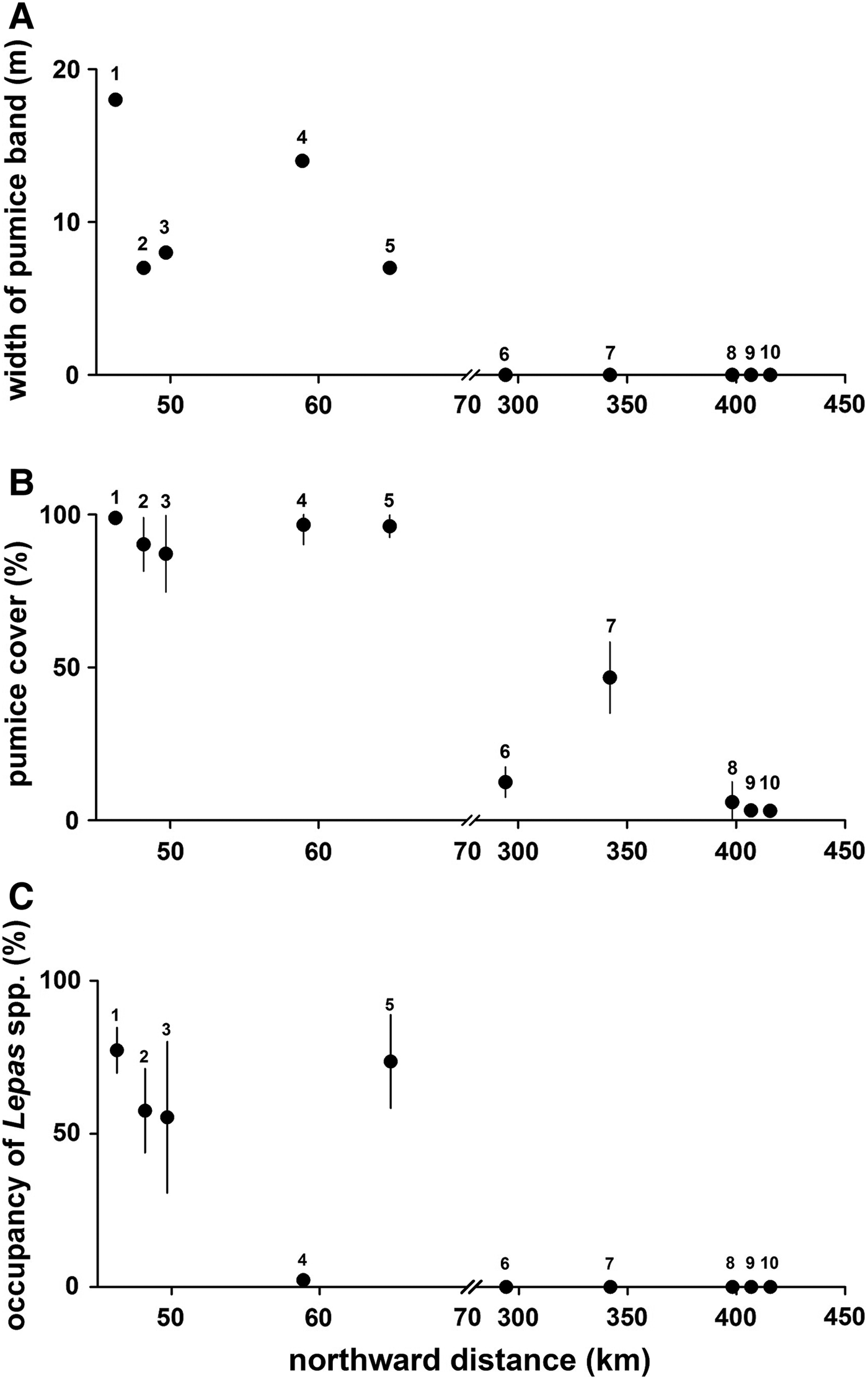
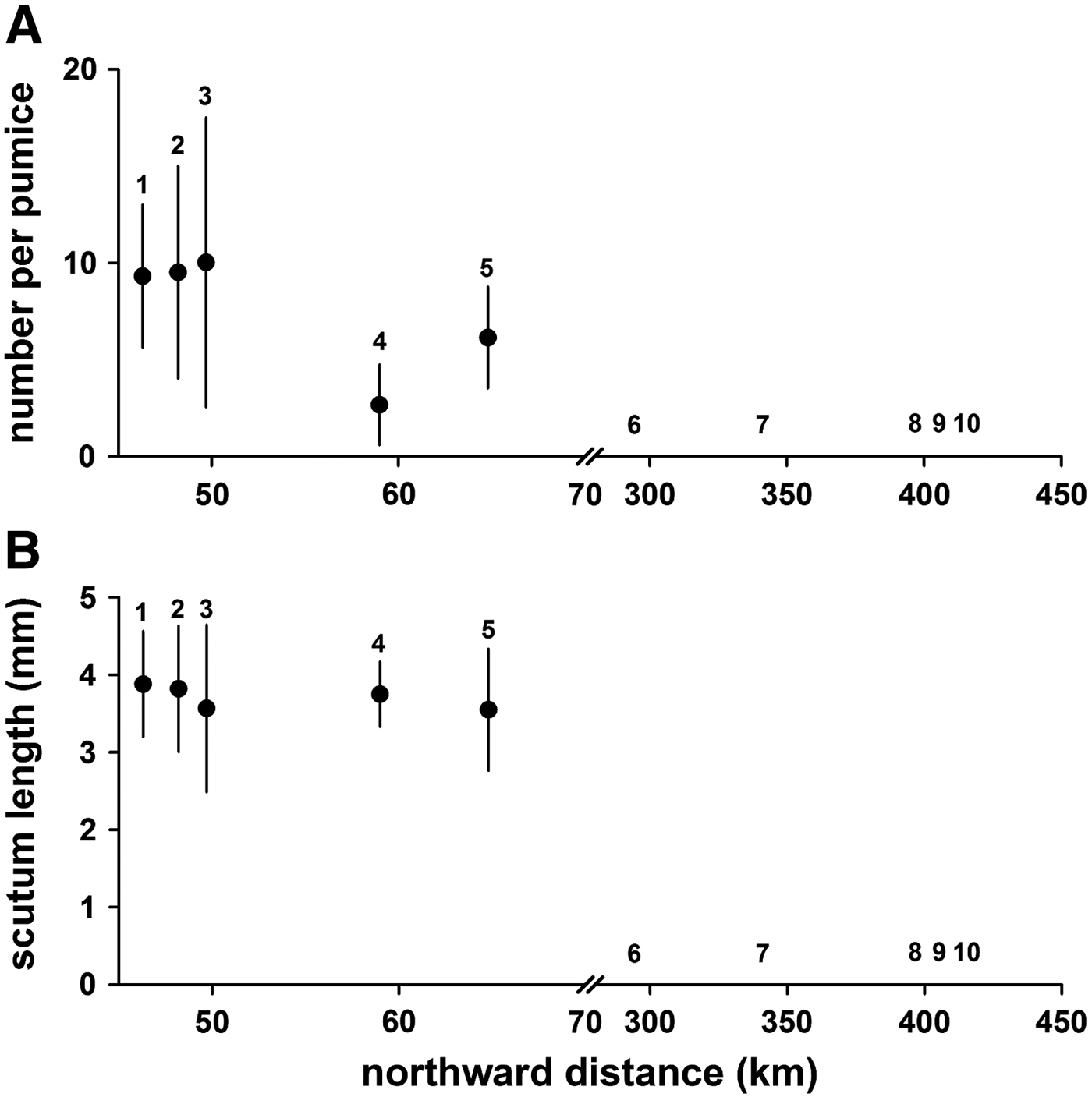
Lepas australis and Lepas pectinata were observed attached to floating pumice (Figure 3). A high percentage of stranded pumice with Lepas species settlement was found in the intertidal zone (Figure 4). The number of observed individuals varied from 1 to 35 per pumice for L. australis with the latter figure corresponding to one piece of pumice found on Centenilla Beach. Lepas pectinata was much less abundant, with only 20 individuals observed versus approximately 1200 individuals of L. australis, all from the XIV Los Ríos Region. When both species were observed, they were attached to the same pumice, i.e. they were sharing substrate (Figure 3). Size ranges of the scutum were between 1.1–7.5 mm for L. australis and 1.1–3.5 mm for L. pectinata. No differences were observed between scutal sizes from the beaches of the Los Ríos Region (Figure 5). However, the average scutal sizes were lower on the beaches from the Bío Bío Region (i.e. Punta Lavapié) than those of the southern region. The larvae of both species occurred in the sample of the Los Ríos Region and were photographed by MEB (Figure 6). Attachment sites chosen by the larvae could also be observed and these corresponded with the holes on the irregular pumice surface (Figure 6).
Lepas species attached to pumice: (A) floating pumice stranded on the shore; (B) Lepas species attached to floating pumice; (C) Lepas species attached to pumice stranded on the intertidal zone; (D) Lepas australis and Lepas pectinata attached to the same pumice observed with a Motic SMZ-168 stereo microscope standardized at 10 × magnification.

Characterization of the surface of pumice deposited on beach shore: (A) bandwidth; (B) % area coverage of the shore with pumice; (C) % area with Lepas australis attached. Vertical bars represent the standard deviation of each parameter.

(A) Representation of the number of individuals attached per pumice by distance to the mouth of the Bueno River; (B) scutal length of Lepas australis attached to pumice found on the shore of XIV Los Rios Region Beaches. Vertical bars represent the standard deviation of each parameter.

MEB images: (A) Lepas australis nauplius larva attached to pumice; (B) L. australis individual attached to pumice; (C) nauplius larva of Lepas pectinata; (D) L. australis larva sharing substrate with metamorphic individuals of same species; (E) detail of the peduncle structure of L. australis; (F) Lepas pectinata.

Morphological characters observed by MEB agree with the observations by Blomsterberg et al. (Reference Blomsterberg, Høeg, Jeffries and Lagersson2004) in their morphological study of Lepas.
DISCUSSION
Our results suggest that the nauplii of Lepas australis and Lepas pectinata have had a high capacity to attach early and rapidly via their larval attachment structures to pumice that had arrived in the Pacific Ocean via the Bueno River mouth. Lepas australis individuals were more numerous than those of L. pectinata and extreme numbers of them could be observed on the shores. This result suggests there was no overlap between the species in this settlement. It directly implies that these organisms can use this floating substrate for attachment as a vector for dispersion, as many authors have reported for other regions of the southern hemisphere (Simpson, Reference Simpson1965; Newman & Ross, Reference Newman and Ross1971; Bryan et al., Reference Bryan, Cook, Evans, Colls, Wells, Lawrence, Jell, Greig and Leslie2004), although these authors only observed a small number of samples.
The small size of the large number of individuals observed in this fortuitous settlement (Figure 5) indicates that the deposition of the pumice on beaches due to the action of ocean surface currents prevented them from reaching adulthood. No analysis of the development of their gonads was performed and thus no information on the reproductive capacity of individuals is available. The low number of individuals found on Curiñanco Beach could be explained by the strong waves on this exposed beach (Duarte et al., Reference Duarte, Jaramillo, Contreras, Acuña and Navarro2009), which could favour the friction between the pieces of pumice with presence of Lepas species, or inhibit the attachment of them to the pumice. The small number of pieces of pumice and barnacles found on the beaches of the VIII Bío Bío Region could be explained by the effects of continental uplift that resulted from the earthquake of 27 February 2010. These changes in intertidal beach structures after the Maule earthquake have been constant during 2010 and 2011 (Jaramillo, Reference Jaramillo2011; Vargas et al., Reference Vargas, Farías, Carretier, Tassara, Baize and Melnick2011; Jaramillo et al., Reference Jaramillo, Dugan, Hubbard, Melnick, Manzano, Duarte, Campos and Sánchez2012a, Reference Jaramillo, Manzano and Moralesb). The finding of juveniles suggests that the larvae had taken little time to find the volcanic substrate and complete their development to adults after the pumice had arrived in the Pacific Ocean, which is consistent with that described by MacIntyre (Reference Macintyre1966). It would be interesting to analyse the origin of the larvae attached to the pumice to corroborate the observations of Scheltema (Reference Scheltema1971), which affirmed the possibility of the larvae of benthic organisms moving long distances, and the observations of Helmuth et al. (Reference Helmuth, Veit and Hilberton1994) on larval dispersal of subantarctic benthic organisms by kelp rafting. In turn, this information would serve for comparison with the results of Barnes et al. (Reference Barnes, Warren, Webb, Phalan and Reid2004), which suggest that it is unlikely that they will find their development site in a few weeks; however, in this case, these pieces of pumice were floating on the ocean surface for less than four months and the larvae age is unknown. Volcanic activity in this area has been recorded from the Cenozoic (Vergara & Munizaga, Reference Vergara and Munizaga1974) and thus it can be argued that these species of barnacles could have used this natural vector for several millennia to move from low subantarctic latitudes, following the ocean currents to warm water, and agreeing with the proposal by Donovan (Reference Donovan1999) for Lepas anatifera in the Caribbean Sea. Barnes et al. (Reference Barnes, Warren, Webb, Phalan and Reid2004) reported stalked barnacles attached to different organisms from the Antarctic region. Herein, we report the first record of Lepas species attached to pumice for the Chilean coast, where past volcanic activity is well known (Illies, Reference Illies1970; Vergara & Munizaga, Reference Vergara and Munizaga1974; Lavenu & Cembrano, Reference Lavenu and Cembrano1999; Pino, Reference Pino2003). The destructive nature of volcanic eruptions can be contrasted with the increased supply of available substrates for utilization by the larval attachment structures of stalked barnacles, serving as an important dispersal vector for these organisms.
ACKNOWLEDGEMENTS
We thank M. González for sorting the scuta of each specimen in the Laboratory of Sedimentology and Soft Bottoms of the Universidad Austral de Chile, as well as C. Arzola for her support with the sampling programme. Also we appreciate the referees' comments and their contributions.
FINANCIAL SUPPORT
This research was supported by grants from FONDECYT Project No. 1090650.