A nuclear or radiological disaster could result in a large number of patients potentially exposed to varying harmful levels of radiation. Currently, early triage and treatment of patients for acute radiation syndrome (ARS) relies heavily on clinical evaluations of signs and symptoms, such as evaluation of blood cell counts and other organ system effects. Applied Research Associates, Inc. (ARA) participated on behalf of the Defense Threat Reduction Agency (DTRA) in NATO’s Research Task Group on the Human Factors and Medicine Panel 222 on Ionizing Radiation Bioeffects and Countermeasures (NATO RTG HFM 222). As a final product of this RTG’s activities, an exercise was organized by Dr Harald Dörr of the Bundeswehr Institute of Radiobiology with support from other task group members. The objective of the exercise was to assess techniques for early evaluation of the severity of ARS in a large number of patients using clinical signs and symptoms. The goals of the exercise included comparing established approaches for diagnosing ARS based on actual case histories from the SEARCHFootnote a database, and evaluation of response time (ie, reporting of results) from the participants.
Approach
Performing a detailed clinical assessment of radiation exposed patients requires significant time and specialized training to accurately interpret the results. Therefore, we anticipate that the patient load during a large-scale incident would quickly overwhelm the small number of qualified clinicians providing treatment available for evaluating these cases. For the exercise, we examined the utility of using automated analysis of tabulated clinical data to facilitate clinic evaluations. We used two triage evaluation approaches to translate clinical data first into categorical data for grouping patients, and then into recommendations for follow-up diagnostics and care. The first approach used a simplified sorting of ARS (presence of ARS or not) based on the neutrophil to lymphocyte ratio and occurrence of emesis (if data was available).Reference Sugarman, Goans, Garrett and Livingston 1 The second approach used the more detailed evaluation method in Medical Treatment Protocols for Radiation Accident Victims (METREPOL). These approaches are described in detail in the following Methods section.
Methods
Neutrophil to Lymphocyte Ratio (REAC/TS)Reference Sugarman, Goans, Garrett and Livingston 1
The Radiation Emergency Assistance Center/Training Site (REAC/TS) Simplified Triage Algorithm (shown in Equation 1) focuses on the evaluation of the neutrophil to lymphocyte ratios as well as if the patient experienced emesis post exposure.
 $$T\, {\equals}\, {\raise0.7ex\hbox{$N$} \!\mathord{\left/ {\vphantom {N L}}\right.\kern-\nulldelimiterspace}\!\lower0.7ex\hbox{$L$}}{\plus}E$$
T=triage scoreN=neutrophil concentration (counts×109/l)L=lymphocyte concentration (counts×109/l)E=0 if no emesis, 2 if emesis occurs post exposure
A normal N/L ratio in healthy adults is ~2.21.Reference Sugarman, Goans, Garrett and Livingston 1 Four hours post exposure, the triage score will be significantly elevated for doses over 1 Gy. A cut-off point of 3.7 can be used to maximize sensitivity and specificity. In this exercise, all patients with a triage score higher than 3.7 are assumed to have ARS and would be referred for further evaluation. Evaluating the neutrophil to lymphocyte ratios should be useful up to 2 weeks post exposure.
METREPOL CriteriaReference Fliedner, Friesecke and Beyrer 2
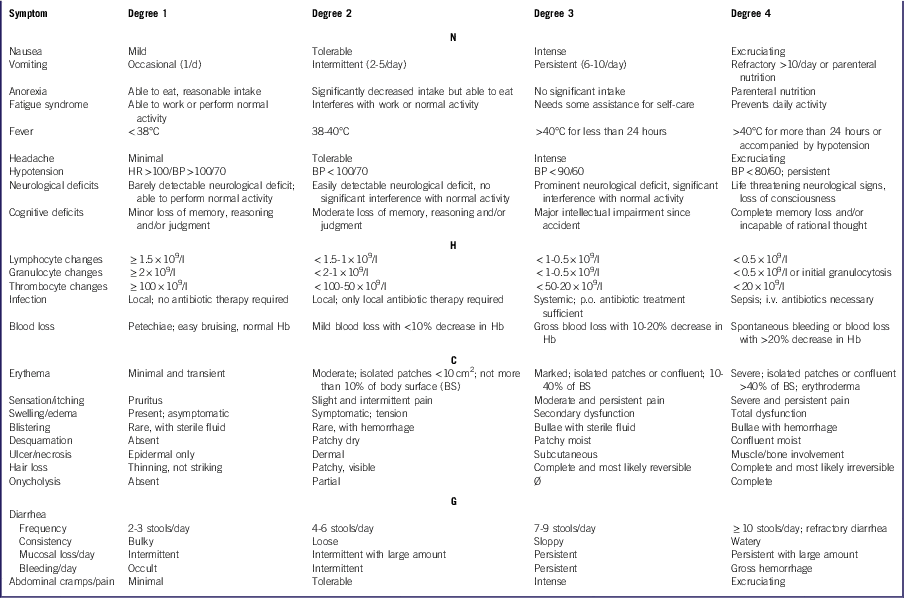
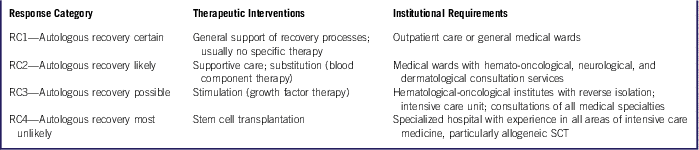
The METREPOL criteria shown in Table 1 are reproduced from the Manual on the Acute Radiation Syndrome.Reference Fliedner, Friesecke and Beyrer 2 The degrees of severity are translated directly to a response category (RC) for each of 4 organ systems, nervous (N), hematological (H), gastrointestinal (G), and cutaneous (C). To determine the overall RC for the patient, the maximum of the organ-specific RC is taken as the overall RC. METREPOL correlates the overall RC to the best probable therapeutic interventions and institutional requirements. This complexity of clinical care is presented in Table 2.
List of the Degrees of Severity of Organ-Specific Symptoms.Reference Fliedner, Friesecke and Beyrer 2

Abbreviations: N, nervous; H, hematological; C, cutaneous; G, gastrointestinal.
Complexity of Clinical Care.Reference Fliedner, Friesecke and Beyrer 2

Abbreviation: SCT, Stem Cell Transplantation.
Application Construction
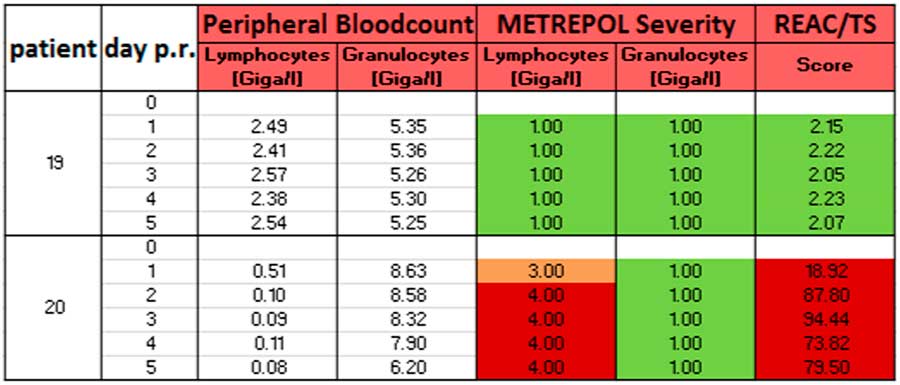
The algorithms for both methods were coded into Excel to estimate the triage score or RC using the format of 20 test case examples provided by the organizers before the exercise. The test cases were based on the formatting of the cases that were to be provided for the exercise and included tables of all recorded signs and symptoms (as well as degree of severity, if applicable) for each of the 4 systems of interest. The translation of each symptom to a degree of severity is necessary to grade each system response and determine a final RC. For each system, the highest degree for any of the symptoms on any day was taken as the overall system grade. Figure 1 shows that the hematopoietic severity category in case 20 would be RC4 because the highest hematopoietic score is H4 because the lymphocyte count drops below 0.5×10⁹/l starting on day 2. ARS was determined using these RCs where an RC of 0 or 1 indicates that ARS is unlikely, RC of 2 indicates further evaluation is necessary, and an RC of 3 or higher definitively indicates ARS.
Application Outputs Based on Peripheral Blood Counts. Abbreviations: METREPOL, Medical Treatment Protocols for Radiation Accident Victims; REAC/TS, The Radiation Emergency Assistance Center/Training Site.

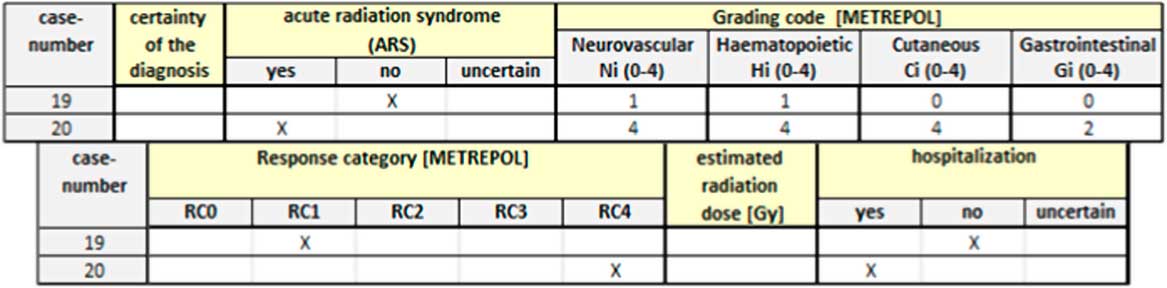
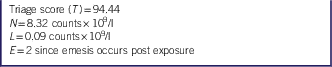
The REAC/TS criteria is a much simpler algorithm due to its dependence on only 3 inputs, the lymphocytes and neutrophils data and the presence of emesis. It should be noted that the neutrophils were not reported as part of this exercise; however, the total granulocyte count, which is normally comprised of about 70% neutrophils, was reported and subsequently used as a substitute in this ratio. The early response of granulocytes (and neutrophils) is a stress response that causes a rise in counts for the first few days following exposure. The response is driven by a spike in neutrophils immediately after exposure while the other granulocytes (eosinophils and basophils) are much slower to respond. This substitution could cause a triage score to be slightly overestimated leading to cases with doses below 1 Gy to be further evaluated. For doses above 1 Gy, the triage score will be significantly high 4 hours after exposure and the calculated triage score would still be well above the 3.7 score limit of concern. The REAC/TS methodology only accounts for the occurrence of vomiting and does not take into account the time of onset and severity. Figures 1 and 2 show example cases 19 and 20 and corresponding outputs for each method and Table 3 shows the calculation of the triage score for example case 20. Example case 19’s triage score shows that ARS is unlikely and the patient’s score is in the healthy range, whereas case 20’s triage score is significantly higher than the 3.7 threshold of concern and ARS is the likely cause.
METREPOL Diagnosis Output, For Example Cases 19 And 20. Abbreviation: METREPOL, Medical Treatment Protocols for Radiation Accident Victims.

Calculation for Simplified Triage Score of Example Case 20 for Day 3 from NATO HFM 222 Exercise (Based on Equation 1).

Application Evaluation Via the Exercise
For the exercise, the evaluators first received only the first 3 days of clinical parameters for the 191 case studies to be analyzed. A few days later, the organizers forwarded a second data set which contained 2 additional days of clinical data (through day 5 post exposure) to be re-evaluated to determine if the additional 2 days of data would change any of the assessments.
Neutrophil/Lymphocyte Ratio Results
Using the criteria developed by REAC/TS, the neutrophil, lymphocyte, and emesis data resulted in 73 ARS cases and 118 cases not classified as having ARS. This assessment provided fast ARS determination but also provided fewer clinical parameters for making treatment decisions for patients.
METREPOL Results
Using the METREPOL criteria, the first 3 days of data from the 191 evaluated cases showed 54 ARS cases, 103 cases were not classified as ARS, and 34 cases were categorized as uncertain. Having 2 additional days of data did not significantly affect results. The additional data collected through day 5 only changed one result from uncertain to conclusively ARS. This outcome indicates that 3 days of clinical observation appears to be sufficient to determine ARS. In the 3-5-day timeframe, the lymphocyte levels dictated nearly all of the assessments using the METREPOL approach while all other hematological parameters did not significantly vary in the vast majority of cases. This is because the other hematopoietic parameters respond at much later time points after exposure. Data for the other systems (gastrointestinal, cutaneous, and nervous) provided valuable confirmatory information; however, clinical data for these systems were not available in many of the cases.
Comparison of Evaluation Approaches
The METREPOL and REAC/TS approaches each provide different information. The REAC/TS approach focuses on quickly identifying patients that have received doses higher than 1 Gy while the METREPOL approach focuses on a more thorough clinical assessment for follow-on diagnostics and treatment. Nevertheless, both approaches provide valuable, useful, and consistent information. The majority of cases developing ARS and requiring hospitalization were correctly identified by all teams during the exercise. However, determination of severity was particularly challenging for RCs 2 and 3.Reference Dörr, Abend and Blakely 3
Summary and Lessons Learned
Using the automated translation as described, import of the tabulated signs and symptoms data into our Excel spreadsheet was accomplished in ~2 minutes for all cases with additional time for quality control. For the exercise, clinical evaluation of 191 case studies was estimated to require up to 50 total hours for completion. Quality control and assurance was essential, as well as pre-defined data inputs, to enable consistent translation of results. Retention of all clinical information is critical in follow-up evaluation if errors or inconsistencies are observed. In any event, a number of patient specific observations could lead to different treatment and diagnosis; however, for this exercise, 3 days of observations were sufficient for diagnosing ARS. In other cases, having all of the clinical data and notes available for review could be essential for handling non-routine cases.
Since a mass casualty radiation incident would quickly overwhelm the number of qualified clinicians available for evaluating patients, automated analysis capabilities could be used in such a scenario to quickly translate clinical data for faster triage and decision-making while minimizing human error. This study clearly demonstrates the need for, and utility of, automated tools to help translate clinical data for effective patient triage after a nuclear or radiological incident.