

I. Introduction
In the second half of the 20th century, the global wine market became deeply integrated. On the supply side, the boom in production and exports of the so-called New World countries gave rise to intense competition in the market, as these producers challenged the consolidated position of the southern European countries (Anderson, Reference Anderson2004; Anderson and Pinilla, Reference Anderson, Pinilla, Anderson and Pinilla2018b). From the demand side, the changes were perhaps even more significant. Wine consumption grew enormously in countries where, until then, it had been a minority product among the alcoholic beverages preferred by their populations. At the same time, in countries where wine had a very solid position, its consumption decreased and other alcoholic beverages, such as beer, challenged its hegemony (Holmes and Anderson, Reference Holmes and Anderson2017; Mills, Reference Mills2018; Swinnen, Reference Swinnen2011).
This integration of the wine market occurring in the second wave of globalization cannot be understood without examining what happened in the preceding century. In the first wave of globalization, an international wine market began to take shape for the first time. This clearly constituted a traditional trade between the shortest distances that prevailed in the pre-industrial era among France, Portugal, or Spain, and Great Britain. The market expanded significantly from the supply side, with the beginning and development of wine production in the now so-called New World countries and the demand side, with increased consumption in northern Europe, the Americas, and other regions of the world. Even so, the globalization of supply was more important, increasing substantially more in Africa, the Americas, or Oceania than demand, which continued to be limited mainly to traditional consumers in Mediterranean countries, their emigrants in other continents, or the highest income earners of the countries in the throes of their industrialization process.
In recent years, some studies have furthered our knowledge of the shaping of the international wine market in the first wave of globalization from a perspective that considers the different participating actors (Unwin, Reference Unwin1991; Simpson, Reference Simpson2011; Pinilla and Ayuda, Reference Pinilla, Ayuda, Campbell and Guibert2007; Anderson and Pinilla, Reference Anderson and Pinilla2018a). Today we also have a solid quantitative base that provides good serial data on international trade and wine production from the mid-19th century (Anderson, Nelgen and Pinilla, Reference Anderson, Nelgen and Pinilla2017; Anderson and Pinilla, Reference Anderson and Pinilla2017). Furthermore, other monographic studies on producing countries have focused on the role that external markets have had in the transformation of wine growing sectors in this period, when exports were significant (Chevet et al., Reference Chevet, Fernandez, Giraud-Héraud, Pinilla, Anderson and Pinilla2018; Federico and Martinelli, Reference Federico, Martinelli, Anderson and Pinilla2018; Lains, Reference Lains, Anderson and Pinilla2018; Fernández and Pinilla, Reference Fernández, Pinilla, Anderson and Pinilla2018; Anderson, Reference Anderson, Anderson and Pinilla2018; Meloni and Swinnen, Reference Meloni, Swinnen, Anderson and Pinilla2018; Pan-Montojo, Reference Pan-Montojo1994; Pinilla and Serrano, Reference Pinilla and Serrano2008; Pinilla and Ayuda, Reference Pinilla and Ayuda2002).
However, unlike the second wave of globalization, in which many studies have been conducted based on economic models that analyze how the global wine market or trade flows operate (e.g., Anderson and Wittwer, Reference Anderson and Wittwer2013, Reference Anderson and Wittwer2017, Reference Anderson and Wittwer2018; Wittwer, Berger, and Anderson, Reference Wittwer, Berger and Anderson2003; Macedo, Gouveia, and Rebelo, Reference Macedo, Gouveia and Rebelo2019), for the first wave of globalization there are practically no such studies. In particular, the gravity models, which have become the workhorse of many studies on international trade, have only been used for the first wave of globalization to analyze the wine exports of France and Spain (Ayuda, Ferrer-Pérez, and Pinilla, Reference Ayuda, Ferrer-Pérez and Pinilla2019; Pinilla and Serrano, Reference Pinilla and Serrano2008).
In this context, the objective of this article is to analyze the determinants of world wine exports in the first wave of globalization, taking into account the principal exporting countries and using an extended version of the gravity model. Therefore, we seek to examine the overall trajectory of wine exports and provide compelling explanations of the pattern with an approach that considers all the possible explanatory factors. We also want to analyze whether the exports of high- and low-quality wines were determined by the same variables. In this way, we believe that we are making a relevant contribution, not only with respect to how the international wine market took shape and developed from the mid-19th century to WWII, but also in terms of furthering our understanding of how it was subsequently integrated after the war to this day. Studying the past enables us to gain a better insight of the present, since the current global wine market owes a lot to how it was shaped in the first wave of globalization.
II. The Formation of the International Wine Market
Although wine production began approximately 8,000 years ago in the neighboring lands and regions of the present Republic of Georgia, subsequently, it shifted to the west, particularly towards the Mediterranean basin, until the Roman invaders introduced it to France circa 600 bc. Subsequently, due to climate and cultural reasons (particularly the Islamic expansion in North Africa and the Middle East since the 18th century), wine production and consumption only consolidated on the northern coasts of the Mediterranean countries. In the pre-industrial era, its international trade was quantitatively small, as problems with conserving the product limited trade to short distances or to fortified wines, which, due to their higher alcohol content, better withstood the longer journeys. In the pre-industrial era, the three principal trade routes for European wine were in the Mediterranean; the Rhine valley, which connects production in southern Germany with the north of the country and the Scandinavian countries; and the route from western France, Portugal, and Spain to the United Kingdom. This country was, by far, the largest importer of wine, and over the centuries the composition and quantity of its imports depended not only on the changes in tastes of the elite British classes, but also on the discriminatory tariffs applicable to wine from different countries and the excise duty on domestic sales (Ludington, Reference Ludington, Anderson and Pinilla2018). Even so, the amount of wine marketed internationally was very modest. In the mid-19th century, world wine trade still accounted for less than 5% of production (Anderson and Pinilla, Reference Anderson, Pinilla, Anderson and Pinilla2018b).
The emergence and formation of an international wine market therefore occurred mainly during the second half of the 19th century. From 1850, wine trade grew significantly, and by the early 1890s it accounted for around 15% of world production, which had also increased significantly. Expanding production, coupled with an even faster growing trade, coexisted with consumption that, throughout the first globalization, was largely limited to populations in the European Mediterranean area or the economic elite, mainly, but not exclusively, in countries with advanced levels of industrialization.
Nevertheless, wine was far from being a homogeneous product. Its heterogeneity is precisely one of its principal features. It is not only the production processes that allow us to differentiate the different types of wine. The wide variety of vines used for production also has a great influence (Anderson, Reference Anderson2013). Evidently, the enormous diversity of prices is also a logical consequence of this lack of homogeneity in the product. We can group the wine produced into two main types (although the distinctions between them are sometimes blurred): high-quality bottled wine and ordinary wine sold in casks.
The formation of a new international wine market during these decades was caused by the following factors: the increase in the consumption of high-quality wines by high-income groups in European countries where wine was not a product of mass consumption (Great Britain, countries in northern Europe, etc.); the massive transatlantic migration which moved millions of Europeans from traditional producing countries to new lands, who either continued their traditional drinking habits by importing wine from their countries of origin or begin producing it in their new countries; the phylloxera plague that blighted European vineyards and forced France to import massive volumes of wine to maintain its growth in international markets and supply its population; and, finally, France's colonial expansion, which was also important as military personnel, civil servants, and colonists moved and demanded wine from the mother country or, as in the case of North Africa, they expanded local vine growing. Furthermore, the drivers of the first wave of globalization were also the key drivers of this process: the liberalization of trade and the reduction in trade costs. As we shall see later on, in reality two parallel wine markets developed that did not follow exactly the same logic: the market for quality wine consumed by the economically elite that sought to differentiate itself from the rest of the population (Niklas and Sadik-Zada, Reference Niklas and Sadik-Zada2019) and the market for ordinary wine that was consumed almost exclusively by populations originating in the Mediterranean, from Europe, or from the places where the population of this origin emigrated.
High-quality wine consumption increased mostly in the second half of the 19th century among high-income groups in those countries that were immersed in their industrialization process, such as Great Britain, Germany, Belgium, or the United States. Economic prosperity encouraged wine consumption, which was considered a luxury product among these groups (Imperial Economic Committee, 1933; U.S. Tariff Commission, 1939). This increase in consumption was favored by modern marketing methods developed by quality wine producers (almost exclusively French) that included the use of modern advertising techniques, accreditation of the quality of their products and brands, adaptation to the preferences of the customers in different countries, the establishment of distribution networks, and a significant effort to improve the quality of their products (Guy, Reference Guy2003; Simpson, Reference Simpson2011; Harding, Reference Harding2017; Ayuda, Ferrer-Pérez, and Pinilla., Reference Ayuda, Ferrer-Pérez and Pinilla2019). Quality wine, particularly champagne, became a social marker of the emerging bourgeoisie (Guy, Reference Guy2003; Harding, Reference Harding2018; Desbois-Thibault, Reference Desbois-Thibault2003). Despite this, wine consumption continued to be very low in these countries.
A considerable part of the 50 million Europeans who emigrated during the hundred years after 1820 were, after approximately 1880, from southern Europe (Hatton and Williamson, Reference Hatton and Williamson1994). This had two important consequences in the formation of the international wine market. First, expanding to another country frequently gave rise to an increase in bilateral trade due to the reduction in fixed trade costs (Peri and Requena-Silvente, Reference Peri and Requena-Silvente2010). Furthermore, the fact that emigrants maintained their consumption patterns generated the creation of trade in the case of food and beverages. Some studies have shown that in the first wave of globalization this happened in the main immigrant-receiving countries, such as the United States (Dunlevy and Hutchinson, Reference Dunlevy and Hutchinson1999) or Argentina (Fernández, Reference Fernández2004.)Footnote 1 Second, it was even more important in the long term for the European colonists to import their knowledge regarding vine growing and wine making. In this way, wine production in the countries of European emigration increased notably, particularly since the end of the 19th century. This generated a contractionary effect on the exports of the countries of origin, as we shall see later, it implied the raising of protectionist barriers to safeguard the emerging production from the competition of traditional producers.
The arrival of the phylloxera plague in France in the 1870s was a determining factor, perhaps the most important, to explain how the international wine market took shape. The moment in which the phylloxera plague hit the French vineyards is fundamental, since it coincided with the maximum level that this country's exports (in volume) reached until WWII. The drop in French production was fast and profound, and in a few years it decreased by almost half. This had two important consequences: first, the need to continue supplying the domestic market forced it to import large amounts of wine, which came mainly from neighboring countries, particularly Spain and also Italy; second, the shock also deeply affected French exports. Therefore, it was necessary to use wine from other countries to mix them with theirs to maintain them; furthermore, a profound process of export specialization in France of high-quality wines (mainly in bottles) began, which enabled the real value of exports to continue to increase until the end of the century; finally, the French difficulties facilitated a double process of substitution of exports in the low-quality segment by exports from other countries such as Spain or Italy, which attempted to steal their external markets and also by domestic production in the new producing countries (Ayuda, Ferrer-Pérez, and Pinilla, Reference Ayuda, Ferrer-Pérez and Pinilla2019). In the medium term, the initial replanting of French vineyards with highly productive hybrids that produced a wine with a low alcohol content and pale color, required the country to import wine with a higher alcohol content and a more intense color to mix it with and render it apt for consumption. Spain was the main supplier until the end of the 19th century, when Algeria began to replace it and Spain was relegated to a secondary position. The arrival of the phylloxera plague in France, the way in which the French vineyards were replanted, and colonial policy were key elements in the functioning of the international ordinary wine market until WWII.
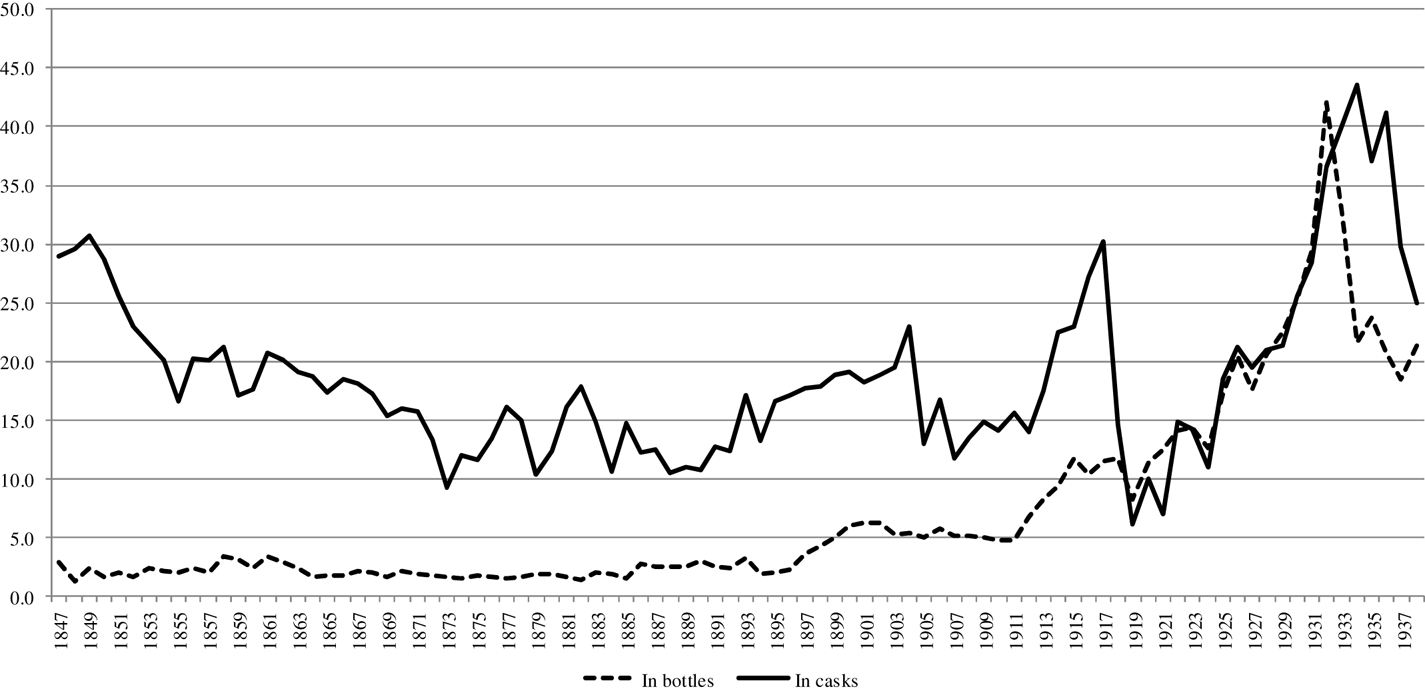
Finally, French colonial expansion also had a profound effect on the shaping of the international wine market. Most importantly, French colonial policy in Algeria fostered the settlement of colonists from the mother country who obtained abundant land and made vines the principal crop for agricultural exports. The expansion of production was spectacular and free access to the French market converted Algerian exports to France into the principal trade flow in the global wine market. Wine production also grew in other French colonies in the Maghreb, such as Morocco and Tunisia, although to a much lesser degree (Meloni and Swinnen, Reference Meloni, Swinnen, Anderson and Pinilla2018). Furthermore, the displacement of colonists, civil servants, and military personnel to the colonies stimulated exports of wine from the mother country to satisfy their needs. France's exports to its colonies represented a sizeable share of total exports from this country, particularly in low-quality wines, which normally varied between 10% and 25% of the total. On the other hand, in the high-quality segment, they normally accounted for less than 5% (Figure 1).
Wine Exports to Colonies over Total French Wine Exports
Source: Authors’ calculation based on Direction General des Douanes (1848–1938).

The reduction in transportation costs was important during the first wave of globalization and facilitated the increase in exchanges. The fall of the naval fleets not only boosted intercontinental trade, but the construction of railway networks facilitated connectivity on the European continent, connecting wine-producing areas with wine-consuming areas.
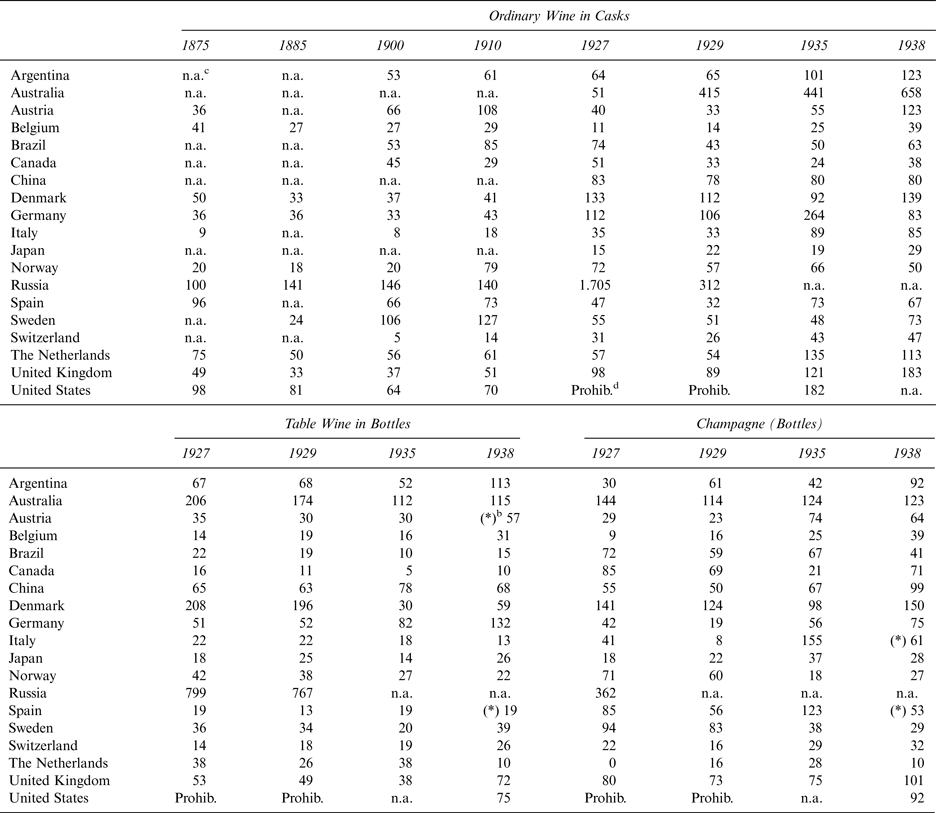
The liberalization of markets, developed mainly through the signing of trade agreements, included a reduction in wine import tariffs. A good example is the Cobden-Chevalier treaty signed by France and Great Britain in 1860, which boosted wine exports from the former to the latter with a spectacular reduction in the tariff paid, which Lafforgue (Reference Lafforgue1947) estimated at 78%. However, the widespread tariff reform in the first wave of globalization had less impact on wine than on other goods. The high tariff barriers imposed on the wine trade are crucial. As we can see in Table 1, the tariffs applied to wine, when entering very diverse countries, were very high, for ordinary- and high-quality wines, and followed an upward trend from 1875 until WWII. There are three very different reasons to explain this heavy tax burden on wine. In producing countries, such as Argentina, Australia, Italy, or Spain, high tariffs were a simple defense barrier to ward off foreign competition, especially France. The case of Spain, one of the largest producers, is particularly illustrative. Wine protection was high until 1879, when a bilateral trade agreement with France opened this country's doors to Spanish wine and, in return, Spain also liberalized wine imports, especially quality wines from France. In 1892, when France withdrew from the treaty and slightly increased its protection, Spain did the same. This Spanish protectionist policy not only gave rise to significant growth in the production of quality table wine, particularly from La Rioja, but, in addition, a sparkling wine production industry emerged to replace champagne imports (Fernández and Pinilla, Reference Fernández, Pinilla, Anderson and Pinilla2018). In non-producing countries, the duties on wine were considered fiscal duties, which means that their main goal was to provide public revenue. Its consideration as a luxury product justifies this revenue collection option. Finally, high excise and import taxes on wine frequently sought to protect local beer or spirits producers (Holmes and Anderson, Reference Holmes and Anderson2017).
Calculation of ad valorem Tariffs on Wine (1875–1938) (in Percent)a

Notes:
a Calculated as the percentage of customs duties of the value of imported wine. Specific tariffs have been obtained from the sources listed below. These are in French francs per hectoliter of wine in the case of wine in barrels or in French francs per bottle for bottled wine and champagne. For the price of wine, we have used the unit value of exports obtained from French external trade statistics: the arithmetic average of Gironde wine in barrels and wine in barrels from other parts of France exported in the corresponding year for ordinary wine; for bottled wine we have taken the arithmetic average of Gironde's bottled table wine and exported bottled table wine from the rest of France; for champagne we have done the same.
b (*) 1937 data.
c n.a. = not available.
d Prohib. means Prohibition, when imports were not allowed.
Sources: 1875–1910, Degroully (Reference Degroully1910), p. 331; 1927–1938, Office International du Vin (1928–1939).
However, the expansion of trade encountered major obstacles that prevented further growth and, therefore, we can refer to a restricted globalization. Although production globalized, expanding from Europe to other continents such as Africa, the Americas, and Australia, consumption continued to be restricted to the original populations of the northern shores of the Mediterranean and to the elite social classes of the most developed countries.
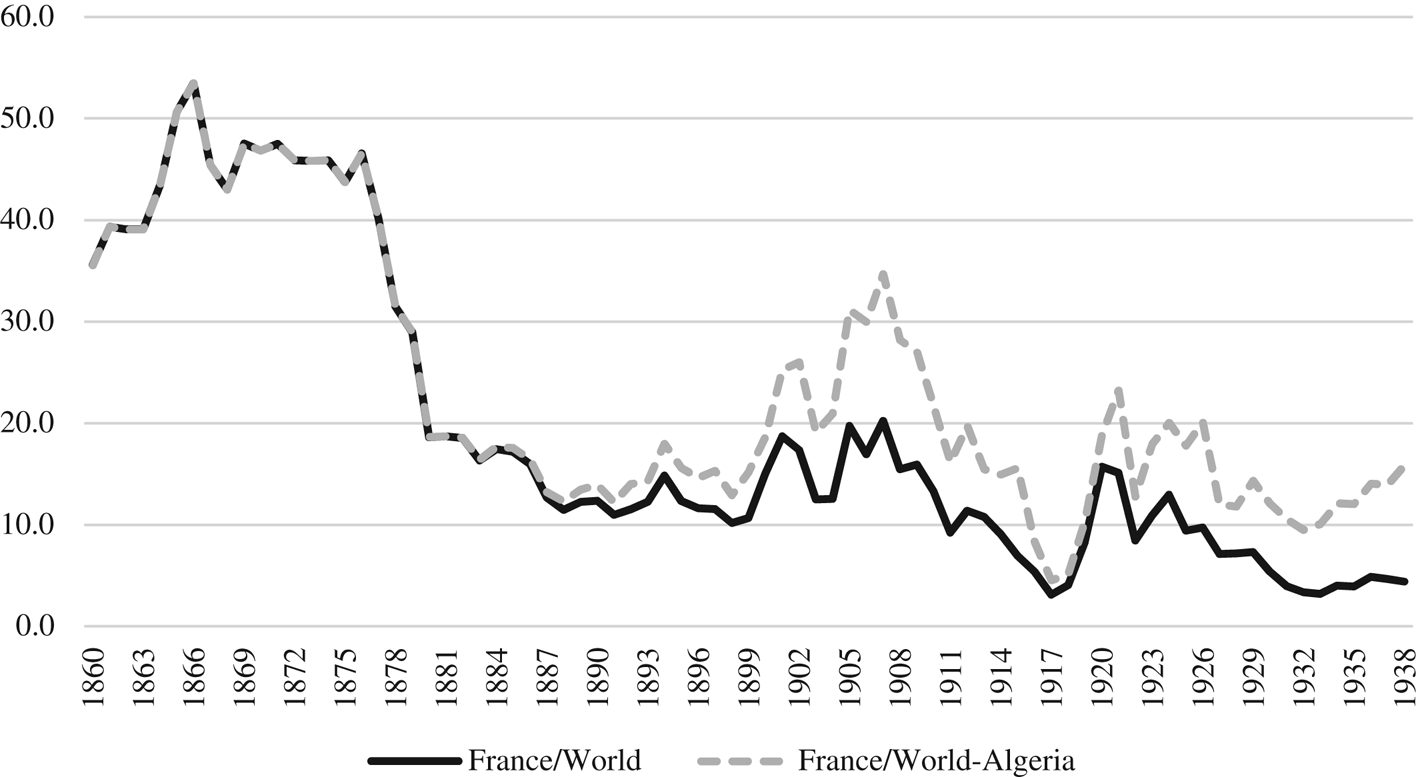
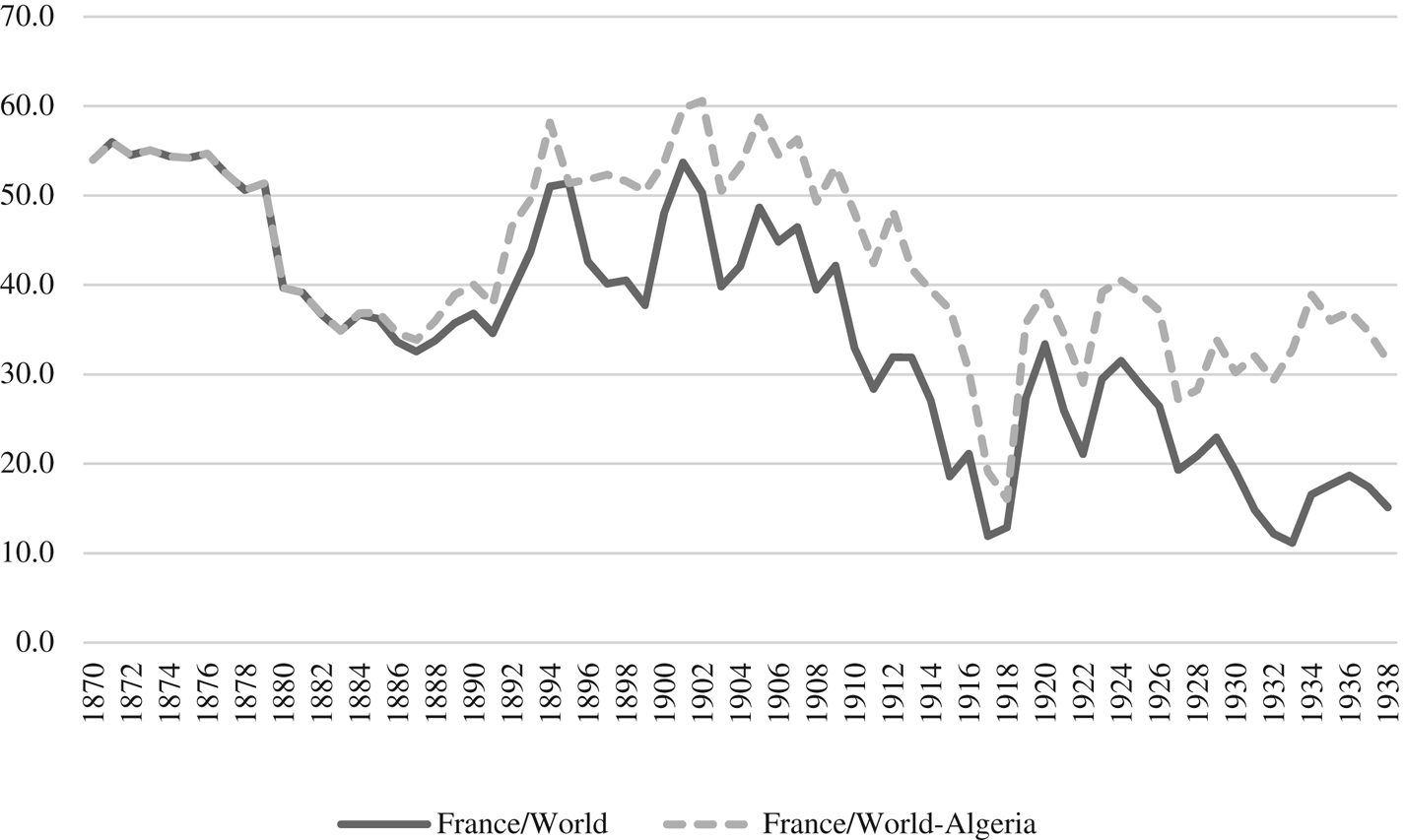
We can conclude by remarking that in the formation of the international wine market, from the outset, France obtained a dominant position, leading the integration of this market (Figures 2 and 3). The configuration of the international wine market was mainly driven by its export dynamism. The arrival of the phylloxera plague in France reinforced the role of this country in the wine market. In addition to being the principal exporting country, it also became the leading importer to complement its shrinking production. Initially, Spain supplied the wines that France needed. However, since the beginning of the 1890s, French colonial policy, which sought to settle colonists in Algeria and provide a viable economy, promoted the expansion of vine growing and the duty-free import of its production to the mother country (Pinilla and Ayuda, Reference Pinilla and Ayuda2002). In this context, metropolitan France specialized in the production of high-quality wines for export or low-quality wines for the domestic market. Imports from Spain, or principally from Algeria, provided wines with a high alcohol content and intense color to mix with wine produced from hybrids resulting from the replantation, which had a low alcohol content and a pale color and it was not appreciated by French consumers (Ayuda, Ferrer-Pérez, and Pinilla, Reference Ayuda, Ferrer-Pérez and Pinilla2019). We could say, therefore, that two parallel markets were formed. In the high-quality wine segment, France was by far the principal exporter and demand came mainly from the elite economic classes of countries with the highest income levels.Footnote 2 On the other hand, in the low-quality wine market, the principal importer was France after it was invaded by the phylloxera plague and the main exporters were Spain, Algeria, and France.Footnote 3
Share of French Wine Exports of World Totals by Volume
(in Percent)
Source: Anderson and Pinilla (Reference Anderson and Pinilla2017).

Share of French Wine Exports of World Wine Exports (in Percent Based on Current Values)
Source: Anderson and Pinilla (Reference Anderson and Pinilla2017).

III. The Evolution of World Wine Exports
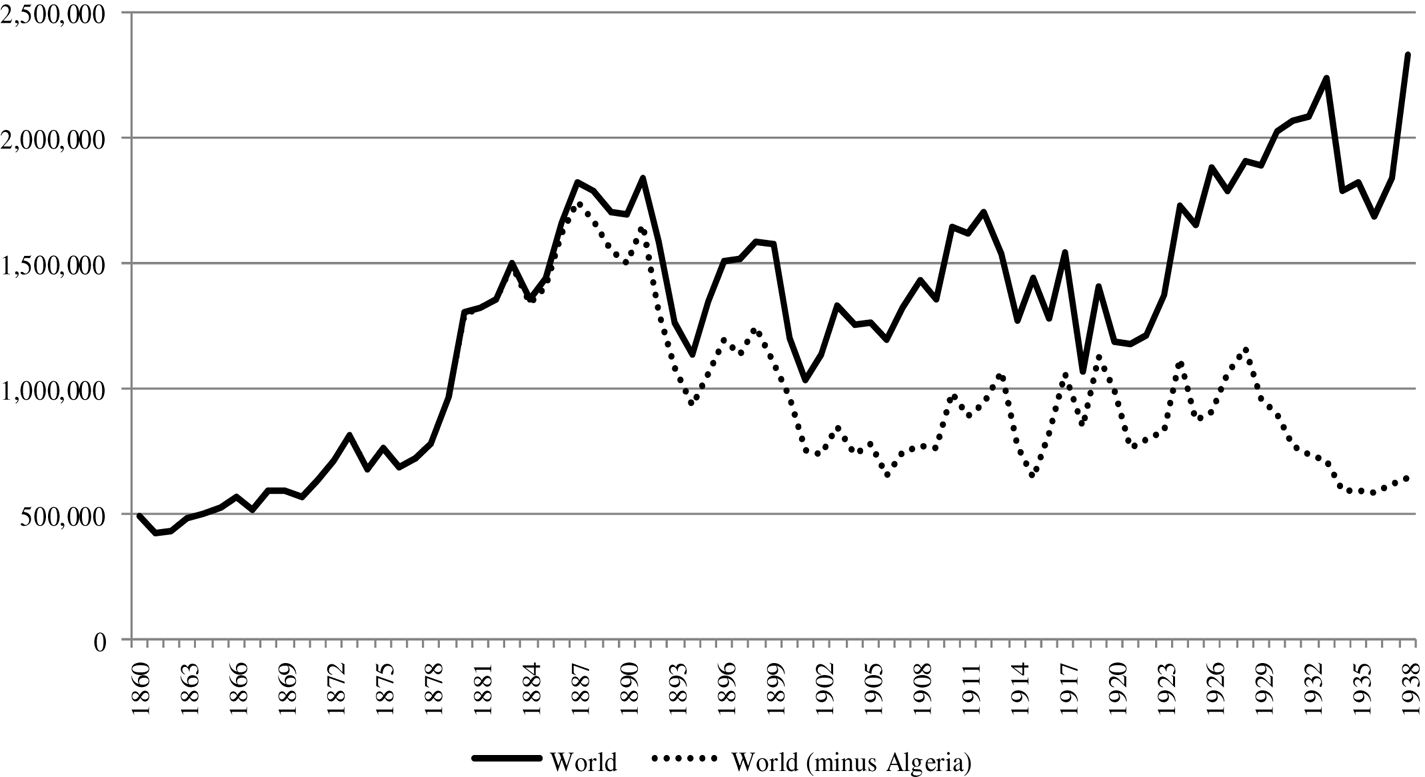
International wine exports experienced an enormously expansive first phase from the mid-19th century until approximately 1890 (Figure 4). World trade remained stable until the mid 1920s and subsequently began to grow again, with two severe circumstantial dips caused by WWI and the Great Depression in the 1930s. However, the picture changes substantially if we do not consider the exports of the French colony of Algeria to France as international trade.Footnote 4 There are no differences in the first expansionary phase in which exports increased more than three-fold. But, since the beginning of the 1890s, international trade contracted significantly, reducing by approximately one-third and remaining at this level until the crisis of 1929, when it plummeted to mid-19th century levels (Anderson and Pinilla, Reference Anderson, Pinilla, Anderson and Pinilla2018b). In other words, global wine exports only grew appreciably during the second half of the 19th century. All subsequent expansion was due exclusively to the exports from the French colony Algeria to the mother country.
Evolution of World Wine Exports by Volume (in KL)
Source: Anderson and Pinilla (Reference Anderson and Pinilla2017).

The stagnation of the international wine trade or its contraction, if we exclude the flows from Algeria to France, can be partly explained by the serious problems caused by the war, the Depression, and the creation of the Soviet state that penalized wine imports, a product traditionally consumed by the Russian aristocracy, with prohibitive tariffs. Furthermore, exports were affected by a series of causes specific to the wine market itself. First, the increased protectionism that took place at the end of the century. Some large importers, such as Argentina, Uruguay, or the United States, substantially increased their tariffs to protect their domestic production and their imports plummeted. Second, imports from northern European countries tended to stagnate, after the appreciable growth they had experienced since the middle of the century. Without a doubt, the failure of its consumption to extend beyond the upper classes explains this stagnation. Finally, the Prohibition in the United States caused exports to this country to fall sharply.
IV. Theoretical Framework, Econometric Model, and Data
The objective of this article is to investigate the determinants of the evolution of world wine exports with a panel data set with a total of 7,025 observations from 1848 to 1938, representing an impressive 75–85% of world exports in volume or 75–90% in value, which, in turn, enables us to draw sufficiently representative conclusions. In particular, we have distinguished between ordinary wine (in casks) and quality wine (bottled) to better understand the determinants of world wine exports.
To address this objective, a gravity model approach is applied due to its proven power to explain trade flows between countries.
In this model specification, we have considered the value of the annual wine traded between Algeria, France, Italy, and Spain (subscript i) and its 37 trading partnersFootnote 5 (subscript j = 1, 2, …, 37) as the endogenous variable X ijt. The variable is expressed in French francs at 1910 prices at year t.Footnote 6
The following extended gravity model has been specified, first for the ordinary-wine case and, second, for the quality-wine case. We have considered the model for both types of wine since we believe that the variables that determine the evolution of the exports or its effects were not always the same, as explained in the previous section. The model considered is:

where $\beta _1^\ast{ = } \ln \beta _1$ and the error term ɛijt is the identically and independently distributed error term.
GDP jt represents the importer's GDP at period t (Bolt and Van Zanden, Reference Bolt and van Zanden2014). With this variable we seek to determine if the potential foreign demand for wine depends on the size of the importer's market.
Y it represents the production of wine in the exporting nations and enables us to observe its capacity to export wine depending on harvest size.Y it−1, Y it−2, and Y it−3 are the 1, 2, and 3 lagged values of exporter countries’ wine production, respectively. These three variables attempt to measure the effect of the harvest of previous years on the supply of wine for export. These lagged variables can be significant since the harvest usually took place in September, but the first wines for export were not available until November or later. In the case of quality wine, harvests of previous years may be even more important, because this type of wine requires ageing. Therefore, it is expected that the export capacity depended more on the harvest from the previous year or earlier, mostly for quality wines.
Y j captures the size of the wine production from trading partners and is used to capture the so-called “home bias” (Dal Bianco et al., Reference Dal Bianco, Ladislao Boatto, Caracciolo and Gaetano Santeramo2016). Y jt−1, Y jt−2, and Y jt−3 represent the corresponding lagged values of importer's wine production. With these lagged variables, we seek to determine the importance of the harvests of previous years so as to determine the demand for wine purchased abroad.
TC ijt reflects the evolution of the real costs of transporting wine between the exporters and their trading partners.Footnote 7
Colony jt is a dummy variable that takes the value 1 when the importer was a colony of the exporting country and 0 otherwise. This variable seeks to measure, on the one hand, if the trade between the mother country and the colonies was carried out under preferential conditions, normally with very low tariffs and even without tariff protection and, on the other hand, if metropolitan officials and military personnel in the colonies wanted to maintain their wine consumption. So, we could expect, a priori, a higher level of trade between the metropolis and its colonies, ceteris paribus.
M ijt is used to reflect the level of monopolistic competition in international wine trade and it is the wine imported by the exporters from their partners.
Furthermore, due to the lack of variables that may accurately measure the change in the level of tariff protection, we have also included a set of dummy variables to proxy the impact of certain political and economic situations that had a relevant direct impact on international trade and in particularly in world wine exports, according to contemporary analysts:
WWI t that takes the value 1 for the years during the WWI, and 0 otherwise.
Dep30t that takes the value 1 during the years of the Great Depression, 0 otherwise.
Soviet jt that takes the value 1 for Russia/Soviet Union from 1917.
$\ Prohibition_{jt}$ that takes the value 1 for the period in which the Prohibition was established across North America (Canada, Mexico, and the United States), 0 otherwise.
As for other transaction costs, we have included a dummy variable GS ijt, as transportation is only a part of international transaction costs and trade can be affected by variations in exchange rates, which did not exist in the countries that used the gold standard (Cardebat and Figuet, Reference Cardebat and Figuet2019; Jacks, Meissner, and Novy, Reference Jacks, Meissner and Novy2011). The variable takes the value 1 if the two trading partners belonged to the gold standard, and 0 otherwise.
We have also included in the model specification other dummy variables (one for each trading partner) to capture the so-called “multilateral resistance terms” which, in turn, may prevent the model from obtaining biased estimates. On some models, we have also included a trend term.
We have used the Poisson pseudo maximum-likelihood (PPML) estimator, proposed in Santos Silva and Tenreyro (Reference Santos Silva and Tenreyro2006), to estimate the models. This PPML estimator takes into account the presence of zero values in the dependent variable,Footnote 8 since it specifies the dependent variable in the levels, so it has the advantage of producing more efficient estimates than the ordinary least squares (OLS) method. This method also produces robust estimates of heteroscedasticity (Sören and Bruemmer, Reference Sören and Bruemmer2012; Staub and Winkelmann, Reference Staub and Winkelmann2013; Kareem and Kareem, Reference Kareem and Kareem2014; Piermartini and Yotov, Reference Piermartini and Yotov2016).
Considering the model separately for high- and low-quality wines should enable us to verify certain hypotheses derived from the previously conducted historical analysis, which will enable us to explain the behavior of the two types of exports.
In this way, we seek to confirm that wine exports were not determined by the increase in income in importing countries, since wine was not a beverage for mass consumption.
Another difference would be that, a priori, we should expect a greater impact from the reduction of transportation costs in ordinary wine exports, since these costs represented a much larger part of the final price than in the case of quality wine.
Finally, as France was both the principal exporter of quality wine and the principal importer of ordinary wine, as previously explained, we would expect the existence of monopolistic competition in the quality wine market.
On the other hand, both types of exports must have been influenced by variations in the harvest of the same year or previous years and by shocks that affected the international economy or specifically the wine-making economy (war, Soviet revolution, the Prohibition, and the Great Depression).
V. Results
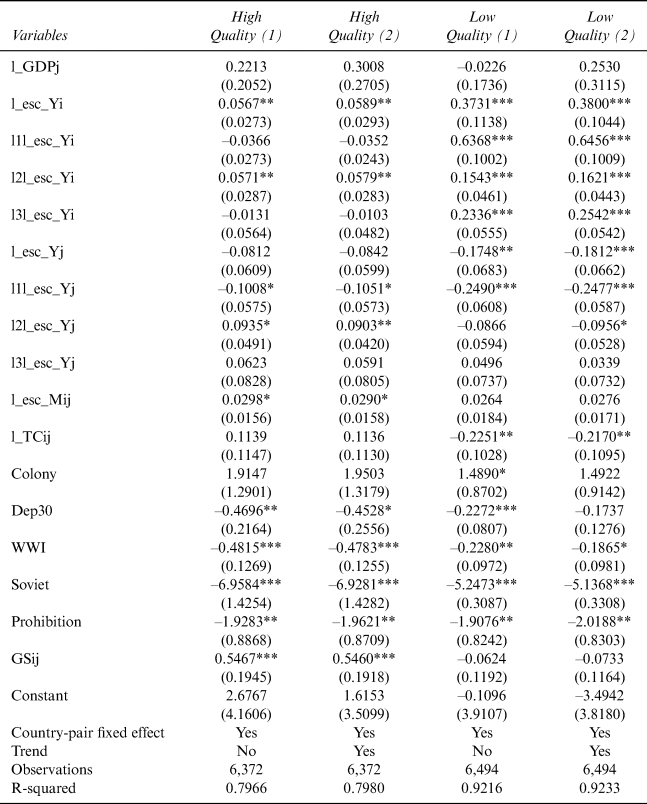
Table 2 shows the results of the gravity models for the two kinds of wine. To analyze the robustness of our estimates, for the main variables, we present two estimations: (1) without a trend term and (2) with a trend term.
Results of the Gravity Models Estimated by PPML

Note: Robust standard errors in parentheses (clustered by country-pairs); *, **, and *** denote statistical significance at the 10, 5, and 1% levels, respectively.
Our results show, first, that the increase in the market size of importing countries did not affect the volume of wine exports. This result can be explained because in almost all of the most relevant importing countries, with the notable exception of France, wine was not the alcoholic drink consumed by the majority of the population: beer or spirits were the favorite drinks. Consequently, a preference for other locally produced drinks had developed. Furthermore, in these countries, even the price of ordinary wine was higher than local drinks, which also benefited from reductions in production costs derived from technological innovations of the industrial revolution (Anderson, Meloni, and Swinnen, Reference Anderson, Meloni and Swinnen2018). Therefore, the expansion of wine exports was restricted by limited progress in the globalization of wine consumption.
As expected, exports were highly conditioned by the production of the exporting country, and since the majority of output was usually sold in the northern hemisphere in the year after harvest, the production of the previous year was even more important. These effects were greater for low-quality wine. Even production from years prior to this influenced the level of exports. These results help us to better understand the effects of the phylloxera plague in France and its impact on its exports.
Domestic production in importing countries had a negative relationship with wine exports, which enables us to conclude that there was a home bias in wine consumption. The existence of a local harvest, in some cases abundant, determined competitive prices for home production (in traditional producing countries) and in new producing countries it generated tariff protection, giving rise to a strong increase in local production.
Decreasing trade costs boosted exports only for low-quality wine, while quality wine, a product that we can consider as a luxury product, was not affected by them. This is not surprising if we consider that the price of transportation represents a much lower proportion of the final price in quality wine than in ordinary wine.
The fact that both trading partners belonged to the gold standard only had a significant effect in the case of quality wine exports.
Exchange rate stability was important for trade in luxury products. Colonial wine trade was only significant for low-quality wines, although when we introduce a trend in the model it is no longer significant. This is also the case for other variables that reflect certain specific circumstances. It is reasonable to think that the civil servants of the mother country or the majority of the displaced troops, although they maintained their consumption habits, did not have sufficiently high enough purchasing power to buy high-quality wine.
The results of the quality wine model show monopolistic competition, although this is probably due France's role as an importer of low-quality wine and an exporter of high-quality wine (Ayuda, Ferrer-Pérez, and Pinilla, Reference Ayuda, Ferrer-Pérez and Pinilla2019).
Finally, one of the most important results of our study is that economic and political shocks have a strong impact on wine exports, since those included in the model significantly affected exports of quality and ordinary wine. The events that had an overall impact, such as WWI or the depression of the 1930s, negatively affected exports. Furthermore, other local shocks, such as the establishment of the Soviet state or Prohibition in the United States severely affected exports to these countries.
VI. Conclusions
In the first wave of globalization, for the first time an international wine market began to take shape, in which France played a key role, first as a prominent exporter and since the arrival of the phylloxera plague also as the leading importer. From the end of the 19th century, new producing countries emerged that would play a fundamental role in the global market a century later. The United States, Argentina, or Australia increased their production with the help of strong tariff protection. Furthermore, Algeria became the world's leading wine exporter in terms of volume as a result of French colonial policy. In this expanding market, exports grew quickly, particularly at the end of the century when the arrival of the phylloxera plague in France had a crucial effect on the market. French exports had to be redirected towards quality wine, due to their production problems and the severe competition from the growing output of other countries such as Spain or Italy. In fact, two parallel markets formed that operated differently. It is important to point out the dual role that France played as a dominant exporter of high-quality wine and a major importer of low-quality wine.
Since the end of the 19th century, global exports began to stagnate, although this does not consider the enormous flow of wine from Algeria to France, at least in volume. This was due to the protectionist policies of the new producing countries and the stagnation of demand in the industrialized European countries, since wine did not become a product of mass consumption that can be seen in the fact that the increase in size of the importing countries’ market only affected high-quality wine exports.
The level of production of exporting countries positively determined to a great extent the flow of exports. On the contrary, the production of the importers negatively affected the sales of the exporting countries since there was a home bias, either due to the competitiveness of the domestically produced wines or to tariff protection. The reduction in transportation costs significantly benefited ordinary wine exports, although it was not important for quality wine, since these costs represented only a small part of its final price.
Finally, a series of external shocks such as WWI, the Soviet revolution, or the depression of the 1930s seriously harmed wine exports. Furthermore, the Prohibition of wine consumption in the United States also affected the volume of exports. All this highlights the sensitivity of the wine trade to regulations (Meloni et al., Reference Meloni, Anderson, Deconinck and Swinnen2019), particularly alcohol consumer tax and trade policies (Anderson, Reference Anderson2020), and the economic climate.
Supplementary material
To view supplementary material for this article, please visit https://doi.org/10.1017/jwe.2020.4.