INTRODUCTION
Rubber (H. brasiliensis) is a tree species, native of Amazonian forests. The cultivation of rubber is spread over in the tropical regions of different continents in more than ten million hectares. It was introduced to India about a century ago and is one of the major crops in the state of Kerala in India extending to an area over half a million hectares and contributing significantly to the agricultural economy of the state. All over the world rubber plantations are monoculture in nature, so also in India (Jacob, Reference Jacob, George and Jacob2000). During the initial five to six years of rubber cultivation, or till the period of closing up of the rubber tree canopy, usually leguminous cover crops or certain inter crops are planted along with rubber. Generally in rubber plantations, growth of other non-cultivated floral species (weeds) are regularly and strictly monitored during the initial five to six years and afterwards also the same weeding operations are continued throughout the plantation cycle in most cases. This sort of weed management referred as ‘clean-weeding’ is common among the rubber growers even during the later stages is basically due to the common belief that, weeds or under-flora may affect the rubber yield by competing for nutrients and moisture. Also clean-weeding is popular due to the operational convenience it creates for fertilizer application and crop harvesting process. Moreover, the ‘aesthetic appearance’ of tree plantations, generated by the traditional clean-weeding practice of not allowing any weed flora is important to many growers. However, a parallel thinking which is allowing the partial growth of weeds or under-flora, in the mature stages of rubber plantations instead of its complete control as practiced in the clean-weeding practice, is gaining importance and practiced by a few farmers in Kerala, India.
The economic life span of a rubber plantation is usually less than 30 years and at present most of the existing rubber plantations are in its third or fourth planting cycle in Kerala. Most of these rubber plantations in the state were initially established in forest cleared lands. The deleterious effects of continuous monoculture of tree plantations with the clean-weeding practice on floral/faunal biodiversity and soil quality are growing concerns among the soil scientists, agronomists and ecologists as well as to a part of planters’ community. As in case of any plantation agriculture systems, rubber based systems also are reported to be affecting the ecosystem biodiversity in many countries including India (Abraham et al., Reference Abraham, Jose, Joseph and Thankamony2010; Jacob, Reference Jacob, George and Jacob2000; Kumar, Reference Kumar2005; Meng, Reference Meng, Martin, Weigel and Xin2012; Phommexay et al., Reference Phommexay, Satasook, Bates, Pearch and Bumrungsri2011; Qiu, Reference Qiu2009; Tata, Reference Tata2011). Also there are recent reports that the soil organic carbon (OC) and other nutrients are gradually declining as the planting cycle proceeds (Abraham et al., Reference Abraham, Jose, Joseph and Thankamony2010; Karthikakutty, Reference Karthikakutty1995; Tata, Reference Tata2011). On the other side there are reports stating that denuded lands and forests had been converted successfully through rubber plantations to environmentally more acceptable systems (Beukema et al., Reference Beukema, Danielsen, Vincent, Hardiwinoto and Andel2007 and Gillson, Reference Gillison2000). It is evident that these changes per se were not due to the effect of rubber plants, but due to the associated management practices.
The diversity and biomass of the above ground flora plays an important role in storage of C and other nutrients in any ecosystem (Henry et al., Reference Henry, Tittonell, Manlay, Bernoux, Albrecht and Vanlauwe2009). Also Ziska and Dukes (Reference Ziska and Dukes2011) had reviewed the agro-ecological benefits of weeds, such as soil quality and fertility enhancement as well as acting as buffers to negate the insect/disease damage in managed ecosystems.
Allowing the growth of weeds or under-flora in mature rubber plantations is based on the thinking that once the canopy of rubber trees crosses over, weeds or under-flora may not compete with the main crop for light and their growth need not be restricted to the level as commonly followed in the ‘clean-weeding’ practice at present. Also there is a chance that if the under-flora is allowed to remain in the field for long period, regular and efficient recycling of nutrients through litter fall can occur. Also these multi-strata, multi-species system may intercept the rain drops through their multi-layer canopy and wide spread root network may reduce surface runoff and erosion and favour infiltration and improve the ground water level and soil moisture status. Above all, such a practice may increase the biodiversity in rubber plantations. Also the energy and money involved in the clean-weeding practice is much higher, about five times more than the newly experimented restricted weeding or broadly ‘no-weeding’ practice. Considering these factors, some prolific farmers in the state have kept few rubber fields in the major rubber growing belt un-weeded in the mature phase viz., five years after planting, except for a minimal slashing in strips of about 1 m width in the platform region, so that convenient movement of tapping (crop harvesting) personnel is possible.
No systematic or scientific investigations had been carried out, to compare the traditionally followed ‘clean-weeding’ and the new approach of ‘no-weeding’ situations in rubber fields, hence this study. The crop yield and soil quality under these situations were investigated in a case study.
MATERIALS AND METHODS
Location and field operations
Eight rubber fields under clean-weeding and eight in no-weeding practice in and around Pathampuzha village (N 9° 7′ E 76°6′) near Palai in Kerala were selected for the study and investigated for different soil health indices and crop yield. This area comes under the major rubber growing tract of the State and belongs to the same soil type. On an average the rubber plants were 18 years of age at the time when the study was conducted in May, 2012 and the clone was RRII 105. All management practices were similar in all the selected study fields including planting distance, cover crop (Mucuna bracteata) establishment and fertilizer input in the initial five years. The cover crop gradually faded out in all the fields by five to six years after planting when the rubber tree canopy crossed over and other under-flora species (shrubs) slowly established. Weeding was regularly carried out by manually slashing all of the under-flora (‘clean-weeding’) in one set of eight fields while in the other set of eight fields, weeding was restricted to very narrow strips of about 1 m width in the platform (‘no-weeding’). The no-weeding practice prevailed in one set of 8 fields for about 12 years and 3 months while in the other set of fields clean-weeding was practiced for about 11 years and 9 months. The no-weeding practice had resulted in the establishment of thick under-flora (mainly shrub type flora) while the clean-weeding practice resulted in sparsely grown shrubs and grasses, with much less number of species. Management practices such as chemical fertilizer (NPK) addition (30:30:30 kg ha−1 annually) and prophylactic copper fungicide application against fungal diseases were regular in fields where clean-weeding was practiced while such practices were not followed in the no-weeding fields after five years of planting.
The soils under all these rubber fields were developed under tropical humid climate (annual rainfall is about 3000 mm and mean temperature is about 27 °C) and were deep, well drained, gravely clay. These very strong acidic soils are dominated by low activity clay (Kaolinite type, CEC < 10 meq 100 g−1 soil) and are very low in basic cations. The soils belong to the family class (soil taxonomy, USDA) clayey-skeletal, kaolinitic, isohyperthermic Ustic Palehumult (NBSS & LUP, 1999).
Soil sample collection and analyses
Soil samples were collected at 0–15, 15–30 and 30–45 cm depths from five sites in each field on a random basis using 15 cm soil cores in duplicate. The samples were air dried and one set of samples were used for estimation of gravel (>2 mm) and fine earth (<2 mm) contents by wet sieving method. The other set of samples were air dried, sieved (2 mm) and fine earth portion were subjected to chemical analysis. Total carbon (TC) and total nitrogen (TN) were estimated following dry combustion method using an automated elemental analyser (Leco Truspec CN) as described by Nelson and Sommers (Reference Nelson, Sommers and Page1996). The TC content estimated is OC, as the soils were acidic and no inorganic forms of carbon present in any of the soils investigated. Other nutrients were estimated following standard methodologies as described in Jackson (Reference Jackson1958). In brief, the available phosphorus (P) was estimated colorimetrically using the extractant, Bray II. Using Morgan's extractant, available K was estimated using flame photometer. Available calcium (av.Ca) and available Magnesium (av.Mg) were estimated using atomic absorption spectrophotometer (AAS) after extracting the soil using 1 N neutral ammonium acetate. Available micronutrients, viz., copper (av.Cu), zinc (av.Zn), iron (av.Fe) and manganese (av.Mn) were also determined using AAS using 0.1 N HCl as the extractant.
The total weight of fine earth (<2 mm) portion per ha in the three soil layers viz., 0–15, 15–30 and 30–45 cm was computed and stock of each nutrient in each layer was determined by multiplying it with respective nutrient concentration. The cumulative nutrient stock in the 0–45 cm soil layer was also computed.
Soil moisture status
Soil moisture status was determined in the summer period during a dry spell of 30 days without rain. Moisture status could be determined only once, as only one such dry spell could be observed during the study period. Soil samples were collected randomly from ten sites at two depths, viz., 0–15 and 15–45 cm from two representative fields in each situation viz., clean-weeded and no-weeded.
Above ground biomass and elemental analysis
From each field, above ground portions of under-flora were cut and removed from five randomly selected sites, each of 1 m2 in size. Samples were collected few days before the usual weeding in clean-weeded fields. During the same period, sampling was carried out from no-weeded fields also. Samples were dried and weight recorded. The samples were pulverized and sub samples were dried at 110 °C for six to eight hours and kept in desiccators for further analyses. TC and TN were estimated following the dry combustion method using an automated elemental analyzer (Leco, USA). Phosphorus (P), potassium (K), calcium (Ca), magnesium (Mg), zinc (Zn) and copper (Cu) were also estimated following standard methodologies (Plank, Reference Plank1992). Briefly the pulverized, homogenized and dried samples were subjected to dry-ashing in a muffle furnace and then extracted using 0.1 N HCl and used for subsequent analysis. P and K were estimated by colourimetry and flame photometry using a flow injection analyzer (Bran & Leubbe). Ca, Mg, Zn, Cu, Fe and Mn were estimated using AAS (GBC, Australia).
In situ soil respiration measurements
Soil respiration measurements were carried out in two representative fields in clean-weeded and no-weeded situations. Prior to the measurement, soil collars (PVC, inner diameter 20 cm) were fixed at ten sites in each field without any vegetation, but covered with leaf litter. Using an iron ring with exact diameter of the PVC collar and having sharp edges on one side, a circular incision is made on the soil surface. The PVC collar could be inserted about 1.5 cm deep on the incision made by the iron ring without disturbing the soil. CO2 efflux from soil was measured after two days using an automated soil respiration analyser (Licor Inc., USA Model: LI 8100). Measurements were taken from ten random sites in each field and each measurement was triplicated.
Statistical analysis
The data generated in the two sets of fields under clean-weeded and no-weeded situations on soil nutrient content and stock (at different soil layers viz., 0–15, 15–30 and 30–45 cm and cumulatively for 0–45 cm), above ground weed nutrient content and stock, soil moisture status (at 0–15 and 15–45 cm) and soil respiration were analysed statistically using independent ‘t’ test to find the differences if any, using SPSS package (version 11).
Crop yield
Total dry rubber yield and total number of tapping (harvesting) days and tapped trees in all the fields were recorded for one year viz., from 1st April to 31st March. Dry rubber yield per tree per annum as well as per tap in each field were computed in the un-weeded and clean-weeded fields and analysed statistically using independent ‘t’ test to find the differences if any, using SPSS package (version 11). The rubber trees in the clean-weeded plots were rain-guarded while the practice was not followed in no-weeded plots.
RESULTS
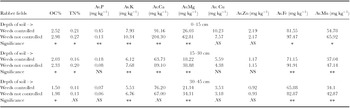
The data on OC, TN, av.P, av.K, av.Ca, av.Mg, av.Cu, av.Zn, av.Mn and av.Fe at different soil depths viz., 0–15, 15–30 and 30–45 cm of the two different set of fields, viz., clean-weeded and no-weeded are shown in the Table 1. It could be observed that at all the three soil depths, OC (%) was significantly higher in no-weeded fields than in ‘clean-weeded’ fields. An accumulation of OC in the top layer and a declining trend in OC (%) with respect to soil depth was observed in rubber fields under both the weeding systems.
Organic carbon, total nitrogen and available nutrients at different soil depths in clean-weeded and no-weeded rubber fields.

(Av.- Available, * p < 0.05, ** p < 0.01).
As in the case of OC (%) the soil TN (%) was also significantly higher at 0–15 and 15–30 cm soil depths in the ‘no-weeded’ fields. At the lower depth of 30–45 cm, the difference in TN (%) was negligible under both weeding situations. The declining trend of TN (%) with respect to soil depth was noted as in the case of OC (%) under both the situations. Moreover, the differences in TN (%) between the two situations were also declining towards lower soil depths.
Significantly higher concentrations of av.K and av.Mg were noted at all the three soil depths in the ‘no-weeded’ rubber fields than in ‘clean-weeded’ fields. In the same fields, higher concentrations of av.Ca were noted in the 0–15 and 15–30 cm soil depths. In the case of av.P, a significantly higher content was noted in ‘clean-weeded’ rubber fields in the 0–15 cm soil layer and in the bottom layers it were not significantly differing among the fields under the two different weeding practices.
In the case of micro-nutrients in soil, av.Zn and av.Cu contents were not significantly different in the two sets of fields with different weed management practices at all the three soil depths viz., 0–15, 15–30 and 30–45 cm. However, at all the three soil depths, av.Fe and av.Mn contents were significantly higher in fields with ‘no-weeding’ practice.
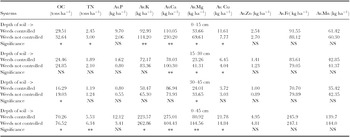
The stock of OC, TN and available nutrients in the 0–15, 15–30 and 30–45 cm soil layers as well as the cumulative stock in 0–45 cm soil layer in fields under both the weed management practices are shown in Table 2. Significantly higher stock of OC was noted in 0–15 and 30–45 cm soil layers of ‘no-weeded’ fields. Also in these fields the cumulative OC stock in 0–45 cm soil layer was significantly higher and was about six tons more than in ‘no-weeded’ fields. The stock of TN in the 0–15 cm soil layer was significantly higher in fields with ‘no-weeding’ practice. Though in deeper soil layers the difference was not significant the cumulative stock of TN in 0–45 cm soil layer was more in fields with ‘no-weeding’ practice.
Stock of organic carbon, total nitrogen and available nutrients in different soil layers under clean-weeded and no-weeded rubber fields.

(OC- organic carbon, TN- total nitrogen, Av.- Available, *p < 0.05, ** p < 0.01).
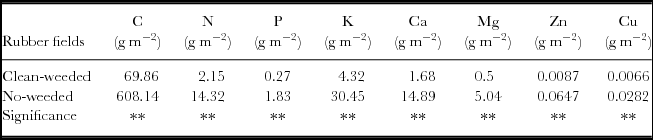
Considerable field-to-field variations existed in the stock of av.P and were not significantly differing among the two different sets of fields. Stock of av.K was significantly higher in 0–15 soil layer of no-weeded fields. As in the case of TN, stock of av.K was not significantly differing in the 15–30 and 30–45 cm soil layers however, the cumulative stock in 0–45 cm soil layer was significantly higher in ‘no-weeded’ fields. In ‘no-weeded’ fields, stock of av.Mg was significantly higher in all the three soil layers studied. In ‘no-weeded’ fields, the stock of av.Ca was significantly higher in the 0–15 and 15–30 cm soil layers. The cumulative stock of av.Ca in the 0–45 cm soil layer was significantly higher in the ‘no-weeded’ rubber fields. Among the micro nutrients studied, only the stock av.Cu had shown a significant difference. It was significantly higher in the fields at 0–15 and 15–30 cm soil layers with ‘clean-weeding’ practice. Also in the same fields the cumulative stock of av.Cu in the 0–45 cm soil layer was significantly higher. No difference in stocks of av.Zn, av.Fe and av.Mn in any of the soil layers among the two sets of fields could be observed. The stock of av.Cu (Table 2) in soils under the clean-weeded and no-weeded rubber fields deserves special attention. The no-weeding practice in rubber fields had generated more weed biomass (Figure 1) and more Cu accumulation in weed biomass was also noted (Table 4). In these fields a depletion of stock of av.Cu in soil was also noted (Table 2). The cumulative stock of av.Cu in 0–45 cm soil layer was significantly higher in fields where ‘clean-weeding’ was practiced.
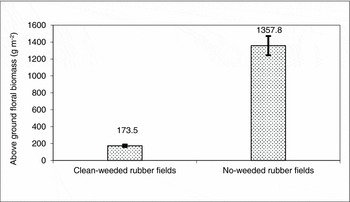
Biomass of above ground flora in clean-weeded and no-weeded rubber fields.

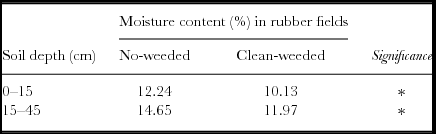
The soil moisture status during the dry period at 0–15 and 15–45 cm depths were significantly higher in the no-weeded fields than clean-weeded fields (Table 3). The difference in moisture status was more in the bottom layer of soil in rubber fields under different weed management practices.
Soil moisture status during dry period in clean-weeded and no-weeded rubber fields.

(*p < 0.05).
The biomasses of the above ground portion of the weeds in the ‘clean-weeded’ and ‘no-weeded’ rubber fields are shown in the Figure 1. In ‘no-weeded’ rubber fields, the weed biomass was about eight times higher than ‘clean-weeded’ rubber fields. The C and other nutrient contents in the above ground portion of the under-flora in the two sets of fields are shown in the Table 4. The total amount of different nutrients stored up (stock) in the live above ground portions of under-flora was invariably higher in ‘no-weeded’ fields. Similar to the situation of C, the stock of N stored in the biomass of under-flora and soil (0–45 cm depth) also were significantly higher in the fields with no-weeding practice. The N accumulated in the live above ground biomass of the under-flora was about seven times more in the ‘no-weeded’ fields compared to ‘clean-weeded’ fields. The rubber systems with no-weeding practice had reflected positively in the case of K and Mg stocks also. The accumulation of these nutrients were more in the under-flora and also in soil in the no-weeding fields compared to the fields where weeding was regularly practiced.
Nutrients in above ground portion of weed flora in in clean-weeded and no-weeded rubber fields.

(*p < 0.05, ** p <0.01).
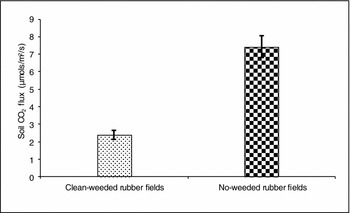
The measured in situ soil respiration rates were significantly higher in ‘no-weeded’ fields (Figure 2). The soil CO2 efflux is about three times higher in ‘no-weeded’ fields compared to the ‘clean-weeded’ fields.
Soil respiration rates under ‘clean weeded’ and ‘no-weeded’ rubber fields.

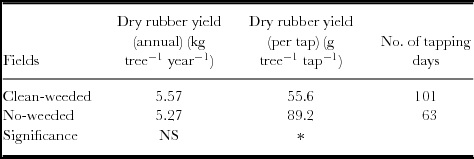
The average dry rubber yield per tree on an annual as well as on per tap basis and the total (annual) number of tapping (harvesting) days in clean-weeded and no-weeded fields are shown in Table 5. The annual per tree crop yield was not significantly different among the two management situations while it was different on per tap basis. Though, the annual harvesting days were less in no-weeded fields, the dry rubber yield per tree per tap was more compared to the clean-weeded fields.
Per tree dry rubber yield (annual) in no-weeded and clean-weeded rubber fields.

(*p < 0.05).
DISCUSSION
Higher litter turn over from luxuriously grown under-flora must be the cause for the significantly higher OC in the no-weeded rubber fields. Also the higher density of under-flora might have resulted in higher root density and the decay of dead roots and root exudates also might have contributed to higher OC content in lower layers of soil under no-weeding.
The reasons for higher TN (%) in soils under ‘no-weeded’ fields could be the same as in the case of OC. It is important to note that even in the absence of N fertilizer input in ‘no-weeded’ fields, the TN (%) in soil had increased. The diverse weed species which were luxuriously growing in the ‘no-weeded’ fields had resulted in much higher litter turn over compared to the ‘clean-weeded’ fields. There are similar reports from other managed ecosystems that certain deep rooted weeds transfer nutrients from deep soil layers and help in improving soil quality and fertility in managed ecosystems (Jordan and Vatovec, Reference Jordan and Vatovec2004). Also weeds with their wider root network prevent nutrient losses through leaching and erosion significantly contribute in N cycling (Patriquin, Reference Patriquin, Lopes-Real and Hodges1986; Ziska and Dukes, Reference Ziska and Dukes2011). The litter from multi-species origin is reported to be having better quality in terms of decomposability and in such systems, rate of C and N cycling would also be more. That could be the reason for higher soil C and N in the top soil layers under ‘no-weeded’ fields (Webster et al., Reference Webster, Hopkins, Chudek, Haslam, Simek and Pîcek2001; Zak et al., Reference Zak, Holmes, White, Peacock and Tilman2003).
There were regular inputs of P and K fertilizers in the ‘clean-weeded’ rubber fields and a build-up could only be observed in the case of av.P. The ‘no-weeded’ fields did not receive any K fertilizer input, yet a significantly higher build up av.K had taken place. The solubility of the used fertilizer materials, nutrient absorption, recycling by the existing flora and variation in soil retention might have influenced the decline or build-up of av.K and av.P contents in these soils. The K fertilizer source was water soluble potassium chloride, whereas the P fertilizer source was insoluble rock phosphate. The soluble K might have leached out more from the top layers of soil in ‘clean-weeded’ fields while in the ‘no-weeded’ fields, more K might have been absorbed by the dense root system of the thick under-flora and recycled efficiently through the higher litter turn over. The P applied in the insoluble form might not have leached out from the soil and a build-up might have occurred because of the regular annual inputs in clean-weeded fields.
The results on soil nutrient contents clearly indicated that the OC, TN and available forms of K, Ca and Mg contents in soil had significantly improved upon retaining the weeds in rubber plantations. This must be obviously because of the higher litter turn over from the multi-species system existing and another reason could be due to the less surface runoff and soil erosion because of better soil consolidation by a better root network system. The build-up of organic matter in rubber plantations is of extreme importance since several reports are there that a depletion of organic matter is noted in rubber plantation compared to nearby virgin forests (Abraham et al., Reference Abraham, Jose, Joseph and Thankamony2010, Karthikakutty, Reference Karthikakutty1995; Tata, Reference Tata2011). The building up of organic matter especially through litter which was generated from multi-species flora, can influence microbial population, their activity, decomposition rate and nutrient release (Abraham and Chudek, Reference Abraham and Chudek2008, Webster et al., Reference Webster, Hopkins, Chudek, Haslam, Simek and Pîcek2001).
The trend observed in the case of OC, TN and available nutrient contents were reflected in the respective stock of nutrients as well. The reasons for the variations in soil nutrient contents must be the same for variations in stock under the two different weed management systems. The higher stock of soil av.Cu in the clean-weeded situation was might be due to the regular application Cu fungicides such as ‘Bordeaux’ mixture on rubber plants in these fields coupled with less absorption by low weed density. More Cu accumulation in the weed biomass under the ‘no-weeded’ rubber plantations must be due to the higher absorption of Cu by the thick under-flora.
Though the high vegetation might have resulted in the higher evapo-transpiration in no-weeded fields, it seems higher boundary layer resistance had prevented the soil surface desiccation. Also, the thick litter layer observed in these fields might have conserved more soil moisture.
About ten years of no-weeding practice had generated more above ground biomass through under-flora in these systems compared to the same in the clean-weeded systems. The ‘clean-weeded’ fields, had received a regular annual dose of 30 kg each of N, P and K ha–1 through inorganic fertilizers. In spite of not receiving any external input of N, P or K in the form of fertilizers, the stock of nutrients was tremendously higher in under-flora of ‘no-weeded’ fields. In such situations where more nutrients were extracted from soil, by the existing flora continuously, depletion in soil nutrient stock could be expected. However, in the present situation, a build-up of nutrients is noted in the soils of ‘no-weeded’ rubber fields compared to ‘clean-weeded’ fields.
The build-up of stock C in soils and above ground flora of ‘no-weeding’ mature rubber fields are of a great significance. The data generated clearly indicated that the environmental significance of rubber based ecosystems would become more relevant and attractive in terms of C sequestration when the no-weeding practice is adopted in mature rubber plantations. The slashing of weeds during earlier occasions might have given biomasses of similar amounts in the clean- weeded fields. However, such additions in the past had not reflected on the soil nutrient status. Also the soil data (Table 2) reveals that the biomass or C accumulated in the under-flora was not at the cost of soil organic matter or other soil nutrients stored (stock) in the no-weeded fields. The ‘no-weeding’ practice in mature rubber plantation had clearly generated such a situation where soil organic matter status was improved by about six tons ha−1. In addition, if the estimated weed biomass is extrapolated to express in per ha basis, about six tons of C is found to be sequestered through weed biomass under such a weed management practice. The results are very important in view of the several reports saying that there can be depletion in organic matter status in soils upon continuous cultivation of rubber (Abraham et al., Reference Abraham, Jose, Joseph and Thankamony2010, Karthikakutty, Reference Karthikakutty1995; Tata, Reference Tata2011). Moreover, the N accumulation in the under-flora had not created any depletion, in fact a significant increase had taken in place in the stock of soil N (Table 2). These results are similar to the observations in other agro-ecosystems by Henry et al. (Reference Henry, Tittonell, Manlay, Bernoux, Albrecht and Vanlauwe2009) and Yachi and Loreau (Reference Yachi and Loreau1999). There are also reports that agro-ecosystems with broader diversity of plant species and living forms might achieve higher levels of productivity in the long-term while maintaining larger and more stable C stocks (Yachi and Loreau, Reference Yachi and Loreau1999). The no-weeding practice in rubber fields had generated more biodiversity and litter turn over based on the visual observations which could bring long term benefits to the ecosystem.
The higher soil respiration rates in ‘no-weeded’ rubber fields were also must be because of the higher organic matter content and nutrients accumulations along with higher moisture retention in the upper layer of soil in these fields which might have generated a congenial situation for higher microbial activity and had reflected in the in situ soil respiration rate. Also in the fields where no-weeding was practiced, the soil organic matter was generated from diverse species, hence the organic matter quality would be much better for increased microbial activity which in turn would bring out more effective nutrient cycling in the ecosystem as reported by Abraham and Chudek (Reference Abraham and Chudek2008) and Webster et al., (Reference Webster, Hopkins, Chudek, Haslam, Simek and Pîcek2001). Similar reports are there that weeds play an important role in ecosystems by their associations with beneficial soil biota and act as an host to arbuscular mycorrhizal fungi (Jordan et al., Reference Jordan, Zhank and Huerd2000; Wardle, Reference Wardle1992).
The yield data collected had its own limitations for comparison between the two situations because of the variation in tapping systems such as rain-guarding and tapping frequency. Since the rubber trees in the clean-weeded fields were not rain-guarded, the number of tapping days was only 63, while in the rain-guarded clean-weeded system, it was 101. In spite of the less number of tapping days in no-weeded systems, the average annual per tree rubber yield was similar and the average per tree per tap rubber yield was obviously higher compared to the clean-weeded systems. If the trees in the no-weeded fields were rain-guarded much higher crop yield could have been expected. Though the data on crop yield cannot be interpreted for arriving conclusions on yield variations, it can be inferred that allowing under-flora in rubber plantations will not result in reduction, but indicates an improvement in yield.
Agronomically, the weed management practice in rubber plantation needs to be judged based on the stock of soil nutrients as well as crop yield of rubber. The yield of rubber plants in this study area was not affected by allowing the growth of under-flora in rubber fields. The study also pointed out that the stock of any nutrients in soil had not depleted by the no-weeding practice in rubber fields and had not created any stress in nutrient availability. It is naturally expected that higher plant density in no-weeded situation might have created higher-level of competition for rubber plants to uptake nutrients. However, no symptoms of nutrient deficiency were noted in rubber leaves in no-weeded situation. It indicates that the rubber plants were not under nutrient stress, even if, a competition for nutrient uptake existed. Probably the deep roots of rubber plants might have aided in nutrients absorption from the sub soil. The litter from diverse species in the no-weeded situation might have favoured higher microbial activity and higher nutrient release which also might have reduced the competition for nutrients absorption by rubber plants. Notably, the practice of no-weeding had resulted in higher soil moisture conservation. There are very positive indications that the no-weeding practice in mature rubber could generate very favourable conditions for long term sustenance of the ecosystem such as increased above ground biomass through diverse under-flora and more accumulation of nutrients in soil. This situation might favour higher soil microbial activity and effective nutrient cycling. None of the soil parameters studied shown a negative effect upon following the no-weeding practice in rubber plantations. Also it is obvious that, the ‘no-weeding’ practice involves less manpower and energy compared to the ‘clean-weeding’ practice when followed in rubber plantations.
There also exists a possibility of weeds overgrowing in specific areas where vacancy arises due to tree damage or branch snap, etc. In such cases specific attention may be required to control the weed growth if interfering with rubber plants.
CONCLUSIONS
The study indicated that allowing growth of under-flora in rubber plantations (five years after planting) improves soil quality. Soil organic matter status, total nitrogen and available nutrients such as K, Ca and Mg improved upon following no-weeding practices in rubber plantations. Soil moisture status and microbial activity represented by soil respiration rates were also positively influenced by allowing under-flora in rubber plantations. Allowing under-flora also had reflected in higher above ground biomass. Also the carbon and other nutrients stored up in the weed biomass were substantially higher in no-weeded rubber fields. This case study indicates the possibility of improving soil health upon allowing under-flora in rubber plantations. Also it was indicated that rubber yield was not negatively affected by the presence of under-flora in rubber plantations. The no-weeding practice if followed in rubber plantations would be economically, ecologically and agronomically beneficial. Similar weed management practices would become globally important, if tested and proved in other plantation crops or orchards.
Acknowledgements
The authors profusely thank Dr. James Jacob, Director (Research), Rubber Research Institute of India for the invaluable guidance and support extended to this study.