


1. INTRODUCTION
The construct of the veil of ignorance has been of significant import in political philosophy during the last half century: three prominent writers – John Harsanyi, John Rawls and Ronald Dworkin – have employed it in different forms. Although these three disagree on exactly how thick the veil should be, each uses it as a tool to guarantee impartiality in the procedure that deduces what the worldly distribution of resources or wealth should be. The veil-of-ignorance model is putatively impartial because the “soul” or “souls” or “parties” or “observer” who contemplate(s) behind the veil are (is) deprived of knowledge of personal attributes whose possession the author deems to be morally arbitrary, to use the phrase of Rawlsian parlance.
From quite a different vantage point, another group of political philosophers (which has a non-empty intersection with the first group) has been concerned to argue that justice requires that priority be given to the worse off in the allocation of wealth. The most extreme form of priority is advocated by Rawls, for whom differences in amounts of primary goods accruing to people are only morally permissible if they maximize an index of primary goods accruing to the worst off (that is, she who is least endowed with primary goods). Rawls (Reference Rawls1971) attempts, unsuccessfully in our view, to argue for this principle using a veil-of-ignorance (original position) construction.Footnote 1
The “difference principle” has often been criticized as being too extreme, and Derek Parfit (Reference Parfit1997) has coined the term prioritarianism for the view that the “worse off” should be given priority over the “better off” with respect to resource allocation, but that the former need not necessarily receive the extreme priority that characterizes maximin. Parfit's conceptualization is that the moral value of a given benefit to the worse off increases, the worse off that individual is. In a welfarist setting, prioritarianism is usually characterized as a social welfare function with strictly convex upper contour sets. The boundaries of prioritarianism are maximin at one pole, and utilitarianism at the other. (See, for example, Roemer, Reference Roemer2004.)
Other philosophers who would identify themselves with either a prioritarian or egalitarian or maximin view include Amartya Sen (Reference Sen1980), Brian Barry (Reference Barry1989, Reference Barry1995), G. A. Cohen (Reference Cohen and Peterson1992), Larry Temkin (Reference Temkin1993) and Thomas Scanlon (Reference Scanlon1998). There are surely many more. We include together the three views here italicized because prioritarianism is a weakening of egalitarianism and the difference principle: if a rule is maximin it is surely prioritarian. Those who advocate priority but not maximin do so usually because they consider the sacrifices of implementing the difference principle too great – sacrifices borne by the better off.
In this paper, we adopt a different, non-welfarist definition of priority. We will postulate the existence of an objective measure of human functioning. Individuals will each convert amounts of the resource (wealth) into levels of human functioning. We will say that individual i is disabled with respect to individual j if i is less efficient at converting wealth into human functioning than j. A wealth-allocation rule will be called prioritarian if, when i is disabled with respect to j, then the rule assigns at least as much wealth to i as to j. Note that prioritarianism sets a low ethical bar. In order to see its bite, consider the following example. Suppose that individual 1 is disabled relative to individual 2. Then, the wealth distribution (W + ϵ, W) is prioritarian for all ϵ ≥ 0, regardless of how much individual 1 is disabled. Prioritarianism is slightly weaker than Sen's (Reference Sen1973) original weak equity axiom. In our context, an allocation satisfies weak equity if, whenever j is disabled with respect to i, then j receives more wealth than i.Footnote 2 We adopt this terminology because assigning wealth under this constraint gives priority to the worse off, although it is certainly a special case of the category of allocations that are motivated by Parfit's priority mandate. In particular, the maximin allocation will always be prioritarian in our sense, although many less extreme allocations will also be prioritarian. So, just as Parfit's priority is a weakening of the moral mandate that motivates maximin, so prioritarian allocations, in our sense, include the maximin allocation (but many others as well).
We believe that those in the philosophical tradition just referred to would endorse the ethic of prioritarianism as we define it: they believe that if A is less efficient at transforming wealth into the capacity to function than B, then A is, in a clear sense, worse off than B and therefore, justice requires that A should receive at least as much wealth as B. In what follows, we will abstract from the issue of how to measure human functioning (or how to create the index of primary goods): we will boldly assume that a complete order R of ordered pairs (i, W) exists, where the statement (i, W)R(j, W′) means that “person i with wealth W has a level of human functioning at least as great as person j with wealth W′”.
We show that the veil of ignorance, when formulated in a rigorous way, is inconsistent with prioritarianism.Footnote 3 We focus on the conceptions of the veil of ignorance outlined by Harsanyi (Reference Harsanyi1953, Reference Harsanyi1977) and Dworkin (Reference Dworkin1981b). In the former case, we complete the theory that Harsanyi began and then show its anti-prioritarian consequences. In the latter case, we show the anti-prioritarian nature of Dworkin's insurance mechanism.
Central to our models of the Harsanyi and Dworkin veils of ignorance is a technique we call objective empathy, which is the following. When a soul behind the veil of ignorance contemplates becoming a particular person with a particular wealth (after the birth lottery has occurred), it evaluates its condition, as such, by comparing the degree of functioning that the person in question would achieve with the degrees of functioning that other individuals (whom the soul might become) would achieve with the amounts of wealth that they receive. Empathy is involved because interpersonal comparisons are being made by the soul; and the empathy is objective in nature because functioning is being compared, rather than a more subjective kind of welfare.Footnote 4 This technique is an innovation in modelling the veil of ignorance, and we believe it (or something equivalent) is necessary in order to solve the decision problem of a soul behind the veil of ignorance.Footnote 5
Our argument will suggest that one cannot coherently advocate both priority (as we define it) and a veil-of-ignorance justification for a distributive recommendation. We explain, in the final section, why we take this result to justify rejecting the veil of ignorance as a technique for discovering what justice requires.
2. THE HARSANYI VEIL OF IGNORANCE
2.1. Harsanyi's original first step
John Harsanyi is usually credited for having proposed the first precise model of the veil of ignorance.Footnote 6 A first (but imprecise) presentation of this model is introduced in Harsanyi (Reference Harsanyi1953) but it is only later that Harsanyi (Reference Harsanyi1977) came to restate his insights more formally.Footnote 7 Suppose there are n individuals, each of whom possesses von Neumann-Morgenstern (vNM) preferences over wealth lotteries. Denote vNM utility functions on wealth for these people by v 1, v 2, . . ., vn. There is an amount of wealth  to be divided among them. What is the just division? Harsanyi proposes to conceptualize a single impartial observer (IO) who contemplates becoming one of these people, with equal probability of becoming each one. How would such an observer allocate the wealth?
The IO's data, for Harsanyi, comprise of the set  .
Denote by (i, W) the extended prospect that means “becoming person i with wealth W”. Harsanyi proposes that the IO, to solve his problem, must itself possess a vNM utility function U defined on extended prospects. (That is, it must be able to evaluate lotteries on extended prospects.) We can then represent the “birth lottery” through which the IO becomes a particular person, and in which the distribution of wealth among the individuals is (W 1, W 2, . . ., Wn), by

This is to be read, “With probability 1/n, the extended prospect (1, W 1) is realized (and the IO becomes person 1 with wealth W 1), with probability 1/n the extended prospect (2, W 2) is realized, and so on”.
Now the utility the IO receives from this lottery is, by the expected utility property, equal to:
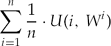
and so the IO need only find the distribution of wealth that maximizes expression (1) subject to the constraint that  . That distribution is the one it would choose, and therefore, that justice recommends.
The problem, then, is to deduce what the function U is. Harsanyi takes an axiomatic approach to this problem. He assumes what he calls:
The Principle of Acceptance: For each fixed i ∈ {1, . . ., n}, the function U(i,·) represents the same vNM preferences on wealth lotteries as vi(·) represents.
Now the vNM theorem tells us that any two vNM utility functions that represent the same preferences must be positive affine transformations of each other. Therefore:
For all W and i, there exist ai > 0 and bi such that

Substituting formula (2) into (1), we have that

Maximizing the right-hand side of (3) is equivalent to maximizing ∑ai·vi(Wi). That is the end of Harsanyi's argument: the IO must maximize some positive weighted sum of the vNM utilities of the individual persons.
2.2. Amending Harsanyi to allow for interpersonal comparisons
Harsanyi's argument is in our view unfinished, for he has provided no (correct) way of determining the values of the positive numbers {ai: i = 1, 2, . . ., n}, so he has not determined the vNM preferences of the IO.Footnote 8 Furthermore, there is no way to derive these values from the information that Harsanyi has provided to the IO, and his axioms.
A moment's thought will show why this is so. The only information the IO has, consists in the profile of risk preferences of the individuals, and the total wealth to be allocated. But to decide whether it would rather become Alan with $1000 or Barbara with $3000, the IO must be able to compare how well off Alan is with $1000 with how well off Barbara is with $3000. (Or it must have some independent reason to prefer to be Alan, say.) There is no way the IO can make such comparisons with the information Harsanyi has given it.Footnote 9 There is, in Harsanyi's original specification of the problem, absolutely no information permitting interpersonal comparisons.Footnote 10 The vNM preferences of the individuals are purely ordinal preferences that measure “utility” in a non-comparable way across persons.Footnote 11
Clearly, if the IO were to possess vNM preferences on the lotteries on the space of extended prospects, such preferences would imply the existence of something that looks like an interpersonal welfare ordering, for the IO. For let such preferences exist and denote them by ≳; then the statement “(i, W) ≳ (j, W′)” which means “the IO would weakly prefer to be person i with wealth W to being person j with wealth W′” is similar, though surely not identical, to the statement “person i with wealth W is at least as well off as person j with wealth W'”. Of course, the second statement presupposes that interpersonal comparisons of welfare are meaningful, while the first statement does not: in the absence of the ability to make such comparisons the IO might have another decision procedure which leads it to its view about the relative merits of being person i or j with the associated wealths.
How can we complete Harsanyi's determination of the lO's risk preferences on extended prospects, while preserving impartiality? If we accept the common view that concepts of welfare across persons are incommensurate – a view many hold – then perhaps the best we can do is adopt some objective index with which to compare different lives. This, indeed, is the move that Rawls makes when he proposes to compare lives with some index of primary goods, and that Sen makes when he proposes to make interpersonal comparisons of some index of functionings. Both Rawls and Sen advocate inclusion in the index, of goods (Rawls) or states of being (Sen) that are objectively measurable.
Using such an index to make interpersonal comparisons is objective; it is harder to defend the claim that it is impartial. For the weights assigned to different goods or functionings in such an index must reflect someone's (partial) view of the relative values of these goods for human accomplishment, satisfaction or welfare. So we cannot claim that the adoption of such an index is impartial: we defend it, rather, as the best we can do.Footnote 12
We thus propose that there is an index of human functioning which allows us to rank pairs of extended prospects (i, W) and (j, W′).
We assume that there is a complete order on extended prospects, denoted R, and for all i, j, W, there exists W′ such that (i, W)I(j, W′), where I denotes the symmetric part of the order R.
The statement (1, W 1)R(2, W 2) means “person 1 with wealth W 1 does at least as well as person 2 with wealth W 2 according to the adopted concept of human functioning.”
We now append to Harsanyi's axioms what we call:
The Principle of Objectivity: (i, Wi) ≿ (j, Wj) ⇔ (i, Wi)R(j, Wj).
The Principle of Objectivity gives the IO a way of comparing different lives.Footnote 13
The data available to the IO are now {v 1, v 2, . . ., vn, , R}, and the axioms that relate his own preference order to the data are those of Acceptance and Objectivity. We will now show that these data and axioms together lead to a characterization result.
To do so, we first introduce another concept. Let  be a human-functioning-equalizing distribution of wealth: that is a distribution such that

Footnote 14 Let there be two more human-functioning-equalizing distributions of wealth denoted {Wib}ni=1 and {Wic}ni=1, and suppose that these three distributions of wealth represent three levels of functioning in increasing order, and so it follows that for each i, W ia < W ib < W ic, because we assume that functioning is increasing in wealth.
We again invoke the vNM theorem, which tells us that for each person i there is a unique probability pi such that:

In general, of course, the probabilities pi will differ across individuals. The more risk averse an individual is, the lower will pi be. We say that:
The individuals in the world {v 1, v 2, . . ., vn, , R} have the same risk attitudes if, for any choice of the three human-functioning-equalizing distributions {Wia}, {Wib} and {Wic}, the numbers {pi : i = 1, . . ., n} defined by (4) are identical for all i = 1, . . ., n. If such is the case, we say that the environment {v 1, v 2, . . ., v n, , R} is risk isomorphic.
If the environment is risk isomorphic, then we can view all individuals as having the same risk preferences over lotteries of human functioning; for if {Wia} and {Wib} bring about levels of human functioning of a for everyone and b for everyone, respectively, then the lottery represented in (4) is, for each person, a lottery over the same two levels of human functioning.
Risk isomorphism is a property of our environments: it requires as data both the profile of vNM preferences and the interpersonal ordering R. Should we view risk isomorphism as a singular condition on environments? On the one hand, one answers affirmatively if one believes that preferences over lotteries on human functioning can be arbitrary, like preferences over commodities. On the other hand, one may believe that all persons do have the same risk preferences over human functioning, and that their preferences over wealth lotteries differ because they possess different technologies for converting wealth into welfare. This view would seem to be endorsed by Stigler and Becker (Reference Stigler and Becker1977). Yet a third view is that the singularity of risk isomorphism lies in the agreement of all individuals upon an ordering, R, of extended prospects.Footnote 15 Indeed, if all individuals agree on the ordering R, this could be taken as evidence of the impartiality of the procedure.
We have the following:
Theorem 1There is a vNM preference order on extended prospects (for the IO) that satisfies the principles of acceptance and objectivity if and only if individuals in the world {v 1, v 2, . . ., vn, , R} have the same risk attitudes. If so, the order is unique and represented by the vNM utility function on extended prospects:
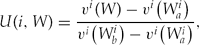
where {Wia}ni=1and {Wib}ni=1are any two human-functioning-equalizing distributions of wealth such that W ib > W iaand U is well defined.Footnote 16
Theorem 1 says that, in the case of risk non-isomorphism, the Harsanyi veil of ignorance, amended by information on interpersonal comparability and the principle of objectivity, is an incoherent thought experiment.Footnote 17 In the case of risk-isomorphism, we uniquely determine the preferences of the IO (that is, we solve for the coefficients {ai} of equation (3).) In particular, if the environment is risk isomorphic, we know the basic procedure by which the IO selects the allocation of wealth. Formally, we define the:
Basic procedure. Let {W 1a}ni=1and {W 1b}ni=1be any two human-functioning-equalizing distributions of wealth such that Wib > Wia. If individuals in the world {v 1, v 2, . . ., vn, , R} have the same risk attitudes, then the IO selects an allocation ωB = (W 1, W 2, . . ., Wn) that maximizes
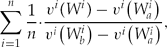
subject to the condition that  .
If the environment is not risk isomorphic there are no vNM preferences for the IO with respect to the order implied by the index of human functioning. If one views risk isomorphism as a singular condition, then perhaps one should conclude that Harsanyi's assumption that the IO must possess vNM preferences on lotteries of extended prospects is too strong, because it conflicts with the reasonable axioms of acceptance and objectivity. Nevertheless, a weakening of the basic procedure by which the IO might decide upon a distribution of wealth in any environment (risk-isomorphic or not) can be proposed upon scrutinizing the notion of objective empathy (e.g. Moreno-Ternero and Roemer Reference Moreno-Ternero and Roemer2005).
2.3. The anti-prioritarian nature of the Harsanyi veil of ignorance
We introduce formally:
Given the human-functioning order R on extended prospects, individual j is weakly disabled with respect to individual i if and only if (i, W)I(j, W) implies W′ ≥ W. We also say that i is weakly able with respect to j.
An allocation of wealth (W 1, . . ., Wn) is prioritarian if and only if when j is weakly disabled with respect to i then Wj ≥ Wi.
As we discussed in the introduction, prioritarianism is a principle that limits the extent of Rawls's difference principle, often criticized as being too extreme.Footnote 18 If one accepts the notion of index of human functioning as a basis for interpersonal comparisons of advantage, the priority principle sets a low ethical bar. This would raise serious doubts, from an ethical viewpoint, about allocation methods failing to satisfy this principle.
We now show the anti-prioritarian nature of the Harsanyi veil of ignorance by means of a simple example. There are two individuals, Andrea and Bob. They are each risk neutral. We may therefore take them to have the same linear vNM utility function, namely

Let us suppose that the indifference curves of the interpersonal human-functioning order are given by (Andrea, W)I(Bob, 2W); that is, Bob always needs twice the wealth of Andrea to achieve the same level of functioning as she. It is easy to see that this environment is risk isomorphic, and Bob is disabled with respect to Andrea.
We compute what the IO recommends for this example. Suppose that  , so a distribution of wealth is represented by (W, 1 − W) where the first component goes to Andrea and the second to Bob. The IO must choose W. We know that U(A, W) = U(B, 2W) by the principle of objectivity. Now the IO must choose W to

By the formula just given we can write this as

But, by the principle of acceptance, this is equivalent to maximizing

which is achieved at W = 1: the IO would give all the wealth to Andrea.
This example shows that in general the veil of ignorance, as we have modelled it, violates priority. Indeed, when all agents are risk neutral, and they can be ordered with respect to ability, then the veil gives all the wealth to the most able individual!
Of course, the interpretation matters here. A situation where Bob requires twice Andrea's wealth to reach her level of welfare could be due to Bob having expensive tastes for which we hold him responsible, and in that case, we might not be so disturbed by the conclusion.Footnote 19 But we insist that that is not the problem we are here studying. We are discussing worlds where people differ in their ability to convert wealth into functioning. Priority is predicated upon an objective measure of well-being, not subjective welfare.
What happens if we alter the risk preferences in the above Andrea–Bob example so that the individuals are risk averse? For small degrees of risk aversion, it continues to be the case that our amended Harsanyi veil delivers more wealth to the able agent, although it will deliver some wealth to both agents. Only for large degrees of risk aversion does the basic procedure assign more wealth to the disabled person.
We have now provided the argument that the veil of ignorance, completed from Harsanyi's first step by the addition of more information and a new axiom (the principle of objectivity), is anti-prioritarian, in the sense that it fails in general to assign at least as much wealth to less able agents as to able ones.Footnote 20
3. THE DWORKIN VEIL OF IGNORANCE
Ronald Dworkin (Reference Dworkin1981b) outlined a conception of the veil of ignorance that is coherent and can be formally modelled. In Dworkin's view, individuals are to be held responsible for their preferences, but not for their “resources.” The veil of ignorance is supposed to shield people from knowledge of the characteristics they possess which are “morally arbitrary” – here, their resources – but not from characteristics which they ‘own’ – here, their preferences. Thus, behind Dworkin's veil, the soul representing a person knows his person's vNM preferences, but does not know the worldly wealth or talent his person possesses. Dworkin's innovation was to propose that souls behind this veil of ignorance enter into insurance contracts with each other, to seek indemnity against bad luck in the birth lottery. In this section, we propose a model of this insurance market.Footnote 21
We begin with a two-person example, and our model of Dworkin's thought experiment. Suppose we again have Andrea and Bob, and Bob is disabled with respect to Andrea – to wit, he requires 2W in wealth to reach the same functioning level as Andrea reaches with W. For the sake of variety, we will now suppose that Andrea and Bob have the same risk preferences over wealth and their vNM utility function is given by

This time, Andrea and Bob are risk averse.
As we said, Dworkin wishes to hold persons responsible for their risk preferences, but not for their talents. In this case, talent is the ability to convert wealth into functioning. Thus, behind the veil of ignorance he constructs, the soul representing a person knows its person's vNM utility function, but does not know its person's talent.
Behind the veil of ignorance, there are two souls – call them α and β – who represent Andrea and Bob, respectively. Each soul knows the abilities of Andrea and Bob, and each believes that it will become Andrea or Bob with equal probability (or, to paraphrase, that it will acquire Andrea's and Bob's ability with equal probability).
Thus there are two states of the world, from the viewpoint behind the veil, as follows:

In state 1, soul α becomes Andrea and soul β becomes Bob; in state 2, the assignments of souls to persons are the other way around. We know that state 1 will occur, but the souls behind the veil assign a probability of one-half to each state's occurring.
We assume that, in the actual world, Andrea has an endowment WA of wealth and Bob has an endowment of WB.
Behind the veil, the souls purchase insurance against bad luck in the birth lottery. We assume (after Dworkin) that the souls have equal purchasing power for insurance. This is where equality enters importantly into Dworkin's view. Each soul has zero purchasing power initially. This means that the only way to purchase insurance for indemnity in one state is to sell insurance for the other's indemnity in the other state.
We model the insurance market as follows. There are two commodities: the first is a contract which will deliver $1 to the holder should state 1 occur, and the second is a contract which will deliver $1 to the holder should state 2 occur. Let us denote the prices (behind the veil) for these two commodities by p 1 and p 2. Note that these commodities are purchased behind the veil, using the currency that exists there, which we call clamshell currency, to follow Dworkin's usage.
Denote by xα and yα the amount of commodity 1 and commodity 2, respectively, that soul α purchases. If x is positive, that means she purchases contracts that will deliver to her x dollars if the state in question occurs; if x is negative, that means she will deliver x dollars to someone else should that state occur. The budget constraint for soul α is

which means that the amount of commodity 1 she can purchase must cost exactly the clamshell income she generates by selling commodity 2 (or, the other way around). This constraint derives from the fact that her endowment of clamshells behind the veil is zero. If the soul faces prices (p 1, p 2) then her optimization problem is as follows: choose xα and yα to maximize

We explain the objective function, which is a form of expected utility. If soul α becomes Andrea (state 1 occurs), then her wealth will be WA + xα. If, however, she becomes Bob (state 2 occurs), her/his wealth will be WB + yα: but, equipped with Andrea's constitution, α must evaluate this wealth from Andrea's perspective. To do so, she employs objective empathy. Wealth WB + yα for Bob is equivalent to wealth  for Andrea, in terms of functioning. This explains the term under the second radical in (8).
We believe that, without some manner of making interpersonal comparisons of outcomes (welfare or functioning) there is no sensible way to formulate the decision problem of the soul behind the veil. For that soul must contemplate becoming two different people, and needs some standard to decide how to allocate wealth over the two states in which this occurs.
In other words, soul α uses Andrea's vNM utility function to evaluate lotteries over wealth, and she converts wealth that she would experience as Bob into human-functioning-equivalent wealth for Andrea.
In like manner, the optimization problem for soul β is to choose xβ and yβ to maximize

Note that, if soul β becomes Andrea, he must evaluate her wealth in terms of the human-functioning-equivalent wealth for Bob.
An equilibrium in the insurance market consists in:
(i) a pair of prices p 1 and p 2, and
(ii) commodity demands (
 , , , ) maximizing (8) and (9) and such that the markets for both commodities clear, that is: .
 ,
 ,
 ,
 ) maximizing (8) and (9) and such that the markets for both commodities clear, that is:
 .
There is a unique equilibrium in this market.Footnote 22 It is:

As we said, we know that, in the event, state 1 occurs; this means that the final wealth levels (under the Dworkinian tax scheme) must be

Thus, disabled Bob ends up with one-third of the total wealth, and able Andrea ends up with two-thirds of the total wealth.
In other words, the Dworkinian insurance market is in general anti-prioritarian. It does not (in general) assign at least as much wealth to the disabled individual as to the able individual. Nevertheless, in the appendix we show that if Andrea and Bob are sufficiently risk averse, then the veil of ignorance does award more wealth to the disabled individual.
4. OUR REJECTION OF THE VEIL OF IGNORANCE
We have shown that the veil of ignorance, in either its amended Harsanyi form or its amended Dworkin form, when viewed as a mechanism for allocating wealth, is non-prioritarian. For those committed to prioritarianism, as we have defined it in this article, this demonstration therefore provides reason to reject the use of veil-of-ignorance arguments. But, perhaps more objectively, one can ask, why should one not take our demonstration as implying that we should reject prioritarianism as a principle of justice (and keep the veil of ignorance)?
We are concerned with the following syllogism:
1. Justice requires impartiality.
2. Impartiality, as far as justice is concerned, is properly captured by the veil of ignorance.
3. The veil of ignorance is in general non-prioritarian.
4. Therefore justice cannot (in general) be prioritarian.
A long tradition postulates #1; although we have not formally proved #3, we have shown that our best efforts to formulate the veils of Harsanyi and Dworkin give non-prioritarian results. Many (Harsanyi, Rawls, Dworkin) have endorsed #2. It would therefore seem that #4 follows.
The choice, to us, seems to be either to reject #2 or #4. As we believe that priority, at least in the weak way we have here defined it, is fundamental to justice, whereas claim #2 is not obvious, we choose to reject #2. Claim #2 is complex, for it involves not only a thought experiment, of placing oneself in the shoes of another, but also a difficult question of exactly how that experiment should be modelled. It is, we believe, difficult to maintain that such a complex claim can be as fundamental as the necessity of priority for justice, which seems to be a much simpler claim.
Impartiality, after all, has a much weaker formulation: that social-choice rules should be anonymous. Perhaps this is all we should require of impartiality. If so, then postulating a veil of ignorance is a quite different move from postulating impartiality. It is doing much more.
One way of seeing how much the veil of ignorance is requiring of us is to contrast the assumption of a veil of ignorance to Kant's categorical imperative, which says “take those actions and only those actions which you would have all others take as well.” This is quite a different approach to justice than postulating a veil of ignorance. For note that the veil of ignorance asks individuals to contemplate seeing the world from the viewpoint of others, while the categorical imperative asks an individual to see the world only from his own viewpoint, but to contemplate how he would feel if everyone behaved as he did. This contrast shows that the veil of ignorance (original position) is a more radical gedankenexperiment than what the categorical imperative requires, in the sense of requiring a displacement of the individual from his own self. The categorical imperative asks individuals to evaluate their own behavior with their own preferences, under a hypothetical counterfactual; the veil of ignorance asks them to evaluate their choices using the preferences of other individuals.
Indeed, it is perhaps strange that Rawls, who thought of himself as a Kantian, did not attempt to justify the difference principle from the categorical imperative, rather than the original position.
5. APPENDIX
5.1. Proof of Theorem 1
Proof of the “if part” in Theorem 1. Suppose first that individuals in the world {v 1, v 2, . . ., vn, , R} have the same risk attitudes. Let U be the vNM utility function on extended prospects defined as in (5). Clearly, acceptance holds: for each i, U(i,·) is a positive affine transformation of vi. We also show that objectivity holds.
Let (i, W)I(j, W′). We show that U(i, W) = U(j, W′). To do so, let {Wia}ni=1 and {Wib}ni=1 be two human-functioning-equalizing distributions of wealth such that W ibW ia. We assume that  .Footnote 23 By risk isomorphism, there exists p ∈ [0, 1] such that

Thus,

Suppose now that  , where
 is the strict part of the order R. Define W* by (i, W*)I(j, W′), i.e. W* = σji (W′). We now know that U(i, W*) = U(j, W′). But since vi(W) > vi(W*), substitution into the definition of U(i, W) immediately shows that U(i, W) > U(j, W′) which shows that objectivity holds.
If we take two other human-functioning-equalizing wealth distributions from the ones chosen here, call them  and
 , the new function, call it
 , thereby defined, is an affine transformation of the function U. We assume that
 .Footnote 24 By risk isomorphism, there exist p, q ∈ [0, 1] such that

Then,

where  and
 .
Thus, we have shown that there is a vNM preference ordering on extended prospects for the IO that is well-defined, independent of the choice of human-functioning-equalizing wealth distributions, and that satisfies acceptance and objectivity.
We show now that the order is unique. Assume there exists another order that satisfies the principles of acceptance and objectivity. By acceptance, this new order should be represented by a vNM utility function  satisfying
 for all i and W, and for some αi > 0 and βi.
Let {Wia}ni=1 and {Wib}ni=1 be two human-functioning-equalizing distributions of wealth. Then, by objectivity, there exist two numbers Ka and Kb such that

Thus,

Consequently,

which says that is an affine transformation of the function U.
Proof of the “only if part” in Theorem 1. Suppose now that risk isomorphism does not hold. Then, there exist three human-functioning-equalizing wealth distributions of wealth denoted {Wia}ni=1, {Wib}ni=1 and {Wic}ni=1 such that Wic > Wib > Wia for all i = 1, . . ., n, and two individuals i, j such that:

and

with p i ≠ p j. Thus,

Now, if a vNM preference order on lotteries on extended prospects satisfying acceptance and objectivity exists, and U is a vNM utility function representing it, then

By acceptance, there exist positive numbers αi and numbers βi and numbers Ka, Kb, Kc such that:

We immediately have by subtracting these equations from each other:

which contradicts (10).
5.2. Related literature
There is a recent literature which is also concerned with completing Harsanyi's veil-of-ignorance approach (e.g. Karni Reference Karni1998, Reference Karni2003; Dhillon and Mertens Reference Dhillon and Mertens1999; Segal Reference Segal2000; Mongin Reference Mongin2001; Gajdos and Kandil Reference Gajdos and Kandil2007). These papers deal with axiomatic models of social choice that permit interpersonal comparisons of variations in individual well-being and touch the issue (some of them only marginally) of the extension of the Harsanyi veil of ignorance. While adopting different philosophical positions and using different analytic frameworks, they all share the aim of deriving a social welfare function axiomatically, based on the information provided by individual preferences, and most of them basically obtain the same one.
There is a broad agreement about Harsanyi's original framework and his principle of acceptance, from which one obtains that the lO's preference relation on the set of social alternative lotteries is representable by a weighted average of suitably chosen individual utilities. At that point, Harsanyi argues that if the distribution of weights in the representation is uniform then the observer is impartial. The justification for the uniform weights assumption is that from behind a “veil of ignorance” the observer behaves as if he assigns the same probability to the event of ending up being each individual in society. Weights, however, depend upon the choice of the vNM utility functions for each agent. There are other choices for the vNM utility functions that are compatible with Harsanyi's first step, without delivering the (equal-weight) additive representation. Thus, unless one has a reason to choose particular vNM utility functions for each individual (out of the affine class that represents his preferences) there is no proper argument for uniform weights. See, for instance, Weymark (Reference Weymark, Elster and Roemer1991), Karni (Reference Karni1998), or Mongin (Reference Mongin2001) for endorsements to this view.
Beyond the agreement on Harsanyi's first step mentioned above, there are different options in the literature to complete it. We decided to do so by appending information on interpersonal comparability – to be thought of as an objective fact about people – and an axiom, relating the lO's vNM preference order on lotteries on extended prospects, to this information.Footnote 25 Our proposal might appear to be similar to the proposal of Karni (Reference Karni1998) who, besides accepting the principle of acceptance, formulates an axiom of impartiality on the IO preferences. Karni claims this axiom “renders meaningful interpersonal comparisons of variation in ordinal welfare” and obtains a representation theorem for the IO preferences, in a more general framework than ours, whose utility function is similar in form to what we obtain in our Theorem I.Footnote 26 It is:

The preferences on extended prospects represented by U* are the same as the preferences represented by U in our Theorem 1 if and only if:
(a) all individuals derive equal human functioning from zero wealth, and
(b) all individuals derive equal human functioning from receiving the entire wealth of the society.
In our environments, this is clearly a singular case. One might agree that receiving zero wealth implies death, and that death engenders the minimum level of human functioning for all individuals. We find it unconvincing, however, that receiving the whole wealth endowment would engender the same level of human functioning for all individuals. This assumption would essentially say that, in all environments, the amount of total wealth is so great that everyone would have completely exhausted the possible gains in human functioning that are possible, were he to receive it all. This is indefensible, as long as we are allowing total wealth to have any value. Therefore, and since U* clearly satisfies the principle of acceptance, by our Theorem 1 and the previous discussion, it is generically true that U* violates the principle of objectivity, on our environments.
Dhillon and Mertens (Reference Dhillon and Mertens1999) and Segal (Reference Segal2000) also derive preferences for the IO which, in our environment, specialize to the representation U* above.Footnote 27 They do not, however, claim that interpersonal comparisons can be made in their worlds, and so we cannot levy against their models the criticism we have just made of Karni's.
Mongin (Reference Mongin2001), in a somewhat related approach to Karni (Reference Karni1998), also assumes that the IO's preferences conform to the subjective expected utility theory albeit interpreting impartiality epistemically. He shows that, provided that one can identify the IO's subjective probabilities, the weights for the lO's utility function would be determined.Footnote 28 Similarly, Gajdos and Kandil (Reference Gajdos and Kandil2007) provide an axiomatic characterization of the IO's preferences as a convex combination of Harsanyi's utilitarian and Rawls's egalitarian criteria, in an extended framework, by formalizing the impartiality requirement as complete ignorance (in the sense that all lotteries on individual identities are considered as possible).
Finally, Karni (Reference Karni2003) also completes Harsanyi's veil-of-ignorance model in a similar way by assuming a notion of impartiality that is divorced from other ethical considerations. The result is a different representation for the IO's preferences in which no weights appear in the aggregation of individual utilities. More precisely, if the IO's preferences satisfy a strengthening of the principle of acceptance and the impartiality notion proposed by Karni (Reference Karni2003) a distribution of wealth is preferred by the IO to another one if and only if the (unweighted) average of utilities at the first distribution is higher than the comparable average of utilities at the second.Footnote 29 Thus, the preferences on extended prospects, so represented, are the same as the preferences represented by our basic procedure described in the body of the text, if and only if the difference in utility provided by two arbitrary equalizing-human-functionings distributions is constant across individuals. Again, this is clearly a particular case within risk-isomorphic environments. Therefore, as before, it is generically true that this new representation of the lO's preferences violates the principle of objectivity, on our environments.Footnote 30
As our concern in this paper is to explore the relationship of the veil of ignorance to prioritarianism, and since the concept of priority assumes that interpersonal comparisons are possible, those comparisons must be possible in our formulation of the problem. We did not, however, argue that adding such information is the only way to complete Harsanyi's approach, although, it need hardly be said, we find it a compelling one.
5.3. A more general example for Dworkin's mechanism
We will now do a more general version of the example appearing in Section 3. We assume that the order on human functioning is given by (Andrea, W)I(Bob, rW) – that is, Bob requires rW to reach the level of functioning that Andrea achieves with wealth W. We assume that r > 1: thus, Bob is disabled with respect to Andrea. We assume that both have the same concave vNM utility function on wealth (v) and that, in the world, wealth endowments are (WA, WB). The states of the world are given in the table appearing in Section 3. Let (xα, xβ) be the demand for delivery of wealth payments by the two souls in case state 1 occurs, and (yα, yβ) be their demands should state 2 occur. We take the common vNM utility function of Andrea and Bob to be  , for some c ∈ (−∞, 1]. (If c = 0, we take v(W) = ln W.)
We normalize prices by letting the price of commodity x be one. Thus p will denote the relative price of commodity y. Behind the Dworkin veil of ignorance, the equilibrium in the insurance market is:
(i) a relative price p of the y commodity, and
(ii) commodity demands
such that:
 such that:

and the markets for both commodities clear, i.e.  .
Again, note the use of the objective empathy concept in formulating these maximization problems. Andrea's soul evaluates the wealth that she would receive if incarnated as Bob, by transforming it into functioning-equivalent wealth for Andrea.
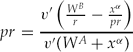
We now solve for the equilibrium. The first-order condition for solution of Andrea's soul's problem is

The first-order condition for solution to Bob's soul's problem is:

We can write (11) and (12) as:
and
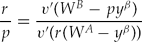
From the budget constraints and the market-clearing condition in (ii), we have  . Substituting this into (14) we have:
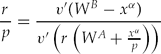
Now v′(x) = x c − 1. Applying this to (13) and (15) gives:

We now solve these equations. Try p = 1. Then both equations resolve to one equation:
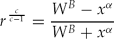
Now the final allocation of wealth is prioritarian if and only if the expression on the right-hand side of (16) is at least one, for that expression is the wealth ratio of Bob to Andrea after insurance contracts have been paid. Thus, the Dworkin veil of ignorance respects priority if and only if  , which is equivalent to c ≤ 0 for c in the interval (−∞, 1].Footnote 31
The agent's degree of risk aversion increases as c becomes smaller. Thus, we have a precise statement of the relationship of when Dworkin's insurance market is prioritarian: if and only if the agents are sufficiently risk averse, in the sense that c ≤ 0.
We attempt to give an intuitive explanation for this result. It is perhaps easiest to understand in the case when the agents are risk-neutral, when c = 1; let us take r = 2. In this case, v(x) = x, and Andrea's soul wants to maximize the ‘Andrea-equivalent’ wealth that she will receive over the two possible states of the world. Every dollar that she decides to take, if incarnated as Bob, translates into only one-half a dollar of functioning-equivalent wealth for Andrea. Thus it is inefficient to allocate any wealth to herself in the state in which she becomes Bob, state 2! Indeed, Bob's soul comes to exactly the same conclusion. So the two souls agree that, whoever becomes Andrea, should get all the wealth. This is the equilibrium the insurance market finds. Now let c decrease slightly. The fact that agents are now a little risk averse means that they want somewhat more equality between their incarnations in the two states – and so they agree that, whoever becomes Andrea should receive most (although not all) of the wealth. It is only when c becomes very small (highly risk averse agents) that they decide that the one incarnated as Bob should receive more wealth. As c approaches negative infinity, the agents become extremely risk averse: and equation (16) tells us that the post-insurance wealth ratio of Bob to Andrea approaches r – which is to say that the post-insurance market allocation of wealth approaches that which equalizes the human functioning of Bob and Andrea. For any c > −∞, Andrea will have a higher level of human functioning that Bob. Of course, this is consistent with prioritarianism, which only requires that, in this case, Bob receive at least as much wealth as Andrea. As we said, for c < 0, the insurance equilibrium is prioritarian.


