Introduction
Posttraumatic stress disorder (PTSD) may follow exposure to traumatic stress, and includes the three classical clusters of symptoms re-experiencing or intrusive memory, hyperarousal, and avoidance (American Psychiatric Association, 1994). The condition is also characterized by abnormal emotional processing (Bryant & Harvey, Reference Bryant and Harvey1995; Constans, McCloskey, Vasterling, Brailey, & Mathews, Reference Constans, McCloskey, Vasterling, Brailey and Mathews2004; McNally, Kaspi, Riemann, & Zeitlin, Reference McNally, Kaspi, Riemann and Zeitlin1990) and impairments in several domains of cognitive functioning (Vasterling, Brailey, Constans, & Sutker, Reference Vasterling, Brailey, Constans and Sutker1998; Yehuda, Golier, Halligan, & Harvey, Reference Yehuda, Golier, Halligan and Harvey2004). In addition, impairments in underlying working memory systems and executive functions have been found in PTSD (Kanagaratnam & Asbjørnsen, Reference Kanagaratnam and Asbjørnsen2007; McFarlane, Weber, & Clark, Reference McFarlane, Weber and Clark1993; Moores et al., Reference Moores, Clark, McFarlane, Brown, Puce and Taylor2008; Vasterling et al., Reference Vasterling, Brailey, Constans and Sutker1998).
In planning future actions, carrying out multi-part tasks, and overcoming habitual responses, individuals are dependent on being able to execute complex, goal-directed thoughts and behaviors. Although variously defined, these cognitive processes have been regarded as executive functions (Lezak, Reference Lezak2004). Recently, executive functions and cognitive control have been used synonymously (Hugdahl et al., Reference Hugdahl, Westerhausen, Alho, Medvedev, Laine and Hämäläinen2009), but cognitive control is often more narrowly defined, and involves the ability to dynamically adjust and regulate behavior on the basis of internal representation and feedback from the environment (Schneider & Shiffrin, Reference Schneider and Shiffrin1977; Shiffrin & Schneider, Reference Shiffrin and Schneider1977, Reference Shiffrin and Schneider1984). This also involves the ability to inhibit inappropriate behavioral responses. These cognitive control processes are essential for coping with cognitive challenges in everyday life and are important for the rapid shifts of one's mind-set and adaptability to diverse situations in the environment.
Memory paradigms using emotional stimuli have demonstrated that patients with PTSD have information-processing biases and repeatedly observed enhancements in recall for trauma stimuli (Golier, Yehuda, Lupien, & Harvey, Reference Golier, Yehuda, Lupien and Harvey2003; Paunovic, Lundh, & Ost, Reference Paunovic, Lundh and Ost2002). Furthermore, the emotional Stroop paradigm shows that despite motivated attempts to comply with instructions to name a color and ignore trauma word meaning, patients with PTSD are unable to avoid processing trauma-related words (Foa, Feske, Murdock, Kozak, & McCarthy, Reference Foa, Feske, Murdock, Kozak and McCarthy1991; Williams, Mathews, & MacLeod, Reference Williams, Mathews and MacLeod1996). This inability to inhibit or control responses to trauma relevant stimuli interferes with the ongoing cognitive processes. In addition neuropsychological studies using trauma-neutral tasks have found that basic attentional capacities seem to be preserved in patients with PTSD (Jenkins, Langlais, Delis, & Cohen, Reference Jenkins, Langlais, Delis and Cohen2000; Johnsen, Kanagaratnam, & Asbjørnsen, Reference Johnsen, Kanagaratnam and Asbjørnsen2008), while other studies have identified difficulties in more complex attentional and executive resources, as inhibiting inaccurate responses and in filtering irrelevant information (Vasterling et al., Reference Vasterling, Brailey, Constans and Sutker1998). In addition, difficulties with respect to ignoring distracting information were found to correlate with self-reported severity of intrusive recollections of trauma. Vasterling et al. (Reference Vasterling, Brailey, Constans and Sutker1998) have suggested that prefrontal cortical regulatory control is disrupted in patients with PTSD, and that a failure to inhibit unwanted trauma-related memories or situation inappropriate information may reflect a more general cognitive gating deficit in patients with PTSD.
Executive impairments have varied in nature and magnitude across studies (Beckham, Crawford, & Feldman, Reference Beckham, Crawford and Feldman1998; Crowell, Kieffer, Siders, & Vanderploeg, Reference Crowell, Kieffer, Siders and Vanderploeg2002; Stein, Kennedy, & Twamley, Reference Stein, Kennedy and Twamley2002), and Leskin and White (Reference Leskin and White2007) have argued that these inconsistencies across studies may be related to the specificity in the tests used. They argue that studies focusing on executive impairment in PTSD should use specific tests measuring the ability to inhibit habitual responses, as the core symptom clusters in PTSD comprise a failure to inhibit responses. To further our understanding of executive and cognitive control impairment in PTSD, the present study was designed to assess impairment in a situation where there is a conflict between stimulus and instruction-driven responses. Thus far, there are no studies examining impairments of cognitive control and attention modulation within a dichotic-listening (DL) paradigm in patients with PTSD.
Since PTSD is related to a failure to process and integrate traumatic experiences, the condition has been described as an information-processing disorder (Brewin, Dalgleish, & Joseph, Reference Brewin, Dalgleish and Joseph1996). Decreased executive and inhibitory control of trauma memories, emotions, and impulses are core symptoms of the disorder. Brewin and Smart (Reference Brewin and Smart2005) found a relationship between working memory capacity and the ability to suppress personally relevant intrusive thoughts. Others have found support for individual differences in interference control and sensitivity to experiencing undesirable intrusive memories (Verwoerd, Wessel, & de Jong, Reference Verwoerd, Wessel and de Jong2008). However, these studies were not performed on clinical samples, and they did not examine the inhibition of automatically triggered responses.
Cognitive dysfunctions in PTSD have been regarded as related to the PTSD symptoms, as risk factors for the development of PTSD, and as markers for neurobiological abnormalities. Kolb (Reference Kolb1987) has described enhanced arousal symptoms as the main contributing factor to cognitive dysfunctions. Hyperarousal symptoms and hypervigilance to threats in the environment may channel processing resources away from cognitive tasks. Intrusive memories have also been linked to cognitive impairment because they engage task-irrelevant processes and leave fewer resources to completing the task (Wolfe & Schlesinger, Reference Wolfe and Schlesinger1997).
Thus far little is known about the mechanisms that trigger the maintenance of intrusive memories. In a recent study, Levy and Anderson (Reference Levy and Anderson2008) formulated the Executive Deficit Hypothesis, suggesting that the differences in intrusive memories arise as a result of individual differences in executive control abilities. In this study, we hypothesized that lack of cognitive control is not restricted to traumatic memories, but to a generalized information-processing deficit. If impaired cognitive control is a more generalized inhibitory problem for individuals diagnosed with PTSD, it would be seen on neuropsychological tests of trauma neutral material. If the intrusive symptoms reflect a general failure in executive control, with a lack of ability to suppress involuntary thoughts and images, it is assumed that this impairment would also be revealed in specific cognitive tests involving cognitive control and attention modulation.
Tasks requiring cognitive control have been found to involve the dorsolateral prefrontal cortex (Garavan, Ross, Murphy, Roche, & Stein, Reference Garavan, Ross, Murphy, Roche and Stein2002) in addition the ventral prefrontal cortex has been associated with inhibitory behavior (Miller & Cohen, Reference Miller and Cohen2001). Neuroimaging studies have indicated that the anterior cingulate cortex and the dorsal prefrontal cortex are involved in cognitive control (Bunge, Ochsner, Desmond, Glover, & Gabrieli, Reference Bunge, Ochsner, Desmond, Glover and Gabrieli2001; Wyland, Kelley, Macrae, Gordon, & Heatherton, Reference Wyland, Kelley, Macrae, Gordon and Heatherton2003). Neuroimaging studies have provided strong evidence for dysfunctions in these areas in patients with PTSD (Moores et al., Reference Moores, Clark, McFarlane, Brown, Puce and Taylor2008; Shin et al., Reference Shin, Whalen, Pitman, Bush, Macklin, Lasko and Rauch2001).
Taken together, differences in behavioral performances with respect to tasks tapping cognitive control and attention modulation are to be expected in patients with PTSD. If the cognitive control and inhibitory responses are impaired in patients with PTSD we expect to see it in neuropsychological test situations in which there is a conflict between stimulus and instruction-driven responses, and in which the participants have to inhibit responses to one stimulus and facilitate responses to another stimulus.
To test impairment with respect to these functions, we applied a single measure of DL task of consonant–vowel (CV) syllables in the auditory sensory modality. The common finding for healthy individuals with regards to the DL task is that they tend to perform better with respect to stimuli presented to the right ear; a bottom-up (stimulus-driven) lateralized right-ear advantage effect (REA). In addition, healthy individuals tend to increase the REA when their attention is shifted to the right-ear stimulus and to a left-ear advantage (LEA) when the attention is switched to the left-ear stimulus. Earlier studies have also confirmed that attention modulations are partly a result of increased reporting of the attended ear input, but suppression of reports of the input from the non-attended ear also plays a significant role (Asbjørnsen & Hugdahl, Reference Asbjørnsen and Hugdahl1995). Hugdahl (Reference Hugdahl, Hugdahl and Davidson2003) explains the LEA in the forced-left condition as the result of executive control over a stimulus-driven effect.
The question addressed in this study is whether there are differences in cognitive control, measured with a DL test, between a group of war-exposed refugees with PTSD and a Control group of exposed refugees without PTSD in the three different DL attention conditions. If PTSD is causing generalized impairment of cognitive control, we believe that cognitive control will negatively impact the typically observed LEA in the FL condition in the PTSD group but not the Control group.
Method
Participants
Forty-five refugees/immigrants (34 men and 11 women) exposed to actions of war and political violence participated in the study. They were mainly from the Middle-East, Bosnia, and Chile. The age range was 18 to 55 years, with a mean age of 38 years.
The PTSD group comprised 22 participants (15 men and 7 women) meeting the Diagnostic and Statistical Manual for Mental Disorders, Fourth Edition (DSM-IV) criteria for PTSD. The diagnoses were made based on the Mini-International Neuropsychiatric Interview (M.I.N.I.), version 5.0.0 (Sheehan et al., Reference Sheehan, Lecrubier, Sheehan, Amorim, Janavs, Weiller and Dunbar1998), and the Clinical Administered PTSD Scale for DSM-IV Revised (CAPS; Blake et al., Reference Blake, Weathers, Nagy, Kaloupek, Charney and Keane1998). The Control group comprised 23 participants (19 men and 4 women) without PTSD or other psychiatric diagnoses. The groups had similar age and ethnicity profiles.
All participants had normal hearing in both ears as assessed with a standard audiometric screening procedure (< 20 dB sound pressure level). Exclusion criteria were as follows: (1) organic brain damage or neurological diseases, (2) those who had been involved in events that gave reason to expect brain injuries, such as blows to the head or loss of consciousness exceeding 30 min (Esselman & Uomoto, Reference Esselman and Uomoto1995), (3) a history of alcohol/substance addiction and/or psychotic disorders, and (4) use of tricyclic antidepressants, benzodiazepine, and/or neuroleptic medication.
Of the 22 PTSD diagnosed participants, 5 participants were from Bosnia, 13 from the Middle-East, 3 from Chile, and 1 was from Sri Lanka. In the Control group, 4 were from Bosnia, 12 from the Middle-East, 3 from Chile, and 2 were from Sri Lanka.
Procedure
The study was approved by the Regional Committee for Medical Research Ethics. Information about the study was given to health personnel at health and social services for refugees and immigrants. Written information was posted at local public health services. All participants were convenient samples recruited through these services, and the participants either referred themselves or were channeled by health- or social services employees. They gave written informed consent to participate and were informed that participation was voluntary.
All assessment measures were translated into the participants’ native language. An authorized interpreter was present during interviewing and testing. The diagnostic assessments were made by a licensed clinical psychologist with experience in the field of psychotraumatology. Neuropsychological tests were administered by graduate students in the psychology program under the supervision of licensed psychologists. Data presented in this study were part of findings collected from a larger neuropsychological test battery focusing on cognitive impairments in this sample.
Instruments
In addition to the CAPS, the Impact of Event Scale – Revised (IES-R), a 22-item self-report measure of current PTSD symptoms, was used (Weiss & Marmar, Reference Weiss, Marmar, Wilson and Keane1997). The IES-R was used to measure the intensity of intrusion, avoidance, and hyperarousal symptoms on a five-point scale (0–4). General distress was measured with the Symptom Checklist–90–R (SCL-90-R; Derogatis, Reference Derogatis1983). This instrument has 90 items within 9 primary symptom dimensions and is scored on a five-point scale (0–4). Both the IES-R and the SCL-90-R have global indices. Current symptoms of depression were assessed with the Montgomery and Åsberg Depression Rating Scale (MADRS), a 10-item clinician-administered questionnaire with scores ranging from 0 to 6 (Montgomery & Åsberg, Reference Montgomery and Åsberg1979).
Picture Completion and Similarities subtests from the Wechsler Adult Intelligence Scale – Revised were used to tap pre-morbid intellectual ability (Wechsler, Reference Wechsler1981). Picture Completion is regarded as a hold test and is described as relatively stable and not so easily influenced by external factors, and it is expected to be an indicator of pre-morbid IQ. Both scales load high on the g-factor (Lezak, Reference Lezak2004). The War Exposure Questionnaire (WEQ) was used to assess exposure to actions of war and political violence (Netland & Kanaaneh, Reference Netland and Kanaaneh1989).
To obtain relevant background information on past and current mental health, other stress factors and similar relevant factors, all participants were initially assessed with a semi-structured interview. Among the PTSD participants, being diagnosed with major depression was not an exclusion criterion. The CAPS and the M.I.N.I. were administered in the Control group only when participants had elevated scores on the IES-R. Four participants had scores higher than 44 on the IES-R and were assessed with the CAPS and then M.I.N.I.
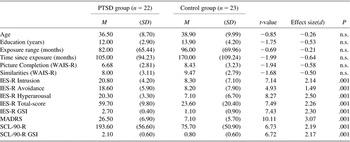
The demographic and clinical characteristics of the participants are given in Table 1. There were no significant differences between the two groups regarding age, education, performances on the WAIS-R subtests, duration of exposure to war and political violence, and time passed since their exposure. As expected, the PTSD group had significantly higher scores on the measures IES-R, MADRS, and SCL-90-R, and the effect sizes were large for these comparisons (Cohen, Reference Cohen1988).
Demographic and clinical characteristics of the PTSD group and the Control group

Note. PTSD = posttraumatic stress disorder; WAIS-R = Wechsler Adult Intelligence Scale; IES-R = Impact of Event Scale-Revised; MADRS = Montgomery and Åsberg Depression Rating Scale; SCL-90-R = Symptom Checklist-90-Revised; GSI = General Symptom Index; n.s. = not significant.
The Dichotic-Listening Task
The DL task is a well-established measure of attention and executive impairment. The dichotic stimuli consisted of six consonants paired with the vowel /a/ to form six consonant—vowel syllables (ba, da, ga, pa, ta, ka). The CV syllables were presented with a male voice, and intonation and intensity were held constant. The syllables were digitized before computerized editing and temporal alignment of onset (see Hugdahl, Reference Hugdahl, Davidson and Hugdahl1995, for details on procedure). The syllables were paired with each other, giving 36 dichotic pairs including the homonymic pairs. Each pair was recorded with three different pseudo random orders as each syllable pair appeared once for each of the three different attention tasks. The dichotic stimuli were copied to an audio CD and replayed from a CD player during the test. Eighty dB was chosen for the output volume, and the syllables were presented with 4-s intervals. All the participants were given a general outline of the nature of the stimulus material. The DL task was administered with three different instructions on how to focus attention. Under the first condition the participants were instructed to report the syllable they perceived most clearly; this was called the non-forced task (NF). Under the forced-right task (FR), the participants were instructed to pay attention to the right-ear syllables and to report only what they heard in the right ear. Under the forced-left task (FL) they were told to pay attention to what they heard in the left ear and only report what they heard in the left ear. A single response was emphasized, even when the participants may have perceived both syllables. All participants were subjected to the NF condition first, but the FR and FL were counterbalanced across participants.
Statistical Analysis
The data were analyzed using analysis of variance (ANOVA); Groups (PTSD; Control Group) × Task conditions (NF; FR; FL) × Ear (right; left). Significant effects between means were followed-up by post hoc tests.
Anxiety and depression are frequently found as comorbid conditions in PTSD. Comorbid conditions are found in up to 80% of the patients with PTSD (Kessler, Sonnega, Bromet, & Hughes, Reference Kessler, Sonnega, Bromet and Hughes1995). This represents a specific challenge with regards to examining neuropsychological impairments in patients with PTSD, because the comorbid conditions may confound the specific effects of the PTSD symptoms on the control and inhibitory functions. However, samples that exclude comorbid depression may not be representative of PTSD patients. The comorbidity challenge can be controlled for by assessing comorbid symptoms and controlling for them statistically. To control for the effect of these conditions, analysis of covariance (ANCOVA) was used to assess the influence of self-reported PTSD symptoms, depressive symptoms, and general distress symptoms on the DL measures.
Results
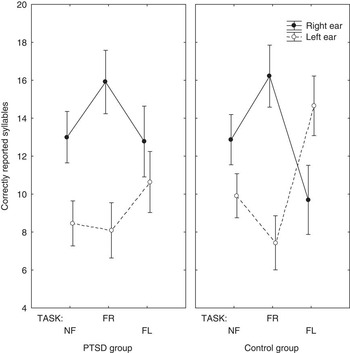
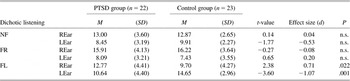
The ANOVA yielded a significant main effect for Ear [F(1,43) = 52.18; p < .001; eta 2 = .55], with an overall right-ear advantage. The factor Task condition also yielded a significant main effect [F(1,43) = 5.19; p < .007; eta 2 = .11] with higher overall accuracy for the forced attention conditions compared to the free recall NF task condition. The Group × Ear interaction also yielded a significant effect (F = 6.86; p < .01; eta 2 = .14) with an overall right-ear advantage in the PTSD group that was not seen in the Control group. The Condition × Ear interaction also yielded a significant effect (F = 31.10; p < .001; eta 2 = .42) with right-ear advantage during NF and FR, but no significant ear advantage during the FL task cognition. Finally, the three-way interaction effect of Condition × Ear × Group was significant (F = 5.59; p < .005; eta 2 = .1). Follow-up with pair-wise t tests confirmed that the right-ear score changed from NF to FL task condition in the Control group (mean scores 12.87 vs. 9.70; t (23) = 3.32; p < .005), but not in the PTSD group (mean scores 13.00 vs. 12.77, t (21) = 0.20, not significant) (see Figure 1), indicating an impairment of the ability to suppress the strong right-ear effect in the PTSD group. Table 2 presents means (M) and standard deviations (SD) for the right- and left-ear stimulus for all three conditions for the PTSD group and the Control group.
Number of correct reported syllables for each dichotic listening condition for the posttraumatic stress disorder (PTSD) group and the control group separate for the right and the left ear. NF = non-forced; FR = forced-right; FL = forced-left.

Dichotic listening measures for the PTSD group and the Control group
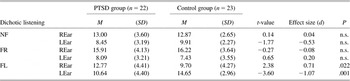
Note. PTSD = posttraumatic stress disorder; NF = non-forced; FR = forced right; FL = forced left; REar = right ear; LEar = left ear.
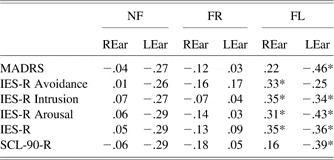
The clinical measures explained much of the variance in the forced-left condition, but not the variance in the forced-right condition (see Table 3). More symptoms of PTSD were associated with increased accuracy in the right ear and decreased accuracy in the left ear.
Pearson product moment correlation coefficients between clinical measures and dichotic listening performance (N = 45)
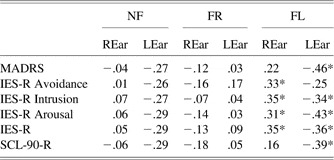
Note. NF = non-forced; FR = forced right; FL = forced left; REar = right ear; LEar = left ear; MADRS = Montgomery and Åsberg Depression Rating Scale; IES-R = Impact of Event Scale-Revised; SCL-90-R = Symptom Checklist-90-Revised.
*Marked correlations are significant at p < .05.
To analyze the relative importance of self-reported PTSD symptoms (IES-R), depressive symptoms (MADRS), and general distress symptoms (SCL-90-R) to the DL performance a covariate analysis was performed. When controlling separately for IES-R, MADRS, and SCL-90-R the main effect for Task condition disappeared (F(1,42) = 1.83; F(1,42) = 1.50; F(1,42) = 1.06, respectively), but the main effect for Ear persisted (F(1,42) = 4.72; p = .05; F(1,42) = 7.64; p = .05; F(1,42) = 10.77; p = .002, respectively). The interaction effects for Group × DL task condition × Ear were for IES-R F(2,84) = 1.29, for MADRS F(2,84) = 1.40, and for SCL-90-R F(2,84) = 2.43.
Discussion
The main finding from this study was impaired performance on a forced attention task in participants with PTSD. Measured with a standard non-emotional dichotic listening test both the PTSD group and the Control group showed the expected REA in the NF and FR conditions. The FL task condition yielded a significant difference between the groups, as the Control group showed an LEA as expected when attending to the left-ear input, whereas the PTSD group continued to show a REA. Further analyses showed that the PTSD participants were unable to suppress the right-ear reporting during the task. This suggests that the PTSD condition is associated with a reduced capacity for top-down attentional control of a bottom-up or stimulus-driven laterality effect. These results support the hypothesis that changes in general information processing skills are associated with PTSD, which is concordant with a model of impaired cognitive control. In particular, the suppression of information that is automatically processed (or the increase in the processing of distracters) was found to be impaired in the participants with PTSD, compared to control participants who had experienced similar exposure to traumatic events without developing PTSD.
Both the FR and FL conditions reflect focused attention, but when contrasting the task demands of the FR, where the top-down attention task requires an enforcement of the automatized right-ear preference, the FL task condition imposes a heavier load on the processing capacity, as the task could be described as a dual Task condition—both reporting from a non-preferred ear and suppression of the input to the automatized preferred right ear (Asbjørnsen & Hugdahl, Reference Asbjørnsen and Hugdahl1995; Hugdahl et al., Reference Hugdahl, Westerhausen, Alho, Medvedev, Laine and Hämäläinen2009). It could, therefore, be argued that the suppression of the automatized processing of the right-ear input constitutes the most important test of cognitive control in the dichotic listening performance. The results thus indicate that persons with and without PTSD differ with respect to situations demanding executive attention control, but also with respect to situations demanding non-executive attention control.
This study supports earlier findings using trauma-neutral tasks that identify difficulties with inhibiting inaccurate responses in PTSD patients (Vasterling et al., Reference Vasterling, Brailey, Constans and Sutker1998), and it further confirms that individual differences in cognitive control are related to PTSD. The findings in the present study indicate that problems with inhibition are related to the problem with suppressing an automatized or bottom-up process. Previous results on executive impairment in PTSD patients have been inconsistent. Our study supports the finding of Leskin and White (Reference Leskin and White2007) that the assessment of executive impairment in PTSD patients must be measured with specific and not general executive tests.
The finding of impaired cognitive control in PTSD on trauma-neutral material indicates that lack of inhibitory mechanisms is not limited to intrusive memory symptoms but to a reduced general capacity for inhibitory control. The present findings provide indirect empirical support for the Executive Deficit Hypothesis (Levy & Anderson, Reference Levy and Anderson2008), which suggests that individuals control the influence of intrusive memories by engaging executive control mechanisms that target the neural regions involved in declarative memory. Individuals with PTSD may thus have developed persistent intrusive symptoms because they have difficulty inhibiting the memories related to the traumatic experiences.
The changes in DL performance share a significant part of the variance with self-reported symptoms of PTSD, as significant correlations were obtained between DL performance and the intrusion and arousal subscales of the revised Impact of Event Scale (Horowitz, Wilner, & Alvarez, Reference Horowitz, Wilner and Alvarez1979; Weiss & Marmar, Reference Weiss, Marmar, Wilson and Keane1997). It is interesting that more severe symptoms of PTSD are associated with increased accuracy in the right ear and decreased accuracy in the left ear. This finding is in accordance with our hypothesis: Patients with PTSD will show a generalized impairment in cognitive control that is associated with the problems of suppressing an automatic (bottom-up) process also for stimulus material unrelated to the intrusive re-experiencing of memories associated with the traumatic event. In addition, the lateralized processing of stimuli was associated with a self-reported increase in arousal that is again associated with an increase in the right-ear advantage in dichotic listening. Similar findings have never previously been reported, but they are partly in line with findings in patients with anxious depression (Bruder, Wexler, Stewart, Price, & Quitkin, Reference Bruder, Wexler, Stewart, Price and Quitkin1999) and schizophrenia (Hugdahl et al., Reference Hugdahl, Rund, Lund, Asbjørnsen, Egeland, Landrø and Sundet2003). This finding has also been reported when comparing old age groups to young groups with respect to DL (Andersson, Reinvang, Wehling, Hugdahl, & Lundervold, Reference Andersson, Reinvang, Wehling, Hugdahl and Lundervold2008).
The influence of self-reported depression on cognitive control in our sample is consistent with previous studies relating depression to cognitive impairment in patients with PTSD (Burriss, Ayers, Ginsberg, & Powell, Reference Burriss, Ayers, Ginsberg and Powell2008; Johnsen et al., Reference Johnsen, Kanagaratnam and Asbjørnsen2008; Kanagaratnam & Asbjørnsen, Reference Kanagaratnam and Asbjørnsen2007). The hypothesis of an independent contribution of PTSD symptoms on impairment in cognitive control was not supported. It has been suggested that depression is inextricably linked to PTSD, and it can be difficult to differentiate these two conditions that have so many common symptoms. It could be argued that comorbid depression in this study does not reflect depression as a phenomenon, but instead reflects the intensity of the PTSD condition. The PTSD group in the present study was all exposed to complex and prolonged trauma exposure, involving threat to life as well as loss. The mechanism linking PTSD and depression remains unclear, although the frequency with which comorbidity is observed suggests that the association is not coincidental (Mollica et al., Reference Mollica, McInnes, Sarajlic, Lavelle, Sarajlic and Massagli1999; Momartin, Silove, Manicavasagar, & Steel, Reference Momartin, Silove, Manicavasagar and Steel2004; Shalev et al., Reference Shalev, Freedman, Peri, Brandes, Sahar, Orr and Pitman1998). The independent contribution of PTSD- and depressive symptoms on cognitive control functions should be further examined in larger samples with the statistical power to use multiple regression procedures to analyze such effects.
Three lines of evidence could be considered when it comes to constructing a model of PTSD for understanding dichotic listening performance. The first concerns the changes in arousal, as degree of lateralization has been found to change after experimentally induced arousal increases (Asbjørnsen, Hugdahl, & Bryden, Reference Asbjørnsen, Hugdahl and Bryden1992). Several researchers have reported that increased activation of the right cerebral hemisphere is associated with “negative” emotional states like depression and anxiety (Davidson, Reference Davidson1993; Heller & Nitschke, Reference Heller and Nitschke1997). More specific activation patterns differentiating between anxiety and depression have also been hypothesized, where negative valence is assumed to increase the activation of the right over the left frontal regions, and changes in arousal are associated with posterior regions. Anxiety is associated with negative valence combined with high arousal, whereas depression is associated with negative valence combined with low arousal (Heller, Koven, & Miller, Reference Heller, Koven, Miller, Hugdahl and Davidson2003). A right hemisphere activation pattern has also been found for patients with PTSD (Metzger et al., Reference Metzger, Paige, Carson, Lasko, Paulus, Pitman and Orr2004), increasing the support for atypical right hemisphere activation associated with PTSD. It is not clear if this represents pre-morbid patterns of activation that increase the vulnerability to developing symptoms after exposure to traumatic events (Gerhards, Yehuda, Shoham, & Hellhammer, Reference Gerhards, Yehuda, Shoham and Hellhammer1997; Spivak, Segal, Mester, & Weizman, Reference Spivak, Segal, Mester and Weizman1998) or if it represents changes in response patterns following exposure to traumatic events. Finally, following this line of argument, brain stimulation with transcranial magnetic stimulation (repetitive TMS, rTMS) is effective for symptom relief with respect to PTSD when it is applied over the right hemisphere, but not when it is applied over the left (McCann et al., Reference McCann, Kimbrell, Morgan, Anderson, Geraci, Benson and Post1998; Osuch et al., Reference Osuch, Benson, Luckenbaugh, Geraci, Post and McCann2009).
A second line of argument to be considered stems from research on callosal transfer. Impaired callosal transfer has been associated with PTSD, and in particular with the impaired ability to tag and verbally process emotional responses (alexithymia) (Tabibnia & Zaidel, Reference Tabibnia and Zaidel2005; Zeitlin, Lane, O'Leary, & Schrift, Reference Zeitlin, Lane, O'Leary and Schrift1989). Studies on participants with impaired callosal fibers have shown that these fibers may be crucial for the ability to shift attention and focus to one ear input at the time (Reinvang, Bakke, Hugdahl, Karlsen, & Sundet, Reference Reinvang, Bakke, Hugdahl, Karlsen and Sundet1994). Further studies have also found evidence for the significance of the role of callosal transfer for dichotic listening performance, both for assessment of laterality and as a measure of auditory attention (Westerhausen & Hugdahl, Reference Westerhausen and Hugdahl2008). The present results are consistent with the hypothesis, that callosal transfer is impaired in PTSD (Tabibnia & Zaidel, Reference Tabibnia and Zaidel2005; Villarreal et al., Reference Villarreal, Hamilton, Graham, Driscoll, Qualls, Petropoulos and Brooks2004; Zeitlin et al., Reference Zeitlin, Lane, O'Leary and Schrift1989). As proposed, impaired callosal transfer is expected to give similar patterns of performance in dichotic listening, with an increased right-ear advantage combined with an impaired attention modulation (Westerhausen & Hugdahl, Reference Westerhausen and Hugdahl2008). In addition, disrupted callosal transfer will also impair the ability to modulate the performance during directed attention tasks, and smaller attention effects will be seen, in particular an impairment of the ability to report from the left-ear input. However, as impaired callosal transfer has been found to be associated with alexithymia in PTSD, this hypothesis cannot be elaborated further on the basis of the present data.
The third line of evidence stems from the inhibitory behavior associated with the ventral prefrontal cortex (Miller & Cohen, Reference Miller and Cohen2001), areas that also have been found to be activated bilaterally during DL task performance (Thomsen, Rimol, Ersland, & Hugdahl, Reference Thomsen, Rimol, Ersland and Hugdahl2004). Patients with PTSD have frequently been reported to show impaired activation in prefrontal areas. As one of the main findings of the present study was intrusive reports and impaired inhibition of the reporting of the stimuli presented to the non-attended ear, this finding can be attributed to an impairment of the ventral prefrontal cortex. However, as no activation data are available, further clarification could not be obtained from the present data.
There are some methodological limitations to the present study that should be mentioned. The sample in our study was small and the results need to be confirmed in larger samples. The retrospective design suggests that no conclusions concerning the causal relationships between cognitive control and PTSD can be drawn. However, cognitive impairment has been shown to increase the vulnerability to the disorder (Bustamante, Mellman, David, & Fins, Reference Bustamante, Mellman, David and Fins2001; Parslow & Jorm, Reference Parslow and Jorm2007), and indirect support for the vulnerability hypothesis comes from studies that show that lower pre-trauma IQ predicts PTSD (Macklin et al., Reference Macklin, Metzger, Litz, McNally, Lasko, Orr and Pitman1998; McNally & Shin, Reference McNally and Shin1995). In addition, recent twin data also support the hypothesis that pre-morbid factors increase the vulnerability to developing PTSD (Gilbertson et al., Reference Gilbertson, Paulus, Williston, Gurvits, Lasko, Pitman and Orr2006). Future prospective studies should examine the causal link between impaired inhibitory control and the development and maintenance of intrusive memories.
Although the mean scores on IES-R, MADRS, and SCL-90-R indicated no psychiatric disorders in the Control group, members of the Control group may have met criteria for PTSD or other psychological disorders that were undetected by these self-report inventories. However, significant differences were still noted in the FL condition even if some members of the Control group had undetected psychological diagnoses. Future studies using clinical interviews for the participants of the Control group in addition to the PTSD group are likely to find even more robust group differences.
Gender differences may have reduced the REA differences observed between the PTSD and the Control group, but too few women in this study prevented the examination of group differences related to gender. The groups did not differ significantly on estimates of premorbid cognitive functioning, yet the effect sizes on Picture Completion and Similarities were moderate. Vasterling, Brailey, Constans, Borges, and Sutker (Reference Vasterling, Brailey, Constans, Borges and Sutker1997) have found that intellectual performances may be sensitive to PTSD status, however it is unlikely that this is the primary explanatory factor for our results.
In addition, collecting data on the cognitive and clinical aspects of exposure to traumatic stress in different minorities entails several methodological challenges. The structural diagnostic interviews, self-report instruments, and the neuropsychological tests were not available in the different ethnic groups’ native languages. This also means that there is a lack of standardized norms when using assessment tools in these populations. The use of interpreters also increases the number of possible sources of errors. The consonant–vowel syllables may have been more or less likely in certain of the languages. It is nevertheless important to carry out research on refugee populations with PTSD, since it gives us valuable data that can guide us in treatment and rehabilitation work. The methodological challenges due to the above limitations were controlled for by balancing ethnic representation in the groups and by having a research design that focused on between-group comparisons rather than comparisons to norms.
To conclude, the present findings suggest that patients with PTSD are impaired on tests measuring cognitive control and attention modulation. The results support the hypothesis that the PTSD condition is associated with a reduced capacity for top-down attentional control of a bottom-up or stimulus-driven effect. It also supports the hypothesis that lack of cognitive control is not only related to intrusive memories, but also to general control problems in these patients’ information processing abilities. However, further studies are needed to investigate to what extent these control problems are a consequence of the disorder, a risk factor for the disorder or a combination of these.
Acknowledgments
This study was financially supported by the Research Council of Norway, L. Meltzers Høyskolefond, and the University of Bergen. There are no conflicts of interest.