Introduction
The combination of rising life expectancy, including at older ages, and falling fertility rates has led to an ageing population, raising the important question of whether the supply of informal care will continue to meet the demand of a growing older population. In Spain, population ageing has occurred at a particularly rapid pace. The number of persons aged 65 years and older doubled in the last 30 years to 19 per cent of the total population, and increased fourfold among those over 80 to 6 per cent. Moreover, about half of the latter have difficulties in carrying out one or more (instrumental) activities of daily living ((I)ADL) (Spijker and Zueras, Reference Spijker and Zueras2016). Population ageing has also accelerated as a result of enduring below-replacement fertility levels since the early 1980s, with today's levels hovering around 1.3 children per woman of childbearing age (see www.ine.es). Official population projections highlight the fact that Spain, already one of the oldest populations in the world, will continue to age in future decades. There will be an estimated 13.6 million people aged 65+ in 2038 (representing 28% of the total population) and 15.2 million by 2058 (31% of the total population). The latter represents an increase of 70 per cent by comparison with 2018 (Instituto Nacional de Estadistica, 2018). This rapid population ageing is also accompanied by other significant changes in the age structure. If the current demographic projection holds, the age group of 30–49 years will decrease by 19 per cent over the next 20 years, after which its proportion is expected to remain stable (Instituto Nacional de Estadistica, 2018).
Population ageing does not necessarily entail a greater demand for elderly care if there is a simultaneous reduction in the disease burden. Hence, for policy makers concerned about future provision of elderly care, it is important to know whether population ageing is occurring in a context of compressing or expanding morbidity, or whether there is no change, as this will have implications for future care demands. For instance, compressing morbidity would mitigate the effect of population ageing. However, Walter et al. (Reference Walter, Beltrán-Sánchez, Regidor, Gomez-Martin, del-Barrio, Gil-de-Miguel, Subramanian and Gil-Prieto2016) found no evidence for the Spanish population that would support the morbidity compression hypothesis. On the contrary, between 1997–2000 and 2007–2010, the burden of morbidity increased, as the age-specific onset of seven out of eight major chronic diseases occurred earlier among both men and women, while life expectancy increased. This lack of morbidity compression is not unique to Spain. Robine et al. (Reference Robine, Cheung, Horiuchi and Thatcher2008) reported increasing rates of disabilities affecting ADL in Belgium, Japan and Sweden. Likewise, Crimmins and Beltrán-Sánchez (Reference Crimmins and Beltrán-Sánchez2011) found no empirical support for morbidity compression in the United States of America when morbidity was defined as ‘major disease and mobility functioning loss’, and Martin et al. (Reference Martin, Freedman, Schoeni and Andreski2010) observed an increased need for help with personal care activities related to mobility among Americans aged 50–64 between 1997 and 2007.
In most societies, informal care (i.e. unpaid and mainly family-based) is the most common source of support received by older people. In Spain, according to studies by Spijker and Zueras (Reference Spijker and Zueras2016) and Durán-Heras (Reference Durán-Heras2000, Reference Durán-Heras2002), 80–90 per cent of people aged 65 years and older who were being cared for at home relied on informal care, while the rest depended on formal care. Other studies focusing on Spain have identified a mixed care pattern that combines different types of formal care and informal care at the same time (Rogero-García et al., Reference Rogero-García, Prieto-Flores and Rosenberg2008; Rogero-García, Reference Rogero-García2009; Rodríguez, Reference Rodríguez2013). However, the availability of informal care-givers may decline in future because of changes in the age composition of the population as well as for other reasons, including the effect of smaller families (Clarke, Reference Clarke, Allen and Perkins1995), the growing incidence of childlessness (Evandrou and Falkingham, Reference Evandrou and Falkingham2000), increasing female labour force participation (Allen and Perkins, Reference Allen and Perkins1995), and rising rates of divorce and remarriage (Wells and Johnson, Reference Wells and Johnson2001; Ganong and Coleman, Reference Ganong and Coleman2006; Glaser et al., Reference Glaser, Tomassini, Racioppi and Stuchbury2006; Albertini and Saraceno, Reference Albertini, Saraceno and Saraceno2008; Lin, Reference Lin2008; Ganong et al., Reference Ganong, Coleman and Rothrauff2009; Van Der Pas and Van Tilburg, Reference Van Der Pas and Van Tilburg2010). Moreover, the obligation of daughters to care for elderly parents in accordance with the notion of intergenerational reciprocity, which has been highly valued by elderly people of the Mediterranean regions over generations, is also being challenged by the current generation of middle-aged women who have witnessed and participated in socio-cultural changes and mass entry into the labour market (Solís, Reference Solís, Triandafyllidou and Marchetti2015). For instance, recent Spanish research has shown that middle-aged economically active and higher-educated women are less likely to consider that the family must be responsible for the care of elderly persons (Zueras et al., Reference Zueras, Spijker and Blanes2018). This is consistent with evidence of informal care being externalised from the domestic domain and more multiple care arrangements (e.g. formal combined with informal) (Spijker and Zueras, Reference Spijker and Zueras2020). The way in which family structures and family relations are likely to evolve in the future may have direct implications for the level of informal old-age care. Any reduction in informal care could have a substantial influence on the demand for formal care. A better understanding of formal and informal care dynamics is therefore clearly an issue of great importance.
The aim of this paper is to understand the impact of demographic changes in the balance between care demand and supply in Spain. In order to achieve this, we first examine the effects of demographic trends across cohorts, among them declining birth rates, increasing life expectancy and changing family structures in kin networks of elderly persons, reconstructed by a microsimulation model. We then apply agent-based modelling to estimate the demand and informal supply of old-age care from the immediate kin network, while also taking into account cohort changes in educational attainment. Finally, we decompose potential family care supply in accordance with socio-demographic factors associated with loss of potential care, including the death of spouse/own children, the dependency of others and labour force participation. Our specific research goal is to estimate how demographic change shapes the care needs, between formal and informal care, of the Spanish population aged 50 and over, for cohorts born between 1908 and 1968, in accordance with our model specifications.
In the next section, we briefly describe the effect that demographic change has had on elderly kinship networks. This is followed by a summary of how care dynamics have changed in Spain during this century. We then present DemoCare, a mixed microsimulation–agent-based care supply and demand model, and provide estimates of care that could potentially be devoted to older people by partners and children, taking into account the fertility and nuptiality levels, and the limitations imposed by mortality and childlessness. We conclude by discussing possible future care supply–demand dynamics for dependent elderly people in Spain in the context of the family environment.
Demographic and socio-economic factors related to the availability of informal carers
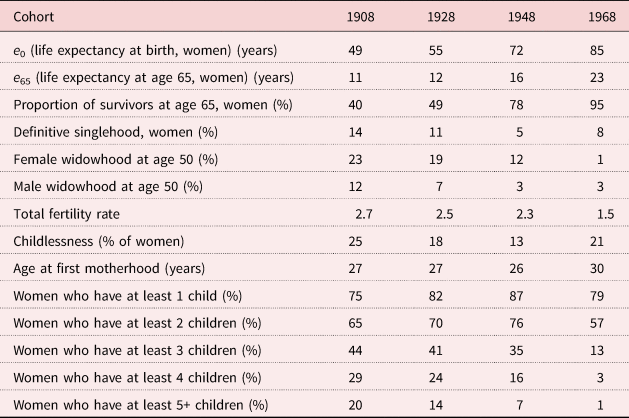
The demographic regime is an essential determinant of the patterns of co-existence of elderly people. In the coming decades, the effect of declining fertility and the rise of childlessness in the generations born during the baby-boom years will restrict the ability of family networks to take care of dependent elderly relatives. As shown with Spanish data in Table 1, women born in 1948 (who are now aged 72) bore an average of 2.5 children, a figure that dropped to 1.5 for the 1968 cohort, who are now 52 years old. At the same time, a much higher proportion of younger generations do not or will not have children (21%, compared to 13% of current septuagenarians). The change in survival has also been very important, with an increase of 36 years in life expectancy at birth between the 1908 and 1968 cohorts, including a considerable lengthening of life after the age of 65. The reduced risk of dying has had a positive effect for families as widowhood is being postponed, while concomitantly, the figures for definite singlehood are also lower, which is why the proportion of women without a partner at the age of 50 (either single or widowed) fell from 37 per cent among the 1908 cohort to 9 per cent for those born in 1968. That said, the widowed population aged 80 and over is still highly feminised (Spijker, Reference Spijker2011), while the increase in divorce rates, since it was legalised in 1981, will condition the availability of a partner in old age, particularly among generations born since the 1970s.
Demographic trends in Spanish cohorts born in 1908, 1928, 1948 and 1968

Source: Mortality indicators and value of the mean age at first motherhood are the authors’ calculations based on data from the National Institute of Statistics (www.ine.es). Fertility values, total and by birth order, are from Devolder (Reference Devolder2018). The rest are estimates obtained from our kinship microsimulation model.
The availability of potential family care-givers is not only affected by demographics. The greater incorporation of female cohorts into the labour market has also meant a lower availability of daughters to take care of parents as well as a diminished disposition to do so. In the latter case, research has shown that higher-educated and economically active women aged 45–54 are less likely to be of the opinion that the burden of caring for elderly persons should fall on the shoulders of the family, despite the fact that the care-givers are precisely women aged between 45 and 64, and not men (Zueras et al., Reference Zueras, Spijker and Blanes2018). On the other hand, pension reform and the extension of working life beyond the age of 65 could penalise women's access to full and larger pensions if they have to reduce or abandon their employment in their last years of working life (Evandrou and Glaser, Reference Evandrou and Glaser2003).
Living arrangement patterns also condition the provision of informal care. In Mediterranean countries including Spain, older people tend more often to live with others than in Nordic countries where living alone or in retirement or nursing homes is more common. In this regard, Central and Eastern European countries occupy intermediate positions somewhere between the two (De Jong Gierveld et al., Reference De Jong Gierveld, De Valk and Blommesteijn2001; Tomassini et al., Reference Tomassini, Glaser, Wolf, van Groenou and Grundy2004; Delbès et al., Reference Delbès, Gaymu and Springer2006; Gaymu et al., Reference Gaymu, Ekamper and Beets2008; Fernández Carro, Reference Fernández Carro2013; Laferrère et al., Reference Laferrère, Van den Heede, Van den Bosch, Geerts, Börsch-Supan, Brandt, Litwin and Weber2013; Zueras and Miret-Gamundi, Reference Zueras and Miret-Gamundi2013). One-person households of non-married adults are still numerous in Spain, particularly among people over 75 years of age, partly as a result of greater access to pensions that favour and facilitate the preference for living independently (López Doblas, Reference López Doblas2005). However, residing with children or relatives continues to be the preference of older Spaniards when suffering a functional loss that hinders or impedes their residential independence (Fernández Carro, Reference Fernández Carro2013).
These living arrangement patterns show considerable geographical variation and differences over time and it is highly likely that they will continue to change in the future as they depend on social norms and the availability of living relatives, factors that have undergone substantial changes in recent decades. In particular, a greater shortage of family members is expected due to the growing proportion of older people without children, especially women, who will be forced to live alone, regardless of their residential preferences (Reher and Requena, Reference Reher and Requena2017). However, co-residence is a complex function of the density of the kinship network, since it depends not only on the number of children people have, but also the age difference between parents and children, and the family situation of the latter.
For the remainder, greater female survival establishes gender differences in living arrangements and care demands in old age, as men generally age while living with partners who become the main care providers in the case of dependence, but women mostly age as widows (Delbès et al., Reference Delbès, Gaymu and Springer2006; Spijker, Reference Spijker2011). Women are therefore more vulnerable and tend to need support from people outside the conjugal nucleus (descendants, siblings, other relatives or non-relatives). Additionally, women are more likely to experience disability during old age than men (a phenomenon known as the ‘health–survival paradox’; Cambois et al., Reference Cambois, Solé-Auró and Robine2019). As a result, women live many more years with disability than men (Nusselder et al., Reference Nusselder, Cambois, Wapperom, Meslé, Looman, Yokota, Van Oyen, Jagger and Robine2019), leading to greater dependency and, therefore, creating a higher demand for care than men of the same age. But, conversely, this greater dependence of women may doubly reduce the family supply of carers for dependent elderly men, directly, because of the dependence of their partner, and indirectly, because the potential supply of carers from the rest of the family will then be reduced. Hence, the demographic regime, labour market attachment and forms of co-residence, as well as the demand for care of elderly people, determine whether the potential offer of family members suffices to help or care for elderly persons.
The dynamics of caring for elderly people in Spain
In Spain, support and care for dependent seniors are mainly organised within the family, with formal care complementing informal care (Rogero-García, Reference Rogero-García2010). Generally speaking, in Southern European countries the burden of care falls on a few people in the family, with greater participation of daughters, while in Northern and Central European countries, other components of social networks, including friends or neighbours, also participate in informal support and care mechanisms (Attias-Donfut et al., Reference Attias-Donfut, Ogg, Wolf, Börsch-Supan, Brugiavini, Jürges, Mackenbach, Siegrist and Weber2005).
Massive incorporation of women into the labour market, together with transformations in family systems and living arrangements, were arguments used to implement the so-called ‘Dependency Law’ that came into force in Spain in 2007 (Spijker and Zueras, Reference Spijker and Zueras2020). This was an important step towards the development of a new System for Autonomy and Care for Dependency (SAAD), aimed at ensuring an adequate amount of resources and services – including prevention, promotion of personal autonomy, remote assistance, day/night centres and residential centres – to meet the growing demand due to population ageing (Spijker and Zueras, Reference Spijker and Zueras2020).
The new SAAD was also designed to reduce the burden of family members who take on the role of primary care-giver. As care-givers are predominantly women, the implementation of the law also represented a step forward in reducing gender differences in both personal care and employment, while also aiming to encourage women to continue working (full-time) despite having a family member with care needs. However, in practice, the new SAAD does not seem to have contributed to outsourcing care from the family environment, since almost half of the economic benefits for care were used to compensate informal carers (Consejo Territorial del SAAD, 2012).
Furthermore, there were severe budgetary adjustments in 2012 that transferred the burden of care of dependent persons back to their families, thus implying a re-familiarisation and re-privatisation of the efforts made during the previous five years (Rodríguez Cabrero, Reference Rodríguez Cabrero2012). Nevertheless, Spijker and Zueras (Reference Spijker and Zueras2020) showed that, between 2006 and 2013, multiple attention strategies became more common and that care was outsourced from the domestic domain in several ways. For example, among 65–79 year olds, the proportion of care provided by non-co-resident relatives and formal sources has been increasing, suggesting that spouses (usually the main care-givers in this age group) are increasingly being aided by kin who live elsewhere, as well as by social services and other professional care workers.
Method: DemoCare – a model to estimate the demand and supply for informal and formal care
In order to study comprehensively the demand and supply of care for elderly persons in situations of dependence, based on their available network of relatives, we have developed a model called DemoCare (Calduch et al., Reference Calduch, Spijker, Zueras, Giménez, Griera, Miguel Quesada and Devolder2017). It uses two different simulation techniques. First, a microsimulation model provides kinship networks of representative individuals, called ‘egos’, based on the demographic characteristics of each cohort and, second, an agent-based model (ABM) simulates the life of individuals belonging to these networks until the death of egos, thus making it possible to estimate the care demand of these egos that could be satisfied by their close kin network (spouse and children). Likewise, the ABM calculates the proportion of the care demand that cannot be assumed by informal family resources. This corresponds to the part that needs to be externalised, presumably to the formal sphere.Footnote 1 In this paper, we apply DemoCare to compare different Spanish generations born during the 20th century with the aim of ascertaining whether, and in what ways, demographic change has contributed to increasing or reducing the deficit of informal care of dependent individuals.
Over the last couple of decades, there has been a resurging interest in computer simulation and agent-based modelling in the social sciences (Billari and Prskawetz, Reference Billari and Prskawetz2003; Silverman et al., Reference Silverman, Bijak, Noble, Cao, Hilton, Chen, Terano, Yamamoto and Tai2014). It has been applied as a tool to model residential segregation (e.g. Clark and Fossett, Reference Clark and Fossett2008; Zhang, Reference Zhang2011; Bruch, Reference Bruch2014), migration (e.g. Heiland, Reference Heiland, Billari and Prskawetz2003; Kniveton et al., Reference Kniveton, Smith and Wood2011; Willekens, Reference Willekens2012), partnership, family formation and divorce (e.g. Billari et al., Reference Billari, Diaz, Fent and Prskawetz2007; Aparicio Diaz et al., Reference Aparicio Diaz, Fent, Prskawetz and Bernardi2011; Bijak et al., Reference Bijak, Hilton, Silverman and Cao2013; Grow et al., Reference Grow, Schnor and Van Bavel2017) and household dynamics (e.g. Geard et al., Reference Geard, McCaw, Dorin, Korb and McVernon2013), but perhaps less to elderly care. Spielauer (Reference Spielauer2007) reviewed 27 dynamic microsimulation models applied to health studies, among which LifePaths, developed at Statistics Canada (Carrière et al., Reference Carrière, Keefe, Légaré, Lin and Rowe2007), and APPSIM, at the University of Canberra (Nepal et al., Reference Nepal, Brown, Kelly, Percival, Anderson, Hancock and Ranmuthugala2011), are close to our model, inasmuch as they were applied to the same subject, the balance between the demand and supply of care for old-age dependent persons, and operated at the family level, taking into account as much variability as possible instead of working on aggregates (for a similar application using a multistate demographic model, see Gaymu et al., Reference Gaymu, Busque, Légaré, Décarie, Vézina and Keefe2010, Reference Gaymu, Ekamper, Beets and Dutreuilh2007). Ma et al. (Reference Ma, Shen and Nguyen2016) developed an ABM to help local governments in Japan review their planning strategy of developing elderly day care centres, while Noble et al. (Reference Noble, Silverman, Bijak, Rossiter, Evandrou, Bullock, Vlachantoni, Falkingham, Laroque, Himmelspach, Pasupathy, Rose and Uhrmacher2012) studied the implications of household formation and other demographic processes in the supply of, and demand for, social care in the United Kingdom (UK). Compared with other applications of microsimulation and agent-based modelling, DemoCare stands out as it simulates in more detail the supply of care that an elderly dependent person can potentially receive from her or his kinship network. For example, Carrière et al. (Reference Carrière, Keefe, Légaré, Lin and Rowe2007) and Gaymu et al. (Reference Gaymu, Ekamper, Beets and Dutreuilh2007) considered close family composition (whether or not with a partner and surviving children) in their care models but, unlike DemoCare, did not take into account interactions within the kinship network and factors that can constrain the potential availability of kin as carers.
By contrast, our model starts with the close kin network of simulated individuals, from the extreme situation of people without any close relative to those who have a partner and many children and grandchildren, replicating the variability of real kinship networks as much as possible. The key difference with previous models is that DemoCare also takes into account other factors that may constrain the supply of care from kin, namely labour force participation and own health status but, importantly, the demand for care from all the other kin in the network as well. Our demand–supply care model is the first of its kind for the Spanish context, and the lifecycle perspective for this kind of model is, as far as we know, also new. Noble et al. (Reference Noble, Silverman, Bijak, Rossiter, Evandrou, Bullock, Vlachantoni, Falkingham, Laroque, Himmelspach, Pasupathy, Rose and Uhrmacher2012), for instance, developed a similar simulation model, but at the household rather than kinship level, and without considering personal characteristics of kin that constrain supply. Their results are expressed at the population level, using a period perspective when, with DemoCare, they are presented using a cohort approach at an individual level.
More specifically, our model follows a group of approximately 10,000 egos from different birth cohorts, whereby the demand for care is studied from the age of 50 until death. The kinship network of egos is reconstructed, limiting it to spouse, children, children-in-law and grandchildren. This is obtained from a classic kinship microsimulation model which recreates the whole diversity of family situations (Devolder, Reference Devolder, Derosas and Oris2002; for a recent review of this kind of microsimulation model, see Zagheni, Reference Zagheni2015). At this stage, the basic lifecycle of all individuals is reconstructed, giving them an age at union formation (if this is the case), an age at the birth of each child (if this is the case) and finally age at death. The model generates kin networks in an ‘open’ way, in the sense that there is no constraint on the stochastic ‘creation’ of kin other than the general fertility, mortality and union formation risks.
For this article, we compare seven different generations of egos, born at intervals of ten years, between 1908 and 1968, with very different demographic characteristics (see Table 1). In our model, the members of the close kinship network of egos of each generation are individuals who belong to other birth cohorts and therefore have nuptiality and fertility behaviour, as well as mortality risks, that differ from those of egos. In other words, our kinship model does not assume that the population is ‘stable but, on the contrary, that each birth cohort has its own demographic characteristics. This is important, especially with more recent cohorts for which the fertility levels of children are less than half those of their parents. The ABM then estimates the demand for care of these egos that could be satisfied by the close kin network (spouse and children). When this is not possible, either totally or partially, the ABM calculates the proportion of the care demand that cannot be taken on by informal family resources and that should, therefore, be externalised, presumably to the formal sphere. The model allows estimating and projecting the demand for care of elderly people in Spain and the distribution of care of a formal (professional) or informal type (by family members) according to the demographic characteristics of each birth cohort, as well as comparing the different Spanish generations born during the 20th century.
With the aim of only identifying the impact of demographic change, we hold constant all the other factors considered in our simulation. For example, the current ABM is based on the health conditions and employment status observed in 2008, which are invariable for all generations. Specifically, the model constrains the age-specific health conditions of each cohort to the dependency levels derived from the 2008 Spanish Survey on Disabilities, Personal Autonomy and Situations of Dependency (EDAD). This is a reasonable assumption given the lack of evidence that morbidity is being compressed in Spain, as mentioned above. Introducing the possibility for age-specific cohort changes in dependency levels, as well as employment status, however, will be considered in a future version of the model.
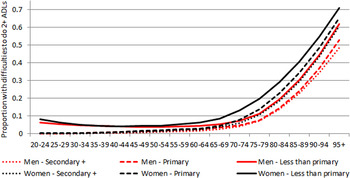
The egos of the seven cohorts born between 1908 and 1968, as well as their kin, are exposed in the ABM to the risks of falling into a specific dependency level, as observed for Spain in 2008. Dependency is specified in terms of four levels: high, medium, low or none. This distinction was made because the EDAD data showed clear differences in the (hours of weekly) care received according to dependency level. To be more specific, highly dependent individuals are those who report major difficulties in carrying out, without help or supervision, at least two ADL related to everyday personal care.Footnote 2 Adults with medium dependency report difficulty in carrying out one ADL or one or more IADL without help or supervision.Footnote 3 People with low dependency have a disability but no ADL or IADL difficulties. Although we assume in our model that they do not receive care (as according to the 2008 EDAD data only 9 per cent of low-dependency adults did receive it), we separated them from the disability-free population as they are less likely to provide care (see also Table 3). Level-specific dependency risks depend on the ego's age and sex, as well as educational attainment, given the sharp educational gradient in dependency. Hence, as Figure 1 shows, less-educated individuals are more likely to have a high degree of dependency (implying more hours of care required) than those with a higher educational level. Likewise, women are at much greater risk of falling into a state of dependency than men. For example, the proportion of dependent women in the 85–89 age group is around 15 points higher than that of men for all educational groups. For the ABM, we derived from the preceding proportions a set of age–sex–education-specific transition probabilities between the initial situation of good health and the three dependent states of increasing severity, without considering the possibility of recovery. These probabilities are used both for egos and their relatives, with the aim of determining which part of our virtual populations requires care and to what degree.
The proportion of the population in the highest dependency state (difficulties with two or more activities of daily living (2+ ADL)) by sex, age and educational level (2008).

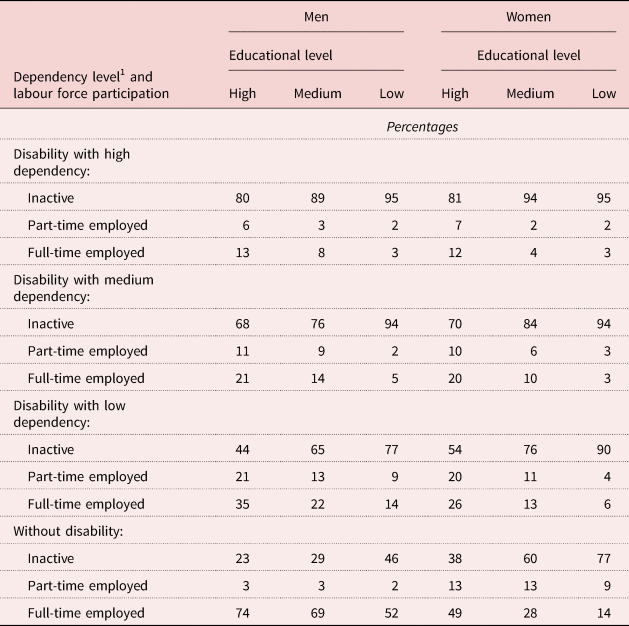
The same logic is used to ascertain whether egos and their relatives work, this being based on activity tables that are a function of sex, age, educational level and degree of dependency. These tables are also obtained from the 2008 EDAD survey, and the probabilities of transition from one employment status to another are estimated from longitudinal data from the Spanish Labour Force Survey (EPA), using the second quarter waves of the years 2008 and 2009. Table 2 presents a summary of this information. As can be observed, labour force participation varies significantly by sex and educational level, as expected, while dependent people with a high educational level do not reduce their activity to the same degree as counterparts with a lower educational level. This justifies taking gender and education into account in our modelling.
Distribution of the population aged 16–69 by labour force participation according to sex, educational level and dependency level (2008)

Notes: 1. The three dependency levels are related to having a disability and not being able to carry out certain activities of daily living (ADL), e.g. dressing, and instrumental activities of daily living (IADL), e.g. cooking: high dependency – two or more ADL; medium dependency – one ADL and/or any IADL; low dependency – disability reported but no problems stated in carrying out ADL/IADL. Some of the totals do not add up to 100 per cent due to rounding.
Source: Authors’ calculations based on data from the 2008 EDAD (Spanish Survey on Disabilities, Personal Autonomy and Situations of Dependency).
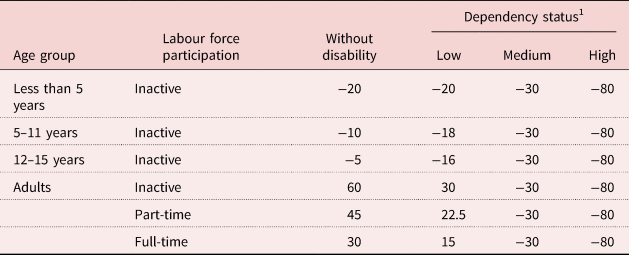
We used estimates made by Noble et al. (Reference Noble, Silverman, Bijak, Rossiter, Evandrou, Bullock, Vlachantoni, Falkingham, Laroque, Himmelspach, Pasupathy, Rose and Uhrmacher2012) as a guide to determining the number of hours per week that dependent individuals require or can be offered to dependants by family members, which is to say the informal care offer (Table 3), because estimates for the average number of hours of care based on the 2008 EDAD survey data were very similar. The amount is a function of the age of kin and their employment situation as well as the state of their own health (level of disability or dependence).
Weekly hours of care, according to age, labour force participation and dependency status

Note: 1. For definitions, see Table 2. Demand (negative values) and supply (positive values) are used in the agent-based model.
Source: Rough estimates based on Noble et al. (Reference Noble, Silverman, Bijak, Rossiter, Evandrou, Bullock, Vlachantoni, Falkingham, Laroque, Himmelspach, Pasupathy, Rose and Uhrmacher2012) and data from the 2008 EDAD (Spanish Survey on Disabilities, Personal Autonomy and Situations of Dependency).
The ABM determines, at each moment of ego's life, the situation of disability and dependence, as well as the number of hours of care that could potentially be received from the closest relatives who are still alive or, in other words, a partner and children. These can take care of ego as long as they have free hours, which can be limited by their work, state of health (but only if they have a low dependency status for, otherwise, they cannot provide care according to our model), and also by the needs for care of the rest of the family. For example, if ego has a disability but has a partner in good health who does not work, the latter will fully care for ego as long as their children are not in need of care as well, because of their level of dependency or due to their young age. On the other hand, ego's children will be able to devote care time to the extent that their own children do not require their time, again because of their age or a possible disability situation. In other words, the hours of care egos can obtain from their relatives are in competition with the needs of the other family members. This competition mechanism is implemented in the model through an algorithm of distribution of available hours of care based on simple rules, which are applied hierarchically to determine the number of hours of care that family members can offer to egos:
(1) Unmarried siblings, children or grandchildren of egos help each other, before looking after their parents or receiving hours of care from them.
(2) Parents preferably help their children, if they need care, before helping their partner or their own parents.
(3) Ego's children will help their partners first, if they need it, before caring for their parents.
(4) If ego and her or his partner are both in a situation of dependency, the hours of care their children can provide will be divided in proportion to the demand of each.
(5) The care of an ego with a living partner will be carried out first and foremost by the partner, and ego's children will only contribute if the partner's offer of hours is insufficient to cover the demand.
Note also that, in the current version of the model, children-in-law care for their partner as well as for their own children, but not for their parents-in-law, and hence not for ego. The reason for this limitation is that the simulated kinship networks do not include the parents of children-in-law whose demand for care could also compete with ego's demand.
Results
Effects of the increase in life expectancy on the number of dependants
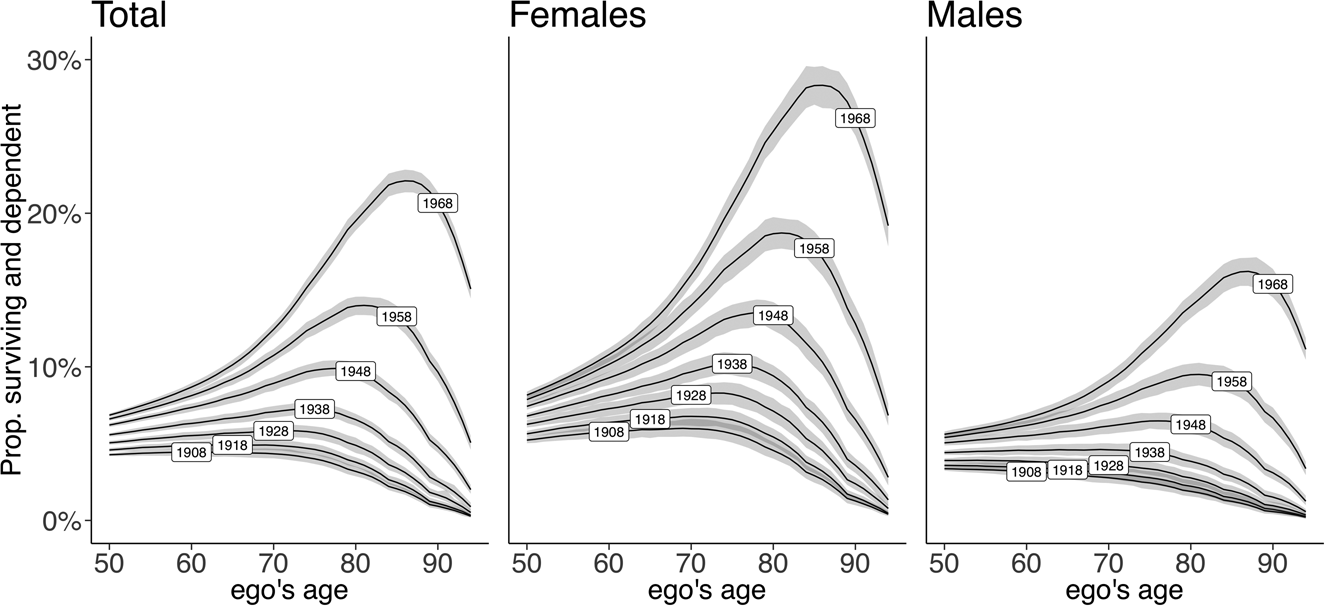
In the first place, the ABM allows examination of the effects of the lengthening of life on the number of dependants in the population. This is done by calculating, for the seven simulated birth cohorts, the probability of a new-born ego being in a state of dependence after the age of 50 (Figure 2). As the risks of falling into dependence in each age interval are the same for all cohorts, the only differential factor lies in the mortality trend from cohort to cohort. Accordingly, for those born in 1968 the probability of being in a situation of dependency at the age of 85 will be 22 per cent for both sexes or, to put it slightly differently, 22 per cent of those born then will reach this age and have a disability that requires care from other people. By contrast, the probability is 2 per cent for a person born in 1908. Therefore, if the number of births in both generations was equal, the number of dependants at the age of 85 would be ten times higher among those born in 1968 than among the 1908 birth cohort. This difference is explained by the higher infant, child and premature mortality of people born at the beginning of the century.
The probability at birth of egos of living in a situation of dependency from the age of 50 onwards, by sex, for the 1908–1968 birth cohorts.

Yet, the biggest difference between two consecutive birth cohorts concerns the two most recent ones: the probability of being dependent at the age of 85 is 13 per cent for the cohort born in 1958, which has just over a seven-year lower life expectancy compared with the 1968 cohort. This rapid increase in the proportion of the youngest cohorts expected to reach old age is due to the predicted decline in old-age mortality. In general, this means that the lengthening of life in recent cohorts gives rise to a higher proportional increase in the total number of dependants, even assuming the same constant dependency conditions such as those observed in 2008. Although this general pattern of cohort changes is equivalent for each sex, the combination of higher survival probabilities and the greater risk of falling into dependency leads to much higher probabilities of women being alive and dependent after the age of 50.
Family (i.e. informal) care deficit
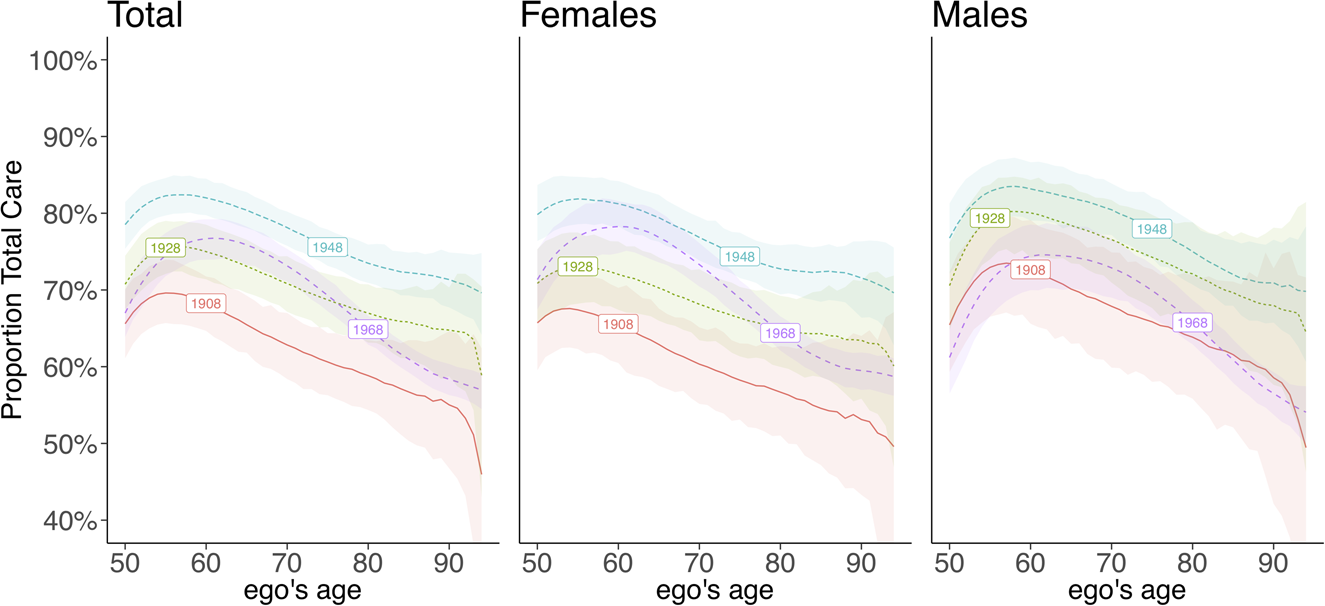
The ABM provides estimates of the proportion of dependent egos’ care demand that can potentially be covered by both partners and children, which we consider to be the total amount of informal care (Figure 3). As can be observed for all simulated cohorts, families with dependent egos present a deficit of the care hours they can provide, which they would therefore need to externalise.
The proportion of the demand for care of dependent egos covered by informal care (i.e. by partner and children), according to sex, age and year of birth (1908, 1928, 1948, 1968).

However, there are substantial differences between birth cohorts and between sexes. The deficit of hours of family care is greatest in the oldest cohort (1908) of dependent egos. For those born in 1948, the deficit is about 15 percentage points less at each age, for both sexes. As will be explained in more detail below, this is mainly due to the reduction in mortality (and hence widowhood) and childlessness levels. Conversely, however, the deficit of hours of family care is subsequently expected to rise as fertility levels for subsequent generations are lower and, consequently, the proportion of total care that can be covered informally will also be smaller. For instance, the 1968 birth cohort will have deficits closer to those observed for the 1928 cohort. Also worthy of note is the dramatic reversal of the situation of men compared with women: while for the oldest cohorts (1908–1928) hours of care provided by direct family members covered almost 10 percentage points more of male than female needs between the ages of 60 and 85, for the 1968 cohort the deficit is expected to be much higher for men at almost every age.
The distribution of informal care provided by partners and children
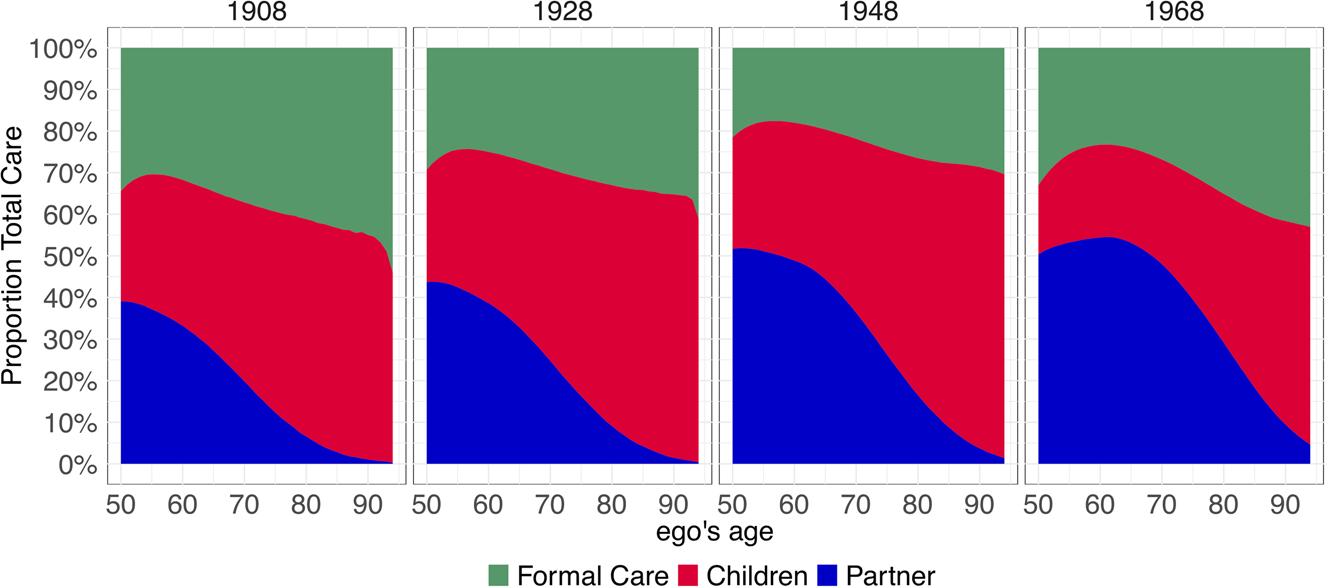
Informal care of dependent egos is assumed by the partner, the children or by both simultaneously. Obviously, if ego is widowed, the children assume this role and if, moreover, ego is childless or the children have died, care-givers external to the family nucleus will be needed. Figure 4 provides more detailed information regarding Figure 3, distinguishing what part of the informal care corresponds to ego's partner or their children. The growing role of the partner across generations is evident. For dependants aged 70 and born in 1968 partners will cover, on average, half the demand by comparison with just 23 per cent for the 1908 cohort. The greater possibility of the partner's survival has brought about a delay in the age at which children become the main care-giversFootnote 4 and has partially compensated for the effects of the decline in fertility. The latter also explains the reduction in the proportion of care provided by children which is predicted for the 1968 generation.
The proportion of care needed by dependent egos that can be covered by the partner and children, according to their age and year of birth (1908, 1928, 1948 and 1968).

Informal care received by dependent men and women
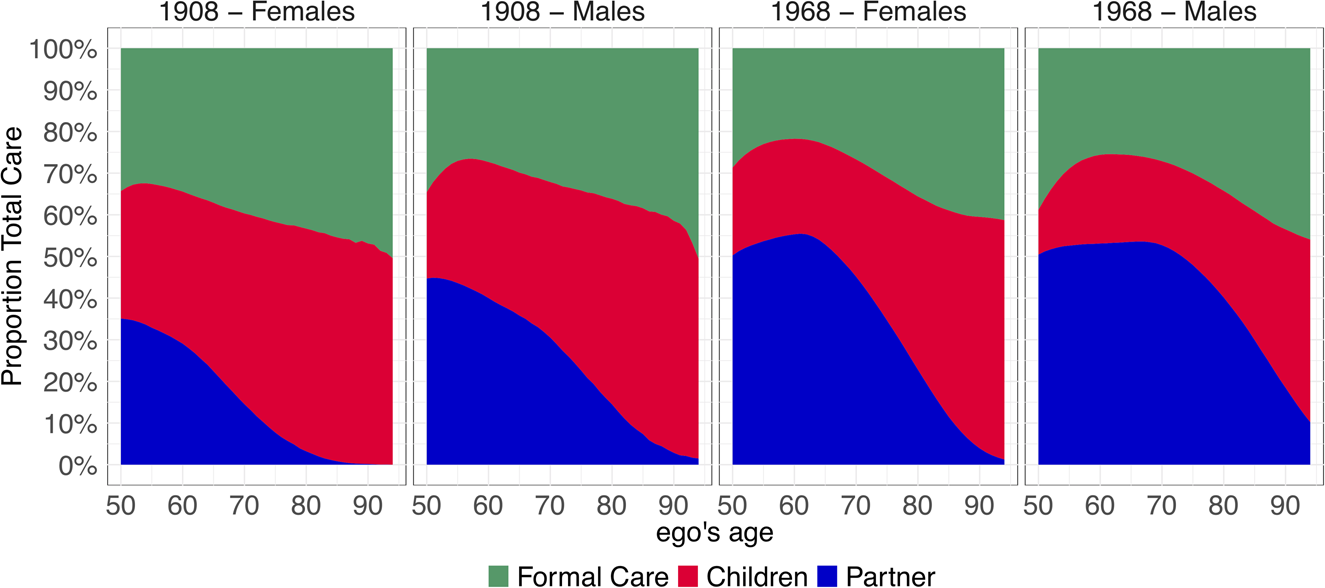
As noted above, the availability of informal carers for dependent men born in the early years of the 20th century was greater than for women. However, this is no longer the case for the most recent cohort analysed, which is mainly due to the combined effect of women living longer than men and partnering with older men. As Figure 5 shows, wives of egos born in 1968 are expected to become the main care-givers of their dependent husbands until the latter turn 85 while, conversely, husbands of dependent women will only be the primary care-givers up to the age of 73. More surprising is the fact that dependent men of the 1968 cohort will receive less care from their children than women, especially under the age of 60 and over 85, which explains why men present a higher deficit of family care than women. An explanation will be given below when discussing the results presented in Figure 8.
The proportion of care needed by dependent egos that can be covered by partner and children, according to sex, age and year of birth (1908 and 1968).

Demographic factors behind the need for formal care: lack of a partner and/or children
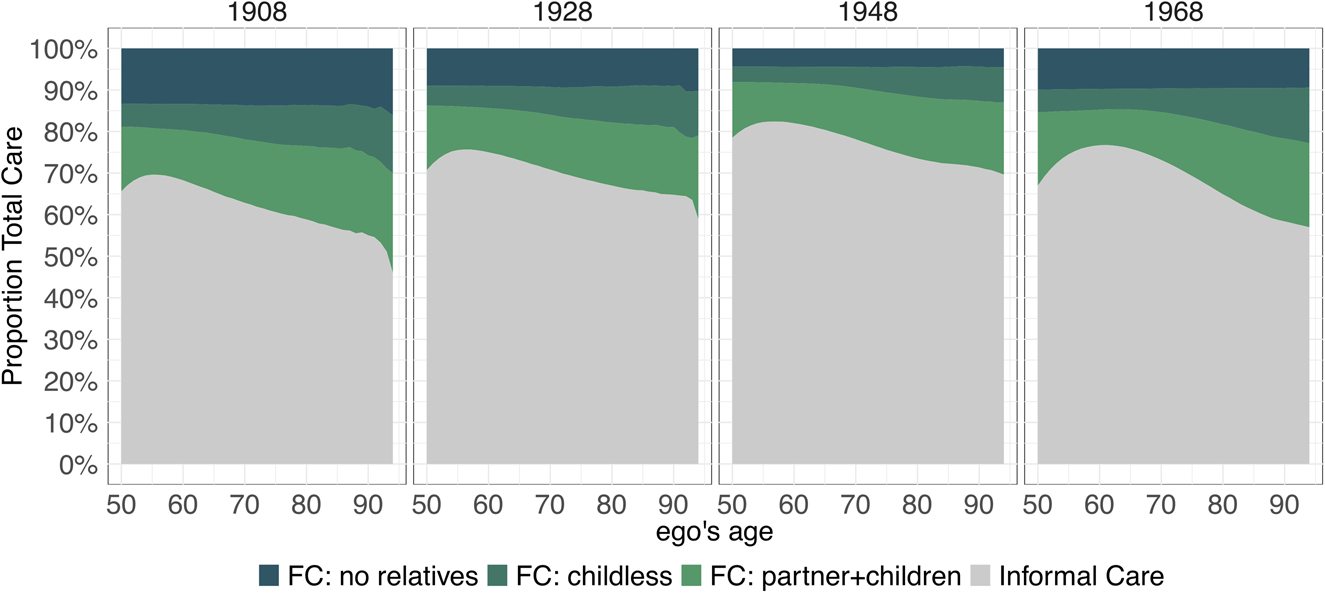
Just as the ABM estimates the contribution of the partner and children in the provision of informal care, the model can also estimate the share of the demand for formal care that results from their absence (Figure 6). In this figure, the total demand for formal care corresponds with the sum of the deficit of care in three family situations, which are shown in different shades. The most obvious situation is the case of egos without direct relatives (dark shade), which is to say those who never had a partner and therefore had no offspring (in our model single parenthood is not considered). But there is also a forced deficit of family care in the case of highly dependent egos that have a partner but are childless. This is because they require 80 hours of care each week, which exceeds the maximum amount of 60 hours that their partner could potentially provide. However, under specific circumstances – outlined in more detail in the next sub-section – egos with both a partner and children may also require formal care.
The proportion of the total demand for care of dependent egos covered by informal care and formal care according to the presence or lack of a partner and/or children, by ego's age and birth cohort (1908, 1928, 1948 and 1968).

This breakdown of the demand for total formal care in accordance with the composition of ego's kin network permits us to determine how much of the difference between cohorts in the deficit of hours of kin-based informal care is due to childlessness, both indirectly (always-single egos) and directly (partnered egos without children). Comparing cohorts, we can observe that most of the reduction in the deficit of family care (i.e. what corresponds to the total demand for formal care) in cohorts from 1908 to 1948 is explained by the reduction in the proportion of childless dependent egos (either with or without a partner). This relationship also holds when we compare birth cohorts from 1948 and 1968, as the upsurge in levels of childlessness is accompanied by a corresponding increase in the overall deficit of family care.
However, other factors come into play for the 1968 generation, since the demand for formal care of dependent egos who have a partner and at least one child presents a more complex picture. For them, there is an overall increase in the demand but, surprisingly, this is much less the case in the age range of 55–70. We shall explore the reasons for this result below.
Factors behind the need for formal care for egos with both partner and children
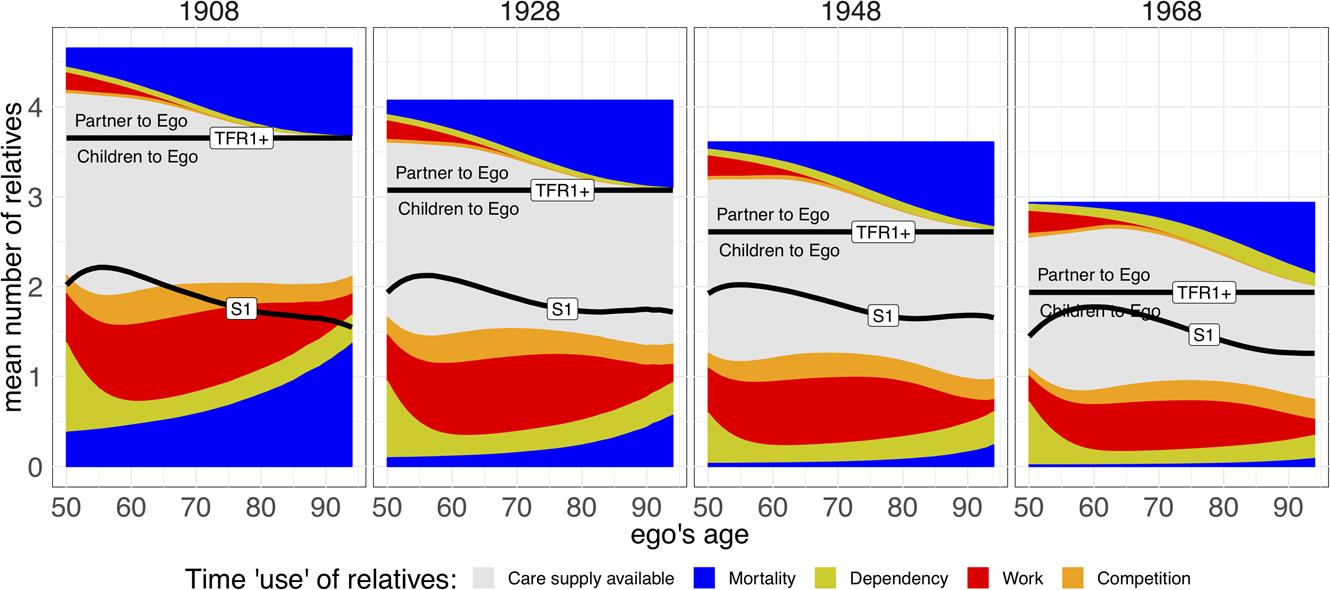
Figure 6 also shows that a substantial part of the deficit of family care (or of the demand for formal care) corresponds to egos who have or had a partner and children. At a first approximation, this is surprising because the availability of at least two adults should, theoretically, be sufficient for the care of even a highly dependent ego. This is where the factors that reduce the capacity of close kin to care come into play. Figure 7 represents these constraints on the potential supply of care from close kin of different cohorts. Here, we consider only egos who have or had just one partner during their lifetime and a mean theoretical number of children equal to the total fertility rate (TFR) for persons with at least one child (computed as the TFR divided by one minus the childlessness level). The sum of the two gives the mean theoretical total number of close kin that can potentially take care of egos throughout their life once they enter a state of dependence that requires personal care. The upper part of the graph corresponds to the potential offer of care by ego's partner. For example, for egos born in 1908, the main factor that limited this offer is mortality, since from the age of 80 most egos were widows or widowers. As the bottom part of the graph shows, mortality also significantly reduced the supply of care by children for the 1908 generation, but this was much less the case among the 1928 generation and is or will be almost negligible for the 1968 generation. The second factor that limits the potential availability of close kin to care for egos corresponds to the situation of dependency among the kin themselves. In the case of ego's partner, this acts as a strong counterfactor at older ages to the decline of mortality for recent cohorts, not because of a deterioration in their health, but simply because the reduction in mortality also reduces the possibility of widowhood. Hence, it increases the likelihood of both ego and her or his partner being alive and dependent. For ego's children, dependency, either because they are still minors and/or they have a health problem, is also an important limiting factor, as we will see in more detail in Figure 8. The third limiting factor corresponds to the time ego's partner or children spend working, which is the most important constraint on children's availability for cohorts born after 1928 and when ego is aged between 60 and 80. The fourth and final factor we have labelled ‘competition’ as it pertains to the care required by ego's partner or ego's children's partner and children. If an ego has a partner who is dependent, the availability of care time is limited due to a double effect: if the partner is severely dependent, not only can he or she not be a carer, but this dependence also limits the offer of care that their children can provide the ego, as they will have to provide care for both parents.
Breakdown of potential family care supply according to number of kin and factors associated with loss of potential care: comparison between 1908, 1928, 1948 and 1968 birth cohorts for dependent egos who have a partner and at least one child.

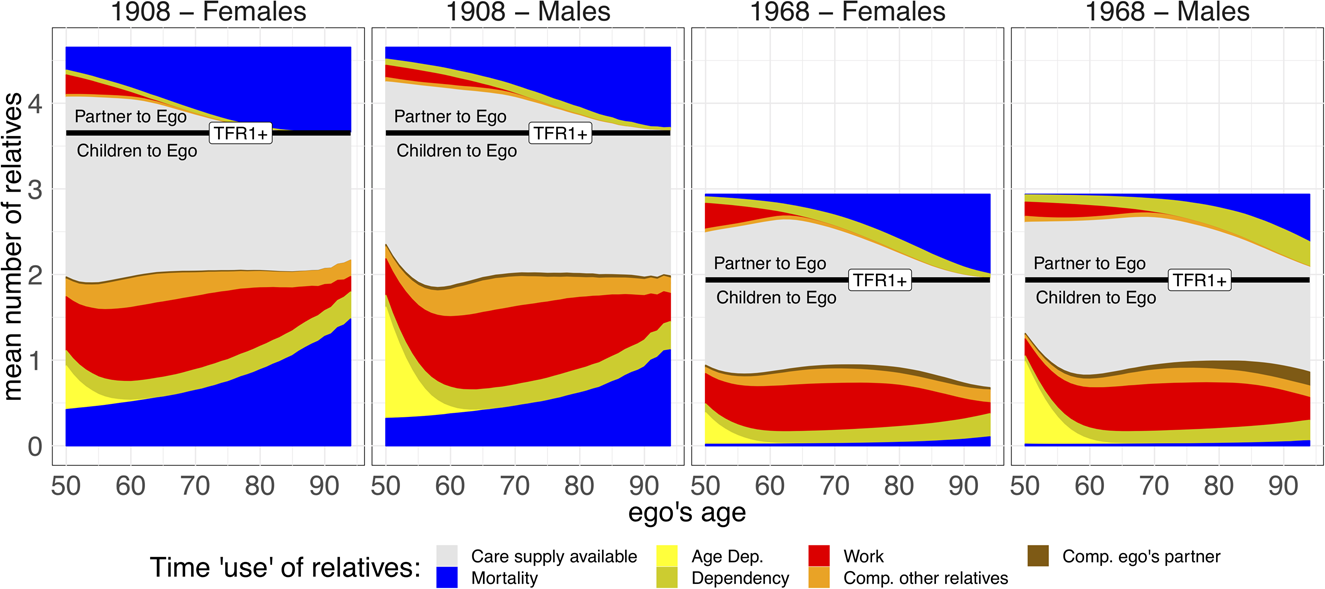
Breakdown of potential family care supply according to number of kin and factors associated with loss of potential care in the 1948 and 1968 birth cohorts for dependent egos who have a partner and at least one child, by sex.

Comparing between cohorts, the most noteworthy result is that the number of close kin (partner or children) who are able to care for this group of dependent egos has been fairly constant from the cohort of 1908 to that of 1948, fluctuating between 1.5 and 2.1 kin who are potentially available as carers (see the line labelled ‘S1’ in Figure 7). For the 1968 cohort, this number drops by about 0.3 kin on average but is still above one. This means that, overall, such families should not have a care deficit if they have one dependent ego. Although this salient finding appears to contradict the results obtained in Figure 6, the explanation of the paradox is simple: families do not share kin, and those with a surplus cannot lend their kin to families with a deficit. This means that a dependent ego who is widow or widower and only has one child, or has a dependent partner, will require external carers. The demand for formal care will therefore always exist, even for egos who have a partner and children.
The approximate constancy of the potential supply of carers across generations until the 1948 cohort can also be explained, since this is due to the existence of compensating mechanisms, some of which are quite subtle:
• The reduction of mortality is counterbalanced by the rise of dependency, especially for ego's partner, which is the main compensation factor.
• The decrease in fertility levels leads to a decrease in the number of children, but its effects are counterbalanced by the reduction in the number of care-needing grandchildren, which moderates the importance of the competition effect (this is shown in Figure 8).
• The decline in fertility may also lead to complex ‘sibling effects’ in different directions depending on ego's age. For example, the demand for care could increase for ego's children if young children no longer have older siblings who are able to take care of them, and they therefore put greater pressure on their parents’ (i.e. ego's child or partner) time, thus reducing their available time to care for ego, especially when the latter is under 60 years of age.
Finally, Figure 8 explores in greater detail why men of the 1968 cohort, compared with the 1908 cohort, appear in the model as obtaining relatively less care time than women, despite the reduction in widowhood, which is observed in Figure 5. Before the age of 60, this is mostly attributable to the proportion of children younger than 16 years of age who are, by definition, dependent and therefore unable to care for their parents (Age Dep.). It is more likely to be the case for men than for women owing to the difference in the age at union formation and with a weight that increases for this generation because of the higher age at the birth of the first child, compared with previous generations.
Conversely, for dependent men aged 85 years and over, the informal care deficit with respect to women of the same age is explained, paradoxically, by the greater survival rate of their wives. This magnifies the risk that both are dependent and compete equally for the limited hours of care that their children can provide, thus illustrating the great amount of time ego's children also devote to care of the other parent. Nevertheless, this situation is more favourable for dependent women of the same age, as a large proportion of their spouses have died, and the few surviving husbands only slightly reduce the available number of hours of care that women can obtain from their children.
Sensitivity analysis
In order to assess the consistency of the results and their sensitivity to our assumptions, we reran our model with three alternative sets of hypotheses. In each one, we regrouped the two highest dependency levels into one, so that the first hypothesis ascribes a low level of demand for hours of care (30 hours), the second a medium level (50 hours) and a third a higher level (80 hours). The results (see the online supplementary material) reveal that the deficit of family care is not determined by our hypothesis of having highly dependent egos with a demand of care exceeding the amount of time that an adult kin member can provide, even in the case of egos who have a partner and children during their lifetime. In that sense, the demand for formal care still exists at an aggregate level when the demand of dependent egos in terms of time of care needed is low. Furthermore, the age pattern of the contribution of ego's partner and ego's children, as shown in Figure 4, remains the same. For example, for the 1968 cohort, the contribution of ego's partner is still essential and the main source of care until ego is approximately 75 years of age.
Discussion
Based on DemoCare, the mixed microsimulation–agent-based modelling that we have developed, we estimated the demand for and supply of care for seven elderly Spanish cohorts born between 1908 and 1968 in situations of dependence based on their available network of relatives. Surprisingly, the results show that there was a greater deficit in family care in cohorts born up to 1948 due to higher mortality rates and thus a greater impact of widowhood. However, for the 1968 cohort of older people, we foresee that persistent below-replacement fertility and, paradoxically, the prolongation of the lifespan of couples will increase the demand for formal care as there will be more couples with both members disabled but without children to take care of them.
Owing to the demographic change observed since the beginning of the 20th century, particularly the higher survival rates of younger cohorts now reaching older ages, the demand for care has increased. In turn, improvements in old-age mortality, especially that of men, favour the role of spouses as primary care-givers through the reduction or delay of widowhood. There is, however, a deficit in the ability of the nuclear family to provide the care demanded by dependent elderly members, which, although reduced between the 1908 and 1948 cohorts, is now greater and will continue to increase among younger cohorts as a result of the decline in fertility. This results in a need to resort to care-givers outside the family network.
It is important to note, however, that in the real world some of the attention needs are simply not satisfied at all, which then gives rise to serious effects for the quality of life of the person. Lacking informal care does not automatically mean that the person who requires care will receive alternative care. As Noble et al. (Reference Noble, Silverman, Bijak, Rossiter, Evandrou, Bullock, Vlachantoni, Falkingham, Laroque, Himmelspach, Pasupathy, Rose and Uhrmacher2012) suggest, not all older people will have savings to pay for private care services. In addition, in present-day Spain there are insufficient resources for this demand to be covered by social services, a problem that was exacerbated after the adoption of austerity measures implemented by the government and affecting health-care provisions that had been stipulated by the 2006 Dependency Law (Correa and Jiménez-Aguilera, Reference Correa and Jiménez-Aguilera2016; Deusdad et al., Reference Deusdad, Comas-d'Argemir and Dziegielewski2016).
Contrary to expectations, the situation of the dependent-male older population is no better than that of the female population. The age difference between spouses contributes to the deficit of care hours available for those men who become dependent at younger ages because their younger wives are still engaged in productive or reproductive work (caring for the shared children), thus reducing their potential involvement in the care of the dependent spouse. At older ages, both higher survival rates and the greater risk of being dependent not only impede the possibility of wives providing (all) the care required by their husbands, but they also compete for the pool of care available from their children. Hence, it is somewhat paradoxical that elderly dependent women benefit from the mortality of their older and dependent spouses, as they are potential competitors for informal care.
DemoCare uses two different simulation techniques – microsimulation and agent-based modelling – to study the demand and supply balance of informal care in a re-created network of kin and to quantify the need for formal care when there is a deficit. While this two-step process may appear to be a limitation or weakness, it could also be viewed as an asset to the extent that populations obtained by similar models (e.g. MicMac; Willekens, Reference Willekens2005) can also be used to ‘feed’ the ABM in kinship networks. We are currently adapting the input format of the ABM module to allow alternative kinship networks from other models to be used. At the same time, agent-based modelling is a powerful technique that facilitates understanding of how biological, social and other complex systems emerge from the characteristics and behaviour of the agents that make up these systems. While surveys or censuses provide a cross-sectional view, ABM can simulate how social changes affect a long-term phenomenon, both over time and across generations. Another difference is that while surveys quantify the current demand and supply of informal and formal care, our DemoCare model is dynamic, permitting both cohort-specific current and future estimations of the potential supply of informal care in accordance with different kinship contexts. It is important to note, however, that the model input is based on real demographic, social and health status estimates derived from data of the Spanish National Statistics Office, the 2008 EDAD and Spanish Labour Force surveys. This has allowed us to recreate the universe as close to reality as possible. Despite its potential applicability for social and health policy, the current version of the model has some limitations as it is still relatively simple given that it only considers demographic change between cohorts:
• Given the hierarchical nature of our simulation, there is no relationship between health status and mortality risk. This is because the basic lifecycle of individuals and the kin network is created at the microsimulation stage, while health status is determined in the ABM. In future adaptations to the ABM, the risk of dying should therefore be made a function of health deterioration.
• Another possible extension would be to formulate hypotheses of change in health conditions, including not only transitioning to a higher level of dependency but also the possibility to a lower level (i.e. health improvement).
• Health improvement could actually be (partially) due to the fact that care was provided. The opposite may also occur, i.e. a care deficit may lead to a (quicker) worsening of dependency status. These are examples of feedback effects not considered in the current ABM. Another example is the impact of having dependent relatives on the behaviour of potential care-givers. For instance, this could alter their labour force participation or even their propensity to form a union or have children.
• Neither does the current ABM include complex interactions between agents because the social network beyond the immediate family is not entered in the model. The offer of ‘informal care’ to dependent egos is therefore limited to only the number of hours of care ego's partner and children can provide.
• The current model does not yet consider the effect of divorce and separation, in part because divorce has only been legal in Spain since 1981 and the rising divorce rates since then have only marginally affected today's elderly people. However, as divorce is more likely among future elderly people and it potentially reduces the hours available for care of current divorced offspring if they are caring for their own children, including divorce would improve the model.
• Finally, we know from studies by Spijker and Zueras (Reference Spijker and Zueras2020) and Silverman et al. (Reference Silverman, Bijak, Hilton, Cao and Noble2013) that not living with children significantly increases the probability of only receiving formal care. Unfortunately, the 2008 EDAD survey does not contain information on the distance between non-resident children and their dependent parents. The results of the model should therefore be taken as estimates of the maximum amount of care the family can provide, supposing that the physical distance between kin is not an issue.
However, one of the benefits of our ABM model lies precisely in its simplicity. It can show the fundamental role of demographic change in the balance between the demand for and supply of care for dependent elderly people and, in particular, increased life expectancy and decline in fertility. The inclusion of numerous hypotheses would increase its complexity and, at the same time would complicate the interpretation of the results when it comes to identifying the factors and the dynamics that produce them. Simplicity, or parsimony in hypotheses, is, therefore, a virtue of the model in our study.
In line with our results, we recommend that specific policies should be oriented to reconciling paid work with informal care work for people with highly dependent parents, especially when considering the increase in female labour participation. This is because the greater demand for care and the reduced offer of informal assistance will probably lead to a heavier fiscal burden for the state. According to estimates by Noble et al. (Reference Noble, Silverman, Bijak, Rossiter, Evandrou, Bullock, Vlachantoni, Falkingham, Laroque, Himmelspach, Pasupathy, Rose and Uhrmacher2012), demographic changes in the UK will double the cost of health and social care per taxpayer between 2000 and 2050. In addition, informal care provides not only personal care and social support but also health care, thereby substituting for some tasks usually done by health professionals, as Rogero-García et al. (Reference Rogero-García, Prieto-Flores and Rosenberg2008) have shown for Spain.
The next steps in the development of our model will be inclusion of some scenarios of change in the variables of economic activity and dependency, posing more realistic situations and allowing testing of ‘what if’ hypotheses. In particular, in the context of the morbidity compression–expansion hypotheses we aim to produce scenarios of formal care needs by considering what would happen if there was a reduction or increase of 2, 5 or 10 per cent in the age-specific prevalence of all types of dependency; or what would happen if entry into dependency states was delayed for two years; or if women are equally as active in the workforce as men. In other words, there are still many questions left to answer.
Supplementary material
The supplementary material for this article can be found at https://doi.org/10.1017/S0144686X20001026.
Acknowledgements
Some ideas in this paper have been presented at the biannual conference of the European Population Conference, Brussels, Belgium, 6–9 June 2018.
Author contributions
All named authors have been actively involved in conceptionalising and writing the presented paper. The size of their contribution is reflected in the order in which their names are presented.
Financial support
This work was supported by the Spanish Ministry of Science, Innovation and Universities under the ‘Ramón y Cajal’ programme (JS, RYC-2013-14851) and the ‘Juan de la Cierva’ programme (PZ, FJCI-2015-27107), and forms part of the R&D project ‘Will future elderly have any relative available to care for them? A study based on a mixed micro-simulation/ABM model’ (CSO2017-89721-R) co-directed by DD and JS and financed by the same ministry; and the Catalan government under the CERCA programme.
Conflict of interest
The authors declare no conflicts of interest.
Ethical standards
All analysis is based on highly anonymised secondary statistical data so no ethical approval was required.