Introduction
Articulated fossil asteroids are rare because the skeletal elements rapidly disperse after decay of soft tissues, and are only well preserved by rapid and permanent burial by sediment, called obrution (Goldring and Stephenson, Reference Goldring and Stephenson1972). However, the Lower Cretaceous (Barremian) of the Agadir Basin, Morocco, has been the source of numerous, diverse, well-preserved, articulated asteroids from localities northeast of Agadir (Hess and Blake, Reference Hess and Blake1995; Blake and Reboul, Reference Blake and Reboul2011). Taxa recorded from these sites have been referred to the families Astropectinidae, Goniasteridae, and Radiasteridae. Blake and Reboul (Reference Blake and Reboul2011) also noted a poorly preserved asteroid with affinities to the family Zoroasteridae, but the material did not provide sufficient features to enable a full description.
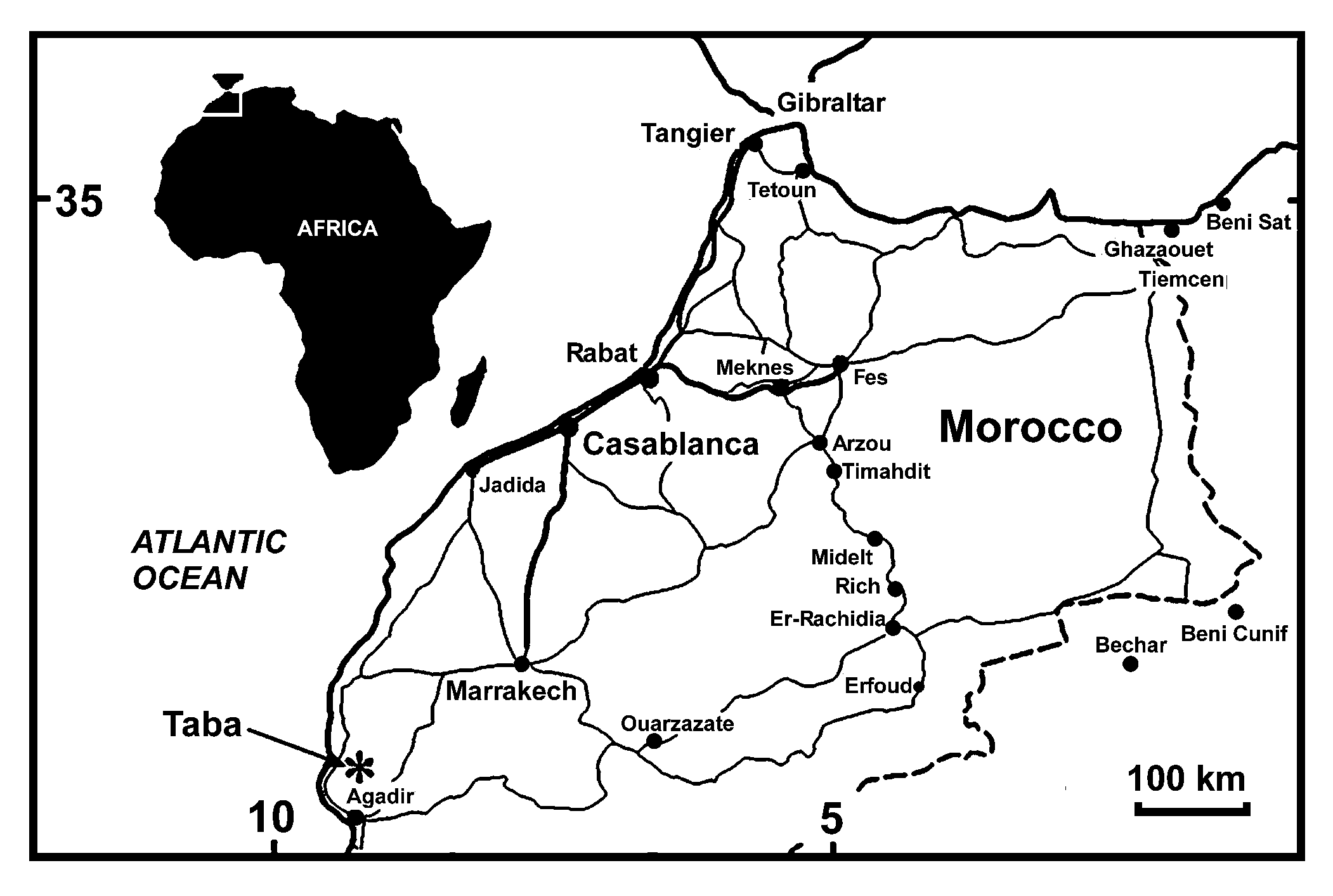
New material from Taba, Agadir Basin, Morocco (Fig. 1) and a reappraisal of existing material has enabled the description of new species of an odontasterid and a terminasterid, along with a detailed description of an ontogenetic sequence, and recognition of an indeterminable asteriid. A review of the goniasterids, including broadening of the description and ontogeny, and a review of the paxillosids described by Blake and Reboul (Reference Blake and Reboul2011) are provided.
Map showing location of Taba, north of Agadir, Morocco, North Africa.

Geological setting and locality
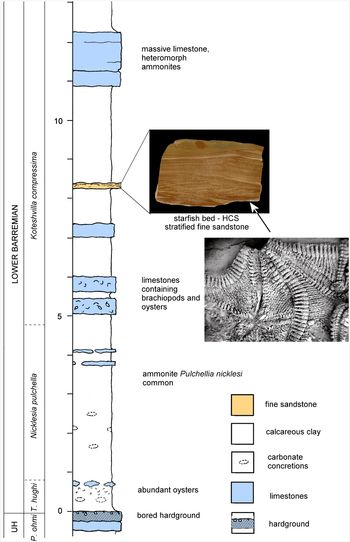
Fossil asteroids from the Lower Cretaceous of the region north of Agadir in Morocco were first described from the Barremian section of the coastal cliffs south-west of Tamanar, at Tillelt (Hess and Blake, Reference Hess and Blake1995), which provided the holotype of Coulonia platyspina Hess and Blake, Reference Hess and Blake1995. Material from a new locality then appeared on the commercial market. This locality was identified by Blake and Reboul (Reference Blake and Reboul2011) as 2.1 km north of the village of Taba (10 km east of Tamri), with specimens coming from a single bed in the Barremian Taboulouart Formation. Subsequently, the locality was visited by ASG in 2016 and 2018, and a map and sedimentological log were produced (Figs. 1, 2). Ammonites collected during these trips verify the age of the unit as within the Kotetishvilia compremissima Zone of the lower Barremian (Company et al., Reference Company, Sandoval, Tavera, Aouatem and Ettachefini2008). The unit is here called the Taba Starfish Bed.
Stratigraphic section of the Barremian of Taba, near Agadir, Morocco, to show the position of the Taba Starfish Bed, a thin, hummocky cross-stratified sandstone of K. compressima Zone age, the lower surface of which yields asteroids.
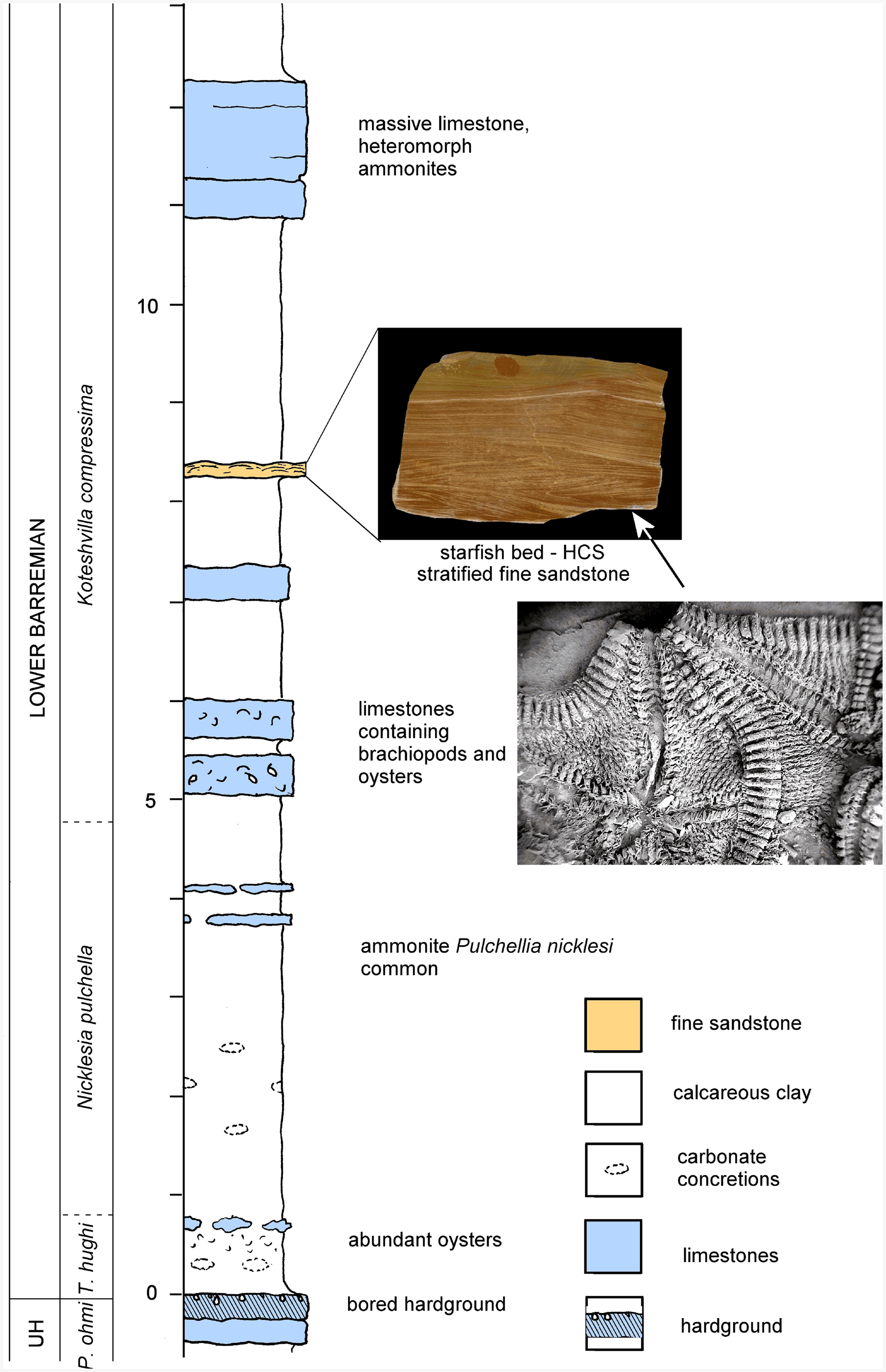
The asteroids come from the sharp contact between a 5–10 cm thick unit of hummocky cross stratified (HCS) sandstone and a pale gray marl. The base of the bed bears sole marks, including groove casts with a single orientation. Such beds are uncommon in the Hauterivian–Barremian sediments of the region. HCS is generated under conditions of unidirectional and oscillatory flow, by large storm waves (Surlyk and Noe-Nygaard, Reference Surlyk and Noe-Nygaard1986), and is indicative of deposition above storm wave base and beneath fair-weather wave base. In this situation, the water depth was probably in the order of 20–30 m. A single major storm overwhelmed the asteroids, ophiuroids, and echinoids (among other shelly invertebrate fauna) beneath a HCS sandstone after short transportation (as evidenced by variation in orientation of many starfish as well as folding and disruption of the arms). The HCS is overlain by bioturbated yellow marls, and burrows can be seen penetrating the top of the bed. However, the HCS was sufficiently thick that this bioturbation did not reach and disturb the starfish at the base. The bed has been excavated extensively by professional Moroccan fossil collectors and can be traced for ~40 m along the hillside. All the specimens studied here were purchased from various fossil collectors.
Materials and methods
All specimens were collected by commercial fossil collectors from the Taba Starfish Bed in the Barremian Taboulouart Formation and were prepared by soaking in potassium hydroxide to soften and disaggregate the clay, which was then removed using air pens and air abrasives by unknown Moroccan preparators and Mr. Joachin Espilez Ibañez to reveal the ossicles and the starfish outlines. Numerous secondary ossicles and parts of arms were lost during this process, although occasionally these have been re-affixed to provide an aesthetic finish. These were discounted for this study. To attain images, the specimens were coated in ammonium chloride and photographed using a Cannon 300 digital SLR camera with a macro lens and a Wild binocular microscope.
Repositories and institutional abbreviations
Specimens housed in various institutions are indicated by the following prefixes: ‘NHMUK PI EE’ and ‘EE’: Earth Sciences collections of the Natural History Museum London, UK. ‘NHMUK’ followed by a year: Life Sciences collections of the Natural History Museum London, UK. NMB: Natural History Museum, Basel, Switzerland. MHNT.PAL.2010: Natural History Museum of Toulouse, France. SMU: Southern Methodist University, Texas, USA.
Systematic paleontology
Terminology follows that of Gale (Reference Gale2011a).
Phylum Echinodermata de Brugière, Reference Brugière1791 (ex. Klein, Reference Klein1734)
Class Asteroidea de Blainville, Reference Blainville1830
Sublass Neoasteroidea Gale, Reference Gale1987
Order Paxillosida Perrier, Reference Perrier1884
Family Astropectinidae Gray, Reference Gray1840
Diagnosis
Five-armed, flattened paxillosids, possessing broad marginal frame made up of paired, opposing, supero- and inferomarginals; fascioles run abactinally-actinally between individual supero- and inferomarginal pairs in majority of genera; abactinal surface composed of small paxillae; actinals, when present, in well-defined rows of imbricating plates.
Genus Coulonia de Loriol, Reference Loriol1873
- Reference Hess1955
Cuneaster Hess, p. 61, figs. 16–22.
- Reference Blake and Reid1998
Betelgeusia Blake and Reid, p. 525, figs. 6, 7.
Type species
Coulonia neocomiensis de Loriol, Reference Loriol1873.
Diagnosis
Astropectinids with relatively short arms; actinal interareas very broad, interradial margin evenly curved. Marginals short and very broad (ratio of 3.5:1), tapering gently towards the lateral margin with very deep intermarginal fasciolar grooves. Inferomarginals bear coarse, irregularly sized spine pits arranged transversely, and have a short abactinal surfaces. Superomarginals 30% narrower than inferomarginals, wedging laterally, external face flat, bearing evenly distributed pits for short, blunt spines.
Remarks
Large, flattened, spinose astropectinids that possess broad actinal interareas and deep fascioles between the marginal plates are common and widespread in the Lower Cretaceous. Distinctive, isolated marginals with deeply embayed fasciolar regions of this type were described by Hess (Reference Hess1955) as Cuneaster, but later referred by the same author to Coulonia de Loriol, Reference Loriol1873, leaving Cuneaster as an objective junior synonym.
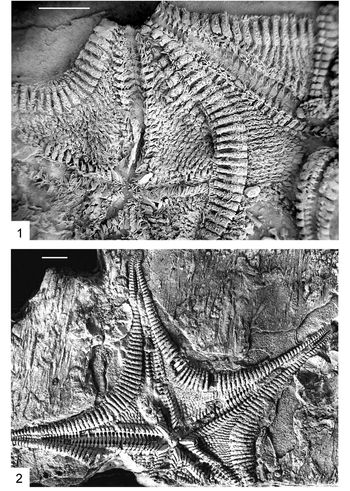
Coulonia is well known from the type species, C. neocomiensis de Loriol, Reference Loriol1873, material of which was figured by Hess (Reference Hess1970, fig. 7, pl. 3, figs. 1, 2, pl. 4, figs. 1, 2). The species is characterized by the broad, evenly curved interradial arcs, broad inferomarginals that possess a short abactinal surface, and particularly, by the narrower superomarginals that do not reach the ambitus. Isolated marginals figured by Hess (Reference Hess1955, figs. 16–22) show broad, short inferomarginals with deep intermarginal fasciolar grooves, irregularly sized spine pits, and short, narrow superomarginals that wedge towards the margin. Hess and Blake (Reference Hess and Blake1995) described C. platyspina from the Barremian of Tamanar, north of Agadir, Morocco, based on an individual with an exceptionally well-preserved actinal surface (Fig. 3), and we agree that it agrees perfectly with the diagnosis of Coulonia.
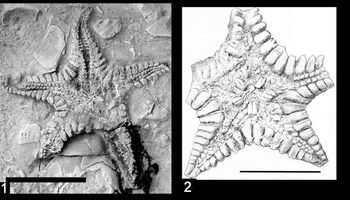
(1, 2) Coulonia platyspina Hess and Blake, Reference Hess and Blake1995. (1) Actinal surfaces of two individuals, Taba Starfish Bed, Taba, Morocco, NHMUK EE 15230; (2) holotype (original of Hess and Blake, Reference Hess and Blake1995, figs. 1–5), WSW of Tamanar, Morocco, NHMB M 9925. Note the similar broad, gently curved interradial arcs, the broad, short inferomarginals with deep fasciolar surfaces, and imbricating columns of actinal ossicles. The holotype differs primarily in its total denudation of secondary ossicles. Scale bars = 10 mm.

However, Blake and Reid (Reference Blake and Reid1998), Blake and Reboul (Reference Blake and Reboul2011), and Blake et al. (Reference Blake, Halligan and Larson2018) described similar starfish from Cretaceous rocks of Texas, Morocco, and South Dakota, under the names Betelgeusia reidi, B. orientalis, and B. brezinai, and placed them within the Radiasteridae based on apparent apomorphic characters of the ventral surface. These characters include the actinal plate morphology (plates being small, flattened, strongly overlapping, tapering toward the tip, and spinose), the plates arranged in closely aligned series forming ridges and furrows extending from the marginal toward the ambulacral furrows, and that both the fossil taxa and radiasterids have numerous small paxillae and a more centrally located madreporite.
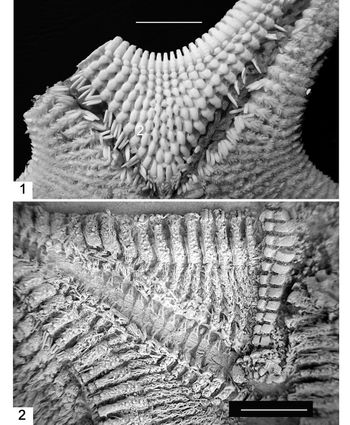
However, these characters are also present in Coulonia and other astropectinids. Many astropectinids also have strongly imbricating actinal ossicles in well-defined columns. This is illustrated here with a specimen of Tethyaster subinermis (Philippi, Reference Philippi1837), in which rows of imbricating actinals extend from the inferomarginals to the adambulacrals (Fig. 4.1). These actinals bear clusters of distally directed spinelets, and individual rows are separated by fasciolar grooves, exactly as in Coulonia (e.g., C. platyspina), although the spinelets are slenderer in the latter species. Furthermore, the marginals of Coulonia and those taxa assigned by Blake and Reid (Reference Blake and Reid1998), Blake and Reboul (Reference Blake and Reboul2011), and Blake et al. (Reference Blake, Halligan and Larson2018) to Betelgeuisia display block-like or laterally compressed marginals with inferomarginals displaying deep intermarginal fasciolar grooves, irregularly sized spine pits, and short, narrow superomarginals that wedge towards the lateral margin, these being much more similar to those of astropectenids (e.g., Figs. 4.1, 4.2, 6.1, 6.2). The lateral margins of radiasterids are quite different as they have distinctive small, paxilliform marginals (see Fig. 6.5, 6.6; Clarke and Downey, Reference Clark and Downey1992, fig. 17; Gale, Reference Gale2011a, text-fig. 22). Furthermore, newly acquired juvenile material of Coulonia platyspina from the Taba Starfish Bed appears to be very similar to that of C. neocomiensis de Loriol, Reference Loriol1873 described by Hess (Reference Hess1970) from the Hauterivian of Switzerland (see below and Fig. 5.1, 5.2).
Actinal interradial views of (1) Tethyaster subinermis (Phillipi, Reference Philippi1837), North Atlantic, Recent and (2) Coulonia platyspina Hess and Blake, Reference Hess and Blake1995, Barremian, Taba Starfish Bed, Taba, Morocco, NHMUK EE15320. Both show proximally imbricating columns of actinal ossicles, each bearing a distally diverging array of short spines that are shorter and sturdier in T. subinermis. The construction of the actinal surfaces is very similar, as is the morphology of the inferomarginals. Scale bars = 10 mm.

Juveniles of Coulonia spp. showing a comparable ontogenetic stage. (1) C. platyspina Hess and Blake (Reference Hess and Blake1995), Barremian, Taba Starfish Bed, Taba, Morocco. NHMUK PI EE 15228. (2) C. neocomensis de Loriol, original of Hess, Reference Hess1970, fig. 8, Hauterivian, Carrieres de Vardes, St-Blaise, Neuchâtel, Switzerland (author collection number A95). Note the pair of broad interradial inferomarginals and the rapid decrease in breadth of more distal plates. Note also the small actinal interareas and the contact between the adambulacrals and inferomarginals along the length of the arm. Scale bars = 10 mm.

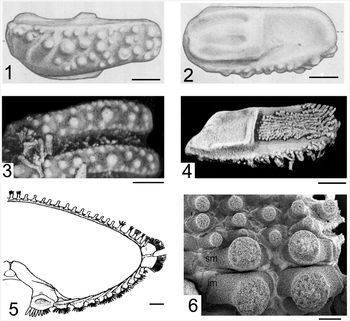
Morphological similarities between species of the astropectinid Coulonia and the differences with a radiasterid, Radiaster tizardi Sladen (Reference Sladen1889). (1, 2) Coulonia neocomensis de Loriol. after Hess, (Reference Hess1955, fig. 16, NHM B M2/1, holotype of Cuneaster hauteriviensis Hess, Reference Hess1955), Hauterivian, Carrieres de Vardes, St-Blaise, Neuchâtel, Switzerland. Inferomarginals in (1) actinal aspect, and (2) proximal/distal aspect. (3, 4) Coulonia reidi Blake and Reid, Reference Blake and Reid1998. Inferomarginals in (3) actinal aspect, and (4) proximal/distal aspect, after Blake and Reid (Reference Blake and Reid1998, fig. 8.14, SMU 30042 holotype; fig. 8.4, SMU 30050 paratype), Cretaceous (Albian) of Texas. Note the numerous similarities between C. neocomensis and C. reidi, including the short, broad inferomarginals with large fasciolar surfaces and proportionately small articulation surfaces between adjacent inferomarginals. (5, 6) R. tizardi. (5) Cross-section of arm of R. tizardi after Clark and Downey (Reference Clark and Downey1992, fig. 17a); (6) SEM image of a lateral view of the mid-arm of R. tizardi showing small elongated paxilliform development of marginals. Note important differences between marginal development of astropectinids (1-4) and the radiasterid, R. tizardi (5, 6). Modified after Gale (Reference Gale2011a, text-fig. 22). Abbreviations: sm = superomarginal, im = inferomarginal. Scale bars = 1 mm.

We are unsure why Blake and Reid (Reference Blake and Reid1998), Blake and Reboul (Reference Blake and Reboul2011), and Blake et al. (Reference Blake, Halligan and Larson2018) placed typical astropectinids, referred to the genus Betelgeusia (=Coulonia), in the family Radiasteridae and do not agree with Blake and Reboul's (Reference Blake and Reboul2011, p. 1022) argument that “expression of the actinal ossicles and the actinal interbrachia provide a character complex of apomorphies supporting a monophyletic Radiasteridae…” as a basis for including Betelgeusia in the Radiasteridae. These characters are also seen in typical astropectinids, including Coulonia, and the aforementioned taxa have further characters of the marginal frame that differ significantly from those of the radiasterids. We therefore consider Betelgeusia a junior synonym of Coulonia and conclude that Coulonia is an astropectinid. This implies that the Radiasteridae are now not known from the fossil record.
Coulonia platyspina Hess and Blake, Reference Hess and Blake1995
Figures 3, 4.2, 5.1
- Reference Hess and Blake1955
Coulonia platyspina Hess and Blake, p. 777, figs 1–5.
- Reference Blake and Reboul2011
Betelgeusia orientalis Blake and Reboul, p. 1029, figs. 3.1–3.9, 4.1–4.8.
- Reference Blake and Reboul2011
Dipsacaster africanus Blake and Reboul, p. 1031, fig. 5.1, 5.3–5.9 only.
- Reference Blake and Reboul2011
Order Paxillosida Blake and Reboul, p. 1032, fig. 6.1 only.
Holotype
NHMB M 9925. Barremian, coastal section WSW of Tamanar, 60 km north of Agadir, Morocco.
Diagnosis
Coulonia with very broad actinal interradial areas, gently curved interradial arcs, and relatively short, rapidly tapering arms. Inferomarginals short and very broad, and superomarginals with elongated abactinal surfaces.
Occurrence
Barremian of Tamanar, and Taba Starfish Bed, Taboulouart Formation, lower Barremian, Lower Cretaceous; 2.1 km northeast of the village of Taba, near Agadir, Morocco.
Description
Body flattened, disc broad, arms relatively short and rapidly tapering (R:r = 2.5:1). Interradial arcs evenly and gently curved, actinal interareas large and triangular. In fully grown individuals, 40–45 marginal pairs on each side of radius. Interradial inferomarginals broad and very short, with nearly parallel proximal and distal surfaces, opposing smaller superomarginals. Interradial inferomarginals 4–5 times broader than long, and deep embayments for intermarginal fascioles extend for 40–50% of plate breadth. Distally, into radius, inferomarginals become proportionately longer and less broad. Actinal surface of inferomarginals bears delicate spines, and lateral margin bears several short, blunt, flattened spines. Superomarginals narrower than inferomarginals, do not reach the lateral margin of interradius; bear fine granular spines. Each adambulacral bears short comb of ~5 flattened furrow spines; subadambulacral spines longer and finer. Actinal interareas broad and triangular, extending approximately half way along radius. Actinal plates arranged in discrete rows of proximally imbricated plates running from inferomarginals to adambulacrals, between which fascioles run. Actinals bear tufts of fine spines, that extend laterally and distally over fascioles. Abactinal surface is constructed of paxillae, with small flat bases and tall pedicels.
Materials
In addition to the type specimen, there are numerous individuals and fragments, including the holotype and several paratypes of Dipsacaster africanus Blake and Reboul, Reference Blake and Reboul2011 MHNT.PAL.2010.2.3A, 3C, 3D, 3E, 3F; the holotype and paratypes of Betelgeusia orientalis Blake and Reboul, Reference Blake and Reboul2011, MHNT.2010.2.1A–G; the hypotype of the order Paxillosida Blake and Reboul, Reference Blake and Reboul2011 MHNT.PAL.20102.4B; and numerous new individuals (~17) and fragments housed at The Natural History Museum, London, specimens NHMUK PI EE 15223, 15225, 15227–30, and 16034.
Ontogeny
The smallest individual presently available (NHMUK PI EE 16034c, Fig. 5.1) has an R of 5 mm and r of 2 mm, and shows the actinal surface. The interradial arcs are slightly angled, and the actinal interareas are very small. Approximately eight pairs of marginal plates are present on each side of the radius, and these taper distally from the interradial pair, which are broad and wedge towards the margin, becoming rapidly shorter and more rhomboidal toward the arm tip. The next smallest individual, EE 15228, has an R of 12 mm, r of 5 mm, ~14 marginal pairs on each arm radius, and again shows the actinal surface. The interareas are still small but the inframarginals within the arm angle are proportionally much longer than wide (when compared to the smaller specimen). During ontogeny, the disc enlarges proportionately faster than the arms, and large actinal interrareas, occupied by well-delineated rows of actinal ossicles, develop in larger specimens. The interradial margin becomes broad and gently, evenly concave, and the inferomarginals become short and very broad, with deep grooves for intermarginal fascioles. Juvenile specimens of C. neocomiensis de Loriol, Reference Loriol1873, from the Hauterivian of Switzerland, (Fig. 5.2; Hess, Reference Hess1970), are similar to those of C. platyspina in possessing angled interradial arcs, the enlarged 1st pair of interradial inferomarginals, and the small actinal interrareas.
Remarks
We are unable to detect any morphological differences among the material referred to Coulonia platyspina by Hess and Blake (Reference Hess and Blake1995), Betelgeusia orientalis by Blake and Reboul (Reference Blake and Reboul2011), and all, except one paratype (MNHT.PAL.2010.2.2B), of Dipsacaster africanus by Blake and Reboul (Reference Blake and Reboul2011). We therefore include all these under the oldest available name, C. platyspina. This differs from C. neocomiensis from the Hauterivian of Switzerland in its broader, shorter, and more numerous marginals and shorter arms (see Hess, Reference Hess1970) and from C. reidi from the Albian–Cenomanian of Texas in its shorter actinal spines and much more elongated interradial superomorginal plates (compare with Blake and Reid, Reference Blake and Reid1998, fig. 8.15). This is more pronounced in small individuals; while in the fully grown individuals, the contacts between marginal pairs are sub-parallel.
Order Valvatida Perrier, Reference Perrier1884
Family Goniasteridae Forbes, Reference Forbes1841
Genus Marocaster Blake and Reboul, Reference Blake and Reboul2011
Type species
Marocaster coronatus Blake and Reboul, Reference Blake and Reboul2011.
Emended diagnosis
Stellate goniasterid with broad, dorsally arched disc; abactinals paxillate, robust, and linked at base with small rods. Interbrachials of primary circlet enlarged and shield-like; first carinal small, second enlarged and elongate and bordered smaller abactinal on either side abutting the first carinal and an interbrachial. Interbrachial disk ossicles small and uniform. Arms short, with few marginals in which articular surfaces between marginal pairs 1–4 are angled at 30–40° to lateral margin. Two distal marginals in contact over radius. Actinal fields small with varying sized polygonal ossicles extending to third inferomarginal. Pedicellariae not recognized, spines beyond adambulacrals lacking.
Remarks
Marocaster is similar to Caletaster Breton, Reference Breton1979, in overall shape and its possession of wedge-shaped median superomarginals that meet over the distal radius. However, the abactinal surface of Caletaster is not shown by the available material, and we feel it is currently best to leave these two genera as separate entities.
Marocaster is unusual in the pronounced angulation of the intermarginal contacts in plates 1–4 to the lateral margin of the interradius. In some other, short-armed Cretaceous goniasterids, such as Crateraster texanus (Adkins and Winton, Reference Adkins and Winton1920), there is a similar angulation between the first two marginal pairs and more distal ones (e.g., Blake and Reid, Reference Blake and Reid1998, fig. 4.1–4.4). This is more pronounced in small individuals; while in the fully grown individuals, the contacts between marginal pairs are sub-parallel.
Marocaster coronatus Blake and Reboul, Reference Blake and Reboul2011
Figure 7
Holotype
MHNT.PAL.2010.2.2.
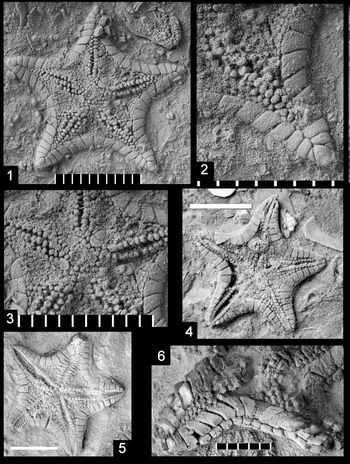
Marocaster coronatus Blake and Reboul, Reference Blake and Reboul2007. (1–3), abactinal view of large specimen, to show overall morphology (1), details of the arm tip (2), and central disc (3) NHMUK EE 15225a; (4, 5) actinal views of two individuals, NHMUK EE 15224, 15223; (6) lateral, oblique view of specimen to show marginals, NHMUK EE 15232b. All from the lower Barremian Taba Starfish Bed, Taba, Morocco. (1–3, 6) Scale bar in mm; (4, 5) scale bar = 10 mm.

Occurrence
Taba Starfish Bed, Taboulouart Formation, lower Barremian, Lower Cretaceous; 2.1 km northeast of the village of Taba, near Agadir, Morocco.
Description
Body flat, arms short (R:r 2:1), interradii gently curved. Marginal frame of equal breadth from interradius to terminal ossicle, and interradial marginals with evenly curved outer face that slopes to the inferomarginal contact. Marginals have sculpture of fine, densely packed spine pits that carried spherical spines. Six to 8 marginals in each half radius, interradial superomarginals 1–4 have angled contacts with adjacent distal plates, not present on inferomarginals. Distal superomarginals possess steeper lateral surfaces, ultimate two pairs meet over radius. Terminal ossicles proportionately large and oval in outline. Abactinal ossicles adjacent to radius (radials and adradials), tall, and set in well-defined rows, separated by spaces that probably bore papular openings. Interradial abactinals flat and tessellated, all abactinals covered by fine granular spines. Large, crescentic primary interradial present in each interradius, including one immediately proximal to madreporite. Triangular actinal interareas bear flattened, tessellate actinal ossicles extending along interradius as far as 4th inferomarginal. Adambulacrals square in actinal aspect bearing a median ridge separating adambulacral from subambulacral spines.
Adambulacrals bear five small spines projecting into ambulacral furrow and two or three longer, more robust spines, projecting directly downwards. Stepped transverse outline accommodated variation in supination with five small spines on each adambulacral that projected into ambulacral furrow and two or three longer, more robust, spines that projected downwards. Orals long and high with rectangular outline when viewed actinally, with central medial pore between paired ossicles that supported numerous spines extending extend into the oral cavity. Pedicellariae absent.
Materials
Type and paratypes of Marocaster coronatus Blake and Reboul, Reference Blake and Reboul2011, MHNT.PAL.2010.2.2, 2010.2.4A, and 2010.2.51, and thirteen new specimens now housed in The Natural History Museum London, including NHMUK PI EE 15223, EE 15224a, EE 15225–6, EE 15229, and EE 16034.
Remarks
The newly available specimens match the description provided by Blake and Reboul (Reference Blake and Reboul2011), although it includes specimens with a greater size range and those that reveal parts of the ambulacra. Larger individuals differ only in having a higher number of marginal ossicles (R ≥ 20 mm with 12 marginals). This greater size variation appears to confirm the speculation of Blake and Reboul (Reference Blake and Reboul2011) that their material represents a single recruitment that had not yet reached full maturity.
The new material also includes two Marocaster specimens (EE 15223–4) that display small areas of the ambulacral groove that are closed in all other specimens. Blake and Reboul (Reference Blake and Reboul2011) identified the stepped nature of the adambulacrals and speculated that this represented differentiated spines. Indeed, the new material confirms this suggestion, showing five small spines on each adambulacral that projected into the ambulacral furrow, and two or three longer, more robust, spines that projected downwards.
Family Odontasteridae Verrill, Reference Verrill1899
Genus Odontaster Verrill, Reference Verrill1880
Type species
Odontaster hispidus Verrill, Reference Verrill1880 (by monotypy).
Diagnosis
Body stellate to pentagonal; unpaired supero- and inferomarginal plate present in each interradius; one or two distally directed, glassy tipped spines present on oral ossicles.
Remarks
Among the specimens referred to Dipsacaster africanus by Blake and Reboul (Reference Blake and Reboul2011), one of the paratypes (Fig. 5.2) showed an interesting and unusual feature: the presence of a single, unpaired interradial marginal. This is suggestive of odontasterid affinity because these are absent in astropectinids. However, further examination of the specimen revealed other odontasterid and specifically Odontaster apomorphies. These include the presence of enlarged spine pits on the lateral actinal margin of the inferomarginals that bear short, robust spines, the ranks of spines on the adambulacrals and the platy morphology and tessellate nature of the actinal ossicles. Comparison with extant odontasterids supports placement within the genus Odontaster as a new species.
Odontasterids have a poor fossil record (see discussion in Gale, Reference Gale2011a, p. 62). The specimen described as O. priscus Fell, Reference Fell1954 from the Jurassic of New Zealand is probably indeterminable. However, it seems probable that Hessaster longimarginalis Gale, Reference Gale2011b, is also an odontasterid because this has elongated, unpaired interradial inferomarginals. Formal re-assignation of this species is, however, beyond the scope of the current project.
Odontaster tabaensis new species
Figure 8.1, 8.3
Reference Blake and Reboul2011 Dipsacaster africanus, Blake and Reboul, fig. 5.2 only.
(1, 3) Holotype of Odontaster tabaensis n. sp., MHNT.PAL.2010.2.3, Taba Starfish Bed, Taba, Morocco, in actinal view. The same specimen as the paratype of Dipsacaster africanus Blake and Reboul (2007, fig. 5.2). (1) Entire actinal surface; (3) enlargement of interradial region to show unpaired interradial inferomarginal and large, flattened oval spines on the lateral margin of the inferomarginals. (2) Comparable features in Odontaster crassus Fisher, Reference Fisher1905, Recent, Santa Catalina Island, California, USA; 39–41 fathoms, NHMUK 1954.9.3.123. (1) Scale bar in mm; (2,3) scale bar = 1 mm.

Holotype
MNHT.PAL.2010.2.3B. Taba Starfish Bed, Taboulouart Formation, lower Barremian, Lower Cretaceous; 2.1 km northeast of the village of Taba, near Agadir, Morocco.
Diagnosis
Odontaster with angled interradial arcs, unpaired interradial inferomarginals with distinctly near-triangular outline, and inferomarginals with weakly pustulose surface ornamentation.
Occurrence
Taba Starfish Bed, Taboulouart Formation, lower Barremian, Lower Cretaceous; 2.1 km northeast of the village of Taba, near Agadir, Morocco.
Description
Single known individual (Fig. 8.1, 8.3) shows only actinal surface of disc, majority of length of two arms, and base of three others. Unfortunately, ambulacral groves obscured by hard matrix. Inferomarginals rectangular and broader than long; unpaired interradial inferomarginals triangular in outline, tapering towards ambitus. Interradial arcs acutely angled (i.e., not rounded/curved). Surfaces of inferomarginals denuded by over-preparation, but locally show irregular, rather coarse rugosities between which occur short, granular spines. Spines on actinolateral margin of inferomarginals larger, flattened, and oval (Fig. 8.3). Actinal ossicles tabular, slightly imbricated, rather irregular in form, and decrease in size towards inferomarginals. Rows of actinals run parallel with adambulacrals. Adambulacrals visible in same interradius; with rather small, square actinal surfaces bearing two rows of spines. Short, conical spines present in situ in ambulacral groove.
Etymology
After the type locality.
Materials
MNHT.PAL.2010.2.3B.
Remarks
Odontaster tabaensis n. sp., differs from the extant species Odontaster mediterraneus (Marenzeller, Reference Marenzeller1893) in its possession of an unpaired interradial inferomarginal that tapers laterally, and has a nearly triangular outline. In O. mediteranneus, the unpaired interradial marginals are trapezoidal and the interradial arcs gently curved, as they are in O. penicillatus (Philippi, Reference Philippi1870). Odontaster tabaensis n. sp. agrees better with O. robustus Verrill in the shape of the unpaired interradial inferomarginal (compare Clarke and Downey, Reference Clark and Downey1992, pl. 37, figs. e, f) and the slightly angled interradial arcs, but differs from that species in having smaller actinal interareas. Odontaster tabaensis n. sp. differs from all extant Odontaster in the pustulose surfaces of the marginals, the living species possessing only small, concave spine pits. Hessaster longimarginalis Gale, Reference Gale2011b differs from O. tabaensis n. sp. in the shape and sculpture of the marginal plates.
Order Forcipulatida Perrier, Reference Perrier1884
Suborder Zorocallina Downey, Reference Downey1970
Families included
Zoroasteridae Sladen, Reference Sladen1889; Terminasteridae Gale, Reference Gale2011a.
Diagnosis
Forcipulatids possessing domed disc composed of relatively few, large abactinal ossicles; only straight forcipulate pedicellariae present.
Family Terminasteridae Gale, Reference Gale2011a
Genera included
Terminaster Hess, Reference Hess1974, Alkaidia Blake and Reid, Reference Blake and Reid1998.
Diagnosis
Zorocallinids with extra-axial arm constructed of seven rows of ossicles organized with one row of radials, two rows of adradials, two rows of superomarginals, and two rows of infromarginals; both marginal rows extend to arm tip.
Remarks
Gale (Reference Gale2011a) assigned Terminaster to a monotypic family, the Teminasteridae, an assignation followed here. Below, we transfer Alkaidia Blake and Reid, Reference Blake and Reid1998 to the Terminasteridae because it displays an arm structure similar to that of Terminaster.
Gale (Reference Gale2011a) suggested that the Terminasteridae may have arisen via paedomorphosis from within the Zoroasteridae. This was based primarily on the close similarities of the oral ossicles between the two families, but was further supported by a number of other characteristics identified as paedomorphic including: large terminals; adambulacrals that are all similar; the small number of plate rows in the arm; retention of large primary abactinal ossicles; possession of only a single large adambulacral spine; elongate ambulacrals; and biserial tube feet. However, Gale (Reference Gale2011a) noted that without a better understanding of the juveniles of all groups concerned, the question of relationships between the two families would remain open.
With the recognition of Alkaidia as a terminasterid and the presence of an ontogenetic sequence of fossil juveniles in the new material described below, a comparison with extant zoroasterid juveniles is possible and reveals several differences (discussed below).
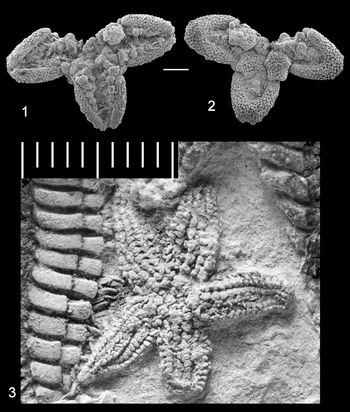
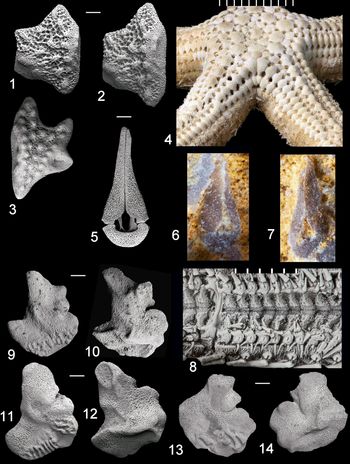
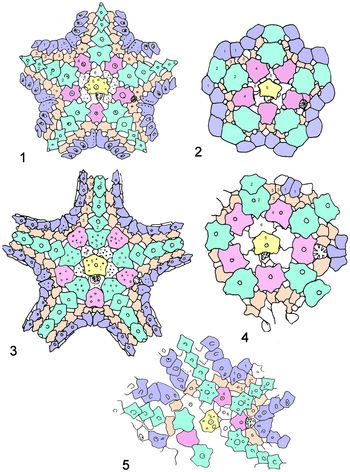
Terminaster has recently been placed in cladistic analyses as sister to all neoasteroids, with the exception of the Triassic Superstesaster, presumably largely on the grounds of its supposed lack of inferomarginals (Villier et al., Reference Villier, Brayard, Bylund, Jenks, Escarguel, Olivier, Stephen, Vennin and Fara2018). However, in this study, we find that Terminaster (and Alkaidia) did possess inferomarginals (see below and Hess, Reference Hess1974, fig. 3; Villier et al., Reference Villier, Charbonnier and Riou2009, fig. 4; Gale, Reference Gale2011a, pl. 27, figs. 6, 15, 16) and that Terminaster, Alkaidia, and zoroasterids share numerous derived characters as follows: (1) Detailed arrangement and shape of the abactinal disc ossicles, shown in Figure 9. The primary interradials are pentagonal to hexagonal and are overlapped by pentagonal primary radials, with which they have a specialized articulation surface. The centrale is a sub-semicircular ossicle, and its margin adjacent to the periproct is concave, (2) Presence of paired, Y-shaped first superomarginals, which articulate proximally across the interradius, and are imbricated by the second superomarginals (Fig. 12.1–12.3). A facet for articulation with the second pair forms a short process on the distal margin of the first pair. A similar arrangement is present in Alkaidia sumralli Blake and Reid, Reference Blake and Reid1998 (Fig. 12.3), A. megaungula n. sp., T. cancriformis (Quenstedt, Reference Quenstedt1876), and all zoroasterids (Fig. 12.4), (3) Oral ossicles are similar in morphology (Gale, Reference Gale2011a; Fig. 12.9–12.14), and (4) Duck-billed forcipulate pedicellariae are present in all zoroasterids (e.g., Fig. 12.5) except Pholidaster (which lacks any pedicellariae), and are very similar to those found in A. sumralli (Fig. 12.8) and A. megalungula n. sp. (Fig.12.6, 12.7). Poorly preserved duck-billed pedicellaria have also been observed in T. cancriformis (Ewin, personal observation).
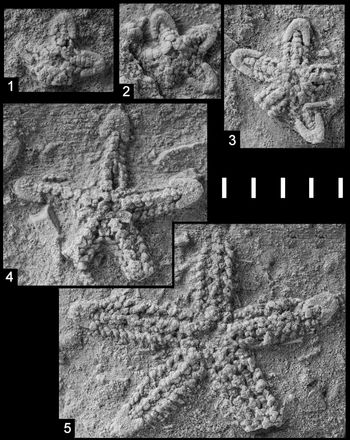
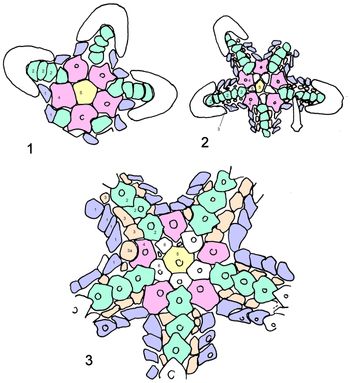
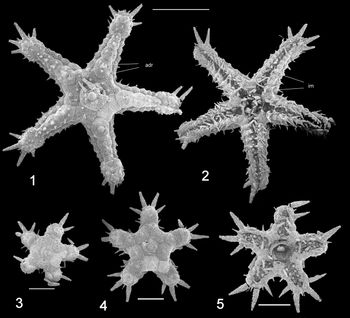
Alkaidia megaungula n. sp. (1–5) Ontogenetic sequence of specimens. Note the very large terminal ossicles in the smallest individuals. Ossicles remain a fairly constant size, even as the arm elongates, by the addition of radial, adradial, and marginal rows. lower Barremian, Taba Starfish Bed, Taba, Morocco. (1) NHMUK EE 15225b, (2) NHMUK EE 15225c, (3) NHMUK EE 15225d, (4) NHMUK EE 15225e, (5) NHMUK EE 15225f. See interpretation of ossicle arrangement in Figure 13. Scale bar in mm.

(1, 2) Juvenile specimen of Alkaidia sumralli Blake and Reid, Reference Blake and Reid1998, Duck Creek Formation, Upper Albian, Fort Worth, Texas. (1) Actinal and (2) abactinal views. Juveniles of A. sumralli and A. megaungula n. sp. are similar because both possesses enlarged U-shaped terminals (compare Fig. 10.1, 10.2 with Fig. 9.1). (3) Largest known specimen of A. megaungula n. sp., from the Taba Starfish Bed, Taba, Morocco, NHMUK EE 16034a. Compared with Figure 9.5, the arms appear to be broader and more strap-shaped in the larger individual, but this is partly due to taphonomic compaction. (1, 2) Scale bar = 1 mm, (3) scale bar in mm.

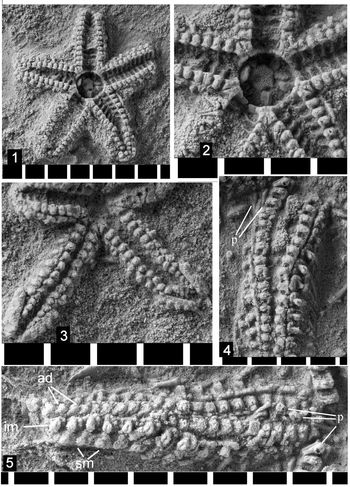
Actinal and lateral aspects of the arm and mouth frame in Alkaidia megaungula n. sp. (1, 2) Actinal aspect of small individual (R ~5 mm) to show nearly circular peristome, small oral ossicles with a rectangular actinal face, and inferomarginals extending to interradius; NHMUK EE. 15226c; (3) actinal surface of arms (R = 3.5 mm) showing block-like adambulacrals in contact with inferomarginals along the entire length of the arm; actinals are absent; NHMUK EE EE 15224c; (4, 5) arms of larger individual (R estimated at 10 mm), NHMUK EE 15225h; (4) actinal surface of an arm showing inferomarginals carrying prominent bifid spine bases and (5) obliquely twisted arm showing superomarginals opposing inferomarginals. Abbreviations: sm = superomarginal, im = inferomarginal, ad = adambulacrals, p = pedicellaria. Scale bar in mm.

Morphological details of Terminasteridae and Zoroasteridae. (1, 2, 9, 10) Terminaster cancriformis (Quenstedt, Reference Quenstedt1876). (1, 2) First superomarginal, to show broad interradial contact with adjacent plate; (9, 10) Oral ossicle, original of Gale (Reference Gale2011a, pl. 26, figs. 6, 9) in radial (9) and interradial (10) views; Oxfordian of Savigna, Jura, France. (3, 8, 11, 12) Alkaidia sumralli Blake and Reid, Reference Blake and Reid1998. (3) First superomarginal for comparison with (1, 2) and (8) actinal surface of arm, to show presence of straight forcipulate pedicellariae on adambulacrals; (11, 12) oral ossicle in radial (11) and interradial (12) views; Grayson Formation, lower Cenomanian, Dottie Lynn Lane, Fort Worth, Texas, USA. (6) NHMUK EE15225g, (7) NHMUK EE15225h, Alkaidia megaungula n. sp., straight forcipulate pedicellariae; Taba Starfish Bed, Taba, Morocco. (4, 5, 13, 14) Zoroaster fulgens Thomson, Reference Thomson1873, Recent, North Atlantic. (4) Oblique abactinal interradial view of individual to show enlarged first superomarginal (SM1); (5) straight forcipulate pedicellaria; (13, 14) oral ossicle, original of Gale, Reference Gale2011a, pl. 26, figs. 7, 10, in radial (13) and interradial (14) views. (1–3, 5–7, 9–14) Scale bars = 500 ųm; (4) scale bar in mm; (8) scale bar = 1 mm.

Furthermore, the Zoroasteridae were also identified as the earliest Forcipulatida in the molecular study of Mah and Foltz (Reference Mah and Foltz2011). As such, we conclude that Terminasteridae and Zoroasteridae are sister taxa belonging to the suborder Zorocallina, and are likely to be sister to all extant Forcipulatida Blake, Reference Blake1987 rather than being sister to all neoasteroids.
Genus Alkaidia Blake and Reid, Reference Blake and Reid1998
Type species
Alkaidia sumralli Blake and Reid, Reference Blake and Reid1998; Washita Group, Del Rio Formation, Waco Dam Quarry, Texas, USA.
Other species
Alkaidia sumralli Blake and Reid, Alkaidia megaungula n. sp.
Emended diagnosis
Terminasteridae with elongated rhombic superomarginals directed obliquely towards the radials; inferomarginals with tall, distally swollen, central spine bases and prominent groove for spine attachment; radials (except primary radial) rhombic in outline.
Occurrence
Kimmeridgian of France; Albian and Cenomanian of Texas, USA; and Barremian of Taba, near Agadir, Morocco.
Remarks
Blake and Reid (Reference Blake and Reid1998) assigned Alkaidia to the benthopectinid subfamily Paleobenthopectinae Blake, Reference Blake1984 on account of the arrangement of the abactinal ossicles, but conceded that the genus had very few features in common with benthopectinids. Villier et al. (Reference Villier, Charbonnier and Riou2009) subsequently removed all taxa, apart from Alkaidia, from the Paleobenthopectinae on the basis that the ambulacral plates of the other included genera, Xandarosaster Blake, Reference Blake1984 and Plesiastropecten Peyer, Reference Peyer1945, more closely resembled those of velatids. The Paleobenthopectininae are thus interpreted as a heterogeneous assemblage of diverse asteroids that do not form a monophyletic group.
Instead, Alkaidia shares numerous characters in common with the Terminasteridae, particularly the similar arm structure composed of radials (one), adradials (two), superomarginals (two), inferomarginals (two), as well as numerous other features including large terminals, straight forcipulate pedicellariae, similar mouth frame construction, and disc plate arrangement. Therefore, we transfer Alkaidia Blake and Reid, Reference Blake and Reid1998 to the Terminasteridae (Forcipulatida) and conclude that it is not a benthopectinid (Paxillosida).
Alkaidia is retained as a separate genus from Terminaster owing to consistent differences in the morphology of several plate rows, particularly the shape of the supromarginals and the distinctly swollen morphology of the spine bases of the marginal ossicles.
Alkaidia megaungula new species
Figures 9, 10.3, 11, 12.6, 12.7, 13.5, 14
Reference Blake and Reboul2011 Paxillosida Blake and Reboul, p.1032, fig. 6.2.
Reference Blake and Reboul2011 Zoroasteridae? Blake and Reboul, p.1032, fig. 6.3.
Holotype
NHMUK PI EE 15225a.
Paratypes
EE 15224 b–c, EE 15225b–m, EE 15226 a–b, EE 15229 a–g, EE 15231, EE 16034a.
Diagnosis
Small Alkaidia with short proportionately broad, strap-shaped arms; large terminal ossicles displaying deep embayment on proximal dorsal margin, and verrucose surface ornament with prominent, rounded marginal spine bases.
Description
Disc small and poorly demarcated from arms, which are strap-like, relatively short, even in largest individuals available (R 8 mm; r 3 mm), and follow the Forcipulatid Plating Rule of Gale (Reference Gale2011a), in which adradials are inset beneath radials and inferomarginals. Primary radials and interradials form a ring of enlarged ossicles at margin of disc, surrounding periproct and enlarged centrale (Fig. 9.5). Centrale polygonal, carries a centrally placed spine base and several smaller spine bases, and inset in most specimens because of post-mortem collapse of central disc. Primary interradials pentagonal, inset beneath adjacent primary radials, bearing small centrally positioned spine base surrounded by smaller spine bases. Marginal half of one interradial bears a rounded polygonal madreporite with large rounded pores (Fig. 13.5). Primary radials, overlapping margins of primary interradials, hexagonal, slightly longer than broad, with concave sides and central spine base, surrounded by three to four smaller spine bases. Distal margin of primary interradial imbricated by second radial plate (Figs. 9.4, 10.3). In larger individuals, smaller plates inserted adjacent to centrale along rays of radials and may also bear central and smaller rounded spine bases.
Interpretative drawings of abactinal plating in zoroasterids and terminaterids. (1) Reconstruction of Terminater cancriformis (Quenstedt, Reference Quenstedt1876), based on material from the Oxfordian of the Jura, France and the UK. (2) Mammaster sigsbeei (Perrier, Reference Perrier1881), Recent, North Atlantic. (3) Alkaidia sumralli Blake and Reid, Reference Blake and Reid1998, Albian of Texas. (4) Zoroaster fulgens Thomson, Reference Thomson1873, Recent, North Atlantic. (5) Alkaidia megaungula n. sp., based on NHMUK EE 15225g. Note the homology and similar arrangement of arm and disc plates. Superomarginals blue (1), radials green (2), adradials beige (3), primary interradials pink (4), centrale yellow (5), ring of plates around centrale, white (6). (Color online)

Ambulacrals visible in situ in ambulacral groove (Fig. 11). Strong actinal transverse ridge visible, as is triangular insertion site for actinal transverse ambulacral muscle. External, actinal surfaces of adambulacrals approximately square, and taper slightly distally. Distal region, bearing interadambulacral muscles, slightly concave (e.g., Fig. 11.4). Proximal transverse region raised, and bears rounded, bifid attachment site for single, large subadambulacral spine, plus two smaller attachments for two furrow spines. Subadambulacral spines large and stout with swollen base. Oral ossicles triangular to rectangular, taper proximally (Fig. 11.2), actinal surface flat, bearing two spines.
Inferomarginals oval to subrectangular, carrying a single, tall, laterally directed spine base that bears bifid terminal articulation surface for large spine, and several smaller rounded spine bases (Fig. 11.5). Adambulacrals shorter than inferomarginals, with ~1.5 adambulacrals to each inferomarginal. Primary inferomarginal spines robust and elongated (Fig. 11.4, 11.5), striated, about twice length of inferomarginals. Superomarginals oppose inferomarginals, asymmetrically rhombic in outline (e.g., Fig. 11.5); long axis is directed at oblique angle to axis of arm. Centrally positioned, rounded spine pit present on each ossicle and surrounded by several smaller rounded secondary spine bases. Adradials inset beneath radials and superomarginals and bear single, central spine base in smaller individuals (which is smaller than those on adjacent plates), although this may be surrounded by several small secondary spines in larger individuals. Radials symmetrically rhombic (Fig. 10.3), equidimensional, carrying single, centrally placed round primary spine base with circular central pit and up to four secondary rounded spine bases surrounding primary spine base.
Terminal ossicles large, conspicuous, and proportionately larger in smaller individuals (Fig. 9; see below, ontogeny). Abactinal outline D-shaped, with deep proximal invagination in smaller specimens, becoming less pronounced in larger individuals. Abactinal surface of terminal ossicle displays verrucose ornament and several large laterally directed rounded spine bases around margin and tip.
Etymology
From the Greek for “great/large” and the Latin for “hoof,” describing the large hoof-like terminal ossicle that characterizes this species.
Materials
NHMUK PI EE 15225a, 15224 a–b, 15225b–m, EE 15226 a–b, EE 15229 a–g, EE 15231, EE 16034. Numerous well-preserved individuals show both actinal and abactinal surfaces as well as an ontogenetic series. Also included is MHNT.PAL.2010.2.8, a hypotype of Paxillosida in Blake and Reboul (Reference Blake and Reboul2011, fig. 6.2) that appears to be a tiny, poorly preserved, juvenile Alkaidia, and MHNT.PAL.2010.2.7, the hypotype of Zoroasteridae? in Blake and Reboul (Reference Blake and Reboul2011, fig. 6.3), which appears to be a more mature Alkaidia.
Ontogeny
The smallest individuals (Figs. 9.1, 9.2, 13.1; NHMUK EE 15225b–c) are R:r = 1.6–0.8 mm. Each arm is composed of very large terminals, extending about half the length of the arms, a single pair of superomarginals, and five radial plates. The disk composed of five large primary interradials that surround a pentagonal centrale. The primary radial is not larger than more distal ones. Slightly larger individuals, (Figs. 9.3, 13.2; NHMUK EE 15225d) with R:r = 2.1–1.6 mm, show seven undifferentiated radials, three to four superomarginals, and three adradials. Individuals larger still (Figs. 9.4, 13.3; NHMUK EE 15225e), with R:r = 3.5–1.6 mm, have eight radials, six to seven superomarginals, and primary radials differentiated as larger hexagonal ossicles. Specimens with R:r = 4.2–1.6 mm and larger display proximal adradial plates with a central spine boss. The disc starts to increase in size in individuals with arm length exceeding ~8 mm (R:r = 8.5–2.3 mm). Beyond this size, plates are simply added at the end of the plate rows in the arm and existing plates expand without drastically changing morphology.
Comparison with the ontogeny of Zoroaster fulgens Thomson, Reference Thomson1873.—For comparison, we obtained a suite of juvenile individuals of Zoroaster fulgens from the Porcupine Basin of the North Atlantic (Fig.15). The second smallest of these (R = 1.7 mm, Fig. 15.3) is at a comparable size and stage of development to the smallest specimen of A. megaungula n. sp. (R = 1.8 mm; Figs. 9.1, 14.1). At this size, Z. fulgens has a large, pentagonal primary interradial ossicle, a small triangular primary radial, and an oval to D-shaped terminal ossicle with a tiny invagination occupied by a single, tiny secondary radial. In comparison, A. megaungula n. sp. has a very large U-shaped terminal and five radial plates.
Interpretation of plating in juvenile Alkaidia megaungula n. sp., based on specimens in Figure 9.2. (1) NHMUK EE15225c, Figure 9.3 (2) EE 15225d, and Figure 9.4 (3) EE 15225e, larger individual, Barremian, Taba Starfish Bed, Taba, Morocco. Colors as in Figure 13, except terminal ossicles, where present, are also white. (Color online)

Juvenile Zoroaster fulgens Thomson, Reference Thomson1873, Porcupine Basin, North Atlantic. (1, 3, 4) Abactinal surface; (2, 5) actinal surface. Compare with individuals of Alkaidia megaungula n. sp. in Figure 9. Abbreviations: adr = adradial, im = inferomarginals. (1, 2) Scale bar = 2 mm, (3–5) scale bar = 1 mm.

At a later stage, Z. fulgens (R = 3.5 mm, Fig. 15.1) has five radial plates, a more deeply incised proximal margin of the terminal, and only a single adradial in the mid-arm, whereas at a comparable size (R = 3.2 mm, Figs. 9.4, 14.3), A. megaungula n. sp. has eight radial plates and a full row of adradials. Furthermore, at this stage, A. megaungula n. sp. possesses a full row of inferomarginals, whereas only a few of these plates appear to have developed in the mid-arm, between the adambulacrals and what we interpret as the superomarginals, in Z. fulgens (Fig. 15.1, 15.2). Multiplication of plates within individual rows therefore occurs more rapidly, and at an earlier ontogenetic stage, in Alkaidia than in Zoroaster, and a full complement of rows is achieved at a smaller size in the former. In Zoroaster, abactinal arm development initially involves only the radials and what we interpret as the superomarginals, and adradials and what we interpret as inferomarginals appear as intercalations within the mid-arm at a later stage (Fig. 15.1, 15.2); a pattern also identified by Fau and Villier (Reference Fau and Villier.2018). The developmental pattern in zoroasterids thus appears to be highly derived compared to terminasterids, with the latter developing plate rows more rapidly and at an earlier ontogenetic stage. We acknowledge, in agreement with Fau and Villier (Reference Fau and Villier.2018), that identification of marginal plate rows in Zoroaster is problematic, when strictly applying the current definition of marginals, because plates secondarily added as intercalations within the mid-arm are considered part of the actinal series. The resolution of this point is beyond the scope of the current work, but we favor the interpretation of these intercalated plates as inferomarginals owing to the position they ultimately adopt in the mature individual.
Remarks
The species is referred to Alkaidia because: (1) the tall, distally swollen, central spine bases on the inferomarginals are very similar to those of A. sumralli but unlike those on T. cancriformis, in which the spine boss is lower and less swollen (Gale, Reference Gale2011a); (2) the superomarginals are elongated, have a rhombic outline, and are directed obliquely towards the radials, whereas in T. cancriformis, the superomarginals are elongated parallel to the axis of the arm (Gale, Reference Gale2011a, text-fig. 36A); and (3) the radials (except the primary radials) are rhombic and approximately as broad as long, as in A. sumralli. Those in T. cancriformis are elongated with a central narrow waist (Gale, Reference Gale2011a, pl. 27, figs. 8, 9).
Comparison between A. megalungula n. sp. and A. sumralli Blake and Reid (Reference Blake and Reid1998) is difficult because the largest individuals known of the former species are smaller than the smallest of the latter. It is thus unknown whether the material of A. megaungula n. sp. represents immature individuals or fully grown individuals of a small species. However, there are small but consistent differences. The outline of the primary radial plates is hexagonal and equidimensional in A. sumralli, but hexagonal and elongated in A. megaungula n. sp., with a lateral embayment. Alkaidia megaungula n. sp., also has a deeply embayed proximal margin on the abactinal surface of the terminal ossicle, even in the largest individuals, a feature that appears more ovate and lacking in an embayment in A. sumralli.
Family Asteriidae Gray, Reference Gray1840
Asteriidae incertae sedis
Figure 16
Description
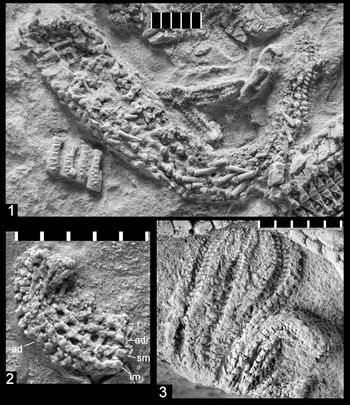
Only three fragmentary individuals available. Figure 15.1 illustrates a single, partially disarticulated, fairly long, twisted, arm showing plates of both actinal (toward the arm tip) and abactinal surfaces. Abactinal surface composed of displaced rows of imbricating bi- and trilobed plates that possess large, centrally positioned, raised boss with depression in center. Robust, conical spines, which originally attached to bosses, scattered over surface of arm. Identification of plate rows uncertain. About two-thirds of way distally, arm twists to expose plates of actinal surface revealing two rows of small, blocky, equidimensional adambulacrals. Adjacent to these is row of elongated, oval, imbricating inferomarginals with large central boss. Small oval terminal ossicle at arm tip.
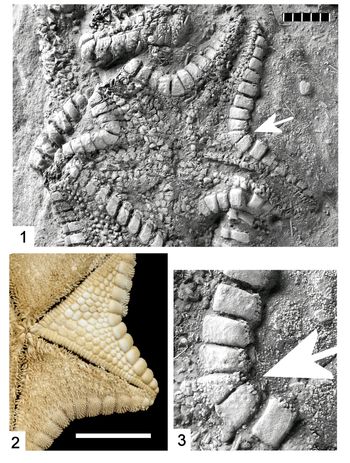
(1–3) Asteriidae incertae sedis. (1) Abactinal view of large, mostly disarticulated specimen, showing the presence of large bifid spine pits on radials and adradials, that bore robust, pointed spines, NHMUK EE 16034b; (2) arm fragment in lateral view, showing adambulacrals, inferomarginals, and superomarginals, NHMUK EE 15229a; (3) poorly preserved individual, overgrown plates, possibly Asteriidae, NHMUK EE 15232b, lower Barremian, Taba Starfish Bed, Taba, Morocco. Abbreviations: ad = adambulacrals, adr = adradial, im = inferomarginals, r = radials, sm = superomarginals. Scale bar in mm.

Figure 15.2 presents a shorter arm fragment in lateral aspect that retains articulated plate rows, although individual plates not well preserved. Adambulacrals short, equidimensional and distally concave; inferomarginals elongated, oval, carry a large, centrally placed spine attachment and short abactinal process for contact with superomarginals. Superomarginals quadrilobate, with elongated central portion, and short actinal and abactinal processes. Adradial and radial rows visible, but detailed shape of plates cannot be discerned.
Third specimen (Fig. 15.3) least well preserved, consisting of individual with long recurved arms such that only actinal surface visible. Stout ambulacrals, with pairs forming “V” shape proximally, suggest biserial arrangement of tube feet; short, rectangular adambulacrals, carrying robust conical spines, visible. Disc not preserved.
Materials
NHMUK PI EE 16034, EE 15229, and NHMUK PI EE 15232.
Remarks
There are several consistent features in the morphology of the various plate rows among these specimens, suggesting a single species. However, before a more precise assignation is attempted, we await the discovery of better-preserved material. The overall morphology of the marginal and abactinal ossicles, which form an open reticulum made up of bi-, tri-, and quadrilobate ossicles each of which possess a large central spine boss, is indicative of affinity to the family Asteriidae. The absence of actinal ossicles and the simple reticulate form of construction are typical of many Mesozoic asteriids (Gale and Villier, Reference Gale and Villier2013).
Very well-preserved material of this family was described from the Maastrichtian of Morocco as Cretasterias reticulatus Gale and Villier, Reference Gale and Villier2013, and the general morphology of the Taba specimens is similar in that the same number of plate rows is present. However, the abactinal ossicles of the Taba specimens are more robust, and the spine bosses and spines are larger than in the Maastrichtian form.
Discussion of fauna
The most abundant components of the Barremian Taba Starfish Bed asteroid fauna are the astropectinid Coulonia platyspina, the terminasterid Alkaidia megaungula n. sp., and the goniasterid Marocaster. These are directly comparable with the closely related main elements from the asteroid fauna described from the late Albian and early Cenomanian of Texas (Blake and Reid, Reference Blake and Reid1998): Coulonia reidi, the terminasterid Alkaidia sumralli, and the goniasterid Crateraster texensis (Adkins and Winton, Reference Adkins and Winton1920). Indeed, C. texensis shows some notable marginal similarities with Marocaster (see above). This fauna, dominated by Coulonia, Alkaidia, and a short-armed goniasterid, appears to have persisted in shallow shelf seas of the northwest part of Tethys for a significant part of the Cretaceous, from the Barremian to the Cenomanian.
Asteriid-like starfish also appear to be widespread during the Jurassic and Cretaceous, with several species described from Switzerland, UK, Germany, and Morocco. Thus, the presence of rare examples within the Taba fauna is not surprising.
Conclusions
The new asteroids from the Barremian Starfish Bed at Taba, Agadir Basin, Morocco, provide further insights into the taxonomy of Lower Cretaceous taxa, including, importantly, the identification of the first convincing fossil member of the extant family Odontasteridae, O. tabaensis n. sp. The new material allows placement of the “radiasterid” Betelgeusia orientalis Blake and Reboul, Reference Blake and Reboul2011, and most of the type material of Dipsacaster africanus Blake and Reboul Reference Blake and Reboul2011, in synonymy with the astropectinid species Coulonia platyspina Hess and Blake, Reference Hess and Blake1995. New juvenile material of C. platyspina shows that this species has an ontogeny similar to that of the type species of Coulonia, C. neocomensis de Loriol, Reference Loriol1873.
A new species of the genus Alkaidia, A. megaungula n. sp., is described on the basis of numerous specimens that show a remarkably complete ontogenetic series, from post-metamorphic individuals to fully grown adults. The genus Alkaidia is transferred to the family Terminasteridae, and is a typical early member of the forcipulatid group Zorocallina. A poorly preserved, probable asteriid is also present in the fauna.
The asteroid fauna from the Barremian of the Agadir Basin is remarkably similar at genus level, and in overall diversity, with that described from the Albian and Cenomanian of Texas (Blake and Reid, Reference Blake and Reid1998), and is part of a western Tethyan fauna that existed on both sides of the Atlantic from the Barremian to the Late Cenomanian.
Acknowledgments
TE would like to thank the Department of Earth Sciences at The Natural History Museum London for making funds available for the purchase of fossil material, H. Taylor for the photography of specimens, and L. Villier and M. Fau for fruitful discussions on forcipulatid palaeontology. We also thank the anonymous reviewers and associate editor R. Mooi for pertinent comments that have improved the manuscript.