Introduction
Over the years, I have given papers related to social and legal cultures in Turkey under various titles: ‘Land of paradoxes’, ‘The türlü (broth) of Turkish law’, ‘A legal system without a history’ and ‘A hyphenated law and people’ among others. I have also written on transposition and mixed systems and assessed the Turkish experience in view of these processes,Footnote 2 the most recent being ‘A Synthetic and Hyphenated Legal System: The Turkish Experience’ (Örücü, 2006).
The purpose of the present article is to assess the work of the courts when law meets culture in Turkey,Footnote 3 as the culture of the official legal system and the culture of the people do not always accord and the courts must navigate and steer within the framework of this synthetic, hyphenated legal system as best they can.
I would like to start with a summary of the conceptual framework I will use, then briefly introduce readers to some of the peculiarities of Turkish law and socioculture, and finally, look at how courts endeavour to tune the received law to meet the needs of society, thus completing the transposition process while at the same time configuring the legal framework to social needs. My main concern is to trace what happens when a monolithic law meets diverse cultures and diverse cultures meet a monolithic law. I will consider the cases I have selected in three groups: when courts face culture contrary to the vision embodied in the official legal framework; when courts face culture which can be catered for within the legal framework, though not necessarily in keeping with it, and now also need revision because of the aspired European Union membership; and third, when courts face demands of further Europeanisation and human rights law, which may or may not fit in the official framework or the traditional values of the people.
Let us first clarify the relevant conceptual framework.
I Conceptual framework
(a) Legal pluralism
Chiba, portraying the concept of legal pluralism, our first concept, as an ‘effective attack on the common sense of orthodox jurisprudence’ by rejecting the ‘oneness of state law as law or universality of western law’ (Chiba, Reference Chiba1986), offers a model of official law as always interacting with unofficial law and legal postulates, and never existing in isolation. The state and its laws, society and its normative orders, and religion and worldviews, are expected to work together to achieve a balanced and sustainable legal order. Yet, legal centralism reflects the ambition of the modern nation state for total legal control and by definition rejects polycentric law. Though, as Griffiths says, ‘legal pluralism is the fact, legal centralism is a myth, an ideal, a claim, an illusion’ (Griffiths, Reference Griffiths1986), in the Western world, the plural arrangement in a centralist legal system, the weaker version of legal pluralism, is the best on offer today. Catering for normative multiplicity, including normative dualism, without an overarching unitary normative framework does not seem to accord with a unitary Western nation state.
It is true that moral pluralism, value pluralism, ethnic pluralism and cultural pluralism are part of social reality and have to be not only tolerated but preserved. Yet the translation of these into legal pluralism carries with it fundamental problems and may not be in the best interests of progress towards the targets of achieving a universal, comprehensive, internally reconcilable moral or political monism. The fit is always uncomfortable.
Sociology may regard pluralism as the belief that society is constructed of many interacting groups, and anthropology that ethnic units co-exist in dynamic relationship to one another, but, how does law regard pluralism? ‘The nation state originally was built on the idea of an identifiable culture’, says Gessner, and though subcultural influence is of growing importance, ‘it can in most cases still be treated as a cultural unit’ (Gessner, Reference Gessner1994, p. 132). So what happens when this law meets diverse cultures? How can the modern unitary nation state recognise diversity, and cultural and religious norms developing independently of officially endorsed rules? Can the state control the whole of the law? Can cultural and social aspects of legal principles accept outside control? These questions are crucial ones for the Turkish legal system.
Turkey is a unitary nation state, which is the source of law and the legitimiser of sources of law. This is a monolithic, centralised, territorial and top-down model of law, which may or may not allow competing sources of law to exist. When it does not, it is regarded as intolerant, undemocratic, even despotic and self-referential. When it does however, this can only be a weak version of legal pluralism where the monolithic, top-down source of law is receptive to other sources, and therefore regarded as more tolerant, democratic, multicultural and reflecting an open society. As pointed out, in the Western tradition, on the whole, the stronger version of legal pluralism, where levels of law of equal value co-exist in the same territorial or social space as overlapping orders, is not favoured. The centralist forces of the unitary state do not live comfortably with so many rivals.
Cultural pluralism becomes a serious issue when it appears to be a threat to the territorial integrity of a state, when nationalism inherent in culture groups is perceived as a threat to the monolithic values or dominant culture within that state. If one accepts that cultural pluralism is the rule and should be reflected as strong legal pluralism, then the modern unitary nation state is an exception. If, however, the unitary state is the rule, then cultural pluralism, that is distinctiveness, cannot be reflected by the legal system as legal pluralism, and becomes the exception. Yet, as Twining says, ‘processes of globalisation stir up old nationalisms, exacerbate cultural conflict, and encourage post-modern scepticism about the universality of values and ideas’ (Twining, Reference Twining and Edge2000, p. 21). It is true that legal development is a rational and natural response to existing social, economic, political, geographic and religious circumstances. However, there are many examples to prove that law can be used as a creative tool for bringing about certain desired effects and sometimes even needs in society rather than rationally and naturally reflecting people’s needs and desires. Law can act as a harmonising agent with economic, social and cultural implications. The debate surrounding the wider issues involved and the pertinent philosophical underpinnings that centre around methods of thought, the historical school of jurisprudence, interaction theory, social engineering, pluralism of cultures and of laws, ethnocultural differences, sociopolitical factors, the relationship between law and morality, universal standards versus local exceptionism, globalisation and localisation, are all of great significance for Turkey. Below, we will see how some of these problems are tackled.
(b) Transposition
Another concept pertinent for our inquiry is ‘transposition’.Footnote 4 Terminology used in classical statements of legal movements such as transplant, imposition and reception, have today been supplemented by a colourful vocabulary highlighting nuances in individual instances of this mobility such as grafting, implantation, re-potting, cross-fertilisation and so on.Footnote 5 New notions and bases for analysis are being developed, such as collective colonisation, contaminants, legal irritants, layered law, hyphenated law and competition of legal systems. Images such as contamination, inoculation, irritation, diffusion, infusion, seepage and infiltration are all appropriate in describing present-day encounters, and the terms reception, imposed reception and concerted parallel development, the activities.
Although the term ‘legal transplant’Footnote 6 has been the usual one applied to all these import and export activities, I believe that the term ‘transposition’, as used in music, is more appropriate as it also involves ‘tuning’, that is the process of ‘fit’, the most important element for the workings of a legal system. The term ‘transposition’ is apt in instances of massive change based on competing models, in that here the pitch is changed. In musical transposition, each note takes the same relative place in the scale of the new key as in the old, the ‘transposition’ being made to suit the particular instrument or the vocal range of the singer. In law then, as each legal institution or rule introduced is used in the system of the recipient, transposition occurs to suit the particular sociolegal culture and needs of the recipient.
Legal developments of our day can be seen as instances of transposition, and the ‘tuning’ to take place after transposition by appropriate actors of the recipient is the key to success.Footnote 7 In fact, there may be a number of transpositions, since no single model may have been used by any one recipient.Footnote 8 Old models may be abandoned with ‘optimistic normativism’ while new legal models are looked for (see Ajani, Reference Ajani1994). In such a case, a transplanted legal system not compatible with the culture in the receiving country will create only a virtual reality without the appropriate transposition and tuning (Smits, Reference Smits and Hondius1998, p. 55). The question, ‘How do legal ideas, institutions and structures find their way from one location to another?’ highlights the importance of those who move the law and help in its infusion and internalisation, which I call ‘tuning’. Countries that adapt transplanted law can have more effective legality by further developing their formal sources and building effective legal systems with effective economic development. This receptivity can be enhanced by making significant adaptation in the foreign formal law to fit the pre-existing formal or informal legal order.
In historical terms, most of the tuning was carried out externally by imposers or exporters of law, by diffusion. Such was the case for instance in the British codifying of the common law for its introduction into the Indian subcontinent. This is not a very sensitive kind of tuning, since it cannot consider the new pitch in its entirety, as the tuner is not an active player of the new instrument. It is internal tuning that is required, and for that the tuners are usually the domestic judges. However, for successful transposition, tuning is necessary at all levels, including legal education. Below we will trace how Turkish courts cope with the tuning, transpose the received legal system and then navigate in order to deal with the culture(s) and needs of the people that may or may not fit the official framework.
(c) Navigation
This leads us to consider the concept ‘navigation’, the art and science of directing the movements of a vessel at sea towards its intended destination. It includes determining the position and course of the vessel by the principles of geometry and astronomy. The navigator uses intuition and traditional guidance in order to reach his intended destination. He steers by observing the general direction and force of the wind and the motion and force of the water. He uses information gained by the movements of the stars, the sun and the moon (Gladwin, Reference Gladwin and Goodenough1964), and above all, the compass. He takes soundings, calculates the impact of magnetism, the movements of the sea (as currents and tides), and the sideways drift (leeway).
The navigator must first determine his exact position. He must then determine the course to steer in order to travel from A to B. The pressures of water (currents and tides) and of wind from any direction always influence the sailing ship. Only a vessel in a known position and with known safe depth on still water and a fair stern wind can move along its course in a straight line. A sailing ship cannot sail directly into a headwind. The navigator steersman uses zigzag tacks to port and starboard across the wind in order to reach the intended point ahead. Similarly, side winds must be calculated and a course closer to the wind taken to allow for leeway. He knows that the wind and sea pressures are but two of the influences. He must also adjust his steering according to the rise and fall of water levels.
Even when a ship is anchored, the tide causes her to swing. If the ship is tied to a buoy, the position of the buoy is not constant since it is anchored to the seabed on a length of chain and sea levels rise and fall causing some sideways movement. The magnetic north pole is not a constant location either. Any swing away from it is a ‘deviation’. This is caused by the magnetic fittings and components on a boat: some fittings will have no effect on the compass, others will. The amount of ‘deviation’ depends upon the direction of the ‘ship’s head’. The angle between the magnetic north and the true north (geographic north) at any time is the ‘variation’. ‘Variation’ depends on the geographic location of the ship, and is measured as east or west.
The navigator uses charts (which are symbols) and a compass. He determines the course (the direction in which the ship is heading), calculates the ground track (the path followed), drift (the distance covered in a given time due to the movement of the tidal stream and wind) and leeway (side wind altering progress so that another future position appears which is the estimated position, the result of travelling sideways and forwards). He takes bearings and notes the position line the bearings gives. He observes and adjusts and tries to keep on an even keel.
Replacing the above by legal and social realities we can regard the judge as both the navigator and the steersman, and his art of interpretation and working out solutions in hard cases and making decisions as to where to go, as navigation. By how much can the judge alter the course? What should be his points of reference when he takes bearings? Can he avoid collision of the legal framework and the traditions and mores of the people either by changing course or speed? What is the impact of the ‘wind’, the ‘current’ and the ‘tide’ on the course of legal change?
The official content of Turkish law reflects values borrowed from the West and does not fully reflect the values of the past traditional national spirit. ‘The content is in many ways foreign to the Turkish mentalité, yet this was intentional as the purpose was to change that mentalité ’ (Örücü, Reference örücü2006a, p. 33). Because the original official vision did not fully take into consideration the winds, the currents, the tides and the starting point, and because the ship’s speed, course and position were plotted by simply measuring along the course line as if on a flat sea with the wind astern, today a heavy burden of adjustment falls upon the shoulders of the judge as navigator and steersman. He must find a ‘fit’ between the official legal framework and the needs and mores of the people.
II Peculiarities of Turkish law and culture(s)Footnote 9
Though the Turkish Republic is heir to the Ottoman Empire and the 1839 Tanzimat (Reformation movement) may be regarded as the cornerstone of Europeanisation for the Ottoman Empire, the Republic set up in 1924 after the collapse of the Empire is the most important starting point for our topic. The ideology underlying the Republic drew on ‘some of the more extreme concepts of “modern” nationalism which were current in late-nineteenth- and early-twentieth-century Europe. Homogeneity – one language, one religion, one Volk – was considered to be the prerequisite of a strong and independent state’ (Ascherson, Reference Ascherson1996, p. 197). Nothing could have been more offensive to this scientific spirit of the Republic than the multiethnic, decentralised and in many ways tolerant Ottoman Empire.
Effie Voutira observes that the Ottoman State ‘looked like a Kokoschka painting where the plurality and diversity of the different points of colour is such that there is no clearly discernible pattern, though the picture as a whole does have one’ (Ascherson, Reference Ascherson1996), especially when one stands back. ‘By contrast, the modern world map looks more like a Modigliani painting, where all shapes and colours have clearly circumscribed boundaries and well defined surfaces with no ambiguity or overlap’ (ibid.). In Effie Voutira’s sense, says Ascherson, the Turkish legal revolutions of the early twentieth century were therefore the overthrow of Kokoschka in favour of Modigliani. The reformers wanted those single, well-circumscribed blocks of primary colours.
In December 1999, on the occasion of Turkey’s becoming a candidate to the European Union, the then Turkish prime minister, Blent Ecevit, said that this official recognition was a landmark event not only for Europe, but also for the world, and that full membership was ‘Turkey’s birthright by virtue of Turkey’s historical development, its geography, and its present day attributes as well as the provisions of the 1963 Association Agreement’. Pointing out that ‘the Turks have been Europeans for 600 years’, he then added that Turks are not only European; they are Asian, Caucasian and Middle Eastern and European all at once.Footnote 10 This statement should be assessed in relation to the particular worldview – which I call the vision – the Turkish Republic is based on.Footnote 11
Between 1926 and 1930, by the adoption and adaptation of Codes of foreign origin from Switzerland, Italy, Germany and France, the élite dirigeante created the legal framework and passed a series of social reform laws (İnkilap Kanunları)Footnote 12 to supplement these Codes aimed at ‘changing the people’ and forging a new identity to fulfil the requirements of the vision.Footnote 13 This was a non-collaborating elite with a vision for modernity. In this top-down model, the same elite acted both as opinion-maker and decision-maker. All was achieved between 1924 and 1930, when the new Turkish Republic went through a process of total modernisation, Westernisation, secularisation, democratisation and constitutionalism.
The ideological message, the original version of which is sometimes referred to as the tenets of ‘Kemalism’, was symbolised by ‘Six Arrows’: nationalism, laicism, republicanism, populism, statism and reformism.Footnote 14 Today this vision also includes Westernisation, commitment to Kemal Atatürk nationalism, the rule of law, the welfare state, human rights and democracy. The above, all interlocked, constitute the official worldview. Over the years, parts of this vision have found their way into the preambles of Constitutions. At present they are in the Preamble of the 1982 Constitution: ‘the resolution to attain the contemporary level of civilisation as an honourable member of the family of world nations with equal rights’, ‘with sovereignty belonging unconditionally to the Turkish nation and to be used in its name not exceeding the limits of free democracy and the rule of law determined by its requirements as defined by this Constitution’ and ‘no thought or consideration to be defended which is opposed to the Turkish national interests, the principle of the indivisible integrity of Turkish existence with its State and territory, Turkish historical and moral values, the nationalism, principles, reforms and modernisation of Atatürk, and that as demanded by the principle of laicism, sacred religious feelings being in no way permitted to interfere with State affairs and politics’. Furthermore, articles 1 to 3 of the Constitution, which are immutable, pose the characteristics of the Republic and reiterate that the state is a Republic, that it is democratic, secular and social, governed by the rule of law, respecting human rights within the concepts of public peace, national solidarity and justice, loyal to the nationalism of Kemal Atatürk, and based on the fundamental tenets set forth in the Preamble; the Republic is an indivisible whole comprising its territory and the nation; and its official language is Turkish. These articles and their immutable character are of the utmost importance for our purposes as they limit the manoeuvrability of the courts in their navigation to adjust the law to the needs and mores of the people.
From its inception, the Turkish legal system tried to transform the social, political, ideological, religious and economic systems it encountered. Though historians and comparatists alike have hailed the Turkish experience as unique, since it represents the passage of a legal system from one legal culture to another, the interlocking of these systems may never be completed as the present Turkish legal system is the product of strong movements of law across frontiers from Switzerland, Germany, France and Italy, the entire legal system having been imported from these sources,Footnote 15 constantly referred to by courts and academics in developing the law, and yet the indigenous socioculture is not related to the sociocultures of the source laws. Hence, I call the legal system a ‘hyphenated legal system’, and the people a ‘hyphenated people’ (Örücü, Reference örücü2006a).
In Turkey, there is assumed similarity of culture with the Turkic and Islamic States, alongside assumed similarity of culture with Europe; hence the statement of the prime minister referred to earlier. Turkey’s legal system is based on the legal systems of European states, most of them now in the European Union, and at the level of the educated, urbanised and elite there is clear affinity of culture and outlook with Western Europe and the Western way of life. Yet a much larger part of the Turkish population is rural and has a traditional outlook, which is maintained even when this population moves into the cities. Some of these poorly educated, rural Anatolians have become wealthy and politically effective. Then there are those who, having started with a traditional rural lifestyle in Turkey, have worked in other countries. These Turks do not fit into the first, the second or the third group when they return. In addition, in the cities, the gap between the rich and the poor is wide and the middle class has shrunk. Ninety-eight percent of the population of Turkey is of the Islamic faith, but not all of the same sect. As would be expected, there are inherent problems. The courts, the legislature and the executive endeavour to mould this sociocultural diversity into a whole. However, with the emergence of democratic ideals and principles, and values of human rights, it becomes more and more difficult to achieve and maintain standardisation, and ‘harmony in diversity’ may have to be accepted. The question is: How far?
Owing to the desire on the part of the elite to modernise, Westernise and Europeanise the country, and because the import of foreign models was voluntary, in the early period of the Republic there were fewer problems than now. Indeed, the most significant aspect of ‘reception’ in Turkey has been that all legal/cultural import was voluntary and was not imposed by a foreign power. For the fundamentalist Islamic sector however, all that is Western represents unwanted cultural elements and therefore there has always been reaction from that quarter. Today, there are also those who challenge the lack of democratic consultation by the elite in deciding on the models. In Turkey this dual reaction is always present.
These days the most important changes in Turkish law result from the desire to integrate with European Union legislation, but Turkish people sometimes react to legal/cultural import from the European Union made with the purpose of joining it. Most possibly this reaction arises from thwarted aspirations. In addition, some of the requirements of membership of the European Union may prove difficult to sell to the public, since the concept of sovereignty and nationalism have a strong hold in Turkey.
At the level of the legal system, no problem of accord should be expected, apart from bureaucracy, delays, lack of co-ordination, transparency and overlaps. These will remain for the time being. At the level of the social and cultural systems, no additional problems would be created for Turkey by a closer union with the European Union. Indeed, the solving of some of the social and cultural problems may be accelerated simply by Turkey’s candidacy; yet the existing problems will not go away swiftly or smoothly. However, for the European Union some problems would be created by Turkey’s membership, the perceived economic burden to be born arising out of the principle of ‘free movement of people’ not being the least! There would also be problems of accommodating a ‘hyphenated’ sociocultural fabric and the need to create a secular and pluralist identity in Europe.
As stated earlier, existing customs, usages and religious mores were not recognised as the basis of legal relationships in Turkey, and the radically reformist attempt to achieve a modern, Western, laic and civilian democracy by creating revolution, not only in the legal but in the sociocultural fabric, became a prime example of ‘social engineering through law’. The Turkish Republic being based on a vision, all her institutions were geared to the achievement of this vision. Though the vision is still there, it needs constant support as it is at times under attack from various quarters. Turkey would be looking to the European Union to provide this support. This vision partly fits the values upheld by the European Union. Yet it is only when Europe sees multiculturalism, multiple identities and religious toleration as central to its own identity that it can accommodate a sociocultural fabric as diverse as that of Turkey. The same can be said of Turkey itself, however, in that the monolithic centralist legal system faces the same problems the European Union faces to accommodate the Turkish sociocultural fabric. Below we will look at judicial navigation to achieve this end, and the limits the steersman faces.
III Judicial navigation: How do the courts steer and tune the official law to society?
It is important to note that parts of the vision of the Turkish Republic coincide with the demands of democracy, parts do not; parts of the vision clash with the indigenous culture and the aspirations of people, parts do not. The outside world, that is the Council of Europe and the European Union, represent some of the aspirations of the Western world today; and yet parts of the Turkish vision and most of the indigenous customs will have to be given up to fit this world. There are additional outside forces such as religion and past history, religious pressures from neighbouring countries, border disputes, the WTO, the IMF and the globalising forces of the world economy. Obviously the legislature is involved in the process of tuning, but most of the burden falls on the shoulders of the judge, especially the Yargıtay (Court of Cassation), the Danıştay (Supreme Administrative Court of Appeal) and the Anayasa Mahkemesi (Constitutional Court).
Turkey is a country of paradoxes, an example of a centralist monolithic system in which the cultures and customs that the law meets are indigenous. But as noted earlier, by choice, desire and design, the legal system was created by borrowing from the Swiss, French, German and Italian legal systems and reflects those other cultures. The legal system is secular and yet 98 percent of the people are Muslim. While the legal system has the aspiration to erase certain cultures and create a new culture, thereby assimilating people into a chosen image,Footnote 16 when law meets cultures which it does not cater for, the judge either endeavours to eradicate or ignore them in keeping with the vision of the founding legislator, or, where he can, to accommodate them within the official framework.Footnote 17 At the present time, new outside forces also are exerting pressure for change.
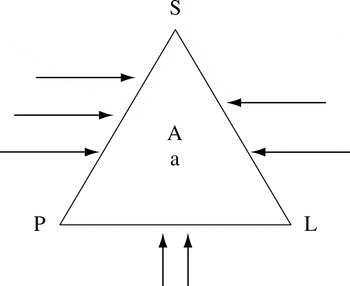
Using the visual aid of a triangle, we can place the state (S), the legal rules and rights (L), and the people (P) at its apices (see Figure 1). Forces inside the triangle keep it in shape. Outside forces push the sides of the triangle inwards and may distort its shape or even lead to its collapse, if the inside forces are not strong enough. Inside the triangle we can place the vision and the tenets of Kemalism, represented by ‘A’, and the Turkish army, represented by ‘a’, as the guarantor of Atatürk’s legacy (guardian/moderator). Officially there is no room here for legal pluralism reflecting the value systems of the variety of peoples, the P, since only S makes L. Thus tradition (culture) and religion become outside forces. Outside forces also include the past, demands made by the EU, IMF, ECHR and neighbouring countries. Keeping the triangle from collapse depends on the balance between the inside and outside forces. Judges try hard to keep this balance.
Let us try to put the above in other words using the vocabulary of our navigation metaphor above. The picture now becomes thus: We regard Turkey (the triangle) as the sailing ship. The big ‘A’ is the deep keel. The small ‘a’ is ballast on that keel. ‘A’ and ‘a’ together keep the ship on an even keel. However, there is always a swing. The ship’s head is in the direction on the vision, the intended destination. We know that even the magnetic north shifts, though be it slightly, and variation can occur. We know that variation is east or west. We also know that deviation can be caused by the contents of the ship, in this case the changing values in Turkey. The forces outside the ship are the forces of tidal streams, currents and winds as well as the heavenly bodies. The wind coming from the direction of the EU is a wind from the stern, in which case there is no sideways drift, but strong forward movement. If the wind is head-on there again will be no leeway, but the movement forward will be hampered or even stopped, in which case tacking or beating to windward will be necessary. A new course may have to be plotted. The crucial winds that can cause leeway and alter progress and direction are the side winds, such as religion. Tidal levels vary and are frequently influenced by ‘storm surges’. Sometimes it may be necessary to alter the ship’s heading in order to counter a tidal stream, to keep the ship on an even keel and to make good an ‘intended track’, the destination. We have to remember though that all tidal information of times and heights are estimates and therefore approximate. It is now up to the reader of this article to assess each of the forces outside the above triangle within this navigational information. So the navigator steersman judge must be alert at all times.
The triangle (The ship)

Let us now consider how navigators cope with the state, the people, the official law and legal rules, and how flexible are the sides of the ‘triangle’, to bend without distorting the ‘dead reckoning position’ caused by forces outside the triangle. It may even be that the chart may have to be updated.
At this point it is worthwhile to remind ourselves that the Yargıtay, one of the most influential navigators, was enabled to make adjustments to the law by the flexible rules present in the 1926 Civil Code and the 2002 Civil Code sections 1, 2 and 4, which correspond verbatim to sections 1, 2 and 4 of the Swiss Civil Code. These are rules on justice and equity, objective good faith and judges’ discretion. For the development of the Turkish law and legal system, and the scope of navigation made possible to the judges, the flexibility afforded by section 1 has been invaluable:
‘The law must be applied in all cases that come within the letter and the spirit of its provisions. If no relevant provision can be found in the statute, the judge must decide in accordance with the customary law and, in its absence, in accordance with the rule, which he would lay down were he the legislator. In so doing, he must be guided by accepted legal doctrine and case law.’
It is also worth remembering that in the Turkish legal system, ‘the source of law is determined by the formal legal framework’, and cultural values, ‘custom and tradition become a source of law only when recognised by courts’ (Örücü, Reference örücü, Esin, Elspeth and Sean1996, p. 106).
(a) Culture and demands that clash with the vision and cannot be accommodated
Some aspects of the culture, such as religious marriage prior to or instead of civil marriage, the wearing of the headscarf in the public sphere and political parties upholding religious (sharia) or separationist views, clash with the officially protected vision and the courts cannot uphold these. The three issues above are related to laicism and the fourth to the unitary state with its nation and its territory, all protected by the Constitution, as seen earlier.
Claims based on traditional relationships not in keeping with the official law create major problems for the courts. Below, I look first to one of the most significant of these, which is related to religious marriage.Footnote 18
Religious marriage
Empirical research tells usFootnote 19 that there are seven types of traditional marriage in Turkey: berdel (two families agree and sons and daughters are exchanged in a double marriage), beşik kertmesi (two families agree upon the birth of two babies on their future marriage), başlık paralı evlilik (marriage takes place upon the payment of monies by the father of the prospective bride to the prospective husband), kan bedelli evlilik (made in order to put an end to blood feuds, one of the daughters of the family whose turn it is to carry out the next killing is given as a wife to the other family), kuma evliliği (a woman is married off to a man with more than one wife), kayın evliliği (a woman is married off to one of the brothers of her deceased husband upon the decision of the ‘family council’) and akraba evliliği (marriage of a woman to a first degree relative).Footnote 20
The official framework accepts only one type of marriage regulated in the Civil Code. Marriage has been secularised and is concluded upon the oral response of the two parties. So none of the above types would create a problem if formally concluded as civil marriages. A marriage certificate is given, without which a religious ceremony cannot take place, and it is a criminal offence to undertake or perform such a ceremony without this certificate.Footnote 21 A religious ceremony is not needed for the marriage to be binding. This was reiterated in the new 2002 Civil Code to indicate the secular nature of marriage in Turkey (section 143).
In earlier years, the Yargıtay tried a number of ways to navigate round this. One way was to stress the acceptability of the civil marriage, even for those with religious objections to it. The Court stated:
‘The fact that the marriage contract is formed by the accord of the consent of the parties is in keeping with both Islamic and Canonical laws. In these laws also, the marriage contract is not completed by an act of the religious man but by the declaration of the wills of the parties.’Footnote 22
As to the children born into religious marriages, again, prior to the first Amnesty Act of 1933,Footnote 23 the Yargıtay attempted to resolve the problem by way of interpretation (one tool of navigation): children of such informal marriages were considered as legitimate by the Court when one of the parents died, by an analogous application of section 249 of the 1926 Civil Code, which said that children of couples who have made promises to marry each other, but were then unable to marry owing to the death or incapacity of one of them, could be declared legitimate by a court upon the application of the other party or of the child himself.
A judgment of the Anayasa Mahkemesi published in 2002 gives an authoritative answer to any question that might arise related to the acceptability of religious marriage as an alternative to civil marriage.Footnote 24 Section 237/4 of the then Penal Code, criminalising religious marriage entered into without civil marriage and imposing a prison sentence of from two to six months on both the man and the woman, was challenged as violating several articles of the Constitution: article 2 (the principle of secularism), article 10 (equality), article 12 (the character and the scope of fundamental rights and freedoms) and article 24 (freedom to conduct religious services and ceremonies). The Anayasa Mahkemesi, referring to article 13 on the limitation of rights and freedoms, stated that section 237 had been inserted into the Penal Code in 1936 to give support to civil marriage, that without this section polygamous marriages become possible and that, though such marriages have no legal consequence, being detrimental to the social order they pose a threat to the concept of family. If couples enter such illegal unions, women cannot use their rights arising from marriage, and children are illegitimate and lose their inheritance rights. Civil marriage must be strengthened to protect the family and the rights of women and children. The Court then went on to say that there is no violation of equality here, as claimed, between those who live together with no marriage of any kind and those with only a religious marriage, since the first group do not wish their unions to be regarded as marriage. Equality before the law does not mean that everyone must be treated alike, differentiation based on article 13 is not unconstitutional. The Court saw the Civil Code as a fundamental building block of the bridge to a contemporary and secular legal system for the Turkish Republic, and said that civil marriage, being the essence of that block, is specifically protected by article 174 of the Constitution. The most important function of secularism is to keep law and religion apart. In addition, as a religious marriage after the civil marriage is not banned, there is no violation of secularism or any fundamental right. The Court decided unanimously that section 237/4 did not violate the Constitution, thus keeping to the ‘intended track’.
Nevertheless, in an effort to steer by taking into consideration the ‘side wind’ and the ‘headwind’, and obviously with considerations of ‘justice’ in mind, the Yargıtay has tacked and extended the right to compensation for death in work-related accidents to the unmarried cohabiting woman (nikahsız eş), albeit on a different basis from the married woman. In fact, we have seen that neither the legal framework nor the courts regard couples living without an official secular marriage as being in a relationship to be protected by law. Therefore, decisions of courts in this area, converting illegality into legality, are of the utmost importance for such couples. In one case,Footnote 25 the childless surviving partner of an imam nikahı Footnote 26 union asked for material and moral compensation after the death of her partner in a work-related accident. The insurance company objected, though the lower court agreed. The Yargıtay decided on a percentage lower than that which would be the due of the married wife. In a later case,Footnote 27 again the insured died in a work-related accident. The partner, who was this time referred to by the Yargıtay as the ‘cohabiting partner’, was eighteen, had a child, and according to the Yargıtay, had more than a 35 percent chance of re-marriage, which is the accepted percentage for an official widow. The Court was of the opinion that:
‘[H]er age, social status, position and family ties mean that she is not in the same position as a married woman who expects to live in the family home for an indefinite period and can expect support throughout her life. The compensation arising out of section 43 of the Code of Obligations therefore should be reduced in keeping with fairness and equity.’
This time there was a telling dissenting opinion by a female judge attached to this decision. Critical of the differentiation drawn between the two women, she said:
‘Here “cohabiting couple” (nikahsız eş) refers to a traditional Anatolian relationship where couples live together as husband and wife, with close family ties and children. Therefore, the presence or absence of official wedlock should not be the criterion on which to treat the two women differently. The Social Security Agency will give a pension only to the officially married wife and this for life. This should be the only extra gain for the married woman. An Anatolian village woman is already oppressed and faces the risk of being officially unmarried owing to tradition. She should not be further weakened when facing the law. This situation would only lead to mistrust of justice. The present circumstance is the outcome of the social structure. She should be given equal compensation.’Footnote 28
It appears that the Yargıtay can accommodate ‘marriages’ not accepted by the official system, when the matter at hand is not related to giving effect to the marriage but, for instance, to the law of obligations where the Court does not have to go into the issue. Thus in a case related to the return of jewellery given at the ‘wedding’, the Court referred to the female partner as the ‘unofficial partner’ (gayriresmi eş) and accepted the claim for compensation as the jewellery was no longer available for return.Footnote 29
The headscarf (The türban cases)
Another example raises the issue of a claim based on another Islamic practice, which remains unacceptable to the official law. In 1993, the name of a female trainee lawyer was removed from the Bar list because she came to court wearing a head cover and refused to remove it. According to the lower administrative court, as she was only a trainee and the matter solely a moral question, there was no violation of the respect due to the legal profession, though the regulations of the profession do impose certain conditions on appearance. The Danıştay (Turkish Conseil d’Etat) however, saw no difference between a lawyer and a trainee and regarded the issue as outside ‘the right to religious freedom’, saying, ‘The behaviour of the trainee is contrary to the principles of a laic state governed by the rule of law, is incompatible with the profession of a lawyer and is an obstacle to her becoming and acting as a lawyer.’Footnote 30 The Danıştay also found the assessment of the lower court in regarding the matter solely as a moral question in a narrow sense to be an incorrect understanding of the law.
Headscarf cases have not lost their significance in Turkey, and continue to challenge the official legal framework. In fact this issue is one that the present government keeps on the agenda. However, the courts are bound by the vision within the official framework. A number of decisions have been given by the Anayasa Mahkemesi and the Danıştay on this issue. More important, the Anayasa Mahkemesi evaluates the headscarf (the türban) cases in educational establishments within the context of laicism. The first decision reached on this issue was in 1989, annulling the amendment to the law lifting the ban on the wearing of the türban in such institutions.Footnote 31 The Court opined that:
‘[T]he fact that wearing of the headscarf, giving the person an appearance of being anachronistic, is gradually spreading, has obvious drawbacks for the Republican reforms and the principle of laicism. … A laic legal order, laic education and laic administration cannot be thought of as separate from one another. … Educational establishments cannot be set up contrary to the requirements of article 42 of the Constitution … and higher education institutions are no exception. To separate students on religious affiliation by symbols indicating which belief they support in classes, laboratories, clinics, policlinics and corridors, where students work together in a spirit of friendship and solidarity to reach the truth by being educated and applying scientific methods, would lead to conflict and hinder co-operation.’
Later, in 1991, in a second caseFootnote 32 the Anayasa Mahkemesi decided that the regulation bringing ‘freedom of attire’ in higher education institutions did not apply to ‘religious dress and covering the neck and hair with a scarf or türban due to religious belief’, and that this regulation being unconstitutional should be annulled. According to the Court, any symbol representing religious belief should be kept out of educational institutions and allowing the wearing of the türban in the universities cannot accord with a laic scientific environment. The reasoning of the Anayasa Mahkemesi has also been accepted by the ECtHRFootnote 33 and the ban on the wearing of the türban in public institutions and educational establishments is regarded as essential to laicism which is seen as a sine qua non of democracy.
Referring to decisions of the Danıştay and the Anayasa Mahkemesi, the Yargıtay, after extensive discussion of ‘personality rights’ and ‘public interest’, held that the headscarf (the türban) cannot be worn in institutions of higher education, and therefore the decision by the principal of the university not to allow female students to take exams with their heads covered did not constitute a violation of personality rights and was not a delictual act, as claimed.Footnote 34 In interpreting section 17 of the Law No. 2547 on Higher Education of 1990, the Court held that ‘freedom of dress’ was to be understood as ‘within what was allowed by law’, and although there were no provisions in any legislation banning the wearing of the headscarf, there were decisions by the Anayasa Mahkemesi and the Danıştay, courts that have the duty to interpret the law, law being a whole.
Closing of political parties (religious/leftist/separationist)
There are a number of cases decided by the Anayasa Mahkemesi related to the permanent closing of political parties.Footnote 35 The majority of these cases are related to political parties that are politically left and/or advocate a separate homeland and/or autonomy for the Kurdish population. The Court bases its decisions on the Law on Political Parties. The political parties and their representatives base their cases partly on the two relevant articles of the ECHR, 11 and 17. The public prosecutor, and the Court following, rejects the claims based on the limitations introduced in 11/2 and 17/2.
In these cases, the relationship of the Turkish Constitution to the ECHR is not clear, as the articles of the Convention and the decisions of the Strasbourg Court are mentioned by the Anayasa Mahkemesi in passing without thorough analysis of either. The Anayasa Mahkemesi takes into consideration first the existing Turkish laws, then the political and social climate and conditions in Turkey, and only in passing pays attention to international instruments.Footnote 36 In the one case decided in 1993, decisions by the French and German Constitutional Courts are referred to by the Anayasa Mahkemesi, yet the references are superficial.
In two other cases related to the closure of religious parties, the Anayasa Mahkemesi discussed laicism in relation to democracy.Footnote 37 In the 1998 case closing the Refah Partisi (the Welfare Party), both the public prosecutor and the defenders brought extensive discussion of various international instruments and American case-law, the concept of laicism as understood by doctrine, and the law in some foreign jurisdictions such as the US, the UK, Switzerland, Germany, France and the former Yugoslavia, with some reference to the case law of the US Supreme Court. Freedom of expression was the major issue here and these cases tried to balance this freedom with the protection of the existing system in keeping with the official vision discussed earlier. In spite of such references, however, in the case related to the Law on Political Parties used in the closing of the Fazilet Partisi (the Virtue Party), although there was a call by the defending party for discussion of contemporary democracies where freedom, equality, pluralism and participation are regarded as fundamental and the rule of law is the basis, in the decision there was neither any reference to the ECHR nor to any other foreign jurisdiction, the matter being regarded as solely Turkish,Footnote 38 the ship sailing on the ‘intended track’.
(b) Culture and demands that can be accommodated within the legal framework
Some aspects of culture can be dealt with by the courts navigating between rules within the legal framework by satisfying the diverse cultural demands, though not necessarily satisfying the demands of the EU and the ECHR. Some examples to be seen below are related to honour killings, rape in the family, equality between the spouses, a woman’s surname, the abandoning of an illegitimate child to die, the status of blood brothers for insurance purposes and ‘the cow case’. These examples show how courts find it difficult to disregard localism and apply universalism, and thus use their discretion to appease localism. There is no departure from the ‘intended track’, but tacking takes place in response to headwinds.
Honour killings
When courts face ‘honour killings’ or ‘customary murders’ among people from the eastern provinces, where the honour of a woman is in the control of the male members of her family, they always deal with this problem within the framework of the Penal Code, taken from the Italian legal system, but use the Code’s facilities to reduce the penalty. Thus in a typical case, the killing, usually committed by the youngest brother to take advantage of the legal framework, is regarded as murder. Yet, as illustrated by the twenty-four court decisions examined between 1988 and 1999, the accused benefits from section 52 of the then Penal Code, which says that if a crime is committed under aggravating circumstances and provocation, this can be taken into account in sentencing; so can the demeanour of the accused. ‘This coupled with the age of the boy or young man charged with the crime, often serves to decrease the sentence to virtually nothing’ (Arın, 2001, p. 824). However, academic debate in Turkey has always regarded such killings as the ultimate violation of women’s human rights.Footnote 39
In 1997, a case involving a claim that section 462 of the then Penal Code was in violation of articles 5 (the state is under an obligation to remove all obstacles limiting fundamental rights and freedoms), 10 (equality), 12 (every person has inalienable and non-transferable fundamental rights and freedoms), 17 (every person has the right to life, to protect and develop his/her material and moral being) and 19 (every person has individual freedom and security) of the Constitution reached the Anayasa Mahkemesi.Footnote 40 The application was made by an Aggravated Felony Court dealing with an accused, who was convinced beyond doubt that his sister was in an illegitimate sexual relationship, and tried to kill both her and her lover. Section 462 foresaw a reduction of up to one-eighth from a sentence of an accused if he/she was one of the spouses or one of the ascendants or sister or brother of the husband, wife, sister or a descendant of the victim. The accused should have no doubt that that person had been adulterous or in an illegitimate sexual relationship, caught in the act or about to perform the act or having been a party to the act. The killing or maiming of both parties to the act fell into this section. Life was converted to imprisonment for from four to eight years and the death penalty (in force at the time) was converted to imprisonment for from five to ten years.
Both the reasoning of the Felony Court and the Anayasa Mahkemesi bring an insight into the attitudes towards illegitimate sexual activity, including adultery, in Turkey. The Aggravated Felony Court stated that every person has the right to life and to the protection and development of life and can live his/her lifestyle by free will and choice; but that section 462 implies a person having a claim to ownership of and domination over another, the egoism in not allowing that other to be happy, and the belief in cleansing the name and honour (namus), and therefore is repugnant to general principles of law. To reduce the sentence of someone without any inquiry into whether that person cared for the other, showed any interest in the life, work and happiness of the other, and whether there was a loving relationship, is not in keeping with the feelings of justice.
The Anayasa Mahkemesi however, limited its inquiry into the killing or maiming of a sister by her brother, considered it within the ambit of serious provocation and did not find section 462 to be unconstitutional, stating that the legislature is free to decide which actions are to be considered as offences in society, what kind and what length of sentence is appropriate, and what are to be regarded as provocation and aggravating or mitigating circumstances. According to the Court, in using this discretion the legislature keeps in mind the sentencing policy, the social and cultural structure, and the ethical values of the country.Footnote 41
A dissenting opinion was critical of the Court’s decision in that the reduction in the sentence is related to who the victim is, and therefore serious provocation seems to be the basis of the decision. The dissenting opinion regarded section 462 as creating a privilege for the accused by accepting higher levels of reduction of the sentence than provided for generally by the Penal Code. It stated that the personality of the victim is an issue to be taken into consideration during sentencing by the judge and cannot form the basis of accepting privileges for certain individuals; such a serious reduction sends a message that such an assault to the right to life is condoned in the name of protecting the name and honour of another. The opinion stated that when principles expressed in the Preamble of the Constitution, the priority given to the individual and developments in penal law are taken into consideration, it becomes obvious that such a section in the Penal Code is unconstitutional in a pluralist, freedom-loving and participatory democracy which has reached levels of contemporary civilisation. It is worthwhile noting that the decision of the Anayasa Mahkemesi was only published in November 2003, four years after the decision was reached. This delay tells us a lot about the ambivalent attitude of Turks, the Turkish judiciary and the Turkish legal system towards adulterous or illegitimate relationships.Footnote 42
Other family matters
As far as rape in the family is concerned, the Yargıtay is now keen to use arguments of tradition and custom in order to increase sanctions. Thus in a case related to the rape of a ‘niece’, the Court held that, ‘As in our traditions and customs related to our family structure the uncle has influence over his niece, his rape of her should be assessed under section 417 of the Penal Code’, which should be qualified as ‘aggravating circumstance’.Footnote 43
However, in another case, the Yargıtay pronounced the banning by a local administration of the payment of money by a bridegroom to the bride’s father (başlık parası) to be illegal, and therefore not obeying the ban not an offence, saying that an administration could not ban a tradition or convert it into an offence. The Court held that, ‘This centuries old tradition is a fact; the practice can only be banned by the legislator if regarded as against public policy’.Footnote 44 The Court added that in any event, to eradicate such a tradition should be a matter of education and not of law.
Equality between spouses
A decision of the Anayasa Mahkemesi illustrates the general attitude to equality between spouses in Turkey – a difficult issue. In this decision,Footnote 45 only published four years after it was delivered, the Anayasa Mahkemesi did not find section 153 (now 187) of the then Civil Code to be unconstitutional. A married woman, who wanted to use her maiden surname only, objected to section 153. The challenge was that this provision violated articles 10, 12 and 17 of the Constitution related to equality, fundamental rights and freedoms, personality rights and rights to development of personality. Following a very conservative interpretation of the family and the place of the woman in it, and referring to long-established traditions, the Anayasa Mahkemesi saw no violation of any of the articles mentioned. However, in the dissenting opinion, the three judges saw a violation of articles 10, 12 and 17 and the provision on equality and the Convention on the Elimination of All Forms of Discrimination Against Women (CEDAW), which Turkey ratified in 1985, and stated that the Constitution should be read in the light of international conventions and contemporary developments. Making reference to German family law indicating that the spouses should be able to choose either of their surnames, these judges stated that it might be extremely important for the development of a spouse’s personality and identity to carry the surname acquired at birth. Obviously, the fact that it took four years to publish its decision indicates how even the Anayasa Mahkemesi finds it extremely difficult to pass judgment in cases related to equality of the sexes in Turkey. It must be with this view in mind that the amended Civil Code has the same approach today.
We see that in Turkey, traditional values of family and lineage for men override claims to modernity. The principle of equality of the sexes was specifically introduced into the Constitution in 2001 by a phrase in article 41, in addition to the existing ‘equality before the law’ principle in article 10. Now, added to the phrase ‘The family is the foundation of Turkish society’, is the phrase ‘and is based on equality between the spouses’. However, Turkish public policy considerations prohibit a man from taking his wife’s surname. Thus a husband is not allowed to use the right given to a wife of having her family name added to that of her husband’s (section 153). This prohibition effects even Turkish husbands of foreign wives in cases where the spouses live abroad and the law of that country allows the spouses to choose which surname they wish to be known by. This principle was pronounced in a case concerning a Turkish man who married a Swiss woman in Switzerland and acquired her surname, a possibility under Swiss law where, as in Germany, spouses can choose either of the surnames. He requested that his surname be changed in his Turkish personal status register. The lower court was of the opinion that such a correction was admissible since it had a ‘foreign connecting factor’. The Yargıtay was quick to point out that the lower court’s qualification was erroneous as there was no possibility in this case to resort to conflict of laws rules, and declared the Swiss rule to be totally against Turkish public policy.Footnote 46 It can be speculated that this creates yet another problem of equality of the sexes that could have been corrected in the amended version of section 153, but was not considered, since the assumption in male-dominated Turkish society must have been that few men would want to choose their wife’s surname.
Abandoning an illegitimate child to die
Another example is related to how the Anayasa Mahkemesi regarded section 475 of the then Penal Code, which created the offence and the punishment of the abandonment of a child or persons incapable of taking care of themselves.Footnote 47 The section accepted the abandonment of an illegitimate child not older than five days as a mitigating circumstance, in order to protect the namus (honour and good name) of the perpetrator, the wife, the mother, the daughter, the granddaughter or the sister. The sentence to be administered could be reduced by up to one-third. The claim in the case was that the reason for reduction violates feelings of justice and equity, threatens the life of an illegitimate child and encourages the commission of a crime with less stigma; to treat the abandonment and even abandonment to death of an illegitimate child cannot be regarded as less onerous than that of a legitimate child, and that there was a violation of articles 10, 17, 41 and 138 of the Constitution.
The Anayasa Mahkemesi held that:
‘When a child born out of wedlock is abandoned within five days of birth, the reason for the reduction in sentencing is the negative effect this birth has on the mother and the family and consequently the saving of the honour. In contemporary criminal law the personality of the perpetrator is being considered important; it is not the act but the actor which is given priority. In reality, considering an act as an offence is related to the pressure of society. Today a person’s fright, astonishment, anger, excitement, sadness, aggressiveness and similar psychological states are regarded as important. Section 475 should be assessed in this light. The purpose is not to create inequality between legitimate and illegitimate children but to create justice in sentences. The aim is to give the most appropriate sentence to the actor. Although article 138 states that judges decide eventually according to their conscience, this is within the framework of laws and the Constitution. Article 17 guarantees everyone the right to life, the protection and development of the personality and is not applicable to section 475.’
There were two dissenting opinions, both of interest. One said that people live in society, its pressure is always felt and crime is committed related to this effect of the society on the individual; the societal causes of crime. The responsibility of the individual is shared between the individual and society. The opinion pointed out that it was true that in Turkish society to ‘save honour and good name’ was accepted as part of traditional and social values and was very important and that it was this that was taken into consideration in section 475. The same mitigating circumstances, which were in section 592 of the 1930 Italian Penal Code – the source law – were abrogated in 1981. The draft Turkish Penal Code covered this matter in section 146, but only for the mother, allowing the reduction of her sentence by one-sixth. The reasoning of the draft states that sanctity of life is one of the most important values of our times and that only the mother can be allowed leniency considering the biological and psychological condition in which she finds herself in such cases. Section 453, related to murdering such a child, which also allowed mitigating circumstances, was amended in 1991 and the reduction of sentence is now only applicable to the mother. Therefore section 475 should also be regarded in this light. This dissenting opinion supported the majority decision only so far as it related to the mother, but regarded the extension of this leniency to others as ‘unreasonable, unjust and incomprehensible’ and suggested annulment of the article for those other than the mother, there being a violation of articles 2 (rule of law), 38 (crime and punishment) and 41 (protection of the family).
The second dissenting opinion approached the subject from the point of view of equality in the right to life between a legitimate and an illegitimate child, stating that section 474 covered abandonment of a legitimate child and considered abandonment of one’s own legitimate child as an aggravating circumstance. As both children should be protected by law equally, this was a violation of article 10 on equality. Whatever the reason, this difference meant that the right to life of an illegitimate child was less worthy of protection than that of a legitimate child, which also violated article 17 since the right to life is inviolable and no other value or tradition could justify its violation. Accordingly, if Turkey wanted to reach contemporary levels of civilisation, as expressed both in the Preface and article 174 of the Constitution, then there was no place for such a provision in Turkish law.
There is no such section in the 2005 Penal Code. In fact section 82/e punishes such an offence with an aggravated life sentence. Thus, this could be regarded as a further alienation of the law from the people. The winds and the tidal stream from the ECHR and the EU are additional forces here.Footnote 48
Blood brother’s rights
In another case a life-insurance policy was taken out for the benefit of a ‘blood brother’. The official law makes no reference to this customary relationship. However, the Yargıtay said that according to Turkish folklore and customs this institution is valued, that it is a ‘private pact’ which creates a relationship like brotherhood or bosom friendship and that since the ‘blood brother’ should be considered to have a moral interest in the continuation of the life of the other, he therefore should be accepted as the beneficiary.Footnote 49
Special nature of the HacFootnote 50
Again, we note that some religious and traditional values are given additional weight. When baggage, carrying gifts brought back from the Hac, was lost in transit, though article 22 of the Montreal Protocol amending the Warsaw/Hague Protocol was to be applied, the Yargıtay held that, ‘When the special nature of this journey and the spiritual value of the gifts to be given to relatives and friends are taken into account, it emerges that the claimant should be given “moral” compensation and not solely “material” compensation’.Footnote 51
The cow case
A most remarkable case serves as an example of the interlocking of the social, religious and legal culture by the innovative dexterity of the Yargıtay as navigator. This is a decision of the Yargıtay reached in 1979.Footnote 52 The case concerned the sexual involvement of an under-age village boy with a neighbour’s cow. The owner of the cow, rather than suing for bestiality under the Criminal Code, sued to recover damages from the father of the boy. He claimed that his cow could not be sold or its meat and milk consumed, since, according to religious sources, which he cited, it had become untouchable. The case was dismissed by the lower court for lack of legal grounds, since religious law is not a recognised source of Turkish law. The owner of the cow appealed. The Yargıtay overturned the decision of the lower court, saying that:
‘Although religious rules or sentiments could not form the basis of any claim, if the complainant could prove by expert evidence that there were local religious or moral beliefs or customs to the effect that the meat and the milk of such an animal could not be consumed, then the animal would be considered to have lost its market value, in which case, by the application of the “noxal” rule of Roman law, the cow should be given to the father of the boy and the claimant should be given the market value of the cow by the father.’
The formula is a fine example of how the Yargıtay avoids openly facing religious issues and resolves disputes within the formal legal system. The case shows how the ‘layers’ of systems may be interlocked and that the judges of the Yargıtay are such innovative navigators.
There was a second very similar case in 1998, where the lower court decided that the pursuer had no case as there was no ‘medical objection’ to the utilisation of the meat and the milk of such an animal, the Yargıtay, overturning the decision, declared that when there is no codal provision applicable to a matter then, according to section 1 of the Civil Code, tradition and custom are to be resorted to, and that:
‘Since facts are not in dispute in this case, tradition and custom have to be investigated in line with the claim, and if custom, tradition, religious and moral beliefs and conceptions are in line with the claim, then the existence of damages cannot be questioned. The pursuer should be asked whether he wishes to surrender the animal to the defendant in return for the market price, and if not, then reasonable compensation must be decided upon.’Footnote 53
(c) Outside pressures that clash with the framework or the culture
There is now pressure from the outside world stemming from Turkish aspirations to EU membership, which may lead to results not necessarily supported by all the Turkish people, such as the abolishing of the death penalty, and some which clash with the official vision, such as making it difficult to close political parties, and enabling retrials after successful ECtHR appeals. Following such pressures the legislation has been changed, but some of these changes challenge the indigenous socioculture further than the official legal framework ever did. Below are some examples to show how the courts navigated before the changes and how changes have taken place.
Since 1987, when Turkey accepted the right of individuals to apply to the ECtHR, there have been more than 4,000 such applications from Turkey to the Commission of the ECHR. When legislation has been found wanting, and this is quite rare, amendments have been undertaken and further changes have been brought in. So the problems seem to lie in the application and implementation of the law and in court decisions. Most of the applications are related to criminal law and criminal procedure, especially to execution without trial, death in prison and torture. There have been cases related to the right to life, to torture, to the period spent in custody, to judicial independence and to cases taking an unreasonably long time to finalise. Moreover, there are other areas of concern, some of which are difficult to resolve in view of the characteristics and principles of the vision of the Republic discussed earlier. These cases are related to freedom of religion and conscience, freedom of expression, the closure of political parties, the right to complain and the freedom to seek rights, and property rights, specifically expropriations. Without a fundamental upheaval of the system, including amendment of the Constitution in very significant ways, or very progressive, creative and active Courts taking into consideration decisions of the ECtHR and decisions of other courts in other jurisdictions in human rights cases, this problem may remain. Here ‘cultural exceptionalism’ overrides ‘globalising uniformity’.
However, in one case related to Law No. 4307 of 1997 on primary education, extending education in primary schools from five to eight years, the claim was that this was contrary to a number of articles of the Constitution, and articles 9 and 10 ECHR and article 2 of its Protocol 1, as it would impede religious education. The appellant, the Refah Partisi (the main opposition party), made reference to foreign doctrine and decisions of the ECtHR on democracy, pluralism, equality, tolerance, fundamental rights and freedoms, conditions of social peace and laicism. There were references to a number of international conventions, the ECHR and foreign jurisdictions in the US, France, Germany, Italy, the UK, Norway and even Japan. The Anayasa Mahkemesi, deciding solely within the framework of the Turkish Constitution, held that:
‘On the other hand, though not a direct basis for constitutional control, the ECHR has value and effect as a supplementary norm and its Article 9 related to freedom of religion and conscience is in essence parallel to Article 24 of the Turkish Constitution. There is no violation of Protocol 1 Article 2, since there is no limitation or prohibition on the choice parents have on the child’s religious education.’Footnote 54
In this case nothing was found to be unconstitutional. The Court was indeed aware of the ‘wind from astern’, and that its position would be supported by outside demands, ‘the tidal wave’ from Europe.
Valid reasons for the changing of names
One such case indicating the force of outside pressure, the tidal wave, is related to the changing of a name, and ‘valid reasons’ for it in keeping with national culture, morality and traditions.Footnote 55 A father wanted to change the name of his daughter from ‘Hatice’ to ‘Mizgin’, the name by which the child was known in the family. The lower court objected to the name, as ‘its root is Persian, and not Turkish; in addition it would offend public opinion’.
The case had reached the Yargıtay once before and been quashed, but the lower court insisted. The Yargıtay discussed the importance of a name for a person and stated that the right to a name is a right protected by the Constitution. The Court then discussed what could be the ‘valid reasons’. The Yargıtay stated that:
‘Anyone can ask for a change of name on valid (haklı neden) grounds. However, together with proof of these grounds the new name must accord with moral principles, our national culture and our traditions; additionally, it must not offend public opinion. In the instant case these two aspects have been met, therefore the decision of the lower court should have been to accept the change. The reason why section 16 of the Population Act was passed was not to purify the Turkish language, but so that no names could be given contrary to our moral principles, our national culture and our traditions. Eastern and South Eastern Anatolia is an area where people of different ethnic origins live. The family is the smallest unit of society and is influenced by socio-economic and cultural structures, traditions and customs. Therefore the individual should be assessed within his own environment. It is inevitable that he will develop according to the region in which he lives. In our country names reflect our history. They are not all from Turkish roots but from Arabic and Persian also. Mizgin means Müjde (joyful tidings) and is given as a name to many girls in that region, as established by research.’
One dissenting opinion (the president of the Second Civil Division) claimed that:
‘Mizgin means “stained by urine or incontinent” (sidikli), as pointed out by the expert evidence of a Professor of Turkish Language and Literature and there is no scientific reason to doubt this evidence, therefore this name is an assault on the personality rights of the child. No one has such a right.’
Again, in another case related to the name of a child, the Registrar of Births objected to the name ‘Helin’ stating that this name was contrary to national culture and the Population Act, but the father insisted. The public prosecutor asked for the ‘annulment’ of the name. The Yargıtay held that a name could not be ‘annulled’ but that the public prosecutor could initiate a lawsuit for the ‘correction’ or ‘change’ of a name. According to the Court, the right to name a child is given to the parents and from the point of view of private law, a name is a concept, which differentiates a person from others, and everyone must have a name; the right to a name is guaranteed by the Constitution. Therefore a name cannot be annulled and there must be ‘valid reasons’ to ask for a correction.Footnote 56
The two cases above show acceptance of names inimical to Turkish culture, and could be regarded as the attempt of the Yargıtay to navigate to reach contemporary European standards as well as to show respect to cultural and language rights, again in keeping with the same standards and demands on Turkey, but not necessarily in keeping with the sentiments of all sections of society.
The position of the wife
A woman, living apart from her husband, sued for divorce because of serious incompatibility.Footnote 57 Her husband objected as the case should have been brought before the court of his residence (kocanın ikametgah mahkemesi). The then Turkish Civil Code accepted the residence of the husband as the residence of the wife and the court of this residence as the competent court in divorce cases brought by either spouse. The challenge was that this created an inequality for the wife and violated her freedom of establishment. The claim was that there was a violation of articles 10, 13 and 23 of the Constitution.
The Anayasa Mahkemesi stated that although every person is free to choose his/her own abode, one person cannot have more than one (section 19 Civil Code); the family is a unit accepted by society, and various laws regulate this unit for its continuity, proper functioning and solidarity. Consequently, some individual rights have been transferred to the family and the section concerned is related to the family having one residence, which is for public interest and not contrary to the equality clause of the Constitution. The Court found that public interest justified this regulation and that the article related to freedom of establishment could be limited as all rights can be for public interest, public morality, public health and any other special grounds mentioned in the pertinent article, as long as these limitations are proper in a democratic society. Again, here, the regulations were found to be for the preservation of the family unit and its functioning, and in keeping with the structure of this relationship. Thus tradition trumped human rights. There were no dissenting opinions.
Although the above case shows the conservative approach to family relationships in keeping with the majority of the values of the populace, again further Europeanisation meant that this or a similar provision did not find a place in the new 2002 Civil Code. The traditional understanding of the ‘family unit’ is further challenged and the judge has now to steer under the pressure of the ‘tidal streams’ and ‘winds’ that push the ‘ship’ from astern in the direction of the ‘charted route’ of the Republic.
In yet another case, a wife became a guarantor to her husband and a debtor to third parties in her husband’s interest without asking permission from the judge. The claim was that this provision (section 169 of the then Civil Code), which appears to be protecting the rights of a wife, actually treats her as a minor since the husband in the same position does not need permission. The insinuation is that she is a second-class citizen. Therefore, there is a violation of articles 10 and 12 of the Constitution. The Anayasa Mahkemesi said that, ‘the aim of this provision is to protect the wife from entering under obligations unwittingly as she may not know the consequences, the scope and the aim of this debt. She may enter such an obligation under the husband’s influence. This limitation is to protect the unity of the family and is in the public interest.’Footnote 58
There were dissenting opinions to the effect that this unequal treatment of the woman violated the Convention on the Elimination of All Forms of Discrimination Against Women, any discrimination based on sex is illegal; national provisions should be viewed in the light of this Convention, not just the Turkish Constitution; the Turkish Civil Code is based on the Swiss Code of 1907 (in effect in 1912) and it may have been meant to protect the wife; but in our day this is not acceptable; this protection presumes that the woman is less intelligent and less capable; and her legal capacity has been limited by this provision; it assumes that she cannot foresee the consequences of her actions, and this cannot be acceptable.
This section of the Civil Code has now been changed, equalised and modernised, by the legislator navigating with the Western ‘wind’ blowing astern. However, it can be claimed that it is now detrimental to illiterate women who would sign any piece of paper under threat from their husbands, and therefore does not accord with Turkish realities as they stand at present. Maybe the changes in the Swiss Civil Code should have been followed. There this provision was removed from the Swiss Code in 1984; now a ratification of such a contract is demanded in relation to either party, in keeping with the equality principle. Perhaps courts, with more sensitive instruments, are better coastal navigators than the legislator.
The Yargıtay was also extremely cautious in the application of the then section 134 of the Civil Code, which was amended in 1988, introducing divorce by mutual consent. The Yargıtay has not changed its approach in view of the new section 166. The Court believes that divorces apparently based upon mutual consent may not be so; women who are the weaker partners in Turkish marriages, may be forced by their husbands to accept divorce under threat of, for example, taking the children from them. The conditions of section 134 are strictly met, that is, the marriage must have lasted for at least a year, the judge must hear both parties himself personally, be convinced that they are expressing their wills freely and endorse as acceptable the arrangements made by the parties for the financial consequences of the divorce and the children. The Court refrains from recognising a divorce decree obtained abroad if the foreign judge has not ensured the existence of these conditions. Here we see the Court acting as the protector of women and children and taking into consideration the realities of Turkish society, creating anomalies for divorces obtained abroad. This stance on the part of the Yargıtay may be welcomed at home, but non-recognition of foreign divorces on public policy grounds leads to ‘limping marriages’ for Turkish couples who have obtained divorces in countries where they live and work.
The publication of the decision of the Anayasa Mahkemesi annulling the then section 159 of the Civil Code, which stated that a wife needs her husband’s permission to work outside the home, was delayed for two years. The decision, reached in 1990, was only published in 1992. The delay was due to difficulty in the composing of the reasoning through which the Court tried to satisfy all sides, and perhaps to hold back the introduction of the change. What is worthy of note in relation to our study here is that the Anayasa Mahkemesi, having found this section unconstitutional and drawn Parliament’s attention to other such sections in the Civil Code in need of removal, has tried hard not to be misunderstood by the target audience at home. After a very thorough and progressive comparative survey and with full reference to contemporary foreign and international developments, the Anayasa Mahkemesi nevertheless felt that it should end its opinion with a statement reflecting a very traditional view. It said that this decision should not be taken to mean that the Court condoned a new lifestyle for the family in which a working wife could neglect her family duties towards her husband and children; if she intended to work, the Court would like to see her making arrangements for these domestic duties to be performed by another person.
It is remarkable that the new Civil Code of 2002 has inserted a new section 192 ‘The profession and job of spouses’, replacing section 159, annulled in 1990, to the effect that, ‘Each spouse is free to choose a profession or a job without seeking permission of the other. However, in the choice and performance of a profession or a job, the peace and interest of the marriage union must be considered.’ It would be interesting to observe how the judges will navigate round this point, and balance the inside and the outside forces.
Rights of the child
A child of the parties to a divorce has now to be heard before custody is allocated following a divorce. To give voice to the child is a new concept for Turkish society and in such decisions the Yargıtay refers to article 12 of the UN Convention on the Rights of the Child and article 6 of the European Convention on the Implementation of the Rights of the Child, both ‘side winds’.Footnote 59
Paternity
Section 310 of the 1926 Civil Code concerned the Court’s decision on paternity upon the demand of a woman in cases where a man had promised marriage to the woman, or sexual intercourse had constituted an offence or an abuse of position. As various methods of deciding on ‘paternity with all its consequences’ had been quashed by the Yargıtay, the lower court brought this case to the Anayasa Mahkemesi, saying:
‘“Natural fatherhood” in section 297 only gives the right to demand compensation whereas “paternity with all its consequences” (section 310), gives the child quite different rights, and from the point of view of the innocent child this differentiation creates inequality. All children born out of wedlock should have the same rights on recognition of paternity.’
The Anayasa Mahkemesi held that:
‘In cases where the conditions of section 310 are not met there can be no decision on “paternity with all its consequences”. This provision is for the protection of the family and to discourage other types of cohabitation; this is in the public interest and morality. Therefore the provision does not violate article 10 of the Constitution. This regulation is also in keeping with the necessities of a democratic society and therefore not contrary to articles 12 and 13. Article 41 is for the protection of the child, the woman and the family. The reasoning of this section specifically mentions that the family to be protected and to be established as an institution in society is the family as envisaged by the Civil Code. One of the aims therefore is to prevent free unions and encourage the formation of the family. This provision is not contrary to these aims.’Footnote 60
There were no dissenting opinions.
However, we now see that there is no distinction left between legitimate and illegitimate children or between cases that determine paternity in the new 2002 Civil Code. This is an intriguing development. On the one hand it accords with the values upheld by the ECHR and on the other with those of some at home who want to have children born out of imam nikahı relationships to be equated to those born in wedlock. Thus it has a paradoxical consequence, which gives the navigators a freer hand to indirectly uphold a culture which otherwise clashes with one of the values of the official framework: laicism.
Freedom of expression
In an area regarded as sacrosanct (and also covered by the Preamble of the Constitution), a human right – that of freedom of expression – is limited in view of the protected values. To incite people to hatred and animosity based on religious and racial differences was a punishable offence in the then Penal Code sections 312 and 59. This is still the case in the new Penal Code of 2005. Thus in a case where laicism was attacked and living under Islamic sharia was promoted, the Yargıtay relied on the Constitution, saying that though article 24 guarantees freedom of religion and conscience, article 14 states that this freedom cannot be used with the aim of creating discrimination of language, race, religion and sect. The Court also referred to the principle of freedom of religion and conscience as it appears in the judgments of the ECtHR and to limitations for the purposes of territorial integrity of the nation, public order, national security, preventing crime and securing the authority and effectiveness of the judicial power. The Court stated that the Constitution accepts ‘the laicist Republic’ as the sine qua non of democracy and that democratic regimes have the right to protect themselves. It is interesting to note that the Yargıtay also says that, though section 312 may be seen as being anti-democratic, judges do not have the competence to differentiate between legislation on the criterion of ‘good law’ and ‘bad law’, as ‘only the Constitutional authorities can resolve such political discussions’,Footnote 61 the ultimate limitation for judges.
When religion is used for anti-laic purposes and division and animosity in the populace are fuelled by the press, again, section 312 is resorted to.Footnote 62
Torture
The Yargıtay is also concerned that torture may be used to obtain confessions. The Court stated that torture (and cited actions amounting to torture) used by the officials of the Anti-Terrorism Department is an offence.Footnote 63 Further, the Yargıtay, citing articles from international conventions, stated that Turkey had accepted and internalised international conventions, and made them part of the law of the land and that, according to article 90 of the Constitution, international agreements put into effect have the force of law; and statements obtained not through free will but by using torture or other forbidden means and evidence gathered illegally cannot be the basis of judicial decisions.
Again, the Yargıtay found medical doctors who prepared false reports without any medical examination, and exonerated those officials who used torture to obtain confessions, liable for ‘negligent execution of duties’.Footnote 64 The Court discussed at length the developments in Turkish law in relation to banning torture and the use of illegally obtained evidence as well as the extension of the scope of the definition of the torturer and the tortured, keeping in mind the demands of outside forces, international conventions and standards, side winds and tides.
IV Concluding remarks
Internalisation of norms and standards by the people living within a legal system is crucial if continuity and harmony is to be achieved, and if there are to be fruitful developments. As harmony is a possibility of conversation then this can be achieved through appreciating diversity as well as by eliminating diversity. Yet, in Turkey, if this were to mean the abandoning of ‘the vision’, then it is fair to say that the compound of Turkish law and its ‘hyphenated’ nature together with the ‘hyphenated’ nature of her socioculture are the ‘constants’. As I have stated elsewhere (Örücü, Reference örücü, Esin, Elspeth and Sean1996, pp. 110–11) the formal legal system in Turkey performs a balancing act. At times it tries to maintain a firm stance, at other times it allows the traditionalist views to be heard. Yet, it survives against all odds and the overall picture does not change. This is mostly achieved by the navigational skills of the judge.
The cases considered in this article indicate that when elements from two interpretive models combine, one drawing its understanding from culture, tradition and religion and the other from official law, they might be able to tap into each other and mesh, bringing ‘cultural conversation’ and creating a ‘fit’ in a wider narrative. In Turkey there is no competition between the rules, as the official legal system does not permit this, but at times there is contradiction. It is the courts that try to create harmony. In the Turkish experience the concepts and values introduced in the early years of the Republic were to a large extent incompatible with the indigenous system, and the deeper values and purposes of the two were not commensurable. One way out was to establish a global purpose and hope that a bridge could be built between traditional culture and Western-style expression of the norms and standards, by the courts.
The divides between the universal and the particular, homogeneity and heterogeneity, global and local can be discussed in the context of theories of modernisation, world systems and the homogenising and converging force of the global (see Robertson, Reference Robertson1992). It has been said that ‘the task for social science is to make sense of these new kinds of global–local relations’ (Lash and Urry, Reference Lash and Urry1994, p. 312), to accommodate the local dimension (Robertson, Reference Robertson, Mike, Scott and Roland1995, pp. 38, 41). Robertson claims that there is now ‘interpenetration of the universalisation of particularism and the particularisation of universalism’ (Robertson, Reference Robertson1992, p. 100).Footnote 65 Where does Turkey stand in this context?
In our day, ironically, the trend to integrate and converge has moved the focus from the similar towards the different. Ethnic exclusionism versus universalism occupies much of today’s discourse. Yet, can ‘global’ be regarded as ‘a collection of diverse “locals”’? Does globalisation require us ‘to recognise “the Other” and, in doing so, to accommodate the “diversity” and “co-existence of cultures”’(Hannerz, Reference Hannerz and Featherstone1990, p. 239)? Can the universal be constituted in the perspective of each culture (see de Sousa Santos, Reference De sousa santos2002, pp. 268–89)? Yet globalised, universal human rights seen as integral to liberalism, democracy, individualism and progressive change, are presented against the pervasive dominance by the community or the State, and claim inclusiveness (Howard, Reference Howard1993). What does the future hold for Turkey?
The major question in this article is, ‘When a legal system meets cultures different to the dominant value system it represents, what should it do?’ The supplementary question is, ‘What are the limits of judicial navigation in such a case?’ A cosmopolitan and pragmatic approach would say that in a globalising world, there is an advantage as well as an inevitability in convergence, that the fundamental values represented by universal standards of human rights should override all other claims to ‘exceptionalism’, that cultural diversity which can be regarded as the spice of life, should stay cultural and not reflect into the legal world, that there should be overarching legal systems all striving towards transnational, regional, intercommunal levels bringing a uniformity of modernity to the legal world which can accommodate multiculturalism in society. At no stage should multiculturalism impede the progress of the law towards these aims. The pursuit is towards ideals of rationality, harmony and reform using a selection of the legal rules and materials best suited to the task (Bussani, Reference Bussani2000). The acceptance of pluralism is to be qualified. Internal group norms repugnant to some overarching sense of natural justice and morality will not be enforced. A society can only remain healthy if diversity does not threaten unity of purpose. There can be only room for ‘qualified legal pluralism’.
In addition, some fundamental questions would have to be resolved. How do we recognise cultural practices and how is culture to be measured? What should be the criteria of proof and who should carry the burden of proof? Who represents culture? Do the diverse communities have internal governance structures to pronounce authoritatively upon internal rules? Within the EU, another issue may also become crucial. European harmonisation of rules may trump certain legal exceptions introduced earlier by a legal system in response to the needs of diverse cultures therein. The Turkish experience considered throughout this article can be illuminating in this context.
It is apparent that the comparative lawyer must consider many complex issues related to visions and traditions, traditions and transitions, interpretation, human rights and margins of appreciation, interaction of law and culture, modernity and tradition, and the relationship between transposed law and ‘source-law’.
In a modern unitary nation state of the Western type, the accommodation of cultural diversity and multiple normative orders can only be brought about by the judge, who is the tuner, or navigator and steersman, of the law, by using discretion and creative interpretation, and not by the legislators whose main demarcation lines are clearly drawn within Turkey by the Constitution and the immutable laws, and within Europe and within the European Union by the demands of human rights and ‘ever closer integration’. Turkish courts will become even more important as navigators and tuners in the coming years, in their efforts to keep the ship in shape and on course.