Introduction
Money is my most important ammunition in this war.
General David PetraeusFootnote 1On 3 October 2015 an AC-130 gunship opened fire on a trauma centre in the Afghan province of Kunduz. It was 2:08 a.m. when the first shell struck and 105 patients were thought to have been in the building at the time, including a handful of government soldiers and approximately twenty wounded Taliban fighters. Nearly 150 members of staff were still there, working their way through the backlog of surgeries that had built up over the day.Footnote 2 The moment the hospital came under attack, staff contacted the International Security Assistance Force (ISAF) headquarters in Kabul to warn them that the hospital had been hit, but an electrical fault prevented them from communicating directly with the aircraft.Footnote 3 Another thirty minutes passed before the crew realised that they had opened fire on the wrong building; their actual target was a Taliban-controlled office block 400 metres away. Approximately 211 shells were expended during this period and 42 people were killed, including 14 members of staff and 24 patients.Footnote 4 Many of the victims were targeted as they attempted to flee because the crew had assumed that they were enemy combatants trying to escape.Footnote 5 After initially denying that the hospital was the target of the attack, ISAF admitted that a combination of human error, equipment failure, and a high operational tempo had caused the aircrew to misidentify the hospital as their intended target.Footnote 6 Sixteen crewmembers were disciplined and more than 170 condolence payments were issued to the victims, who received $3,000 for serious injuries and $6,000 for dead familymembers. President Obama phoned the head of Médecins San Frontières to apologise and offered her $5.7 million to help rebuild the hospital.Footnote 7
While presidential apologies are rare, condolence payments have become increasingly common in recent wars, although it is unclear precisely how much money has been disbursed.Footnote 8 As one military spokesperson conceded, ‘there is no total dollar amount’.Footnote 9 Obtaining accurate figures might be tricky, but it is possible to get a rough estimate based on the snippets of information that have filtered into the public domain. A report by the US Government Accountability Office (GAO) in 2007, for example, indicated that coalition forces had paid out more than $29 million in condolence payments and approximately $1.9 million in solatia payments in Afghanistan and Iraq between 2003 and 2006.Footnote 10 Files obtained by The Nation document various payments made to Afghan civilians between 2008 and 2011, including $3,000 that was paid to a man following the death of his wife and daughter, $11,070 that was paid to villagers in Kunar following an attack that killed one civilian, injured 14 more and caused damage to 15 homes, and $400 to a 13-year-old boy who was injured while collecting firewood. Although these documents do not provide a running tally, a coalition spokesperson revealed that the United States paid out more than $3.7 million in ‘battle damage repairs’ to Afghans in 2010, a figure that jumped to nearly $12 million in 2011.Footnote 11
When pressed about the accuracy of this data, a spokesperson admitted that the numbers were a little ‘muddled’, telling journalists that she ‘could wade through the numbers to the best of my ability, but my numbers would be a guess and most likely inaccurate’.Footnote 12 Additional data was obtained by The Intercept that documents 953 condolence payments totalling $2.7 million, which were paid from the Commander's Emergency Response Program (CERP) between 2011 and 2013.Footnote 13 Only minimal information is provided, including basic details about who was injured or killed, the province where the incident occurred, and the amount of money that was eventually paid to the victims or their family. We learn about one payment of $2,500 that was made to a ‘local national for death of daughter that occurred as a result of a coalition operation’, a payment of $601.79 to cover the ‘medical bill for a local national for injuries sustained as a result of a coalition operation’, and a payment of $261.23 to a ‘local national for cut to child's head and damage to one car window as a result of a coalition operation’.Footnote 14 According to this particular database, the average payment for a dead civilian was $3,426, although one man only received $145.90 for his son.Footnote 15 Subsequent figures indicate that an additional $1.2 million was disbursed between 2014 and 2016, although these figures are almost certainly incomplete.Footnote 16
Considering the amount of money that has been disbursed, surprisingly little has been written about the role of condolence payments in contemporary conflict. There are some notable exceptions, of course. Emily Gilbert argues that ‘while monetary payments can alleviate short-term economic needs, the lack of legal liability is problematic as it may help amplify the impunity of warring soldiers’.Footnote 17 Condolence payments may appear like a humane response to a horrible eventuality, but she warns that this ‘money deflects the highly political questions about the place of injury and death in war and accepts that they are its inevitable outcome’.Footnote 18 Others have criticised the way in which these policies were implemented, with the Center for Civilians in Conflict (CIVIC) arguing that the system has been fraught with challenges, despite the good intentions of military personnel, due to ‘the lack of uniform policies, inadequate information gathering about civilian harm, low and inconsistent valuation of life and limb, and a lack of training across all branches and rank on the importance, availability, and implementation of payments’.Footnote 19 In addition, there is a growing body of literature that focuses on normative questions about whether belligerents have a duty to provide compensation to the victims of war.Footnote 20
This article will approach the issue from a slightly different direction, focusing the strategic imperatives that encouraged commanders to use money as a way of managing or mitigating the consequences of civilian casualties for the success of the mission. Although sympathetic to the idea that condolence payments reproduce the idea that civilian casualties are merely collateral damage – that is, a tragic but unavoidable side effect of war – I will argue these policies need to be situated within the coalition's changing attitude towards civilian harm. As the conflicts in Afghanistan and Iraq progressed, coalition forces began to recognise the strategic importance of protecting civilians from death and injury and mitigating the consequences of this harm when civilians were killed or injured.Footnote 21 As General Stanley McChrystal put it in his tactical directive, ‘we must avoid the trap of winning tactical victories – but suffering strategic defeats – by causing civilian casualties or excessive damage and thus alienating the people’.Footnote 22 As such, I will argue that condolence payments do not simply deflect from broader questions about the place of death and injury in contemporary conflict, but are an essential part of the warrior's arsenal.
Rather than viewing condolence payments as a tool of transparency or accountability, this article will suggest that they should be seen as a weapon of war, something that can be used by the military to help manage the consequences of civilian harm and ensure that they do not disadvantage themselves in the battle for hearts and minds. The article will begin with a brief overview of the different types of compensation schemes and condolence payments that have been in operation, drawing attention to crucial differences in terms of who and what can be compensated, the amount of compensation that can be provided, and the specific meaning or importance that the military attaches to these payments. The second section will engage existing studies of condolence payments, which tend to focus on practical problems with their implementation, ethical and legal concerns about the limits of accountability, or normative questions about whether belligerents ought to compensate those they kill. The final sections will outline the strategic rationale underpinning these payments, tracing their relationship to broader civilian casualty mitigation efforts in Afghanistan and Iraq, which framed money as a weapon in the battle for hearts and minds rather than a way of making amends for the harm that was inflicted. Drawing on the work of Judith Butler and Jenny Edkins, I will argue that these payments continue to objectify and devalue the lives of Afghan and Iraqi civilians by treating them as a means to an end rather than an end in themselves.
Compensation and condolence payments
Although there has been a significant increase in the amount of money disbursed to civilians, it is important to stress that use of compensation and condolence payments is not entirely new. In 1917, the Commander of the American Expeditionary Force in Europe, General John Pershing, wrote to President Woodrow Wilson to request money for compensation claims. More than 100,000 automobiles had been shipped across the Atlantic to transport troops around Europe but a combination of inexperienced drivers, poorly maintained roads, and preoccupied pedestrians resulted in numerous accidents. Pershing warned that the ‘inability to pay claims for injuries due to accidents caused by government motor vehicles … results in much hardship and injustice to the French people and seriously injures the reputation of the American Army’.Footnote 23 His request was approved and by the end of the war his office had processed more than 51,745 claims.Footnote 24 In 1942, these early innovations were formalised in the Foreign Claims Act (FCA), which sought to ‘promote and maintain friendly relations through the prompt settlement of meritorious claims’. Military commissions, appointed by the Secretary of Defense, were authorised to compensate foreign civilians up to $100,000 for damage to persons or property. The scheme had an immediate impact and more than 87,000 claims were handled during the Second World War.
The FCA provides one mechanism through which foreign civilians can claim for harm resulting from negligent, wrongful, or criminal acts involving United States military personnel, but there are a number of problems that hinder its ability to provide adequate compensation to those who have seemingly meritorious claims. Firstly, the FCA does not cover claims that are the result of an engagement with enemy forces, which means that civilians cannot be compensated if they are caught in the crossfire or hit by an errant bomb, but they might be eligible for compensation if a soldier accidentally discharges their weapon or is involved in a road traffic accident.Footnote 25 The combat exclusion, as it became known, created some peculiar problems for those responsible for adjudicating these claims in Iraq. For example, when the family of an Iraqi man who was killed by a US helicopter while fishing on the Tigris in 2003 tried to claim compensation, their claim was rejected on the grounds that it was a combat-related incident because the helicopter crew thought the man was an insurgent and had opened fire on his boat. However, the family were offered compensation for the missing boat, which had drifted downstream and sunk after soldiers failed to secure it to a nearby dock. Under the FCA, the family received $3,500 for the abandoned boat, but nothing for their dead relative.Footnote 26
Secondly, the FCA includes claimants who are ‘inhabitants of foreign countries’, but excludes claims from ‘inhabitants of unfriendly foreign countries or by individuals considered to be unfriendly to the United States’.Footnote 27 This exemption might make sense within the confines of a more conventional conflict, where there is a much clearer demarcation between friend and enemy, combatant and noncombatant, but these distinctions are much more difficult to maintain in unconventional conflicts, including counterinsurgencies. As Amanda Carroll and Marcus Schulzke argue, ‘[e]ven if one assumes that it is fair to exclude enemy combatants and their supporters from receiving compensation, the difficulty in determining who is a combatant raises the risk that civilians who deserve compensation may be mistakenly excluded because they are suspected of being hostile.’Footnote 28 Finally, the FCA does not waive sovereign immunity, which means that civilians are unable to sue the United States for the harm they experience or appeal against any judgements that have been made.Footnote 29 If they disagree that the harm caused falls under the combat exclusion or feel that the victim has been wrongly identified as someone who is unfriendly to the United States, they have absolutely no recourse to appeal.
There are two other mechanisms that the United States military can use to make amends for civilian casualties – including those that would normally be exempt under the combat exclusion – but these mechanisms only allow discretionary payments rather than formal compensation. One of these mechanisms are solatia payments, which can be offered as a ‘token or nominal payment for death, injury, or property damage caused by coalition or US forces during combat’.Footnote 30 The amount paid is supposed to be set in accordance with local custom, but the money is not intended as ‘an admission of legal liability or fault’.Footnote 31 Lawyers in Iraq, for example, could offer up to $2,500 to the families of dead civilians, up to $1,500 for serious injuries, and up to $200 for minor injuries. In Afghanistan, they could offer up to 100,000 afghani ($2,400) for dead civilians, up to 20,000 afghani ($470) for serious injuries, and 10,000 afghani ($240) for non-serious injuries and damage to property.Footnote 32 Condolence payments are the other mechanism that can be used to make amends for civilian harm and are intended as an ‘expression of sympathy for death, injury, or property damage caused by coalition or US forces generally during combat’ rather than an ‘admission of legal liability or fault’.Footnote 33
Variations of these schemes have been used in previous conflicts. Following Operation Urgent Fury in Grenada in 1983, for example, the United States Army Claims Service used money from the United States Agency for International Development to settle claims that fell outside the scope of the FCA, paying out nearly $1.9 million to 649 claimants for property damage, destruction of crops, and loss of livestock.Footnote 34 To circumvent the combat exclusion during Operation Restore Hope in Somalia, commanders adopted a very narrow definition of ‘combat’ to ensure that they could pay meritorious claims under the FCA. The United States Ambassador also authorised solatia payments so that troops could ‘convey personal feelings of sympathy or condolence toward the victim or victim's family’.Footnote 35 Both schemes – solatia payments and condolence payments – were used in Afghanistan and Iraq. In practice, the two schemes are very similar. The main difference is the source of the funding as solatia payments are normally taken from a commander's operations and maintenance fund, while condolence payments come from the Commander's Emergency Response Program (CERP), which was initially financed by assets seized from the remnants of the Ba'ath Party in Iraq. Crucially, the payments made under both schemes were never intended as ‘an acknowledgment of any moral or legal responsibility for someone's death, injury, or damaged property’.Footnote 36
Other countries, including Australia, Canada, and the United Kingdom, had their own processes to make amends for civilian harm. Figures obtained by The Guardian, for example, show that the United Kingdom paid out £1.3 million in compensation in 2010, including £542 to the family of a girl killed in a fire started by a rocket, £1,549 for a girl who was shot and left paralysed in Nad-e Ali, and £5,600 to a man whose wife and son died when a mortar caused a wall to collapse on them.Footnote 37 A spokesperson told the newspaper that these were ‘goodwill payments’ that do not imply legal liability, while the ‘amounts paid are in accordance with local compensation rates’.Footnote 38 It is estimated that the Ministry of Defence has also paid £19.8 million to settle another 326 cases from Iraq.Footnote 39 In 2009, Australia introduced the Tactical Payment Scheme, which authorised voluntary and discretionary payments of up to AUD 2,500 for civilian casualties and property damage. The debate prompted one parliamentarian to suggest that ‘in a place like Afghanistan, losing an animal may, in fact, be more devastating than losing a relative’ on the grounds that camels ‘can have a higher value than a human’.Footnote 40 Although Canada has not established a formal payment system, leaked documents suggest that approximate $650,000 was disbursed in Afghanistan between 2008 and 2009.Footnote 41
Making amends
The previous section provided a brief overview of the different mechanisms that were used to make amends for the death and injury inflicted on civilians in Afghanistan and Iraq. At first glance, the condolence payments distributed by coalition troops seem to provide some acknowledgement of the pain and suffering experienced by ordinary civilians, not to mention some much-needed economic relief to those struggling to cover the costs of burying their loved ones, unable to pay for the medical care that was needed to treat their injured bodies, or incapable of raising the funds needed to repair broken buildings or replace lost livestock. Despite the enormous sums of money that were disbursed, a number of concerns were raised about the effectiveness of these programmes and the way in which this money was managed. David Zucchino, for example, paints a grim picture of the claims process in the Iraqi city of Baqubah, describing how ‘a long line of the bereft and the aggrieved forms on the dusty roadway outside the fortified U.S. military compound’ every week as local civilians, including some children, ‘wait in blinding sunshine or dreary rainfall to present damage claims to the U.S. military’.Footnote 42 The programme, he argues, is ‘arbitrary and uneven’. Many Iraqis are simply not aware that it exists, while others are unable to reach the claims processing area or gather the necessary evidence. Even then, ‘the burden of proof is on Iraqis, the final decision is made by a U.S. commander, and there is no appeal’.Footnote 43
Jeffrey Gettleman describes a similar scene in Baghdad where he saw ‘masses of grief-weary Iraqis line up, some on crutches, some disfigured, some clutching photographs of smashed houses and silenced children, all ready to file a claim for money or medical treatment’.Footnote 44 Once inside, he describes how a military lawyer would cross-check each claim against a database of incident reports, which was meant to list details of all military engagements. Yet this database was often inaccurate or incomplete because soldiers had not logged engagements or had entered incorrect coordinates or the wrong date.Footnote 45 A review of 490 FCA claims found that claimants faced a disproportionately high evidentiary threshold, with military lawyers dismissing credible eyewitness reports or physical evidence of death and injury because the incident was not logged in the database.Footnote 46 The review identified ‘distressingly sloppy lawyering throughout the system’ and ‘wild inconsistencies in the administration of claims’.Footnote 47 In some areas, lawyers had adopted a very narrow definition of combat so that they could approve claims that would normally be ineligible under the combat exclusion, while some lawyers seemed to be operating under the assumption that any time a soldier fired a weapon – including cases of accidental discharge – it automatically qualified as a combat engagement.Footnote 48
Condolence payments were meant to rectify this problem by allowing military lawyers to provide some financial assistance to those harmed as a result of coalition attacks. As Major John Moore explained, they ‘were intended as a public relations tool, a sort of a no-hard-feelings type of payment … it's not designed to make them whole again, only to alleviate their hardships’.Footnote 49 Although commanders were authorised to make solatia payments from their operations and maintenance fund from the earliest stages of the war in Iraq, condolence payments, which come from CERP funds, were not introduced until March 2004. During the early stages of Operation Enduring Freedom in Afghanistan, it was determined that solatia and condolence payments would be culturally inappropriate, so military lawyers were not able to provide any financial assistance, outside the FCA, until the policy was changed in October 2005.Footnote 50 Even when money was finally made available for condolence payments, the discretion given to commanders and the absence of uniform guidelines resulted in serious discrepancies between different areas of operation.Footnote 51 One lessons learned report from Afghanistan noted that battalion commanders were often limited to $25,000 of CERP funds and that the process for replenishing these funds was regarded as ‘time consuming and logistically demanding’.Footnote 52 As a result, military lawyers were forced to deny perfectly credible claims, ask the victims to return at a later date or give them ‘significantly less than what was authorised’.Footnote 53
These discrepancies seem to be reflected in a review of 1,630 condolence payments that were made in Afghanistan between October 2005 and September 2014, which found some worrying inconsistencies around gender and location.Footnote 54 In 2012, for example, the death of two women in Logar was worth $3,084.91, whereas the death of a male was worth $9,302.44. In 2013, a man in Helmand received $972.76 following the death of his wife, while a woman received $2,483.11 following the death of her husband.Footnote 55 In 2011, a man received $1,124.61 for the death of his wife, while in Kandahar a local national – no gender is noted in the data – received $2,284.15 for damage to their left eye. In 2012, a dead son was valued at $5,000 in Uruzgan, $2,451.29 in Nangarhar, but only $238.41 in Kandahar.Footnote 56 Without access to the full records, we cannot know for certain why these discrepancies exist, but critics have suggested that different procedures in different areas may explain why similar types of injuries received such wildly different levels of financial support.Footnote 57 Some may have been reduced if military lawyers believed that the civilian had been negligent in some way, although separate review of ex-gratia payments suggested that some were applying ‘questionable standards … of contributory negligence’.Footnote 58
My own research suggests that these discrepancies were often due to lack of funds, with lawyers having to make tough decisions about how to split the limited money they had available. As one military lawyer put it to me,
If I had an endless amount of money, I would pay everybody the $2,500 and call it a day, but instead, I had to play this game. If a man dies, and the woman is left with three kids, well I'm going to give her $2,500 because she needs everything she can get; she can't work because she's got four mouths to feed, and the money earner is dead. Whereas, if a woman dies and the man was still there, and he could still work, I'd probably pay him less … It doesn't come down to whether or not I valued a woman's life more, or a man's life more, it really came down to who needed the money more.Footnote 59
While condolence payments were intended as an expression of sympathy, the inconsistent and seemingly arbitrary amount that was awarded to the victims, combined with the long and convoluted bureaucratic hoops they were expected to jump through, meant that these payments ended up alienating the very people they were intended to support. Indeed, the former Chief of Client Services for the Multi-National Corps in Iraq warned that ‘without clear, uniform standards, foreign claimants will clearly not understand the process and will doubt the objectiveness of the law’. Moreover, he warned that if foreign claimants think that coalition forces are ‘playing favourites … this could lead to several individuals having a distaste for Americans when they never had any before’.Footnote 60
It is important to note that many of these problems were addressed as the programme matured and new tactics, techniques, and procedures were introduced, but a significant portion of the existing literature focuses on the practical problems associated with condolence payments and provides some technical solutions that might be able to resolve some of these concerns. For example, John Fabian Witt argues that ‘further administrative guidance for claims personnel in places like Afghanistan and Iraq could provide more continuity across claims and eliminate at least some of the inconsistency that seems to plague the program’.Footnote 61 Katharine Adams argues that dedicated funding would ensure that ‘commanders do not need to prioritise a key infrastructure project over the decision to pay condolence’. At the same time, she suggests that a higher payment threshold would counter the perception that coalition forces do not value the lives of Afghan and Iraqi civilians.Footnote 62 According to CIVIC, ‘no single change could do more to improve response to civilian harm than the adoption of a uniform system … of amends (ex-gratia payments) [which could …] facilitate coordination, improve transparency, expedite payment, and earn goodwill among civilians’.Footnote 63 In addition, it argues that coalition forces should proactively identify victims who cannot access a military base, provide on-the-spot-payments for small-scale property damage, and ensure that all troops receive adequate training on the process so that they can provide accurate advice to civilians who may wish to make a claim.Footnote 64
While much of the literature focuses on addressing the practical problems with condolence payments, there is a growing body of work that focuses on whether belligerents have a duty to compensate or provide some form of financial assistance to those they injure or kill. Sarah Holewinski, for example, argues that there is a plethora of rules and regulations that are meant to protect civilians on the battlefield, such as the principles of discrimination, proportionality, and precautions, but international humanitarian law provides ‘warring parties little incentive to help civilian victims pick up the pieces of their lives’. The fact that civilians harmed during these otherwise lawful military operations have no right to redress when the smoke clears is, she argues, a ‘surprising omission in the international framework set up to ensure human dignity’.Footnote 65 However, she argues that war need not be so unforgiving. While no amount of money can bring loved ones back to life, repair the wounds inflicted on bodies, or undo the damage caused to civilian property, she suggests that financial compensation can provide some much needed financial assistance to those in need and some acknowledgement of their suffering.Footnote 66 Similarly, Saba Bazargan-Forward concedes that all ‘wars – including just wars – inflict massive casualties on innocent civilian populations’, but argues that these civilians are ‘owed compensation even if inflicting such casualties satisfies the proportionality constraint’.Footnote 67
One of the most detailed normative engagements with the issue of compensating civilian casualties can be found in the work of Amanda Carroll and Marcus Schulzke, who argue that belligerents have a negative duty to avoid causing harm to civilians and a positive duty to compensate those civilians who are harmed even if the attack was perfectly lawful and morally permissible.Footnote 68 They acknowledge that offering financial compensation for death and injury seems a little insensitive as it could ‘appear to cheapen civilian lives or to underestimate the magnitude of civilian suffering [and …] might even seem like a way for combatants to buy their way out of moral guilt’.Footnote 69 Nevertheless, they argue that financial compensation is really the only way that belligerents can respond to the harm they inflicted as the liquidity of cash enables them to address a multitude of different harms in a quick and effective manner. For example, this money could be used to pay for expensive medical bills, enabling the victims to travel to specialist hospitals, purchase prosthetics, or cover lost earnings. This money can be used to rebuild ruined buildings, repair damaged property, or replace livestock that was killed during an attack, and this money can also be used to cover funeral costs in the event of a bereavement and provide long-term financial support with the loss of the family breadwinner. As Schulzke and Carroll explain,
Although no amount of money can repair the damage done by war, especially for those who have lost family members or who are seriously injured, financial compensation is, in most cases, the only mechanism that could mitigate plausibly the suffering of individuals whose rights have been breached.Footnote 70
It is important to stress that these authors are not suggesting that current practices are fit for purpose or endorsing the use of condolence payments as an appropriate mechanism for responding to the suffering of civilians. Reflecting on the use of condolence payments in Afghanistan and Iraq, for example, they argue that the ‘money paid to victims is often woefully inadequate to repair the harm they sustained, cases are arbitrated without independent oversight, and those harmed during combat operations are generally exempt from compensation’.Footnote 71 Nevertheless, they argue that these emerging practices – however flawed – demonstrate that the principle of compensating civilians has broad appeal and that belligerents have the capacity to provide financial assistance to those they harm.Footnote 72 The challenge for them is working out how to translate these moral obligations into international law while being mindful of some of the practical challenges that may prevent belligerents from compensating some civilians in certain kinds of wars.Footnote 73
As this brief review of the literature shows, the debate about the use of condolence payments in Afghanistan and Iraq tends to focus on practical problems with the implementation of these particular measures or broader normative arguments about whether belligerents have a moral duty to compensate civilians who are injured or killed on the battlefield. Although these commentaries identify a catalogue of concerns – from the low and seemingly arbitrary valuation of Afghan and Iraqi lives through to the uneven, ad hoc, and inconsistent manner in which these policies were introduced – there is a general consensus that providing some form of financial assistance to the victims of war is a good thing. As one report put it, condolence payments were a good idea enacted badly.Footnote 74 While there is much to learn from these interventions, there has been relatively little discussion about the politics of compensating civilian casualties and how these payments work to rationalise, normalise, and excuse the killing of civilians on the battlefield. At the same time, there has been relatively little discussion about the strategic imperatives that underpinned the coalition's decision to start compensating civilians for the harm they endured.
Mitigating civilian harm
We're going to lose this fucking war if we don't stop killing civilians.
General McChrystalFootnote 75In the remainder of this article, I will relate the increased reliance on condolence payments to changing attitudes towards civilian harm as coalition forces began to abandon the idea that civilian casualties were incidental to military operations and started to reimagine civilian casualties as strategic setbacks that could jeopardise the success of the entire mission. Rather than viewing condolence payments as a way of making amends for the harm inflicted on civilians, I will argue that they should be viewed as a weapon of war designed to mitigate the strategic consequences of civilian casualties. One thinker who has been particularly critical of condolence payments is the feminist geographer Emily Gilbert, who argues that the insistence that these payments are an expression of sympathy or compassion rather than an admission of legal liability or fault shows that the military is unwilling to accept responsibility for the harm caused to civilians or make meaningful changes to the way it wages war.Footnote 76 On the one hand, she argues that these payments drag the recipients of condolence payments into a moral economy that makes them indebted to the very militaries that have caused their injuries or killed their loved ones.Footnote 77 She suggests that parallels can be drawn between condolence payments and the giving of gifts, which may seem like a completely benevolent or altruistic act but masks the more insidious effects of this exchange.
In her view, the reliance on condolence payments to make amends for the harm inflicted in war ‘produce and reproduce structures of subjectivity that bind soldiers and civilians into relations of indebtedness and dependence’.Footnote 78 On the other hand, she argues that the refusal to accept responsibility for the harm caused to civilians may actually encourage a culture of impunity by reinforcing the idea that Afghan and Iraqi civilians are eminently killable and profoundly disposable. As she puts it, ‘for all the accounting for death that takes place in the making of a military payment, militaries are not held accountable for the harm that is inflicted in any moral or legal sense’.Footnote 79 To illustrate this point, she refers to the distinction that Judith Butler draws between grievable and ungrievable lives, when she notes that ‘we do not feel the same horror and outrage over the loss of their lives as we do over the loss of those lives that bear national or religious similarity to our own’.Footnote 80
At first glance, the willingness to provide some form of compensation to those it injures or kills seems to disrupt the idea that foreign civilians are not cherished in the same way as coalition troops, but Gilbert argues that the low valuation of Afghan and Iraqi lives – up to $2,500 for death, $1,500 for injury – seems to suggest that their lives still do not matter that much, particularly when American soldiers were automatically insured for $400,000.Footnote 81 As Didier Fassin explains,
The injustice of contemporary war [resides …] in the unequal value accorded to lives on the battlefield: the sacred life of the Western forces of intervention, in which each death is counted and honoured, versus the sacrificable life of not only the enemy troops but also their civilian populations, whose losses are hardly tallied.Footnote 82
This last point was not lost on the recipients of these condolence payments. As one former military lawyer recalls, ‘every Iraqi I spoke with on the issue expressed disbelief I could only offer $2,500 for the death of a human being … not one Iraqi I encountered ever said the amount made sense or was equitable’.Footnote 83 In some cases, the low valuation of civilian lives generated even more anger and resentment among the recipients, prompting some to refuse payments.Footnote 84 One Iraqi man, who lost four members of his family in an airstrike on his home and required major surgery to repair his shattered hip, declined a condolence payment of $15,000, describing it as ‘an insult’.Footnote 85
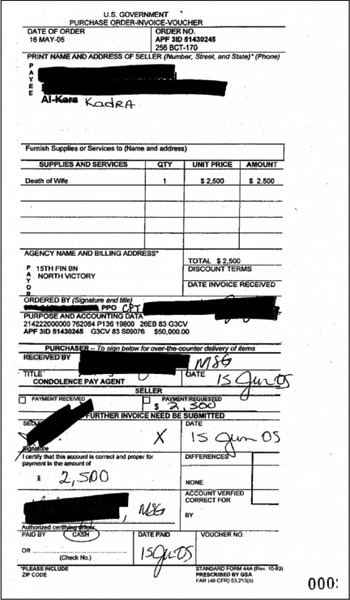
Local civilians were also awarded pitifully low amounts for property damage. Oliver Belcher, for example, describes a series of complaints that were made in the Afghan village of Taroke Kalacha after farmland was damaged by a combination of coalition airstrikes and construction schemes. While villagers estimated that the damaged pomegranate trees were worth 15,000 afghani ($228) and the damaged vines were worth 12,000 afghani ($182), they were only offered 5,000 afghani ($76) for the pomegranate trees and 1,500 afghani ($23) for the vines.Footnote 86 For Gilbert, the low valuation of Afghan and Iraqi lives and the failure to provide adequate compensation for damaged property shows that condolence payments simply reinforce the idea that civilian harm is an unfortunate but unavoidable consequence of military operations. As she puts it, the ‘profligate disbursement of money by troops is used not only to constitute civilian harm as accidental, but to deny accountability’.Footnote 87 As such, it fails to contest the dehumanising logic that renders civilian lives so expendable in late modern warfare. Nowhere is this more apparent than the United States Government Purchase Order Invoice Voucher that was given to one man in Baghdad. Under the supplies and services column, a military lawyer has written ‘death of wife’, in the quantity column they have put ‘1’, and in the unit price column they have written ‘$2,500’ (Figure 1).
United States Government Purchase Order Invoice Voucher.

Rather than disrupting the necropolitical frames that render Afghan and Iraqi civilians so eminently killable, Gilbert argues that condolence payments work to legitimise the killing and injuring of civilians by reproducing the idea of civilian casualties as collateral damage, that is, the tragic but unavoidable consequence of lawful and morally permissible military operations. Echoing Fassin, she argues that,
In their payments for death and injury, militaries are calculating, counting, measuring, balancing and acting upon their calculations that differentiate between the ‘sacred lives of Western soldiers’ – whose deaths are to be avoided at all costs – and the ‘sacrificable lives of local civilians’ – whose deaths have been reckoned as proportional to military purpose.Footnote 88
Although Gilbert is right to draw attention to the lack of accountability attached to condolence payments, it is too simplistic to say that they merely reproduce the notion that civilian casualties are a form of collateral damage because it does not account for broader changes in the way coalition forces viewed civilian casualties and their impact on the success of military operations. During the early stages of the conflict, coalition forces tended to treat civilian casualties as a form of collateral damage, something that was unintentional and largely incidental to the success of military operations.Footnote 89 At the start of Operation Enduring Freedom, for example, Defense Secretary Donald Rumsfeld argued that ‘coalition forces have gone to extraordinary lengths not only to avoid civilian deaths but to save civilian lives’. Nevertheless, he argued that it is ‘an unfortunate fact of war that, inevitably, innocent civilians are killed [and …] this has been true, true throughout the history of warfare, and it remains true even in this age of advanced technology and precision-guided munitions’.Footnote 90
As the conflicts in Afghanistan and Iraq unfolded, the coalition seemed to abandon the language of collateral damage – the idea that civilian casualties were unintentional and largely incidental to the war effort – and started recognising the strategic costs or consequences of civilian harm. In 2008, General David McKiernan issued new restrictions on the use of force in Afghanistan with the explicit aim of reducing civilian casualties, arguing that ‘good tactical judgement, necessity and proportionality are to drive every action and engagement [and that …] minimizing civilian casualties is of paramount importance’.Footnote 91 When General McChrystal assumed command, he introduced even tougher restrictions, warning troops about the dangers of winning tactical victories, but suffering strategic defeats by killing civilians and thus alienating the local population. In his view, minimising civilian casualties was no longer just ‘a legal and a moral issue, it is an overarching operational – clear-eyed recognition that loss of popular support will be decisive to either side in this struggle’.Footnote 92 In Iraq, General Peter Chiarelli had already begun to recognise the strategic costs of civilian casualties as he struggled to reduce the number of locals killed or injured at coalition checkpoints.Footnote 93 Commenting on the strategic rationale that drove his intervention, General Chiarelli told reporters that, ‘we have people who were on the fence or supported us who in the last two years or three years have in fact decided to strike out against us. And you have to ask: Why is that? And I would argue in many instances we are our own worst enemy.’Footnote 94
These changing attitudes towards civilian harm – the move from viewing civilian casualties as a form of collateral damage to seeing civilian casualties as a strategic setback – were related to the resurgence of a counterinsurgency doctrine focused on winning the hearts and minds of the local population rather than defeating enemy combatants through kinetic operations.Footnote 95 The use of condolence payments to mitigate the consequences of civilian harm suggests that coalition forces were already well aware of the strategic costs of civilian harm, but we begin to see these principles become codified with the revitalisation of counterinsurgency doctrine and, in particular, with the revisions that were made to the Counterinsurgency Field Manual (FM3-24) in 2006.Footnote 96 Cautioning against an enemy-centric form of warfare focused on defeating insurgents with kinetic operations and overwhelming firepower, the manual argues that political power is the central issue in counterinsurgencies and that long-term success hinges on securing the hearts and minds of the local people.Footnote 97 The manual argues that the local population will be split between a small minority who support the insurgency, a small minority who support the counterinsurgency and a neutral or passive majority whose support must be secured.Footnote 98 Civilian casualties can be detrimental to the success of military operations if they end up driving the local population into the hands of the enemy. As Sarah Sewall puts it, ‘killing the civilian is no longer just collateral damage, the harm cannot be dismissed as unintended [as …] civilian casualties can tangibly undermine the counterinsurgent's goals’.Footnote 99
The Counterinsurgency Field Manual is surprisingly quiet on the issue of civilian casualties, but it does identify a series of paradoxes that are meant to encourage commanders to reflect on the tactics they would normally use. The manual notes, for example, that ‘sometimes, the more force that is used, the less effective it is [as …] the more force that is applied, the greater the chance of collateral damage and mistakes’. Similarly, it argues that sometimes doing nothing is the best reaction to an insurgent attack because the enemy may be trying to entice counterinsurgents into overreacting, such as ‘opening fire on a crowd or executing a clearing operation that creates more enemies than it takes off the streets’.Footnote 100 While the manual only makes minimal reference to the strategic consequences of civilian casualties, the tactical directives and counterinsurgency guidance issued by commanders on the ground is much more explicit. In his instructions to troops, for example, General McChrystal argued that ‘protecting the people is the mission [and that …] the conflict will be won by persuading the population, not destroying the enemy’. In his view, the intricate familial and tribal connections of Afghan society turns ‘attrition math’ on its head. Rather than reducing the number of enemy fighters, killing insurgents – particularly when civilians are killed – will increase the number of people willing to support the insurgency or who are prepared to pick up weapons and enter the fray.Footnote 101
Money as a weapons system
Every civilian death diminishes our cause.
General PetraeusFootnote 102As the previous section shows, coalition forces no longer viewed civilian casualties as just a moral or legal concern, but now regarded it as a potential strategic problem; minimising or mitigating civilian casualties was now considered a military necessity. New rules of engagement were introduced to reduce civilian casualties, but these measures were never going to eliminate them entirely. Therefore, coalition forces also introduced specific measures concerned with consequence management, including policies around the treatment or evacuation of wounded civilians, the need to investigate allegations of civilian harm, and the use of condolence payments to quell the anger of injured or bereaved civilians. As we have seen, soldiers seemed to recognise the strategic benefits of providing condolence payments for death, injury, and property damage long before coalition forces re-embraced counterinsurgency as a doctrine. In an article for the Military Law Review, for example, Major Katharine Adams argues that ‘condolence payments have proven to be an effective tool in winning hearts and minds’ by creating an ‘opportunity for dialogue with the local population and a personal expression of sympathy’.Footnote 103 Similarly, Lieutenant Colonel Leonard DeFrancisci argued that condolence payments provided troops ‘with an economy of force measure – a cheap yet effective method for pulling community support away from the insurgents’.Footnote 104
Various lessons learned reports have noted that commanders in Afghanistan and Iraq ‘soon found that there are strategic advantages in making amends for unintended harm when this harm is a consequence of its actions’.Footnote 105 After a period of intense fighting back in October 2004, for example, a mobile payment team was dispatched to the Iraqi city of Najaf to make on-the-spot solatia and condolence payments to Iraqis caught in the crossfire, disbursing $176,180 worth of payments in less than ten hours.Footnote 106 Indeed, the Counterinsurgency Field Manual actually has surprisingly little to say about the need to manage or mitigate the strategic costs of civilian harm or the importance of ex-gratia to this process barring a few brief comments in an appendix on legal considerations, where it notes that the ‘individual or unit involved in the damage has no legal obligation to pay [as …] compensation is simply offered as an expression of remorse’. The manual does mention that claims made under the FCA are often unpayable due to the combat exclusion, so warns commanders be ‘careful not to raise expectations by promising payment’.Footnote 107 Nevertheless, the strategic importance of mitigating civilian harm was captured in subsequent lessons learned reports. In 2010, for example, the US Marine Corp published a summary of lessons and observations about the tactics used in Afghanistan, where it stated that ‘solatia or condolence payments to the family [were] the most effective mitigation measures …, along with key leader engagement of tribal elders’.Footnote 108
The importance of mitigating or managing the strategic consequences of civilian harm is also discussed in the Afghanistan Civilian Casualty Prevention Handbook, which was published by the Center for Army Lessons Learned (CALL). The handbook argues that experience shows that ‘soldiers who were ineffective in addressing civilian harm … can turn a village against international forces, put troops at further risk of retaliation, and cause strategic fallout at the national and international level’. Although it is not always easy to recover the trust and support of locals, it argues that ‘responding properly to these losses can minimize further negative effects caused by … mishandling the unfortunate incident’.Footnote 109 The handbook describes condolence payments as a ‘key element of consequence management’ and recommends that ‘units exercise the complete process for these payments – from making the payment to how they will track how much they have paid and to whom’.Footnote 110 To ensure that condolence payments are ‘culturally appropriate’ it recommends that ‘all offerings of amends should be thoroughly discussed with key leaders in the communities to ensure they are perceived as genuine [and that …] families or local leaders may choose to refuse amends, and this decision should be respected’.Footnote 111 According to the handbook, ‘the ex-gratia payment process should strike a balance between not being excessively bureaucratic and having enough verification in the claims process to keep it from being viewed as an opportunity for local populations (and their leaders) to make a quick profit’.Footnote 112
Although condolence payments prefigured the revitalisation of counterinsurgency doctrine in Afghanistan and Iraq, these payments came to be seen as an essential tool in efforts to manage or mitigate the strategic costs of civilian harm. These measures became so importance that coalition forces issued new doctrinal guidance on the importance of civilian casualty mitigation, which argued that ‘focused attention on CIVCAS [civilian casualty] mitigation is an important investment to maintain legitimacy and ensure eventual success’.Footnote 113 In the event of civilian harm, the guidance states that commanders ‘should make appropriate amends’ by issuing an apology, providing the victims with an ex-gratia monetary payment or offering ‘other tangible dignifying gestures’. While units are unable to offer compensation for civilian casualties, it argues that condolence payments can be used as a ‘goodwill gesture as part of making amends and demonstrating concern’.Footnote 114 The guidance states that these payments are ‘meant to be token amounts as recognition for loss rather than strict compensation and should be explained as such to avoid anger and resentment’. It suggests that standardised payments can reduce ‘bargaining and ill-will’, but recommends that these payments be ‘reviewed periodically to ensure they are still appropriate in the context of economic shifts such as inflation or changes in the operational environment’.Footnote 115
Despite the well-documented problems with condolence payments, the institutionalisation of these civilian casualty mitigation measures could be seen as fortunate confluence of military necessity and humanitarian concern. While she acknowledges that these practices are not perfect, Holewinski argues that condolence payments ‘represent marked improvements in the conduct of war’. Moreover, these payments demonstrate that ‘responding is not simply an act of compassion, it is an act of strategic self-interest’.Footnote 116 In her view, the ‘strategic imperative to defeat the Taliban and its moral imperative to help where it has hurt are far more similar than they seem’.Footnote 117 Yet this reliance on condolence payments should not be seen as a great awakening of moral sentiment, coalition forces were not suddenly getting ‘mushy’ about civilian casualties, as General Sir Richard Shirreff put it.Footnote 118 Protecting civilians and mitigating the effects of civilian harm were considered important because they were seen as being strategically important to the success of the mission. As General John Allen argued, ‘how we treat civilians is a force multiplier for us and a force-detractor for the enemy’.Footnote 119 The strategic rationale behind these changes is also evident in the new doctrinal guidance on mitigating civilian harm, which warns that a failure to respond to instances of civilian harm in a timely and effective manner can ‘lead to ill will among the host-nation population and political pressure that can limit freedom of action of military forces’.Footnote 120
Rather than treating condolence payments as a form of reparation or mechanism of accountability, it would be more accurate to view these payments as a tactic or instrument of war. Coalition forces were surprisingly candid in their own appraisal of these payments, referring to them as a weapon – albeit a non-lethal one – that could be deployed in the fight against insurgents.Footnote 121 Referring to them as a weapon may seem slightly excessive, but it is important to note that the standard operating procedures that governed the use of these payments referred to ‘money as a weapon system’.Footnote 122 Describing Iraq as ‘arguably the most complex and challenging fiscal environment in our nation's history’, Colonel Thurman Pittman argues that ‘money is truly a ‘“weapons system” here in Iraq, especially in light of our non-kinetic efforts and the arsenal of supporting financial resources’.Footnote 123 Colonel Thurman goes on to explain how CERP funds can be used to achieve a variety of ‘focused effects [by] providing urgent humanitarian relief while offering significant employment opportunities for the Iraqi people’.Footnote 124 At the same time, he argues that CERP funds can be used for condolence payments, but notes that ‘it is crucial to remember that when a Commander uses CERP funds, it is not an acknowledgement of any moral or legal responsibility for someone's death, injury, or damaged property. Condolence payments are symbolic gestures and are not paid to compensate someone for a loss.’Footnote 125 Another lessons learned report describes CERP as a ‘combat multiplier’.Footnote 126
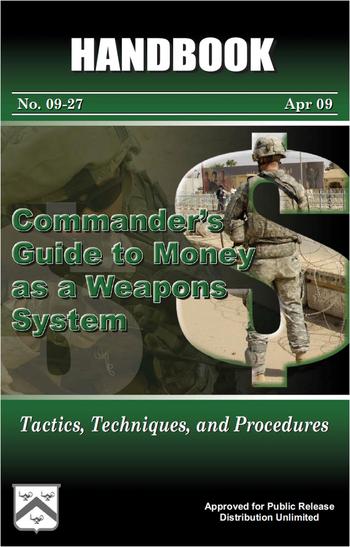
CALL also produced a separate guide to using money as a weapons system (Figure 2), which describes how ‘coalition money is defeating COIN [counterinsurgency] targets without creating collateral damage, by motivating anti-government forces to cease lethal and nonlethal operations, by creating and providing jobs along with other forms of financial assistance to the indigenous population, and by restoring or creating vital infrastructure’.Footnote 127 Only a small percent of this money went towards condolence payments; the vast majority was used to make emergency repairs to schools and hospitals, build water and sanitation facilities, and support various other initiatives that were meant to demonstrate the advantages of supporting the counterinsurgents in their battle against insurgents.Footnote 128 Nevertheless, despite only accounting for a small fraction of the overall spend, condolence payments have been identified as an important ‘non-kinetic weapon system that offers a quick and effective method yielding immediate impact to [local …] people’.Footnote 129 Indeed, General Petraeus argued that ‘money is my most important ammunition in this war’.Footnote 130 As with any other kind of weapon, he suggested that condolence payments have to be carefully calibrated to ensure that they achieve the ‘greatest effect for each “round” expended’.Footnote 131 Subsequent guidance has emphasised the need to ‘streamline civilian casualty response mechanisms, so that civilians suffering losses do not see an ad-hoc response that they could mistake for political or economic bribery’.Footnote 132 At the same time, it suggests that commanders should balance any concerns about fraudulent claims against the ‘potential for fostering resentment by not paying real claims that have insufficient evidence for legitimate reasons’.Footnote 133
Centre for Army Lessons Learned, ‘Commander's Guide to Money as a Weapons System’.

As this section has shown, the condolence payments were never intended as a way of making amends for the harm caused by war, but were viewed as a weapon of war that could be used to mitigate or manage the strategic costs of civilian casualties. These payments should not, in my view, be seen as a well-intentioned but flawed attempt at responding to the pain and suffering experienced by civilians in Afghanistan and Iraq because these payments were never really concerned with the pain and suffering of ordinary Afghans and Iraqis. These payments were intended to provide coalition forces with a simple technical fix to a complex ethico-political dilemma, a weapon that could be deployed in order to combat the potentially detrimental effects of civilian casualties on the effectiveness of the mission. As such, these payments continue to objectify and devalue Afghan and Iraqi civilians by treating them as a means to an end rather than an end in themselves.Footnote 134 As Jenny Edkins explains, albeit in a radically different context, this is ‘a politics that misses the person, a politics that objectifies and instrumentalises’ because it treats people as objects that need to be classified, managed, and administered rather than unique, singular, and irreplaceable beings.Footnote 135 The civilians who were killed or injured in these wars did not register as human beings, but were seen as a potential problem, strategic setbacks that could jeopardise the success of the entire mission if they were not managed or mitigated effectively. As such, these civilians casualties were ‘produced as an object of governance: as something without political standing, as something that has no voice’.Footnote 136
Conclusion
This article has examined the use of condolence payments as a weapon of war, a tool that could be used to manage or mitigate the strategic costs of civilian casualties, the damage that these deaths and injuries might do to mission success. Although the programme has been riddled with problems – from the arbitrary and uneven processes used to assess these claims through to the low and inconsistent valuation of civilian lives – some argue that condolences payments are a welcome development. There may have been flaws with the way in which these payments were made, but they did at least provide some recognition for the harm inflicted on civilians and some financial assistance to those who have lost loved ones and livelihoods as a result of the conflicts. Yet these payments were never intended to compensate the victims for the pain and suffering they have endured and these payments came with no guarantee that coalition forces would actually acknowledge the harm they had caused, listen to the concerns raised by victims, or make meaningful changes to the way in which these wars were conducted. These payments came with no commitment that the violence would not be repeated in the future, that coalition forces would actually learn from their mistakes and make efforts to avoid repeating them in the future – they were only ever intended as a gesture of sympathy or an expression of remorse, not an admission of legal liability or moral responsibility. More troubling were the martial imperatives that underpinned these payments, imperatives that constituted civilian casualties as a strategic problem rather than a moral or legal one.
As I have shown, condolence payments were used extensively in both Afghanistan and Iraq because commanders were concerned that civilian casualties could jeopardise the success of the entire mission, so needed to find ways of mitigating the effects of this harm. There was no great awakening of humanitarian sentiment, no real desire to make amends for the death and destruction that was caused; this was a calculated and very deliberate attempt to use money as a way of managing the consequences of civilian harm, a technology or weapon that could be deployed to contain the anger and unrest caused by coalition operations. In common with other weapons, the money spent on condolence payments had to be carefully calibrated to ensure it achieved maximum effect for every dollar spent, every round that was expended. Specific procedures were developed to ensure that the victims received their money, but these procedures were not there to ensure that people received appropriate compensation for the harm they endured but to help placate a population that had already lost so much. A standardised payment schedule was developed to ensure that the payments were perceived as fair and the sudden influx of money did not distort the local economy, detailed records were kept so that commanders could track the amount of money spent and minimise fraud, even if they meant issuing receipts for dead husbands and dead wives. As Edkins argues, the systems used to administer the civilian population do not treat people as unique and irreplaceable beings but objects to be governed, they do not ‘see the person-as-such, only the person as object’.Footnote 137
It is worth pausing to think about the broader implications of this for how we think about contemporary practices of violence. At first glance, framing civilian casualties as a strategic problem might seem like a positive development given that the victims received at least some compensation for their suffering even though the amount of money they received was pretty paltry and the rationale behind the scheme was hardly benign. The danger with this approach is that the enhanced protections afforded to civilians in conflicts where they are considered strategically important will be abandoned in conflicts where they are not considered to be a strategic asset or a potential impediment to the success of military operations. Even though specific funds for condolence payments have been set aside in the Pentagon's budget, the amount of money disbursed has plummeted in both Afghanistan and Iraq. According to the Los Angeles Times, only three condolence payments were issued in Iraq between 2014 and 2017, and various human rights organisations have complained that coalition forces have not established clear and accessible procedures so that the victims of conflicts in Syria, Somalia, Pakistan, and Yemen can lodge claims or the harm they have suffered.Footnote 138
Moving the issue of civilian harm from a moral or legal economy and placing it firmly with strategic calculations might appear to enhance civilian protections, but only in conflicts where the military feels that there is something to be gained by protecting civilians and making amends for any harm it has caused. When civilian casualties lose their strategic significance, then these enhanced protections will quickly fall to the wayside and the civilian population will find that even these symbolic displays of sympathy and miniscule amounts of money will be less forthcoming. No matter how seductive these measures may appear they continue to objectify and devalue the civilian population by treating them as a means to an end rather than an end in themselves. They are not directed at the civilian-as-person but at the civilian-as-asset in the battle for hearts and minds. Despite the huge sums of money that were disbursed in Afghanistan and Iraq, the civilian population remained disposable, and their deaths ungrievable.
Acknowledgements
For critical and insightful comments on earlier drafts, I would like to thank Mandy Roberts, Kathie Gregory, Emily Gilbert, Kandida Purnell, and Lauren Wilcox, along with the three anonymous reviewers.