Introduction
Striving for sustainable solutions towards greater efficiency, better quality and higher responsiveness of health service delivery and finance, regulators in several European countries are extending user choice in health care systems. This development can be seen within the context of an increasing tendency to introduce market elements into what has long and often been state-owned and provided health care. The most explicit strategy towards greater user choice can be found in the United Kingdom where the Labour government announced ‘patient choice’ as a central element for reforms of the National Health Service (NHS) (see e.g. Milburn, Reference Milburn2002; Blair, Reference Blair2003). However, as the theoretical debate and the first empirical results show, extended user choice in health systems is a rather complex strategy and might not achieve the goals targeted by health policy makers.
In general, user choice can be defined as the possibility for individuals to freely choose from a bundle of goods and services according to individual preferences (see e.g. Barr, Reference Barr2004). ‘User choice’ is seen here as the more stringent terminology when referring to the general subject (compared to patient choice) as some choices affecting health systems are exercised by non-patients (e.g. the choice of insurer by healthy citizens). The term ‘user’ here refers to anybody potentially entitled to benefit from a given set of health services. This paper seeks to contribute to the development of the user choice discourse by proposing a systematic framework for analysis of one category of potential choice: the choice of health service provider. We contend that the analytical dimensions: technical efficiency, administrative efficiency, allocative efficiency, equity in access and equity in finance are to be mapped against specific determinants of the success or failure of user choice programmes. The determinants should be clustered into general systemic determinants, demand-side determinants and supply-side determinants.
The paper is structured as follows. First, the methods underlying this article are outlined. Second, the relevant conceptual background of choice in health systems is summarised. In its third and central part, the paper systematically analyses choice of provider according to the proposed analytical dimensions to identify and critically discuss specific determinants of extended choice of provider programmes. Subsequently, a systematic matrix framework is proposed, which maps the analytical dimensions against the identified key determinants. We conclude by underlining the implications for future research and political practice.
Methods
The development of a systematic framework for the analysis of user choice in health systems is based on a review of the available and applicable scientific literature. We searched the following databases for the calendar years 1980–2006: EMBASE, PubMed, EconLit, Cochrane Database of Systematic Reviews, Cochrane Central Register of Controlled Trials and the NHS Economic Evaluation Database. Furthermore, references in relevant articles and books were followed up manually and publications known previously to the authors were taken into account. Given the highly heterogeneous literature on choice in European health systems, no explicit inclusion or exclusion criteria were employed.
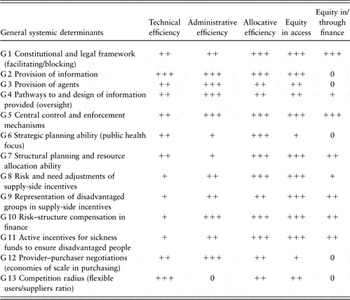
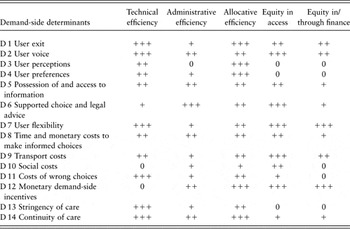
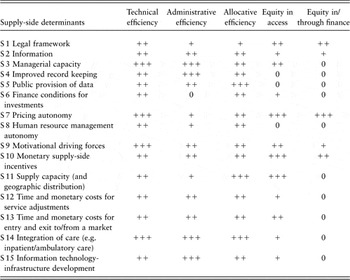
The analytical framework and its application for studying the impact of user choice of provider on technical, administrative and allocative efficiency, as well as on equity in access and on equity in finance are depicted in Tables 1–3. Table 1 analyses general system determinants of user choice (G 1 to G 13). In Table 2, demand-side determinants of user choice (D 1 to D 14) are analysed, whilst Table 3 shows the analysis for supply-side determinants (S 1 to S 15). Scores depicted within the matrix are suggestions of relative importance made by the authors. The scores are non-linear general weightings, intended to stipulate expert discussion and to illustrate the complex interrelations of choice of provider policies. Relative importance of different determinants will strongly depend on the specific policy design and setting.
Choice of provider – a systematic framework for analysis (general systemic determinants)

Suggestions of theoretical relevance: 0 = low/no impact; + = of relevance; ++ = of importance; +++ = of significant importance.
Choice of provider – a systematic framework for analysis (demand-side determinants)

Suggestions of theoretical relevance: 0 = low/no impact; + = of relevance; ++ = of importance; +++ = of significant importance.
Choice of provider – a systematic framework for analysis (supply-side determinants)

Suggestions of theoretical relevance: 0 = low/no impact; + = of relevance; ++ = of importance; +++ = of significant importance.
Conceptual background of user choice
Proponents of extended choice in health systems may choose normative and/or instrumental arguments to support their case, that is, choice may be both an end in itself and a means to an end (Le Grand, Reference Le Grand2006). The normative quality is rooted within the libertarian school of thought where freedom and autonomy of individuals are to be maximised and self-determination is seen to be superior to any form of state intervention or regulation [see e.g. Hayek (Reference Hayek1960), Friedman (Reference Friedman1962), Friedman and Friedman (Reference Friedman and Friedman1980); for the patient autonomy debate see e.g. Coulter (Reference Coulter2002a)].
Another related argument is offered by the ‘Theory of Revealed Preferences’ (Samuelson, Reference Samuelson1938). The central assumption being that where individuals are given the possibility to freely express their preferences, a competitive market will have to adjust its production to these ‘revealed preferences’ (see also Rice, Reference Rice2001). Consequently, collective utility increases. Various aspects of economic theory are of relevance to the user choice debate. These are presented in the following section.
User choice and the principles of economic theory
The instrumental quality of choice stems from the context of economic theory where Adam Smith’s (Reference Smith1776) ‘invisible hand’ theorem requires free choice by consumers as one necessary condition. Free choice in consequence leads to competition among (numerous) suppliers who will then seek to increase the efficiency of production, given the price and quality offers of competitors.
The ultimate aim of the market is the ‘competitive equilibrium’, where, in essence, price equals the average cost of production at its minimum and consequently no supernormal profits are made. The reallocation of these ‘released’ resources potentially adds to the collective utility of a society (see also Jacobs, Reference Jacobs1997; Rice, Reference Rice1998). However, the above-mentioned conditions are necessary but not sufficient prerequisites of the competitive equilibrium which needs certain demand- and supply-side conditions to materialise.
Demand-side requirements of choice
Economic theory assumes that consumers are completely informed when making their choices. Furthermore, consumers have to make rational choices, that is, the consumption ceases where its marginal cost equals its marginal benefit. It is well known that these standard assumptions are considerably violated with respect to health care markets (see e.g. McGuire et al., Reference McGuire, Fenn and Mayhew1989). In particular, the complete information requirement is difficult to fulfil. Even if health care users are increasingly informed, there will remain asymmetry of information between patients and health providers. The resulting agency relationship [i.e. doctors (agents) make decisions on behalf of patients (principals) because of differing levels of medical knowledge] will leave the health sector supply-side dominant (see Arrow, Reference Arrow1985).
Supply-side requirements of choice
On the supply side, further requirements have to be met: goods and services have to be homogeneous with well-defined production functions (i.e. relations of inputs to outputs known). This condition is violated by the highly complex and sometimes stochastic nature of health care, which results in incomplete information and uncertainty for suppliers, and also makes quality as a leading criteria of user choice difficult to define and to specify [Barr (Reference Barr2004); see also Bernstam et al. (Reference Bernstam, Shelton, Walji and Meric-Bernstam2005) and Coulter (Reference Coulter2006)]. Profit maximisation, being the main and driving incentive for suppliers, constitutes another standard assumption of economic theory. Whether this assumption holds for health care suppliers is reflected in the following paragraph.
What really drives health care suppliers: profit or humanity?
Investigating the headlining question, Le Grand (Reference Le Grand2003: 30–38) inter alia, based on Titmuss (Reference Titmuss1971) and Frey (Reference Frey1997), shows that it may be questionable whether the economic standard assumption of suppliers as profit maximisers holds (see also Le Grand, Reference Le Grand1997). Le Grand’s (Reference Le Grand2003: 67–70) model suggests that through increasing monetary reward, supply activity changes and may even be reduced within a certain interval of financial compensation. After this interval the “relative price effect dominates” (Le Grand, Reference Le Grand2003: 68), that is, motivation is driven primarily by monetary reward.
Le Grand’s (Reference Le Grand2003) model may illuminate the motivational driving forces for health care suppliers and questions whether, for example, ‘payment by results’ (Department of Health, 2002) as partly based on the profit maximiser assumption, will directly and linearly lead to higher quality and efficiency in health care production (see also Brewer et al., Reference Brewer, Selden and Facer2000; Frey, Reference Frey2000; Croxson et al., Reference Croxson, Propper and Perkins2001; Gosden et al., Reference Gosden, Forland, Kristiansen, Sutton, Leese, Giuffrida, Sergison and Pedersen2001).
Exit, voice and loyalty: differing impact of incentives?
Hirschman’s (Reference Hirschman1970) concept of “Exit, Voice and Loyalty” applied to health care, for example by Klein (Reference Klein1980), sheds light on the pitfalls of ‘exit’ competition (i.e. choice) when compared to the potential of user ‘voice’. Analysing the impact of different supply-side incentives, Hirschman (Reference Hirschman1970: 30) notes that the expression of “…Voice…rather than just go over to competition can ‘kick up a fuss’ and thereby force improved quality or service upon delinquent management”.
In addition, Hirschman (Reference Hirschman1970) identifies potential frustration of suppliers and delayed improvements as potential adverse consequences of ‘exit’ competition. Such consequences may indeed come at a cost and are therefore important for any efficiency consideration. However, Le Grand (Reference Le Grand2006) argues that for ‘voice’ to work, the ‘exit’ option has to be in place in health care systems [just as in competitive markets to which Hirschman (Reference Hirschman1970) inter alia refers to] [for further related contributions see e.g. Barkema (Reference Barkema1995), Coulter (Reference Coulter2002b) and Ellins and Coulter (Reference Ellins and Coulter2005)].
Analysis
Technical efficiency
According to Palmer and Torgerson (Reference Palmer and Torgerson1999), “technical efficiency refers to the physical relation between resources (capital and labour) and health outcome. A technically efficient position is achieved when the maximum possible improvement in outcome is obtained from a set of resources.”
One major demand-side determinant for technical efficiency is compounded by user information, preferences and perceptions (D 3 to D 5). These interlinked determinants are crucial for choice to work, as only well-informed users will be able to develop preferences so that the objectively most efficient care is actually perceived as such and henceforth demanded. Otherwise, suppliers may react upon potentially misleading demand-side preferences such as high technology care with its associated cost inflation (Hsiao, Reference Hsiao2001; Pauly, Reference Pauly2004). Related to the latter argument is the issue that only a specific subset of health services is suitable for user choice and provider competition. Services such as planned surgery, dentistry, family doctor visits or ambulatory specialist services are often elective and hence choice may play a role. In the case of emergency care or specific mental health services however, user choice can be substantially limited. From a regulator perspective, it is of importance that there are no disincentives for high quality and effective non-elective care. If not, a systematic shift of provider attention towards choice- and competition-related activities might occur.
User flexibility (D 7) in terms of geographic and interpersonal dimensions can be seen as another important factor, determining whether choice will actually lead to sufficient competition and hence (ceteris paribus) to greater efficiency [see Xavier (Reference Xavier2003) for a modelled analysis of hospital competition in the UK]. Fotaki (Reference Fotaki1999), conducting a case study on elective cataract surgery in London and Stockholm, shows that proximity (travelling distance) may be a major factor influencing patient choice (Table 4). However, geographically flexible users have to count for a ‘critical mass’, that is, enough users may potentially leave one supplier in the case of dissatisfaction. Otherwise, efficiency (including quality) incentives for suppliers might not be strong enough. Furthermore, within a given competition radius (G 13) (depending, among others, on user flexibility) a sufficient number of suppliers have to be available for efficiency gains in production forced by competition to weigh up travelling and related social costs borne by users.
Factors influencing choice – relative relevance as reported by users in the UK and Sweden

GP = general practitioner.
Source: Fotaki (Reference Fotaki1999).
Continuity, integration and coordination of care (D 13, 14) are further determinants of technical efficiency, as excessive supplier changes may lead, for example, to duplication of diagnostic tests or may cause adverse events through incompatible treatments. Related to the latter requirement, costs and benefits of information technology (IT)-infrastructure (S 15) on the supply-side (e.g. for ‘e-booking’ at the point of referral and integration of inpatient and outpatient care) are determinants of technical efficiency (see e.g. NHS Connecting for Health, 2006). Where increasing numbers of autonomous players act in a market, a clear emphasis on health care integration (S 14) is necessary to avoid further fragmentation of services (Enthoven and Tollen, Reference Enthoven and Tollen2005). This is all the more important as exchange of information among different health professions and an interdisciplinary approach in general is often vital for an exact diagnosis, effective treatment and the necessary rehabilitation and/or secondary prevention. The integration of care is all the more difficult where public and private providers are supposed to interact at different levels of a given care continuum. Why, for example, should a private hospital help a competitor to perform better on a given patient by providing data on a patient’s medical history and previous procedures? Obviously patients’ best interest and the nature of business are conflicting entities in this case. This is another argument underlining the ambiguous nature of choice in health systems. From a slightly different point of view, Thomson and Dixon (Reference Thomson and Dixon2004) point out that time, monetary and social costs of potentially bad choices made by patients (D 11) determine technical efficiency of extended choice.
The supply side is determined by informational requirements (S 2) as well. First, suppliers have to know about (hopefully reasonable) user preferences and perceptions to be able to adjust their performance accordingly (Coulter, Reference Coulter2004). Second, suppliers have to know about the means and possibilities to improve the efficiency of production. This requirement is closely linked to managerial capacity (S 3). However, managerial capacity is not only determined by the genuine abilities of health service managers but is also dependent on a range of external factors: (a) the legal framework, that is, the degree of independence and legal status of health care suppliers (S 1) (legal frameworks thereby can be facilitating and blocking, depending on the exact context and the situation); (b) the pricing autonomy (S 7); (c) the autonomy in human resource management, for example, ‘hire and fire’ ability and the possibility to engage in skill mix changes (S 8); (d) the costs of entry and exit to and from a market (S 13); (e) the finance conditions for investments (S 6).
The above supply-side determinants underline that institutions and specific market features crucially matter (Propper et al., Reference Propper, Wilson and Burgess2005). Furthermore, a large part of technical efficiency gains through exit competition depends on the actual incentives for suppliers. Whether, for instance, ‘money follows the patient’ and ‘payment by results’ arrangements achieve their objectives, will depend on the prevailing supply-side culture and especially the motivational driving forces (S 9). As Titmuss (Reference Titmuss1971) demonstrated in his classic study on blood donation in the UK, monetary incentives may even lead to decreasing supply activity when existing altruism (ceteris paribus) conflicts with financial compensation.
Determining technical efficiency on the supply side, a potential delay in efficiency improvements through, for example, the lack of user ‘voice’ in the form of feedback to providers, potentially comes with the cost of further market losses instead of market gains through timely improved services (see Hirschman, Reference Hirschman1970). Hence, the explicit use of user voice (D 2) may determine whether suppliers are able to avoid ‘delay of turn-around’ losses and costly frustration of the work force [see Coulter et al. (Reference Coulter, Nye and Pollard2005) for an analysis of health services against patient-defined success measures].
To allow user flexibility within the supply structure there has to be a certain degree of (over-) capacity (S 11) within a given choice radius. On the health system level, this may constitute a threat to technical efficiency. However, health care needs are quantitatively fluctuant by nature and impossible to exactly predict in advance. Some spare capacity, therefore, can be seen as a natural requirement of health care provision (e.g. for emergencies and seasonal variations in the prevalence of diseases). On the other hand, where waiting times are to be reduced, choice can lead to the efficient use of existing spare capacity as seen in the UK during the London Patient Choice Project (Appleby et al., Reference Appleby, Harrison and Devlin2003; Dawson et al., Reference Dawson, Jacobs, Martin and Smith2004; Burge et al., Reference Burge, Devlin, Appleby, Rohr and Grant2005).
Administrative efficiency
Administrative efficiency can be seen as a sub-dimension of technical efficiency related to that part of capital and labour which is devoted to administer given processes. Regarding choice arrangements, three levels of administrative effort can be identified: the system level (e.g. governmental investments to set up and monitor choice policies); the institutional level (e.g. any additional administrative effort necessary in hospitals); and the individual level (i.e. time and monetary costs for users to make informed choices).
On the system level, altered legal frameworks may need new experts and commissions and training of civil servants. These necessities can be seen as natural conditions of the political process and development. However, the provision of information material and agents (G 1 to G 3) such as independent audits or patient advisors, will come with additional administrative costs for a choice-favouring government (Dawson et al., Reference Dawson, Jacobs, Martin and Smith2004).
On the institutional level, extended choice also requires additional organisational arrangements such as more differentiated record keeping (S 4) and documentation for hospitals including public provision (S 5) of performance data (Shepperd et al., Reference Shepperd, Charnock and Gann1999). Furthermore, to establish and to run the necessary incentive structures for individual health care professionals (S 10), additional administrative effort, whether in hospitals or in the ambulatory sector, will be required. In addition, extended competition means increased time and monetary costs to hospitals and insurers to engage in provider–purchaser negotiations (G 12). The fact that numerous actors have to negotiate, administer and enforce their contracts, including potentially inflating jurisdictional costs, can be seen as an efficiency disadvantage of extended competition. On the contrary, monopsonist purchasing by a central regulator seems to carry clear advantages regarding economies of scale and purchasing power (Mossialos et al., Reference Mossialos, Dixon, Figueras and Kutzin2003). These theoretical insights are supported by Le Grand (Reference Le Grand1999) who reports that high transaction costs were one of the undisputed effects of the internal market experiments in the UK.
On the individual level, time and monetary costs (D 8) to make informed choices are not to be underestimated. These determinants of administrative efficiency in turn depend on the available ways of access to information, the design of information provided and the resulting degree of possible oversight (G 4).
Allocative efficiency
Allocative efficiency can be defined by the requirement that resources are to be “…allocated so as to maximise the welfare of the community” (Palmer and Torgerson, Reference Palmer and Torgerson1999). Allocative efficiency applies to at least the following levels: the societal level, the health system level, the health care production level and the individual user level.
The health sector, as a whole, may compete with education, public transport and other collective interests on the societal resource allocation level. Priority setting amongst these competing sectors is part of the wider political agenda of individual states, provinces or counties. On the health system level, allocative efficiency is partly determined again by user preferences and whether these are based on sufficient information and insight (D 4, 5). Otherwise users may choose, for example, to primarily seek acute care and rehabilitation, rather than opting for healthy lifestyle choices and primary prevention consultations.
On the production level, policies in France and Germany have aimed to strengthen the gatekeeping function of general practitioners (GPs). In Germany, the choice of specialist without referral has been monetarily limited since 2004 through modest co-payments (€10 per quarter). Governments thereby seek to establish inbuilt agents into the resource allocation between different levels of health care production. Such measures potentially improve allocative efficiency through the reduction of unnecessary and expensive use of specialist care; the latter being an explicit example of efficiency gains through restricted choice. In the German case, the introduction of co-payments led to an 8.8% reduction in utilisation of ambulatory visits (Grabka et al., Reference Grabka, Schreyögg and Busse2005). Although according to Grabka et al. (Reference Grabka, Schreyögg and Busse2005) this alleviation seems not to include necessary utilisation; easy access to necessary care is important for allocative efficiency as, for example, earlier treatment is often less expensive and more effective. Hence, the two sides of the coin (free choice and potential inefficient utilisation on one side and restricted choice and patchier access to care on the other side) have to be weighed carefully and accompanied by sensible planning and evaluation processes. The latter argument is underlined by the Swedish situation, where the overuse of hospital care, in absentia of sufficient ambulatory care facilities (Thomson and Dixon, Reference Thomson and Dixon2006), constitutes an obvious threat to allocative efficiency. Hence, infrastructure prerequisites (G 7) certainly determine whether users can make allocatively efficient choices.
The precise characteristics of monetary incentives for the supply side (G 8, S 10) crucially matter for allocative efficiency on the production level. Given the complex and sometimes stochastic nature of health care, it is a rather challenging task to design monetary incentives in such a way that in consequence the optimal activity allocation at the provider level is achieved. On the other hand, where monetary incentives are based on a set of incomprehensive criteria, providers might concentrate on rather isolated factors. Reimbursement criteria such as ‘post surgical infection yes/no’ might, for example, lead to an allocatively inefficient over-use of antibiotics. Furthermore, if monetary supply-side incentives cannot be adjusted for individual patient characteristics (G 8, 9) cream-skimming of patients who are comparatively easy to treat might occur. The latter phenomenon constitutes a threat to allocative efficiency through delayed and insufficient treatment of more complex cases. In addition, cream-skimming undermines equity which is discussed in the following sections.
Equity in access and treatment
The potentially normatively desirable dimension of equity in access and treatment can be defined as equal access to quality and quantity of care for equal need (Donaldson and Gerard, Reference Donaldson and Gerard1993). The relevant categories across which the equity imperative may apply are age, gender, educational status, ethnicity and socio-economic status. Furthermore, and especially important for equity considerations concerning user choice, geographical equity might be an objective.
Analysing aspects of geographical equity under extended user choice in health systems, one has to consider the findings of Hart (Reference Hart1971). His ‘inverse care law’ describes that “the availability of good medical care tends to vary inversely with the need of the population served” (Hart, Reference Hart1971). Furthermore, Hart (Reference Hart1971), summarising his findings, notes that “This inverse care law operates more completely where medical care is most exposed to market forces, and less so where such exposure is reduced”.
Given the findings of Hart (Reference Hart1971), which were shown to be true in many settings, one can conclude that health care supply activity and quality levels in different geographic areas do need a certain degree of health policy planning and intervention, and cannot simply be left to market forces. Hence, to assure geographical equity in access to quantity and quality of care supplied, central control and enforcement mechanisms (G 5) are needed. Under extended choice of provider, such mechanisms are to be established or continued by a central or local governmental institution [Le Grand (Reference Le Grand1991); see also Perri 6 (2003) for a cross-sectional analysis of choice policies and the institutional and political implications in the UK].
With respect to equity across socio-economic groups, critics of extended choice may claim that choice potentially favours middle and upper classes because of louder voices, higher self-confidence and better access to, and possession of, relevant information. On the contrary, Dixon and Le Grand (Reference Dixon and Le Grand2006) argue that extended choice actually favours lower-income groups as these are then empowered through potential exit. However, the latter ideas conflict with the theoretical insights into potential behaviour of suppliers. Depending indeed on the actual incentive design on the supply side, lower-socio-economic groups (with a higher incidence and prevalence of many disorders) might experience extensive disempowerment. Recognising the exit-option for users, providers might be encouraged to avoid complex (i.e. expensive) cases. More or less subtle, providers may ‘shift’ patients with complex diseases via the exit-option over to competitors or other health system levels. Where such behaviour is encouraged by a given incentive structure, equity might considerably and systematically be threatened. Thus the design of monetary supply-side incentives (S 10) heavily influences equity (Ellis and McGuire, Reference Ellis and McGuire1996).
According to Matsaganis and Glennester (Reference Matsaganis and Glennester1994) GP-fundholders in England, who were allocated a budget to buy, for example, hospital services for their patients from an institution of choice, did not seem to ‘cream-skim’ patients in the 1990s. However, the explicit representation of potentially disadvantaged groups (G 8) is an essential requirement for the design of monetary incentive schemes in order to assure that disadvantaged people are served properly. Ideally, risk and need adjustments (G 9) for individual patients are established. However, the latter come with formidable methodological and confidentiality problems, as well as with high administrative costs [for further background on the methodological issues concerning risk-adjustment schemes see e.g. Oliver (Reference Oliver1999) and Chernichovsky and van de Ven (Reference Chernichovsky and van de Ven2003)].
Other findings by Dixon and Le Grand (Reference Dixon and Le Grand2006) are supported here as valid contributions to equity determinants. The main obstacles for equity to be achieved under extended user choice are unequal information, unequal capabilities and unequal flexibility/mobility as well as the differing proportions of income spent, for example, travelling costs (Dixon and Le Grand, Reference Dixon and Le Grand2006). In consequence, Dixon and Le Grand (Reference Dixon and Le Grand2006) argue that ‘supported choice’ should be offered. However, supportive measures such as personal user advisors and improved access to information through free Internet access provided in the community (Dixon and Le Grand, Reference Dixon and Le Grand2006) are rather controversial proposals. Whether especially disadvantaged groups will actually demand such services, remains an unanswered question. However, the authors in response to the counterargument of cost inflation argue that existing personnel in the health system could serve as user advisors. This is undoubtedly so at least if there is free capacity among existing personnel. Otherwise, any additional informational effort will come with additional costs (time and monetary) whether exercised by existing or newly employed health workers. In addition, where the above-mentioned patient shifting of expensive cases occurs, users may need independent assistance, which eventually has to comprise legal advice (D 6). Hence, to restore and improve equity under extended choice, investments into independent and focused supported choice will be a prerequisite. Thorlby (Reference Thorlby2006) found a positive tendency concerning equity in access and quality provided under choice arrangements. Her study suggests that competing HIV/AIDS units in London specialise to cater for different sub-groups of patients. This might improve access and quality of care supplied for disadvantaged minority groups, which constitute a sufficiently large market.
Equity in finance
Equity in health care finance applies more directly to choice of insurer, which lies outside the scope of this paper. However, there are complex interrelations with equity in access. Equity in finance can be differentiated into horizontal equity, that is, people with the same income pay proportionally the same contributions, and vertical equity, that is, the normative imperative that higher income groups have to contribute larger proportions.
The interference of health care finance with choice of provider begins where monetary demand-side incentives (D 12) (e.g. co-payments which are financing mechanisms at the same time) to guide user choice are applied by regulators. If in consequence low-income groups are relatively more discouraged to access care, equity will erode. Hence, mechanisms applied to guide user choice towards efficient use of resources have to be income adjusted as seen, for example, in Ireland (Robinson, Reference Robinson2003).
A situation where equity in finance and equity in access may overlap is discussed in the remainder of this paper. Extended choice of insurer may lead to adverse consequences on equity in access where risk-structure compensation schemes fail to achieve their aim. In consequence, funds might evolve which are under relatively higher economic pressure because of higher average risk of their members [for an analysis of social health insurer choice in Germany and the Netherlands, see Schut et al. (Reference Schut, Greß and Wasem2003)].
In competitive health care markets these funds may be forced to negotiate lower prices with providers. The result may be that health care providers differentiate according to the compensation offered to them by different insurance funds. High-risk individuals may then be systematically disadvantaged being potentially adversely selected by certain sickness funds. Hence, further development and comprehensive application of risk-structure compensation schemes (G 10) is important for equity not to be undermined in the case of extended choice of insurer.
Another measure to avoid adverse selection and subsequent inequity in access to health care in competitive insurance markets are active incentives for sickness funds to ensure disadvantaged people (G 11). The German Disease Management Programmes (DMP), for instance, are successful in promoting the chronically ill as an attractive population sample to insure (Busse, Reference Busse2004). These schemes are considered to be a ‘Gordian solution’ to adverse selection where competition among health insurers is expanded, emphasising evidence-based and integrated health care at the same time (Busse, Reference Busse2004).
Conclusion
We have argued that the user choice debate requires the systematic application of analytical dimensions and the explicit linkage to individual determinants of user choice arrangements. Consequently, the paper has sought to exemplify the development of a systematic analytical framework for the case of choice of health care provider. A stringent set of standard dimensions embracing technical, administrative and allocative efficiency as well as equity in access and finance were applied and finally mapped against identified determinants of user choice within a systematic matrix framework for analysis. Our analysis underlines that user choice in health systems should be seen as a selective instrumental health policy tool rather than a normatively justified general agenda. Extended choice within some categories and levels of health systems may lead to higher health system costs without contributing to improved health system outcomes. If these losses are not offset by substantial efficiency gains through choice in other categories and levels, there will be a net loss of benefits, including choice, for individuals because of higher taxes or insurance contributions for example. In consequence, individuals will be less ‘free to choose’ in general because of shrunk budgets. The latter being an explicit contradiction to the libertarian imperative.
The choice matrix can be complemented by dimensions such as political feasibility and risk. However, the implications for empirical research are already numerous. The majority of quadrants displayed in the choice of provider matrix need further detailed analysis. Systematic empirical investigation of dimensions and determinants is a prerequisite for the development of evidence-based user choice policies in European health systems. The following questions, for example, deserve special attention: (1) What ways of provision and design of information for users are most effective to ease oversight and comparability of health services? (2) Do efficiency gains through competition weigh up the costs of fragmented provider–purchaser relations in health care markets? (3) What are the comparative potentials and mutual dependencies of ‘exit’ and ‘voice’ within the context of extended competition in health systems? (4) Integration, continuity and coordination of health care: what are the consequences and legal implications of competition and privatisation of health care? (5) Health service management: what generic qualifications and structural prerequisites are needed for promises of competition in health care provision to be achieved?
The above given questions are only a small selection of the wide range of inconclusive consequences of extended user choice in health systems. Hence, the implications for political practice are: First, any given choice affiliated policy goal is ideally to be tested with well-defined pilots to identify adverse consequences and to expand the user choice evidence base. Second, given the ambiguous and complex nature of choice (as shown here for the case of choice of provider), there is no need for health policy makers to be overly enthusiastic concerning the general potential of extended user choice. On the contrary, choice, at least when instrumentally applied, will remain only one strategy among others to achieve the ultimate aim of efficient, high-quality and sustainable health services in European health systems.
Acknowledgement
The authors thank the two anonymous referees for their thoughtful and valuable comments on earlier versions of this paper.