Introduction
At weaning, the piglet is exposed to nutritional and environmental stressors inducing marked structural and immunological changes in the gut. Structural changes, essentially villi atrophy and crypt hyperplasia, reduce the digestive and absorptive capacity of the small intestine and increase its sensitivity to infections (Pluske et al., Reference Pluske, Hampson and Williams1997). The immunological changes include an alteration of the intestinal immunity and the intestinal immune responses against dietary and bacterial antigens (King et al., Reference King, Kelly, Morel and Pluske2003). Moreover, composition and stability of the microflora undergo disruption in this period, leaving the piglet more susceptible to overgrowth of potentially disease-causing pathogenic bacteria, principally Escherichia coli (Hopwood and Hampson, Reference Hopwood and Hampson2003; Melin et al., Reference Melin, Mattson, Katouli and Wallgren2004). This critical period has been controlled over decades by using in-feed antibiotics showing growth-promoter properties. However, their total ban in the EU since January 2006 requires alternative solutions.
Active components of bovine colostrum may be of importance in this context. The most interesting include (i) growth promoters which promote the growth and development of the newborn and (ii) antimicrobial factors, which provide passive immunity and protection against infections during the first week of life (Pakkanen and Aalto, Reference Pakkanen and Aalto1997).
Beneficial effects of high-level bovine colostrum supplementations (40 to 100 g/kg of diet) on growth performances and feed intake in piglets at weaning have already been described (Pluske et al., Reference Pluske, Pearson, Morel, King, Skilton and Skilton1999; King et al., Reference King, Morel, James, Hendriks, Pluske, Skilton and Skilton2001; Le Huërou-Luron et al., Reference Le Huërou-Luron, Hughet, Callarec, Leroux and Le Dividich2004). Observed effects were explained by both an increase in feed intake level (Le Huërou-Luron et al., Reference Le Huërou-Luron, Hughet, Callarec, Leroux and Le Dividich2004) and a direct stimulation of the gut (Huguet et al., Reference Huguet, Sève, Le Dividich and Le Huërou-Luron2006 and Reference Huguet, Le Normand, Fauquant, Kaeffer and Le Huërou-Luron2007). Nevertheless, action of bovine colostrum may also be related to its immuno-modulatory effects as some proteins isolated and purified from whey have been shown to be potent modulators of cellular immune functions in ruminant as well as in non-ruminant species. Several studies have also shown that in vivo administration of bovine milk proteins to heterologous species can affect lymphocyte function and antibody responses (see review of Cross and Gill, Reference Cross and Gill2000). In the weaned piglet, a previous study (Boudry et al., Reference Boudry, Buldgen, Portetelle, Collard, Théwis and Dehoux2007) suggested an influence of bovine colostrum on the development of the systemic IgA response by potentiating a Th2 response in the ileal Peyer’s patch.
The objective of this study was to study further the action of bovine colostrum on the immune response in the piglet through the investigation of the effect of bovine colostrum whey supplementation in weaning diet (20 g/kg) on growth performances, feed intake and the systemic immune response of piglets at weaning. Faecal E. coli counts were also performed to follow the sanitary status of the piglets.
Material and methods
The experimental protocol used in this study was approved by the Animal Care and Use Committee (protocol no. 02/05) of Gembloux Agricultural University.
Animals
Ninety-six Belgian Piétrain × (Large White × Landrace) piglets weaned at 26 ± 2 days of age with an average BW of 8.3 ± 0.8 kg were selected from 15 litters.
Treatments
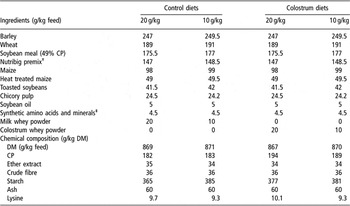
Two treatments were compared: (i) a control diet (commercial diet with bovine milk whey powder) and (ii) a colostrum diet (commercial diet with bovine colostrum whey powder). The commercial diet (SCAR, Herve, Belgium) was a starter diet free of any growth promoters. This diet was distributed the week before weaning to the 15 litters from which the piglets were selected for the trial. The two supplements were mixed with the commercial diet at a rate of 20 g/kg for the first 2 weeks of the trial and 10 g/kg for the next 2 weeks. The compositions of the experimental diets are given in Table 1. The bovine colostrum whey used in this study was prepared from bovine colostrum standardised at 75 g of Ig per litre (Centre d’Economie Rurale, Marloie, Belgium). This colostrum was defatted by centrifugation. Whey was obtained after rennet coagulation at 37°C for 24 h and separation from curds by a mechanical press. The whey was then freeze-dried. The milk whey used was a commercial spray-dried powder (Euroserum, Port-sur-Soane, France). All pigs had ad libitum access to a four-hole feeding trough and a nipple drinker.
Experimental design
The animals were blocked according to BW and gender and assigned to one of the two treatments. For each treatment, the piglets were housed in four pens of 12 piglets (6 males and 6 females). Littermates were distributed between the two treatments.
BW and feed consumption were evaluated weekly to determine the average daily gain (ADG), the average daily feed intake (ADFI) and the feed efficiency (G/F), which is obtained by the following ratio: BW gain/feed intake. Piglets were weighed in the early morning without feed or water restriction.
Diet and whey analyses
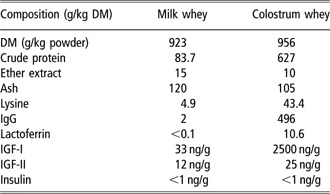
The diets distributed during the trial were ground to pass a 1-mm screen (Cyclotec 1.093; Foss Tecator AB, Höganäs, Sweden) before dry matter, ether extract, Kjeldahl N, crude fibre and ash analyses (Association of Official Analytical Chemists, 1990) were conducted. Samples from the four diets were also ground to pass a 0.5-mm screen for analyses of lysine (AccQ-Tag, Waters, Milford, MS, USA) and starch (adapted from Faisant et al., Reference Faisant, Planchot, Kozlowski, Pacouret, Colonna and Champ1995). The same analyses were performed on the milk and bovine colostrum wheys. Additional analyses were conducted on both milk and colostrum wheys. IGF-I, IGF-II and insulin concentrations were determined with sandwich ELISA quantitation kits (Diagnostics Systems Laboratories, Assendelft, The Netherlands) according to the manufacturer’s procedure. Total IgG and lactoferrin concentrations were measured by sandwich ELISA (Biopole, Les Isnes, Belgium) and reverse-phase HPLC (Shodex Asahipak C4P-50 4D column, Shoko America, Inc., Colorado Springs, CO, USA), respectively. The results of the analysis on the experimental diets and the wheys are presented in Tables 1 and 2, respectively.
Composition of the milk (Control) and colostrum diets

CP = crude protein; DM = dry matter.
†The premix (Roche Vitamins, Deinze, Belgium) is composed by 60% of milk products, 12% of oleaginous seeds, 10% of cereal seeds by-products, 5% of tuber and roots by-products and 12% of minerals and vitamins (vitamins, minerals and amino acids supplied per kilogram of premix: Vitamin A, 100 000 IU; vitamin D3, 13 000 IU; vitamin E, 335 mg; vitamin K3, 9 mg; vitamin B1, 13 mg; vitamin B2, 34 mg; vitamin B3, 100 mg; vitamin B6, 20 mg; vitamin C, 302 mg, vitamin PP, 200 mg; folic acid, 2 mg; choline, 2163 mg; iron (as FeSO4), 1332 mg; copper (as CuSO4), 1100 mg; manganese (as MnSO4), 400 mg; cobalt (as CoSO4), 7 mg; Zinc (as ZnSO4), 1583 mg; Iodine (as CaI206), 14 mg; selenium (as Na2SeO4), 3 mg; Ca, 39 586 mg; P, 8584 mg; Na, 8100 mg; l-lysine HCl, 16 240 mg; dl-methionine, 6630 mg; l-threonine, 2990 mg; l-tryptophan, 260 mg; lysine, 22 740 mg; methionine, 8994 mg; threonine, 10 217 mg; tryptophan, 2352 mg).
‡Providing the following per kilogram of the complete diet (g): methionine, 0.25; lysine, 0.5; threonine, 0.5; tryptophan, 0.25; monocalcique phosphate, 3 g.
Composition of the milk and colostrum wheys

DM = dry matter; Ig = immunoglobulin; IGF = insulin-like growth factor.
Faecal E. coli counts
Fresh faeces were collected on one piglet in each of the 15 litters the day before weaning (day −1) as Katouli et al. (Reference Katouli, Lund, Wallgren, Kühn, Soderlind and Mollby1995) showed a similarity in E. coli populations between littermates during suckling. After weaning, five piglets were randomly chosen in each pen and faeces were collected weekly from these piglets from the fourth day after weaning until the end of the study (days 4, 11, 18 and 25). Faeces were collected by rectal massage. On the day of collection, 10 g of faeces were diluted to a concentration of 1/10 (weight/weight) using peptone water and then 10-fold serial dilutions were achieved. Finally, 100 μl of three successive dilutions of each sample were applied in duplicate to plates containing the culture media (Tryptone Bile X-glucuronide; Biokar Diagnostics, Beauvais, France) (six plates by media and by sample). The dilutions varied from 10−3 to 10−7 g of faeces/ml, according to the results of the precedent week. Plates were incubated at 44°C for 24 h, in aerobic conditions, according to the manufacturer’s procedure to determine the concentrations of E. coli. Only the plates containing 10 to 300 colonies were counted.
Blood collection
Blood samples from the jugular vein were collected into EDTA (ethylene diamine tetra acetic acid) and dry tubes. On the day of weaning (day 0), blood was collected from one piglet of each litter. These animals were then excluded from the experiment. On days 7 and 21, half of the experimental piglets in each pen were blood sampled. The other half were sampled on days 14 and 28. This method of sampling was used to minimise the effect of blood sampling on measured parameters. On day 0, blood was taken on pigs that never entered the study to strictly limit the stress to that of weaning, which was the object of the study.
Blood analysis
Fresh blood collected with EDTA was analysed by a cell counter (MS4.5; MS Laboratoires, Cergy-pontoise, France) for red and white blood cells, haematocrit, haemoglobin and platelet concentrations.
The blood phenotype was analysed by flow cytometry (FACSCalibur flow cytometer; Becton Dickinson, San Jose, CA, USA) for lymphocyte subpopulations (B, T, Th and Tc cells). Blood peripheral lymphocytes were isolated from fresh blood collected with EDTA by density centrifugation on Ficoll PM 400 (Sigma-Aldrich, Bornem, Belgium). The cells were then labelled with mouse antibodies directed against porcine leucocyte-differentiation antigens: anti-CD3ε, anti-CD4a, anti-CD8a and anti-CD21 (BD Pharmingen, San Diego, CA, USA). The anti-CD3 antibodies were labelled with fluorescein isothiocyanate (FITC) and the three others with phycoerythrin (PE). Relative percentages of lymphocyte subpopulations T (CD3+, CD21−), B (CD3−, CD21+), Th (CD3+, CD4+) and Tc (CD3+, CD8+) were determined. A panel of FITC- and PE-labelled mouse IgG (Simultest Control; BD, San Jose, CA, USA) was used as negative control.
Total immunoglobulins
Blood serum was separated from cells by centrifugation (1000 × g, 10 min) after clotting at 2°C for 24 h. Serum was then frozen at −20°C until use. Total serum IgM, IgG and IgA concentrations were determined with sandwich ELISA quantitation kits (Bethyl Laboratories, Montgomery, TX, USA), according to the manufacturer’s procedure, except for the solutions used to wash and dilute samples, which were the solutions usually used in our laboratory and tested previously with the kits. Briefly, the analyses were carried out on 96-well ELISA microplates (Nunc 439454; VWR, Leuven, Belgium). Wells were coated with 1 μg of capture antibody diluted in 100 μl of phosphate buffered saline (PBS) and incubated for 60 min at room temperature. After three washes with PBST 0.2% (PBS containing 0.05% of Tween-20), a blocking solution (PBS/bovine serum albumin (BSA) 2%) was added to block non-specific antigenic sites. Three new washes were performed. Samples and standards were diluted in a PBST 4% solution, according to the expected concentrations of the studied antibody (serum dilutions 1/800 and 1/1600 for IgA and IgM and 1/3200 and 1/6400 for IgG), and 100 μl of the preparation were incubated in the assigned wells for 60 min at room temperature. After five washes, the detection antibodies were added in each well for 60 min at room temperature. Wells were then washed five times with the washing solution and 100 μl of the enzyme substrate (tetramethyl benzidine, TMB) was added for 30 min at room temperature. Finally the reaction was stopped with 100 μl of 2N H2SO4. The absorbance at 450 nm was determined in a microplate reader PR 5000 (Labsystems Multiskan RC, Helsinki, Finland), and the values for each standard were plotted against the concentration to produce a standard curve for the three antibodies. The concentration of the target samples was extrapolated from those curves.
Statistical analysis
For all the parameters, there were four repeated measures. However, for the blood parameters, analysis was separated in two groups of piglets with two replicates for each (days 7 and 21 for the first half of the piglets and days 14 and 28 for the second half of the piglets). Modelling of repeated records was done using the MIXED procedure of SAS (SAS Institute Inc., Cary, NC, USA). Analysis of variance tested treatment (control − colostrum) × time (days post-weaning) interactions. Effects were compared using the CONTRAST statement in the repeated MIXED analysis. The pen was used as the experimental unit for ADFI and G/F. For all the other parameters, the pigs were used as the experimental unit. To fulfil the requirements of normality, a log 10 transformation of the E. coli counts was performed. The values presented are LSmean + s.e. The differences were declared significant at P < 0.05.
Results
Growth performance
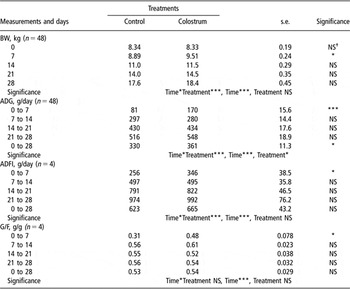
The ADG, ADFI and G/F for the 4-week trial are presented in Table 3. The ADG was higher for the colostrum whey-supplemented pigs compared with the control piglets (P < 0.001) during the first week. In the next 3 weeks, the ADG were similar. Finally, the ADG calculated on the total experimental period was higher for the piglets supplemented with bovine colostrum whey (P = 0.02). The ADFI and G/F per pen (n = 4) were greater in the first week of the trial for pigs fed the colostrum treatment compared with pigs fed the control diet (P = 0.03 and P = 0.04, respectively). For the next 3 weeks and the entire 4-week trial, feed consumption and G/F were not affected by the colostrum treatment.
BW, average daily gain, average daily feed intake and feed efficiency of piglets fed a commercial diet containing milk (Control) or bovine colostrum whey powder for 4 weeks

ADG = average daily gain; ADFI = average daily feed intake; G/F = feed efficiency.
†NS = P > 0.05.
Faecal microflora
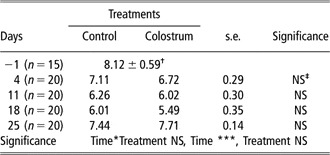
Results of E. coli counts are presented in Table 4. No differences between treatments were shown. A high variability was observed between animals and over the time, but no diarrhoea was observed in piglets during the experimental period.
Faecal Escherichia coli sp. populations (log10 cfu/g of faeces) in piglets fed a commercial diet containing milk (Control) or bovine colostrum whey powder for 4 weeks

†The values on day −1 (mean ± s.d.) were measured on naive piglets coming from the litters in which the piglets were selected for the trial.
‡NS = P > 0.05.
Blood parameters
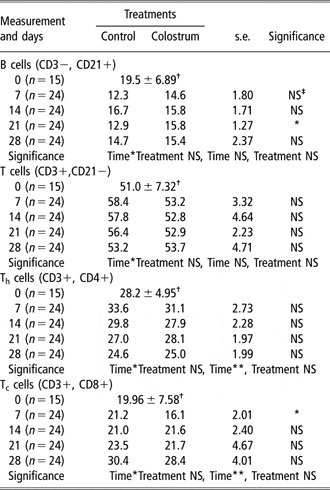
There was no difference (P > 0.05) between the dietary treatments in the red and white blood cells, haematocrit and haemoglobin concentrations (data not shown). Phenotyping of the blood lymphocytes, as presented in Table 5, showed a reduction in B cells on day 21 in the control treatment and a reduction of Tc cells on day 7 in the colostrum-treated piglets. Moreover, while Th population decreased after weaning, Tc increased.
Relative percentage of lymphocyte subpopulations (B, T, Th and Tc) in the blood serum of piglets fed a commercial diet containing milk (Control) or bovine colostrum whey powder for 4 weeks

†The values on day 0 (mean ± s.d.) were measured on naive piglets coming from the litters in which the piglets were selected for the trial.
‡NS = P > 0.05.
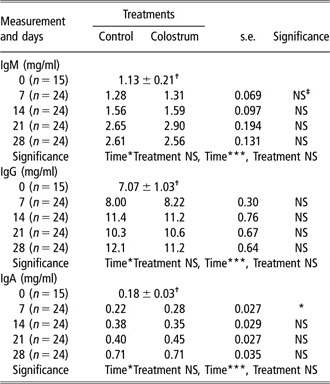
Total IgM, IgG and IgA concentrations are given in Table 6. The total IgM and IgG levels were not influenced by dietary treatment (P > 0.05), but IgA concentrations were higher on day 7 (+25%, P = 0.03) for pigs fed the colostrum diet.
Immunoglobulins (IgM, IgG and IgA) concentrations in the blood serum of piglets fed a commercial diet containing milk (Control) or bovine colostrum whey powder for 4 weeks

†The values on day 0 (mean ± s.d.) were measured on naive piglets coming from the litters in which the piglets were selected for the trial.
‡NS = P > 0.05.
Discussion
Composition of both supplements
The analyses of both supplements show an important difference in the concentration of crude proteins between the two wheys (8.37% for milk whey v. 62.7% for colostrum whey), which could be mainly explained by the concentration in IgG (2 g/kg in milk whey v. 496 g/kg in colostrum whey). Higher concentrations in lactoferrin and IGF-I were also measured in the colostrum whey. These results indicated that the latter contains higher concentrations in growth promoters and antimicrobial factors than milk whey.
Growth-promoting activity of bovine colostrum
The inclusion of bovine colostrum whey in the weaning diet improved growth performances, feed intake and G/F (by 100%, 30% and 50%, respectively) the first week after weaning. These results corroborate observations made by Pluske et al. (Reference Pluske, Pearson, Morel, King, Skilton and Skilton1999), King et al. (Reference King, Morel, James, Hendriks, Pluske, Skilton and Skilton2001) and Le Huërou-Luron et al. (Reference Le Huërou-Luron, Hughet, Callarec, Leroux and Le Dividich2004) who measured, on weaning piglets fed with diets containing 40 to 100 g/kg of bovine colostrum extracts, increases in ADG from 20% to 115% and for ADFI from 10% to 30% during the first 10 days post-weaning. However, in our study, a lower supply of bovine colostrum (20 g/kg feed) increased growth performances and improved feed intake at comparable levels to those reported by the previous authors. These observations suggest that the effects of bovine colostrum on performance and feed intake of piglets at weaning may be obtained with a lower level of supplementation. Nevertheless, the differences in the results may also be explained by the composition of the bovine colostrum used, as little information is given about the preparation and the composition of the colostrum extracts experimented in the above-cited studies. Indeed, the action of the colostrum may be related to its composition in growth factors (e.g. epidermal growth factors (EGF), IGF-I, transforming growth factors-β (TGF-β)). Xu et al. (Reference Xu, Sangild, Zhang and Zhang2002) reported a regulatory role for the colostrum growth factors in stimulating intestinal tissue growth in newborn piglets. In the newly weaned piglet, Le Huërou-Luron et al. (Reference Le Huërou-Luron, Marion, Bebin, Thomas, Ganier, Thibault and Le Dividich2003) and Huguet et al. (Reference Huguet, Sève, Le Dividich and Le Huërou-Luron2006 and Reference Huguet, Le Normand, Fauquant, Kaeffer and Le Huërou-Luron2007) showed an effect of bovine colostrum on the digestive and absorptive capacity of the small intestine, which may explain the improved G/F observed in the colostrum treatment.
Antimicrobial activity of bovine colostrum
Successful use of colostrum in the treatment of diarrhoea caused by E. coli has been reported in human patients (Carbonare et al., Reference Carbonare, Silva, Palmeira and Carneiro-Sampaio1997; Honorio-Franca et al., Reference Honorio-Franca, Carvalho, Isaac, Trabulsi and Carneiro-Sampaio1997). Colostrum and milk wheys contain antimicrobial components effective against E. coli such as lactoferrin (Saito et al., Reference Saito, Miyakawa, Tamura, Shimamura and Tomita1991; Erdei et al., Reference Erdei, Forsgren and Naidu1994), lactoperoxidase (Reiter, Reference Reiter1985) and lysozyme (Yamauchi et al., Reference Yamauchi, Toimita, Giehl and Ellison1993). Despite the higher concentration of lactoferrin in bovine colostrum whey compared with milk whey, no difference between the total E. coli populations with the two treatments was observed. This may be due to the absence of post-weaning diseases during this study.
As the IgG may also act as an antimicrobial component by preventing viruses and bacteria from damaging the gut wall, thereby resulting in a more functional intestinal wall (Coffey and Cromwell, Reference Coffey and Cromwell2001), the far higher concentration of bovine colostrum whey in IgG compared with milk whey can also have improved ADG, ADFI and G/F. This is confirmed by Pierce et al. (Reference Pierce, Cromwell, Lindemann, Russell and Weaver2005), who showed that the IgG fraction of bovine plasma increased the growth rate and feed intake of piglets during the early post-weaning period.
Systemic immune response to bovine colostrum
The main effect of bovine colostrum observed in this study on the systemic immune response of the piglets is an increase in seric IgA concentrations the first week post-weaning. In a previous study (Boudry et al., Reference Boudry, Buldgen, Portetelle, Collard, Théwis and Dehoux2007), an increase in seric IgA was also observed after bovine colostrum distribution to weaned piglets; however, this increase occurred 3 weeks after weaning. Many differences between this study and the previous one may be responsible for this early immune response: (i) the sanitary conditions of the experiment (on-farm facility with continuous pig flow v. university facility without other pigs), (ii) the weaning age (28 days v. 21 days) and (iii) the piglet origin (production farm v. selection farm). In our previous study, results indicated an influence of bovine colostrum on the development of the systemic IgA response by potentiating a Th2 response in the ileal Peyer’s patch. IgA is the most produced isotype in the intestine, with more than 80% of the intestinal Ig secreting cells producing IgA (Bianchi et al., Reference Bianchi, Scholten, Moonen Leusen and Boersma1999). The increase in blood IgA may be due to an increase in intestinal IgA synthesis, as Vaerman et al. (Reference Vaerman, Langendries, Pabst and Rothkötter1997) demonstrated that roughly 30% of the total plasma IgA originated daily from local intestinal synthesis.
Gill and Rutherfurd (Reference Gill and Rutherfurd1998) reported that oral administration of bovine milk proteins to heterologous species can enhance localised antibody responses to heterologous orally delivered antigens. Therefore, the administration of bovine colostrum, which is enriched in proteins, can have reduced the sensitivity of the weaned pig to post-weaning infection. Among these proteins, Chun et al. (Reference Chun, Nam, Goh, Kim, Han and Kim2004) showed that TGF-β2 is the most potent cytokine in the induction of IgA isotype switching in mesenteric lymph node cells of BALB/c mices. Van Vlasselaer et al. (Reference Van Vlasselaer, Punnonen and De Vries1992) showed the same effect of porcine TGF-β1 on IgA production by human splenic B cells, but no effect on IgG and IgM production. Elfstrand et al. (Reference Elfstrand, Lindmark-Mansson, Paulsson, Nyberg and Akesson2002) showed that this cytokine is present in higher concentrations in bovine colostrum than in milk (289 ng/ml 0–6 h post partum v. 66 ng/ml 51–80 h post partum) and that 67% of it is conserved in freeze-dried whey.
The difference in blood IgA between the two treatments disappeared the second week post-weaning, simultaneously with the difference in feed intake and growth performance. This suggests a relationship between feed intake and the stimulation of systemic and gut IgA production in the first days post-weaning, but no information confirming this postulate was found in the literature.
The phenotyping of the blood lymphocytes showed a reduction of the Tc population on day 7 in the colostrum-fed piglets, suggesting a cytokine-profile related effect. The Tc cells presence is commonly associated with a Th1 immune response, whereas a Th2 profile leads to a decrease in this population (McGee and Agrawal, Reference McGee and Agrawal2006). We previously demonstrated a more marked Th2 immune profile in the ileal Peyer’s patch of colostrum-fed piglets with the enhanced production of IL-4 and IL-10 (Boudry et al., Reference Boudry, Buldgen, Portetelle, Collard, Théwis and Dehoux2007); this Th2 profile could be responsible for the decrease of the Tc cells by interfering in IFNγ and IL-12 production (Romagnani, Reference Romagnani1991).
Statistical analysis also showed an effect of colostrum treatment on B cells. However, in our study, the sampling protocol did not allow to conclude if this observation is the consequence of the treatments or if they are related to the variability among the piglets. To clarify this point, in further studies, blood samples should be collected on the same animals throughout the experiment.
Conclusion
Our study demonstrated that bovine colostrum whey may be used in piglet weaning diet at a level of 20 g/kg during the first week post-weaning to reduce under-feeding and weight losses. The supplementation also induced an increase of the total seric IgA level 7 days post-weaning. The performance response may be in part mediated by an increase in seric IgA. Further work is required to confirm the mechanism and minimum level of dietary inclusion of bovine colostrum to obtain performance enhancement.
Acknowledgements
The research was subsidised by the ‘Direction Générale de l’Agriculture’ (DGA) and the ‘Direction Générale des Technologies de la Recherche et de l’Energie’ (DGTRE) of the Ministry of Walloon Region, Namur, Belgium.