

Research is increasingly demonstrating that health profession university students experience high levels of burnout from their study (DiGiacomo & Adamson, Reference DiGiacomo and Adamson2001; Jacobs & Dodd, Reference Jacobs and Dodd2003). Students in the health profession degrees of nursing, social work, psychology and occupational therapy participate in work placements as part of their study and are therefore exposed to similar stressors as professionals, as well as academic pressure, deadlines, and often financial struggles (D. Edwards, Burnard, Bennett, & Hebden, Reference Edwards, Burnard, Bennett and Hebden2010; Rella, Winwood, & Lushington, Reference Rella, Winwood and Lushington2009). Burnout in students has been linked to increased suicidal ideation, decreased self-esteem and performance, and dropout (Dyrbye et al., Reference Dyrbye, Thomas, Massie, Power, Eacker, Harper and Shanafelt2008; D. Edwards et al., Reference Edwards, Burnard, Bennett and Hebden2010; Moneta, Reference Moneta2011). While burnout has been demonstrated to be a problem in university students there has been little research on study engagement in students. Engagement is the positive antipode to burnout; while work and study can be stressful and depleting, they can also be rewarding and energising, and engagement in work is related to positive health outcomes (Christian & Slaughter, Reference Christian and Slaughter2007). Preliminary research has linked engagement to student performance, at times more strongly than burnout, highlighting the importance of exploring engagement in students (Salanova, Schaufeli, Martinez, & Breso, Reference Salanova, Schaufeli, Martinez and Breso2010). This study aimed to explore burnout and engagement in health profession students, using relevant theories and focusing on the role of personal resources.
Research on student burnout and engagement has rarely used the two most prominent burnout theories, the Job Demands and Resources (JD-R) and Conservation of Resources (COR) models. This study aimed to add to the existing burnout and engagement literature by exploring these concepts in a sample of health profession students, also including personal resources such as psychological flexibility, which has not been explored in the context of the JD-R model previously.
Current Definitions and Theory
Burnout is most frequently defined as ‘a psychological syndrome that involves a prolonged response to stressors in the workplace’ (Maslach, Reference Maslach2003, p. 189), which involves three dimensions. These consist of exhaustion, which is considered the starting point from which the two further components, cynicism (or depersonalisation) and diminished professional efficacy, develop (Maslach, Reference Maslach2003). Exhaustion can be described as a state of ongoing, intense fatigue in response to demanding work conditions, and is often considered the key element in burnout (Bakker, Van Emmerik, & Van Riet, Reference Bakker, Van Emmerik and Van Riet2008; Maslach, Schaufeli, & Leiter, Reference Maslach, Schaufeli and Leiter2001). Cynicism is very closely related to the exhaustion component of burnout and is an act of distancing oneself from work or clients in the attempt to make work more manageable (Maslach et al., Reference Maslach, Schaufeli and Leiter2001). Professional efficacy relates to feelings of accomplishment and effectiveness at work. It has been considered less central to the burnout concept than exhaustion or cynicism (Bakker et al., Reference Bakker, Van Emmerik and Van Riet2008; Lee & Ashforth, Reference Lee and Ashforth1996), and some studies have found it is more related to engagement than burnout (e.g., Schaufeli & Salanova, Reference Schaufeli and Salanova2007). Engagement is a positive and fulfilling state of wellbeing related to work and study. Schaufeli, Salanova, González-Romá, and Bakker (Reference Schaufeli, Salanova, González-Romá and Bakker2002) identified three aspects of engagement: vigour, characterised by high levels of energy and persistence; dedication, the feeling of being strongly involved and a sense of pride in one's work; and absorption, where one is fully absorbed in work and time passes quickly. Both engagement and burnout have been explored with student populations. Dyrbye et al. (Reference Dyrbye, Moutier, Durning, Massie, Power, Eacker and Shanafelt2011) found that at graduation 49% of medical students experienced symptoms of burnout. Casuso-Holgado et al. (Reference Casuso-Holgado, Cuesta-Vargas, Moreno-Morales, Labajos-Manzanares, Baron-Lopez and Vega-Cuesta2013) found a small but significant correlation between study engagement and GPA in health science students.
The development of the COR model (Hobfoll, Reference Hobfoll1989, Reference Hobfoll2001) and the JD-R model (Demerouti, Bakker, Nachreiner, & Schaufeli, Reference Demerouti, Bakker, Nachreiner and Schaufeli2001) has greatly increased theory-based research in the areas of burnout and engagement. While these models have been used increasingly with employees, there is very little research using these models with students (see Alarcon, Edwards, & Menke, Reference Alarcon, Edwards and Menke2011; and Salanova et al., Reference Salanova, Schaufeli, Martinez and Breso2010, for exceptions). Research on student burnout and engagement needs to use relevant theories, such as the JD-R and COR models, to develop a stronger evidence base around the causes and consequences of burnout and engagement.
The JD-R model focuses on two processes: the health impairment process predicts that burnout will occur when the conditions of high job demands and limited job resources are met, while the motivational process predicts that engagement will occur under conditions of high job resources (Bakker, Demerouti, & Euwema, Reference Bakker, Demerouti and Euwema2005). Job demands are aspects of work that require effort, while job resources are aspects of the job that aid achievement of work goals, reduce job demands and/or promote personal growth and development (Demerouti et al., Reference Demerouti, Bakker, Nachreiner and Schaufeli2001). There is a large evidence base supporting this model in workers; Llorens, Bakker, Schaufeli, and Salanova (Reference Llorens, Bakker, Schaufeli and Salanova2006) demonstrated that demands predicted burnout and resources predicted engagement in many different work contexts. Demands and resources have been explored in student burnout and engagement: Dahlin, Fjell, and Runeson (Reference Dahlin, Fjell and Runeson2010) found that that demands of competence were related to exhaustion in medical students. Llorens, Schaufeli, Bakker, and Salanova (Reference Llorens, Schaufeli, Bakker and Salanova2007) found that study resources led to increased engagement, via increased self-efficacy. However, the JD-R model has not been tested explicitly in study burnout and engagement.
The COR model and the JD-R model are complementary; the JD-R model provides a robust framework for burnout and engagement and the COR provides additional information, including recognising the importance of personal resources (Akhtar & Lee, Reference Akhtar and Lee2010). The COR model proposes that stress will occur when there is a threat to resources, actual loss of resources, or failure to make adequate gains after investing resources (Hobfoll, Reference Hobfoll1989). The COR also outlines resource loss and gain spirals, where the loss of one resource is likely to lead to further losses, and having resources leads to further accumulation of resources (Salanova, Llorens, & Schaufeli, Reference Salanova, Llorens and Schaufeli2011).
The Current Study
This study examined study burnout and engagement in nursing, occupational therapy, social work and psychology students. While burnout and engagement have been explored in health profession students, this has largely occurred in specific disciplines. Comparing across disciplines may provide valuable information about whether some degrees lead to more burnout or engagement than others. Mental health in students was also measured, both to explore the relationship of burnout and engagement with mental health in students and to review the current mental wellbeing of health profession students. This study aimed to validate the JD-R model, with the student population contributing to the theoretical understanding of burnout and engagement in students as being similar or different to workers. This study also aimed to extend on the JD-R framework by incorporating theory from the COR model. This was achieved by including personal resources in some analyses and by using moderation and mediation to explore the indirect relationships between demands and resources and their impact on burnout and engagement. The study aimed to inform future interventions for burnout and engagement, and variables were chosen where possible that could be targeted in an intervention.
The first aim of this study was to use the framework of the JD-R model to explore student burnout and engagement in a sample of health profession students. While there has been increasing interest in study burnout and engagement, very little of this research has used validated theoretical models. The study demands explored were subjective measures of workload and the psychological demand of pressure to be a competent professional. Workload, perceived and actual, has been one of the most frequently measured demands associated with workplace burnout (e.g., Demerouti et al., Reference Demerouti, Bakker, Nachreiner and Schaufeli2001). In a sample of university students, Jacobs and Dodd (Reference Jacobs and Dodd2003) found that while subjective workload predicted high levels of burnout, actual workload was not predictive of burnout. Another demand strongly related to the health profession students is the pressure to perform as a competent professional. Worry about future performance and capability has been linked to exhaustion in medical students (Dahlin et al., Reference Dahlin, Fjell and Runeson2010). Cherniss's (Reference Cherniss1992) qualitative and longitudinal study of burnout in early career professionals found that burnout in the early years of helping professionals was often related to demands of competence. As these findings suggest a strong role of pressure and worry about performance on burnout, the second demand explored in this study was the pressure to be a competent professional.
Social support as a work resource has been found to be very important in both preventing burnout and increasing engagement (Christian & Slaughter, Reference Christian and Slaughter2007; Halbesleben & Buckley, Reference Halbesleben and Buckley2004). The COR model suggests that the impact of demands can be reduced by increasing resources that will directly impact that demand (Halbesleben & Buckley, Reference Halbesleben and Buckley2004). Supervisor support may be particularly important as it can directly target demands such as professional competence and subjective experience of workload. There are many avenues in which supervisor support may reduce perceptions of demands, including aiding students to positively reframe stressful situations or providing an experienced perspective.
The JD-R model suggests that burnout and engagement can be predicted by a combination of demands and resources. It suggests that demands will be positively related to burnout and negatively related to engagement, with the opposite relationship for resources; also, that demands are more strongly related to burnout than resources, with the opposite relationship for engagement (Bakker et al., Reference Bakker, Demerouti and Euwema2005). To test whether the JD-R model fit with health profession students, the following hypotheses were formulated:
Hypothesis 1a. It is expected that study demands will be positively related to burnout and negatively related to engagement.
Hypothesis 1b. It is expected that study resources will be negatively related to engagement and positively related to burnout.
The next aim of this study was to expand upon the JD-R model, using the COR model, to explore the role of personal resources in students’ burnout and engagement. While the majority of research exploring work and study burnout and engagement has been on organisational factors, there have been ongoing recommendations to explore the role of personal resources (Xanthopoulou, Bakker, Demerouti, & Schaufeli, Reference Xanthopoulou, Bakker, Demerouti and Schaufeli2007, Reference Xanthopoulou, Bakker, Demerouti and Schaufeli2009). Personal resources are important as not all stressors are avoidable and therefore differences in appraisal and varying ability to cope with stressors may significantly impact burnout and engagement (Bond, Flaxman, van Veldhoven, & Biron, Reference Bond, Flaxman, van Veldhoven, Biron, Houdmont and Leka2010). Four personal resources were explored, based on relevance, prior research and whether the variables could be targeted in psychosocial interventions for burnout and engagement. The personal resources explored were coping, optimism, mindfulness and psychological flexibility.
Coping can be conceptualised as a personal resource and has been linked to burnout in workers (Riolli & Savicki, Reference Riolli and Savicki2003). This study focused on positive reframing coping. Use of positive reframing coping may lead to perception of demands as less stressful and therefore leads to reduced burnout, given the importance of perceived workload versus actual workload in student burnout (Jacobs & Dodd, Reference Jacobs and Dodd2003). Positive reframing is an important part of cognitive behaviour therapy (CBT) interventions and it could easily be incorporated into many styles of intervention.
Optimism is an important concept in the emerging field of positive psychology, which finds that people who generally see situations in a more positive or hopeful light utilise more effective coping strategies than those who see things more negatively (Scheier & Carver, Reference Scheier and Carver1993). Evidence for the role of optimism in workers has been found, with Riolli and Savicki (Reference Riolli and Savicki2003) demonstrating that optimism moderated the effects of work resources on burnout, particularly where work resources were low. Optimism during university was found to lead to increased work engagement and decreased burnout several years later (Salmela-Aro, Tolvanen, & Nurmi, Reference Salmela-Aro, Tolvanen and Nurmi2009).
There are promising interventions for burnout using mindfulness and acceptance and commitment therapy (ACT)–based therapies (i.e., Brooker et al., Reference Brooker, Julian, Webber, Chan, Shawyer and Meadows2013; Flaxman & Bond, Reference Flaxman and Bond2010). However, there has been very little research looking at the role of mindfulness or psychological flexibility (an ACT-related concept) as personal resources impacting burnout or engagement, and none that the authors are aware of in students. Glomb, Duffy, Bono, and Yang's (Reference Glomb, Duffy, Bono, Yang, Joshi, Liao and Martocchio2011) review of mindfulness in the workplace describes mindfulness as paying attention to the present moment, without judgment or evaluation. Mindfulness may decrease burnout by decreasing rumination, increasing response flexibility and engagement, and improving affective regulation, as it leads to increased persistence (Glomb et al., Reference Glomb, Duffy, Bono, Yang, Joshi, Liao and Martocchio2011).
Psychological flexibility is a concept from relational frame theory, a recent empirically validated model, which proposes that psychological difficulties are developed through our use of language and the role of avoidance in coping (Bond, Hayes, & Barnes-Holmes, Reference Bond, Hayes and Barnes-Holmes2006). Psychological flexibility is the ability to contact and accept the present moment, similar to mindfulness, and to use that acceptance of reality to act in a way that fits one's values and goals. Bond and Bunce (Reference Bond and Bunce2003) hypothesised that psychological flexibility would impact work performance through a dual action model: first, an employee high in flexibility would be able to accept their current emotions and therefore not spend their resources attempting to solve their emotions; and second, behaviour driven by values leads to an increased ability to focus available resources on work. Psychological flexibility has been demonstrated as the active ingredient in reducing burnout in an intervention (Lloyd, Bond, & Flaxman, Reference Lloyd, Bond and Flaxman2013) but has not been explored as a personal resource within the COR or JD-R models in students.
The COR model and previous research suggests that personal resources are important in explaining burnout and engagement. To test this, the following hypotheses were formed:
Hypothesis 2a and 2b: Personal resources, including psychological flexibility, mindfulness, coping and optimism, will be (a) negatively related to burnout and (b) positively related to engagement.
Testing mediation and moderation relationships suggested by the JD-R and COR models has been a recent focus of burnout and engagement research (Alarcon et al., Reference Alarcon, Edwards and Menke2011). The JD-R model specifies that job resources are likely to have a moderation relationship with burnout by buffering job demands (Xanthopoulou, Bakker, Dollard et al., Reference Xanthopoulou, Bakker, Dollard, Demerouti, Schaufeli, Taris and Schreurs2007); for example, if social support is high, the relationship between work load and exhaustion might become weaker. It follows that personal resources may also have a moderating role on job demands. For example, people high in psychological flexibility will likely be buffered from the effects of study demands on burnout as they may be able to respond more effectively to demands and find them less draining than people low in psychological flexibility, preventing a resource loss spiral where one resource loss leads to another (e.g., Onwezen, van Veldhoven, & Biron, Reference Onwezen, van Veldhoven and Biron2012). The COR model suggests that personal resources may moderate by boosting the impact of job resources on engagement as part of a positive gain spiral. For example, Bond and Bunce (Reference Bond and Bunce2003) found higher levels of psychological flexibility predicted a stronger relationship between job control and mental health and work performance, indicating a boosting effect.
The COR model also suggests that having resources leads directly to further accumulation of resources; this may occur by way of mediating relationships between personal and study resources (Xanthopoulou, Bakker, Demerouti et al., Reference Xanthopoulou, Bakker, Dollard, Demerouti, Schaufeli, Taris and Schreurs2007). For example, psychological flexibility could lead to increases in study resources due to the value-driven behaviour of those high in psychological flexibility. Where resources are valued highly, more investment towards procuring and maintaining study resources will likely occur. People high in psychological flexibility may be more driven to access supervision or other social support due to a strong goal focus, which may result in increased engagement. It was also hypothesised that job demands could mediate between personal resources and exhaustion. Personal resources such as psychological flexibility, optimism and mindfulness are all likely to lead to reduced perception of job demands, which in turn leads to reduced exhaustion. Xanthopoulou, Bakker, Demerouti et al. (Reference Xanthopoulou, Bakker, Dollard, Demerouti, Schaufeli, Taris and Schreurs2007) explored whether job demands could mediate between personal resources (using a measure combining optimism, organisational-based self-esteem and self-efficacy) and exhaustion, and did not find a significant result. This mediation relationship will be retested using psychological flexibility in the current study.
An a priori decision was made to test mediation and moderation effects using only one personal resource, psychological flexibility. There were several reasons behind this. The first was that although related, the personal resources in this model were considered different enough that it was preferable to look at individual impacts rather than a combined measure. There is a strong theoretical link between psychological flexibility, burnout and engagement, and psychological flexibility is a key mechanism of change in ACT training programs; this study had the aim of further exploring how psychological flexibility may impact exhaustion. To test possible moderating and mediating relationships, the following hypotheses were developed:
Hypothesis 3a. Personal resources (psychological flexibility) will moderate (buffer) the effects of study demands (perceived workload) on burnout.
Hypothesis 3b. Personal resources (psychological flexibility) will moderate (boost) the effect of study resources (supervisor support) on engagement.
Hypothesis 4a. Study demands (perceived workload) will partially mediate the relationship between personal resources (psychological flexibility) and burnout.
Hypothesis 4b. Study resources (supervisor support) will partially mediate the relationship between personal resources (psychological flexibility) and engagement.
The overarching aim of the study was to provide further information about burnout, engagement and mental health on a heterogeneous sample of health profession students. Research on Australian university students suggests that mental health is significantly poorer than in the general population (Stallman, Reference Stallman2010). In studies of burnout and engagement, the impact on mental health is often implied; however, it was considered important to explicitly demonstrate these relationships in this study, adding to the understanding of how study and work health are related to mental health. The majority of research on health students has focused on medical students and nursing students (Dutta, Pyles, & Miederhoff, Reference Dutta, Pyles and Miederhoff2005). There is very little research looking at burnout and engagement in psychology, social work or occupational therapy students, and even less comparing disciplines. In nursing students, research suggests that burnout is higher and engagement lower as study progresses (Deary, Watson, & Hogston, Reference Deary, Watson and Hogston2003). DiGiacomo and Adamson (Reference DiGiacomo and Adamson2001) suggested that stress levels have been reported as higher in nursing students than other health profession students; however, this needs validation. In workers, a general trend is that burnout is often higher in younger rather than older individuals (Schaufeli & Enzmann, Reference Schaufeli and Enzmann1998), and this may be similar in students. Comparison between disciplines may help to clarify whether there are significant differences in course demands or whether study demands and resources tend to be fairly similar across different health profession degrees.
Method
Participants and Procedure
Participants were 260 health profession students from the disciplines of nursing (53.5%), occupational therapy (16.9%), social work (15.4%), and psychology (14.2%). Participants were recruited from 10 universities across two states in Australia. Program coordinators for all the relevant courses in New South Wales and South Australia were invited to send an email to their students that included information about the study and a link to the online survey. Relevant courses included any nursing, social work and occupational therapy undergraduate degrees. Only masters and clinical PhD or doctorate programs were contacted in psychology. These programs were targeted as they all involve placements where students will work with clients (patients, consumers). This study was approved by the University of Adelaide School of Psychology Human Resources Ethics subcommittee. It was not possible to calculate a response rate as participants were contacted via program coordinators and not directly by the researchers. Uncertainty about response rate is expected when participants are not contacted directly (e.g., Young, Fang, Golshan, Moutier, & Zisook, Reference Young, Fang, Golshan, Moutier and Zisook2012). Suggestions from P.J. Edwards et al. (Reference Edwards, Roberts, Clarke, DiGuiseppi, Wentz, Kwan and Pratap2009) were followed, such as providing an incentive — participants were put in a lottery to win one of three $100 retail vouchers — and making the topic interesting to participants. The survey was directed at final year students; however, a proportion of participants were not in their final year of study (20%). The average age of students was 29 (SD = 10.17), ranging between 18 and 68.
Measures
Personal resources
Psychological flexibility was measured by the seven-item Acceptance and Action Questionnaire version 2 (AAQ-II; Bond et al., Reference Bond, Hayes, Baer, Carpenter, Guenole, Orcutt and Zettle2011). A sample from the questionnaire is: ‘I’m afraid of my feelings’. The AAQ-II was developed to improve earlier versions and acceptable internal reliability and convergent and discriminant validity have been reported (Bond et al., Reference Bond, Hayes, Baer, Carpenter, Guenole, Orcutt and Zettle2011). Higher scores indicate lower levels of psychological flexibility. Mindfulness was measured with the Mindfulness Attention Awareness Scale (MAAS; Brown & Ryan, Reference Brown and Ryan2003). The MAAS is sensitive to levels of individual mindfulness, particularly in regards to present awareness, and has good psychometric properties (Baer, Smith, Hopkins, Krietemeyer, & Toney, Reference Baer, Smith, Hopkins, Krietemeyer and Toney2006). A sample of the 15 items is: ‘I could be experiencing some emotion and not be conscious of it until some time later’. Higher scores indicate higher levels of mindfulness. Positive reframing coping was measured with the two-item scale from the Brief COPE; for example, ‘I’ve been looking for something good in what is happening’ (Carver, Reference Carver1997). Higher scores indicate more frequent use of positive reframing coping. The measure has reported acceptable reliability and validity in medical students (Yusoff, Reference Yusoff2010). Optimism was measured using the Life Orientation Test — Revised (LOT-R; Scheier, Carver, & Bridges, Reference Scheier, Carver and Bridges1994). The questionnaire consists of 10 items including four ‘filler’ items that were not included in calculating the final optimism score, and higher scores indicate more optimism. An example item is: ‘I’m always optimistic about my future’. The LOT-R is widely used and satisfactory psychometric properties have been reported (Glaesmer et al., Reference Glaesmer, Rief, Martin, Mewes, Brähler, Zenger and Hinz2012).
Study resources
Social support was measured with a modified version of Caplan, Cobb, French, Harrison, and Pinneau's (Reference Caplan, Cobb, French, Harrison and Pinneau1975) questionnaire, reworded as suggested by Galek, Flannelly, Greene, and Kudler (Reference Galek, Flannelly, Greene and Kudler2011) and further modified to fit the university setting. The measure asks four questions to be rated for two different groups of people: a university supervisor or staff member and university peers. An example question is: ‘How willing are the following people to listen to your work-related problems?’ Higher scores indicate higher levels of perceived social support. Frese (Reference Frese1999) found high test–retest reliability and acceptable convergent validity for the scale in workers.
Study demands
Two types of study demand were measured using the Mental Health Professionals Stress Scale (MHPSS; Cushway, Tyler, & Nolan, Reference Cushway, Tyler and Nolan1996). The subscales included were workload and professional self-doubt and included six items each. The workload subscale measures the subjective experience of workload; for example, ‘too much work to do’. The professional self-doubt subscale was used to measure the demand for professional competence expected as a new health professional. Items included ‘uncertainty about own capabilities’ and ‘feeling inadequately skilled for dealing with difficult clients’. While the scale was developed particularly for mental health professionals, the items are relevant to health profession students. Higher scores indicate the presence of more perceived demands. Mehrotra, Rao, and Subbakrishna (Reference Mehrotra, Rao and Subbakrishna2000) found acceptable reliability and validity of the scale in working psychologists.
Outcomes
Burnout was measured using the five-item ‘exhaustion’ subscale of the Maslach Burnout Inventory — Student Survey (MBI-SS; Schaufeli, Martínez, Marques Pinto, Salanova, & Bakker, Reference Schaufeli, Martínez, Marques Pinto, Salanova and Bakker2002). This was chosen as exhaustion is often considered the key component of burnout and the first result of the health impairment process of the JD-R. A sample item is: ‘I feel burned out from my studies’. Higher scores on the exhaustion scale indicate higher levels of reported exhaustion. Initial validation for the MBI-SS found acceptable reliability and validity (Schaufeli et al., Reference Schaufeli, Martínez, Marques Pinto, Salanova and Bakker2002). Study engagement was measured using the Utrecht Work Engagement Scale For Students (UWES-SS; Schaufeli et al., Reference Schaufeli, Martínez, Marques Pinto, Salanova and Bakker2002), a 14-item scale. The measure consists of three scales: Vigour (e.g., ‘When I am studying I feel strong and vigorous’), Dedication (e.g., ‘My studies inspire me’) and Absorption (e.g., ‘Time flies when I’m studying’). The total score for the engagement was used as it had higher internal consistency score than the components (Schaufeli, Bakker, & Salanova, Reference Schaufeli, Bakker and Salanova2006). Higher engagement scores indicate higher levels of engagement. The initial validation of the UWES-SS found acceptable reliability and validity (Schaufeli et al., Reference Schaufeli, Martínez, Marques Pinto, Salanova and Bakker2002). Mental health was measured using The General Health Questionnaire (GHQ; Goldberg, Reference Goldberg1972). The GHQ is a questionnaire designed to measure psychological distress; it also provides an estimate of whether an individual may have a psychiatric illness. Higher scores indicate higher levels of distress. For this study the 12-item version was used, which has been reported to have adequate convergent and discriminant validity and acceptable reliability in healthcare workers (Hardy, Shapiro, Haynes, & Rick, Reference Hardy, Shapiro, Haynes and Rick1999). An example question is: have you recently ‘been able to concentrate on whatever you’re doing?’
Statistical Analysis
Data were analysed using Statistics SPSS v. 20. Assumptions of multicollinearity, outliers, normality, linearity, homoscedasticity and independence of residuals were checked and assumptions were met for all analyses conducted (Tabachnick & Fidell, Reference Tabachnick and Fidell2007). Moderation and mediation were tested using Baron and Kenny's (Reference Baron and Kenny1986) method, and Frazier, Tix, and Barron's (Reference Frazier, Tix and Barron2004) guidelines for meeting assumptions and maximising power were followed. Power for mediation and moderation can be increased when testing hypotheses strongly grounded in theory and with highly reliable scales. All hypotheses were strongly theory based. Reliability coefficients for all tests can be found on the diagonal of the correlation matrix, and all reliabilities are high and are over the recommended .70.
Results
Descriptive Statistics
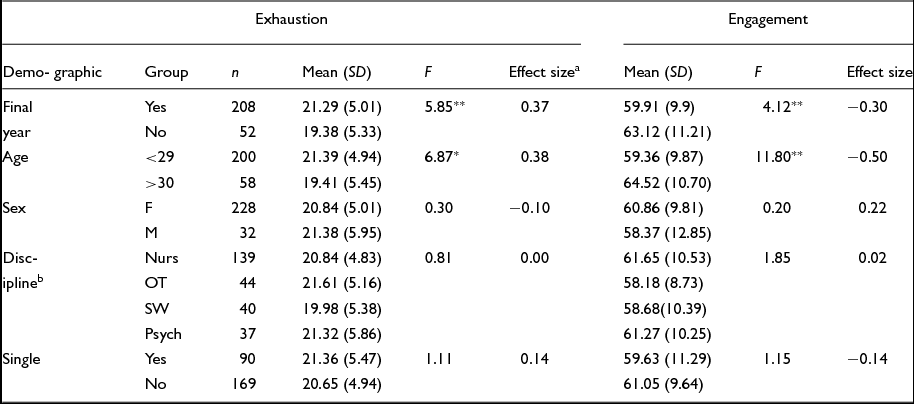
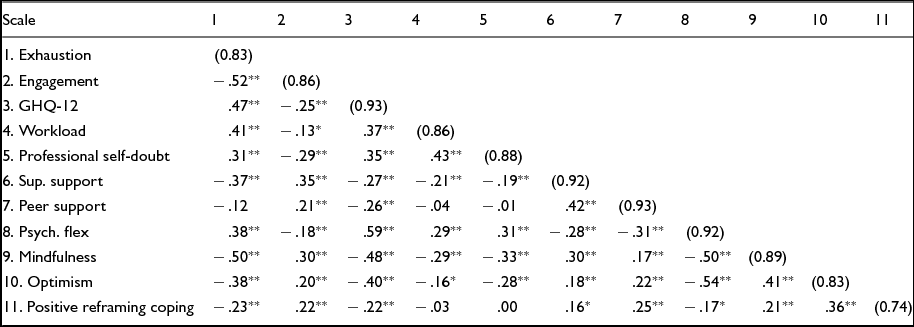
Exhaustion and engagement were significantly higher in final year students versus those prior to their final year. Younger students had higher exhaustion scores and lower engagement scores than older students. There were no significant differences in exhaustion or engagement between disciplines, gender, or relationship status (see Table 1). Mental health was explored using the GHQ-12. Using the recommended (conservative) criteria of having a score of 4 or more on the GHQ-12 (Hardy et al., Reference Hardy, Shapiro, Haynes and Rick1999), 36.1% of students could be considered ‘cases’ (likely to have a diagnosable mental health problem). This is higher than would be typically expected in a general population, as the GHQ-12 manual suggests between 12% and 20% will meet the ‘caseness’ criteria. The GHQ-12 was moderately to strongly correlated with exhaustion and had a weak to moderate correlation with engagement (see Table 2).
Demographic and Discipline Based Differences in Exhaustion and Engagement

Note: aCohen's d used for t-tests; η2 used for ANOVAs; bNurs = Nursing. OT = Occupational therapy; SW = Social work; Psych = Psychology.
*p < .05. ** p < .01.
Correlations With Cronbach's αs on the Diagonal
Note: GHQ-12 = General Health Questionnaire — 12 item version.
**p > .01. *p > .05.
Regression Analyses
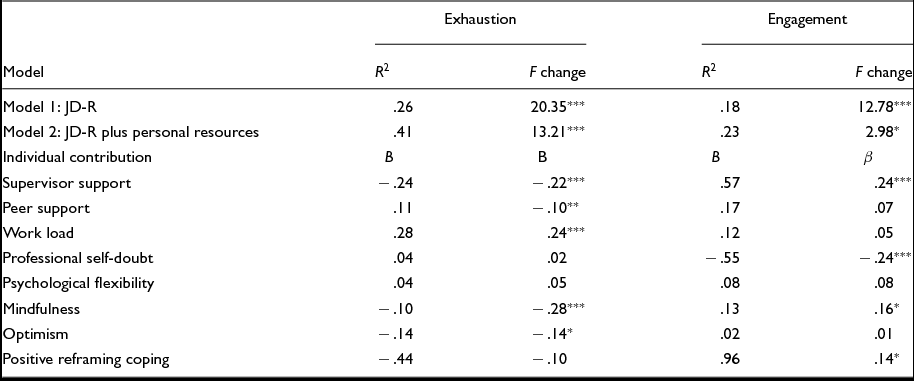
To test the first two hypotheses, correlations were examined and two hierarchical multiple regression analyses were conducted, with exhaustion and total engagement as the outcomes. Hypothesis 1 predicted that study demands would relate positively to burnout and negatively to engagement and that study resources would relate negatively to burnout and positively to engagement. Hypothesis 2 predicted that personal resources would relate negatively to burnout and positively to engagement. All relationships were found in the expected directions, supporting the JD-R model (see Table 2, and note that psychological flexibility is scored so that higher scores equals lower flexibility). Variables were entered in two steps, with study demands and resources in the first step and personal resources in the second step. A total of 41% of the variance in exhaustion was explained by the model, which included 15% variance explained by personal resources, with study demands and resources controlled for (see Table 3). Mindfulness was the strongest correlate of exhaustion, a personal resource (−.50), workload the next strongest (.41), with psychological flexibility (.38; note that psychological flexibility is scored so that higher scores equal lower flexibility), optimism (−.38) and supervisor support (−.37) following closely.
Regression Analyses Testing the JD-R Model and the Role of Personal Resources
Note: *p < .05, **p <.01, ***p < .001.
Twenty-four per cent of the variance of engagement was explained by the model. Included in this, 3% of the variance was explained by personal resources, after controlling for study demands and resources. Supervisor support, a study resource, was the strongest correlate of engagement (.35), followed by mindfulness (.30) and professional self-doubt (.29). This supports the JD-R model, which suggests that study resources are more important in predicting engagement than demands, and fits with the COR model, which recognises the importance of personal resources in engagement.
Moderation and Mediation Analyses
Moderation was tested using Baron and Kenny's (Reference Baron and Kenny1986) method of a two-step hierarchical regression, where the two independent variables were entered in one step and their product term was entered in the second step, to test the significance of an interaction effect. Hypotheses 3a and b, which stated there would be a moderation effect of psychological flexibility on demands and resources in exhaustion and engagement respectively, were not supported as there was no significant effect of the interaction between demands, B = 1.65, p < .001, and psychological flexibility, B = 1.49, p < .001, on exhaustion, R 2 = .004, F(1,228) = 1.25, p = .27, and there was no significant effect of the interaction between resources, B = 3.36, p < .001, and psychological flexibility, B = -.89, p = .17, on engagement, R2 = .001, F(1,235) = .24, p = .62.
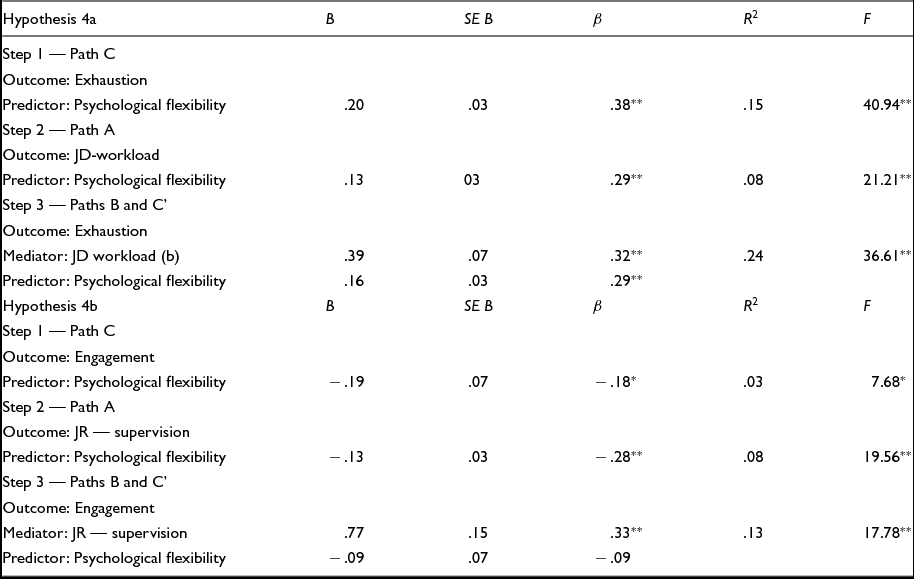
Hypothesis 4a, which stated that job demands would partially mediate the relationship between psychological flexibility and exhaustion, was supported. The three regressions outlined in Baron and Kenny (Reference Baron and Kenny1986) were performed and conditions were met for a partial mediation effect (see Table 4). To test the significance of this, the formula provided by Frazier et al. (Reference Frazier, Tix and Barron2004) was used. The resulting z score was 3.64; as this is greater than 1.96, the partial mediation effect was found to be significant at the .05 level. Hypothesis 4b, which stated that job resources partially mediate the relationship between psychological flexibility and engagement, was also supported. The three regressions needed were performed and conditions were met for full mediation, as Path c’ is no longer significant (see Table 4). The resulting z score was 3.27, indicating significance at the .05 level.
Regression Analyses Testing Mediation Hypotheses
Note: JD = Job Demand. JR = Job Resource.
*p < .01, **p < .0001.
Discussion
This study aimed to add to the existing knowledge about burnout and engagement in health profession students, using well validated theoretical models. The health impairment and motivation processes in the JD-R model were largely supported in the sample of health students, with relationships found in the expected directions, a large amount of variance explained by job demands and resources in the burnout model, and a medium amount in the engagement model (Cohen, Reference Cohen1992). Contrary to expectations that demands would be most important in explaining exhaustion, mindfulness was the most strongly correlated variable with exhaustion, with work load second, followed closely by psychological flexibility, optimism and supervisor support. This may be due to the fact that only two job demands were considered, and that they were both subjective. There may also be other demands that are important in explaining burnout in students; role conflict predicted burnout in a longitudinal study of health professionals (Borritz et al., Reference Borritz, Bultmann, Rugulies, Christensen, Villadsen and Kristensen2005) and had a moderate correlation with student burnout (Clark, Murdock, & Koetting, Reference Clark, Murdock and Koetting2009).
These results speak of the considerable importance of the role of resources, particularly mindfulness, psychological flexibility, and a supportive university supervisor in preventing burnout in health profession students. While reducing work load or role conflict in a university course may not always be possible, increasing personal resources such as mindfulness and psychological flexibility and increasing satisfaction with supervision relationships may be feasible interventions for student burnout. Supervisor support and mindfulness were the strongest correlates with engagement and it is possible that interventions targeting these areas may also increase student engagement. The strong relationship of mindfulness and the moderate relationship of psychological flexibility supported the recent literature that has found that mindfulness and ACT interventions impact upon burnout (e.g., Brooker et al., Reference Brooker, Julian, Webber, Chan, Shawyer and Meadows2013; Lloyd et al., Reference Lloyd, Bond and Flaxman2013).
While it had been hypothesised, based on previous theory that personal resources would be strongly related to engagement, the variables explored had only small to moderate correlations with engagement. This was surprising, as Christian and Slaughter's (Reference Christian and Slaughter2007) meta-analysis found that variables that had a motivational component tended to be predictive of engagement. Mindfulness has been related directly to motivational processes (Glomb et al., Reference Glomb, Duffy, Bono, Yang, Joshi, Liao and Martocchio2011), while psychological flexibility and optimism have both been linked indirectly to the motivational process via strong links to action and performance outcomes (Bond et al., Reference Bond, Hayes and Barnes-Holmes2006; Riolli & Savicki, Reference Riolli and Savicki2003). While it is possible that these concepts are less related to engagement than hypothesised, these relationships need further exploration.
Moderation and Mediation Hypotheses
While it was hypothesised that psychological flexibility would have a moderating influence on job demands with respect to exhaustion, and job resources with respect to engagement, these relationships were not supported. As the mediation hypotheses were supported it may be that psychological flexibility works primarily as a predictor for the job demands and resources examined. This would mean that rather than this personal resource buffering the effect of workload, or boosting the effect of supervisor support, psychological flexibility works to decrease exhaustion and increase engagement by directly leading to decreases in demands and increases in burnout. As moderation hypotheses exploring personal resources have been confirmed using other variables (Liao, Yang, Wang, Drown, & Shi, Reference Liao, Yang, Wang, Drown and Shi2013; Xanthopoulou, Bakker, Demerouti et al., Reference Xanthopoulou, Bakker, Dollard, Demerouti, Schaufeli, Taris and Schreurs2007), further studies are needed to clarify these relationships.
Both study demands and resources were found to have mediating effects between psychological flexibility and exhaustion and engagement, respectively. This finding supports the role of psychological flexibility as impacting burnout and engagement by increasing study demands and resources. Psychological flexibility involves increased acceptance of and contact with the present moment (Bond & Bunce, Reference Bond and Bunce2003). The result of this is more attention is able to be focused on those aspects of the moment that are value and goal relevant (Bond, Flaxman, & Bunce, Reference Bond, Flaxman and Bunce2008). Similar results were found by Bond et al. (Reference Bond, Flaxman and Bunce2008), demonstrating that psychological flexibility led to increased perception of job control. This study found that supervisor support completely mediated the relationship between psychological flexibility and engagement, suggesting that psychological flexibility affects engagement solely through its impact on improving satisfaction with supervision. Overall, the impact of personal resources appeared important, particularly to study burnout, supporting the inclusion of the COR model with the JD-R model (Akhtar & Lee, Reference Akhtar and Lee2010; Xanthopoulou, Bakker, Demerouti et al., Reference Xanthopoulou, Bakker, Dollard, Demerouti, Schaufeli, Taris and Schreurs2007)
Burnout, Engagement and Mental Health in Health Profession Students
Consistent with recent findings about mental health in Australian students, the sample of nursing, psychology, occupational therapy, and social work students had higher rates of mental health problems than normative data (Stallman, Reference Stallman2010). Measures of mental health were strongly correlated with the exhaustion component of burnout. There were no significant differences in burnout or engagement between disciplines, despite previous suggestions that nursing students may be more stressed than other students (DiGiacomo & Adamson, Reference DiGiacomo and Adamson2001). Burnout increased and engagement decreased from penultimate to final year of study, replicating other studies (Rella et al., Reference Rella, Winwood and Lushington2009). Younger students were more burned out and less engaged than older students, a pattern that has often been found in employees (Schaufeli & Enzmann, Reference Schaufeli and Enzmann1998). These results indicate that health profession students in Australia experience burnout and engagement with their study and that they experience significant related mental health difficulties. Burnout and mental health have been demonstrated to be related; Toker and Biron (Reference Toker and Biron2012) demonstrated burnout and depression have a reciprocal relationship in workers, while Dahlin and Runeson (Reference Dahlin and Runeson2007) found that depressive symptoms predicted burnout in a longitudinal study of medical students. A reciprocal relationship between mental health and burnout in health profession students has important implications for addressing both depressive symptoms and burnout in students.
Overall, this study found that burnout and engagement follow a similar pattern in students as in workers and that a combination of personal resources, study resource and demands have a significant impact on burnout. Support was found for mediation relationships explaining the mechanisms by which personal resources may impact burnout and engagement.
Limitations and Areas for Future Research
While there are many strengths of this study, including a heterogenous sample of health students, strong theory base and highly reliable measures, there are particular limitations of this study that can be outlined. The first is the cross-sectional nature of the data limiting the ability to say that variables ‘predict’ burnout or engagement. While this is the case, previous longitudinal studies have verified that resources and demands are predictive of, or in a reciprocal relationship with, burnout and engagement. While there have been some recent longitudinal studies exploring the JD-R and COR models in workers (Hakanen, Schaufeli, & Ahola, Reference Hakanen, Schaufeli and Ahola2008; Xanthopoulou, Bakker, Demerouti et al., Reference Xanthopoulou, Bakker, Demerouti and Schaufeli2009), this research is also necessary in student populations. Another possible concern of the study is the uncertain response rate; therefore, it needs to be noted that these results are not necessarily generalisable beyond the sample and results need replication in future research. Particularly, further studies regarding the role of psychological flexibility in relation to engagement would be enlightening, as theory suggested a stronger relationship than was found. Finally, while guidelines were followed to increase power in the moderation analyses, there were factors that may have resulted in insufficient power. For example, the correlations between the outcomes (exhaustion and engagement) and the predictor (psychological flexibility) were not as strong as it was hypothesised in the planning stages, and there may have been effects of range restriction that were unavoidable given the specified responses on the measures (Frazier et al., Reference Frazier, Tix and Barron2004).
Conclusion
The JD-R model combined with the COR model was found to be a valid way of exploring burnout and engagement with university students. The important role personal resources plays was highlighted by the added explanatory variance provided to the models and in the mediation relationships with study resources and demands in predicting burnout and engagement. Further research, especially using longitudinal designs and using valid models, is needed to clarify both antecedents and consequences of study burnout and engagement. The existing research base, which suggests the importance of these constructs with students and their relationship with mental health, suggests interventions for both burnout and engagement should be considered. The results from this study suggests psychosocial interventions utilising mindfulness and ACT may be particularly helpful for health profession students, along with an increased focus on encouraging supervision or mentor relationships with university staff and increasing student satisfaction with these relationships.