The manners of a town population always improve with its numbers and prosperity; hence, within the last thirty years, there has been a manifest improvement in this respect; more politeness and civility in general intercourse; a greater degree of display in dress – in furniture – and in fitting out the table; and an air of fashion and of gaity little known to the last generation.
The public amusements are indeed very limited: business is the main pursuit; and there exists a prejudice against any species of diversion. (Andrew Mercer, History of Dunfermline, from the earliest records down to the present time (Dunfermline, 1828), pp. 191, 193.)
Andrew Mercer's was one of three histories of Dunfermline published before 1830 by local printers, symptomatic of a new dynamism and confidence in Scottish urban life in the early nineteenth century.Footnote 1 Driven by rapid growth of the linen industry, particularly the manufacture of table linen, Dunfermline's population increased from a little over 5,000 in the early 1790s to around 13,000 in 1821. The town had undergone considerable improvement in its search for greater amenity and salubriousness, a process which had accelerated with the passage of a police act in 1811, creating a new rate-raising improvement commission at the same time as effectively extending the burgh's boundaries.Footnote 2 The tone of Mercer's history was celebratory, his narrative constituting a strong endorsement of the modernity which he saw as characterizing his present, and that of Dunfermline. Yet, as his apparently contradictory remarks quoted above indicate, change and growth also brought tensions, a key one of which was that between the trend towards a more polite, refined style of living and simultaneous resistance to a process of cultural liberalization that could threaten the religious and commercial character of society.
Such a tension was hardly unique to Scotland, and can be found in ‘commercial’ and ‘manufacturing’ towns throughout Britain in the ‘long eighteenth century’. It forms, for example, a central thread of Jon Stobart's discussion of patterns of cultural change in Liverpool between the mid-eighteenth and early nineteenth centuries, where the later eighteenth century saw an important transition to a new cultural order forged around ‘associations, learning and improvement’.Footnote 3 The rapid growth of evangelical religion sharpened the sense of opposition. Nor was the tension uniform in its influence and operation in Scottish towns; rather its salience depended, to a significant extent, on the size and character of the town and, to a lesser degree, its location. Even allowing for such diversity, however, and significant regional and local urban differences in the rest of Britain, its prominence in Scotland was unusual. It partly reflected the fact that many Scottish towns were, like Dunfermline, relatively small scale, compact communities experiencing very rapid change under the impact of developments in the manufacturing sector. Similar kinds of community were developing at only slightly less dramatic rates in this period in the midlands and north-west of England, and south Wales. It also, however, derived from Scotland's presbyterian religious identity and traditions, and the eagerness with which influential groups within Scottish urban society embraced enlightenment (broadly defined) as an aspect of improvement. It was also a function of an urban inheritance which was, in several crucial respects, very different to England and Wales.
The purpose of this article is, first, to trace the scope and main elements of cultural change in Scottish provincial towns during what was a crucial phase in modern Scottish urbanization. Mapping change must precede assessment of its broader historical significance; but it is the latter question which lies at the article's core. A common theme in existing literature on Scottish urbanization in this period, if often implicit, is of belated convergence on an Anglo-British urban or even western European norm.Footnote 4 What we might be seeing, in brief, is a historic acceleration of cultural assimilation a century or so after the union of 1707, or a sharp deepening and widening of such a process. This, in turn, might be viewed as one aspect of a Scottish ‘urban renaissance’ similar in kind to that undergone, rather earlier, in England.Footnote 5 It is a proposition which possesses some merit, since much of what was encompassed by contemporary cultural change – the spread of polite culture, the rise of luxury trades, and (to a lesser extent) new styles of urban living – can be subsumed within this framework. The growing influence of fashionable metropolitan (meaning, in this instance, London) culture is readily discernable in Scottish towns from the central decades of the eighteenth century onwards. The case against, however, is strong since, as we will see below, other strands are clearly discernible, which point in a somewhat different direction. Wherever the balance properly lies, continually exerting a deeper pull on change in urban Scotland were religion and the Kirk, and the preoccupation of most urban dwellers with commerce and ‘industry’ in its widest sense. This led the latter to make choices which, in degree at least, appear to have been different from those of many English townspeople.
Before we start, a few words are needed about the scope of the analysis in this article. Around twenty towns have been examined in depth, the majority falling within the population range of between 5,000 and 15,000, although Perth, Greenock, Dundee, and Paisley were significantly larger, with populations in 1821 of around 19,000, 22,000, 30,000, and 47,000 respectively.Footnote 6 The sample should be sufficiently large and diverse to ensure that meaningful generalizations may emerge about provincial urban society in Scotland. Omitted, except insofar as they were an important influence on other towns, are the ‘big three’ of Edinburgh, Glasgow, and Aberdeen. This is partly because they have attracted much attention elsewhere;Footnote 7 but the purpose here is also to focus attention on towns generally neglected in discussions of Scottish and British urbanization in this period. A second, potentially more serious, omission is the large number of smaller towns, those with fewer than around 5,000 inhabitants, which constituted a diminishing, albeit still significant, component of the Scottish urban population.Footnote 8 As Iain Whyte has emphasized, Scotland remained a country of small towns in the eighteenth century.Footnote 9 This reflected the peculiarities of the Scottish urban structure as it developed during the early modern period, dominated by four large towns (Edinburgh, Glasgow, Aberdeen, and Dundee), growth of which often squeezed those in the middle, and with a long tail of tiny urban settlements.Footnote 10 Small towns continued to expand in number and size in areas of rapid urban and manufacturing growth in the eighteenth century; and since a very high proportion of Scottish urban growth in this period was concentrated in such areas – Renfrewshire, Lanarkshire, and Ayrshire in the west, Angus and Fife in the east – this perpetuated the importance of small-scale urbanism.Footnote 11 The omission of such places is partly explained by the paucity of relevant sources, especially before the end of this period. It is, nevertheless, worth bearing in mind that the cultural sway of larger towns was growing as they drew smaller ones and a great deal of rural society significantly closer within their economic, social, and indeed cultural orbit. This was a consequence of their new-found dynamism, the close interconnectedness of growth in towns of different sizes within manufacturing areas, proliferating transport links (carriers, coach services, and postal services), and high levels of mobility among the Scottish population. More broadly, it reflected deepening integration of the Scottish urban order at regional, national, and British level, a process that gathered speed from the final third of the eighteenth century.
I
Scotland's provincial urban cultural efflorescence of the later Georgian era had weak, shallow roots, as was the case in several towns in the same period in the midlands and north-west of England.Footnote 12 What was different about Scotland was that this was true of nearly all towns, including those with a rich history and long-standing place within the Scottish urban hierarchy. Even with respect to Glasgow and Aberdeen, it was only during the central decades of the eighteenth century that assemblies and musical concerts became relatively commonplace, although the former had been a regular feature in Edinburgh from 1723 and the first concert in the Scottish capital had been staged thirty years earlier in 1693.Footnote 13 Cock fighting was on offer in some places in the early eighteenth century, such as Mercer's Dunfermline, but theatre, assemblies, and balls were seemingly conspicuous by their almost complete absence.Footnote 14 Dundee played host to a theatre company from Edinburgh in 1734 and staged an assembly in the subsequent year. The latter appears to have been a one-off event in the town, however, while the next visit from a theatre company was twenty years later. It was only from the 1770s that dramatic entertainment was regularly available in Dundee.Footnote 15 In England, the early eighteenth century saw a huge expansion in horse racing, at least until curtailment through restrictive legislation passed in 1740 and renewed in 1745; north of the border, it appears to have grown in popularity during the Restoration, but gone into decline post-union. While there is evidence of racing in several burghs in the early eighteenth century – Selkirk, Hawick, Peebles, Dunfermline, Cupar, and Perth – the general impression is not of buoyancy.Footnote 16 In Cupar, annual races survived into the middle of the century, but were declining by the 1750s before lapsing entirely in the early 1760s. In Perth, there was a race meeting in 1714, then an interval of twenty years before the next (in 1734), although they appear to have occurred at fairly regular intervals thereafter.Footnote 17 With the exception of freemasonry (of which more below), clubs and associations were thin on the ground. Only one musical society emerged outside Edinburgh and Aberdeen before 1760: in Dundee in 1757.Footnote 18
The archival silence may possibly be misleading, and more may have been going on hidden from the historian's gaze. Annual races linked to fairs, such as that which took place in Paisley, and which attracted participation largely from local townspeople, appear to have been fairly common, although they have left only sporadic written records.Footnote 19 According to George Penny, the early nineteenth-century historian of Perth, whose memories of the town stretched back to his boyhood in the central decades of the eighteenth century, song, learnt and transmitted orally, had long been an important aspect of local popular culture, and seems to have been particularly identified with women.Footnote 20 Organized concerts were rare, but music was probably widely played and heard. It was an important feature of Masonic sociability, with musicians frequently admitted to lodges without paying the usual fees.Footnote 21 In Haddington disturbances were occasioned by ‘a tumultuous part of the inhabitants assembling under pretence of visiting one another with music, and drinking Healths at the Cross’ in 1722.Footnote 22 In 1751, the Kirk Session in Dumfries called two musicians to testify that they had been employed to play at a gathering at a private house which had disturbed neighbours.Footnote 23 Music was still being taught in burgh music schools in several towns in the early eighteenth century, such as Haddington, Montrose, and Dunfermline. On the other hand, such schools appear to have been struggling institutions, not least because church choir singing had declined in the previous century in favour of heterophonic psalm singing. The choral tradition in Scottish churches would revive in the later eighteenth century, necessitating the import of educated church musicians in significant numbers from England.Footnote 24
Since at least the sixteenth century, Scottish urban society had shown a strong commitment to education and literary culture. The Scottish capital was, moreover, by 1700 a relatively print-rich environment, with a dynamic printing and publishing industry.Footnote 25 Reflecting their compact nature and small populations, in the majority of Scottish towns, oral forms of communication remained, however, strongly dominant. Official notices were made by ‘tuck and drum’, as had been the case for centuries, while funerals were announced by the ringing around town of the so-called mort bell.Footnote 26 Reliance on such modes of communication only started to be significantly eroded at the end of the eighteenth century, in turn, reflecting the rarity of provincial printers before the 1770s.Footnote 27 Booksellers were more common, although they were still comparatively few in number and usually combined bookselling with bookbinding and indeed other activities in a limited market for books, a pattern which continued in smaller towns into the early nineteenth century.Footnote 28 Reading was highly valued, but, with the exceptions of the Bible, catechisms, and other devotional works, private book ownership seems to have been confined to a small minority.Footnote 29 Even in the case of newspapers and newsletters, urban elites seemingly depended heavily on copies purchased by town councils and then placed in the town's coffee house or room for consultation by council members and others.Footnote 30
If the general picture in the early decades of the eighteenth century appears to be one, therefore, of cultural stasis, signs of vitality and change were not wholly absent, albeit their significance is often elusive. Dancing masters were present in several burghs, such as Montrose and Perth.Footnote 31 Instruction in dancing was an important marker of gentility, or an aspiration to such, and the presence of such individuals is a good indicator of the infiltration of new polite norms. On the other hand, much of the clientele of dancing masters may have been local landowners and their families. Dumfries, Haddington, and Inverness, meanwhile, saw the establishment of sizeable endowed libraries.Footnote 32 It is, however, debatable if this tells us more about the character of the towns than the inclinations of specific individuals connected to them. It continued a long tradition of forming such libraries; Dundee, for example, had a burgh library from the mid-fifteenth century, which was, according to Paul Kaufman, the earliest public library in Britain outside Oxford and Cambridge.Footnote 33 Books continued to be added in the early Hanoverian period to the Dundee library, while the most recent historian of the Gray Library in Haddington has detected a significant shift in borrowing and reading patterns from the 1760s towards secular literature.Footnote 34 In 1736, the Dumfries Presbytery Library was opened to lay readership. Thanks to a bequest in 1711 of a very large book collection by Dr John Hutton, physician to William and Mary, it had notably diverse holdings.Footnote 35 In Dunfermline and Perth, the idea of establishing a town library was discussed in, respectively, 1711 and 1723, but the proposals proved abortive.Footnote 36 In Ayr, the curriculum of the Grammar School began to be revised and modernized from the later 1720s by its new master, John Mair. A graduate of St Andrews, and appointed to the post in Ayr in 1727, Mair's innovations apparently failed to survive after he left for Perth to take up an appointment in 1761 at the newly established Perth Academy.Footnote 37
More important, however, if only because not confined to one or few towns, was the start of an expansion in speculative freemasonry from the mid-1730s. In 1736, the year in which the Grand Lodge of Scotland was founded, the number of chartered provincial lodges (including in Glasgow and Aberdeen) stood at forty-three; by 1765 the comparable figure had increased almost threefold.Footnote 38 Currently, little is known about either the social composition of these early lodges, or their wider social and cultural impact. Entries in minute books, where they survive, are generally frustratingly bland. Unlike south of the border, operative and speculative freemasonry were frequently present in the same lodge in Scotland. Scottish speculative freemasonry grew out of the operative tradition, and never shed these roots.Footnote 39 From the early eighteenth century, operative lodges also began to admit larger numbers of craftsmen who were not working masons.
The social composition of the new provincial lodges of the early Hanoverian period showed considerable variation, reflecting the diversity of the impulses behind their development. Mark Wallace has argued that Edinburgh-based lodges tended to be more elitist than their provincial counterparts.Footnote 40 Several provincial lodges appear, nevertheless, to have been fairly exclusive, their membership consisting of local gentry and urban notables, together with a handful of tradesmen. The Stirling no. 3 lodge, for example, examined by Wallace, had 121 entrants between 1739 and 1771, seventeen of whom were operative masons; twenty-two were merchants; twenty-one professionals; and ten were local gentlemen.Footnote 41 Among the early members of the Kelso lodge were, in addition to nineteen operative masons, ten country gentlemen, thirteen professionals, eight merchants, and several farmers, wrights, brewers, distillers, and others.Footnote 42 The forty-four members of the St David's Lodge in Dundee in 1759, the year in which the lodge received its charter, included several local landowners, teachers, doctors, merchants, two vintners, a goldsmith, and a shoemaker.Footnote 43 In a British context, Margaret Jacob has emphasized that the lodges can be seen as developing novel forms of sociability in urban society that cut across social rank, simultaneously adapting older guild traditions of fraternity and festivity.Footnote 44 More narrowly, some of the early lodges functioned as places where the urban middling sort and members of the neighbouring rural elites could meet in an atmosphere that emphasized a common code of conduct at the expense of differences in rank, religion, and politics. One effect of the early growth of speculative freemasonry may have been, therefore, to instil in several urban elites new confidence, simultaneously strengthening their aspirations to refinement and civility, and even perhaps cultural novelty. In 1759, on St John's day (24 June) – one of two regular Masonic feast days in Scotland – the Dundee St David's lodge hosted a ball following a procession.Footnote 45 In the longer term, the overall social composition of Scottish freemasonry shifted towards greater representation of craftsmen and tradesmen, while the welfare aspects of freemasonry became ever more important from the end of the eighteenth century. There continued to be, however, considerable diversity between lodges regarding composition of their membership. In towns capable of sustaining several lodges, a hierarchy among lodges could emerge.Footnote 46 The St David's lodge in Dundee, for example, appears to have retained its elite status during the second half of the eighteenth century.
II
How should we explain the absence of a substantial cultural change in Scottish provincial towns before the final third of the eighteenth century? Economic conditions were crucial. The immediate post union period in Scottish urban history has been generally neglected by historians.Footnote 47 It is widely accepted, nevertheless, that any positive economic impact from union, for most towns, was only evident by the later 1730s, if not slightly later; and in some areas, particularly in eastern Scotland, the short-term effects were strongly negative.Footnote 48 Several towns, such as Dumfries, never really recovered their earlier economic dynamism; Dumfries's Georgian fortunes depended, despite a brief foray into the tobacco trade, on its position straddling major routes from England and Ireland, its role as a market centre, and as a meeting place for the gentry of south-west Scotland. It was only from the mid- to later 1740s that rapid growth in linen manufacturing, and developments in overseas trade, prompted a sharp upwards turn in urban economic fortunes, which lasted, albeit with some short interruptions, throughout the period.Footnote 49 That income levels were significantly lower, in any case, than in English towns reinforced the impact of a depressed economy.Footnote 50
Another force for change might conceivably have been the landed elites. As Peter Borsay demonstrated several decades ago in his seminal study of the English ‘urban renaissance’, in the first phase of English urban renewal between 1660 and 1760, such demand could be very significant, especially with respect to county and so-called leisure towns, such as York or Bury St Edmunds, or the multiplying spas, pre-eminently Bath, but also places such as Matlock or Harrogate.Footnote 51 There is little evidence of a similar dynamic north of the border before the later eighteenth century. This may be because wealth was more sharply polarized in Scottish landed society, while those with substantial surplus wealth were drawn to London and/or Edinburgh.Footnote 52 London acted as a powerful magnet for the nobility, although this pre-dated 1707. Meanwhile, the appeal of Edinburgh for the gentry may also have served as a brake on cultural development in the rest of urban Scotland well into the later eighteenth century. From the mid-seventeenth century, Edinburgh's role as a service provider and centre of luxury trades and crafts grew. This trend deepened in the second half of the eighteenth century, while the city's importance as a social and cultural centre increased as growing numbers of the gentry resided there in the winter months.Footnote 53 There were no county towns in Scotland similar to those of south of the border, and although several sherrifdom centres were starting to develop a stronger role as regional centres providing social activities for surrounding landowners, this only really became the case in the later eighteenth century. Criminal justice in Scotland was heavily centralized in Edinburgh, and county meetings as important instruments of local governance only developed from the 1770s. In the early decades of the century, meanwhile, political division and instability exerted considerable impact, particularly in areas of episcopalian strength such as Angus, Aberdeenshire, and Banffshire. Support for the Jacobite cause in these areas disrupted, if not wrecked, the fortunes of many landed families.
Constraints on change before 1760 were not, however, solely economic. They also stemmed from the structure of the urban population and nature of most Scottish urban communities. The number of professionals in any given town before the later eighteenth century, who were often identified with cultural innovation, was very small. From the 1770s, not only was the supply of professionals expanding – due to Scottish universities' new emphasis on vocational and secular forms of learning – but maturing, expanding urban and rural economies also meant greater demand for their services and new opportunities in the largest towns for forging a much stronger sense of professional identity and cohesion. As late as 1782, for example, there were only three writers (attorneys) in Inverness; by 1822 there were over twenty.Footnote 54 The strength of civic consciousness, traditional patterns of association, and both membership of, and deference to the leadership of, the church may also have impeded cultural change before George III's reign. There are certain similarities here with urban communities in New England, where Christine Heyrman has argued for the abiding power of traditional elements of the older puritan order, despite commercial growth and expansion in the first half of the eighteenth century. Moreover, as Bruce Daniels has shown, religious values continued to shape strongly patterns of cultural development in New England into the later eighteenth century.Footnote 55 In contrast to most English towns, where guilds were declining by 1700, trades incorporations and the guildry, where they existed, also remained a powerful force in provincial Scottish urban life.Footnote 56 By the later eighteenth century, their exclusive privileges and influence were under sustained challenge from various factors, but their decline was slow, uneven, and protracted. Against this background, older patterns of association were often resilient, as were traditional civic celebrations and local festivities, which often seem to have continued largely unaltered into the early nineteenth century. This may help to explain why, with the exception of freemasonry, relatively few new clubs and associations were founded, especially in smaller Scottish towns. The pattern began to change towards the end of the eighteenth century, but the earlier proliferation of societies and clubs in Scotland had been a development almost exclusively identified with Edinburgh, and, to a lesser extent, Aberdeen and Glasgow.Footnote 57
Meanwhile, the Kirk undoubtedly influenced very closely the pace and scope of Scottish cultural change, partly reflecting the continuing strength of religious belief and adherence among Scottish urban populations and the continuing centrality of the church in urban life.Footnote 58 Orthodox Calvinist presbyterianism, with its deep-rooted suspicion of worldly activities, created strong resistances to the intrusion of new forms of recreation and leisure, whilst also emphasizing communal values and identity. The growth of more liberal attitudes among some ministers and their congregations thereby removed a major obstacle to change. This development markedly accelerated from the 1750s, with the rise to power within the Church of Scotland's general assembly of the so-called ‘Moderates’, led by William Robertson.Footnote 59 A key battleground between the Moderates and their rigidly orthodox opponents was the theatre, of which the latter disapproved. Well after 1760, there are signs of often fierce debate and opposition to actions that might be seen to condone dancing and theatrical entertainment. Unsurprisingly, this evidence comes from towns where Calvinist orthodoxy was strongly embedded, such as Kilmarnock or, indeed, Mercer's Dunfermline, which was ‘long celebrated for its sancity’, as one anonymous early nineteenth-century writer put it.Footnote 60 In Dundee, another locus of orthodoxy, where the principal early opponent of the Moderates, John Willison, had been a minister for most of the first half of the century, the town council sought as late as 1787 to oppose the presence of theatre in the town, declaring that ‘exhibiting plays here is not authorised but in direct opposition to the laws of the country, and prejudicial in many respects to the interests of the society’.Footnote 61 Dramatic entertainment spread fairly widely in urban Scotland from the end of the eighteenth century, and several towns saw the construction of permanent theatres, such as Dumfries, Dundee, Perth, and Greenock. In general, however, theatre did not flourish in Scottish provincial towns and by the 1820s its fortunes were ebbing in several places, due both to the persistence of religiously inspired hostility and suspicion, and also the instability of the early industrial economy.Footnote 62 In Glasgow, another stronghold of evangelical presbyterianism, opposition to the theatre remained influential throughout the second half of the eighteenth century.Footnote 63
Meanwhile, in the earlier eighteenth century, town authorities had maintained, with varying degrees of tenacity, the ambition of moral custodianship of the community, in conjunction with local Kirk Sessions. In Perth, new regulations were issued as late as 1748 for the so-called ‘constables for restraining immoralities’. Their primary role was to ensure that Perth's inhabitants observed the Sabbath, but they were also directed to ensure that landlords did not serve alcohol on other days after 10pm, to report swearing, and to prevent ‘all other kind of immoralities’.Footnote 64 In 1752, Paisley's town council revived an earlier practice of appointing officers ‘for taking notice of those who vague [i.e. loiter] or stroll on the streets or in the fields on the Sabbath day’, although, as the town's nineteenth-century historian, Robert Brown, observed, this was the ‘last time’ that the council can be found interfering ‘in matters of this kind’.Footnote 65 Although the ambitions and motivations which lay behind such measures did not disappear in the later eighteenth century, the position of the established church had changed, and with very significant effects. By the later eighteenth century, the Kirk was in competition with burgeoning secession and a myriad of other churches for the population's religious allegiance; the alliance between Kirk and town council had been broken; and new ways had to be found to inculcate moral and social discipline among urban dwellers. One consequence was that novel spaces emerged in which cultural change and development could take place, driven by gathering commercial forces and new sources of demand in urban and rural society.
III
There were, therefore, strong reasons why the first half of the eighteenth century was marked by an absence of substantial cultural change in most Scottish towns. From, however, the final third of the eighteenth century, as urban growth rates, particularly in manufacturing regions, surged, Scottish provincial urban culture entered a phase of remarkable expansion and diversification. To a significant extent, it was part of a British-wide process of accelerating and deepening commercialization of culture and recreation. In Scotland, this was facilitated by marked improvements from the 1770s in transport and communications, especially the creation of new turnpike roads, and upgrading of existing ones, linking Scottish towns more tightly to each other, to London and elsewhere. London fashions, print culture, and cultural habits spread throughout the Scottish urban order. Edinburgh played an important role in this process, reflecting the breadth of connections between it and London, and between it and the rest of Scotland. Before 1783, all Scottish post from London passed through Edinburgh. Theatrical entertainment spread out from the Edinburgh theatre, which, in turn, presented London actors and entertainment for a provincial audience.Footnote 66 Newspapers, including the sharply growing numbers of English newspapers circulating north of the border from the 1760s, gave much publicity to London theatre and other metropolitan events and fashions.Footnote 67 In the eighteenth century London attracted considerable cultural talent, but there were multiplying opportunities for earning a livelihood in the provinces; the relationship was reciprocal. In 1794, for example, a pantomime actor, Richard Wilson, who appears to have left London's stage in the early 1790s because of debt, was competing for patronage and an audience in Perth. A native of Durham, Wilson had apparently started his career on the Scottish touring circuits before being engaged by Covent Garden in 1776.Footnote 68
In the realm of print a process of commercialization also drew on talents and energies from across the British Isles, within which London (sometimes in co-operation with Edinburgh) played a strategically crucial role.Footnote 69 The ‘explosion’ of reading in Britain in the later Georgian era, recently described by William St Clair, was a development in which Scots participated fully – as writers, printers, publishers, and readers.Footnote 70 From the 1770s, booksellers in Scottish towns multiplied in number and at the same time spread to new places.Footnote 71 Isaac Forsyth was, for instance, the first to establish a bookshop between Aberdeen and Inverness, in Elgin in 1787.Footnote 72 By 1820, even small urban communities boasted booksellers. Beith and Saltcoats, in Ayrshire, for example, with populations, respectively, of around 2,500 and 3,000 in 1820, both had two by that date.Footnote 73 In large towns, where demand was greatest, bookselling became more specialized, encompassing sales of music, prints, and drawings, as well as cheap, part, and foreign language books. Circulating libraries began to appear, with Robert Morison of Perth leading the way in 1752.Footnote 74 George Miller set up a circulating library in Dunbar with 500 books in 1789, a number which grew to 1,019 by 1790 and over 3,500 by 1809. In 1814, Miller moved his library to Haddington, the county town of East Lothian, where it then failed, probably due to the post-Napoleonic war economic downturn, the presence of the free Gray Library, and the establishment of Samuel Brown's itinerating libraries in East Lothian from 1817.Footnote 75 Saltcoats apparently had three circulating libraries in 1820, including one containing works appropriate for Sabbath schools.Footnote 76
It would be difficult to exaggerate the importance of print both as instrument and symbol of cultural change in Scottish towns. The rise of subscription libraries, subscription reading rooms, and coffee rooms lay at the heart of changing notions of urban cultural identity. By the early nineteenth century, as one historian has emphasized, few Scottish towns of even relatively small size lacked a subscription library and many had more than one.Footnote 77 By 1820, Kilmarnock had two subscription libraries, in addition to three circulating libraries, ‘in which’, one contemporary declared with evident local pride, ‘the number of books is considerable and well selected’.Footnote 78 Circulating and subscription libraries were established in many English towns, as were book clubs of various kinds.Footnote 79 The rapidity and extent of the rise of the Scottish subscription libraries was, however, unparalleled elsewhere in the British Isles.Footnote 80 As Mark Towsey has emphasized, their formation furnishes a clear set of markers for the rapid diffusion of enlightenment attitudes and ideals across urban Scotland from the end of the eighteenth century.Footnote 81 It was a version of enlightenment that was mostly derivative; seemingly penetrated quite slowly down through urban society; existed often alongside and in dynamic tension with orthodox Calvinist and evangelical religious currents; had a strong utilitarian dimension; but which was seen as bringing intellectual and moral benefit to provincial urban communities, improving manners and taste, at the same time constituting a powerful vehicle for the expression of the new self-confidence of provincial urban elites.Footnote 82
Changes to educational provision similarly testified to the strength of the provincial urban commitment to ‘improvement and learning’, a commitment rooted in the past, but re-energized and adapted under the impact of enlightenment currents, economic growth, and the spread of polite values. This was, in some ways, a case of belatedly following trends evident earlier in Edinburgh, Aberdeen, and Glasgow.Footnote 83 The best-known aspect is the rise of academies, with modern, practical curricula, starting with Perth Academy in 1760. Specialist teaching of navigation and other ‘useful’ subjects became much more widely available from the 1760s, often supported by town councils.Footnote 84 The number of private schools and classes increased significantly, as did boarding schools for girls offering training in polite accomplishments. In 1766, Inverness town council provided a salary to support a boarding school for young women in the town. By 1800, even remote Forres had such an establishment.Footnote 85 Charity and Sabbath schools grew rapidly in number from the 1780s, especially in larger manufacturing towns, such as Dundee, Greenock, or Paisley. Elsewhere, the first Sabbath school in Haddington was founded in 1791, and in Inverness in 1800.Footnote 86 The extent and breath of educational provision was a source of considerable civic pride. Writing a topographical guide to the Cunninghame district of Ayrshire, a native of Irvine could barely contain his enthusiasm for the new Irvine Academy, completed in 1814 to a design by Glasgow architect, David Hamilton. A drawing class was added to the existing grammar and English schools by 1820. By the same date, the town also had a free school for eighty pupils; a sewing school; a boarding school for young women; five to six private schools which provided a ‘good education in reading, writing and arithmetic’; and 527 pupils in Sunday schools.Footnote 87 Instruction in music, drawing, and dancing were also much more readily accessible by the early nineteenth century, with teachers commonly operating in circuits between several towns.Footnote 88 In 1818, for example, one dancing teacher was instructing in Coupar Angus, Blairgowrie, Kirriemuir, and even the village of Alyth in Perthshire.Footnote 89 The growing ranks of teachers, along with rising numbers of lawyers, medical men, and ministers, were vital accelerators of cultural change, and featured prominently, for example, among founders of subscription libraries. They also commonly formed part of a subaltern provincial literary class starting to take shape by the 1810s, especially in highly literate communities such as Paisley, Kilmarnock, and Ayr, which provided copy for a steadily growing number of provincial publications, periodicals, miscellanies, histories, and collections of verse.Footnote 90
Due, therefore, to the influence of print and education, Scottish towns came much more strongly to reflect and facilitate the diffusion of enlightened ideas and values from the final third of the eighteenth century. By around 1800 they were also host to an expanding range of recreations and leisure activities – Mercer's ‘public entertainments’. Subscription assemblies, usually during the winter months, spread from the end of the 1770s, although they began rather earlier in Montrose and Ayr. By the early nineteenth century, assembly seasons were becoming well established in many county and several larger towns, while smaller places, such as Arbroath, Melrose, and Selkirk, hosted annual balls. In Ayr, Dundee, and Montrose, and probably elsewhere, there were several types of subscription assembly by the 1810s aimed at different sections of the local population. Charity balls were relatively common, while balls and dances for tradesmen and artisans were a recurrent feature of holidays or celebrations.Footnote 91 Less formal dances were probably fairly commonplace in inns and taverns. In 1780, for example, an Edinburgh medical student visiting the Highlands recorded hearing the ‘scraping violin’ of a dancing party at a ‘pretty little inn’ in Stonehaven.Footnote 92
Diversions and entertainments multiplied over the decades. Increasing numbers of musical concerts were staged, many given by music teachers, but touring professional musicians also became more frequent visitors, often from, or arriving via, London. Exhibitions and lectures on subjects such as elocution or natural philosophy also started to feature in provincial town life. Unsurprisingly, it was the largest towns, most readily capable of furnishing audiences (and hence sizeable ticket receipts), that attracted the greatest number of such events. Between 1802 and 1805, the Greenock Advertiser published notices regarding around thirty concerts, exhibitions, lectures, or performances of different kinds. Many were staged in Greenock's main inns, indicating how innkeepers in pursuit of profits were another force for cultural change, especially in the largest towns. In smaller towns, performers were attracted by a combination of opportunism and convenience, for example en route to Edinburgh or the occurrence of fairs or race meetings. Walks and bowling greens emerged, or were revived, in a smaller number of towns, such as Stirling, Montrose, Paisley, Kilmarnock, and Cupar, although several evidently failed, perhaps due to the adverse climate.Footnote 93 Designated walks may also have been relatively rare since there continued to be amenable open space within towns such as Dundee or Perth or on their periphery, which allowed walking without the need to invest scarce financial sources in constructing special promenades.Footnote 94
IV
If the general direction and nature of cultural change is thus clear, so far nothing has been said about possible differences between towns. To what degree was Scotland's new dynamic provincial urbanism from the 1770s accompanied by increased specialization in respect of the provision of leisure facilities and the nature of cultural life? Were there other patterns of cultural difference which reflected the nature of the local economy, local religious traditions, or location?
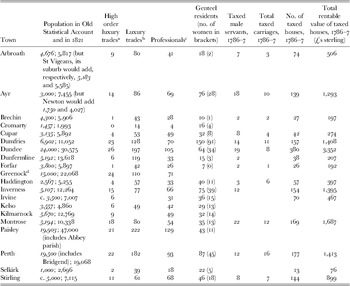
Bringing together several sets of data reveals fairly clearly development of leisure and aspirations to greater refinement in different towns. Table 1 below compares the presence (or absence) of various amenities which either directly reflect this development, or can stand as appropriate proxies. Numbers of professionals and genteel residents are included since these might have been expected to exercise a strong influence on the scope of local demand for luxuries and polite entertainments. The second category, genteel residents, is a loose one, but follows the categorizing of the urban populations in Pigot's 1825/6 commercial directory for Scotland, which was the first national directory to present comparable data for most towns. This assumes that this group was, to a significant degree, self-selecting or based on recognition of status. It included, inter alia, wealthier professionals, elite merchants, widows and spinsters of landed and mercantile background living on rentier incomes, retired army and naval officers, and wealthy returnees from empire. Women could comprise a significant component; for example, eighty-eight out of a total of 137 individuals who were classed as ‘genteel residents’ in Dumfries, and forty out of sixty-one in Inverness. The category of high-order luxury trades represents a deliberately restrictive and minimalist notion of luxury designed to capture differences between towns. The issue of what constituted luxury was obviously subject to change; watches, for example, were relatively commonplace by the final third of the eighteenth century, having been very rare before 1760. Trades that are indisputably markers of fashion in the early nineteenth century are, therefore, required. The table includes, however, a more generous category of luxury trades for purposes of comparison and comprehensiveness. The data supplied by trade directories is far from perfect, with problems of inconsistent categorization; upholsterers may, for example, be separately listed or clearly distinguished in one entry, but not in others. The general picture conveyed is, nevertheless, reasonably accurate.
Leisure profile

a Hairdressers; perfumers; jewellers; upholsterers; carvers and gilders; confectioners; coachmakers; and portrait painters.
b Tailors; milliners and other kinds of hat maker; dressmakers; drapers; silk mercers; hosiers; cabinetmakers; dealers in and makers of receptacles made from glass, china, porcelain and other fragile ceramic wares; tobacco dealers and retailers; confectioners; perfumers; tea dealers; umbrella makers; gunsmiths; coachmakers; hairdressers; cutlers; clock and watchmakers; dealers and workers in precious metals; upholsterers; carvers and gilders.
c Clergy; lawyers; teachers; architects; physicians; surgeons; and anyone in receipt of a university degree.
d The entry for Greenock omits any listing of gentry residents.
The second main source exploited in the table are returns from several assessed taxes of the later eighteenth century, deliberately designed by ministers in London as imposts on luxury expenditure. These are again imperfect, not least because returns were erratic and incomplete, and often displayed curious trends over time. Carriage, house, and male servant taxes have been chosen as potentially the most revealing. The servant tax may be slightly less so in that male servants appear to have been relatively rare in Scottish urban society, outside Edinburgh and Glasgow.Footnote 95 House tax was levied on the rental value of properties above a minimum rental threshold, and returns furnish a sense of differences in the status of urban housing, especially when viewed alongside population figures.
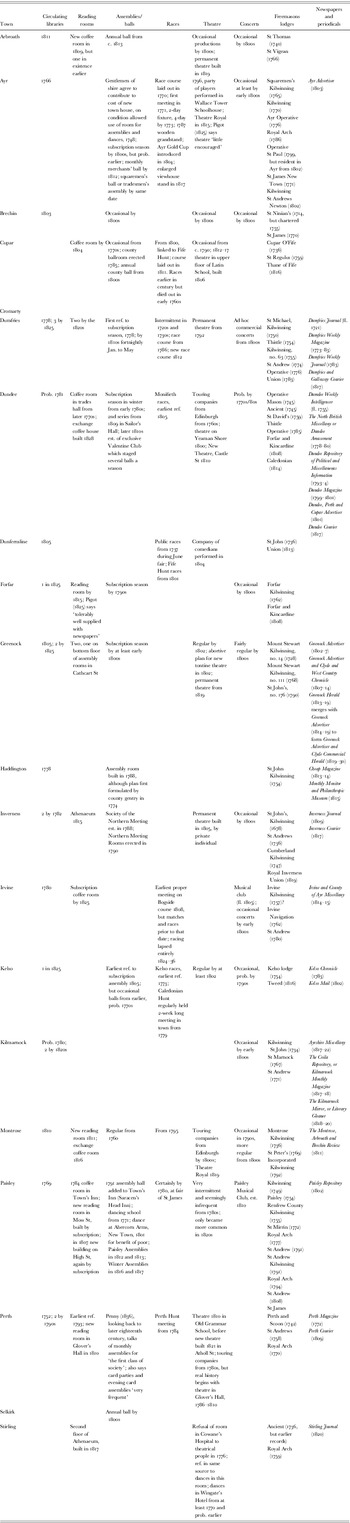
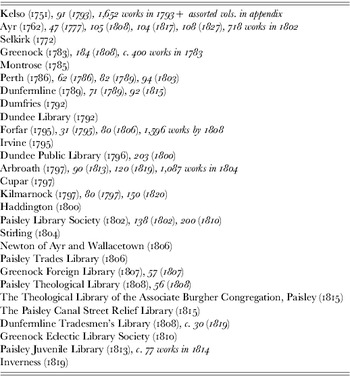
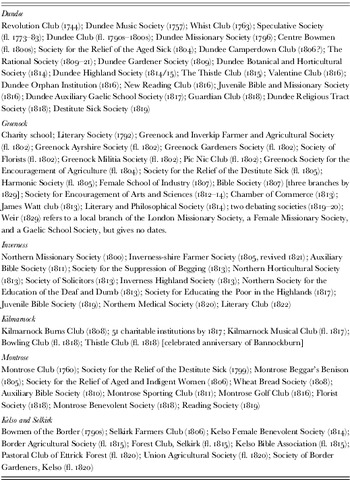
Tables 2–4 below include information on leisure and cultural facilities and provision in the towns, drawn from various sources, including directories, newspapers, town council minutes, minute books and printed catalogues of subscription libraries, and nineteenth-century urban histories. The information is again incomplete, especially for towns which lacked a newspaper or one published reasonably nearby; in some cases, such information has been inferred from impressionistic evidence.
Cultural facilities and provision

Subscription libraries, membership and growth (where known)

Clubs and societies, selected towns (not including friendly societies)

The results in Table 1 do not display complete consistency across the different series of data. A definite picture, nevertheless, emerges from the tables. First, there was a small, select group of towns which might claim genuine genteel credentials: Inverness, Dumfries, Montrose, and Perth. As one early nineteenth-century contemporary declared of Montrose, ‘In the winter season, Montrose is the rendezvous of all the fashion and elegance of the neighbouring country, and is then extremely gay.’Footnote 96 The genteel credentials of Dumfries were commonplace by the end of the eighteenth century, the prolific hack writer, Robert Heron, declaring it ‘a place of higher gaiety and elegance, than any other town in Scotland, of the same size’.Footnote 97 Several other county towns had similar, but less marked, leisure characteristics, such as Ayr and Haddington, or Banff and Elgin in the north-east. Provincial cultural change and aspirations to refinement, together with the development of a luxury economy, were certainly not restricted to a small minority of towns, and are discernible in many different types and sizes of town. Writing in The Ayrshire Miscellany, ‘Natalis’ proudly reported, for example, following a recent stay in Kilmarnock with relations, that their ‘speech, manners, and social qualities’ were ‘nearly akin to the inhabitants of the metropolis’, presumably meaning London.Footnote 98 In a British context, however, what appears striking is the comparatively limited scale of such developments in the most rapidly growing large manufacturing towns and ports. The pattern in this respect differs from that in eighteenth-century England, where, as Stobart and others have shown, the range and numbers of luxury trades in large manufacturing towns actually exceeded those in so-called ‘leisure towns’ by the later eighteenth century.Footnote 99
One important factor which helps to explain both the extent and limitations of change in Scotland was the distinctive pattern of urbanization in Scotland. Growth was telescoped into a shorter period than south of the border and occurred within the context of a relatively stable urban hierarchy. As seen, the foundations of change were also fairly shallow. Cultural change in urban Scotland may also be regarded less as one development than at least two which overlapped at various points but remained distinct. The first was a growing demand for urban leisure and leisure facilities from an increasingly cohesive landed class, consisting of gentry and, increasingly, tenant farmers, buoyed by rising rents and agricultural prices before 1815, and reinforced by commercial and imperial wealth. The second was internal to urban society and an aspect of the new-found dynamism and prosperity of the urban population. The rhythm and direction of change in the two cases were in various respects convergent, but ultimately distinct.
The importance of gentry demand and initiative driving the growth in provision of assemblies or racing from the later eighteenth century is clear. In Montrose, for example, it was local gentry who were behind the development of the new Town House with its assembly room in 1759–60, its redevelopment in 1819, and the revival of horse racing in 1795.Footnote 100 In Inverness, the annual October meeting of the Northern Club brought local and regional gentry to the town for a week's entertainments, including balls.Footnote 101 In other towns, it was the rise of hunts which was linked to race meetings and the provision of assemblies and other accompanying entertainments. The prestigious Caledonian Hunt was instituted in Hamilton in 1777, visiting various towns in turn for its annual hunt meeting.Footnote 102 Formed in 1780, the Fife Hunt was behind the revival of racing in Cupar in 1800 and the creation of a new race course in 1811, while the Perth Hunt Club, established in 1784, staged annual races from its foundation.Footnote 103 Membership of hunts was exclusive, normally by nomination and ballot, and numbers were carefully restricted. Urban members were seemingly rare. The original membership of the Ayr Hunt, which met at Ayr, Kilmarnock, and Irvine, was unusual only in that it included four residents of Ayr (a wine merchant, the collector of customs, the provost, and a physician); but this was four out of twenty-one.Footnote 104 Several towns hosted a series of new clubs formed among local gentry from the 1790s, such as the Bowmen of the Border in Kelso, the Forest Club in Selkirk, or the New Club of East Lothian gentry who met in Haddington.
Landowners' influence was apparent in several other ways. A significant proportion of the finance required to build academies in several towns came from local gentry, reflecting their long-standing dependence on burgh schools for their children's education.Footnote 105 It is also striking how far the development of several new, larger inns from the 1790s arose from landed initiative or drew strong support from landowners. In several cases, the inns' construction was a direct response to new demands for urban meeting places from local landed society and, increasingly, tenant farmers. This was the case, for example, of the Forfar New Inn, built in 1792, and the tontine inn constructed in Peebles in 1806, which hosted regular meetings of the Peebles Shooting club and the annual Tweeddale Ball, inaugurated in 1790 and hitherto held in the town hall.Footnote 106 A growing volume of commercial travellers and tourists on Scotland's rapidly expanding road network represented new commercial opportunities for inn-keeping. In 1787, for example, Warren Hastings stayed at a new inn in Perth, ‘Campbell's’, en route to the Highlands. Hastings described the inn as ‘very large, well built, and even elegantly decorated within’, and also noted that large additions were underway, presumably in response to the increasing number of tourists, like himself, in search of the picturesque to the north.Footnote 107 The rate and extent of investment in inns in Scottish towns accelerated sharply from the 1770s. In Inverness, the local freemasons were behind the development of the Mason Lodge Hotel, erected in 1776 at a cost of £1,600.Footnote 108 In the 1790s, following the example of Glasgow, a flurry of schemes emerged for the construction of tontine hotels and inns, although such plans, dependent on raising funds from the mercantile and manufacturing elites, were vulnerable to short-term economic fluctuations.Footnote 109 Growing numbers of agricultural and horticultural societies, membership of which consisted of significant numbers of landed gentry and in the former case, tenant farmers, met in new or re-developed inns, as did volunteer companies and other loyalist bodies in the 1790s and 1800s. Whether this led to genuine mixing on the part of the landed elites and involved other than a tiny minority of the urban elite is debatable; it was, nevertheless, symptomatic of an increasingly cohesive landed elite which sought to impress its needs and tastes on towns and urban society, as well as the profound impact on Scottish society of war and the defensive patriotism prompted by the threat of French invasion between 1793 and 1815.
The second main development underpinning urban cultural change was, as emphasized, accumulating prosperity derived from manufacturing and burgeoning domestic and overseas trade. This drove important changes in lifestyle among wealthy merchants, professionals, and shipmasters – a growing appetite for refinement and comfort in domestic lives as reflected, for example, in widespread modernization of tenements or their rebuilding, the emergence of terraces and villa-style dwellings across urban Scotland, and the concomitant tendency of the homes of the urban elites to contain dining rooms and parlours. The range of furniture and furnishings of different kinds grew exponentially in the houses of the wealthy, while new fashions and better-quality goods could find their way into the homes of even the modestly prosperous.Footnote 110 Changes in dress may equally have extended down through the social ranks, as artisans and tradesmen increasingly bought, rather than made, their own clothes. In 1788, the Perth linen manufacturers claimed, in support of the benefits of duties on imports of foreign linen, that the rise of the linen industry in and around Perth since the mid-eighteenth century was the ‘cause of even the meanest mechanic now being clothed in English cloth and all our tables with English hardware’. They also declared that, whereas fifty years before, there had been one ship engaged in trade with London, there were now eight, bringing English groceries and other taxable commodities.Footnote 111 By the early nineteenth century, there is frequent comment on the ubiquity of fashion. To cite just one example, an inhabitant of Ayr complained in 1818: ‘The lower orders are entirely lost in a general propensity to mimic the finery of the higher.’Footnote 112 It was the new extent, and depth, of urban demand that explains both the expansion and diversification of the service and craft economy across urban Scotland, manifestations of which included the striking rise of specialist cabinetmakers after 1800, and the equally notable increase in the numbers of milliners and dressmakers from the middle of the eighteenth century. High-status shops tended to cluster in central streets and areas, which, in many towns, were well paved and lit by 1820, helping, as in many English towns, to create a new social space in which wealthy women gained novel visibility.Footnote 113 Some of the clientele for these shops and trades, and for other new amenities and events – concerts, theatre, and lectures – came from a buoyant landed society, but the major proportion was generated from within the urban population. It reflected, in short, the development of new styles of urban living such as have been described recently by Maxine Berg in a broader eighteenth-century British context.Footnote 114
As elsewhere in Britain, rapidly expanding commerce and manufacturing created their own habitus and cultural styles; and in many Scottish towns, especially those which lacked genteel pretensions or much in the way of gentry patronage, it became the determining feature of cultural life. It was an eminently practical culture, concerned with information, efficiency and progress, and ‘improvement’, but defined in ways appropriate to environments shaped by commerce and, often, evangelical religious currents. It was a culture which achieved its sharpest definition in the most dynamic commercial and manufacturing towns, such as Paisley, Greenock, or Dundee, but which was also evident in places such as Arbroath, Kilmarnock, Irvine, Dunfermline, Forfar, and Perth. In Glasgow, which had very close connections to towns such as Greenock, Kilmarnock, Paisley, and Irvine, Richard Sher has emphasized how two versions of enlightenment tended to converge at the beginning of the nineteenth century in a manner that re-emphasized the city's commercial character: one which was Moderate and classically inflected, another shaped profoundly by commercial and evangelical religious imperatives.Footnote 115 Growth and prosperity in such towns depended on manufacturing and commerce, and the industriousness of their inhabitants. Their most influential cultural institutions, apart from churches and meeting houses, were not assembly rooms or theatre, but subscription reading rooms – the regular haunts of the commercial and manufacturing elites – and subscription libraries. Both were products of a voluntary associationalism which was developing and spreading rapidly from the end of the eighteenth century.Footnote 116 In the reading rooms, male commercial elites met on a daily basis, eagerly scrutinizing the proliferating amount of newsprint from across the British Isles and, on occasion, Europe, India, and the Americas. Subscription libraries in such towns were avowedly concerned with improvement, thereby demonstrating the towns' serious intellectual credentials.Footnote 117 The novelist, John Galt, subsequently claimed that it was early immersion in the ‘useful’ works of the Greenock subscription library which accounted for his ‘habitual partiality for works of a solid character’.Footnote 118 In an English context, David Allan has argued that the subscription libraries were ‘the natural expression of a specifically urban and strongly middle-class form of culture’.Footnote 119 If this was the case of English libraries, it was equally as applicable to comparable Scottish ones, whose subscribers were dominated by local commercial and professional elites.Footnote 120
What is significant in a Scottish context, however, is not just the prominence and sharply delineated form of this developing cultural order in ‘commercial’ and ‘manufacturing’ towns; rather, it is that the influence of these cultural currents was strongly felt much more widely across the urban order. This, in turn, reflected the extent to which manufacturing and the linen industry in particular provided the crucial impetus to urban growth and development in Scotland in the first phase of industrialization up to the 1820s. Manufacturing continued to be a vital presence in smaller towns between c. 1760 and the 1820s, despite a longer-term trend towards concentration in larger towns. The balance between, in Mercer's words, ‘levity and thoughtlessness’, commerce, rationality, and religion varied by town according to its character and economic base, inherited traditions, and religious currents present. For example, Stirling, Dunfermline, Kilmarnock, and Paisley were places where religion exerted an extremely powerful grip on inhabitants. One early historian of Stirling saw religion as the wellspring of local manufacturing success.Footnote 121 Commerce and religion were the twin poles of cultural life in many Scottish towns, affecting a broad cross-section of the urban population, which is easily underestimated in preference to concentration on the genteel. Alongside subscription libraries, the most frequent forms of new association, apart from friendly societies and freemasons' lodges, were missionary and Bible societies, Sunday schools, and other philanthropic bodies which strove to sustain the spiritual and moral, as well as physical, health of the lower orders. Support for such institutions cut across denominational boundaries, and drew middle-class women into new public roles. Custodianship of moral community, so crucial to older notions of Scottish urban community, was not extinguished, but assumed new and varying forms in a more complex, fluid, and diverse society.
V
What, finally, about the other question posed at the outset – convergence on a British or Anglo-British norm? In various ways, Scottish urban culture was becoming much more meaningfully British from the 1790s onwards. One cause, as seen, was the degree to which cultural development was driven by commercial opportunism and pressures, the broadening of demand for new goods, products, and services, including leisure and entertainment, often imported from England, and their dispersal throughout the British Isles. The basic pattern was not new; what was novel, however, was its democratization and extension beyond a narrow world of luxury consumption in Edinburgh and select social circles. The flow was not simply in one direction, as Allan has emphasized in relation to the dissemination of Scottish enlightenment works south of the border.Footnote 122 Nevertheless, the influence of London fashions was strongly felt in many Scottish towns in this period, as in many English provincial ones. Performers, music, drawing, and dancing teachers crossed and re-crossed the border in search of audiences, students, and profits, commonly advertising their fashionable, metropolitan credentials. The impact was greatest at the level of the prospering and expanding urban elites, especially the ‘pseudo gentry’, who lived off rentier wealth, a group which was expanding in size and visibility in towns such as Dumfries, Perth, Montrose, Inverness, and Ayr; but it extended well beyond their ranks. While such trends are apparent, however, whether they produced social and cultural environments which can be mainly characterized in such terms is much less clear. Urban convergence and assimilation proceeded in environments strongly shaped by distinctive local and national traditions, memories, and institutional inheritances. Powerful religious currents closely influenced patterns of cultural change throughout the period, albeit in evolving ways and to differing degrees in different kinds of town. In the most dynamic towns, moreover, the most important process of convergence was one which looked forwards rather than backwards, that was focused less on London or notions of what was fashionable, and more on a rapidly developing British provincial industrial culture wherein different local and national traditions happily merged without losing their distinctive inflections in local settings. The sixty years to 1820 thus represented a distinctive phase of Scottish urbanization, in which at least two different modes of cultural convergence developed rapidly, overlapping and interacting at different points, and forming a ‘bridge’ between an older urban world and the modern urbanized society of the later nineteenth century. Within rapidly changing urban milieux, inherited values and affiliations were not simply swept away, but continued to exert a powerful influence.