Introduction
Patients who have undergone tracheostomy or laryngectomy have an increased risk of acute respiratory obstruction due to common occurrences such as mucous plugging and tube displacement. After tracheostomy, the rate of serious complication is reported as 2.7 per cent for tube obstruction and 1.5 per cent for tube displacement.Reference Bradley, Kerr and Booth1
In an emergency scenario, effective communicationReference El-Sayed, Ryan, Schell, Rappazini and Wang2 coupled with an appreciation of the difference between a laryngectomy and a tracheostomy are essential so that oxygen can be administered to these patients in an appropriate manner. It is widely regarded that the airway management of such patients by emergency healthcare professionals is substandard,Reference Casserly, Lang, Fenton and Walsh3 and this is usually attributable to inadequate training and experience together with a poor understanding of fundamental anatomy.Reference El-Sayed, Ryan, Schell, Rappazini and Wang2, Reference Clayton, Henderson, McCracken, Wigmore and Paterson-Brown4, Reference Awad and Pothier5
The aim of this study was to ascertain the level of emergency healthcare personnel's knowledge with regards to distinguishing between a tracheostomy and a laryngectomy patient, and the management of these patients within an emergency setting.
Methods
Following approval from the hospital clinical governance department, a questionnaire (Appendix 1) was distributed within the emergency department over a one-week period. A total of 60 questionnaires were equally distributed within the acute medical unit and the accident and emergency divisions.
A pilot questionnaire was tested on a small, representative group prior to proceeding with the main survey, and any ambiguous questions or phrases were adjusted accordingly.
The response options for each question were agreed via the consensus opinion of three otolaryngology specialist trainees (specialist registrar or specialist trainee 3 grade or above), a consultant respiratory physician, and two general or geriatric physicians.
Results
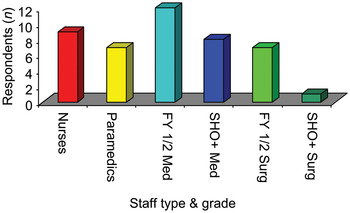
A total of 44 completed questionnaires were returned, giving a response rate of 73.3 per cent. Respondents comprised nine nurses, seven paramedics, 19 foundation doctors and nine core trainees (core trainee one, two or higher) (Figure 1).
Responding healthcare professionals: grades and numbers. FY 1/2 = foundation year 1 or 2 doctors; SHO + = senior house officers or above; med = medicine; surg = surgery.

Respondents' emergency medicine experience ranged from less than six months to more than 10 years.
Question one: difference between tracheostomy and laryngectomy
Almost all of the respondents (43/44) described a tracheostomy as a stoma between the skin and the trachea. Eighty per cent of the respondents knew that a laryngectomy was removal of the larynx. However, only two respondents (one paramedic and one surgical middle grade doctor) appreciated the fundamental difference that a laryngectomy stoma was the sole route of airflow.
Question two: confidence in distinguishing between tracheostomy and laryngectomy
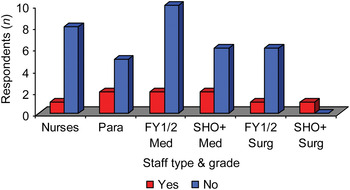
Thirty-five of the 44 respondents (79.5 per cent) felt they were unable to confidently distinguish between a tracheostomy and a laryngectomy. The discrepancy in knowledge appeared to be uniformly distributed amongst all healthcare professionals (Figure 2).
Respondents' answers regarding confidence in their ability to differentiate between tracheostomy and laryngectomy. FY 1/2 = foundation year 1 or 2 doctors; SHO + = senior house officers or above; med = medicine; surg = surgery.

Question three: oxygen delivery for tracheostomy patients
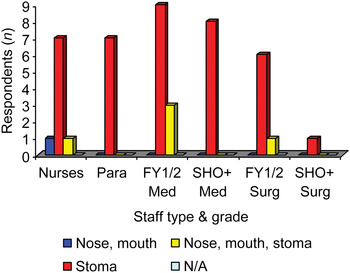
The site of oxygen delivery for tracheostomy patients was correctly identified by 38 of the 44 respondents (86 per cent) (Figure 3).
Respondents' answers regarding site of oxygen delivery for tracheostomy patients. FY 1/2 = foundation year 1 or 2 doctors; SHO + = senior house officers or above; med = medicine; surg = surgery; N/A = don't know

Question four: oxygen delivery for laryngectomy patients
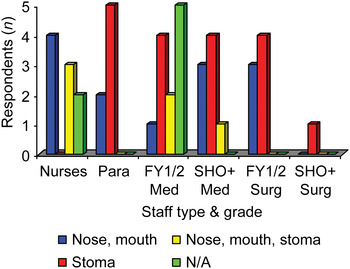
The variation in answers to this question was significantly greater, with only 42 per cent of respondents (18/44) identifying the stoma as the correct site of oxygen delivery. Thirty per cent of respondents (13/44) thought that oxygen should be delivered through the nose and mouth, while 16 per cent (seven of 41) were unsure of the delivery site (Figure 4).
Respondents' answers regarding site of oxygen delivery for laryngectomy patients. FY 1/2 = foundation year 1 or 2 doctors; SHO + =senior house officers or above; med = medicine; surg = surgery; N/A = don't know

Questions five & six: life support and resuscitation training
Eight respondents (seven paramedics and one surgical senior house officer) had completed an Advanced Trauma Life Support course. Of these, six correctly identified the proper site for oxygen delivery in a laryngectomy patient, and all eight correctly identified the proper site for a tracheostomy patient.
Twenty-eight respondents were trained in Advanced Life Support, 18 of whom correctly identified the proper site of oxygen delivery for laryngectomy patients. All 28 gave the correct answer for the route of oxygen delivery for tracheostomy patients.
Questions seven and eight: training and education
Forty-one of the 44 (93 per cent) felt that they had received inadequate training on the subject area covered in the survey, and 40 (91 per cent) felt that an information leaflet provided at departmental induction would go some way towards addressing this.
Discussion
Although tracheostomy is a relatively rare procedure, the chance of tracheostomised patients being transferred to the care of non-specialised staff still remains a distinct possibility. Due to the infrequency with which such patients are encountered, many general clinical staff will subsequently lack the skills, knowledge and confidence to provide safe tracheostomy care.Reference Awad and Pothier5
Airway emergencies can be characterised by hypoxia or anoxia, which may lead to irreversible brain damage within a matter of minutes, and in extreme cases death.
It is the authors' experience that laryngectomy stomas are frequently mistaken for tracheostomies, leading to futile attempts at oral ventilation or intubation. A poor understanding of fundamental anatomy,Reference El-Sayed, Ryan, Schell, Rappazini and Wang2 as well as lack of clinical exposure to the management of such patients, has been shown to cause significant concern and anxiety amongst healthcare staff.Reference Heafield, Rogers and Karnik6
It is important that all front-line emergency staff appreciate the difference between a tracheostomy and a laryngectomy stoma, as this has significant implications for administering oxygen in an emergency setting.
Our survey results indicated that our respondents had a poor level of understanding and confidence regarding the differentiation and management of patients with tracheostomies and laryngectomies. The vast majority of the surveyed cohort attributed such deficiencies to inherent training deficits.
It is also worthwhile noting that perceived inadequacies in training may not always correlate well with levels of confidence in dealing with the same issues in an emergency setting. Awad et al. demonstrated that junior ENT staff had lower confidence levels for managing surgical airway emergencies, attributed to training deficiencies, despite the fact that they possessed a greater scope of ENT knowledge than the other medical and surgical staff with whom they were compared.Reference Awad and Pothier5
A lack of appreciation of the difference between tracheostomy and laryngectomy is, unsurprisingly, also reflected in undergraduates. A pilot survey of 18 individuals, conducted by ourselves prior to initiation of this study, demonstrated that over 90 per cent of final year medical students were unable to confidently discriminate between the two procedures.
In our main survey, respondents who had undertaken the Advanced Trauma Life Support course appeared to appreciate the difference between tracheostomy and laryngectomy. However, making this course compulsory for all front-line healthcare workers would have significant cost and time implications.
Despite the fact that a relatively large number of our respondents had undertaken the Advanced Life Support course, our results demonstrated that this had no significant impact on their levels of knowledge regarding tracheostomy and laryngectomy. It is notable that emergency tracheostomy and laryngectomy management is not covered routinely on this course.
• It is crucial to distinguish laryngectomy from tracheostomy, particularly in airway emergencies
• Many emergency staff do not appreciate this distinction
• Such staff are also unsure about the correct oxygen administration route
• Attendance at courses does not correlate well with confidence and knowledge
• Improved education and training for emergency staff is needed
The amount of previous ENT experience and the ability to perform advanced airway procedures should inevitably enhance staff confidence in the management of such patients; however, attendance at airway management courses does not.Reference Awad and Pothier5
Our survey results clearly emphasise the need for more tracheostomy- and laryngectomy-related education to be given routinely to front-line emergency staff. Possible options include otolaryngology-led training during induction. However, this would have to be implemented on a frequent basis in order to accommodate the frequent turnover of staff in emergency departments. An alternative would be the production of management algorithms for clinical areas which accommodate tracheostomy and laryngectomy patients.
Conclusion
It is crucial to distinguish between a laryngectomy and a tracheostomy patient, particularly in an emergency setting, as airway emergencies require prompt management in order to prevent hypoxic brain injury. This staff survey found that many front-line emergency staff did not appreciate the fundamental difference between a tracheostomy and a laryngectomy, and were uncertain about the correct route of oxygen administration in these groups of patients. Attendance at life support courses did not correlate well with respondents' confidence or knowledge regarding the effective management of these patients. Thus, improved education and training in this subject area is needed for emergency staff.
Appendix 1. The survey questionnaire
1 Please explain in your own words what you understand by the terms below, and what is the difference?
A tracheostomy:
A laryngectomy:
2 Could you confidently differentiate between a laryngectomy and tracheostomy patient?
□ Yes
□ No
3 If a patient has a tracheostomy, where would you give oxygen? (Please tick one response only)
□ Via a facemask over the mouth and nose
□ Via the tracheostomy stoma
□ Via both the facemask over the mouth and nose and the tracheostomy stoma
□ Don't know
4 If a patient has a laryngectomy, where would you give oxygen? (Please tick one response only)
□ Via a facemask over the mouth and nose
□ Via the laryngectomy stoma
□ Via both facemask over the mouth and nose and the laryngectomy stoma
□ Don't know
5 Are you trained in Advanced Life Support?
□ Yes
□ No
6 Are you trained in Advanced Trauma Life Support?
□ Yes
□ No
7 Do you feel that you have received adequate training regarding this subject area?
□ Yes
□ No
8 Do you feel an information leaflet on the covered subject would be beneficial?
□ Yes
□ No
9 What is your position?
□ Doctor: please specify specialty and grade:
□ Staff nurse
□ Other: please specify profession and grade: