INTRODUCTION
Puffer fish are oval shaped and represent an exceptional category among the fish group, as they possess spines all around their bodies with toxic glands beneath. They have the ability to inflate or expand their bodies with air or water when they feel threatened and are most commonly found in marine or brackish water habitats (Nelson, Reference Nelson1994; Shipp, Reference Shipp and Carpenter2003). The majority of puffers belong to the Diodontidae family, which is composed of 20 species (Froese & Pauly, Reference Froese and Pauly2012). The porcupine puffer is most commonly observed in the seas and oceans of tropical regions with approximate latitudes ranging from 45° north to 45° south. Notable sightings are reported from Brazil, the Florida coast, the Red Sea, Mauritius, the Japanese coast, California, Columbia, the west and south coast of India and South Africa (Froese & Pauly, Reference Froese and Pauly2007). This species is also observed in shallow coastal ecosystems such as estuaries, mangroves, coral reefs and sand and gravel sediments, including the soft bottom areas of inshore and offshore regions. It invades areas from the shallow regions to deeper regions, with depths in the range of 1–100 m (Leis, Reference Leis, Fischer and Bianchi1984; Lieske & Myers, Reference Lieske and Myers2004; Froese & Pauly, Reference Froese and Pauly2014).
The dentition of the porcupine puffer is specifically designed to crush hard shells. Thus, their feeding is mostly dependent on hard-shelled invertebrates such as bivalves, gastropods, crabs and sea urchins (Leis, Reference Leis, Fischer and Bianchi1984; Kuiter, Reference Kuiter1993; Nelson, Reference Nelson1994). As nocturnally active voracious feeders, they act as a predatory threat to other marine organisms, particularly those that often move during the night such as crabs, prawns, shrimps, gastropods, etc.
Detailed taxonomic work on puffer fish in the Indian context began during the earlier part of the 19th century (Russell, Reference Russell1803; Hamilton, Reference Hamilton1822; Day, Reference Day1865, Reference Day1876–1878, Reference Day and Blanford1889), but only gained momentum between the mid-1970s and the mid-1980s (Dekkers, Reference Dekkers1975). More recently, Talwar & Jhingran (Reference Talwar and Jhingran1991) provided the descriptions of 11 puffer species from the coasts of India along with some brief information on their geographical distribution and ecology.
Several other species of puffer were collected and reported from Indian waters during the past decade. For example, Muthukumarasamy et al. (Reference Muthukumarasamy, Jeyaraj and Shanth1999) recorded a puffer from the genus Chelonodon (Tetraodoniformes, Tetraodonitae) from the freshwater habitat of the Western Ghats for the first time. Similarly, the first-occurrence report of the marine puffer Torquigener brevipinnis (Osteichthyes: Tetraodontidae) and its distribution and description was made by Biswas et al. (Reference Biswas, Mishra, Satpathy and Selvanayagam2010) from the south coast of India. In addition to this, ten species of puffer fish belonging to the Tetraodontidae family were reported along the Parangipettai coast of southeast India (Veeruraj et al., Reference Veeruraj, Arumugam, Ajithkumar and Balasubramanian2011).
As far as the distribution of the genus Diodon in an Indian context is concerned, findings are reported from Gujarat, Andaman and the Nicobar islands (Talwar, Reference Talwar1990), Kavaratti atoll, Bitra and the Minicoy islands of Lakshadweep (Anand & Pillai, Reference Anand and Pillai2003), the Gulf of Mannar, Tamilnadu (Kumaraguru, Reference Kumaraguru2000), Vizhinjam, Kerala (Bijukumar & Deepthi, Reference Bijukumar and Deepthi2009) and Digha, West Bengal (Kar, Reference Kar1996; ZSI, 2010). Bandyopadhyay (Reference Bandyopadhyay2013) recently reported Diodon hystrix from the Digha coast. However, there have been no previous records of this species from the whole of the Odisha coast.
The present study describes the first distributional record of a porcupine puffer (Diodon holocanthus) from the shallow coastal waters of the Gopalpur coast, located in southern Odisha on the east coast of India. Available literature suggests that this is the first report of this particular type of puffer fish in this part of the Bay of Bengal.
MATERIALS AND METHODS
The Gopalpur coast is located on the east coast of India, adjoining to the Bay of Bengal. It is an important tourist destination for the coastal region of the Odisha state and is well known for its fishing activities. The Gopalpur port, a seasonal port, is established there and is located within 3 km of the Gopalpur coast (Figure 1). There is a 7 km-long backwater connection to the port, called Haripur creek. During a survey made by a fishing fibber boat on the nearshore waters of the Gopalpur coast on 17 November 2013, a porcupine puffer fish was collected in the trawl net at the coordinates 19°15′40.7″N 84°55′17.6″E. The sample was collected, preserved in 10% formalin and kept in the Department of Marine Sciences, Berhampur University, Odisha, India, for further identification processing.
Map of the Gopalpur coast showing the sampling location.

RESULTS AND DISCUSSION
Identification
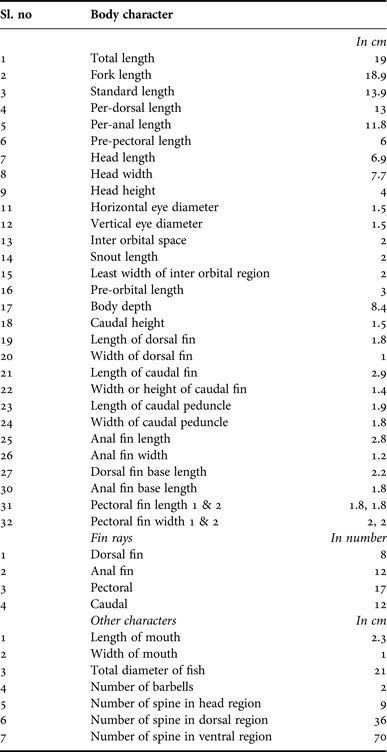
The collected specimen obtained from the shallow waters of Gopalpur was identified as Diodon holocanthus (Linnaeus, 1758) which belongs to the kingdom Animalia, class Actinopterygii, order Tetraodontiformes and family Diodontidae. It is also termed as the Indo-Pacific porcupine puffer because its whole body contains stout erectable spines and it has the ability to expand the body with water or air. The salient features of the presently encountered species D. holocanthus are given in Table 1 and Figure 2.
A. Porcupine puffer fish Diodon holocanthus Linnaeus, 1758 (Diodontidae: Diodon) collected from nearshore waters of the Gopalpur coast. B. Head region. C. Tail region.
Morphometric character of Diodon holocanthus Linnaeus, 1758.
Description
The body colour is pale brownish with black patches on the dorsal side. Shades of white are observed on the ventral side. Two depressible spines rooted on the head are observed. The teeth of the two jaws are fused to form a ‘beak’. The mouth is large and opens wide to crush hard shells. There are small black spots on two thirds of the head and the body. Eyes are blue in colour and a vertical brown bar is observed in the eye from top to bottom. A large, oval, dark-brown patch around the base of each pectoral fin and dorsal fin is observed. The gills open to a vertical slit before the pectoral base of the fish. Fins are devoid of spines and pelvic fins are absent. The body is more compressed and covered with long spines including the head region. There are no spines at the pelvic base. Total length of the body is 19 cm and the diameter is 21 cm in expanded condition. The length of the head is 6.9 cm, the width of the head is 7.7 cm, the length of the mouth is 2.3 cm and the width of the mouth is 1 cm. The specimen has two barbells, the vertical and horizontal diameter of each eye is 1.5 cm, the interorbital length is 2 cm, the snout is 2 cm long and the length of the caudal fin is 2.9 cm. The specimen has eight dorsal fin rays, 12 anal fin rays, 17 pectoral rays and 12 caudal rays. The spines are erectable and there are 115 spines in total: nine spines in the head region, 36 spines in the dorsal region and 70 spines in the ventral region. The spines on the top of the head and the dorsal region are longer than those found on the posterior and pectoral fins. Detailed information regarding the morphometric characters of the specimen's body is given in Table 1 and the complete body of this specimen of Indo-Pacific porcupine puffer, along with the head and tail region, is exhibited in Figure 2.
Colours
The body colour is brown with dark patches scattered on the dorsal sides with black spots. The black spots are absent in the fins. The abdominal region is whitish. The colour of the eye is deep blue, whereas the colour of the spines is greyish white. The head region looks greyish and the tail portion is dark greyish as observed during the morphometric analysis.
Remarks
The body morphology of the Diodon holocanthus might be confused with another species of the same genus, the Diodon liturosus, also known as the black-blotched porcupine fish, which is so named because of its body colour. The Diodon liturosus differs from the presently encountered species in respect to the presence of long spines on its body. Similarly, the body features of the Diodon hystrix exhibit some resemblance to that of the Diodon holocanthus, but still it differs from the Diodon holocanthus with respect to the presence of black spots on its fin (Froese & Pauly, Reference Froese and Pauly2014), which are absent in the presently observed species. The puffer Diodon holocanthus can attain a maximum growth of up to 50 cm.
The most interesting fact associated with these benthivorous fish is that they have the following three defence mechanisms: (i) they have poisonous spines all over their bodies that protect them from being grazed by predators; (ii) when threatened, they can inflate their bodies with air or water, thus becoming large in size and looking dangerous with erected spines – this is enough to avoid wide-mouthed organisms; and (iii) when engulfed by larger organisms, they can kill the predator with the poisonous substance ‘tetrodotoxin’, which is found in its body and vital organs (Halstead et al., Reference Halstead, Auerbach and Campbell1990). The fact that such a wonderful set of defence mechanisms has been developed by a fish is seen as extraordinary when compared with other marine organisms. Despite possessing all these defence mechanisms, sometimes the porcupine fish is grazed on by dolphins and sharks (Bandyopadhyay, Reference Bandyopadhyay2013; Froese & Pauly, Reference Froese and Pauly2014). However, it is not clear how this toxin is found inside the body of the porcupine puffer. Two theories are considered in this regard. The first theory asserts that the toxin may have been deposited in the puffer fish's body through the food items it eats, i.e. via the bioaccumulation process, and the second theory states that it might have produced this toxin from its own body to avoid grazing from predators (Froese & Pauly, Reference Froese and Pauly2014).
Frequently, ‘tetrodotoxin’ is seen in fish belonging to the Tetraodontidae family. It acts as a very potent neurotoxin to human beings when consumed but still has many medicinal values and therapeutic uses. According to the findings of Hagen et al. (Reference Hagen, Lapointe, Ong-Lam, Dubuc, Walde, Gagnon, Love, Goel, Hawley, Ho Ngoc and du Souich2011), the tetrodotoxin from poisonous puffers may be given to cancer patients in low concentrations as an analgesic drug instead of morphine, which is used as a painkiller. In low concentrations, it can reduce the pain of cancer patients, in particular, those that are being treated with chemotherapy. It is still under critical clinical trials and more time is needed before it can be used extensively. Besides this, the puffer fish is also used in traditional Chinese medicine (Froese & Pauly, Reference Froese and Pauly2014).
As a feeder of macrobenthic organisms, a puffer fish's prey includes sea urchins, crabs, gastropods, etc. Interestingly, the macrobenthic community of the Gopalpur coast mainly consists of gastropods, bivalves and crustaceans. Among the dominant gastropods, Conus vulgaris, Bursa spinosa, Cerithdia cingulata, Neritina, Nerita Turitella, Epitonium, Oliva oliva and Bulia vitata are prominently found. Among the bivalves, the conspicuous representatives are those of Chiton, Perna viridis, Modiolus, Branchiodontus, etc. Among the crustaceans, the hermit crab Neptunus pelagius, etc., are dominant and frequently observed in the nearshore waters of the Gopalpur coast.
Recently, in the nearshore waters of the Gopalpur coast, a large number of porcupine puffers were caught by anglers during the post-cyclonic periods of ‘Phailin’. This is presumed to be a consequence of the super cyclone ‘Phailin’ that hit the Gopalpur coast on 12 October 2013 (IMD, 2013). Most likely, the destruction of the natural habitat of the Diodon holocanthus, due to high waves and changes in current patterns from south-westward to north-eastward during the super cyclone, has forced this species to invade new areas such as the Gopalpur coast. Since then, this prickled puffer has been more frequently observed within the study area and at present, it is becoming a menace to local anglers. Its presence in coastal waters not only reduces the catch of commercially important fish and shell fish but also drastically damages fishing nets and creates human hazards. This has an adverse impact on the socio-economics of the anglers of the Gopalpur coast. From Figure 3 it is evident that a large number of dead and decaying porcupine puffers (genus Diodon) were found scattered across the sandy beaches of Gopalpur after being thrown by anglers from their fishing nets. This condition of unintended bycatch is found to be more pronounced after the occurrence of the super cyclone ‘Phailin’. This is the first time these kinds of conditions have been reported from this part of the east coast of India.
Dead Indo-Pacific porcupine puffer Diodon holocanthus (Linnaeus, 1758) caught as bycatch on the Gopalpur coast, Bay of Bengal (photograph by author, dated 17 November 2013).
CONCLUSION
The present study describes the preponderance of the Indo-Pacific puffer fish (Diodon holocanthus) in the coastal waters of Gopalpur, on the east coast of India. It is the first distributional record to be reported from this part of the coast after the super cyclone ‘Phailin’. As an excess bycatch in fishing nets, Diodon holocanthus have created an inconvenient situation for local anglers. A possible explanation for such an abundance of this species on the Gopalpur coast may be that the adverse weather conditions have forced the species there, along with the circulation of water mass from south-westward to north-eastward, which occurred during ‘Phailin’. Furthermore, the sustained presence of this species on the Gopalpur coast might be due to the non-availability of prey and a favourable ecosystem. Nevertheless, due to the present lack of substantial information regarding the habitat, biology and diversity of this species, it is difficult to provide any valid conclusion. However, the present findings have enriched the information regarding the geographical distribution of this species along the east coast of India.
ACKNOWLEDGEMENTS
The authors are grateful to Dr A.K. Mohapatra, ZSI, for providing the identification remarks for the species. The authors would also like to thank the Head of the Department of Marine Sciences, Berhampur University, for granting us the use of the laboratory facilities.