Introduction
The pharmacological treatment of older persons with schizophrenia and other psychotic disorders is similar to that of younger patients (Thorpe, Reference Thorpe1997; Alexopoulos et al., Reference Alexopoulos, Streim, Carpenter and Docherty2004; Lehman et al., Reference Lehman2004a; White et al., Reference White2006; Limosin, Reference Limosin2009), but several specific factors should be taken into consideration. In particular, elderly psychotic patients have a reduced life expectancy compared with healthy seniors, which is associated with a low rate of treatment for hypertension, dyslipidemia and diabetes (Gury, Reference Gury2004; Marder et al., Reference Marder2004; Sokal et al., Reference Sokal2004; Hennekens et al., Reference Hennekens2005; Lefebvre et al., Reference Lefebvre2006; Nasrallah et al., Reference Nasrallah2006). The concurrent decline in cognitive function and functional abilities further compromises health outcomes (Harvey et al., Reference Harvey1998; Friedman et al., Reference Friedman2001; Harvey, Reference Harvey2001). On the other hand, second generation antipsychotics such as risperidone, olanzapine, quetiapine and aripiprazole have been preferred over classical antipsychotics because of their lower incidence of extrapyramidal, anticholinergic and cardiac side-effects and a greater efficacy in reducing negative and neurocognitive symptoms (Alexopoulos et al., Reference Alexopoulos, Streim, Carpenter and Docherty2004; Jeste et al., Reference Jeste2005). However, these medications have a propensity to cause weight gain and metabolic disorders, and elderly people with psychotic disorders have more somatic comorbidities, which cause greater difficulty in their treatment (Wirshing et al., Reference Wirshing, Pierre, Erhart and Boyd2003; Gury, Reference Gury2004; Jeste et al., Reference Jeste2005; Ruetsch et al., Reference Ruetsch, Viala, Bardou, Martin and Vacheron2005). Data on tolerance of atypical antipsychotics in elderly patients suffering from schizophrenia and other psychotic disorders are still scarce, particularly concerning the dose adaptation in aging schizophrenic patients with altered renal or hepatic function (Rosenheck et al., Reference Rosenheck2006). Finally, anticholinergic medication, used to treat the side-effects of typical antipsychotic agents, is not without adverse effects, particularly for elderly people with cognitive and memory impairments (Drimer et al., Reference Drimer2004). An expert consensus panel has recently revised recommendations for using antipsychotic drugs in older patients (Alexopoulos et al., Reference Alexopoulos, Streim, Carpenter and Docherty2004). The medical needs of elderly people with psychotic disorders are not adequately addressed by clinicians in specialty mental health programs or in primary care settings (Limosin, Reference Limosin2009).
Consequently, the medical care of elderly patients with psychotic disorders is a matter of major concern. Therefore, we decided to enlist French psychiatrists and geriatricians to participate in a survey about the therapeutic management (primary objective), the cognitive status and overall health conditions of their elderly psychotic patients.
Methods
Participants and procedures
This observational, cross-sectional survey (SAGE, Schizophrenia AGEd) was carried out among French psychiatrists having clinical experience in geriatric psychiatry and geriatricians working in different Services of Geriatric Psychiatry or having a university diploma in psychogeriatrics. These physicians were selected by a Scientific Committee through the national database of the Ministry of Health (Direction de la recherche, des études, de l'évaluation et des statistiques, www.sante.gouv.fr/drees) with the inclusion criteria being that they must be psychiatrists and/or gerontologists prescribing antipsychotic drugs to psychotic patients aged ≥60 years. An invitation to participate in the study was made by telephone to about 500 physicians.
A questionnaire was subsequently mailed and completed by 123 physicians (97 psychiatrists and 26 geriatricians) who agreed to participate in the study. To reduce selection bias, physicians were asked to include the first 7 to 10 patients fulfilling the selection criteria during the first four weeks following the initiation of the study.
Questionnaire
The questionnaire contained items concerning:
• physicians' characteristics and clinical aspects of the participating patients (mental disease according to the ICD-10 diagnostic criteria (WHO, 2007), duration of psychotic disease, somatic comorbidities);
• therapeutic management of patients (main objective of SAGE):
○ antipsychotic treatment (typical or atypical antipsychotic, monotherapy or polytherapy)
○ antiparkinsonian medication and reasons for prescribing it (actual or previous extrapyramidal side-effects or to prevent extrapyramidal side-effects)
○ psychotropic co-medication
• secondary objectives of SAGE:
○ mental state evaluation: at least one evaluation of psychotic trouble severity (item 1 of the Clinical Global Impression (CGI) scale) and at least one evaluation of cognitive capacity in the previous six months (Mini-Mental State Examination (MMSE), and verbal fluency test)
○ somatic evaluation: at least one electrocardiogram (ECG) in the previous 12 months, at least one biochemical analysis in the previous 6 months (at least one positive answer to the questions regarding: glycemia, or HDL cholesterol, or triglycerides, or creatininemia).
Patients
The participating physicians were asked to include psychotic patients aged 60 years and older. The evaluated patients were required to have had schizophrenia or another psychotic disorder for at least 10 years, to have been treated with at least one antipsychotic drug and not to have dementia or any other neurodegenerative disorder. Physicians participating in the study examined and included patients from their current medical practices. Current diagnostic and therapeutic modalities were respected by the SAGE protocol.
Psychiatrists recruited many more patients (n = 746) than gerontologists (n = 184) with no significant differences in the main measured variables between both groups of patients. Therefore, patients in both groups were pooled.
Statistical analysis
Frequencies and percentages of all category responses for physicians’ questionnaires were calculated. Continuous variables were summarized using the mean, median, SD, minimum, and maximum.
Results
Demographic aspects
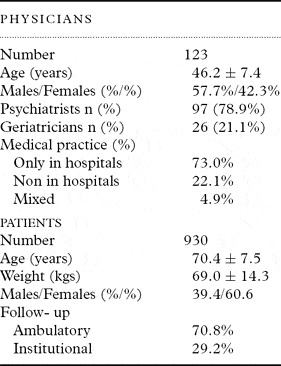
A total of 123 physicians participated in the study. Their demographic characteristics are shown in Table 1. Of the participating physicians, 97 were psychiatrists and 26 were geriatricians. The majority physicians (73%) worked exclusively in hospitals (Table 1).
Demographic aspects of the participating physicians and patients

Values are given as mean ± SD or in % of total.
The participating physicians recruited 942 patients to take part in the study. Data from 12 patients were excluded due to major protocol deviations, leaving data from 930 patients that were ultimately used for analysis. Table 1 shows the demographic characteristics of the included patients. Mean patients’ age was 70.4 ± 7.5 years. The patient population included more women than men (60.6% vs 39.4%), reflecting their longer life expectancy, and 70.8% of patients were outpatients and 29.2% were inpatients.
Clinical characteristics
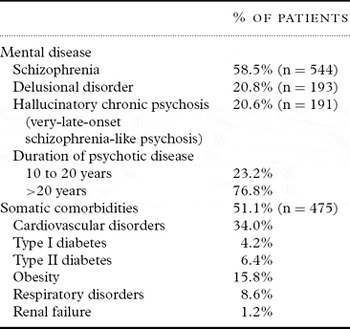
As shown in Table 2, most patients suffered from schizophrenia (58.5%). The remaining patients suffered from delusional disorder (20.8%) and hallucinatory chronic psychosis (very-late-onset schizophrenia-like psychosis) (20.6%). In most patients (76.8%), the psychotic disorder had lasted for more than 20 years. At least one of the following somatic comorbidities were identified in 475 (51.1%) patients: cardiovascular disorders (34.0%), Type I diabetes (4.2%), Type II diabetes (6.4%), obesity (15.8%), respiratory disorders (8.6%) and renal failure (1.2%).
Clinical aspects of the participating patients (n = 930)

Therapeutic management (primary objective)
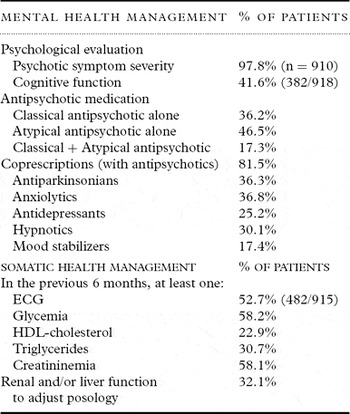
Antipsychotic treatment: 63.8% of patients received at least one atypical antipsychotic drug and 53.5% received at least one classical antipsychotic. Of these, 17.3% of patients received both in combination, whereas 36.2% patients received a classical antipsychotic alone and 46.5% patients received an atypical antipsychotic alone (Table 3).
Health management of elderly psychotic patients (n = 930)

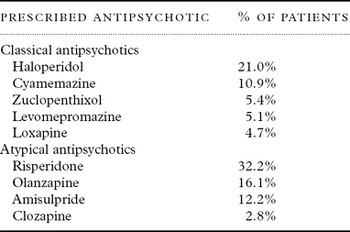
A prescribed antipsychotic was identified in 920 patients. Table 4 shows that the most frequent classical antipsychotics were: haloperidol (21% of patients), cyamemazine (10.9%), zuclopenthixol (5.4%), levomepromazine (5.1%) and loxapine (4.7%). The most frequent atypical antipsychotics were: risperidone (32.2% of patients) olanzapine (16.1%), amisulpride (12.2%) and clozapine (2.8%).
Prescribed antipsychotic (n = 920)*

* The prescribed antipsychotic was identified in 920 out of the 930 investigated patients.
Co-prescriptions: Antipsychotics were prescribed with other psychotrops in 81.5% of cases (Table 3). The coprescribed psychotrops were: antiparkinsonians (36.3% of patients, of whom only 17.8% were prescribed it as a preventive treatment), anxiolytics (36.8%), antidepressants (25.2%), hypnotics (30.1%) and mood stabilizers (17.4%).
Health conditions (secondary objectives)
Mental health evaluation: The psychotic symptom severity was evaluated for 910 patients (97.8%) (Table 3). Conversely, only 41.6% of patients had been evaluated for cognitive function during the previous six months (Table 3).
Somatic health evaluation: Only 52.7% of patients had had an ECG within the last 12 months (Table 3). Glycemia evaluations within the last six months was available for only 58.2% of patients, HDL-cholesterol for 22.9% of patients, triglycerides for 30.7% patients and creatininemia for 58.1% patients (Table 3). Evaluation of renal function and/or liver function to adjust the treatment dose was only performed in 32.1% of patients (Table 3).
Discussion
In accordance with the recommendations for good clinical practice from main expert guidelines and consensus conferences (Thorpe, Reference Thorpe1997; Wirshing, Reference Wirshing, Pierre, Erhart and Boyd2003; Alexopoulos et al., Reference Alexopoulos, Streim, Carpenter and Docherty2004; Gray, Reference Gray2005; Lehman et al., Reference Lehman2004a; Reference Lehman, Lieberman, Dixon, McGlashan, Miller, Perkins and Kreyenbuhl2004b; Limosin, Reference Limosin2009), the 930 elderly psychotic patients investigated here received antipsychotic treatment mostly in monotherapy (82.7%) and inappropriate antiparkinsonian medication was infrequent (only in 6.3% of patients as preventive treatment). Moreover, the severity of psychosis was evaluated for almost all patients. Conversely, cognitive function was evaluated in less than half of the patients and evaluation of renal and/or liver function (to adjust the dose of treatment) was performed in only one third of patients. Almost half of the patients had no ECG evaluation (during the previous 12 months) or glycemia or creatininemia evaluations (during the previous 6 months). In addition, HDL-cholesterol and triglycerides were available for less than one third of them. And all this in spite of a high frequency (51.1%) of somatic comorbidities, particularly: cardiovascular disorders (34.0%), Type I diabetes (4.2%), Type II diabetes (6.4%), obesity (15.8%), respiratory disorders (8.6%) and renal failure (1.2%).
Several age-related physiological changes may influence the approach to pharmacotherapy in older psychotic patients (Thorpe, Reference Thorpe1997; Alexopoulos et al., Reference Alexopoulos, Streim, Carpenter and Docherty2004; Lehman et al, Reference Lehman, Lieberman, Dixon, McGlashan, Miller, Perkins and Kreyenbuhl2004b; Limosin, Reference Limosin2009,). In particular, the reduced cardiac output and the concomitant reduction in renal and hepatic blood flow require adaptation of the posology. These changes may alter pharmacokinetic aspects (absorption, distribution, metabolism and excretion) of medications and may result in prolonged drug effects and greater sensitivity to medications, in terms of both therapeutic response and side-effects (Lehman et al., Reference Lehman, Lieberman, Dixon, McGlashan, Miller, Perkins and Kreyenbuhl2004b). However, our survey revealed that evaluation of renal and/or liver function to adjust the dose of treatment was performed in only 32.1% of patients. This is a very important aspect, potentially aggravated by the propensity of older patients to take medications incorrectly due to sensory impairment, cognitive deficits, medical comorbidity, polypharmacy, and heightened sensitivity to adverse effect (Masand and Gupta, Reference Masand and Gupta2003).
In the aged psychotic patient, the deterioration of cognitive function is a frequent phenomenon, requiring special care (Harvey et al., Reference Harvey1998; Friedman et al., Reference Friedman2001; Harvey, Reference Harvey2001). In schizophrenia, progressive cognitive loss is often secondary to the evolution of schizophrenia itself, and not to evolution of dementia. In geriatric patients with lifelong schizophrenia, cognitive impairment is a predictor of both overall outcome and specific adaptive deficits (Harvey et al., Reference Harvey1998). Interventions aimed at cognitive impairment may have an impact on the functional and social status of the psychotic patient. Yet our observations reveal that only 41.6% of older psychotic patients had an evaluation of cognitive function during the previous six months. In light of our findings, it is apparent that this discrepancy warrants further consideration.
Several important considerations influence the use of antipsychotics in elderly patients (Thorpe, Reference Thorpe1997; Alexopoulos et al., Reference Alexopoulos, Streim, Carpenter and Docherty2004, Lehman et al., Reference Lehman, Lieberman, Dixon, McGlashan, Miller, Perkins and Kreyenbuhl2004b, Limosin, Reference Limosin2009). Classical antipsychotics induce tardive dyskinesia in the later stages of life more often than in younger adults. Other side-effects of particular concern in elderly patients include sedation, anticholinergic effects and postural hypotension. Second-generation (atypical) antipsychotics are thus generally recommended because of their significantly lower risk of inducing extrapyramidal symptoms and tardive dyskinesia in older persons. However, the second-generation agents have other clinically significant and common side-effects, most notably sedation and orthostatic hypotension. Elderly patients with low cardiac output are especially vulnerable to hypotension and cardiac arrhythmia. Moreover, a recent study did not find that atypical antipsychotics produce any differential protective effect relative to typical antipsychotics on the long-term manifestations of symptoms, cognition and self-care in poor-outcome geriatric schizophrenic patients (White et al., Reference White2006). Finally, more attention has been paid to the tolerance of atypical antipsychotics in older persons since it has been demonstrated that these drugs significantly increase the risk of death by stroke in patients with Alzheimer's disease (Brodaty et al., Reference Brodaty2003; Wooltorton, Reference Wooltorton2002; Reference Wooltorton2004).
In the USA, patients with serious mental illness were found to be more likely to have diabetes (Dixon et al., Reference Dixon2000; De Hert et al., Reference De Hert2006) and other comorbid medical conditions than people in the general population (Sokal et al., Reference Sokal2004; McEvoy et al., Reference McEvoy2005). Conversely, rates of diabetes found among aged psychotic patients in France (10.6%) were similar to the general French population aged 60 years or more (8.3–11.5% in women and 14.2–17.7% in men) (Kusnik-Joinville et al., Reference Kusnik-Joinville2008). Moreover, French aged psychotic patients had a similar incidence of obesity (15.8%) as the general French aged population (16.8–17.7%) (Charles et al., Reference Charles2008). Another difference with American patients with serious mental illness concerns the high rate of chronic pulmonary illness (31% incidence) (Jones et al., Reference Jones2004), whereas it was 8.6% in French aged psychotic patients. Age, diet and differences in psychotropic therapy can explain, at least in part, these differences between USA and France.
With regard to somatic health care, our results confirm and extend previous observations in the USA showing a low rate of treatment for hypertension, dyslipidemia and diabetes. Thus, the CATIE trial showed that 30% of schizophrenic patients were untreated for their diabetes, 62% for their high blood pressure and 88% for their dyslipidemia (Nasrallah et al., Reference Nasrallah2006). Some 75% of schizophrenic patients are smokers (versus 25% in the general US population) and frequently present cardiovascular risk factors such as obesity, high blood pressure, hypercholesterolemia and diabetes (Gury, Reference Gury2004; Marder et al., Reference Marder2004; Sokal et al., Reference Sokal2004; Hennekens et al., Reference Hennekens2005). Taken together, all these factors can explain, at least in part, why more than 66% of schizophrenic patients suffer from coronary incidents (versus 50% in the general population) and had a mean life expectancy 10–12 years shorter than that of the general population (suicide contributes also to the higher mortality rates, but to a lesser extent) (Gury, Reference Gury2004; Marder et al., Reference Marder2004; Sokal et al., Reference Sokal2004; Hennekens et al., Reference Hennekens2005).
The presence of concomitant medical illness or the use of multiple medications frequently complicates the treatment of older patients (Thorpe, Reference Thorpe1997; Alexopoulos et al., Reference Alexopoulos, Streim, Carpenter and Docherty2004; Lehman et al., Reference Lehman, Lieberman, Dixon, McGlashan, Miller, Perkins and Kreyenbuhl2004b; Limosin, Reference Limosin2009). Some medical treatments, particularly some atypical antipsychotics, constitute an additional risk factor, given their undesirable side-effects, particularly weight gain and metabolic disorders (Wirshing et al., Reference Wirshing, Pierre, Erhart and Boyd2003; Gury, Reference Gury2004; Jeste et al., Reference Jeste2005, Ruetsch et al., Reference Ruetsch, Viala, Bardou, Martin and Vacheron2005). In some cases, elderly patients who are frail or malnourished may benefit from medication-induced weight gain; however, weight gain may also aggravate pre-existing cardiovascular disease or osteoarthritis in this population.
All of the above deficiencies in the health management of elderly people with psychotic disorders deserve particular attention. It is expected that, with the overall increase in life expectancy, the number of elderly patients with psychotic disorders is expected to increase rapidly over the next three decades (Lehman et al., Reference Lehman2004a).
Seventy-three percent of the physicians participating in the study worked solely in hospitals while 70.8% of the patients were outpatients. This apparent discrepancy is explained by the fact that, in France, the vast majority of patients are treated as outpatients, so that 68% of those in public psychiatric services are never hospitalized (hopital.fr, 2010).
Finally, it is important to consider the limitations of our study. First, there was a degree of selection bias, since responder physicians (123 out of the 500 contacted) are generally better motivated and more interested in the care of their patients. Second, dosage ranges for elderly patients (generally lower than the ones recommended for younger patients) were not assessed with the survey. Finally, HDL-cholesterol was surveyed, but not LDL-cholesterol (LDL-cholesterol is more commonly measured for cardiovascular risk).
In conclusion, antipsychotic and antiparkinsonian drug prescriptions in aging French psychotic patients tend to follow the recommendations of guidelines and consensus conferences. Conversely, cognitive, cardiac and metabolic aspects are less well managed and should be monitored more tightly. Finally, a better understanding of the medical care modalities of older psychotic patients should help to establish specific guidelines.
Conflict of interest
None.
Description of authors' roles
C. Arbus, with the help of V. Camus, wrote the paper. C. Arbus, T. Bougerol, J.P. Clément, P. Frémont and V. Camus were all involved in the elaboration of the study protocol and supervision of the data collection and statistical analyses.
Acknowledgments
This study was sponsored by Sanofi-Aventis France.