During arguments in Obergefell v. Hodges, Chief Justice Roberts stated “People feel very differently about something if they have a chance to vote on it than if it’s imposed on them…” (2015). The idea behind this statement is that the method used to reach a policy outcome affects evaluations of the policy. Studies have shown that processes deemed fair increase people’s willingness to acquiesce to unfavorable outcomes (Gibson Reference Gibson1989; Lind and Tyler Reference Lind and Tyler1988; Tyler Reference Tyler2000). Contrary to this, however, previous work finds that while people may claim to support certain processes, they really only care about getting their preferred outcome (Harbridge, Malhotra, and Harrison Reference Harbridge, Malhotra and Harrison2014). Do people feel differently about laws depending on how they are enacted?
I address this in a series of experiments manipulating the way in which a law is passed – through ballot initiative or the state legislature – to test the effect of process on citizens’ evaluations of laws. My results suggest that people view the ballot initiative process as fairer than the legislative process, but process has a negligible effect on individuals’ views on the law itself. This finding contributes to our understanding of the effect of procedural preferences on individuals’ views on policy outcomes; it casts doubt on the claim that people feel differently about laws depending on how they are enacted.
EXPERIMENTAL DESIGN
I conducted two online survey experiments using Amazon Mechanical Turk (Mturk) to assess whether the way in which a law is passed affects people’s evaluations of those laws. Holding the law itself constant, participants were randomly assigned to one of the two lawmaking processes through which the law was passed: ballot initiative vs. state legislature.
Study 1: Same-Sex Marriage and State Personnel Guidelines
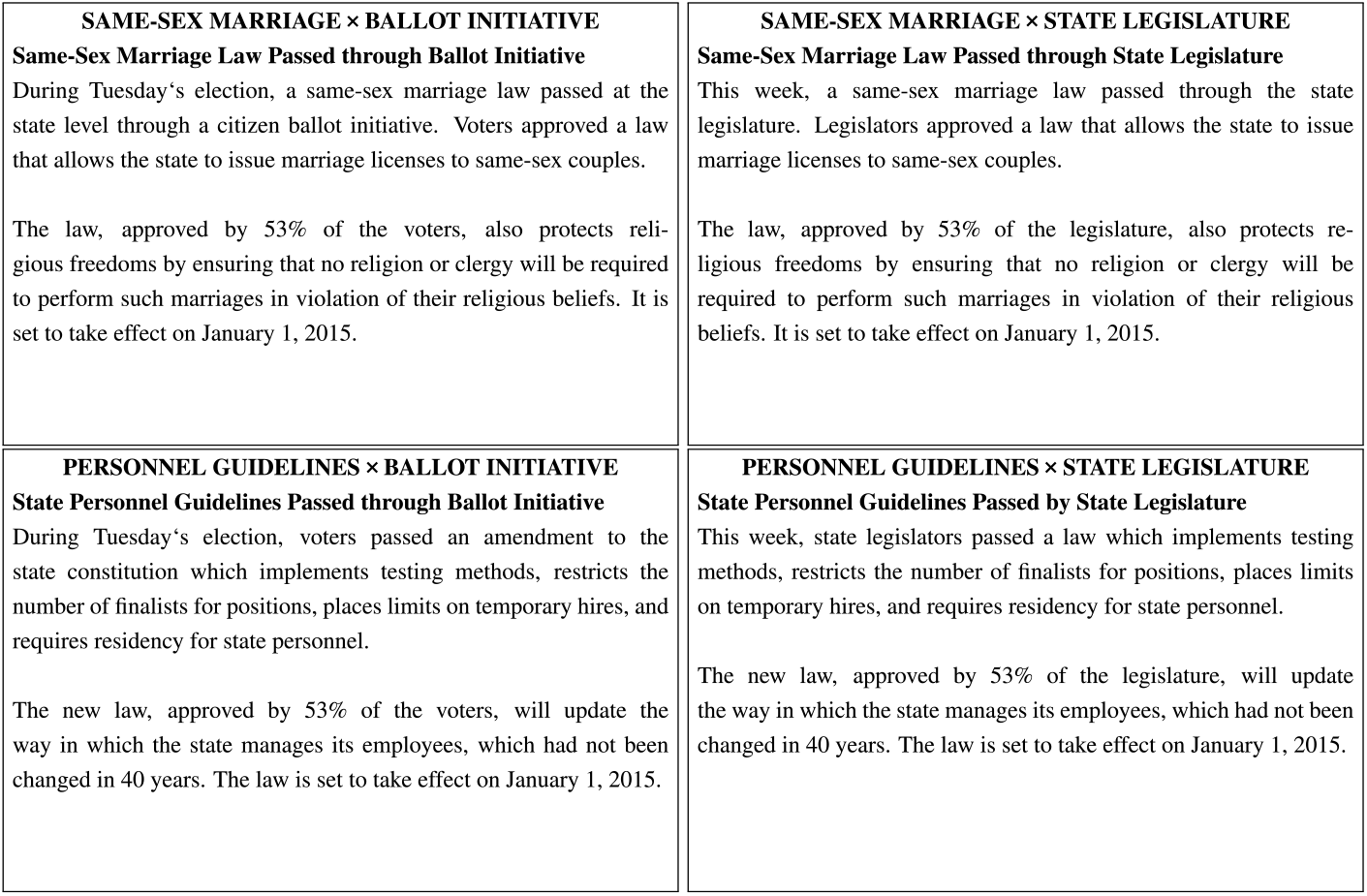
The first experiment (fall 2014) utilized a 2 × 2 factorial between-group design with four treatment groups varying on two dimensions: the process used to pass a law and the policy area. Four hundred and thirty-one participants were recruited, ranging from 105 to 110 in each treatment group.Footnote 1 Participants read one of the four vignettes designed to look like a news story describing a recently adopted law within a state. Participants were randomly assigned to one of the two laws: the legalization of same-sex marriage or a law regarding a change in state personnel guidelines. For each of the two laws, participants were randomly assigned to whether the law was passed through ballot initiative or through the state legislature. The full text of the vignettes is found in Figure 1. Following the treatment and a manipulation check,Footnote 2 participants were asked questions regarding their views on the law.Footnote 3
Treatment Vignettes.

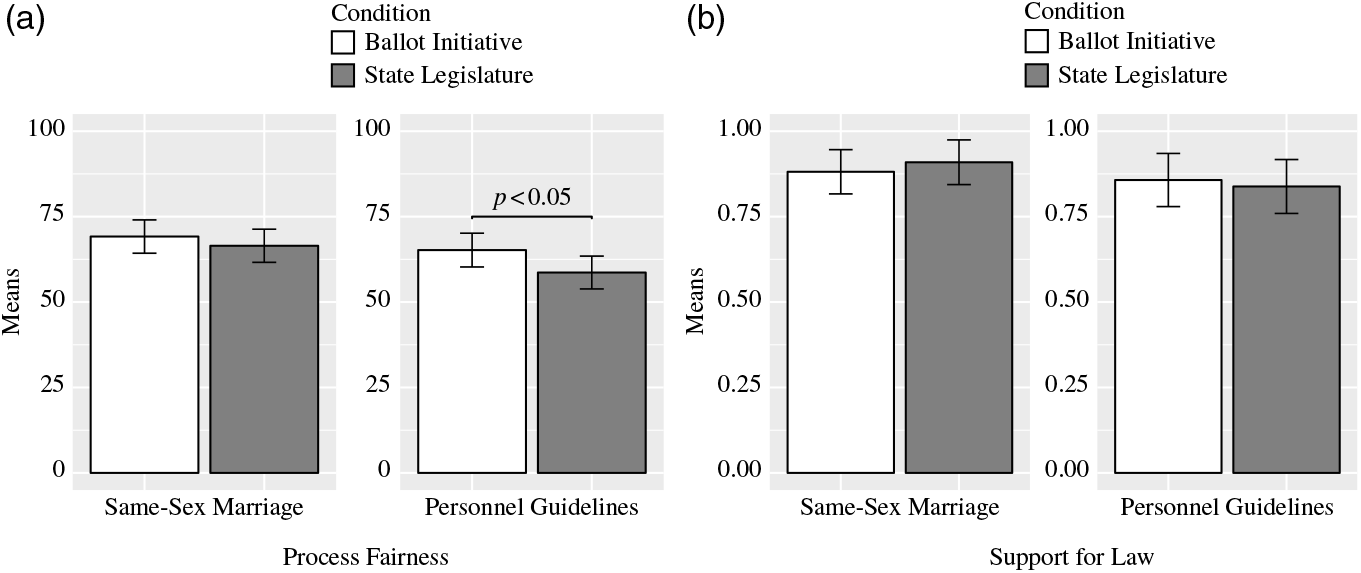
I first look at whether respondents’ views on the fairness of the process used to pass the law are different for the ballot initiative and state legislative treatments. Participants were asked: “Do you think the process used to pass the law was very fair, very unfair, or somewhere in between?” Responses were recorded using a feeling thermometer ranging from 0 to 100, with zero being “Very unfair” and one hundred being “Very fair.” Figure 2(a) shows the difference-in-means across treatments, with bars indicating the means of each treatment group and lines for 95% confidence intervals.Footnote 4
Study 1 Results, Difference-in-Means.

Across all treatment groups, most respondents view the processes as fair, with means ranging from 59 to 69. While those receiving the same-sex marriage treatment passed by ballot initiative did, on average, rate the process as fairer than those receiving the state legislature treatment, the difference is not statistically significant. For the personnel guidelines treatment, those receiving the ballot initiative treatment viewed the process as significantly fairer than those receiving the legislative process; the mean increase in fairness evaluations for those receiving the ballot initiative treatment is 6.57 (t = −2.05, p < 0.05).
I then examine whether respondents evaluated the laws differently based on how they were passed. Participants were asked, “Would you support an effort to repeal the law, or let it stand?” The response variable is dichotomous, with zero indicating support for repealing the law, and one being support for letting the law stand. Figure 2(b) presents difference-in-means results from this question. There are no significant differences in support across procedural treatments for either policy. The likelihood of supporting the law ranged from 84% to 91% across treatment groups, indicating that most people were likely to support the law regardless of treatment.
Study 2: Marijuana Decriminalization and Auto Insurance Guidelines
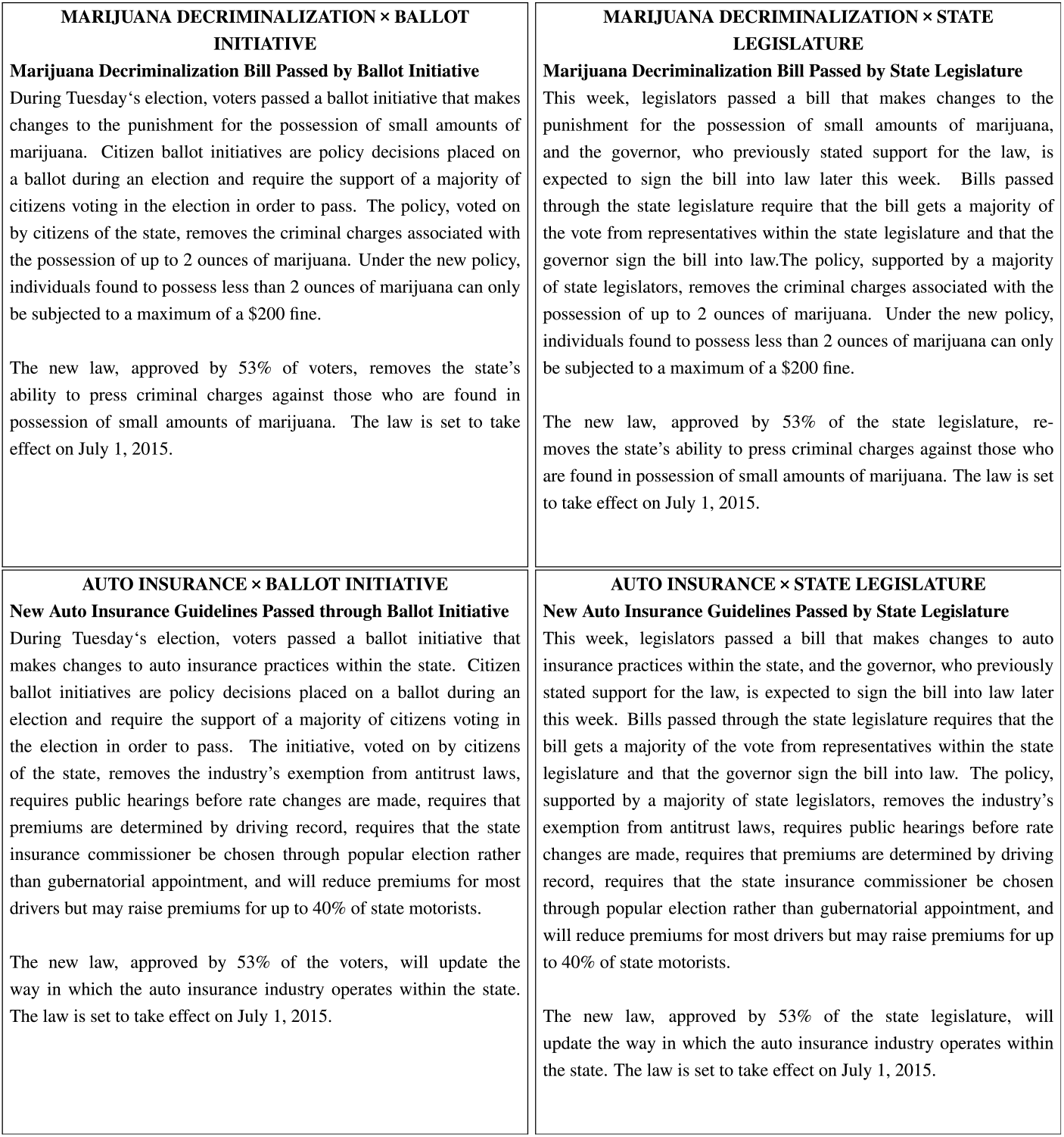
The second experiment (spring 2015) enrolled 1,712 MTurk participants, ranging from 427 to 430 in each treatment group.Footnote 5 The 2 × 2 factorial design remained the same but tested different policy issues: marijuana decriminalization and auto insurance guidelines. Full vignettes appear in Figure 3.
Treatment Vignettes.

Following the treatment and a manipulation check,Footnote 6 participants were asked about their views on the law and the process used to pass the law.
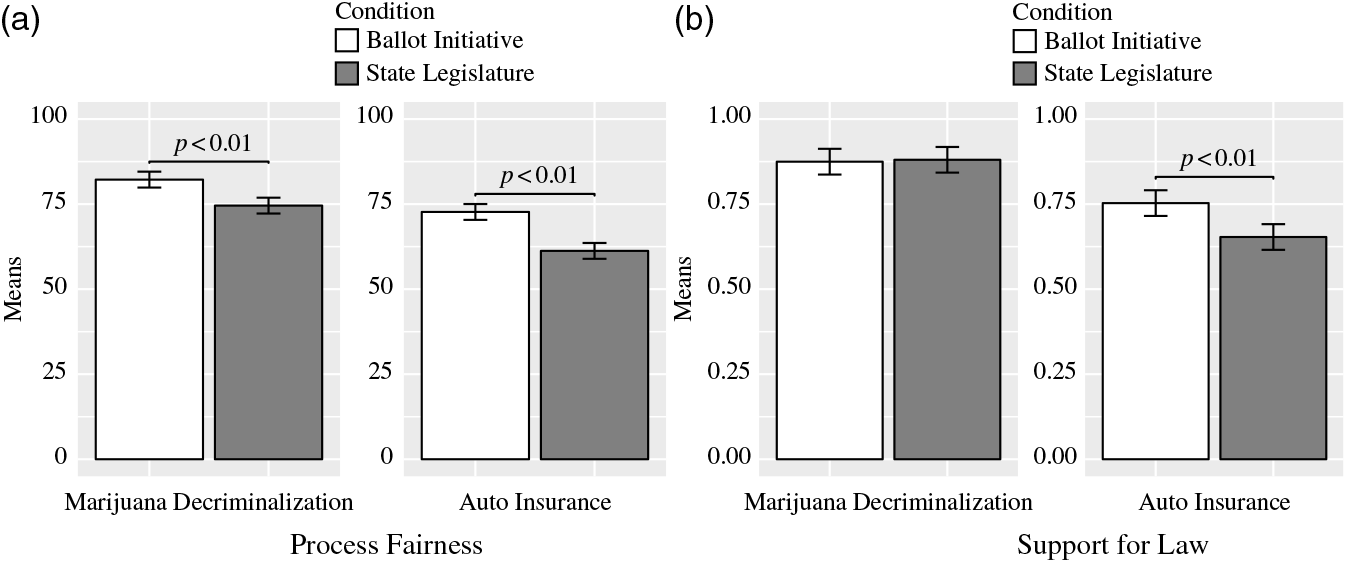
As in the first study, respondents reported their perceived fairness of the process used to pass the law using a feeling thermometer (0 = “Very unfair”, 100 = “Very fair”). Figure 4(a) shows the difference-in-means of this variable. Across treatment groups, respondents viewed both the ballot initiative and legislative processes as fair ways to pass these policies with means ranging from 61 to 82. However, respondents in both policy treatments view the ballot initiative process as significantly fairer than the legislative process; the mean increase in fairness evaluations for those receiving the marijuana decriminalization and auto insurance treatments is 7.64 (t = −4.56, p < 0.01) and 11.45 (t = −6.78, p < 0.01), respectively.
Study 2 Results, Difference-in-Means.

Figure 4(b) displays difference-in-means in support for the policy passed (“1” = Support, “0” = Lack of support). Like the first study, most respondents within each treatment group expressed support for the law passed. For those receiving the marijuana decriminalization treatments, there is no significant difference in support between processes; roughly 88% of them support the law, regardless of the process used to pass the law. For those receiving the auto insurance treatment, there is a significant difference in support by procedural treatment; 10% more of those receiving the ballot process supported the policy (t = −3.19, p < 0.01).
CONCLUSION
Across two survey experiments, I find one significant effect of process on policy evaluations: respondents report higher levels of support for auto insurance regulation policy when it is enacted by ballot initiative. My results suggest that while people generally feel that both the ballot initiative and legislative processes are fair, they often view the former as fairer than the latter. However, this perception of fairness does not translate into higher support for policy. Overall, my work builds on previous studies (e.g., Harbridge, Malhotra, and Harrison Reference Harbridge, Malhotra and Harrison2014) in concluding that process has a negligible effect on policy evaluations.Footnote 7 Future work should consider whether people hold different preferences for policy passage based on issue area – it may be that people prefer greater public input through ballot initiative on certain issues and would prefer deference to a legislative body for other issues.
Supplementary Material
To view supplementary material for this article, please visit https://doi.org/10.1017/XPS.2019.28