INTRODUCTION
Constitutional provisions take on meaning as they are applied to particular cases and political questions. Consequently, judges are often seen as the authors of constitutional meaning. It is therefore unsurprising that, in the U.S. context, questions about how the Supreme Court should interpret and apply constitutional content have composed the core of constitutional theorizing since the Progressive Era.Footnote 1 These debates about the proper relationship between the Court and Constitution only intensified with the famous decisions of the Warren CourtFootnote 2 and persisted throughout the so-called culture wars of the late twentieth century,Footnote 3 as courts continued to interpret the Constitution's broad declarations of rights in order to rule on the validity of specific, highly salient, and divisive policies (like economic regulations, regimes of racial segregation, and abortion-related laws).
Despite constitutional theorists' longstanding interest in judicial interpretation, a recent wave of scholarship has begun to focus on the way that nonjudicial actors also create and interpret meaning out of constitutions. Those outside the judiciary have also made (and won) arguments about the meaning of the Constitution in order to further the establishment of their preferred political policies.Footnote 4 This process has been dubbed “popular constitutionalism.” Some studies of this phenomenon emphasize the way in which members of Congress make sense of the Constitution and determine its political consequences, others focus on the role of political parties and networks of legal activists in shaping judicial interpretation of the Constitution, while still others highlight the role of grassroots social movements and popular understandings in creating new constitutional meanings and convincing courts to read the Constitution in a new light.Footnote 5
As constitutional scholarship has moved away from its exclusive focus on judicial interpretations of the Constitution, it has begun to ask different sorts of questions about the reasons for constitutional drafting. Rather than asking what the framers meant when they enshrined particular rights in the Constitution, and how judges ought to interpret and apply those rights, this newer wave of scholarship has begun to examine the process of and impetus for the writing of constitutions. Scholars have often described the motive for constitution writing as the desire to involve courts in particular areas of policymaking, and in so doing, “to entrench” specific political goals in a document expected to be long-standing and difficult to amend. For instance, through his study of four national constitutions, Ran Hirschl has argued that the creation of legal rights is motivated by elites' hopes that the judiciary will insulate their existing political gains in the event that they find themselves unable to maintain a winning electoral coalition.Footnote 6 In his study of the activities of nineteenth-century American politicians, Howard Gillman has also described constitutional change as the product of legislative majorities who feel that they can trust the judiciary to entrench their policy agendas in the face of electoral threats.Footnote 7 Because constitutions may empower courts in the face of democratic opposition, they have been dubbed a form of political insurance for the reigning legislative coalition.Footnote 8
To date, most scholarship about the purpose of constitution writing or constitutional change has been conducted with reference to national constitutions. Thus, the consensus about why people write constitutions (or seek to change their meaning) has been formed largely with national constitutions in mind. However, in the U.S. context, the constitutional texts that are most easily amended, and therefore arguably the most subject to popular pressure, are state constitutions. Not only do the texts of state constitutions tend to be far more malleable than that of the U.S. Constitution, but most state constitutions must be ratified by the state's entire electorate, and many state constitutions can be amended through statewide referenda. As a result, state constitutions are an important (and largely neglected) site of popular constitutional politics.Footnote 9
State constitutions' marked differences from federal constitutions, particularly in the U.S. context, can allow us to expand the existing understanding about who seeks constitutional changes and why they do it. While relatively little research has been conducted on the drafting and amendment of state constitutions, it is clear that state constitutions often reflect a wide array of political debates and anxieties. For this reason, John Dinan has called them mirrors of American political thought.Footnote 10 Amy Bridges emphasizes, in her discussion of constitution writers in Western states, that the delegates who drafted Western constitutions sought to address particular problems posed by governing states on the nation's periphery.Footnote 11 But despite this excellent research, scholars of state constitutions have yet to examine why political actors at this level pursued constitutional change in addition to their efforts to influence the regular lawmaking process.
In this study of the American labor movement's pursuit of protective constitutional provisions, I examine whether new constitutions and constitutional provisions are (as the existing literature on constitutional origins suggests) always drafted with the primary aim of involving courts in the enforcement of existing policies. Throughout the second half of the nineteenth century and the first half of the twentieth, regional and state-level labor organizations strove to influence the drafting of state constitutions. Labor organizations lobbied constitutional conventions, urged their members to ratify protective constitutions, and used the initiative and referendum processes to add protective amendments to existing constitutions. I here explore why labor activists devoted resources to the drafting and ratification of constitutional provisions.Footnote 12 I argue that in states with pro-worker legislatures, state constitutional amendments promised to safeguard the protective regulations those legislatures had passed (or someday might pass) from courts. State constitutional provisions also held the potential to protect existing legislation from changes that future, less sympathetic, legislatures might make. Alternatively, in states with legislative majorities opposed to labor interests, state constitutional amendments allowed labor organizations an alternative forum to demonstrate their strength within the state's electorate, with the intent of prodding those legislatures into enacting protective statutes.
This research, then, expands on the popular constitutionalism literature by suggesting additional, and even opposing, motivations for influencing the shape of constitutions. Labor organizations were not interested in using constitutions to usher courts into policymaking, as the existing literature would predict. On the contrary, they were primarily interested in prompting legislatures to pass protective regulations and in further insulating that legislation from court intrusion. Consequently, this paper also challenges the descriptions of the American labor movement that have emphasized the national labor movement's embrace of antistatist voluntarism and have argued that the American labor movement eschewed the pursuit of protective regulations after suffering multiple defeats at the hands of legislatures and particularly the courts.Footnote 13
Although state law may seem unimportant from the perspective of today's heavily nationalized, post–Wagner Act labor policy, activity at the state level constituted the majority of American social and economic policy well into the twentieth century. The maintenance of social welfare and order was, in fact, one of the primary roles of state governments.Footnote 14 By the middle of the nineteenth century, many believed that the maintenance of a well-ordered society required the regulation of labor relations and working conditions. As a consequence, pressure for labor regulations came from several quarters. Not only did organizations of actual laborers often demand protective statutes in order to shorten their workdays, raise their wages, and ameliorate their working conditions, middle-class reformers also advocated an increased role for the state in labor relations. However, the agenda of these reformers was only partially devoted to improving the lives of laborers. Typically, progressive reformers also hoped that increased labor regulation would facilitate the social, and even moral, assimilation of immigrant labor and that new labor laws would maintain industrial peace. Clearly, these reformers' goals sometimes came into conflict with the goals of laborers themselves.Footnote 15
In this study, I draw primarily from the publications of state-level labor organizations. I also examine the efforts of middle-class, progressive reformers as they contributed to the passage of protective labor provisions in state constitutions. Despite their differences, these two groups often identified the same political obstacles to the establishment of such legislation and viewed constitutions as a means through which they could overcome those obstacles. Thus, although there were certainly important differences in the worldviews and priorities of these two types of left-leaning activists, this article discusses their shared motives for the pursuit of state constitutional change.
To many of those on the political left, the growing power of corporations (particularly in the mining and railroad industries) appeared to endanger laborers' lives and threaten democratic politics. Working conditions were often exceedingly dangerous and the typical workday was crushingly long. In addition, state legislatures (particularly in the Western United States) were often thought subject to the financial influence of national corporations.Footnote 16 However, under pressure from the Populist and Progressive movements, as well as labor unions' own activism, state legislatures began to regulate labor relations and workplace safety. Such regulations were consistently challenged in state courts, some of which deemed these regulations unconstitutional because they appeared to apply only to a single class of citizen, and to restrict the laborers' freedom of contract.Footnote 17
Many scholars of American political development have suggested that the antilabor stance of courts during this time led the labor movement out of the political arena with a focus on organizing the factory.Footnote 18 But, as I demonstrate, labor organizations pursued constitutional change at the state level. These organizations, along with those of middle-class, progressive reformers, acted in the hope that constitutions would help them solve their problems with existing court decisions, as well as potentially problematic litigation and recalcitrant legislatures. They believed that statewide displays of support for these constitutional provisions would prompt legislatures to pass protective statutes, and that explicit and detailed constitutional requirements might also prevent future legislatures from repealing protective laws. By placing protective provisions directly in constitutions, labor activists also planned to reverse existing court decisions that overturned protective legislation, and to prevent courts from issuing such unfavorable rulings in future. Karen Orren has argued that labor advocates were able to rewrite American labor law through statute, but that they needed to shift these policy questions from the judiciary and into legislatures before they could achieve reform.Footnote 19 State-level labor organizations clearly sought constitutional provisions in this quest to exclude courts and effect change.
Attention to constitutional labor amendments demonstrates, first, that labor organizations continued to seek the active intervention of the state through labor regulation even in the face of hostile court decisions. Second, it reveals that the goal of pursuing constitutional change is not always to further involve the judiciary in policymaking. Quite to the contrary, labor leaders hoped that the constitutional provisions they sought would preempt judicial involvement, and in some cases overturn previous decisions. Labor leaders also hoped, by drafting explicit and detailed mandates for the passage of protective policies, and by demonstrating the popularity of protective labor amendments, that they could use constitutional amendments in order to prompt legislatures to pass similar statutes. Some believed that they could simultaneously strengthen their own organizations through these highly visible and public promises of governmental protection. As this case demonstrates, political actors seek constitutional change for a variety of reasons that have not been adequately addressed by existing studies of popular constitutionalism.
LABOR ACQUIESCENCE OR ACTIVISM IN THE SHAPING OF EMPLOYMENT LAW?
The origins of constitutional labor protections suggest that we ought to expand our view of why political actors seek constitutional change. These origins also imply a more complicated relationship between the American labor movement and government protection than has been traditionally understood. Unlike many studies of the labor movement's relationship to law, I demonstrate here that the labor movement was not only desirous of state intervention on its behalf, but also that the institutional barriers state-level labor organizations encountered on the road to statutory protections did not dissuade them from pursuing legal changes and legislative politics.
By contrast, Louis Hartz's influential account of American liberalism asserts that the labor movement was a co-participant, not a rival, with the dominant economic and ideological regime. Because American labor was an unwitting product of the nation's liberal tradition, he argues, the movement never developed a salutary sense of class-consciousness, and consequently failed to demand the creation of a powerful and protective state, like those in Western Europe. Hartz declared that, “Far from inheriting the earth, all [the American laborer] wanted to do was to smash trusts and begin running the Lockian race all over again.”Footnote 20
More recent studies of American political thought have made it clear that liberalism was not hegemonic as a matter of either ideology or law.Footnote 21 Scholars of law and American political development have tended to emphasize structural, rather than ideological, explanations for labor's failure to create a national political movement on the scale of those in Western Europe. For instance, William Forbath's preeminent treatment of the rights consciousness of the American Federation of Labor (AFL) argues that the AFL was not duped by America's pervasive liberalism as Hartz suggested, but that it consciously and strategically chose to reject governmental intervention in labor's affairs.Footnote 22 Because judicial rulings often criminalized the AFL's activities and undercut its legislative gains, the AFL abandoned its former arguments in favor of interventionist government and began to demand only that government leave it alone. Thus, the AFL's leadership embraced a classically liberal rhetoric, arguing that, like capital, labor was entitled to freedom from intrusive government.Footnote 23 According to Forbath, by the 1890s, the AFL had adopted “a rigid and anti-statist liberalism.”Footnote 24 While Forbath rejects Hartz's assertion that American laborers were too blinded by liberalism to request state intervention, he nonetheless argues that the AFL was forced to abandon those requests and to adopt a different, and far more defensive, posture toward government.
Victoria Hattam has similarly argued that American labor was not ideologically stunted, but that it rejected governmental intervention in response to its institutional and political environment. In fact, she demonstrates that American labor was no less militant than European labor, and argues that what requires explanation is not why labor never tried to improve its lot, but why its militancy in the industrial realm was accompanied by a marked moderation in the political realm.Footnote 25 She explains this bifurcation as the result of the institutional structure in which American labor organizations found themselves and of the conclusions they drew about that structure. Because the judiciary was able to undermine many of its legislative victories, the AFL ultimately shifted tactics away from law and toward private bargaining. She writes, “Having tried and failed to use political channels for their own ends, the AFL set about developing an alternative strategy … Voluntarism was a carefully crafted strategy that enabled the AFL to avoid the pitfalls of political reform largely by avoiding the state and negotiating and protesting directly with their employers.”Footnote 26 Thus, Hattam argues that American labor was exceptional not because it was less radical, but because it had fewer incentives to bring that radicalism to bear in the legal and political arenas.
Current scholarship, like that of Forbath and Hattam, has largely undermined Hartz's account of American labor as simply blinded to the potential value of an active and protective state. However, these studies still assert that, during the Gilded Age and Progressive Era, the American labor movement gave up on political and legal institutions, and stopped seeking legislation that would require the state to intervene in its affairs. In light of this conclusion, the existence and origins of the protective labor provisions in state constitutions are particularly illuminating. The existence of such constitutional provisions suggests that at least part of the American labor movement did not respond to its institutional context and liberal environment by entirely abandoning its quest to institutionalize demands for protection in law. In fact, the histories of these provisions demonstrate that labor organizations lobbied extensively for their creation, attempting to use state constitutions to further their movements for active and protective government. Despite the national AFL's decision to forgo legislative lobbying in favor of voluntarism and private bargaining, state and local chapters of the AFL often chafed at the national leadership's approach, opting to press their demands on state governments through political channels.Footnote 27
The hostile political climate in which labor organizations found themselves may explain not only their adoption of liberal rhetoric and demands, but also their desire to influence state constitutions. Those who are confined to the margins of the political game often perceive themselves as having an incentive to change the rules.Footnote 28 And, as Richard Bensel's survey of state party platforms demonstrates, while the nation was industrializing, labor issues were often effectively excluded from the agendas of the two major parties.Footnote 29 Thus, as relative outsiders to the political process, labor organizations had an incentive to change the rules governing that process. Elizabeth Clemens has demonstrated that, in the United States, political outsiders have attempted to alter existing institutions by employing familiar political forms for new, subversive purposes.Footnote 30 Labor organizations' attempts to change state constitutions make sense through this lens. Because labor organizations found themselves at the margins of the political scene, they attempted to alter the constitutions that governed it. Although state constitutional change was already a familiar phenomenon, labor organizations supported the addition of new types of provisions that would mandate government protection for laborers.
Labor organizations' pursuit of state, rather than federal, constitutional change can be explained in part by the mechanics of the federal system. First, although the amendment procedures for state constitutions do vary, the federal Constitution is harder to amend than any of its state counterparts. Second, the majority of labor regulation at the end of the nineteenth century was composed predominantly of state laws. To the degree that social and economic intervention was deemed legitimate, such regulation was understood to be the province of state governments. Consequently, state laws and institutions were a primary target of progressive social politics.Footnote 31 Because Congress was only constitutionally authorized to regulate interstate commerce, and few industries were understood at that time to fall under that rubric, Congress was thought to possess fairly limited authority over labor policy. The Industrial Commission's Report on General Labor Legislation actually begins: “The subject covered by this report is particularly a matter of domestic law, and with one or two notable exceptions (such as railway labor, which may be regulated under the interstate commerce clause) the commission has to recommend improved legislation to the State Legislatures.”Footnote 32 Because labor regulation was seen as the province of state governments, state constitutions, which set the rules by which those governments operated, were relevant targets for those seeking changes in labor policy.
THE LABOR PROVISIONS IN STATE CONSTITUTIONS
Labor organizations, as well as other advocates of protective labor regulation, not only pursued legal change at the state level, they were actually quite successful in accomplishing it. This section includes a survey of the state constitutional provisions about labor issues and describes the timing and geographic distribution of their inclusion. In order to develop an explanation for why these labor organizations sought to change state constitutions, I examined the legal and political context of their addition and use. Using a series of digests of labor legislation, I compiled a list of labor laws passed by state legislatures during this period. I used the Westlaw Key Number System to compile a list of state supreme court cases addressing the constitutional validity of these laws. I also examined the records from AFL conventions and state constitutional conventions, state-level labor newspapers, and opinions of state supreme courts, as well as law reviews and political science journals of the period. In addition, I compiled a list of state constitutional amendments that require active government protection of laborers. I did this by reading the text of every state constitution, including all of their amendments. Since most states have ratified multiple constitutions, it is often challenging to acquire the text of constitutions and their amendments now that those documents have been superceded. I obtained every constitution and amendment of thirty-nine states from the NBER State Constitution Project.Footnote 33 Because the NBER project is still incomplete, I also referred to an earlier compilation of state constitutional texts.Footnote 34 I restricted my analysis to provisions that directly addressed labor or laborers and that mandated active government intervention in their workplaces and relations with employers.Footnote 35 Rather than determining an a priori time period for this study, I allowed the timing of the addition of these amendments to establish the historical period over which I examined labor organizations' constitutional activities.
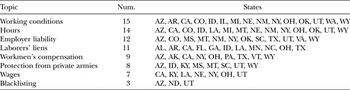
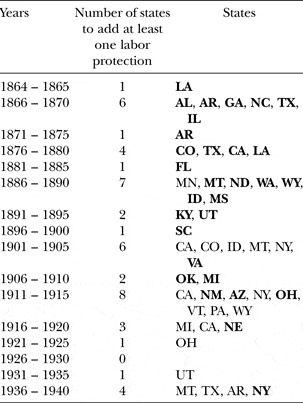
The provisions I examined relate to laborers' liens, the number of hours in a legal workday, the safety of workplace conditions, the minimum amount of wages, the frequency with which those wages were paid, and the form of those wages. They also outlawed, or called for the legislature to outlaw, contracts that released employers of liability for workplace injuries, and established the constitutionality of workmen's compensation programs. Some called for the state to outlaw blacklists and provide protection from employers' private armies. These labor provisions were rarely universal—often relating only to women, people in particularly dangerous industries, and public employees. They were almost always written with only white workers in mind. However, these labor provisions did address many of the central concerns of labor organizations during the time of their passage. Table 1 summarizes the provisions by topic. Table 2 offers a chronology of their addition, by state. Both exclude broad declarations of labor rights that lack specific policy content.
Constitutional Labor Protections by Topic

Chronology of Constitutional Labor Protections

States that wrote labor provisions into new constitutions appear in bold.
The individual states that appear more than once in Table 2 either added new provisions in succeeding years or expanded existing provisions after the original inclusion of a labor provision. In addition to the regulation of particularly dangerous workplaces, labor organizations also petitioned for the constitutionalization of other sorts of regulations, including maximum hours, minimum wages, and the creation of laborers' liens on the products of their labor (see Table 1). These constitutional provisions mandated positive governmental activity in the form of regulation. They were thus intended to protect employees from the practices of employers, rather than from the threat of interventionist government. In general, provisions relating to laborers' liens, employer liability, and workplace safety (particularly for mines and railroads) dominate the early provisions. Provisions outlawing private armies and blacklisting were mostly constitutionalized in the 1890s (although both appear in Arizona's original constitution of 1912). Provisions relating to the hours and wages of labor are scattered throughout the period, while states began adding workmen's compensation to their constitutions only in 1911.
Labor organizations regularly contrasted property rights with constitutional protections for labor, which they often described as the right to live. For example, The Toledo Union Leader declared “The right to live is inherent … The right to live comes first … and he [the workingman] can't surrender that right by listening to the senseless drivel and sugar-coated preachments of smug respectables well clothed and housed, who talk of their ‘inherent rights.”Footnote 36 One delegate to the Virginia Constitutional Convention of 1901 similarly argued, “Surely, if it is necessary to put in the Constitution some provision to protect a man's property, if you find the whole tendency or doctrine of the courts is to allow a man's life to be taken without due compensation, it is necessary to have a Constitutional protection to stop that evil also.”Footnote 37 These constitutional protections of laborers’ lives took the form of mandates and permissions for state intervention and regulation.
Many conservatives of the period described protective labor regulations, like laws establishing maximum hours and minimum wages, not only as active state intervention in social and economic life, but as illegitimate intervention, the very sort of overreaching that substantive due process jurisprudence was developed to prevent. Rather than allowing market forces to govern employment relationships and workplace practices, these constitutional provisions demanded that the state intervene to offer laborers protection. In the case of provisions outlawing the use of private armies and blacklists, these regulations protected laborers from the union- and strike-breaking practices of their employers.
Workmen's compensation programs are another clear example of the state extending itself through the creation of a statewide program and often a monetary fund for the protection of injured laborers. These provisions comprised the tail end of a larger constitutional campaign to reform the governmental response to employer liability for workplace injuries. The employer liability provisions in state constitutions protected workers from the necessity of signing contracts guaranteeing that their employers could not be held liable for workplace injuries. Several constitutions even abrogated the judicial doctrine known as the “fellow servant doctrine,” which held that employers could not be held responsible for injuries resulting from the actions of another employee. These clauses spoke directly to the judiciary and, by eliminating the legal barriers to collecting compensation from employers, participated in the project of crafting protective legislation for injured workers through the state constitution.
One way that constitutions established states' obligations to provide a particular labor protection was by including the protective regulation directly in the text of the constitution. For example, eleven constitutional provisions (in ten different states) simply declared that “Eight hours shall constitute a lawful day's work.” In total, thirty-six different labor protections were directly constitutionalized in this way. This group was primarily composed of provisions relating to laborers' liens, employer liability, maximum hours, private armies, and blacklists. Some of the earliest constitutional labor provisions were phrased this way, and this phrasing was employed through the late 1930s.
Another way that constitutions established protective policies was by mandating legislative action on a particular issue. The New Mexico Constitution required the legislature to regulate the working conditions of the state's mines in order to protect the health and safety of its miners. Some provisions also described a state policy first and then demanded that the “legislature shall” write laws to enforce the provision. Twenty-two labor provisions used this mandatory language. The provisions that employed this phrasing related primarily to workers' safety and laborers' liens and were added to constitutions between 1864 and 1912.
Twenty-five labor provisions simply authorized or empowered legislatures to implement labor legislation, but did not mandate that the state provide the protection. For example, the Texas Constitution was amended in 1936 to read “The legislature shall have the power to provide for workman's compensation insurance for … State employees.” This permissive phrasing was particularly prevalent among workmen's compensation provisions. The New York Constitution was similarly amended in 1913 to read “nothing in this constitution shall be construed to limit the power of the legislature to set up a system of workmen's compensation.” Four provisions, including New York's, were phrased only as guidance about what the constitution could not be said to prevent, and several additional provisions had a similar clause tacked on the end. Although the permissively phrased provisions in state constitutions were not written to be judicially enforceable, the political struggles surrounding their adoption reveal that they were drafted as directives to both legislatures and courts about the purposes and expectations of government. Constitutional labor provisions like these were phrased as grants of authority not because those amending the constitution hoped to give the legislature choices about whether or not to protect labor, but often because they were responding to court decisions that had explicitly denied permission to legislatures.Footnote 38 Thus, permissive provisions were often included in state constitutions with the understanding that they would allow, and in some cases prompt, legislatures to pass protective legislation. These permissions were thus aimed at overcoming the political obstacles that hindered the passage of protective labor laws. After all, the U.S. Constitution reserves to states all the powers that it does not explicitly deny them. Therefore, state legislatures would not have needed permission to enact labor legislation unless some obstacle stood in their way. These provisions were written with the understanding that legislatures would, in the absence of such obstacles, pass protective legislation.
THE ACTIVISM THAT CREATED CONSTITUTIONAL LABOR PROVISIONS
Different types of labor organizations, some far more formal and long lasting than others, engaged in the writing and rewriting of constitutions so that these constitutions would address, and in many cases require, the governmental protection of labor. The Knights of Labor, the Western Federation of Miners, the California Workingmen's Party, as well as many state chapters of the AFL all lobbied for the addition of protective labor provisions to state constitutions. Women's organizations, such as local chapters of the Women's Trade Union League (WTUL), and Progressive social reformers, including the nationally prominent Florence Kelley, also supported (and sometimes spearheaded) the inclusion of protective labor provisions.Footnote 39
While popular participation in federal Constitutional change has most often occurred in periods of crisis,Footnote 40 state constitutions have been continuously shaped by the demands of interest groups and social movements. In fact, many different interest groups strove to use these constitutions to force state governments into a positive, regulatory role. For instance, both Prohibitionists and Grangers sought to influence the text of state constitutions in order to ensure that states would engage in the active regulation of social and economic life.Footnote 41 As a result, state constitutions had come to embody many different substantive commitments and to reflect a wide variety of political controversies by the end of the nineteenth century. During the nineteenth century, the formal revision of state constitutions was both frequent and politically charged. As Alan Tarr explains in his study of state constitutional development, “state constitutions increasingly became instruments of government rather than merely frameworks for government.”Footnote 42 This trait became particularly pronounced during the Gilded Age and Progressive Era, when state constitutions became the focus of several national political movements. The proponents of labor protections jumped into this fray through their participation in both constitutional conventions and their advocacy of individual amendments.
Labor organizations and progressive reformers lobbied both to amend existing constitutions and to add provisions during the writing of new constitutions by convention. Before 1900, only Minnesota added a labor provision to an existing constitution. The other twenty states that included protective labor provisions in their state constitutions did so while drafting entirely new documents. In the twentieth century, there were twenty-five different instances in which labor provisions were added to a state constitution (several were in the same states, although in different years), and in only eight of these instances were the provisions included in entirely new constitutions (see Table 2).
It is difficult to generalize about the relative effort required to add a provision to a constitution as an amendment as compared to the difficulties of achieving one's desired changes through a constitutional convention. The procedures required to amend a state constitution are different from those required to influence a constitutional convention. Although the requirements for amending state constitutions differ across states and have differed over time, generally speaking, state constitutions can be amended through the initiative or referendum processes or through a vote of the legislature (often requiring a supermajority), followed by a statewide vote on ratification. Constitutional conventions can be established through a vote of either the legislature or the electorate. It is then possible to influence the document the convention drafts through the election of delegates to the convention and/or by lobbying the elected delegates. In general, a convention's proposed constitution is then either ratified or rejected through a statewide vote. Thus, on its face, neither mode of constitutional change seems inherently easier to achieve than the other. However, it is clear that once a constitutional convention had been established, labor leaders often attempted to capitalize on the fact that an entirely new constitution was being written, and desired to ensure that the product would benefit their members. It is possible that because the delegates to constitutional conventions would not be seeking reelection, they were (or were perceived as) less subject to the influence of antilabor interests than state legislators.
Whether or not it was actually easier for labor's advocates to influence constitutions through conventions than amendments, it is clear that constitutional conventions created a sense of opportunity among labor leaders and organizations, prompting them to pursue the addition of labor provisions to the constitutions that were being written. Amy Bridges' description of the role of delegates to constitutional conventions applies equally well to the reasoning of labor leaders and reformers who sought to capitalize on those conventions: “The opportunity to legislate group preferences might well not reappear in state assemblies, encouraging them to seize the time … When would there be another gathering of such hard working delegates, with so much public attention, and afterwards, so great a claim to popular mandate?”Footnote 43 For instance, in 1910, when it became clear that the Arizona territory would begin writing a state constitution, the many labor organizations of the state convened a large conference to discuss the provisions that they hoped would be included in the new constitution and to formulate plans for the pursuit of their inclusion. The Arizona Daily Star reported: “All organizations are urged to be present at the conference. The working class, if it only utilizes it, has the power to make the constitution to its own liking, and if it is properly drafted, our economic struggles of the future will be greatly simplified and our opportunities of bettering our conditions rendered much easier.”Footnote 44
The earliest instance I have identified of a protective labor provision added to a state constitution called on the legislature to establish a nine-hour workday and a minimum wage for laborers on public works in Louisiana, and seems to exemplify the role of opportunity in laborers' decisions to push for a constitutional right. In 1864, while the constitutional convention was composed largely of delegates who were themselves white laborers, thousands of the state's white laborers formed an informal lobby to ask that their policy preferences be written into the new fundamental law. They prefaced their petition to the Louisiana constitutional convention with the words, “The undersigned, citizens of the state of Louisiana, beg leave to memorialize you honorable body in behalf of our claims, feeling that this being the only liberty-loving body, composed purely of the laboring class, that has ever convened in the State of Louisiana for the promotion of the interests of mankind in general, their appeal will not be in vain.”Footnote 45 For more formally organized groups as well, constitutional conventions represented an opportunity to influence state law and extract a visible and public promise of governmental protection.
Labor leaders tried to ensure that sympathetic delegates were elected to constitutional conventions. In Arizona, labor organizations briefly attempted to form a labor party to elect delegates to the convention, but settled on an alliance with the Democratic Party, promising to support Democrats in exchange for their support of robust labor protections.Footnote 46 Similarly, the Twin Territories Federation of Labor refused to support the election of any delegates to the Oklahoma constitutional convention who would not pledge in writing to support the inclusion of a list of labor protections. The Federation of Labor then hired a paid lobby to attend the convention to ensure that these delegates served labor as they had promised.Footnote 47 Utah unionists similarly decided to support only candidates to the state constitutional convention who promised to accede to their list of demands.Footnote 48 Similarly, when George Meany was president of the New York Federation of Labor, he spent an intensive week lobbying the New York constitutional delegates when they threatened to reject the labor article proposed for the New York Constitution.Footnote 49
In some cases, labor organizations even tried to elect constitutional convention delegates from among their own ranks. For example, the Michigan Union Advocate explained that members of the Michigan Federation of Labor were “determined to take matters into their own hands and ‘pass up’ the alleged reformers who turned down their most important resolution last week.” Thus, “the labor unionists of this city and county decided to put up their own candidates for the constitutional convention.”Footnote 50 Similarly, feeling that they had “not obtained any satisfactory ‘recognition’ at the hands of either political party,” New York labor organizations discussed the need for “strenuous efforts to secure direct representation in the Constitutional convention [of 1893].”Footnote 51
When labor organizations succeeded in inserting their provisions into the proposed constitutions, they then mobilized their members in an effort to ensure that voters ratified these documents. For instance, because it was satisfied with the labor protections embodied in the Ohio Constitution of 1912, the Ohio Federation of Labor called a statewide meeting of labor leaders to “devis[e] ways and means to stimulate interest in the new constitution and secure a full vote for its adoption at the special election by arousing workers to its importance.”Footnote 52 The Toledo Union Leader then announced that “labor unions throughout the state, working under the direction of the Ohio Federation of Labor, and co-operating with various progressive organizations, will begin an active campaign for the adoption of the proposed constitutional amendments.”Footnote 53
Labor organizations also organized themselves and their members to amend existing constitutions through state legislatures (followed by a statewide vote) and through constitutional initiatives. The particular political circumstances (particularly the strength and organization of labor) in each state undoubtedly determined how challenging it was to add pro-labor amendments to the constitutions.Footnote 54 In the absence of a constitutional convention, labor organizations may have required a more direct and immediate impetus to seek amendments to existing constitutions. However, it is clear that labor organizations did spearhead campaigns for constitutional amendments. They lobbied legislatures, just as they lobbied constitutional conventions, ran statewide “get out the vote” efforts to attract both union members and nonunion members to the cause, and labor leaders circulated letters about the need to garner support for their amendments and published numerous proamendment editorials in their journals.Footnote 55
Whether they pursued constitutional changes during conventions or as amendments, labor organizations did not seek constitutional provisions alone, but as part of larger campaigns to change state policy. Thus, constitutional provisions were always understood to supplement, not substitute for, protective legislation. While a particular organization was attempting to influence the shape of its state's constitution, it often devoted significant resources to that endeavor, publishing newspaper articles, influencing constitutional conventions, lobbying state legislatures, and/or creating statewide support for their proposals. However, once the organization had succeeded (or even failed) to influence the writing of the constitution, it typically returned to other political activities, such as lobbying for the passage of protective legislation and working to ensure that existing legislation was enforced. As I demonstrate later on, constitutional reforms were motivated by a desire to facilitate the passage and continued existence of protective statutes, not to replace them.
Protective labor provisions were steadily added to state constitutions throughout the entire period from 1864 to 1940 (see Table 2). (Although certain five-year periods saw more labor amendments added to constitutions than others, the appearance of discrete bursts of activism is largely due to the relatively small increments into which Table 2 divides this period.) However, in general, the earliest instances of constitutional change did differ from those in the middle and at the end of the period. The years following the Civil War saw the constitutionalization of labor provisions through the rewriting of many Southern constitutions. With the exception of Louisiana, which included a provision about the regulation of hours and wages, all of the protective labor provisions added to Southern constitutions in the 1860s established laborers' liens. The labor provisions written at end of the nineteenth century and the beginning of the twentieth century were largely included through the writing of new Western states' original constitutions. Many of these provisions addressed the concerns of miners, including the safety of their workplaces and the hours they were required to spend underground. Finally, the Progressive Era witnessed the most organized and concerted attack on judicial interpretations of state constitutions and the most coordinated attempts to establish protective legislation related to hours, wages, and working conditions and witnessed the first attempts to safeguard workmen's compensation programs through constitutions. In fact, many of the provisions written during this period were devoted to the establishment of legally controversial workmen's compensation policies.
It is clear that labor organizations put a great deal of resources and effort into winning the inclusion of provisions in state constitutions. I do not assess the efficacy of these constitutional provisions or compare their effects to those of statutes. Instead, I ask why laborers and reformers devoted their attention to writing and changing constitutions. I now explain the reasons that laborers, along with the other reformers seeking labor regulations, sought constitutional change by listing and characterizing the advantages that labor delegates believed constitutional change held over and above the potential benefits of statutes.
THE GOALS OF CONSTITUTIONAL LABOR PROTECTIONS
Overturning Courts
One advantage that the creation of constitutional labor protections held over the passage of statutes was that constitutional protections could solve a problem that statutes could not: the hostile stance of state courts toward labor. Some scholars have questioned the degree to which state courts ultimately hampered the development of protective legislation.Footnote 56 Yet, regardless of how many protective statutes were actually overruled by state courts, labor legislation passed during the Gilded Age and Progressive Era was constantly challenged through litigation. Consequently, labor organizations of the period were convinced that judicial decisions posed a formidable obstacle to their legislative agenda. AFL founder Samuel Gompers concluded that “The power of the courts to pass upon the constitutionality of a law so complicate[d] reform by legislation as to seriously restrict the effectiveness of that method.”Footnote 57 This anxiety about the constitutionality of labor legislation transformed labor's desire for protections that could simply have been enacted as statutes into demands for constitutional protections.Footnote 58
One reason constitutional amendments seemed superior to mere statutes is that they enabled labor to work around adverse court decisions by widening the scope of conflicts about the constitutionality of a particular law.Footnote 59 By increasing the number of people engaged in the conflict over the legitimacy of labor legislation, it was possible for labor to change the ratio of its allies to its opponents. This tactic was particularly important when state supreme courts struck down protective labor legislation. Because no appeal to a higher court was legally possible, when the state supreme court nullified a piece of labor legislation, the only way to authorize such legislation was to remove the conflict from the court and shift it to a different venue. Once constitutions clearly authorized legislatures to pass particular pieces of protective legislation, there could be little question about the constitutionality of that legislation (at least on state grounds). Thus, these amendments effectively returned questions about whether protective legislation should exist to state legislatures.
New York's Constitution was amended in 1905 for just this purpose. The primary goal of the New York State Workingmen's Assembly, founded in 1865, was to promote the passage of protective labor legislation in New York State. One of its earliest legislative demands was the eight-hour workday and, by 1897, it had succeeded in convincing the legislature to pass a law limiting the workday on public works to eight hours and requiring that laborers must be paid at the prevailing rate.Footnote 60 In a series of cases in the state's highest court, this regulation was challenged and declared unconstitutional and completely void.Footnote 61
In order to reestablish the regulations, New York State labor leaders attempted to amend the state's constitution. In a 1906 article about New York's eight-hour movement, political scientist George Groat explained: “The only way out of the difficulty was to change the fundamental law of the state in such a way as to overcome the objections of the court against the law.”Footnote 62 Groat was pointing out that, because the state's highest court had ruled the eight-hour law unconstitutional, the only way to address their problems with the courts and to reestablish the law was to change the constitution itself.Footnote 63 Of the New York Federation of Labor's response, Groat wrote: “The machinery of the state organizations was accordingly at once set in operation to accomplish this result. The state federation became the champion of the cause.”Footnote 64 Changing the composition of the court wasn't enough, Groat argued. With only changes in personnel, the constitutionality of the law would always remain in doubt and subject to changes on the bench. By contrast, a constitutional amendment would settle the issue permanently.
The New York chapter of the AFL shepherded a resolution proposing a constitutional amendment through both houses of the state legislature, then publicized the amendment and called on all of its members to vote for its ratification. In October of 1905, the president of the state chapter sent a letter to every labor organization in the state. It explained, “This [amendment] means if it is adopted that the Legislature of this state will have constitutional authority to pass laws in the interest of wage-earners, and the courts will not have the former excuse of nullifying our laws on the ground of unconstitutionality as has been the case, especially in the eight-hour and prevailing rate laws.” It then urged each labor organization to “take immediate steps to notify each individual member and see to it that he is not permitted to forget his duty on electionday.”Footnote 65 The eight-hour amendment was adopted in 1905 and took effect on the first of January, 1906. That same year, the eight-hour law was reenacted, and, in 1908, was upheld by the state supreme court. In its opinion, the court explained that the constitutional amendment required the court to reverse itself and uphold the eight-hour law.Footnote 66 Thus, the eight-hour constitutional amendment shifted the ultimate authority to establish (or decline to establish) the eight-hour day from the state courts to the state legislature.
Karen Orren's seminal work argues that American labor had to fight to establish liberalism as a replacement for the older and less advantageous feudal order that permeated the relationships within American employment law.Footnote 67 She characterizes America's original system of labor law as feudal, rather than liberal, because it treated the laborer not as an equal of his employer, but as a member of a rigid social hierarchy. Feudalism treats the laborer's status as an inalienable, personal characteristic, outside of the sphere of politics.Footnote 68 The judiciary, first through its common law jurisprudence and then through constitutional rulings that invalidated government regulations on behalf of workers, continually maintained the feudal understanding of the workplace embodied in the common law. Consequently, Orren sees the shift from feudal relationships to liberal ones as both defined and accomplished by a shift in venue. The state became liberal precisely when, and in part because, legislatures began (and courts ceased) to direct the development of labor law. Orren has already described labor's attempt to wrest control of labor relationships from the courts and locate that control in elected legislatures. Changing state constitutions was yet another element of labor's efforts to widen the scope of conflict in its efforts to achieve this switch from courts to legislatures.
I looked for labor provisions that were added to state constitutions after a supreme court case in the same state declared a labor law on the same topic unconstitutional. I consulted primary and secondary sources to verify that the amendments I identified were actually passed in direct response to the state supreme court's ruling. Because my survey of state court cases includes only supreme courts, I could not identify amendments that were prompted by lower court decisions. However, it is quite likely that other constitutional amendments were also created in an attempt to overturn specific lower court rulings.
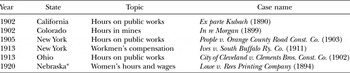
In my survey of state supreme court cases related to labor statutes, I identified six instances in which an amendment to a state's constitution overturned a decision by that state's supreme court (see Table 3). In each of these six cases, the state supreme court declared a labor regulation unconstitutional and that same labor regulation was subsequently added to the state's constitution in order to establish the constitutionality of the regulation and to nullify the supreme court's previous ruling.
Amendments in Direct Response to a Supreme Court Case within the State

*The Nebraska amendment about women's hours and wages followed a Nebraska state court decision that overturned a regulation for both men and women. In fact, while delegates passed this constitutional amendment in response to a state supreme court case overturning an eight-hour law for both men and women, a similar law for women alone was actually passed and even upheld by the state supreme court before the constitutional revision of 1920. Consequently, an examination of records from the constitutional convention was necessary to reveal that this constitutional amendment was proposed in response to this case. This suggests that even more amendments (than are evident from my survey alone) may have been proposed in response to supreme court cases within the same state.
Labor protections were not only desirable to overturn particular court decisions, but were also introduced in the original constitutions of newly admitted states. For instance, Colorado, Wyoming, North Dakota, Montana, Washington, Idaho, Utah, Oklahoma, New Mexico, and Arizona all included labor protections in their original constitutions. Though a state's first constitution could not have been a response to the state's own supreme court, it does seem quite likely that labor provisions were added to these state constitutions in response to the opinions of other states' courts. For instance, Florence Kelley explained Utah's inclusion of labor protections in its first constitution with reference to an Illinois Supreme Court case that declared it unconstitutional for the state to regulate the hours of women's employment: “The people of Utah, instructed by the supreme court of Illinois in 1895, showed by their action in 1896 that they had learned their lesson … they incorporated in their own constitution of 1896 an article dealing explicitly with the rights of labor.”Footnote 69 In this article, written in 1898, Kelley then advised other states to follow Utah's example by including specific labor protections in their constitutions (both new and old.) In this way, Kelley explained, state legislatures could be made to pass such legislation and state courts could be prevented from overturning it. Thus, even in brand-new states, constitutional labor protections appear to have stemmed in part from the national sense that such provisions would facilitate the passage of labor legislation and entrench this legislation against potentially hostile courts.
Preempting Courts
As the New York case studies demonstrate, labor protections in state constitutions conferred power on labor's advocates by strengthening their position in existing political battles over protective legislation. However, power can also operate in the absence of outright political conflict. In fact, power can be exercised precisely by preventing certain conflicts from ever occurring.Footnote 70 Thus, labor organizations not only hoped to win conflicts over the validity of the laws, but also to preempt (or at the very least alter the terms of) such conflicts. Constitutional labor protections had the potential to preempt constitutional challenges to statutory labor protections because, if these protections were actually contained in a state's constitution, it seemed much less likely that they could be declared unconstitutional.
Labor organizations hoped that constitutional provisions would take certain questions off of the political agenda by settling the question of whether particular regulations were constitutional. For instance, in 1904, Montana added a provision to its constitution establishing an eight-hour workday for miners, smelters, and state employees. Two years later, the state supreme court upheld similar legislation. However, over the next three decades, the legislature passed many more eight-hour laws that were not protected by this constitutional amendment. These included eight-hour laws for laborers employed in strip mining, sugar refineries, cement and hydroelectric plants, and retail stores. Statutes also existed establishing an eight-hour day for bus drivers and women.Footnote 71 In 1935, a law regulating the hours of firemen was ruled unconstitutional by the state Supreme Court.Footnote 72 In addition, two lower courts ruled the law regulating store clerks' hours unconstitutional.Footnote 73 Even before these decisions were handed down, labor advocates desired a constitutional amendment that would establish a universal eight-hour day. Labor advocates made several attempts to have the legislature place the eight-hour amendment on the ballot for ratification by the electorate.Footnote 74 Once they accomplished this goal, the Montana State Federation of Labor campaigned aggressively for this amendment. Its newspaper, the Montana Labor News, ran a series of articles about the need to constitutionalize the right to an eight-hour day. One headline read: “All of these laws will be in danger if the eight hour amendment is defeated by the people November 3.” The article explained:
Let us try and understand this picture presented by the proposed 8-hour amendment. Only a few industries are governed in hours by the Constitution of the state of Montana, namely underground workers and work performed by various units of the government. These people are protected. Other people who are enjoying 8 hours have gained this advantage by laws passed by the legislature and not through the Constitution. These people include clerks in stores and women in industry. Sugar beet workers, coal strip miners and others. All of these latter laws that have been passed by the Legislature are subject to challenge by the courts as to their constitutionality. All of these 8-hour laws may be destroyed by the corporations unless you pass this 8-hour amendment. Usually, the courts function in the interests of the corporations; so does the legislature.Footnote 75
One primary purpose of the new eight-hour amendment was clearly to preempt an adverse court decision and protect these laws from courts. In 1938, the state's supreme court did uphold the eight-hour law for store employees.Footnote 76 As the quotation above suggests, this provision was also designed to entrench the shorter workday against any future legislative action. This intent was reflected in the text of the amendment itself. It read “the legislative assembly may by law reduce the number of hours constituting a day's work whenever in its opinion a reduction will better promote the general welfare, but it shall have no authority to increase the number of hours constituting a day's work beyond that herein provided.”Footnote 77 This provision denied the legislature the authority to increase the legal workday, thereby allowing any future legislatures to continue shortening the workday while simultaneously entrenching the current eight-hour maximum.
Labor organizations were not the only bodies that employed constitutional provisions in order to preempt constitutional challenges to protective legislation. State legislatures also employed this strategy on occasion. For instance, in 1914, members of the California legislature attempted to pass an amendment to the California Constitution authorizing the legislature to establish a minimum wage for women and minors; regulate on behalf of the “comfort, health, safety, and general welfare of any and all employees;” and to confer on “any commission now or hereafter created such power and authority as the legislature may deem requisite to carry out the provisions of this section.” The addition of this provision was motivated primarily by the desire to establish the constitutionality of the Industrial Welfare Commission that the legislature had created the previous year and endowed with the power to regulate wages, hours, and working conditions.Footnote 78
The commission's power to establish minimum wages for women seemed particularly likely to provoke a constitutional challenge and was quite controversial, even among California's labor organizations. The California State Federation of Labor had officially declared its opposition to minimum wages in 1912, and its official journals published editorials vehemently opposing the establishment of a state commission empowered to set wages. Labor opposition to minimum wages stiffened still further when Samuel Gompers weighed in on the question.Footnote 79 By the time of the California Federation of Labor's annual convention in 1914, the state's labor leaders were sharply divided on the desirability of a minimum wage for women.Footnote 80 The strongest support for these laws came from Progressive social reformers who were committed to protectionist policies for women. One such activist, Katherine Edson, a special agent for the Bureau of Labor Statistics for Southern California, advocated a preemptive amendment to the state constitution even before the legislature had passed the relevant law.Footnote 81 Several women's organizations, including the newly established Women's Trade Union League of Los Angeles, organized a campaign to convince voters to support the minimum wage bill and to ratify the constitutional amendment.Footnote 82
Two years earlier, members of the Vermont legislature (like its counterpart in California) had been so concerned about preempting a conflict over the constitutionality of a proposed workmen's compensation law that they sought a constitutional amendment on the subject before even passing the law. The state Republican Party included workmen's compensation legislation as a plank in its 1912 platform. Once elected, however, legislators became so concerned about the constitutionality of this legislation that, instead of passing a workmen's compensation law, they refused to act before securing explicit constitutional authority. The voters approved the amendment in 1914, authorizing the legislature to create a system of workmen's compensation. Only then, in 1915, did the legislature pass a workmen's compensation law.Footnote 83 Thus, we can clearly see that in the early twentieth century, the desire to entrench protections against potential court decisions prompted both labor organizations and legislatures to pursue preemptive constitutional amendments.
What about Lochner?
Even taking into account constitutions' potential to overturn or preempt adverse judicial rulings, it would have made little sense for labor organizations to amend their state constitutions if the U.S. Supreme Court had declared all labor legislation unconstitutional on federal grounds. Under such circumstances, labor provisions in state constitutions would have had little power to protect labor legislation. After all, the federal Supreme Court of this period is best remembered for its declaration in Lochner v. New York that a state law limiting the working hours of bakers violated the Due Process Clause of the federal, not state, Constitution.Footnote 84
However, scholars of American political development have begun to challenge the conventional understanding of the Supreme Court's doctrine during this period. First, relatively recent scholarship has begun to dispel the myth that the Court struck down labor legislation simply to protect the “liberty of contract” it saw implied in the Fourteenth Amendment. Instead, as Howard Gillman has demonstrated, the Court was mainly concerned about whether it was constitutional to pass legislation that applied only to a single class of people, rather than applying equally to all members of the polity.Footnote 85 This mode of decision making was significantly different from a jurisprudence that required the Court to strike down any statutes that limited contractual freedoms. It left room for the Court to uphold protective labor legislation. This reinterpretation of Lochner-era jurisprudence helps to explain the second type of revisionist scholarship, which argues that the Supreme Court was not a major impediment to the establishment of labor regulations.Footnote 86 More often than not, the Court ruled that statutes regulating the hours and conditions of work could be justified, despite the fact that they singled out one class of citizens, because these laws fell under the state's police power to regulate in the interests of the health and order of the community. Between 1897 and 1937, forty-three Supreme Court rulings rejected substantive due process objections to employment regulations, while only twelve declared employment regulations unconstitutional.Footnote 87 Consequently, many advocates of labor legislation argued that state supreme courts posed an even more serious threat to labor legislation than the federal courts. State courts posed this threat through their interpretations of the due process clauses of state constitutions.Footnote 88
Many protective labor provisions were added to state constitutions before it was even clear that the U.S. Supreme Court would hinder the enactment of labor legislation. Initially, state courts were the only institutions overturning protective legislation. In 1898, when the Supreme Court finally did rule on these questions, its first ruling actually affirmed the constitutionality of the state labor law.Footnote 89 Even after the Court's famous Lochner decision in 1905, the Court did not strike down a significant number of labor regulations until the 1920s.Footnote 90 This period of active judicial review occurred in the final third of the period during which states added labor amendments to their constitutions (see Table 2).
The relative threat that state courts posed to protective labor legislation was not lost on contemporaneous observers. In a Columbia Law Review article published in 1913 the prominent Progressive and law professor Charles Warren argued that, with the notable exception of Lochner itself, the Supreme Court's attitude toward labor legislation was markedly sympathetic and that state courts posed the more serious threat.Footnote 91 The previous year, a political scientist published a similar assessment and noted that the public was widely frustrated with the opposition of state courts to labor legislation. He went on to explain that “While this [frustration] is the feeling towards many state courts, it is not to-day the feeling towards the Supreme Court of the United States. There is, I am glad to say, a very general belief that that Court, as now constituted, is in reasonably close touch with the desire of the people for social and economic legislation.”Footnote 92 These observers characterized the federal Supreme Court as progressive at the height of the period now known as the Lochner Era. Their analyses suggest that, although a federal case lent the period its name, state supreme courts may have played at least as large a role as their federal counterpart in distressing labor legislation's advocates.
Because the state courts did not always interpret the due process clause of state constitutions in the same way that the U.S. Supreme Court interpreted the identical clause in the Fourteenth Amendment, labor legislation had to overcome two distinct sets of restrictions on government power. One delegate to the Nebraska Constitutional Convention in 1919 explained: “I want to say that the Supreme Court of the United States has construed laws of this character more with reference to the public welfare clause of our national Constitution than to the inhibitory clause as to due process of law, and therefore the necessities under the federal Constitution are quite different from ours.”Footnote 93 Similarly, in a discussion of workmen's compensation laws, one political scientist explained: “No state compensation act can be effective which violates the Fourteenth Amendment; But on the other hand, satisfying the Fourteenth Amendment will not insure the validity of the act. The state constitution must also be satisfied.”Footnote 94
Although most historical studies of the Lochner Era have focused almost exclusively on the Fourteenth Amendment, legal scholars and labor advocates of the period frequently discussed the need for labor legislation to conform to dual due process clauses—in both the state and federal constitutions. For instance, in its brief about the need to add more protective labor provisions to the New York Constitution, the American Association for Labor Legislation explained:
There have been since 1868 two due process clauses to which New York legislation must conform—one authoritatively and finally interpreted by the United States Supreme Court, the other finally and authoritatively interpreted by the New York Court of Appeals. If these two tribunals always agreed as to what due process requires in connection with labor legislation … no harm would have resulted from this repetition … But it is notorious that the courts have not agreed.Footnote 95
The significance of this system of dual due process clauses became clear to Colorado's labor leaders trying to enact legislation providing an eight-hour workday for miners and smelters. In 1895, the Colorado supreme court issued an advisory opinion stating that it would consider the eight-hour law unconstitutional on both state and federal grounds.Footnote 96 However, in 1898, the federal Supreme Court upheld a Utah law that was virtually identical, stating that such limitation did not violate the Fourteenth Amendment.Footnote 97 Encouraged by the federal Supreme Court's decision, the Colorado legislature then enacted the eight-hour law. In cases such as these, in which the U.S. Supreme Court upheld protective legislation from one state, opponents of such legislation would sometimes issue reminders that, regardless of what the Supreme Court had to say about the Fourteenth Amendment, their state's constitution still forbade such legislation. For instance, one lawyer who argued against the constitutionality of an eight-hour law in New York responded to a U.S. Supreme Court decision upholding an extremely similar law in Kansas, saying, “The Court of Appeals of this state held that the eight-hour law was not only a violation of the Constitution of the United States, but of the Constitution of the state of New York as well and that was a material difference.”Footnote 98 In fact, when the Colorado supreme court reviewed the constitutionality of the eight-hour law, it employed this very logic, declaring the Supreme Court's ruling insufficient to render the law constitutional. The Colorado court explained that the U.S. Supreme Court's ruling could not validate Colorado's law:
It goes without saying that if a federal question were involved in the case at bar, and had been passed upon by that tribunal [the federal Supreme Court], our duty in the premises would be clear. But the petitioner does not invoke the protection of any provision of the national Constitution. He maintains that his sacred rights of liberty, and freedom of contract embraced in his right of property, and his exemption from arbitrary and unjust discriminations, all of which are guarantied to him in the sections of our constitution …, are violated by this act.Footnote 99
This ruling illustrates the importance of both state and federal due process clauses. Without an amendment to its state constitution, even the Supreme Court's interpretation of the federal Constitution could not protect Colorado's labor laws. Accordingly, in 1902, Colorado's labor unions responded by organizing a (successful) campaign to add such a provision to the Colorado Constitution.Footnote 100 As we have seen, the advocates of labor legislation addressed their concern about state courts by changing state constitutions.Footnote 101
Prodding Legislatures
Labor organizations employed constitutional labor provisions not only in their attempts to overturn and preempt courts, but also in their larger efforts to lobby legislatures for protective statutes. While courts are often the villains in stories of labor laws in the Gilded Age, and particularly in the Progressive Era, George Lovell's work on (what he has termed) legislative deferrals demonstrates that even when Congress passed seemingly pro-labor statutes, it simultaneously and deliberately created conditions that would empower judges to vitiate the statutes it passed.Footnote 102 Although Lovell observed this dynamic at the federal level, one relevant lesson from his study is that we should be wary of assessments of labor politics that lionize legislatures at the expense of courts. And, in fact, while judicial obstacles were frequently cited as the reason constitutional amendments were necessary, labor organizations and other advocates of protective legislation also identified legislatures themselves as the targets of constitutional amendments. Labor amendments were also passed with the express purpose of circumventing or controlling legislatures, which were often perceived as corrupt and/or puppets of large corporations.Footnote 103
Constitutional amendments held the potential to influence legislative action in large part because they often necessitated a statewide vote for their inclusion. As a consequence of this procedural requirement, when constitutional amendments were ratified by large margins or enacted through the initiative and referendum process, labor organizations were able to point to these results to demonstrate their electoral strength and threaten any legislators who voted against protective legislation. While labor organizations in the Arizona territory were gearing up to influence the shape of the new state's constitution, an observer from Arizona noted, “the coming campaign for the constitutional convention is expected to demonstrate that the political power of the working class is becoming one that will have to be considered in the affairs of the territory or state hereafter.”Footnote 104
The Ohio Federation of Labor (OFL) also used the amendment of its constitution to demonstrate the extent of labor's electoral power within the state. In 1913, the Ohio State Constitution was amended to include provisions that established an eight-hour day on public works, created liens for laborers on the products of their labor, authorized the legislature to pass a workmen's compensation law, and empowered the legislature to regulate the hours, wages, and working conditions of all employees. In the OFL convention that followed the adoption of these amendments, labor leaders explained that they planned to redouble their efforts to achieve protective labor legislation: “Now that the new constitution has been adopted, the work of this convention will be especially important, as it will have to adjust itself to new conditions, and the legislative demands of organized labor will not be made in the fear that some court will stand over the law and wipe it out of existence.”Footnote 105 Labor leaders were particularly energized and optimistic about the prospect of passing labor legislation because of the extensive support that labor's amendments received when they were ratified. The Toledo Union Leader explained: “The fact that nearly every labor amendment received over 100,000 majority is best evidence that the people of Ohio are ready and willing to give labor such legislation as may be needed for its protection and welfare.”Footnote 106 At the convention itself, speakers raised the explicit idea of using all of this voting strength to threaten legislators into acting on labor's demands. For example, one speaker stated: “Public sentiment can be so aroused as to force punishment of the party that fails or refuses to comply with its express contract.”Footnote 107 In the legislative session that followed, Ohio's workmen's compensation law was extended and an eight-hour law for public works was established. The legislature passed further safety regulations for both mines and railroads. The state's existing lien laws were repealed and replaced and the legislature required that employers institute a semi-monthly payday. Mercantile establishments were required to report on the hours and wages of their female employees and the ten-hour day for women was extended to mercantile establishments. In addition, the legislature created an industrial commission to collect labor statistics and enforce the states' existing laws.Footnote 108
As Ohio's experience demonstrates, constitutional amendments did not mark the end of labor organizations' efforts to secure regulation. Instead, labor organizations viewed these amendments as a step on the road to establishing legislation. After constitutional provisions were incorporated, labor organizations resumed their pursuit of legislative action. Labor organizations behaved this way in new states as well as existing ones. For instance, Arizona's labor organizations felt convinced that they had been ignored by the territorial legislature and intended to follow their successes at the constitutional convention with legislative action. One labor newspaper explained: “considering the fact that this is the first legislature and that labor in the ‘territory’ got short shrift at the hands of the politicians and federal judges … The men of labor had more to do with securing the ‘new constitution’ than any other class in the territory and now they do not propose to neglect their opportunities.”Footnote 109 The years following the passage of the Arizona constitution did in fact mark a high point for labor influence in legislative politics and witnessed the passage of many protective labor laws.Footnote 110 Constitutional change was thus only a part, and only occasionally a primary part, of labor organization's overall strategy. When opportunities presented themselves to pursue constitutional change or when court decisions made such changes seem necessary, such change was on the agenda of labor organizations, but it was always (at least in part) a means to some other end. While the primary end was the establishment of protective labor laws, constitutional amendments may also have been useful to labor organizers as they attempted to strengthen their own organizations.
Movement Building
By giving labor a place in the visible institutions of government, constitutional labor protections may also have appealed to labor organizations because of their potential value for what Michael McCann has termed “movement building.” In his study of the ways that protections claims empower their bearers, McCann notes that protections may facilitate the process of “raising citizen expectations regarding political change, activating potential constituents, building group alliances, and organizing resources for tactical action.”Footnote 111 The Arizona territory's proposed constitution, which included the popular recall of state judges, was so radical that Taft threatened to veto it, denying Arizona statehood. Yet, some believed that labor's constitutional victories would be such a powerful organizing tool that, even in the face of a presidential veto, workers would rally around the constitution. In fact, Miners Magazine declared that a veto would actually strengthen labor's position: “Plutocracy may kill a constitution that demands liberty for the masses of the people, but assassinating the constitution … will only inspire men and women to stand more firmly on their feet to demand that the people must be heard on the organic law which governs the people of a state.”Footnote 112
A speaker at the Colorado Federation of Labor also touted the mobilizing potential of the eight-hour amendment to the Colorado Constitution. He explained “I believe that the adoption of the eight-hour amendment will do more toward thoroughly organizing Colorado in all lines than all the other agencies that could be introduced or all the eloquence possible to be let loose from organizers.”Footnote 113 In fact, labor organizers did point to the constitution's eight-hour amendment when justifying the labor strikes that followed its passage. The Miners Magazine, which was published by the Western Federation of Miners, pointed to the existence of this eight-hour amendment and the lack of hours legislation immediately following the amendment to explain and to justify the miners' strikes in the state. It announced “Since the Fourteenth General assembly refuses to obey the political mandate of the people of Colorado discontent has grown and spread until thousands of men who are the victims of long hours are in rebellion”Footnote 114
Labor advocates and publications described the role of state constitutions as that of broadcasting the demands of labor through a highly visible public institution. The Miners Magazine descriptions of the state constitution as “the political mandate of the people” exemplifies this view. In fact, labor publications often described constitutions as the voice of the people, unmediated by legislatures and unmolested by courts. For example, one labor newspaper compared the delegates to the Oklahoma constitutional convention to the members of the Oklahoma legislature, calling the constitutional convention delegates the “real representatives of the people.”Footnote 115 Similarly, when the New York Federation of Labor presented its slate of demands for the new constitution, it explained: “[our slate of labor proposals] constitutes a Bill of Rights. We earnestly petition that it be made part of the new state constitution … it represents the hopes and aspirations of the wage-earners for better living and working conditions in the future.”Footnote 116 While labor publications and organizers almost always described labor-friendly state constitutions as broadcasting the voice of the people, they also took pains to credit the particular unionists and politicians who facilitated the drafting of labor provisions and to list the parts of the state in which labor's agenda received strong support, thereby emphasizing the vitality of their movement and the efficacy of its leaders.
CONCLUSION
Constitutional law and the courts that interpreted it certainly hindered the enactment of state labor regulations in the United States in the late nineteenth and early twentieth centuries. Many union leaders, especially at the federal level, did consequently determine that private bargaining would serve their interests better than public law. However, other labor organizations embraced constitutional law, viewing constitutions as vehicles through which they could continue to work for state regulation. Their activism demonstrates that, at least at the state level, American labor organizations abandoned neither the quest for government regulation nor the tactic of writing their demands into law. Instead, labor organizations sought protective legislation in tandem with, and sometimes in order to facilitate, private bargaining.
Labor organizations and other advocates of regulation worked to include protective provisions in state constitutions because they believed that such provisions would be strategically valuable. They hoped that constitutional changes would enable them to overcome hostile state court decisions and motivate reluctant legislatures to pass protective legislation. Labor provisions were also attempts to insulate such regulation from future court challenges.
Attention to the origins of these constitutional labor protections and the goals of their advocates demonstrates that constitutional change is not always motivated by the desire to judicialize conflicts. In fact, for the proponents of protective labor provisions, one of the primary goals was actually to exclude the judiciary from this policymaking arena. Labor organizations' significant efforts to ensure that these provisions were ratified also demonstrates that, at least at the state level, American labor leaders did demand government protection through law well before the New Deal.
The New Deal represented a change in labor law at the federal level; it thus federalized and cemented the nationwide change in the authority of government to intervene in labor relations that had already been underway at the state level for half a century. In the 1937 case of Jones & Laughlin Steel, Footnote 117 the Supreme Court forged new doctrinal ground when it decided that Congress has the legitimate authority to regulate labor relations under its power to regulate interstate commerce. Orren explains why the Court's acquiescence was so significant: “The change in the governance of labor was constitutional. The destruction of the order of master and servant removed constitutional barriers, and once they were gone, private industry was exposed to the diverse intrusions that would characterize relations between business and government in succeeding decades.”Footnote 118 At the state level, the doctrinal question about labor regulation was not about federal authority and interstate commerce, but about the role of state governments and the meaning of due process rights. Despite this doctrinal difference, the shift away from the older order of master and servant relations, governed by courts, to the new order, in which private industry was exposed to myriad legislative intrusions, was similarly constitutional. At the state level, this constitutional change was not achieved through the decisions of courts, but through changes in the text of state constitutions.
As we have seen, these textual, constitutional changes in labor regulation were achieved through popular political pressure. This version of popular constitutionalism did not, in the main, require the crafting of complicated legal arguments or the pursuit of litigation. Instead, the advocates of regulation could pursue constitutional change through familiar and accessible political tactics like get-out-the-vote efforts and the subsequent application of political pressure to constitutional conventions and legislatures. Although popular constitutionalism is often studied by examining the relationship between popular activists and courts,Footnote 119 the case of labor demonstrates that interest groups and social movements have also shaped constitutions in their dealings with legislatures, conventions, and state electorates as a whole.
While this article is primarily concerned with the political conditions that motivate popular pursuit of constitutional change, it would certainly be valuable to know whether these instances of popular constitutionalism made any real difference. Unfortunately, it is very difficult to determine whether, taken as a whole, the state constitutional amendments about labor had a significant effect on labor policy.Footnote 120 It is clear that, in certain cases, these constitutional labor provisions achieved their desired ends. The effect of constitutional amendments was clearest when those amendments allowed state legislatures to reestablish regulations after a state court ruled the amendment unconstitutional. In California, both New York cases, and Ohio, the type of protective law that the court struck down was restored after the passage of the constitutional amendment (see Table 3). These amendments clearly allowed for the reestablishment of particular labor legislation.Footnote 121
When asked to rule on the constitutionality of the new eight-hour law for public employees, New York's highest court explained that the new constitutional amendment forced it to reverse its earlier decision:
The power to fix and regulate the hours of labor upon public work was entrusted to the Legislature by the amendment which took effect on the 1st of January, 1906. Prior to that date the power did not exist, and hence certain decisions made under the Constitution before it was thus amended do not now apply … . We had held that the Legislature had no power to pass the labor law of 1897, and the amendment was designed to authorize a law of that kind. The Legislature acted under the amendment and re-enacted the precise law the overthrow of which by the courts made the amendment necessary … . Unless the amendment did this it did nothing, and the Constitution is the same in effect as it was before. The presumption is that the people in exercising their supreme power did not do a vain act, but effected a definite purpose.Footnote 122
In this section of its opinion, the court announced that it could no longer prevent the legislature from establishing an eight-hour law. One could view this case as a sort of Jones & Laughlin Steel for New York State. Like Jones & Laughlin Steel, it recognized, and helped to reify, a change in the constitutional order. Thanks to the constitutional amendment about labor, the legislature was finally free to intervene in this area of employment relations.
In Colorado, the state labor organizations had a more difficult time getting the state legislature to pass an eight-hour law after the passage of a constitutional amendment. Although the legislature passed a law regulating hours of work, this new statute lacked penalties for violating the law. The legislature's reluctance to pass a meaningful eight-hour law was widely attributed to the influence of mining companies and was often cited as one reason for the miners' strikes that rocked Colorado in the first decade of the twentieth century. The Colorado State Federation of Labor continued to agitate for a meaningful eight-hour law, which the legislature passed in 1911.Footnote 123
In states in which supreme courts upheld protective regulations in the presence of constitutional labor provisions, it is not always possible to know whether the court would have decided the same way even in the absence of such a constitutional provision. However, there were cases, like the New York case cited above, in which state supreme courts cited the labor provision of the state's constitution in order to justify their rulings on state constitutional grounds. For instance, Kentucky's supreme court upheld the state's law that miners must be paid in lawful money against the charge that this was special class legislation, and therefore unconstitutional, by citing the state's own constitution. The Kentucky court explained: “The organic law makes the general classification in the first instance, and this fact cuts short all discussion of its constitutionality which might otherwise grow out of the special application to miners.”Footnote 124 Similarly, the Utah supreme court declined to void an eight-hour law for miners, stating that such a law could not violate the state's constitution because the state constitution explicitly directed the legislature to pass laws providing for the health and safety of employees in factories, smelters, and mines.Footnote 125 The U.S. Supreme Court even cited Utah's constitution in its opinion affirming the state supreme court's decision.Footnote 126
When the Wyoming supreme court upheld the state's workmen's compensation statute against the charge that it violated the state's constitution, it too described the “active and strenuous campaign by and on behalf of the workmen of the state and their organizations” to see the constitutional amendment enacted, and then explained that the workmen's compensation law could not possibly be said to violate the constitution or deprive workmen of their constitutional rights: “The act in question …is in accord with the system of workmen's compensation acts that were in the minds of the people adopting the constitutional amendment … And any and all provisions of the [state] Constitution that might have been construed as preventing the Legislature from passing such an act are modified or repealed as far as they would effect such an act.”Footnote 127 Opinions like these do suggest that the labor provisions in state constitutions did prevent at least some state supreme courts from overturning legislation. While state supreme court decisions were recorded and compiled in the late nineteenth century and early twentieth century, this was not always true of lower state courts' decisions. Thus, it is virtually impossible to determine how many amendments forced lower courts to reverse themselves.
The difficulty of determining the effect of state constitutional provisions about labor is especially pronounced in the absence of litigation. In cases in which labor organizations lobbied for a constitutional amendment in order to protect statutes from courts, it is difficult to determine whether the constitutional amendment successfully protected legislation from constitutional challenge or whether there would have been no litigation even in the absence of an amendment. In addition, while it is clear that labor organizations used their constitutional victories to justify their demands for regulation and to demonstrate their electoral power even in the absence of adverse court decisions, it is more difficult to determine what role constitutional amendments actually played in convincing state legislatures to take action. One reason for this difficulty is that states with strong labor organizations or weaker business interests may well have been more likely than other states to adopt both pro-labor constitutional amendments and regulatory statutes. Thus, even in states in which the adoption of a constitutional amendment preceded the passage of a regulatory statute, it is difficult to determine whether labor organizations would have been successful in establishing statutes in the absence of a constitutional amendment. Furthermore, even if one controlled for the strength of labor and business interests within a state, it would be a mistake to simply compare the amount of labor legislation passed in states with constitutional labor protections to the amount of labor legislation passed in those without such protections in order to determine whether states with labor amendments had more or stronger statutory regulations than those without. Since many labor provisions were passed with the hope that they would preempt litigation or adverse court decisions, such a comparison would not account for the fact that states with constitutional amendments may have needed those amendments to achieve legislative outcomes identical to those of states without constitutional provisions.
One other difficulty in evaluating the effect of these rights provisions is that individual state legislatures did not establish labor policies in a vacuum. On the contrary, states were widely understood to have been forming the component pieces of the nation's labor policy.Footnote 128 Thus, when reformers wanted to demonstrate success at instituting a policy, they commonly counted the states that had individually instituted the kind of law they were seeking and/or the number of state courts that had upheld such a law.Footnote 129 Though reformers may have sought changes to state-level law, their concerns extended well beyond the borders of their own states to the condition of the country more generally. One common argument for the adoption of a particular kind of regulation was its existence in other states. While labor policy was forged largely at the state level, each state's policies were discussed in the context of national trends. Thus, it is reasonable to suppose that constitutional amendments in one state may have helped to promote legislation in others, or that decisions of one state's supreme court (while not legally binding on any others) may have influenced the outcome of labor cases in other states. Thus, it would also be problematic to treat the outcomes in each state as an independent observation in a cross-state comparison. While it may well be possible to overcome the many methodological challenges involved in determining the consequences of these labor provisions, such an inquiry is clearly beyond the scope of this study.
The origins of constitutions, however, are interesting and important in their own right. Constitutions establish and order all the other political institutions. They determine which institutions of government make which kinds of policies and further set the rules for that policymaking. Whether or not the social movements that shaped state constitutions ultimately got what they wanted under the rules they helped to write, they did succeed in shaping new rules for their governance. Scholars of political development have demonstrated again and again that institutions shape the course of political battles and, consequently, influence policy outcomes. The advocates of labor regulation understood this, and accordingly sought to contribute to one of the primary legal institutions of their time: state constitutions.