PROLOGUE
I wrote most of this article before October 2016. The news has brought to the fore points made in scholarship on sexual harassment, including that people do not complain, that sexual harassment is widespread and ordinary in some work settings, that legal settlement contributes to allowing problems to go unaddressed, and that sexual harassment is experienced well beyond the high-profile settings that made the news in the fall of 2016 or winter of 2017. Political science most recently finds itself in the professional press in contests over individual stories of sexual harassment as unwanted sexual attention and the use of professional power (Gluckman, Reference Gluckman2018). The New York Times's 2017 reporting of sexual assault by Harvey Weinstein (Kantor and Twohey, Reference Kantor and Twohey2017) sparked the spread of #MeToo, a term that an African-American woman had first deployed years earlier (Vagianos, Reference Vagianos2017). The term relies on framing a wrong but often without the law. Before the fall of 2016 and the spread of #MeToo, law and decisions by administrators in higher education had generated reporting about the academy. Generated in part by law and decisions by administrators in higher education, sexual harassment reporting about the academy predated the fall of 2016. This article concerns that earlier reporting and the way that sexual harassment as unwanted sexual attention can crowd out other ways of seeing law in employment problems and other ways of interpreting employment problems without relying on law.
LAW'S STORIES: DEFINING PROBLEMS AT WORK
On the evening of October 7, 2016, the Access Hollywood tape of the Republican presidential candidate bragging about sexually assaulting women was released and widely reported (Farenthold Reference Farenthold2016). On September 6, a month earlier, Gretchen Carlson settled a sexual harassment lawsuit against her former employer, Fox News, for the actions of Roger Ailes, the chief executive (Wemple Reference Wemple2016). The case was settled after many women alleged a pervasive environment of sexual harassment under Ailes at Fox. The pervasiveness of sexual harassment at work and sexual assault as problems comes decades after law defined sexual harassment as illegal sex discrimination in the United States (Baker Reference Baker2008). Feminists first defined sexual harassment as a problem because it meant that women worked under worse conditions than men did, rather than because it hindered individual women's advancement (Cobble, Gordon, and Henry Reference Cobble, Gordon and Henry2014). The social movement of a diverse coalition of working women was remarkably successful (Baker Reference Baker2008). Making harassment a management problem, as the U.S. movement did, was not an option in other countries where feminists were once leery of defining sexual harassment as a wrong or were less successful at doing so (Saguy Reference Saguy2003; Zippel Reference Zippel2006). The movement's success in defining sexual harassment as illegal sex discrimination is evident in that stories of harassment are news. The failure of the movement is evident in the pervasiveness of harassment, with news coverage triggered by representation of individual cases such as Carlson's.
What is remarkable about the proliferation of incidents in the news, however, is that they are framed as significant problems for elite white women at work, even television stars, at all. Just three years earlier, the chief operating officer of Facebook, Sheryl Sandberg (Reference Sandberg2013), advised women to lean into leadership in organizations, persisting in the face of bias and greater responsibility for care than men have (Slaughter Reference Slaughter2015). Sandberg mentioned sexual harassment briefly twice in her book, once acknowledging that it is among the many problems women face at work and then noting that many companies have policies to stop harassment (Sandberg Reference Sandberg2013, 8, 150). The news of employment discrimination, or solutions to it, has shifted. News of sexual assault and harassment as problems in employment has crowded out other ways of thinking about disadvantage, after a few years of talking about so much else: how women do not get credit or do not negotiate on their own behalf as aggressively as men do (Babcock and Laschever Reference Babcock and Laschever2007).
The two reports of problems at work—sexual harassment and everything else—operate in parallel. For years, the puzzle for scholars of sexual harassment at work was explaining why there were so few complaints given that it was illegal (Blackstone, Uggen, and McLaughlin Reference Blackstone, Uggen and McLaughlin2009; Fitzgerald, Swan, and Fischer Reference Fitzgerald, Swan and Fischer1995; Hébert Reference Hébert2007; Marshall Reference Marshall2005; Morgan Reference Morgan1999; Quinn Reference Quinn2000; Stambaugh Reference Stambaugh1997). Women lived with it or quit a job, rather than complaining and thereby putting jobs at risk. Individual rather than collective complaints were risky, and both were painful (Bingham and Gansler Reference Bingham and Gansler2002). Indeed, one way of describing how law works is that it can allow two practices at once (Ewick and Silbey Reference Ewick and Silbey1998): a social movement transformed laws in the United States to recognize sexual harassment as a legal wrong, but harassment continues. Transformation—in sexual harassment or in other areas that law has addressed—is difficult, and it requires reporting on individual complaints naming sexual harassment as illegal as well as ongoing overlaps with social movement frames that may name and limit harms.
However, losing other ways of understanding how to imagine advancement for women as reporting of sexual harassment expands is a problem. Legal complaints tell stylized stories that inform thinking about what is wrong. Not having law as an imagined remedy means not having access to stories of institutional failures in all their complexity.
This article takes professional reporting on the academy between 2013 and 2016 as a case to illuminate the contrast between reporting and systematic evidence of disadvantage at work. The article contributes to the analysis of the politics of law as multiactor governance rather than as orders from courts. Universities are a significant case: both the institutions and sexual harassment within them have been on the national agenda. As the psychologist Faye Crosby (Reference Crosby2017) recently argued, the academy needs to get its “own house in order” with regard to disadvantage and discrimination.
This article argues that framing specific complaints in the academy has meant framing sexual harassment in the three years before the Access Hollywood tape or the publicity about settlements at Fox, dropping out law as an imagined remedy for other inequities. What may be a realistic silence about law as both a framework for wrong and a remedy outside of sexual harassment drops out ways of telling other problems for women at work, where agency and causation may be complex. Stories with characters who commit wrongs at specific places and times can crowd out ways of thinking about cumulative disadvantage over a career. Problems named as legal gain press. So does sex. Although Sandberg (Reference Sandberg2013) and Babcock and Laschever (Reference Babcock and Laschever2007) illustrated in their analyses what can go wrong for women at work with multiple stories, many professions have specialized local knowledge about what work requires. The academy is one of those professions. Systematic evidence does suggest what goes wrong at work, including evidence specific to the academy.
This article draws on reporting from the Chronicle of Higher Education (CHE) during the period between a widely reported resignation of a faculty member in 2013 and the Fox News cases beginning in September 2016. The latter cases ensured that sexual harassment would be the dominant frame for news reporting of sex discrimination. CHE used the resignation to announce that it had set off a debate over sexism in universities (Schuessler Reference Schuessler2013). CHE articles are supplemented by cross-checks with the website Inside Higher Ed and the New York Times for other understandings of employment discrimination.
This article will highlight how the sexual harassment news frame excludes many women by implying a particular kind of target and therefore suggesting that only some women experience problems of discrimination. For the purposes of this article, the critique points out that sexual harassment as a publicly recognized frame for disadvantage represents some women's experiences, not all. The article will then synthesize scholarship on legal mobilization concerning employment discrimination to point out that law has been imagined as a collective remedy for problems at work. Next, it will explore how the analysis of stories illuminates systematic problems. It will then analyze reports of sex discrimination and what they have excluded.
SEXUAL HARASSMENT: IMAGES OF OBJECTS OF DESIRE
The outcry over the Access Hollywood tape continued in the emblem for the January 21, 2017, women's marches around the world, the pink hand-knit hat, named the “pussy hat” (Charlton Reference Charlton2017). Pink hats claimed sexual assault as common enough to add up to a collective political harm, even if experienced individually. The language of academic feminism concerning multiplicity among women shaped feminist critiques of both the march and the hat as a symbol. The New York Times reported on problems of race and inclusion as problems of intersectionality (Stockman Reference Stockman2017).Footnote 1 Signs at the march advocated intersectionality as a grounding for inclusion. The legal scholar Kimberlé Crenshaw developed this concept in an article in Reference Crenshaw1989 (see also Alexander-Floyd Reference Alexander-Floyd2010). Crenshaw used intersectionality to describe how women of color were harmed in ways that law did not recognize. Injuries distinctive to African American women were legal wrongs neither against women nor against African Americans. Judges subsumed African American women in either the category “women” or the category “African American,” rather than analyzing at the intersection. Separating identities mistakes harms and categories for identifying harms.
The scholar Chandra Mohanty articulated the importance of understanding differences among women internationally (Mohanty, Russo, and Torres Reference Mohanty, Russo and Torres1991). The political scientist Ange-Marie Hancock (Reference Hancock2007) adapted the framework as a way of analyzing politics both normatively and empirically. Differences claimed as significant to core identity have multiplied, and multiplicity colored critiques of the pussy hat. Diversity among women shaped both mainstream and feminist reporting of the march. Not only were some women exhausted with pink as a symbol (Gurwitch Reference Gurwitch2017), but also the hat implied that women are cis-gendered or that women's gender expression matches their gender of birth (Burns Reference Burns2017). Women of color and white women have been sexualized differently, and sexual assault as desire or unwanted sexual attention, as well as sheer hostility on the basis of gender, have had different expressions by race (Alexander-Floyd Reference Alexander-Floyd2010).Footnote 2 Disability rights movements (Heyer Reference Heyer2015) have made differences in agency, vulnerability, position, and perspective by physical and mental abilities visible. The pervasiveness of social media has made these critiques widely available, and differences were visible at the marches and on internet searches for images.Footnote 3
Given the riveting Access Hollywood tape, the Republican candidate's widely reported preference for heteronormatively attractive white women, and the image of women on Fox News as the targets of sexual harassment, an easily conjured image of harassed women was white, cis-gendered, and heteronormatively attractive. A simpler way to name that category is #distractinglysexy, a hashtag scientists used on Twitter in response to a comment by an elite male scientist on why women do not do well in science. Yet naming sexual harassment as a legal wrong came from action by working-class women, rather than the white media stars represented in the news from 2016 onward (Baker Reference Baker2008; Bingham and Gansler Reference Bingham and Gansler2002). In sum, critiques highlight that organizing around reports of sexual harassment as unwanted sexual attention in 2016 and 2017 focused on reports of the experiences of elite white women. In contrast, a symbol of sexual harassment in the early 1990s was Anita Hill, an African American woman. Increased reporting since the 2016 has sometimes drawn on the experiences of working-class women and nonwhite women (Chira and Einhorn Reference Chira and Einhorn2017). This reporting has made it clear that sexual harassment either as unwanted sexual attention or as sheer hostility accompanies other forms of discrimination for many women. For example, the icon for wage inequality, Lilly Ledbetter, wrote an editorial in the New York Times recognizing that the fight over wage disparity had led to dropping out how significant the sexual harassment that created a hostile environment was to her experience of inequality (Ledbetter Reference Ledbetter2018).
Recognizing sexual assault by a major-party nominee as a significant political problem turns on the response to sexual harassment by other political leaders 20 years earlier, when sexual harassment was legally wrong but debated in specific cases. Gwendolyn Mink argued (Reference Mink2000) that excuses made concerning accusations of sexual harassment against President Bill Clinton when he was running for office constituted a “political betrayal of sexually harassed women.” Before that, accusations against U.S. Supreme Court Justice Clarence Thomas occasioned very public disputes in elite politics about believing Anita Hill (Morrison and Higginbotham Reference Morrison and Higginbotham1992).
The article next turns to the limits to law in discrimination complaints, arguing that responses by courts dampened the aspiration that legal complaints could change wage inequality, for example. The article then turns to an analysis of reports of sex discrimination in the leading newspaper of the academy, the Chronicle of Higher Education. I argue that the reports of sex discrimination as a legal wrongs have focused on sexual harassment as unwanted heterosexual desire, by prominent academics, usually at leading research institutions. I then argue that systematic evidence regarding disadvantage in the academy offers more complex diagnoses of problems, which are often difficult to tell as an individual story. Not telling stories about what goes wrong stunts learning. I conclude by arguing that the method of legal complaint, which draws out stories, could illuminate more complicated understandings of where things go wrong for advancing women in the profession, even if the implicit conclusion in the advice literature that legal complaints are not a remedy accurately captures the limits of law.
GOVERNANCE AND MOBILIZING LAW IN THE UNITED STATES: INDIVIDUATION, INTENTION, COMPLEXITY
The significance of law in politics and governing means that avoiding sex discrimination and legal institutions as political institutions excludes too much (Kenney Reference Kenney2013). Rights claims gain traction in the context of political movement support (Epp Reference Epp1998; McCann Reference McCann1994). Courts and law can improve negotiation over rights, even if courts and legal institutions do not issue orders (McCann Reference McCann1994). They often do not concerning complex employment problems, and the politics of judicial appointments means that they are unlikely to start.
The United States often describes itself as regulating through litigation (Farhang Reference Farhang2010). Scholars have debated the effectiveness of that strategy for gaining broad social change (Rosenberg Reference Rosenberg2008), arguing that it dampens political organizing and claims making in other institutions (Silverstein Reference Silverstein2009). Empirically, the image of the United States as soaked in lawsuits brought by individuals is a persistent myth (Epp Reference Epp2000). People have long lumped together the wrongs they experience (Felstiner, Abel, and Sarat Reference Felstiner, Abel and Sarat1980), and most cases settle. Settlements are public only if someone decides to write about them, and legally can, which people often cannot (Daniels Reference Daniels2014; Mershon and Walsh Reference Mershon and Walsh2015). The political scientist Kristin Bumiller (Reference Bumiller1988) argued that complaining about employment discrimination requires claiming one is a victim, which many find shameful. Shame dampens complaints. Bumiller based her analysis on interview data collected before much of the lab-based evidence about biases that writers such as Sandberg and Babcock and Laschever have popularized. Collective claims for wage equity rather than for individual advancement in the 1970s and 1980s sometimes relied on claims of illegal discrimination. Mobilizing employment discrimination law for a collective benefit framed understandings of rights (Acker Reference Acker1989; Evans and Nelson Reference Evans and Nelson1989; McCann Reference McCann1994), rather than the shame that Bumiller found among people she interviewed.
Sexual harassment is a subset of sex discrimination. Courts have taken unwanted sexual attention to be a primary form of harassment, even though it exhausts neither sexual harassment nor discrimination (Schultz Reference Schultz1990, Reference Schultz1998). Vicki Schultz, a leading scholar of employment discrimination and gender, contrasted unwanted sexual attention with action that is hostile and hazing and need not be interpreted as an expression of sexual desire. An example that the U.S. Supreme Court recognized included the threats and assaults on a man working on an oil rig in the Gulf of Mexico; these acts were based on his gender and constituted illegal sexual harassment.Footnote 4 Price-Waterhouse v. Hopkins also recognized stereotyping as sex discrimination, informed by scholarship on stereotypes and hostility (Crosby Reference Crosby2017).Footnote 5 Although judges often rely more on individual stories than systematic evidence of disadvantage, individual stories of harassment can build to systematic critiques, both across cases and when they cumulate to a class-action suit (Bingham and Gansler Reference Bingham and Gansler2002). Mobilizing legal complaints allowed representing systematic problems as individual stories (Mackinnon Reference MacKinnon1979).
Individuating stories can be compelling, but judges have used individuation to support skepticism about patterns. Job segregation, or the different distribution of people into jobs by race and gender, was on the legal agenda as a way of addressing employment discrimination. The most notorious case in feminist scholarship illustrating the problem of how courts tell stories outside of sexual harassment is EEOC v. Sears, tried in 1984–1985.Footnote 6 In the Sears case, the Equal Employment Opportunity Commission contested women's exclusion from higher-paying jobs in sales of bigger-ticket items. While the plaintiffs had systematic evidence of women's exclusion from jobs, Sears answered with a historian who argued that women generally did not want higher-pressure sales jobs. Women were not as interested in the competition that higher-paying jobs required, and responsibilities at home often meant they could not take on the hours or the pressure. This defense was called the “lack of interest” defense (Hall and Cooper Reference Hall and Cooper1986).
From the start of litigating employment discrimination, judges found the lack of interest defense persuasive concerning why women were not in some jobs (Schultz and Petterson Reference Schultz and Petterson1992; Nelson et al., Reference Nelson, Nielsen, Lancaster, Donohue and Siegelmanvarious dates). The lack of interest defense tells us little about why people might not be interested in a job, particularly when a substantial number have met entry requirements and then do not progress. Schultz (Reference Schultz1998), a legal expert on employment discrimination, has argued that even if women are not interested, they may not be interested because discrimination is pervasive in a workplace. Judges have continued to focus on individual stories of harms done to particular people. Judges have dismissed statistical evidence concerning the lack of inclusion of women in professions (Nelson and Bridges Reference Nelson and Bridges1999). If people do not complain now, it could be not just out of shame, as Bumiller found, but also because people learn how hard it is to win and how much time it takes (Berrey, Nelson, and Nielsen Reference Berrey, Nelson and Nielsen2017; on the academy, see AAUW Educational Foundation 2004; LaNoue and Lee Reference LaNoue and Lee1987).
Even if judges were amenable to broader definitions of legal wrongs, lawsuits are also notoriously erratic regulatory instruments. Lawsuits can increase adversariness without improving practices (see, e.g., Berrey, Nelson, and Nielsen Reference Berrey, Nelson and Nielsen2017; Kagan Reference Kagan2009). Goals are sometimes separated from compliance with the rules (Edelman, Uggen, and Erlanger Reference Edelman, Uggen and Erlanger1999). Without a leadership commitment to measure success by an appropriate outcome, legal requirements lead to a focus on compliance and defensiveness,Footnote 7 which is not the same as fostering success. Even when there are legal complaints, they result in settlement. Lawyers negotiate outcomes in cases rather than wait for a judge to decide. Settlements are not public and often require the plaintiff to refrain from discussing the terms. Therefore, it is difficult for law to inform accountability beyond an individual case. Settlements also have a lottery-like quality, making them difficult to use as regulatory instruments. The people who negotiate settlements may not talk to those responsible for the behavior or managing it (Schwartz Reference Schwartz2010). In contrast, acknowledging problems outside of individual blaming or shaming allows looking for patterns that reveal processes (Savelsberg and King Reference Savelsberg and King2011, 27).
Legal complaints as stories with characters, place, time, and events fit well with news reporting. News stories are usually about individuals (Altheide and Schneider Reference Altheide and Schneider2013; Bennett Reference Bennett2001; Haltom and McCann Reference Haltom and McCann2004, 195; Iyengar Reference Iyengar1996). Legal complaints tie incidents to a specific time and place (Nelson and Bridges Reference Nelson and Bridges1999), which fits with reporting frames (Altheide and Schneider Reference Altheide and Schneider2013, 30). Even when a lawsuit is taken concerning a practice other than sexual harassment, wrongs are individual and intentional (see, e.g., Flaherty Reference Flaherty2016). Individuating complaints can allow making them political and collective as well, since cumulating wrongs and linking them in patterns begins to imply that a problem goes beyond a few wrongdoers.
Law's absence when imagining problems is less evident (Levitsky Reference Levitsky2008; Silbey Reference Silbey2005) than persistent myths concerning law's pervasive presence in the United States. Recovering the recent history of how the news reports disparities makes the space of what is not reported more visible, when absence links with systematic evidence about what else goes wrong in academic employment. If invitations to conferences, citation patterns, or submissions to journals are gendered yet less visible in the news, legal stories leave out information that could be included yet drops out.
Systematic evidence concerning complex interactive problems is more difficult to narrate as individual wrongs. When systematic bias shows up against one's self, even women who see systematic biases can explain away the problem in their own instance as something else (Crosby Reference Crosby2017). For example, an exception to the focus on sexual harassment in the news recent years was the story of “W” and Nazareth College. The college offered W a tenure-track job, and she attempted to negotiate the terms. The college withdrew the job offer. Was it a story of punishment of women for negotiating? Was it a story of a woman who did not understand the college, and it learned she was a poor fit after it had made the offer? News outlets debated whether withdrawing the offer constituted discrimination (Ball Reference Ball2014; Schuman Reference Schuman2014).
Law can be difficult to find in a particular individual complaint, as the Nazareth College instance shows. Law does more than name particular complaints, though. Law from bureaucratic rules, organizations, and lower courts communicates messages, gives leverage to allies mobilized around an issue, and contributes to reorganizing what law means, even absent an order from a highest court. Law enables allies with decision-making authority in organizations. Law produces. Histories of problems as well as feminist mobilizing contribute to recognizing sexual harassment now. So, too, did a letter that serves to state priorities rather than craft new law.
On April 4, 2011, the Office of Civil Rights published a Dear Colleague Letter (OCR) explaining that schools and universities are responsible for responding to sexual assault complaints as part of the legal requirement of nondiscrimination in education under Title IX. Undergraduate students have raised complaints, using social media and media-grabbing demonstrations (Kipnis Reference Kipnis2017). Graduate students have also brought complaints. In the United States, graduate students are often apprentices in the academy as well as students. The law could produce complaints or resignations even without legal orders from courts.
The article next turns to interpreting what fragments of stories do, including cumulating to an overarching narrative.
WHAT DO STORIES TELL? STORIES, NARRATIVES, INTERPRETATION
The sociologists of law Patricia Ewick and Susan Silbey unpacked narrative, contrasting subversive stories and hegemonic tales. They argued that subversive stories link the particular to general social structure, making structures visible. In contrast, hegemonic tales tell fragments, separated from structure and not explaining connection. Fragmented stories not linked to structure reproduce what they claim to illuminate by ignoring the institutions that organize individual problems (Ewick and Silbey Reference Ewick and Silbey1995; see also Silbey Reference Silbey2005, quoting Dorothy Smith).Footnote 8 Particular stories of wrongs become more when stories link wrongs to institutions. Furthermore, they argue, when individual stories share content, collecting the stories illustrates the “collective element” of life, rather than making stories individual events. Rather than fragmenting stories from their broader context (Bennett Reference Bennett2001), subversive stories use context and structure to animate stories (O'Brien Reference O'Brien2008). Ewick and Silbey wrote before Twitter. Cumulatively naming problems very briefly on Twitter, however much individual stories are separated from context, add up to naming a collective wrong set in a context rather than a hegemonic tale. Individual fragments and the context for them are contested, but nothing about the reporting makes these vignettes the same hegemonic tale told when Babcock and Laschever or Sandberg published their books.
The repeated stories that Ewick and Silbey interpret cumulate to a narrative, which Karen Beckwith defined as “a form of repeated discourse … that links selected events in causal sequence, within an identifiable timeframe” (Reference Beckwith2015a, 2). Beckwith traced how social movements draw lessons from narratives of defeat. The narrative about sexual harassment has been one of victory in naming a political and legal wrong, with individual losses and coping strategies experienced in workplaces. Beckwith argued that defeats are seldom final and narratives seldom singular. She argued that the ways in which movements speak of defeats open up possibilities of acting in the future. She argued that portraying defeat as learning, or defeat as survival, support further mobilization. If recent news and experiences in universities are defeats in sexual harassment, they are in the context of recognizing both defeat and victories in the feminist movement in the United States. Victories for movements are then opportunities for individual claims, such as those of the women of Fox News.
A storytelling perspective decenters the law as elite courts say it is, beginning from the perspective that multiple people “participate in a shared legal discourse, collectively contributing to the construction of legality” (Silbey Reference Silbey2005, 337). Stories, as Ewick and Silbey argued from the sociology of law and of narrative, can subvert expert authority by rewriting the past from an unauthorized point of view, an insight that is central to critical race studies (see, e.g., Wing Reference Wing2003). Strategies for improvement that do not diagnose a problem by connecting particular stories to social structures do not subvert the power that allows institutions to keep repeating the same problems (Ewick and Silbey Reference Ewick and Silbey1995).
The political science methodologist Andrew Gelman and his coauthor Thomas Basbøll (Reference Gelman and Basbøll2014) also argued that stories contribute to theorizing under certain conditions. First, they argued, a useful story is an anomaly. Anomalies show where theories do not work. The second condition is that the characteristics of a story are stable. They argued for transparency in sourcing, to check on details of stories, as changes in details contribute to changes in meaning. The criterion of stability turns away from what can be politically most compelling about stories: their instability. Contests over stories often reveal flash points, including, in this case, sexuality in the United States. Those telling of sexualized commentary at work attribute different meanings to those stories. In the United States, contests over sexual assault and due process in universities often attribute different meaning to encounters. The criterion of anomaly invites the question of when and how people produce stories, and when they remain hidden so that the limits to existing theories are invisible. Finally, transparency in sourcing is admirable; sourcing new information draws out what are sometimes hidden stories that, in turn, bring up puzzles in existing theories. Hashtags such as #MeToo may contribute to transparency in sourcing, but the fragments reported are unlikely to contribute to stability in details. Shared spreadsheets anonymously reporting incidents without relevant details may not contribute to either.Footnote 9 Still, the fragments change what counts as a political issue and cumulate to contribute to shared beliefs in widespread wrongs.
Advocacy of storytelling as a method, and analysis of stories, focuses on the stories told, often through interviews, and how to analyze them. It is more difficult to say anything about untold events, since there is an infinite multiverse of things to talk about. Yet the untold events are there. The rapid shift from not mentioning sexual harassment in key popular books on the advancement of women to debates over heteronormative attractiveness in marches that include hundreds of thousands of people demonstrates that the legal problems are there, revealed in interviews and surveys and published in scholarly books and journals but not often available for popular discussion until a lawsuit by a celebrity is settled. Similarly, past lawsuits about pay equity or social movements to claim equity and the ongoing reports about stalled achievements demonstrate what could be legal complaints but are not reported as stories of wrongs.
Systematic scholarship on gender in the academy implies reasons for problems in advancement when popular reports of law are silent and few stories circulate. Systematic scholarship can invite “subversive stories,” linking individual biography with social structure. Stories linking biography with structure could illuminate the process of what goes wrong and how it goes wrong, and people and organizations can learn, just as they can from the proliferation of sexual harassment complaints. How things go wrong enriches the possibility of acting on what systematic scholarship on inequality in outcomes shows.
The project draws on the methods of ethnographic content analysis (Altheide and Schneider Reference Altheide and Schneider2013). Immersion in the world that one is writing about allows interpreting problems in a context that comes from knowing the world, not coming from outside it. As Edward Schatz argued in the introduction to the collection Political Ethnography, understanding the meaning that people attribute to actions requires immersion in a field. He argued that immersion includes immersion in texts, particularly when the immersive world is one of texts, which the academy and news reporting about it surely are, and texts are read for complexity (Schatz Reference Schatz2009, 4–5).
This project began by reflecting on stories of legal complaints that might circulate quietly or settlements that that people mention in meetings or have only recently been the subject of articles in professional journals. Some of the stories draw on patterns in systematic scholarship on patterns in service, or decisions to leave a major as an undergraduate, or decisions to leave a field. Unlike the recent stories of settlements concerning sexual harassment as unwanted sexual attention, very few stories circulate that bring together reward structures with individual decisions.
METHOD
The approach taken in this article is interpretive, such that prior knowledge informs the questions one asks and the problems one is interested in (Schwartz-Shea and Yanow Reference Schwartz-Shea and Yanow2012, 25–26; see also Altheide and Schneider Reference Altheide and Schneider2013, 24–27) and allows one to notice puzzles that emerge in everyday life. The logic of inquiry is abductive, moving from a puzzle to try to explain what would make that puzzle “less surprising” (Schwartz-Shea and Yanow Reference Schwartz-Shea and Yanow2012, 27).
To understand what is reported as a legal problem, what is reported as a story, and what is reported as systematic evidence about disparities, a graduate assistant and I searched the body of articles in CHE with Lexis/Nexis using (sex! AND (discrim! OR harass! OR misconduct) AND university AND (faculty OR professor)) for news reports published between June 2013 and August 2016. The period begins after the Dear Colleague Letter, when the philosopher Colin McGinn resigned from the University of Miami in 2013. It ends at the beginning of the academic year in 2016, before the release of the Access Hollywood tape, which would change the news and the stories that the news would mobilize. CHE focuses on managing higher education, so its reporting on sex discrimination is likely to be more dense than that in general newspapers. For the purposes of this project, the search did not include terms that would intentionally capture the many stories about sexual assault policies and practices at universities.
The search yielded 153 articles after excluding articles that listed job changes or other brief news of the profession. Cross-checking with reports of individual cases alleging misconduct in CHE revealed that this search is biased against finding stories of individual wrongdoing and toward stories of policies and policy change. The same keyword search of CHE’s online news site The Ticker added 38 posts. In addition, theoretical sampling from articles in the New York Times (Altheide and Schneider Reference Altheide and Schneider2013, 56–57) illuminated how the national newspaper of record reported employment disparities for women in universities. Theoretical sampling from the New York Times concerning employment disparities for women in universities allowed addressing themes specific to the topic without capturing too much irrelevant material. Cross-checking stories from CHE with the New York Times captured synthetic reports and more incidents but no additional themes. Reports from Inside Higher Ed, an online news site for higher education, also sampled purposively for frames and for individual incidents, ensured including a full range of reporting. As Altheide and Schneider (Reference Altheide and Schneider2013) explain concerning qualitative content analysis, the documents that are relevant to the topic at hand become clear through analysis. Theoretical sampling allows checking on emergent themes for presentation, checking for consistency or differences in messages, and exclusion of material that is not relevant to the question at hand.
Even a search of CHE centered on faculty caught many articles on sexual assault policies, given the 2011 Dear Colleague Letter, feminist mobilizing, and student responses. Since the point is to understand professional reporting on sex discrimination now, the discussions of sexual assault policies that did not involve faculty were excluded. A graduate assistant and the author coded articles for the dominant topic, with the article as the unit of analysis. Articles were also read for actors and actions. Content analysis software allowed checks using keyword searches and word counts.
What, then, does the news of the profession say about employment discrimination among faculty in universities?
REPORTING PROBLEMS IN THE ACADEMY: POLICIES AND INCIDENTS
Of the articles captured in the search, 38 (28%) primarily concerned sexual assault policies, including Title IX, responses to the Dear Colleague Letter, and universities’ responsibility under the Clery Act to report crimes. Articles reported individual victims who were demanding better policies or revisited universities that had been in the news, particularly around athletics. Forty-five (34%) articles centered on sexual harassment. Of the articles focused on sexual harassment, six concerned policies and general responses rather than problems in a department, a discipline, or an institution. Ten articles (11%) concerned other forms of sex discrimination, including discussions about the use of family-friendly policies and what Obamacare could mean for women. One article concerned authorship attribution, another microaggressions (Voosen Reference Voosen2016; Wilson Reference Wilson2015a), and two on hostility in social media. Authorship attribution and social media hostility—each concerned women faculty members as well as graduate students. Sixteen articles (12%) discussed race discrimination, primarily diversity on campus for students and curriculum; two of the 16 articles discussed diversifying the profession.Footnote 10 Eight articles (6%) concerned transgender discrimination; the time period captured the controversy over North Carolina's House Bill 2, regulating bathroom use. Five (4%) captured discrimination on the basis of sexual orientation. These categories overlap, as the discussion of intersectionality earlier explained. For example, two of the eight articles on transgender discrimination discussed sexual harassment. Dominant themes differed, though.
Even in recognizing sexual harassment as a legal wrong, most cases were ones of investigation or resignation, not stated in law. The actors discussed were those accused of harassment and the officials who responded or investigated. The level of detail in the discussions of what a faculty member had done varied, from the very specific to the general, and some included references to histories of inappropriate relationships with women who were now faculty members. People disagree about what constitutes sexual harassment enough to make for a hostile work environment, and levels of reported detail vary. When faculty members resign or cases settle, not reporting detail can be part of an agreement. Uncertainty, histories of exclusion, and the availability of sexualization as a frame can contribute to what Schultz (Reference Schultz2003) called “the sanitized workplace.” Students have privacy rights, and faculty members who have been students, or who have been harassed as faculty members, may not wish to have their names revealed. Since they were not filing lawsuits, they did not have to. Officials acting on sexual harassment were leaders of universities, two of whom had long identified as feminists, and outside faculty members investigating workplace problems.
In June 2013, the philosopher Colin McGinn agreed to leave the University of Miami as he contested a report of sexual harassment of a graduate student. Rumors circulated about long-standing concerns about his behavior with graduate students (Zweifler Reference Zweifler2013). The president of the university, Donna Shalala, had previously served as secretary of health and human services for President Clinton and as chancellor of the University Wisconsin–Madison. Law enabled a powerful president. Resignation means the traces are not visible in courts. Law also enables investigation when complaints are difficult. In January 2014, the University of Colorado Boulder removed the chair of the philosophy department as a response to a report from the American Philosophical Association's Committee on the Status of Women (DeSantis Reference DeSantis2014b). Although the review and report allows acting without blaming, telling of individual wrongs, or making legal claims, some of the women in the department argued that a report can also harm the conditions of work in the department by implying broad responsibility for wrongs rather than naming individuals and containing the problem (DeSantis Reference DeSantis2014a).
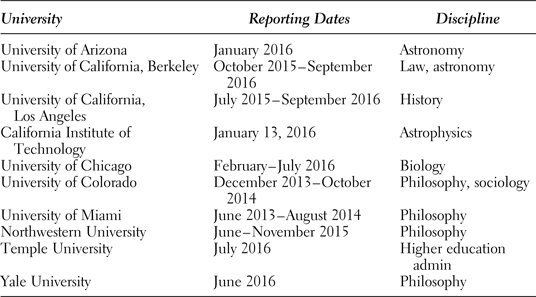
Table 1 reports specific cases of sexual harassment discussed during the reporting period and the disciplines or universities.
Reports of Harassment in Universities, Chronicle of Higher Education, June 2013–September 2016

The accumulation of incidents contributes to demonstrating a “collective element” to individual harms, as Ewick and Silbey argued.Footnote 11 Most of these institutions are research universities; those accused were people with reputations as leaders, both as administrators and eminent scholars (see, e.g., Schuessler Reference Schuessler2013). Each story included both a faculty member's name and a discipline; graduate students were usually those complaining, though reporters would return to a case to say that many people had come forward to say the harassment had been ongoing over many years, with many women, generally unnamed. One case concerned a staff member. The students’ names were not mentioned, except when women were plaintiffs in lawsuit. Complainants who have not filed suit are unlikely to wish to be public, which can reinforce the image of who is harassed at the beginning of the article: celebrity white women. The exception to the lack of depiction of those complaining was the Berkeley law case, in which an African American woman who had been the executive assistant for the dean filed a lawsuit, and the graduate students at the University of California, Los Angeles, who sued in California court.Footnote 12
Cumulative individual stories imply more widespread problems (Wilson Reference Wilson2014, Reference Wilson2016). Fragments cumulating to the repetition that makes an overarching narrative unmoor the problem from a particular time or place. For example, Geoffrey Marcy, an astronomer at the University of California, Berkeley, faced multiple accusations stretching over years concerning inappropriate sexual behavior; the university's initial reprimand brought more complaints and more media attention. Marcy had the greatest number of stories in CHE of any individual faculty member. Other individual stories concerned whether and when sexual relationships were a problem when faculty members claimed that they were only dating young women, not harassing or assaulting (Wilson Reference Wilson2014, Reference Wilson2015c). Reporters cited as examples professors who resigned (Brown Reference Brown2016; Wilson Reference Wilson2014).
Containing reports in time or place implies that harassment is not an unchanging condition of employment. The publicity about complaints about the discipline of astronomy contained the problem to an intellectual field, which, in turn, implied a place. Indeed, feminist astronomers have argued that being in the field, at a telescope, makes sexual harassment easy. So does travel to conferences, which crosses fields of study. The National Science Foundation (NSF) and National Aeronautics and Space Administration (NASA) responded to framing the problem as one of a particular intellectual field. Both agencies would cut funding when universities did not comply with Title IX requirements. The policy was announced in January 2016 and appeared in Science on February 1, 2016 (Benderly Reference Benderly2016). The NSF does not usually enforce legal requirements outside of grant accountability through the granting mechanism. At the time, France Cordova, an astrophysicist who had been president of Purdue University, led the NSF.
Resolution of complaints allowed the news to revisit each case. Reporting expanded with decision points or the start of the school year or problems for characters that already were in the story (Mytelka Reference Mytelka2016); new reporting did not require new incidents. For example, the dean of the Berkeley law school countersued the university for damage to his career as a result of the way the university had handled the sexual harassment complaint against him. The decision to allow someone back on campus also brings a story and a context for it (see, e.g., Leiter Reference Leiter2016; Thomason Reference Thomason2016). When Yale cleared a political theorist of wrongdoing in the summer of 2016, the New York Times reported it, following up earlier reports of the complaints.
The New York Times used the case as a way to talk about a “culture of silence” at Yale. The place for harassment was a university, not an intellectual field or physical field site, as reflections on astronomy suggested. Clearing the theorist meant that no one raised documented problems (Remnick Reference Remnick2016). The New York Times grouped the Marcy case into a long story about Berkeley, told as a series of complaints about Berkeley professors and officials, also a general problem in a place rather than either disconnected incidents or a problem in an entire discipline or an unchanging problem within a profession. Yet the accumulation of incidents, revisited with new incidents or responses, implies that sexual harassment was not about one science, or one person (Fuller Reference Fuller2016). In 2016, the president of the University of California System, Janet Napolitano, made dealing with the problem of sexual harassment a systemwide concern. Napolitano had previously served in the Barack Obama administration as secretary of homeland security and as governor of Arizona.
These reports could tell us that the luminaries are a particular problem—their eminence grants them special access—or that research institutions, or particular research institutions, have a problem (Fuller Reference Fuller2016). Alternatively, these are the institutions worth reporting on, where administrators will act, or where the faculty members are newsworthy. Placing faculty in the university and the university as a physical space locates the harassment in a university as much as a profession. The problem is the university's, for women early in their career. The news since then, including a crowdsourced spreadsheet inviting people to name incidents at universities (Flaherty Reference Flaherty2017), implies that the problems are not limited to research universities, eminent academics, or particular fields.Footnote 13
Cumulating instances allow individual incidents to counter the story that sexual harassment results from individual wrongdoers. Making these stories public shifts from not acknowledging sexual harassment as a systematic problem for the advancement of women. For example, the solicitation for a premier program to promote the advancement of women in sciences in the United States, the NSF ADVANCE grant, has not in the past mentioned sexual harassment as a significant barrier for women.
Reporting sexual harassment finds its parallel in news reports of other legal wrongs; in tort law, “if it bleeds it leads” (Haltom and McCann Reference Haltom and McCann2004, 157, citing Bennett, Reference Bennett2001; see also Altheide and Schneider Reference Altheide and Schneider2013, 30). Even so, legal change mobilized stories. As noted earlier, sexual harassment had long been underreported—so underreported that it did not make a description of barriers to advancement in the two main books popularizing scholarship on barriers to employment for professional women, Sandberg (Reference Sandberg2013) and Babcock and Laschever (Reference Babcock and Laschever2007).
The proliferating reporting of sexual harassment invited some dissent, both about the centrality of sexual harassment as a problem and about women's agency.
DISSENT: SEXUAL AGENCY, IMAGINING CAREERS, AND RACE DISCRIMINATION
Dissenters argued that university processes were not fair to those accused, that the policies did not recognize women's choices in sexual relationships, or that accusations had bad spillovers (DeSantis Reference DeSantis2014a). Articles claiming sexual agency for women pointed to graduate school, not to work conditions for faculty members, nor to students as employees. Jane Gallop, a literary theorist, argued in her Reference Gallop1997 book that sexual relationships are part of the intimacy of teaching and always had been; she attested to her own relationships with students and colleagues over the years (Wilson Reference Wilson2014). In 2015, a faculty member from Northwestern University, Laura Kipnis (Reference Kipnis2015), reminded readers of Gallop's argument. Kipnis echoed Gallop, arguing that it had once not seemed that professors, including male professors, were all-powerful in sexual relationships. She argued that her university, Northwestern, was pursuing faculty for sexual harassment too aggressively; CHE returned to that story when Kipnis was excoriated by students and in the Northwestern University press, and again when the university cleared her of not violating Title IX by objecting to new sexual harassment policies (see, e.g., Wilson Reference Wilson2015b). To name sexuality as a source of power most often centers on young women, including faculty members remembering when they were young women. Kipnis developed her argument against regulation, condemning unfair administrative legal processes and recognizing complexity and agency (Kipnis Reference Kipnis2017).
Sexual harassment as unwanted sexual attention did open reporting to other ways of seeing problems for women in research science careers. Reports and the resignation of the astronomer Geoffrey Marcy at the University of California, Berkeley, sparked multiple stories in CHE about astronomy. In November 2015, CHE reporter Robin Wilson used the Marcy case to discuss questions concerning pipelines and discouragement and those who encourage women to develop their work as physicists. The article cited as an authority the eminent astrophysicist C. Megan Urry, who has argued for broader ways of seeing problems: women need to imagine themselves as authorities, and little encourages women to do so. Without imagining themselves as authorities, women cannot thrive in the sciences:
C. Megan Urry, a professor of physics and astronomy at Yale University, says the biggest barrier to women in astronomy isn't necessarily sexual harassment. She acknowledges it's a serious problem that severely harms some young women. But persuading women from the start that they are smart and accomplished enough to choose a physics or astronomy major is the biggest hurdle, she says. … A big part of that, she says, is that men in the field talk about how accomplished scholars must be to make it. “The more people in the field see themselves as incredibly gifted human beings,” she says, “the fewer women there are.” (Wilson Reference Wilson2015b)
Urry has made arguing for ongoing problems for women in science a mission, supported by both stories and systematic data. She has focused on imagination and decisions over a lifetime, often made in response to encouragement and discouragement, ascribing discouragement to “a steady drumbeat,” rather than one problem (quoted in Pollack Reference Pollack2015). Her quotation about the damage in the language of being gifted, made in an article about gender in astrophysics, applies across categories of women in a way that the problem of sexual harassment as unwanted sexual attention may not. The “drumbeat” can extend over time, taking exclusion beyond entry. Excluding by naming brilliance, or by not encouraging any students, including white young men, can have a neutral tone but a disparate impact if women respond especially well to encouragement or are especially discouraged by discussions of genius or brilliance (Pollack Reference Pollack2013). Imagination and encouragement may not be as, well, sexy, as unwanted sexual attention, nor does it name a solitary wrong and a wrongdoer. Few rewards await people who tell stories about how they imagined their careers or the stumbling steps they took along the way, including courses failed, or early training gone awry (see, e.g., Pollack Reference Pollack2013, Reference Pollack2015). Stories illuminate limits in early training or imagination, but it takes courage to reflect aloud on how one imagined one's self or why one stopped pursuing a course of study.
Placing sexual harassment in a broader frame, as the article quoting Urry did, invites discussion of racism in the profession, which, as intersectional analyses suggest, makes sexism a different experience. The astrophysicist Jedidah Isler illustrated the racism she had experienced:
There was the time she was at a national astronomy meeting and a fellow scientist asked her what was on the menu. The man had assumed she was a food server. It wasn't the first time something like that had happened. (Wilson Reference Wilson2015b)
The story demonstrates direct, personal, individual bias, though she, too, could talk about imagination and the problems of “drumbeats.” CHE also reported on efforts to diversify faculty by race, celebrating Penn State's success in graduating African American women PhDs in philosophy. That article discussed multiple steps in working against the racism in the profession, including in hiring, curriculum, and admissions (Patel Reference Patel2016). The article included photos and stories, giving life to strategy.
By 2016, enough stories of sexual harassment had proliferated that Hope Jahren, a geobiologist, could write a sharply stated New York Times editorial published in March 2016 on women's experiences of unwanted sexual attention and their decisions to leave the profession. She argued that the stories allow everyone to individualize the problems to bad apples, who, as she argued, “are so rare they have been encountered by every single woman I know” (Jahren Reference Jahren2016b). She did not contain it to a particularly university and its culture, to a field site or opportunity, or to academic stars and R1 institutions. Further supporting the focus on sexual harassment as the publicly recognizable wrong in employment, Jahren's New York Times article showed up as the top article in a September 2016 Google search on “science sexual discrimination.” Partial stories about sexual discrimination as unwanted sexual attention could open up the possibility of telling other stories about disadvantage. Jahren's well-received book Lab Girl (Reference Jahren2016a), published a month after the New York Times article, tells about the her love of lab science and the difficulties, including relying on soft money and needing to raise enough to keep the work going. Telling lab stories opens up imagination and allows diagnosing problems in funding and what they mean for science, problems that persist long after the unwanted sexual attention reported as problems earlier in some women's careers. Problems of funding that Jahren tells lead into alternative analyses of agency and problems in universities.
WITH EVIDENCE, WITHOUT NAMING WRONGS
Systematic evidence concerning exclusion is less often told in a way that is easy to remember and easy to learn from. Aggregate information is seldom tied to a particular place or to characters, not lending itself to news, to a legal complaint, or to individuation. Yet sexual harassment is largely told concerning women at the beginning of careers, leaving little that allows detailed analysis of process to explain declining percentages of women at each level of the academy. Systematic analyses yield conclusions that illuminate career differences: for example, young women may be more sensitive than men to grade signals and drop out too quickly (Rask Reference Rask2010; Rask and Tiefenthaler Reference Rask and Tiefenthaler2008).
In political science, men and women do not publish in leading journals proportionate to their participation in the profession (Teele and Thelen Reference Teele and Thelen2017); differences have long-term implications for advancing in the academy (see, e.g., Claypool et al. Reference Claypool, Janssen, Kim and Mitchell2017). Differences in citations, including self-citations (Leahey Reference Leahey2007; Voosen Reference Voosen2016; Wilson Reference Wilson2014), by gender are common. Since universities use this metric, and since citation also contributes to changing ideas, citation differences accumulate over a career to limit advancement, salary, and transformation of knowledge. Women may not repeat what they publish as often, leading to fewer articles (Leahey Reference Leahey2007). In political science, women who teach undergraduates face a wage penalty compared with faculty members who teach graduate students (Claypool et al. Reference Claypool, Janssen, Kim and Mitchell2017). Choices ill adapted to the university as it is add up to cumulative disadvantage. In other fields, journals require attributing work in multiauthor articles. Content analysis of journals that attribute work in multiauthor articles has demonstrated that women do not get credit in coauthored work for having “big ideas” (Pierson Reference Pierson2014).
Responsibility for service that matters to supervisors also varies by gender (Mitchell and Hesli Reference Mitchell and Hesli2013). Teaching evaluations are biased against women and not clearly tied to learning outcomes (Jaschik Reference Jaschik2013; Miller Reference Miller2015). Attributions of responsibility for scholarship, teaching, and service differ by gender (Mitchell and Hesli Reference Mitchell and Hesli2013). With many of these, women could strategize for individual advancement, or the problems could be a way of seeing problems with the profession. For example, Claypool and her coauthors recommend that women teach graduate students if possible, to avoid the wage penalty for teaching undergraduates. Another way of describing the problem would be the mismatch between what universities need and what they reward. As discussed earlier, women's choices are a way to describe inequities. Problems regarding differences in practices are often ascribed to choice—the “lack of interest” in publishing, or repetition, or teaching graduate students, or service the profession recognizes—and defined as not a problem, rather than leading to questioning the conditions under which people choose (Williams and Ceci Reference Williams and Ceci2014; for a critique of research design and methods, see Bastian Reference Bastian2016).
A yawning gap separates the long time between when some women are more likely to experience sexual harassment as unwanted sexual attention and the summation of a career, when few women lead universities (June Reference June2015). Some of the evidence about gendered inequities in the academy sometimes breaks into the press, often with characters and events attached, making the systematic research more accessible (Antecol, Bedard, and Stearns Reference Antecol, Bedard and Stearns2016, cited in Wolfers Reference Wolfers2016a; Wolfers Reference Wolfers2015; for a critique, see Srivistava Reference Srivistava2016; Wolfers Reference Wolfers2016b, citing Sarsons Reference Sarsons2016). Translational writings tell problems that become evident in the aggregate, giving them characters, plots, and life (Babcock and Laschever Reference Babcock and Laschever2007;Sandberg and Grant Reference Sandberg and Grant2014, Reference Sandberg and Grant2015a, Reference Sandberg and Grant2015b, Reference Sandberg and Grant2015c, Reference Sandberg and Grant2016). The stories draw from professions ranging from finance to musical performance (Goldin and Rouse Reference Goldin and Rouse2000). However, the reports do not focus on the problems of a particular profession, much less a particular discipline. Knowing what to do in one's own profession requires local knowledge.
Therefore, reports of problems in the academy in gender disparities for gatekeeping of future and current faculty are asymmetrical: problems most recently described as legal wrongs are individuated, intentional, sexual, and for administrators at R1 institutions to worry about. Other problems are professionally significant yet aggregated, so there is no one person harmed and no one wrongdoer and no judgment of wrongdoing. Problems analyzed in scholarly literature have not led to popular reports of resignations or enforced remedies, reinforcing taken-for-granted knowledge that gender-based discrimination that constitutes a legal wrong is unwanted sexual attention, since it has resulted in recent resignations. Not imagining law as a remedy is realistic, given legal processes. However, using findings on what goes wrong can give new ways of telling individual stories, linking individual circumstances to broader structure, as Ewick and Silbey argued that subversive stories do, and cumulating to an overarching narrative, as Beckwith has argued.
Analyses of differences in success as an outcome rather than a process—getting granted tenure or not, getting grants or not—cannot get at reasons for what medicine calls “failure to thrive.” Women may not be doing as well. Even the phrase “not doing as well” leaves in place the standards of the profession, rather than critiquing the profession for all the necessary work that often does not count. Focusing on the standards as they exist promotes a misalignment between what universities need to thrive—people who help run the place—and what it asks people to do—more research publications—which is surely a management problem (Hirsch Reference Hirsch2016). Scholarship on outcomes can illuminate whether women get tenure with the same numbers of publications, the same reviews of teaching, or the same service practices. It cannot illuminate how something goes wrong. The processes of employment, not the outcomes, allow intervening. Outcomes make the employment process a black box. Telling of the processes, though, is difficult and seldom rewarded.
LOYALTY AND VOICE: MAKING SPECIFIC PROBLEMS DISAPPEAR
Not knowing about the process of how things go wrong happens for good reason; telling stories criticizes institutions as well as one's own decisions, and institutions do not welcome voice. In Exit, Voice, and Loyalty, the economist Albert O. Hirschman (Reference Hirschman1970) argued that while exit expresses dissatisfaction with failing institutions, it does little to improve them. Universities can replace those who exit with new faculty members. Because the stories of leaving are unevenly shared and are only sometimes publicly available, prospective faculty members cannot be able to take information about the problems of the workplace into account. Exit costs institutions and individuals.
Loyalty could strengthen the alternative accountability mechanism that Hirschman described, voice. If people do not leave, perhaps they talk back to institutions. However, Hirschman pointed out that institutions relying upon loyalty do not always promote voice. Hirschman (Reference Hirschman1970, 93) argued that institutions that have a very high cost of entry and a very high cost of exit require loyalty and can afford not to foster voice. A high cost of entry and a high cost to exit encourage people to believe that they have made the right choice in joining an institution: a club, a profession, or a country. It was so costly to join that it must be worth joining. If exiting would destroy one's career, and one needs to work, or only comes with painfully recognizing that it was wrong to pay the high cost of entry, then one stays. The academy is a classic case of a profession that has both a high cost of entry and a high cost of exit.Footnote 14 Hirschman did argue, though, that people who enter at a high personal cost and are disappointed might well find it worthwhile to exercise voice, or to act to change the institution. The two ways the high cost of entry pull—toward loyalty and silence, or toward loyalty and voice—may help account both for the difficulty of critiquing the profession in specifics and for the people who do, particularly the more senior members.
ADVICE AS ALTERNATIVE ACCOUNTABILITY
The problems with exit and voice give a way of understanding how there can be problems with advancement with specifics that can be difficult to find in publicly available documents. How, then, to address widely recognized problems in outcomes? Political scientists have taken on equity as a project for transforming the discipline to better represent governance and political action. Political science has had a widely recognized problem with the advancement of women (APSA Task Force 2011; Hesli, Lee, and Mitchell Reference Hesli, Lee and Mitchell2012; Mitchell and Hesli Reference Mitchell and Hesli2013). As universities change faculty positions to have greater teaching loads and less job security, women may be at greater risk for less secure jobs, though the APSA Task Force (2011) noted a dearth of data. Political scientists have written about strategies for advancement for women, and seeing gender in the discipline (Ackerly Reference Ackerly2014; Anonymous 2014; Beckwith Reference Beckwith2015b; Claypool et al. Reference Claypool, Janssen, Kim and Mitchell2017; Daniels Reference Daniels2014; Hero Reference Hero2015; Kittilson Reference Kittilson2015; Mershon and Walsh Reference Mershon and Walsh2014, Reference Mershon and Walsh2015; Sinclair-Chapman Reference Sinclair-Chapman2015) and how women experience lives in the discipline, with clear statements of the importance of bodies to belonging (Alexander-Floyd Reference Alexander-Floyd2015; Behl Reference Behl2016). The journals Politics & Gender (2014), PS: Political Science and Politics (2015), and Politics, Groups and Identities (Claypool and Mershon Reference Claypool and Mershon2016; Ford Reference Ford2016; McClain et al. Reference McClain, Ayee, Means, Reyes-Barriéntez and Sediqe2016; Mershon and Walsh Reference Mershon and Walsh2016; Smooth Reference Smooth2016) have all published symposia from Carol Mershon and Denise Walsh's project on advancing women in political science.
Advice has emerged as a strategy for improving the status of women. What could be wrong with advice, except that it can be difficult to follow? Advice to advance women draws from women who explain how to follow in their own successful footsteps (see Chenoweth et al. Reference Chenoweth, Fortina, Mitchell, Savun, Weeks and Cunningham2016; for a critique, see Sjoberg Reference Sjoberg2016) or from success or failure in social movements (see the symposia in Politics & Gender, PS: Political Science and Politics, and Politics, Groups and Identities just cited). The proliferating advice is valuable—the more detailed, the better. However, advice can miss context, or the good reasons people have for not following advice, or the critiques of institutions embedded in why people do not follow advice. For example, advice can presume partners at home (Chenoweth et al. Reference Chenoweth, Fortina, Mitchell, Savun, Weeks and Cunningham2016), or it can presume that people are fully able and always available to work (Andersen Reference Andersen2016), exactly against feminist theorizing of bodies and workforce participation. Advice also suffers from survivorship bias. People or movements for equity that did not succeed, or people who quit because the academy and not their choices was the problem, also might have followed all the good advice.
Law appears as a generality in recent advice within political science. Mershon and Walsh described problems as ones of “persistent discrimination in the academy” (Mershon and Walsh Reference Mershon and Walsh2015, 459). They named legal rules, legal settlements, and human resources offices as significant allies, but they did not make the legal rules or the offices responsible for implementing rules central to explaining how to remedy discrimination in what they discuss. Significantly, given the news over the last few years in higher education, sexual harassment is not visible in advice about changing departments.
Reflections on learning from loss and mistakes have largely been missing from the advancement discussion. Systematic evidence could animate complex stories about decisions to apply for jobs or how to spend one's time or what writing projects to pursue. Since legal complaints start from where things have gone wrong, the limits to stories of loss outside of sexual harassment accompany the absence of law as a remedy. Both lead to an absence of stories of what goes wrong that would allow learning, whether because it enriches an understanding of loss in the profession or because it allows seeing where people can decide differently.
CONCLUSION: VOICE AND STORY AS ALTERNATIVE ACCOUNTABILITY
Problems with legal accountabilities lead to reflecting on what stories of problems can promote. Both place and time are essential elements of stories, and how writers deploy them imply different explanations for problems: the culture of a place, a field, or an opportunity far from home or the academy. How problems of harassment, citation practices, authorship, credit, teaching assignments, or service responsibility are limited in time and place is unclear. Universities are changing, including more temporary labor itself conditioned by declining investments per student in states and increasing demands for innovation in teaching and greater accountability. Problems based in analyses of existing data are both familiar and seem oddly disconnected from the proliferating changes in conditions of work. Problems may not predict those of the future.
The changing environment includes regulation as information sharing and setting shared goals, rather than punishment through law. It also has begun to include more voice, from people who have not left the profession and those who have shifted career paths.
Sharing information promotes accountability, but it is difficult to talk of exclusion and how family, field of study, and career intersect, even for eminent senior scholars (Crosby Reference Crosby2017; Givens Reference Givens2017). Some collections about life in the academy breach the distinction between stories in the popular press and systematic scholarship (Alcoff Reference Alcoff2003; Chilly Collective 1995; Gutierrez y Muhs Reference Gutierrez y Muhs2012; White Reference White2008). Proliferating more complex stories informed by systematic research on imagination, encouragement, discouragement, field choice, submissions, authorship, and citations, which the psychologist Faye Crosby, the political scientist Terri Givens, the astrophysicist Megan Urry, the geobiologist Hope Jahren, and the science writer Eileen Pollack all have done, illuminate more ways inclusion of women's work fails. Both kinds of scholarship illuminate processes rather than outcomes, rather than relying on dominant frames concerning sexual harassment as unwanted sexual attention, or child rearing, or choice.
Websites that have no gatekeepers other than the knowledge required to set them up, Twitter, and a willingness to exercise voice make women's authority available. Naming exclusions embarrasses or calls attention when nondiscrimination is a publicly agreed upon legal commitment (Beaulieu et al. Reference Beaulieu, Boydstun, Dionne, Klar, Krupnikov, Michelson, Searles and Wolbrecht2016; Beaulieu et al. Reference Beaulieu, Boydstun, Brown, Dionne, Gillespie, Klar, Krupnikov, Michelson, Searles and Wolbrecht2017; Diascro Reference Diascro2017; The Precariat and the Professor 2017; #distractinglysexy). Telling stories linking patterns to people can satisfy an urge for equity, improvement, and truth telling. It allows mourning what is lost, including a dream of a transformed university and transformed knowledge that would be less, rather than more, driven by status hierarchies.
Legal complaints may be deeply imperfect, but so are other strategies for remedying problems. In inequities at work, complaints have sometimes made problems publicly available, when settlement agreements do not prohibit it. They could allow a close diagnosis of a problem, particularly if coupled with the systematic evidence. Resisting systematic evidence, or refusing to couple stories to larger patterns, leads to what Patricia Ewick and Susan Silbey called “hegemonic tales,” divorcing details from broader social structure and make them look anomalous when they are not. Cumulating incidents reveal stable contests over meanings of sexuality—desire, hostility, consent, deniability, and the meanings that people attribute to sexual behavior—even if the acceptability of sexualized workplaces has changed and may be going through further changes.
In sum, people respond to stories. Legal method is one of stylized storytelling, usually one that blames, and legal cases teach of wrongs because lawsuits and legal complaints are publicized, and some documents are public. Public complaints and public guidance letters communicate messages about law. However, even winning legal complaints often do not satisfy individual complainants (Bingham and Gansler Reference Bingham and Gansler2002). Wrongs in employment in the academy that are individuated in this moment are the widely reported stories of unwanted sexual attention. Other evidence about disadvantage in the academy is more systematic, less often told as a particular wrong, and therefore less available for discussion and messages about what is wrong. Advice is a form of accountability, but it can be divorced from the conditions that produce problems and the reasons people do not or cannot follow advice.
Recognizing sexual harassment has at least a double meaning. That it gets reported now answers an assumption that if a problem goes undiscussed, it must no longer be a problem. However, crowding out other analyses confines women to discussing dominant tropes of what it means to be a woman at work. To have to continue discussing sexual harassment, may be welcome in recognizing a wrong, difficult where it erases women's sexual agency, deflects from broadening knowledge about how women contribute and can continue to—in astrophysics, in international relations, in lab sciences, in social welfare, and in climate change politics.