Thousands of older adults across the United States (US) have suffered severe effects from recent disasters such as Hurricanes Maria, Harvey, and Irma in 2017, and the 2018 California wildfires. In addition to billions of dollars in property damages, these events caused substantial morbidity and mortality among older Americans. 1-Reference Quast, Andel and Sadhu4 Disasters are expected to increase in frequency, severity, and cost as effects from climate change increase, 1 while at the same time the population of older adults worldwide is projected to expand. 5
Applying principles of emergency preparedness, which have the goal of mitigating the potential effects of a disaster, can help support older adults to maintain health and function in the event of a disaster. However, despite the emphasis placed on preparedness across multiple organizations and media campaigns, challenges with communication and low prioritization of disaster planning have been identified as issues for older adults. Reference Shih, Acosta and Chen6 At the same time, the potential negative effects of disasters on older adults are more severe in terms of health and long-term recovery. Reference Bell, Abir and Choi7,Reference Malik, Lee and Doran8 Older adults are at heightened risk for harm from disasters as they may have added vulnerabilities, such as impaired mobility, cognitive deficits, chronic diseases, social isolation, and limited financial resources. 9
This study sought to understand how levels of emergency preparedness, both in terms of actual preparedness actions and confidence in feeling prepared to address disaster situations, are affected by challenges common with aging. The broader goal was to identify populations that may benefit from targeted interventions to support emergency preparedness. Therefore, the purpose of this study was to examine predictors of emergency preparedness and confidence in ability to address emergency situations among a nationally representative sample of older US adults.
METHODS
Sample
The National Poll on Healthy Aging (NPHA) is a recurring household survey of US older adults aged 50-80 y conducted with the goal of informing older people, health care professionals, and policy makers on a variety of important health issues that affect older adults and their families. 10 The NPHA emergency preparedness survey was fielded in May 2019 by the University of Michigan Institute for Healthcare Policy and Innovation. The NPHA uses the Ipsos KnowledgePanel (Ipsos Group Public Affairs LLC), a probability-based Internet survey panel designed to be representative of the US population, where the sample is generated using address-based sampling. Demographic information is collected from panel members, which is then used to generate and adjust design weights to ensure respondent characteristics reflect US Census population estimates. Previous NPHA surveys using Knowledge Panel have included topics such as sleep, Reference Maust, Solway and Clark11 loneliness, dental care, health-care overuse, Reference Kullgren, Malani and Kirch12 and brain health. Reference Maust, Solway and Langa13 The survey was administered online to a randomly selected, stratified sample of 2256 individuals in May 2019, where the overall response rate was 76%. The University of Michigan Institutional Review Board reviewed this study and deemed it exempt from human subjects review because it was a study of deidentified respondents.
Assessment of Emergency Preparedness Questions
In the survey, respondents were asked about the following domains: (1) experiences with past emergency situations, (2) use of community alert warning systems, (3) communication about preparedness with family or friends, (4) use of essential medical equipment that requires electricity, (5) emergency preparedness supplies, (6) confidence about preparedness, (7) information sources in the event of a disaster, (8) opinions on likelihood of experiencing a disaster, and (9) perceived challenges associated with evacuation. (See the online Appendix for full survey questions.) Preparedness questions were created based on key recommendations from leading disaster response sources, including the American Red Cross, 14 the Federal Emergency Management Agency, 15 and the Centers for Disease Control and Prevention. 16
Demographics
Basic demographic information was self-reported by respondents. Demographic variables included age, sex, race/ethnicity (White, non-Hispanic; Black, non-Hispanic; Hispanic; Other/multiple), education level, and total household income. Respondents also answered questions on their use of mobility aids (defined as use of a cane, walker, wheelchair, electric scooter, or other), physical health status (excellent, very good, good, fair, poor), and the number of people living in their household. In addition, respondents were asked if they had experienced an emergency situation in the past year.
Data Analysis
Basic descriptive statistics were first calculated. Associations between preparedness and confidence were examined using chi-square with 95% confidence intervals (CIs). Logistic regression was then used to predict outcomes of interest. The first category of outcomes was emergency preparedness actions, defined as (1) having a 7-d supply of food and water, (2) having a 7-d supply of essential medications and equipment, (3) having a stocked emergency kit that meets recommended guidelines, and (4) having had conversations about evacuation plans with family and friends. A second category of outcomes was confidence in ability to address 1 of 3 emergency situations: (1) power outage lasting more than 24 h, (2) severe weather, and (3) evacuation from home. The main predictors of interest for each category of outcomes were (1) living alone, (2) physical health status, (3) use of mobility aids, and (4) use of essential medical equipment requiring electricity, because individuals in these categories may be at greater risk for harm from disasters. Models were adjusted for age, sex, race/ethnicity, income, and education. Odds ratios (ORs) were calculated, and a 2-tailed P < 0.05 was considered statistically significant. Data analysis was completed using Stata version 15.1 (StataCorp LP, College Station, TX). All analyses used survey weights to generate nationally representative estimates.
RESULTS
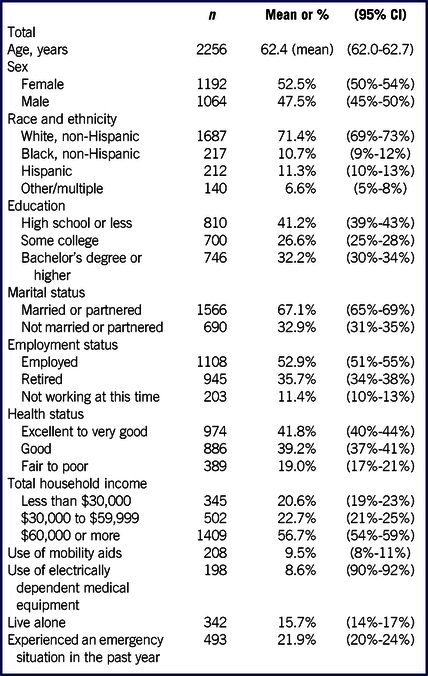
Among the 2256 respondents, the mean age was 62.4 ± 8.0 y and 52% were female. Of the 4 categories of race and ethnicity, 71% were non-Hispanic White, 11% were Black, 11% were Hispanic, and almost 7% reported as being of other or multiple races. A total of 32% held a bachelor’s degree or higher. More than half (56.7%) reported a household income of more than $60,000 per y, while 20% had a household income less than $30,000. A total of 73% had experienced an emergency situation in their lifetime, while 22% had experienced an emergency situation in the past year. Among all respondents, 16% lived alone, 9% used medical equipment that requires electricity, and 9% used mobility aids (Table 1).
Characteristics of US Adults (50-80 Years OD)

Abbreviation: CI, confidence interval.
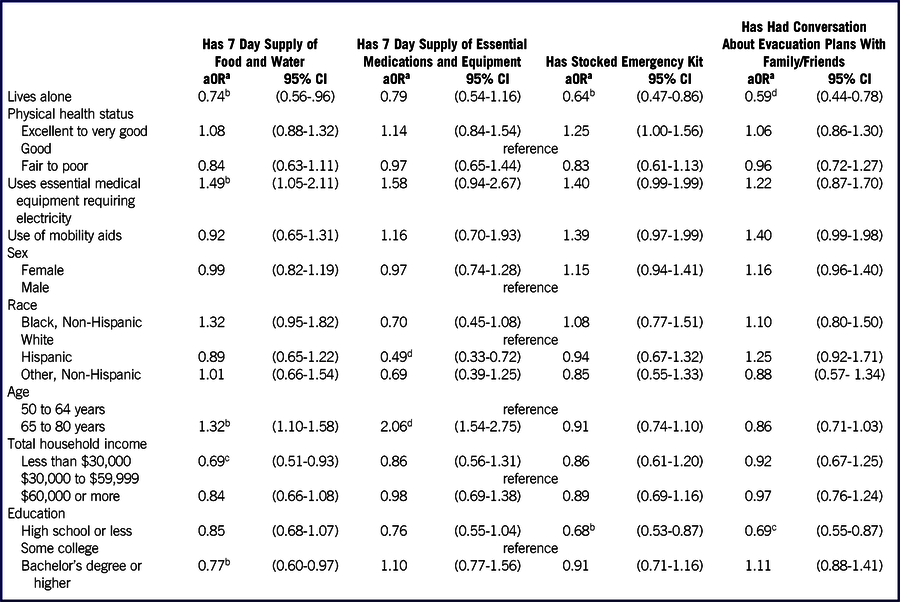
Living alone was associated with a decrease in preparedness for certain actions, including lower odds of having a 7-d supply of food and water (aOR = 0.74; 95% CI: 0.57-0.96), having a stocked emergency kit (aOR = 0.64; 95% CI: 0.47-0.86) and having had conversations with family or friends about evacuation plans (aOR = 0.59; 95% CI: 0.45-0.78) (Table 2).
Predictors of Emergency Preparedness Actions Among US Adults Aged 50-80 Years

Abbreviations: aOR, adjusted odds ratio; CI, confidence interval.
a Odds ratios are adjusted for all other characteristics in the table.
b P < 0.05.
c P < 0.01.
d P < 0.001.
Use of essential medical equipment requiring electricity was associated with higher odds of having a 7-d supply of food and water (aOR = 1.49; 95% CI: 1.05-2.11) but not with having a 7-d supply of essential medications and equipment, having a stocked emergency kit, or having had conversations about evacuation with family or friends. Associations between physical health status and use of mobility aids were not observed with any of these 4 predictors of emergency preparedness.
Earning an income of less than $30,000 was associated with lower odds of having a 7-d supply of food and water (OR = 0.69; 95% CI: 0.51-0.93) compared with those with an income of $30,000 to $60,000 per y. Having a high school education or less was associated with lower odds of having a stocked emergency kit (OR = 0.68; 95% CI: 0.53-0.87) and having had conversations about evacuation plans with family/friends (OR = 0.69; 95% CI: 0.55-0.87) when compared with those with a high school degree. Higher odds of having a 7-d supply of food and water (OR = 1.32; 95% CI: 1.10-1.58) and a 7-d supply of essential medications and equipment (OR = 2.06; 95% CI: 1.55-2.75) were seen with age of 65-80 y compared with age of 50-64 y.
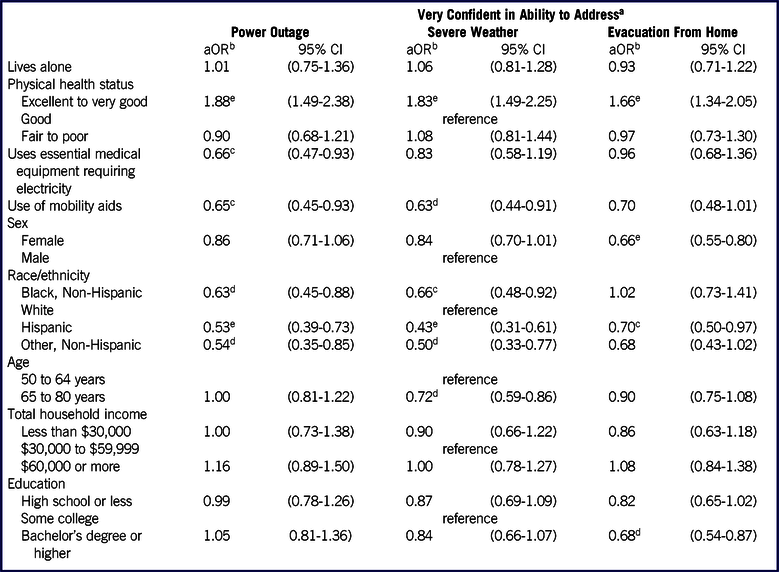
Self-reported excellent or very good health was associated with higher odds of confidence in ability to address each of the 3 emergency situations, including power outage (aOR = 1.88; 95% CI: 1.49-2.38), severe weather (aOR = 1.83; 95% CI: 1.49-2.25), and evacuation from home (aOR = 1.66; 95% CI: 1.34-2.05), while poor health did not differ from the reference group of self-reported good health. Use of essential medical equipment requiring electricity was associated with less confidence in ability to address a power outage (aOR = 0.66; 95% CI: 0.47-0.94). Less confidence was seen in the group using mobility aids in both confidence to address power outages (aOR = 0.65; 95% CI: 0.45-0.93) and severe weather (aOR = 0.63; 95% CI: 0.44-0.91). Living alone was not significantly different than the reference group in terms of confidence in addressing emergency situations.
Hispanic ethnicity was associated with lower odds of confidence in power outages lasting more than 24 h (OR = 0.53; 95% CI: 0.39-0.73), severe weather (OR = 0.43; 95% CI: 0.31-0.61), and evacuation from home (OR = 0.70; 95% CI: 0.50-0.97). Black race was associated with lower odds of confidence in ability to address severe weather (OR = 0.66; 95% CI: 0.48-0.92) and power outages lasting more than 24 h (OR = 0.63; 95% CI: 0.45-0.88). Female sex was associated with lower odds of confidence in evacuation from home (aOR = 0.66; 95% CI: 0.55-0.80) (Table 3).
Predictors of Confidence in Addressing Emergency Situations Among US Adults Aged 50-80 Years

Abbreviations: aOR, adjusted odds ratio; CI, confidence interval.
a Response options included ‘very confident,’ ‘somewhat confident,’ and ‘not confident.’ ‘Very confident’ tested as outcome. See full survey instrument in Appendix.
b Odds ratios are adjusted for all other characteristics in the table.
c P </- 0.05.
d P < 0.01.
e P < 0.001.
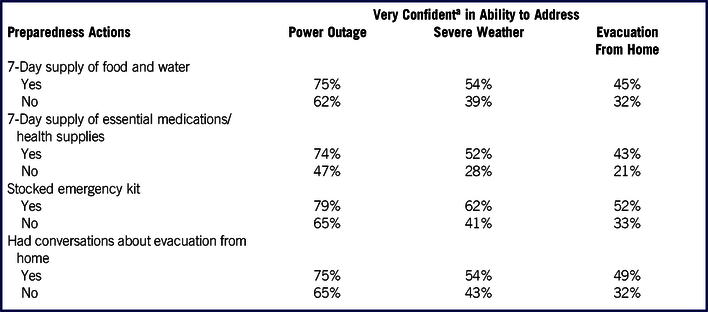
The association between preparedness actions and levels of confidence in addressing emergency situations was also examined. Respondents who reported taking preparedness actions had higher levels of confidence than those not taking preparedness actions (Table 4).
Association Between Preparedness Actions and Confidence in Addressing Emergency Situations Among US Adults Aged 50-80 Years

Note: Unadjusted association tested using chi-squared analysis; p-value < 0.001 for all analyses.
a Response options included ‘very confident,’ ‘somewhat confident,’ and ‘not confident.’ ‘Very confident’ tested as outcome. See full survey instrument in the Appendix.
DISCUSSION
This nationally representative survey of older adults aged 50 to 80 y examined emergency preparedness actions and confidence in ability to address disaster situations. Following the Sendai Framework for Disaster Risk Reduction, this study was conducted from the standpoint that older adults are the key stakeholders in preparedness and should be the central focus of conversations about preparedness and aging. 17 This study looked specifically at emergency preparedness among older adults who may be at greater risk for harm from disasters, including those living alone, those with poor physical health, those using mobility aids, and those using electrically dependent essential health equipment (such as oxygen concentrators or home dialysis machines, among others). This study found that individuals with these challenges were less likely to have taken preparedness steps, and in some cases were less likely to feel confident in their ability to address common emergency situations.
In this study, older adults who live alone were less likely to be prepared for emergency situations. When compared with older adults who did not live alone, those living alone were less likely to have a 7-d supply of food and water, a stocked emergency kit, or to have had conversations with family or friends about their plans in the event of a need to evacuate. Individuals who use essential medical equipment requiring electricity were more likely to have a 7-d supply of food and water, but they did not differ significantly in other preparedness actions, including having a stocked emergency kit or having discussed evacuation plans with family and friends. Other factors, such as income and social relationships, likely influence this as well. It is encouraging that older adults aged 65 to 80 y had higher odds of having a 7-d supply of food, water essential medications, and equipment than the reference group of ages 50 to 64 y. Individuals reporting a bachelor’s degree or higher were less likely to have a 7-d supply of food and water, and less confidence about the need to evacuate from home than the reference group, respectively. This may be related having more education and, therefore, more income. Individuals with lower income and less education were less likely to have taken the other preparedness actions, such as having a stocked emergency kit or talking to family about evacuation plans. Addressing this disparity is an important consideration for emergency preparedness planners. It is also important to learn how these groups are situated in their communities to determine how community-level factors contribute to emergency planning.
Identifying those older adults less confident in their ability to address emergency situations is an important consideration in emergency planning. In this study, individuals who use mobility aids were less likely to feel confident in their ability to address a power outage when compared with those not using mobility aids. Individuals who use medical devices requiring electricity had similar results. However, both of these groups did not differ from those who do not use these devices in terms of confidence in ability to address severe weather or the need to evacuate from their homes. Making space for older adults to be empowered about taking steps to be prepared, in keeping with the Sendai Framework’s 17 focus on older adults as stakeholders, is an important consideration. Disparities also exist by race and ethnicity in terms of confidence to address emergency situations, where Black, Hispanic, and other racial/ethnic groups reported less confidence in their abilities to address emergency situations than the reference group of White race. Women were also less likely than men to be very confident in addressing the need to evacuate from home. Additional efforts to improve confidence in addressing emergency situations should be directed at these specific groups of older adults. Conversely, older adults who reported being in “excellent” health had high levels of confidence in their ability to address various emergency situations, while those with “poor” physical health were not different than the reference group of those with “good” health.
Finally, the finding that even individuals who have taken steps to be prepared may not have high levels of confidence in certain emergency situations (such as evacuating from home) indicates that a better understanding of what contributes to this lack of confidence is needed. At the same time, there is value in understanding why individuals who have not taken preparedness actions feel confident in their ability to address certain emergencies, such as extended power outages. Exploring the individual reasons for confidence, or lack thereof, is an important consideration for future research.
Given that close to 85% of older Americans are living with one or more chronic diseases, 18 which often require access to medications and other treatments, specific diets, and reliable transportation to health appointments, a greater focus on supporting vulnerable older adults to reach optimal levels of emergency preparedness is necessary. This population could receive additional preparedness information and support from trusted sources, including local aging organizations such as Area Agencies on Aging or faith-based organizations. An additional consideration would be to encourage clinicians to discuss preparedness actions for those with chronic medical conditions during routine patient visits.
Public health officials have long struggled with how to help people of all ages prepare for disasters and emergencies. Guidance specific to older adults to adequately prepare for these disruptions exists across multiple entities, including through American Association of Retired People (AARP), Federal Emergency Management Agency (FEMA), and the American Red Cross. Surveys of the general population of the United States, however, have indicated that, despite the many resources available to aid in planning, many of the populations surveyed are underprepared for emergencies. 19,20 The current study echoes these findings in terms of preparedness actions, calling attention to the need for preparedness messaging and communication interventions that achieve adequate uptake among the most vulnerable populations. Reference Uscher-Pines, Chandra and Acosta21 Emergency preparedness messages generally focus on telling people how to prepare, but it is important to ensure they are delivered in a way that encourages behavior change, ie, actually taking actions to prepare. Reference Uscher-Pines, Chandra and Acosta22 While many organizations have developed emergency preparedness communication geared toward older adults, measuring the effectiveness of these interventions is critical. Social cohesion, or how connected groups are within and to a community, has been shown to be a strong factor in disaster recovery. Reference Aldrich and Kyota23,Reference Aldrich24 Applying these principles to preparedness by engaging older adults in preparedness activities within the wider community can facilitate not just personal preparedness, but may also encourage families, friends, and community members to follow their example to become more prepared. 25
LIMITATIONS
The NPHA panel does not include adults over 80 y of age, thereby excluding the oldest Americans. There are many other factors that may affect preparedness (such as examining wider groups of race and ethnicity, or including mental health) that were not included in the larger study design but that may contribute to a greater knowledge base about aging and preparedness. Overall, this study examines older adults within the context of their own homes, alone or with their loved ones, and does not address the community-level factors that contribute to preparedness. There is also the risk of bias in this study. Recall bias is a potential concern, as is response bias common in surveys relying on self-reported measures. Reference Rosenman, Tennekoon and Hill26 The potential for nonresponse bias, common to survey research, also exists. The use of survey weights helps account for this limitation. Finally, there is the risk of multiple comparison problems from applying more than 1 statistical test on the same set of observations.
CONCLUSIONS
The current results support the identification of at-risk groups who may benefit from tailored interventions to support preparedness, specifically those living alone and those who are using mobility aids or medical devices requiring electricity. Focusing preparedness efforts on the unique needs of specific groups of older adults and on empowering older adults may help limit adverse health effects related to disasters.
Acknowledgments
The University of Michigan National Poll on Healthy Aging is sponsored by AARP and Michigan Medicine; the funders had no role in the study design, data collection, management and analysis, nor any participation in the preparation, review and approval of the manuscript. Dr. Kullgren is a VA HSR&D Career Development awardee at the Ann Arbor VA. The views expressed in this article are those of the authors and do not necessarily reflect the position or policy of the Department of Veterans Affairs or the United States government or the official views of the National Institutes of Health.
Funding
Research reported in this publication was supported by National Institute on Aging of the National Institutes of Health under award number K23AG059890 (Bell, PI). Support was also provided by the Department of Veterans Affairs, Veterans Health Administration, Health Services Research and Development Service (Kullgren).
Disclosures
Dr. Kullgren has received consulting fees from SeeChange Health, HealthMine, and the Kaiser Permanente Washington Health Research Institute; and honoraria from the Robert Wood Johnson Foundation, AbilTo, Inc., the Kansas City Area Life Sciences Institute, and the American Diabetes Association.
Supplementary material
To view supplementary material for this article, please visit https://doi.org/10.1017/dmp.2020.80