INTRODUCTION
Diverse clinical populations ranging from dementia to schizophrenia exhibit functional impairments that are associated with considerable public health burden (Wu et al., Reference Wu, Birnbaum, Shi, Ball, Kessler, Moulis and Aggarwal2005; Zhu et al., Reference Zhu, Scarmeas, Torgan, Albert, Brandt, Blacker and Stern2006). Functional impairment has often been examined via self- or caregiver-report questionnaires (Green, Kern, Braff, & Mintz, Reference Green, Kern, Braff and Mintz2000), which provide only coarse and potentially biased assessments (Atkinson, Zibin, & Chuang, Reference Atkinson, Zibin and Chuang1997; Zanetti, Geroldi, Frisoni, Bianchetti, & Trabucchi, Reference Zanetti, Geroldi, Frisoni, Bianchetti and Trabucchi1999). These drawbacks limit the depth of our understanding of functional impairment and its treatment. By comparison, performance-based measures of everyday action provide detailed, objective assessment of functional errors, allowing for the conceptualization of impairment within a neuropsychological framework that may inform targeted interventions for specific functional disabilities.
The Naturalistic Action Test (NAT), a validated measure that examines an array of error types, including omissions and various commissions (Schwartz, Buxbaum, Ferraro, Veramonti, & Segal, Reference Schwartz, Buxbaum, Ferraro, Veramonti and Segal2003), has informed two neuropsychological theories of everyday action impairment: resource theory and the omission-commission model. According to the latter model, omission errors (i.e., failure to complete task steps) and commission errors (i.e., inaccurate performance of task steps) represent dissociable components of everyday functioning resulting from distinct underlying processes. Resource theory, by contrast, proposes that seemingly disparate errors arise from a unitary deficit in overall cognitive resources (Schwartz, Reference Schwartz2006; Schwartz et al., Reference Schwartz, Montgomery, Buxbaum, Lee, Carew, Coslett and Mayer1998).
Giovannetti et al. (Reference Giovannetti, Bettcher, Brennan, Libon, Kessler and Duey2008) examined these theories in dementia using a principal component analysis (PCA) aimed at reducing various error types to their essential components. Results showed that omissions and a subset of commissions (sequence errors, perseverations, substitutions) comprised two separate, uncorrelated (r=.08) components of functional impairment. These components were associated with distinct neuropsychological domains, namely, commissions with executive functioning and omissions with episodic memory and global cognition (Giovannetti et al., Reference Giovannetti, Bettcher, Brennan, Libon, Kessler and Duey2008, see also Giovannetti et al., Reference Giovannetti, Britnell, Brennan, Siderowf, Grossman, Libon and Seidel2012), and with distinct brain regions (Bailey, Kurby, Giovannetti, & Zacks, Reference Bailey, Kurby, Giovannetti and Zacks2013; Seidel et al., Reference Seidel, Giovannetti, Price, Tanner, Mitchell, Eppig and Libon2013), suggesting that these error components are the result of separate underlying processes.
In addition to their theoretical contributions, findings supporting the omission-commission model in dementia have important practical implications. Reducing numerous error types to two primary components may allow for efficient and optimal assessment and treatment of functional impairments. Evidence from the treatment of aphasia and other complex neuropsychological disorders suggests interventions may be most effective when matched to the specific demonstrated problem (Riddoch & Humphreys, Reference Riddoch and Humphreys1994; Sohlberg & Mateer, Reference Sohlberg and Mateer2001; Wilson, Reference Wilson1999). Because certain types of commissions (i.e., sequence errors, perseverations, and substitutions) appear to share a common underlying process in dementia, they are most efficiently examined and rehabilitated together rather than separately in this population. On the other hand, because omissions and commissions reflect distinct components of action impairment in dementia, they should continue to be assessed separately in this population and may benefit from distinct targeted interventions. Specifically, omissions may be prevented by interventions promoting recall and access of task goals (Bickerton, Humphreys, & Riddoch, Reference Bickerton, Humphreys and Riddoch2006; Brennan, Giovannetti, Libon, Bettcher, & Duey, Reference Brennan, Giovannetti, Libon, Bettcher and Duey2009), whereas commissions may be prevented with interventions that facilitate task organization by imposing environmental structure (Bickerton et al., Reference Bickerton, Humphreys and Riddoch2006; Giovannetti et al., Reference Giovannetti, Bettcher, Brennan, Libon, Wambach and Seter2010) or promoting task monitoring (Bettcher et al., Reference Bettcher, Giovannetti, Libon, Eppig, Wambach and Klobusicky2011; Levine et al., Reference Levine, Robertson, Clare, Carter, Hong, Wilson and Stuss2000, Reference Levine, Stuss, Winocur, Binns, Fahy, Mandic and Robertson2007; Robertson, Reference Robertson1996).
However, the omission-commission model has thus far only been tested in dementia; therefore, it is unclear whether this model generalizes to other populations. Given the heterogeneity of functional and neuropsychological impairments across disorders, testing this model in other populations is crucial. The unique cognitive and functional profile of schizophrenia makes it a prime population in which to test the generalizability of the omission-commission model. Individuals with schizophrenia have demonstrated a higher proportion of NAT commissions (81% of total errors) and fewer omissions (19%), despite comparable total errors as individuals with dementia (Kessler, Giovannette, & MacMullen, Reference Giovannetti, Bettcher, Libon, Brennan, Sestito and Kessler2007). This “commissive” pattern differed from that observed not only in dementia (41% omissions) but also in a range of diverse neurological populations, including brain injury and right and left hemisphere stroke (38%, 47%, and 44% omissions, respectively; Buxbaum, Schwartz, & Montgomery, Reference Buxbaum, Schwartz and Montgomery1998; Schwartz et al., Reference Schwartz, Montgomery, Buxbaum, Lee, Carew, Coslett and Mayer1998, Reference Schwartz, Buxbaum, Montgomery, Fitzpatrick-DeSalme, Hart, Ferraro and Coslett1999).
This unique pattern of impairment may be attributable to schizophrenia’s distinct neuropsychological profile, which differs from the amnestic profile that characterizes AD (Bilder et al., Reference Bilder, Goldman, Robinson, Reiter, Bell, Bates and Lieberman2000). Among studies examining neuropsychological correlates of everyday action impairments in schizophrenia (Iampietro, Giovannetti, Drabick, & Kessler, Reference Iampietro, Giovannetti, Drabick and Kessler2012; Kessler et al., Reference Kessler, Giovannetti and MacMullen2007; Rempfer, Hamera, Brown, & Cromwell, Reference Rempfer, Hamera, Brown and Cromwell2003; Semkovska, Bédard, Godbout, Limoge, & Stip, Reference Semkovska, Bédard, Godbout, Limoge and Stip2004; Zayat, Rempfer, Gajewski, & Brown, Reference Zayat, Rempfer, Gajewski and Brown2011), all have highlighted the role of executive function. For example, Kessler et al. (Reference Kessler, Giovannetti and MacMullen2007) showed that the commission errors characteristic of individuals with schizophrenia were associated with executive dysfunction. Semkovska et al. (Reference Semkovska, Bédard, Godbout, Limoge and Stip2004) observed that various types of everyday action errors were more strongly related to executive dysfunction than to episodic memory impairment. This dysexecutive, commissive pattern of everyday action impairment in schizophrenia has lent support to an executive account of functional impairment in schizophrenia (Kessler et al., Reference Kessler, Giovannetti and MacMullen2007), which posits that a unitary deficit in executive dysfunction underlies everyday action impairments. An examination of everyday action components in schizophrenia has the potential both to assess the validity of the omission-commission model and to deepen our understanding of the nature and causes of functional impairment in this population. If the omission-commission model generalizes, then functional impairment in schizophrenia may be best explained by this model or a variant thereof. Alternatively, everyday action impairment in schizophrenia might be better explained by resource theory, an executive account, or another model.
Although several studies have examined functional impairment in schizophrenia with performance-based measures (Harvey, Velligan, & Bellack, Reference Harvey, Velligan and Bellack2007; Harvey et al., Reference Harvey, Helldin, Bowie, Heaton, Olsson, Hjärthag and Patterson2009, Reference Harvey, Raykov, Twamley, Vella, Heaton and Patterson2013; Kessler et al., Reference Kessler, Giovannetti and MacMullen2007; Klapow et al., Reference Klapow, Evans, Patterson, Heaton, Koch and Jeste1997; Rempfer et al., Reference Rempfer, Hamera, Brown and Cromwell2003; Semkovska et al., Reference Semkovska, Bédard, Godbout, Limoge and Stip2004; Seter, Giovannetti, Kessler, & Worth, Reference Seter, Giovannetti, Kessler and Worth2011; Zayat et al., Reference Zayat, Rempfer, Gajewski and Brown2011), to our knowledge none have examined empirically-defined components of everyday action impairment using data reduction techniques (e.g., PCA). Several studies have used gross measures that do not capture the nuances of functional impairment (e.g., Harvey et al., Reference Harvey, Velligan and Bellack2007, Reference Harvey, Helldin, Bowie, Heaton, Olsson, Hjärthag and Patterson2009; Klapow et al., Reference Klapow, Evans, Patterson, Heaton, Koch and Jeste1997). Others have used a large number of detailed error measures (e.g., Kessler et al., Reference Kessler, Giovannetti and MacMullen2007; Semkovska et al., Reference Semkovska, Bédard, Godbout, Limoge and Stip2004), which may be inefficient. Previous publications using the NAT in schizophrenia (Iampietro et al., Reference Iampietro, Giovannetti, Drabick and Kessler2012; Kessler et al., Reference Kessler, Giovannetti and MacMullen2007) have analyzed omissions and commissions separately and have analyzed action-additions, perseverations, substitutions, and sequence errors together as a unitary category of commissions without empirical support for these error groupings in this population. Reducing a wide range of action errors to their empirically-defined components is, therefore, essential for efficient and accurate assessment of everyday action in schizophrenia.
Thus far, there is mixed evidence regarding whether specific aspects of everyday action impairments in schizophrenia have unique neuropsychological correlates. Although Kessler et al. (Reference Kessler, Giovannetti and MacMullen2007) reported a predominantly commissive error pattern in schizophrenia, which was associated with a characteristic executive impairment, omissions nonetheless occurred in this sample in association with global cognitive impairment, providing preliminary support for the omission-commission model. Analyses examining relations between a priori-defined components of everyday action performance (i.e., accuracy and efficiency) and neuropsychological measures have broadly supported associations between accuracy and processing speed/working memory, and between efficiency and executive functions (e.g., planning, set-shifting; Rempfer et al., Reference Rempfer, Hamera, Brown and Cromwell2003; Zayat et al., Reference Zayat, Rempfer, Gajewski and Brown2011), further supporting the existence of distinct components of action impairment in schizophrenia. Nevertheless, these components’ neuropsychological correlates also overlap substantially, with roughly as many shared correlates (including memory and executive function) as unique predictors (Rempfer et al., Reference Rempfer, Hamera, Brown and Cromwell2003; Zayat et al., Reference Zayat, Rempfer, Gajewski and Brown2011). Similarly, in another study (Semkovska et al., Reference Semkovska, Bédard, Godbout, Limoge and Stip2004), specific error types had both distinct and overlapping neuropsychological correlates. Given these discrepancies, it is necessary to clarify whether empirically identified everyday action error components show unique or common neuropsychological correlates in schizophrenia.
The purpose of this study was to examine the component structure of everyday action errors in schizophrenia to enhance our understanding of the nature and causes of functional impairment in this population, enable meaningful and efficient assessment, and inform intervention strategies. We evaluated whether the omission-commission model, developed in dementia, could be extended to understand functional impairments in schizophrenia. We examined a range of errors made by individuals with schizophrenia on a performance-based test of everyday action, used PCA to reduce these errors to their principal components, and correlated resultant components with measures of global cognition and executive function. Given prior findings (Giovannetti et al., Reference Giovannetti, Bettcher, Brennan, Libon, Kessler and Duey2008, Reference Giovannetti, Britnell, Brennan, Siderowf, Grossman, Libon and Seidel2012; Iampietro et al., Reference Iampietro, Giovannetti, Drabick and Kessler2012; Kessler et al., Reference Kessler, Giovannetti and MacMullen2007; Rempfer et al., Reference Rempfer, Hamera, Brown and Cromwell2003; Zayat et al., Reference Zayat, Rempfer, Gajewski and Brown2011), we hypothesized the PCA would yield at least two components reflecting the omission-commission distinction. We predicted these components would be associated with distinct neuropsychological functions, with commissions relating to executive function and omissions relating to global cognition.
METHODS
Participants
Participants (N=54) were recruited from inpatient units at two local hospitals for a study of environmental adaptations (n=38) or a study of goal management therapy (n=16). All individuals met Diagnostic and Statistical Manual of Mental Disorders–Fourth Edition, Text Revision (American Psychiatric Association, 2000) criteria for schizophrenia or schizoaffective disorder, determined through chart review and structured diagnostic interview. When disagreement arose between charts and structured interview (n=3), diagnoses were determined from the structured interview.
Participants also met the following inclusion criteria: no substance abuse in the past month; no history of traumatic brain injury or neurological disorder (e.g., stroke, epilepsy); and no mental retardation, defined as verbal and nonverbal IQ scores <70 on the Kaufman Brief Intelligence Test–Second Edition (Kaufman and Kaufman, Reference Kaufman and Kaufman2004). All participants spoke English and were taking antipsychotic medication.
Procedures
Research was conducted in accordance with Temple University’s Institutional Review Board and the Declaration of Helsinki. Participants signed approved consent forms and received financial compensation for participation. Measures were administered in two to three sessions over 1 to 4 weeks to minimize fatigue.
NAT Procedures
The NAT requires participants to perform three everyday tasks with little guidance from the examiner: (1) prepare toast with butter and jelly and coffee with cream and sugar; (2) wrap a gift while distractor objects (e.g., gardening clippers for scissors) are available on the table; and (3) pack a lunch box with a sandwich, snack, and drink and pack a school bag with supplies for school, while several necessary objects are stored out of view in a drawer with potentially distracting objects. Instructions, object placement, cueing procedures, and scoring are standardized and described in the test manual (Schwartz et al., Reference Schwartz, Buxbaum, Ferraro, Veramonti and Segal2003).
The NAT was developed for use with inpatient rehabilitation populations (i.e., brain injury and stroke) and has sound psychometric properties in these populations (Buxbaum, Schwartz, & Montgomery, Reference Buxbaum, Schwartz and Montgomery1998; Schwartz et al., Reference Schwartz, Montgomery, Buxbaum, Lee, Carew, Coslett and Mayer1998, Reference Schwartz, Buxbaum, Montgomery, Fitzpatrick-DeSalme, Hart, Ferraro and Coslett1999, Reference Schwartz, Buxbaum, Ferraro, Veramonti and Segal2003; Schwartz, Segal, Veramonti, Ferraro, & Buxbaum, Reference Schwartz, Segal, Veramonti, Ferraro and Buxbaum2002) and in schizophrenia (Kessler et al., Reference Kessler, Giovannetti and MacMullen2007). Prior studies have shown NAT scores are not affected by education, gender, or motor difficulties (Schwartz et al., Reference Schwartz, Segal, Veramonti, Ferraro and Buxbaum2002, Reference Schwartz, Buxbaum, Ferraro, Veramonti and Segal2003). A previous study of a heterogeneous dementia sample (n=51) has demonstrated significant correlations between NAT variables and caregiver-reported activities of daily living (Giovannetti, Reference Giovannetti2006; Giovannetti, Libon, Buxbaum, & Schwartz, Reference Giovannetti, Libon, Buxbaum and Schwartz2002).
NAT Scoring Procedures
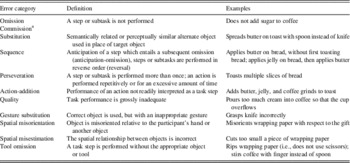
Performance was videotaped for subsequent scoring. The following scores were obtained according to the procedures outlined in the test manual and prior publications (Buxbaum et al., Reference Buxbaum, Schwartz and Montgomery1998; Giovannetti et al., Reference Giovannetti, Libon, Buxbaum and Schwartz2002, Reference Giovannetti, Bettcher, Brennan, Libon, Kessler and Duey2008; Schwartz et al., Reference Schwartz, Montgomery, Buxbaum, Lee, Carew, Coslett and Mayer1998, Reference Schwartz, Buxbaum, Montgomery, Fitzpatrick-DeSalme, Hart, Ferraro and Coslett1999, Reference Schwartz, Buxbaum, Ferraro, Veramonti and Segal2003): Accomplishment Score: Percentage of task steps completed with or without error (range=0–100). NAT Score: Accomplishment Score combined with a sum of key errors that reliably distinguish patient from healthy populations. A score ranging from 0 (Accomplishment Score <50% and ≥0 errors) to 6 (Accomplishment Score=100% and <2 errors) is assigned to each NAT item and summed to equal the NAT Score (range=0–18). According to older adult norms, a NAT Score <14 indicates impairment (Sestito, Schmidt, Gallo, Giovannetti, & Libon, Reference Sestito, Schmidt, Gallo, Giovannetti and Libon2005). Comprehensive Error Score (CES): Total number of errors, including omissions and commissions. Table 1 describes all error categories.
NAT Comprehensive error score categories

Note. Reprinted with permission from Kessler, R.K., Giovannetti, T., & MacMullen, L.R. (2007). Everyday action in schizophrenia: performance patterns and underlying cognitive mechanisms. Neuropsychology, American Psychological Association, 21(4), 439–47.
aCommission errors entail instances when a task step is inaccurately preformed or an extra, off-task step is performed.
Neuropsychological Assessment
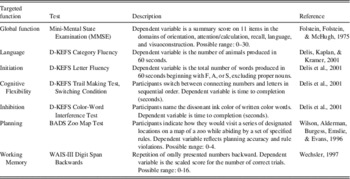
Participants completed neuropsychological tests (described in Table 2) selected for their relation to everyday action errors and sensitivity to executive dysfunction in schizophrenia (Giovannetti et al., Reference Giovannetti, Bettcher, Brennan, Libon, Kessler and Duey2008; Iampietro et al., Reference Iampietro, Giovannetti, Drabick and Kessler2012; Kessler et al., Reference Kessler, Giovannetti and MacMullen2007; Rempfer et al., Reference Rempfer, Hamera, Brown and Cromwell2003; Semkovska et al., Reference Semkovska, Bédard, Godbout, Limoge and Stip2004; Zayat et al., Reference Zayat, Rempfer, Gajewski and Brown2011).
Neuropsychological protocol

Note. BADS=Behavioural Assessment of the Dysexecutive Syndrome; D-KEFS=Delis–Kaplan Executive Function System; WAIS–III=Wechsler Adult Intelligence Scale– Third Edition.
Design and Statistical Analyses
This study used a single-group, cross-sectional, retrospective design with data from two different studies. First, correlations and exploratory PCA were performed to examine relations among NAT error types. Spearman Rank Order Correlations (r s) were performed because most NAT variables were not normally distributed. Alpha for all comparisons was set at .05 (two-tailed). PCA was performed with eigenvalue criterion >1 to determine the number of components and with varimax rotation to simplify interpretation. Second, correlations between NAT component(s) and neuropsychological tests were examined.
Approximately one-third of the sample (n=20) had missing neuropsychological data; the 16 participants in the goal management study did not complete the neuropsychological tests examined here, and four participants in the environmental adaptations study were unable to complete either the Trail Making Test (n=1), Zoo Map Test (n=2), or Digit Span Test (n=1) due to inability to understand task requirements.
RESULTS
Sample Characteristics
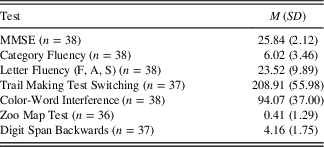
On average, participants were 42 years old (SD=11.3; range=21–60 years) and had completed 12 years of education (SD=2.2; range=7–18 years). Women comprised approximately half the sample (48%; n=26). Average IQ was 77.37 (SD=10.72). Participants recruited for the two studies did not differ in age, gender, education, IQ, or overall NAT errors (all p>.05). Mean MMSE score was 25.8 (SD=2.1; range=20–30), suggesting normal to mildly impaired global cognition. Neuropsychological performance is reported in Table 3.
Mean neuropsychological test scores

Note. MMSE=Mini-Mental State Examination.
NAT Performance
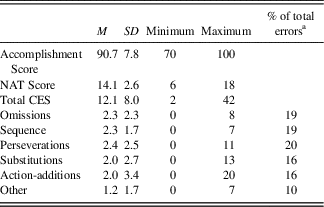
NAT performance is shown in Table 4. Mean NAT score fell within the impaired range relative to published norms, with 53% of the sample demonstrating impaired performance (i.e., >2 SD below norms; Kessler et al., Reference Kessler, Giovannetti and MacMullen2007). As described previously, Accomplishment Scores were high, and the distribution of error types differed from that observed in other clinical populations (Kessler et al., Reference Kessler, Giovannetti and MacMullen2007). Participants made very few quality, gesture substitution, spatial misorientation and misestimation, and tool omission errors. As in prior studies (Giovannetti et al., Reference Giovannetti, Bettcher, Brennan, Libon, Kessler and Duey2008; Kessler et al., Reference Kessler, Giovannetti and MacMullen2007), we combined these errors into a category called “other” but did not include this category in subsequent analyses because of its infrequency and heterogeneity.
Mean naturalistic action test scores and distribution of error types (N=54)

Note. NAT=Naturalistic Action Test; CES=Comprehensive Error Score.
a Proportions calculated from the total sum of errors.
Correlations and PCA of NAT Error Types
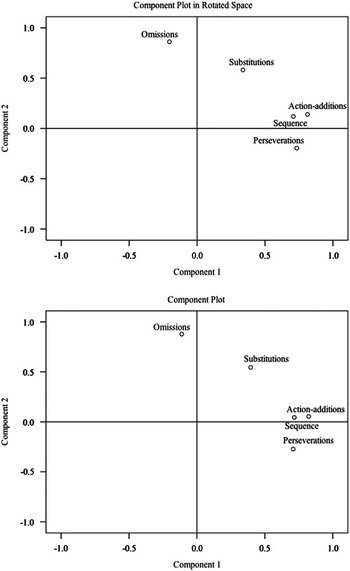
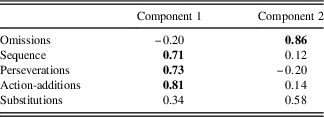
Correlations among NAT error variables revealed a significant association between action-additions and sequence errors, both types of commissions (see Table 5). The appropriateness of PCA was supported by the Kaiser-Meyer-Olkin measure of sampling adequacy (0.58) and Bartlett’s test of Sphericity, χ2(10)=29.69, p <.001. The ratio of cases to variables (10.8:1) was appropriately high. The PCA yielded a two-component solution accounting for 60% of the variance (Table 6). Sequence errors, perseverations, and action-additions loaded on the first component and omissions on the second; substitutions loaded weakly (rotated loadings <.6) on both components, although somewhat more strongly on the second. Substitutions consistently fell between omissions and commissions in component plots (Figure 1). When performed without substitutions, the PCA yielded a two-component solution accounting for 71% of the variance. Sequence errors, perseverations, and additions loaded on the first component (rotated loadings=.80, .59, and .86, respectively) and omissions on the second (rotated loading=.93).
Component loading plots obtained from the rotated (top) and unrotated (bottom) Principal Component Analyses of NAT Error Types. Both plots show perseverations, sequence, and additions (i.e., commissions) were closely clustered and distinct from omissions, with substitutions falling between commissions and omissions.

Spearman rank order correlation coefficients among NAT error types (N=54)

Note. NAT=Naturalistic Action Test.
*p <.05.
Rotated component matrix (N=54)

Note. Boldface indicates values >.60.
A PCA with only participants who had complete neuropsychological data (n=34) yielded similar results, a two-component solution accounting for 63% of the variance. Sequence errors, perseverations, and additions loaded on the first component (rotated loadings=.83, .54, and .80, respectively) and omissions on the second (rotated loading=.89). Substitutions loaded weakly on both components, although somewhat more strongly on the first than on the second (rotated loadings=.51 and .35, respectively).
Finally, because of the skewed distribution of NAT errors, a PCA was performed with log-transformed error variables and yielded similar results. A two-component solution accounting for 55% of the variance resulted. Sequence errors, perseverations, and additions loaded on the first component (rotated loadings=.70, .68, and .70, respectively) and omissions on the second (rotated loading=.80). Substitutions also loaded strongly on the second component (rotated loading=.70).
After considering the results, we reasoned that substitutions should be analyzed separately from omissions and commissions. PCA results were interpreted as suggesting two primary components underlying NAT performance: commissions and omissions. The weak loading of substitutions on both components suggests substitutions may represent an additional component. Furthermore, correlations among these error types showed substitutions were not significantly correlated with either commissions (i.e., sequence, perseverations, and action-additions combined; r s=.09; p=.51) or omissions (r s=.11; p=.41). The correlation between omissions and commissions was also nonsignificant (r s=−.14; p=.31). Thus, in subsequent analyses, sequence, perseveration, and action-addition errors were summed to form a single commission category. Omissions and substitutions were analyzed as separate categories.
Relations among NAT Variables and Neuropsychological Test Scores
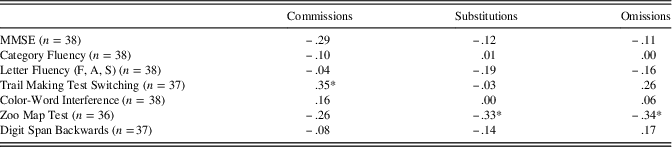
Correlations among neuropsychological measures and NAT omissions, commissions, and substitutions are shown in Table 7. Commissions were associated with poorer performance on the Trail Making Test – Switching Condition (p=.033). Omissions and substitutions were associated with poorer Zoo Map Test performance (p=.044 and p=.048, respectively). After Bonferroni correction for multiple comparisons, no correlations reached the significance threshold.
Spearman rank order correlation coefficients among NAT error types and neuropsychological test scores

Note. NAT=Naturalistic Action Test; MMSE=Mini-Mental State Examination.
*p <.05.
DISCUSSION
The present study investigated the components of everyday action impairment in schizophrenia and their associated neuropsychological functions with the aims of furthering our understanding of functional impairment in this population and determining the generalizability of the omission-commission model, a neuropsychological model of functional impairment developed in dementia (Giovannetti et al., Reference Giovannetti, Bettcher, Brennan, Libon, Kessler and Duey2008).
PCA yielded a two-component solution; perseverations, sequence errors, and action-additions (i.e., commissions) comprised the first, omissions comprised the second, and these components were not correlated with each other. These results are generally consistent with our findings with dementia patients (Giovannetti et al., Reference Giovannetti, Bettcher, Brennan, Libon, Kessler and Duey2008) and support the omission-commission model; namely, omissions and commissions represent two dissociable components of everyday action errors. These findings are inconsistent with the resource theory, which predicts that everyday action errors would be reduced to a single component. The present study is notable in being the first to test the omission-commission model in a population other than dementia. Given the neuropsychological and functional dissimilarities between dementia and schizophrenia, the current findings lend support for the generalizability of the omission-commission model across diverse clinical populations.
One major difference between prior findings in dementia and the present findings is the emergence of substitutions as a separate error type, uncorrelated with either omissions or commissions but with a somewhat stronger loading on the omission component. By comparison, an analogous result was observed for action-additions in dementia. This difference may be attributable to these populations’ distinct neuropsychological profiles and suggests that although the omission-commission model is generally supported across populations, slight differences may emerge in the composition of the commission component, with sequence and perseverative errors consistently co-occurring across populations. This divergence emphasizes the importance of empirically defining action error components in different populations.
The present findings are generally consistent with results from another performance-based measure of everyday action, the Test of Grocery Shopping Skills (TOGSS), in schizophrenia. This task yields separate, uncorrelated scores for accuracy and efficiency (Rempfer et al., Reference Rempfer, Hamera, Brown and Cromwell2003; Zayat et al., Reference Zayat, Rempfer, Gajewski and Brown2011). Although scoring differences between the NAT and the TOGSS prevent direct comparisons, omissions and substitutions would generally be reflected in TOGSS accuracy scores, whereas perseverations, action-additions, and sequence errors would be reflected in efficiency scores. Therefore, prior studies support the notion that substitutions occur independently of other types of commissions and may have more underlying similarities with omissions in individuals with schizophrenia.
By examining the neuropsychological correlates of everyday action components, we identified potential underlying cognitive origins of functional impairments. Commissions were significantly associated with impairments on the Trail Making Test – Switching Condition, a measure of cognitive flexibility, whereas omissions and substitutions were significantly associated with impairments on the Zoo Map Test, a measure of planning. The association between commissions and executive dysfunction, specifically cognitive inflexibility, is consistent with prior findings in schizophrenia (Iampietro et al., Reference Iampietro, Giovannetti, Drabick and Kessler2012; Kessler et al., Reference Kessler, Giovannetti and MacMullen2007; Semkovska et al., Reference Semkovska, Bédard, Godbout, Limoge and Stip2004) and other populations (e.g., Giovannetti et al., Reference Giovannetti, Libon, Buxbaum and Schwartz2002, Reference Giovannetti, Bettcher, Brennan, Libon, Kessler and Duey2008), suggesting the ability to perform everyday tasks in the right sequence and to inhibit incorrect or repetitive actions is consistently related to executive control. The link between omissions and planning deficits is in contrast with earlier studies in populations such as dementia and stroke that have supported global cognition and episodic memory as the primary neuropsychological correlates of omissions (Buxbaum et al., Reference Buxbaum, Schwartz and Montgomery1998; Giovannetti et al., Reference Giovannetti, Libon, Buxbaum and Schwartz2002, Reference Giovannetti, Bettcher, Brennan, Libon, Kessler and Duey2008; Kessler et al., Reference Kessler, Giovannetti and MacMullen2007; Schwartz et al., Reference Schwartz, Montgomery, Buxbaum, Lee, Carew, Coslett and Mayer1998). On the other hand, this finding is consistent with prior evidence linking executive function with omissions in schizophrenia (Rempfer et al., Reference Rempfer, Hamera, Brown and Cromwell2003; Semkovska et al., Reference Semkovska, Bédard, Godbout, Limoge and Stip2004; Zayat et al., Reference Zayat, Rempfer, Gajewski and Brown2011). Furthermore, although global functioning was not significantly associated with any error component, the effect size was larger for commissions (r=−.29) than omissions (r=−.11), suggesting increased statistical power might have yielded a significant association between global functioning and commissions, not omissions. Together with existing literature, results suggest that relations between action errors and neuropsychological functions in schizophrenia differ from those observed in other populations and may reflect a greater contribution of executive function. Alternatively, omissions may be related to episodic memory in schizophrenia as observed previously in other populations, but our limited neuropsychological protocol precluded such a finding.
Another key objective in examining the neuropsychological correlates of action components was to elucidate whether each component is associated with distinct cognitive functions. Although omissions and commissions were associated with different neuropsychological measures, there was insufficient evidence to support a dissociation. First, the Zoo Map Test and the Trail Making Test, which were significantly associated with omissions and commissions, respectively, are both complex executive function measures. Second, several small correlations failed to reach significance, possibly because of limited statistical power. Notably, the Zoo Map Test was associated with commissions (r=−.26; p=.12) and the Trail Making Test with omissions (r=.26; p=.12), and these correlations did not differ meaningfully from those that did reach statistical significance (e.g., Zoo Map Test with omissions, r=−.34, and substitutions, r=−.33; Trail Making Test with commissions, r=.35), suggesting these action components may actually be associated with shared neuropsychological functions. Finally, correction for multiple comparisons suggests a lack of distinct neuropsychological correlates, an interpretation consistent with other studies of schizophrenia (Iampietro et al., Reference Iampietro, Giovannetti, Drabick and Kessler2012; Zayat et al., Reference Zayat, Rempfer, Gajewski and Brown2011). In fact, support for unique neuropsychological correlates of specific action components in schizophrenia has been mixed (Rempfer et al., Reference Rempfer, Hamera, Brown and Cromwell2003; Semkovska et al., Reference Semkovska, Bédard, Godbout, Limoge and Stip2004; Zayat et al., Reference Zayat, Rempfer, Gajewski and Brown2011), with distinct and overlapping neuropsychological correlates reported with roughly equal frequency. The present findings may be interpreted to suggest that neuropsychological measures are not sufficiently sensitive to discriminate the different types of functional impairment in schizophrenia.
Another aim in identifying components of functional impairment in schizophrenia was to inform efficient and optimal assessment and treatment of functional deficits in this population. To our knowledge, this study is the first to use data reduction to identify components of action errors in schizophrenia. Present findings suggest that sequence errors, perseverations, and action-additions appear to share a common underlying process and may, therefore, be most efficiently examined and treated altogether in schizophrenia. Omissions, a subset of commissions, and substitutions, on the other hand, should be assessed separately and targeted with separate intervention strategies in this population. This matching of intervention strategies to specific deficits has been proven most effective for other complex neuropsychological disorders (Riddoch & Humphreys, Reference Riddoch and Humphreys1994; Sohlberg & Mateer, Reference Sohlberg and Mateer2001; Wilson, Reference Wilson1999). Although further research is needed to examine the efficacy of targeted intervention strategies in schizophrenia, evidence from other populations suggests omissions may be reduced by interventions promoting recall and access of task goals (Brennan et al., Reference Brennan, Giovannetti, Libon, Bettcher and Duey2009), commissions by interventions promoting task monitoring (Bickerton et al., Reference Bickerton, Humphreys and Riddoch2006; Giovannetti et al., Reference Giovannetti, Sestito, Libon, Schmidt, Gallo, Gambino and Chrysikou2006, Reference Giovannetti, Bettcher, Libon, Brennan, Sestito and Kessler2007), and substitutions by removing non-essential objects that are semantically related to task objects (Giovannetti et al., Reference Giovannetti, Bettcher, Brennan, Libon, Wambach and Seter2010).
Another intervention approach may involve cognitive remediation, which has shown significant and lasting effects on cognition and functioning in this population (McGurk et al., 2007). Associations between action errors and executive dysfunction in the present sample suggest cognitive remediation of executive function may be an effective broad strategy for schizophrenia. However, the lack of discrete neuropsychological correlates of action errors in this sample suggests that intervention strategies based solely on neuropsychological deficits may not target the impairment of interest as effectively as intervention strategies matched to the specific profile of functional deficits. Detailed, performance-based measures of everyday action, with attention to omissive, commissive, and substitution profiles, may be more useful in identifying effective interventions that reduce functional impairment, caregiver burden, and public health costs.
We acknowledge several limitations of the present study. First, analyses were retrospective and used data from two different prior studies, which may increase the possibility of spurious results. Still, the two subsamples were comparable in demographic, cognitive, and functional characteristics, and PCA results were analogous when excluding participants from the smaller study. The study’s retrospective nature limited the neuropsychological protocol, which was originally selected to assess executive deficits central to schizophrenia; episodic and semantic memory, which are relevant to the omission-commission model, were not assessed. The protocol may have restricted our ability to determine whether components of everyday action in schizophrenia have unique neuropsychological correlates. Nonetheless, we did include measures of global cognition and executive functioning, the neuropsychological functions most strongly associated with omission and commission components in dementia. Still, future studies should include a comprehensive protocol to better examine neuropsychological correlates of error components.
Additionally, because of differing neuropsychological protocols of the parent studies, a third of participants were missing neuropsychological data, which further limited statistical power. Because these analyses were sufficiently powered to detect only moderate-to-large effects, and only large effects when controlling for multiple comparisons, they should be considered preliminary. In addition, although our data met the basic assumptions required for a PCA and maintained an appropriately high ratio of cases to variables, caution is nonetheless advisable when interpreting PCA results with n < 100. Thus, future studies with larger samples and prospective designs should look to replicate these preliminary findings. Finally, participants were inpatients with few real world functional demands; this precluded the possibility of examining whether error components have distinct real world functional correlates and may limit the generalizability of the present results to community-dwelling populations.
Despite these limitations, a major strength of the present study is the use of the NAT, a well-researched, validated measure allowing for detailed analysis of errors in everyday action. In comparison with self- or caregiver-report questionnaires that may be prone to bias, the performance-based NAT provides a more objective, standardized measure of everyday action. In comparison with questionnaires and broader performance-based measures that provide only a gross assessment of functioning, the NAT assesses a wide range of error types that may be reduced to empirically-defined components, allowing for a more thorough understanding of the nature of everyday action impairment.
In summary, our results support a model for everyday action impairment in schizophrenia comparable to that observed in dementia, in which omissions and commissions reflect distinct components of everyday action errors. Thus, the omission-commission model may apply to everyday action impairment across diverse clinical populations, although the specific error types comprising the commission component and the neuropsychological correlates of these components may differ across populations. These findings have important implications in schizophrenia and beyond for our understanding of the nature and causes of functional impairment, the meaningful and efficient assessment of everyday action, and the development of effective interventions, namely the use of separate intervention strategies for the treatment of omissive and commissive errors. Future research should seek to assess the generalizability of the omission-commission model in other populations, to validate this model in other samples through confirmatory factor analysis, and to examine the effectiveness of interventions informed by this model.
ACKNOWLEDGMENTS
This research was supported by internal funds from Temple University and a Research and Study Leave awarded to Tania Giovannetti. The authors have declared that no conflicts of interest exist. A portion of this article was presented in February 2007 at the annual meeting of the International Neuropsychological Society in Portland, OR, United States. We thank Theresa Atwood, Bernadette Hayburn, Yong-Kook Kim, Myles Ladenheim, Julie Rosner, Laura MacMullen, Polina Zilbering, and the staffs of Temple University Episcopal Hospital and Girard Medical Center for their help with participant recruitment and data collection.