Introduction
The transmission of sexually transmitted infections (STIs) is a serious health problem in many African countries (Maina et al., Reference Maina, Kimani and Anzala2016; Mudau et al., Reference Mudau, Peters, De Vos, Olivier, Davey and Mkwanazi2018). The Human Immunodeficiency Virus (HIV) is one such STI, and a global HIV pandemic has been reported in almost all the countries in the world, including Nigeria. The first two HIV cases in Nigeria were diagnosed and reported in 1985 and 1986, respectively, in Lagos, one of which was a young female sex worker aged 13 years from a West African country (Nasidi & Harry, Reference Nasidi, Harry and Adeyi2006). Globally, Nigeria is among the countries with the highest HIV prevalence rates (Ibrahim et al., Reference Ibrahim, Ipadeola, Adebayo and Fatusi2013; UN, 2013), and most people affected are aged 15–24 years, with only a small proportion of sexually active individuals using protection (Obidoa et al., Reference Obidoa, M’Lan and Schensul2012; Federal Ministry of Health, 2013).
Several interventions have led to a reduction in the incidence of HIV in clinical trials, including early treatment of HIV infection (Donnell et al., Reference Donnell, Baeten, Kiarie, Thomas, Stevens and Cohen2010; Cohen et al., Reference Cohen, Chen and McCauley2011). This includes recognizing the importance of voluntary counselling and testing (VCT) for both HIV prevention and treatment, and the Joint United Nations Programme on HIV/AIDS (UNAIDS) proposed the target of diagnosing 90% of HIV-positive individuals by 2020 (UNAIDS, 2014). Achieving this is possible because the prevalence of HIV among young people in Nigeria could be attributed in part to factors associated with the lack of uptake of voluntary HIV VCT (Oladunni & Osezua, Reference Oladunni and Osezua2013).
HIV counselling and testing is an important entry point for most HIV care and prevention interventions (Sam-Agudu et al., Reference Sam-Agudu, Folayan and Ezeanolue2016). The primary aim of HIV VCT is to help people, especially those between the ages of 15 and 24 years, to change their sexual behaviours so as to avoid transmitting HIV to sexual partners, if positive (Kiene et al., Reference Kiene, Bateganya, Wanyenze, Lule, Nantaba and Stein2010; Suthar et al., Reference Suthar, Ford, Bachanas, Wong and Rajan2013; Johnson et al., Reference Johnson, Rehle, Jooste and Bekker2015). It also helps to reduce the spread of HIV by making people aware of their HIV status and promoting safer sex behaviours (Delavande & Kohler, Reference Delavande and Kohler2012). As a prevention strategy, voluntary HIV counselling and testing services are widely recognized as having an effective role to play in the fight against the HIV pandemic, by providing contact centres where information, guidance and referral to medical treatment can be sought (Hutchinson & Mahlalela, Reference Hutchinson and Mahlalela2006). However, HIV VCT has several limitations that contribute significantly to the challenges of implementing this in sub-Saharan Africa, including Nigeria (Asefa & Mitike, Reference Asefa and Mitike2014; Osborn & Obermeyer, Reference Osborn and Obermeyer2016). Studies have shown that family-based HIV testing and counselling facilitates the uptake of HIV testing and increases the identification of HIV-positive individuals before they become sick, enabling early linkage to care (van Rooyen et al., Reference van Rooyen, Essack, Rochat, Wight, Knight, Bland and Celum2016; Moshoeu et al., Reference Moshoeu, Desmond, Nonjabulo and Tivani2019). During HIV VCT, individuals are provided with sex education and promotion of behaviour change, which will result in the reduction of risky sexual behaviours (Johnston et al., Reference Johnston, O’Bra, Chopra, Mathews, Townsend, Sabin, Tomlinson and Kendall2010; Ostermann et al., Reference Ostermann, Reddy, Shorter, Muiruri, Mtalo and Itemba2011).
Individual behavioural change and interventions, especially sexual behaviours, appear to be the most effective means of preventing further spread of HIV in developing countries. HIV prevalence and sexual behaviour tend to differ between individuals with different socioeconomic backgrounds (Hargreaves & Howe, Reference Hargreaves and Howe2010). Previous studies have shown that those who learn they are HIV-positive take steps to prevent infecting others (Gersovitz, Reference Gersovitz2010; Delavande et al., Reference Delavande, Gine and McKenzie2012). A study in Kenya revealed that providing teenage girls with their relative risk of HIV infection leads to a decrease in them having unprotected sex with older men (Dupas, Reference Dupas2010). However, studies have shown that individuals in relationships might perceive themselves to be at less risk for HIV and other STIs due to their partner’s status, but also underestimate their partner’s risk (Witte et al., Reference Witte, El-Bassel, Gilbert, Wu and Chang2010; Nemoto et al., Reference Nemoto, Bodeker, Iwamoto and Sakata2014). Voluntary HIV counselling and testing is useful to identify new HIV-positive young people promptly and direct them to treatment, management and support programmes (Emeka-Nwabunnia et al., Reference Emeka-Nwabunnia, Ibeh and Ogbulie2014). Hence, youths with low self-perception have been shown not to be inclined to reduce their risky sexual behaviours or to seek HIV counselling and testing (Oshi et al., Reference Oshi, Ezugwu, Oshi, Dimkpa, Korie and Okperi2007; May & Parrott, Reference May and Parrott2015; Sewell et al., Reference Sewell, Miltz, Lampe, Cambiano, Speakman and Phillips2017).
For adolescents, HIV prevention programmes have largely focused on the ABC strategy (Abstinence, Being faithful and Condom use) and there is a growing consensus that partner number reduction for young people is particularly crucial, particularly the decrease in number of concurrent partnerships, due to the higher risk of exposure to acute HIV infection (Green et al., Reference Green, Daniel, Halperin and Hogle2006; Mah & Halperin, Reference Mah and Halperin2010). In addition, adolescents’ perceptions of their own HIV risk can help them to decide to adopt protective behaviours, such as delaying sexual activity, using condoms or seeking VCT (Kibombo et al., Reference Kibombo, Neema and Ahmed2007). At the societal level, religion exerts its social force on behaviour by providing a moral framework for sexual socialization (Odimegwu, Reference Odimegwu2005; Trinitapoli & Regnerus, Reference Trinitapoli and Regnerus2007; Anarfi & Owusu, Reference Anarfi and Owusu2011). Also, young people’s household wealth translates into autonomy, which enables them to negotiate condom use with their partners (Odimegwu et al., Reference Odimegwu, Somefun and Chisumpa2019). Young people residing in rural areas may be exposed to sexual beliefs that are socially constructed and subject to social change, which may lead them to conceal their sexual relationships (Mshana et al., Reference Mshana, Wamoyi and Plummer2002).
Despite large investments in health facility-based HIV VCT, uptake of HIV testing and counselling remains relatively low in sub-Saharan Africa (Kalichman & Simbayi, Reference Kalichman and Simbayi2003; Nwachukwu & Odimegwu, Reference Nwachukwu and Odimegwu2011; Mall et al., Reference Mall, Middelkoop, Mark, Wood and Bekker2013). This could be due to barriers to the utilization of HIV VCT services such as poor access to services, stigma and lack of confidentiality of services (Bwambale et al., Reference Bwambale, Ssali, Byaruhanga, Kalyango and Karamagi2008; Odimegwu et al., Reference Odimegwu, Adedini and Ononokpono2013), socio-demographic factors (Leta et al., Reference Leta, Sandoy and Fylkesnes2012), nearness of a health facility, HIV-related awareness and knowledge, perception of being at risk of HIV infection and perceived benefits of HIV VCT (Young et al., Reference Young, Hlavka, Modiba, Gray, Van Rooyen and Richter2010; Mall et al., Reference Mall, Middelkoop, Mark, Wood and Bekker2013). Also, the perception that medical care or advice is not required in the absence of symptoms could discourage individuals from utilizing HIV VCT (Nachega et al., Reference Nachega, Uthman, del Rio, Mugavero, Rees and Mills2014). In rural Uganda, for instance, people who thought HIV testing was not normative, despite it being so, tended not to have sought HIV testing and counselling (Perkins et al., Reference Perkins, Nyakato, Kakuhikire, Mbabazi, Perkins and Tsai2018).
Consequently, there is mixed evidence about the efficacy of VCT in promoting safer sexual practices, including increased condom use and reduced number of sexual partners (Kennedy et al., Reference Kennedy, Medley, Sweat and O’Reilly2010; Fonner et al., Reference Fonner, Denison, Kennedy, O’Reilly and Sweat2012; Lacroix et al., Reference Lacroix, Pellowski, Lennon and Johnson2013). These practices have been shown to be effective, especially when the HIV test results are surprises (Gong, Reference Gong2015; Beegle et al., Reference Beegle, Poulin and Shapira2015). A number of previous observational studies have indicated moderate behavioural changes following HIV VCT (Voluntary HIV-1 Counselling and Testing Efficacy Study Group, 2000; Mola et al., Reference Mola, Mercer, Asghar, Gimbel-Sherr, GimbelSherr and Micek2006; Arthur et al., Reference Arthur, Nduba, Forsythe, Mutemi, Odhiambo and Gilks2007). Despite the provision of VCT centres in most countries with generalized or high-burden HIV epidemics, including Nigeria, the comparison and measurement of the impact of voluntary HIV counselling and testing on behavioural change among youths have been quite limited. Focusing on the influence of HIV VCT on behavioural changes among this group of people would provide them with better chances of reducing their risky sexual behaviours and vulnerabilities to HIV. In addition, understanding this relationship is critical to intensify efforts in the development of further HIV prevention strategies, because poor VCT utilization and lack of subsequent lifestyle modification among youths often lead to a vicious circle of high incidence and prevalence of HIV, culminating in high morbidity and mortality, as well as poor economic resources. The information from this study will assist policymakers in effectively planning, designing and improving the quality of VCT services for young adults. In an attempt to explore the influence of HIV VCT on behavioural changes among youths in Nigeria, this paper examines how effective voluntary HIV counselling and testing is in stimulating behavioural changes among never-married youths who have experienced VCT. The study further investigates how much of the reported behavioural change is attributable to the utilization of VCT.
Methods
Data source
The study utilized secondary data from the most recent Nigeria Demographic and Health Survey (NDHS) dataset of 2013 on the basis of availability. The 2013 NDHS is the fifth nationally representative survey in Nigeria, designed to collect data and provide information on various health issues, including sexual behaviour, condom use, fidelity and HIV/AIDS. The survey was jointly conducted by the National Statistical Organizations and Macro International, USA. The NDHS 2013 is a nationally representative sample of urban and rural areas with a probabilistic two-stage sampling design. The details of the research design and methodology used in the survey are well described in the full report. For the purpose of this study, the analysis was based on data from never-married youths, defined in line with the World Health Organization (WHO) as those aged 15–24 years (WHO, 2010), and the term is used interchangeably with ‘adolescents’ and ‘young people’ (Prata et al., Reference Prata, Weidert and Sreenivas2013). For the purposes of this study, data were taken from a subsample of 8046 females and 6031 males aged 15–24 giving a total sample of 14,077 never-married youths who were interviewed in the 2013 NDHS.
Outcome variables
The sexual behaviour changes among the sample youths included ‘sexual abstinence’, ‘being faithful’ and ‘condom use’. Sexual abstinence was derived from the question on ‘timing of last sexual intercourse’. Being faithful was derived from the question ‘How many sexual partners, excluding spouse, do you have?’ Finally, condom use was deduced from the question ‘Did you use a condom during the last sex with most recent partner?’ Those who reported having used a condom at last sexual intercourse were coded ‘1’ and ‘0’ otherwise. A 12-month reference period was used to capture the most recent behaviours and to minimize recall errors (Akwara et al., Reference Akwara, Madise and Hinde2003). The study focus was on number of sexual partners and condom use in the last 12 months preceding the survey because having a sexual partner and using a condom constitute the key mechanisms through which never-married youths can be protected from STIs including HIV.
Explanatory variables
The key explanatory variable was HIV VCT. Based on existing studies, some significant demographic and socioeconomic predictors of sexual behaviour change were identified: age, educational attainment, religious affiliation, employment status, place of residence and wealth status (a proxy for household socioeconomic status captured through a wealth index based on household possessions and amenities). Age may influence sexual behaviour as young people are at greater risk of STIs because they often engage in unprotected sexual intercourse (Zembe et al., Reference Zembe, Townsend, Thorson and Ekström2012). Religiosity was included because it may discourage risky behaviour, and therefore serve as a barrier to HIV infection. Socioeconomic status was considered because various associations between socioeconomic status and youth sexual behaviour have been described (Berhan & Berhan, Reference Berhan and Berhan2015; Edin et al., Reference Edin, Nilsson, Ivarsson, Kinsman, Norris and Kahn2016).
To make the analyses and interpretations simpler and more meaningful, some variables were re-grouped from their original dataset categories. Educational attainment, for instance, has been shown to be associated with young people’s sexual behaviours. Educated youth are more likely to be knowledgeable about reproductive health services, which may translate into positive health behaviours. Educational level was coded as: no education, primary, secondary or tertiary. Wealth status was re-grouped into ‘lowest’, ‘middle’ and ‘highest’ wealth quintiles; work status was measured as a dichotomous variable coded as ‘not working’ and ‘working’. The association between work status and protective behaviours may be difficult to predict for two reasons. Arguably, being employed can promote protective behaviour by making it possible for a man or a woman to develop life aspirations that make it difficult to have multiple sexual partners. On the other hand, being employed may also increase the inclination to engage in risky behaviour by increasing exposure to opportunities that can be used to address occasional emotional and/or economic needs. Religion was classified as ‘Catholic/other Christian’ or ‘Other’, and region was re-grouped into North (North East, North Central and North West) and South (South East, South South and South West).
Statistical analysis
Three levels of analysis (univariate, bivariate and multivariate) were carried out including gender disaggregation to explore the differences in the sample size between female and male youths in Nigeria. At the univariate level, the baseline demographic and socioeconomic characteristics of participants in general and a fraction of those who sought HIV VCT by gender were described. Bivariate analysis was done to examine the independent effect of each of the explanatory variables for significant association with behavioural changes. Finally, analysis at the multivariate level was carried out to model the combined effects of the independent and outcome variables. Multivariate logistic regression was used to analyse the role of HIV VCT and other explanatory variables in sexual behaviour change. Separate models were fitted for the three types of behavioural change (sexual abstinence, being faithful and condom use). Thus the probabilities of adopting each behavioural change were estimated as a function of selected explanatory variables because the outcome variables were binary.
To eliminate the effect of potential confounding factors, stepwise regression modelling was employed. Possible associations between each of the explanatory variables and the outcome variable were assessed by observing the p-values. Only explanatory variables that indicated possible associations (p<0.05) were subjected to further analysis. The results are presented as Odds Ratios (ORs) with 95% confidence intervals (CIs). A variable with an OR greater than 1.00 implies that the variable increases the likelihood of the outcome variable (sexual behaviour change), while the opposite is true when the OR is less than 1.00. All analyses were conducted using Stata version 14 for Windows. The Svy command in Stata was used to adjust for the complex survey design of the DHS data.
Results
Profile of the study population
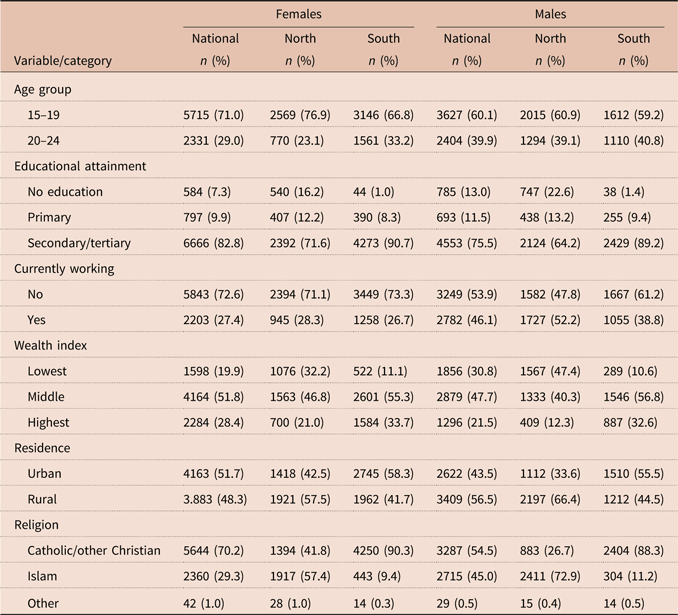
The descriptive statistics of the study youths by gender are shown in Table 1. A total of 14,077 youths (8046 females and 6031 males) aged 15–4 were included in the analysis; 57.2% were female and 42.8% male. A large proportion of the sample youths were aged 15–19 years across both regions. More females (82.8%) than males (75.5%) had secondary education, with similar variation by region. Over two-thirds of the female youths were not working compared with 53.9% of their male counterparts. A little over half of the females (51.8%) and 47.7% of the males belonged to the middle household wealth group, with huge variation by region. Just over half (51.7%) of females were urban dwellers, whereas 56.5% of males lived in rural areas. The largest proportion of youths in the South resided in urban areas (females 58.3%, males 55.5%), while in the North the largest proportion were rural dwellers (females 57.5%, males 66.4%). In general, large proportions of the respondents were Christians (females 70.2%, males 54.5%), with a higher percentage of Muslims in the North region, and Christians dominating in the South.
Description of the study population by region (N=14,077)

HIV VCT and sexual behaviour change by region
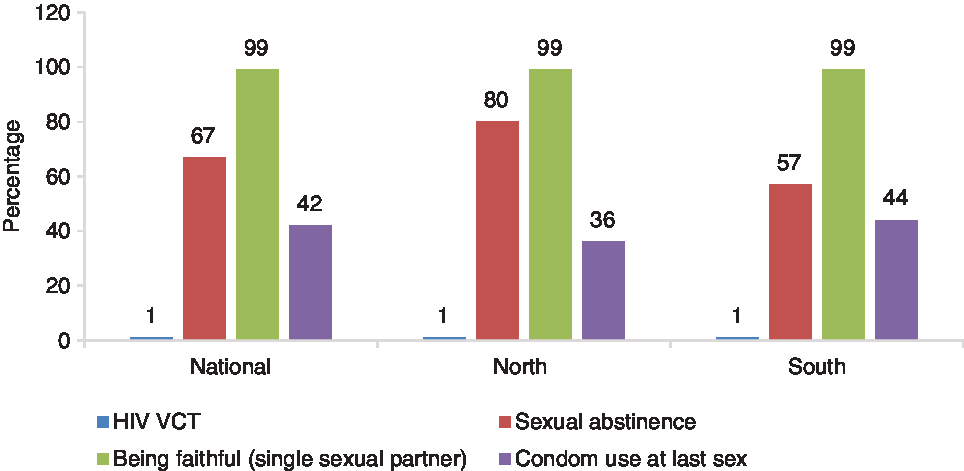
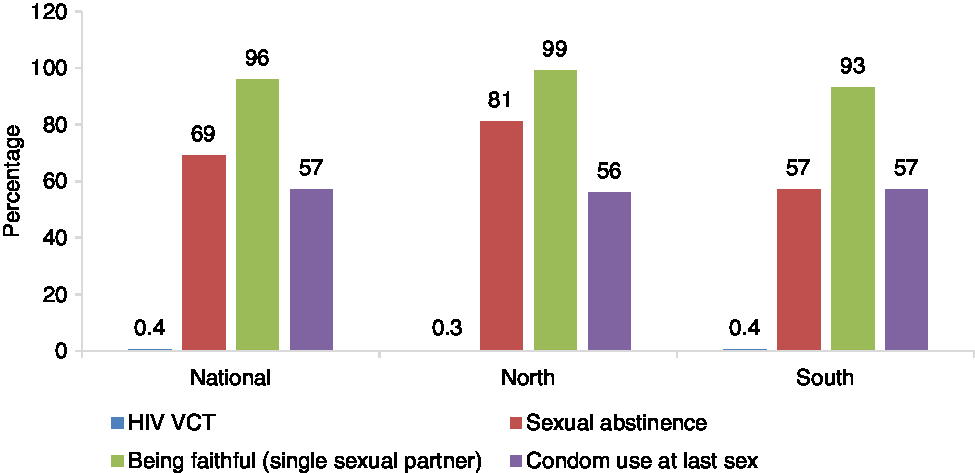
The proportions of female and male youths who had voluntary HIV VCT were low, in both the North and South regions (Fig. 1 and Fig. 2). The level of female youths’ sexual abstinence (primary abstinence) was 67% at the national level, ranging from 80% in the North region to 57% in the South region (Fig. 1). For males, sexual abstinence (primary abstinence) was 69% at the national level, and 81% and 57% in the North and South, respectively (Fig. 2). The incidence of ‘single sexual partner’ was 99% among females, with a similar result being observed across the regions, while that of males was 96% at the national level, but varying by region. At the national level, female youths’ rate of condom use at last sex was 42%, but this was higher in the South (44%) compared with the North (36%) (Fig. 1). The result was 57% for males at the national level, but slightly higher in the South (57%) than in the North (56%) (Fig. 2).
HIV VCT and sexual behaviour changes of never-married females aged 15–24 by region.

HIV VCT and sexual behaviour changes of never-married males aged 15–24 by region.

Bivariate analysis
Sexual abstinence
The unadjusted association between selected characteristics and sexual abstinence as assessed by bivariate analysis is presented in Table 2. HIV VCT was found to be significantly associated with sexual abstinence for both females and males. For instance, having HIV VCT was associated with decreased sexual abstinence for all youths. Age was significantly associated with sexual abstinence for both females and males. Being older (20–24 years) reduced the odds of practising primary sexual abstinence compared with being younger (aged 15–19 years). Education and working status were significantly associated with sexual abstinence for both females and males. For instance, youths who had primary and post-primary education, as well as being employed, reduced the odds of sexual abstinence for both genders compared with the reference categories. Similar results were found for both females and males in the middle and highest wealth quintiles. Rural place of residence significantly increased the odds of sexual abstinence among males compared with urban residence. Religion was also significantly associated sexual abstinence. In general, Muslim female youths and those in the ‘other’ religious category (traditionalists and others) had higher odds of sexual abstinence compared with their Christian counterparts. For males, belonging to Islam was positively associated with sexual abstinence. Living in the South region was found not to be a protective factor for sexual abstinence for both females and males.
Unadjusted bivariate analysis of sexual behaviour changes and explanatory variables among never-married youths aged 15–24 by gender

*p<0.05; **p<0.01; ***p<0.001; Ref., reference category.
Being faithful (single sexual partnership)
Table 2 also presents the unadjusted results of the associations between selected characteristics and ‘single sexual partner’ status. HIV VCT was significantly associated with single sexual partnership for females. Female youths who sought HIV VCT had lower odds of having a single sexual partner than those who did not seek HIV VCT. Also, age was significantly associated with single sexual partnership for both genders. Older female and male youths aged 20–24 had lower odds of having a single sexual partner compared with their counterparts aged 15–19. Education had a significant association with single sexual partnership. Primary education reduced the odds of having single sexual partner among males, with a similar result being observed for both female and male youths who had secondary and tertiary education relative to those in the reference category. Male youths who were working had significantly lower odds of having a single sexual partner than those who were not working. Belonging to the middle wealth quintile for males significantly reduced the odds of having a single sexual partner compared with being in the lowest quintile. Also, being in the highest wealth households was significantly not a protective factor for both female and male youths. Though not significant, residing in a rural area was associated with higher odds of having a single sexual partner for both female and male youths compared with living in urban areas. In general, Muslim female youths and those in the ‘other’ religious category (traditionalists and others) had higher odds of sexual abstinence compared with their Christian counterparts. With respect to region, coming from the South significantly reduced the odds having a single sexual partner for both female and male youths compared those living in the North.
Condom use at last sex
Seeking voluntary HIV VCT significantly increased the odds of using a condom at last sex for female youths (Table 2). Age was significantly associated with condom use at last sex. Older female and male youths were more likely to use a condom at last sex than those aged 15–19 years. Also, having primary and secondary/tertiary education increased the odds of using a condom at last sex for both females and males compared with having no education. The odds were higher for female youths compared with their male counterparts. Both female and male youths who were working had lower odds of using a condom at last sex than those who were not working, but this was not significant. Females and males in the middle and highest wealth quintiles had higher odds of using a condom at last sex than those in the lowest quintile. Rural place of residence was associated with lower odds of using a condom at last sex than urban residence. Although not significant, female Muslims had higher odds of condom use at last sex, while their male counterparts had lower odds relative to Christians in the reference category. The odds of using a condom at last sex increased for both female and male youths living in the South region compared with the North.
Multivariate analysis
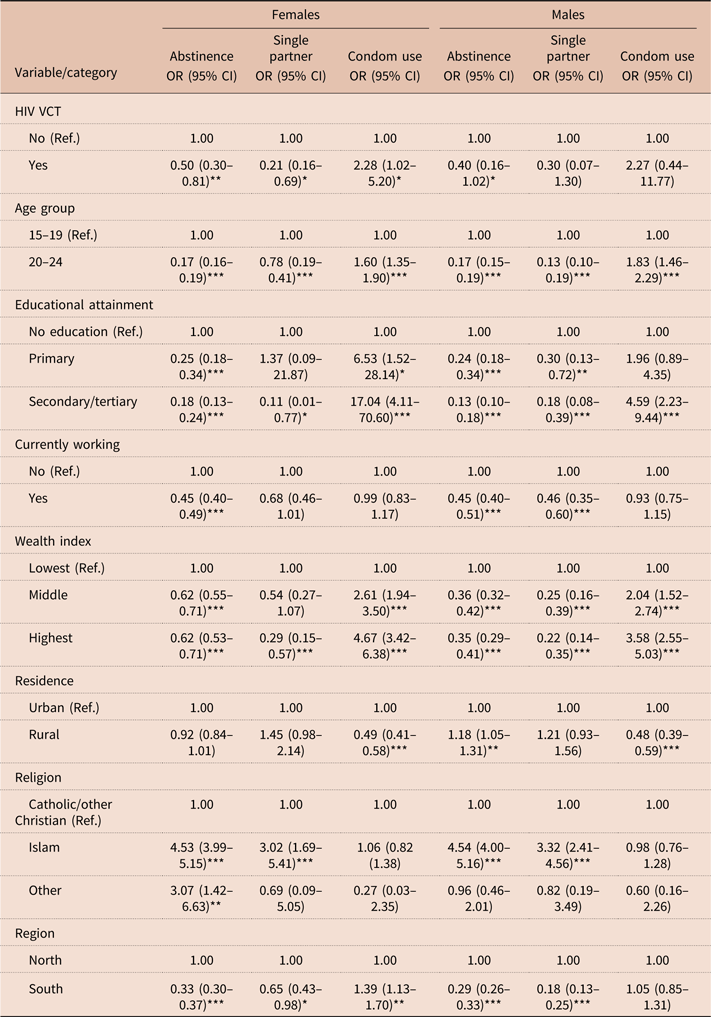
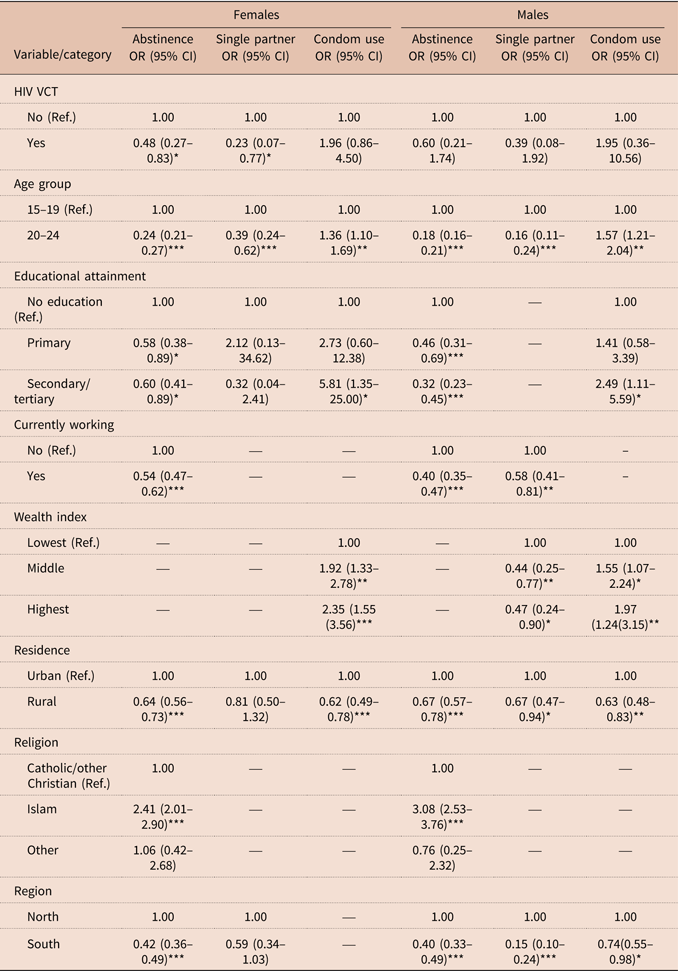
The adjusted associations between selected explanatory variables and youth sexual behaviour changes (sexual abstinence, single sexual partnership and condom use at last sex) using multivariate analysis are presented in Table 3.
Adjusted multivariate analysis of sexual behaviour changes and explanatory variables among never-married youths aged 15–24 by gender

*p<0.05; **p<0.01; ***p<0.001; Ref., reference category.
Sexual abstinence
Seeking voluntary HIV counselling and testing was not found to be a significant protective factor for sexual abstinence for females (OR: 0.48, CI: 0.27–0.83). Older females and males aged 20–24 had lower odds of sexual abstinence compared with their counterparts aged 15–19. Having formal education was not a protective factor for sexual abstinence for either females or males. For instance, for females (OR: 0.60, CI: 0.41–0.89) and males (OR: 0.32; CI: 0.23–0.45), secondary and tertiary education reduced the odds of sexual abstinence compared with having no education. Similarly, being employed reduced the odds of sexual abstinence for both male (OR: 0.54; CI: 0.47-0.62) and female youths (OR: 0.40; CI: 0.35–0.47) compared with being unemployed. Residing in a rural area reduced the odds of sexual abstinence for females (OR: 0.64; CI: 0.56–0.73) and males (OR: 0.67; CI: 0.57–0.78) compared with residing in an urban area. Coming from a Muslim background was a protective factor for sexual abstinence for both females (OR: 2.41, CI: 0.42–2.68) and males (OR: 3.08, CI: 2.53–3.76). Similar results were seen for females and males living in the South.
Being faithful (single sexual partnership)
Seeking HIV VCT significantly reduced the odds of having a single sexual partner for females (OR: 0.23, CI: 0.07–0.77) (Table 3). Older female (OR: 0.39, CI: 0.24–0.62) and male youths (OR: 0.16, CI: 0.11–0.24) aged 20–24 had lower odds of having a single sexual partner compared with their counterparts aged 15–19 (reference category). Though not significant, females with primary education (OR: 2.12, CI: 0.13–34.62) had increased odds of having a single sexual partner, relative to those with secondary education (OR: 0.32, CI: 0.04–2.41). Males who were working had reduced odds of having a single sexual partner (OR: 0.58, CI: 0.41–0.81) compared with being unemployed. Similarly, the likelihood of having a single sexual partner reduced for males residing in the middle (OR: 0.44, CI: 0.25–0.77) and highest wealth quintile households (OR: 0.47, CI: 0.24–0.90) compared with those in the lowest quintile. Also, males living in rural areas had lower odds of having a single sexual partner relative to those in urban areas (OR: 0.67, CI: 0.47–0.94). A similar result was observed for females, but this was not significant. Region of residence was found to be significantly associated with single sexual partnership for male youths. For instance, the odds of having a single sexual partner was lower for males in the South (OR: 0.15, CI: 0.10–0.24), compared with their counterparts in the North.
Condom use at last sex
Seeking HIV VCT increased the odds of condom use at last sex for females (OR: 1.96, CI: 0.86–4.50) and males (OR: 1.95, CI: 0.36–10.56) compared with those who did not seek HIV VCT. Similarly, the odds of condom use at last sex increased for both older females (OR: 1.36, CI: 1.10–1.69) and males (OR: 1.57, CI: 1.21–2.04) relative to their counterparts aged 15–19. Higher education was a protective factor for condom use at last sex for both females and males. Females (OR: 5.81, CI: 1.35–25.00) and males (OR: 2.49, CI: 1.11–5.59) with secondary or tertiary education had increased odds of condom use at last sex compared with those with no education. Similar results were seen for female and male youths in middle and highest wealth quintile households. For instance, females (OR: 2.35, CI: 1.55–3.56) and males (OR: 1.97, CI: 1.24–3.15) in the highest wealth quintile households had increased odds of condom use at last sex compared with their counterparts in the lowest wealth category. Both female (OR: 0.62, CI: 0.49–0.78) and male (OR: 0.63, CI: 0.48–0.83) youths residing in rural areas had lower odds of condom use at last sex in comparison with their urban counterparts. Coming from the South region reduced the odds of condom use at last sex for males compared with coming from the North (OR: 0.74, CI: 0.55–0.98).
Discussion
The objective of this paper was to examine the influence of HIV voluntary counselling and testing on sexual behaviour changes, i.e. sexual abstinence, single sexual partnership and condom use at last sex, among never-married female and male youths in Nigeria. The analysis of nationally representative survey data found a low national and regional uptake of voluntary HIV counselling and testing for both females and males. This is in agreement with the findings of previous studies on uptake of HIV VCT (Kalichman & Simbayi, Reference Kalichman and Simbayi2003; Nwachukwu & Odimegwu, Reference Nwachukwu and Odimegwu2011; Mall et al., Reference Mall, Middelkoop, Mark, Wood and Bekker2013), and could be the result of a lack of carefully planned and long-term approaches and VCT-dedicated centres in the country at the community level. It is pertinent to note that the 2013 NDHS did not report behavioural changes following VCT among never-married female and male youths. Despite the provision of VCT in Nigeria, with its generalized and high burden of HIV, the comparison and measurement of the impact of VCT on behavioural changes among female and male youths has been limited. Therefore, the basis for comparing the present findings and previous studies in Nigeria is lacking.
In line with the observations of Teva et al. (Reference Teva, Bermúdez, Ramiro and Ramiro-Sánchez2013) and Liu et al. (Reference Liu, Hariri, Bradley, Gottlieb, Leichliter and Markowitz2015), the present study found that males tend to have a greater number of sexual partners. There was some regional variation in sexual behaviour changes for both female and male youths in the country. These results have some policy implications. The regional variation in behavioural changes underlines the influence of environmental factors in shaping behaviour and its consequences for sexual health. Young people will naturally reflect the communities in which they live, and their behaviours and practices will therefore be diverse, as is that of adults. Youths with low self-perception are less inclined to reduce their risky sexual behaviours or to seek HIV counselling and testing (Oshi et al., Reference Oshi, Ezugwu, Oshi, Dimkpa, Korie and Okperi2007; May & Parrott, Reference May and Parrott2015; Sewell et al., Reference Sewell, Miltz, Lampe, Cambiano, Speakman and Phillips2017). A plausible explanation for the regional differences in sexual abstinence and condom use at last sex is the difference in social norms regarding youths’ sexual behaviour. For instance, cultural factors, such as postponement of marriage in the South region, could have grave implications for risky sexual behaviour among youths in the region. Another influence could be changes in cultural norms and values resulting from globalization. As a result, the interplay between socioeconomic status and behavioural change, which brings with it changes among young people, can be properly understood.
The present finding that voluntary HIV counselling and testing was a protective factor for condom use at last sex for female youths fits with the results of a study by Dupas (Reference Dupas2010), which reported that informing teenage girls of their relative risk of HIV infection leads to a decrease in unprotected sex with older men. Other studies have also shown that VCT positively influences sexual behaviour, including increased condom use (Fonner et al., Reference Fonner, Denison, Kennedy, O’Reilly and Sweat2012; Kennedy et al., Reference Kennedy, Medley, Sweat and O’Reilly2010; Lacroix et al., Reference Lacroix, Pellowski, Lennon and Johnson2013). This result was expected, as condom use is a key intervention for HIV prevention. The negative association between female and male youths’ voluntary HIV counselling and testing, sexual abstinence and single partnership may be a result of their limited knowledge about healthy sexual practices due to a lack of careful planning and long-term approaches to HIV VCT.
At the individual level, after controlling for individual and family characteristics, becoming older was found not to be a protective factor for practising sexual abstinence and having a single sexual partner for both female and male youths. This could be due to the fact that older youths tend to have better knowledge and experience, which might influence their sexual behaviour (Khan, Reference Khan2002). Also, the fact that increased education was associated with secondary sexual abstinence, as well as condom use at last sex for females and males, could be a result of the role education plays in societal transformation and the provision of information about healthy sexual behaviour. This is mostly achieved through the sexual education young people receive from schools, friends and social media. Also, education provides youths with sexuality information, which gives them more liberal attitudes towards sexual behaviour and the ability to make decisions that may be misguided. The rate at which female and male youths are exposed through education, even across the regions, could influence their sexual behaviour (Johnston et al., Reference Johnston, O’Bra, Chopra, Mathews, Townsend, Sabin, Tomlinson and Kendall2010; Ostermann et al., Reference Ostermann, Reddy, Shorter, Muiruri, Mtalo and Itemba2011).
In a similar vein, at the family and societal level, the fact that employed female and male youths tend not to practise primary sexual abstinence, as well as male youths tending not to have a single sexual partner, could be due to them being more financially secure. Money predisposes youths to engaging in risky sexual behaviour, especially when they feel that the situation can be handled. Also, the positive association between household wealth and condom use at last sex for both females and males suggests that household wealth translates into autonomy, which enables youths to negotiate condom use with their partners (Odimegwu et al., Reference Odimegwu, Somefun and Chisumpa2019). The fact that residing in a rural area reduces the odds of sexual abstinence, having a single sexual partner and condom use at last sex for both female and male youths, as confirmed by previous studies, is of concern (Mshana et al., Reference Mshana, Wamoyi and Plummer2002; Odimegwu & Somefun Reference Odimegwu and Somefun2017). This could be due to rural youths having contradictory social norms and expectations about healthy sexual behaviour because of social change, which could result in young people managing such contradictions by carefully concealing their sexual relationships.
Religious affiliation was shown to be a protective factor for sexual abstinence among both female and male Muslim youths. This supports the hypothesis that religion exerts its social force on behaviour among adolescents by providing a moral framework for sexual socialization (Odimegwu, Reference Odimegwu2004; Trinitapoli & Regnerus, Reference Trinitapoli and Regnerus2007; Anarfi & Owusu, Reference Anarfi and Owusu2011). However, the extent to which religion influences youths’ attitudes and behaviour depends on the specific doctrines and policies of the churches and degree of commitment of individuals to their religious groups (Lehrer, Reference Lehrer2004). This has great implications for HIV/AIDS prevention among youths in Nigeria.
The findings of this study are in support of the literature on the low uptake of HIV VCT in Nigerian youths and reveal a regional variation in behavioural changes for female and male youths in the country. The study further shows that voluntary HIV counselling and testing is a protective factor for condom use at last sex for female youths, but significantly reduces the likelihood of primary sexual abstinence for both sexes, and having a single sexual partner for female youths. The sexual behaviours of the youths who sought HIV VCT might have been influenced by their limited information about healthy sexual practices due to a lack of careful planning and long-term approaches to HIV VCT. Thus, given the protective factors of youths’ socioeconomic status to sexual behaviour change, the creation of supportive environments where such behaviours are supported and practised, as well as voluntary HIV counselling and testing, will be vital to end the epidemic of STIs in the country. Also, intensifying efforts and strategies towards national voluntary HIV counselling and testing programmes would help to achieve the sexual health needs of youths across all regions of the country.
The objectives of the Nigerian government as regards prevention, control and management of HIV/AIDS will not be met if Nigerians continue to display a negative attitude towards voluntary HIV counselling and testing. Government and non-governmental organizations, religious leaders and policymakers must engage in carefully planned and long-term approaches to helping youths be involved in voluntary HIV counselling and testing, which will encourage behavioural change.
This study has established that there is an important gap in knowledge about behavioural changes due to HIV VCT uptake in Nigeria. Policymakers should plan and implement effective VCT services for youths, as well as the entire population. Further studies are needed to explore the cultural norms that influence voluntary HIV counselling and testing, as well as behavioural changes among Nigeria’s youth. In addition, subsequent Demographic Health Surveys in Nigeria should provide more and comprehensive insight on the direct association between HIV VCT and behavioural change.
This study has its limitations. Using NDHS data constrained inference of causation given that the data were cross-sectional. Thus, the predictors were only temporal factors associated with youths’ behavioural changes. Also, the study was based on youths’ self-reported information, which may have been affected by reporting bias, which could vary by region. Finally, the data used were nearly 6 years, so there is a need for more recent data to assess the level of changes since 2013. Despite these limitations, the findings highlight the influence of HIV voluntary counselling and testing on behavioural changes among youths in Nigeria.
Acknowledgments
The authors are grateful for comments from the anonymous reviewers which helped to improve the quality of this paper. They also wish to thank ICF Macro for granting permission to use the NDHS datasets for this study.
Funding
The University Research Committee (URC), University of the Witwatersrand, Johannesburg, South Africa, provided postdoctoral funding and an enabling environment to conduct this research.
Conflicts of Interest
The authors have no conflicts of interest to declare.
Ethical Approval
The study utilized a secondary dataset from NDHS with all identifier information removed. This was downloaded from the DHS website and is free to be used by researchers for further analysis. This paper was extracted from a larger study for which permission had been given by ICF Macro to utilize NDHS data.