Mastitis is considered to be the disease affecting milk production the most (Bansal et al. Reference Bansal, Hamann, Grabowski and Singh2005) and is one of the most costly and prevalent production diseases in the dairy industry worldwide (Seegers et al. Reference Seegers, Fourichon and Beaudeau2003; Petrovski et al. Reference Petrovski, Trajcev and Buneski2006; Halasa et al. Reference Halasa, Huijps, Østerås and Hogeveen2007). Moreover, mastitis leads to decreased milk quality, increased somatic cell count (SCC), milk production losses, clinical modifications of the udder and other problems related to animal welfare (Seegers et al. Reference Seegers, Fourichon and Beaudeau2003; Halasa et al. Reference Halasa, Huijps, Østerås and Hogeveen2007). Pathogens are the predominant cause of mastitis (Hamann, Reference Hamann and Hogeveen2005). In addition, factors such as udder tissue damage, stage of lactation, parity, nutrition, milking machine, milking routine, weather and housing conditions affect a cow's SCC (Brade, Reference Brade2001).
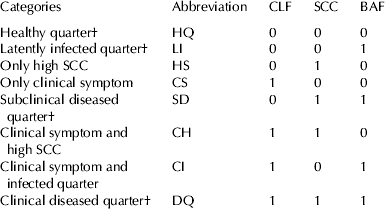
SCC of milk from healthy quarters is lower than 100 000 cells/ml (Urech et al. Reference Urech, Puhan and Schallibaum1999; Hamann, Reference Hamann and Hogeveen2005; Sarikaya & Bruckmaier, Reference Sarikaya and Bruckmaier2006). Both clinical and subclinical mastitis induce an increase of SCC (Berglund et al. Reference Berglund, Pettersson, Ostensson and Svennersten-Sjaunja2007) as a result of an inflammatory response to an intramammary infection (IMI) (Schukken et al. Reference Schukken, Wilson, Welcome, Garrison-Tikofsky and Gonzalez2003). Therefore, SCC is often used to distinguish infected quarters from uninfected ones. According to the German Society for Veterinary Medicine (DVG, 2002) the categorization of udder health is based on SCC and on the bacteriological status of the quarter (Table 1).
Definition of udder health based on quarter foremilk samples (DVG, 2002)

Measuring SCC in milk is the standard method for detecting the inflammatory process in the udder and for monitoring udder health (Pyörälä, Reference Pyörälä2003; Bruckmaier et al. Reference Bruckmaier, Weiss, Wiedemann, Schmitz and Wendl2004; Jayarao et al. Reference Jayarao, Pillai, Sawant, Wolfgang and Hegde2004). Forsbäck et al. (Reference Forsbäck, Lindmark-Månsson, Andrén, Åkerstedt, Andrée and Svennersten-Sjaunja2010) found that the day-to-day variation at quarter level was 2% for cows without bacteriological findings. This variation is considered to be due to factors not related to inflammation (Klastrup et al. Reference Klastrup, Bakken, Bramley and Bushnell1987). An increased SCC may be of short duration, due to a minor deviation in the daily management of the cows (e.g. contaminated feed used on a given day). However, it may also point to the beginning of a more serious and long-lasting inflammatory reaction (Berglund et al. Reference Berglund, Pettersson, Ostensson and Svennersten-Sjaunja2007). To detect this kind of SCC alteration, frequently performed analyses of quarter milk samples are required (Berglund et al. Reference Berglund, Pettersson, Ostensson and Svennersten-Sjaunja2007). The most accurate relationship between IMI and SCC exists at quarter level (Schukken et al. Reference Schukken, Wilson, Welcome, Garrison-Tikofsky and Gonzalez2003). In most studies, almost all bacteriological analyses as well as the measurements of SCC were carried out on quarter foremilk samples (Djabri et al. Reference Djabri, Bareille, Beaudeau and Seegers2002). Furthermore, Djabri et al. (Reference Djabri, Bareille, Beaudeau and Seegers2002) also reported that the average SCC in bacteriological negative quarters was about 70 000 cells/ml. Quarters infected by minor pathogens (i.e. coagulase negative staphylococci) had an average SCC of 110 000 cells/ml, and those infected by major pathogens (i.e. Staphylococcus aureus) had an average SCC higher than 350 000 cells/ml.
Machine milking with conventional clusters often leads to udder and teat damage, which is caused by forces pulling and pushing the teat cups in different directions. Rose-Meierhöfer et al. (Reference Rose-Meierhöfer, Brunsch and Jakob2009) reported that the wrong positioning of teat cups can be avoided if systems with single-tube guidance are implemented. Another advantage of milking with single tubes is the possibility of preventing the spreading of bacteria among the teats due to respray and cross-contamination (Hamann & Tolle, Reference Hamann and Tolle1978; Magee et al. Reference Magee, Sagi, Scott and Gates1984). The MultiLactor®, a new quarter-individual milking system (MULTI), has been developed to reduce undesirable effects of conventional milking systems (CON). Improved udder health and milk quality are expected advantages of using MULTI.
The present study was the first comparison between a quarter-individual (MULTI) and a conventional (CON) milking system, both of which were installed in milking parlours. The experimental design of the present study had the benefit of comparing two different systems within the same herd over the same time period. Therefore, the results of former studies could only be used in a limited way for comparative purposes in relation to the results of this study. The object of this study was to determine and compare the effects of MULTI and CON on SCC and the health status of quarters.
Material and Methods
Animals and milking management
The study was performed at a dairy farm located in Thuringia (Germany) over a period of 32 weeks. The trial ran from May to December 2009. A total of 84 primiparous and multiparous German Holstein cows were included in the study. Parities ranged from the first to the seventh lactation. Cows were randomly divided into two groups. Only cows up to the 120 d in milk (DIM) at the onset of the trial and without clinical indications of udder inflammation were considered. Both groups were housed in the same freestall barn and were fed the same mixed ration, supplemented with additional concentrates that were fed animal-specific, according to the milk production level. There were two milkings a day, with a milking interval of 12 h between the morning (6·30) and the evening (18·30) milking. The dairy farm provided two auto-tandem milking parlours. During the trial, group 1 was milked with a conventional (CON) and group 2 was milked with a quarter-individual (MULTI) milking system. Milking operations were performed by two milkers in each group. Pre-milking procedures included fore-stripping and cleaning of the teats with disinfection tissues as well as teat dipping at the end of milking. Teat cups were flushed in both milking systems with water and disinfectant after each cow was milked. Back flush, meaning the cleaning of only the interior surface of the teat cups, was used in the CON milking, whereas in the MULTI milking, the teat cups were purified on the inside and outside.
Milking systems
The conventional milking system (CON, Westfalia®) was manufactured by GEA Farm Technologies (Bönen, Germany) and the quarter-individual milking system (MULTI, MultiLactor®) was manufactured by Siliconform (Türkheim, Germany). MULTI was a milking system prototype which at the time of the trial was still in the development stage, but it was not further modified during the trial. The prototype of the year 2009 fulfilled the basic requirement of quarter-individual milking with its single-tube guidance. Both milking parlours had a low-level milk line and were equipped with milk meters. The system vacuum levels were 40 kPa (CON) and 37 kPa (MULTI), with a pulsation rate of 60 cycles/min in both milking systems. Pulsation ratios were 60 : 40 in CON and 65 : 35 in MULTI. The MultiLactor® used single-tube guidance with silicon liners and periodic air inlet under the teat end (BioMilker®). Furthermore, MULTI has a different concept in terms of pulsation, called sequential pulsation. In contrast to alternative pulsation, where pulsation starts in two teat cups at the same time, alternating with the remaining two teat cups starting a half pulsation cycle duration later, sequential pulsation works with four pulsators. That means that the pulsation for each of the four teat cups starts individually, evenly distributed over the duration of the pulsation cycle: teat cup one at 0%, teat cup two at 25% of the duration of the pulsation cycle and so on. The MultiLactor® system also applied a special pre-stimulation (50 s), with a mechanical actuator stimulating all four teats with vibrating movements of the long milk tubes. The Westfalia® system was equipped with a milking cluster (Classic 300, Westfalia®) and a claw volume of 300 ml as well as silicon liners. Moreover, CON used alternating pulsation with a pulsation rate of 300 cycles/min at a vacuum level of 19 kPa for pre-stimulation (60 s). Teat cups were detached when the milk flow at udder level was below 300 g/min (CON) and 200 g/min (MULTI), respectively. Technical parameters (vacuum, pulsation rate and ratio etc.) of both systems were used according to the indication of the manufacturers and were not changed during the trial period. Subject of the experiment were the milking systems as a whole as they are intended to be used by the manufacturers. These were the settings that ensure that the milking systems functioned optimal and reliably.
Collection and analysis of foremilk samples
During the morning milking, quarter foremilk samples were taken once a week to determine SCC. Before milking, all teats were prepared using disinfectant tissues until no dirt was visible. A 40-ml foremilk sample was collected manually from each quarter after pre-stripping. The unpreserved samples were stored in a cold box at 4–6 °C for a maximum of 1 d. Before starting SCC measurements, milk was heated to 40 °C. Determination of SCC was performed with a fluorescent-based electronic cell counter (Fossomatic 5000, FOSS, Hillerød, Denmark). Accuracy and linearity of the Fossomatic 5000 was calibrated by using bovine milk standards of known SCC, provided by LKV Brandenburg (Germany).
Every third month, sampling of quarter foremilk was performed to analyse its bacteriological status. For that purpose, the first three streams of milk were discarded; teat ends were disinfected with a paper towel moistened with 70% 2-propanol, and then quarter foremilk samples (4–6 ml) were collected. Bacteriological examinations were carried out by LKV Brandenburg (Germany).
Udder palpation
Udder palpation was carried out three times (in weeks 9, 22 and 28 of the trial), each time 1 week after bacteriological examinations (in weeks 8, 21 and 27). The investigations were performed by experienced veterinarians. The selected clinical findings (CLF) used for statistical analyses and evaluation of quarter health considered, on the one hand, dead and atrophic quarters as well as quarters with an abnormal milk secretion (purulent, blood, aqueous, flocculent). On the other hand, also quarters with rough tissue, peripheral proliferating tissue as well as rough and peripheral proliferating tissue were included in the study.
Definition of quarter health categories
Quarter health status was treated as a binary trait: healthy quarters (SCC ⩽ 100 000 cells/ml) were coded with the number 0 and suspicious quarters (SCC > 100 000 cells/ml) were coded with the number 1, using the results of quarter foremilk samples. The next step was to classify quarters in various health categories according to a self-defined evaluation key (Table 2) which considered the results of all three examination types: SCC, clinical findings (CLF) and bacteriological findings (BAF).
Categories of quarter health status including results of SCC, clinical finding (CLF) and bacteriological finding (BAF)
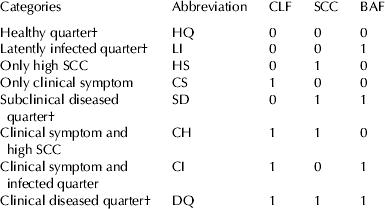
† Categories used by DVG, clinical examination: 0 (no CLF)/1 (with CLF), SCC: 0 (SCC ⩽ 100 000 cells/ml)/1 (SCC > 100 000 cells/ml), bacteriological examination: 0 (no BAF)/1 (with BAF)
Data evaluation and statistical analysis
In a preliminary investigation, quarter foremilk samples of 84 cows were tested according to their SCC and BAF. In the evaluation, only 59 cows (MULTI: n = 28, CON: n = 31) with SCC ⩽ 100 000 cells/ml, and without BAF on quarter level, were taken into account. Measurements of the 4-week adaptation phase were excluded from the analysis. The evaluation period consisted of 28 trial weeks or until a cow reached 305 DIM respectively. Some cows were dried off before 305 DIM because of too little milk yield. Data from the eleventh trial week could not be included in the study because of a malfunction in the dairy management software. A lightening bolt struck the installation. This incident resulted in the loss of milk yield values, which were required as a co-variable in the statistical model.
The study was based on a data set consisting of 5455 measurements. Quarter health status can take discrete values in two different states: healthy or suspicious. Therefore, quarter health status was coded in binary terms and assumed to be Bernoulli-distributed. A generalized mixed linear model was used to estimate the influence of several factors and co-variables on quarter health status. SAS (Version 9.2, SAS Institute Inc., Cary NC, USA) was used for all of the following statistical analysis. The data were evaluated with the GLIMMIX procedure, using an inverse logit-function as a link function.
 $$P(Y = 0) + P(Y = {\rm 1}) = {\rm 1}\quad {\rm probability}$$
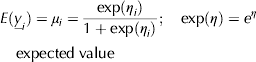 $$E(\underline y _i ) = \mu _i = \displaystyle{{\exp (\eta _i )} \over {1 + \exp (\eta _i )}};\quad \exp (\eta ) = e^\eta \quad {\rm expected}\;{\rm value}$$
 $$\eqalign{{\rm with}\;\eta _{ijklqw} = & \mu + {\rm MS}_k + {\rm LN}_l + {\rm SB}_j + {\rm QA}_q + {\rm TW}_w \cr & + {\rm D}({\rm LN}_l ){\rm t} + {\rm Mm} + {\rm C}_i + {\rm e}_{ijklqw}} $$
with η ijklqw: linear predictor for udder quarter health status; μ, general mean; MSk: fixed effect of the k-th milking system; (k = 1,2); LNl: fixed effect of the l-th lactation; (l = 1,2,3); SBj: fixed effect of the j-th quarter health status in the previous week; (j = 1,2); QAq: fixed effect of the q-th quarter; (q = 1,2,3,4); TWw: fixed effect of the w-th trial week; (w = 1, … ,27); D(LNl): co-variable (DIM t nested with lactation l); M: co-variable (milk yield m); Ci: random effect of i-th cow; (i = 1, … ,59); eijklqw: residual.
The emphasis in this analysis lay on possible differences between the examined milking systems. Global hypotheses for the fixed effects and co-variables were tested with F tests at a significance level of α = 0·05. Within the above mentioned effects, differences were tested by pair-wise t tests between levels and the results were presented as Least Square Means (LSM)±se. The SIMULATE option was used to keep a global significance level of α = 0·05 when adjusting P-values for multiple testing.
Results
SCC and variation over time
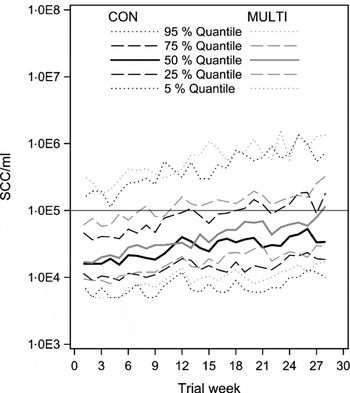
The median of SCC was 32 000 cells/ml (25% quantile: 14 000 cells/ml and 75% quantile: 97 000 cells/ml), calculated for MULTI and CON together. The median of MULTI (n = 2603) was 40 000 cells/ml (25% quantile: 15 000 cells/ml and 75% quantile: 121 000 cells/ml) and the median of CON (n = 2852) was 27 000 cells/ml (25% quantile: 13 000 cells/ml and 75% quantile: 74 000 cells/ml) in foremilk samples during the trial period. At the beginning, median values of both groups were close to each other (<70 000 cells/ml). Both groups displayed an increase of SCC with increasing duration of the trial (Fig. 1). MULTI and CON did not permanently exceed the 100 000 cells/ml threshold during the trial period, respecting the median, with the exception of the last trial week (MULTI).
Time courses of SCC median per group (MULTI and CON) during the trial period, including the presentation of selected quantiles

Overall, the examination results demonstrated that the share of healthy quarters amounted to 75·78% (n = 4134 quarters) and the share of suspicious quarters amounted to 24·22% (n = 1321 quarters), with respect to the SCC in both groups. The percentage of healthy quarters (SCC < 100 000 cells/ml) was 70·92% for MULTI (n = 1846 quarters) and 80·22% for CON (n = 2288 quarters) during the entire trial period. The percentage of suspicious quarters (SCC > 100 000 cells/ml) was 29·08% for MULTI (n = 757 quarters) and 19·78% for CON (n = 564 quarters) considering all foremilk samples, accordingly. The results showed a declining percentage of healthy quarters during the trial period in both groups. From week 19 on, the first cows reached 305 DIM and dropped out of the trial group. These cows were not considered for further evaluations.
Factors influencing quarter health status
In the following section, effects and differences between levels were estimated by the use of LSM and tested via multiple comparisons. The influence of fixed effects and co-variables on quarter health status was tested based on the SCC results. The results of the F test stated that milking system (P = 0·0587) and DIM (P = 0·8066) had no significant influence on quarter health status. On the other hand, lactation (P = 0·0396), quarter health status of the previous week (P < 0·0001), quarter (P = 0·0023), trial week (P = 0·0061) and milk yield (P < 0·0001) affected the quarter health status significantly.
The estimated probabilities of the occurrence of a suspicious quarter were 19·97% (CON) and 31·72% (MULTI). Therefore, the tendency of the occurrence of a suspicious quarter was higher for quarter-individually milked cows compared with conventionally milked cows. But the test of differences of LSM showed no significant differences (Adj P = 0·0585) between CON and MULTI. The estimated probability that a quarter which had SCC > 100 000 cells/ml in the previous trial week was suspicious once again in the following trial week was 50·52%. In contrast, the probability that a healthy quarter became suspicious in the next trial week was relatively low (10·20%). As expected, the quarter health status of the previous week showed significant differences (Adj P < 0·0001) between health status 0 (healthy) and 1 (suspicious). The estimated probability that quarters became suspicious during the first lactation was 12·51%. With an increasing number of lactation, the probability for a quarter to become suspicious increased clearly (2nd lactation: 32·73% and 3rd lactation: 36·19%). Comparisons showed that significant differences concerning the number of lactation existed between 1st and 2nd (Adj P = 0·0038) lactation as well as between 1st and 3rd (Adj P = 0·0019) lactation. On the other hand, no significant differences (Adj P = 0·9258) between 2nd and 3rd lactation could be detected. Left front quarters became suspicious with a probability of 30·93% during the trial period. The other three quarters showed lower probabilities (23–24%) for SCC > 100 000 cells/ml. Significant differences (Adj P ⩽ 0·0042) between left front quarters and the other three quarters existed concerning the probability that suspicious quarters appeared during the trial period.
Quarter health categories
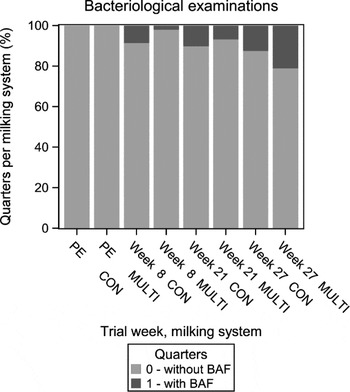
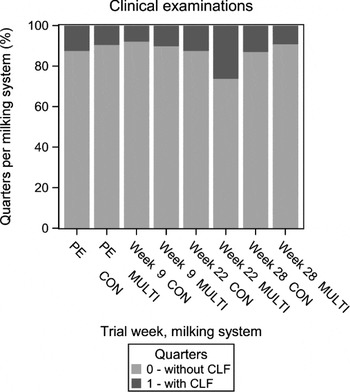
The following bacteria were found or detected in BAF quarters: Escherichia coli, streptococci, coliforms, CNS, Staphylococcus aureus, Arcanobacterium pyogenes. The percentage of quarters with BAF (Fig. 2) was smaller than for quarters with CLF (Fig. 3), with the exception of the last examination (week 28). The percentage of quarters with BAF increased slightly from 8·62% up to 11·94% (CON) during the trial period. On the basis of a smaller percentage (2·08%) of quarters with BAF (week 9) at MULTI, the percentage rose to 25% to the end of trial. The increase of BAF in the MULTI-group is mainly caused by newly diagnosed streptococcal infections in the week 27 of the trial. In all, cow associated streptococci were the most common bacteria detected during the trial period. Up to 10·42% (MULTI) and 25·86% (CON) of quarters showed positive CLF at the first examination after adaptation phase (week 9). Thirteen weeks later (week 22), the percentage of quarters with CLF (MULTI) increased up to 27·38% whereas in the case of quarters with CLF (CON) the percentage remained nearly the same (29·89%). At the end of the trial, examination results showed that the percentage of quarters without CLF increased again in both groups (week 28).
Percentage of bacteriological findings (BAF) for both milking systems (MULTI and CON), (PE = preliminary examination)

Percentage of clinical findings (CLF) for both milking systems (MULTI and CON), (PE = preliminary examination)

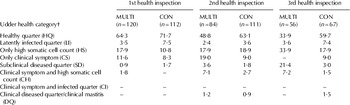
The percentages of health categories, for a total of 550 quarters, are presented in Table 3. The majority of quarters in both groups were affected neither by increased SCC, nor positive BAF, nor positive CLF. It was shown, however, that the percentage of healthy quarters decreased over time during the trial. In general, the percentage of quarters that were classified as diseased was small (two diseased quarters in the CON-group/one diseased quarter in the MULTI-group). Table 3 also shows that the health category CI, which described quarters with clinical and bacteriological findings (CLF = 1, SCC ⩽ 100 000 cells/ml, BAF = 1), did not occur during the trial period. When assessing frequencies of quarter health categories, data showed that high SCC was the most common finding in connection with quarters with health problems.
Percentage of quarter health categories based on three examination dates

† Classifications in categories (see Table 3)
Discussion
SCC and variation over time
SCC measured in foremilk samples is widely recognized as an indicator of udder health in individual cows (Müller & Sauerwein, Reference Müller and Sauerwein2010). The relation between SCC measured at the udder level and IMI must be interpreted with caution, because an increase in SCC associated with an IMI in one quarter may be reduced by a dilution effect, if all other quarters are found to be bacteriologically negative (Djabri et al. Reference Djabri, Bareille, Beaudeau and Seegers2002). Therefore, the authors decided to collect foremilk samples exclusively at the quarter level. Several authors (Urech et al. Reference Urech, Puhan and Schallibaum1999; Hamann, Reference Hamann and Hogeveen2005; Sarikaya & Bruckmaier, Reference Sarikaya and Bruckmaier2006) used a SCC threshold value of 100 000 cells/ml to distinguish between healthy and suspicious quarters. In contrast, Dohoo & Leslie (Reference Dohoo and Leslie1991) suggested that the exceeding of SCC above a threshold value of 200 000 cells/ml was optimal for making predictions of new IMI. The present study was in line with the lower SCC threshold because SCC values which are already over 100 000 cells/ml may be a sign of the stress related to the housing conditions, or an inflammatory process in the mammary gland.
There was a tendency for both groups (Fig. 1) to show a rise of SCC over the duration of the trial. This result might partly be due to the mechanical load on the udder tissue with increasing DIM. Another factor may well be that milk yield decreased during lactation and the dilution effect was reduced. It has been demonstrated by Schepers et al. (Reference Schepers, Lam, Schukken, Wilmink and Hanekamp1997) that SCC increases more at the end of lactation in cows with parity >1. Laevens et al. (Reference Laevens, Deluyker, Schukken, De Meulemeester, Vandermeersch, De Muelenaere and De Kruif1997) reached similar conclusions. They observed that first-lactation cows had a constant excretion of cells and older cows did not increase cell output until >240 d post partum. The present study also demonstrated that DIM had no significant influence on quarter health status, although there is a tendency for a slow increase in SCC with increasing time during lactation. The DIM effect interfered with the trial-week effect to some extent, as the examined cows were in a similar stage of lactation during the entire duration of the trial. Milk from quarters with mild health disorders had a more variable SCC (Berglund et al. Reference Berglund, Pettersson, Ostensson and Svennersten-Sjaunja2007). Fluctuations in SCC, even if the SCC on the quarter level was below 100 000 cells/ml, appeared to influence milk synthesis (Berglund et al. Reference Berglund, Pettersson, Ostensson and Svennersten-Sjaunja2007). Furthermore, Berglund et al. (Reference Berglund, Pettersson, Ostensson and Svennersten-Sjaunja2007) showed that milk production and milk composition per quarter, within a pair of quarters, was similar if the quarters were healthy and if compared within the front and rear quarters, respectively. The present study showed that left front quarters had a significantly higher probability of becoming suspicious than the other three quarters. The increased SCC in left front quarters can be safely assumed to result from the sequence of taking foremilk samples. Left front quarters usually were the first quarters with the highest foremilk content and least dilution, with cistern or even alveolar milk.
Effects on quarter health status
The present study has shown that the estimated probability of the occurrence of a suspicious quarter was higher for MULTI, but the test of differences of LSM showed no significant differences between CON and MULTI. Other studies, including results of automatic milking system (AMS) investigations, found no differences in SCC between AMS and CON in regard to composite milk (Berglund et al. Reference Berglund, Pettersson and Svennersten-Sjaunja2002). A negative influence on udder health, measured by an increase of SCC during the first year after introduction of AMS compared with CON, was reported by Rasmussen et al. (Reference Rasmussen, Blom, Nielsen and Justesen2001). The increase came suddenly and was synchronized with the onset of automatic milking; but the number of cows with increased SCC decreased slowly 3 months after the new installation (Rasmussen et al. Reference Rasmussen, Blom, Nielsen and Justesen2001).
Reitsma et al. (Reference Reitsma, Cant, Grindal, Westgarth and Bramley1981) described how the duration of the liner closure per pulsation cycle affected bovine mastitis and noticed that the occurrence of new IMI increased considerably with a decrease in duration of liner closure, especially at the pulsation ratio 70 : 30 (Mahle et al. Reference Mahle, Galton and Adkinson1982). They also found out that rear quarters were infected more readily than front quarters (Reitsma et al. Reference Reitsma, Cant, Grindal, Westgarth and Bramley1981) and the number of infected quarters increased as vacuum increased from 33·3 to 50 kPa (Mahle et al. Reference Mahle, Galton and Adkinson1982). These results could not be verified by our own investigations. On the one hand, only left front quarters had a significantly higher probability of becoming suspicious. On the other hand, both milking systems were rated as an entire unit and the effect of vacuum on quarter health status was not explicitly tested. Calculations showed no significant difference between both systems concerning the probability of a quarter of becoming suspicious. Against this background, the difference in the vacuum of 3 kPa between MULTI and CON can be considered as low. One experiment on ewes showed that vacuum level had no significant effect on the proportion of new IMI at udder level (18% of IMI at vacuum level of 36 kPa and 23% of IMI at vacuum level of 42 kPa) (Peris et al. Reference Peris, Dίaz, Balasch and Beltrán2003). The same authors also showed that SCC was significantly affected by the day effect, but the vacuum level had no significant effect on SCC. Therefore, it may be concluded that the influence of shorter massage phases (pulsation ratio 65:35) and a lower working vacuum (37 kPa) in the group milked with MULTI equalizes the influence of a higher working vacuum (40 kPa) and longer massage phases (pulsation ratio 60:40) in the group milked with CON, with respect to the effects on quarter health. Otherwise, Öz et al. (2010) found that the average liner vacuum values during the d-phase were calculated to be 34·2 kPa for CON and 12·3 kPa for MULTI. They concluded that the considerably reduced vacuum value during the d-phase for MULTI can be attributed to the use of BioMilker®. The system allows periodic air inlet under the teat end and provides an effective massage of the teat. In the present study this positive effect, which should lead to lower SCC values in the MULTI-group, could not be confirmed. In the authors’ view, one possible explanation for the result that there were no significant differences between MULTI and CON is the fact that the systems as a whole were analysed, and not their individual components. Dufour et al. (Reference Dufour, Fréchette, Barkema, Mussell and Scholl2011) analysed numerous studies with regard to the effect of management practices on SCC. They found that many authors reported on associations between different components of the milking system and SCC. Dufour et al. (Reference Dufour, Fréchette, Barkema, Mussell and Scholl2011) expressed that the results from earlier studies were very unequal. They suggested that a milking system can only be correctly assessed in its entirety.
Quarter health categories
DVG defined four categories for the description of quarter health status. In this evaluation key (Table 1), SCC and BAF on quarter level were used for categorizing the quarter health status. In the present study, the classification scheme was extended by involvement of CLF in order to allow a more precise and comprehensive characterization of quarter health status as well as to include all possible health conditions. In this context, we have considered four additional health categories (Table 2).
In both groups, the percentage of quarters with BAF increased more or less strongly during the trial period. The increase of BAF in MULTI is mainly caused by newly diagnosed streptococcal infections in the week 27 of the trial. One obvious reason for the increase in BAF within MULTI-group in week 27 can be traced back to the illness of one animal. Cow no. 516, which was inconspicuous during the trial period in terms of udder health, had three quarters with BAF at the last investigation. The bacteria found were streptococci. However, it is not possible for the authors to specify or name other causes for the increased rate of BAF in MULTI. In retrospect, the authors believe that additional examination dates were needed to provide more reliable information about cases of IMI concerning the comparison of MULTI and CON. According to Buelow et al. (Reference Buelow, Thomas, Goodger, Nordlund and Collins1996), some chronically infected quarters eliminate bacteria in milk sporadically, leading to possible false-negative results. At least for this reason, it is safer to take repeated samples in order to minimize the number of false-negative samples (Djabri et al. Reference Djabri, Bareille, Beaudeau and Seegers2002). Bansal et al. (Reference Bansal, Hamann, Grabowski and Singh2005) described that latent infections were not associated with significant alteration in milk constituents. Furthermore, Bansal et al. (Reference Bansal, Hamann, Grabowski and Singh2005) found that mastitis, both at the specific and non-specific level, caused a significant (P < 0·05) increase in SCC in all the milk fractions studied. The change in SCC in mastitic quarters is thought to be caused by a higher accumulation of leucocytes at the infection site and a greater leakage of blood constituents such as electrolytes into alveolar milk through the damaged epithelium. Barkema et al. (Reference Barkema, Schukken, Lam, Beiboer, Wilmink, Benedictus and Brand1998) concluded that to assess the risk of getting clinical mastitis, SCC should be evaluated at the single cow level. Clearly, a low SCC at herd level does not contribute to a significant increase in clinical mastitis (Barkema et al. Reference Barkema, Schukken, Lam, Beiboer, Wilmink, Benedictus and Brand1998).
First study results (Rose-Meierhöfer et al. Reference Rose-Meierhöfer, Brunsch and Jakob2009) indicated that single-tube guidance prevented negative torsional, leverage or tractive forces on the udder and therefore spares the udder tissue from unnecessary mechanical stress. Furthermore, milking machines may increase the infection rate by transferring pathogens among teats by the milking claw (Spencer, Reference Spencer1989). Milk transport with single guided tubes, together with cleaning between milkings, should prevent such cross-infections (Spencer, Reference Spencer1989). For this reason, the teat cups of MULTI and CON were flushed with water and disinfectant after each cow. The automation of milking routines allows the operator to adopt a more structured and efficient milking process as well as additional time for mastitis prevention (Ohnstad et al. Reference Ohnstad, Barkema, Hogewerf, de Koning, Olde Riekering and Lam2008). Plozza et al. (Reference Plozza, Lievaart, Potts and Barkema2011) concluded that wearing gloves and using single paper towels for each cow were further appropriate practices in reducing the transmission of bacteria during the milking process and in preventing new IMI. In the present study, the named practices were carried out in both groups, so that tendential differences with regard to udder health cannot be traced back to the milking routine. Similarly, Dufour et al. (Reference Dufour, Fréchette, Barkema, Mussell and Scholl2011) reported that milking procedures such as using gloves during milking, post-milking teat dipping, automatic milking unit take-offs and yearly inspections of the milking system, were consistently associated with lower herd SCC.
In conclusion, this study is the first comparison between quarter-individual (MULTI) and conventional (CON) milking systems installed in a milking parlour. Quarter health status was not significantly affected by the milking system and DIM nested with lactation. In contrast, all other factors significantly affected quarter health status, e.g. parity, milk yield, trial week and udder quarter health status of the previous week. A main finding of this trial was that for MULTI, the probability of the occurrence of suspicious quarters was tendentially higher. However, the results of multiple comparisons did not show any significant differences between MULTI and CON concerning the quarter health status based on a SCC threshold value of 100 000 cells/ml. It has been presumed that the tendential differences between both groups cannot be traced back to the milking systems used. This indicates a smooth adaptation of heifers and cows previously milked conventionally to the new milking system with single-tube guidance. MULTI fulfils the required standards which are currently being placed upon new milking techniques in terms of udder health. Additional analyses are needed to evaluate the effects of quarter-individual milking on milk constituents and teat condition. It can be concluded that as far as the udder health of dairy cows is concerned, state of the art quarter-individual and conventional milking systems are equally acceptable for gentle milking.
The study was funded by the Federal Agency for Agriculture and Nutrition (BLE) as a management agency for the Federal Ministry of Food, Agriculture and Consumer Protection (BMELV). The authors wish to express their appreciation to Prof Dr Kurt Wendt and Dr Jens Unrath for performing clinical examinations and for valuable discussions. Furthermore, the authors are very grateful to the staff of the Landwirtschaftliche Produktions- und Handelsgesellschaft Remptendorf for their friendly support throughout the experimental phase of the study.