Who gets to be in the room? Participation underlies much of the current debate about international organizations (IOs). Many organizations have expanded to nearly universal membership, but they are criticized for limiting the participation of their members. For instance, observers have long criticized how financial contributions determine voting rights in the World Bank and International Monetary Fund, which generates “exclusionary decision making” and “limited information generation.”Footnote 1 By comparison, World Trade Organization (WTO) decisions are made by consensus, rather than voting. Yet agenda-setting by big members is said to exclude other countries from effective participation in major decisions.Footnote 2 The famed WTO “green room” replicates the club model of the General Agreement on Tariffs and Trade (GATT): a few superpowers negotiate in private, and then present the outcome to the other members for approval.Footnote 3 Nongovernmental organizations routinely denounce the WTO's “‘informal’, undocumented and exclusive meetings which they view as undermining transparency and participation.”Footnote 4
The debate over participation has thus been framed predominantly in normative terms. Rational choice scholarship, in turn, has suggested some reasons why such exclusion may appear as institutions seek to secure cooperation. The growing size of international institutions can affect the odds of reaching agreement: the greater the number of actors, the greater the transaction costs of negotiations. In the words of American diplomat Harlan Cleveland, the challenge is, “how do you get everyone into the action and still get action?”Footnote 5 Similarly, scholarship on the “broader/deeper” trade-off argues that as an institution grows larger, states will cooperate less because the institution must satisfy those states that are least willing to cooperate.Footnote 6 Large multilateral institutions may thus be doomed to shallow levels of cooperation. Wider participation can also make deadlock more likely if the losers of bargaining outcomes mobilize more effectively than the winners.Footnote 7 Limits on participation may thus be necessary to promote deep cooperation and effective decision making in large multilateral organizations.
One way that states have tried to ameliorate the costs of large multilateral institutions is to delegate authority to technocratic bodies.Footnote 8 Multilateral organizations routinely rely on legal institutions to interpret rules and adjudicate disputes.Footnote 9 These IOs also usually include international bureaucracies to provide expertise and make rules.Footnote 10 These technocratic bodies can promote cooperation by creating a “functional domain to circumvent the direct clash of political interests.”Footnote 11 Courts and bureaucracies are intended to shift disputes and decision making from the political to the technocratic arena.
Decision making may be more effective when it occurs in “a relative political vacuum,”Footnote 12 though states that expect to lose in technocratic bodies have an incentive to try and shift decision making back to the political realm. Wider participation can reduce the authority and normative force of technocratic decisions by including a greater number and diversity of political opinions. States that benefit from the status quo ante under the technocratic body should want narrow participation, while states that lose should want more voices in the room. Calls for pluralism and transparency are thus likely to be motivated, at least in part, by strategic interests.
Methodological challenges hinder empirical analysis of IO participation and its effects. Tests of institutional design theories usually force scholars to exploit variation either across institutions or over time within a given institution. In both cases, any such variation is likely driven by strategic concerns that also affect the outcomes of interest. We surmount this methodological challenge by exploiting a providential design feature of the WTO that allows us to systematically observe whether disputants choose to allow other countries into the room.
One way in which the WTO has addressed its “participation deficit” is by allowing for third parties in dispute settlement.Footnote 13 These are nonlitigant countries that have an interest in the dispute and can participate in otherwise private negotiations during the consultations period. If the case proceeds to litigation, third parties can also hear the litigants' arguments and submit their own views, which become an integral part of the panel report if a ruling is reached. As a European Union (EU) representative put it, “the fundamental purpose of increased third-party access was to give all Members an opportunity to contribute to the development of WTO law.”Footnote 14
Despite the vast literature on the WTO's design, and the growing attention paid to third parties, little attention has been paid to the fact that complainants can influence the number of third parties in the room: complainants launch a dispute by requesting consultations under either Article XXII:1 or Article XXIII:1 of GATT 1994. Under Article XXII, third parties can join consultations with relative ease, which often leads to “kibitzing,” whereby third parties take sides and raise their own issues.Footnote 15 By contrast, Article XXIII makes it possible for litigants to keep third parties out of the room. As the WTO's own training module puts it, “the choice between Articles XXII:1 and XXIII:1 of GATT 1994 is a strategic one, depending on whether the complainant wants to make it possible for other Members to participate.”Footnote 16
As general theories of multilateralism would suggest, the likelihood of a negotiated settlement decreases as the number of third parties increases.Footnote 17 Accordingly, many WTO legal scholars assume that if third parties decrease the odds of settlement, then filing under Article XXII, which promotes third parties, should also hinder settlement. As Porges argues, “disputes where the consultations are solely conducted under Article XXII should be less likely to settle.”Footnote 18 This logic seems plausible; yet our formal model and empirical tests show that it is exactly wrong.
We argue that third party participation creates insurance by lowering both the benefit of winning and the cost of losing an international dispute. If disputants reach an early settlement, then third parties are costly to the complainant because it must share the spoils of victory. However, if a case goes to litigation and the complainant loses on the merits, then third parties can dampen the costs of failure by introducing ambiguity into the normative force of the panel ruling. So if a complainant believes that it will lose on the legal merits of a case, it will attempt to “win on the politics” by seeking third party support. Empirical evidence supports our arguments that the choice to promote or prevent participation in WTO dispute settlement is strategic, affecting both the likelihood and terms of early settlement.
More broadly, our analysis shows that preferences over IO inclusiveness depend, at least in part, on dispute attributes, and are not wholly driven by disputant characteristics. When a state expects to benefit from the status quo ante, it will try to keep policy within the technocratic domain by restricting participation. However, when a state expects to lose under the status quo ante, it has incentive to encourage participation and thereby shift the dispute from the technocratic to the political domain.
These dynamics are not limited to WTO disputes. We examine the EU debate over genetically modified organisms in the late 1990s, and WTO committee rulemaking about whether members can protect goods that achieve a social objective. In both of these cases, individuals and states that expected to lose in the technocratic realm sought to politicize the regulatory process by increasing participation.
Third Parties in WTO Dispute Settlement
The Role of Third Parties
The WTO Dispute Settlement Understanding (DSU) is the bedrock of the multilateral trade system. The DSU allows countries to challenge whether a trade partner's policies comply with WTO law. More than 60 percent of WTO disputes include third parties, which are WTO members that join a case after stating an interest in the dispute. Third parties can submit legal arguments and participate in private prelitigation negotiations (“consultations” in WTO parlance). This participation in prelitigation negotiations is key, because settlement—rather than punishment, retaliation, or compensation—is the WTO's primary goal.Footnote 19 If the case proceeds to litigation, third parties can ask questions of the litigants and submit their views to judges. Most importantly, their views and submissions are included alongside the verdict itself in the panel report, which is made public immediately after it is adopted.
A largely overlooked fact is that complainants have some control over the expected number of third parties. A complainant must file its dispute under either Article XXII or Article XXIII of GATT 1994.Footnote 20 This choice is consequential. As the WTO instructs potential litigants, the “main difference between these two legal bases relates to the ability of other WTO Members to join as third parties.”Footnote 21 Article XXII makes third party participation relatively easy, while Article XXIII makes party participation relatively difficult.Footnote 22 The average number of third parties in consultations for an Article XXII case is 2.5, while the average number of third parties for an Article XXIII case is 0.8, and this highly significant difference remains throughout all the stages of disputes.
However, the choice between the two filing methods does not fully determine party participation. A country can still request to join as a third party in an Article XXIII case, but those requests are rarely granted. This is because filing the dispute under Article XXIII allows the complainant to block all third parties in a way that it cannot do under Article XXII. Complainants need not exercise this right, but the filing method is indicative of their intent to do so. As a result, nonlitigants rarely request party status when the case is filed under Article XXIII, and when they do, those requests are rarely granted. The EC—Generalized System of Preferences (GSP) dispute, for instance, was filed under Article XXIII, and all countries that applied for party status despite this fact saw their requests denied. The minutes from the corresponding meeting state that “although Colombia was aware that the request had been made under Article XXIII of the GATT 1994, it had asked to be joined in the consultations, but had been informed that these consultations would be held exclusively between the EC and Thailand.”Footnote 23 Yet in another instance, party status was granted to several states in EC—Coffee, another Article XXIII case about GSP. Such cases remain rare, because again, the acknowledged purpose of Article XXIII is to allow the complainant to negotiate in private with the defendant, by letting the complainant block the entry of any prospective third parties, in a way that it cannot do under Article XXII.
The disputants' goal is to negotiate a “mutually acceptable solution” during consultations. Bargaining can continue even after a panel ruling. However, early settlements—reached before a panel ruling—are preferred because the terms of the settlement usually remain private and do not formally assign blame.Footnote 24 Importantly, the rules require that all settlements be “consistent” with WTO obligations.Footnote 25 The litigants negotiate settlement terms, yet third parties can affect these terms. The WTO's training module for dispute settlement asserts that a country can become a third party if it “ha[s] an interest in being present at discussions on any mutually agreeable solution because such a solution may affect its interests.”Footnote 26 In the words of the EU representative, third parties “contribute to the development of WTO law.”Footnote 27
Scholars disagree about the overall impact of third parties on dispute settlement. Some argue that third parties can benefit the WTO by ensuring that settlements are consistent with WTO rules.Footnote 28 Additionally, developing countries—which lack legal resources—believe that third party participation increases their legal capacity.Footnote 29 However, others believe that third parties hinder the effectiveness of WTO dispute settlement. Davey and Porges argue that “privacy is usually more conducive to settlement.”Footnote 30 Pauwelyn and Bown both warn that third parties hinder early settlements by adding more voices and issues to consultations.Footnote 31 Busch and Reinhardt find empirical evidence bolstering these beliefs, showing that private disputes are on average 38 percent more likely to reach settlement than disputes with third parties.Footnote 32 In short, more public negotiations tend to break down more often and are more likely to lead to litigation, which is widely seen as an inefficient outcome.
WTO members themselves also disagree about the net impact of third parties. Some countries advocate reforms that would expand third party participation.Footnote 33 Other members oppose these reforms. Nonlitigants often publicly voice their dissatisfaction when they are kept from being in the room when a dispute has been filed under Article XXIII.Footnote 34 The vehement debate about third party participation reflects broader concerns about WTO transparency and inequity.
Complainants' ability to prevent or promote third party participation produces two major puzzles. First, if third parties hinder early settlement, then why does a complainant ever promote participation by filing under Article XXII? Second, do filing decisions affect negotiation and litigation outcomes?
Third Parties as Insurance
Most WTO disputes reach an early settlement before a panel ruling. The specific terms of these mutually agreed settlements remain private. These settlements do not formally allocate blame, but anecdotal evidence suggests that complainants usually extract partial or complete removal of the offending measure from the defendant.Footnote 35 If the case does proceed to litigation, then the panel rules in favor of either the complainant or the defendant.Footnote 36 We examine how third party participation affects disputant payoffs in these three different outcomes.
Early Settlement
If a case reaches an early settlement, then third parties are costly for the complainant. A defendant faces domestic constraints on how much total market access it can offer during negotiations. Settlements can be carefully crafted to distribute this market access to those states in the room, and exclude states not present in negotiations. Such discriminatory settlements are prohibited under Article 3.5 of the Dispute Settlement Understanding (DSU). Yet the secrecy of early settlements makes it difficult to enforce their consistency with WTO rules. As one legal scholar recently put it, “As the content of the mutually satisfactory solution is not disclosed, there is a small chance for an interested… Member to detect it and take action against it under the WTO DSM.”Footnote 37 For example, the defendant can redefine a trade standard or reallocate a quota to benefit the complainant, at the expense of nonlitigants not present in the room.Footnote 38 The WTO believes that the presence of third parties makes “bilateral opportunism” less likely.Footnote 39 Similarly, Bown argues that third parties “minimiz[e] the likelihood that settlements between litigating parties result in discrimination against exporting firms from third countries.”Footnote 40
It follows that in cases that settle early, third parties decrease the complainant's share of the pie, because trade concessions must be distributed among a larger number of states. Countries that are affected by the defendant's policies want to participate in negotiations so that they can protect their interests and free-ride on the complainant's legal effort. Bechtel and Sattler provide statistical evidence that third parties profit nearly as much as the complainant from the defendant's concessions.Footnote 41 Anecdotal evidence supports this finding. For example, the United States filed a complaint in 2002 against Japan's import restrictions on apples. New Zealand—which also exported apples to Japan—joined as a third party. Phil Alison, the chairman of Pipfruit New Zealand Growers, rejoiced that “the Americans will now sit down to negotiate a protocol with the Japanese and we will hope to piggy-back on that.”Footnote 42 The implication for complainants is that if an early settlement is reached, they would prefer that it take place in private, to tailor it maximally to their preferences.
Fear of such bilateral opportunism is precisely what leads nongovernmental organizations (NGOs) and other observers to advocate for greater participation and transparency during multilateral negotiations.Footnote 43 Although privacy is conducive to settlement, it risks discriminatory outcomes.Footnote 44 Wider participation, by contrast, leads to both a more equal distribution of the gains from liberalization, and greater procedural legitimacy. From the complainant's perspective, having an additional third party in negotiations can reduce, but never increase, the complainant's share of concessions.
Conversely, third party participation benefits the defendant if there is an early settlement. A settlement with all affected parties in the room is akin to orderly bankruptcy proceedings, where all creditors coordinate on a single deal. Discriminatory settlements leave defendants susceptible to future legal challenges filed by countries that were excluded from negotiations. This is especially likely given how precedents that are set in the initial case often set the stage for subsequent cases.Footnote 45 Conversely, a nonlitigant that benefits from a nondiscriminatory settlement becomes less likely to file a dispute of its own. This is why defendants almost never block third party participation.Footnote 46 A defendant would rather allow a third party in the room than have that third party file a complaint of its own. All things equal, if early settlement occurs, then the defendant benefits from wider third party participation.
Panel Rulings
If a case proceeds to litigation, then what is being fought over is no longer the distribution of concessions under a settlement, but rather the longer lasting impact of the panel report, which is immediately made public and adds to WTO jurisprudence.Footnote 47 As with most functioning courts, a WTO ruling—the average length of which now reaches more than 450 pages—is not simply a condemnation or an exoneration. It is also a signal to the broader membership of the extent of a violation; of whether it constituted a willful breach or one hinging on a technicality; and of how similar legal issues are likely to be resolved in the future. In short, beyond the mere direction of the ruling, the perception of the ruling by the remainder of the membership matters. In this way, countries are seen fighting to limit the number of unfavorable findings by the panel, even when these findings do not influence the ruling's overall direction.Footnote 48 This is first because in an institution that retains its fundamentally diplomatic character, and that remains based on reciprocity, members' perceptions about a disputant's behavior today affect the way it will be treated by other states in the future. Second, a growing consensus among legal scholars suggests that the WTO is based on de facto stare decisis, insofar as rulings generate “legitimate expectations” among WTO members over the future treatment of similar issues subsequently.Footnote 49 As a result, the panel report either strengthens or weakens the legal merit of future cases, and the subsequent understanding of countries' obligations under the rules. Every dispute that makes it to litigation thus becomes a contest over both the panel ruling and the membership's perception of the ruling.
In this context, third parties take on considerable importance because they generate ambiguity over panel rulings. Third parties take sides in disputes, and raise their own legal arguments and issues, which can water down the force of a panel ruling. Their legal submissions are a central part of the public panel report, and introduce ambiguity into the political implications of a ruling. This dynamic is not unique to the WTO. Garrett, Kelemen, and Schulz show that a country that loses a ruling at the European Court of Justice is better off if other EU member governments are also adversely affected by the ruling and express their disagreement.Footnote 50 Much like WTO dispute settlement, scholars ascribe the very success of the European Court of Justice (ECJ) in part to its “ability to camouflage controversial political decisions in ‘technical’ legal garb.”Footnote 51 Third party participation, and its elevation as a key part of the final panel report, takes away from this ability. It politicizes the outcome, adding divergent takes on the interpretation of the rules to the mix. That, of course, is precisely what the loser of the panel report seeks.
Along similar lines, the broader legal literature generally agrees that both dissenting and concurring opinions “weaken the force of the majority opinion.”Footnote 52 Third parties lack the status of a judge's dissenting or concurring opinion, but in aggregate they can exert a similar qualifying effect on the broader perception of a ruling. In short, third party participation in litigation politicizes disputes by taking them out of a purely legal realm.
To sum up, the ambiguity generated by third parties, and the way in which their participation politicizes the issue, help the loser of the panel ruling and harm the winner. In the complete absence of third parties, panel rulings are interpreted in a purely legalistic fashion. However, third parties reduce the normative force of a panel ruling by introducing new legal arguments that temper the interpretation of a legal victory. In this way, third parties can help litigants that have lost on the merits to win on the politics, by voicing the beliefs and concerns of the greater membership. WTO disputants always prefer winning to losing, regardless of the level of third party participation. However, third parties discount both the benefits of winning and the costs of losing relative to a case with no third parties. Consider the role of third parties in two major cases that involved the United States: US—Section 301 Trade Act and US—Anti-Dumping and Countervailing Duties.
In 1998, the European Community (EC) launched a complaint against Section 301 of the US Trade Act of 1974. Section 301 had been the cornerstone of US “aggressive unilateralism.”Footnote 53 It allowed the United States to use material power to coerce targets to reform their trade policies in an extra-judicial fashion. The EC faced a high legal barrier. In order to prevail in the dispute, the EC needed to demonstrate that Section 301 did “not allow the US to comply with the rules of the DSU.”Footnote 54 This was especially difficult to prove because it required the panel to rule that Section 301 “mandated” noncompliance with WTO rules, rather than merely providing the United States with the “discretion” to do so.
The EC filed the case under Article XXII, and twenty-one third parties joined the case. Sixteen of these countries filed submissions. A contemporary observer described the case as an “unprecedented situation” in which many WTO members “jointly condemn[ed] Section 301. The United States were more isolated than ever.”Footnote 55 Nevertheless, the panel ruled in favor of the United States on all the legal claims.
Even as the EC lost the case, the broad participation of third parties, as well as their written submissions, served as a condemnation of the US legislation. The panel itself did not fail to note this public condemnation: “in addition to the EC, twelve of the sixteen third parties [that filed third party submissions] expressed highly critical views of this legislation.”Footnote 56 The EC lost the panel ruling, but won the political contest. Section 301 was effectively crippled, and no longer represents a threat of illegitimate unilateral action to US trade partners.Footnote 57 If the defendant wins a case, then third parties can harm the defendant and help the complainant.
Conversely, if the complainant wins a case, then third parties can help the defendant and harm the complainant. In 2008, China launched a complaint that US trade laws violated both the Subsidies and Countervailing Measures Agreement and the Anti-Dumping Agreement. China claimed that the United States broke its WTO obligations by concurrently imposing antidumping and countervailing duties on the same products, in what it called a double remedy. Fourteen WTO members joined as third parties. Five countries filed submissions that supported the US argument, and four countries filed submissions that supported China's claim.Footnote 58
China prevailed in the legal proceedings. However, the panel report contained numerous legal arguments made by third parties that complicated the interpretation of the ruling. Together, these submissions suggested that the legal issue was sufficiently ambiguous that the panel could have ruled in either direction. The contention among third parties is frequently mentioned in subsequent discussions of the panel ruling. For example, Lester notes that the Appellate Body—which issued the final ruling—had to “pick a side,” and could not “make everyone happy,” and goes on to list the differing third party positions on a key facet of the case, the interpretation of “public body.”Footnote 59 The ambiguity that was created by third party participation weakened the ruling's normative impact and suggested that the United States had not engaged in a willful breach of WTO law.
Insurance
The combined impact of third parties on both early settlement and panel rulings creates insurance for both disputants. If an early settlement is reached, then third parties decrease the complainant's payoff—because concessions must be shared—while increasing the defendant's payoff—because third parties are unlikely to file future disputes of their own. However, if the case proceeds to a panel ruling, then third parties introduce ambiguity into the ruling. This ambiguity alters member perceptions of the ruling and shifts a dispute from the legal to the political realm. This transformation helps the loser and harms the winner.
Our model shows that this insurance effect ensures that the willingness of a complainant to promote or prevent third parties depends on the strength of its case. If the complainant has a relatively strong case, then the complainant is likely to win the panel ruling if the case proceeds to litigation. Since third parties reduce the benefit of a legal victory, greater participation will likely harm a complainant with a strong case. By contrast, if the complainant has a relatively weak case, it is unlikely to win a panel ruling. Since third parties reduce the cost of losing in litigation, more participation will then benefit the complainant.
The overall impact of third party participation is to reduce risk. Third parties create insurance for disputants, generating a cost in the case of success and a benefit in the case of failure. We formalize this account of third parties as insurance by constructing a model of WTO dispute settlement. We generate several hypotheses and then conduct a systematic empirical analysis to test our model.
Theory
Model
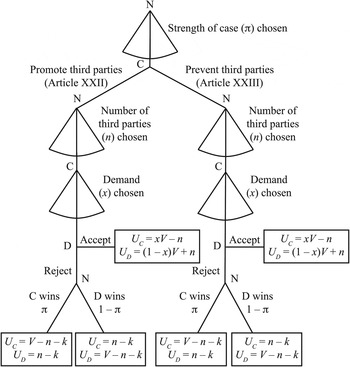
We assume that two states, a complainant and a defendant, are involved in a trade dispute. The defendant has previously taken some action that has caused injury to the complainant. We denote the value of such injury by V > 0. As Figure 1 shows, the game begins when Nature chooses the strength of the complainant's case, π .Footnote 60 This is the probability that the complainant wins the panel ruling if the disputants are unable to reach an early settlement. This probability is revealed only to the complainant and is her private information. The complainant then decides how to file her case. Filing under Article XXII (“promote”) leads to high levels of third party participation, while filing under Article XXIII (“prevent”) leads to low levels of third party participation. Nature chooses the number of third parties, n ≥ 0, based on the complainant's filing decision. A larger number of third parties is more likely when the complainant has filed under Article XXII (“promote”) than under Article XXIII (“prevent”).Footnote 61
Structure of the model

In prelitigation bargaining, the complainant demands, x ∈ [0,1], which is a share of the injury caused by the defendant's prior actions. If the defendant accepts the demand, then there is early settlement of the dispute. If the defendant rejects the demand, then the panel hears the case and issues a ruling. Both players must pay a litigation cost, k > 0, if the panel hears the case. The complainant wins with probability π and the defendant wins with probability 1–π. We restrict attention to a fully separating perfect Bayesian equilibrium.Footnote 62
The payoffs shown in Figure 1 reflect the role of third parties in providing insurance for disputants. If there is an early settlement, then third parties decrease the complainant's payoff and increase the defendant's payoff. If there is a panel ruling, then third parties decrease the winner's payoff but increase the payoff of the loser. The combination of these effects makes victories less valuable and losses less painful. Third parties serve as insurance: they mitigate risk by compensating the losing state at the expense of prevailing state.
Equilibrium Behavior and Comparative Statics
How does the size of the demand relate to the strength of the case? Our first finding is that the complainant's demand is always strictly increasing in the strength of her case. The more likely she is to prevail in panel proceedings, the more she demands in prelitigation negotiations. The defendant can always infer the strength of the complainant's case based on the size of her demand. After hearing the complainant's demand, the defendant is no longer uncertain about the likelihood that each disputant will prevail in panel proceedings.
Intuition might suggest that the defendant should be more likely to accept larger demands because he knows that stronger types are choosing these demands. However, the opposite effect must hold in order for an equilibrium to exist: larger demands must be rejected with a higher probability.Footnote 63 To understand why this must be true, suppose that large demands are more likely to be accepted. Then a complainant with a weak case has incentive to bluff by making larger demands. By asking for more, she would be more likely to receive this large settlement and less likely to go through litigation, which she believes she will lose. All types would have incentive to pretend as though they are stronger than they really are. Separation would not be possible since all types would want to make larger demands. In contrast, if larger demands are less likely to be accepted, then the implicit threat of litigation disciplines the complainant's demands in prelitigation negotiations. Weak types will not mimic the demands of stronger types because they know that this behavior is more likely to result in panel proceedings, which weak types want to avoid. This logic drives Proposition 1.
Proposition 1
The complainant's demand increases in the strength of her case, and the defendant is less likely to accept larger demands.
Next, we consider the impact of third parties on equilibrium demands. Recall that the defendant's early settlement payoff increases in the number of third parties. However, third parties have a mixed effect on the defendant's expected payoff from litigation: they increase the payoff from losing, but decrease the payoff from winning. As the number of third parties grows larger, the desirability of early settlement relative to litigation increases for the defendant. This increased willingness to settle allows the complainant to make larger demands. This behavior is summarized in Proposition 2.
Proposition 2
The complainant's demand increases in the number of third parties.
Since the complainant's demand reveals the strength of her case, the complainant's filing strategy (that is, her choice between Article XXII and XXIII) is not driven by an attempt to signal private information to the defendant, but instead represents her genuine preferences about the number of third parties. One effect of third parties is that they introduce ambiguity into legal rulings, which helps the loser and harms the winner. So the complainant has incentive to promote third parties if she has a weak case, and prevent third parties if she has a strong case. This leads to semi-separating behavior during the filing stage. Weak types will promote third parties by filing under Article XXII, while strong types will prevent under Article XXIII.
Proposition 3
The complainant promotes third parties if she has a weak case, and prevents third parties if she has a strong case.
The strength of a plaintiff's case has two major effects. First, it affects whether the complainant wins a panel ruling. The complainant is more likely to win a panel ruling if she has a strong case. Second, if affects the plaintiff's incentives to promote or prevent third parties, as stated in Proposition 3. Weak types value the insurance provided by third parties and will promote their participation. Strong types, which are unlikely to lose panel rulings, prevent third parties because their cost outweighs the benefit.
We assume that the complainant's filing decision and the number of third parties do not affect the panel ruling. Panelists rule solely on the basis of the strength of the complainant's case. Nonetheless, there is a relationship between the filing decision and the likelihood of a procomplainant ruling if a case proceeds to litigation. This relationship is not a causal one. Rather, weak types (who are unlikely to win a panel ruling) file under Article XXII, and strong types (who are likely to win) file under Article XXIII. This selection effect means that a complainant's observed decision about whether to promote third parties is a proxy for the unobservable strength of the complainant's case. Article XXII cases should thus be less likely to receive procomplainant rulings than Article XXIII cases.
Proposition 4
The complainant is less likely to win a panel ruling if she has promoted third parties than if she has prevented them.
Under the logic of Proposition 4, the decision about whether to promote third parties should be correlated with the outcome of panel rulings, even if third parties have no causal effect on how judges rule. However, third parties do have a causal effect on bargaining behavior. Early settlement is a key objective of the WTO. Proposition 2 shows that third parties increase the complainant's demand, and Proposition 1 shows that the defendant is less likely to accept larger demands. Third parties thus have a causal effect on the likelihood of early settlement: decreasing its probability.Footnote 64
Proposition 5
The probability of settlement decreases in the number of third parties.
We cannot actually observe the complainant's ex ante belief about the strength of her case. Similarly, we cannot observe the complainant's demand because bargaining in the WTO occurs behind closed doors. However, our theory suggests that a complainant with a stronger case demands more, and the defendant is more likely to reject this demand. If we hold constant the number of third parties, then there will be observable differences in Article XXII and XXIII settlement rates.
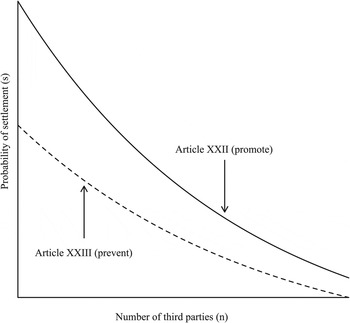
The legal literature suggests that Article XXII cases, which promote third party participation, should be less likely to end in early settlement than Article XXIII cases.Footnote 65 However, our model shows the opposite: Article XXII cases are more likely to end in early settlement than Article XXIII cases. This relationship is not created by a causal effect of filing decisions on settlement. Rather, it is caused by semi-separation in the filing strategy. Weak types promote third parties by filing under Article XXII, and choose smaller demands that the defendant is more likely to accept. Strong types prevent third parties by filing under Article XXIII, and choose larger demands that the defendant is less likely to accept. So filing decisions and settlement rates will be correlated when we control for the number of third parties. Proposition 6 summarizes this result, which is also shown in Figure 2.Footnote 66
Proposition 6
Cases that promote third parties (Article XXII) are more likely to end in early settlement than cases that prevent third parties (Article XXIII), conditional on the number of third parties.
Theoretical relationship between filing choices and early settlement

Robustness
Third parties in the WTO serve as insurance: participation reduces the difference between winning and losing a dispute. A complainant will thus seek to promote third parties when it expects to lose a panel ruling. Our argument differs markedly from the abundant literature on audience costs.Footnote 67 In these accounts, domestic audiences increase the difference between winning and losing a dispute. Rather than reducing risk, domestic audiences exacerbate risk during disputes. To examine this alternative, we constructed a model extension in which third parties generate audience costs rather than insurance. Not surprisingly, almost every result in this model extension was the exact opposite of the corresponding earlier result.Footnote 68 If third parties generate audience costs, then a complainant wants to promote third parties when it expects to win a panel ruling. The empirical results that follow contradict every observable implication of an audience cost model of WTO disputes. This makes us confident that the mechanism driving participation at the elite level in the WTO differs from standard arguments about the impact of domestic audiences during crisis bargaining.
One explanation for such relationships is that international judges may strategically alter their rulings in response to anticipated reactions by member-states. If international judges dislike noncompliance with their rulings, then they will be biased against unpopular legal positions. Our model does not allow for the possibility of judicial bias. We assume that the panel ruling is determined solely by the merit of legal claims, and not by third party participation. Nonetheless, it is worth asking whether our model results are robust to the inclusion of judicial bias. We constructed a model extension in which third parties directly influence both bargaining payoffs and panel rulings. Namely, we assumed that more third parties increase the probability that the complainant wins a panel ruling. The results of this extension match most of our findings: judicial bias does not invalidate our arguments.Footnote 69 Our simpler model—in which the number of third parties does not influence judges—shows a correlation between third party participation and panel outcomes. Strikingly, strategic behavior by disputants can generate the perception of judicial bias, even if judges are not biased in their decision making.Footnote 70 Our theoretical model and empirical analysis show that an empirical relationship between third party participation and the direction of panel rulings does not imply that third parties have a causal effect on rulings.
Another alternative is that perhaps third parties are more likely to support the litigant with the stronger case, and judges are more likely to rule in favor of the side with more support.Footnote 71 So if a weak complainant promotes third parties, then the third parties support the defendant. A weak complainant will benefit from insurance, because third parties will introduce ambiguity into the ruling, but the complainant will be less likely to win the court ruling. Similarly, if a strong complainant promotes third parties, then the third parties support the complainant. This insurance will be costly to a strong complainant, but the complainant will be more likely to win the court ruling. For high-value disputes, the impact of third parties on judicial rulings will outweigh their impact on insurance. So weak complainants will prevent while strong cases will promote. Our empirical analysis does not yield support for this account. Rather, our findings demonstrate that weak complainants promote third parties while strong complainants prevent.
Under WTO law, third parties can also join a case after consultations end and before the case goes to panel. Yet this is a rare occurrence: Busch and Reinhardt mention that only four out of the 507 cases of third party involvement corresponded to third parties that joined at the panel stage, without having previously joined at the start of consultations.Footnote 72 Nonetheless, we show in a model extension that our results hold if we allow additional third parties to join after negotiations and before the panel ruling.
Empirical Implications
Not all of these hypotheses are testable in the context of the WTO. Prelitigation bargaining is private, so we cannot observe demands. This rules out quantitative tests of Propositions 1 and 2. However, our model generates hypotheses about three observable aspects of state behavior: filing decisions, whether an early settlement is reached, and the direction of panel rulings. We can conduct empirical tests of Propositions 4 to 6. We cannot observe a complainant's ex ante belief about the strength of her case, so we cannot directly test Proposition 3. However, if panel rulings are more likely to be appealed when the loser has a stronger case, then examining the relationship between filing decisions and appeal rates provides an indirect test—or at least a plausibility check—of Proposition 3. These tests of Propositions 3 to 6 allow us to assess the explanatory power of our theoretical model.
Empirics
We test the implications of our theory on a data set of all available WTO disputes. These data cover 423 disputes for which we have full data. The actual sample number is somewhat lower, mostly because disputes by multiple complainants, though formally distinct, are dealt with in the same proceedings, and thus constitute a single dispute for our purposes.Footnote 73 For the most part, our sample is thus constituted of 386 observations. The data on third parties come from Busch and Reinhardt, which we update using the data from Horn and Mavroidis, hosted by the World Bank, and data from the WTO itself for post-2008 cases, up to the present day.Footnote 74
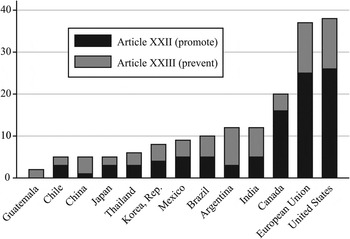
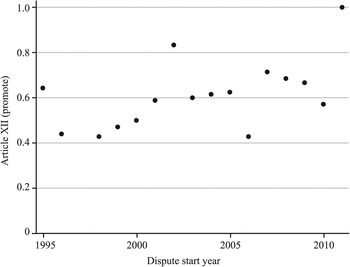
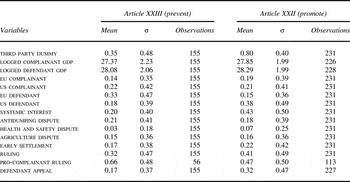
It is useful to note that the decision over whether to file in a way that promotes or prevents third parties is not reducible to variation in fixed country preferences. On average, countries promote audiences in 59 percent of cases, and few countries stray far from this mean. Table 1 shows that richer complainants do not appear significantly more or less likely to file under Article XXII than poorer complainants. Similarly, key members such as the United States or the EU do not seem to be more or less in favor of promoting audiences. The only notable outliers in this respect are China, which filed four out of five of the disputes it has initiated under Article XXIII, by preventing audiences, and Canada, which filed 80 percent of its twenty disputes by promoting audiences under Article XXII. These country differences are illustrated in Figure 3, which shows the breakdown of promote/prevent decisions across all complainants that have filed five or more disputes. Disputes that are filed simultaneously by multiple complainants similarly do not exhibit any significant relationship with the filing method.Footnote 75 Indeed, the only pattern we can observe is a slight growing tendency toward promoting audiences through time, as shown in Figure 4. This may reflect growing acceptance of the role of third parties in dispute settlement. These preliminary observations suggest that except for a discernible time trend, the decision over whether to promote or prevent audiences does not appear to reflect fundamental country preferences. As we argue, it is more likely to be driven by strategic behavior, in accordance with the case at hand.
Filing choices (promote versus prevent) across countries

Filing choices (promote versus prevent) through time

Summary statistics by filing decision (prevent versus promote)

Early Settlement
Here, we test the empirical implications of our model, following the order in which they present themselves through the stages of a WTO dispute. We thus begin by testing hypotheses about the odds of early settlement. Recall that Proposition 5 shows that the greater the number of third parties, the lower the odds of settlement. Moreover, Proposition 6 makes a counterintuitive claim: filing under Article XXII—which increases the number of third parties—should be associated with greater odds of early settlement.
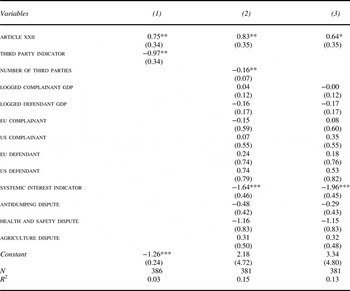
We test these formal results in Table 2 using a rare-events logit model, which is the right model to use given our small sample, and relatively rare positive outcome. Our dependent variable is a dummy coded as 1 if the disputants reached any form of settlement short of a panel ruling, and 0 otherwise. Our definition of settlement here is stringent: we define early settlements as those cases where both parties reached a “mutually agreeable solution,” and communicated it as such to the membership.Footnote 76 This does not include disputes where the complainant simply dropped the case before a panel, or even those disputes where an ostensible solution was reached behind closed doors, but never conveyed to the membership as such. Such cooperative early settlements make up only 21 percent of all dispute outcomes. Yet as we show when estimating the first stage of panel and appeal outcomes, these results hold if our definition of early settlement is defined in a less conservative fashion, that is, as any dispute that does not reach a ruling.
How does preventing versus promoting third parties affect settlement?

Notes: Rare-events logit estimation, robust standard errors clustered on dispute combined in parentheses. * p < .10; ** p < .05; *** p < .001.
Our main explanatory variable indicates the way in which a case has been filed. This variable—named article xxii—is coded as 1 if the complainant filed the case under Article XXII (“promote”), and 0 if it was filed under Article XXIII (“prevent”). The coding of this central variable is straightforward: all complainants must indicate their method of filing in the request for consultations, which forms the first document of any dispute. We begin by showing a parsimonious estimation in the first column. Here, we include only one additional variable on the right-hand side, a third party dummy coded as 1 if any third parties were present, and 0 otherwise.
In the remaining two columns in Table 2, we verify that our results are robust to additional controls, and the removal of all third party indicators. We begin by expanding the third parties variable to a full count variable, number of third parties, which we code using the WTO documents relevant to each dispute. We control for the logged gross domestic product (GDP) of the complainant and defendant, using World Development Indicators data, since market size may matter in decisions to settle or litigate. We include dummy variables for the participation of either superpower as either the complainant or the defendant, since the literature suggests that deterrence and the risk of retaliation may drive dispute outcomes. We also include an indicator of systemic disputes, which are disputes in which at least one third party joined by citing a systemic interest, rather than a substantive trade interest. This latter control is a useful proxy for the implications of the dispute on WTO jurisprudence, and is coded by going through each third party's request to join the dispute. Finally, we include indicator variables for what many consider to be the three most politically sensitive issue-areas in the regime: antidumping disputes, which cover the most widespread trade remedy in the WTO; sanitary and phytosanitary (SPS) issues, or health and safety disputes, which rely on controversial and evolving scientific standards, such as in the EC—Hormones dispute; and agriculture disputes, which have long been thought of as the single-most sensitive issue in the trade regime. A dispute concerns one of these issues if, and only if, the complainant refers to the relevant agreement in its request for consultations. The estimates for all these control variables are shown in the second column of Table 2.
In the third and last column of Table 2, we look at how the Article XXII variable behaves without any third party controls. Since Article XXII is highly correlated with the number of third parties, this amounts to testing the relative strength of the two variables. In this, as in other estimations in the analysis, we cluster robust standard errors on the common dispute number.Footnote 77
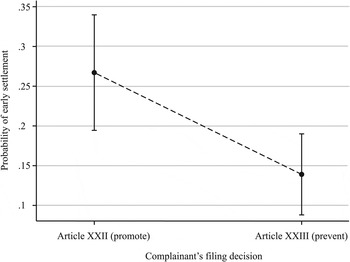
The results from Table 2 offer strong support for our theoretical expectations. First, as suggested by the literature and our model, third parties appear to be strongly negatively associated with the odds of settlement in both the first and second columns. More interestingly, the invocation of Article XXII (“promote”) has a strong positive association with the odds of settlement. The intuitive claim advanced by legal scholars such as Porges, to the effect that Article XXII cases—which promote large audiences—should have the same effect on odds of settlement as greater audiences do, turns out to be exactly wrong.Footnote 78 Article XXII cases are associated with higher odds of settlement, and this relationship is substantively significant. If we set all variables, including the number of third parties, at their sample means, then the odds of observing early settlement nearly doubles when a complainant invokes Article XXII rather than Article XXIII, jumping from 13.9 to 27.0 percent. Figure 5 illustrates this effect with 95 percent confidence intervals.
Predicted probability of settlement, by filing choice

Few other variables show any significant effect on the odds of settlement, with the exception of systemic interest. Disputes of systemic interest are associated with significantly lower odds of early settlement. The rare-events logit model as a whole does an admirable job predicting early settlement, correctly predicting 82 percent of cases.
Finally, in the third column of Table 2, we show that the significance of Article XXII does not rely on controlling for the number of third parties. However, the effect of Article XXII drops slightly in magnitude and significance, as expected given its relationship to the number of third parties. This continued significance suggests that the selection effect represented by the filing choice trumps third parties' direct effect on settlement odds.
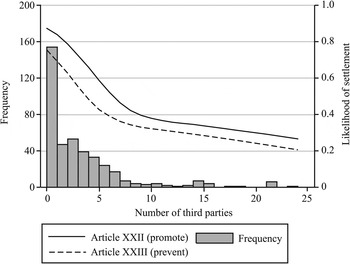
When we add a squared third parties count term (not shown), it is consistently positive, and considerably reduces the effect of the original third parties count variable, suggesting nonlinearity in the effect of third parties on settlement, as per Figure 2. To offer a better sense of this nonlinearity, and of the differential impact of Article XXII versus Article XXIII, we graph this empirical relationship in Figure 6. The two curves correspond to filings under the two respective articles, and are overlaid on a histogram indicating frequency of third party counts across the WTO caseload. What Figure 6 tells us is that past eight third parties, the marginal effect on settlement of an additional country sharply decreases. Yet as can be read from the frequency histogram, there are also few disputes that go beyond this number. Figure 6 graphically shows that Article XXII cases are systematically more likely to result in settlement than Article XXIII cases.
Empirical relationship between filing choices and early settlement

Direction of the Panel Ruling
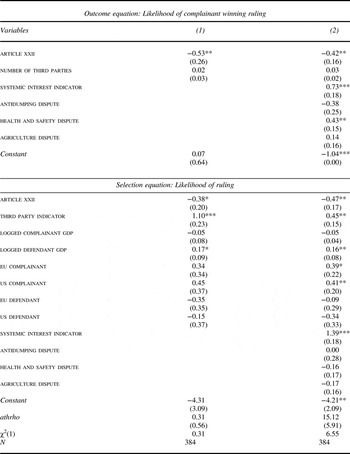
Our next set of expectations, from Proposition 4, bears on the panel stage. If third parties serve as insurance, then our theory implies that complainants who invoke Article XXII (promote) will be less likely to win at the panel stage, conditional on reaching the verdict stage.
We are cognizant of the possible selection bias in directly estimating the effect of Article XXII on the direction of the ruling since, as Table 2 shows, filing decisions affect the odds of early settlement, and thus, by extension, the likelihood of seeing a ruling in the first place. We run a two-stage Heckman probit model to control for this selection effect, where the first stage estimates the odds of a given dispute making it to a ruling.
The dependent variable in the second stage is a measure of whether or not a panel has ruled in favor of the complainant. Examining the panel report for every dispute in our sample that produced a ruling, we collect original data on panel verdicts, where we code the number of claims that have been ruled on by each panel, and how many of these are found in favor of either the complainant or the defendant. The underlying premise that all claims are of equal importance is unlikely to be true, yet this remains as good a measure as can be consistently collected about the overall direction of the ruling, and useful to the task at hand. We use the resulting ratio to code what constitutes a favorable ruling. There is a well-established procomplainant bias at the WTO—as a result, we consider rulings as a win for the complainant if the panel finds 90 percent or more of the claims in favor of the complainant.
Our identification strategy is based on the belief that while complainant and defendant characteristics should matter in the first stage, which relies on countries' decisions, they should not affect the second stage, which relies on the decisions of judges whose function it is to rule objectively on the merits of the case. It is useful to recall that panelists are never drawn from among the countries participating as either litigants or third parties. Although work on legal capacity has shown that capacity affects decision to file and to settle, there is little evidence that it affects the odds of winning a case.Footnote 79 Our own sample confirms this: we find no significant relationship between market size of litigants, or the EU/United States playing either role, and the odds of favorable panel rulings.Footnote 80
We begin by offering a more parsimonious model in the first column of Table 3: the second stage includes only our right-hand-side variable of interest, article xxii, and the number of third parties. In the first stage, we include the same variables, with third parties as an indicator variable, and our identifying variables, corresponding to the market size of the complainant or defendant, and US and EU indicator variables. Then, in the second column, we add issues-area variables, and the systemic interest indicator, in both stages.
How does preventing versus promoting third parties affect panel rulings?

Notes: Heckman probit estimation. Robust standard errors in parentheses. * p < .10; ** p < .05; *** p < .001.
The selection stage results parallel—or rather, mirror—our earlier findings about the odds of settlement. Note that this is not a trivial result, since as we specified, rulings, which occur in only 35 percent of cases in our sample, are not the complement of early settlement, which we defined earlier according to a strict definition that pertained to 21 percent of cases. As a result, this amounts to another test of the impact of Article XXII and third parties, this time on the most liberal definition of early settlement.Footnote 81 The presence of third parties makes rulings strongly more likely, while the invocation of Article XXII, which promotes their presence, is associated with significantly less likely rulings. Disputes where systemic interests are cited by third parties are significantly more likely to see a ruling, as are disputes with a large defendant market. Additionally, both EU and US complainants appear more likely to litigate.
As per our theoretical expectations, filing under Article XXII has a negative association with the likelihood of a procomplainant ruling. This supports Propositions 3 and 4: if third parties act as insurance, Article XXII filings should be associated with cases with less legal merit, which comes across in the ruling direction. On average, these cases result in demonstrably less favorable verdicts for the complainant. This association is substantively important: using the second column estimation, and keeping all other variables at their sample mean, the odds of obtaining a procomplainant ruling drop from 23.0 to 12.3 percent when complainants file by invoking Article XXII (promote) instead of Article XXIII (prevent).
Additionally, issues of systemic importance appear to be more likely to favor the complainant, and panels appear to rule more favorably on health and safety (SPS) disputes. But the most important finding remains the strong association between filing method and verdict outcome, and how it conforms to our expectations: Article XXII cases are less likely to be ruled in favor of the complainant, controlling both for the underlying selection and other variables of interest.
Appeals
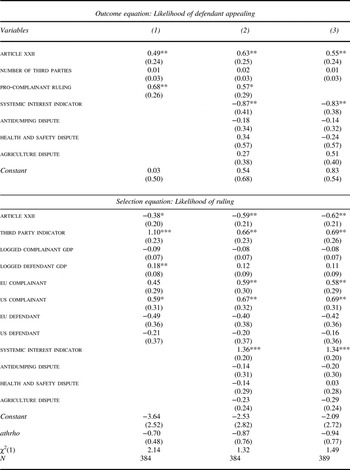
Finally, as an ancillary test of our models, we consider the impact of filing decisions on the odds of panel rulings being appealed. Recall that in our theory, the complainant promotes audiences if she has a relatively weak case. This means that the defendant has a relatively strong case if the complainant files under Article XXII. A strong case is more likely to win the panel ruling than a weak case. However, rulings are stochastic in the model: we allow for the fact that with some small probability, a strong case will lose and a weak case will win—the very existence of the Appellate Body testifies to this possibility. Our formal model does not explicitly consider appeals to panel rulings. Nevertheless, it stands to reason that a disputant who has a strong case is more likely to appeal a ruling than a disputant with a weak case. So the logic of the insurance model suggests that cases filed under Article XXII should be more likely to be appealed by the defendant (who has a strong case), and less likely to be appealed by the complainant (who has a weak case). We are able to test the implication about defendant appeals using a Heckman probit model. By comparison, we are less able to test the implication about complainant appeals, since these are rare within the data.
Note that we do not restrict the data in the second stage to only those cases where the panel ruled wholly in favor of the complainant, since defendants may, and often do, appeal a ruling—even if it was in their favor—to have the Appellate Body modify a legal interpretation, or emit an even stronger verdict. However, since procomplainant rulings should logically be more likely to be appealed by defendants (regardless of the strength of the defendant's case), we control for these in the second stage.
To control for possible selection effects, we first estimate the odds of a ruling being handed down, and then use those estimates to consider the odds of appeal in Table 4. In other words, we follow an identical strategy to Table 3. The only difference is that in the first two columns, we include the indicator of procomplainant rulings in the second stage. This variable is identical to the dependent variable in the first stage of Table 3. In the third column, we remove this variable to ensure that our results are not dependent on it, thus exactly replicating the second model in Table 3, this time with appeals as the outcome of interest.
How does preventing vs. promoting third parties affect defendant appeals?

Notes: Heckman probit estimation. Robust standard errors clustered on dispute combined in parentheses. * p < .10, ** p < .05, *** p < .001.
The findings are striking. Apart from the coefficient on procomplainant rulings, which, as expected, has a significant positive effect on the odds of the panel decision being appealed by the defendant, Article XXII is one of only two explanatory variables with any significant impact on the decision to appeal. In accordance with our theory, the defendant is significantly more likely to appeal a panel ruling if the complainant files under Article XXII. Additionally, only systemic interest disputes show any significant effect: these appear less likely of being appealed. Finally, in the third column estimation, we show that our results do not depend on the inclusion of the procomplainant ruling variable, though the theoretical justification for including it is strong. As for the first stage, it looks identical to that of Table 3, with small differences because of the sample size.
In this way, filing choices that are driven by the strength of the case allow us to account for an event that is notoriously hard to predict, and that often occurs years after the initial filing choice.Footnote 82 The observable implications of our model hold from the start of a dispute to its very end.
Implications
The benefit of technocratic bodies, such as courts and bureaucracies, is that they can act as what Burley and Mattli aptly call a “mask for politics”: they defuse political conflict by channeling decision making into a realm that relies on stand-alone principles. As a result, “it is possible to reach outcomes that would be impossible in the political arena.”Footnote 83 While this may make institutions more effective overall, in any given instance political actors on the losing end will find it in their interest to repoliticize the issue. The means of doing so invariably call into question the legitimacy of the technocratic body: by their very nature, functionalist domains such as legal and regulatory settings tend to score low on inclusiveness, transparency, and democratic deliberation.
Consider the case of genetically modified organisms (GMOs) in Europe. In the late 1990s, scientists and EU regulators moved toward greater acceptance of GMOs. This harmed European farmers who were not among the early adopters of GMOs. European interest groups began to denounce the democratic deficit of EU decision making, and to push for greater pluralism. They sought to remove GMOs from the technical regulatory domain, by politicizing the underlying issue. As Pellizzoni noted, “the issue of GMOs offers a test case of … a shift from technical to political framing, from a question entrusted to expert advisory bodies to a highly politicised controversy that involves many actors claiming the relevance of a number of neglected aspects.”Footnote 84 Since the status quo ante was unfavorable, eliciting a plurality of views could only help, and not hinder, anti-GMO interests. Pluralism injected ambiguity into the previous regulatory consensus, and this favored European producers.
Europeans farmers had tolerated the exclusionary nature of the EU regulatory bodies until the growing acceptance of GMOs among regulators relying on scientists grew unfavorable to them. At that point, they began trying to increase participation and sought to bring GMOs into the political realm. Broader participation served as insurance: it was undesirable when the farmers expected to “win” under the regulatory body, and beneficial when the farmers expected to “lose.”
We can expect a similar dynamic to play out at the international level. Consider the clash between free trade and competing social objectives. A current issue in this long-standing debate is whether countries can protect goods that achieve a social objective, such as environmental sustainability or high labor standards. For example, can a country give more favorable treatment to an imported T-shirt if it was made using sustainable cotton by workers with protected rights?Footnote 85 The EU is generally in favor of this possibility, while the United States is generally not. The United States prefers to conduct negotiations over such questions in the Technical Barriers to Trade (TBT) Committee, which is relatively exclusionary and does not allow participation by nonstate actors, such as environmental and labor NGOs. In contrast, the EU and its allies have been pushing to move these negotiations to a more open forum, such as the Committee on Trade and Environment, that allows for easier participation by nonstate actors.Footnote 86
Increasing participation is not without risks, even for the parties seeking it. If environmental groups are given a greater role in the WTO, then industry groups with differing views may seek the same right. Broader participation does not necessarily entail that all new participants will support the losing side. But it does ensure that a greater range of voices are heard, and shifts the debate from a technocratic setting back to a political one. On average, such a shift will favor countries that expect to lose under current rules, and disfavor countries that expect to prevail.
Conclusion
Third parties create insurance in WTO disputes, lowering the benefit of winning and the cost of losing a dispute. If there is early settlement, third parties are costly for the complainant, since concessions by the defendant must be distributed among more states. However, third parties benefit the defendant in an early settlement because they make subsequent cases, strengthened by precedent, less likely. If a dispute proceeds to litigation, third parties generate ambiguity that affects members' perception of the ruling. This helps the loser and harms the winner. In the absence of third parties, panel rulings are interpreted in a legalistic fashion. However, the presence of third parties can reduce the normative force of a ruling, which discounts both the benefits of winning and the costs of losing, relative to a case without third parties.
Because third parties generate insurance, a complainant's filing choice will depend on the strength of her case. If the complainant expects to win a panel ruling, then third parties are likely to harm her. If the complainant expects to lose a panel ruling, then third parties are likely to help. A complainant will thus promote participation by filing under Article XXII when she has a weak case, and prevent participation by filing under Article XXIII if she has a strong case. Conditional on a panel ruling, complainants who promote are less likely to win than those who prevent. Weaker complainants make smaller demands, which the defendant is more likely to accept. So if we hold the number of third parties constant, Article XXII cases are more likely to reach early settlement than Article XXIII cases. This relationship is created by differences in the behavior of weak and strong complainants, not a causal effect. However, third parties do have a causal effect on the likelihood of settlement. As the number of third parties grows larger, the complainants make larger demands, and the defendant is less likely to accept.
We test our theory by examining early settlement and the direction of panel rulings for all WTO disputes from 1995 to 2011. As an ancillary test, we also examine Appellate Body rulings. Our empirical results support our theory across all dispute stages. Cases where the complainant promotes participation (Article XXII cases) are more likely to settle, less likely to win the panel ruling, and more likely to be appealed by the defendant.
Our argument and evidence counter audience costs theories of international relations. We do not offer an analysis of when our mechanism will prevail, but institutional attributes may affect the role of audiences in international organizations. Most audience cost models are motivated by the impact of domestic audiences. These audiences can reward or punish a leader beyond the crisis in question. In WTO disputes, the audience is other states. If domestic interest groups were allowed in the room, increasing participation would probably exacerbate risk by making both wins and losses more acute.
The participation-as-insurance argument has considerable reach beyond the particular institution we examine. Functional areas such as legal or regulatory domains derive their effectiveness from operating in a political vacuum. Yet actors who stand to “lose” in these technocratic settings will benefit from repoliticizing the underlying issue. Participation is thus a strategic factor that states can try to manipulate to gain political advantage. The result—wider participation—may come at a cost to the effectiveness of the institution as a whole.
In closing, it is worth noting which views our findings allow us to reject. The even distribution of Articles XXII and XXIII filings across countries and development levels suggests that filing decisions are not driven by intrinsic country attitudes toward participation or transparency. The choice of whether to promote or prevent participation in an international organization is fundamentally strategic and driven by the particular circumstances of the case at hand.
Appendix
Let x(π, n) denote a demand by type π given n third parties. Let s(x) denote the probability that the defendant accepts x. Suppose π is distributed with full support over [π
L
, π
H
] according to density f, where 0 < π
L
<
 ${\textstyle{1 \over 2}}$
< π
H
< 1. For ease of exposition, assume: n is continuous; if the complainant prevents, n ~ U[n
L
, n
L
+ η]; and if the complainant promotes, n ~ U[n
H
, n
H
+ η] where 0 < n
L
< n
H
< n
L
+ η < n
H
+ η. All results hold if n is discrete (results available from the authors). Finally, to ensure that each player always prefers winning the ruling to losing, we assume: 2(n
H
+ η) < V. We first derive our fully separating equilibrium and then prove Propositions 1 to 6.
Define the minimal equilibrium offer by
 ${x_L^{\ast} \equiv {x^{\ast}}({\pi _L},{n_L})}$
and the maximum equilibrium offer by
 ${x_H^{\ast} \equiv {x^{\ast}}({\pi _H},{n_H} + \eta )}$
.
Lemma 1
For large V, there exists a fully separating equilibrium in which:
-
• the complainant promotes if
 ${\pi \lt \tilde \pi}$
, prevents if
${\tilde \pi \le \pi}$
, and
${\tilde \pi \in ({\pi _L},{\pi _H})}$
;
-
• the complainant demands
${x^{\ast}(\pi, n) = \pi + \textstyle{{2n(1 - \pi ) + k} \over V}}$
; and -
• the defendant settles with probability
${s^{\ast}}(x) = {\rm exp}\left( {{\textstyle{{ - \left( {x - x_L^{\ast}} \right)V} \over {2k}}}} \right)$
for
$x \in \left[ {x_L^{\ast},x_H^{\ast}} \right]$
;
${{s^{\ast}}(x) = 1}$
for
${x \lt x_L^{\ast}}$
and
${{s^{\ast}}(x) = 0}$
for
${x \gt x_H^{\ast}}$


Proof of Lemma 1
Conditional on x, the defendant will play a mixed strategy if and only if:
 $$\eqalign{ \lpar 1 - x\rpar V + n &= \lpar 1 - \pi \rpar V - n\lpar 1 - 2\pi \rpar - k \cr & \quad \Leftrightarrow {x^{\ast}}\lpar \pi \comma \; n\rpar = \pi + \displaystyle{{2n\lpar 1 - \pi \rpar + k} \over V}}\eqno(1)$$
This is always an interior value for large V. Let T C (π, n) denote the complainant's expected utility from litigation. The complainant's expected utility from x is:
 $$\eqalign{& E{U_C}\lpar x\vert \pi \comma \; n\rpar = s\lpar x\rpar \lpar xV - n\rpar + \left[{1 - s\lpar x\rpar } \right]{T_C}\lpar \pi \comma \; n\rpar \cr & \quad \Rightarrow \displaystyle{{\partial E{U_C}\lpar x\vert \pi \comma \; n\rpar } \over {\partial x}} = s\lpar x\rpar V + s^{\prime}\lpar x\rpar \lpar xV - n\rpar - s^{\prime}\lpar x\rpar {T_C}\lpar \pi \comma \; n\rpar = 0 \cr & \quad \Leftrightarrow x = \displaystyle{{{T_C}\lpar \pi \comma \; n\rpar + n} \over V} - \displaystyle{{s\lpar x\rpar } \over {s^{\prime}\lpar x\rpar }}}\eqno(2)$$
Both (1) and (2) must hold in equilibrium, so:
 $$\eqalign{\pi + \displaystyle{{2n\lpar 1 - \pi \rpar + k} \over V} &= \displaystyle{{{T_C}\lpar \pi \comma \; n\rpar + n} \over V} - \displaystyle{{s\lpar x\rpar } \over {s^{\prime}\lpar x\rpar }} \cr \Leftrightarrow \left({\displaystyle{{2k} \over V}} \right)s^{\prime}\lpar x\rpar &= - s\lpar x\rpar \cr \Rightarrow {s^{\ast}}\lpar x\rpar &= {\rm exp}\left({\displaystyle{{ - xV} \over {2k}} + \Gamma} \right)}$$
This is always an interior value if and only if
 $\Gamma \le {\textstyle{{x_L^{\ast}V} \over {2k}}}$
. Bayes' Rule does not constrain the defendant's beliefs when the complainant makes an off-the-equilibrium-path demand. We assume that the defendant always accepts very low off-the-equilibrium-path demands
 ${(x \lt x_L^{\ast})}$
and rejects very high off-the-equilibrium-path demands
 ${(x \gt x_H^{\ast})}$
. No type of player ever has incentive to deviate upwards to a demand
 ${x \gt x_L^{\ast}}$
, and no type of player ever has incentive to deviate downwards to a demand
 ${x \lt x_L^{\ast}}$
if and only if
 $\Gamma = {\textstyle{{x_L^{\ast} V} \over {2k}}}$
.
The complainant's expected utility from the bargaining and litigation subgame is:
 $$\eqalign{{B_C}\lpar \pi \comma \; n\rpar & = {s^{\ast}}\left({{x^{\ast}}\lpar \pi \comma \; n\rpar } \right)\left[{{x^{\ast}}\lpar \pi \comma \; n\rpar V - n} \right]+ \left[{1 - {s^{\ast}}\left({{x^{\ast}}\lpar \pi \comma \; n\rpar } \right)} \right]{T_C}\lpar \pi \comma \; n\rpar \cr \quad &= \pi V + n\lpar 1 - 2\pi \rpar - k + 2k \;{\rm exp}\left({\displaystyle{{ - \left[{{x^{\ast}}\lpar \pi \comma \; n\rpar - x_L^{\ast}} \right]V} \over {2k}}} \right)}$$
 $$\eqalign{\displaystyle{{\partial {B_C}\lpar \pi \comma \; n\rpar } \over {\partial n}} &= 1 - 2\pi - 2\lpar 1 - \pi \rpar {\rm exp}\left({\displaystyle{{ - \left[{{x^{\ast}}\lpar \pi \comma \; n\rpar - x_L^{\ast}} \right]V} \over {2k}}} \right)\cr &\Rightarrow \mathop {lim}\limits_{V \to \infty } \displaystyle{{\partial {B_C}\lpar \pi \comma \; n\rpar } \over {\partial n}} = 1 - 2\pi \gt 0 \Leftrightarrow \pi \lt \displaystyle{1 \over 2}}$$
Recall that
 ${\pi _L} \lt {\textstyle{1 \over 2}} \lt {\pi _H}$
. So for large V, type π
L
promotes and type π
H
prevents. Define:
 $$\eqalign{ \Delta \lpar \pi \rpar &\equiv E{U_C}\left({{\rm promote}\vert \pi } \right)- E{U_C}\left({{\rm prevent}\vert \pi } \right)\cr & = \mathop \int\limits_{{n_H}}^{{n_H} + \eta } \, {B_C}\lpar \pi \comma \; n\rpar \;f\left({n\vert {\rm promote}} \right)dn - \mathop \int\limits_{{n_L}}^{{n_L} + \eta } \, {B_C}\lpar \pi \comma \; n\rpar f\left({n\vert {\rm prevent}} \right)dn \cr & = \displaystyle{1 \over \eta }\left[{\mathop \int\limits_{{n_L} + \eta }^{{n_H} + \eta } \, {B_C}\lpar \pi \comma \; n\rpar dn - \mathop \int\limits_{{n_L}}^{{n_H}} \, {B_C}\lpar \pi \comma \; n\rpar dn} \right]}$$
By above, Δ(π
L
) > 0 and Δ(π
H
) < 0 for large V. By the intermediate value theorem, there exists a type
 ${\tilde \pi \in ({\pi _L},{\pi _H})}$
such that
 ${\Delta (\tilde \pi ) = 0}$
. To have an equilibrium in which all types
 ${\pi \lt \tilde \pi}$
promote and all types
 ${\tilde \pi \lt \pi}$
prevent, we must show that
 ${\tilde \pi}$
is unique:
 $$\eqalign{\displaystyle{{\partial \Delta \lpar \pi \rpar } \over {\partial \pi }} & = \displaystyle{1 \over \eta }\left[{ \mathop \int\limits_{{n_L} + \eta }^{{n_H} + \eta } \, \displaystyle{{\partial {B_C}\lpar \pi \comma \; n\rpar } \over {\partial \pi }}dn - \mathop \int\limits_{{n_L}}^{{n_H}} \, \displaystyle{{\partial {B_C}\lpar \pi \comma \; n\rpar } \over {\partial \pi }}dn} \right]\cr & = \displaystyle{1 \over \eta }\left\{{ \mathop \int\limits_{{n_L} + \eta }^{{n_H} + \eta } \, \lpar V - 2n\rpar \left[{1 - {\rm exp}\left({\displaystyle{{ - \left[{{x^{\ast}}\lpar \pi \comma \; n\rpar - x_L^{\ast}} \right]V} \over {2k}}} \right)} \right]dn} \right. \cr & \quad \quad \left. { - \mathop \int\limits_{{n_L}}^{{n_H}} \, \lpar V - 2n\rpar \left[{1 - {\rm exp}\left({\displaystyle{{ - \left[{{x^{\ast}}\lpar \pi \comma \; n\rpar - x_L^{\ast}} \right]V} \over {2k}}} \right)} \right]dn } \right\}\cr & \Rightarrow \mathop {lim}\limits_{V \to \infty } \displaystyle{{\partial \Delta \lpar \pi \rpar } \over {\partial \pi }} \lt 0}$$
So for large V,
 ${\tilde \pi}$
is unique.
Proof of Proposition 1
 $$\eqalign{\displaystyle{{\partial {x^{\ast}}\lpar \pi \comma \; n\rpar } \over {\partial \pi }} & = 1 - \displaystyle{{2n} \over V} \gt 0 \cr \displaystyle{{\partial {s^{\ast}}\lpar x\rpar } \over {\partial x}} & = - {\rm exp}\left({\displaystyle{{ - \left({x - x_L^{\ast}} \right)V} \over {2k}}} \right)\left({\displaystyle{V \over {2k}}} \right)\lt 0}$$
Proof of Proposition 2
 $$\displaystyle{{\partial {x^{\ast}}\lpar \pi \comma \; n\rpar } \over {\partial n}} = \displaystyle{{2\lpar 1 - \pi \rpar } \over V} \gt 0$$
Proof of Proposition 3
Follows directly from Lemma 1.
Proof of Proposition 4
 $$\eqalign{E\left[{\pi \vert {\rm promote}} \right]&= \mathop \int\limits_{{\pi _L}}^{\tilde \pi } \, \pi f\left({\pi \vert {\rm promote}} \right)d\pi \cr E\left[{\pi \vert {\rm prevent}} \right]&= \mathop \int\limits_{\tilde \pi }^{{\pi _H}} \, \pi f\left({\pi \vert {\rm prevent}} \right)d\pi \cr & \Rightarrow E\left[{\pi \vert {\rm promote}} \right]\lt E\left[{\pi \vert {\rm prevent}} \right]}$$
Proof of Proposition 5
 $$\eqalign{\displaystyle{{\partial {s^{\ast}}\left({{x^{\ast}}\lpar \pi \comma \; n\rpar } \right)} \over {\partial n}}&= -{\rm exp}\left({\displaystyle{{ - \left[{{x^{\ast}}\lpar \pi \comma \; n\rpar - x_L^{\ast}} \right]V} \over {2k}}} \right)\left({\displaystyle{{1 - \pi } \over k}} \right)\lt 0 \cr \displaystyle{{{\partial ^2}{s^{\ast}}\left({{x^{\ast}}\lpar \pi \comma \; n\rpar } \right)} \over {\partial {n^2}}} &= {\rm exp}\left({\displaystyle{{ - \left[{{x^{\ast}}\lpar \pi \comma \; n\rpar - x_L^{\ast}} \right]V} \over {2k}}} \right)\mathop {\left({\displaystyle{{1 - \pi } \over k}} \right)}\nolimits^2 \gt 0}$$
Proof of Proposition 6
Recall that π is distributed according to density f on [π L , π H ].
Conditional on n:
 $$\eqalign{{s^{\ast}}\left({{x^{\ast}}\left({{\rm promote}\vert n} \right)} \right)&= \mathop \int\limits_{{\pi _L}}^{\tilde \pi } \, {s^{\ast}}\left({{x^{\ast}}\left({\pi \comma \; n} \right)} \right)\;f\left({\pi \vert {\rm promote}} \right)d\pi \cr {s^{\ast}}\left({{x^{\ast}}\left({{\rm prevent}\vert n} \right)} \right)&= \mathop \int\limits_{\tilde \pi }^{{\pi _H}} \, {s^{\ast}}\left({{x^{\ast}}\left({\pi \comma \; n} \right)} \right)\;f\left({\pi \vert {\rm prevent}} \right)d\pi \cr \displaystyle{{\partial {s^{\ast}}\left({{x^{\ast}}\left({\pi \comma \; n} \right)} \right)} \over {\partial \pi }} & = - {\rm exp}\left({\displaystyle{{ - \left[{{x^{\ast}}\lpar \pi \comma \; n\rpar - x_L^{\ast}} \right]V} \over {2k}}} \right)\left({\displaystyle{{V - 2n} \over {2k}}} \right)\lt 0 \cr & \Rightarrow {s^{\ast}}\left({{x^{\ast}}\left({{\rm promote}\vert n} \right)} \right)\gt {s^{\ast}}\left({{x^{\ast}}\left({{\rm prevent}\vert n} \right)} \right)}$$
Supplementary material
Replication data are available at http://dx.doi.org/10.1017/S0020818314000241.