I. INTRODUCTION
The Fe–Co–2V, Hiperco 50A®, soft ferromagnetic alloy (referred to as Hiperco hereafter), possesses exceptional soft magnetic properties that include the highest saturation induction of all soft ferromagnetic alloys, low coercivity, and high permeability.Reference Sourmail1,Reference Sundar and Deevi2 These beneficial properties, which are controlled mostly by the material chemistry (e.g., composition and impurity content) and microstructure (e.g., grain size and crystallographic texture), are utilized in a variety of electromagnetic applications such as solenoids, electric motors, and generators.3 Commercial Hiperco is available in a variety of bulk forms processed through conventional manufacturing methods, such as rolling and forging, and their process–structure–property relationships have been well characterized.Reference Sourmail1–Reference Storch, Rollett and McHenry5
In Part I of this study, a novel simple-shear deformation process, equal channel angular extrusion (ECAE), also known as equal channel angular pressing, was demonstrated for producing bulk Hiperco bars. As a well-known severe plastic deformation technique for improving mechanical properties,Reference Valiev, Sabirov, Zhilyaev and Langdon6–Reference Valiev and Langdon9 ECAE was shown to successfully produce bulk Hiperco bars with significantly enhanced tensile strength and ductility compared to conventional, low workability Hiperco bar material. This Part II contribution builds on Part I to focus on the microstructure, crystallographic textures, and magnetic properties of ECAE-processed Hiperco bar, with comparisons to conventional Hiperco.
The crystallographic texture was characterized with the magnetic properties due to its importance in controlling the performance of magnetic materials. For soft ferromagnetic alloys (e.g., Fe–Ni, Fe–Si, and Fe–Co), the texture can have significant influence on the structure-sensitive magnetic properties, such as coercivity and permeability, due to the intrinsic crystal anisotropy. This anisotropy is typically described through the orientation relationships between the easy magnetization directions and the applied magnetic field.Reference Cullity and Graham10 Several instances of texture influencing the magnetic properties can be gleaned from the literature for various soft ferromagnetic alloys.Reference Bunge11–Reference Rollett, Storch, Hilinski and Goodman14 Perhaps one of the most important examples of texture-induced magnetic anisotropy is the commercial grain-oriented (GO) Fe–Si (electrical steel)-laminated sheets.Reference Kustas, Sagapuram, Trumble and Chandrasekar15–Reference Mishra, Därmann and Lücke18 Due to a strong alignment of the easy 〈001〉 magnetization directions along the sheet length (so-called {110} 〈001〉 Goss texture), rolled GO electrical steel sheet possesses a highly anisotropic magnetic behavior with near-optimum soft magnetic performance (i.e., low coercivity and high permeability) along the sheet length and a significantly harder magnetic response (lower permeability and higher coercivity) in the sheet transverse direction. As a result, these sheets are used in transformer applications that take advantage of the texture-induced anisotropy. While similarly strong textures are not typically reported for near-equiatomic Fe–Co alloys, its consideration is nonetheless important for the magnetic performance and is thus characterized in this study.Reference Hall19 A discussion is included on the effects of texture on coercivity and permeability for ECAE-processed Hiperco.
II. EXPERIMENTAL PROCEDURES
A detailed description of the processing matrix used can be found in the Part I contribution. However, a brief overview is given here. Hiperco bar specimens with composition 49.1 wt% Co, 1.93 wt% V, 0.051 wt% Nb, and balance Fe, and with 25.4 mm × 25.4 mm square cross sections were processed using ECAE following routes C and E as shown in Table I. In ECAE, the sample billets can be rotated in between consecutive ECAE passes since the cross section of the billet does not change, and the alphabetical character defining each deformation route describes the way(s) and amount of rotation of the billet between subsequent passes. In route A, the billet orientation is kept the same for each ECAE pass. The billet is rotated ±90° between successive passes for route BA. 180° rotation is applied in route C and 90° rotation in route BC in the same direction after each ECAE pass.Reference Valiev and Langdon9 Route E is a combination of the routes BA and C, such that it involves a rotation sequence of 180°/90°/180°.Reference Niendorf, Canadinc, Maier and Karaman20,Reference Yapici, Beyerlein, Karaman and Tomé21 Routes C and E were selected in this study to obtain near-equiaxed grains and a weak crystallographic texture to minimize texture-induced magnetic anisotropy.Reference Segal7,Reference Beyerlein and Tóth22,Reference Haouaoui, Karaman and Maier23 This is in contrast to routes A and BA, which develop strong textures and anisotropic grain morphologies.Reference Beyerlein and Tóth22,Reference Barber, Dudo, Yasskin and Hartwig24 The ECAE tool used in this study had a cross-section of 25.4 × 25.4 mm2 with a sharp Φ = 90° channel cross-section angle and used the “sliding walls concept” where the two side walls of the die, as well as the bottom wall, slide alongside the sample during extrusion.Reference Segal, Goforth and Hartwig25 This motion of die walls with the sample significantly reduces the friction and the required work for deforming the sample, which in turn enables extrusion of materials with high yield strength and longer billet geometries.
ECAE processing matrix used in this study. Routes C and E were imposed on the Hiperco material up to 4 passes.

Due to the low workability of Hiperco, deformation was performed at temperatures of 750–850 °C by preheating the workpiece prior to ECAE deformation for 30 min. The temperature and time were selected to simultaneously reduce the material flow stress (and required plunger pressure) and avoid cracking by processing above the disorder/order phase boundary (∼720 °C).Reference Clegg and Buckley26 For both routes, processing was conducted at 850 °C for a minimum of two passes, and in select cases followed by processing at 750 °C. To minimize thermal shock and temperature drop during deformation, the die walls were held constant at 350 °C. Deformation was imposed through an ECAE die and at a rate of 12.7 mm/s plunger speed. Immediately following deformation, ECAE specimens were water quenched with the exception of one condition that was air cooled after the final pass. Note that both the cooling rate and processing temperature (i.e., 750 or 850 °C) had only minor effects on the texture intensity and thus were not isolated in the texture analysis. Between passes, the specimens were slightly milled for geometric flatness. The specimens for microscopy were viewed perpendicular to the extrusion direction (ED) and flow direction (FD), see Fig. 1. Surfaces were mechanically polished to 0.06 μm colloidal silica and microstructural characterization was performed using a FEI (Brno, Czech Republic) Quanta 600 scanning electron microscope (SEM) with 25 kV accelerating voltage.
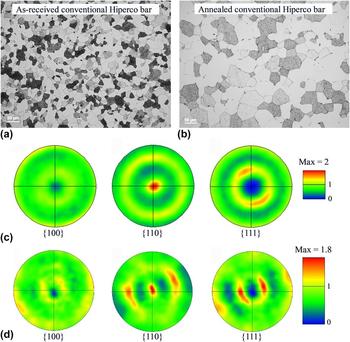
(a) and (b) Example microstructures of as-received and annealed conventional Hiperco bars with (c) and (d) showing the corresponding pole figures. The pole figures are taken with the bar length (extrusion axis) normal to the plane of the figure. Significant grain growth was apparent in the annealed bar relative to the as-received condition. The varying shades of the etched grains suggest different crystallographic orientations. The pole figures showed a weak 〈110〉 fiber along the bar extrusion axis.

Crystallographic textures were acquired from metallographically prepared specimens in both as-deformed and annealed conditions. The annealing treatment was performed at 838 °C for 2 h in a high vacuum (<1 × 10⁻⁵ Torr) atmosphere with a slow furnace cool of 2.33 °C/min. Electron backscatter diffraction (EBSD) was performed on a Zeiss (Oberkochen, Germany) Supra 55VP SEM at 20 kV equipped with an Oxford/HKL (High Wycombe, UK) EBSD system and Channel 5 analysis software. Large-area low-magnification EBSD maps, and in some cases nearly the entire 4 cm2 extrusion cross-section, were obtained to characterize the uniformity of the microstructure and texture from center to edge of the specimen.
Magnetic properties were measured from B–H rings that were wire electrical discharge machined from the ECAE square specimens at the dimensions of 22.9 mm outer diameter, 19.4 mm inner diameter, and thickness 1.73 mm, in accordance with ASTM A773.27 Properties were measured by KJS Associates, Inc. (Indianapolis, IN) using a SMT-700 computer-automated soft magnetic hysteresigraph system, also complying with ASTM A773.
III. RESULTS
Presented first is the microstructure and crystallographic texture of the conventionally processed Hiperco bar material. Both as-received and annealed Hiperco bars were characterized in terms of grain size and crystallographic texture. Note that the as-received bar served as the initial workpiece microstructure entering the ECAE die. Then, the as-deformed ECAE Hiperco bar texture development is presented for routes C and E. This is then followed by an example condition that was subjected to the annealing treatment. Finally, magnetic properties are presented for the ECAE Hiperco, both in as-deformed and annealed conditions, and compared with other soft ferromagnetic alloys and conventionally processed Hiperco. Some implications are discussed.
A. Conventionally processed Hiperco
Figure 1 shows example microstructures and crystallographic textures of the starting conventionally processed Hiperco bar material, both in as-received and annealed conditions. Etched microstructures are shown as optical micrographs, while the crystallographic textures are presented by the {100}, {110}, and {111} pole figures. Note that the pole figures are oriented such that the longitudinal direction of the bar is normal to the plane of the figure. This orientation was selected due to the convenience in describing the texture character. A coarse equiaxed grain morphology with the grain size of 18.6 µm and 40.5 µm was observed in the as-received and annealed conventionally processed Hiperco bar, respectively. Micrographs in Fig. 1 were selected from regions of the bar characterized by a relatively homogeneous microstructure; however it is important to note that the conventional bar had significant spatial variation in the grain size throughout the cross-section. Reasons for the inhomogeneous grain size distribution are discussed in more detail in Sec. III.B and IV.A.
The analysis of the pole figures revealed that the as-received bar material had a minor fiber texture with the 〈110〉 directions aligned along the bar longitudinal axis at an intensity of 2 multiples of a random distribution (MRD). This texture was relatively unaffected by annealing, only decreasing slightly in intensity to 1.8 MRD. The 〈110〉 fiber texture in the as-received and annealed conventional Hiperco bar is perhaps not surprising since this is a common texture known to develop in BCC metals following forging/bar rolling.Reference Belyakov, Kimura and Tsuzaki28–Reference Gurao, Kumar, Sarkar, Brokmeier and Suwas30
B. As-ECAE processed Hiperco
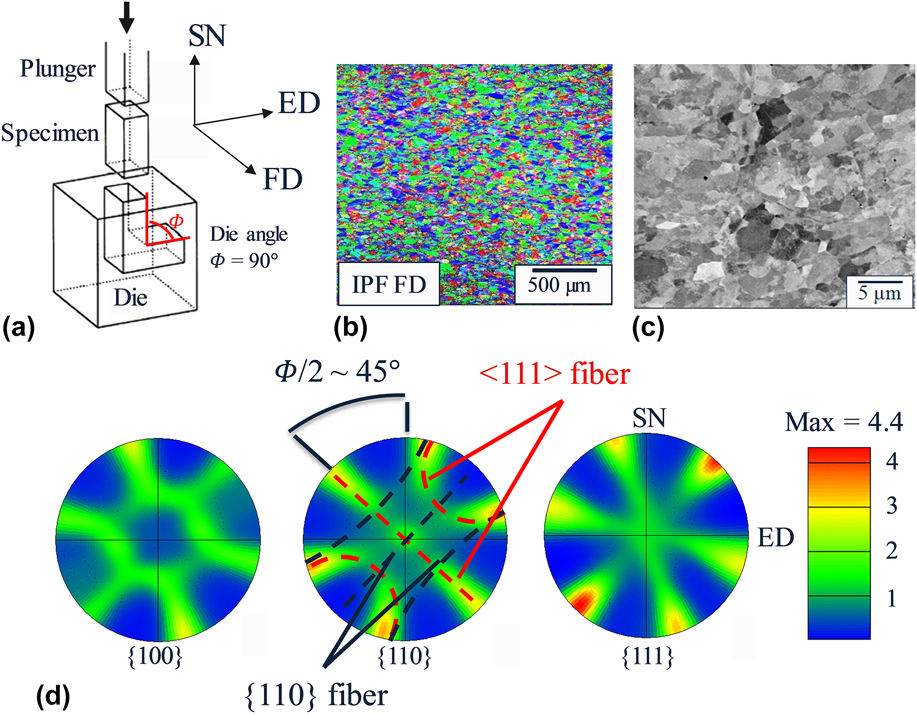
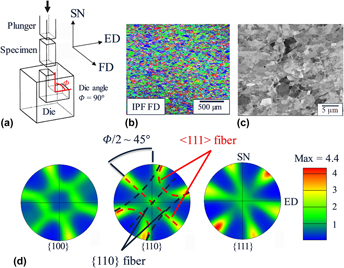
Figure 2 presents an analysis of the microstructure and texture of the Hiperco bar following a single-pass of ECAE. Figure 2(a) shows a schematic diagram of the ECAE process detailing the die angle of Φ = 90°, and the chosen orientation for analysis of the ECAE specimen textures, i.e., the side view of the billets with the ED horizontal, surface normal (SN) vertical, and FD normal to the plane of the figure. Figures 2(b) and 2(c) show example microstructures of the as-ECAE Hiperco bar, expressed as an inverse pole figure color map and SEM channeling contrast image. EBSD analysis of the as-ECAE Hiperco specimen revealed a highly refined, equiaxed microstructure with a grain size of 1.25 µm, which was considerably finer than the as-received microstructure of the conventionally processed Hiperco bar. Furthermore, the ECAE bar cross-section showed a significantly more homogeneous grain size distribution relative to the conventionally processed bar. The fine grain size and homogeneous distribution is a result of the fundamental difference between conventional forging/rolling and ECAE processing. Unlike conventional forging or bar rolling, material elements processed through ECAE are subjected to homogeneous (shear) strains throughout the bar cross-section as the billet passes through the deformation zone. This necessarily causes a homogeneous refinement of the parent billet grain structure.Reference Segal7 Note that while it is expected that some degree of heterogeneity develops in the ECAE bar at regions near the billet–die interface, these were essentially negligible here due to moveable ECAE die walls that significantly reduce friction and secondary shear (sliding) deformation.Reference Segal8
Description of a single ECAE pass: (a) schematic of the ECAE simple-shear process defined by a 90° die angle, (b) inverse pole figure map with respect to the FD, and (c) SEM channeling contrast image of the as-ECAE specimen demonstrating the refined grain size. Microstructures were highly refined, with an average grain size of 1.25 µm and a significantly narrower size distribution compared to the conventional bar material. (d) The (100), (110), and (111) pole figures describing the crystallographic texture. A simple-shear texture defined by dual partial {110} and 〈111〉 fibers [dotted lines superimposed on the (110) pole figure] inclined relative to the bar length axis was observed, in agreement with other reports on ECAE processing of BCC materials.

The as-ECAE texture for a single pass was also quantified by the {100}, {110}, and {111} pole figures, taken from the same bar thickness cross-section (SN-ED plane, FD normal), and shown in Fig. 2(d). The texture was characterized by two partial {110} and 〈111〉 fibers that are inclined relative to the ED (bar length axis). The ideal fibers are shown as dashed lines superimposed on the {110} pole figure for reference. The {110} fiber represents an alignment of the {110} crystallographic planes parallel to the shear plane, reflecting orthotropic symmetry about the plane normal.Reference Kustas, Sagapuram, Trumble and Chandrasekar15 In an equivalent manner, the 〈111〉 fiber denotes the 〈111〉 crystallographic directions at an orientation along the shear direction, possessing the same orthotropic symmetry. These two partial fibers are in fact characteristics of BCC metals subjected to large strain, simple-shear deformation and are fundamentally different to the textures of conventionally processed bar.Reference Kustas, Sagapuram, Trumble and Chandrasekar15,Reference Beyerlein and Tóth22,Reference Kustas, Sagapuram, Chandrasekar and Trumble31,Reference Li, Beyerlein and Bourke32 Unlike the as-received Hiperco bar material with a 〈110〉 fiber aligned parallel to the ED, the ECAE-processed bar possessed a texture that is defined by two distinct partial fibers inclined relative to this direction. Furthermore, the orientation of the inclined fibers is controlled through the ECAE deformation path, which is a function of the die angle. Consequentially, the textures in the ECAE specimen represent the ideal simple-shear texture rotated counterclockwise about the FD.Reference Segal8 For the present study, which utilized a die angle of Φ = 90°, the two simple-shear fibers were inclined at approximately 45° (Φ/2) relative to the ED, illustrating a near one-to-one correspondence between the imposed ECAE deformation and resultant texture. In addition to the deviations in the texture character, as-ECAE textures were also significantly stronger, with approximately 4.4 MRD, which is a near 2-fold increase in intensity compared to the as-received conventional bar.
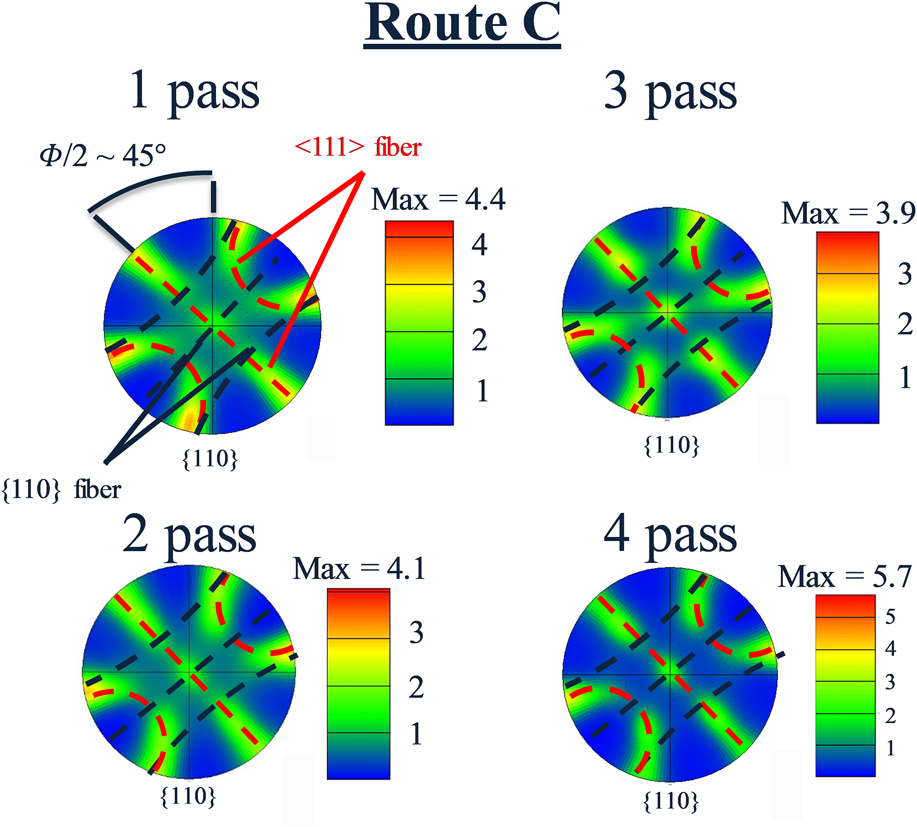
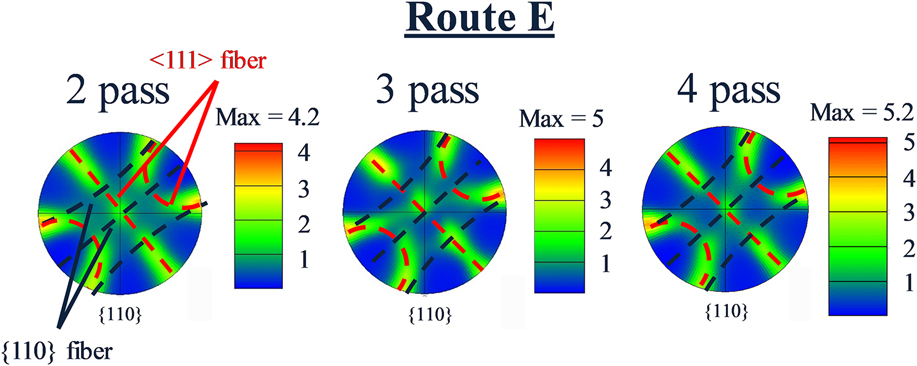
The texture described in Fig. 2 was as expected for simple-shear deformation of BCC metals following a single ECAE pass, which is independent of the particular route used. Continued texture development in ECAE is possible through multipass deformation. Thus, the role of multiple ECAE deformation steps on the texture development in Hiperco was evaluated for both routes C and E up to four passes. Figures 3 and 4 summarize the texture results. Note that for simplicity, only the {110} pole figures in the SN-ED plane are shown with the idealized single pass simple-shear fibers again superimposed as dashed lines. Furthermore, the same texture for single pass route C was observed for single pass route E and is not included.
Multipass route C ECAE deformation developed a single pass simple-shear texture in Hiperco billets. High deformation temperatures are proposed to have annealed out previous deformation steps. Pole figures were taken from the SN-ED plane (FD normal).

Multipass route E ECAE also displayed a retained single pass simple-shear texture. Similar to route C, the high processing temperatures likely annealed out previous pass effects. Pole figures were taken from the SN-ED plane.

Interestingly, specimens following the multipass route C and E deformation seemingly developed consistent simple-shear textures with orientations that were nearly identical to those of a single ECAE pass. This can be observed when examining Figs. 3 and 4 that show excellent agreement between the pole figures and superimposed {110} and 〈111〉 partial fibers oriented at Φ/2–45°. The durable, single pass simple-shear textures in Hiperco following multistep ECAE is unique when considering the characteristics of the deformation routes applied (Table I). For route C, back and forth shearing was imposed from sequential 180° rotations of the billet about the ED, while route E was characterized by back and forth cross-shearing through alternating 180° and 90° rotations. Rotations of the billet between subsequent ECAE deformation steps typically have substantial effects on the developing textures for both FCC and BCC metals.Reference Li, Gazder, Beyerlein, Pereloma and Davies33,Reference Li, Gazder, Beyerlein, Davies and Pereloma34 For example, odd passes during route C deformation of interstitial-free steel (BCC material) have been shown to retain a simple-shear deformation texture reminiscent of single step ECAE, while even passes developed fundamentally different textures defined by shear components that are rotated clockwise toward the ED. A similar alternating simple-shear texture may then be expected for the route C Hiperco bar in this study. However, these developments in the texture were not observed. Retention of the single pass texture for all conditions was likely due to the combined effects of the high temperature processing and subsequent annealing between ECAE passes used in this study. This is discussed further in Sec. IV.A. While the subsequent passes did not change the texture substantially in the present study due to high temperature processing, they helped creating a more refined and homogeneous grain size in the billet, as compared to the as-received material. This reduction in grain size aids extrusion of billets in the following passes, and thus continued reduction in grain size that promotes higher strength.
C. Annealed ECAE Hiperco
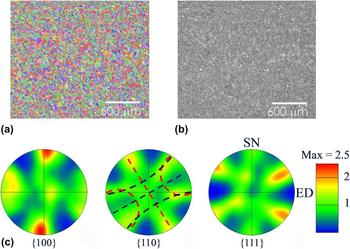
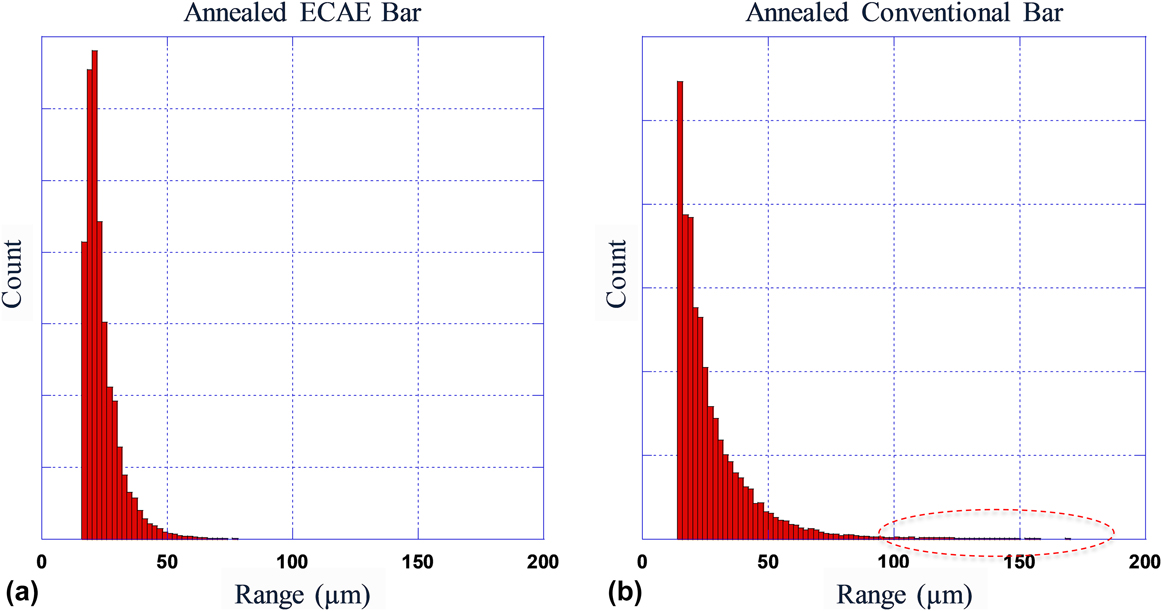
Figure 5 shows microstructure and texture analysis of an example annealed ECAE Hiperco bar processed by route E for 4 passes. Microstructures are again shown as an inverse pole figure color map [Fig. 5(a)] and grain channeling contrast SEM images [Fig. 5(b)], with the {100}, {110}, and {111} pole figures illustrating the texture in Fig. 5(c). As expected, ECAE Hiperco experienced significant grain growth following the annealing treatment, with an average annealed grain size of 18 µm. Interestingly, this was slightly finer than the average grain size found in the conventionally processed and annealed Hiperco bar. Furthermore, the statistical analysis of the grain size revealed that the ECAE bar possessed a significantly tighter and more homogeneous distribution relative to the conventional bar. Histograms of grain count versus grain size in Fig. 6 give some details of these differences. The annealed conventional bar exhibited a significantly wider distribution with a more pronounced upper tail along the 100–150 µm grain size regime. By comparison, annealed ECAE Hiperco exhibited only a very minor tail in the grain size above 50 µm.
Following annealing, ECAE samples experienced significant grain growth, shown as (a) an inverse pole figure map and (b) a SEM image. Analysis of the texture revealed a similar single pass simple-shear texture character shown in (c), but with a significantly reduced intensity.

Grain size distribution histograms determined from the EBSD data for (a) annealed ECAE processed and (b) conventionally processed Hiperco bar. A slightly finer average grain size is shown for the ECAE specimen, with a significantly narrower distribution. Continuous-type recrystallization/grain growth mechanisms are proposed to have promoted the more homogeneous structure. The dashed circle on (b) shows a range of grain sizes that were observed in the conventional bar, but not ECAE.

The pole figures of annealed ECAE in Fig. 5(c) showed a similar simple-shear texture character of the as-ECAE specimen conditions with inclined {110} and 〈111〉 fibers close to the expected Φ/2 of 45°. However, the fibers appeared significantly broadened following annealing with decreased pole figure intensities showing a maximum of 2.5 MRD, close to half the strength of the as-ECAE textures. The combination of a more homogeneous annealed grain size and retention of the simple-shear texture in annealed ECAE bar suggests that a fundamentally different recrystallization/grain growth mechanism may have influenced the microstructure evolution of the ECAE Hiperco.Reference Jazaeri and Humphreys35,Reference Jazaeri and Humphreys36 A more detailed discussion on this topic is provided in Sec. IV.
D. Magnetic properties
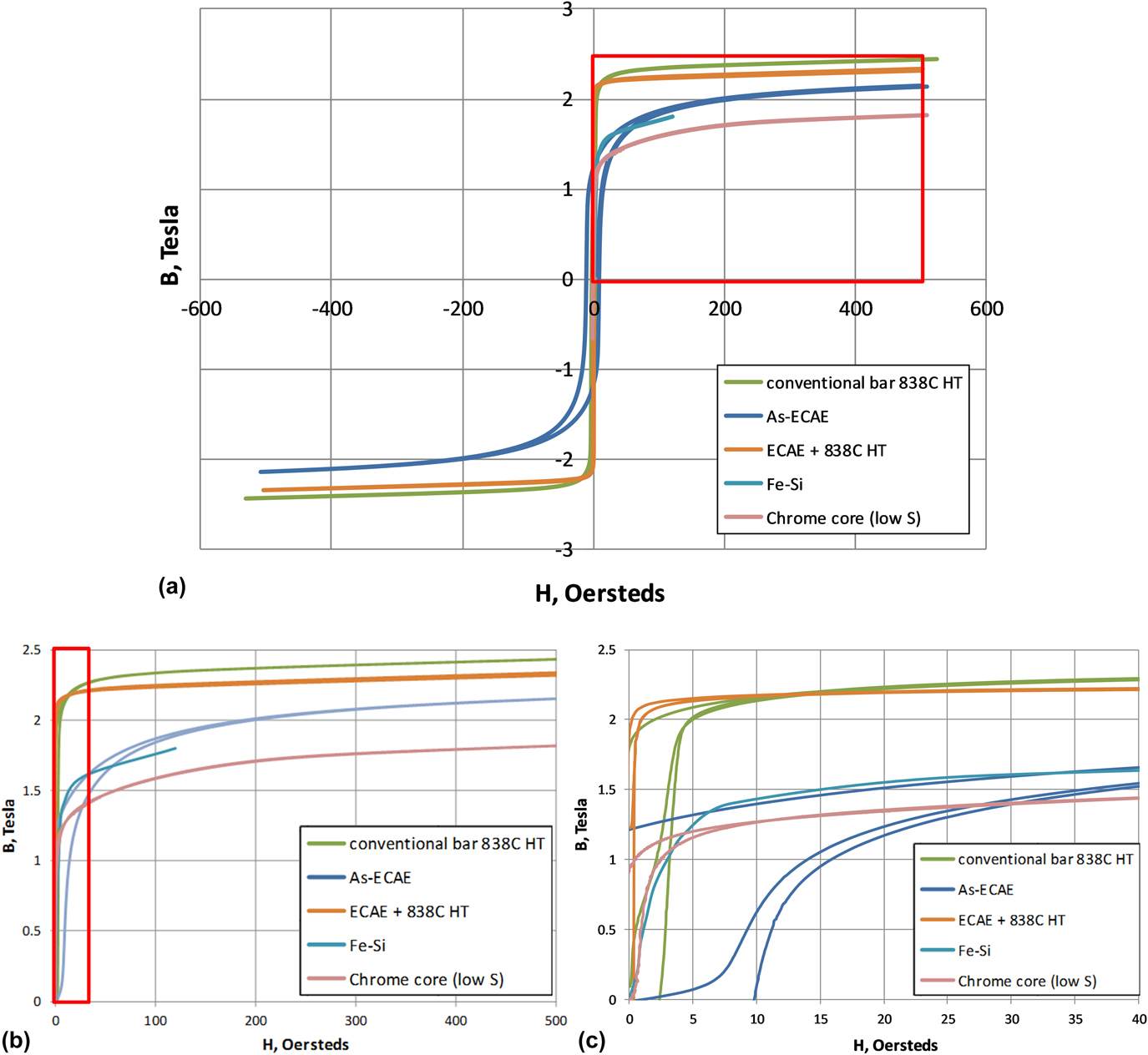
Quasi-static magnetic properties were assessed from B–H rings and are presented in Fig. 7 as full-field loops in Fig. 7(a), and detailed images of the first quadrant in Figs. 7(b) and 7(c). All figures are plotted with induction, B, in Tesla against the applied field, H, in Oersteds. ECAE-processed and conventionally processed Hiperco bars are presented along with other soft ferromagnetic alloys, including Fe–3 wt% Si and Chrome-core stainless steel. Note that for the ECAE processed material, magnetic properties were determined in the as-ECAE condition for the material subjected to 4 deformation passes of route E. An additional material was tested under the post-ECAE (4 passes route E) heat-treated condition following 2 h exposure at 838 °C. While the texture was indeed consistent throughout the ECAE routes, changes in grain size would be expected to have some impact on the magnetic properties. However, magnetic properties characterization as a function of route and pass number was beyond the scope of the present study. Select properties from the loops are tabulated in Table II for ECAE and conventionally processed Hiperco, including the full-field induction (B max), coercivity (H c), and maximum permeability (µmax). Compared to the hysteresis loops of Fe–3 wt% Si, Chrome-core, and conventionally processed Hiperco alloys in Fig. 7, ECAE (both as-deformed and annealed) Hiperco specimens exhibited similar soft ferromagnetic behavior with characteristically high permeability, narrow hysteresis loop widths, and high magnetic induction [Fig. 7(a)]. All Hiperco specimens also exhibited significantly higher B max values, well over 2 T. Such high magnetic moments are a well-documented attribute of near-equiatomic Fe–Co alloy compositions.Reference Bardos37 However, the as-ECAE condition revealed a significantly more “sheared” and wider hysteresis loop compared to the annealed alloys, as noted in Figs. 7(b) and 7(c). Furthermore, both as-deformed and annealed ECAE Hiperco conditions also displayed slightly lower B max values relative to the conventionally processed Hiperco.
(a) Full-field hysteresis loops for Fe–3 wt% Si, Chrome-core, and conventional and ECAE processed Hiperco. (b) and (c) Higher magnification views of the first quadrant providing additional details of the hysteresis loops. Note that the red boxes in (a) and (b) are the representative magnifications for (b) and (c), respectively. Both as-ECAE processed and subsequently annealed Hiperco bars demonstrated soft magnetic behavior, which was significantly softer in the annealed condition with lower coercivity and higher permeability. Annealed ECAE Hiperco showed the highest permeability with a sharper magnetization knee during the approach to saturation and a slightly lower B max than the conventional Hiperco bar.

Select magnetic properties of Hiperco in as-ECAE, annealed ECAE, and conventional annealed forms. Interestingly, the annealed ECAE specimen revealed lower full-field induction, lower coercivity, and higher permeability relative to the conventionally processed sample. Differences in the coercivity and permeability are proposed to be driven mostly by the texture.

Tabulated magnetic properties for Hiperco (Table II) largely corroborated the qualitative appearances of the hysteresis loops in Fig. 7, albeit with some interesting and unexpected results. As-ECAE Hiperco possessed a slightly lower B max than the annealed ECAE-processed and conventionally processed Hiperco, with B max = 2.15 T for as-ECAE, B max = 2.34 T for annealed ECAE, and 2.47 T for annealed conventional bar, respectively. More pronounced differences were found in the H c and µmax properties. An overall harder magnetic response was observed for the as-ECAE condition, with H c = 9.78 Oe and µmax = 723, compared to the annealed ECAE and conventional Hiperco bar, characterized by H c = 0.30 Oe and µmax = 37,000, and H c = 2.35 Oe and µmax = 28,283, respectively.
These differences in magnetic properties between the as-deformed and annealed conditions are perhaps not surprising. Annealed specimens possessed a significantly larger grain size relative to the as-ECAE bar, and also likely possessed significantly less stored energy/dislocation density due to the recovery and recrystallization processes promoted by annealing. Grain boundaries and deformation-induced stored energy (i.e., dislocation substructure) inhibit the alignment of magnetic domains during magnetization and cause a degradation or hardening of the magnetic performance.Reference Sourmail1,Reference Herzer38 However, an interesting observation was noted when comparing properties of the annealed ECAE-processed bar with conventionally processed Hiperco. Following annealing, the ECAE specimen possessed a significantly reduced H c and larger µmax compared to the conventional bar. Since both specimens had identical composition, the differences in magnetic properties must be linked to deviations of the microstructure, i.e., grain size or texture, which were inherited from the particular processing route used. Interestingly, the grain size was not significantly different between annealed ECAE and conventional Hiperco bar. In fact, the annealed ECAE specimen had a slightly smaller average grain size (18 µm) with a tighter distribution characterized by only a few grains in the 50–100 µm size range. By contrast, conventional Hiperco had a larger average grain size (40.5 µm) with a significantly larger population of grains in the same 50–100 µm range, and even some residing in the 100–150 µm regime. Consequentially, it is not unreasonable to conclude that the grain size for the annealed ECAE bar was less conducive for producing a desired soft magnetic performance due to a larger volume fraction of grain boundaries that would act as pinning obstacles during the microscale magnetization processes. Despite this disadvantage, the more refined microstructure of the annealed ECAE Hiperco specimen possessed notably lower coercivity and higher permeability compared to the conventional bar and also revealed a sharper magnetization knee along the hysteresis loop. However, a slight decrease in the B max was also observed for the ECAE specimen compared to the conventional bar, with a 0.1–0.3 T reduction. The primary mechanism responsible for the lower observed full-field induction is unknown; however slight deviations in local composition from varying Nb-concentration in the alloy may explain these slight differences. High resolution microscopy is currently underway to evaluate the distribution of Nb-containing precipitates. The texture is proposed to be the dominant mechanism for the lower coercivity and higher permeability properties and is discussed in more detail in Sec. IV.
IV. DISCUSSION AND IMPLICATIONS
The results have shown that ECAE can produce bar forms of low workability Hiperco with predictable simple-shear deformation and recrystallization textures. These textures were unlike those of conventional bars, and were characterized by dual partial fibers inclined relative to the ECAE bar axis. Interestingly, the coercivity and permeability properties of the ECAE processed bar were shown to reside reasonably well within the ranges of other soft ferromagnetic alloys and, in the annealed condition, were even softer than those of state-of-the-art versions of conventionally processed Hiperco. These observations have significant implications for creation of bars from low workability, functional alloys with unique textures that impart potentially improved magnetic performance. The results are discussed in the following sections in terms of the microstructure/texture development and texture effects on the magnetic properties.
A. Microstructure and texture development
The microstructures and textures of ECAE Hiperco were fundamentally different than the conventionally processed bar material, characterized by a significantly more homogeneous grain size and unique dual {110} and 〈111〉 partial fiber simple-shear texture with the fibers inclined relative to the bar length (extrusion axis). In the as-ECAE processed samples, the homogeneous grain size is believed to have resulted from differences in the deformation of ECAE and forging/rolling. ECAE is characterized by a comparably more confined and narrower deformation zone geometry that imposes large, homogeneous shear strains throughout the cross-section of the extruded billet material. These large strains promote a similarly homogeneous and uniform refinement of the initial workpiece microstructure. Such refinement during severe plastic deformation has been linked to either a discrete fragmentation of the parent/initial workpiece microstructure or through a gradual increase in the misorientation of the material substructure from incremental deformation.Reference Jazaeri and Humphreys35 Both mechanisms result in the formation of a highly refined grain size relative to more conventional deformation processes. In addition, due to the unique tool design utilized in the present work, the nonuniform deformation zone at the billet–die interface is relatively small (i.e., ∼2 mm into the billet surface), aiding in maintaining a uniform refined grain size. The extent of the refinement is also significantly influenced by the processing temperature, where lower temperatures promote finer substructures. It is instructive to note here that deformation was performed at relatively high temperatures (750–850 °C), which is indeed a significant fraction of the homologous temperature of Hiperco.Reference Sourmail1 Thus, refinement of the incoming bar material likely occurred with simultaneous dynamic continuous grain coarsening of the substructure from the high processing temperatures. These dynamic annealing effects would then produce a homogeneous equiaxed microstructure in the bar with a larger grain size than the more typical ultrafine grain structures that result during large strain deformation at lower temperatures.Reference Jazaeri and Humphreys35,Reference Jazaeri and Humphreys36,Reference Kaibyshev, Shipilova, Musin and Motohashi39–Reference Purcek, Saray, Karaman and Maier42
In addition to influencing the as-ECAE microstructure, the high processing temperatures also aid in explaining the retention of a single pass simple-shear texture in the specimens throughout the multipass processing of routes C and E. Prior to each deformation step, billets were held in a furnace at high temperature for approximately 30 min. It is likely that the deformation history in the specimens was largely removed during this preheating through combined recovery/recrystallization. Therefore, billets entering the die for subsequent deformation behaved as would be expected during an initial single ECAE pass. This may indicate that the multipass processing could be simplified to a single step (an important practical consideration) while maintaining a homogeneous refined grain size and unique simple-shear texture independent of the initial workpiece texture and microstructure. This observation agrees with previous reports that have examined the role of the initial workpiece texture on its subsequent evolution during ECAE.Reference Beyerlein and Toth43
B. Texture effects on magnetic properties
As described in Sec. III.D., the magnetic properties of ECAE Hiperco exhibited comparable or superior soft magnetic performance relative to conventionally processed Hiperco, albeit with slightly lower saturation induction. The lower coercivity and higher permeability properties of annealed ECAE Hiperco suggest that the ECAE process is a promising approach for producing bulk components for electromagnetic devices. Observed differences in the properties must originate from either the composition or structural differences between the two bar specimens. As was described above, the composition was consistent for both ECAE and conventional Hiperco. Furthermore, microstructural comparison of annealed ECAE and conventional bar showed that the ECAE specimen had a less favorable (refined) grain size for achieving the desired soft magnetic performance. Therefore, it is suggested that the texture was primarily responsible for the lower coercivity and higher permeability of the annealed ECAE sample.
Crystallographic texture is well-known to significantly influence magnetic properties in soft ferromagnetic materials, especially the structure-sensitive quantities such as H c and µmax. The influence comes from the orientation relationships of the easy magnetization directions with respect to the applied field. Select properties are generally softer, i.e., lower H c and higher µmax, as the easy magnetization directions become more closely aligned (through the texture) with the orientation of the applied field. Easy magnetization directions are fundamental attributes of the material and are typically determined from the first (K 1) and second (K 2) magnetocrystalline anisotropy constants.Reference Marcinkowski and Polaik44 In cubic materials, when K 1 and K 2 < 0, the 〈111〉 direction is considered the preferred magnetization direction, while for K 1 and K 2 > 0, it is the 〈100〉 directions. Mixed anisotropy constants can lead to a range of easy magnetization directions. For near-equiatomic Fe–Co alloys, such as Hiperco, these constants are complicated by the degree of atomic ordering and thus the processing conditions used.Reference Hall19,Reference Marcinkowski and Polaik44–Reference Kustas, Susan, Johnson, Whetten, Rodriguez, Dagel, Michael, Keicher and Argibay46 For a fully disordered condition, both K 1 and K 2 are large negative values and therefore the easy magnetization directions are expected to lie along the 〈111〉 crystallographic directions.Reference Hall19 In the fully ordered condition, K 1 has been found to be a small negative value, close to zero, with a large negative K 2.Reference Hall19,Reference Marcinkowski and Polaik44 As a result of the near-zero proximity of K 1, the magnetic domain structure has been shown to be complicated by curved boundaries, indicating that the direction of magnetization is not fixed within the domain structure. This is a unique attribute of the near-equiatomic Fe–Co composition and makes the easy magnetization directions difficult to determine based solely on the crystal anisotropy constants. However, the 〈111〉 directions are assumed here as the primary easy magnetization directions for Hiperco to motivate a discussion of potential simple-shear texture effects. Furthermore, the 〈111〉 crystallographic directions have been discussed as the easy magnetization directions in other reports on near-equiatomic Fe–Co alloys.Reference Sundar and Deevi2,Reference Hall19,Reference Kustas, Susan, Johnson, Whetten, Rodriguez, Dagel, Michael, Keicher and Argibay46 Note that in the as-ECAE condition, the Hiperco specimens are likely less ordered than the annealed condition and thus expected to be more influenced by the orientation of the 〈111〉 directions relative to the annealed case.
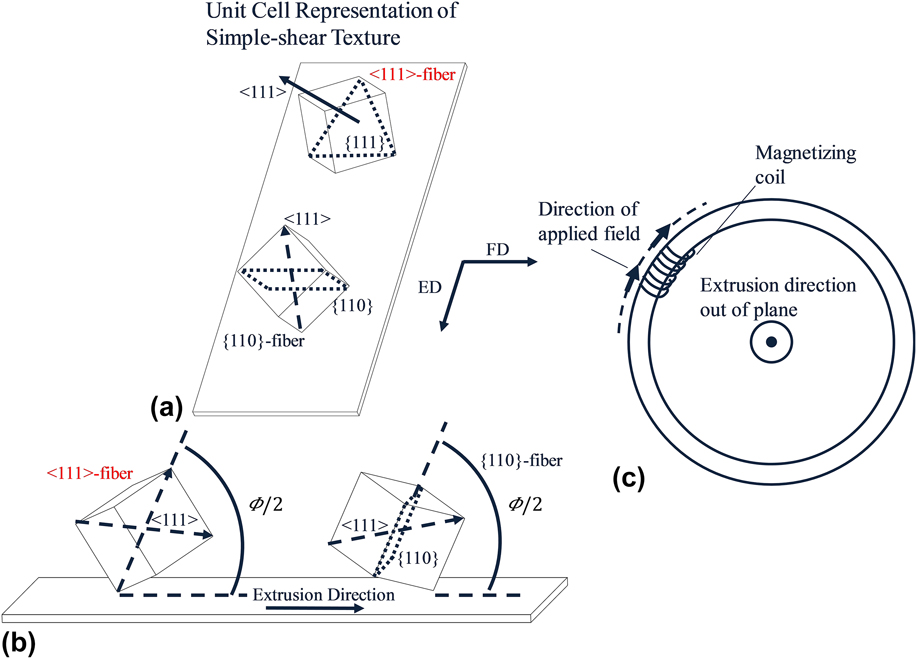
Consider the schematic in Fig. 8 that depicts a representation of the unit cells along the dual {110} and 〈111〉 partial fibers. This schematic embodies a plane cut through the bar cross-section along the ED, as defined in the figure. The unit cells are inclined relative to the ED at an arbitrary angle denoted by the corresponding Φ/2 relationship shared with the ECAE die. Superimposed are some of the 〈111〉 crystallographic directions. Note that the schematic is a snapshot along the fibers, which are rotated about the {110} plane and 〈111〉 direction. These unit cell orientations are fundamentally different to the texture noted in conventionally processed bar, and two distinct differences are worth emphasizing. First, the simple-shear texture of the ECAE bar is defined by two partial fibers, while the conventional bar developed a single 〈110〉 fiber texture with the 〈110〉 directions oriented along the extrusion axis. Second, the {110} and 〈111〉 fibers of the simple-shear texture are both inclined relative to the extrusion axes, unlike the fiber texture of the conventional bar that showed a 〈110〉 direction aligned parallel to this axis.
(a) and (b) Two schematics of a unit cell representation of the {110} and 〈111〉 partial fibers defining the simple-shear textures expected of BCC metals. The fibers are inclined in the schematic at some arbitrary angle, denoted by the relationship with the ECAE die angle. Select 〈111〉 easy magnetization direction is also superimposed on the unit cells. (c) Schematic detailing of the magnetic property characterization of B–H ring specimens. A tangential field was applied with the ED perpendicular (out of the plane of the ring).

Magnetic properties of the Hiperco specimens were assessed using B–H rings that were removed from billets such that the ED direction was coming out of the plane of the ring shown in Fig. 8(c). Thus, the orientation between the crystallographic texture and magnetic field (applied tangentially to the ring circumference) varied along the ring perimeter. In this configuration, specimens would possess an improved performance with a texture that results in a significant fraction of the easy 〈111〉 magnetization directions closely aligned to the field direction along the B–H ring circumference. Neither the ECAE nor conventional bar texture accomplishes this. However, unlike the conventional bar with only a single fiber texture, the homogeneous, dual fibers in ECAE specimens could promote a larger population of the 〈111〉 directions with orientations closer to the magnetic field, easing the approach to saturation. Additionally, both the dual fiber nature of the simple-shear texture and the ECAE processing routes employed are expected to reduce the magnetic anisotropy in specimens relative to the single fiber of the conventionally processed bar. Hysteresis loops in Fig. 7 show evidence in support of this notion in which the annealed ECAE Hiperco possessed a significantly sharper knee for the first quadrant magnetization loop compared to conventionally processed Hiperco. A sharper hysteresis loop knee, in combination with the lower coercivity and higher permeability, suggests that both domain wall motion and rotation are less inhibited in the ECAE specimens compared to conventional Hiperco. Therefore, it might be expected that the simple-shear texture, and more generally the ECAE process, promotes a reduced anisotropy and thus more ideal performance in applications with a variable orientation between the applied field and easy magnetization directions.
V. SUMMARY AND CONCLUSIONS
ECAE, through multipass routes C and E, was explored as a thermomechanical processing method for producing bulk billets of low workability Hiperco. Through the large shear strains of the severe plastic deformation process, ECAE was shown to develop unique simple-shear crystallographic textures in the bulk square billet form, fundamentally different to the textures in conventionally processed bar. Simple-shear textures were maintained throughout the ECAE processing matrix explored. High processing temperatures were believed to cause dynamic recrystallization in combination with grain fragmentation to develop a homogeneous, fine grain size that also retained a texture characteristic of a single ECAE pass. The simple-shear texture was also shown to be retained in specimens following a post-processing annealing treatment with a larger but similarly homogeneous grain size, proposed to be the result of continuous recrystallization/grain growth mechanisms. Magnetic properties were also measured and compared with other conventional soft ferromagnetic alloys, including conventionally processed Hiperco. As-ECAE specimens exhibited similar soft ferromagnetic behavior in terms of the full-field induction, but with higher coercivity and lower permeability. Interestingly, upon annealing, the ECAE-processed bar demonstrated lower coercivity and higher permeability relative to even conventionally processed Hiperco, despite a finer grain structure, and was proposed to be due primarily to fundamental differences in the textures of ECAE and conventional specimens. Both the dual fiber nature of the simple-shear texture and the ECAE processing routes employed are expected to promote a reduced magnetic anisotropy to ease the approach of the domains to saturation in situations with varied orientations between the applied flux and easy magnetization directions. Overall, ECAE is a promising next generation processing route for producing bulk Hiperco bars with homogeneous microstructure, predictable textures, and desired soft magnetic properties.
ACKNOWLEDGMENTS
The authors wish to thank M. Reece, A.C. Kilgo, and B.B. McKenzie for materials characterization. Dr. R. Kellogg provided insightful discussion and review of this work. Sandia National Laboratories is a multimission laboratory managed and operated by National Technology and Engineering Solutions of Sandia LLC, a wholly owned subsidiary of Honeywell International Inc. for the U.S. Department of Energy’s National Nuclear Security Administration under contract DE-NA0003525. The FE-SEM acquisition was supported in part by the National Science Foundation under Grant No. DBI-0116835.