Introduction
Sorghum is believed to have originated in Ethiopia and the surrounding countries, around 4000–3000 BC (Dillon et al., Reference Dillon, Shapter, Henry, Cordeiro, Izquierdo and Lee2007), from its wild relatives. The genus Sorghum contains five sections: Chaetosorghum, Heterosorghum, Parasorghum, Stiposorghum and Sorghum (De Wet, Reference De Wet1978). Section sorghum includes Sorghum bicolor (L.) Moench, an annual non-rhizomatous species, which in turn includes both cultivated types and wild and weedy relatives found in Africa (De Wet, Reference De Wet1978; Duvall and Doebley, Reference Duvall and Doebley1990) and a complex of perennial taxa from southern Europe and Asia (De Wet, Reference De Wet1978). Within S. bicolor, three major subspecies of African origin have been described, i.e. subspecies bicolor (encompassing race bicolor, caudatum, guinea, durra, kafir and ten hybrids derived from a combination of the five races), subspecies arundinaceum, later called ssp. verticilliflorum (encompassing race verticilliflorum, arundinaceum, aethiopicum and virgatum; Doggett, Reference Doggett1988) and subspecies drummondii (weedy hybrids between cultivated and wild sorghum; De Wet, Reference De Wet1978). S. bicolor drummondii (shatter cane) is an aggressive weed that causes significant loss in crop sorghum grain production, both through the competition for nutrients and by acting as a reservoir host for pests and viruses (Harlan and De Wet, Reference Harlan and De Wet1974; Ejeta and Grenier, Reference Ejeta, Grenier and Gressel2005).
Ethiopia, a centre of origin of cultivated sorghum, may harbour both immense sorghum genetic diversity (Ayana et al., Reference Ayana, Bryngelsson and Bekele2000; Tesso et al., Reference Tesso, Tirfessa and Mohammed2011) and unique wild sorghum germplasm that may be worthy of conservation. Wild sorghum represents a good source of germplasm for use in crop improvement. For example, sources of resistance to ergot and green bug (Reed et al., Reference Reed, Ramundo, Claflin and Tuinstra2002), Striga resistance (Rich et al., Reference Rich, Grenier and Ejeta2004) and sorghum shoot fly (Kamala et al., Reference Kamala, Sharma, Manohar Rao, Varaprasad and Bramel2009) have been identified from wild sorghum species. Several studies have estimated genetic diversity in cultivated sorghum in Africa, both from genebanks and field collections using phenotypic traits (e.g., Zongo et al., Reference Zongo, Gouyon and Sandmeier1993; Ayana and Bekele, Reference Ayana and Bekele1998; Ayana et al., Reference Ayana, Bryngelsson and Bekele2000; Mutegi et al., Reference Mutegi, Sagnard, Muraya, Kanyenji, Rono, Mwongera, Marangu, Kamau, Parzies, de Villiers, Semagn, Traore and Labuschagne2010; Tesso et al., Reference Tesso, Tirfessa and Mohammed2011). Genetic diversity of wild sorghum has not been well characterized. There have been recent reports on Kenyan material (Muraya et al., Reference Muraya, Geiger, Mutegi, Kanyenji, Sagnard, de Villiers, Kiambi and Parzies2010; Mutegi et al., Reference Mutegi, Sagnard, Muraya, Kanyenji, Rono, Mwongera, Marangu, Kamau, Parzies, de Villiers, Semagn, Traore and Labuschagne2010), and some analyses of Ethiopian collections from fairly narrow geographic distributions (Ayana et al., Reference Ayana, Bryngelsson and Bekele2001, Tesso et al., Reference Tesso, Kapran, Grenier, Snow, Sweeney, Pedersen, Marx, Bothma and Ejeta2008). To our knowledge, the present study represents the first systematic, wide-scale analysis of wild sorghum phenotypic diversity in the centre of origin (Ethiopia). Here we (1) determine the geographic distribution of wild and weedy sorghum in major sorghum growing regions of Ethiopia, (2) examine the extent and the geographic pattern of the in situ phenotypic diversity of wild sorghum populations, occurring sympatrically and allopatrically with cultivated sorghum, (3) estimate the probability of gene flow in the crop–wild–weedy sorghum complex through morphological observations and (4) suggest conservation measures.
Materials and methods
Sampling sites
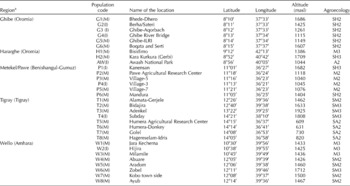
Ethiopia is divided into 32 agroecologies based on the amount of annual rainfall, temperature and the length of the growing period (MOARD, 2005). Oromia, Amhara and Tigray states are the major sorghum-producing regions in the country (Adugna, 2012). In total, 31 sites from five geographical regions and eight agroecologies were surveyed (Table 1). Each site was considered to represent a population. Sites were selected to include both a broad swath of the range of sorghum cultivation in Ethiopia and locations where wild sorghum populations were known to occur based on previous surveys (Tesso et al., Reference Tesso, Kapran, Grenier, Snow, Sweeney, Pedersen, Marx, Bothma and Ejeta2008). The collection sites in the Benishangul-Gumuz region included the Pawe Agricultural Research Center (P2; Table 1), which is near the abandoned airport where Ayana et al. (Reference Ayana, Bryngelsson and Bekele2001) have previously reported the presence of wild sorghum populations. Politically, the Awash National Park is inside the Afar regional state. However, as it is closer to the Hararghe collection sites, we grouped it with Hararghe populations in Oromia. Readings of the coordinates and altitudes of the collection sites were recorded by a global positioning system, which was later overlaid onto the regional map of Ethiopia using ArcGIS version 9.3 (Fig. 1).
Characteristics of the wild sorghum collection sites

I, isolated (>500 m away from the crop); M, mixed with the crop (intermixed, found < 500 m from the crop, or found < 500 m and mixed with other cereals); A2, warm arid lowland plains; SA2, warm semi-arid lowlands; SM2, warm sub-moist lowlands; SM3, Tepid sub-moist mid-highlands; M2, warm moist lowlands, M3, Tepid moist mid-highlands, SH2, warm sub-humid lowlands; SH3, Tepid sub-humid mid-highlands.
a Names of the regional states are given in parentheses.
Map of Ethiopia showing the wild sorghum collection sites by region (see Table 1 for location codes). AA, Addis Ababa; AF, Afar; AM, Amhara; BG, Benishangul-Gumuz; DD, Dire Dawa; GA, Gambella; HA, Harari; OR, Oromia; SN, Southern Nations; SO, Somali; TI, Tigray.

Data collection
Panicle collections and in situ phenotypic measurements of wild/weedy sorghum were made during October through November 2008 from the three states listed above as well as from Benishangul-Gumuz (Metekel zone). A total of 600 (20 plants per site) wild S. bicolor ssp. verticilliflorum and weedy S. bicolor ssp. drummondii types were measured in situ from 30 populations to estimate phenotypic diversity. In each site, the area of collection rarely exceeded a hectare. The number of populations sampled for phenotypic data analysis was not equal for all geographical regions, as they primarily differ in the area coverage and abundance of wild sorghum. They were six for each of Ghibe and Pawe, two for Hararghe and eight for each of Tigray and Wello. However, as the two south Tigray populations (T1 and T2) were very close to the north Wello populations, they were merged with Wello populations during data analysis. Hence, Tigray had six and Wello had ten final populations. The population from the Awash National Park was not included in the final analysis as seeds were shattered during arrival for sampling. The quantitative phenotypic traits measured in the field included panicle length and width (cm), flag leaf length and width (cm), leaf number on main stalk, plant height (cm), number of tillers and 100-seed weight (g). Moreover, the qualitative phenotypic traits (categorical) measured in the field and in the laboratory were panicle compactness and shape, grain covering, grain shattering, grain colour, grain size, glume colour, presence of awn at maturity and presence of glume hair. Data were recorded according to published standards for sorghum (IPGRI and ICRISAT, 1993; Bioversity International, 2010) (see Supplementary Table S1, available online only at http://journals.cambridge.org). Because most of the wild sorghum seeds were fully covered by glumes, these were removed using fine sandpaper to record grain colour and size. Seed size was estimated by visual comparison with prepared standards that represented each of the five seed size classes. A simple magnifying hand lens was used to observe the presence of hair on glumes. In Ethiopia, there have been no reports of wild sorghum other than those belonging to S. bicolor, a non-rhizomatous species. To confirm this, the roots of at least two plants in each population were excavated and checked for the presence of rhizomes. The occurrence of gene flow was estimated based on the morphological observation of putative hybrids.
Statistical analyses
Simple descriptive statistics and construction of frequency histograms for the quantitative morphological characters were performed on 600 plant samples using GenStat 7th edition (DE3) version 7.2 (VSN International Ltd., 2008). For qualitative phenotypic traits, the Shannon–Weaver diversity index (H′) (Hutcheson, Reference Hutcheson1970) was calculated on 516 plant samples with complete data as follows:
 $$\begin{eqnarray} H _{ c } = - { \sum _{ i = 1}^{ n } }\, P _{ i }\,ln\, Pi \end{eqnarray}$$
where, for a given character C, H is the Shannon–Weaver diversity index, n is the number of phenotypic classes in a given categorical character and P is the proportion of observation in the ith class Pi (1, 2,…n). To keep all values between 0 and 1, H was later standardized to H′, the ratio of H and ln n, where n is the total number of phenotypic character classes.
The quantitative phenotypic data were scaled to fit a normal distribution, Pearson's coefficients of correlations were calculated between all pairs of traits and significance was tested using a t-test. Values from the correlation matrix were used to perform principal component analysis (PCA) using GenStat.
Results
Distribution of wild/weedy sorghum
Rhizomes were not found in the excavated samples. Wild and weedy sorghum are fairly distributed in Ethiopia but were most abundant in north-western Ethiopia, Metekel zone, Benishangul-Gumuz state (Fig. 1). In Hararghe, however, wild sorghum populations were scarce (collected only from Bisidimo and a roadside near Bedesa-Gelemso, H1 and H2, respectively; Table 1 and Fig. 1). In Awash, wild sorghum populations were found along the roadsides from Welenchiti (where some sorghum is grown) to Awash National Park. The wild sorghum populations at the Awash National Park were located more than 30 km from any cultivated sorghum fields.
Unlike cultivated sorghum, which grows in a wide range of altitudes (400–2500 m), wild sorghum populations were more abundant in lower altitudes. Wild sorghum populations were found throughout the Tigray region, from hot lowlands (600 m) at Humera to a relatively cooler and higher elevation (1925 m) at Adenkel.
Wild sorghum populations were usually found (in 23 of the 31 sites) intermixed with or located within 500 m distance from cultivated sorghum populations. At eight sites, however, wild sorghum either comprised isolated populations in both disturbed (abandoned farm lands, river banks or irrigation ditches) and undisturbed (park or forest lands) habitats, or occurred as weeds in the fields of other cereal crops (maize, barley or teff).
In general, wild sorghum populations collected in cultivated sorghum or maize fields were vigorous, while those found among small cereals, tef and barley had a very short stature and thin stalks. Compact panicles were observed on weedy sorghum collected in Wello (W6; Table 1) where farmers grow compact-headed durra-type sorghum landraces. At Abuare and Aradom (W4 and W5), weedy sorghum types intermixed in a common variety, 76T1#23, grown on private commercial farms were collected. Both compact and loose panicle wild and weedy sorghum types co-occurred in sorghum fields in western Tigray (T7). However, the compact panicle weedy sorghum types found here were morphologically distinct from the commonly grown caudatum landraces.
Extent and patterns of phenotypic diversity
Quantitative traits
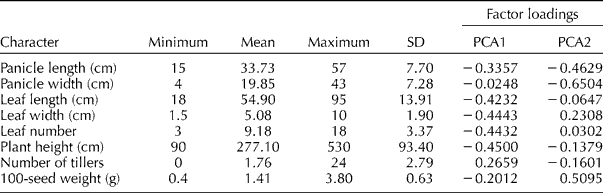
The phenotypic characters of wild sorghum populations were extremely variable (Table 2; see Supplementary Table S3, available online only at http://journals.cambridge.org), ranging from weak-stemmed, grass-like open-panicle forms (typical wild phenotypes) to those with vigorous stalks, as thick as sugar cane, and panicles, as compact as the cultivated race durra (stabilized hybrid forms). Supplementary Fig. S1 (available online only at http://journals.cambridge.org) shows the frequency histograms of the various quantitative phenotypic traits. The correlation was significant (P< 0.001) among all pairs of characters except for 100-seed weight and number of tillers per plant.
Summary of the descriptive statistical values and principal component factor loadings of the quantitative morphological characters measured on the 600 wild sorghum plants in the field
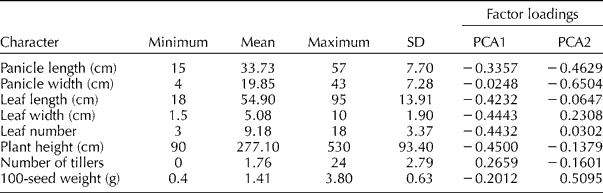
PCA, principal component analysis.
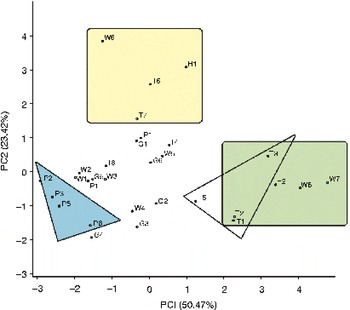
PCA indicated that 73.89% of the total variation in the populations was accounted for by the first two components. Plant height had the largest contribution (factor loadings) to the first principal component (PC1; 45%) followed by leaf number (44%) and leaf width (44%). The second component was mostly influenced by panicle width (65%) and 100-seed weight (51%). In general, the region-specific population structure was weak among the Ethiopian wild sorghum types (Fig. 2). The sampling sites tended to be dispersed throughout the plot, except that four (P2, P3, P5 and P6) of the six Benishangul-Gumuz/Pawe populations clustered together (Fig. 2, left triangle), as did Tigray populations (T1 and T2) and three south Wello populations (W1, W2 and W3). P1 is far from the other populations in the region. The most differentiated populations were composed of sites where either short stature, loose panicle ‘typical wild’ sorghum forms (T1, T2, T3, H2, W7 and W8) (Fig. 2, lower rectangle) or traits more typical of cultivated types (H1, T6, T7 and W6) predominated (Fig. 2, upper square). PCA of individual plant samples showed more or less a similar scattering pattern to that of the populations (Supplementary Fig. S3, available online only at http://journals.cambridge.org).
Principal component (PC) plot showing the population structure of wild sorghum based on quantitative phenotypic characters. Left triangle, populations from the Benishangul-Gumuz region; right triangle, tigray populations; lower rectangle, typical wild populations; upper square, populations with traits typical of cultivated types. A colour version of this figure can be found online at http://journals.cambridge.org/pgr

Qualitative traits
Overall, 90% of the plants had awns at maturity, 67.1% had high to very high seed shattering and 52.7% had very loose to loose panicles with both erect and drooping primary branches (Supplementary Table S1, available online only at http://journals.cambridge.org). The panicle architecture of some wild/weedy sorghum samples is presented in Supplementary Fig. S2 (available online only at http://journals.cambridge.org). For the grain-associated traits, 65.7% had hairs on their glumes, all of the collections had grains fully covered (58.9%) or glumes longer than grain (41.1%), and 75.9% had very small (as small as finger millet seed) to medium grain size. Large-seeded wild sorghum resembling cultivated types were present in all five geographical regions. As much as 81.4% of the populations had light to dark brown seeds (see Supplementary Table S2, available online only at http://journals.cambridge.org). White grain was observed only in Wello populations and yellow grain was found in the Tigray and Hararghe regions. In Tigray, all grain colours except white were observed. In total, 74.6% of the collections had black (brown-black) glumes.
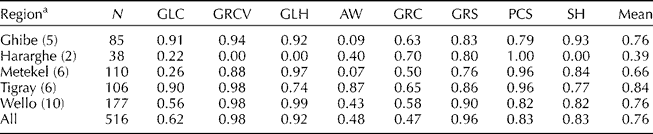
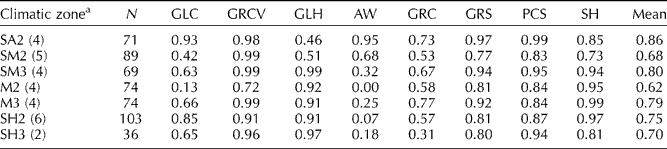
The overall standardized Shannon–Weaver diversity index (H′) of the qualitative traits ranged from 0.48 (for the presence of awn at maturity) to 0.98 (for grain covering). The value over all characters ranged from 0.39 for Hararghe to 0.84 for Tigray with an average of 0.76 (Table 3). Moreover, the distribution of the qualitative traits in agroclimatic groups showed that warm semi-arid lowlands (SA2), the Tigray populations, were the most diverse (H′ = 0.86) (Table 4). On the other hand, the warm moist lowlands (M2), which contain Metekel populations, supported the lowest Shannon–Weaver diversity index (H′ = 0.62) for these traits. The correlation between phenotypic diversity (based on the Shannon–Weaver diversity index) and sample size was not significant (r= 0.672, P= 0.214).
Estimates of the standardized Shannon–Weaver diversity index (H′) of wild sorghum collections for the qualitative morphological traits by their region of origin
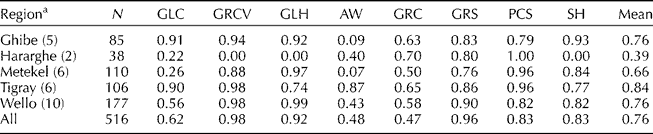
N, sample size; GLC, glume colour; GRCV, grain covering; GLH, presence of glume hair; AW, presence of awn at maturity; GRC, grain colour; GRS, grain size; PCS, panicle compactness and shape; SH, shattering.
a Values in parentheses show the number of populations represented in each region, each population consisted of 17–20 individual plants.
Estimates of the standardized Shannon–Weaver diversity index (H′) of wild sorghum collections for the qualitative morphological traits by climatic zones
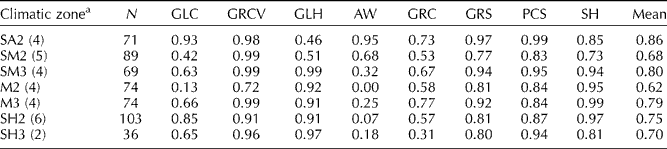
N, sample size; GLC, glume colour; GRCV, grain covering; GLH, presence of glume hair; AW, presence of awn at maturity; GRC, grain colour; GRS, grain size; PCS, panicle compactness and shape; SH, shattering.
a Values in parentheses show the number of populations represented in each climatic zone, each population consisted of 17–20 individual plants.
Discussion
Distribution and abundance of wild sorghum in Ethiopia
Knowledge on the distribution of wild/weedy relatives of crop species is essential for conservation and risk assessment of transgenic crops (Chandler and Dunwell, Reference Chandler and Dunwell2008). In Ethiopia, wild sorghum populations are widely distributed and exist in sympatric and allopatric ranges with cultivated sorghum types. The absence of rhizomatous roots in the excavated samples may show the existence of a single species of wild sorghum (S. bicolor) in all sampled regions included in this survey. On a separate study that aimed at tentatively assigning the collections by comparing them with the already identified subspecies and races of wild/weedy sorghum accessions acquired from the ICRISAT, Adugna (2012) recognized the existence of ssp. drummondii and all races of ssp. verticilliflorum, except virgatum.
In areas where crop–livestock farming system is practised, wild sorghum types were rarely found in open fields such as abandoned farm lands. However, those plants grown in nearby fences and in areas inaccessible to livestock often escape grazing and thus can mature and shatter their seeds. Due to this survival strategy, wild sorghum types that are isolated from the cultivated sorghum often have patchy distributions that are highly variable based on location. In most sorghum-growing areas, farmers notice the weedy sorghum only after flowering, and when they do so, they cut them and feed to their livestock. In Kenya, farmers consume the advanced crop–wild sorghum hybrid forms (Mutegi et al., Reference Mutegi, Sagnard, Muraya, Kanyenji, Rono, Mwongera, Marangu, Kamau, Parzies, de Villiers, Semagn, Traore and Labuschagne2010), but there was no similar evidence of this practice in our survey of Ethiopia.
Although highly diverse cultivated sorghum landraces occur throughout the Hararghe region (Ayana and Bekele, Reference Ayana and Bekele1998; Ayana et al., Reference Ayana, Bryngelsson and Bekele2000), wild/weedy sorghum populations were rare during our collection season, which is in agreement with Tesso et al. (Reference Tesso, Kapran, Grenier, Snow, Sweeney, Pedersen, Marx, Bothma and Ejeta2008). Farmers in Hararghe predominantly grow compact-headed durra-type sorghum landraces; hence, the loose panicle wild sorghum plants are easily identified and removed by farmers during flowering and fed to their livestock (Tesso et al., Reference Tesso, Kapran, Grenier, Snow, Sweeney, Pedersen, Marx, Bothma and Ejeta2008). Perhaps the scarcity of wild sorghum in farmers’ fields was due to this practice. Moreover, Hararghe had little uncultivated land and even marginal lands were planted with Khat (Catha edulis, also called Arabian tea). With such competition, there were few places where wild sorghum could grow.
Earlier, Stemler et al. (Reference Stemler, Harlan and De Wet1977) reported that the places where wild sorghum grows in Ethiopia are limited and relatively unpopulated. The current observation also confirmed that when not intermixed with cultivated sorghum, the distribution of wild sorghum was patchy. However, the wild subspecies were widely distributed in the Ethiopian lowlands ( < 1600 m) and intermediate altitudes (1600–1900 m), being most abundant in the Benishangul-Gumuz region (Metekel zone). These populations were differentiated from those in other regions both on the basis of phenotypic traits (this study) and simple sequence repeat loci (Adugna, 2012). This result may be due to the early colonization of the species in areas west of the Ethiopian highlands where sorghum was first domesticated (Stemler et al., Reference Stemler, Harlan and De Wet1977). Because the Shannon–Weaver diversity index was the lowest (H′ = 0.62), it is also likely that wild sorghum types in the Benishangul-Gumuz region have undergone recent expansion. This expansion may have been aided by favourable climatic conditions (adequate rainfall and high temperatures) or by the fact that ample, competition-free habitat (large uncultivated areas and abundant natural forests) was available. Compared with the Wello and Tigray areas, the Benishangul-Gumuz region adopted agriculture in recent historical times. As a result, the local farmers very rarely keep livestock (e.g. Ahrens, 1996) that graze on wild sorghum (i.e. lack of predation may have aided population expansion).
Extent and structure of phenotypic diversity
In general, high diversity was observed in wild/weedy sorghum for the measured phenotypic characters. Some characters such as glume and seed colour are influenced by maturity and thus only fully matured grains should be used to score these traits. In the present study, white, yellow and purple seed colours were rare and found only in specific sampling regions, which is in agreement with Muraya et al. (Reference Muraya, Geiger, Mutegi, Kanyenji, Sagnard, de Villiers, Kiambi and Parzies2010). The majority of the samples had very high grain shattering. However, Muraya et al. (Reference Muraya, Geiger, Mutegi, Kanyenji, Sagnard, de Villiers, Kiambi and Parzies2010) found intermediate shattering to be dominant in Kenyan materials. Despite the inconsistency in the number of samples, the correlation between phenotypic diversity (based on the Shannon–Weaver diversity index) and sample size was not significant. The PCA also revealed a low level of geographic structuring. P1 was collected at a higher altitude and in the PCA, it was placed far from the other populations in the same region. In some instances, the clustering seemed to be based on race. For instance, populations comprised of S. bicolor verticilliflorum race arundinaceum (T1, T2, T3, H2, W7 and W8) were associated. These populations were all collected from tef or barley fields and displayed morphological similarities. However, all races of subspecies verticilliflorum morphologically grade into one another, hence formal taxonomic status is not warranted (De Wet, Reference De Wet1978).
Implications for gene flow and conservation
Gene flow through hybridization has received particular attention in recent times due to the potential risks associated with the introduction of transgenic crops. To date, no transgenic sorghum is under commercial production. Nutritionally enhanced transgenic sorghum, however, is being developed for Africa by the Africa Biofortified Sorghum project (Zhao, Reference Zhao and Xu2007). The present study has shown that gene flow probably occurred between Ethiopian cultivated and wild sorghum as the two congeners are sympatric, have overlapping flowering windows and no apparent genetic barrier to hybridization (Tesso et al., Reference Tesso, Kapran, Grenier, Snow, Sweeney, Pedersen, Marx, Bothma and Ejeta2008; Mutegi et al., Reference Mutegi, Sagnard, Muraya, Kanyenji, Rono, Mwongera, Marangu, Kamau, Parzies, de Villiers, Semagn, Traore and Labuschagne2010). The weedy sorghum in cultivated sorghum fields displayed some of the domestication traits, such as compact panicles and large seeds, probably resulting from frequent cultivated-to-wild sorghum pollen-mediated gene flow and subsequent introgression of cultivated alleles into wild populations. Okeno et al. (2012) also observed putative hybrids with phenotypes intermediate between the two congeners in their collections from western Kenya. Therefore, potential for transgene flow to the wild sorghum is a legitimate concern and may call for effective conservation measures if transgenic sorghum is deployed in Ethiopia and other regions of Africa (Ejeta and Grenier, Reference Ejeta, Grenier and Gressel2005; Tesso et al., Reference Tesso, Kapran, Grenier, Snow, Sweeney, Pedersen, Marx, Bothma and Ejeta2008; Mutegi et al., Reference Mutegi, Sagnard, Muraya, Kanyenji, Rono, Mwongera, Marangu, Kamau, Parzies, de Villiers, Semagn, Traore and Labuschagne2010).
Although the weedy sorghum populations are damaging to the crop and face constant culling by farmers, their potential as the source of new genes for disease and pest resistance should deserve conservation. The Tigray region is rich in wild/weedy sorghum diversity and should be priority for future germplasm collection. Even though Metekel/Pawe populations showed low phenotypic diversity, based on the Shannon–Weaver diversity index, they were observed to have unique microsatellite alleles (Adugna, 2012), which may also need conservation.
All sorghum accessions held at the Ethiopian Institute of Biodiversity have been preserved under S. bicolor with no classification as to whether it is cultivated or wild material (Mrs Weynshet, personal communication). Moreover, the herbarium specimens kept at the national herbarium are not adequate to represent the wild/weedy populations at the country level. Therefore, much needs to be done to collect, characterize and conserve these genetic resources. We sampled mainly in sorghum-growing regions as we aimed at studying the relationship between cultivated and wild sorghum. However, wild sorghum is also found near irrigation ditches, river banks and areas where cultivated sorghum is not grown. Future studies should focus on areas of Ethiopia not included in this study.
Acknowledgements
This study serves as part of a PhD dissertation research work for the first author. The study was supported by a grant from the Biotechnology and Biodiversity Interface program of the United States Agency for International Development to Prof. Allison A. Snow. We also thank Dr Sharon E. Mitchell, Institute for Genomic Diversity, Cornell University for her critical comments on the manuscript and for language editing. Our thanks extend to the national herbarium at Addis Ababa University. The first author thanks Mr Mesfin Bekele, Melkassa Agricultural Research Center, Ethiopia for his help during the collection trip.