


This essay explores a language of violence that has played a prominent and misunderstood role in modern politics and political thought: revolutionary, redemptive violence. Dominick LaCapra has described it as a violence that aims to interrupt “a deadly compulsive cycle of repetition” and introduce “a radical, even total, rupture with the past” through “purification, regeneration, or redemption” (LaCapra Reference LaCapra2009, 92). It brings together a normative sociology of the human bond with a moral commitment to forging those bonds anew in an act of violence. Its history stretches back at least to the Wars of Religion, but the French Revolution adapted it into a vocabulary of extralegal popular agency. It would henceforth become a persistent feature of revolutionary politics across the ideological spectrum and into the 21st century (Hughes Reference Hughes1958; Sternhell Reference Sternhell and Maisel1996; Falasca-Zamponi Reference Falasca-Zamponi2000; Verhoeven Reference Verhoeven2009; Brown Reference Brown2014).
Historians have long been familiar with revolutionary, redemptive violence (Ozouf Reference Ozouf1989; Sternhell Reference Sternhell and Maisel1996; Mayer Reference Mayer2000; Traverso Reference Traverso and Lloyd2003; Antliff Reference Antliff2007; LaCapra Reference LaCapra2009; Falasca-Zamponi Reference Falasca-Zamponi2011; Jaume Reference Jaume2015). Political theorists, however, have yet to give it the attention it deserves. It is easily caricatured, and its teleological association with totalitarianism provides a pretext for repudiating it as antipolitical, mute, or as Tracy Strong has complained, something to be dismissed (Strong Reference Strong2012, 4; see also Talmon Reference Talmon1952; Arendt Reference Arendt1970; Howes Reference Howes2016). Nor does it fit easily into existing conceptual languages designed to explain violence. It is a deliberate political act, and so differs from the violence of impersonal structures or the cruelty of strategic necessity (Kalyvas Reference Kalyvas2006; Nixon Reference Nixon2011; Dilts Reference Dilts2012). The harm it inflicts is physical rather than symbolic, even if the wounding depends on its symbolic representation (Cover Reference Cover1986; Goldhammer Reference Goldhammer2005). It resembles founding violence in its aim to illegally constitute a new order, but it is not the work of singular figures such as the lawgiver, prince, or conspiratorial elites (Honig Reference Honig1991; Matthes Reference Matthes2000; Honig Reference Honig2007; Cocks Reference Cocks2012). Indeed, in its modern invocations, it is most often wielded by “the people.” Even if it shades into founding violence, the causal link it posits between democratic agency and social regeneration is distinctive and deserves to be grasped in its own right.
What follows is an effort to grasp that distinctiveness through one of redemptive violence's first invocations on behalf of revolutionary democracy: the trial and execution of Louis XVI in the French Revolution. Held during the autumn of 1792, the trial served as the fulcrum between the Revolution's “liberal” and “radical” phases. It concluded with regicide on January 21, 1793, consummating the Revolution's mutation into a democratic revolution. Though the king officially died for treason against the nation, Jacobins advanced unusual arguments during the trial for how Louis XVI should be punished. From their point of view, the king needed to be killed, not as an act of law, but as the outcome of the people's extralegal moral agency. As one popular section to the Legislative Assembly put it, citing Voltaire: “The holiest duty, the most cherished law / Is to forget the law, to save the patrie” (Footnote AP 47:458).Footnote 1
This essay explains why Jacobins reached for redemptive violence in the king's trial, the better to understand its wider role in French revolutionary republicanism and modern revolutionary politics. It argues that Jacobins construed regicide as an act of redemptive violence, because they discovered that the Revolution raised a problem which neither natural-law theory nor constitutionalism could readily solve: how could the social body be reconstituted after its revolutionary disintegration and the execution of its unifying principle, the king? How could democratic revolution produce social cohesion rather than anarchy? It is true, as Michael Walzer has argued, that the Jacobin theory of violence “[left] open the question of right” (Walzer Reference Walzer and Rothstein1992, 71). In according primacy to extralegal popular violence, it did not and could not point the way from revolutionary realism to ordinary justice. But Jacobins had discovered that democratic revolution involved something more than “the question of right.” Royalism defined the king as a linchpin binding together discrete individuals as a social body. To kill the king was to provoke social disintegration. That was why regicide raised, in ways that few other acts could do, the need to discover a new principle of social cohesion, a vision of national belonging that could explain why democratic citizens and not royal subjects ought to live together. Indeed, if the legalistic arguments of the Gironde during the trial more satisfyingly addressed questions of right, they almost completely ignored this latter problem. It was a problem that took on urgency as the revolution's development made regicide increasingly plausible. We do not have to endorse Jacobin arguments to concede that, more than any others, they acknowledged that fact. It was why they forged in the crucible of revolution a democratic language of redemptive violence.
The essay begins by analyzing Girondin interpretations of the philosophical problems raised in judging an inviolable king. It shows how, beneath their disagreements over the proper judicial procedures for the occasion, there lay a common interpretation of the problem to be solved: locating the true source of right. Reconstructing this Girondin interpretation of the trial brings into focus the contrasting Jacobin approach. For Robespierre and Saint-Just, Louis XVI's trial raised the urgent need to supplant France's ancient corporatist vision of society with a new, republican alternative. The essay then describes the Jacobins' proposed solution for founding a new republican social body: regicide as redemptive violence. By lifting regicide out of classical theories of tyrannicide and resituating it in Enlightenment conceptions of natural disaster, this language imbued the people with nature's own catastrophic, regenerative agency. It also recast regicide as a site for repairing society's moral fabric. Regicide as redemptive violence, Jacobins believed, could become a means of realigning the orders of nature and society, morality and law.
Jacobin prescriptions would not carry the day. In the end, the king was guillotined under the sign of the law. Yet representations of revolutionary violence as redemptive reappeared throughout modern political history. They would travel into the hands of thinkers across the political spectrum, from anarchists to Catholics, Russian terrorists to Third World nationalists. Accounting for the appeal of redemptive violence in Louis XVI's trial therefore does more than deepen our understanding of the Revolution and its history of ideas. It also provides clues for explaining redemptive violence's recurring role in modern revolutionary politics. It reminds political theorists that democratic revolution does not only concern justice. To negate an existing form of society for an emancipated one, more than fidelity to right is needed. One must also remake the social bond. And unlike constitutionalism or natural-law theory, revolutionary, redemptive violence promised to do just that. That was the profound and difficult conclusion Jacobins reached on January 21, 1793.
THE DEBATE OVER ROYAL INVIOLABILITY
As the National Convention debated whether to put the king on trial in the autumn of 1792, revolution had already been reshaping France for three years. A slew of decrees had already destroyed feudalism and its society of orders. The legislative session of August 4, 1789 redefined property in individualist terms, abolished tithes and venal offices, and suppressed seigniorial privileges. In November, political leaders nationalized church property and auctioned it off to support France's first fiat currency, the assignat. In the summer of 1790, the Assembly adopted the Civil Constitution of the Clergy, a measure that subordinated the church to civil authority and compelled priests to swear an oath of loyalty to the state. The nobility's privileges were abolished that same summer. Jews were emancipated in September 1791. Civil marriage and divorce were instituted in November. The corporate guild system, too, was broken with the adoption of the Le Chapelier Law of June 14, 1791.
These reforms rendered much of the old regime obsolete within months. In place was now the Declaration of the Rights of Man and Citizen and, after the spring of 1792, continental war on its behalf. Among the features of the old regime under pressure, however, the existence of the king remained a confusing and stubborn problem. Many political leaders were reluctant to confront monarchism directly, a fact notoriously dramatized after the king's flight to Varennes on June 20, 1791. In one of the revolution's first major crises, the royal family fled Paris towards the border to rally the court from afar. Upon leaving Paris, the king left a statement repudiating the Revolution. The statement was discovered as the royal family was caught at Varennes and escorted back to Paris. Republicans interpreted the king's flight as overt abdication by the monarchy. Larger segments of the population, too, increasingly questioned the viability of a constitutional monarchy (Tackett Reference Tackett2003, 179–202). And yet political leaders chose to evade the problem: to explain the king's flight, the legislature fabricated the fiction that Louis was kidnapped under an émigré’s plot. Louis, in turn, accepted the new constitution and, with it, earned inviolability and a suspensive veto.
Many republicans found this course of action bewildering. As one petition circulated afterwards put it, “A great crime is committed. Louis XVI flees. He shamefully abandons his post; the empire is on the verge of anarchy.” And yet, the petitioners complained, “you have decided in advance that he is innocent and inviolable. . . Legislators! This was not the wish of the people” (Baker Reference Baker1987, 275–77). Why, republicans wondered, should a treasonous king be rewarded with the office of constitutional monarch? By the summer of 1792, the Parisian popular sections were prepared to take action into their own hands in the face of legislative indecision. “Representatives of the people, listen again to their cries of sorrow,” a deputation of fédérés pleaded to the legislative assembly in July.
Weeks have passed since you declared the patrie in danger, and you indicate to us no means of saving it. Can it be that you still do not know the cause of our ills, or the remedies? Well then, legislators, we citizens of the 83 departments . . . we shall show you the remedy. We say to you that the source of our ills is in the abuse that the head of the executive power makes of his authority . . . Spare your country a universal upheaval, use all the power confided to you, and save the patrie yourselves. (Footnote AP 47:69-70)
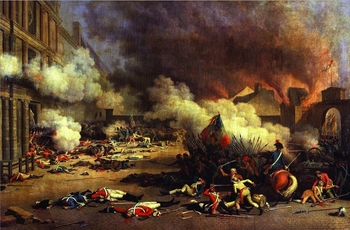
The deputation warned that if legislators did not depose Louis, “there would only remain one recourse for the nation, that of deploying all of its force to crush all its tyrants” (Footnote AP 47:70). Paris's sections made good on that promise within weeks. Cumulative frustrations over food, the war situation, and Louis's conspiracy against the revolution reached its climax on August 10, 1792 [Figure 1]. In what observers called the “second” Revolution, Paris's armed sections attacked the Tuileries as the royal family fled to the nearby Legislative Assembly. Sheltered in the journalists’ logographie room, Louis was arrested by the Assembly and the municipal government, the Commune. As a result, the question of what to do with the king could no longer be deferred. Three years after the revolution began, France would finally have to put the king on trial and judge him.
Prise du palais des Tuileries, 10 août 1792, painting by Jacques Bertaux.

* * *
Convention members immediately confronted two obstacles in judging the king. First, no preexisting adversarial procedures existed for such a trial and, except for the English case of Charles I in 1649, few available scripts existed for regicide. As Jean-Paul Marat was compelled to remind his legalistic opponents, “It is not at all here a question of an ordinary trial” (Footnote AP 55:15). Second, Louis was legally inviolable, and not by dint of divine right but positive law. He received his schedule of legal immunities by virtue of the 1791 Constitution, and no trial would be possible until a way around that fact could be found.
As the convention members searched for ways to circumvent royal inviolability from roughly October 1 to December 6, Paris's popular sections continued to experiment with new idioms of collective agency. And to the displeasure of moderates, they leaned towards extralegal violence as their preferred vocabulary of popular sovereignty. As Jean-Marie Roland, Minister of the Interior, explained to Louis before the August 10 insurrection, “The revolution is achieved in their minds; it will be completed at the cost of blood, and will be cemented by it, if wisdom does not prevent misfortunes that can still be avoided.” If Louis continued blocking legislation with his suspensive veto, Roland warned, “the departments will be forced to substitute for it, as they do everywhere, with violent measures,” while “the angered people will supplement [the law's] absence with excesses” (Footnote AP 45:163–4). The “September Massacres” seemed to prove Roland's point. This journée saw Parisian crowds mass-murder thousands of prisoners in fear that they would join the invading armies of Europe as a fifth column. These septembriseurs placed the king's trial against the backdrop of bloody, extralegal popular violence.
It was in these months that Jacobins discovered redemptive violence as a language of democratic agency. But before turning to the commitments which comprised that language, it is important to understand that it was neither the only one to be invoked during the trial nor the most persuasive. Some royal sympathizers, for example, took inviolability at face value and reasoned accordingly. After all, the law was not completely silent on Louis's guilt. Inviolability was not invincibility. Because the king's legal immunities were a provision of constitutional law, even if Louis exercised discretion in his executive power, it was still the case that, as the 1791 Constitution put it, “only in the name of the law may he exact obedience” (Stewart Reference Stewart1951, 240). Louis was acutely aware of this fact. In response to Bertrand Barère's prosecutorial statement on December 11 that “Louis, the French people accuse you of having committed a multitude of crimes, of establishing your tyranny by destroying their liberty,” Louis gave the careful reply: “There were no laws which stopped me” (Soboul Reference Soboul1966, 114–5). His was a condition of inviolability along with clear conditions for abdication: if Louis refused to take the oath to the constitution, if he led an army against the nation, or if he refused to disavow foreign armies fighting against the nation in his name, then he would be stripped of inviolability, reduced to a citizen, and made culpable for any future treasonous actions.
This legal context guided Charles-François-Gabriel Morrison when he asked in a November 13 speech, “Can Louis XVI be judged?” A royalist deputy from the Vendée, he drew the most straightforward conclusion: under a strict interpretation of the constitution, a trial was impossible and unnecessary. Although “a sovereign people have no other rule than its supreme will,” there are intrinsic limitations to that will such as ex post facto justice. “When a nation has promulgated a law,” Morrison explained, “although that nation have the right to change the law at will, nevertheless, that changed law cannot have a retroactive effect.” To insist otherwise was to commit “injury to the most basic principles of justice,” to forfeit principles “unknown only to tyrants” (Morrison Reference Morrison, Walzer and Rothstein1992 [1792], 111–3). Morrison concluded that the people could choose to abolish the monarchy, but they could not try Louis whose crimes were committed while inviolable. The revolution needed to “avoid a monstrous and interminable trial, perhaps with untoward results” (Morrison Reference Morrison, Walzer and Rothstein1992 [1792], 119).
For his part, the Marquis de Condorcet, a philosophe and leader of the Gironde, tried to split the difference. Like Morrison, he accepted Louis was inviolable. But unlike Morrison, Condorcet believed that inviolability did not prevent the king from being tried. “Even if one gives constitutional inviolability a force most contrary to reason and to justice,” he believed, “it remains true that the nation has the right to judge him” (Condorcet Reference Condorcet, Walzer and Rothstein1992 [1792], 148). But to reach this conclusion, Condorcet had to design a series of baroque legal distinctions. Among them, he decoupled the question of guilt from punishment. Inviolability, he wanted to say, protected Louis from punishment but not from guilt. The king could be legally condemned for his actions, but he could not be punished without committing ex post facto justice.
Both Morrison and Condorcet's arguments were powerful examples of constitutional reasoning. Neither bothered denying the king's guilt, for the latter's behavior already made that impossible. The discovery of incriminating documents in an iron safe in the Tuileries revealed that Louis was collaborating with foreign powers to subvert the revolution. The documents, signed by Louis and compiled into a dossier for the Convention by Dufriche-Valazé, made his guilt undeniable (Soboul Reference Soboul1966, 83–87).
And yet Morrison and Condorcet's arguments persuaded few deputies. The victorious position was closer to that of Jean-Baptiste Mailhe, a lawyer from Toulouse whose report to the Convention on royal inviolability opened up the trial in earnest. For Mailhe, a faithful application of the law led to counterintuitive conclusions about the nature of royal guilt and popular sovereignty. He admitted that “in no case could the king be judged by the other constituted authorities, since he was their superior . . . It did not follow,” however, that the king “could not be judged by the nation, since to come to such a conclusion would be to claim that by virtue of the Constitution, the king was superior to the nation or independent of the nation” (Mailhe Reference Mailhe, Walzer and Rothstein1992 [1792], 98). Such an inviolability, Mailhe claimed, would have entailed the nation's alienating its sovereignty. As everyone who read Rousseau knew, that was impossible.
Mailhe's appeal to “the nation” drew on prerevolutionary precedents. By the late 18th century, the various parlements were already presenting themselves as the nation's body. And in the lead up to the Estates-General in 1789, French leaders described the event as a meeting between the nation and its executive authority. In other words, the nation had already been invoked as a site of sovereignty distinguished from the executive branch of government. However, references to the nation prior to the revolution referred above all to a judicial entity. The parlements, after all, were courts, staffed by judges, and comprised of judicial instruments meant to represent the nation to the king on behalf of the people. They represented the nation qua legal subject. It was not this legal subject that Mailhe had in mind when he claimed that, “No, the nation was not bound by royal inviolability, nor could it be.” Whereas Louis received his inviolability from the constitution, “the nation was sovereign regardless of constitution or king. Its inalienable sovereignty proceeds from nature alone” (Mailhe Reference Mailhe, Walzer and Rothstein1992 [1792], 98).
Mailhe's appeal to nature is remarkable given that he was neither a radical nor a Jacobin. Although a revolutionary, in the Convention he was associated with the moderate majority. Nevertheless, he invoked the revolution's most radical claim: the nation named a sovereignty that preceded all legal forms. It resembled Sieyès's famous doctrine of constituent power. But unlike Sieyès, who limited the constituent power to a constitution-making function, Mailhe's nation possessed the powers of judgment. In his report, the nation was asleep, but as it “awoke” to its sovereignty, it recovered its “instincts,” especially those of revenge and self-defense. As a natural existence, it was governed by laws which preceded positive law and “are as old as society itself.” The nation did not depend on positive laws because it was not a positive existence. Before its agency, “all the difficulties disappear: royal inviolability might never have been” (Mailhe Reference Mailhe, Walzer and Rothstein1992 [1792], 97, 100–101). Since the nation bestowed on Louis his inviolability, it was within its powers to discard it and to judge Louis as a citizen before the law. Thus, because the Convention was a “perfect” representation of the nation, Mailhe believed it could judge the king. To say otherwise would be “to reject the nation” (Mailhe Reference Mailhe, Walzer and Rothstein1992 [1792], 107).
The arguments of Morrison, Condorcet, and Mailhe were grounded in different threads of revolutionary political culture. Although they arrived at different conclusions about how best to engage royal inviolability, they each accepted popular sovereignty. The point is important, because it suggests that regicide was neither an intrinsic feature of revolutionary ideology nor entailed by popular sovereignty. Even as late as April 1792, Robespierre agreed. Writing in the opening editorial of his Le Défenseur de la Constitution, he skeptically asked, “Is it in the words republic or monarchy that an answer resides to the great social problem?” (Robespierre Reference Robespierre and Laurent1939, 9). If Robespierre and his Jacobin allies subsequently charted a different path by advocating for extralegal regicide, it was because the prospect of regicide led them to adopt a different perspective on what was at stake in founding a republic. For despite all that divided Morrison, Mailhe, and Condorcet, these leaders shared a common interpretation of the problem inviolability posed: the ultimate source of right. If Morrison denied there was a source of right higher than the constitution, Mailhe claimed to have found exactly that: “there is no Constitution which could prevent you from calling down upon [an enemy's] head the censure of divine and human laws: rights and duties of nature are of an order higher than human institutions” (Mailhe Reference Mailhe, Walzer and Rothstein1992 [1792], 103). They both approached the trial in terms of the final grounds of right and disagreed where that ground was located: the Constitution or the nation? It was also why Condorcet's argument became so convoluted. He wanted a trial, but he refused to invoke an extralegal authority like “the nation” to sanction it. He was thus compelled to decouple guilt from punishment to remain philosophically consistent.
Jacobins found this debate tedious. “Those who attach any importance to the just punishment of a king will never found a Republic,” Saint-Just argued in his first speech to the Convention (Saint-Just Reference Saint-Just, Walzer and Rothstein1992 [1792], 122). It all amounted to exasperating “constitutional logic-chopping” as far as Robespierre was concerned (Robespierre Reference Robespierre, Walzer and Rothstein1992 [1792], 135). It wasn't their opponents’ legal reasoning that frustrated these Jacobins. After all, like Mailhe, they too would appeal to the law of nations to circumvent inviolability. Instead, they were frustrated with the overriding presumption that, at bottom, the trial was about the final ground of legal right. It was as if monarchy was illegitimate merely because it placed those grounds in the wrong body. If all it takes to found a republic is shifting the grounds of right to the people, and if regicide is essentially supplanting a treasonous king with the rule of law, then we ought to concede to the Girondin leader Pierre-Victurnien Vergniaud's claim that “the Constitution,” could be, and was, the “basis of civil society,” or Condorcet's belief that, suitably adjusted, positive law might be enough to bridge the revolutionary gap (Vergniaud Reference Vergniaud, Walzer and Rothstein1992 [1792], 195). That was a point even Marat conceded, and unlike other Jacobins, he defended a trial.
However, Robespierre and his allies were discovering that affixing the source of law to “the people” was inadequate for founding a republic. Redefining the source of right might curtail the arbitrary authority of the king. It might even place ordinary justice within the people's reach. But royalism in France was never primarily a doctrine about the nature of justice or the source of right. It was an entire ideology of “the social,” and to found a republic, a specifically republican vision of society had to take the place of the old regime. Without a new vision of society, France could achieve a republican regime in law, but not a republican people. And so when Jacobins turned to the laws of nature to overcome inviolability, they did so for different reasons than their critics. Their appeal to the “terror of the justice of the people” sought to reframe regicide as an act of terror against an external enemy rather than the fulfillment of justice. If regicide could be construed this way, perhaps it might reassert the moral bases of social cohesion and forge a new republican social body.
* * *
We can observe the Jacobin critique of the legalistic interpretation of regicide in at least two places. The first is in their insistence that the trial did not present a judicial proceeding, but a scene of war. In his speech on November 13, 1792, Saint-Just attacked Morrison and Mailhe's opinions as “equally false.” Rather than respecting inviolability (Morrison) or judging Louis as a regular citizen (Mailhe), “the king ought to be judged according to principles foreign to both.” Applying old ideas to a new situation, the two misconstrued the task at hand. “The single aim of [Mailhe's] committee was to persuade you that the king should be judged as an ordinary citizen,” Saint-Just claimed. “And I say that the king should be judged as an enemy; that we must not so much judge him as combat him; that as he had no part in the contract which united the French people, the forms of judicial procedure here are not to be sought in positive law, but in the law of nations” (Saint-Just Reference Saint-Just, Walzer and Rothstein1992 [1792], 121). For Saint-Just, appealing to the law of nations did not mean appealing to a higher law to judge an inviolable king. This was not a recapitulation of the Girondin search for a higher source of right. Instead, Saint-Just appealed to the law of nations for the rules of combat. The king was an enemy in an international arena, a “brigand,” “the lowest class of humanity,” “outlaw,” and a “rebel.”
Some men search for a law which would allow the punishment of the king. But in the form of government from which we come, he was indeed inviolable with respect to each citizen. Between the people as a whole and the king, I do not however recognize any natural bond . . . The social contract is between citizen and citizen, not between citizen and government. A contract affects only those whom it binds. As a consequence, Louis, who was not bound, cannot be judged in civil law. . . . All these reasons should lead you to judge Louis, not as a citizen, but as a rebel (Saint-Just Reference Saint-Just, Walzer and Rothstein1992 [1792], 123).
Robespierre agreed. He wrote in early December, “Citizens, the Assembly has unwittingly been brought far from the true question. There is no trial to be conducted here.” That was because “Louis is not an accused man. You are not judges. You are, and you can only be, statesmen and representatives of the nation.” As representatives of the general will, “You do not have a verdict to give for or against a man, but a measure to take for the public safety.” And unfortunately, “the character of the deliberations hitherto goes directly against this latter aim” (Robespierre Reference Robespierre, Walzer and Rothstein1992 [1792], 131).
The second place we see Jacobins object to the Gironde's legalistic framing of the trial lay in their focus on regenerating social cohesion. Rather than cite the law of nations, this argument reached into an alternative strand of French thought that was concerned with “the social.” Unlike political unity, the cohesion of “the social” referred to customary relations of interdependence. As Daniel Gordon has argued, 18th-century French thinkers theorized “the social” in response to absolutism. Where court life in Versailles monopolized the sphere of politics, ordinary people were compelled to search for alternative, nonpolitical modes of association. “The invention of the social as a distinctive field of human experience,” however, “required a demonstration that some meaningful activities are self-instituting; that in some situations human beings can hang together of their own accord; that humans, in short, are sociable creatures” (Gordon Reference Gordon1994, 4–5). That demonstration could come from sources ranging from anthropological histories of non-Western cultures to new archaeological studies on “the golden age,” the theme of natural sociabilité in Baron d'Holbach and Rousseau, or Condorcet's new “social science,” which promised to render “the social” in the new authoritative language of scientific appraisal (Baker Reference Baker1975; Mantena Reference Mantena2010, 56–88; Edelstein Reference Edelstein2009).
For ordinary people, however, the most immediate source for understanding the social was prerevolutionary France's corporatist society, which consisted of overlapping bodies such as the family, the city, and the guild. Far from arrangements of convenience, each corps was understood to be an autonomous moral entity. Trade guilds, for example, had their own patron saints, holidays, mutual aid institutions, and rituals of moral improvement and economic cooperation (Sewell Reference Sewell1980). And just as every corps was adhered by its esprit de corps, société at large was bound together by la morale. As the Montesquieu enthusiast Louis de Jaucourt put it, morality did not involve “knowing the essence of real substances.” Instead, it concerned the relations between men and their conduct with one another. To see morality, Jaucourt explained, “it is only necessary to compare with care certain relations among human actions and a certain rule.” On this account, morality is about the collective activity of moral regulation as much as it is about maxims of conduct. La morale is what makes society more than a collection of individuals—a corps—and it is why “la morale is the proper science of man; because it is a general knowledge proportioned to their natural capacity, and from which depends their greatest interest” (Jaucourt Reference Jaucourt, Diderot and Rond d'Alembert1765, 699–700). Although moral relations between men are fixed and unchanging, they are nevertheless relational rather than essential. They describe not natural, but social laws governing men of reason.
And yet, part of the reason 18th-century French thinkers theorized the social at all was because its cohesion was entering into crisis. Corporatism in particular came under attack from reform movements in the years leading up to the revolution. Led by ministers allied with the philosophes and the physiocrats, these reformers sought to resolve the monarchy's looming debt crisis by dismantling the corporate privileges that interfered with increasing taxation. Anne-Robert-Jacques Turgot led the attack on the corporatist conception of the social, explaining, “Public utility is the supreme law,” and before that law, “particular corporate bodies do not exist of themselves, or for themselves; they have been formed for society, and they must cease to exist immediately after they cease to be useful.” Reduced to a utilitarian arrangement, Turgot, a champion of the scientific reform of government and Condorcet's idol, denied corporate bodies their moral standing in order to exalt the abstract individual and aggregate social utility: “Citizens have rights” which, he insisted, “exist independently of society” (Turgot Reference Turgot and Michael Baker1987 [1757], 96; Sonenscher Reference Sonenscher2007, 283–90). It was a revolutionary stance that provoked outrage from the parlements, the nobility, and trade associations. After issuing a series of laissez-faire reforms in 1776, his program finally lost the support of fellow ministers and Louis dismissed him as Controller-General of Finances.
Turgot's edicts were only a prelude to successive attempts at atomizing the French social body. Revolutionary leaders instituted civil marriage and divorce, thereby redefining the broader purpose of “association” (Roche Reference Roche and Goldhammer1998, 521–2; Robcis Reference Robcis2013, 20–25). They denied political voice to any intermediary bodies between the nation and the king, giving the Third Estate exclusive power to “interpret and present the general will of the nation; there cannot exist between the throne and this assembly any veto, any negative power” (Footnote AP 8:127). They repudiated the schedule of privileges allotted by corps in favor of abstract individual rights, because those intermediary corps foreclosed the formation of a united body politic. After all, Sieyès wrote, if social ascriptions were not suppressed, forming a national representation would be futile: “They would still remain three types of heterogeneous matter [the three Estates] that it would be impossible to amalgamate” (Sieyès Reference Sieyès and Sonenscher2003 [1788], 128). Social atomization came to a point with Le Chapelier's Law of 1791, which decreed “association” between workers to be “unconstitutional” and “in contempt of liberty and the Declaration of the Rights of Man.” Indeed, any associations that obstructed “the free exercise of industry and labor” were to be criminalized as “seditious assemblies” (Stewart Reference Stewart1951, 165–6; Sewell Reference Sewell1980, 90–91).
If social cohesion was emerging as a pressing problem in France, so, too, had the king presented a special type of solution to it, and for two reasons. Unlike the family or guild which presented an autonomous moral corps consisting in several persons, the king was a corps unto himself. And whereas the former mediated relations between the individual and the state, the corps of the latter was the state. (“L’état, c'est moi,” Louis XIV is to have famously proposed.) These attributes of royal embodiment partake in aspects of the well-known doctrine of “the king's two bodies,” a feature of royalism with origins in medieval jurisprudence and Christian thought (but with “a post-Christian appeal,” Walzer adds) (Walzer Reference Walzer and Rothstein1992, 22). Better known in the context of English political thought, the doctrine portrays the king as possessing a temporal and eternal body. When this ideology held sway in France under absolutism, the king was thought to incarnate in his person the eternal corpus mysticum, the essence of the real nation and from which the dispersed temporal instances of the body politic acquired a higher moral unity. Thanks to it, the king held in his person a transcendental guarantee of national unity, and the mere fact of his embodiment answered the problem of social cohesion.
However, like corporatism generally, developments in intellectual culture corroded this political theology by 1789. During Louis XVI's reign, new theories of representation hallowed out the ideology of the king's two bodies. The shift from thinking about representation as making-present to representation as delegation in mid-18th-century France undercut the king's claim to incarnate social cohesion in his body. It permitted the royal corpus mysticum to yield to the parlements of France, then the Estates-General, and finally the National Assembly as the incarnation of the nation's body (Friedland Reference Friedland2002, 47–50; Baker Reference Baker2001, 32–53). Sieyès gave this transformation its canonical formulation in his pamphlet “What is the Third Estate?”: “a nation is made one by virtue of a common system of law and a common representation” (Sieyès Reference Sieyès and Sonenscher2003 [1788], 99).
Yet despite royalism's weakened grip, most French subjects still described the king as the linchpin of the body politic. When the cahiers de doléances addressed Louis as the father of the French, it was a pious reaffirmation of the father-king who clasped together the “real” national body with its myriad temporal instances. Even after the revolution began, most subjects still believed that what formed a nation was the unity of its will, and as a consequence, only the king could give to individuals the form of “the nation” by identifying the national will with his own. The king provided the transcendental organizing principle of society, a guarantee that society was more real and durable than the mortal individuals that made it up (Baker Reference Baker1990, 227–51). So long as his royal body remained intact, France possessed moral unity even as its population and institutions changed.
For that same reason, calling into question the royal body described an unprecedented act of violence, for it was a direct attack on society itself. This explains why Saint-Just and Robespierre returned, time and again, to the question of the moral basis of social cohesion during and after the trial. In his speech on November 13, 1792, Saint-Just attacked Mailhe's report for succumbing to an amoral legalism: “The committee fell into forms without principles” (Saint-Just Reference Saint-Just, Walzer and Rothstein1992 [1792], 121). Robespierre echoed this exact point the next month: “We invoke forms because we lack principles” (Robespierre Reference Robespierre, Walzer and Rothstein1992 [1792], 133). By prioritizing procedural justice over concrete morality, Saint-Just believed political leaders had forgotten that founding a republic entailed more than setting new legal standards of right. It also demanded “an example of virtue which would be a bond of public spirit and unity in the republic” (Saint-Just Reference Saint-Just, Walzer and Rothstein1992 [1792], 122). That “bond of public spirit” was morality itself. As Saint-Just put it later in December, “What do you call a revolution? The fall of a throne, a few blows levied at a few abuses?” Although Girondin deputies carried on as if the answer was yes, for Saint-Just, the revolution posed the more demanding task of reconstructing the moral foundations of the social. “The moral order is like the physical,” he insisted, and so even if “abuses disappear for an instant, as the dew dries in the morning, and as it falls again with the night, so the abuses will reappear” (Saint-Just Reference Saint-Just, Walzer and Rothstein1992b [1792], 176). Moral order is something that must be reconstituted for society's rebirth. That is why “it is not sufficient to say that in order of eternal justice, sovereignty is independent of the existing form of government and thence to infer that the king should be tried”—that is, Maihle's argument. “We will have no Republic,” Saint-Just explained, “without these distinctions which permit all the parts of the social order their natural movement, just as nature creates life from a union of elements” (Saint-Just Reference Saint-Just, Walzer and Rothstein1992 [1792], 126).
To reforge the republican social body, there would need to be active coordination between morality, nature, and society. And for that, existing constitutional law was inadequate. After all, Robespierre explained, having entered into war with the king, “It is too great a contradiction to suppose that the Constitution might preside over this new order of things. That would be to suppose that it could outlive itself. What laws replace it? Those of nature, which is the basis of society” (Robespierre Reference Robespierre, Walzer and Rothstein1992 [1792], 133). In short, unlike Turgot and Condorcet, Robespierre and Saint-Just's vision of the republican social body was not reducible to individual consent and aggregate utility. Rather, it called for the corporatism of the old regime to be replaced by a society modeled on the normative patterns of nature.
These two objections to the Gironde interpretation of the trial—that it was an act of war rather than a judicial proceeding, and that it needed to produce not “a few blows levied at a few abuses” but “moral order”—amounted to a claim that if the revolution approached Louis as a citizen to be judged rather than an enemy of mankind to be killed, there would only be a regime change rather than a revolution. “Citizens, did you want a revolution without a revolution?” Robespierre asked (Robespierre Reference Robespierre and Howe2007 [1792], 43). “If you declare the king a citizen,” Saint-Just warned, “he will slip from your grasp” (Saint-Just Reference Saint-Just, Walzer and Rothstein1992 [1792], 125). The “he” in question did not refer only to the king's person, but also to his mystical body and the corporatist vision of society which that body cohered. It was why Robespierre and Saint-Just demanded Convention leaders to go beyond redefining the ground of right. Jacobins hoped to strike Louis in both his person and as a representation. And executing that representative body required the revolution to posit an alternative account of social cohesion in place of the old corporatism. Leaving the moral bases for social cohesion unspecified was simply not an option. Citizens born into an established liberal political culture today might endorse legalistic or prudential considerations as the basis for the polity's unity. They might even accept a type of “constitutional patriotism” (Habermas Reference Habermas2001; Müller Reference Müller2007). But such an orientation was simply unrealistic in 1792. Republican democracy was taking root among a people whose sense of collective belonging had never been construed as essentially political, and it would have been—and was—utopian to insist that it suddenly be otherwise.
The Jacobins, long vilified as blinded by “abstract” reasoning, were the ones most attentive to this fact. Condorcet and Sieyès, on the other hand, vastly underestimated the importance of “the social” for republican democracy. (When Turgot was dismissed for attacking the corporate structure of the social in his edicts, Condorcet was shocked, evidently not understanding why Turgot's edicts might have been so unpopular.) If the revolution was to yield a republican people, it would also need to produce a new type of social bond with which to supplant the royal corpus mysticum. That was why regicide had to do more than cancel the past. It was incumbent on it to produce a new social body cohered by moral principles which were not yet widely accepted. Therein lay the central challenge posed by the trial for revolutionary democracy.
FROM TYRANNICIDE TO REDEMPTIVE VIOLENCE
This interpretation of the trial's challenge was itself revolutionary. It was therefore unclear how regicide was supposed to answer it. After all, earlier regicides did not believe they were forming new societies with their violence. As Camus has observed, “Kings were put to death long before January 21, 1793, and before the regicides of the 19th century.” But all of those earlier regicides “were interested in attacking the person, not the principle, of the king. They wanted another king and that was all. It never occurred to them that the throne could remain empty forever” (Camus Reference Camus and Bower1956, 112). As Robespierre himself reflected, “If we had not had a greater task to fulfill, if all that was at issue here were the interests of a faction or a new aristocracy, we might have been able to believe . . . that the plan for the French Revolution was clearly written in the works of Tacitus and Machiavelli” (Robespierre Reference Robespierre and Howe2007e [1794], 109). There was, however, a “greater task” at hand about which the classical texts of political theory remained silent: democratic revolution. And Louis was not just a tyrant. Thanks to royalist ideology, he was also the transcendental guarantee of social cohesion. If the Jacobins believed that at stake was nothing less than killing kingship itself and founding a new society, then how was regicide supposed to fulfill this unprecedented historical task?
As the legal trial proceeded in spite of Jacobin protests, Robespierre and his allies adapted regicide to this task by transposing it from classical republican theories of tyrannicide into newer Enlightenment discourses of nature. Specifically, they employed two concurrent rhetorical strategies: they sacralized regicidal violence, and they naturalized democratic agency.
Jacobins repeatedly described regicide in sacralized, expiatory, and redemptive terms. Regicide was not simply the removal of a king, but a “sacred cause” with a “sublime outcome” (Robespierre Reference Robespierre and Howe2007 [1792], 44). It was analogized to biblical moments of absolution like the great flood (Robespierre Reference Robespierre and Howe2007b [1793], 88–89). The blood shed by the revolution “is the expiation we offer the world,” the revolutionary “cause is holy,” and indeed in the case of regicide, “Honouring the Divinity and punishing kings are the same thing” (Robespierre Reference Robespierre and Howe2007c [1793], 93, 95, 97). Spurning atheism as antirepublican, this language of redemptive violence affirmed the salvation of “the people” as “the holiest of all laws” (Robespierre Reference Robespierre and Howe2007d [1793], 100). Indeed, it is worth recalling that the Jacobins were among the fiercest enemies to the revolution's de-Christianization efforts. Atheism was just as immoral as royalism. As Robespierre remarked, “The scapular-wearing fanatic and the fanatic preaching atheism have many similarities. . . . sometimes red bonnets are closer to red high heels than one might think” (Robespierre Reference Robespierre and Howe2007d [1793], 174–5).
It would be misleading to interpret this redemptive rhetoric as a desire to return to the past. Undoubtedly, its Edenic sentimentality and allusions to the “golden age” resembled prerevolutionary conceptions of moral order, even a reactionary “deification of violence” (Fehér Reference Fehér1987; Edelstein Reference Edelstein2009). But in 1792–1793, invocations of redemption functioned as claims to rupture. Calls to redeem mankind encouraged revolutionaries to leap as much into the future as to return to the past (Ozouf Reference Ozouf1989; Jaume Reference Jaume2015).
Nor was violence's sacralization a return to preceding cognates in prerevolutionary penal ideology. Since at least Michel Foucault, scholars have been familiar with the idea that capital punishment provides a restorative ritual of wounded sovereignty. “The public execution,” Foucault argued, was “a ceremonial by which a momentarily injured sovereignty is reconstituted. It restores that sovereignty by manifesting it at its most spectacular” (Foucault Reference Foucault and Sheridan1995, 48). But it is unlikely that revolutionaries had this image of violence in mind, because decades before 1789, nearly all proponents of enlightened, reformed government—including the future leaders of the revolution—repudiated spectacular capital punishment as barbaric. Especially after Cesare Beccaria published his 1764 On Crimes and Punishment and the Abbé Morellet translated it into French, reforming or abolishing capital punishment became a widely agreed-upon tenet of prerevolutionary political thought. Leaders such as Thomas Jefferson, Catherine the Great, Marat, Brissot, Mably, and Robespierre each turned the abolition of spectacular capital punishment into a cause célèbre. That was why Robespierre entered the revolution as a proud advocate of its abolition (Footnote AP 26: 622–3). It seems unlikely that the king's execution was conceived in terms of an ideology of violence that virtually all significant political thinkers had repudiated for a generation (Friedland Reference Friedland2012, 204–17). Robespierre, for his part, never recanted his arguments for the abolition of capital punishment. He insisted that its abolition was compatible with endorsing regicide, implying that the latter entailed an altogether new type of sacralized violence from the old regime's ceremonial, spectacular killings.
Naturalizing the agency behind regicide proved more challenging. It involved portraying the agent of regicide, “the people,” as an extension of nature's agency rather than a lone assassin or a coup by a vanguard. Without doubt, Jacobins are notorious among students of revolutionary culture for naturalizing the revolution. After 1792, they would restructure the calendar around seasons and natural objects, plant liberty trees, organize festivals personifying Mother Nature, and forge a solar cult to connect the Republic to nature's immanent moral authority (Gombrich Reference Gombrich1979; Ozouf Reference Ozouf1991; Huet Reference Huet1997; Daston Reference Daston and Peterson2004, 371–411; Hunt Reference Hunt2004; Edelstein Reference Edelstein2009). During the king's trial, however, Jacobins specifically invoked images of nature to connect the will of the people to nature's catastrophic agency and ecological self-regulation. They hoped to transform popular violence into a force of moral redemption consistent with new scientific theories of nature as generative and regenerative.
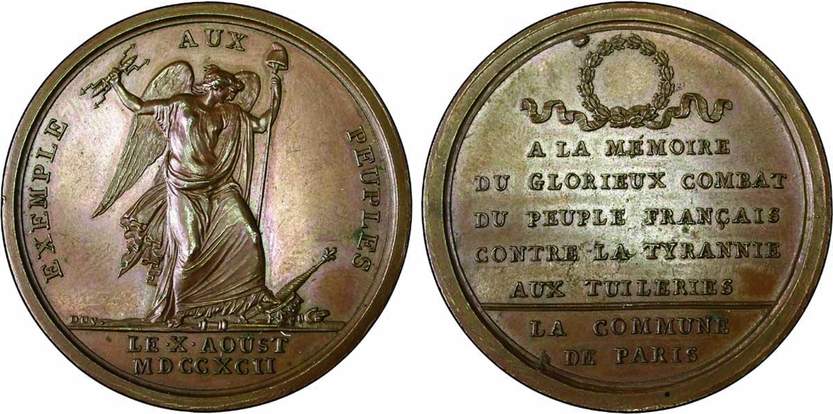
Jacobins were particularly keen to model democratic agency after natural disasters (Miller Reference Miller2011, 72–103). “The majestic movements of a great people, the sublime force of virtue” was, according to Robespierre, “like the eruptions of a volcano” (Robespierre Reference Robespierre, Walzer and Rothstein1992 [1792], 132). Images of floods, earthquakes, and storms pervaded Jacobin depictions of popular assembly and insurrection. Particularly compelling was the image of the people's agency as lightning, as in the medallion pressed to commemorate the August insurrection at the Tuileries [Figure 2]. The medallion bears an image of Liberty crushing royalist symbols under her foot. In her raised hand is a dagger discharging lightning bolts.
A medallion in memory of the August 10, 1792 assault on the Tuileries, medallion by Benjamin Duvivier [1792].

The illustration neatly visualizes Robespierre's most important speech during the king's trial: on December 3, 1792, Robespierre described the people's redemptive violence as the antithesis of the law: “A people does not judge as does a court of law. It does not hand down sentences, it hurls down thunderbolts; it does not condemn kings, it plunges them into the abyss” (Robespierre Reference Robespierre, Walzer and Rothstein1992 [1792], 133). It was a point he reiterated in his famous speech on political morality on February 5, 1794: “The revolution's government is the despotism of liberty over tyranny. . . . And are not thunderbolts meant to strike vainglorious heads?” (Robespierre Reference Robespierre and Howe2007e [1794], 115). And again, he invoked lightning in his speech on the pedagogical purpose of republican festivals.
The world has changed, it should change again. . . . Man has conquered lightning and diverted lightning from heaven. . . . Everything has changed in the physical order; everything should change in the moral and political order. Half the world's revolution is already complete; the other half should be accomplished (Miller Reference Miller2011, 73).
Appreciating Robespierre's claim requires connecting it to the special significance lightning acquired in late 18th-century French scientific culture: lightning manifested nature's simultaneous capacity for destruction and regeneration. This was the position that emerged among revolutionary scientists like Marat. Marat was a journalist and one of the revolution's legendary leaders. Although he is most known for his bloodthirsty endorsement of discretionary popular violence, before the revolution he researched lightning in a 1782 study entitled Recherches physiques sur l’électricité. In that text, Marat outlined the regenerative, purifying effects of lightning for the atmosphere. He built his analysis upon the work of popular naturalists like the Comte de Buffon, who portrayed lightning in the Histoire naturelle as a spontaneous manifestation of the earth's universal energy (Dunn Reference Dunn1999; Miller Reference Miller2011).
Marat was intervening in a fad sweeping Paris in the 1780s: Mesmerism. Franz Mesmer, a popular pseudoscientist and spiritualist, had opened up clinics which were controversial for their healing practices. Besides hypnotism, he was known for his claims about the “refreshing” power of electricity. According to Mesmer, lightning struck whenever the composition of the atmosphere was imbalanced. Its heat functioned to spontaneously restore atmospheric equilibrium. Lightning was part of nature's self-regulation, its destructive capacity for self-correction. Mesmer tried to draw from his studies on lightning an account of social harmony and regeneration. Just as lightning manifested a spontaneous chemical reaction to restore atmospheric equilibrium, social upheavals occurred spontaneously to restore social harmony.
The connection between lightning and social regeneration was a widespread motif of revolutionary political culture. For example, the infamous Jacobin deputy, the Marquis de Sade, featured it in his 1791 libertine novel Justine as an agent of moral providence (Sade Reference Sade and Phillips2012 [1791]). The mayor of Paris, Jérôme Pétion, also appealed to it in March 1792, a few months before the king's trial:
There exists in the social order, as in the political order, laws whose imposing effect is felt only in memorable times. When the atmosphere that surrounds us is charged with wicked vapors, nature can only break free with a lightning bolt; in the same way, society can only purge itself from the excesses that trouble it with an impressive explosion; and after these great blows are struck, everything is reborn in hope and happiness (Miller Reference Miller2011, 41).
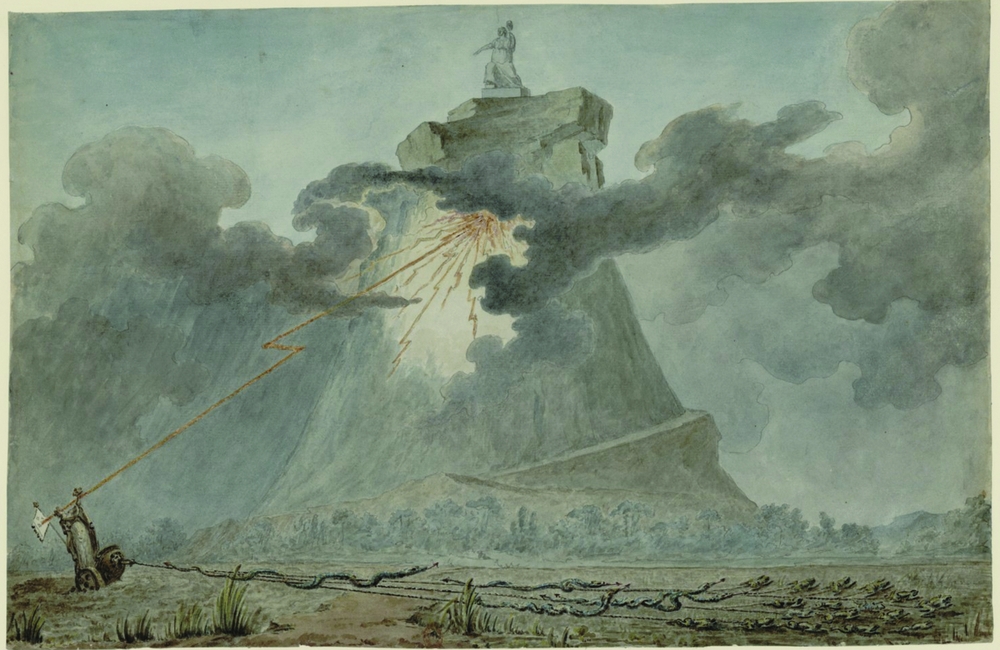
We can see these two rhetorical strategies—the sacralization of violence and the naturalization of democratic agency—intersect in several allegorical paintings from the period, like the illustration above from 1792 [Figure 3]. In this tableau, a thunderbolt dissipates the obfuscating clouds from the interior of “the Mountain,” a metaphor for the Jacobins dissipating superstition and ushering in enlightenment. But the lightning is also a weapon: a mechanical structure conducts the electricity towards fleeing frogs and snakes, who represent “the Swamp”—that is, Girondin moderates. Atop the mountain stands Zeus, who it turns out is a republican. His hand clutches a pike adorned with a Phrygian cap.
Allégorie sur la journée du 10 août 1792, unknown provenance. Bibliothèque Nationale de France, Département Estampes et Photographie.

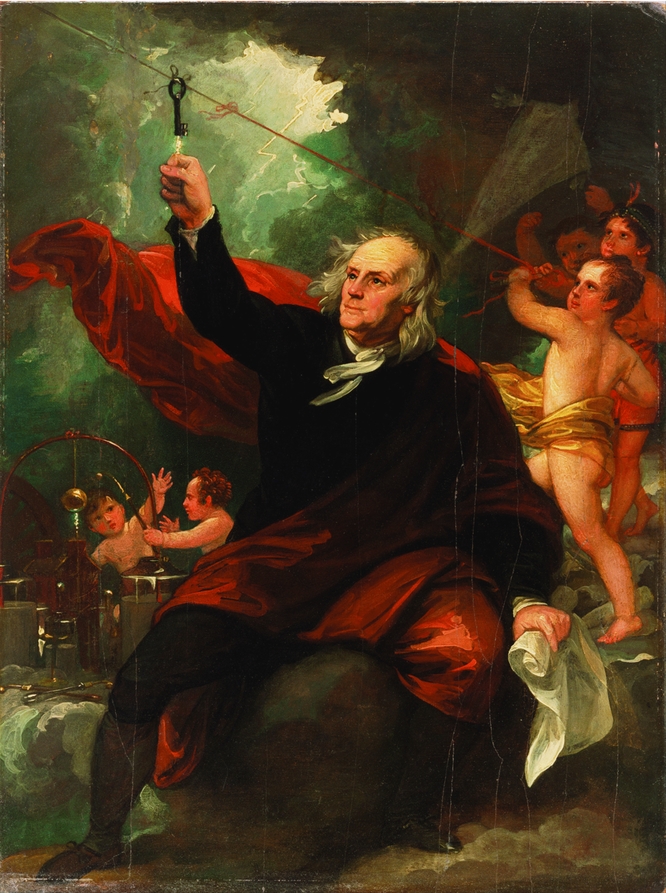
It is telling that Jacobins not only represented revolutionary violence as lightning, but as lightning conducted. Below is an illustration from 1793 depicting a Jacobin conducting lightning from the sky to strike frogs and snakes (Figure 4). After it is Benjamin Franklin (Figure 5). Every revolutionary knew Benjamin Franklin had taught men how to conduct lightning. That included Robespierre: before the Revolution, Robespierre made his name as a lawyer in a case involving a lightning conductor (Riskin Reference Riskin1999; McPhee Reference McPhee2012, 35–36). A young lawyer based in Arras, Robespierre took on a widely watched case in nearby Saint-Omer defending Charles Dominique de Vissery de Bois-Valé. De Vissery had affixed a lightning rod to his home. Fellow townsmen asked it be removed, because they believed the rod summoned lightning into the village rather than directing it safely to the ground. Robespierre defended De Vissery with arguments for the progress of enlightenment, the eradication of superstition, and the cause of science. Importantly, he proclaimed the lightning rod a triumph for mankind because, with the conductor, man had learned to channel nature's agency. Upon winning De Vissery's case, Robespierre wrote to Franklin describing how the case “presented to me the occasion to plead . . . the cause of a sublime discovery, to which mankind is beholden to you” (Robespierre Reference Robespierre and Cohn2014 [1783]). Lingering on these visual analogies between Franklin and the Jacobins as lightning conductors provides a clue about the latter's conception of revolutionary leadership. If Jacobins saw themselves as the voice of the people's rage, they would do so, these illustrations suggest, as its conductor rather than as its vanguard. Champions of the people, they were at the same time their instrument.
“Sans Union Point de Force, Sans Force Point de Liberté,” unattributed (c. 1793). Stanford University Libraries, French Revolution Digital Archive.

Benjamin West, “Benjamin Franklin Drawing Lightning from the Sky” (c. 1816). Philadelphia Museum of Art.

The scientific backgrounds of the revolution's leaders suggest that it would be a mistake to interpret these rhetorical and visual strategies in strictly figurative ways. Revolutionary leaders were searching for a new vocabulary of collective, democratic agency, and they found it in the esteemed discourses of nature which saturated French scientific culture. These depictions of natural disasters captured the felt experience of popular sovereignty. From the storming of the Bastille to the women's March on Versailles to the attack on the Tuileries, popular agency truly did appear like lightning: a flash of popular power that reasserted natural morality against social disequilibrium. Like lightning, the people's violence was spontaneous and regenerative.
These arguments help explain why Jacobins—many of whom were scientists themselves—refused to accept regicide as the outcome of a legal trial. Because the people's agency extended that of nature's, their agency naturally took the form of extrajudicial, spontaneous violence. Their will manifested, not through the law, but as a regenerative natural disaster—a flood, volcanic eruption, or lightning strike. Hence, if the king were to die under the sign of the law, it would be evidence that he was killed by something other than the people.
The king's trial was therefore also a drama about the nature of democratic agency. What does action by “the people” actually look like? What was its proper form of expression? Jacobins answered that the people's revolutionary agency manifested as a natural disaster. That belief shaped their approach to the king's trial. Regicide as redemptive violence could satisfy the need for a new social body upon the death of the royal corpus mysticum. It would become the premier weapon of revolutionary democracy, the unique type of violence possessed by the people.
CONCLUSION
On December 11, Louis finally appeared at the bar of the Convention. In anticipation, the Commune was declared permanently in session and the popular sections took up arms. To communicate the day's world-historic significance, Barère addressed the audience as the session's president: “Representatives, you are going to exercise the right of national justice . . . Europe observes you. History records your thoughts, your actions . . . The dignity of your session must answer to the French people's majesty. Through your body, they will give a great lesson to kings and a useful example to the liberation of nations” (Soboul Reference Soboul1966, 113). Upon Louis's seating, Jean-Baptiste Robert Lindet read to him the acte énonciatif, or prosecutorial statement. Upon being asked to comment, he denied each charge. After the frustrating appearance, the Convention gave Louis and his lawyers—Lamoignon de Malesherbes, François Denis Tronchet, and the young Raymond de Sèze—two weeks to prepare his defense.
When the vote was called on January 15, 1793, convention members were presented with three questions. The first question concerned Louis's culpability. It asked, “Louis Capet, former king of the French, is he guilty of conspiring against liberty and attacking the safety of the state? Yes or No.” Of the convention members present, 691 voted yes. Another 27 made various speeches which were tallied as abstentions. In the end, Louis's guilt was never in question. The second question was more contentious, for it concerned the “appeal to the people.” It asked the following: “The judgment which will be rendered to Louis, will it undergo a ratification by the people united in their primary assemblies? Yes or No.” Whereas many convention members offered long qualifications for why they voted one way or another, Saint-Just stated simply, “If I did not retain from the people the right to judge the tyrant, I would hold it from nature. No” (Footnote AP 57:90). Of the convention members present, 287 voted in favor of the appeal to the people and 424 against, with 12 abstentions. It was a major victory for the Jacobins and marked their triumphant ascendance in the Convention (Jordan Reference Jordan1979, 178–192).
The final question was deferred to the next day, and it took so long that roll-call voting lasted until the morning of January 17. The question asked, “What punishment will Louis, the former king of the French, receive?” Here, answers did not always observe party lines. Marat answered, “Death in 24 hours.” Robespierre and Danton simply said, “Death,” but so did Girondin leaders like Vergniaud. On the other hand, radicals like Thomas Paine voted against death, proposing instead that the former king be sent to America to earn a bourgeois living. The exact vote tally here has been a matter of dispute, but there was a straightforward majority plus one who voted death with no qualifications or amendments. Vergniaud announced the results: “I declare, in the name of the National Convention . . . that the punishment that is pronounced against Louis Capet is that of death” (Soboul Reference Soboul1966, 216). Except for his two appearances before the Convention's bar—to hear the acte énonciatif and to watch de Sèze read his defense—Louis had spent the trial's duration imprisoned in the Temple with his family. There, he had given his son daily geography lessons while reading a copy of The Imitation of Christ at his bedside. But on 21 January 1793, he was marched to the scaffold where Sanson, the executioner of Paris, guillotined him. At the fall of the blade, the crowd shouted vive la nation and vive la république; a few cut their own throats as Louis the Last's head plopped into the basket. Onlookers snatched up scraps of the king's bloodied shroud, souvenirs of monarchy's demise.
In the end, the Jacobin arguments failed. A trial was held, and Louis died under the sign of the law. But though they lost the battle, they would pursue more durable sources of republican social cohesion through civic festivals, public education, the militaristic fervor of the wars of liberty, and the Terror. Moreover, their representation of revolutionary violence as redemptive would persist beyond the Revolution. Pierre-Joseph Proudhon would invoke it in 1861 when he wrote that “war is divine . . . primordial, essential to life,” because it was “morality itself” (Proudhon Reference Proudhon, Edwards and Fraser1969, 202–203). So would the Russian terrorist group Narodnaia Volia (People's Will) when they assassinated Tsar Alexander II in 1881 (Verhoeven Reference Verhoeven2009), as did Georges Sorel in 1908, when he argued, “it is to violence that socialism owes those high ethical ideals by means of which it brings salvation to the modern world” (Sorel Reference Sorel and Jennings1999, 251). The Italian futurist Filippo Marinetti, too, claimed in 1915 that “we believe that only a love of danger and heroism can purify and regenerate our nation” (Marinetti Reference Marinetti, Berghaus and Thompson2006, 62). Even Frantz Fanon appealed in 1961 to the regenerative power of anticolonial violence, writing “violence . . . binds them together as a whole . . . a part of the great organism of violence which has surged upward in reaction” (Fanon Reference Fanon and Farrington1963, 93).
Bringing this longue durée of revolutionary, redemptive violence into view is not only a concern for the history of political thought. It also provides a better vantage point to understand its contemporary appeal. Sectors of the American far right, for instance, have in recent years invoked idioms of redemptive violence. Citing tyrannical government, the Tea Party has made a credo out of Thomas Jefferson's remark that “the tree of liberty must be refreshed from time to time with the blood of patriots and tyrants.” Brandishing this quotation like a catechism, conservative nationalists have posited a causal relation between violence by “the people” and national renewal. Even more, white nationalists like Stephen Bannon have decried intergenerational degeneration, and to mitigate it, they have proposed civilizational warfare as a form of regeneration capable of counteracting American imperial decline and the corrosive effect of elite interest politics (Livingston Reference Livingston2017).
It has been, and continues to be, easy to condemn these claims as antidemocratic deviations from a democratic political culture. But situating these 21st-century claims within a wider historical aperture reveals that they are symptomatic of a familiar problem that has dogged democratic politics since the French Revolution: how to make a people? As troubling as it may be, contemporary allusions to redemptive violence should be grasped as continuous with, rather than deviations from, the most prominent tendencies within modern political thought—and not just conservativism. After all, American democratic thought has long nurtured its own idiom of redemptive violence. Developed in dialogue with its French counterpart, the American idiom was grafted onto a mythology of westward expansion's regenerative effects (Slotkin Reference Slotkin1973; Hale Reference Hale2017). And it was turn-of-the-century liberals like Theodore Roosevelt in “The Strenuous Life” and “The Winning of the West” who, upon the closing of the frontier, recast military service and imperial expansion as a source of regeneration. These liberals, together with American revolutionaries, French Jacobins, Russian anarchists, Italian fascists, and anti-colonial nationalists, may be seen as antecedents for present invocations of redemptive violence, whether by Tea Party conservatives or white nationalists on the far right. The point is not to group them all into a homogenous “illiberal” tradition to be condemned; it is to situate the contemporary trope of redemptive violence in its proper context, which was always transatlantic and modern rather than national or simply reactionary: the ongoing conflictual and socially disintegrating experience of democratization.
The persistence of redemptive violence underscores how this question is fundamental to democratic politics: how should we conceive the social bond in the age of democracy? Political scientists have long presumed that political violence snaps that bond, but Jacobin thought teaches us that violence could just as often be seen to repair it. We do not have to normatively endorse that perspective to appreciate the ways it reorients democratic theory. Revolutionary, redemptive violence's enduring appeal reminds us that democracy is a claim about sociality as much as political institutions. It names not only a political regime, but a form of society. The Jacobins were among the first to grasp that fact. That is why they believed democratic revolution could not avoid regenerating the social bond. We, too, should try to understand this. Otherwise we will continue misunderstanding redemptive violence as a deviation from democratization rather than a vocabulary rooted in its own revolutionary ambitions.




Comments
No Comments have been published for this article.