Introduction
The nineteenth century brought the growth of the translation of mathematics books and articles. The phenomenon was indicative of the international circulation of knowledge (Crozet and Horiuchi Reference Crozet and Horiuchi2004; Xu Reference Xu2005; Raj Reference Raj2007, 80–81), the modernization of teaching curricula (Chatzis et al. Reference Chatzis, Morel, Preveraud and Verdier2017; Ageron Reference Ageron and Preveraud2017) and the establishment of mathematical communities, especially through journals (Despeaux Reference Despeaux, Karen and Adrian2002; Lützen Reference Lützen, Karen and Adrian2002). In the United States, mainly between 1820 and 1850,Footnote 1 a vast editorial movement in favor of the translation of French mathematical textbooks of the period 1780–1840Footnote 2 captured higher and secondary education. This has been the subject of numerous works by American and European historians (Cajori Reference Cajori1890; Simons Reference Simons1931; Struik Reference Struik1962, 227–232; Parshall and Rowe Reference Parshall and Rowe1994, 7–14; Grattan-Guinness 2002, 20–23; Preveraud Reference Preveraud2014). Some of the translations were written within institutions (Harvard, West Point, Virginia Military Institute) wishing to reform their mathematics curriculums: Existing scholarship emphasizes thus how textbook translations were often intended to develop or modernize training for engineers and academics (Pycior Reference Pycior, David and McCleary1989; Ackerberg-Hastings Reference Ackerberg-Hastings2000, Reference Ackerberg-Hastings2010; Kidwell, Ackerberg-Hastings, and Roberts Reference Kidwell, Ackerberg-Hastings and Lindsay Roberts2008, 9–19; Preveraud Reference Preveraud2014, Reference Preveraud2016). For those institutions, it was a question of both teaching their students new mathematical knowledge and transforming the way this knowledge was presented.
Against this background, this article focuses on mathematical translations of a different kind. First, those under examination here were produced in non-academic environments, for which very little research has hitherto been done.Footnote 3 This kind of translation deserves special attention since they were both mathematical and technical/professional in nature and were often achieved in a context of high economic stakes. In trade contexts, the translators did not simply translate the mathematical content. They had to produce a version adapted to the audience of the receiving country. They had to take into account divergences in terms of cultural, technical, scientific, educational, or editorial contexts of both emitter and receiver trades.Footnote 4 Second, the translations here analyzed appeared less than six months after the original from which they were inspired, a short lead time that was exceptional for more academic works. This is due to the fact that translations were produced in a professional environment. The development and growth of a trade or industry often meant that there was an urgent need for useful information and technical documents (Bret and Verdier Reference Bret, Verdier, Chevrel, D’Hulst and Lombez2012). Furthermore, in relatively closed professional environments, partnerships or competitive relationships inevitably brought key players into contact very quickly, even on an international scale. Throughout this article, it is crucial to keep in mind that the various actors acted within an extremely brief time frame, a constraint that contextualizes the choices they made in mathematical translation.
The setting is the United States horse-drawn carriage trade of the last quarter of the nineteenth century. This professional milieu produced several translations of a French descriptive geometry treatise:Footnote 5 Traité de menuiserie en voitures was originally written by French woodworker Brice Thomas (1820–1895) for the Parisian carriage manufactures. The treaty first appeared serially in French in the professional journal Le guide du carrossier between 1869 and 1870, before being published as a book in 1870. In the same year, part of this French work was also translated into English for the first time (Houghton Reference Houghton1879, 527). In fact, horse-drawn-carriage-trade elites in the United States favored descriptive geometry. In the early 1870s, a group of New York practitioners oversaw descriptive geometry to meet the needs of the growing horse-drawn-carriage industry in the United States (Kinney Reference Kinney2004, 91–95). This group included the bosses of large American companiesFootnote 6 focused primarily on the luxury trade (in New York, Cincinnati, and Amherst) – for instance the sons Henry (1824–1887) and James B. (1818–1902) of the famous carriage maker James Brewster (1788–1866), the New York carriage manufacturer and banker John Britton (1823–1886), and the descendant of a prominent New England carriage-making family, Charles P. Kimball (1825–1894). Among the influential members of the carriage industry, there were also the editors of professional journals – like Isaac Ware (1839–1901) for The Carriage Monthly or George Houghton (1850–1891) for The Hub – and some carriage draftsmen versed in descriptive geometry. Editors and bosses of large companies maintained close relationships, with the former often inviting the latter to write regularly in their column. From 1872, they would all be part of the first national carriage trade bosses’ union, The Carriage Builder’s National Association (CBNA).Footnote 7
To modernize the drawing of the coaches’ plans, the elites of the trade had the translations of Thomas’ treatise published in very popular trade periodicalsFootnote 8 three times between 1869 and 1877.Footnote 9 Thomas and the American translators wished to present and organize a theoretical knowledge related to drawing and projections in a professional context (for the workshops of the trade). Contrary to the “réduction en arts” of the craft knowledge used by many practitioners since the Renaissance (Dubourg-Glatigny and Vérin Reference Dubourg-Glatigny and Vérin2008; Daston Reference Daston2022, 48–52), here was the formalization of a new theoretical knowledge, at least in its mathematical form. Coachmakers were indeed already using projections in the eighteenth century and in the early nineteenth. But they did so without the help of any general theory, using graphic tricks to correct errors due to the projection of curved surfaces, and knowledge passed down from generation to generation.
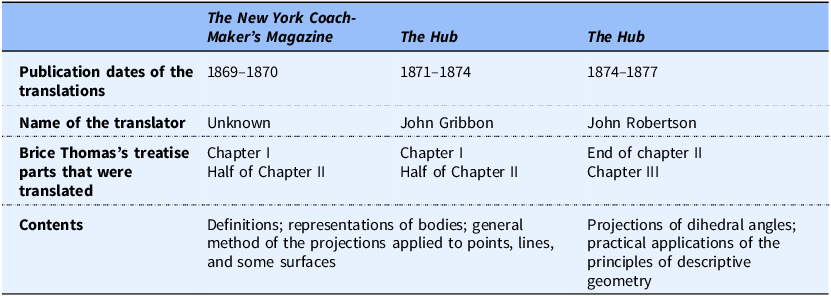
Some of Brice Thomas’ Traité de menuiserie en voitures was first translated in The New York Coach-Maker’s Magazine (1869–1870), directed by Erza M. Stratton (1809–1883), and then twice in George Houghton’s The Hub (the first translator between 1871 and 1874 and the second between 1874 and 1877) (table 1). Each version was the work of a different translator, and the second and third claimed to significantly improve upon their immediate predecessor.Footnote 10 Following the serial publication of Le guide du carrossier, the translation was made in parts appearing in series, successively in each of the three American journals. The first translation in The New York Coach-Maker’s Magazine was partial and ceased in 1870. In 1871, George Houghton bought the journal but changed its name, thereby founding The Hub. Regarding the continuation of the translation begun in The New York Coach-Maker’s Magazine, he could have continued the translation, benefiting from the network of readers acquired through previous journal subscriptions. Houghton could also have republished the partial translation that appeared some two years earlier and then extended it. Instead, he decided to start from scratch with the help of a new translator. Why? We will explore this below. The third translation, still published in The Hub, completed the work, which had lasted almost ten years under the supervision of the editors-in-chief of The New York Coach-Maker’s Magazine and The Hub. But it was again carried out by another translator. The purpose of this article is to analyze these editorial incongruities, bearing in mind that it occurred in a competitive professional context with a rapidly developing industry and trade (Kinney Reference Kinney2004, 34). Why did the trade press publish three versions of the same French text (that overlapped or complemented each other), in such a short period of time (table 1)?
Timeline of the publication of translations of the various parts of Brice Thomas’ treatise

In American academic circles, such consecutive translations of the same French textbook were not exceptional. For instance, several translations of Adrien-Marie Legendre’s (1752–1833) Éléments de géométrie were published between 1819 and 1880 (Preveraud Reference Preveraud2014). Louis Pierre Marie Bourdon’s (1779–1854) Éléments d’algèbre were also translated at least four times between 1830 and 1835 (Preveraud Reference Preveraud2016). In both cases, the new translations diverged quite clearly from the previous ones. The translators modified, deleted, and added mathematical content according to the contexts in which their translations were written: The target audiences, the mathematical curriculum of the target institutions, the economic pressures exerted by the publishers, and the evolution of the school publishing market were all factors that explain the differences or similarities between the translations. Thus, the many translations of French mathematical academic textbooks – far from seeing their status decline (Bret and Verider Reference Bret, Verdier, Chevrel, D’Hulst and Lombez2012, 986) – enlivened and stratifiedFootnote 11 part of American educational publishing until the end of the nineteenth century (Kidwell, Ackerberg-Hastings, and Roberts Reference Kidwell, Ackerberg-Hastings and Lindsay Roberts2008, 15–20).
What about translations of Brice Thomas’ treatise? The repeated versions of Traité de menuiserie en voitures did not ignore the previous ones. On the contrary, the editors claimed that the new translations improved the work of the previous translator, of whom they were very critical. The present article challenges this purely and only “qualitative” explanation. We show that the publication of second and third translations integrated a more global and long-term strategy of lobbying and occupation of the editorial space, in order to promote and impose descriptive geometry in the face of resistance and difficulties in the workshops.
What follows is a comparison of the three different translations that focuses on the choice of translators, the mathematical and technical vocabulary, and the general style of the texts. This lexical and stylistic analysis highlights a misalignment between the reasons given by the editor of The Hub to justify the publication of second and third translations. During this study, we will also analyze the promotion of descriptive geometry through these translations in relation to the reception of descriptive geometry in workshops. To do so, we will use the readers’ correspondence from The Hub. This will give us evidence for contextualizing the triple translation of the French mathematical treatise given to the United States horse-drawn-carriage trade. We will show that not all draftsmen and workersFootnote 12 of the trade listened to the ideas of the “elites.” For each translation, we will also question the choice and the replacement of translators. Did the American carriage networks include individuals capable of producing such translations with a consistent knowledge in mathematics, French, and trade? Who were the successive translators? How were they chosen by the editors of trade journals? How did the professional and economic context influence the choice of these translators and the execution of their translations?
After having exposed, in the first part, the trade context and the role descriptive geometry played in reforming the drawing techniques, we devote the following three sections of this article to the chronological study of each of the three translations of Brice Thomas’ Traité de menuiserie en voitures.
1. Reforming coaches’ drawing with descriptive geometry
Gaspard Monge (1765–1818) developed descriptive geometry as a method and tool for the planar representation of three-dimensional objects. It unified under a single mathematical theory all the stereotomic methods used by the construction trades (stonecutters, carpenters, joiners, etc.) since the Renaissance (Sakarovitch Reference Sakarovitch1998), and then could be taught as a general and mathematical theory (Barbin, Menghini, and Volkert Reference Barbin, Menghini and Volkert2019). In Monge’s approach, any volume was thus projected onto two (or three) perpendicular planes, one horizontal and the other vertical (the possible third plane was also vertical), before the vertical plane was folded onto the horizontal plane around their intersection line. The resulting drawing was called an “épure descriptive” (descriptive drawing) and consisted of the superimposition of the two projections of the volume (fig. 1). Their relationship through geometric constructions allowed the determination of lengths, angles, and intersections that would otherwise be inaccessible. With Monge, any technical object (or industrial project) was thus drawn flat before being manufactured.
Segment AB projected onto two perpendicular planes (left); folding (“rabattement”) of the vertical projection around LM onto the horizontal plane (right) (Monge Reference Monge1798, pl. I).

Emergence of descriptive geometry in the French carriage trade
Descriptive geometry was first circulated among carriage makers in France by Brice Thomas, a Parisian practitioner who worked alongside two other coachmakers and woodworkers to bring the principles of Monge’s science to a professional audience. Thomas became editor-in-chief of the first French journal dedicated to the carriage trade, Le guide du carrossier (1859–1914). In 1869 he published in his journal a series of articles on carriage design that he titled Traité de menuiserie en voitures (Thomas 1869–Reference Thomas1870).Footnote 13 These articles presented a serialized course very freely adapted from two French academic manuals of descriptive geometry,Footnote 14 in which Thomas skillfully combined Monge’s theoretical principles and canonical problems with concrete situations of the workshop. Thomas also participated in the organization of several professional schools that opened in Paris in the 1860s and 1870s, with curricula that included descriptive geometry (Preveraud Reference Preveraud2023, 141–158).
Brice Thomas’ lessons were divided into three main chapters. The first provided definitions of plane geometry and stereotomy figures (polygons, angles, solids, planes, etc.). It concluded with the exposition of the general principles of descriptive geometry under the heading “méthode des projections” (fig. 2). Thomas defined here what were the projections, the projecting planes, and the folding of one plane onto the other. Chapter two – “l’art du trait” – solved a number of classic geometric problems using the method of Monge. How to determine the length of a segment knowing its projection? How to determine the angle between two planes knowing their projections? While the first two chapters were essentially theoretical and abstract – an innovative characteristic for a work intended for a professional audience – the third chapter provided applications to the carpentry of vehicles’ bodies. Thomas solved concrete situations of tracing coaches’ pieces with descriptive geometry (Preveraud Reference Preveraud2020, 71–82). According to him, his lessons were an organization of a series of principles most useful to the carriage maker. They allowed the user to modernize the learning of drawing, which, until then, was based on “a series of isolated material facts” (Thomas Reference Thomas1870, vii). For him, teaching a general theory would allow woodworkers to understand all the specific problems encountered in the field. Thus, Thomas explained that “descriptive geometry is precisely the science that contains all the theories relating to notions of drawing and knowledge of the art of drawing” (Thomas Reference Thomas1870, iv).
Excerpt from the first chapter of Brice Thomas’ treatise (Reference Thomas1870, 7–9 and pls II–III). We chose excerpts from the book instead of the lessons published in Le guide du carrossier because the copy of the journal we consulted was not in good condition. However, the contents were strictly identical.

Why did Thomas (and a few other carriage makers and heads of the largest companies of the trade) promote descriptive geometry? The 1850s marked a period of contextual changes that affected the French carriage trade. Technical innovations improved the comfort of carriages. During the Second French Empire, a growing bourgeoisie demanded increasingly luxurious and personalized models. Carriage transportation then became an important social marker (Bouchet Reference Bouchet1993; Roche Reference Roche2008). For Parisian firms, the style of carriages was an innovation challenge as it involved the reputation of the company. The proliferation of models – nearly 100 names of carriages in 1850 – allowed for almost infinite combinations. The diversity of vehicle types and the increase in production changed the relationship of the woodworkers to drawing. When the models used were small in number, artisans learned the essential geometric facts and repeated them. From 1850, Thomas and some carriage makers believed that woodworkers needed to be trained in a more general graphic method, as otherwise “the science of the line has neither beginning nor end” (Thomas Reference Thomas1870, v). They defended the idea that drawing should be informed by the theoretical and mathematical principles of descriptive geometry in order to gain precision and accuracy.Footnote 15 For its proponents, descriptive geometry was a means of rationalizing production, because this mathematical theory allowed for the control and supervision of an entire industrial project. It enabled the determination, upstream of manufacturing, of the mutual relationships between the different parts of the carriage and induced better organization of workshop tasks from the foreman’s or boss’s perspective (Sakarovitch Reference Sakarovitch2000). That is why Brice Thomas explained that descriptive geometry “would not only be important for all carriage makers to know, but also for all those who are called upon to direct the construction of carriages” (Thomas Reference Thomas1870, iv).
Transmission to the United States and the mathematization of technical drawing
In the United States, the CBNA and the elites of the US carriage trade took the argumentation of their French counterparts in favor of descriptive geometry to reform and standardize the drawing of carriages (Preveraud Reference Preveraud2023, 159–198). The introduction of descriptive geometry among American carriage makers came at a time of upheaval in the trade. From the mid nineteenth century, coach production significantly grew in the United States, leading to an increase in the number of establishments and employees in the industry (Kinney Reference Kinney2004, 33–34). The sales amount more than tripled between 1850 and 1860. At the same time, the carriage trade became institutionalized, seeking to defend its interests and promote the modernization of its workshops in the context of a gradual industrialization of production (Kinney Reference Kinney2004, 74–87).
But use of descriptive geometry in the carriage woodworkers’ practices represented a significant change for practitioners (Preveraud Reference Preveraud2023). Up to that point, the drawings made by/for the woodworkers and used in the workshop could take various forms. In the case of the most complex models, woodworkers – more rarely professional draftsmen before the end of the nineteenth century – used analytical drawings, which were representations combining several coordinated views of the carriage drawn on the same sheet of paper. And even these were rare before 1850 (Belofsky Reference Belofsky1991, 32). When the models had bodies’ surfaces without extravagant curvature, workshops mostly resorted to often handmade profile elevations. The technique of the “Cant Rule,” borrowed from English carriage makers, was very popular in American workshops: It involved step-by-step construction of the various lines of the carriage body in simple orthogonal projection (Middleton Reference Middleton1873). The method was not very rigorous, and the often-approximate drawings made out of habit caused errors in the wood, which the woodworkers could, however, easily correct once the pieces were cut (Preveraud Reference Preveraud2023, 37–41). In most countryside establishments where the models sold were agricultural carts, drawings were not necessary because standard wooden part templates were used: They could be reproduced on sheets to cut new wooden identical pieces (Kinney Reference Kinney2004; Preveraud Reference Preveraud2023, 36–40). In the 1860s and 1870s, carriage trade workers learned drawing either within the company or at apprentice schools. In both cases, several testimonies indicate that descriptive geometry was not part of the common culture of drafting training (Preveraud Reference Preveraud2023, 177). It was against this backdrop of traditional technical gestures that the trade’s elites promoted the reform of coaches’ bodies drawing with the help of descriptive geometry.
In the United States, this mathematization of drawing was part of a broader evolution of modes of representation of industrial projects and engineering in the late nineteenth century. With the organization of production, many industrial sectors increasingly resorted to plane representations rationalized by mathematics such as technical drawings (Brown Reference Brown2000, 199).Footnote 16 This recourse to a standardized form of drawing in a professional context was one facet of the process that was building “normativities of technical practices” (Brown, Downey, and Diogo Reference Brown, Lee Downey and Paula Diogo2009, 738). This standardization movement also concerned the training of technicians and engineers (Ferguson Reference Ferguson1992) and architects (Sugarman, Reference Sugarman1986). The second half of the nineteenth century was therefore the period when the practice of drawing became widespread in companies and workshops. Drawing, once the work of artists, including for technical projects (Preveraud Reference Preveraud2023, 265), became a gesture increasingly taken over by engineers or professional draftsmen trained in mathematics (Belofsky Reference Belofsky1991, 37; Brown Reference Brown2000). In the last quarter of the nineteenth century, professional schools in various trades integrated it as a separate discipline, and dedicated manuals were published on the subject.
2. Was the first translation so flawed? (1869)
In the early 1850s, the carriage trade journals brought descriptive geometry to the attention of workshops and companies. The main carriage-makers’ journals in the United States were founded between 1855 and 1870, and they circulatedFootnote 17 the “French” method – to the point that it took on the name “French Rule.” The first among them, The Coach-Maker’s Illustrated Monthly Magazine (1855–1858), featured a number of coach-model drawings based on descriptive geometry. These were step-by-step construction guides to help the reader build a descriptive outline. No general theoretical principle of descriptive geometry was given (Preveraud Reference Preveraud2023, 163–166).
The trade newspaper that followed The Coach-Maker’s Illustrated Monthly Magazine, meanwhile, gave theoretical lessons by translating Brice Thomas’ treatise. The first of the three translations of the Traité de menuiserie en voitures appeared in the columns of the New York Coach-Maker’s Magazine. The format resembled the serial format adopted by Thomas in Le guide du carrossier. An article was published monthly between September 1869 and August 1870, only a few months after the first article of the original appeared in the French periodical. The beginning of the publication was heralded with great acclaim by the American journal’s editor, Erza M. Stratton (1809–1883):
Our readers will no doubt have noticed the articles we are now publishing in this Magazine, under the caption of a “Treatise on the Wood-work of Carriages” which we have had translated expressly for us at considerable expense from the French, by a competent scholar, attached to the editorial staff of the New York Herald. The letterpress will be copiously illustrated by geometrical diagrams, and continued through several monthly parts. (Stratton Reference Stratton1869, 60)
Self-taught, Stratton started his own carriage business in 1836. He had also been the assistant editor of The Coach-Maker’s Illustrated Monthly Magazine. In his New York Coach-Maker’s Magazine, the translation was exhaustive and literal – including diagrams, as Stratton noted – until the middle of Thomas’ treatise, after which the serial was discontinued (table 1). The translation did not alter the meaning of the source, and it preserved the connection between principles and examples (Preveraud Reference Preveraud2023, 168–169). All the carriage trade terms translated were in conformity with the uses of American workshops. Stratton was keen to make the singularity of the enterprise known: The reader of The New York Coach-Maker’s Magazine found there the first “real French Rule published in English!” (Stratton Reference Stratton1869, 60).
The choice of a translator by default and in a hurry
Who did Stratton choose to translate Thomas’ treatise? They were not named. We only know that the individual was a scholar close to The New York Herald (Stratton Reference Stratton1869, 60). He was therefore probably not a practitioner but a journalist or a literary man, with an academic background. He must have had a certain mastery of French. The trade network heads between France and United States seem not to have spoken or written each other’s language, or at least not to the level required for translation work: “The principal difficulty that I have labored under, has been the matter of understanding the French language,” conceded the editor of The Hub, when “Mr. Brice Thomas … does not read English” (Houghton Reference Houghton1874a).
But a translator with no stated coach-making expertise seems a surprising choice. Did he know mathematics? The term “scholar” used by Stratton was ambiguous in the context of translation: Did it refer to language and/or mathematics? Was this term used to boost the status of the translation and legitimate it? In any case, the translator worked for The New York Herald,Footnote 18 a competitor of the New York Tribune, one of whose editors, Horace Greeley (1811–1872), contributed from time to time to The Hub and promoted mathematics there:
Some time ago, in one of the departments of the “Tribune”, we said: above all, to a successful mechanic, you must be a mathematician. Unless you can conquer the mathematics of this trade, you will always have to drudge at the hardest work done. With a thorough practical knowledge of the work and the principles underlying it, you will soon rise above the lathe and file. (Greeley Reference Greeley1872, 59)
Had Greeley’s networks in New York journalistic circles allowed Stratton to find a French-speaking mathematics scholar? The man was perhaps also a default choice, imposed by the urgency. Indeed, the translation began in September 1869, when Brice Thomas was not very advanced in the publication of his own treatise in Le guide du carrossier. The editor of The New York Coach-Maker’s Magazine therefore wanted to publish a translation very quickly, an editorial pressure quite characteristic of contexts with high economic stakes. Indeed, the sponsors of translations sought to obtain quickly the transcription of unpublished works, a phenomenon that was particularly prevalent in the case of technical literature, supported by industrial circles (Bret and Verdier Reference Bret, Verdier, Chevrel, D’Hulst and Lombez2012, 941–974). It was necessary to “follow the march of science” and of technique (Bret and Verdier Reference Bret, Verdier, Chevrel, D’Hulst and Lombez2012, 935): In the case of drawing and woodworking, it was the descriptive geometry that the carriage trade elites wanted to disseminate as fast as possible to the workshops, at the cost, perhaps, of the quality of the translation.
Editor criticized translation
A few months later, in April 1871, criticisms from George Houghton, the first editor of The Hub,Footnote 19 supported the hypothesis that the low-quality of the translation in The New York Coach-Maker’s Magazine required a second attempt:
In February 1869, a French journal, “Le guide du carrossier”, began publishing a series of articles on the French Rule applied to carriage building. This was partly translated in The New York Coachmaker, but [was not] readable and instructive to every wood-worker and every carriage-maker [and was too] literal. (Houghton Reference Houghton1871b, 4)
Houghton lamented the New York Herald journalist’s lack of knowledge of the domestic mathematical language: His work, Houghton claimed, consisted of a flat word-for-word transcription of scientific terms, without any rephrasing to facilitate understanding. The translator had lost the meaning of Thomas’ explanations. To justify his criticism, Houghton gave an “amusing” example of a passage that was translated in a calamitous way – he said – from Le guide du carrossier to The New York Coach-Maker’s Magazine:
From the “Guide du Carrossier”. Pour définir la forme des corps réguliers, les géomètres ont imaginé de considérer leur surface comme si elle était engendrée par le mouvement d’une ligne droite ou courbé, de forme constante ou variable quand elle se meut, et dont la loi du mouvement dépend de la nature de la surface à engendrer. Ils ont appelé génératrice la ligne qui, dans son mouvement, engendre la surface, et directrice toute ligne suivant laquelle la génératrice se meut.
Translation by the “New York Coachmakers’ Magazine”. To define the form of regular bodies and the geometry of imaginary surfaces as produced by the running of a straight or curved line; or of a constant or changeable form when it moves, and the law of movement which depends upon the nature of the surface to be produced – they call generator the line which in its movement describes the surface, and “director” every line after which the generator moves. (Houghton Reference Houghton1871d, 151)
The chosen extract was striking. It evoked an overly literal translation that was even more abstruse than the original version. The translator merged the two sentences (one of which was already quite complicated in French), making it difficult to follow the meaning. A mathematical translation not only acted on the specialized lexicon, it had also to consider the idioms, the cultural untranslatables, and take care of the necessary transformations of the syntax (Agostini-Ouafi and Hermetet Reference Agostini-Ouafi and Hermetet2006, 115–128). In this case, the New York Herald journalist testified to some shortcomings. The text published suffered in some places from a lack of intelligibility of the writing style. The translator sometimes neglected the importance of clarity, implicitness, rephrasing, and adaptation. Some of the mathematical terms chosen seem inappropriate: The “mouvement” of a line that generates a surface was translated sometimes as “movement,” sometimes as “running”; the “génératrice” became “generator” instead of the existing “generatrix.” In other few places, he ignored terms existing in the domestic mathematical lexicon, of which examples will be discussed below. This comparison given to the reader of The Hub was intended to delegitimize the translation. It also made from the incriminated passage an example that a reader of The Hub could have generalized to the entire translation.
3. A new translator from the trade … but why a new translation (1871)?
Highlighting the supposed deficiencies of The New York Coach-Maker’s Magazine translation, the editor of The Hub decided to almost immediately produce a new translation that would be more “readable and instructive” and less “literal”:
We have been requested by several parties to retranslate it from the beginning, under the supervision of a practical carriage wood-worker of New York, and with annotations by him. We are led to believe that so conducted, it can be made readable and instructive to every wood-worker and every carriage-maker. In explanation of some parts of this second translation, which differ from the first translation, we will say that whereas the first was literal, we shall aim to substitute the English definition of mathematics instead of translating the French, and although this may alter the form materially in some places, we shall endeavor to adhere clearly to the meaning. (Houghton Reference Houghton1871b, 4)
It seems that there was never any question of repeating the previous translation while amending it: “From the very first we were aware of the difficulties which a true translation of the French Rule would give our readers, and we saw very well that there was one escape from these difficulties, namely, by rewriting the whole essay” (Houghton Reference Houghton1872, 196). Correcting mistakes and errors in translation was one thing. Indeed, it was an editorial practice frequently encountered in “journals that wished to maintain their credit” (Bret and Verdier Reference Bret, Verdier, Chevrel, D’Hulst and Lombez2012, 935). But a completely new translation of an entire text was another thing altogether. The plan was to produce “not only a literal translation but an intelligible one” (Houghton Reference Houghton1871d, 151). Houghton therefore urged readers of The Hub who had read the first translation not to ignore the new one, since “no wood-worker can read the series without pleasure and benefit” (Houghton Reference Houghton1871b, 4). Moreover, the new translation would not betray Thomas’ theoretical ambition and would be faithful to the pedagogical style of his treatise (Houghton Reference Houghton1872, 196).
The new version also appeared in serial form in The Hub, starting in April 1871. To avoid the supposed pitfall of literal translation from French, the editor this time called upon a professional coach maker, “a practical wood-worker of New York” (Houghton Reference Houghton1871c, 61). The new translation was not signed, but a speech delivered to the members of the CBNA in 1897 revealed the identity of the translator: “Prof. John D. Gribbon, the first instructor in the CBNA Technical School for carriage Draftsmen” (Schildbach Reference Schildbach1897, 88).
John Gribbon, the choice of a “triple man”
In scholarly circles, book historians told us that translators were “double men” because they “belong jointly to two cultural levels that were usually separate and served as bridges between them” (Charle Reference Charle1992, 73): the languages used and mathematics. But the fact that translation took place in a technical environment added a third required skill: the knowledge of the trade environment, in this case the carriage workshop. Practitioners or not, the translators in trade environments had to know the existing technical literatureFootnote 20 in order to understand the trade stakes (Durieux Reference Durieux1990, 671): To “make people understand,” one must first “understand” (Durieux Reference Durieux2000, 17). At that time, the vocabulary used in workshops was common throughout the United States, even though there were variations in the names of certain models between the East Coast and the regions of the South and the Midwest (Berkebile Reference Berkebile1978, 8). The terms used in newspapers were directly derived from practitioners, as they were the ones who wrote the content (Berkebile Reference Berkebile1978, 8).
Once the vocabulary had been mastered, translating a professional document was not simply a matter of matching technical terms with a dictionary, but required the author to make a “discursive equivalence” (Durieux Reference Durieux2000, 22). Language skills were thus also required, but might at first glance seem more difficult to assemble in an environment such as the workshop. For instance, the fashions, habits, and practices of manufacturers and customers, from one linguistic space to another, shaped technical language. Certain terms did not correspond easily or, worse, had no immediate equivalent, as with the coach models, the shape and name of certain pieces of wood, and the woodworker’s techniques.Footnote 21 Also, the mathematical nature of the translation, in a professional environment, added a further skill that the translator would need to have (Durieux Reference Durieux2000, 17). Translating Thomas’ highly theoretical lessons required a very good knowledge of the vernacular mathematical lexicon. In addition to the basic knowledge of geometry and arithmetic, a minimal understanding of descriptive geometry was needed. Mastering mathematics, French, and trade knowledge, the translators therefore had to be “triple men.”
John Gribbon (1818–1892) probably met these requirements. In 1871, he was not yet teaching descriptive geometry at the Technical School – and for good reason, it would not open for another ten years. He nonetheless had thirty years of experience in all aspects of coach body drawing, notably at the famous Brewster & Co. workshops in New York (Kinney Reference Kinney2004, 150–187). He knew and practiced drawing using descriptive geometry, something confirmed by Houghton: “Mr. John D. Gribbon, late foreman body-maker with Brewster & Co., New York … approves with enthusiasm of my intention to learn the principles of the French Rule. He has employed them himself practically, and knows that they are worth knowing” (Houghton Reference Houghton1873, 262). Also, Gribbon’s visits to the World’s Fairs of Paris (1867), Vienna (1873), and Philadelphia (1876) showed his interest in foreign fashions and techniques, in new ways of building and drawing a coach, and more generally in the spectacle of modernity, of which descriptive geometry was one of the avatars (FitzGerald Reference FitzGerald1892, 571).
If the choice of the first translator was perhaps guided by urgency, that of John Gribbon seems to have been more to reassure the new institutions of the profession and a way to legitimate the translation with readers.
Making a new translation … using the first one
Initially intending to have everything retranslated, Houghton changed his mind. A complete retranslation of Thomas’ lessons would be an enormous task. Facing this, Gribbon and Houghton finally decided not to rewrite everything – “we, moreover, have the benefit of all that has been written previously,” noted Houghton (Reference Houghton1871c, 61) – but a very important work of rewriting certain parts was still to be done. Why was there such a reversal on Houghton’s part? The years 1871 to 1873 were a period of intense promotion of descriptive geometry in all carriage trade institutions in the United States, especially in the trade journals. Two years earlier, The Hub’s main competitor – The Carriage Monthly – published its own series of lessons on descriptive geometry (which were not a translation from French) (Preveraud Reference Preveraud2023, 173). In this context, it seems that Houghton prioritized the speed of the translation execution. But another explanation is possible; it would support the hypothesis of the translation-lobby that we outlined in the introduction. It is indeed curious that Houghton reused a translation that he had judged very deficient. This choice is surprising if Houghton’s objective was pedagogical, and if he had wanted to convey a clear and understandable teaching of descriptive geometry. But if Houghton wished to impose more than profess descriptive geometry (without these two objectives being incompatible), the quality of the translation mattered less than its presence in the table of contents of each issue in the early years of The Hub’s publication.
A quick examination of the two translations, that of the New York Herald journalist and that of Gribbon, shows that a large part of the latter was entirely borrowed from the former. Nevertheless, it was still a challenging task, and it certainly involved going back and forth between the French version and the first translation. Gribbon had to match the terms that had been awkwardly translated from French into English with correct mathematical and trade languages. To carry this out, the new translator, under Houghton’s supervision, methodically examined the available documentation, whether technical, professional, or mathematical:
We have gone every now and then into the work-shops in order to get the names given by the working-man to the different parts of a vehicle, mentioned by the French writer, etc. We have looked into different American hand-books of geometry to substitute the genuine English definitions for the French ones, thus making the translation more familiar to those of our readers who have already studied geometry in English. (Houghton Reference Houghton1871d, 151)
One of the central points, Gribbon and Houghton agreed, was the mathematical vocabulary. The first half of Thomas’ lessons was devoted to strict theory, with workshop lexicon and different parts of the coach not appearing until later. When Houghton spent a semester in a Parisian school learning carriage drawing, he also noted how the translation from one mathematical language to another was what made it so tricky to learn the French Rule from a document written in French or translated too literally:
I could understand very little even of ordinary conversation, and, of course, still less of geometrical explanations, which were sufficiently difficult when explained in one’s own tongue, and which became tenfold more difficult when they abounded in French technicalities, with which I was at first perfectly unacquainted. (Houghton Reference Houghton1874a, 315)
Once the translation was completed, Houghton resorted again to the comparison of excerpts, the first taken from the first translation, the second from the translation coordinated through Gribbon. The expected effect was to highlight the new translation and its superior quality:
Translation by the “New York Coachmakers’ Magazine”. To define the form of regular bodies and the geometry of Imaginary surfaces as produced by the running of a straight or curved line; or of a constant or changeable form when it moves, and the law of movement which depends upon the nature of the surface to be produced – they call generator the line which in its movement describes the surface, and “director” every line after which the generator moves.
Translation by The Hub. In order to define the form of regular bodies, the geometricians imagine that their surface is produced by the movement of a straight or curved line; the form of this line may be constant, or may change while it moves, and the law of its movement depends on the nature of the surface to be produced. The line which by its movement produces the surface, is called the generatrix, and the line along which the generatrix moves is called the directrix. (Houghton Reference Houghton1871d, 151)
In the passage chosen by Houghton, we identify the significant changes made by Gribbon. Improper mathematical terms (generator, director) and some turns of phrase had been corrected. Displayed as a canonical example of the discrepancy between the two translations, the supposed added value of the “Gribbonian” grooming here concerned mathematical lexicon and syntax. So, let’s look at the rest of the text: Would the changes Gribbon made elsewhere be as significant?
Modifications did not deliver as promised
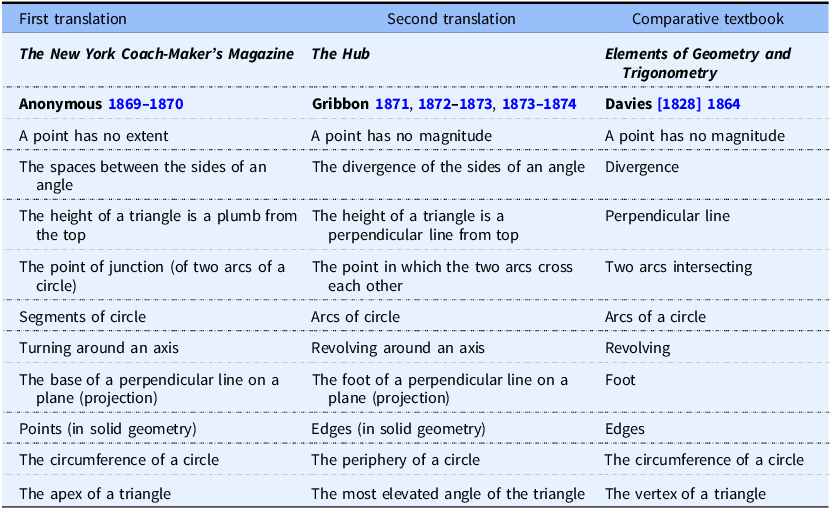
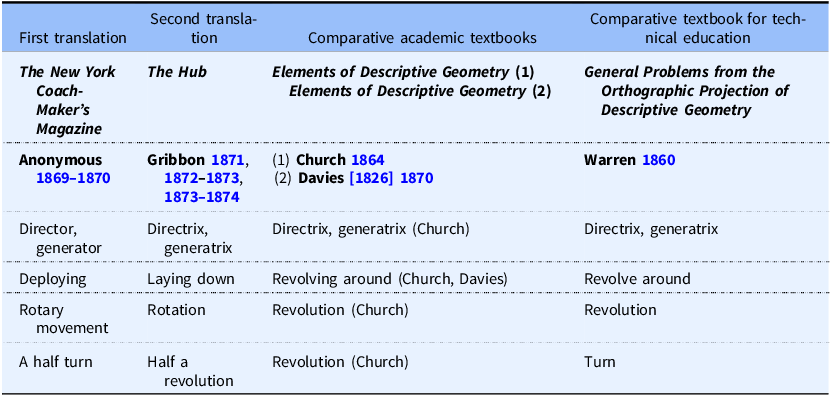
The modifications mainly concerned mathematical terms in the register of plane geometry (table 2) and the more specific register of descriptive geometry (table 3). On the plane geometry account, Gribbon identified a number of terms that were improperly translated. For example, “un point n’a aucune étendue” (Thomas, Reference Thomas1870, 5) was literally translated in the first instance as “a point has no extent” whereas conventional usageFootnote 22 would argue for the use of “magnitude” (Davies [1828] Reference Davies1864, 13): Gribbon therefore replaced “extent” with “magnitude.” Similarly, Gribbon corrected the original translation of “grandeur d’un angle” (Thomas Reference Thomas1870, 6) by replacing “space between the sides” with “divergence,” again conforming to local American mathematical practices. Several other terms – from “arcs de cercle” to “pied d’une hauteur” – were thus cleaned up by Gribbon in an academic manner. A few modifcations by Gribbon, however, actually used more improper language. This was the case of “circumference,” used by the first translator to mean the circumference of a circle. It was a term adopted in many American works through the nineteenth century. Gribbon preferred “periphery,” an old term, more widespread in the eighteenth century, or found in nineteenth-century mathematical works for young children (Guthrie Reference Guthrie1830, 186).
Compared mathematical terms (plane geometry)

Compared mathematical terms (descriptive geometry)

In descriptive geometry, the first translator chose the term “deploying” to mean folding (le rabattement), i.e., the flattening of the vertical plane onto the horizontal plane by rotation about their intersection. Thomas explicitly used the term/verb “rabattement/rabattre”: “[un plan] a tourné autour de leur intersection comme charnière pour venir se rabattre sur le premier plan” (Thomas Reference Thomas1870, 14). To convey both the idea of movement and the flattening of one plane onto the other, the choice of “deploying” was neither orthodox nor appropriate. While it may have suggested the idea of movement, this term did not appear in contemporary American academic treatises,Footnote 23 whether they were intended for college students (Davies [1826] Reference Davies1870), military school engineers (Church Reference Church1864), or even craftsmen and technicians (Warren Reference Warren1860). The standard term in use was “revolving around.” It communicated the nature of the movement but did not give the idea of flattening. Gribbon, the second translator, discarded “deploying” but did not choose “revolving around.” His choice was “laying down,” a term that was more graphic than mathematical, and which was used in some academic treatises of the early nineteenth century. This was the case of the Treatise on Descriptive Geometry that Claude Crozet (1789–1864) wrote in 1821 for the teaching of descriptive geometry at the military academy of West Point (Preveraud Reference Preveraud, Barbin, Menghini and Volkert2019, 343–347). But “laying down” was no longer in use in 1870. When points, lines, or surfaces “tournent autour de la charnière” (Thomas Reference Thomas1870, 13), Gribbon replaced the term “rotary movement” with “rotation.” Again, this term is not found in contemporary academic treatises, translators instead preferring the term “revolution,” meaning that objects were not rotating around a point but around an axis. However, “rotation” was not entirely absent from the classical literature and was also found in Crozet’s textbook (1821, 12), as was “turn,” chosen by the journalist of the New York Herald and also by Warren in his treatise.
On the mathematical level, the scholarly and practitioner milieus had become closer. The in-use mathematical discourse of university, secondary, and technical education was globally the same as the one used by Gribbon in his translation, with a few exceptions (“periphery, laying down, rotation or turn”). One can therefore question whether some of the terms chosen by the first translator can be considered improper when they were found in academic textbooks. Since the terms designating certain concepts were still varied and unstable, why did Houghton and Gribbon accuse the first translation of so many errors?
Because the first translation stopped in the middle of chapter II of Thomas’ lessons, at a stage when only theoretical principles had been addressed, Gribbon’s corrections to the strictly trade lexicon were more limited. Only two modifications can be noted, among which is “menuiserie en voitures,” translated in the first instance by “carriage carpentry.” This became “body making,” one of the usual expressions of the professional press. This is another piece of evidence suggesting that the first translator was not from the carriage trade.
Besides the mathematical and technical vocabulary, the second translation also made some language and style adjustments. In figure 3, we have extracted a significant excerpt of the language modifications between the first and second translation. It is not a matter of retrospectively stating that the second translation was of better quality than the first one, as what constitutes a “good” translation is historically situated. However, it is still possible to quantify and qualify the changes from one version to another. They fall into several categories: fifteen changes on a word-for-word basis (nouns, verbs, adverbs); eleven additions and nine deletions (words or noun phrases); three punctuation modifications (all replacing a point with a semicolon); two changes in sentence structure; three word rearrangements within a sentence; one short passage deleted; and two corrections related to explanations of graphics (which were actually not errors).
The same extract in the two translations published in The New York Coach-Maker’s Magazine (Anonymous 1869–1870, 81–82) and in The Hub (Gribbon Reference Gribbon1871, 46).

Did these modifications significantly improve the clarity of the text? Did they demonstrate a profound transformation of the writing, as one might expect considering Houghton’s criticism of the first translation as being “only a pleasantry” (Houghton Reference Houghton1871d, 151)? Did the criticism directed towards the first translation match the scope of the changes made in the second? From both the perspective of mathematical terminology and language correctness, it appears to us that Houghton exaggerated the weakness of the first translation in regard of the changes made in the second.
Exaggerating the faults of the first translation was perhaps a marketing tool to launch The Hub in 1871. In fact, Houghton published his new translation of Thomas’ treatise right from the first issues of his journal in 1871, a way for him to break away from The New York Coach-Maker’s Magazine and to arouse the reader’s interest. Even if minor, the transformations were highlighted by the publisher. He wanted the reader to want to read a second, supposedly much better translation. Indeed the press had to bring something new to the table to survive (Bret and Verdier Reference Bret, Verdier, Chevrel, D’Hulst and Lombez2012, 935). But why did Houghton choose a complex mathematical text to do this? Our hypothesis is that Houghton and his translator generated a second translation not mainly to improve the first version, but rather to occupy space in the journal and to increase the visibility and circulation of descriptive geometry. Houghton was an ardent promoter of the French Rule. He had an impressive collection of articles, drawings, and notes on descriptive geometry published in his journal between 1871 and 1880 (Preveraud Reference Preveraud2023, 171–172). He also visited Paris on multiple occasions to learn descriptive geometry from professional draftsmen, and brought back from France sketches and drawings to circulate within the editorial team of The Hub and the New York carriage-trade community.
Houghton remained dissatisfied with the new translation
Gribbon’s corrections did not, however, end the criticism: It seemed that the new translation could still be improved. As he was about to translate the rest of Thomas’ lessons, Gribbon half-heartedly conceded his doubts: “although I have taken much pains in giving a correct and readable translation … I hope you will not find me deficient now that the more practical and more important part of the work begins” (Gribbon Reference Gribbon1872, 140). The translation was nevertheless scrutinized by Thomas, who could only control the accuracy of the plates and drawings,Footnote 24 and not the text:
Mr Brice Thomas looked over the last two volumes of The Hub and examined all the reproductions of his drawings. He does not read English and has therefore not given any criticism of the translation of the text, but he has expressed himself as well pleased with the cuts and the general representation of the articles. (Houghton Reference Houghton1874a, 315)
This misleading validation did not prevent Houghton from quickly expressing new explicit reservations about Gribbon’s work:
First, [Thomas’ Treatise] gave us considerable trouble in translating; for … it is not written in a thoroughly practical manner. There is a middle course between pure scientific evolution and pure practical statement, and this middle style, if not managed with wit and piquancy, which would be quite impossible with a subject like the French Rule, is much more difficult to grapple with than the lofty sternness of pure science, or the dryness of practical rules. But the original treatise is written just in this middle style, and we have had great trouble in making a translation, that should be not only concise, but comparatively easy for our readers to understand. And now we have still greater trouble in getting our translation read. (Houghton Reference Houghton1872, 196)
For Houghton, Gribbon’s version lacked conciseness – indeed, it ran in The Hub for nearly twenty issues by mid 1872. Worse, Houghton criticized, it was not written in an adequate style, a style halfway between the theoretical treatise and the practical manual that Thomas had made. Was this Gribbon’s translation that Houghton was complaining about? Or the difficulty of the subject alone? In fact, the translation quality (and not the dryness of the subject) was blamed for the deluge of criticism from readers from 1871 onwards, as we will see in the fourth part of this article.
4. From one triple man to another (1874)
Gribbon’s task came to an end in January 1874, when he had just published in The Hub a translation of a new excerpt from chapter II of Thomas’ lessons. In the course of 1874, Gribbon was replaced. A third translator – Englishman John Robertson – was hired to continue (rather than re-do) the translation of Thomas’ treatise in the columns of The Hub:
The articles on The French Rule … will be continued. The translation which becomes more and more difficult each month, as the subject matter becomes more and more difficult, technical, and interesting, has now been entrusted to a leading body maker of London, who has spent six months in … Paris, and is thoroughly conversant with the principles of the rule, which he applies daily in his own work. (Houghton Reference Houghton1874b, 381)
The parts to be translated therefore concerned essentially the end of chapter II, still devoted to general and theoretical problems, and chapter III, which included many practical and recurrent problems of the workshop (Robertson Reference Robertson1874a, 235). The translation was spread over nearly three years, after having started in July 1874 in the following terms: “as published in Le guide du carrossier, conducted by M. Brice Thomas” (Robertson Reference Robertson1874a, 113).
Unlike Gribbon, Robertson did not translate again the portion that originally appeared in The New York Coach-Maker’s Magazine (table 1). The contents published in The Hub between 1874 and 1877 were new for an American reader. For Houghton, this third “wave” was made necessary because the end of Brice Thomas’ treatise had not been translated by Gribbon; but the supposed failings of the previous translator would naturally explain the choice of a new one. Faced with this account, we hypothesize that the change of translator was actually due less to the supposed defects of Gribbon’s version than to Houghton’s desire to send a signal to his readers: By ousting Gribbon for Robertson, Houghton wished to contain the heavy criticism that The Hub had received about descriptive geometry since its introduction in 1871.
Responding to workshop criticisms
Indeed, certain workshops – of mainly small rural establishments – protested against the French Rule as soon as it was delivered to the trade.Footnote 25 With The New York Coach-Maker’s Magazine ceasing publication just after the first translation of Thomas’ treatise, it was mostly the first issues of The Hub that welcomed the first reactions from workshops in the correspondence section of the journal.Footnote 26
Some readers said that the mathematization of their environment by descriptive geometry was unnecessary and required too much theoretical learning. In companies where the main orders were for simple models (such as the traditional Buggy or agricultural vehicles), woodworkers didn’t need descriptive geometry to draw. These reluctant readers saw the French Rule as a useful tool only for companies that produced luxury and large models, with complex shapes and lines, warped or curved, requiring a good theoretical command of projections. For instance, the owner of a small workshop on the outskirts of Massachusetts explained that:
All its fellow workmen raise the same objection, that it does not pertain to anything except coach work. Do you intend giving any drawings of buggies, carryalls or sleighs by the French Rule? I suppose you are well aware that coach building is carried on to a very small extent in Massachusetts compared with light work. (Board Reference Board1869, 73)
In other words, the small workshops seemed to wonder the point of learning this mathematical theory if they could do without it for most daily tasks. Especially since several readers of The Hub wrote that learning the French Rule was often “painful” (Houghton Reference Houghton1872, 196) or akin to a session of “torture” (Houghton Reference Houghton1874d, 238). Even in larger companies, many coachmakers saw that descriptive geometry was “imperfectly understood” (Lurkins Reference Lurkins1861, 1), that it was “not better understood” or that it forced “good-makers giving up its study in disgust” (Ware Reference Ware1879, 176). Many woodworkers also criticized the French Rule for flattening the industrial project. While perspective drawings and technical drawings allowed them to visualize the whole coach and its general appearance, descriptive geometry produced a highly abstract, unrealistic drawing. “L’épure descriptive” – see an example in figure 4 – has indeed often been accused by practitioners (architects, stonemasons, painters, woodworkers) of “derealizing” projects (Sakarovitch Reference Sakarovitch2000, 15). The Hub’s readers explained that lines and surfaces blended together. According to them, any draftsman using the French Rule had to draw lines between the projections, resulting in the finished drawing being seemingly unable to visually represent the overall shape of the coach.
Example of drawing produced with the French Rule in The Hub (Gribbon Reference Gribbon1871, 128).

Several readers (coachmakers, foremen, and workers) who had been in charge of the drawing until then were quickly lost in the face of this theoretical and mathematical knowledge imposed from the top of the trade. For example, a certain B.B. wrote to Houghton:
Mr. Editor, are you soon done with the French Rule? For I tell you in good earnest that I am completely done with it, and the only interest it has for me is that it makes me exasperated every time I receive my paper. It may be that it is a big thing, but it certainly is too big for us poor mechanics – or at least for me. I cannot understand it. With is projections on all eleven hundred plans it soars far over me … but I should like to see that man who dares say that he has got any real information from all these projections. (B.B. 1871, 161)
The same workshops defended in contrast the efficiency of traditional and artisanal methods and said these, in combination with a little practical knowledge of the trade, were perfectly capable of taking care of most of the drawing problems (Preveraud Reference Preveraud2023, 205–207).
A third translator for reluctant readers?
Houghton appeared very concerned about the critical letters that The Hub received and believed that a new translator would be able to meet his readers’ expectations:
We are in hopes that, by this combined and concerted action of the three nationalities – the writing being done in Paris, the translation in London, and the publication in New York – we shall be able some time to lead the body-makers to such an appreciation of this system of drafting that we shall not, as now, be obliged to give sugar-coated doses. (Houghton Reference Houghton1874c, 37)
To support the thesis of a third translator responsible for providing the “sugar-coated doses” administered to the disgruntled reader and masking for him “the unpleasant taste” (Sonnedecker and Griffenhagen Reference Sonnedecker and Griffenhagen1957, 486) of the French Rule, we must look at the author chosen to replace Gribbon. The man in question, Englishman John Robertson, drew for the London coachbuilder Hooper & Co. (Robertson Reference Robertson1874b, 38). In the 1860s, he had studied drawing in Paris at the city’s best technical school (Preveraud Reference Preveraud2023, 69–78), then brought the science of Monge back to the London workshops, at a time when descriptive geometry had a hard time breaking through in England (Houghton Reference Houghton1874c). Robertson received Thomas’ imprimatur in a letter that the Frenchman sent to the editors of The Hub in 1874 (Thomas Reference Thomas1874, 167). Indeed, the Englishman combined the several skills needed to be a “triple man”: According to Houghton, they legitimized Roberson to translate the lessons of the Traité de menuiserie en voitures.
Robertson was first of all a skilled practitioner. He knew the principles of descriptive geometry, he read and wrote technical lexicon in French: “He has the advantages, therefore, first, of being practically acquainted with the subject matter, and second, of having that thorough knowledge of the technical terms, both of French and English, which is absolutely necessary in order to give a correct translation” (Houghton Reference Houghton1874c, 37). Were his mathematical, technical, and linguistic skills superior to those of Gribbon? First, Gribbon had a great deal of experience in the workshop and in drawing, so much so that a few years later he would become the professor of descriptive geometry at the Technical School in New York (1881). Secondly, there was no evidence that Robertson was more fluent in French than Gribbon. Both men had spent time in France. Gribbon had also received a solid education at the Dublin Royal Society of Arts, which most likely required regular practice of French. Last, Robertson knew the French, English, and American coachbuilders very well, which could have helped him to produce a more understandable translation by his trade. But this was also the case with Gribbon, who had worked in the workshops of the British Isles and had stayed several times in Paris, where he had met the most famous French carriage manufacturers. Gribbon also knew foreign fashions via his frequentation of the World’s Fairs. In short, Gribbon was not a novice.
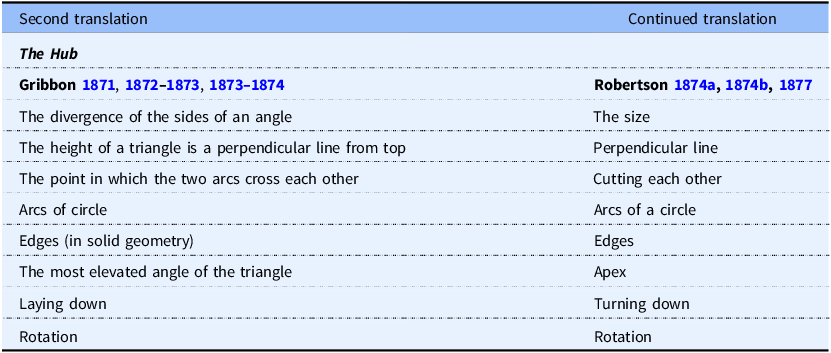
Exactly as Gribbon had done in 1871, Robertson announced from the outset that he rejected literal translation: “I didn’t translate this part as literally as usual, but you can believe in its correctness” (Robertson Reference Robertson1874b, 38). One could compare the “Gribbon” and “Robertson” styles and judge which was more suitable for teaching. But if we look closely at the translation produced by Robertson, it is difficult to find any obvious innovations. On the mathematical aspect, the most significant improvement consisted in replacing “laying down” with “turning down”: Robertson introduced there the double meaning intended by Thomas (turning and laying down at the same time). But the common term, “revolving around,” was still ignored. Also, we note, among other things, a fixation of mathematical lexical usages. Robertson employed most of the terms used in the chapters already translated by Gribbon (“edges,” “arcs of a circle,” “rotation”) or very similar terms (table 4). Worse, in some places, the third translator agreed with the first. For instance, Robertson took back the “apex” of the first translation by the New York Herald journalist. In the same way, he also rejected the Gribbon’s “divergence between the sides of an angle” and preferred the term “size,” more similar to the first translator’s use of “space.”
Compared mathematical terms (plane and descriptive geometry)

Among the reasons given by Houghton for replacing Gribbon with Robertson, none seem entirely convincing. First, the profile of the latter did not present any quality that his predecessor did not possess. Second, the style and the accuracy of the two translations are sufficiently close to raise questions as to Houghton’s possible other motivations.
Conclusion
For the trade journal editors Stratton and Houghton, the hazards and constraints they encountered in publishing a satisfactory translation of the lessons of Brice Thomas showed that professional and technical translation was no less a delicate undertaking than scholarly translation. Editors needed “triple men,” that is translators who were educated in both languages of exchange, specialists in the technical-mathematical field, and familiar with the scientific, technical, editorial, and trade contexts in France and the United States. We know too little about the New York Herald journalist who completed the first translation. But for Gribbon and Robertson, we can say that they combined several skills in the field of mathematics, in the specialized technical field (in this case, coach making and drawing), and in the two languages of knowledge circulation. These “triple men” navigated these different levels of knowledge and offered readers of The New York Coach-Maker’s Magazine and The Hub the means to discover new scholarly goods (Chatzis et al. Reference Chatzis, Morel, Preveraud and Verdier2017).
For the carriage trade institutions (journals, attempts at federations of large companies in the Northeast), the recourse to translation obviously expressed the will to make known, on their side of the Atlantic, the graphic innovation exposed in Thomas’ lessons. Publishing multiple translations of this French treatise, one of Houghton’s objectives was therefore certainly the dissemination of training in descriptive geometry to The Hub’s readership. He also clearly states this in the first issue of his journal:
In this number we begin the principal serial of the volume, in which we intend to give a correct, and readable translation of the so-called “French rule”, which practical men assure us of great consequence to the carriage-draughtsman and wood-worker as it gives the mathematical rules and fundamental principles which govern the construction of a carriage. (Houghton Reference Houghton1871a, 3)
However, as we have shown in this article, one should not rely solely on the discourse of the actors of the time. The comparative analysis of the different versions published in his journal, as well as the replacement of translators, nuances this thesis of translations solely for educational purposes. In our opinion, the repeated translation of the same French text by authors who were replaced on the pretext of improvements in content and style integrated a broader strategy of lobbying the trade. First, Houghton was very close to the large manufacturers of New York and the major American carriage-making cities, which were inclined to accelerate the modernization of carriage manufacturing. Houghton wished to impose descriptive geometry as a universal language. According to him, this allowed for normalization of the drawing of the vehicles’ bodies. Integrated into a web of communicative processes that aimed to promote Monge’s science in the coachbuilders’ milieu, the translations here took on a dimension that reinforced the hierarchical social relationship within the profession. By staging versions that would have supposedly been extensively corrected in order to improve the understanding of the different texts produced, Houghton also intended to respond to the criticisms that were being levelled from the workshops, not so much at the translations themselves, but at the very legitimacy of the introduction of descriptive geometry. He then blamed the translators, who were judged to be responsible for the difficulties encountered by the workshops, rather than the difficulties inherent in learning descriptive geometry. From this perspective, the logic of replacement constituted a bypass route. The Hub had to repeatedly occupy the editorial space with texts that were successively translated – even though the translations made no fundamental improvements and even though they did not alter in any way the learning process of descriptive geometry. Our explanatory hypothesis is that the trade institutions had to convince reluctant readers,Footnote 27 workers, or small carriage shops that they had taken note of their grievances with regard to the modernization of their profession, even if their response was to overexpose them with content and change translators.
What does this case study in a professional environment teach us about the act of technical-mathematical translation in the nineteenth century? The translation here served as a legitimization of knowledge through mathematics, in an environment where there was a desire to standardize practices. The use of mathematics in practical environments served not only to solve problems encountered in the field but also as a means of organizing a profession by leveraging the credit traditionally associated with the mathematical discipline (Binois and Pansini Reference Binois and Pansini2022; Ehrhardt Reference Ehrhardt2022). Another significant result of this article highlights the role of translation in the dissemination of theoretical mathematical knowledge to a non-academic milieu, in a country like the United States where this descriptive geometry was not as widely taught as it was in France. Indeed, by contrast, in France, Brice Thomas used manuals intended for secondary education and engineering training (Preveraud Reference Preveraud2023, 102–109). The Frenchman thus benefited from the strong presence of descriptive geometry in the curricula of high school classes, art schools, government and military schools, and écoles des arts et métiers (d’Enfert Reference d’Enfert2003; Barbin, Reference Barbin, Barbin, Menghini and Volkert2019). In France, mathematical knowledge followed a top-down trajectory, from academic circles to the carriage trade. In the United States, by contrast, it was a horizontal circulation (inside the trade itself), from the French to the US trade, which, through translation, ensured the transmission of descriptive geometry to practitioners.
Competing interests
The author declares none.
Thomas Preveraud is a lecturer in the history of mathematics at the University of Lille and the University of Artois. His research focuses on the circulation of mathematical knowledge in the nineteenth century through the social, cultural, technicalm and editorial dimensions by which it was produced and used.