


Introduction
Seed germination has intrigued the human mind for a long time and research on seeds can be traced back to at least 400 bc, driven partly by curiosity and partly by practical reasons (as stated by Evenari (Reference Evenari1984)), which is still the case today. Evenari (Reference Evenari1984) described a list of discoveries and observations made by ancient authors (between c. 400 bc and ad 100) that concern seed biology, including deposition of food in seeds for seedling growth; seed dispersal mechanisms; the dependence of germination on soil, water, climate, season of the year, habitat and age of seeds; spread of germination over time; seed pelleting in dung and differences in seed longevity between different species. The most important contributor to this list was a student of Aristotle, Theophrastus (c. 372–287 bc), who was named as the first seed scientist. Interestingly, he described the phenomenon that germination speed is affected by seed age. Some seeds germinate more quickly at a young age, others at older age, something that nowadays we would refer to as seed dormancy and afterripening (Evenari, Reference Evenari1984). Dormancy in seeds is defined as a temporary failure of a viable seed to complete germination under normally favourable conditions (Bewley, Reference Bewley1997). Simply said, mature seeds that are dispersed from a plant do not readily germinate despite suitable environmental conditions. One of the functions of dormancy is to time plant growth and reproduction to the most optimal season (Fenner and Thompson, Reference Fenner and Thompson2005) and therefore, in nature, dormancy is an important adaptive trait which is under selective pressure (Huang et al., Reference Huang, Schmitt, Dorn, Griffith, Effgen, Takao, Koornneef and Donohue2010).
Physiological dormancy (PD) has been described as a physiological inhibiting mechanism that prevents radicle emergence (Baskin and Baskin, Reference Baskin and Baskin2014). It can be caused by the embryo (embryo dormancy) as well as the structures that cover the embryo (coat-enhanced dormancy) (Finch-Savage and Leubner-Metzger, Reference Finch-Savage and Leubner-Metzger2006). In the model plant Arabidopsis, seed dormancy is classified as non-deep PD [common in seeds of most weeds, vegetables and many garden flowers (Baskin and Baskin, Reference Baskin and Baskin2014)], which is usually broken by relatively short periods of cold stratification and dry seed storage at room temperature (a process known as afterripening). In Arabidopsis seeds, the covering layers play an important role in dormancy maintenance, considering that removal of the covering layers results in growth of the embryo and normal seedling establishment. In this, both the testa (Debeaujon et al., Reference Debeaujon, Leon-Kloosterziel and Koornneef2000) and endosperm play a role (Bethke et al., Reference Bethke, Libourel, Aoyama, Chung, Still and Jones2007; Lee et al., Reference Lee, Piskurewicz, Tureckova, Strnad and Lopez-Molina2010). Further, PD in Arabidopsis is reversible and allows dormancy cycling in the hydrated state, which is an important strategy allowing seeds to persist in the soil seed bank until conditions are permissive for germination (Cadman et al., Reference Cadman, Toorop, Hilhorst and Finch-Savage2006; Finch-Savage and Leubner-Metzger, Reference Finch-Savage and Leubner-Metzger2006; Footitt et al., Reference Footitt, Douterelo-Soler, Clay and Finch-Savage2011).
Dormancy is a complex trait affected by many loci (Bentsink et al., Reference Bentsink, Soppe, Koornneef, Bradford and Nonogaki2007; Graeber et al., Reference Graeber, Nakabayashi, Miatton, Leubner-Metzger and Soppe2012), as well as by an intricate web of plant hormone interactions (Kucera et al., Reference Kucera, Cohn and Leubner-Metzger2005; Feurtado and Kermode, Reference Feurtado, Kermode, Bradford and Nonogaki2007). Moreover, it is strongly affected by a multitude of environmental effectors (Fenner, Reference Fenner1991; Fenner and Thompson, Reference Fenner and Thompson2005; Donohue, Reference Donohue2009; Baskin and Baskin, Reference Baskin and Baskin2014). Its induction, maintenance, cycling and loss come down to the central paradigm, which is the balance between two key hormonal regulators, i.e. the plant hormone abscisic acid (ABA), required for dormancy induction, and gibberellins (GA), required for germination (Karssen and Lacka, Reference Karssen, Lacka and Bopp1986; Cadman et al., Reference Cadman, Toorop, Hilhorst and Finch-Savage2006; Finch-Savage and Leubner-Metzger, Reference Finch-Savage and Leubner-Metzger2006; Finch-Savage et al., Reference Finch-Savage, Cadman, Toorop, Lynn and Hilhorst2007; Finkelstein et al., Reference Finkelstein, Reeves, Ariizumi and Steber2008; Holdsworth et al., Reference Holdsworth, Bentsink and Soppe2008; Nambara et al., Reference Nambara, Okamoto, Tatematsu, Yano, Seo and Kamiya2010). In this review we will summarize recent developments in dormancy research (mainly) in the model plant Arabidopsis thaliana, focusing on two key players for dormancy induction, i.e. the plant hormone ABA and the DELAY OF GERMINATION (DOG) 1 gene. In the case of ABA, the focus is on signalling rather than on metabolism (for reviews on ABA metabolism in seed dormancy see Gubler et al., Reference Gubler, Millar and Jacobsen2005; Finkelstein et al., Reference Finkelstein, Reeves, Ariizumi and Steber2008; Nambara et al., Reference Nambara, Okamoto, Tatematsu, Yano, Seo and Kamiya2010; Finkelstein, Reference Finkelstein2013). We will discuss the role of ABA and DOG1 in relation to the various aspects of seed dormancy, i.e. induction during seed maturation, loss during dry seed afterripening, the rehydrated state (including dormancy cycling) and (only briefly) the switch to germination.
The role of ABA in dormancy
The plant hormone ABA has been implicated in seed dormancy for a long time, and both ABA content and sensitivity are important (Hilhorst, Reference Hilhorst1995; McCarty, Reference McCarty1995; Bewley, Reference Bewley1997; Kermode, Reference Kermode2005; Finkelstein et al., Reference Finkelstein, Reeves, Ariizumi and Steber2008; Bewley et al., Reference Bewley, Bradford, Hilhorst and Nonogaki2013; Finkelstein, Reference Finkelstein2013). Genetic evidence for the role of ABA in seed dormancy is available in Arabidopsis mutants. Mutants that lack the capacity to produce ABA (Koornneef et al., Reference Koornneef, Jorna, Brinkhorst-van der Swan and Karssen1982; Lefebvre et al., Reference Lefebvre, North, Frey, Sotta, Seo, Okamoto, Nambara and Marion-Poll2006) or to transduce the ABA signal [e.g. abscisic acid insensitive (abi) 1-1, abi2-1 and abi3-1 (Koornneef et al., Reference Koornneef, Reuling and Karssen1984)] are completely non-dormant. On the other hand, mutants that overaccumulate ABA, or those that show an ABA-oversensitive phenotype, have enhanced dormancy levels (Cutler et al., Reference Cutler, Ghassemian, Bonetta, Cooney and McCourt1996; Kushiro et al., Reference Kushiro, Okamoto, Nakabayashi, Yamagishi, Kitamura, Asami, Hirai, Koshiba, Kamiya and Nambara2004; Okamoto et al., Reference Okamoto, Kuwahara, Seo, Kushiro, Asami, Hirai, Kamiya, Koshiba and Nambara2006; Lin et al., Reference Lin, Hwang, Endo, Okamoto, Koshiba and Cheng2007; Nonogaki et al., Reference Nonogaki, Sall, Nambara and Nonogaki2014). Similar results were also found in other plants. For example, Groot and Karssen (Reference Groot and Karssen1992) showed that, in tomato, ABA deficiency also resulted in non-dormancy [although this could be affected by a morphological change in the testa as well (Hilhorst and Downie, Reference Hilhorst and Downie1996)]. Also higher ABA levels (by overexpression of the ABA biosynthetic enzyme, SlNCED1) enhanced dormancy levels in this species (Thompson et al., Reference Thompson, Jackson, Symonds, Mulholland, Dadswell, Blake, Burbidge and Taylor2000). ABA deficiency in maize results in non-dormant seeds that germinate on the mother plant (McCarty, Reference McCarty1995). Furthermore, active ABA biosynthesis is necessary to maintain dormancy in imbibed seeds of Nicotiana plumbaginafolia as well as Arabidopsis (Debeaujon and Koornneef, Reference Debeaujon and Koornneef2000; Grappin et al., Reference Grappin, Bouinot, Sotta, Miginiac and Jullien2000; Ali-Rachedi et al., Reference Ali-Rachedi, Bouinot, Wagner, Bonnet, Sotta, Grappin and Jullien2004). Moreover, an important transducer of the ABA signal, and a key regulator of seed dormancy, is the B3 domain containing transcriptional regulator known as VIVIPAROUS (VP) 1 in maize (McCarty et al., Reference McCarty, Carson, Stinard and Robertson1989) or ABI3 in Arabidopsis (Koornneef et al., Reference Koornneef, Reuling and Karssen1984; Giraudat et al., Reference Giraudat, Hauge, Valon, Smalle, Parcy and Goodman1992), which is discussed in more detail below. VP1/ABI3 is conserved among many plant species (Graeber et al., Reference Graeber, Linkies, Muller, Wunchova, Rott and Leubner-Metzger2010) and is implicated in dormancy in, for example, Arabidopsis, maize and wheat (Koornneef et al., Reference Koornneef, Reuling and Karssen1984; McCarty, Reference McCarty1995; McKibbin et al., Reference McKibbin, Wilkinson, Bailey, Flintham, Andrew, Lazzeri, Gale, Lenton and Holdsworth2002). Thus, the roles of ABA and ABI3 in dormancy seem to be conserved among different species.
The core ABA signalling module in Arabidopsis
Several receptors for ABA have been proposed, including GENOMES UNCOUPLED (GUN) 5 (Shen et al., Reference Shen, Wang, Wu, Du, Cao, Shang, Wang, Peng, Yu, Zhu, Fan, Xu and Zhang2006), GPCR-type G protein (GTG) 1/GTG2 (Pandey et al., Reference Pandey, Nelson and Assmann2009) and the PYRABACTIN RESISTANT 1/PYR1-LIKE/REGULATORY COMPONENTS OF ABA RECEPTORS (PYR/PYL/RCAR) proteins (Ma et al., Reference Ma, Szostkiewicz, Korte, Moes, Yang, Christmann and Grill2009; Park et al., Reference Park, Fung, Nishimura, Jensen, Fujii, Zhao, Lumba, Santiago, Rodrigues, Chow, Alfred, Bonetta, Finkelstein, Provart, Desveaux, Rodriguez, McCourt, Zhu, Schroeder, Volkman and Cutler2009) which have been reviewed recently (Cutler et al., Reference Cutler, Rodriguez, Finkelstein and Abrams2010; Hubbard et al., Reference Hubbard, Nishimura, Hitomi, Getzoff and Schroeder2010; Raghavendra et al., Reference Raghavendra, Gonugunta, Christmann and Grill2010; Umezawa et al., Reference Umezawa, Nakashima, Miyakawa, Kuromori, Tanokura, Shinozaki and Yamaguchi-Shinozaki2010; Finkelstein, Reference Finkelstein2013; Miyakawa et al., Reference Miyakawa, Fujita, Yamaguchi-Shinozaki and Tanokura2013). The identification of PYR/PYL/RCAR proteins as ABA receptors (Ma et al., Reference Ma, Szostkiewicz, Korte, Moes, Yang, Christmann and Grill2009; Park et al., Reference Park, Fung, Nishimura, Jensen, Fujii, Zhao, Lumba, Santiago, Rodrigues, Chow, Alfred, Bonetta, Finkelstein, Provart, Desveaux, Rodriguez, McCourt, Zhu, Schroeder, Volkman and Cutler2009), especially, signified an important step forward in our mechanistic understanding of how ABA is perceived, as well as the early steps of its signal transduction cascade, and this will be discussed in more detail.
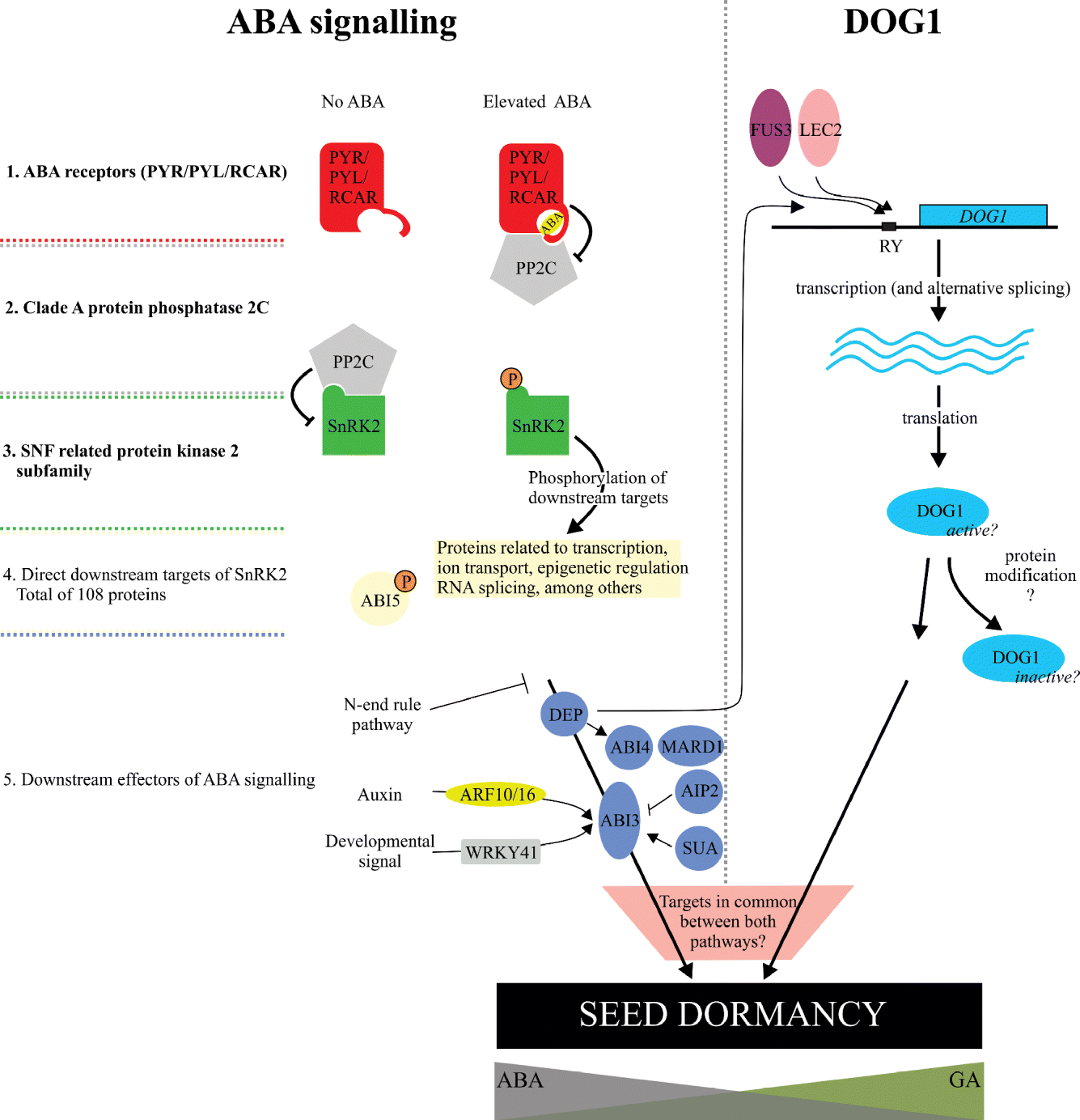
In short, the core signalling module for ABA perception consists of three sets of proteins, i.e. the PYR/PYL/RCAR ABA-receptors, phosphatases of the clade A PP2C, and Snf1-related kinases 2 (SnRK2) (Fig. 1). SnRK2 proteins are positive regulators of the ABA signal and are responsible for the phosphorylation of downstream targets. Three genes, SnRK2.2, SnRK2.3 and SnRK2.6, appear to be essential for transducing the ABA signal, and a triple knockout of these SnRKs is strongly ABA insensitive (Fujii and Zhu, Reference Fujii and Zhu2009; Nakashima et al., Reference Nakashima, Fujita, Kanamori, Katagiri, Umezawa, Kidokoro, Maruyama, Yoshida, Ishiyama, Kobayashi, Shinozaki and Yamaguchi-Shinozaki2009). In the absence of ABA, SnRK2 activity is inhibited by PP2C proteins that bind to their catalytic domain (Soon et al., Reference Soon, Ng, Zhou, West, Kovach, Tan, Suino-Powell, He, Xu, Chalmers, Brunzelle, Zhang, Yang, Jiang, Li, Yong, Cutler, Zhu, Griffin, Melcher and Xu2012). Examples of PP2Cs that are known to act in ABA signalling include ABI1, ABI2, HYPERSENSITIVE TO ABA (HAB) 1, HAB2, ABA HYPERSENSITIVE GERMINATION (AHG) 1, AHG3 and HONSU (HON) (Koornneef et al., Reference Koornneef, Reuling and Karssen1984; Leung et al., Reference Leung, Bouvierdurand, Morris, Guerrier, Chefdor and Giraudat1994, Reference Leung, Merlot and Giraudat1997; Saez et al., Reference Saez, Apostolova, Gonzalez-Guzman, Gonzalez-Garcia, Nicolas, Lorenzo and Rodriguez2004; Kuhn et al., Reference Kuhn, Boisson-Dernier, Dizon, Maktabi and Schroeder2006; Yoshida et al., Reference Yoshida, Nishimura, Kitahata, Kuromori, Ito, Asami, Shinozaki and Hirayama2006; Nishimura et al., Reference Nishimura, Yoshida, Kitahata, Asami, Shinozaki and Hirayama2007; Kim et al., Reference Kim, Lee, Park, Lee and Choi2013). A triple mutant of three PP2C genes shows strong growth reduction, extreme sensitivity to ABA, delayed germination and a partially constitutive ABA-responsive transcriptome (Rubio et al., Reference Rubio, Rodrigues, Saez, Dizon, Galle, Kim, Santiago, Flexas, Schroeder and Rodriguez2009). Upon ABA binding, the PYL/PYR/RCAR receptor undergoes a conformational change that allows binding to, and inhibition of, the PP2C protein function (Ma et al., Reference Ma, Szostkiewicz, Korte, Moes, Yang, Christmann and Grill2009; Park et al., Reference Park, Fung, Nishimura, Jensen, Fujii, Zhao, Lumba, Santiago, Rodrigues, Chow, Alfred, Bonetta, Finkelstein, Provart, Desveaux, Rodriguez, McCourt, Zhu, Schroeder, Volkman and Cutler2009). This relieves the SnRK2 kinase from its inhibitor, which is followed by activation via autophosphorylation (discussed in Hubbard et al., Reference Hubbard, Nishimura, Hitomi, Getzoff and Schroeder2010). This allows the SnRK2 proteins to phosphorylate downstream targets in response to ABA. Recently, Cai et al. (Reference Cai, Liu, Wang, Yang, Chen, Li, Pan, Dong, Tang, Barajas-Lopez, Fujii and Wang2014) showed that SnRK2s can also be phosphorylated by GLYCOGEN SYNTHASE (GSK) 3-like kinases, which suggests that ABA signalling can be modulated through these factors as well.
ABA and DOG1 affect seed dormancy by largely parallel pathways. ABA levels are controlled by the balance between biosynthesis and catabolism (Nambara and Marion-Poll, Reference Nambara and Marion-Poll2005). Elevated levels of ABA are bound by the PYR/PYL/RCAR ABA receptors and the receptor–ABA complex sequesters and inhibits activity of PP2C (a family of negative regulators of ABA signalling, inhibiting SnRK2). This allows the SnRK2 kinases to phosphorylate downstream targets such as ABI5. ABI3, positioned further downstream, is involved in transmitting the ABA signal and is a key regulator of dormancy induction. It is regulated by several regulators, including SUA, AIP2, DEP, auxin and WRKY41. DOG1 is suggested to act in a parallel pathway to ABA. Its expression might be regulated by FUS3 and LEC2. Dormancy levels are strongly regulated by the balance between ABA and GA content and signalling, but thus far it is unclear how DOG1 impinges on this balance or acts in parallel to it, and which common targets exist between both pathways.
Mosquna and co-workers (2011) reported the construction of a constitutively active version of the PYL2 protein (PYL2CA3) which allowed binding to (and inhibition of) PP2C proteins and, thereby, enhanced the ABA signal. When overexpressed in Arabidopsis Columbia wild-type plants, this version showed a strong seed dormancy phenotype (Mosquna et al., Reference Mosquna, Peterson, Park, Lozano-Juste, Volkman and Cutler2011). For most of the clade A PP2C protein phosphatases, dormancy phenotypes have been described and include ABI1, ABI2, HON, AHG1 and AHG3 (Koornneef et al., Reference Koornneef, Reuling and Karssen1984; Yoshida et al., Reference Yoshida, Nishimura, Kitahata, Kuromori, Ito, Asami, Shinozaki and Hirayama2006; Kim et al., Reference Kim, Lee, Park, Lee and Choi2013). Furthermore, the triple mutant snrk2.2 snrk2.3 snrk2.6 shows a very strong ABA insensitivity and produces non-dormant seeds (Nakashima et al., Reference Nakashima, Fujita, Kanamori, Katagiri, Umezawa, Kidokoro, Maruyama, Yoshida, Ishiyama, Kobayashi, Shinozaki and Yamaguchi-Shinozaki2009). Thus, members of all core components of ABA signalling are involved in seed dormancy, in agreement with the important role of ABA in dormancy induction.
ABA signalling downstream of SnRK2 proteins
The next step in ABA signalling occurs downstream of SnRK2 and involves proteins that are phosphorylated by these SnRK2 kinases. Two recent studies have identified such targets using quantitative proteomics, comparing ABA-treated wild type (WT) and the triple mutant snrk2.2 snrk2.3 snrk2.6. One study identified 56 protein targets (Umezawa et al., Reference Umezawa, Sugiyama, Takahashi, Anderson, Ishihama, Peck and Shinozaki2013) and another 58, but only six protein targets overlapped in both sets (Wang et al., Reference Wang, Xue, Batelli, Lee, Hou, Van Oosten, Zhang, Tao and Zhu2013). Such targets represent the next step in ABA signalling. Interestingly, Umezawa et al. (Reference Umezawa, Sugiyama, Takahashi, Anderson, Ishihama, Peck and Shinozaki2013) describe the analysis of one of these SnRK2 targets, named SnRK2-SUBSTRATE (SNS) 1. This gene encodes a small protein (133 amino acids) which, when mutated, results in an ABA-hypersensitive phenotype. Another example is the ABI5 transcription factor (as well as other related bZIP transcription factors) (Fujii et al., Reference Fujii, Verslues and Zhu2007; Umezawa et al., Reference Umezawa, Sugiyama, Takahashi, Anderson, Ishihama, Peck and Shinozaki2013; Wang et al., Reference Wang, Xue, Batelli, Lee, Hou, Van Oosten, Zhang, Tao and Zhu2013) which link this early ABA-signalling module directly to a well-known downstream transcriptional regulator (Finkelstein and Lynch, Reference Finkelstein and Lynch2000; Lopez-Molina and Chua, Reference Lopez-Molina and Chua2000). At least some of these SnRK2 targets are expected to be involved in the induction of seed dormancy. Although ABI5 is a SnRK2 target and a well-known ABA signalling component, thus far no primary dormancy phenotype has been reported. However, its effect might be hidden due to redundancy within the bZIP transcription factor family (Finkelstein et al., Reference Finkelstein, Gampala, Lynch, Thomas and Rock2005; Yoshida et al., Reference Yoshida, Fujita, Sayama, Kidokoro, Maruyama, Mizoi, Shinozaki and Yamaguchi-Shinozaki2010). Perhaps, a similar phosphoproteomics approach on developing seeds [as described on seedlings by Umezawa et al. (Reference Umezawa, Sugiyama, Takahashi, Anderson, Ishihama, Peck and Shinozaki2013) and Wang et al. (Reference Wang, Xue, Batelli, Lee, Hou, Van Oosten, Zhang, Tao and Zhu2013)] would reveal more possible downstream candidates.
Further downstream, other intermediates are important for dormancy. A key regulator is the B3-type transcription factor ABI3. ABI3 transcript levels are regulated by alternative splicing involving the splicing factor SUPRESSOR OF ABI3-5 (SUA) (Sugliani et al., Reference Sugliani, Brambilla, Clerkx, Koornneef and Soppe2010). Next, ABI3 protein abundance is regulated by targeted degradation involving ABI3-INTERACTING PROTEIN (AIP) 2, which is a RING motif protein able to polyubiquinate ABI3 (Zhang et al., Reference Zhang, Garreton and Chua2005). Factors that affect ABI3 expression include the RING finger protein DESPIERTO (DEP) and a WRKY transcription factor gene (WRKY41) (Barrero et al., Reference Barrero, Millar, Griffiths, Czechowski, Scheible, Udvardi, Reid, Ross, Jacobsen and Gubler2010; Ding et al., Reference Ding, Yan, Li, Wu, Zhang and Zheng2014) (Fig. 1). Another player that regulates seed dormancy in the ABA pathway is the zinc-finger protein MEDIATOR OF ABA-REGULATED DORMANCY (MARD) 1 (He and Gan, Reference He and Gan2004), although its mode of action is unclear. Further, protein degradation via the N-end rule pathway is essential for proper control of ABA sensitivity and seed dormancy. This was shown by the analysis of a mutant in one of the components of this pathway [proteolysis (prt) 6] which showed enhanced ABA sensitivity and seed dormancy (Holman et al., Reference Holman, Jones, Russell, Medhurst, Tomas, Talloji, Marquez, Schmuths, Tung, Taylor, Footitt, Bachmair, Theodoulou and Holdsworth2009).
DOG1 is a key regulator of seed dormancy that acts in parallel with ABA
There is considerable genetic variation for seed dormancy within plant species, and quantitative trait loci (QTL) mapping has identified numerous genetic loci affecting seed dormancy in crop and model species, such as barley (Hordeum vulgare), wheat (Triticum aestivum), rice (Oryza sativa) and Arabidopsis (van Der Schaar et al., Reference van Der Schaar, Alonso-Blanco, Leon-Kloosterziel, Jansen, van Ooijen and Koornneef1997; Lin et al., Reference Lin, Sasaki and Yano1998; Han et al., Reference Han, Ullrich, Clancy and Romagosa1999; Cai and Morishima, Reference Cai and Morishima2000; Alonso-Blanco et al., Reference Alonso-Blanco, Bentsink, Hanhart, Blankestijn-de Vries and Koornneef2003; Laserna et al., Reference Laserna, Sanchez and Botto2008; Meng et al., Reference Meng, Macquet, Loudet, Marion-Poll and North2008; Huang et al., Reference Huang, Schmitt, Dorn, Griffith, Effgen, Takao, Koornneef and Donohue2010; for a review, see Bentsink et al., Reference Bentsink, Soppe, Koornneef, Bradford and Nonogaki2007). From a recombinant inbred line (RIL) population between the low-dormant Landsberg erecta (Ler-0) accession and the high-dormant Cape Verde Islands (Cvi) accession, seven dormancy QTLs were detected, which were named DELAY OF GERMINATION (DOG) 1–7 (Alonso-Blanco et al., Reference Alonso-Blanco, Bentsink, Hanhart, Blankestijn-de Vries and Koornneef2003). The gene underlying the DOG1 QTL has been cloned and encodes a protein that lacks any obvious functional domains (Bentsink et al., Reference Bentsink, Jowett, Hanhart and Koornneef2006). The important role of DOG1 was emphasized by the fact that it was also among the strongest QTL in other populations (Bentsink et al., Reference Bentsink, Hanson, Hanhart, Blankestijn-de Vries, Coltrane, Keizer, El-Lithy, Alonso-Blanco, de Andres, Reymond, van Eeuwijk, Smeekens and Koornneef2010; Huang et al., Reference Huang, Schmitt, Dorn, Griffith, Effgen, Takao, Koornneef and Donohue2010). In addition, Huang et al. (Reference Huang, Schmitt, Dorn, Griffith, Effgen, Takao, Koornneef and Donohue2010) showed that DOG1 is important for fitness in the field, using a RIL population between the Arabidopsis accessions from Calver (UK, Cal-0) and Tacoma (Washington, USA, Tac-0) which were planted in different locations and seasons. Furthermore, by studying a set of accessions from four different geographical regions, Kronholm et al. (Reference Kronholm, Pico, Alonso-Blanco, Goudet and de Meaux2012) showed that DOG1 is a target for adaptation.
Like the plant hormone ABA, the DOG1 gene is essential for dormancy induction, as mutants lacking either ABA or DOG1 fail to induce dormancy. A lack of either cannot be compensated for by enhanced levels of the other (Nakabayashi et al., Reference Nakabayashi, Bartsch, Xiang, Miatton, Pellengahr, Yano, Seo and Soppe2012). Although DOG1 affects ABA levels, this is thought not to be a direct mode of DOG1 function. Therefore it is hypothesized that these factors are interdependent and act via largely parallel pathways (Nakabayashi et al., Reference Nakabayashi, Bartsch, Xiang, Miatton, Pellengahr, Yano, Seo and Soppe2012) (Fig. 1). Despite its importance, DOG1 function and mode of action are still obscure. Its expression is seed specific and it is mainly expressed in the vasculature of the developing embryo, where the protein is localized in the nucleus (Bentsink et al., Reference Bentsink, Jowett, Hanhart and Koornneef2006; Nakabayashi et al., Reference Nakabayashi, Bartsch, Xiang, Miatton, Pellengahr, Yano, Seo and Soppe2012).
DOG1 genes are also found in other plant species. Graeber et al. (Reference Graeber, Linkies, Muller, Wunchova, Rott and Leubner-Metzger2010) reported orthologues of DOG1 in Brassica rapa and Lepidium sativum. In L. sativum higher DOG1 expression was reported for ABA-treated seeds, suggesting that it functions in germination timing in this species (Graeber et al., Reference Graeber, Linkies, Muller, Wunchova, Rott and Leubner-Metzger2010). DOG1 genes were also found in other Lepidium species, including the dormant L. papillosum (Graeber et al., Reference Graeber, Voegele, Buttner-Mainik, Sperber, Mummenhoff and Leubner-Metzger2013). The LepaDOG1 protein was detected during seed development in L. papillosum. Accumulation started during early maturation but decreased much earlier during maturation compared to that reported for Arabidopsis (Nakabayashi et al., Reference Nakabayashi, Bartsch, Xiang, Miatton, Pellengahr, Yano, Seo and Soppe2012; Graeber et al., Reference Graeber, Voegele, Buttner-Mainik, Sperber, Mummenhoff and Leubner-Metzger2013). Others have reported DOG1-like genes in several monocot species, including wheat, barley and rice (Ashikawa et al., Reference Ashikawa, Abe and Nakamura2010; Sugimoto et al., Reference Sugimoto, Takeuchi, Ebana, Miyao, Hirochika, Hara, Ishiyama, Kobayashi, Ban, Hattori and Yano2010). Interestingly, overexpression of wheat and barley DOG1-like genes elicits higher dormancy in the Arabidopsis Columbia accession. Furthermore these lines showed an enhanced sugar sensitivity (Ashikawa et al., Reference Ashikawa, Abe and Nakamura2010), which was also shown for high DOG1 expressors in Arabidopsis (Teng et al., Reference Teng, Rognoni, Bentsink and Smeekens2008). Thus, similar to the role of ABA, the DOG1 gene seems to be conserved among different plant species.
Dormancy induction, release, cycling and the switch to seed germination
We will discuss the roles of ABA and DOG1 in the context of different aspects of seed dormancy (for an overview see Fig. 2). This includes its induction during seed maturation, its loss during dry seed afterripening, its maintenance and loss in the rehydrated state (including dormancy cycling) and, finally, the switch to germination (although the latter is beyond the focus of this review and will only be addressed briefly). This final switch is dependent on a light signal and WT seeds require synthesis of GAs (Koornneef and van der Veen, Reference Koornneef and van der Veen1980) to complete germination. Interestingly, aba and abi3 mutants germinate in the absence of GA (Koornneef et al., Reference Koornneef, Jorna, Brinkhorst-van der Swan and Karssen1982; Nambara et al., Reference Nambara, Naito and McCourt1992; Leon-Kloosterziel et al., Reference Leon-Kloosterziel, Gil, Ruijs, Jacobsen, Olszewski, Schwartz, Zeevaart and Koornneef1996a), but the dog1 mutant does not, which indicates that it still requires GA for germination (Bentsink et al., Reference Bentsink, Jowett, Hanhart and Koornneef2006). The depth of dormancy in seeds is strongly affected by environmental conditions experienced by the seeds. These include the maternal environment during seed formation and even prior to anthesis (Fenner, Reference Fenner1991; Fenner and Thompson, Reference Fenner and Thompson2005; Donohue, Reference Donohue2009; Kendall and Penfield, Reference Kendall and Penfield2012; Bewley et al., Reference Bewley, Bradford, Hilhorst and Nonogaki2013; Baskin and Baskin, Reference Baskin and Baskin2014), during dry seed storage (temperature and relative humidity) (Bewley et al., Reference Bewley, Bradford, Hilhorst and Nonogaki2013) or conditions that are experienced by seeds in the rehydrated state (e.g. Cadman et al., Reference Cadman, Toorop, Hilhorst and Finch-Savage2006; Finch-Savage et al., Reference Finch-Savage, Cadman, Toorop, Lynn and Hilhorst2007). The response to such environmental factors will be discussed below with a focus on the roles of ABA and DOG1.
Regulation of seed dormancy by ABA and DOG1 at different seed stages. (1a) Seed development. The graph shows the ABA and DOG1 protein levels during seed development (based on Nakabayashi et al., Reference Nakabayashi, Bartsch, Xiang, Miatton, Pellengahr, Yano, Seo and Soppe2012; Bewley et al., Reference Bewley, Bradford, Hilhorst and Nonogaki2013). Germination during development is blocked by inhibiting growth, which is initially regulated by ABA, LEC1, LEC2 and FUS3. Later primary dormancy is induced, which relies on the activity of ABA, ABI3 and DOG1. Cold affects dormancy levels by affecting ABA as well as DOG1. (1b) Prolonged dry seed storage (or afterripening). Afterripening results in modification of DOG1 that inactivates the protein, thereby reducing dormancy levels (Nakabayashi et al., Reference Nakabayashi, Bartsch, Xiang, Miatton, Pellengahr, Yano, Seo and Soppe2012). (2) The rehydrated state. Low temperatures over winter (by temporal sensing of seasonal changes) induce strong dormancy and close the germination window in Cvi seeds (Footitt et al., Reference Footitt, Douterelo-Soler, Clay and Finch-Savage2011). This is linked with enhanced levels of ABA and higher expression of SnRK2, ABI3 and DOG1. Loss of dormancy occurs gradually and results in a more shallow state of dormancy. At different stages seeds become sensitive to dormancy-breaking signals, including nitrate, cold and, finally, light (Finch-Savage and Leubner-Metzger, Reference Finch-Savage and Leubner-Metzger2006; Finch-Savage et al., Reference Finch-Savage, Cadman, Toorop, Lynn and Hilhorst2007). Also, compounds from smoke (karrikins) affect dormancy and their activity includes the enhancement of light signalling (Nelson et al., Reference Nelson, Flematti, Riseborough, Ghisalberti, Dixon and Smith2010). Sensing of environmental conditions during this shallow dormant state is referred to as spatial sensing (Footitt et al., Reference Footitt, Douterelo-Soler, Clay and Finch-Savage2011) and is correlated with higher expression of the ABA catabolic gene CYP707A2 and the GA biosynthetic gene GA3ox2, as well as the DELLA gene RGL2 (Footitt et al., Reference Footitt, Douterelo-Soler, Clay and Finch-Savage2011). If germination does not occur, seeds are able to cycle to a deeper state of dormancy by induction of secondary dormancy. (3) Dormancy loss and completion of germination. In the absence of light, germination is inhibited by the activity of PIL5 (Oh et al., Reference Oh, Kim, Park, Kim, Kang and Choi2004). PIL5 stimulates the expression of a CCCH-type zinc-finger gene called SOMNUS (SOM) (Kim et al., Reference Kim, Yamaguchi, Lim, Oh, Park, Hanada, Kamiya and Choi2008). In total, four DELLA genes are involved in the regulation of light- and GA-regulated seed germination (Cao et al., Reference Cao, Hussain, Cheng and Peng2005). PIL5 (but not SOM) regulates the expression of two DELLA genes [GA INSENSITIVE (GAI) and REPRESSOR OF GA1 (RGA)] (Oh et al., Reference Oh, Yamaguchi, Hu, Yusuke, Jung, Paik, Lee, Sun, Kamiya and Choi2007; Kim et al., Reference Kim, Yamaguchi, Lim, Oh, Park, Hanada, Kamiya and Choi2008). The DELLA repressor protein RGL2 activates ABA synthesis (Piskurewicz et al., Reference Piskurewicz, Jikumaru, Kinoshita, Nambara, Kamiya and Lopez-Molina2008). This promotes ABI5 accumulation and activation (via phosphorylation by SnRK2), which inhibits the transition to germination. Upon a light signal, PIL5 repression is relieved, resulting in GA biosynthesis and removal of DELLA and ABI5 repression. See the text for more details.

Seed development
Seed development in Arabidopsis takes approximately 20 d under laboratory conditions. After fertilization, embryogenesis starts and, during this phase, via a well-organized series of cell divisions and cell specification, the whole body plan of the mature embryo is laid out (for reviews, see Bowman and Floyd, Reference Bowman and Floyd2008; Moller and Weijers, Reference Moller and Weijers2009). At late heart stage/early torpedo stage the patterning of the embryo is completed and seed development switches from embryogenesis to seed maturation (Fig. 2). For proper seed development, germination of developing seeds needs to be prevented and this is done by ABA in conjunction with four important regulators of seed maturation. These are LEAFY COTYLEDON (LEC) 1, LEC2, FUSCA (FUS) 3 and ABI3. These genes encode transcription factors; LEC1 is a HAP3 family CCAAT-box binding factor whereas LEC2, FUS3 and ABI3 are B3 domain containing transcription factors (Giraudat et al., Reference Giraudat, Hauge, Valon, Smalle, Parcy and Goodman1992; Lotan et al., Reference Lotan, Ohto, Yee, West, Lo, Kwong, Yamagishi, Fischer, Goldberg and Harada1998; Luerssen et al., Reference Luerssen, Kirik, Herrmann and Misera1998; Stone et al., Reference Stone, Kwong, Yee, Pelletier, Lepiniec, Fischer, Goldberg and Harada2001). They are referred to as the LAFL transcriptional network (for a review, see Jia et al., Reference Jia, Suzuki and McCarty2014). Mutants in any of these genes show severe seed maturation phenotypes: seed storage protein accumulation is affected in all of them, they show a reduced degradation of chlorophyll and produce desiccation-intolerant seeds which can barely be stored (To et al., Reference To, Valon, Savino, Guilleminot, Devic, Giraudat and Parcy2006). These mutants also fail to induce dormancy, which emphasizes the importance of this developmental phase for dormancy imposition (Koornneef and Karssen, Reference Koornneef, Karssen, Meyerowitz and Somerville1994). Mutants of these key seed maturation regulators are very strong and pleiotropic, and for this reason it is difficult to assess whether the individual genes are affecting primary dormancy directly. Raz et al. (Reference Raz, Bergervoet and Koornneef2001) hypothesized that growth stops in sequential steps. Initially a growth arrest is induced by LEC1, LEC2 and FUS3. The latter acts as a positive regulator of ABA biosynthesis (Gazzarrini et al., Reference Gazzarrini, Tsuchiya, Lumba, Okamoto and McCourt2004). ABA peaks around this stage and is likely involved in this growth arrest (Bewley et al., Reference Bewley, Bradford, Hilhorst and Nonogaki2013). Secondly, growth is stopped by the induction of primary dormancy during seed maturation by the action of ABA, ABI3 and DOG1 (Raz et al., Reference Raz, Bergervoet and Koornneef2001; Bentsink et al., Reference Bentsink, Jowett, Hanhart and Koornneef2006; Nakabayashi et al., Reference Nakabayashi, Bartsch, Xiang, Miatton, Pellengahr, Yano, Seo and Soppe2012).
The ABI3 gene is crucial for the induction of primary seed dormancy. Although strong abi3 mutants have severe seed maturation phenotypes (Nambara et al., Reference Nambara, Naito and McCourt1992, Reference Nambara, Keith, McCourt and Naito1995; Ooms et al., Reference Ooms, Leon-Kloosterziel, Bartels, Koornneef and Karssen1993), as described above, weaker mutants like abi3-1 produce normal brown seeds which are ABA insensitive and still strongly non-dormant (Koornneef et al., Reference Koornneef, Reuling and Karssen1984). Several genes and hormones that are related to seed dormancy regulate, or act through, ABI3. Recently, a WRKY gene (WRKY41) has been implicated in seed dormancy by regulating ABI3 transcript levels. This transcription factor activates expression of ABI3 by binding to the W-boxes in its promoter. The authors propose that WRKY41 does not act via the ABA pathway, but that this gene product acts as seed developmental signal (Ding et al., Reference Ding, Yan, Li, Wu, Zhang and Zheng2014). Auxin also affects dormancy [via two AUXIN RESPONSE FACTORs (ARF), i.e. ARF10 and ARF16] which is dependent on ABI3 (Liu et al., Reference Liu, Zhang, Zhao, Feng, Li, Yang, Luan, Li and He2013). Further, the RING finger protein DESPIERTO is involved in seed dormancy. When mutated, its seeds are less sensitive to ABA, suggesting that it may act in the ABA signalling pathway. Its dormancy phenotype could be explained by a reduction in ABI3 (as well as ABI4) expression levels (Barrero et al., Reference Barrero, Millar, Griffiths, Czechowski, Scheible, Udvardi, Reid, Ross, Jacobsen and Gubler2010).
Like aba and abi3 mutants, dog1 mutants are also completely non-dormant. DOG1 transcript expression is detected from about half way through development and peaks around 15 d after pollination (DAP). In contrast, the DOG1 protein content remains high and increases slightly towards the end of seed development (Nakabayashi et al., Reference Nakabayashi, Bartsch, Xiang, Miatton, Pellengahr, Yano, Seo and Soppe2012) and this timing is in agreement with dormancy induction. The DOG1 transcript is alternatively spliced (Bentsink et al., Reference Bentsink, Jowett, Hanhart and Koornneef2006) but the role of the different splice variants in relation to seed dormancy induction is not yet clear. Importantly, it was shown that the level of DOG1 protein accumulation at the end of maturation is highly correlated with the depth of seed dormancy (Nakabayashi et al., Reference Nakabayashi, Bartsch, Xiang, Miatton, Pellengahr, Yano, Seo and Soppe2012). The DOG1 promoter contains an RY element consensus sequence. RY elements are bound by B3 domain containing transcriptional regulators (Monke et al., Reference Monke, Altschmied, Tewes, Reidt, Mock, Baumlein and Conrad2004). Interestingly, DOG1 was among the set of potential direct targets of the B3 transcription factors FUS3 and LEC2 (Braybrook et al., Reference Braybrook, Stone, Park, Bui, Le, Fischer, Goldberg and Harada2006; Wang and Perry, Reference Wang and Perry2013). This opens up the possibility that both are involved in regulating DOG1 levels (and in this way dormancy) and, perhaps even more interestingly, suggests that DOG1 is directly related to the core regulators of seed maturation. The RING finger protein DESPIERTO is also involved in the regulation of DOG1 expression levels (Barrero et al., Reference Barrero, Millar, Griffiths, Czechowski, Scheible, Udvardi, Reid, Ross, Jacobsen and Gubler2010), indicating that it affects both the ABA and DOG1 pathways.
Additionally, the expression of dormancy regulators such as ABI3 and DOG1 are controlled by chromatin modifications (Muller et al., Reference Muller, Bouyer, Schnittger and Kermode2012; Zheng et al., Reference Zheng, Chen, Wang, Cao, Li, Deng, Soppe, Li and Liu2012; Molitor et al., Reference Molitor, Bu, Yu and Shen2014). Using genome-wide association mapping, Yano et al. (Reference Yano, Takebayashi, Nambara, Kamiya and Seo2013) identified a histone deacetylase gene (HD2B) as a factor affecting seed dormancy, which was found to affect GA content. Also, mutants involved in transcription elongation by the polymerase II associated factor 1 complex show dormancy-related phenotypes [e.g. REDUCED DORMANCY (RDO) 2/TFIIS and RDO4/HISTONE MONOUBIQUITINATION (HUB) 1] (Leon-Kloosterziel et al., Reference Leon-Kloosterziel, van de Bunt, Zeevaart and Koornneef1996b; Peeters et al., Reference Peeters, Blankestijn-De Vries, Hanhart, Leon-Kloosterziel, Zeevaart and Koornneef2002; Liu et al., Reference Liu, Koornneef and Soppe2007, Reference Liu, Geyer, van Zanten, Carles, Li, Horold, van Nocker and Soppe2011), and the expression of several dormancy-associated genes [such as DOG1, 9-CIS-EPOXYCAROTENOID DIOXYGENASE (NCED) 9 and CYP707A2] were shown to be affected by RDO4/HUB1 (Liu et al., Reference Liu, Koornneef and Soppe2007).
Next to genetic differences, the environment (including temperature, light and nutrients) experienced by the developing seeds, or the mother plant on which the seeds are developing, also strongly affects the dormancy level of the mature seeds (Fenner, Reference Fenner1991; Munir et al., Reference Munir, Dorn, Donohue and Schmitt2001; Alboresi et al., Reference Alboresi, Gestin, Leydecker, Bedu, Meyer and Truong2005; Schmuths et al., Reference Schmuths, Bachmann, Weber, Horres and Hoffmann2006; Donohue, Reference Donohue2009; Chiang et al., Reference Chiang, Bartsch, Barua, Nakabayashi, Debieu, Kronholm, Koornneef, Soppe, Donohue and De Meaux2011; Kendall et al., Reference Kendall, Hellwege, Marriot, Whalley, Graham and Penfield2011; Baskin and Baskin, Reference Baskin and Baskin2014). Temperature is an important environmental signal for the plant (Kendall and Penfield, Reference Kendall and Penfield2012) and has been studied in molecular detail in relation to dormancy induction. Warmer temperatures are generally related to lower levels of dormancy (Fenner, Reference Fenner1991), whereas cool temperatures (10–15°C) that are experienced by the mother plant induce higher dormancy levels in seeds and are, in Arabidopsis, correlated with strongly enhanced DOG1 levels (Kendall et al., Reference Kendall, Hellwege, Marriot, Whalley, Graham and Penfield2011; Nakabayashi et al., Reference Nakabayashi, Bartsch, Xiang, Miatton, Pellengahr, Yano, Seo and Soppe2012) as well as enhanced levels of ABA (Kermode, Reference Kermode2005, Kendall et al., Reference Kendall, Hellwege, Marriot, Whalley, Graham and Penfield2011). Interestingly, Kendall et al. (Reference Kendall, Hellwege, Marriot, Whalley, Graham and Penfield2011) showed that the dog1–2 mutant had WT transcript levels of CYP707A2, which is an important regulator of seed ABA levels. This could indicate that cold induces ABA and DOG1 independently, and supports the idea of largely parallel activity of both dormancy regulators. Despite the fact that the maternal temperature effect is dependent on ABA, it was shown that DOG1 expression levels predicted dormancy better than those of two genes related to ABA metabolism (i.e. NCED9 and CYP707A1) (Chiang et al., Reference Chiang, Bartsch, Barua, Nakabayashi, Debieu, Kronholm, Koornneef, Soppe, Donohue and De Meaux2011).
How the temperature signal is sensed, transduced and integrated into a changed dormancy output is largely unknown. Kendall and co-workers (2011) investigated the role of C-REPEAT BINDING FACTORS (CBF), which are quickly activated upon cold and play an important role in a transcriptional stress response (Fowler and Thomashow, Reference Fowler and Thomashow2002). Although CBFs were found to be involved in the regulation of seed dormancy, CBF1 transcription in seeds was hardly affected upon cold, in contrast to vegetative tissues (Kendall et al., Reference Kendall, Hellwege, Marriot, Whalley, Graham and Penfield2011). CBFs are expressed in seeds and could function in dormancy regulation independently of temperature, or, alternatively, a CBF-triggered response in the mother plant could be transduced to the developing seeds. Perhaps reciprocal crosses between cbf mutants and WT could help to distinguish maternal from embryonic effects. Also, enhanced expression of the flowering time regulator FLOWERING LOCUS C (FLC) enhanced germinability of seeds matured on plants grown at 15°C and subsequently germinated at 10°C, possibly acting on ABA levels via CYP707A2 expression (Chiang et al., Reference Chiang, Barua, Kramer, Amasino and Donohue2009). Other flowering-related genes also show dormancy phenotypes, suggesting that there is a certain level of conservation between the genetic pathways used for two important plant developmental phase transitions, i.e. dormancy and flowering (Bassel et al., Reference Bassel, Lan, Glaab, Gibbs, Gerjets, Krasnogor, Bonner, Holdsworth and Provart2011).
Dormancy loss during dry seed storage (afterripening)
The switch from a fresh, dry, mature seed to a rehydrated one can be interrupted by a period of dry seed storage (Fig. 2). Freshly harvested seeds fail to complete germination when they are dormant. However, such a storage period in the dry state releases dormancy over time. This release of dormancy by dry seed storage is known as seed afterripening and is affected by storage conditions (relative humidity and temperature) as well as seed characteristics (Bewley et al., Reference Bewley, Bradford, Hilhorst and Nonogaki2013). Transcriptome studies of fresh and afterripened seeds of both dormant and non-dormant genotypes have indicated that afterripening results in transcriptome changes in the imbibed state, irrespective of dormancy release (Carrera et al., Reference Carrera, Holman, Medhurst, Dietrich, Footitt, Theodoulou and Holdsworth2008). Thus, storage of dry seeds (afterripening) results in changes in seeds that are important for, but not limited to, dormancy release.
Most interestingly, using two-dimensional gel electrophoresis, it was shown that during afterripening the DOG1 protein is modified (Nakabayashi et al., Reference Nakabayashi, Bartsch, Xiang, Miatton, Pellengahr, Yano, Seo and Soppe2012). DOG1 of freshly harvested seeds was focused at the isoelectric point of ~5.15. The DOG1 protein isolated from seeds after 12 weeks of storage was detected at two spots that were shifted to the acidic side. This observed modification potentially reduces its activity and therefore it was suggested that DOG1 protein may act as a timer for dormancy release (Nakabayashi et al., Reference Nakabayashi, Bartsch, Xiang, Miatton, Pellengahr, Yano, Seo and Soppe2012). Afterripening also affects the sensitivity to exogenously applied ABA (Muller et al., Reference Muller, Carstens, Linkies, Torres and Leubner-Metzger2009). In addition, lower levels of ABA were found in afterripened seeds as compared to dormant ones (Ali-Rachedi et al., Reference Ali-Rachedi, Bouinot, Wagner, Bonnet, Sotta, Grappin and Jullien2004). Whether this really affects dormancy levels is unclear. During imbibition, seeds show active ABA metabolism, in which the levels drop dramatically in both afterripened and dormant seeds, only to be induced again later during imbibition in dormant seeds only (Ali-Rachedi et al., Reference Ali-Rachedi, Bouinot, Wagner, Bonnet, Sotta, Grappin and Jullien2004).
How afterripening in dry seeds affects dormancy release is not well understood. Considering the extremely low levels of water in the seed, this is unlikely due to complex enzymatic activities (for a discussion, see Holdsworth et al., Reference Holdsworth, Bentsink and Soppe2008; Bewley et al., Reference Bewley, Bradford, Hilhorst and Nonogaki2013; Meimoun et al., Reference Meimoun, Mordret, Langlade, Balzergue, Arribat, Bailly and El-Maarouf-Bouteau2014). Reactive oxygen species (ROS) are good candidates, since these accumulate in dry seeds and can potentially modify cellular components such as lipids, proteins and mRNA (Rajjou and Debeaujon, Reference Rajjou and Debeaujon2008). ROS have been implicated in seed dormancy release, and oxidation of mRNA and protein (carbonylation) have been suggested as possible mechanisms involved in seed dormancy release (Oracz et al., Reference Oracz, Bouteau, Farrant, Cooper, Belghazi, Job, Job, Corbineau and Bailly2007; Bazin et al., Reference Bazin, Langlade, Vincourt, Arribat, Balzergue, El-Maarouf-Bouteau and Bailly2011; El-Maarouf-Bouteau et al., Reference El-Maarouf-Bouteau, Meimoun, Job, Job and Bailly2013). ROS are produced by NADH oxidases, and knockouts in the NADPH oxidases rbohB and rbohD showed phenotypes related to afterripening, dormancy and germination (Muller et al., Reference Muller, Carstens, Linkies, Torres and Leubner-Metzger2009; Leymarie et al., Reference Leymarie, Vitkauskaite, Hoang, Gendreau, Chazoule, Meimoun, Corbineau, El-Maarouf-Bouteau and Bailly2012).
Dormancy maintenance, cycling and release in rehydrated seeds
After shedding from the mother plant, or after an additional period of dry seed storage, a dry mature seed can become rehydrated again. If the seed is still in primary dormancy when imbibed, this dormancy needs first to be removed before the seed is able to complete germination. The speed at which dormancy release occurs depends on environmental conditions, as well as seed characteristics (depth of dormancy). It is a gradual process and at different stages during dormancy release seeds become sensitive to dormancy-breaking signals (Finch-Savage and Leubner-Metzger, Reference Finch-Savage and Leubner-Metzger2006). For example, during afterripening, dormant Cvi seeds first become sensitive to nitrate, then cold (also known as stratification) and finally light (Finch-Savage et al., Reference Finch-Savage, Cadman, Toorop, Lynn and Hilhorst2007). The dormancy-releasing activity of nitrate is related to the induction of the ABA catabolic enzyme CYP707A2, which reduces ABA content and, hence, dormancy (Matakiadis et al., Reference Matakiadis, Alboresi, Jikumaru, Tatematsu, Pichon, Renou, Kamiya, Nambara and Truong2009). The effects of cold and light seem more related to the stimulation of GA content and sensitivity (Ogawa et al., Reference Ogawa, Hanada, Yamauchi, Kuwalhara, Kamiya and Yamaguchi2003; Yamauchi et al., Reference Yamauchi, Ogawa, Kuwahara, Hanada, Kamiya and Yamaguchi2004). Additionally, seed dormancy is negatively affected by compounds found in smoke, named karrikins (Nelson et al., Reference Nelson, Flematti, Ghisalberti, Dixon and Smith2012). These compounds were found to enhance light and GA signalling (Nelson et al., Reference Nelson, Riseborough, Flematti, Stevens, Ghisalberti, Dixon and Smith2009, Reference Nelson, Flematti, Riseborough, Ghisalberti, Dixon and Smith2010). If a seed is released from dormancy and the environmental conditions are favourable for germination, the seed is able to complete germination.
When environmental conditions do not permit the completion of germination, seeds do not necessarily remain non-dormant in the soil. Some have the capacity to regain dormancy again by inducing so-called secondary dormancy (Fig. 2). Thus, within a year seeds can alternate between the dormant and non-dormant states, also known as ‘dormancy cycling’. This helps to time germination, combining appropriate environmental conditions with the right time of the year to complete the plant's life cycle. The occurrence of dormancy cycles was inferred from burial experiments in which seeds were buried and samples exhumed at intervals to test germination under controlled conditions (Bouwmeester and Karssen, Reference Bouwmeester and Karssen1993a, Reference Bouwmeester and Karssenb; Bewley et al., Reference Bewley, Bradford, Hilhorst and Nonogaki2013; Baskin and Baskin, Reference Baskin and Baskin2014). These studies demonstrated that seeds in the soil went through cycles of dormancy, expressed as changes in permissive temperatures for germination and sensitivity to light and nitrate. Dormancy release was associated with a widening of the temperature window for germination and with increased responsiveness to light and nitrate, whereas dormancy induction was accompanied with the reverse. Under field conditions, germination may occur when the temperature window and responsiveness to light and nitrate coincide with prevailing field conditions.
Arabidopsis seeds are able to induce secondary dormancy (Cadman et al., Reference Cadman, Toorop, Hilhorst and Finch-Savage2006) and are known to have seasonal dormancy cycles (Baskin and Baskin, Reference Baskin and Baskin1983; Derkx and Karssen, Reference Derkx and Karssen1994; Footitt et al., Reference Footitt, Douterelo-Soler, Clay and Finch-Savage2011). Until recently, very few studies addressed seasonal dormancy cycling at the molecular level, despite its ecological importance. However, several recent publications have shed more light on this aspect (Footitt et al., Reference Footitt, Douterelo-Soler, Clay and Finch-Savage2011, Reference Footitt, Huang, Clay, Mead and Finch-Savage2013, Reference Footitt, Clay, Dent and Finch-Savage2014). To obtain insight into the molecular aspects of dormancy cycling in the natural environment Footitt and co-workers (2011) buried Arabidopsis Cvi seeds in the soil at 5 cm depth to mimic seed behaviour in the soil seed bank. Seeds were buried in autumn and exhumed at monthly intervals and seed dormancy was analysed and correlated with environmental conditions (temperature and soil moisture content) and ABA content of seeds, as well as the expression of a sub-set of transcripts known to be involved in dormancy regulation (Footitt et al., Reference Footitt, Douterelo-Soler, Clay and Finch-Savage2011). Environmental sensing was identified at two levels. First, seeds sensed slow seasonal changes and this set the depth of seed dormancy (dormancy cycling). They also incorporated signals from seasonal changes in temperature, referred to as temporal sensing, which opened and closed the window in which seed germination can occur, as discussed above. Low temperatures over winter induced strong dormancy (and, as such, closed the germination window), which was linked with enhanced levels of ABA, and higher expression of SnRK2, ABI3 and DOG1. Although ABA content increased during the induction of deeper dormancy, it was not directly correlated with the dormancy level. This suggests that ABA signalling and sensitivity are also important and may be affected by DOG1 (Footitt et al., Reference Footitt, Douterelo-Soler, Clay and Finch-Savage2011).
The shallow state of dormancy and the switch to the completion of germination
Higher seasonal temperatures over spring and summer release the deep dormant state and seeds gradually switch to a shallow dormant state. This opens the window that allows seed germination, but only if conditions are favourable and appropriate signals (light) are received (Footitt et al., Reference Footitt, Douterelo-Soler, Clay and Finch-Savage2011). Sensing of environmental conditions during this shallow dormant state is referred to as spatial sensing (Footitt et al., Reference Footitt, Douterelo-Soler, Clay and Finch-Savage2011). It is correlated with higher expression of the ABA catabolic gene CYP707A2 and the GA biosynthetic gene GA3ox2, as well as ABI4 and the DELLA gene RGA-LIKE (RGL) 2. The light signal is required for Arabidopsis seeds to germinate and likely acts as a sensor to ensure that the seed, once it germinates, is close enough to the soil surface for successful seedling establishment (Bewley et al., Reference Bewley, Bradford, Hilhorst and Nonogaki2013) (although there are some exceptional combinations of genotype, maternal environment and germination conditions that seemingly bypass this light requirement, as shown by some examples in which germination was observed in the dark; Derkx and Karssen, Reference Derkx and Karssen1993, Reference Derkx and Karssen1994; Kendall et al., Reference Kendall, Hellwege, Marriot, Whalley, Graham and Penfield2011). Next to the light signal, GA synthesis (which is stimulated by light; Hilhorst and Karssen, Reference Hilhorst and Karssen1988) is required to complete germination (Koornneef and van der Veen, Reference Koornneef and van der Veen1980).
During this shallow dormant stage, in the absence of light, germination is inhibited by the activity of the bHLH transcription factor PIF3-LIKE (PIL) 5 (Oh et al., Reference Oh, Kim, Park, Kim, Kang and Choi2004) (Fig. 2). PIL5 stimulates the expression of a CCCH-type zinc-finger gene called SOMNUS (SOM) by binding to its promoter (Kim et al., Reference Kim, Yamaguchi, Lim, Oh, Park, Hanada, Kamiya and Choi2008). This regulation of SOMNUS expression involves protein–protein interaction between PIL5 and ABI3, and binding of ABI3 to RY elements in the SOM promoter (Park et al., Reference Park, Lee, Kim, Lim and Choi2011). SOM is an important intermediary for PIL5 activity and both som and pil5 mutants germinate in the absence of light and are characterized by changed expression of genes involved with ABA and GA, as well as changed ABA and GA contents compared to WT seeds (Oh et al., Reference Oh, Yamaguchi, Kamiya, Bae, Chung and Choi2006; Kim et al., Reference Kim, Yamaguchi, Lim, Oh, Park, Hanada, Kamiya and Choi2008). However, in contrast to PIL5, SOM does not regulate the expression of two DELLA genes [GA INSENSITIVE (GAI) and REPRESSOR OF GA1 (RGA)] (Oh et al., Reference Oh, Yamaguchi, Hu, Yusuke, Jung, Paik, Lee, Sun, Kamiya and Choi2007; Kim et al., Reference Kim, Yamaguchi, Lim, Oh, Park, Hanada, Kamiya and Choi2008). In this state the DELLA repressor protein RGL2 activates ABA synthesis (Piskurewicz et al., Reference Piskurewicz, Jikumaru, Kinoshita, Nambara, Kamiya and Lopez-Molina2008). This promotes ABI5 accumulation and activation (via phosphorylation of SnRK2), which inhibits the transition to germination (Piskurewicz et al., Reference Piskurewicz, Jikumaru, Kinoshita, Nambara, Kamiya and Lopez-Molina2008). These components are shown schematically in Fig. 2. Here several important factors are shown, but bear in mind that many other factors are intermediaries of this pathway or impinge on it (e.g. see Finkelstein, Reference Finkelstein2013). If during this stage the proper environmental conditions are not met to complete germination, the window for germination closes by the induction of a deeper state of dormancy (through temporal sensing). However, if the seed receives a light signal, this relieves PIL5 repression, resulting in GA biosynthesis and removal of DELLA and subsequently ABI5 repression.
Conclusions
Here we reviewed recent progress in the study of two key regulators of seed dormancy. ABA is a key factor for seed dormancy induction, maintenance and a critical regulator of the switch to germination. The elucidation of the early steps in ABA signal transduction is a major step forward and we can now question how the downstream regulators in dormancy are connected to this early signal transduction cascade. DOG1 is involved in dormancy induction and maintenance. However, its role in the switch to germination seems small since dog1 mutants still require light and GA to complete germination (Bentsink et al., Reference Bentsink, Jowett, Hanhart and Koornneef2006). DOG1 is highly responsive to temperature during both seed development and dormancy cycling (Footitt et al., Reference Footitt, Douterelo-Soler, Clay and Finch-Savage2011; Chiang et al., Reference Chiang, Bartsch, Barua, Nakabayashi, Debieu, Kronholm, Koornneef, Soppe, Donohue and De Meaux2011; Kendall et al., Reference Kendall, Hellwege, Marriot, Whalley, Graham and Penfield2011). This could highlight its role as an environmental sensor and it would be of interest to see whether it is responsive to other environmental conditions as well. An important question is how DOG1 exerts its function and how it affects dormancy. ABA sensitivity is not much affected by DOG1, which is suggested to act in parallel with ABA (Bentsink et al., Reference Bentsink, Jowett, Hanhart and Koornneef2006; Nakabayashi et al., Reference Nakabayashi, Bartsch, Xiang, Miatton, Pellengahr, Yano, Seo and Soppe2012). Gene expression related to GA metabolism is affected in the dog1 mutant, as well as GA levels and sensitivity (Bentsink et al., Reference Bentsink, Jowett, Hanhart and Koornneef2006; Kendall et al., Reference Kendall, Hellwege, Marriot, Whalley, Graham and Penfield2011; Nakabayashi et al., Reference Nakabayashi, Bartsch, Xiang, Miatton, Pellengahr, Yano, Seo and Soppe2012). Perhaps DOG1 influences the ABA/GA balance and dormancy by affecting the GA-side of the balance. Additional support for this was presented recently by Graeber et al. (Reference Graeber, Linkies, Steinbrecher, Mummenhoff, Tarkowska, Tureckova, Ignatz, Sperber, Voegele, de Jong, Urbanova, Strnad and Leubner-Metzger2014). In their work they showed that DOG1 regulates germination in response to temperature, which was linked to changes in GA metabolism and endosperm weakening. However, as argued by Nakabayashi et al. (Reference Nakabayashi, Bartsch, Xiang, Miatton, Pellengahr, Yano, Seo and Soppe2012), the differences observed in ABA and GA contents between the different DOG1 genotypes might be caused indirectly and therefore may not represent the direct mode of action of DOG1.
Although the first observations concerning dormancy were described in antiquity (Evenari, Reference Evenari1984), and despite the undoubtedly great and important progress that has been made in this field, we obviously do not have a complete understanding of the dormancy-controlling process, as the example of ABA and DOG1 shows. Not all genetic factors are known, let alone their interactions and the molecular mechanisms involved. Further, important and fundamental questions remain open or are only partly answered, relating to the influence of genetics and environment, and how dormancy is shaped in nature (evolutionary forces; which genes are recruited).
In agriculture, seed dormancy, either too much or too little, can result in problems that are significant in the light of the central role of seeds in human nutrition (Bewley et al., Reference Bewley, Bradford, Hilhorst and Nonogaki2013). Fundamental knowledge and insight into dormancy can have important practical applications (Martinez-Andujar et al., Reference Martinez-Andujar, Martin and Nonogaki2012). Seed dormancy has been documented in many crop species (Geneve, Reference Geneve1998) and variable environmental conditions can have a large impact on seed germinability. Seed batches that have higher levels of dormancy are prone to slow and non-uniform germination and, for this reason, a low dormancy level is generally preferred, since this gives fast and uniform germination and seedling establishment. Further, a high level of dormancy is not preferred in barley grains, since this does not permit the fast and uniform germination that is required in the malting process. Storage of dormant seeds to remove dormancy involves extra costs (Gubler et al., Reference Gubler, Millar and Jacobsen2005).
On the other hand, low dormancy levels may cause problems, as they sensitize crops to a phenomenon known as vivipary, or pre-harvest sprouting (PHS). This occurs after maturation, when seeds on the mother plant are imbibed due to moist conditions. Due to the low level of dormancy, germination is not prevented, which results in germination of seeds when still attached to the mother plant (Gubler et al., Reference Gubler, Millar and Jacobsen2005; Bewley et al., Reference Bewley, Bradford, Hilhorst and Nonogaki2013). It is a well-known problem in cereals, including wheat, sorghum and maize. The presence of sprouted grains in wheat batches has a strong negative impact on the quality of products that are made from them, such as bread (Singh et al., Reference Singh, Matus-Cadiz, Baga, Hucl and Chibbar2010). Batches that contain high levels of sprouted grains are downgraded, resulting in economic losses. Many wheat-growing areas in the world have problems with pre-harvest sprouting. For example, for the Western Australian wheat belt it has been estimated that pre-harvest sprouting occurs approximately once every 4 years. In the 2003/2004 season farmers in this region lost 20% of their crop value due to downgrading after the occurrence of PHS (Biddulph et al., Reference Biddulph, Mares, Plummer and Setter2005). In Canada, problems with PHS occurred four times between 1978 and 1988 and it led to financial losses estimated at ~C$100 million due to downgrading on each of these occasions (Clarke et al., Reference Clarke, Clarke, DePauw, Fernandez, Fox, Gilbert, Humphreys, Knox, McCaig, Procunier, Sissons and Somers2005). Losses due to preharvest sprouting are also known in hybrid rice production, as some varieties are prone to PHS (Gao et al., Reference Gao, Ren, Lu, Sun, Li, Gao, Luo, Yan and Zhang2008). Precociously geminated rice seeds are of lower quality and PHS occurs every 3 years, resulting in yield losses up to 50% yield in the Yangtse River Valley and south-western China (Tao et al., Reference Tao, Wang, Tan, Chen, Yang, Zhuang and Zheng2007). Significant losses due to vivipary have also been recorded for the pecan industry in the USA. Precociously germinated pecan nuts are unmarketable and yield losses may exceed 50% in extreme cases (Sparks et al., Reference Sparks, Reid, Yates, Smith and Stevenson1995; Durham, Reference Durham2003). These examples show that dormancy-related problems can occur fairly regularly, in a variety of crops, and can result in substantial losses. This underlines the importance of a better understanding of seed dormancy and its regulation by genetic and environmental factors.
Acknowledgements
We thank Henk Hilhorst for critically reading the manuscript and his valuable comments.
Financial support
This work was supported by the Netherlands Organization for Scientific Research (NWO) and by the Dutch Technology Foundation, which is the applied science division of the Netherlands Organization for Scientific Research and the Technology Program of the Ministry of Economic Affairs.
Conflicts of interest
None.



